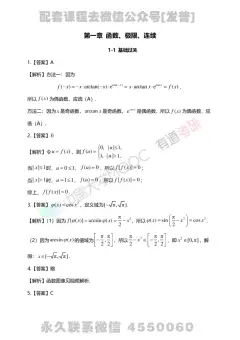
第一章 函数、极限、连续
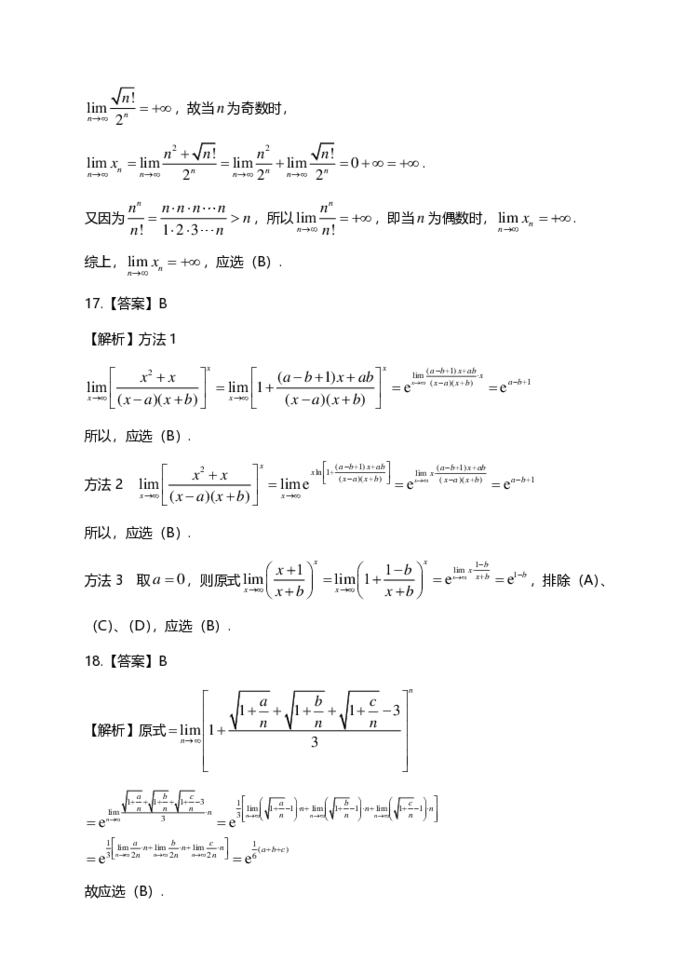
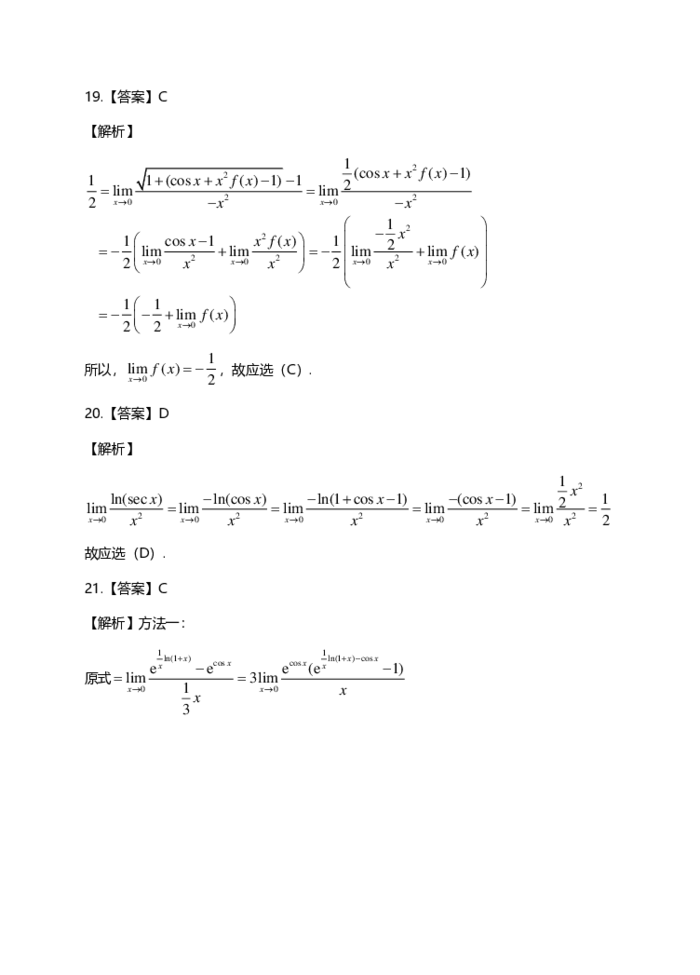
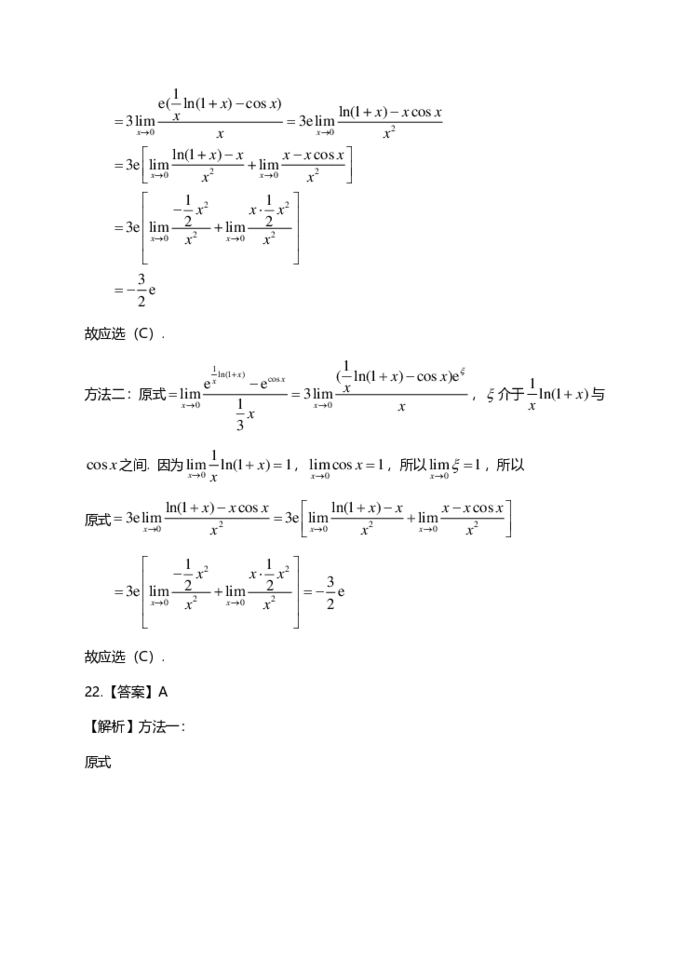
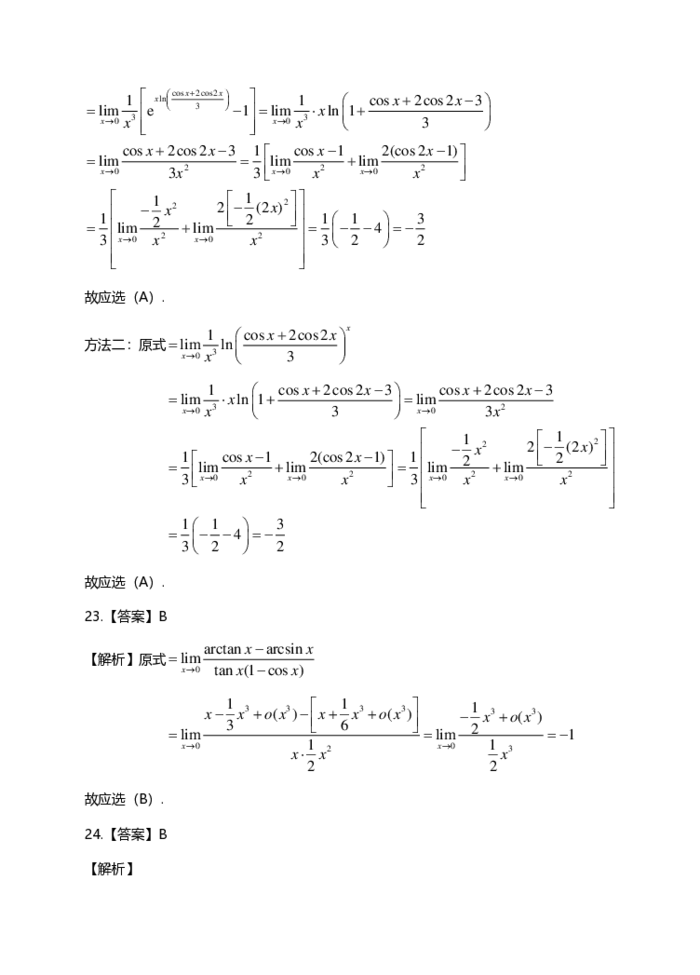
1-1 基础过关
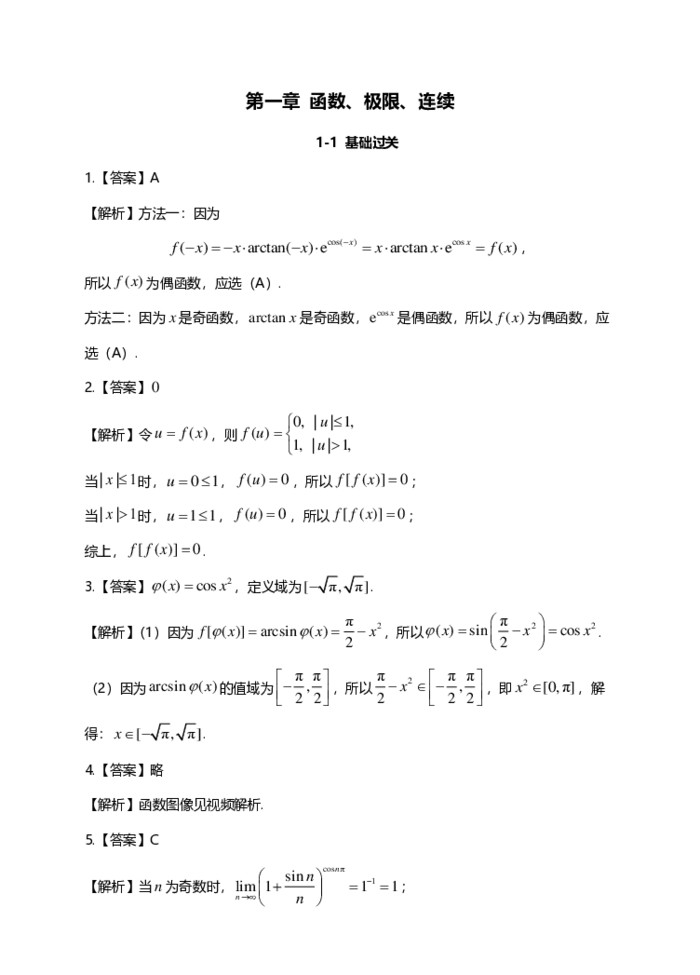
1.【答案】A
【解析】方法一:因为
cos(
)
cos
(
)
arctan(
) e
arctan
e
( )
x
x
f
x
x
x
x
x
f x
,
所以
( )
f x 为偶函数,应选(A).
方法二:因为x 是奇函数,arctan x 是奇函数,
cos
e
x 是偶函数,所以
( )
f x 为偶函数,应
选(A).
2.【答案】0
【解析】令
( )
u
f x
,则
0, |
| 1,
( )
1, |
| 1,
u
f u
u
当|
| 1
x 时,
0
1
u
,
( )
0
f u
,所以[ ( )]
0
f f x
;
当|
| 1
x 时,
1 1
u ,
( )
0
f u
,所以[ ( )]
0
f f x
;
综上,[ ( )]
0
f f x
.
3.【答案】
2
( )
cos
x
x
,定义域为[
π,
π]
.
【解析】(1)因为
2
π
[ ( )]
arcsin ( )
2
f
x
x
x
,所以
2
2
π
( )
sin
cos
2
x
x
x
.
(2)因为arcsin
( )
x
的值域为
π π
,
2 2
,所以
2
π
π π
,
2
2 2
x
,即
2
[0,π]
x
,解
得:
[
π,
π]
x
.
4.【答案】略
【解析】函数图像见视频解析.
5.【答案】C
【解析】当n 为奇数时,
cos π
1
sin
lim 1
1
1
n
n
n
n
;
当n 为偶数时,
cos π
1
sin
lim 1
1
1
n
n
n
n
;
故
cos
sin
lim 1
1
n
n
n
n
,应选(C).
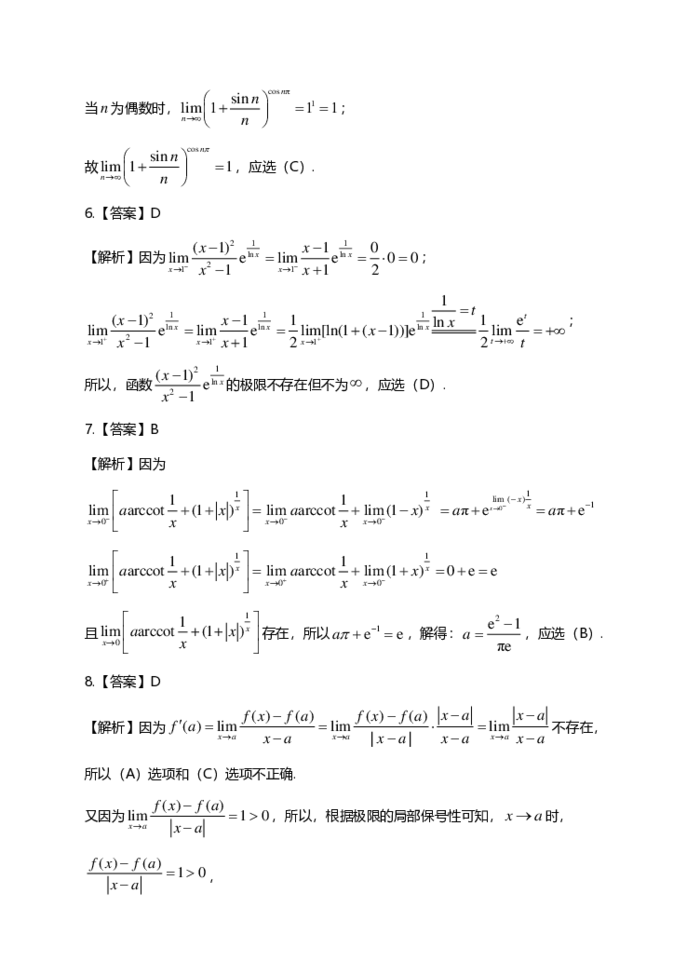
6.【答案】D
【解析】因为
1
1
2
ln
ln
2
1
1
(
1)
1
0
lim
e
lim
e
0
0
1
1
2
x
x
x
x
x
x
x
x
;
1
1
1
2
ln
ln
ln
2
1
1
1
1
(
1)
1
1
1
e
ln
lim
e
lim
e
lim[ln(1 (
1))]e
lim
1
1
2
2
t
x
x
x
t
x
x
x
t
x
x
x
x
x
x
t
;
所以,函数
1
2
ln
2
(
1) e
1
x
x
x
的极限不存在但不为,应选(D).
7.【答案】B
【解析】因为
0
1
1
1
lim (
)
1
0
0
0
1
1
lim
arccot
(1
)
lim arccot
lim(1
)
π
e
π
e
x
x x
x
x
x
x
x
a
x
a
x
a
a
x
x
1
1
0
0
0
1
1
lim
arccot
(1
)
lim arccot
lim(1
)
0
e
e
x
x
x
x
x
a
x
a
x
x
x
且
1
0
1
lim
arccot
(1
) x
x
a
x
x
存在,所以
1
e
e
a
,解得:
2e
1
πe
a
,应选(B).
8.【答案】D
【解析】因为
( )
( )
( )
( )
( )
lim
lim
lim
|
|
x
a
x
a
x
a
x
a
x
a
f x
f a
f x
f a
f
a
x
a
x
a
x
a
x
a
不存在,
所以(A)选项和(C)选项不正确.
又因为
( )
( )
lim
1
0
x
a
f x
f a
x
a
,所以,根据极限的局部保号性可知,x
a
时,
( )
( )
1
0
f x
f a
x
a
,
所以,x
a
时,
( )
( )
0
f x
f a
,即
( )
f x 在x
a
处取得极小值,故应选(D).
9.【答案】B
【解析】因为
2
2
2
2
2
2
2
1 (
1)
1
2
1
2
2
1
2
1
1
1
1
n n
n
n
n
n
n
n
n
n
n
n
2
2
2
2
2
2
2
1 (
1)
1
2
1
2
2
1
2
n n
n
n
n
n
n
n
n
n
n
n
n
n
n
n
,
且
2
1 (
1)
1
2
lim
1
2
n
n n
n
,
2
1 (
1)
1
2
lim
2
n
n n
n
n
,所以,由夹逼准则可知:
2
2
2
1
2
1
lim
1
2
2
n
n
n
n
n
n
,故应选(B).
10.【答案】B
【解析】因为
1
x
x
x
,所以
x
x
介于
1
x
x
和x
x 之间. 又因为
1
lim
1
x
x
x
,lim
1
x
x
x
,所以,由夹逼准则可知,
lim
1
x
x
x
,应选(B).
11.【答案】A
【解析】因为
!
!
(
1)
2 1
1
0
(
)
n
n
n
n
n
n
n
n
n n
n n
n
,且
1
lim
0
n
n
,所以,根据夹逼
准则可知
!
lim
0
(
)
n
n
n
n
,故应选(A).
12.【答案】C
【解析】因为lim
n
n
x
a
对任意给定的
0
0
,总存在正整数N ,当n
N
时,恒有
0
nx
a
,即
2
2
0
(
)
nx
a
,对任意给定的
0
,总存在正整数N ,当
n
N
时,恒有
2
(
)
nx
a
,所以,两者是充分必要条件,故应选(C).
13.【答案】B
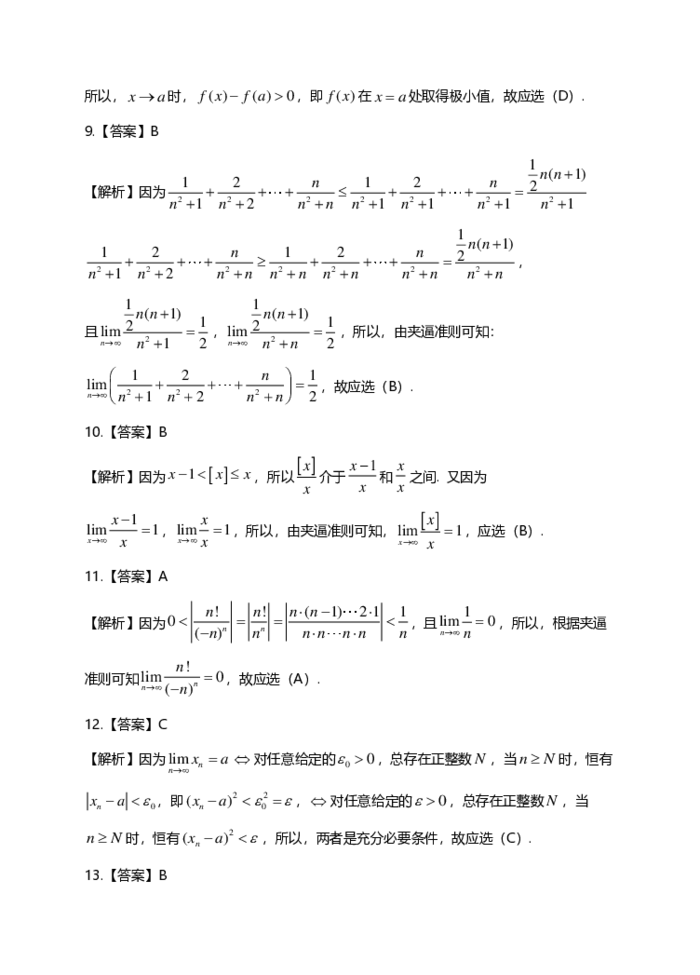
【解析】①若lim
n
n
x
a
,则n 充分大时,
nx
的所有项都无限接近a ,但不一定偶数项
无限接近a ,奇数项无限接近a
,故①不正确,例如:
nx
a
.
②若n 充分大时,
nx 的偶数项无限接近a ,奇数项无限接近a
,则
nx
的所有项都无限
接近a ,即lim
n
n
x
a
,故②正确.
③若n 充分大时,sin
nx 无限接近0 ,则
nx 不一定无限接近0 ,可能无限接近
π,
k
k Z ,甚至可能
nx 的有些项接近0 ,有些项接近π ,从而lim
n
n
x
不存在,故③不正
确.
④若lim
0
n
n
x
,则根据复合函数极限运算法则可知,
0
limsin
limsin
0
n
n
u
x
u
,故④正
确.
综上,应选(B).
14.【答案】D
【解析】因为当
0
x
时,
2
2
2
cos (1 cos
)
cos sin
1
sin
( )
~
x
x
x
x
x
x
x
x
x
x
,所以
( ) ~
x
x
,故应选(D).
15.【答案】D
【解析】根据“抓大头”和洛必达法则可知,
( )
ln(1 e )
e
lim
lim
lim
1
1 e
x
x
x
x
x
x
f x
x
x
,
所以,当x 充分大时
( )
f x 等价于x (可以看作等价无穷大),而( )
g x 为对数函数,( )
h x
为指数函数,根据三类函数的变化速度,应有( )
( )
( )
h x
f x
g x
,故应选(D).
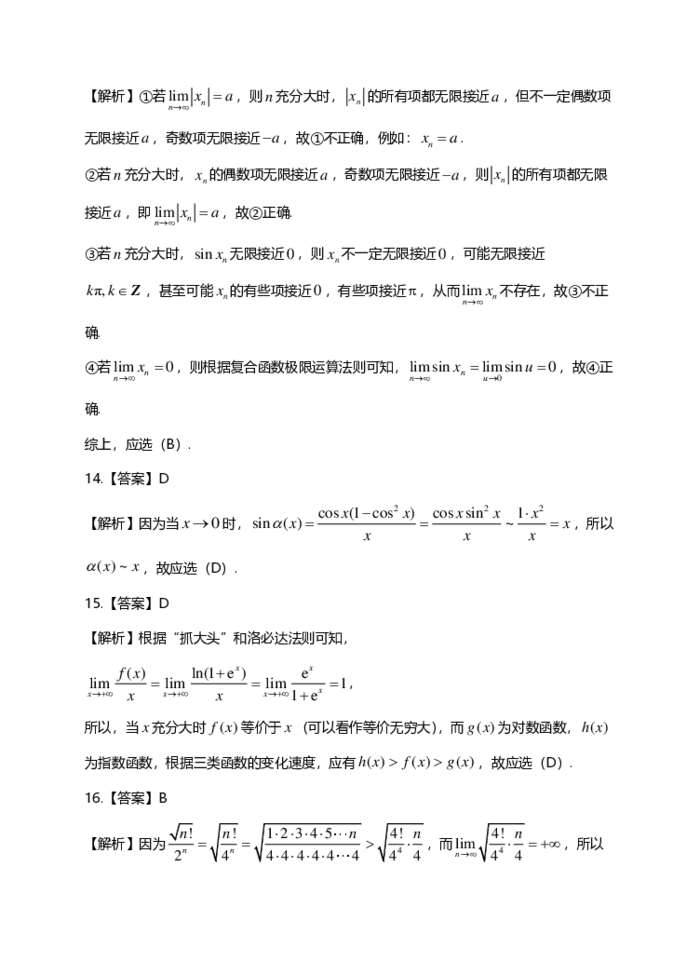
16.【答案】B
【解析】因为
4
!
!
1 2 3 4 5
4!
2
4
4 4 4 4 4
4
4
4
n
n
n
n
n
n
,而
4
4!
lim
4
4
n
n
,所以
!
lim 2n
n
n
,故当n 为奇数时,
2
2
!
!
lim
lim
lim
lim
0
2
2
2
n
n
n
n
n
n
n
n
n
n
n
n
x
.
又因为
!
1 2 3
n
n
n n n
n
n
n
n
,所以lim
!
n
n
n
n
,即当n 为偶数时,lim
n
n
x
.
综上,lim
n
n
x
,应选(B).
17.【答案】B
【解析】方法1
(
1)
2
lim
1
(
)(
)
(
1)
lim
lim 1
e
e
(
)(
)
(
)(
)
x
x
x
a b
x ab x
a b
x a
x b
x
x
x
x
a
b
x
ab
x
a x
b
x
a x
b
所以,应选(B).
方法2
(
1)
(
1)
2
ln 1
lim
(
)(
)
1
(
)(
)
lim
lime
e
e
(
)(
)
x
x
a b
x ab
a b
x ab
x
x
x a
x b
a b
x a
x b
x
x
x
x
x
a x
b
所以,应选(B).
方法3 取
0
a
,则原式
1
lim
1
1
1
lim
lim 1
e
e
x
x
x
b
x
b
x b
x
x
x
b
x
b
x
b
,排除(A)、
(C)、(D),应选(B).
18.【答案】B
【解析】原式
1
1
1
3
lim 1
3
n
n
a
b
c
n
n
n
1
1
1
3
1 lim
1
1
lim
1
1
lim
1
1
lim
3
3
1
1
lim
lim
lim
(
)
3
2
2
2
6
e
e
e
e
n
n
n
n
n
n
n
a
b
c
a
b
c
n
n
n
n
n
n
n
n
n
n
a
b
c
n
n
n
a b c
n
n
n
故应选(B).
19.【答案】C
【解析】
2
2
2
2
0
0
2
2
2
2
2
0
0
0
0
0
1 (cos
( ) 1)
1
(cos
( ) 1)
1
1
2
lim
lim
2
1
1
cos
1
( )
1
2
lim
lim
lim
lim
( )
2
2
1
1
lim
( )
2
2
x
x
x
x
x
x
x
x
x f x
x
x f x
x
x
x
x
x f x
f x
x
x
x
f x
所以,
0
1
lim
( )
2
x
f x
,故应选(C).
20.【答案】D
【解析】
2
2
2
2
2
2
0
0
0
0
0
1
ln(sec )
ln(cos )
ln(1 cos
1)
(cos
1)
1
2
lim
lim
lim
lim
lim
2
x
x
x
x
x
x
x
x
x
x
x
x
x
x
x
故应选(D).
21.【答案】C
【解析】方法一:
原式
1
1
ln(1
)
ln(1
) cos
cos
cos
0
0
e
e
e
(e
1)
lim
3lim
1
3
x
x
x
x
x
x
x
x
x
x
x
2
0
0
2
2
0
0
2
2
2
2
0
0
1
e(
ln(1
)
cos )
ln(1
)
cos
3lim
3elim
ln(1
)
cos
3e lim
lim
1
1
2
2
3e lim
lim
3 e
2
x
x
x
x
x
x
x
x
x
x
x
x
x
x
x
x
x
x
x
x
x
x
x
x
x
x
故应选(C).
方法二:原式
1 ln(1
)
cos
0
0
1
(
ln(1
)
cos )e
e
e
lim
3lim
1
3
x
x
x
x
x
x
x
x
x
x
,介于1 ln(1
)
x
x
与
cos x 之间. 因为
0
1
lim
ln(1
)
1
x
x
x
,
0
limcos
1
x
x
,所以
0
lim
1
x
,所以
原式
2
2
2
0
0
0
ln(1
)
cos
ln(1
)
cos
3elim
3e lim
lim
x
x
x
x
x
x
x
x
x
x
x
x
x
x
2
2
2
2
0
0
1
1
3
2
2
3e lim
lim
e
2
x
x
x
x
x
x
x
故应选(C).
22.【答案】A
【解析】方法一:
原式
cos
2cos2
ln
3
3
3
0
0
2
2
2
0
0
0
2
2
2
2
0
0
1
1
cos
2cos2
3
lim
e
1
lim
ln 1
3
cos
2cos2
3
1
cos
1
2(cos2
1)
lim
lim
lim
3
3
1
1
2
(2 )
1
1
1
2
2
lim
lim
3
3
x
x
x
x
x
x
x
x
x
x
x
x
x
x
x
x
x
x
x
x
x
x
x
x
x
x
3
4
2
2
故应选(A).
方法二:原式
3
0
1
cos
2cos2
lim
ln
3
x
x
x
x
x
3
2
0
0
2
2
2
2
2
2
0
0
0
0
1
cos
2cos2
3
cos
2cos2
3
lim
ln 1
lim
3
3
1
1
2
(2 )
1
cos
1
2(cos2
1)
1
2
2
lim
lim
lim
lim
3
3
1
1
3
4
3
2
2
x
x
x
x
x
x
x
x
x
x
x
x
x
x
x
x
x
x
x
x
x
故应选(A).
23.【答案】B
【解析】原式
0
arctan
arcsin
lim
tan (1 cos )
x
x
x
x
x
3
3
3
3
3
3
0
0
2
3
1
1
1
(
)
(
)
(
)
3
6
2
lim
lim
1
1
1
2
2
x
x
x
x
o x
x
x
o x
x
o x
x
x
x
故应选(B).
24.【答案】B
【解析】
原式
2
4
0
1
ln(1
e )
2
lim
x
x
x
x
x
x
2
2
2
2
2
2
2
2
0
0
0
2
2
2
0
0
1
1
e
( e )
(
)
e
(
)
1
1
(1 e )
2
2
lim
lim
lim
2
2
1
1
1
1
1
lim
lim
e
1
2
2
2
2
4
x
x
x
x
x
x
x
x
x
x
x
x
x
o x
x
o x
x
x
x
x
x
x
故应选(B).
25.【答案】B
【解析】原式
1
1
1
lim
cos
lim
cos
lim
cos
1
2
x
x
x
ax
x
b
x a
b
x
x
x
所以,
1
lim
cos
1
1
0
x
a
a
x
,所以
1
a . 从而,原式
2
1
lim
2
2
x
x
b
b
x
,故应选(B).
26.【答案】C
【解析】因为
0
limarcsin
( cos
1)
0
x
x
b
x
,所以
0
lim e
1
1
0
x
x
a
a
,即
1
a .
所以,原式
0
lim
( cos
1)
1
5
x
x b
x
b
x
,即
6
b
,故应选(C).
27.【答案】D
【解析】原式
2
2
4
| 2 |
2
lim
lim
lim
3
|
|
x
x
x
x
x
x
x
x
x
x
x
x
,故选(D).
28.【答案】D
【解析】原式
0
0
1
e
lim
lim e
ln(1
)
x
x
x
x
a
x
x
2
2
2
0
0
2
2
2
0
1
(
)
[1
( )]
ln(1
)
e
2
lim
lim
ln(1
)
3
(
)
3
2
lim
1
2
x
x
x
x
x
x
o x
x
x
o x
x
x
a
a
x
x
x
x
o x
a
a
x
所以,
5
2
a
,故应选(D).
29.【答案】A
【解析】
2
2
2
2
1 (
1
)
1
2
2
1
2
n n
n
n
n
n
n
n
n
n
n
n
n
n
n
n
n
n
2
2
2
2
1 (
1
)
1
2
2
1
2
1
n n
n
n
n
n
n
n
n
n
n
n
n
n
n
n
n
而
2
1 (
1
)
3
2
lim
2
n
n n
n
n
n
n
n
,
2
1 (
1
)
3
2
lim
1
2
n
n n
n
n
n
n
,故原式
3
2
. 答案选(A).
30.【答案】D
【解析】采用“抓大头”的思想(只看大头,其余部分直接忽略即可),首先判断1,2,
x 的大小关系,显然2
1
,所以只需要判断2,x 的大小关系,下面分类进行讨论:
当
2
x
时,原式
lim 1
2
=lim
n
n
n
n
n
n
n
x
x
x
;
当0
2
x
时,原式
lim 1
2
=lim
2
2
n
n
n
n
n
n
n
x
;
综上所述,
2,0
2
lim 1 2
=
,
2
n
n
n
n
x
x
x x
. 答案选(D).
31.【答案】C
【解析】采用“抓大头”的思想,首先判断x ,sin x ,tan x 的大小关系. 当
π
0, 2
x
时,先判断x ,sin x 的大小,可以构造函数
( )
sin
f x
x
x
,
( )
1 cos
0
f
x
x
在
π
0, 2
上恒成立,所以
( )
f x 在
π
0, 2
上单调递增,故
( )
(0)
0
f x
f
,即
sin
x
x
;
同理可构造函数得到tan x
x
,综上,x ,sin x ,tan x 的大小关系为sin
tan
x
x
x
.
故lim
sin
tan
lim
tan
tan
n
n
n
n
n
n
n
n
x
x
x
x
x
,答案选(C).
32.【答案】D
【解析】采用“抓大头”的思想,首先判断(
)n
a
,(
)n
b
的绝对值的大小关系,由于
0
a
b
,故(
)
(
)
n
n
b
a
,故
2
2
2
lim (
)
(
)
lim (
)
n
n
n
n
n
n
n
a
b
b
b
,故答案
选(D).
33.【答案】D
【解析】采用“抓大头”的思想,首先判断1,x ,
1
ex的大小关系.
当0
1
x
时,
1
1 1
e
e
1
x
,此时1为三者中的最大值,所以原式
1
;
当
1
x 时,令
1
( )
ex
f x
x
,
1
( )
e
1
0
x
f
x
,所以
( )
f x 在[1,
)
上单调递增,
所以
( )
(1)
0
f x
f
,即
1
ex
x
,故此时
1
ex为三者中的最大值,所以原式
1
ex
.
即
1
1
1, 0
1
lim 1
(e
)
e
,
1
n
n
x
n
x
n
x
x
x
,所以答案选(D).
34.【答案】lim
1
n
n
x
【解析】先证有界性:易知
0
nx
,
3
1
2
2
2
1
1
1
1
1
1
2
3
1
3
3
3
n
n
n
n
n
n
n
n
n
x
x
x
x
x
x
x
x
x
(均值不等式),同理有
3
1
1
1
1
1
2
2
2
1
1
1
1
1
1
1
1
1
2
3
1
3
3
3
n
n
n
n
n
n
n
n
n
x
x
x
x
x
x
x
x
x
所以数列{ }
nx
有下界,其下界为1.
接下来证明单调性:
3
1
2
2
2
1
1
1
1
2
0
3
3
3
3
n
n
n
n
n
n
n
n
n
x
x
x
x
x
x
x
x
x
,所以数列
{ }
nx
单调递减.
即数列{ }
nx
单调递减且有下界,故由单调有界准则,数列{ }
nx
收敛,设lim
n
n
x
a
.
对
1
2
1
1
2
3
n
n
n
x
x
x
两边同时取极限,即
2
1
1
2
3
a
a
a
,解得
1
a . 即lim
1
n
n
x
.
35.【答案】D
【解析】(A)选项
2
x 为2 阶;(B)选项
2
1
1 cos
~ 2
x
x
为2 阶;(C)选项
2
2
1
1
1~
2
x
x
;
(D)选项
3
1
tan
~
3
x
x
x
为3 阶. 故答案选(D).
36.【答案】D
【解析】
3
2
4
4
4
4
4
4
4
( 1
2 arcsin
cos2 )( 1
2 arcsin
cos2 )
( )
1
2 arcsin
cos2
1
1
1
1
2
1
(2 )
(2 )
(
)
1
2 arcsin
cos2
6
2
24
2
2
1
2
(
)
1
3
3
(
)
2
2
x
x
x
x
x
x
x
x
x
x
x x
x
x
x
o x
x
x
x
x
x
o x
x
o x
故
1 ,
4
2
c
k
,答案选(D).
37.【答案】B
【解析】
3
3
3
3
3
3
1
1
2sin
sin 2
2
(
)
2
8
(
)
(
)
6
6
x
x
x
x
o x
x
x
o x
x
o x
3
ln(1
)
2
[(1
)
1]
e
1~
ln(1
) ~
x
x
x
x
x
x
x
;由题意3
3
2
n
,所以整数n 的取值
为2 ,故答案选(B).
38.【答案】B
【解析】由于
2
2
0
0
ln(
1
)
1
lim
lim
1
1
x
x
x
x
x
x
洛
,所以当
0
x
时,
2
ln (
1
) ~
x
x
x
;
2
2
2
2
2
1
1
3
cos
cos2
1
1
4
(
)
(
)
2
2
2
x
x
x
x
o x
x
o x
,故
1
(cos
cos2 )
x
x
同
阶于
2
x;
由题意得
1
,2
1
,所以
(1,2)
,故答案选(B).
39.【答案】B
【解析】
3
5
3
6
1
(e
1) ~
x
x
x
x
x
;
1
1
ln(1 3 )
ln(1 2 )
3
3
2
2
1
1
1
ln(1 3 )
ln(1 2 )
ln(1 2 )
3
2
2
2
2
2
2
2
2
1 3
1
2
e
e
e
e
1
1
1
1
1
1
1
~
ln(1 3 )
ln(1
2 )
3
9
2
4
(
)
3
2
3
2
2
2
1
1
(
) ~
2
2
x
x
x
x
x
x
x
x
x
x
x
x
x
o x
x
o x
x
2
3
2sin
1
cos
1 cos
2
csc
cot
sin
sin
sin
2sin
cos
2
2
tan
~
2
2
x
x
x
x
x
x
x
x
x
x
x
x
综上所述,无穷小量按照从低阶到高阶的排序为
1
3
2
,
,
,答案选(B).
40.【答案】C
【解析】
2
2
2
2
2
1
ln 1
1
1
1
1
ln 1
2
2
1
1
e
1
1
1
lim
lim
lime
lime
e
1
e
e
n
n
n
n
bn
n
bn
n
n
n
bn
bn
n
n
n
n
n
a
a
a
a
a
故
1
2
e
a
,
1
b . 故答案选(C).
41.【答案】B
【解析】由
( )
f x 在
0
x
处连续,故
( )
f x 在
0
x
处左右极限相等,并等于
(0)
f
;
0
0
π
lim
( )
lim arccot
2
x
x
f x
b
x
b
,
2
2
0
0
0
0
1
1
cos
1 cos
1
2
lim
( )
lim
lim
lim
ln(1
)
2
ln(1
)
2
4
x
x
x
x
x
x
x
f x
ax
x
ax
x
ax
a
,
即π
1
1
2
4
2π
b
ab
a
,故答案选(B).
42.【答案】
2
2
ln 2
【解析】由
( )
f x 在
0
x
处连续,故
( )
f x 在
0
x
处极限等于
(0)
f
;
ln2
0
0
0
0
sin 2
2
1
sin 2
e
1
lim
( )
lim
lim
lim
2
ln 2
(0)
2
ax
ax
x
x
x
x
x
x
f x
a
f
a
x
x
x
解得
2
2
ln 2
a
.
43.【答案】1
【解析】由于c 的正负不定,故此处需要对c 进行讨论:
(1)当
0
c
时,此时
2
( )
f x
x
x
,显然
( )
f x 在
0
x
不连续,不满足题意;
(2)当
0
c
时,此时
2,
0,
( )
2
,
0
x
f x
x x
x
,
0
0
2
lim
( )
lim
x
x
f x
x
x
不存在,不满足
题意;
(3)当
0
c
时,由于
( )
f x 连续,且
( )
f x 为偶函数,所以只需要关注当
0
x
的情况即
可. 当
0
x
时,
2
1,
,
( )
2
,
x
x
c
f x
x x
c
x
,可得
( )
f x 在x
c
处左右极限相等,即
lim
( )
lim(2
1)
2
1
x
c
x
c
x
c
f x
,
2
2
lim
( )
lim
x
c
x
c
f x
x
c
x
c
,
由
2
2
1
c
c
c
,观察得到一个解
1
c ,接下来证明此方程有唯一解:
令
2
( )
2
1
x
g x
x
x
,
2
2
( )
2 ln 2
1
x
g x
x
,当
(0,1)
x
时,
2
2
2
2
2
( )
2 ln 2
1
1
1
1
0
1
x
g x
x
x
,当
[1,
)
x
时,
2
2
( )
2 ln 2
1
2 ln 2 1
2ln 2 1
ln 4
ln e
0
x
x
g x
x
,综上( )
g x 在(0,
)
上
单调递增,即方程
2
2
1
c
c
c
有唯一解
1
c .
44.【答案】A
【解析】先找可能的间断点:
1
x
(分母为0 的点),
0
x
(指数函数底数大于0);
下面逐一分析间断点类型:
(1)
1
x
ln
1
1
1
1
1
1
1
1
e
1
ln
1
lim
( )
lim
lim
lim
lim
lim
1
1
1
1
1
1
x
x
x
x
x
x
x
x
x
x
x
x
x
x
x
f x
x
x
x
x
x
ln
1
1
1
1
1
1
1
1
e
1
ln
1
lim
( )
lim
lim
lim
lim
lim
1
1
1
1
1
1
x
x
x
x
x
x
x
x
x
x
x
x
x
x
x
f x
x
x
x
x
x
左右极限均存在,但不相等,所以
1
x
为跳跃间断点.
(2)
0
x
ln
0
0
0
0
0
1
1
lim
( )
lim
lim
lim e
1
lim
ln
0
1
1
x
x
x
x
x
x
x
x
x
x
x
f x
x
x
x
ln
0
0
0
0
0
1
1
lim
( )
lim
lim
lim e
1
lim
ln
0
1
1
x
x
x
x
x
x
x
x
x
x
x
f x
x
x
x
左右极限均存在,且相等,所以
0
x
为可去间断点.
1个可去间断点,1个跳跃间断点,故答案选(A).
45.【答案】C
【解析】先找可能的间断点:
1
x ,
0
x
,
1
x
,
3
x
(分母为0 的点);
2
x
(对数函数定义域). 下面逐一分析间断点类型:
(1)
1
x
1
1
1
1
1
1
1
1
1
1
1
e
ln |1
|
e
ln |1
|
lim
( )
lim
lim
(e
1)ln |
2 |
(e
1)ln3
1
ln
1
1
1
lim e ln
lim
(e
1)ln3
(e
1)ln3
e
1
1
lim
0
(e
1)ln3
e
x
x
x
x
x
x
t
t
t
t
t
t
x
x
f x
x
t
t
x
t
t
洛
1
1
1
1
1
1
1
1
1
e
ln |1
|
e
ln |1
|
lim
( )
lim
lim
(e
1)ln |
2 |
(e
1)ln3
1
1
1
lim e ln
(e
1)ln3
x
x
x
x
x
x
t
t
x
x
f x
x
t
x
t
右极限不存在,故
1
x 为第二类间断点.
(2)
0
x
1
1
0
0
0
0
e
ln |1
|
eln |1
|
eln(1
)
e
lim
( )
lim
lim
=lim
(e
1)ln |
2|
(e
1)ln 2
(e
1)ln 2
ln 2
x
x
x
x
x
x
x
x
x
x
x
f x
x
左右极限均存在且相等,故
0
x
为可去间断点.
(3)
1
x
1
1
1
1
2
2
1
1
1
1
e
ln |1
|
e ln 2
e ln 2
1
lim
( )
lim
lim
lim
(e
1)ln |
2|
(e 1)ln(2
)
(e 1)
ln(2
)
x
x
x
x
x
x
x
f x
x
x
x
左右极限均不存在,故
1
x 为第二类间断点.
(4)
3
x
1
1
1
1
4
4
3
3
3
3
3
3
e
ln |1
|
2e ln 2
2e ln 2
1
lim
( )
lim
lim
lim
(e
1)ln |
2|
(e
1)ln(
2)
(e
1)
ln(
2)
x
x
x
x
x
x
x
f x
x
x
x
左右极限均不存在,故
3
x
为第二类间断点.
(5)
2
x
1
1
1
1
3
3
2
2
2
2
2
2
e
ln |1
|
e ln3
e ln3
1
lim
( )
lim
lim
lim
0
(e
1)ln |
2|
(e
1)ln |
2|
(e
1)
ln |
2|
x
x
x
x
x
x
x
f x
x
x
x
左右极限均存在且相等,故
2
x
为可去间断点.
综上所述,
( )
f x 有3个第二类间断点,答案选(C).
46.【答案】
1
3
e
【解析】由函数连续性定义,
0
lim
( )
(0)
x
f x
f
,即
2
2
2
0
2
2
0
0
ln
lim
ln
arctan
arctan
0
0
arctan
1
lim
1
lim
arctan
arctan
3
lim
lime
= e
arctan
e
= e
e .
x
x
x
x
x
x
x
x
x
x
x
x
x
x
x
x
x
x
x
x
a
x
47.【答案】
0
x
为
( )
f x 的无穷间断点;
1
x
为
( )
f x 的第二类间断点;
1
x 为
( )
f x 的可去间断点
【解析】先找可能的间断点:
0
x
,
1
x
,
1
x (令分母为0的点).
下面逐一分析间断点类型:
(1)
0
x
2
1
1
0
0
0
1
1
(
1)sin
cos
sin1cos1
1
1
lim
( )
lim
lim
(
1)ln(e
1)
ln(e
1)
x
x
x
x
x
x
x
x
f x
x
左极限不存在,故
0
x
为第二类间断点.
(2)
1
x
2
1
1
1
1
1
1
1
(
1)sin
cos
1
1
lim
( )
lim
(
1)ln(e
1)
1
1
1
2sin
cos
2sin
1
2
1
2
lim
limcos
ln(e 1)
ln(e 1)
1
x
x
x
x
x
x
x
x
f x
x
x
x
左右极限均不存在,故
1
x 为第二类间断点.
(3)
1
x
2
1
1
1
1
1
1
1
1
1
(
1)sin
cos
1
1
lim
( )
lim
(
1)ln(e
1)
1
1
1
(
1)cos
sin
cos
1
2
1
2
lim
lim(
1)sin
0
ln(e
1)
ln(e
1)
1
x
x
x
x
x
x
x
x
f x
x
x
x
x
x
左右极限均存在,且相等,故
1
x 为可去间断点.
48.【答案】D
【解析】先找可能的间断点:由于当x 取整数时,均可使分式分母为0,所以所有的整数
均为可能的间断点,但注意到当
2,
, ,
x
时分式分子为0,故这四个点比较特殊,
需要单独讨论.
(1)
2
x
2
2
2
2
2
2
2
2
(
1)ln |1
|
3ln |1
|
3ln |1
|
lim
( )
lim
lim
lim
sin π
sin(2π
π )
sin π(2
)
3ln |1
|
3
ln |1 (
2) |
3
2
3
lim
lim
lim
π(2
)
π
(2
)
π
(2
)
π
x
x
x
x
x
x
x
x
x
x
x
f x
x
x
x
x
x
x
x
x
x
左右极限均存在,且相等,故
2
x 为可去间断点.
(2)x
2
2
1
1
1
1
1
1
(
1)ln |1
|
(
1)ln |1
|
(
1)(
1)ln |1
|
lim
( )
lim
lim
lim
sin π
sin(π
π )
sin π(1
)
(
1)(
1)ln |1
|
2
lim
lim ln |1
|
π(1
)
π
x
x
x
x
x
x
x
x
x
x
x
x
x
f x
x
x
x
x
x
x
x
x
左右极限不存在,故x 为第二类间断点.
(3)
0
x
2
0
0
0
0
(
1)ln |1
|
ln |1
|
1
lim
( )
lim
lim
lim
sin π
sin π
π
π
x
x
x
x
x
x
x
x
f x
x
x
x
左右极限均存在,且相等,故
0
x
为可去间断点.
(4)
1
x
2
1
1
1
1
(
1)ln 2
(
1)(
1)ln 2
(
1)(
1)ln 2
2ln 2
lim
( )
lim
lim
lim
sin π
sin(π
π )
π(1
)
π
x
x
x
x
x
x
x
x
x
f x
x
x
x
左右极限均存在,且相等,故
1
x
为可去间断点.
(5)x
k
,其中k
Z
且
{ 2, 1,0,1}
k
2
2
2
(
1)ln |1
|
(
1)ln |1
|
lim
( )
lim
lim
sin π
sin π
1
(
1)ln |1
| lim sin π
x
k
x
k
x
k
x
k
x
x
k
k
f x
x
x
k
k
x
左右极限不存在,故为第二类间断点.
综上所述,可去间断点有3个,分别为
2
x ,
0
x
和
1
x
,答案选(D).
49.【答案】
1,
0
a
b
【解析】先写出极限函数
( )
f x 的表达式.
(1)当
1
x 时,
2
1
2
( )
lim
lim
1
1
n
n
n
n
x
ax
b
ax
b
f x
ax
b
x
(2)当
1
x 时,
2
1
2
1
( )
lim
1
2
n
n
n
x
ax
b
a
b
f x
x
(3)当
1
x 时,
2
1
2
1
( )
lim
1
2
n
n
n
x
ax
b
a
b
f x
x
(3)当
1
x
时,
2
1
2
1
2
2
1
( )
lim
lim
1
n
n
n
n
n
n
x
ax
b
x
f x
x
x
x
故
2
1
2
,
1
1
,
1
2
( )
lim
1
1
,
1
2
1 ,
1
n
n
n
ax
b
x
a
b
x
x
ax
b
f x
a
b
x
x
x
x
由于分段函数
( )
f x 连续,故其在分段点
1
x 处左右极限相等,且等于对应的函数值.
先考虑
1
x 处的连续性:
2
1
1
1
(
1)ln 2
1
lim
( )
lim
lim
1
sin π
x
x
x
x
f x
x
x
,
1
1
lim
( )
lim (
)
x
x
f x
ax
b
b
a
可得
1
b
a
①
再考虑
1
x 处的连续性:
1
1
lim
( )
lim(
)
x
x
f x
ax
b
a
b
,
1
1
1
lim
( )
lim
1
x
x
f x
x
可得
1
a
b
②
联立①②解得
1,
0
a
b
.
50.【答案】提示:零点定理
【证明】由所证明的结论,可构造函数( )
( )
g x
f x
x
,可知
1
1
1
1
0
2
2
2
2
g
f
,(1)
(1) 1
1
0
g
f
由零点定理可知,存在
1 ,1
2
,使( )
( )
0
g
f
,即
( )
f
.
1-2 基础真题
1.【答案】( )
ln(1
)
x
x
,
0
x
.
【解析】由
2
( )
( ( ))
e
1
x
f
x
x
,得( )
ln(1
)
x
x
. 又ln(1
)
0
x
得,
1
1
x
,即
0
x
,所以( )
ln(1
),
0
x
x
x
.
2.【答案】D
【解析】
2
2
(
) ,
0,
(
)
(
)
,
0,
x
x
f
x
x
x
x
即
2
2
,
0,
(
)
,
0.
x
x
f
x
x
x x
,故选(D).
3.【答案】D
【解析】根据( )
g x 的定义知,复合函数
2
( ),
( )
0,
[ ( )]
( )
2,
( )
0.
f x
f x
g f x
f x
f x
而
0
x
时,
2
( )
0
f x
x
;
0
x
时,
( )
0
f x
x
. 故
2
2,
0,
[ ( )]
2
,
0.
x
x
g f x
x x
,
故答案选(D).
4.【答案】B
【解析】由于
( )
1
f x ,故
[ ( )]
1
f f x
,因而{ [ ( )]}
1
f
f f x
,故选(B).
5.【答案】错误
【解析】此处未说明函数可导,因此不可以直接判断导函数的正负. 另外,取
3
( )
f x
x
,其为严格单调增函数,但
(0)
0
f
,故错误.
6.【答案】D
【解析】由于
cos
cos
(
)
sin(
) e
sin
e
( )
x
x
f
x
x
x
x
x
f x
,所以为偶函数,故选
(D).
7.【答案】C
【解析】令
2
x
k
,其中k Z . 由于
(2
)
2
sin 2
0
f
k
k
k
,
2
2
2
2
f
k
k
(k 充分大),则
( )
f x 在(
,
)
内无界,但x 时,
( )
f x 不是无穷大,也没有极限,则应选(C).
8.【答案】D
【解析】
当
2
1
n
k
时,
2
2
1
(2
1)
2
1
1
lim
lim
lim 2
1
2
1
2
1
k
k
k
k
k
k
x
k
k
k
,
当
2
n
k
时,
2
1
lim
lim
0
2
k
k
k
x
k
,
所以当n 时,
nx 既不是无穷大量,也不是无穷小量,而是无界变量,故选项(D)
正确.
9.【答案】上述论断是错误的
【解析】取
( )
f x
x
,
1
( )
sin
g x
x
,则
0
lim
( )
0
x
f x
,
0
lim
( ) ( )
0
x
f x g x
,但是
0
lim ( )
x
g x
不存在,故错误.
10.【答案】D
【解析】取
1
nx
n
,
2
(
)
(
) sin
0
n
f x
n
n
,lim
(
)
0
n
n
f x
;
取
1
2
2
ny
n
,
2
2
(
)
2
sin 2
2
2
2
2
n
f y
n
n
n
,lim
(
)
n
n
f y
则当
0
x
时,
2
1
1
sin
x
x
是无界的,但不是无穷大.
11.【答案】D
【解析】方法一(直接法):由于
1 (
)
n
n
n
n
y
x y
x
,则
1
1
lim
lim
(
)
lim
lim
0
n
n
n
n
n
n
n
n
n
n
n
y
x y
x y
x
x
,选(D).
方法二(排除法):取
nx
n
,
0
ny
,
1,2,
n
,排除(A).
取
2
1,
2
1,
1,2,
0,
2 ,
n
k
n
k
x
k
n
k
;
0,
2
1,
1,2,
2 ,
2 ,
n
n
k
y
k
k
n
k
;排除
(B).
取
1,
2
1,
1,2,
0,
2 ,
n
n
k
x
k
n
k
;
0,
2
1,
1,2,
1,
2 ,
n
n
k
y
k
n
k
;排除(C).
12.【答案】D
【解析】假设lim
n
n
n
b c
Α
(存在),则
lim
lim
lim
lim
n
n
n
n
n
n
n
n
n
n
n
b c
b c
c
Α
b
b
(存在),这与
lim
n
n
c
矛盾,故lim
n
n
n
b c
不存在.
13.【答案】1
【解析】方法一:
2
2
2
2
4
2
lim
4
1
1
lim
si
lim
1
n
x
x
x
x
x
x
x
x
x
x
x
x
x
x
方法二:分子分母同时除以x ,转化成常数相除.
2
2
2
2
4
1
1
lim
s
1
1
1
4
1
2 1
lim
1
1
sin
1
in
x
x
x
x
x
x
x
x
x
x
x
x
14.【答案】2
【解析】
2
0
0
2
ln(1
)
lim
lim
2
1
1 cos
2
x
x
x
x
x
x
x
.
15.【答案】1
6
【解析】原式=
3
4
4
0
0
1 sin
sin
1
sin
1
6
lim
lim
6
6
x
x
x
x
x
x
x
.
16.【答案】
1
6
【解析】原式=
3
2
3
3
0
0
0
1
1
sin
sin
1
6
lim
ln 1
lim
lim
6
x
x
x
x
x
x
x
x
x
x
x
x
17.【答案】
1
4
【解析】方法一:
原式=
2
2
2
2
2
2
0
0
0
1
( 1
1
)
4
2( 1
1)
1
2
lim
lim
lim
4
4
2
4
x
x
x
x
x
x
x
x
x
x
方法二:利用泰勒公式
2
2
(
1)
(1
)
1
(
)
2!
x
x
x
o x
.
2
2
2
2
2
0
2
2
2
0
1
1
1
1
1
(
)
1
(
)
2
2
8
2
8
=lim
1
(
)
1
4
=lim
=
4
x
x
x
x
o x
x
x
o x
x
x
o x
x
原式
方法三:利用洛必达法则.
1
1
1
1
2
2
2
2
2
0
0
3
3
2
2
0
1
1
(1
)
(1
)
(1
)
(1
)
2
2
2
=lim
=lim
2
1
1
(1
)
(1
)
1
4
4
=lim
=
2
4
x
x
x
x
x
x
x
x
x
x
x
原式
18.【答案】
1
6
【解析】
原式=
3
3
3
3
3
3
0
0
0
0
lim
lim
lim
1
1
arctan
sin
1
1
1
3
lim 6
3
6
6
x
x
x
x
x
x
x
x
x
x
x
x
x
x
19.【答案】1
【解析】
1
1
4
0
0
0
1
4
4
2
e
sin
2
e
si
lim
n
e
= lim
lim
1
0 1 1
1 e
1 e
e
x
x
x
x
x
x
x
x
x
x
x
x
x
1
4
0
1
4
0
2
e
sin
2
2
= lim
1
2 1 1
1
1 e
e
sin
lim
1 e
x
x
x
x
x
x
x
x
x
x
=1
原式
20.
【答案】4
3
【解析】方法一:
2
2
2
2
2
2
2
4
4
0
0
0
3
4
0
sin
cos
4
sin
(2
sin 2 )(2
sin 2 )
lim
lim
lim
sin
4
4
1
2
2
( )
(2 )
4
6
lim
4
3
x
x
x
x
x
x
x
x
x
x
x
x
x
x
x
x
x
x
x
o x
x
x
原式
方法二:1
1
0
0
时,可通分变成整个分式;四则运算
2
2
2
2
2
2
2
3
0
0
0
4
4
0
0
0
2
2
2
2
lim
lim
lim
1
( )
(
sin )(
sin )
6
lim
lim
1
lim
1
1
4
1
3
3
1
1 sin
1
1
sin
sin
sin
sin
1
sin
x
x
x
x
x
x
x
x
x
x
x
x
x
x
x
x
x
o x
x
x x
x
x
x
x
x
x
原式
21.【答案】3
2
【解析】方法一:
0
0
0
0
0
0
2
0
1
1
1
e
lim
lim
lim
li
1
m
1 e
1 e
(1 e
)
1
e
e
lim
lim
1
1
lim
1
2
2
1
3
1
2
2
x
x
x
x
x
x
x
x
x
x
x
x
x
x
x
x
x
x
x
x
x
x
x
x
原式
方法二:1
1
0
0
时,可通分变成整个分式; 泰勒展开.
2
2
2
2
2
0
0
2
2
2
0
1
1 1
(
)
1
e
2
lim
lim
(1 e )
3
(
)
3
2
=lim
= 2
x
x
x
x
x
x
x
x
x
o x
x
x
x
x
x
o x
x
原式
22.【答案】
2
e a
【解析】方法一:”1”型极限计算:重要极限.
0
2
li
2
m
0
2
=
lim
e
e
1
x
x
ax
x a
x
a
a
x
a
原式
.
方法二:幂指函数指数化.
0
2
2
ln 1
lim
2
0
lime
e
e
x
a
ax
x
a
x a
x a
x
原式
.
23.【答案】
π
2
e
【解析】方法一:”1”型极限计算:重要极限.
0
0
1
lim (cos
1)
lim (
)
2
2
0
lim(1 cos
1
e
e
)
ex
x
x
x
x
x
x
x
x
原式
.
方法二:幂指函数指数化.
【解析2】
0
0
1
lim (cos
1)
lim (
)
ln(cos
)
2
2
0
lim
e
e
e
ex
x
x
x
x
x
x
x
x
原式
.
24.【答案】C
【解析】
2
2
(
1)
(1
)
=lim
=lim
1
1
1lim
1
0
1
x
x
x
x
ax x
a x
ax
b
b
x
x
x
a
b
b
x
原式
所以
1
b ,答案选(C).
25.【答案】2
【解析】
原式=
3
4
4
lim
lim
lim
2
3
3
n
n
n
n
n
n
n
n
n
n
n
n
n
n
n
n
n
n
n
.
26.【答案】
4e
【解析】方法一:
0
2
0
π
tan
2
1
1
π
2
4
lim tan
1
lim
4
π
sec
2
2
4
lim
4
1
π
2
li
π
2
li
m 1
tan
1
4
e
e
m tan
4
e
e
n
t
t
n
n
n
n
t
n
n
n
t
t
n
t
n
方法二:
π
2
lim
tan
1
4
π
2
lim tan
e
e
4
n
n
n
n
A
n
n
,
而
π
2
π
2
π
tan
1
tan
tan
π
2
4
4
4
lim
tan
1
lim
2lim
1
2
4
n
n
n
n
n
A
n
n
n
n
2
π
4
π
2(tan )
2sec
4
4
x
,故
4
π
2
lim tan
e
4
n
n
n
.
【注】求
π
2
tan
1
4
lim
1
n
n
n
时,当然也可以转化为函数极限洛必达法则,但不如上面直
接凑导数的定义方便.
27.【答案】
1
1
2a
【解析】
2
1
1
1
1
limln
lim ln 1
lim
1 2
1 2
1 2
1 2
n
x
x
x
n
na
n
n
n
a
n
a
n
a
a
.
28.【答案】lim
3
n
n
x
【解析】方法一:令
( )
6
f x
x
,则
1
( )
0
2 6
f
x
x
,所以
( )
f x 单调增.
由
1
10
x
及
1
6
16
4
n
n
x
x
知
1
2
x
x
.
设对某正整数k 有
1
k
k
x
x
,则有
1
1
2
6
6
n
k
k
k
x
x
x
x
. 由归纳法知,对一
切正整数n ,都有
1
n
n
x
x
,即
nx
为单调递减数列. 显见
0(
1,2,
)
nx
n
,即
nx
有下界,根据单调有界准则知lim
n
x
x
存在.
再设lim
n
n
x
a
,则有
6
a
a
成立,从而
2
6
0
a
a
,解得
3
a
,
2
a ,因
0(
1,2,
)
nx
n
,所以
0
a
,舍去
2
a ,得lim
3
n
n
x
.
方法二:
1
10
3
x
,设
3
kx
,设
1
6
6
3
3
k
k
x
x
,故对一切正整数n ,
都有
3
nx
;
1
(3
)(2
)
6
0
6
n
n
n
n
n
n
n
n
x
x
x
x
x
x
x
x
,则
1
n
n
x
x
,即数列
nx
单调递减;根据单调有界准则知lim
n
n
x
存在,再设lim
n
n
x
a
,则有
6
a
a
成立,从
而
2
6
0
a
a
,解得
3
a
,
2
a ,因
0(
1,2,
)
nx
n
,所以
0
a
,舍去
2
a ,得lim
3
n
n
x
.
29.【答案】(1)lim
0
n
n
x
;(2)
1
6
e
【解析】利用单调有界准则证明数列极限存在,基本不等式sin
tan
x
x
x
,
π
0, 2
x
;不能对数列直接使用洛必达法则.
(1)用归纳法证明{ }
nx
单调减少且有下界.
由
1
0
π
x
得
2
1
1
0
sin
π
x
x
x
设0
π
nx
则
1
0
sin
π
n
n
n
x
x
x
所以{ }
nx
单调减少且有下界,故lim
n
n
x
存在.
记
lim
n
n
a
x
,由
1
sin
n
n
x
x
得
sin
a
a
,所以
0
a
,即lim
0
n
n
x
.
(2)因lim
0
n
n
x
3
2
2
2
3
3
1
1
1
1
sin
6
1
lim
lim
1
6
sin
sin
lim
lim
lim 1
e
e
e
n
n
n
n
n
n
n
n
n
n
x
x
x
x
x
x
x
x
n
n
n
n
n
n
n
n
n
n
x
x
x
x
x
x
x
.
30.【答案】B
【解析】
2
2
0
0
0
1
sin
1 cos
2
lim
lim
lim
0
2
2
x
x
x
x
x
x
x
x
x
x
.
31.【答案】D
【解析】(A)选项
2
x 为2 阶;(B)选项
2
1
1 cos
~ 2
x
x
为2 阶;(C)选项
2
2
1
1
1~
2
x
x
;(D)选项
3
1
tan
~
3
x
x
x
为3 阶.
32.【答案】
2
a
,
1
b
【解析】方法一:
由
0
( )
(2 )
(0)
lim
0
h
af h
bf
h
f
I
h
,
( )
f x 在
0
x
的某邻域内具有一阶连续导数得,
0
lim[
( )
(2 )
(0)]
(
1) (0)
0
h
af h
bf
h
f
a
b
f
,所以
1
0
a
b
. ①
所以
0
lim[
( )
2
(2 )]
2
(0)
0
h
I
af
h
bf
h
a
b f
,所以
2
0
a
b
②
由①②,解得
1,
2
b
a
.
方法二:
( )
f x 在
0
x
处泰勒展开,有
( )
(0)
(0)
( )
f x
f
f
x
o x
0
0
0
( )
(2 )
(0)
lim
(0)
(0)
( )
(0)
(0) 2
( )
(0)
lim
1
(0)
2
(0)
( )
lim
0
h
h
h
af h
bf
h
f
I
h
a f
f
h
o h
b f
f
h
o h
f
h
a
b
f
a
b f
h
o h
h
所以
1
0
2
0
a
b
a
b
,解得
2
1
a
b
.
33.【答案】B
【解析】由微分的定义d
Δ (Δ
0)
y
A x
x
,得
0
1
d
(
)
2
y
A x
f
x
x
x
.
34.【答案】B
【解析】
方法一:
0
0
0
( )
lim
lim
li
2
3
2
m
ln 2
ln3
ln
2 ln 2
3 ln
6
3
x
x
x
x
x
x
x
f x
x
x
.
方法二:
0
0
0
0
0
( )
lim
lim
lim
lim
lim
ln 2
ln3
ln
2
1
3
1
l
6
ln 2
n3
x
x
x
x
x
x
x
x
x
f x
x
x
x
x
x
.
35.【答案】C
【解析】当
0
x
时,
tan
tan
3
1
e
e
e (e
1)
1 (tan
)
3
x
x
x
x x
x
x
x
.
36.【答案】
3
2
【解析】分析:当
0
x
时,
1
2
2
3
1
(1
) ~ 3
ax
ax
,
2
1
cos
1~
2
x
x
,即
1
2
2
3
0
0
2
1
(1
)
1
3
lim
lim
1
c
3
1
2
os
2
1
x
x
ax
ax
x
a
x
,解得
3
2
a
.
37.【答案】4
【解析】分析:当
0
x
时,
4
1
2
2
1
(
)
4
1
~
ax
ax
,
2
sin
~
x
x
x ,即
4
1
2
2
2
0
0
1
4
1
sin
1
4
(1
)
1
lim
lim
x
x
ax
ax
x
a
x
x
,解得
4
a .
38.【答案】B
【解析】(A)选项1
~
e x
x
;(C)选项
1
1
1~ 2
x
x
;(D)选项
2
1
1
1 cos
~
(
)
2
2
x
x
x
.
(B)选项
1
ln
ln(1
( )
(
)
(
)
)
ln(1
)
1
x
o x
x
o
x
x
o
x
x
x
x
x
;
或(B)选项
1
ln 1
~
~
1
1
1
1
1
ln
1
x
x
x
x
x
x
x
x
x
x
x
x
x
.
39.【答案】A
【解析】验证分段函数分段点的连续性,需要求这个点的左右极限,满足
0
0
0
lim
( )
lim
( )
(
)
x
x
x
x
f x
f x
f x
时,函数
( )
f x 在
0
x
x
处连续.
1
1
1
(
1)(
1)
1
lim
( )
lim
2lim
1
1
x
x
x
x
x
x
f x
x
x
. 则
1
lim
( )
2
x
f x
,
1
lim
( )
2
x
f x
. 左右极
限不相等,极限不存在,函数在点
1
x
处不连续.
40.【答案】
( )
f
x
在
0
x
处是连续的.
【解析】当
0
x
时,
2
2
3
2
4
4
1
1
2
1
2
( )
arctan
arctan
1
1
1
x
f
x
x
x
x
x
x
x
当
0
x
时,
2
0
0
( )
(0)
1
(0)
lim
limarctan
0
2
x
x
f x
f
f
x
x
由于
2
2
4
0
0
1
2
lim
( )
lim arctan
0
(0)
1
2
2
x
x
x
f
x
f
x
x
故
( )
f
x
在
0
x
处连续.
方法二:利用
1
π
arctan
arctan
(
0)
2
x
x
x
化简;
2
2
(
arctan
),
0
( )
arctan
2
2
0
0
x
x
x
f x
x
x
x
,
2
2
2
4
4
2
2
( )
arctan
arctan
2
1
2
1
x
x
f
x
x
x
x
x
x
因为
2
0
2
0
4
lim
( )
lim
0
0
(0)
2
2
arctan
2
2
1
x
x
x
x
x
f
x
f
故
( )
f
x
在
0
x
处连续.
41.【答案】D
【解析】若
e
0
bx
a
有解,
e
0
bx
a
, 因为要求
( )
f x 连续,即分母不能为0,即
0
a
. 因为lim
( )
0
x
f x
, 所以lim (
e )
bx
x
a
, 可得
0
b
. 此题选(D).
42.【答案】2
【解析】
tan
0
0
0
1 e
tan
lim
( )
lim
lim
2
arcs
2
in 2
x
x
x
x
x
f x
x
x
,
2
0
0
lim
( )
lim e x
x
x
f x
a
a
, 则
(0)
f
a
. 因为函数
( )
f x 在
0
x
处连续, 可得
2
a .
43.【答案】2
【解析】
0
0
2
0
2
2
1
( )
=lim
( )
1
1
2
( )
(0)
1
lim
lim
( )
2
2
x
x
x
x f
x
f x
f
x f x
f x
原式
, 所以
(0)
2
f
.
44.【答案】B
【解析】方法一:
0
0
0
( )
( )
(0)
lim
( )
lim
lim
(0)
0
0
x
x
x
f x
f x
f
F x
f
x
x
因为
(0)
(0)
0
F
f
,所以
0
lim
( )
(0)
x
F x
F
.
因此
0
x
是
( )
F x 的可去间断点,即第一类间断点,选(B).
方法二:
0
0
0
0
( )
(0)
(0)
( )
(0)
( )
lim
( )
lim
lim
lim
(0)
0
x
x
x
x
f x
f
f
x
o x
f
x
o x
F x
f
x
x
x
因为
(0)
(0)
0
F
f
,所以
0
lim
( )
(0)
x
F x
F
.
因此
0
x
是
( )
F x 的可去间断点,即第一类间断点,选(B).
45.【答案】D
【解析】若
1,
0
( )
1,
0
x
x
x
,
2
( )
1
f x
x
,(A)则( ( ))
1
f x
,连续;(B)
2( )
1
x
,连续;(C)
2,
0
( ( ))
2
2,
0
x
f
x
x
,连续;(D)利用连续函数的性质,假
设
( )
( )
x
f x
无间断点,因为
( )
f x 为连续函数,则
( )
( )
( )
( )
x
x
f x
f x
必无间断点,这与( )
x
有间断点矛盾,答案选(D).
46.【答案】间断点为
π 3π 5π 7π
,
,
,
4
4
4
4
x
;
( )
f x 在
π 5π
,
4
4
x
处为第二类间断点;
( )
f x
在
3π 7π
,
4
4
x
处为可去间断点.
【解析】使得
( )
f x 在(0,2π) 内无定义的点为
π 3π 5π 7π
,
,
,
4
4
4
4
x
.
因为
π
4
ta
lim
n
0
4
x
x
,可得
π
4
tan
li
4
m
x
x
x
,所以
π
4
lim
( )
x
f x
,
因此
π
4
x
为无穷间断点.同理,
5π
4
lim
( )
x
f x
,
5π
4
x
为无穷间断点.
因为
3π
4
tan
li
4
m
x
x
,
3π
4
0
tan
li
4
m
x
x
x
,所以
3π
4
( )
1
lim
x
f x
,因此
3π
4
x
为可去间断点. 同理
7π
4
( )
1
lim
x
f x
,
7π
4
x
为可去间断点.
综上所述,间断点为
π 3π 5π 7π
,
,
,
4
4
4
4
x
;
( )
f x 在
π 5π
,
4
4
x
处为第二类间断点;
( )
f x
在
3π 7π
,
4
4
x
处为可去间断点.
47.【答案】
0
x
是
( )
f x 的可去间断点;而
π
x
k
(
1, 2,
k
)均为无穷间断点
【解析】当x
k
时,
sin
sin
sin
sin
limsi
sin
n
sin
sin
sin
sin
lim 1
sin
( )
e
e
t
x
x
x
t
x
t
x
t
x
x
t
x
x
x
f
x
x
x
t
当x
k
时,k
Z
为
( )
f x 的间断点.
0
lim
sin
sin
0
0
lim
( )
lime
e
e
x
x
x
x
x
x
x
f x
, 所以
0
x
为
( )
f x 的可去间断点;
0
k
时,
lim
sin
sin
lim
( )
lim e
e
e
x
k
x
x
x
x
x
k
x
k
f x
, 所以
(
0)
x
k
k
为
( )
f x 的无穷间断
点.
48.【答案】当
1
a 时,
( )
f x 在
0
x
处连续;当
2
a 时,
0
x
是
( )
f x 的可去间
断点.
【解析】
2
2
2
0
0
0
0
2
2
2
0
0
1
e
1
e
2
lim
( )
lim
4 lim
4 lim
2
sin 4
e
2
4 lim
lim 2(
e
2)
2
4
2
ax
ax
ax
x
x
x
x
ax
ax
x
x
e
x
ax
x
ax
a
x
a
f x
x
x
x
x
a
a
a
3
3
0
0
0
3
3
ln(1
)
lim
( )
lim
lim
6
1
arcsin
(
)
6
x
x
x
ax
ax
f x
a
x
x
x
x
x
o x
若函数连续,则
2
6
2
4
a
a
, 解得
1
a 或
2
a .
当
1
a 时,
0
lim
( )
6
(0)
x
f x
f
,即
( )
f x 在
0
x
处连续.
当
2
a 时,
0
lim
( )
12
(0)
6
x
f x
f
,因此
0
x
是
( )
f x 的可去间断点.
1-3 拓展拔高
1.【答案】D
【考点】复合函数
【解析】在区间
π
0, 2
内,sin x 单调增加,cos x 单调减少,任取
1
2
π
,
0, 2
x x
,且
1
2
x
x
,则
1
2
sin
sin
x
x
,故
1
2
c
sin
cos
os(
)
(
)
sin
x
x
,所以函数
( )
f x 单调减少,又
1
2
cos
cos
x
x
,则
1
2
s
cos
sin
in(
)
(
)
cos
x
x
,故函数( )
g x 单调减少,(D)正确.
2.【答案】B
【解析】由
2
2
(
)
1
1
( )
f
x
x
x
x
x
f x
,知
( )
f x 为奇函数.
3.【答案】
2
2
1
2
e
,
1,
2,
1
0,
[ ( )]
e
,
0
2,
1,
2.
x
x
x
x
x
f
x
x
x
x
【解析】采用先内后外的方法
将( )
x
代入
( )
f x 中,得到
( )
e
,
( )
1,
[ ( )]
( ),
( )
1.
x
x
f
x
x
x
用( )
x
的各个分段函数分别替换上式中右端的( )
x
,有
2
2
1
2
2
2
e
,
2
1,
0,
2,
2
1,
0,
[ ( )]
e
,
1 1,
0,
1,
1 1,
0.
x
x
x
x
x
x
x
f
x
x
x
x
x
x
将内层函数的值域属于外层函数的定义域的不等式(例如
2 1
x<)与内层函数的定义域
(例如
0
x
)求交集. 为此求解上式右端四个不等式组,确定[ ( )]
f
x
的分段(部分)
定义域.
解
2
1
0
x
x
,得
1
x ;解
2
1
0
x
x
,得1
x
0 ;解
2
1
0
x
x
<1
,得0
2
x
.
解
2
1
1
0
x
x
,得
2
x
.
最后,得到所求的分段复合函数为
2
2
1
2
e
,
1,
2,
1
0,
[ ( )]
e
,
0
2,
1,
2.
x
x
x
x
x
f
x
x
x
x
.
4.【答案】
1
2
,
1,
( )
, 1
16,
log
, 16
.
x
x
y
f
x
x
x
x
x
【解析】求反函数的方法是在原函数
( )
y
f x
中解出x ,再交换x 与y 的位置即得所求
的反函数
1( )
y
f
x
, 同时得到
1
f 的定义域即为f 的值域.
当
1
x
时,在
( )
f x
x
中解出x 得到x
y
,交换x 与y 的位置,得到反函数为
y
x
,其中
1
x
.
当1
4
x
时,在
2
( )
f x
x
中解出x 得到x
y
,交换x 与y 的位置,得到反函数为
y
x
,其中1
16
x
.
当4
x
时,在
( )
2x
f x
中解出x 得到
2
log
x
y
,交换x 与y 的位置,得到反函
数为
2
( )
log
f x
x
,其中16
x
.
综上所述,
( )
f x 的反函数表达式为
1
2
,
1,
( )
, 1
16,
log
, 16
.
x
x
y
f
x
x
x
x
x
5.【答案】
1,
1
0,
[ ( )]
e , 0
1.
x
x
f g x
x
【解析】因为
1
1,
1,
( )
e
,
1
e,
x
f x
x
x
,( )
ex
g x
则
当0
1
x
时,1
( )
e
g x
,[ ( )]
(e )
ex
x
f g x
f
当1
0
x
时,
1
e
( )
1
g x
,[ ( )]
e )
1
(
x
f g x
f
所以,
1,
1
0,
[ ( )]
e , 0
1.
x
x
f g x
x
综上所述,
1,
1
0,
[ ( )]
e , 0
1.
x
x
f g x
x
6.【答案】
2
2
2
( )
(
)
ac
bcx
f x
a
b
x
,奇函数
【解析】由
1
( )
c
af x
bf
x
x
,可得
1
( )
af
bf x
cx
x
,两式联立,解得
2
2
2
(
) ( )
ac
bcx
a
b
f x
x
,即
2
2
2
( )
(
)
ac
bcx
f x
a
b
x
.
因为, ,
a b c 为常数,且a
b
,所以
2
2
0
a
b
,则
2
2
2
( )
(
)
ac
bcx
f x
a
b
x
成立,
定义域为(
,0)
(0,
)
关于原点对称
2
2
2
2
2
2
(
)
( )
(
)
(
)
ac
bc
x
ac
bcx
f
x
f x
a
b
x
a
b
x
,
所以
( )
f x 为奇函数.
综上所述,
2
2
2
( )
(
)
ac
bcx
f x
a
b
x
且
( )
f x 为奇函数.
7.【答案】D
【解析】取
2
3
1
n
n
n
a
n
,
2
1
n
n
n
b
n
, 显然lim
n
n
a
,lim
n
n
b
都不存在,但
2
2
2
3
1
3
1
lim(
)
lim
lim
3
1
(
1)
n
n
n
n
n
n
n
n
n
n
a
b
n
n
n n
同理,若lim
n
n
a
,lim
n
n
b
都不存在,lim(
)
n
n
n
a
b
也可能存在.
取
2
( 1)n
na
,
2
( 1)n
nb
显然
lim
n
n
a
,lim
n
n
b
都不存在,但lim
3
n
n
n
a b
;
取
,
1,3,5,
,
0,
1,3,5,
,
0,
2,4,6,
,
,
2,4,6,
,
n
n
n
n
n
a
b
n
n
n
显然
,
n
n
a
b
都无界,但
0
n
n
a b
,即
n
n
a b
有界,应选(D).
8.【答案】C
【解析】若
0
lim
( )
x
x f x
存在,则
0
lim
( )
x
x g x
必不存在. 因为若
0
lim
( )
x
x g x
也存在,则由和、差
极限知
0
0
lim ( )
lim[ ( )
(
]
2
)
x
x
x
x
u x
f x
g x
与
0
0
2 lim ( )
lim[ ( )
( )]
x
x
x
x
v x
f x
g x
必都存在,矛盾.
选(C).
9.【答案】D
【解析】方法一:
证明选项(D)是正确的. 由lim
( )
u
f u
A
. 对于任给
0
,存在
0
M
,当u
M
时,有
( )
f u
A
. 又因
0
lim
( )
x
x g x
,故对于上述
0
M
,存在
0
,当
0
x
x
0
时,
( )
g x
M
,将上述两点结合起来推知,对于任给
0
,存在
0
,当
0
x
x
0
时,有
[ ( )]
f g x
A
,即
0
lim
[ ( )]
x
x f g x
A
,
(D) 正确.
方法二:用排除法.(A)的反例:
2
1
( )
f x
x
,
0
lim
( )
x
f x
不存在.
( )
g x
x
,
0
lim ( )
x
g x
存在. 但
0
0
1
lim
( ) ( )
lim
x
x
f x g x
x
仍不存在.
(B)的反例:
( )
(
0)
x
f x
x
x
,
0
lim
( )
x
f x
不存在,( )
(
0)
x
g x
x
x
,
0
lim ( )
x
g x
亦
不存在,但
2
2
0
0
lim
( ) ( )
lim
1
x
x
x
f x g x
x
极限存在.
(C)的反例:
1
( )
sin
g x
x
x
,
0
lim ( )
0
x
g x
,
sin
( )
u
f u
u
,
0
0
sin
lim
( )
lim
1
x
x
u
f u
u
.
但对于复合函数
1
sin
sin
[ ( )]
1
sin
x
x
f g x
x
x
,不论
0
多么小,在
0
x
的去心邻域
( )
{ |
}
U
x
x
0
0
内,[ ( )]
f g x
在无穷多个点处(例如
1 ,
1,2,
π
x
n
n
),没有定
义(因分母为0). 因此谈不上取极限
0
lim [ ( )]
x
f g x
,(C)也不成立,故选(D).
10.【答案】D
【解析】
对于(A):取
1
2
a
M
,则
1
M
,令
1
2
n
n
a
x
a
,则
1
1
1
lim
lim
0
2
2
2
n
n
n
n
a
a
a
x
a
a
.
由极限的保号性,可知当n 充分大时,有
1
0
2
n
n
a
x
a
,即
1
1
2
n
a
a
M
.
对于(B):令
n
n
n
x
b
a
,则lim
lim(
)
0
n
n
n
n
n
x
b
a
b
a
由极限的保号性,可知当n 充分大时,
0
nx
,即
n
n
a
b
.
对于(C):令
n
n
x
N
a
,则
(
0
1 2,
)
,
nx
n
,由极限的保号性,得
lim
0
n
n
N
a
x
,即a
N
,同理可得M
a
.
对于(D):取
2
2
na
n
,则
2
lim
lim 2
2
0
n
n
n
a
n
. 显然
2
1
2
2
na
n
n
<
,故
选(D).
11.【答案】B
【解析】
0
|
|
1
π
lim
arctan
(
1)
2
x
ax
x
a
x
x
,
0
|
|
1
π
lim
arctan
(
1)
2
x
ax
x
a
x
x
,
因为
0
|
|
1
lim
arctan
x
ax
x
x
x
存在,所以
π
π
(
1)
(
1)
2
2
a
a
,
解得
0
a
,
π
2
b
,故答案选(B).
12.【答案】0
【解析】由于
3
2
2
3
2
1
3
2
6
2
6
lim
lim
lim
lim
0,
3
e
e
e
e
6
6
x
x
x
x
x
x
x
x
x
x
x
x
x
x
x
x
且| sin
cos
| 2
x
x
即有界,故原式
0
.
13.【答案】1
3
【解析】因为
2
2
2
3
2
3
2
3
2
(
1,2,
, )
1
i
i
i
i
n
n
n
n
n
n
n
n
i
n
n
n
所以
2
2
2
2
2
2
2
3
2
3
2
3
2
1
1
2
1
2
1
n
i
n
i
n
n
n
n
n
n
n
n
i
n
n
n
由
2
2
2
(
1)(2
1)
1
2
6
n n
n
n
得
2
2
2
2
2
2
3
2
3
2
1
2
1
2
1
lim
lim
1
3
n
n
n
n
n
n
n
n
n
n
n
,根据夹逼定理得
2
2
2
3
2
3
2
3
2
1
2
1
lim
1
2
3
n
n
n
n
n
n
n
n
n
n
n
n
14.【答案】1
【解析】由于
1
1
1
1
2
n
n
n
n
且lim
1
n
n
n
,故由夹逼准则,知原式
1
.
15.【答案】A
【解析】由lim(
)
n
n
n
a
b
存在可知,存在
0
M
,使得
n
n
a
b
M
,因此有
n
n
M
a
b
M
,
1
n
n
a
b
M
b
M
, 可得
n
a
单调递减且有下界;
1
n
n
b
a
M
a
M
,可得
nb
单调递增且有上界;因此数列
n
a
,
nb
单调有界故
极限存在,分别设极限为A 、B ,则
lim
lim
lim(
)
lim
n
n
n
n
n
n
n
n
n
B
b
b
a
b
a
A
.
16.【答案】e
【解析】
2
2
2
2
2
2
2
2
2
2
1
1
2
1
2
2
1
2
lim
1
2
1
2
1
2 lim
2
1
1
lim
2
2
2
1
2
1
2
lim
lim
1
e
2
1
2
1
e
e
e
x
x
x
x
x
x
x
x
x
x
x
x
x
x
x
x
x
x
x
x
x
x
x
x
x
x
x
17.【答案】
3
2
e
【解析】
2
2
2
2
2
2
2
2
2
2
0
0
2
2
2
0
e
cos
2
1
1
e
cos
2
0
0
e
cos
2
(e
1) (cos
1)
lim
lim
1
3
2
lim
2
lim(e
cos
1)
lim
e
cos
2
e
1 (
)
e
e
e
x
x
x
x
x
x
x
x
x
x
x
x
x
x
x
x
x
x
x
x
x
x
x
x
18.【答案】1
8
【解析】
由
2
2
2
2
3
2 2
2
3
2
1
2
3
2
2 lim
1
2
4
(
1)(
)
2
lim
lim
1
e
e
x
x
x
c
x
x
x c
x
x c
x
x
c
x
c
c
x
x c
x
x
x
c
c
x
c
x
c
2
2
2
2
2
2
0
2
2
0
2
cos
1
1
1
sin
2
2
sin
cos
1
0
0
cos
1
lim
sin
cos
1
lim
cos
1
1
lim
1
2
lim(cos
)
lim
1 (co
)
s
1
e
e
e
e
x
x
x
x
x
x
x
x
x
x
x
x
x
x
x
x
x
x
x
x
x
x
得
1
8
c
.
19.【答案】
2
3
.
【解析】当
0
x
时,
1
1
1~
n
x
x
n
,ln(1
) ~
x
x
当
0
x
时,
3
2
2
1
1
4
sin
1~
( 4
sin )
3
x
x
x
x
,
2
2
ln(1 2
) ~ 2
x
x
,所以
3
2
2
0
0
1 4
sin
1
2
sin
2
lim
lim
.
ln(1
2
)
3
3
x
x
x
x
x
x
x
x
20.【答案】
2
(ln 2)
【解析】
lnco
1
0
s
0
( )
ln 1
( )
4
1
lim 1
2
lim
ln 2
4
1
ln cos
x
x
x
x
x
f x
f x
x
. 此时必有
0
( )
0
4
1
lim
x
x
f x
.
利用当
0
x
时的等价无穷小关系n
~
(
l 1
)
x
x
和
2
1
1 cos
~ 2
x
x
,把分子换为
( )
4
1
x
f x
,
把分母换为
2
1
2 x
,即得
2
0 (
2 ( )
lim
ln 2
4
1)
x
x
f x
x
又4
1
ln 4
x
x
,从而
2
3
0
( )
ln 2
lim
ln 4
2
(ln 2)
x
f x
x
21.【答案】4
3
【解析】
方法一:
2
2
2
2
2
2
2
2
2
2
2
4
0
0
0
3
3
0
0
3
3
0
0
0
1
cos
sin
cos
sin
cos
lim
lim
lim
sin
sin
sin
sin cos
sin cos
lim 1
cos
2lim
sin
sin
sin cos
2 lim
lim
1
sin
1 cos
2
lim
6
x
x
x
x
x
x
x
x
x
x
x
x
x
x
x
x
x
x
x
x
x
x
x
x
x
x
x
x
x
x
x
x
x
x
x
x
x
x
x
x
x
2
1
1
4
2
.
6
2
3
x
方法二:
2
2
2
2
2
2
2
2
2
2
4
0
0
0
2
2
2
2
4
4
0
0
3
0
1 sin 2
1
cos
sin
cos
4
lim
lim
lim
sin
sin
(2 )
sin 2
sin
4lim
2
4lim
2
sin
sin
4
4lim
.
3
x
x
x
x
t
t
x
x
x
x
x
x
x
x
x
x
x
x
x
t
t
x
t
t
x
t
t t
t
t
t
22.【答案】7
【解析】
2
2
2
0
0
0
2
2
2
2
2
2
0
0
0
0
1 cos
1 cos2
1 cos3
lim
limcos
limcos cos2
1
1
(2 )
(3 )
1
1 cos2
1 cos3
1
2
2
lim
lim
lim
lim
7.
2
2
x
x
x
x
x
x
x
x
x
x
x
x
x
x
x
x
x
x
x
x
x
x
x
x
原式
23.【答案】1
【解析】先用等价无穷小因子替换:
1
1
ln(1
)
ln
ln 1
~
(
)
x
x
x
x
x
然后用分项求极限法可得
2
2
2
1
1
1
(3
)sin
cos
sin
3sin
cos
lim
lim
lim
1
0
1
1
1
ln(1
[
)
]
ln
x
x
x
x
x
x
x
x
x
x
x
x
x
x
x
24.【答案】24
【解析】
方法一:先对分母用等价无穷小代换,即当
0
x
时,
3
2
2
1
1
1
(
)
3
x
x
,再利用洛
必达法则,得
5
5
4
4
2
0
0
2
3
4
4
5
0
0
1 3
cos4
2
1 3
cos4
2
lim
3lim
1
3
1
12
4sin 4
5
(1 3
)
sin 4
3lim
24lim
24
2
4
x
x
x
x
x
x
x
x
x
x
x
x
x
x
x
x
原式
方法二:对分母作等价无穷小代换后,可拆成两项,再对每一项的分子作等价无穷小代
换: 当
0
x
时,
3
2
2
1
1
1~ 3(
)
x
x
,
3
4
4
1
1 3
1~
3
5
x
x
,
2
2
1
cos4
1~
16
8
2 (
)
x
x
x
,得
4
5
4
2
2
2
2
2
0
0
0
0
1 3
1 3
1
cos4
1
8
5
3lim
3lim
3lim
3lim
24
x
x
x
x
x
x
x
x
x
x
x
x
原式
25.【答案】1
2
【解析】
2
4
3
3
4
3
3
4
5
5
6
2
ln(3
2
2)
(6
2)(2
3
1)
3
2
2
lim
lim
lim
8
3
ln(2
3
1)
(3
2
2)(8
3)
2
3
1
12
1
lim 24
2
x
x
x
x
x
x
x
x
x
x
x
x
x
x
x
x
x
x
x
x
x
x
26.【答案】
1
e
【解析】由于
ln
lim
0
x
x
x
,所以当x 时,
1
ln
ln
1
e
1~
x
x
x
x
x
x
,则原式
ln
ln
ln
ln
ln
2
2
e
1
1 ln
lim
(e
1)
lim
e
ln
1
ln(e
1)
1
ln
ln
e
1
1 ln
lim ln
1 ln
li
1
m
1
ln
(
)
lim e
1
lim e
e
e
e
e
e
x
x
x
x
x
x
x
x
x
x
x
x
x
x
x
x
x
x
x
x
x
x
x
x
x
x
x
x
x
x
x
27.【答案】
2
2
1(ln
ln
)
2
e
a
b
【解析】
2
0
0
2
2
0
0
(
1)ln
(
1)ln
ln(
ln )
ln(
ln )
ln
lim
lim
1
ln
1
ln
1
1
lim
lim
(ln
ln
)
2
l
2
ln
2
n
n
l
x
x
x
x
x
x
x
x
x
x
x
x
x
x
x
b
x
x
a
a
b
b
a
x
a
b
x
b
a
x
a
b
x
a
a
b
b
a
b
a
x
a
x
b
x
b
故原式
2
2
1(ln
ln
)
2
e
a
b
28.【答案】5
【解析】当
0
x
时,
3
5
5
sin
(
)
3!
5!
x
x
x
x
o x
,
3
5
5
(2 )
(2 )
sin 2
2
(
)
3!
5!
x
x
x
x
o x
得
3
5
5
3
5
5
5
5
1
1
(2 )
(2 )
sin (cos
4)
3
sin 2
4sin
3
2
(
)
2
2
3!
5!
4
(
)
3
3!
5!
1
(
)
10
x
x
x
x
x
x
x
x
x
o x
x
x
x
o x
x
x
o x
故得为x 的5阶无穷小.
29.【答案】3
16
【解析】由
2
2
e
1
(
)
2
x
x
x
o x
得:
2
2
4
4
2
e
1
(
)
2
8
x
x
x
o x
,即
2
2
4
2
e
1
~
2
8
x
x
x
,故
2
2
2
3
3
2
2
0
0
0
2
2
2
2
0
0
e
1
1
1
2
lim
lim
lim
tan
8
tan
tan
16
tan
3
3
3
lim
lim
16
sec
1
16
tan
16
x
x
x
x
x
x
x
x
x
x
x
x
x
x
x
x
x
x
x
x
x
x
30.【答案】1
3
【解析】因为
2
2
2
3
2
3
2
3
2
(
1,2,
, )
1
i
i
i
i
n
n
n
n
n
n
n
n
i
n
n
n
所以
2
2
2
2
2
2
2
3
2
3
2
3
2
1
1
2
1
2
1
n
i
n
i
n
n
n
n
n
n
n
n
i
n
n
n
由
2
2
2
(
1)(2
1)
1
2
6
n n
n
n
得
2
2
2
2
2
2
3
2
3
2
1
2
1
2
1
lim
lim
1
3
n
n
n
n
n
n
n
n
n
n
n
,根据夹逼定理得
2
2
2
3
2
3
2
3
2
1
2
1
lim
.
1
2
3
n
n
n
n
n
n
n
n
n
n
n
n
31.【答案】1
【解析】
3
2
3
1
1
1
1
1
1
lim
lim
1
1
1
1
1
n
n
k
n
k
n
n
k
n
n
n
n
n
注意到
1
1
1
1
1
1
1
1
n
n
n
k
k
k
k
k
n
n
n
,显然
1
1
lim
1
n
n
k
n
,
1
1
lim
1
1
n
n
k
n
因此,由夹逼准则得
1
1
lim
1
1
n
k
k
n
k
n
32.【答案】1
4
【解析】
2
2
1
1
2
2
1
1
1
lim
lim
1
1
1
1
n
n
n
n
i
i
i
i
n
n
i
i
n
n
原式
注意到
1
1
1
2
2
1
1
1
1
1
1
1
1
n
n
n
i
i
i
i
i
i
i
n
n
n
显然
2
2
1
2
2
(
1)
1
1
1
2
lim
lim
4
1
1
1
1
1
1
n
n
n
i
n n
i
n
n
n
n
,
2
2
1
(
1)
1
1
2
lim
lim
2
4
1
1
1
n
n
n
i
n n
i
n
n
n
因此,由夹逼准则可得
2
1
1
lim
1
1
4
n
n
i
i
n
.
33.【答案】3
【解析】令
3
n
n
y
x
,则
1
1
3
3
3
1
(
3)(1
3)
3
1
1
3
3
(
1)(
3)
n
n
n
n
n
n
n
n
n
n
n
x
y
x
x
x
y
x
x
x
x
x
由
0
nx
,故
1
1
nx ,于是
3
1
3
1
1
nx
. 则
2
1
1
1
0
( 3
1)
( 3
1)
( 3
1)n
n
n
ny
y
y
y
因
1
( 3
l
1
im
)
0
n
n
y
,由夹逼准则,lim
0
n
n
y
,即lim
0
n
n
y
,于是lim
3
n
n
x
.
34.【答案】1
【解析】有界性:由题可知
1
0
0
1
a
,
2
3
0
1
4
a
,不妨假设
1
0
1
ka
,则
1
3
3
4
ka
,所以
1
3
3
1
4
4
ka
,即0
1
ka
.
再证单调性:
1
2
1
2
1
3
3
4
4
4
n
n
n
n
n
n
a
a
a
a
a
a
,所以
1
n
n
a
a
与
1
2
n
n
a
a
同号,
则数列
na
单调,又
2
1
3
4
a
a
,即数列
na
单调递增.
由单调有界收敛准则可知
na
收敛,假设lim
n
n
a
k
,给
1
3
4
n
n
a
a
两侧同时求极限可
知,lim
1
n
n
a
.
35.【答案】0
【解析】当0
1
x
时,
1
n(1
e
l
)
x
x
x
.
由
1
0
1
x
可知
2
1
1
0
e
1
ln(1
)
1
x
x
x
,从而
2
0
1
x
. 同理可证当0
1
kx
时
1
kx
同样满足
1
0
1
kx
. 由数学归纳法知对一切
1,2,
n
有0
1
nx
. 即数列
nx
是有界的.
又当0
1
nx
时,
1
1
e
1
ln(1
)
nx
n
n
nx
x
x
,即
nx
单调减少.
由单调有界准则知lim
n
n
x
存在. 将该极限值记为a ,则
0
a
.
对
1
ln(1
)
e
1
x
nx
两边取极限,得ln(1
)
e
1
a
a
.
设
( )
e
1 ln(1
)
x
f x
x
,当0
1
x
时
1
( )
e
0
1
x
f
x
x
. 因此
( )
f x 单调增加.
由
0
(0)
f
,可知
( )
0
f x
,从面只有
0
a
,即lim
0
n
n
x
.
36.【答案】(Ⅰ)lim
0
n
n
a
;(Ⅱ)1
2
.
【解析】(Ⅰ)有界性:由于
1
0
a
,又
1
ln(1
)
n
n
a
a
,所以根据对数函数性质可知
0
na
(
1,2,
)
n
,故
na
有下界.
单调性:因为
0
x
时,ln(1
)x
x
,所以
1
ln(1
)
n
n
n
a
a
a
,即数列
na
单调递减,
故lim
n
n
a
存在. 令lim
n
n
a
A
,
1
ln(1
)
n
n
a
a
,两边取极限得
ln(1
)
A
A
,解得
0
A
.
(Ⅱ)由题意
1
1
1
2
0
0
0
ln(1
)
1
1
lim
lim
lim
ln(1
)
1
1
ln(1
)
ln(1
)
1
1
lim
lim
lim
ln(1
)
2
2
n
n
n
n
n
n
n
n
n
n
n
n
n
n
t
t
t
a
a
a
a
a
a
a a
a
a
a
t
t
t
t
t
t
t
t
t
t
37.【答案】2
【解析】 由
1
0
x
可得
1
2
1
e x
x
,进而
0(
1,2,3
)
nx
n
.
易证当
0
x
时,1 e x
x
,那么
1
1 e
nx
n
n
x
x
,数列
nx
单调减少有下界.
故lim
n
n
x
存在.
设lim
n
n
x
A
,对
1
1 e
nx
nx
两边取极限,得
1
e A
A
,解得
0
A
.
1
0
1
(1
e
)
(1
e
)
lim
lim
lim
2
1
e
1
e
n
n
x
x
n
n
n
x
x
n
n
x
n
n
n
x
x
x
x
x
x
x
x
38.【答案】(Ⅰ)lim
0
n
n
x
;(Ⅱ)
3
1
2
1
2
lim
2
n
n
n
x
x
x
x
x
x
.
【解析】(Ⅰ)由
1
2
0
x
,
2
1
2
1
4
0
1
3
x
x
x
,不妨假设
0
kx
,下面证
1
0
kx
,
由于
2
1
0
1
k
k
k
x
x
x
,从而可知
1
0
kx
,由数学归纳法可知
nx
有下界;令
2
( )
1
x
f x
x
,由于在
0
x
上,
2
1
( )
1
0
(1
)
f
x
x
从而可知
nx
单调,又由于
2
1
x
x
,从而可知
nx
单调递减;综上可知
nx
单调递减有下界,由单调有界收敛准则
可知
nx
极限存在.
不妨设lim
n
n
x
A
,对
2
1
1
n
n
n
x
x
x
两边取极限可得:
2
1
A
A
A
,解得
0
A
,从而
lim
0
n
n
x
.
(Ⅱ)由题中
2
1
1
n
n
n
x
x
x
可得:
1
1
n
n
n
n
x
x
x
x
,
1
1
n
n
n
n
x
x
x
x
,从而可知
1
1
n
n
n
n
x
x
x
x
,故
3
1
2
1
2
2
3
1
1
2
lim
lim(
)
n
n
n
n
n
n
x
x
x
x
x
x
x
x
x
x
x
x
;
由
1
2
2
3
1
1
1
lim(
)
lim(
)
2
n
n
n
n
n
x
x
x
x
x
x
x
x
,可知
3
1
2
1
2
lim
2
n
n
n
x
x
x
x
x
x
.
39.【答案】(1)4
e
;(2)
π
ln 2 2 2
e
.
;(3)1
2
【解析】(1)
因为
1
0
ln 1
1
(
1)(
2)
(2
1)
e
n
k
k
n
n
n n n
n
n
n
由于
1
1
0
0
1
lim
ln 1
ln(1
)d
2ln2 1
n
n
k
k
x
x
n
n
,所以原式等于4
e
.
(2)
2
1
2
2
1
0
1
2
2
2
lim
ln 1
ln(1
)d
2
2
2
1
2
lim
1
1
1
e
e
n
n
i
i
x
x
n
n
n
n
n
n
n
n
.
得
π
2
2
2
ln 2 2 2
2
2
2
1
1
2
lim
1
1
1
e
.
n
n
n
i
n
n
n
n
(3)
2
2
2
1
2
2
0
1
π
2π
π
sin
sin
sin
1
π
1
lim
lim
sin
sin π d
2
n
n
n
i
n
i
n
n
n
x x
n
n
n
n
n
.
40.【答案】C
【解析】当
0
x
时,由于
2
2
ln(1
) ~
x
x
,
2
3
2
3
2 (e
1) ~ 2
x
x
,高阶+低阶
低阶,因此
2
3
( )
2
f x
x
,故
2
3
k
.
41.【答案】C
【解析】因为
0
( )
lim
x
g x
b
x
,
0
b
,所以
0
lim ( )
0
x
g x
,且存在
0
x
的去心邻域
(0)
o
U
,当
(0)
o
x
U
时
( )
g x 与bx 同号,从而知( )
0
g x
.
于是存在去心邻域
1(0)
(0)
o
o
U
U
,当
1(0)
o
x
U
时
[ ( )]
f g x
有定义,且
0
0
0
0
[ ( )]
[ ( )]
( )
( )
( )
lim
lim
lim
lim
( )
x
x
u
x
f g x
f g x
g x
f u
g x
x
g x
x
u
x
其中,由题设
0
( )
lim
0
u
f u
a
u
,从而
0
[ ( )]
lim
0
x
f g x
ab
x
,故答案应选(C).
(A)的反例:
2
( )
f x
x
x
,( )
g x
x
,当
0
x
时,均与x为同阶无穷小,而
2
( )
( )
f x
g x
x
,当
0
x
时为x的高阶无穷小,不选(A).
(B)的反例:
( )
2
f x
x
,( )
g x
x
,当
0
x
时,均与x为同阶无穷小,而
( )
( )
f x
g x
x
,当
0
x
时为x的同阶无穷小,不选(B).
42.【答案】A
【解析】当
π
x
时,
4
4
4
2
2
π
π
1
π
sin
1
cos
1
1
cos
1
1~
cos
1
2
2
2
2
2
4
2
2
1
1 π
1
~
(
π)
4
2
2
32
x
x
x
x
x
x
故
1
32
a
,
2
b
.
43.【答案】C
【解析】 已知
3
3
4
0
( )
sin
lim
5
x
f x
x
x
x
,即
3
4
0
sin
( )
lim
5
x
x
xf x
x
,可知
3
4
4
sin
5
(
)
( )
x
x
o x
f x
x
,则
3
4
4
3
4
4
2
2
2
2
0
0
0
0
0
( )
sin
5
(
)
sin
(
)
lim
lim
lim
5lim
lim
0
x
x
x
x
x
f x
x
x
o x
x
x
o x
x
x
x
x
x
所以当
0
x
时,
( )
f x 是x的高阶无穷小量,故选(C).
44.【答案】C
【解析】因
1
2
b
a x
为
1
2
x
时的无穷小量,故
0
b
,又
2
1
1
1
2
2
4 2
π
4arccos
2
1
2
lim
lim
1
1
1
2
2
b
b
x
x
x
x
a x
ab x
,
则
1
b ,因若不然,极限不为1,即
2
1
2
4 2
8
1
2
lim
1
x
x
a
a
,于是
8
a
,
1
b ,故答案
选(C).
45.【答案】D
【解析】由于
2
2
3
4
1
1
sin
(
sin )(
sin ) ~ 2
(
0)
6
3
x
x
x
x x
x
x
x
x
x
,因此
2
2
2
2
2
4
2
2
2
1
sin
sin
1
( )
ln
ln 1
~
~
(
0)
1
sin
1
sin
1
sin
3
x
x
x
x
x
f x
x
x
x
x
x
,所以
4
n
.
46.【答案】
1 1
,
2 3
【解析】由泰勒公式知,n 时,
2
2
1
1
1
ln 1
(
)
2
o n
n
n
n
,所以当n 时,
2
2
2
2
1
1
1
(
)
2
2
1
1
1
e
1
e
~ e
3
3
3
n
n
n
o n
n
n
n
n
n
,即
2
1
1
1
3
n
n
n
的等价无穷小为
1
2
e
e
3
n
,所以
1
2
,
1
3
47.【答案】D
【解析】由题可得
( )
( )
1
1
lim
lim
lim
0
( ) ( )
( )
( )
x
x
x
f x
g x
f x g x
g x
f x
. 故(D)正确.
48.【答案】C
【解析】由已知,可得
2
(1
)
(
)
lim
0
1
x
a x
a
b x
b
x
,故1
0
a
,
0
a
b
解得
1
a ,
1
b ,故(C)正确.
49.【答案】D
【解析】当
0
x
时,ln(1
) ~
x
x
,
3
3
1
1
cos2
1
1
(cos2
1) ~
(1 cos2 )
3
x
x
x
,
故
1
0
0
0
1 cos2
2sin2
4
lim
lim
lim
0
3
3(
1)
3(
1)
a
a
x
x
x
x
x
x
b
x
a
x
a
x
,所以
1
a ,
2
3
b
,故选(D).
50.【答案】C
【解析】当
0
x
时,
2
2
2
ln(
1
)
ln(1
1
1) ~
1
1~
x
x
x
x
x
x
x
(
)
高阶
低阶
低阶,是关于x
的一阶无穷小;
2
1
1
cos
2
x
x
,是关于x的二阶无穷小;
3
1
tan
sin
tan (1
cos ) ~ 2
x
x
x
x
x
,是关于x的三阶无穷小;
2
2
2
1
1
e
e
2
1
1
2 ~
2
2
x
x
x
x
x
x
x
,是关于x的二阶无穷小;
所以最高阶的无穷小是tan
sin
x
x
,选(C).
51.【答案】D
【解析】当
0
x
时,
2
1
1
cos
2
x
x
,
2
2
1
1
1
2
x
x
,因为
2
3
2
0
0
tan
1
sec
1
lim
lim
3
3
x
x
x
x
x
x
x
,所以
tan
x
x
是比其他三个无穷小阶数更高的无穷小,
选(D).
52.【答案】4
【解析】当
0
x
时,
1
2
2
2
1
1~
(
)
2
a
ax
x
,
sin2
sin2 ln(1
)
2
(1
)
1
e
1~ sin2
ln(1
) ~ 2
x
x
x
x
x
x
x
,故
4
a
.
53.【答案】8 ,3
3
【解析】
1
sin
cos
cos2
sin4
4
x
x
x
x
x
x
由
2
3
3
2
2
0
0
0
0
1
1
sin4
(4 )
sin
cos
cos2
1
cos4
8
4
2
lim
lim
lim
lim
3
3
3
x
x
x
x
x
x
x
x
x
x
x
x
x
x
x
x
得
当
0
x
时,
3
8
sin
cos
cos2 ~ 3
x
x
x
x
x
,故
8,
3
3
a
b
.
54.【答案】2,2
【解析】当
0
x
时,
2
2
lncos
ln[1
(cos
1)] ~ cos
1~
2
a
ax
ax
ax
x
,则由题意可知
2
2
2
a
,
2
b
,即
2(
0)
a
a
,
2
b
.
55.【答案】A
【解析】
2
0
0
arctan
sin(e
1)
(0
0)
4 lim
lim
4
2
x
x
x
x
f
a
a
x
x
,
2
2
2
2
0
0
0
2
ln(1
2 )
2
l
(
n(1
2 )
ln(1
)
(0
0)
lim
4 lim
4 lim
2
)
2
x t
x
x
x
x
x
x
x
t
t
f
x
x
t
.
因为
( )
f x 在
0
x
处连续,所以
(0
0)
(0)
(0
0)
f
f
f
,则
1
a ,
2
b
,选(A).
56.【答案】B
【解析】
令
1,
,
( )
1,
\
,
x
Q
f x
x
R Q
显然
1
f x
处处连续,然而
( )
f x 处处间断,(A)不正确.
令
2
0,
,
( )
,
\
,
x
Q
f x
x
x
R Q
显然
( )
f x 在
0
x
处连续,但在任意
0
x
a
处函数
( )
f x 都是
间断的,故(C)不正确.
令
2,
,
( )
0,
,
x
a
f x
x
a
显然
0
lim
(0
)
(0
[
])
0
h
f
h
f
h
,但
( )
f x 在
0
x
处不连续,(D)不
正确.
若
( )
f x 在x
a
处连续,则lim
( )
( )
x
a f x
f a
,又0
( )
( )
( )
( )
f x
f a
f x
f a
根据夹逼定理可知,lim
( )
( )
x
a f x
f a
,选(B).
57.【答案】
1
a ,
e
b
.
【解析】
( )
f x 只有间断点x
a
,x
b
当
1
a ,
e
b
时
1
1
e
e
1
e
( )
lim
lim
(
1)(
e)
(
1)(
e)
1 e
e
e
1
e
1
e
e
x
x
x
x
x
f x
x
x
x
x
x
1
x 为可去间断点,
e
e
e
lim (
1)(
e)
x
x
x
x
,
e
x
为无穷间断点.
当
e
a
,
1
b 时,
1
( )
(
e
e
)(
1)
x
f x
x
x
,
1
lim
( )
x
f x
,
e
lim
( )
x
f x
.
1
x ,
e
x
均为无穷间断点. 因此
1
a ,
e
b
.
58.【答案】A
【解析】显然函数
( )
f x 的间断点为
1
x ,
0
x
,
1
x .
由
2
1
1
1
ln(
)
1
ln[1 (
1)]
1
lim
( )
lim
lim
1
1
1
2
x
x
x
x
x
f x
x
x
x
2
1
1
1
ln(
)
1
ln[1 (
1)]
1
lim
( )
lim
lim
1
1
1
2
x
x
x
x
x
f x
x
x
x
得
1
x 为
( )
f x 得跳跃间断点;
由
0
lim
( )
x
f x
得
0
x
为
( )
f x 得第二类间断点;
由
2
1
1
1
ln
1
ln[1
(
1)]
1
lim
( )
lim
lim
1
1
1
2
x
x
x
x
x
f x
x
x
x
2
1
1
1
ln
1
ln[1
(
1)]
1
lim
( )
lim
lim
1
1
1
2
x
x
x
x
x
f x
x
x
x
得
1
x 为
( )
f x 得跳跃间断点;
故答案选(A).
59.【答案】
π 3π
,
4
4
x
为
( )
f x 得可去间断点;
5π 7π
,
4
4
x
为
( )
f x 得无穷间断点
【解析】显然
π 3π 5π 7π
,
,
,
4
4
4
4
x
为函数
( )
f x 得间断点.
由
π
4
lim
( )
e
x
f x
得
π
4
x
为
( )
f x 得可去间断点;
由
3π
4
lim
( )
1
x
f x
得
3π
4
x
为
( )
f x 得可去间断点;
由
5π
4
lim
( )
x
f x
得
5π
4
x
为
( )
f x 得无穷间断点;
由
7π
4
lim
( )
1
x
f x
得
7π
4
x
为
( )
f x 得可去间断点.
60.【答案】B
【解析】令
( )
( )
( )
x
x
w
x
f
g
. 设
( )
w x 在
1
x
x
处连续,由
( )
( )
( )
x
x
f
x
w
g
及题设
( )
g x 仅在
2
x
x
处间断,其他处均连续,于是推知
( )
f x 在
1
x
x
处亦连续,与题干所设矛
盾. 故
( )
w x 在
1
x
x
处间断. 同理可推知
( )
w x 在
2
x
x
处亦间断. 所以选项(B)正确.
61.【答案】(
,
)
【解析】先求出
( )
f x ,
2
2
2
2
2
e
0
0,
( )
lim
,
1
e
1
0
0 ,
(0)
0,
e
e
0
0,
( )
lim
lim
.
1
e
1
e
1
0
nx
nx
nx
x
nx
nx
x
x
nx
x
x
x
x
f x
x
x
f
x
x
x
x
x
x
f x
x
因此,
2
,
0
( )
,
0
x x
f x
x
x
.
( )
f x 处处连续,即连续区间为(
,
)
.
62.【答案】略
【解析】令
1
( )
( )
2
g x
f x
f
x
,
1
0, 2
x
则
1
(0)
(0)
2
g
f
f
,
1
1
(1)
2
2
g
f
f
,若
1
0
2
g
,取
1
2
即可;若
1
0
2
g
,则由
(0)
(1)
f
f
,知
1
0
0
2
g
g
.
由零点定理,知至少存在一点
1
0,
(0,1)
2
使得
1
( )
( )
0
2
g
f
f
,即
1
( )
2
f
f
.
63.【答案】略
【解析】由( )
g a
a
,( )
g b
b
得到( )
0
g a
a
,( )
0
g b
b
,为使所构造的函数
( )
F x
在区间端点值异号,应令
( )
( )
F x
g x
x
. 因( )
g x 在区间[ , ]
a b 上连续,故
( )
F x 在区间
[ , ]
a b 上连续. 又由题设有
( )
0
F a
,
( )
0
F b
.
(1)若
( )
F a ,
( )
F b 中至少有一个是零,则,a b 中至少有一个可作为,使得( )
g
.
(2)若
( )
0
F b
,
( )
0
F a
,则由零点定理知,在区间[ , ]
a b 至少存在一点,使得
( )
( )
0
F
g
,即( )
g
.
综上,在区间[ , ]
a b 上至少存在一点,使( )
g
.