VII The Wannsee Conference, or Pontius Pilate
There was another reason that made the day of this conference
unforgettable for Eichmann. Although he had been doing his best
right along to help with the Final Solution, he had still harbored
some doubts about "such a bloody solution through violence,"
and these doubts had now been dispelled. "Here now, during this
conference, the most prominent people had spoken, the Popes of the
Third Reich." Now he could see with his own eyes and hear with
his own ears that not only Hitler, not only Heydrich or the "sphinx"
Müller, not just the S.S. or the Party, but the elite of the good old
Civil Service were vying and fighting with each other for the honor of
taking the lead in these "bloody" matters. "At that moment, I sensed
a kind of Pontius Pilate feeling, for I felt free of all guilt." Who was
he to judge? Who was he "to have [his] own thoughts in this matter"?
Well, he was neither the first nor the last to be ruined by modesty.
So Eichmann's opportunities for feeling like Pontius Pilate were
many, and as the months and the years went by, he lost the need to
feel anything at all. This was the way things were, this was the new
law of the land, based on the Führer's order; whatever he did he did,
as far as he could see, as a law-abiding citizen. He did his duty, as he
told the police and the court over and over again; he not only obeyed
orders, he also obeyed the law. Eichmann had a muddled inkling
that this could be an important distinction, but neither the defense nor
the judges ever took him up on it. The well-worn coins of "superior
Tiger Times 01
“平庸的恶”到底有多可怕?——读《艾希曼
在耶路撒冷》
讲师丨Karen 来源丨Eichmann in Jerusalem 日期丨2021.05.28 Fri.
▶ 艾希曼是如何摆脱大屠杀中的良心不安的?
▶ 在审判台上,艾希曼主要是用什么理由为自己辩护的?
▶ 如何理解本书副标题 The Banality of Evil ?
扫码听课
听课笔记
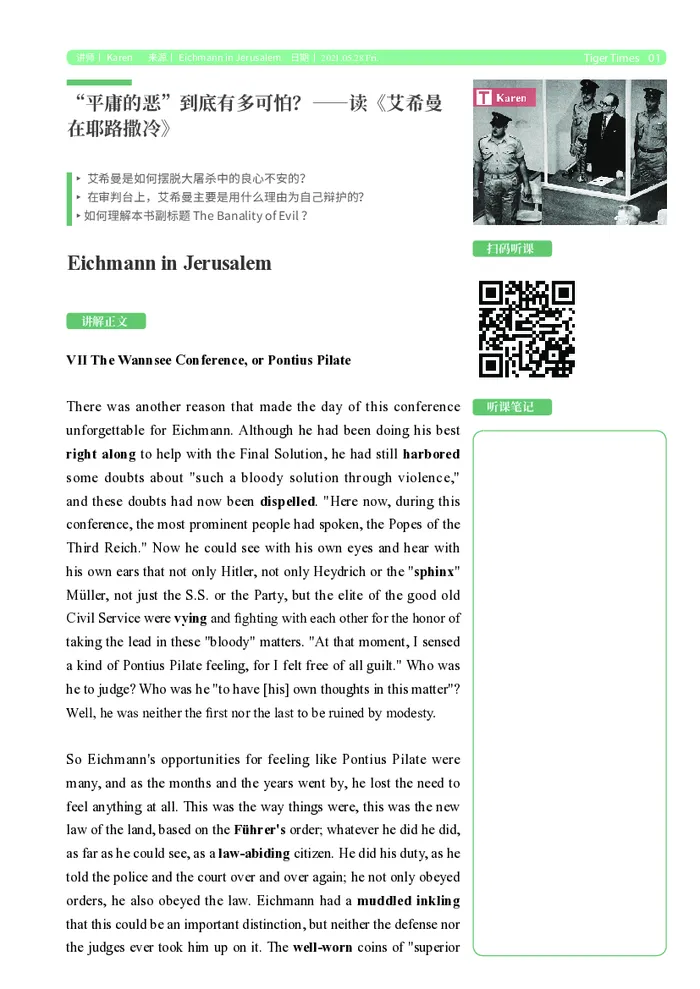
Eichmann in Jerusalem
讲解正文
orders" versus "acts of state" were handed back and forth; they had
governed the whole discussion of these matters during the Nuremberg
Trials, for no other reason than that they gave the illusion that the
altogether unprecedented could be judged according to precedents
and the standards that went with them. Eichmann, with his rather
modest mental gifts, was certainly the last man in the courtroom to be
expected to challenge these notions and to strike out on his own.
Since, in addition to performing what he conceived to be the duties
of a law-abiding citizen, he had also acted upon orders – always
so careful to be "covered" – he became completely muddled, and
ended by stressing alternately the virtues and the vices of blind
obedience, or the "obedience of corpses," Kadavergehorsam, as he
himself called it. The first indication of Eichmann's vague notion that
there was more involved in this whole business than the question
of the soldier's carrying out orders that are clearly criminal in
nature and intent appeared during the police examination, when he
suddenly declared with great emphasis that he had lived his whole
life according to Kant's moral precepts, and especially according
to a Kantian definition of duty. This was outrageous, on the face
of it, and also incomprehensible, since Kant's moral philosophy is
so closely bound up with man's faculty of judgment, which rules
out blind obedience. The examining officer did not press the point,
but Judge Raveh, either out of curiosity or out of indignation at
Eichmann's having dared to invoke Kant's name in connection with
his crimes, decided to question the accused.
Tiger Times
02
Tiger Times
03
right along /raɪt əˈlɒŋ/ adv. 不间断地,一直地
○ all the time or over a period of time
harbor /ˈhɑːbə(r)/ v. 怀有,心怀(尤指反面感情或想法)
○ to keep feelings or thoughts, especially negative ones, in
your mind for a long time
○ e.g. The arsonist may harbour a grudge against the
company. 纵火犯可能对公司怀恨在心。
dispel /dɪˈspel/ v. 驱散,消除(尤指感觉或信仰)
○ to make something, especially a feeling or belief, go away
or disappear
○ e.g. His speech dispelled any fears about his health. 他的
发言消除了人们对他身体健康的担心。
sphinx /sfɪŋks/ n. 斯芬克斯;猜不透的人
○ an ancient Egyptian stone statue of a creature with a human
head and the body of a lion lying down. In ancient Greek
stories the Sphinx spoke in riddles.
○ e.g. a sphinx-like enigma 一个类似斯芬克斯之谜的难题
vie /vaɪ/ v. 激烈竞争;争夺
○ to compete strongly with somebody in order to obtain or
achieve something
○ e.g. She was surrounded by men all vying for her attention.
她周围尽是争相博得她青睐的男子。
Führer /ˈfjʊərər/ n. 元首;德国独裁者(纳粹统治时期对
希特勒的称呼)
○ a ruthless, tyrannical leader
law-abiding /ˈlɔː əbaɪdɪŋ/ adj. 守法的
○ obeying and respecting the law
○ e.g. law-abiding citizens 遵纪守法的公民
muddled /ˈmʌdld/ adj. 糊涂的;困惑的;混乱的
○ confused
○ e.g. He gets muddled when the teacher starts shouting. 老
师一喊叫他就心烦意乱。
inkling /ˈɪŋklɪŋ/ n.(对正在或即将发生的事)略知
○ a slight knowledge of something that is happening or about
to happen
○ e.g. He had no inkling of what was going on. 他对正在发
生的事情一无所知。
well-worn /ˌwel ˈwɔːn/ adj. 听腻了的;陈腐的
○ (of a phrase, story, etc.) heard so often that it does not
sound interesting any more
unprecedented /ʌnˈpresɪdentɪd/ adj. 前所未有的;空前的
○ that has never happened, been done or been known before
○ e.g. The situation is unprecedented in modern times. 这种
情况在现代还没有出现过。
strike out /straɪk aʊt/ v. 独立出去;自立谋生
○ to start being independent
○ e.g. a desire to make changes and to strike out in new
directions 想要有所改变并朝新的方向开拓的渴望
词汇
conceive /kənˈsiːv/ v. 想像;构想;设想
○ to form an idea, a plan, etc. in your mind
○ e.g. He conceived the idea of transforming the old power
station into an arts centre. 他想出了把旧发电站改造为艺术
中心的主意。
alternately /ɔːlˈtɜːnətli/ adv. 轮流地;交替地
○ If two things happen alternately, they follow each other in
a regular way, one after the other.
○ e.g. He felt alternately hot and cold. 他感到忽冷忽热。
vice /vaɪs/ n. 恶行;不道德的行为;邪恶
○ behaviour that is evil or immoral; a quality in somebody's
character that is evil or immoral
○ e.g. Greed is a terrible vice. 贪婪是一种恶习。
precept /ˈpriːsept/ n.(思想、行为的)准则,规范
○ a rule about how to behave or what to think
○ e.g. moral precepts 道德法则
outrageous /aʊtˈreɪdʒəs/ adj. 骇人的;无法容忍的
○ offensive and unacceptable
○ e.g. outrageous behaviour 极端无礼的行为
incomprehensible /ɪnˌkɒmprɪˈhensəbl/ adj. 无法理解的;难
懂的
○ impossible to understand
○ e.g. Some application forms can be incomprehensible to
ordinary people. 有些申请表格一般人可能看不懂。
faculty /ˈfæklti/ n. 官能,天赋
○ any of the physical or mental abilities that a person is born
with
○ She retained her mental faculties (= the ability to think and
understand) until the day she died. 她直到临终那天一直保
持着思维和理解能力。
indignation /ˌɪndɪɡˈneɪʃn/ n. 愤慨;愤怒;义愤
○ a feeling of anger and surprise caused by something that
you think is unfair or unreasonable
○ e.g. The rise in train fares has aroused public indignation.
火车票提价激起了公愤。
invoke /ɪnˈvəʊk/ v. 提及,援引
○ to mention a person, a theory, an example, etc. to support
your opinions or ideas, or as a reason for something
○ e.g. She invoked several eminent scholars to back up her
argument. 她援引了几位赫赫有名的学者来支持她的论点。
Tiger Times
04
今日习题
1. 根据英文释义写出文中出现的对应单词
______: a slight knowledge of something that is happening or about to happen
______: a feeling of anger and surprise caused by something that you think is unfair or unreasonable
2. 一词多义
Which of the following underlined words is closest in meaning to the one in the sentence "Eichmann, with
his rather modest mental gifts, was certainly the last man in the courtroom to be expected to challenge
these notions and to strike out on his own." ____
A. I was struck by her resemblance to my aunt.
B. I knew it was time I struck out on my own.
C. The movie struck out and didn't win a single Oscar.
D. In a recent speech, she struck out at her opponents.
3. 翻译:根据给定中文回译英文
尽管他一直在尽力协助“ 最终解决”,但总是对“ 这样一种暴力血腥的解决方案” 心存疑虑;而今,
这些疑虑终于烟消云散。
_____________________________________________________________________________________
_________________________________________________________________________
习题答案
1. inkling; indignation
2. B
3. Although he had been doing his best right along to help with the Final Solution, he had still har
bored some doubts about "such a bloody solution through violence," and these doubts had now
been dispelled.
编辑丨汤晓宇