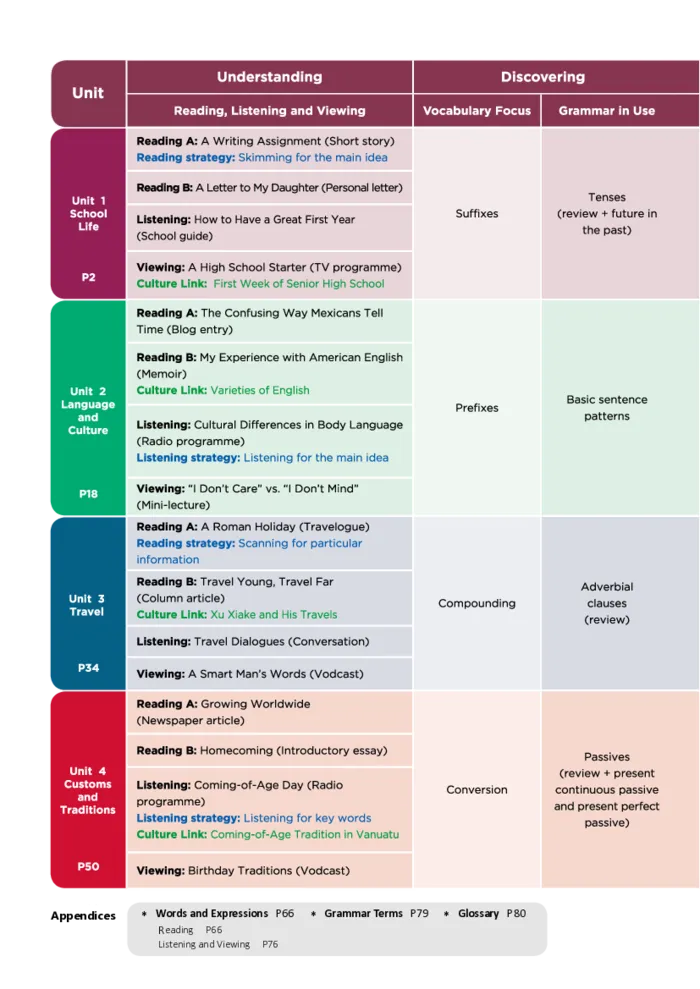
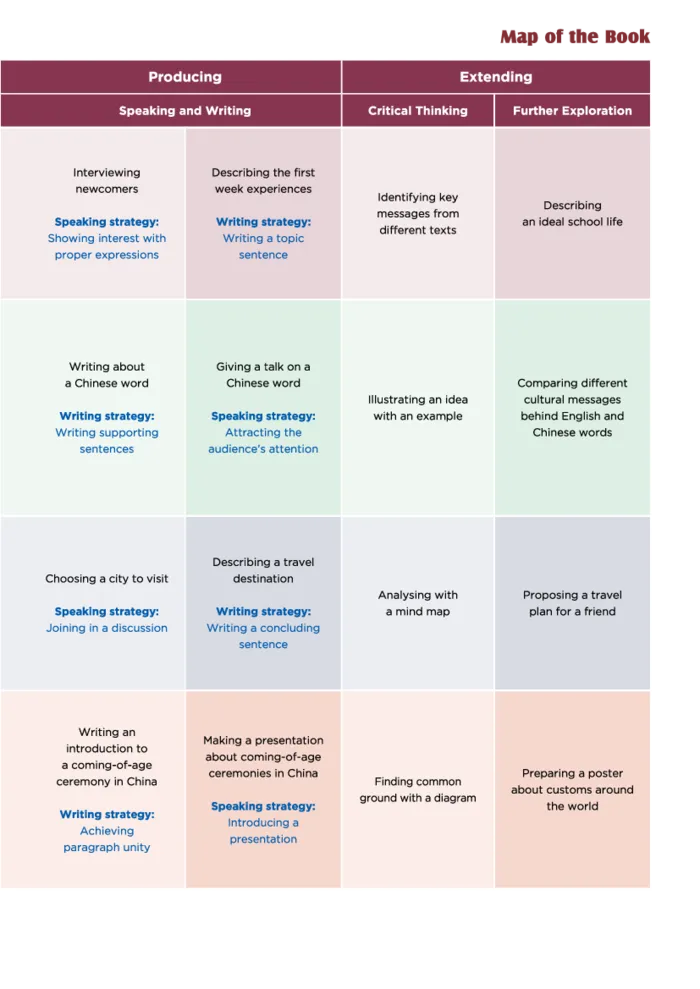
Appendices
*   Words and Expressions   P66
Reading     P66
Listening and Viewing     P76
*   Grammar Terms   P79
*   Glossary   P80
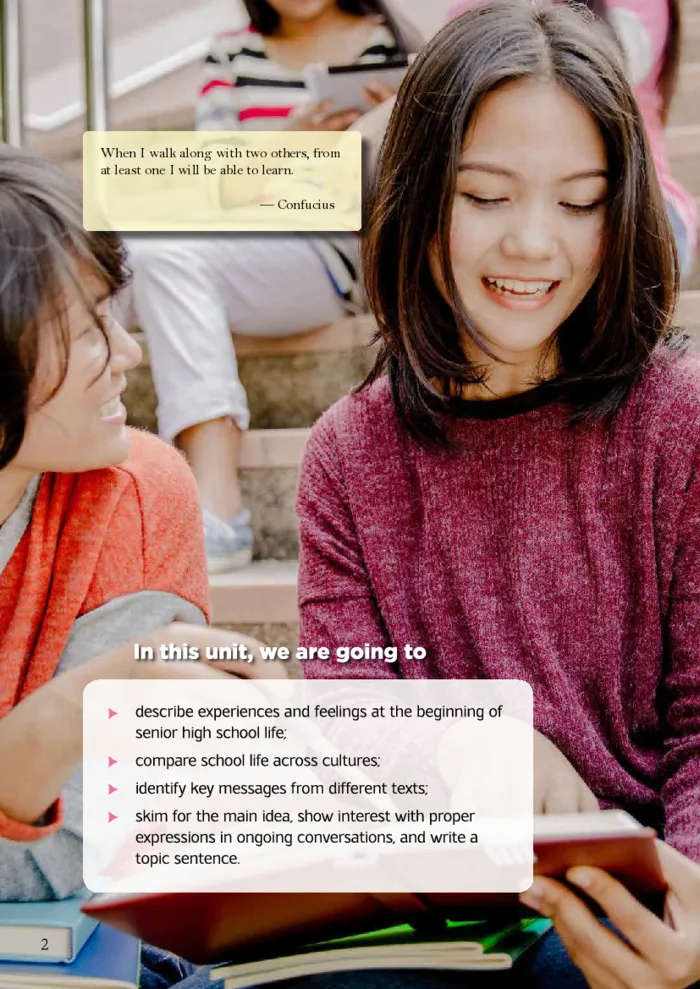
When I walk along with two others, from
at least one I will be able to learn.

                                             — Confucius
School Life
Look at the pictures and talk
about your expectations
about senior high school life.
Mrs Peabody, the English teacher, gave
the class a writing assignment. “Write
something in some way related to summer
vacation,” she said. “Be as creative as you
can. But,” the teacher added, “make sure
you use proper spelling and grammar.”
That night Jim sat at his desk at home
and stared at a blank sheet of paper. He
didn’t want to write about his summer
vacation as usual. What could he write
about, except a dog, a water park, and two
weeks of camp? Boring … He’d actually
been happy to get back to school.
So he wrote what he wanted. Not
an essay at all but a short story, science
fiction. It was about a distant planet that
didn’t have summer — it was spring all the
time. And it didn’t have vacations either.
The aliens on the planet worked 24 hours
a day. They wished they had vacations.
The next morning he handed in the
story, but later that night he lay awake
until 3 a.m., thinking, “Why did I do that?
delicious food
interesting lessons
plenty of books
in the library
colourful school activities
UNIT 1
A Writing Assignment
“This is bad,” Jim thought, “I’m
getting an F, I know it.”
“But,” the teacher continued,
“one of you had the courage to be as
imaginative as I asked you to be. Jim
Martin was the only one who got an A
on the assignment.”
Jim couldn’t believe his ears.
Will Mrs Peabody think I ignored the
assignment?” English was his favorite
class. Maybe he would beg Mrs
Peabody for a chance to write another
one, the sort she wanted.
But when he got to class the
following day, it turned out that Mrs
Peabody had already read and graded
the essays.
The teacher said, “I’m going to pass
back your summer vacation writing in a
minute. I’m afraid I’ve got some rather
harsh words to say. Almost everyone
in class simply wrote an essay about
his or her summer vacation … Almost
everyone.”
Personal Touch
Is the ending of the story a surprise to you? Why or why not?
School Life
Comprehension
II. Complete the table with Jim’s feelings based on information from the text. An
example is given.
Time
Jim’s feeling(s)
Evidence from the text
after Mrs Peabody gave the
class a writing assignment on
summer vacation
bored, unhappy
Jim stared at a blank sheet of
paper because he didn’t want
to write about his summer
vacation.
after Jim handed in his
writing

when Mrs Peabody started
to comment on the graded
essays

when Mrs Peabody praised
Jim for his courage and
imagination

III. Answer the questions.
I. Choose the correct answers.
1. Who are the main characters in the text?

A. Jim and the aliens.

B. Jim and Mrs Peabody.

C. Mrs Peabody and the aliens.

D. Jim, Mrs Peabody and the aliens.
2. What is the text mainly about?

A. Jim’s summer vacation in his English writing.

B. A different writing assignment Jim was given.

C. A writing assignment Jim did based on his own imagination.

D. Jim’s decision to write science fiction about his summer vacation.
1. Why didn’t Jim write an essay about his summer vacation?
2. Do you think it was fair that Mrs Peabody gave Jim an A for his assignment?
Why or why not?
Skimming for the main idea
Reading Strategy
UNIT 1
Vocabulary Focus
A suffix is a letter or a group of
letters added at the end of a
word to make a new word.
I. Key Vocabulary
 Fill in each blank with the appropriate form of a word from the text. The first letter is
 given.
As the new school year began, Jim was quite happy. But the writing assignment
troubled him because the English teacher, Mrs Peabody, asked the students to write
something r_______ to summer vacation. That night he s________ at a blank sheet of
paper for quite a long time. He didn’t think his summer vacation was fun. So, he made
up a science fiction story about life on a d________ planet. He also made s________
that he used proper spelling and grammar as Mrs Peabody required. Next day after
handing in the story, Jim stayed awake that night. He feared that he had i________ Mrs
Peabody’s requirements. He was worried that his writing would disappoint Mrs Peabody
as most students might write e________ about their summer vacation. However, it
t________ out that Jim was the only student who got an A. Mrs Peabody thought he
had been c________. What a great surprise!
II. Word Formation: Suffixes
2.  Read the passage and identify the verb or noun
form of each underlined word.
Noun suffixes: -age,  -er/-or,
-ance/-ence, -ation/-ion,
-ment, -ness,-ship, -ty, etc.
Adjective suffixes: -al, -ful,
-able/-ible, -ant/-ent, -ous,
-ive/-ative, -less, -ly, -y, etc.
Adverb suffixes: -ly,
-ward(s), -wise, etc.
Verb suffixes: -en, -ise/-ize,
-ify, etc.
For Confucius, China’s greatest teacher,
learning was a powerful joint effort between
teacher and student. He had a lot of interesting
and meaningful discussions with his students.
Once Zilu asked, “When learning something,
should I put it right into practice?” The Master
replied, “Your father and elder brothers are still
alive; how would you dare to act immediately
after learning something?” Ran You then asked
the same question. The Master replied, “Yes.
Upon learning something, put it right into action.”
In fact, the two students had different
characters. Ran You was shy and slow, so
Confucius encouraged him to go forward; Zilu was
active and courageous, so he kept Zilu back.
1.  Read the text and find at least five words with
suffixes.
School Life
Grammar in Use
Tenses (review + future in the past)
I. Read the passage and tell what tenses are used and why.
3. Fill in the blanks with the appropriate forms of the words in brackets.
I am now going to start my new life in a senior high school.
I remember at the beginning of my junior high school life, I wanted everyone to
like me and be 1 ________ (friend) to me. I had a lot of 2 ________ (difficult) catching
up with my classmates. The following year was 3 ________ (definite) a problem year.
I tried hard to build 4 ________ (friend) but didn’t always succeed. Some subjects
were 5 ________ (real) hard for me, especially physics. Every time I did experiments,
I felt worried and 6 ________ (nerve). Both internal and external factors influenced
my feelings.
The third year was fruitful for me. I became more 7 ________ (confidence) as I
made great progress in physics. I got on well with my classmates. Many of them have
now become my good friends.
Nothing is ever as bad as it seemed. The most 8 ________ (value) thing I have
learned is that life will go on and efforts will pay off.
On the first day of September, Anne came home in high spirits. “I think I’m going to
like school here,” she announced. “I don’t think much of the master, though. He’s curling
his moustache all the time ...” “Anne Shirley, don’t let me hear you talking about your
teacher in that way again,” said Marilla sharply. “That is something I won’t tolerate. I’m
sure he can teach YOU something, and it’s your business to learn.”
Tense
Form
Use
Example
Simple present
am/is/are
do
There are a lot of neatly-
dressed nice girls in school.
Simple past
was/were
did
Ruby gave me an apple
and Sophia lent me a
lovely pink pen.
Simple future
am/is/are going
to do
will/shall do
But I like Diana best and
always will.
Present
am/is/are doing
For something that is happening at the
moment of speaking or for a limited
I
because at the moment
I am too excited to fall
asleep.
Past
was/were doing
I was thinking of my new
yesterday evening.
Present
perfect
have/has done
or state that began in the past and
past event with results in the present
have
shared a dorm with three
other girls.
G rammar Highlights
UNIT 1
II. Work in pairs. Talk about your expectations about senior high school life when you
were a junior high school student.
III. Send an email to your friend Jim about your school life based on the above
discussion. The following three questions can be used as your guide.
Tense
Form
Use
Example
Future
in the past
would/should
do
Maybe he would beg Mrs
Peabody for a chance to
write another one, the
sort she wanted.
was/were going
to do
and it works well as an example of an
excuse.
I was going to send you
a message, but the smart
phone ran out of power.
EXAMPLE
A:  What did you expect about senior high
school when you were in junior high
school?
B:  I hoped that I would be able to join a
school drama club and perform on the
stage.
A.  What did you expect about the senior high school?
B. Is your life now the same as you expected?
C. What are you going to do in the days to come?
Hi Jim,
How’s your life in the new school? I hope you have adapted well and enjoy the life
there.
Up till now, I have been here for _____________ days. I still remember in junior
high school, I hoped that ________________________. Now _________________________
_________________________________________________________________________________.
All the best
Yours,
_____________
From:
To:
Subject:
School Life
How to Have a Great First Year (School guide)
Which tips are given to the first-year students?
A. To meet new friends.
B. To take part in social activities.
C. To make a learning plan.
D. To try something new.
III. Listen again and fill in the blanks.
IV. How do you like the above tips? Why?
I. Look at the pictures and say what they are about.
II.  Some senior students are giving suggestions to first-year students. Listen and
 choose the answers to the question.
Ways to follow tips
Examples/Reasons
Tip 1
To 1  ________.
I first met my best friend at Year 7 camp.
Tip 2
To use a 2 ________.
To start a regular study plan.
You are expected to be more
3 ________________.
To set up 4 ________ at home.
You can concentrate on work.
To 5 ________ for homework and tick
them off as you finish each task.
Know when you need to hand in your
assignments and plan what you have to get
done.
To ask teachers for help with
6 ________ if you need it.

1
3
2
4
UNIT 1
A High School Starter (TV programme)
I. Do a survey in class with the following questions. You may add more questions.

1. What experiences did Lizzie’s father have in
his first week in senior high school?

A. He was punished by his teacher.

B. He had no locker to himself.

C. He made fun of Lizzie’s mother.

D. He was thrown into the dustbin.
2. Which of the following was Lizzie’s experience
before she entered senior high school?

A. Being class president.

B. Doing well in gymnastics.

C. Protecting the environment.

D. Getting praise in her first job.
3. Lizzie's father advised that she should
________ if she meets difficulties or failures
in senior high school.

A. try again

B. learn to grow up

C. turn to her friends

D. ask him for help
II. Look at the picture on the right and guess Lizzie’s feelings
about her senior high school life. Watch the video and
check your guess.
III. Watch the video again and choose the best answer.
IV. Do you think the conversation between Lizzie
and her father would help her in senior high
school? Why or why not?
What is your biggest concern about senior high school life?
 School rules
 School facilities
 School activities
 Others: _______
How did you feel on the first day of senior high school?
 Happy
 Surprised
 Puzzled
 Others: _______
Culture Link
First week of high school varies greatly
from culture to culture. For instance,
it’s a custom in South Korea and Japan
to welcome new students with a school
entrance ceremony, emphasising students’
duties and responsibilities. Some skilled
painters in Japan draw welcome pictures
on the blackboard. In the US, most high
schools offer a training course before
school actually starts. New students
learn their way around the building and
meet some of their teachers and fellow
students.
School Life
I. Speaking: Interviewing newcomers
The school English newspaper No. 1 Senior High School Weekly is conducting an
interview about students’ experiences and feelings during their first week in No. 1 Senior
High School.
Work in groups of four. Brainstorm the interview topic. The topic can be
school activities, school facilities, people you meet at school or school
subjects and so on. Each group chooses one topic.
Conduct the interview. One student is the reporter, one is the note-taker,
and the other two are the interviewees. Try to show interest while listening
and talking.
 Step
1
 Step
2
Take turns to act out the interview in class.
 Step
3
Li Mei: Hi, I’m Li Mei from No. 1 Senior
High School Weekly. Anything exciting
about your new school life?
Zhang Yan: The school library is great!
Zhao Shan: Yes. I loved the place when I
visited it for the first time.
Li Mei: Wow! What makes it so
attractive?
Zhang Yan: The environment is quiet and
comfortable.
Zhao Shan: There’s a large collection of
magazines and books. It also has modern
facilities.
Li Mei: Amazing! Could you tell me more
about your experiences at the library?
Zhao Shan: Sure. It only took me five
minutes to borrow Selected Stories of
O. Henry. The computer helped me to
quickly find the book because the self-service
borrowing system was very convenient.
Zhang Yan: The library is decorated with
plants, lovely desks and chairs, so I felt totally
relaxed while studying or reading there.
Li Mei: Yeah, a good place to go.
EXAMPLE
UNIT 1
Sort out the notes you have taken in the interview.
Come up with a topic sentence for your selected notes.
Combine the topic sentence and the selected notes into a paragraph. Add
your paragraph to the sample paragraph below.
Which statement might be the proper topic sentence of
the interview notes?
a. The school library is a great place to visit.
b. Zhang Yan and Zhao Shan loved the school library for
several reasons.
c. The environment of the school library is attractive to
Zhang Yan and Zhao Shan.
New Friends, New Voices
This year our school has 300 new students. They felt happy to share their
experiences and feelings about their first week at school.
 _____________________________________________________________.
Zhang Yan said the library is decorated with plants, lovely desks and chairs
and she felt totally relaxed while studying or reading there. Zhao Shan
remembered he was able to borrow Selected Stories of O. Henry within five
minutes. The computer helped him quickly find the book because the self-
service borrowing system was very convenient.
_____________________________________________________________.
______________________________________________________________
______________________________________________________________
II. Writing: Describing the first experiences
Write a paragraph in 60-80 words based on the interview conducted by the school
English newspaper.
 Step
1
 Step
2
 Step
3
When we are interested in what other people say, we use actions and expressions to participate actively.
Actions include smiling, nodding and the like. Expressions are as follows:
Response: Uh-huh./Oh, I see./Yeah, that’s true./ You are right.
Stronger response: Really?/Hmm, that’s an excellent point!/Wow! That’s amazing!/That’s wonderful!/
                                   You must be joking!
Showing interest with proper expressions
Speaking Strategy
EXAMPLE
EXAMPLE
A topic sentence gives
readers an overview of
what they are about to
read. It usually appears
at the beginning or the
end of a paragraph.
Writing a topic sentence
Writing Strategy
Details
Topic sentence
Details
Topic sentence
School Life
UNIT 1
I. Complete the table based on the letter.
II. Answer the questions.
1. What qualities does the mother wish her daughter to have?
2. How might the daughter feel after reading the letter?
I. What suggestions for senior high school students have you learned from this unit?
Identify the key messages and put them in the corresponding boxes.
II. What other suggestions for school life have you been given before? Write them
in the blanks above. How do you feel about these suggestions? What suggestions
would you like to give high school starters based on your experiences?

Comprehension Plus
Daughter’s possible problems
Mother’s advice
Trying to make everything perfect for the
first day at school.
Believe you are good enough.
Teacher’s advice
Senior’s tips
Mother’s advice
Father’s advice
Other suggestions
Suggestions for senior high school students
Other suggestions
Identifying key messages
from different texts
School Life
Describing an ideal school life
Work in groups. Share what you know about school life and
describe your ideal school life.
           Share something interesting, meaningful or unique
about your school life in the past or at present. Search for
information related to school life in different countries. Put the
information you have shared and collected in the table.
           Decide whether to present it as a report, a short
play, a talk show or an interview. Prepare two questions for
the audience to answer.
           Take turns to give presentations and raise questions.
The audience should take notes while listening and be
prepared to answer the questions.
           Sort out the information you have collected. Hold a
discussion and select the part of school life you like. Work out
an ideal school life by putting together your favourite parts.
 Step 1
 Step 2
 Step 3
 Step 4
UNIT 1
Look at the expected learning outcomes of this unit and answer
the questions.
A. Figuring out feelings of senior high school starters
B.  Talking about experiences and feelings about senior high
school life
C.  Describing ideal school life in a certain culture
D. Identifying tips about school life from different sources
E. Reading a text quickly to get the main idea
F.  Using proper expressions to show interest in a discussion
G. Writing a topic sentence for a paragraph
Which of the above have you done well? Why and how?
School Life
Absolutely nothing is so important for a
nation’s culture as its language.

                        — Wilhelm von Humboldt
Language and Culture
Look at the picture and
answer the questions.
Many Chinese used to greet
each other by asking if they
had eaten. Are there people
around you still doing that?
Who might misunderstand it
as an invitation or something
else?
When I first set foot on Mexican soil, I
spoke Spanish well. So when I asked a local
ice-cream seller for an ice-cream, and he
said “ahorita,” which directly translates to
“right now,” I took him at his word, believing
that its arrival was immediate.
I sat near his shop and waited. Half an
hour passed and still no ice-cream arrived,
so I asked again about it. “Ahorita,” he told
Have you
eaten?
UNIT 2
me again. His face was a mix of confusion
and maybe even embarrassment.
I was torn. Waiting longer wasn’t
pleasant, but I felt it was impolite to
walk away, especially if the ice-cream
was now being delivered just for me.
But finally, after waiting too long, I made
a rush for the nearest bus to take me
home. As I left, I signalled at my wrist
and shrugged to the ice-cream seller.
Obviously I couldn’t wait any longer and
it really wasn’t my fault. His face was,
once again, one of total confusion.
This experience faded from my
memory until years later when I came
back to live in Mexico. I discovered
that understanding “ahorita” took not
a fluency in the language, but rather a
fluency in the culture. When someone
from Mexico says “ahorita,” it should
almost never be taken literally; its
meaning changes greatly with context.
As a linguist told me, “Ahorita could
Personal Touch
What word in your mother tongue is confusing like “ahorita” in Mexico?
Could you share any story or experience related to the word?
mean tomorrow, in an hour, within five
years or never.” It is even used as a polite
way of saying “no, thanks” when refusing
an offer.
Difficulty in explaining what I have
come to call “Ahorita Time” is a reflection
of different cultural understandings
of time. Since I moved to Mexico, my
attitude towards time has changed
dramatically. I don’t worry so much
about being late; I am generally still on
time for appointments, but when I’m
not, I don’t panic. Ironically, it would
seem that “Ahorita Time” has actually
allowed me to live far more in the “right
now” than I ever did before.
The Confusing Way Mexicans Tell Time
Language and Culture
Comprehension
I. Below is an outline of the passage you have just read. Complete the diagram with
information from the text.
II. Answer the questions.
1. What did “ahorita” mean to the author? What might the ice-cream seller mean by saying
“ahorita”?
2. What did the author suggest by saying “I was torn” (line 12)?
3. Why didn’t the author worry so much about being late after moving to Mexico years
later?
4. Do you think Spanish people would mean the same as Mexicans when they say “ahorita”?
Why or why not?
Climax
Setting
Development
Beginning
Message
Ending
The author was torn
and _____________
________________.
Time: __________
Place: __________ in Mexico
Character(s): ___________
The author then waited because
______________________________.
However, half an hour later, when she
asked again, the ice-cream seller felt
______________________________.
The author left the shop after
a long time. The seller looked
_______.
Understanding “ahorita” took not a fluency in
the language, but rather ________________.
The author asked a local ice-
cream seller for an ice-cream,
and the seller answered
________.
UNIT 2
Vocabulary Focus
A prefix is a letter or a group of letters added to the beginning of a word to
indicate or modify its meaning.
I. Key Vocabulary
Fill in the blanks with the appropriate forms of the given words and expressions to
complete the passage.
This is a story about how a foreigner got confused about a Mexican word even though
she could speak fluent Spanish. It happened when she 1 _________ Mexican soil for
the first time. She asked an ice-cream seller for an ice-cream, and he said “ahorita.” She
thought it would 2 _________ immediately because the word can be directly translated
to “right now.” But she waited for half an hour and still no ice-cream came. When she
asked the seller about it, he said “ahorita” again, with his face showing 3 _________.
She felt 4 _________ between waiting and walking away. Finally, she had to go home,
so she 5 _________ to the seller that she could not wait any longer. Years later back
in Mexico, she came to realise that the meaning of “ahorita” changes according to its
 6 _________. It could mean “tomorrow,” “within five years,” “never,” or even “no,
thanks” when one wants to 7 _________. “Ahorita Time” is a 8 _________ of different
cultural understandings of time. That is, understanding “ahorita” takes not a fluency in
the language, but a fluency in the culture.
II. Word Formation: Prefixes
1.  Read the sentence and rewrite it with the opposites of the underlined words
without changing the meaning.
Prefix
Word
Word with a prefix
im-
polite
impolite
in-
expensive
inexpensive
un-
fortunate
unfortunate
fold
unfold
dis-
appear
disappear
advantage
disadvantage
mis-
understanding
misunderstanding
cross-
cultural
cross-cultural
en-
rich
enrich
pre-
view
preview
co-
operation
cooperation
Waiting longer wasn’t pleasant, but I felt it was impolite to walk away.
Waiting longer was ________, but I felt it wasn’t ________ to walk away.
Language and Culture
Grammar in Use
Basic sentence patterns
I.  Read the passage and tell how many sentence patterns there are.
2. Add a prefix in the left box to a word in the right box to make a new word. Fill in the
blanks with the new words.
S+V:
Subject+ Verb (vi.)

The meaning of the idiom changes greatly.

S
V
S+V+C:
Subject + Linking Verb + Complement

I was torn.

S V
C
S+V+O:
Subject + Verb (vt.) + Object

I spoke Spanish well.

S V
O
S+V+O+C:
Subject + Verb + Object + Complement

She found the word “ahorita” confusing.

S
V
O
C
S+V+Oi+Od: Subject + Verb + Indirect Object + Direct Object

She gave him a signal.

S
V
Oi
Od
The origin of the English word hello is the French holà. It roughly means “whoa
there!” (ho, là). But the French people do not make holà a greeting word. The Italian
word Ciào finds its origin in the Venetian phrase s-ciao vostro or s-ciao su. The literal
translation is “I am your slave.” In fact, the meaning is “at your service.”
G rammar Highlights
Prefix: cross-    en-    mis-
inter-    un-    co-    tele-
Word: cultural    understanding    phone
able    certainty    operation    national
Culture shock refers to a sense of confusion or 1 _________ with feelings of anxiety
when people are introduced to a foreign environment.
If you are a(n) 2 _________ student experiencing culture shock, here are some tips
that might help:
• Research the host country’s culture and build up 3 _________ awareness.
• Look for activities that 4 _________  you to interact with other students who
share your interests.
• Stay calm when some 5 _________ occurs and reach out for help if necessary.
• Keep in touch with your family and friends via email, video chat or 6 ________.
• Value 7 _________ and prepare to work with other students.
UNIT 2
II. Identify the sentence pattern of each sentence in the paragraph. An example is
given.
III. Complete the story according to the pictures and the clue words. Try to use as
many different sentence patterns as possible.
A couple were travelling in Spain. One day they went into a small
restaurant for lunch. They did not speak the local language and the waiter
did not speak their language ...
Today my friend told me a funny story. One day, an American was meeting

 (S + V+ Oi + Od)
 (                                   )
a Chinese man. As the visitor saw the host’s wife, he said, “Your wife is very beautiful.”

 (                                   )
 (                                   )
The host smiled and said, “Where? Where?” This surprised the American very much,
 (                                   )
 (                                   )
but still he answered, “Eyes, hair, nose.” Of course the host found the answer

 (                                   )
a bit puzzling. We know that cultural differences in languages caused the confusion.

 (                                   )
 “Where? Where?” in Chinese is a kind of humble expression, but the American

 (                                   )
understood it as “Which parts of the body?”
1
(restaurant)
3
(cow)
4
(bullfight)
2
(milk)
Language and Culture
Cultural Differences in Body Language (Radio programme)
A. Gestures differ from country to country in expressing similar ideas.
B. Similar gestures may have different meanings in different countries.
C. People often use their hands or heads to express their feelings.
D. People in different countries use different gestures to show disagreement.
II. Listen and choose the main idea of the programme.
I. If you were a traveller in Spain, how would you use your body language to ask the
waiter for milk?
III. Fill in each blank with no more than two words. Then listen again and check.
IV. Some gestures may convey different messages in different cultures. Give an
example.
Listening for the main idea
Listening Strategy
Using gestures to express
what you are feeling is common
in some countries but not in
others. Shaking heads mostly
means ‘no,’  but in some
countries it can mean the
1 ____________. For example,
in Greece, shaking heads means
2 ____________; in Bulgaria,
it means 3 ______________;
and in India, it means lots of
4 _________. Besides, in some
areas of southeastern Europe,
5 _________ means ‘no.’
UNIT 2
 “I Don’t Care” vs. “I Don’t Mind” (Mini-lecture)
II. Watch Part I of the video and choose the best answer.
The video is about the difference __________.
A. between tea and coffee
B. in making decisions in the US and the UK
C. between American and British English
D. in showing disagreement in the US and the UK
1. What other differences between American and British English are mentioned in the video?
2. Can you give more examples to show differences between American and British English?
1. — Do you mind giving a free ride to a stranger?

— ________________________________________________.
2. — Would you like to have tea or coffee?

— ________________________________________________.
I’m happy with either alternative.
1 _______________
But in British English, it means
you are not interested.
But in American English, it makes
3 ____________.
2 _______________
III. Watch Part II of the video and complete the diagram.
IV. Answer the questions.
I. Before watching, complete the dialogues with “I don’t care” or “I don’t mind”.
American English
British English
Language and Culture

Work in groups. Brainstorm about words in Chinese and their different
usages in different contexts. The words can be confusing, interesting or
funny, such as “ahorita” in Mexican Spanish or “chi” in Chinese.

Choose one word and list its different usages or stories. Find out the peculiar
cultural message behind the word.

Write a topic sentence based
on the information. Find
relevant details and put them
in the supporting sentences.
I. Writing: Writing about a Chinese word
All the supporting sentences should be related to
the topic sentence. Good supporting sentences have
different goals. Writers use them to explain, describe,
give reasons, give facts, give examples or define.
Writing supporting sentences
Writing Strategy
Suppose some students from your sister school abroad are visiting
your school. You are asked to give a talk about “Chinese words and
their stories.”

Put all the sentences into a paragraph.
Tick ( ) the sentences that are related to the given topic sentence.
Topic sentence:
A simple Chinese word “chi” (to eat) has a lot of extended meanings.
Supporting sentences:
 As the saying goes, “People can’t do without food.”
 Chinese people’s love or concern for food has lent many colourful expressions to their
mother tongue.
 The word sometimes goes beyond its literal meaning. For example, “chi moshui” means “to
receive education” instead of “to eat ink,” and “chi cu” means “to be jealous” rather than “to
eat vinegar.”
 It can be referred to as “to depend on.”  For instance, “chi laobao” means “to live on labour
security funds” and “kaoshan chishan” means “those living in a mountainous area depend
on the mountains for a living.”
UNIT 2
II. Speaking: Giving a talk on a Chinese word
 Step 1    Work in groups. Find a way to attract the audience’s attention with the
help of the speaking strategy.
Step 2   Put what you have written in a speaking outline. Practise the group
presentation with other members. Prepare some questions for listeners
to answer after the presentation.
Step 3   Give your presentation in class. Ask some questions after the
presentation.
Introduction
Greeting
Asking a question
e.g. Do you know how to say “eat” in Chinese?
Body
Topic sentence
e.g. A simple word “chi” has a lot of extended meanings.
Supporting sentences
e.g. meaning 1

meaning 2
Conclusion
A good speaker begins a presentation with a quick and friendly
greeting. This makes the audience feel welcome.
A speaker can also attract the audience’s attention by asking a
question.
• How many of you have ever studied Chinese?
• Have you got a Chinese expression similar to “ahorita”?
Speaking Strategy
Language and Culture

When I was ten years old, I went to
the US to visit some family friends. We
travelled all the way from California to Las
Vegas. I noticed something funny about the
way everyone spoke English. I was thinking,
“This is the way they speak in films!”
At the beginning of the holiday, one of
my friends asked me if I wanted to order
“French fries.” I couldn’t imagine what
French fries were. What was fried and
French?! Snails? Cheese? She was amazed
that I had never tried them and she ordered
a portion for us to share. When the waiter
brought us some chips, I asked her where
the French fries were. She pointed to the
plate of chips! Later that week she said she
was going to buy some “chips” from the
supermarket. She came out with a packet
of crisps!
During that holiday we were also
offered “biscuits and gravy” with our lunch.
This was a very strange idea to me, because
in England biscuits are sweet. Gravy is a
salty, meat-based sauce. I later realised that
“biscuits” in America are savoury snacks.
What we call “biscuits,” they call “cookies.”
I was also embarrassed when a
stranger told me she liked my “pants.” I
remember thinking, “How can she see my
underwear!?” My mum then told me that
they call “pants” what we call “trousers,”
the outer clothing that you wear on your
legs!
I was disgusted when I saw an “egg-
plant” pizza on the menu in a restaurant.
Eggs do not grow on plants, I thought.
What on earth could an “eggplant” be?
Something eggy and leafy? My dad ordered
this pizza and it was covered in aubergines.
I asked him where the “eggplant” was. He
laughed and pointed to the aubergines.
He told me, “They call this ‘eggplant’ in
America!”
Although the same “language” may
be spoken in different countries, there
are likely to be many differences, not
just in vocabulary but also in spelling,
grammar and pronunciation! I think part
of the excitement of learning a language
is discovering the differences in how it is
spoken in different places.
Culture Link
Varieties of English
There are many varieties of English throughout
the world, such as British English, American
English, Australian English, Indian English,
Canadian English, Malaysian English and
Singapore English. Take Singlish (Singapore
English) as an example. The New York Times
calls Singlish a “patchwork” because Singapore’s
population consists of migrants from a variety of
countries, including China, India and Malaysia,
all of whom have made their own special
contributions to the country’s unique version
of English. In Singlish you can easily recognise
influences from Chinese like “mee siam” (rice
noodle) in terms of the accent.
UNIT 2
I. Answer the questions.
II. Fill in the blanks with information from the text.
II. Do you agree that learning about cultural
differences can help you better communicate
with others? Give an example to support your
opinion.
Where does the author most probably come from? Why?
I. Cultural factors may influence meanings of
languages and cause misunderstandings in
cross-cultural communication. Fill in the blanks
with information from the unit.
her friend ordered French fries for her.
she felt curious.

   French fries      Chips


 _________ _________


 _________ _________


 _________ _________


(1) _______  (1) ______
(2) _______  (2) ______
she saw
she felt
When she was in a
restaurant,
At the beginning of
the holiday,
her friend
she felt
Later that week,
they were
she felt
During that holiday,
the stranger said
she felt
When she met a
stranger,
Illustrating an idea with
an example
Cross-cultural
misunderstandings
food
traditions
e.g. _________
_________
time
concept
e.g. ________
regional
differences
e.g. ____________
_____________
...
ahorita
Comprehension Plus
American
English
British
English
Language and Culture
Comparing different cultural messages
behind English and Chinese words

English
Chinese
Word
Cultural
message
Example
Cultural
message
Example
white
purity
wedding dress
(bride)
death
funeral
black

red
…
Work in groups. Each group searches for a certain
type of words in both languages, such as words for
numbers, colours, animals, plants or foods.
Find out the different cultural messages of these
words in each language. Take their respective
cultural traditions into consideration as cultural
messages may have changed over time. Sort out
the collected information and put it in the table.
An example is given.
Practise your presentation within groups.
Give your presentation to the class. Other groups
listen carefully, raising questions or making
comments afterwards.
Group 1: Comparing Colour Words in Traditional Cultures
UNIT 2
Which of the above have you done well? Why and how?
Look at the expected learning outcomes of this unit and answer
the questions.
A. Understanding one’s feelings when he or she is experiencing a
different culture
B. Introducing a Chinese word or expression with different meanings in
different contexts
C. Exploring different cultural messages behind English and Chinese words
D. Illustrating factors leading to cross-cultural misunderstandings with
examples
E. Listening for the main idea about cross-cultural communication
F. Writing supporting sentences for a paragraph
G. Attracting the audience’s attention at the beginning of a presentation
Language and Culture
Travel makes one modest. You see what
a tiny place you occupy in the world.

                               — Gustave Flaubert
Travel
Look at the pictures. Discuss
the questions in pairs.
If you have an opportunity to
travel to any of the following
places, where would you like
to go? Why?
Last week I visited Rome for the first
time. I spent three busy days in the Italian
capital, seeing lots of tourist attractions
and walking down streets lit with Christmas
decorations. Here are the things that I loved
about the city.
Rome is one of the most ancient cities in
the world and is full of wonderful relics from
its distant past. These include the Roman
Forum, which was once the centre of public
and political life in Ancient Rome, as well
as the vast Coliseum,
Cairo, Egypt
Maldives
Paris, France
Beijing, China
UNIT 3
1. The Renaissance started from the 14th century
and lasted until the late 16th century. It is
considered to be the bridge between the Middle
Ages and the modern era.
Note
Personal Touch
Have you ever visited a historic place like Rome? Did you like it?
Why or why not?
the largest outdoor theatre ever built
and one of the greatest wonders in
the world. The ruins of buildings and
temples are fascinating: you can’t quite
believe how old they are.
I studied the masterpieces of the
Renaissance1 period at school and was
excited to see them in real life. When I
walked around the museum in Vatican
City, I saw plenty of famous sculptures.
The best part of the visit was, without
doubt, the Sistine Chapel ceiling, painted
in the early 16th century by the great
Michelangelo. It was so breathtaking
that I couldn’t tear my eyes away from
it.
In Rome, there is a large offering
of food for tourists, but some of it isn’t
very good in quality. I made an effort
to find some restaurants to taste the
popular meals of the region, like pasta
with tomatoes, onions and bacon. I also
loved eating ice cream and drinking hot
chocolate under the Christmas lights.
Rome has not only lots of luxury
stores, but also plenty of shops that
are in my price range. It was a perfect
opportunity to buy presents for my
family and friends. There was also a
Christmas market, where I bought a
sparkly decoration for the tree.
I love visiting new places, especially
capital cities. I have been very lucky this
year because I also visited Amsterdam
in the summer. Hopefully I’ll travel even
more in the future.
A Roman Holiday
Travel
Comprehension
III. Answer the questions.
II. Read the text again and tick ( ) the
things Eleanor did in Rome. Explain
why she liked them.
I. List the things Eleanor loved about Rome.
1.  Why does Eleanor love visiting capital cities?
2. Where do you think Eleanor would go next? Why?
Scanning for particular information
Reading Strategy
Eleanor
loved
Rome.
Rome is an ancient city full of relics.
UNIT 3
Vocabulary Focus
Compound words are
formed by putting two or
more words together. The
new word can be a noun,
such as masterpiece,
an adjective, such as
breathtaking, or a verb
like spoonfeed.
I. Key Vocabulary
Describe Eleanor’s experiences according to the travel plan, using the words and
expressions given below. The beginning sentences are given.
II. Word Formation: Compounding
1.  Read the sentences below and see how
the underlined words are formed.
(1) I studied the masterpieces of the
Renaissance period at school and was
excited to see them in real life.
(2) It was so breathtaking that I couldn’t
tear my eyes away from it.
Day 1
Visit the Coliseum …
Day 2
See the masterpieces of the Renaissance …


Go to some restaurants …
Day 3
Buy presents …
tourist attraction          decoration          wonder                      opportunity
Eleanor visited Rome last week. She visited many tourist attractions and walked
down streets lit with decorations. She stayed in Rome for three days. On the first day, …
Time
Activities
Eleanor’s travel plan
Travel
Grammar in Use
Adverbial clauses (review)
2. Make compound words by matching a word from Box A with one from Box B.  Then
complete the sentences with the appropriate compound words.
(1) Travel can be a scary thing, but most of the
things we may fear about travel can easily
be __________.
(2) I’ve been looking to change the
__________ images on my computer.
That’s why I was happy to find a wonderful
photo taken in New Zealand last summer.
(3) We know that __________ brings great
sadness and emotional suffering but travel
is a good way to help us forget.
(4) If you walk in the __________ of Britain,
you’ll spot piles of stones along the road
from time to time.
(5) Famous __________ in Shanghai include
the Bund, the Oriental Pearl TV Tower and
the Huangpu River.
(6) Edinburgh is famous as the home of many
________ writers such as Robert Louis
Stevenson, Arthur Ignatius Conan Doyle
and Joanne Kathleen Rowling.
come          side          ground
break          mark          known
heart          back          over
country          land          well
On a winter afternoon, we walked along the Huangpu River though a cold wind
was blowing. Clouds moved across the sky and at times hid the tip of the Oriental Pearl
Tower. We talked as we walked. We tried to let go of our thoughts about study yet they
kept creeping into our conversations. We walked for about an hour before we headed
back to school.
I. Read the paragraph and underline the adverbial clauses. Tell which type each
adverbial clause belongs to.
UNIT 3
II. Read the passage and complete the sentences with appropriate conjunctions.
Type of
adverbial clauses
Meaning
Example
Conjunction
Time
To show when
something happens
She has stayed in the hotel
since she arrived in Rome.
before, after, as, as
soon as, while, when,
since, until
Condition
To express a condition,
real or imagined
We will not postpone the sports
meeting unless it rains.
if, unless,
as long as
Result
To indicate the result(s)
of an act or event
The book was so interesting
that I couldn’t tear my eyes
away from it.
so … that,
such … that
Reason
To give a reason
Since she is a tourist, she
would like to have a guide.
because, since, as,
now that
Concession
To show contrast
between two
statements
He is used to the package
tour even though he dislikes
the tight schedule.
although, though,
even though
Purpose
To express an aim or
goal of an act
She has downloaded a travel
planning app so that she can
make an agenda for the
summer vacation.
so that,
in order that
III. Describe one of your travel experiences with the help of the following questions.
Use different types of adverbial clauses. You may add details if needed.
1. What place comes to your mind?
2. When did you go there?
3. Why did you go there?
4. How did you like the trip?
 We passed by sculptures and art works along the road 1 _________ we
counted our steps and watched the time. In the distance, sea lions on the
docks were begging for fish. But we could not get closer to them 2 _________
we didn't have enough time, which was a pity. We decided to take another walk
the next day 3 _________  we could appreciate more works of art.
An adverbial clause is a clause used as an adverb within
a sentence to indicate time, condition, result, reason,
purpose or concession.
G rammar Highlights
Travel
Travel Dialogues (Conversation)
A. Conversation 1
1. Buying souvenirs


2. Booking airline tickets
B. Conversation 2
3. Making vacation plans


4. Checking in at a hotel
C. Conversation 3
5. Enquiring about luggage regulations
1. ____________________
2. ____________________
3. ____________________
I. Look at the pictures. Discuss what we usually do before and while travelling.
II. Listen to three conversations. Match them to the corresponding situations.
III. Listen to the three conversations again and fill in the blanks with no more than
three words.
IV. Discuss and make a list of things we need to prepare before travel.
Situation 1
Tina is planning to go on 1 ___________ but she has not decided where
she is going. She would like to go somewhere with a nice 2 ___________. The whole
travel cost is 3 ___________ pounds.
Situation 2
Tina is 4 ___________ for her holiday now. She needs some information
about the luggage regulations. The 5 __________ allows only one carry-on item for free and
charges a fee for 6 ___________. Therefore, she shouldn’t take anything that she doesn’t
really need.
Situation 3
Tina is at the souvenir stand looking for some gifts for 7 ___________. Her
friend thinks things are a bit 8 ___________ here and suggests that they walk to other
places to see what the prices are like there.
UNIT 3
A Smart Man’s Words (Vodcast)
II. Watch the video clip in silent mode and answer the questions.
1.  Where did the girl go?
2. Did she enjoy travelling? Why do you think so?
III. Watch again and complete the passage.
IV. Complete the mind map based on what you have watched.
A smart man once told me that you should experience life to the fullest when you
are young, so you have 1 _________ to tell when you are old. Is there a better way
to create 2 _________ than by travelling, or by seeing the 3 _________ this world
has to offer, or by witnessing what human beings have been able to 4 _________
over the centuries? Never was I able to see life’s beauty as clearly as when I travelled.
Being away from home just 5 _________. It also opens your heart, and makes you
6 _________ how blessed, how endlessly blessed you are for being born into this life.
I. Work in pairs and ask each other the questions in the boxes. You may ask other
questions about travelling.
1 Do you like travelling? Why or why not?
2 What is the best place you have

visited? Why?
3 ____________________________?
1 Which do you prefer to visit, natural

or man-made wonders? Why?
2 Could you describe your experience
of visiting one of your favorite natural
or man-made wonders?
3 ____________________________?
making new
friends
getting lost in
a new place
what travel
means to me
finding a new way of
seeing things
Travel

Work in groups of four. Each group chooses one city out of the five above and
makes a list of tourist attractions, foods or other interesting things to do in
the city. Xi’an is given as an example.

Hold a discussion about the city. One of the members asks for advice, and
the other members try to give advice. Use adverbial clauses if possible. An
example is given on page 45.
I. Speaking: Choosing a city to visit
Emily, a German student, has an opportunity to visit Xi’an, Hangzhou, Beijing,
Nanjing or Shanghai this winter. She needs some advice from her friends on
which city to choose.
Take turns to do role plays in class. Other groups listen and note down the
cities and their attractions.
• Qinshihuang Mausoleum and
Terracotta Warriors
• Dayan (Giant Wild Goose)
Pagoda
• Bell Tower and Drum Tower
• Huaqing Hot Springs
• Yang Rou Pao Mo (pita bread
soaked in lamb soup)
 Step
1
 Step
2
 Step
3
UNIT 3
James, you know I’ve got an opportunity
to visit a Chinese city this winter. Which
city do you think is the best choice?
I’d recommend
Xi’an too. I just
want to add …
Surely Xi’an. I still remember the breathtaking Terracotta Warriors
though I went there over ten years ago. You can also visit Bell
Tower and Drum Tower, two other must-sees for visitors. Besides,
local food like Yang Rou Pao Mo is delicious ... You can’t imagine
how nice the city is unless you are there.
II. Writing: Describing a travel destination
EXAMPLE
Emily needs more information about a city. Write about the city in 60-80 words
based on your travel experiences and your group discussion results.
We strongly recommend Xi’an, an amazing historic city in Northwest China. Xi’an
enjoys a long history as it was the starting point of the Silk Road and the capital city of
13 dynasties in ancient China. James visited the city when he was very young. But he
can still remember the breathtaking Terracotta Warriors, which was built in the Qin
Dynasty. Besides, Xi’an is also famous for its delicious local food like Yang Rou Pao Mo.
a. It is easy to understand why so many tourists visit Xi’an every year.
b. You can’t know how nice the city is until you are there.
c. The biggest Bell Tower and Drum Tower built in the Ming Dynasty are another two
must-sees for visitors.
 Step 1    Work in groups. Sort out your notes about the city.
Read the paragraph. Choose a proper statement as the concluding sentence of the
paragraph and give your reason.
 Step 2    Write a paragraph based on the notes.
 Step 3    Make sure the paragraph has a concluding sentence.
The ability to join in a conversation
naturally is a key social skill.
Below are some useful expressions:
• Can I add something to that?
• Can I say something here?
• You guys look like you’re talking about

something exciting — do you mind if I

join you?
Speaking Strategy
Joining in a discussion
The concluding sentence is the last sentence of a paragraph. It indicates that you are bringing
an end to your talk or writing. A concluding sentence often has one of these three important
purposes: to restate the main idea, to offer a suggestion and to make a prediction.
Writing Strategy
Writing a concluding sentence
Travel
Culture Link
Xu Xiake and His Travels
Xu Xiake (1587–1641) was an
outstanding explorer and travelogue
writer in the Ming Dynasty. For over
30 years, Xu visited a wide range of
mountains, valleys, rivers and
caves in China in spite of
difficulties and dangers.
His travel experiences were
 vividly recorded in
The Travels of Xu Xiake,
 which was recognised
as an extensive collection
of field study reports
in Chinese geography,
 geology and botany.
Dear Young Dreamer,
You wrote to me about your problem.
You dream of travelling, and you wonder
how, as a teenager, you can make it
happen.
I understand that you are not very
happy about taking the subjects that
don’t interest you. You don't think you will
ever need much of what you are studying
right now. While some of your lessons
may not seem directly relevant to your
needs at the moment, you are learning
valuable study skills. You do need these
skills to analyse the world around you,
to process information, and above all, to
think for yourself. These exact skills will
help you overcome obstacles that stand
between you and your travel dreams.
I say dream big but stay practical.
However, it’s the practical part that most
people miss. Even the most pleasant life
has its obstacles, but a setback won’t
prevent you from reaching your dreams
if you stay rooted in the practical, in the
action you can take to bring yourself
closer to your dreams. Work hard, chart
a course ahead and then actually stick
to it. Travel was a goal that I believed
would finally signal that I had made it
through to the other side of my troubled
background. I made it there. You can, too.
As a teen, you have some limitations
when making your travel plans. Your
parents have a say in where and how
you travel. The amount of money they
can spend on your travel is also a factor.
Cost will determine your experience ––
whether you visit Europe, participate in
a student exchange programme, or stay
and work to help with family finances.
Given the limitations that have
shaped your life until now, I hope you
will maintain your travel dreams. A plan
for travel acts like a silent ship running
alongside your life as you take your first
solo steps into the world. It is there
waiting for you, always inviting you to
step on board.
Sincerely yours,
Shannon
UNIT 3
I.  Work in groups. List factors that should be considered for a travel plan based on
information in this unit. You can use a mind map to organise the ideas.
II.  Analyse these factors and consider which factor(s) may be a problem for you. How
would you solve the problem?
learning about
the destination
booking tickets
a good travel plan
Analysing with a mind map
I. Complete the table with information from the text.
Comprehension Plus
Young dreamer’s problems
Shannon’s suggestions
• He/She dreams of travelling but does

not know how to make it happen.
•
•

  • He/She should dream big but stay practical.

  •
  •

II.  Answer the questions.
1. Do you think Shannon’s suggestions can help the young dreamer solve problems?
Why or why not?
2. Have you met with similar problems? How did you solve them?
Travel
Proposing a travel plan for a friend
Your friend Chris, a Canadian, is planning a trip to China in
December. Recommend a city and make a three-day travel plan
for him.
A Three-Day Trip
Time
Place
Arrangement
Day 1
Arrive at _____ airport
Register at the _____ hotel
Visit __________________
Tourist attractions:
Foods:
Shopping:
Other:
Day 2
Visit __________________
Have dinner in __________
Day 3
Visit __________________
Check out of the hotel
Depart from the airport
Work in groups. Each group chooses a city. List
its tourist attractions, typical foods or shopping
places in downtown and suburban areas.
Make a travel plan for Chris.
Write an email to Chris about the travel plan you
have made for him.
 Step 1
 Step 2
 Step 3
UNIT 3
Which of the above have you done well? Why and how?
Look at the expected learning outcomes of this unit and answer
the questions.
A.  Understanding conversations and experiences about travel
B.  Identifying and reflecting on the meaning of travel
C.  Talking about travel experiences and travel destinations
D.  Comparing different cities and making a travel plan for a friend
E.  Organising ideas about travel using a mind map
F.  Locating specific information in a text
G. Joining in a discussion politely and naturally
H. Writing a concluding sentence for a paragraph
Travel
It takes an endless amount of history to
make even a little tradition.

                         — Henry James
Customs and Traditions
Look at the pictures and find
out how people celebrate
New Year in different places.
Which celebration is the most
interesting to you? Are you
familiar with other New Year
traditions?
2. Burmans splash water to start the
New Year with a purified soul.
1. Chinese New Year usually closes
off with the Lantern Festival.
3. In the hope of having a travel-
filled year, Colombians carry
a suitcase around on 31
December.
Entering adulthood is an important
step in everyone’s life. It means that a
young person must soon leave childishness
behind and start to shoulder grown-up
responsibilities.
In Germany, there’s a ceremony called
“Jugendfeier,” or “youth celebration,” a
coming-of-age ceremony for 14-year-
olds. They go to school to prepare for the
occasion, studying topics thought to be
important for young citizens of the future.
The things these young people learn about
include multiculturalism and general
responsibilities in society.
“Jugendfeier” began in the 19th century,
when awareness of civic practices was on
the rise. At the ceremony, a teacher makes a
speech about values, such as having respect
for other people and having a sense of duty.
The idea is that the young people taking
part in the ceremony will take on these
values for themselves. Perhaps it’s fair to say
that “Jugendfeier” is treated differently from
other coming-of-age events in the world —
it’s more serious than it is fun.
In Latin America, there is a coming-of-
age tradition called “quinceanera.” It is a
celebration for girls on their 15th birthday,
marking a girl’s entry into womanhood. In
the past, “quinceanera” was connected with
UNIT 4
Growing Worldwide
marriage. Girls were taught cooking,
sewing, and other general household
skills before the special day to get
prepared for their upcoming marriage.
Traditional ceremonies began when the
teenager arrived, with her father. He
would dance with her, and then “give
her away” to dance with other males
from among their family and circle of
friends.
Today, the ceremony has become
more like an individual celebration of
the young person’s coming-of-age —
similar to how one’s 18th birthday is
considered an important day in other
cultures.
In some Indian families, the sacred
thread ceremony is performed when
a boy is grown-up. He is given three
strands of the sacred thread which
represent three promises he makes: to
respect knowledge, to respect his
parents and to respect society.
 It is said that the sacred
thread ceremony marks
a new life. The child, traditionally,
leaves his family to go and live with
the Guru (teacher). At this point the
boy becomes “twice-born.” In Indian
traditions, a human being has at least
two births — the first one is his physical
birth and the second one his intellectual
birth through a teacher’s care. At this
ceremony, a Guru accepts a child and
draws him towards knowledge.
Coming-of-age traditions vary
significantly from culture to culture.
Nearly every society has specific rituals,
ceremonies, and traditions to symbolise
or celebrate one’s transition from
childhood to adulthood.
Customs and Traditions
Personal Touch
Do you know any coming-of-age ceremony in your local area or in other
places of China? What are the activities at this ceremony?
Comprehension
I. Answer the questions.
III. Look at the apps and choose the ones that might appeal to the young people who
are entering adulthood from Germany, Latin America or India. Note that one app
might appeal to young people from different cultures.
From: Latin America
Reason: “girls were taught
cooking, sewing, and other
general household skills …”
From: ________________
Reason: _______________
______________________
______________________
From: ________________
Reason: _______________
______________________
______________________
From: ________________
Reason: _______________
______________________
______________________
Germany: “having respect for other people”
(lines 18-19)
India: “to respect knowledge, to respect his
parents and to respect society” (lines 51-53)
1. How many coming-of-age ceremonies are described in the text?
2. What do young people need to do to prepare for the “youth celebration” in Germany?
3. How has “quinceanera” changed over time in Latin America? Why?
4. What do the three strands of the sacred thread symbolise in India?
5. What are the two births that a human being experiences in Indian traditions?
II. Tick ( ) the expectations related to coming-of-age ceremonies in different cultures.
Support your choices with the sentence(s) from the text. An example is given.
                    Expectations
Germany    Latin
India
Evidence from the text


America
1. having respect for


 other people
2. developing a sense


 of responsibility
3. acquiring a multicultural


 perspective
4. being ready for


 household tasks
5. showing great respect


 for knowledge
UNIT 4
Vocabulary Focus
I. Key Vocabulary
Fill in the blanks with the appropriate forms of the given words to complete the passage.
-
hood to 1
of most people.
In Germany, the coming-of-age ceremony is called “Jugend-
feier,” which means 2 _________ celebration. It is an import-
ant 3 _________ for 14-year-olds to think about various topics
related to their future as citizens. At the ceremony, teachers
deliver speeches about certain values such as having a sense of
4 _________. This makes the ceremony more serious.
-
-
hold skills in order to be prepared for 5 _________. Now the
ceremony is 6 _________ as an individual event like one’s birthday.
At an Indian coming-of-age ceremony, a boy is given three
strands of the sacred thread, which 7 _________ three promises.
their own 8
II. Word Formation: Conversion
1.  Read the two sentences
and pay attention to the
underlined words. Do they
belong to the same word
class?
(1) “Jugendfeier” began in
the 19th century, when
awareness of civic practices
was on the rise.
(2) Their voices rose when they
talked about the coming
homecoming celebration.
Conversion is a word formation process whereby
a word of one class is shifted into a word of
another class without adding an affix. Here are
some of the major types.
(1) Noun to verb conversion (e.g. view, voice,
target, stage, mail, flash)

The foreign student values his exchange
experience in the Chinese high school.
(2) Verb to noun conversion (e.g. desire, compare,
match, like, decline, protest)

On the cover page is the New Year celebration
in the China town.
(3) Adjective to verb conversion (e.g. pale, sour,
calm, slow, narrow, yellow)

The host cleared his throat before giving a
speech at the ceremony.
(4) Adjective to noun conversion (e.g. chief,
Chinese, professional, chemical)

A native of Britain tends to talk about the
weather in English.
duty
adulthood
marriage
occasion
perform
represent
youth
Customs and Traditions
Grammar in Use
Passives (review + present continuous passive and present perfect passive)
I. Read the sentences. Underline the passive verbs and discuss why the passive voice is used.
1. In some Indian families, the sacred thread ceremony is performed when a boy is grown-up.
2. It is said that the sacred thread ceremony marks a new life.
2. Fill in the blanks in Column B by converting a word in Column A. Change forms where
necessary.
3. Study the underlined converted words in the passage. Try to explain the original
sentence or make another sentence with another form of the word. An example is given.
(1) The photographs of the coming-of-
age ceremony from 20 years ago have
become yellow with age.
(2) At “Jugendfeier” yesterday, Mr
Kaufmann expressed the hope that
young students would take more
responsibilities from then on.
(3) The students are asked to match the
traditions with the festivals.
I can still recognise my mother although
the photographs _________ with age.
Young students started to shoulder
their responsibilities as Mr Kaufmann
_________.
Some of the traditions are not the right
_________ for the festivals.
In ancient China, when a girl was aged 15, a hair-pinning ceremony (Ji Li) would be
held to mark the occasion on the third day of the third month according to the Chinese
lunar calendar. Girls would wash and comb their hair and a ceremony master would put
a pin in it.
The coming-of-age ceremony for boys used to take place when they were 20.
Respected seniors were invited to perform the capping ceremony (Guan Li) for the boys.
Becoming an adult is an important stage in one’s life. It means that you need to
shoulder grown-up responsibilities while also enjoying a bigger say in your own affairs.
EXAMPLE
age
v.  In ancient China, when a girl was aged 15, a hair-pinning ceremony would be held …
n.  In ancient China, at the age of 15, a girl would attend a hair-pinning ceremony which
was held ...
n.  Inuit boys go out to the wilderness with their fathers between the ages of 11 and 12 to
test their hunting skills.
We use the passive voice to focus on the person or thing affected by an
action. Sometimes, we use the passive voice because we do not know or do
not want to mention the one who performs the action.
G rammar Highlights
A
B
UNIT 4
II. Read the birth traditions in different countries. Fill in the blanks with the appropriate
forms of the verbs in brackets.
1. When a baby turns one month old in China, a Full
Moon ceremony 1 _________ (hold) to celebrate
the first full month of life.
2. In Finland, babies come with a box! For the past 75
years, Finland’s mothers-to-be 2 _________ (give) a
box by the government. It’s a starter kit of nappies,
clothes, sheets and toys.
3. In a hospital in Brazil, different kinds of gifts
3 _________ (choose) by a soon-to-be mother as
she asks her husband for advice. The gifts
4 _________ (give) to each person who comes to
the hospital when the baby is born.
4. In Jamaica, a mother who gave birth to a baby girl
yesterday is now busy in the garden. The afterbirth
and the cord 5 _________ already _________ (bury)
by her in person in a specially chosen location and
a tree 6 _________ now _________ (plant) on
that spot. The tree 7 _________ (provide) by her
parents before the birth of the baby. This tradition
comes from a Jamaican expression that says, “Home
is where your navel string is buried.”
Basic structure of the passive
subject + auxiliary verb (be) + main verb (-ed form)
National flags are often designed with many kinds of shapes on them, such as the sun,
stars, the moon, animals and bars.
Present continuous passive
subject + am/is/are being + main verb (-ed form)
When the national flag is being raised, students should stand at attention and salute
according to the constitution.
Present perfect passive
subject + has/have been + main verb (-ed form)
Laws have been made to govern the use of the national flag.
Customs and Traditions
Coming-of-Age Day (Radio programme)
 A haircut
 Traditional clothes
 A bow to parents
 Traditional food
 A speech of encouragement
II. Listen and tick ( ) the celebrations of Coming-of-Age Day in South Korea.
I. Answer the questions before listening to the radio programme.
IV. List some elements or activities that are necessary to describe a coming-of-age
ceremony.
III. Listen again and complete the passage. One word
for each blank.
1. In your opinion, at what age does one enter adulthood?
2.  What does “becoming an adult” mean to you?
The third Monday of May is the day to celebrate the occasion for those who turn
1 _________ years old that year. More than 2 _________ young people are to come of age
this year. This means they will be able to enjoy the rights that come with adulthood, such
as being able to 3 _________ _________ _________. It also reminds them to take on real
4 _________ as adults.
Young participants dressed up in traditional South Korean clothes attended the
Coming-of-Age Day 5 _________ in Seoul. The event ended with the young adults offering
a graceful bow to their parents so as to 6 _________ _________ _________. The gesture
also symbolised the beginnings of their journeys in the real world 7 _________ _________
them.
Listening for key words
Culture Link
In Vanuatu, a small island nation in the middle of the South Pacific, young boys
come of age by jumping off a 98-foot-tall tower with a bungee-like vine tied to
their ankles, just barely preventing them from hitting the ground. Boys there
begin jumping at around 7 or 8. In their first dives their mother will hold an item
representing their childhood, and after the jump the item will be thrown away,
representing the end of childhood. As boys grow older they will jump from taller
towers, showing their manliness.
UNIT 4
Birthday Traditions (Vodcast)
II. Watch again and complete the table with the information about birthday traditions.
I. Watch the video in silent mode and count how many birthday traditions have been
mentioned.
III. Answer the questions.
1. Which of the above celebrations is(are) shared by your family or friends on their
birthdays?
2. What other birthday traditions have you experienced or heard about?
People
Age
Meaning
Germans
(1)
A man’s friends will hang a
“sockencranz,” or sock wreath,
outside of his house.
(2)                                    are
a symbol of his old age.
Jews
12 / 13
Girls have a bat mitzvah and
boys have a bar mitzvah.
The  ceremonies mean
(3)                                          .
South Africans
(4)                              Parents give their child a
(5)                              .
It stands for responsibility
and the future.
Chinese
1
The baby is placed in front
coins, toys, etc. and asked to get
something.
The items the baby
reaches for indicate its
(6)                                 .
Customs and Traditions
Introducing a Coming-of-Age Ceremony
in China
A school in China is holding a coming-of-age ceremony when
students from a US high school come to pay a visit. Chinese
participants are asked to write an introduction to a certain
Chinese coming-of-age ceremony to explain its history and
celebrations to the American students.
I. Writing: Writing an introduction to a coming-of-age ceremony
in China
 Step 1   Work in groups. Each group collects information about a
coming-of-age ceremony in a certain place or of a certain
ethnic group such as the Miao or the Yi people. The
information can include time, celebration, meaning, etc.
 Step 2    Sort out the collected information and put the
sentences in the right order.
 Step 3    Write a paragraph in 60–80 words with a topic
sentence, supporting sentences and a concluding
sentence to achieve paragraph unity.
Paragraph unity is the quality of sticking
to one idea from start to finish, with every
supporting sentence contributing to the
topic sentence of that paragraph and the
concluding sentence echoing the topic
sentence.
Achieving paragraph unity
Writing Strategy
UNIT 4
II. Speaking: Making a presentation about coming-of-age ceremonies in China

Give a presentation on the Chinese coming-of-age ceremony based on the written
paragraph.
A good introduction in a formal presentation is meant to achieve three goals:
• to catch the audience’s attention;
• to identify the topic and the purpose or core message of the presentation;
• to provide a brief overview of what you will cover in the presentation.
Here are some useful opening techniques to catch the audience’s attention:
• quoting someone else, e.g. “Tradition is a guide and not a jailer.” by W. Somerset

Maugham;
• asking a question, e.g. “Have you ever smashed a cake on a birthday? Do you

know where the tradition is from?”;
• telling a joke or sharing a story, e.g. “One of the most famous April Fools’ pranks

occurred in 1957, when BBC news programme Panorama reported on

Switzerland’s spaghetti harvest.”;
• making a bold statement, e.g. “In fifty years, there will be no schools.”
Introducing a presentation
Speaking Strategy
 Step 1    Work out a draft or an outline of the presentation based on the

passage from the writing activity.
 Step 2    Make a list of key words and summarise the main points in different

parts of the presentation.
 Step 3    Use the speaking strategy to make your introduction interesting.
 Step 4    Take turns to give your presentations in class.
Coming-of-age ceremonies are rituals held all over the world
to celebrate a young person’s transition from childhood to
adulthood. For example, Inuit boys go out to the wilderness
with their fathers to test their hunting skills; Senufo girls receive
training in a ceremonial dance called the Ngoron to prepare
for their entry into womanhood. The age varies from culture to
culture. The rituals are also diverse and likely to change as time
goes by. But one thing that all coming-of-age ceremonies have
in common is that they prepare a young person to take on rights
and responsibilities as an adult.
Customs and Traditions
Homecoming refers to a tradition
at many universities, colleges, and high
back to your town and the campus, see old
friends, and reminisce about your school
days.
There are many activities that centre
around homecoming, and they vary from
start at the school with current students on
Monday and last all the way through the
weekend when the alumni show up.
Many schools start their homecoming
celebrations with Spirit Week. Starting on
Monday, each day of the week is themed,
For example, Monday could be “crazy
hair day,” Tuesday could be “rent a senior
day,” Wednesday could be “wear your
pajamas to school day.” Some schools have
has the most school spirit.
Some schools hold elections for
Homecoming King and Queen with an
accompanying Homecoming Court of
Princes and Princesses. Homecoming Court
elections are different from school to
school,
but are
generally held
like this: the king and queen are selected
from among the upper-level students while
the court are first-year students. Since
homecoming is all about school spirit, the
students elected to the court are usually
Some towns stage a homecoming
parade with the school’s marching band,
sports teams, and classic cars. It is a
time for the whole town to get together,
socialise, cheer on the football team and
celebrate their town and high school.
A homecoming dance is just for the
students of the school, and it usually takes
Spirit Week. It is usually open to every
Some schools keep it casual, while others
a DJ or a band, but the place is up to the
or cafeteria, and other times it is at an
outside place. Either way, a homecoming
dance is a time for the entire school to
come together and party.
UNIT 4
I. Summarise the traditions of the coming-of-age ceremonies, birthday and homecoming
celebrations mentioned in this unit in the diagram. An example is given.
II. Look at the diagram you have completed. Explain the shared values between
traditions in different cultures.
purposes of
keeping traditions
to show respect
Jugendfeier in Germany
coming-of-age ceremony
in South Korea
to develop a sense of
responsibility
...
Finding common ground
with a diagram
I.  Answer the questions.
II. Fill in the blanks with the activities that centre around homecoming.
1. What is homecoming?
2. What do homecoming celebrations usually start with?
(1) ______________
Tradition: Each day of the week
has a theme, e.g., “crazy hair
day,” “rent a senior day.”
Homecoming parade
Tradition: The whole town
celebrates it with
(3) ______________.
(4) ______________
Tradition: There is a DJ or a band at the
party, open to every student on Friday or
Saturday night.
(2) ______________ for Homecoming King
and Queen and Homecoming Court of Princes
and Princesses
Tradition: The king and queen are upper-level
students; the court are first-year students.
Comprehension Plus
Customs and Traditions
Preparing a poster about customs
around the world
Customs in Different Cultures
Work in groups. Make a poster about customs in different
cultures.
           Choose one type of the customs and three countries
from the table. You can add more customs or countries to the
table.
CUSTOMS
COUNTRIES
Greeting
China
Greece
Brazil
Visiting
Japan
Egypt
South Africa
Dining
France
Spain
Indonesia
Dressing
Mexico
the US
the UK
 Step 1
           Search for information about the chosen custom in
these three countries and put it in your poster. An example is
given.
 Step 2
           Present the poster in class.
 Step 3
UNIT 4
Which of the above have you done well? Why and how?
Look at the expected learning outcomes of this unit and answer
the questions.
A. Following coming-of-age customs, birthday traditions and
homecoming traditions
B. Describing coming-of-age customs in a certain place in China
C.  Making and presenting a poster about customs around the world
D.  Figuring out similarities between traditions in different countries
E.  Listening for key words in a report
F. Writing a unified paragraph on a coming-of-age ceremony in China
G. Using proper strategies to begin a presentation
Customs and Traditions
way

 rather /
/ adv. used to mean
'fairly' or 'to some degree', often when
you are expressing slight criticism,
disappointment or surprise
used to correct sth you have said, or to
give more accurate information

 harsh /
/ adj. cruel, severe and
unkind

 (be) related to

 make sure


 hand in

 turn out


 Peabody /
/

 teenager /
/ n. a person who
is between 13 and 19 years old
pressure /
/ n.
feelings of anxiety that are caused by
the need to achieve or to behave in a
particular way
v. to persuade sb to do sth, especially
by making them feel that they have to
or should do it

  expectation /
/ n. a hope
that sth good will happen

  comfort /
/ n. a feeling of
not suffering or worrying so much; a
feeling of being less unhappy
v. to make sb who is worried or

  assignment /
/ n. a task or
piece of work that sb is given to do,
usually as part of their job or studies
 related /
/ adj. connected with
sth/sb in some way

 creative /
/ adj. involving
the use of skill and the imagination to
produce sth new or a work of art

  stare /
/ v. to look at sb/sth for a
long time

  blank /
/ adj. empty, with nothing
written, printed or recorded on it

 sheet /
/ n. a piece of paper for
writing or printing on, etc. usually in a
standard size

  essay /
/ n. a short piece of writing
by a student as part of a course of study

 actually /
/ adv. used in
speaking to emphasize a fact or a
comment, or that sth is really true


/
/ n. a type of literature
that describes imaginary people and
events, not real ones

  distant /
/ adj. far away in
space or time

 alien /
/ n. a creature from
another world

 ignore /
/ v. to pay no attention to
sth

 beg /
/ v. to ask sb for sth especially
in an anxious way because you want or
need it very much

sort /
/ n. a group or type of people
or things that are similar in a particular
Unit 1
unhappy feel better by being kind and
sympathetic towards them

 throughout /
/ prep. during the
whole period of time of sth
in or into every part of sth

 adult /
/ adj. fully grown or
developed
n. a fully grown person who is legally
responsible for their actions


/
/ v. to think carefully
and deeply about sth
to show or be a sign of the nature of sth
or of sb’s attitude or feeling

 nasty /
/ adj. unkind; unpleasant

 comment /
/ n. something that
you say or write which gives an opinion
on or explains sb/sth

 glance /
/ n. a quick look

 behaviour /
/ n. the way that
sb behaves, especially towards other
people

  shortage /
/ n. a situation when
there is not enough of the people or
things that are needed

  genuine /
/ adj. sincere and
honest; that can be trusted

 forward /
/ adv. towards a place
or position that is in front

 chapter /
/ n. a period of time in
a person's life or in history

 limitation /
/ n. a rule, fact
or condition that limits sth

 under pressure

 hold back

  confusing /
/ adj.
to understand; not clear

 Mexican /
/ n. a person from
Mexico

  soil /
/ n. a country; an area of land
the top layer of the earth in which
plants, trees, etc. grow

 Spanish /
/ n. the language of
Spain, Mexico and most countries in
Central and South America

 immediate /
/ adj. happening
or done without delay

  confusion /
/ n. a state
of not being certain about what is
happening, what you should do, what
sth means, etc.

  embarrassment /
/
n. shy, awkward or guilty feelings; a
feeling of being embarrassed

 torn /
/ adj. to be unable to decide
or choose between two people, things
or feelings

  pleasant /
/ adj. enjoyable,
pleasing

 deliver /
/ v. to take goods,
letters, etc. to the person or people they
have been sent to
Unit 2

 signal /
/ v. to make a movement
or sound to give sb a message, an order
to be a sign that sth exists or is likely to
happen

  wrist /
/ n. the joint between the
hand and the arm

 shrug /
/ v. to raise your shoulders
and then drop them to show that you do
not know or care about sth

 obviously /
/ adv. used when
giving information that you expect
other people to know already or agree
with

  fault /
/ n. the responsibility for sth
wrong that has happened or been done

 fade /
/ v. to disappear gradually

 memory /
/ n. a thought of sth
that you remember from the past


 /
/ n. the quality of
being able to speak or write a language,
especially a foreign language, easily
and well

  literally /
/ adv. in a way that
uses the most basic meaning of a word
or phrase rather than an extended or
poetic meaning

 context /
/ n. the words that
come just before and after a word,
phrase or statement and help you to
understand its meaning

 linguist /
/ n. a person who
studies languages or linguistics

 within /
/ prep. before a
particular period of time has passed;
during a particular period of time

 attitude /
/ n. the way that you
think and feel about sb/sth

  dramatically /
/ adv. very
suddenly and to a very great and often
surprising degree

  appointment /
/ n. a
formal arrangement to meet or visit sb
at a particular time

  panic /
/ v. to suddenly feel
frightened so that you cannot think
clearly and you say or do sth stupid,
dangerous, etc.

 ironically /
/ adv. in a way
that is strange or amusing because it
is very different from what you expect

 set foot on

 Mexico /
/

  fry /
/ n. a long thin piece of potato
that has been cooked in fat

 snail /
/ n. a small soft creature
with a hard round shell on its back,
that moves very slowly and often eats
garden plants

  cheese /
/ n. a type of food made
from milk that can be either soft or hard
and is usually white or yellow in colour

 amazed /
/ adj. very surprised

 portion /
/ n. an amount of food
that is large enough for one person

 chip /
/ n. (BrE) a long thin piece of
potato fried in oil or fat

 plate /
/ n.
dish that you put food on

 packet /
/ n. a small paper or
cardboard container in which goods are
packed for selling

 crisp /
/ n. (BrE) a thin round slice
of potato that is fried until hard then
dried and eaten cold

 gravy /
/ n. a brown sauce made
out of meat while it is cooking

  salty /
/ adj. containing or tasting
of salt

 -based /
/ adj. (in compounds)
containing sth as an important part or
feature
 sauce /
/ n. a thick liquid that is

 savoury /
/ adj. having a taste
that is salty, not sweet

 snack /
/ n. (informal) a small
meal or amount of food, usually eaten
in a hurry

  embarrassed /
/ adj. (of
a person or their behaviour) shy,
awkward or ashamed, especially in a
social situation

 pants /
/ n. (BrE) underpants or
knickers
 (especially NAmE) trousers

 underwear /
/ n. (also formal
underclothes, underclothing) clothes
that you wear under other clothes and
next to the skin

 disgusted /
/ adj. feeling or
showing disgust

 eggplant /
/ n. (NAmE) a
vegetable with shiny dark purple skin

 pizza /
/ n. an Italian dish
with cheese, tomatoes, vegetables,
meat, etc. on top

 aubergine /
/ n. (BrE) a
vegetable with shiny dark purple skin

 likely /
/ adj. probable or expected

  vocabulary /
/ n. all the
words in a particular language
all the way

 on earth

 California /
/

 Las Vegas /
/

 attraction /
/ n. an interesting
or enjoyable place to go or thing to do

 decoration /
/ n. a thing
that makes sth look more attractive on
special occasions

 relic /
/ n. an object, a tradition, a
system, etc. that has survived from the
past

 political /
/ adj. connected
with the state, government or public
affairs

  vast /
/ adj. extremely large in
area, size, amount, etc.

 outdoor /
/ adj. used, happening
or located outside rather than in a
building

  ruin /
/ n. the parts of a building
that remain after it has been destroyed
or severely damaged

  temple /
/ n. a building used for
the worship

 fascinating /
/ adj.
extremely interesting and attractive

 masterpiece /
/ n. a work
Unit 3
book, etc. that is an excellent, or the
best, example of the artist's work

  sculpture /
/ n. a work of art
carving or shaping wood, stone, clay,
metal, etc.

  ceiling /
/ n. the top inside surface
of a room

 breathtaking /
/ adj. very
exciting or impressive (usually in a
pleasant way)

 tear /
/ v. to pull yourself/sb away by
force from sb/sth that is holding you or
them; to become damaged in this way
to damage sth by pulling it apart or into
pieces or by cutting it on sth sharp; to
become damaged in this way

 quality /
/ n. the standard of sth
when it is compared to other things like
it; how good or bad sth is
effort /
/ n. an attempt to do sth
the physical or mental energy that you
need to do sth

 region /
/ n. a large area of land,
usually without exact limits or borders

 pasta /
/ n. an Italian food
eggs, formed into different shapes and
usually served with a sauce

  onion /
/ n. a round vegetable
with many layers inside each other and
a brown, red or white skin

  bacon /
/ n. meat from the back
or sides of a pig that has been cured,
usually served in thin slices

  luxury /
/ n. a thing that is
expensive and enjoyable but not
essential

 range /
/ n. the limits between
which sth varies
a variety of things of a particular type

 opportunity /
/ n. a time
when a particular situation makes it
possible to do or achieve sth

 sparkly /
/ adj. shining and

 tourist attraction

 tear … away (from)

 make an effort

 Eleanor /
/

 Rome /
/

 Roman Forum /
/

 Coliseum /
/

 Renaissance /
/

 Vatican City /
/

 Sistine Chapel /
/

 Michelangelo /
/

 Amsterdam /
/

  relevant /
/ adj. closely
connected with the subject you are
discussing or the situation you are
thinking about

  analyse /
/ v. to examine the
nature or structure of sth, especially by
separating it into its parts, in order to
understand or explain it

  process /
/ v. to treat raw
material, food, etc. in order to change
it, preserve it, etc.
n. a series of things that are done in
order to achieve a particular result

  overcome /
/ v. to succeed in
dealing with or controlling a problem
that has been preventing you from
achieving sth

 obstacle /
/ n. a situation, an
to do or achieve sth

  practical /
/ adj. (of an idea,
a method or a course of action) right or
sensible; likely to be successful
connected with real situations rather
than with ideas or theories

 setback /
/ n.
problem that delays or prevents sth, or
makes a situation worse

 prevent /
/ v. to stop sb from
doing sth; to stop sth from happening

  rooted /
/ adj.
not moving or changing

  chart /
/ v. to plan a course of
action
n. a page or sheet of information in the

 ahead /
/ adv. earlier

 goal /
/ n. sth that you hope to
achieve

 teen /
/ n. (informal, especially in
NAmE) a person who is between 13 and
19 years old

 amount /
/ n. (used especially
with uncountable nouns) a quantity of
sth

 factor /
/ n. one of several things

 determine /
/ v. to make sth
happen in a particular way or be of a
particular type

  participate /
/ v. (rather
formal) to take part in or become
involved in an activity

 exchange /
/ n. an
arrangement when two people or
groups from different countries visit
each other's homes or do each other's
jobs for a short time
an act of giving sth to sb or doing sth
for sb and receiving sth in return


/
/ n. (especially  BrE)
money used to run a business, an
activity or a project

 maintain /
/ v. to make sth
continue at the same level, standard,
etc.
v. to keep a building, a machine, etc. in
good condition by checking or repairing
it regularly

  alongside /
/ prep. together
with or at the same time as sth/sb
next to or at the side of sth

  solo /
/ adj. done by one person
alone, without anyone helping them

  sincerely /
/ adv.  (NAmE )
(formal) used at the end of a formal
letter before you sign your name, when
you have addressed sb by their name

 (be) relevant to

 (be) rooted in

 participate in

 on board

 Shannon /
/

 worldwide /
/ adv. to or in
all parts of the world

 adulthood /
/ n. the state of
being an adult

 childishness /
/ n. a
property connected with or typical of a
child
 responsibility /
/ n. a
duty to help or take care of sb because
of your job, position, etc.

 ceremony /
/ n. a public or
religious occasion that includes a series
of formal or traditional actions

 youth /
/ n. young people
considered as a group
the time of life when a person is young,
especially the time before a child
becomes an adult
coming-of-age /
/ n. the
time when a person reaches the age at
which they have an adult’s legal rights
and responsibilities

 occasion /
/ n. a special event,
ceremony or celebration
a particular time when sth happens

 topic /
/ n. a subject that you talk,
write or learn about

  citizen /
/ n. a person who has
the legal right to belong to a particular
country

 multiculturalism /
/
n. the practise of giving importance to
all cultures in a society

 civic /
/ adj. connected with the
people who live in a town or city

 respect /
/ n. polite behaviour
towards or care for sb/sth that you think
is important
v. to have a very good opinion of sb/sth;
to admine sb/sth

 duty /
/ n. sth that you feel you
have to do because it is your moral or
legal responsibility

 event  /
/ n. a planned public or
social occasion
a thing that happens, especially sth
important

 tradition  /
/ n. a belief, custom
or way of doing sth that has existed for
a long time among a particular group of
people; a set of these beliefs or customs

  entry /
/ n. an act of going into or
getting into a place
n. the right or opportunity to take part
in sth or become a member of a group

 womanhood /
/ n. (formal)
the state of being a woman, rather than
a girl

 marriage /
/ n. the legal
relationship between a husband and
wife

  sewing /
/ n. the activity of
making, repairing or decorating things
made of cloth using a needle and thread

  household /
/ adj. connected
with looking after a house and the
people living in it
n. all the people living together in a

 upcoming /
/ adj. going to
happen soon

 male /
/ n. a male person, animal or
plant
adj. belonging to the sex that does not
give birth to babies

 individual /
/ adj.
connected with one person; designed
Unit 4
for one person
n. a person considered separately rather
than as part of a group

 sacred /
/ adj. considered to be
holy

 thread /
/ n. a thin string of cotton,
wool, silk, etc. used for sewing or
making cloth

 perform /
/ v. to do sth, such as
a piece of work, task or duty

 strand /
/ n. a single thin piece
of thread, wire, hair, etc.

 represent /
/ v. to be a
symbol of sth
to be a member of a group of people
and act or speak on their behalf at an
event, a meeting, etc.

 intellectual /
/ adj.
connected with or using a person’s
ability to think in a logical way and
understand things

  vary /
/ v. to change or be
different according to the situation


/
/ adv. in a
way that is large or important enough
to have an effect on sth or to be noticed


/
/ adj. (formal)
existing only in one place or limited to
one thing
detailed and exact

 ritual /
/ n. a series of actions
that are always performed in the same
way, especially as part of a religious
ceremony

  symbolise /
/ v. to be a
symbol of sth

 transition /
/ n. the process
or a period of changing from one state
or condition to another

 childhood /
/ n. the period of
sb's life when he/she is a child

 leave … behind

 shoulder responsibilities

 on the rise

 a sense of

 take on

 give … away

 Jugendfeier /
/

 Latin America /
/

 quinceanera /
/

 Guru /
/

 homecoming /
/ n.
(NAmE) a social event that takes place
every year at a high school, college or
university for people who used to be
students there

 refer /
/ v. to describe or be
connected to sb/sth
to mention or speak about sb/sth

 graduate /
/ v. to get a
from a university or college

 campus /
/ n. the buildings
of a university or college and the land
around them

 reminisce /
/ v. to think, talk
or write about a happy time in your past

 current /
/ adj. happening now;
of the present time

 alumni /
/ n. the former male
and female students of a school, college
or university

 themed /
/ adj.
a particular subject or period of history

  rent /
/ v. to pay money to sb so
that you can use sth for a short period
of time

 senior /
/ n. an older child in a
school

 pajamas /
/ n. a loose
jacket and pants/trousers worn in bed

   election /
/ n. the process of
choosing a person or a group of people
for a position

  accompany /
/ v. to happen
or appear with sth else
to travel or go somewhere with sb

 court /
/ n.
kings and queens live
the place where legal trials take place
and where crimes, etc. are judged

 prince /
/ n. a male member of a
royal family who is not king, especially
the son or grandson of the king or
queen

 princess /
/ n. a female
member of a royal family who is not
a queen, especially the daughter or
granddaughter of the king or queen
select /
/ v. to choose sb/sth from
a group of people or things, usually
according to a system

  elect /
/ v. to choose sb to do a
particular job by voting for them

  involve /
/ v. to make sb take
part in sth
if a situation, an event or an activity
involves sb/sth, they take part in it or
are affected by it

 stage /
/ v. to organise and present
a play or an event for people to see
n. a period or state that sth/sb passes
through while developing or making
progress

 parade /
/ n. a public celebration
of a special day or event, usually with
bands in the streets and decorated
vehicles

 march /
/ v. to walk with stiff
regular steps like a soldier

 band /
/ n. a group of musicians
who play brass and percussion
instruments
a small group of musicians who play
popular music together, often with a
singer or singers

  classic /
/ adj. elegant, but
simple and traditional in style or design;
not affected by changes in fashion

  socialise /
/ v. to meet and
spend time with people in a friendly
way, in order to enjoy yourself

 casual /
/ adj. not formal

 semi- /
/
 (in adjectives and
nouns) half; partly

 formal /
/ adj. (of a style of
dress, speech, writing, behaviour, etc.)
important occasions

 affair /
/ n. an event that people
are talking about or describing in a
particular way
[pl.] matters connected with a person’s

 DJ /
/ n. the abbreviation for
disc jockey

 gymnasium /
/ n. a
room or hall with equipment for doing
physical exercise, for example in a
school

  cafeteria /
/ n. a restaurant
where you choose and pay for your
meal at a counter and carry it to a table.
Cafeterias are often found in factories,
colleges, hospitals, etc.

 entire /
/ adj. including
everything, everyone or every part

 centre around

 show up

 (be) involved in
Unit 2

 gesture /
/ n. a movement
that you make with your hands, your
head or your face to show a particular
meaning

  differ /
/ v. to be different from sb/
sth

  mostly /
/ adv. mainly;
generally

 besides /
/ adv. used for making
an extra comment that adds to what you
have just said
prep.  in addition to sb/sth; apart from
sb/sth

  hug /
/ v. to put your arms around
sb and hold them tightly, especially to
show that you like or love them

  alternative /
/ n. a thing
that you can choose to do or have out
of two or more possibilities

 differ from

 Greece /
/

 Bulgaria /
/
Unit 3

 souvenir /
/ n. a thing that
you buy and/or keep to remind yourself
of a place, an occasion or a holiday/
vacation; something that you bring
back for other people when you have
been on holiday/vacation


  airline /
/ n. a company that
Unit 1

 tip /
/ n. a small piece of advice
about sth practical

 regular /
/ adj. following a
pattern, especially with the same time
and space in between each thing and
the next

 concentrate /
/ v. to give
all your attention to sth and not think
about anything else

 concern /
/ n. something that is
important to a person, an organization,
etc.

 facility /
/ n. buildings, services,
equipment, etc. that are provided for a
particular purpose

 puzzled /
/ adj. unable to
understand sth or the reason for sth

 locker /
/ n. a small cupboard that
can be locked, where you can leave
your clothes, bags, etc. while you play
a sport or go somewhere

 dustbin /
/ n. a large container
with a lid, used for putting rubbish/
garbage in, usually kept outside the
house


 gymnastics /
/ n. physical
exercises that develop and show the
body's strength and ability to move and
bend easily, often done as a sport in
competitions

 take part in

 concentrate on

 Lizzie /
/
passengers and goods to different
places

  enquire /
/ v. (especially
BrE) (also inquire) to ask sb for some
information

 luggage /
/ n.  (especially BrE)
bags, cases, etc. that contain sb's clothes
and things when they are travelling

 regulation /
/ n.
rule made by a government or some
other authority

  charge /
/ v. to ask an amount of
money for goods or a service

  fee /
/ n. the amount of money that
you pay for professional advice or
services

  therefore /
/ adv. used to
introduce the logical result of sth that
has just been mentioned

 vodcast /
/ n. a videocast
(a podcast with video content)

  prefer /
/ v. to like one thing or
person better than another; to choose
one thing rather than something else
because you like it better

  witness /
/ v. to see sth happen
(typically a crime or an accident)

  being /
/ n. a living creature

  beauty /
/ n. the quality of being
pleasing to the senses or to the mind

  blessed /
/ adj. enjoyable in a
way that gives you a sense of peace or
a feeling of freedom from anxiety or
pain

 to the fullest
Unit 4

 opinion /
/ n. your feelings or
thoughts about sb/sth, rahter than a fact

 partner /
/ n. a person that you
are doing an activity with, such as
dancing or playing a game

  bow /
/ n. the act of bending
your head or the upper part of your
body forward in order to say hello or
goodbye to sb or to show respect

 remind /
/ v. to help sb
remember sth, especially sth important
that they must do

  participant /
/ n. a person
who is taking part in an activity or
event


 graceful /
/ adj. moving in a
controlled, attractive way or having a
smooth, attractive form

 nation /
/ n. a country
considered as a group of people with
the same language, culture and history,
who live in a particular area under one
government

 wreath /
/ n. an arrangement of
circle, traditionally hung on doors as a
decoration at Christmas

  symbol /
/ n. a person, an
object, an event, etc. that represents a
more general quality or situation

 Jew /
/ n. a member of the people
and cultural community whose
traditional religion is Judaism and who
come from the ancient Hebrew people
of Israel

 stationery /
/ n. materials
for example paper, pens and envelopes

  item /
/ n. a single object or
article
one thing on a list of things to buy, do,
talk about, etc.

  indicate /
/ v. to be a sign of
sth; to show that sth is possible or likely

 dress up

 stand for

 Seoul /
/

 sockencranz /
/

 bat mitzvah /
/

 bar mitzvah /
/

 South African /
/
tense

simple present
 simple past
 simple future
 present continuous
 past continuous
 present perfect
 future in the past
sentence pattern
 subject
 verb
 complement
 object
 direct object
 indirect object
adverbial clause
 conjunction
 adverbial clause of time
 adverbial clause of condition
 adverbial clause of result
 adverbial clause of reason
 adverbial clause of concession
 adverbial clause of purpose
passive (voice)
 auxiliary verb
 present continuous passive
 present perfect passive
A
accompany /
/ v.
actually /
/ adv.

adult /
/ adj.
n.
adulthood /
/ n.
affair /
/ n.
ahead /
/ adv.
airline /
/ n.
alien /
/ n.
alongside /
/ prep.
alternative /
/ n.
alumni /
/ n.
amazed /
/ adj.
amount /
/ n.
analyse /
/ v.
anxious /
/ adj.
appointment /
/ n.
assignment /
/ n.
attitude /
/ n.
attraction /
/ n.
aubergine /
/ n.
B
bacon /
/ n.
band /
/ n.
-based /
/ adj.
beauty /
/ n.
beg /
/ v.
behaviour /
/ n.
being /
/ n.
besides /
/ adv.
prep.
blank /
/ adj.
blessed /
/ adj.
bow /
/ n.
breathtaking /
/ adj.
C
cafeteria /
/ n.
campus /
/ n.
casual /
/ adj.
ceiling /
/ n.
ceremony /
/ n.
chapter /
/ n.
charge /
/ v.
chart /
/ v.
n.
cheese /
/ n.
childhood /
/ n.
childishness /
/ n.
chip /
/ n.
citizen /
/ n.
civic /
/ adj.
classic /
/ adj.
comfort /
/ n.
v.
coming-of-age /
/ n.
comment /
/ n.
concentrate /
/ v.
concern /
/ n.
confusing /
/ adj.
confusion /
/ n.
context /
/ n.
court /
/ n.
creative /
/ adj.
crisp /
/ n.
current /
/ adj.
D
decoration /
/ n.
deliver /
/ v.
determine /
/ v.
differ /
/ v.
disgusted /
/ adj.
distant /
/ adj.
DJ /
/ n.
dramatically /
/ adv.
dustbin /
/ n.

duty /
/ n.
E
effort /
/ n.
eggplant /
/ n.
elect /
/ v.
election /
/ n.
embarrassed /
/ adj.
embarrassment /
/ n.
enquire /
/ v.
entire /
/ adj.
entry /
/ n.
essay /
/ n.
event  /
/ n.
exchange /
/ n.
expectation /
/ n.
F
facility /
/ n.
factor /
/ n.
fade /
/ v.
fascinating /
/ adj.
fault /
/ n.
/
/ n.
/
/ n.
 /
/ n.
formal /
/ adj.
forward /
/ adv.
fry /
/ n.
G
genuine /
/ adj.
gesture /
/ n.
glance /
/ n.
goal /
/ n.
graceful /
/ adj.
graduate /
/ v.
gravy /
/ n.
gymnasium /
/ n.
gymnastics /
/ n.
H
harsh /
/ adj.
homecoming /
/ n.
household /
/ adj.
n.
I
ignore /
/ v.
immediate /
/ adj.
indicate /
/ v.
individual /
/ adj.
n.
intellectual /
/ adj.
involve /
/ v.
ironically /
/ adv.
item /
/ n.
J
Jew /
/ n.
L
likely /
/ adj.
limitation /
/ n.
linguist /
/ n.
literally /
/ adv.
locker /
/ n.
luggage /
/ n.
luxury /
/ n.
M
maintain /
/ v.
male /
/ n.
adj.
march /
/ v.
marriage /
/ n.
masterpiece /
/ n.
memory /
/ n.
Mexican /
/ n.
mostly /
/ adv.
multiculturalism /
/ n.
N
nasty /
/ adj.
nation /
/ n.
O
obstacle /
/ n.
obviously /
/ adv.
occasion /
/ n.
onion /
/ n.
opportunity /
/ n.
outdoor /
/ adj.
overcome /
/ v.
P
packet /
/ n.
pajamas /
/ n.
panic /
/ v.
pants /
/ n.
parade /
/ n.
participant /
/ n.

participate /
/ v.
partner /
/ n.
pasta /
/ n.
perform /
/ v.
pizza /
/ n.
plate /
/ n.
pleasant /
/ adj.
political /
/ adj.
portion /
/ n.
practical /
/ adj.
prefer /
/ v.
pressure /
/ n.
v.
prevent /
/ v.
prince /
/ n.
princess /
/ n.
process /
/ v.
n.
Q
quality /
/ n.
R
range /
/ n.
rather /
/ adv.
refer /
/ v.
/
/ v.
region /
/ n.
regular /
/ adj.
regulation /
/ n.
related /
/ adj.
relevant /
/ adj.
relic /
/ n.
remind /
/ v.
reminisce /
/ v.
rent /
/ v.
represent /
/ v.
respect /
/ n.
v.
responsibility /
/ n.
ritual /
/ n.
rooted /
/ adj.
ruin /
/ n.
S
sacred /
/ adj.
salty /
/ adj.
sauce /
/ n.
savoury /
/ adj.
sculpture /
/ n.
select /
/ v.
semi- /
/
senior /
/ n.
setback /
/ n.
sewing /
/ n.
sheet /
/ n.
shortage /
/ n.
shrug /
/ v.
signal /
/ v.
/
/ adv.
sincerely /
/ adv.
snack /
/ n.
snail /
/ n.
socialise /
/ v.
soil /
/ n.
solo /
/ adj.
sort /
/ n.
souvenir /
/ n.

Spanish /
/ n.
sparkly /
/ adj.
/
/ adj.
stage /
/ v.
n.
stare /
/ v.
stationery /
/ n.
strand /
/ n.
symbol /
/ n.
symbolise /
/ v.
T
tear /
/ v.
teen /
/ n.
teenager /
/ n.
temple /
/ n.
themed /
/ adj.
therefore /
/ adv.
thread /
/ n.
throughout /
/ prep.
tip /
/ n.
topic /
/ n.
torn /
/ adj.
tradition  /
/ n.
transition /
/ n.
U
underwear /
/ n.
upcoming /
/ adj.
V
vary /
/ v.
vast /
/ adj.
vocabulary /
/ n.
vodcast /
/ n.
W
within /
/ prep.
witness /
/ v.
womanhood /
/ n.
worldwide /
/ adv.
wreath /
/ n.
wrist /
/ n.
Y
youth /
/ n.