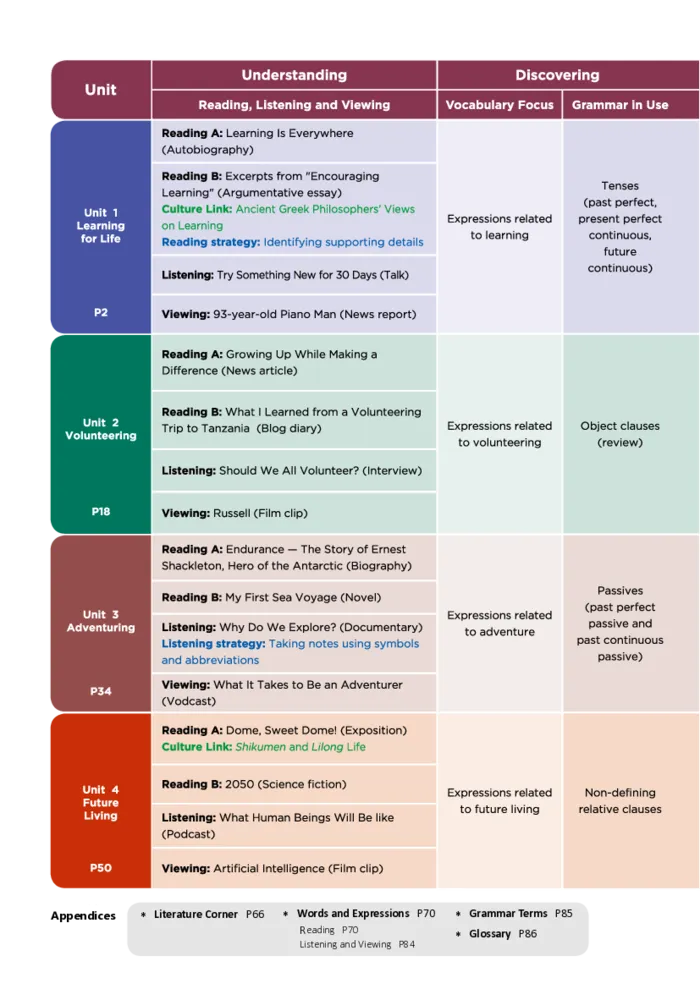
Appendices
*   Literature Corner   P66    *   Words and Expressions   P70
Reading   P70
Listening and Viewing   P84
*   Grammar Terms   P85
*   Glossary   P86
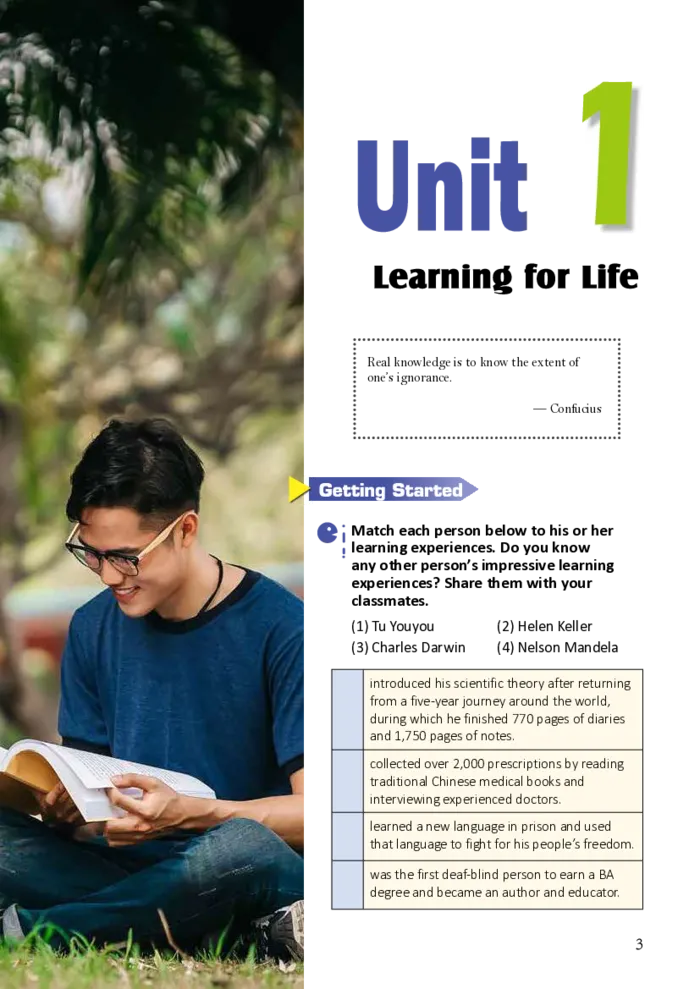
Match each person below to his or her
learning experiences. Do you know
any other person’s impressive learning
experiences? Share them with your
classmates.
(1) Tu Youyou
(2) Helen Keller
(3) Charles Darwin
(4) Nelson Mandela
Real knowledge is to know the extent of
one’s ignorance.

                                       — Confucius
introduced his scientific theory after returning
from a five-year journey around the world,
during which he finished 770 pages of diaries
and 1,750 pages of notes.
collected over 2,000 prescriptions by reading
traditional Chinese medical books and
interviewing experienced doctors.
learned a new language in prison and used
that language to fight for his people’s freedom.
was the first deaf-blind person to earn a BA
degree and became an author and educator.
Learning is never limited to classrooms. Instead, it may occur at home,
in the laboratory or in nature, which is well illustrated in the following
excerpts from three biographies.

Marie Curie
Like my sisters and brothers, I started
my study when I was only six years old.
Because I was the youngest and smallest
in the class, I was frequently brought
forward to recite when there were
visitors. This was a great trial to me,
away and hide. My father, an excellent
educator, was interested in our work and
knew how to help. He was very familiar
composed poetry himself. His little
poems on family events were our delight.
On Saturday evenings, he used to recite
or read to us the masterpieces of Polish
prose and poetry. These evenings were
for us a great pleasure and a source of
patriotic feelings. Gradually I acquired
a strong taste for poetry, and I willingly
learned by heart long passages from our
great poets and recited to others.
UNIT 1
Personal Touch
Do you have any learning experience similar to what is mentioned in the
text? If yes, share it with your classmates.
Charles Darwin
Towards the close of my school life,
my brother worked hard at chemistry,
and made a fair laboratory in the tool-
house in the garden, and I was allowed
to aid him in most of his experiments.
He made all the gases and many
compounds, and I read with great care
several books on chemistry. The subject
interested me greatly, and we used to
go on working till rather late at night.
This episode was the best part of my
education at school, for it showed me
science. The fact that we worked on
chemistry somehow got known at
school, and I was nicknamed “Gas.”
Nelson Mandela
I was no more than five when I
and calves in the fields. It was in the
out of the sky with a slingshot, to gather
wild honey and fruits, to drink warm,
sweet milk straight from a cow, to swim
in the clear, cold streams, and to catch
fish with twine and sharpened bits of
wire. One day I learned my lesson from
an unruly donkey. My friends and I had
been taking turns climbing up and down
its back and when my chance came I
jumped on and the donkey rushed into
a nearby bush. It bent its head, trying to
unseat me, which it did, embarrassing
me in front of my friends. Like the
people of the East, Africans have a
highly developed sense of dignity. I had
lost face among my friends. Even though
it was a donkey that unseated me, I
learned that to shame another person
is to make him suffer an unnecessarily
cruel fate. Later even as a boy, I defeated
my opponents without dishonouring
them.
Learning for Life
III. Answer the questions.
1. Which of the learning experiences in the text is the most impressive to you? Why?
2. Can you list some experiences outside the classroom which have been helpful to your
learning?
3. Can you recommend an autobiography that includes inspiring learning experiences?


Where
did learning
occur?

In the laboratory.

Who
did he/she
learn from?
Her father.
What
did he/she
learn?
It’s unnecessarily cruel
to shame a person.
How
did he/she
learn?
On Saturday evenings,
her father used to recite
or read the masterpieces
of Polish prose and
poetry to the family.
I. What do the three learning experiences have in common? List them from three
aspects. An example is given.
II. Complete the table with information from the text.
• All of the three learning experiences took place outside the classroom.
______________________________________________________________________
______________________________________________________________________
______________________________________________________________________
Comprehension
Identifying supporting details
Reading Strategy
UNIT 1
Vocabulary Focus
Today I read about the early learning experiences of three famous people: Marie
Curie, Charles Darwin and Nelson Mandela. Young Curie was frequently asked to
1 _________ in front of visitors. In the beginning, she considered it a(n) 2 _________
because she was a timid little girl. Fortunately, her father kept reading Polish
3 _________ to the family on Saturday evenings. With the help of this great 4 _________,
Curie gradually developed a taste for poetry and became willing to learn 5 _________
and recite poems. Young Darwin acquired a nickname of “Gas” because he used to help
his brother with his experiments in making gases and compounds in their laboratory.
By doing this, he learned, in a(n) 6 _________ way, the real meaning of experimental
science. In a manner different from that of the other two, young Mandela learned a
lesson from a(n) 7 _________ incident with a donkey. It managed to unseat him while
he was riding it. He 8 _________ and felt embarrassed. He learned that he would not
9 _________ his opponents by destroying their 10 _________.
John Goodenough, born 1922, was awarded the Nobel Prize in Chemistry 2019 for
his work on developing lithium-ion batteries.
As a child, Goodenough 1 _________ dyslexia, a learning disorder marked by
difficulty in reading and spelling. However, he taught himself to write and eventually
2 _________ to a boarding school. The rigorous and highly structured education there
paved the way for his 3 _________ at Yale University, where he graduated with honours in
mathematics. Shortly after World War II, Goodenough went to the University of Chicago
to 4 _________. He studied physics, a complete new subject for him. But he earned a
Ph.D. in 1952 and then went to work at MIT’s Lincoln Laboratory. In 1976, he was invited to
manage the Inorganic Chemistry Laboratory at Oxford University, where he researched the
properties of materials 5 _________ produce rechargeable batteries with higher energy
density. His 6 _________ led to the invention of safer, faster-charging and longer-lasting
rechargeable batteries for mobile devices, electric vehicles and energy storage systems.
bend
defeat
trial
cruel
educator
lose face
masterpiece unnecessarily
practically
recite
dignity
by heart
pioneering work
pursue further studies
struggle with
work on
major breakthrough
win a scholarship
in an attempt to
stand out
undergraduate study
be interested in
I. Key Vocabulary
Fill in the blanks with the appropriate forms of the given words and expressions to
complete the passage. Note that there are two more options than you need.
II. Topic-Related Expressions

Fill in the blanks with the appropriate forms of the given expressions to complete
the passage. Note that there are two more options than you need.
Learning for Life
I. Read the passage and think about why these tenses are used.
Grammar in Use
Tenses (past perfect, present perfect continuous, future continuous)
One day in August 1950, a steamship was sailing on the Pacific Ocean towards
China. On the ship, a young man was looking in the direction of his homeland. “I will be
working for my country soon,” he murmured. This man was Deng Jiaxian.
Since his childhood, Deng Jiaxian had been under the influence of his father, a well-
known philosopher and educator. When Beijing was occupied by Japanese forces in
Grammar Highlights
Uses
Examples
We use the past perfect to describe
something that happened before
another thing in the past.
• Since his childhood, Deng Jiaxian had
been under the influence of his father.
• Just nine days after he had gained his
degree, the Chinese nuclear physicist
stepped on the ship back to his country.
We use the present perfect to
talk about things where there is a
connection between the past and the
present. We use the present perfect
continuous when the focus is on an
activity that is unfinished.
• Our motherland has been suffering from
the Japanese attack for so long.
We use the future continuous to
talk about something that will be in
progress at or around a time in the
future.
• I will be working for my country soon.
• For the country’s dignity and future, you
will be studying science when you grow
up.
1937, the father told his son: “Our motherland
has been suffering from the Japanese attack for
so long. For the country’s dignity and future,
you will be studying science when you grow
up.” Later, after graduating from the National
Southwest Associated University, Deng Jiaxian
furthered his education at Purdue University.
Just nine days after he had gained his degree,
the Chinese nuclear physicist stepped on the
ship back to his country.
Receiving the honour at the age of 97, he 7 _________ among his fellow Nobel laureates.
Goodenough had been told many times in his career that he was too old to succeed,
but he had not taken it to heart. Now, at 97, he 8 _________ the next breakthrough. He
still goes to his laboratory every day, researching new types of batteries. He says, “I’m
only 97. I still have time to go.”
UNIT 1
II. Look at the pictures and describe the actions at different times.
past
past
now
9 a.m.
9 a.m.
6.30 a.m.
tomorrow
III. Liu Xin meets Wu Xuan at the campus. Fill in the blanks with the appropriate forms
of the given words to complete their conversation.
Liu Xin:
Hi, Wu Xuan. I 1 ____________ (not hear) from you lately. How’s everything
going?
Wu Xuan: I 2 ____________ (work) on my English recently because I 3 ____________
(take) an important test this time next week. I 4 ____________ (do) a lot of
exercises. I think I 5 ____________ (make) great progress.
Liu Xin:
Great! What have you 6 ____________ (learn) so far?
Wu Xuan:  Well, I 7 ____________ (improve) my listening skills greatly by listening to
English radio programmes every day. I 8 ____________ (begin) to do reading
exercises under the guidance of my English teacher three months ago. I was
told that he 9 ____________ (win) first place in the test many years ago. His
tips 10 ____________ (turn out) to be quite effective.
Liu Xin:
Lucky you! So you don’t  need to worry about the test.
6.15 a.m.
1. When I got up at 06:30 this morning, my mother __________ (prepare) toast and jam.
2. It is 9 a.m. now. I __________ (study) in my English class for 30 minutes.
3. My twin sister will have a chemistry lesson tomorrow morning. This time tomorrow
she __________ (do) an experiment at the lab.
Learning for Life
I. Tick the daily habit(s) that you would like to develop. You may add a habit to
the list if you want to.
II. Listen and answer.
According to the speaker, what can you achieve if you try something new for 30 days?
eating a balanced diet
reading for at least 15 minutes every day
doing sports on a regular basis
taking a nap after lunch
Try Something New for 30 Days (Talk)
III. Listen again and complete the notes.
Try Something New for 30 Days
Challenges:
(1) ________________
Hiking up Mt Kilimanjaro
Writing a (2) ________________
Benefits:
Becoming (3) ________________ and adventurous
Advice:
To make small and sustainable (4) ________________
93-year-old Piano Man (News report)
I. Look at the title of the video and predict what the video is about.
II. Watch the video and complete the sentences.
IV. Complete the diagram with your plan to develop a new habit.
1. Jack Prince joined the army during (1) ___________.
2.  Just now he had a piano lesson and is going to go home and (2) ___________ soon.
3.  His (3) ___________ is coming. Now he is preparing for his birthday party. He goes
to the Wisconsin Conservatory of Music, practising with his teacher for 45 minutes
every two weeks. He is considered a hard-working and (4) ___________ student.
playing a musical instrument
reflecting on what I have done every night
going to bed before 11 p.m.
_________________________

What is the habit?
How do you develop
the habit?
What are the challenges
of forming the habit?
• Jogging every day.
•
• Make a plan, find a partner
to go jogging with.
•
• Bad weather may prevent
me from jogging.
•
UNIT 1
• All learning has an emotional base. — Plato
• Education consists mainly in what we have unlearned. — Mark Twain
• Learning never exhausts the mind. — Leonardo da Vinci
• One more quote: ______________________________________________
I’ve been working in the Go Green Club since last October. Thanks to
this club, I’ve learned a lot about environmental protection and how to
cooperate with my teammates. Last month, we organised an event to reduce
food waste in the school canteen. Next Friday, we’ll be showing kindergarten
kids how to reuse and recycle glass bottles …
Conducting an interview about learning experiences outside the classroom
The school newspaper is conducting an interview about “What I’ve learned outside
the classroom.” Role-play the interview, asking for and sharing opinions.
III. Watch the video again. Choose the quote(s) that is/are related to it and explain
why. You may think of another quote.
Asking for opinions
Could you please share your thoughts on ...?
How does ... sound to you?
What’s your view on ...?
How do you feel about ...?
Giving opinions
As far as I’m concerned, ...
It seems to me that ...
Well, from my perspective ...
I believe/feel/imagine that ...

Work in groups. List some activities in your school that have helped you learn.

e.g. working in the Go Green Club

Talk about your learning experiences. Use the appropriate tenses.
EXAMPLE
Interviewer: Which school club impresses you the most?
Interviewee: It’s definitely the Go Green Club. I’ve been a member for over
one year. During this time, I’ve participated in many activities
that help to raise public awareness of environmental protection.
Interviewer: Sounds lovely. What have you learned from those activities?
Interviewee: Well, I’ve acquired some practical knowledge about
environmental protection. My sense of responsibility and team
spirit have also developed.

Role-play the interview based on what you have discussed.
EXAMPLE
 Step
1
 Step
2
 Step
3
Learning for Life
The gentleman says: Learning
should never cease.
Blue comes from the indigo plant
but is bluer than the plant itself. Ice is
made of water but is colder than water
ever is. A piece of wood as straight as a
plumb line may be bent into a circle as
true as any drawn with a compass and,
even after the wood has dried, it will
not straighten out again. The bending
process has made it that way. Thus, if
wood is pressed against a straightening
is put to the grindstone, it can be
sharpened. If the gentleman studies
widely and each day examines himself,
his wisdom will become clear and his
conduct be without fault.
I once tried spending the whole day
in thought, but I found it of less value
than a moment of study. I once tried
standing on tiptoe and gazing into the
distance, but I found I could see much
farther by climbing to a high place. If
you climb to a high place and wave to
someone, it is not as though your arm
were any longer than usual, and yet
people can see you from much farther
away. If you shout down the wind, it
is not as though your voice were any
stronger than usual, and yet people can
hear you much more clearly. Those who
make use of carriages or horses may
not be any faster walkers than anyone
else, and yet they are able to travel a
thousand li. Those who make use of
boats may not know how to swim, and
yet they manage to get across rivers.
The gentleman is by birth no different
good at making use of things.
Pile up earth to make a mountain
and wind and rain will rise up from
it. Pile up water to make a deep pool
and dragons will appear. Pile up good
deeds to create virtue and profound
there the mind of the sage will find
steps, you can never journey a thousand
li
can never make a river or a sea. The
finest thoroughbred cannot travel ten
paces in one leap, but the sorriest nag
UNIT 1
I. Answer the questions.
II. Below are three pairs of sentences selected from different translated versions of
“Encouraging Learning.” Decide which one you prefer, and explain why.
1.  Which sentence in the text shows the main idea of “Encouraging Learning”?
2.  Does Xunzi aim to persuade, inform, or entertain? How can you tell?
3.  Why does Xunzi mention plant, water, wood and metal in paragraph 2? What
function do a grindstone and a straightening board have in common?
4.  What makes people see farther, see more clearly, hear more clearly, travel
faster and get across rivers without having to know how to swim according to
paragraph 3? Why does Xunzi make such comparisons?
5.  What is the point of describing how to make a mountain and a deep pool in
paragraph 4?
6.  What do you think of the way Xunzi encourages learning? Can you suggest other
ways to encourage learning?
1-A Learning should never cease.
1-B Learning must never be concluded.
2-A Blue comes from the indigo plant but is bluer than the plant itself.
2-B Although blue dye comes from the indigo plant, it is bluer than indigo.
3-A Pile up earth to make a mountain and wind and rain will rise up from it. Pile up
water to make a deep pool and dragons will appear.
3-B If you accumulate enough earth to build up a high hill, rain and wind will
flourish because of it. If you accumulate enough water to fill a chasm, dragons
and scaly dragons will be born within it.
can go a ten days’ journey. Achievement consists
in never giving up. If you start carving and then
give up, you cannot even cut through a piece of
you can carve and inlay metal or stone.
Culture Link
Ancient Greek philosophers expressed
pearls of wisdom that stand up today. For
example, Socrates maintained that the
more we come to know ourselves, the
greater will be our ability to reason and
make choices that lead to true happiness.
He stated, “The only true wisdom is
in knowing you know nothing.” Plato,
who was a student of Socrates’ and the
founder of the Academy of Athens, the
first institute of higher learning in the
Western world, said, “Ignorance is the
root and stem of all evil.”
Ancient Greek Philosophers’
Views on Learning
Note
“Encouraging Learning” is a chapter in Xunzi, a Chinese
classic written by Xunzi (313–238 BCE), literally “Master
Xun,” who was a Confucian philosopher during the
Warring States period. This text was translated into
English by Burton Watson (1925–2017), an American
translator.
Comprehension Plus
Learning for Life
I. Reflect on the learning experiences referred to in this unit. Which one impresses you
the most? What factors have promoted learning in this case? An example is given.
II.  Work in groups. Think about your own learning experiences. Which factors listed
in the above table have promoted or may promote your learning? Discuss and rank
the factors in order of importance. Give your reasons.
People
Learning experiences
Factors
Marie Curie
learning poetry under her father’s guidance
and becoming a confident student
• parental influence
• a strong taste for
poetry
Explanation(s):
Ranking factors in order
of importance
Factor 2
________________
Factor 3
________________
Factor 1
________________
UNIT 1
Li Jun, who works for the Students’ Union, is organising
an event themed “Learning by Doing” for students in his
school and a sister school in Singapore. Below is a short
article he is going to post on the event website. Li Jun is
calling for more articles to be published on the website.
The Art of Learning by Doing
The idea of “learning by doing” proved effective in one of the most
unforgettable courses I took in the Art Club at school. To my surprise,
the course named “Introduction to Three Dimensional Design” was not
computer-based at all, but focused on materials and their properties
instead. One of the tasks was seeing what structure we could create
simply by folding pieces of paper. We were
encouraged to use our hands and cool tools
to make as many things as possible, such as
cranes, lanterns and frogs. Another task
was to see how many materials could be
removed from a wooden structure without
it collapsing. This course has given us useful
exposure to design principles because it
actively engaged us in the learning process.
Learning for Life
Step 3  Write a general statement about “learning by doing.”
Step 4  Think of your or other people’s experiences involving “learning by doing.”
List some details and indicate how the experiences are supportive of your
statement.
Step 5  Organise your personal experiences to support the general statement by
referring to the sample writing. Complete the article in 90–110 words.
Step 1  Read Li Jun’s website article and underline the sentences used as supporting
details.
Step 2  Which sentence below is more convincing? Why?
___________________________
(Statement) ____________________________________________________
______________________________________________________________
(Personal experiences as supporting details) ___________________________
______________________________________________________________
______________________________________________________________
______________________________________________________________
______________________________________________________________
(Concluding sentence)  ___________________________________________
______________________________________________________________
Guided Writing
A.  We were encouraged to use our hands and cool tools to make as many
things as possible, such as cranes, lanterns and frogs.
B.  We were encouraged to make many things.
e.g. The idea of “learning by doing” is becoming increasingly appealing to high
school students.
Personal experiences and observations are often used to support
a writer’s statements. They can be the writer’s own or someone
else’s experiences. Personal experiences can help to convince
readers if they are interesting, reliable, and are likely to remind
readers of their own experiences.
Using personal experiences as supporting details
Writing Strategy
UNIT 1

Fill in the table with information about your learning plan. An example is given.

Find classmate(s) with similar interests and form a study group, e.g. the piano
group, the drama group, etc. Share your ideas with group members and see how
you can learn from your role models.

Sort out your ideas and make a clear, detailed, and practical weekly plan for
each member of your group.
playing the piano
music club
the 93-year-old piano
man
•  taking online piano courses
•  practising about an hour every day
What to learn
Where to learn
Who to learn from
How to learn
Successful learning requires good planning. Work in groups to make learning plans.
Making learning plans
 Step
1
 Step
2
 Step
3
Look at the expected learning outcomes of this unit. Tick the items you think you
have done well.
Write a reflective note on what you think you need to improve. You may include
some or all of the following points:
What you still find difficult
Your plan to solve the problem(s)
Possible cause(s) of the problem(s)
Learning resources that you could use
  A. Recognising the value of out-of-class learning experiences and the
significance of lifelong learning
  B. Talking about learning experiences with effective use of tenses
  C. Grasping ancient Greek philosophers’ views on learning
  D. Ranking factors in order of importance
  E. Identifying supporting details in descriptive writing
  F.  Using personal experiences to support an observation
Learning for Life
You make a living by what you get, but you
make a life by what you give.

       — Winston Churchill
Look at the pictures and answer the
question.
Which of the following volunteer activities
have you ever done or heard about?
nursing home volunteer
school volunteer
environmental volunteer
nature reserve volunteer
There is an old saying about
volunteer work that goes like this: “No
one can do everything, but everyone
can do something.” Today, young people
around the world have volunteered to
help others in various ways. The future
is looking pretty bright with these
young people leading the way.
has worked hard all year to save
cheetahs from the very real threat of
to purchase GPS collars that track and
protect the animals, earning money by
selling lemonade, flowers and T-shirts,
and by organising skating parties and
a garage sale. Joris donated all that he
had raised to a wildlife conservation
organisation in Namibia where he and
his mother have volunteered for the
past three summers. “I’ve learned that
everyone can make a difference, even
if you’re just a kid!” Joris said. “You just
have to start somewhere.”
old twins, launched the Kids That Do
Good database to allow young people
to search for volunteer opportunities
started when the boys began cooking
meals to serve the homeless with a
family friend in his home kitchen. “We
UNIT 2
Personal Touch
List the different types of volunteer work mentioned in the text. Which would
you most like to do? Explain why.
asked him to take us with him to serve
the meals, but when he looked into it,
someone told him, ‘No, they are simply
too young,’” said Max. That’s when they
decided to start the website, which
receives an average of 100 visitors
every day and has a growing number of
organisations, such as animal shelters
and urban farming groups, requesting
to be listed.
Jackson, aged 17, has always
been aware of the issue of plastic
an environmental club. This year he
organised a march in Orange County to
raise awareness of water rights. Jackson
is also leading a campaign in his town
to promote the usage of reusable
restaurants to join our movement by
Xiao Meng, a 20-year-old student in
Beijing, is one of around 300 volunteer
tour guides in the Forbidden City. She
hangs around the palace like other
visitors, but with a red “volunteer”
card. It took her about three months
to remember every detail of the 176
clocks in the clock gallery of the Palace
Museum. Xiao Meng said she loves
spending time in the buildings where
25 emperors spent their whole lives.
“Every brick has a story to tell,” she
said.
Sometimes you may worry about
grades or get annoyed because
you don’t have the most expensive
sneakers or the latest computer games.
Volunteering gives you a chance to
value what you have and focus on the
truly important things in your life.
Volunteering
I. Choose the best answer.
II. Complete the table with information from the text.
III. Answer the questions.
1. This text is most probably from _______.

A. a letter
B. a poster

C. a newspaper
D. an advertisement
2.  The writer is trying to _______.

A. persuade readers to do volunteer work

B. inform readers of volunteer opportunities

C. entertain readers with fun facts about volunteering

D. provide information about exceptional volunteers
3.  According to the text, young people do volunteer work most probably
because they _______.

A. want to tell stories about volunteer work

B. find volunteering experiences rewarding

C. are eager to use their skills and knowledge

D. need to find out the truly important things in life
2. Find an example in the text that illustrates “making a difference.”
3. At the end of the text, the author says, “Volunteering gives you a chance to
value what you have and focus on the truly important things in your life.”
Comprehension
Who?
How old?
Why?
How?
Joris
10
cheetahs are under
threat of extinction.
collars that can track and
protect cheetahs.
Jake and Max
Jackson
Xiao Meng
UNIT 2
Vocabulary Focus
Young people in different places of the world have volunteered to help others using
their time, energy, knowledge and skills. For example, Joris, a 10-year-old boy in Seattle, has
helped to protect cheetahs from the t
to p
c
l_________ a database
to connect children with volunteer opportunities such as working for animal s_________
led a c_________ in his town to p
u_________ the local restaurants to sell more paper water bottles. Xiao Meng is a volunteer
tour guide in the Palace Museum. She worked hard to remember almost every detail of
the 176 clocks in the clock g_________ in order to offer tourists in-depth explanations. By
doing meaningful volunteering, young people can avoid getting a_________ at small things
in life and focus on what is truly important.
1. The best ______________ brings a destination to life with their knowledge,
storytelling skills, and passion.
2. Volunteering gives you an opportunity to switch your focus, connect you to others,
and involve yourself in activities that can ______________.
3. Volunteering can raise your confidence by offering you the chance to try something
awesome. You may discover talents that you ______________ previously.
cheetah extinction, ______________, and promote initiatives to protect the animals.
search for
wildlife conservation
    raise awareness
be aware of
lead a campaign
    rewarding experience
I.  Key Vocabulary
Fill in each blank with the appropriate form of a word from the text. The first letter is
given.
II. Topic-Related Expressions
Fill in the blanks with the appropriate forms of the given expressions to complete
the sentences. Note that there are two more options than you need.
Volunteering
I. Read the text below. Underline the object clauses, label the clauses with numbers
and put the numbers in the corresponding places in the table. The first one has
been done for you.
Grammar in Use
Object clauses (review)
Grammar Highlights
A sentence containing an object clause
usually has the following structure:
subject + verb + object clause
She observed that volunteering gave her
a sense of purpose.
The object clause should be in normal word
order with necessary tense changes.
5. The city has taken steps to reduce plastic pollution by ______________ of the
environmental impact of plastic waste and by imposing bans on single-use plastics.
6. The local government ______________ in the city to promote waste sorting.
7. Perhaps the key to a(n) ______________ is volunteering in areas of one’s interest.
Over 5,000 volunteers worked at the first China International Import Expo in
November 2018. The expo is part of China’s efforts to demonstrate that it is willing to
open its markets further to global trade. Jiang, a 29-year-old Communist Party member
and Metro worker in Shanghai, said she was proud to be part of another grand event in
her hometown after the World Expo. Jiang was one of the first 25 volunteers selected
by the Shanghai Youth League. After the interview, she was told where she would work,
what she was responsible for, whether her attendance would be recorded, and whom
she should report to. An experienced volunteer showed her how she could guarantee
to its source and waste oil was properly recycled. “Every detail matters. Every task is an
opportunity to learn something new,” Jiang said. She was delighted to do whatever she
could for her city.
Connectives
Examples
that / (/)
if, whether
what, which, who, whom, whose, where, when, how
whatever, whichever, whoever, whomever, wherever, whenever
UNIT 2
II. Fill in the blanks with proper connectives.
III. Xu Yuan went to an interview for a volunteer position
yesterday. Read the questions in the box and complete the
dialogue between Xu Yuan and her classmate James using
object clauses.
James:
Xu Yuan:  Pretty well. The interviewer said she would get back to me soon.
James:
Xu Yuan:  At first she asked me 1 _______________________. Then she wondered
2 _______________________.
James:
Xu Yuan:  After that the interviewer wanted to know 3 _______________________.
Then I was supposed to tell her 4 _______________________.
James:  Sounds like just the right question for you.
Xu Yuan: Probably. Finally, I talked about 5 _______________________.
James:  Well, you must have answered very well!
Xu Yuan:  You might be right. She seemed quite happy with my answers.
A. What is your greatest strength?
B. How will this strength enable you to be
a volunteer?
C. When would you like to serve as a
volunteer?
D. How does your work experience relate
to the volunteer position?
E. What are your expectations of the
volunteer position?
Some people probably assume (1) _________ volunteer work is “hard work
with no pay,” but in fact it can make an unbelievable difference in your life.
There are several things you can learn while volunteering. For instance, you
can find out (2) _________ type of work fits you and have a clearer career
goal. Volunteer work is also a great way to know (3) _________ you are
capable of being a real team player and (4) _________ you can work with.
Finally, volunteering is a brilliant way to find out (5) _________ your true
strengths and skills are.
Volunteering
II. Listen and answer.
I. List some of the benefits and challenges of volunteering and discuss them with
your partners.
Should We All Volunteer? (Interview)
III. Listen again and fill in each blank with no more than two words.
According to Sue, ...
•  It is important to do volunteer work
that is something (1) _____________
and means something to you.
•  It won’t help if the work is a(n)
(2) _____________ to you.
•  Very low levels of volunteering or
(3) _____________ volunteering probably
won’t benefit your health.
Benefits
Challenges
• developing a positive attitude
towards life
• lack of time
Volunteer Profile
   Name
Russell
Volunteer type
A Wilderness (1) _________
The volunteer work
he offers
_____________________________________________.
Why he offers help to Carl
Carl is an elderly man and probably needs some help.
What badge he needs
(3) __________________________________________.
Why he needs the badge
and attend a ceremony so that his dad will pin on his
badge.
Russell (Film clip)
I. Watch the first video clip and guess the relationship between the old man and the boy.
II. Watch the second video clip. Check your guesses and complete the volunteer
profile of Russell.
UNIT 2
Name

Answer to question 1

Answer to question 2
Answer to question 3
III. Answer the questions.
Reporting a mini-survey about volunteering
Conduct a mini-survey about volunteering in class and then report your findings.
Giving reasons
Giving examples
Owing to ..., people volunteer ...
That reminds me of ...
The reason for volunteering is that ...
Take ... for instance, ...
That is why people volunteer ...
What’s more, ...
Most people volunteer on account of ...
Take the case of ...
 Step 1     Work in a group of three or four. Each member asks a classmate outside their group
the following questions about volunteer work. Take notes by using the table.
 Step 2     Share your notes in the group and work together to find out why and how people
volunteer.
 Step 3     Select a group member to report your findings in class. Emphasise key points when
presenting.
Emphasising key points
Speaking Strategy
Here are a few tips for emphasising a point during presentation:
1. Say “It’s important to note that ...”, “I should stress that ...”, etc., before you

raise the point.
3.  Speak more slowly and emphasise key words.
Volunteering
Subscribe to this blog
Pippa Biddle
I was in Tanzania a few years ago as
part of a trip organized by the private all-
group consisted of 15 students, most of
whom were white, and a few teachers.
orphanage, a few pickup soccer games,
and a week-long safari.
Our mission at the orphanage was
to build a library. But it turned out that
we, a group of highly educated high
school students, couldn’t deliver on this
mission. We were so bad at the most
later, the local men who were helping us
had to secretly come back each night to
undo our work and rebuild the structure.
Our costs were covering not just one
to construct and the one built in secret
each night to replace it. Basically, we
failed at the only purpose of our being
orphanage to have taken our money to
hire locals to do the work.
Perhaps even more awkward was my
In the months leading up to our trip
to Tanzania, we collected hundreds of
at the orphanage. Most of them were
related to school and health, but we also
collected many hair styling products. I
had worn a hair band on my wrist for as
long as I could remember, so the idea
of collecting them for others seemed
logical. I always needed one, so why
Also, they were cute and fashionable.
It wasn’t until we arrived at the
orphans’ school and saw the beautiful
girls in their crisp uniforms that we
I hadn’t known that one of the regular
parts of the Tanzanian schoolgirl uniform
is a closely cropped head. The girl’s hair
is highly regulated by school officials.
We were later told that the haircut
is believed to increase productivity,
encourage focus on studies, and promote
personal cleanliness.
If I, with all my resources, had
taken just 20 minutes to research what
Tanzanian schoolgirls wear, I would have
This kind of volunteering trip I was
and with reason. The lesson I learned: if
do your research first. Don’t assume
that the things that you value and enjoy
are the same things people in another
country value and enjoy.
UNIT 2
I. Fill in the diagram with information from the text.
II. Answer the questions.
1. If you were one of the Tanzanian girls, what would you think of the hair band
2. Do you think it would be better for volunteers to do volunteer work in their local
Setting: an orphans’ school in Tanzania
Lesson: If you plan to take a volunteering trip, make sure to
(6) ________________________________________________.
What I Learned from a Volunteering Trip to Tanzania
Reality: Local men had to
(3) _______________ at night.
Result:
_________________________.
Reality: Local girls had a
(5) ______________________.
Result: No use.
Volunteer work:
(1) ______________________.
Expectation:
We would construct it
successfully.
Gift giving:
Giving gifts like (2) __________
_________________________.
Expectation:
African girls would like these
cute and fashionable products.
Comprehension Plus
Volunteering
I. Complete the table with information about two of the volunteer projects mentioned in
this unit. An example is given.
Analysing Volunteer Projects
II. If you were to choose one volunteer project initiated by your school, which of the
factors above would you consider first? What other factors may also influence your
decision?
Factors
Example Project
Project 1
Project 2
Venue
Where am I going to work?
Target group (=whom to help)
Who do I help?
Cheetahs.
What is the project for?
What goals do the volunteers
want to achieve?
To save cheetahs from
Task(s)
What do I do to help?
Raising money to purchase GPS
collars
and T-shirts;
and a garage sale.
Required skills
What skills should the volunteers
be equipped with?
Require
selling skills;
planning and organising skills.
cost the volunteers?
Identifying priorities in
order to make a decision
Culture Link
International Volunteer Day
The act of volunteering is found in all cultures. Each year, hundreds of millions
of people volunteer their time and skills to help make the world a better place.
When they volunteer, they help to improve the lives of others. And when they
volunteer, they also gain a greater sense of belonging to their communities. On 5
December, people around the world celebrate International Volunteer Day with
parades, volunteer fairs, group clean-ups, blood donations, conferences, and
exhibitions.
UNIT 2
The student editors working for the school WeChat official
account are planning a special column called “Voices of
Volunteers” to celebrate International Volunteer Day.
Below is a short essay they will publish in the column. You
are invited to contribute to the column.
Helping Others Helps You
helping others, and the others feel good
because they’re getting help.” Giving back
to your community is valuable in itself,
and helping others also brings you many
benefits. As an old saying goes: “The
fragrance of the rose lingers on the hand
that casts it.” The happiest people are
those who give and give generously.
Volunteering has a
positive effect on your
community — and it’s good
for you too. Ben, a college
student who did volunteer
work, called it “a win-win
feel good because you’re
Volunteering
Step 2
 Read the example below and pay attention to the sentences in different colours.
Note how quotes are used to support the writer’s argument.
Step 3
 Write a general statement about volunteering.
Step 4
 Interview volunteers around you or search the Internet to collect quotes in
support of your statement.
Step 5
 Organise the quotes to support the general statement by referring to the sample
writing. Complete your essay in 90–110 words.
__________________________
(Statement) ____________________________________________________________
______________________________________________________________________
(Quotes as supporting details) ______________________________________________
______________________________________________________________________
______________________________________________________________________
(Concluding sentence) ____________________________________________________
______________________________________________________________________
As an old saying goes: “The fragrance of the rose lingers on the hand that casts it.”
The happiest people are those who give and give generously.
The quote sandwich
Explaining your quote
Introducing your quote
Step 1  Read the text “Helping Others Helps You” and underline the sentences used as
supporting details.
Guided Writing
e.g. Volunteering is an efficient and effective way to broaden our horizons.
The quote sandwich format encourages writers to introduce quotes and discuss them
afterwards. Using a quote sandwich will help the reader to connect someone else’s
ideas to the writer’s and to understand why the quote supports the writer’s statement.
Keep in mind that quotes should be the supporter, not the supplier, of information in
an essay.
Using quotes as supporting details
Writing Strategy
UNIT 2

Decide on the type of volunteer

work suitable for your community.

Discuss the work, the number
of volunteers needed, volunteer
positions, responsibilities,
qualifications and the time of
work.

Design a “volunteers needed”
advertisement and post it on
the school bulletin board to find
volunteers to join your project.
A sample poster is given on the
right.
VOLUNTEERS
We Need You. Yes, YOU!
Position: Summer Camp Volunteer
Responsibilities
• Providing 1–6 graders with a safe and comfortable
learning environment
• Helping programme directors organise activities
• Informing programme directors of all incidents and
injuries as they occur
Qualifications
• Experience working with youth preferred
• Ability to work cooperatively with others
• Flexible and able to deal with unexpected situations
• Creative, responsible, and energetic
Time of work
• At least 2 days per week during the summer camp
programme
• 09:00 – 16:00, 8 July – 19 August.
Interested? Then contact Daniel at:
daniel@xxx.com
Work in groups. Plan a volunteer project
for your community on International
Volunteer Day.
Designing a “volunteers needed”
advertisement
 Step
1
 Step
2
 Step
3
Look at the expected learning outcomes of this unit. Tick the items you think you
have done well.
Write a reflective note on what you think you need to improve. You may include
some or all of the following points:
What you still find difficult
Your plan to solve the problem(s)
Possible cause(s) of the problem(s)
Learning resources that you could use
  A. Understanding the benefits and challenges of volunteering
  B.  Reporting a mini-survey about volunteering in class
  C.  Designing a “volunteers needed” advertisement with specific requirements
  D.  Getting priorities right in order to make a decision
  E.  Giving a presentation with key points properly emphasised
  F.  Writing an essay with quotes used as supporting details
Volunteering
Match the following mottos to the
corresponding adventure activities. What
sort of people are attracted to these
activities?
Adventure is not outside man; it is within.
    — George Eliot
A. Nothing else matters but the step ahead of you!
B. Dive into an unexplored environment!
C. Stay sharp. Don’t look down!
____ (1) rock climbing
____ (2) high ropes
____ (3) diving
The story began in 1914, with an
“Men wanted for a hazardous journey.
The man who had placed the
advertisement was the explorer,
Ernest Shackleton. He planned to
to the Ross Sea via the South Pole,
something no one had ever done
before. More than 5,000 men applied
to join the expedition. Only twenty-
eight were chosen.
Shackleton’s ship, the
,
left England on 8 August 1914 and it
was exceptionally bad and on 17
January 1915, the
 got stuck
in ice. Unable to move, Shackleton and
his men had to wait for eight months
in complete darkness and freezing
cold.
Finally spring came, but it brought
disaster. As the ice melted, the ship
broke in half. The crew had to abandon
ship and camp on the ice for two
 finally
What are some of the essential qualities of adventurers and
explorers? Read the text describing one of the greatest explorers
UNIT 3
Personal Touch
If you had the opportunity, would you try an expedition like the one led by
Ernest Shackleton? Why or why not?
sank on 21 November 1915, Shackleton
and his men tried to survive by
floating on the ice. Eventually the ice
melted and Shackleton put his men
into three small lifeboats and headed
for the nearest land.
Elephant Island. The men were cold,
exhausted, and weak from the journey
and the lack of food. There was no
chance of rescue in this remote place,
so Shackleton decided to continue
to South Georgia. He knew there
was a Norwegian whaling station
there, where he could get help, but
it was a journey of 1,300 kilometres.
Leaving the others on Elephant
Island, Shackleton chose five men to
accompany him to South Georgia in a
winds of sixty kilometres an hour and
waves of up to fifteen metres high,
they arrived in South Georgia. The
weather was so bad that they couldn’t
land for two days. Even when they
landed, their journey wasn’t over. The
whaling station was sixty kilometres
away on the other side of the
mountainous island. No one had ever
crossed South Georgia on foot before.
The men marched continuously
for 36 hours. They had no tent and
could not stop to rest for more than a
few minutes — if they fell asleep they
would die of the cold. Starved and
On 30 August 1916, two years
after the expedition began, they
returned to Elephant Island in a
small boat provided by the Chilean
government. The other twenty-three
men were still waiting. Miraculously,
not one person had died.
Shackleton even returned to
Antarctica. In 1921, he set out again
to sail round the continent, but
died during the journey in 1922.
He was buried in South Georgia,
remembered by history as a man who
showed exceptional leadership and
unbelievable endurance.
Adventuring
I. Answer the questions.
II. Fill in the blanks in the table.
III. Answer the questions.
 A. Nothing ventured, nothing gained.
 B. Better safe than sorry.
 C. The early bird catches the worm.
 D. Don’t cry over spilled milk.
 E. No pain, no gain.
 F. Actions speak louder than words.
Comprehension
Qualities of Ernest
Shackleton
Facts
A persistent explorer
• It took Shackleton and his men about four months to reach
• They got stuck in ice and waited for about (1) ________
months.
• They abandoned ship and camped (2) ________ for two
months.
• It took them five days to reach Elephant Island.
• It took them (3) ________ to reach South Georgia.
• They marched continuously for (4) ________ to reach the
whaling station.
A(n) (5) ________
leader
• Shackleton found no chance of (6) ________ and decided to
continue to South Georgia.
• He knew it was a journey of (7) ________.
• He chose five men to (8) ________ him and left the others
on Elephant Island.
A trustworthy man
by the Chilean government, the other twenty-three men
were still waiting on Elephant Island.
UNIT 3
I. Key Vocabulary
Fill in the blanks with the appropriate forms of the given words and expressions to
complete the passage. Note that there are two more options than you need.
Vocabulary Focus
Shackleton’s 1914 adventure, called the
 Expedition, was designed to cross
Antarctica. His ship, the
, was unfortunately stuck in ice and the 1 _________
had to spend their days in complete darkness and 2 _________ cold for eight months.
ice. They had no choice but to 3
the broken ship, Shackleton and his men eventually made it to Elephant Island. However,
since the island was 4 _________ from any shipping routes, it was unlikely that the men
would be 5 _________. In order to save themselves, Shackleton, 6 _________ by five
most trusted men, left most of his men on Elephant Island and 7 _________ for South
Georgia, 810 miles away. The 8 _________ in this part of the world can often reach 50
9 _________ in an open 23-foot boat! Almost three
weeks later, Shackleton and his men, extremely tired and 10 _________, reached a
by the Chilean government, the captain finally made his way back to Elephant Island to
save his men. Nobody died. Nobody!
sail
exceptional
set out
crew
starve
freezing
rescue
remote
accompany
sink
wave
abandon
Adventuring
I. Read the sentences and explain why the passive voice is used.
Grammar in Use
Passives (past perfect passive and past continuous passive)
1. A total of 28 men had been selected out of the applicants before Ernest Shackleton
set out for Antarctica.
2. It is said that South Georgia had never been crossed by explorers on foot before
Shackleton and his men’s expedition.
3. On 17 January 1915, the
 got stuck in ice. A lot of efforts were being made
to solve the problem when the ice melted and the ship suddenly broke in half.
NARRATOR: The year was 1915 and the outside world had no idea of the hazards they

1 _________ of the Antarctic winter and the 2 _________ on the journey, they were about to
be pushed to the limits of 3 _________.
PETER WORDIE

 scientific staff): My father
never — to any of us, his children — ever discussed the
 expedition … He never let
us read his log when he was alive. It was locked up.
MARY CREAN O’BRIEN (Daughter of the
 seaman Tom Crean): My father didn’t
4 _________ …
NARRATOR:
polar explorer with 5 _________, he knew that anyone that 6 _________ in this 7 _________
where there was no chance of rescue would starve to death. He knew it was up to him to get
his men out alive.
II. Topic-Related Expressions
Fill in the blanks with the appropriate forms of the given expressions to complete the
passage. Note that there are two more options than you need.
constant danger
chance of rescue
exceptional leadership
human endurance
remote place
head for
bitter cold
march continuously
a tough time
UNIT 3
II. Complete the review with the appropriate forms of the words in brackets.
Grammar Highlights
Yang Liwei was selected as an astronaut candidate in
1998 and 1 _________ (train) for spaceflight by the time of
the Shenzhou V launch. Before this launch, almost nothing
2 _________ (make) public about the Chinese astronaut
candidates; his selection for the Shenzhou V human spaceflight
3 _________ (leak) to the media only one day before the
launch.
4 _________
(launch) into space aboard his Shenzhou spacecraft on the top
of a Long March 2F rocket at Jiuquan Satellite Launch Centre.
Yang’s journey 5 _________ (monitor) to receive
regular updates about his condition until experts at the
We employ the passive voice to retain objectivity or to focus on the person or thing
affected by an action.
Past perfect passive
Subject + had been + -ed (+ by AGENT)
 had been delayed
Past continuous passive
Subject + was / were being + -ed (+ by AGENT)
 were being made for an
Indian wedding.

V started its eighth circuit around the Earth, Yang 6 _________ (speak) to his wife.
He said, “I feel very good. Don’t worry.” In the middle of the journey, Yang 7 _________
(wave) a small flag of the People’s Republic of China and that of the United Nations
inside his capsule. This 8 _________ (broadcast) by CCTV before it 9 _________ (meet) with
praise from around the world.
human spaceflight mission of the Chinese space programme. It 10 _________ (describe) by
NASA as an “important achievement in human exploration.”
Adventuring
Taking notes using symbols and abbreviations
Listening Strategy
II. Listen to the documentary and tick the items you hear about what explorers have done.
I. Work in pairs and discuss the question.
 building in outer space
 climbing mountains
 crossing oceans
 diving in oceans


 exploring new areas on lands
 flying in skies
 walking in outer space
 Periods of time
    Reasons
In the past
•  we wonder
d wh was on othr side of sky
   (we wondered what was on the other side of the sky.)
Now

II. Watch the second video clip and complete the chart with no more than two words
for each blank.
I. Watch the first video clip and guess: What is the man’s job?
III. Listen again and find out the reasons for exploration. Take notes using symbols and
abbreviations.
Why Do We Explore? (Documentary)
What It Takes to Be an Adventurer (Vodcast)
The man dreamed of becoming a(n)
(1) __________.
There were very few (2) __________.
The man gathered stories from his time
on the road.
He couldn’t (3) __________ anywhere.
The man started a radio show in his closet
and went on to (4) __________.
He has been doing the same thing for
(5) __________.
What the man did
What the man overcame
UNIT 3
crossing a desert
snow boarding
bungee jumping
mountain biking
III. Answer the questions.
Describing personal experiences
Expressing possibility
Back when I was …
There’s a chance ...
I remember when …
It’s possible that ...
One time (when) …
Possibly, ...
Performing a class live show: How adventurous are you?

Look at the pictures. Tick the activities you would love to try and cross those you
would be too nervous or scared to do.

Work in groups. Compare your answers with those of your group members. Who
has ticked the most activities in your group? Who is the most adventurous?

The most adventurous student will be the group representative to go to the front
to take questions. The audience can select any questions from the question cards
below or create new questions to ask the speaker. If a group representative cannot
answer a question within 15 seconds, he or she will be replaced by another group
representative. The one who can answer the most questions wins.
Do you think of yourself
Tell us.
Give an example.
If you were offered a
space trip, would you
adventure story, film,
 Step
1
 Step
2
 Step
3
Adventuring
All this time the storm increased
and the waves rose very high.
Although it was nothing like what
I have seen many times since, nor
even what I saw a few days later, it
was enough to make a big impression
on me, as I was only a young sailor
and knew nothing about the sea. I
expected every wave to eat us up and,
every time the ship dived down into
the depths of the waves, I thought we
would never come up again.
In this anxious state of mind,
I made many promises and good
resolutions that if my life would be
spared on this one voyage, I would
go directly home to my father if I
ever set foot upon dry land again and
would never set sail in a ship again
as long as I lived. I resolved that I
would listen to his advice and never
place myself into such a desperate
situation as this again. Now I saw
quite plainly the soundness of his
of life and I recognised how easily,
how comfortably he had lived all his
days and had never been exposed to
storms at sea or troubles on shore. I
thus resolved that I would go home to
my father.
These thoughts continued all the
while the storm lasted, and indeed for
some time afterwards; but the next
day the wind had died down and the
sea had become calmer and I began
to get used to it. However, I was very
serious throughout that day, being
also a little sea-sick still; but later on
the weather cleared up, the wind died
away and a charming, fine evening
clear evening sky and rose in the same
no wind and a smooth sea with the
sun shining upon it, the sight was, as I
ever seen.
I had slept well in the night and
was no longer sea-sick, but very
cheerful, looking with wonder upon
the sea that had been so rough and
terrible the day before and could be
so calm and so pleasant such a little
time later. And now, my friend, who
had persuaded me to go away to sea,
came up to me so as to make sure
back to my father’s house no longer
existed.
upon the shoulder. “How are you feeling
last night, weren’t you, when the storm
I. “It was a terrible storm.”
“A storm, you fool,” replied he.
nothing at all. Give us a good ship and
we think nothing of such a bit of wind
as that! But you’re only a freshwater
sailor, Bob. Come, let us forget all that.
Don’t you see what charming weather
UNIT 3
I. Answer the questions.
II.  Robinson Crusoe’s mood changed at different times of the sailing. Come up with
as many adjectives as possible to describe his mood. Some examples are given.
Note
This is an excerpt from
, a
novel written by Daniel Defoe (1660–1731).
First published in 1719, the novel tells the
story of a man who spent 28 years abandoned
on a desert island. This excerpt has been
adapted from Chapter 1 of the original text
and describes Robinson’s first sea voyage.
Parts of the trip
Mood
1. The storm increased and the waves rose
very high.
frightened; regretful; eager to go
back home
2. The wind had died down and the sea had
become calmer.
3. The weather cleared up, the wind died away,
and a charming, fine evening followed.
Comprehension Plus
Adventuring
How Do Different Cultures Deal with Failure
Dealing with failure, and learning from it, is in many cases the key to success. Different
cultures may have completely opposing attitudes to failure. In the USA, failure is seen as a
mere bump in the road to success. It is common in job interviews to invite candidates to
talk about their experiences with failure and how they overcame it. Yet in Japan, failing in
a business venture can be fatal to a person’s professional reputation. It would therefore be
unwise to share stories of your business failures with Japanese colleagues.
Culture Link
I.  In the table below, note details that show the similarities and differences between
Ernest Shackleton and Yang Liwei. An example is given for one of the aspects. You
may add one more aspect that you consider relevant.
II. In your view, which of the aspects is most likely to make an explorer remarkable?
Give examples to support your view.
Comparing and contrasting
Aspects
Ernest Shackleton
Yang Liwei
A. extreme weather
B.
C. constant danger
D. food shortage
E.
A, B, C, D, E
B, C
B, C / A, D, E
F. grit/endurance
G.
H. passion
I.
leadership
Drive
J. to push the boundaries
K. to explore the unknown
Team
L.

       support team
M.
Result
N. success (survival)
O. success (making history)
P. failure (death)
Q. failure (mission not completed)
UNIT 3
People who come from different cultural backgrounds
may hold different beliefs about adventure. The text
below is selected from a survey of Australians’ attitudes
towards adventure. Read and think: To what extent
are Chinese people’s beliefs different from those of
Australians? Prepare to conduct a mini-survey in class and
write an essay to report on your classmates’ beliefs about
adventure.
What Does Adventure Mean to Australians?
Figure 1   Australians’ definition of adventure
Getting off the
beaten track, 43.4%
Other, 1.1%
Seeing and doing
something new,
26.6%
Highly risky
activities, 22.5%
Travelling on a budget, 6.4%
Over the past 29 years, there has been a shift in Australians’ beliefs about adventure.
To survey how Australians describe adventure, we interviewed 1,000 people. As Figure 1
shows, 43.4% of the interviewees said adventure was “getting off the beaten track and
going to places less visited by ordinary tourists.” A total of 26.6% of them described it as
“seeing and doing something new.” Those who believed adventure was
“highly risky activities” accounted for 22.5%. Also, 6.4% of the people we
interviewed thought it was “travelling on a budget.” It can thus be seen
that in Australia what is adventurous to one person is not necessarily
adventurous to another.
Adventuring
Step 1
Read the sample text and underline the sentences used as supporting details.
Guided Writing
Step 2
Which sentence below is more convincing? Why?
A. A small percentage of the people we interviewed thought adventure was
“travelling on a budget.”
B. Also, 6.4% of the people we interviewed thought adventure was “travelling
on a budget.”
Step 3
Design and conduct your mini-survey in class. Analyse your data and write a
general statement about your findings.
Step 4
Describe and interpret the data you have analysed. Present the statistics in a
specific, relevant, and clear way to support your statement. For example, “68.2%”
sounds more convincing than “more than half.”
Step 5
Organise your statistical evidence to support the general statement by referring
to the sample writing. Complete the essay in 90–110 words.
e.g. The majority of my classmates hold a positive attitude towards adventure,
while a small percentage tend to relate adventure to dangerous situations.
My Classmates’ Beliefs about Adventure
(Statement) ____________________________________________________
______________________________________________________________
(Statistics as supporting details) _____________________________________
______________________________________________________________
______________________________________________________________
______________________________________________________________
______________________________________________________________
(Concluding sentence)  ___________________________________________
______________________________________________________________
Statistics are facts expressed in numbers, which allow writers
to support their statements with convincing evidence. They
also enable writers to draw clear conclusions. Statistics used as
supporting details should be specific, relevant, and clear.
Using statistics as supporting details
Writing Strategy
UNIT 3

Read the following news report.

Imagine that FAST has detected signs of life on other planets. Three items will
be sent in a parcel as symbols of life on Earth. Brainstorm suitable items (e.g. a
family photograph, a bottle of seeds, a volunteer’s badge) with your partner.
Explain your group’s choices to the class.
Planning an imaginary “space adventure”
China has put the finishing touches to FAST, the world’s biggest radio
telescope, whose 1,650-foot-wide dish will, among other tasks, scan the
universe for signs of intelligent alien life. “Located at an extremely radio-quiet
site, its scientific impact will be extraordinary,” said the FAST Project’s chief
scientist.

Discuss the questions with a partner.
Items
Reasons
 Step
1
 Step
2
 Step
3
Look at the expected learning outcomes of this unit. Tick the items you think you
have done well.
Write a reflective note on what you think you need to improve. You may include
some or all of the following points:
What you still find difficult
Your plan to solve the problem(s)
Possible cause(s) of the problem(s)
Learning resources that you could use
  A. Appreciating explorers of nature and their expeditions
  B.  Retelling and commenting on stories about adventure
  C.  Identifying different attitudes towards failure across cultures
  D.  Comparing and contrasting explorers and their experiences
  E.  Using symbols and abbreviations while taking notes
  F.  Writing a brief report with statistics used as evidence
Adventuring
We are made wise not by the recollection of
our past, but by the responsibility for our
future.

— George Bernard Shaw
The following are some predictions about
what life will be like in 50 years. Do you
think they will come true? Why or why
not?
Yes/No
1. Robots will do most of the
housework.
2. Few people will read printed
books.
3. Most buildings will be
solar-powered.
4. Many people will take food pills

Weather-proof, solar-powered, and
no housework to speak of!
Just imagine a house which cleans
itself, where robots prepare the meals,
where dusting, ironing, and DIY are
things of the past. Imagine a house
heated and powered by the energy
equivalent to just one gas ring, a house
in which you could actually go skiing …
The home of the future will be built
indoors, for a start. Small groups of
houses will nestle under gigantic glass
domes surrounded by lush trees and
roof-tops in the constant, computer-
controlled warmth.
will be made of glass. This will allow
flower borders, shrubs, and lawns to
grow well in that wasted space we
normally use for rubbish.
The house itself will be any style
or size you fancy. Being indoors, it will
need only a tiny amount of energy to
heat. Most of the power will come from
solar panels in the dome — the round
roof.
Forget front door keys. Your door
will be opened as soon as it hears
a voice it recognises. Your space-
Can you imagine what our future homes will be like? In what
ways do you think future homes might be different from the
homes of today?
UNIT 4
Personal Touch
Which advance(s) in technology mentioned in the text would you like to have
in your future home? Why?
age butler — the ultimate home
computer — will oversee security.
This discreet electronic servant will
control everything, from temperature,
humidity, and lighting to household
gadgets and cleaning chores. It’ll
pay the bills and order food, which is
delivered to your door. It’ll book your
holidays, order library books and even
help you with the crossword!
your guests leave, make it smaller
move backwards or forwards.
out ready to wear, thanks to the new,
a power wall where you will be able to
Gone, too, will be the good old-
fashioned duster — the air will be
filtered and then scented with your
favourite perfume.
There will be plenty of room for
fun! The sitting-room door will be the
entrance to a world full of endless
adventures. When you get bored,
simulators will provide any experience
you like from boating to surfing to
skiing.
Love them or loathe them, such
homes of the future are on their way.
Culture Link
Shikumen and Lilong Life
Homes have changed over time. Today, most of us live in high-rise, self-contained flats,
while decades ago, connected residential blocks with an intimate neighbourhood were
more common. Lilong, a neighbourhood of lanes with shikumen houses, is a historical type
of housing that was commonly found in Shanghai. At the height of their popularity in the
1930s, shikumen-style buildings housed as much as 80% of Shanghai’s total population.
Today, this proportion is much lower, as many Shanghainese families have been eager to
move to newer and more spacious homes, especially in the 1990s. The elderly residents,
who are used to the intimacy and conveniences of their neighbourhoods, have a more
difficult time leaving lilong life behind.
Future Living
I. What does the text tell us about the future home? Tick the predictions that are
mentioned in the text.
II. Find the details the author uses to support the following statements.
A. The home is a smart home.
B. The home can clean itself.
C. The home does not need any energy.
D. There is a butler for each home.
E. The future homes have a huge glass dome over them.
III. Answer the questions.
reasons.
Comprehension
EXAMPLE
Statement:
Less energy will be needed in the future home.
Details:

Being indoors, it will need only a tiny amount of energy to heat.

Most of the power will come from solar panels in the dome — the

round roof.
1. Statement:
People will be close to nature inside and outside the future home.
 Details:

2. Statement:
The future home will be any size you fancy.
 Details:

3. Statement:
There will not be much housework to do in the future home.
 Details:

4. Statement:
It will be fun to live in the future home.
 Details:
UNIT 4
Vocabulary Focus
When you are not home, some little doubts can start
to crowd your mind. Did I turn the lights off? Did I set the
1 ________ alarm? Is the temperature indoors too low for my pet?
With a smart home, you could quiet all these worries
with a quick look at your smartphone or tablet. You could
connect the 2 ________ devices in your home so they can
communicate with each other and with you. Of course, you will
have the 3 ________ control of all the smart devices at home.
Almost any device in your home that uses electricity
can be 4 ________ into your home network and under your
control. Most applications relate to lighting, temperature
control, home security, 5 ________ chores, and entertainment.
Living in a smart home, you will definitely enjoy more leisure
time. Also, as an electronic 6 ________ takes over almost all
the housework, the old-fashioned tools such as 7 ________
and steam irons will be gone. Much of this is due to the jaw-
dropping success of smartphones and tablet computers.
These ultra-portable computers are everywhere, and
their 8 _________ Internet connections mean they can be
designed to control numerous online devices from basement
to 9 ________. The idea of a smart home may sound like
something in 10 ________. However, the technology is real
and is becoming increasingly smart. It is especially useful
for the elderly and people with disabilities who wish to live
independently.
1. As technology is rapidly changing the world around us, many people worry that
_________ will replace human intelligence.
2. Some people believe that computers will soon take care of every statistical analysis,
describing data and predicting _________. Therefore, the human interpretation of
these data will become a much more important part of the future curricula.
3. What does the phrase “home of the future” mean? Does it mean a home with more
technology? Or very _________? It really depends on who you ask.
1. the activities involved
in protecting a
building
2.  connected with
electricity
single thing
5.  relating to a house or
6.  a person working in
dust
8.  that does not change
10. stories about events
I.  Key Vocabulary
Fill in the blanks with words or expressions from the text to complete the passage.
Refer to the explanations in the box if necessary.
II. Topic-Related Expressions
Fill in the blanks with the appropriate forms of the given expressions to complete
the sentences. Note that there are two more options than you need.
Future Living
I. Read the passage and think about why the relative clauses are used.
Grammar in Use
Non-defining relative clauses
Grammar Highlights
As the name suggests, non-defining relative clauses tell us more about someone or
something, but the information in these clauses does not help us to define what we
are talking about.
• The time is in the early 22nd
century, when the Sun has aged
and is about to destroy the solar
system.
The non-defining relative clause tells
us something more about the early
22nd century.
• In order to survive, the human race
builds 10,000 huge engines which
slowly push the Earth out of the
solar system.
The defining relative clause
tells us what the huge
engines are.

clause from the rest of the sentence.
A famous science fiction writer in China, Liu Cixin, who is a winner of the 2015 Hugo
Award, wrote the short story “The Wandering Earth” more than 20 years ago. The story
is set in the early 22nd century, when the Sun has aged and is about to destroy the solar
system. In order to survive, the human race builds 10,000 huge engines which slowly
push the Earth out of the solar system. As the planet moves away from the Sun, much of
its surface is frozen in abnormal weather conditions, forcing human beings to live in vast
underground cities that are built next to the engines. It takes 20 years to reach Jupiter,
which should assist in the escape of the frozen Earth with its massive gravity. Yet things
go very wrong on the day when the Earth is passing Jupiter …
4. It’s likely that windows will disappear from airplanes altogether so that planes are
stronger and better equipped to handle faster speeds. _________ will make it possible to
entirely replace windows.
5. We might be currently daydreaming of _________ but the future might well be
screenless. There are already plenty of devices that can beam usable screens onto your
skin, clothing, or other surfaces.
6. We’re not quite in a world where we can magic up anything we want out of thin air.
But _________ is coming along quickly and companies are already experimenting with
printing food.
7. Analysing data on which show, series, and movie you watch, when you pause and repeat,
company creates a(n) _________ on each customer and provides an individualised
entertainment service.
UNIT 4
II. Combine each pair of sentences into one sentence with a non-defining relative
clause.
III. Below is a story with some information missing. Use sentences a–d to fill in the
blanks, changing them into proper non-defining relative clauses.
EXAMPLE
a.  I had to fix my smartphone.
b.  I bought this smartphone a year ago.

I had to fix my smartphone, which I bought a year ago.
1. a. Stephen gave a talk about how humans will live on another planet within the

next generation.

b. Stephen’s talk has been viewed by 1.5 million people.

________________________________________________________________

________________________________________________________________
2. a. Dr Johnson says 10 million self-driving cars will be on the road within the next

five years.

b. Dr Johnson works for a large car company.

________________________________________________________________

________________________________________________________________
That night, Margie took out her diary. On the page headed 17 May 2157, she wrote,
“Today, Tommy found a real book!”
It was a very old book, 1 ______________________________________. The words
didn’t move the way they did on a screen, 2 __________________________________.
It was even funnier when the words stayed on the page even after they read them.
Margie wondered where Tommy found the book. Tommy told her it was found in the
attic of his house, 3 ____________________________________. He also told her the book
was about school.
Margie always hated school. She disliked her mechanical teacher, 4 ________________
“Because it’s not our kind of school, stupid. This was hundreds of years ago.” He added
proudly, pronouncing the word carefully, “More than a century ago.”
Future Living
II. Listen to the podcast and answer the questions.
I. Read the predictions about future human beings. Tick the predictions you agree
with and give your reasons.
1. What reliable predictions are made for what human beings will be like in 5,000
 1. Humans will be taller.
 2. Humans will be smarter.
 3. Humans will be healthier.
 4. Humans will be busier.
What Human Beings Will Be Like (Podcast)
III. Listen again and fill in each blank with no more than three words.
IV. Discuss the question.
Artificial Intelligence (Film clip)
I. Watch the film clip and answer the questions.
Predictions about future human beings
Height
Human beings will (1) __________ to grow taller.
Brain
They will have to use their brains more often, and (2) __________
human brains will become more and more substantial.
Head
The forehead will grow (3) __________.
Eyes
Over a very long (4) __________, human eyes will certainly grow
stronger.
Arms and legs
They are likely to grow less and less (5) __________.
Fingers
Human fingers will grow more (6) __________ because they are used
a great deal in modern life.
Hair
Hair may disappear from the body altogether over the course of time
because it does not serve (7) __________ any longer.
UNIT 4
1. The boy’s name is __________.

A. Dan                     B. David                     C. Davis                     D. Damian
2. The woman says that the boy is __________.

A. a real boy
B. unique in the world

C. an adorable child
D. deeply loved by his mother
3. We can predict from the conversation that __________.

A. the boy will become a real boy

B. the boy will be taken to a new house

C. the boy’s mother will be brought back to life

D. the boy will be given some presents
II. Watch the film clip again and choose the best answer.
Debating how AI impacts on human intelligence
Past
Present
Future with AI
wrote letters
send emails, send WeChat messages, etc.
travelled in carriages
travel in high-speed trains
The robot’s job
What will you do?
To walk my dog on rainy days.
To stay at home reading a novel.
(1)
(2)
(3)
Agree
That’s right.
Exactly.
I couldn’t agree more.
I see exactly what you mean.
Partly Agree
I agree up to a point, but ...
I see your point, but ...
That’s partly true, but ...
I’m not so sure about that.
Disagree
I’m afraid that is not the case.
That’s not the way I see it.
I’m not sure about that.
It’s not necessarily the case.
Expressing agreement or disagreement
Speaking Strategy
It is a good idea to express your opinions. However, it is not enough to just say
“I agree/disagree.” Give reasons to support your view.
Step 1
How did technologies change our life in the past? How will AI
change our life in the future? Brainstorm ideas of changes and
complete the table with as much information as possible.
Step 2
Imagine you have a robot to help you at home and school. Which job would you like
your robot to do, and what might you do instead? List the top three possibilities.
Step 3
Do you think robots will make humans more or less intelligent? Have a debate in
class. You can use the following expressions.
Future Living
My lights turn on automatically.
It’s 6.50 a.m. and the house is waking
me up. Still sleepy, I find my uniform
in the wardrobe and put it on. It has
been washed, ironed, and hung up the
night before by Lina X15 –– my family’s
housekeeper. When I was younger, she
was my nanny. She’s been with me all
my life. My parents didn’t have time
as a reliable helper, looked after me.
That’s why my parents bought her.
Almost everyone has an X15 today.
I enter the kitchen. My breakfast
sits there, waiting for me. Always
the same. Planned, with a controlled
quantity. The government says our
Food is grown in laboratories, and
every house receives just enough food
–– no more, no less. Mum always talks
about the old days when people had
vegetable gardens and could go to the
market to buy food. Animals actually
lived in the wild and not in carefully
controlled zoos. It’s all I’ve ever
known.
Robots are everywhere now; they
are usually referred to as “zoids.”
When they first came on the market
in 2030, everyone wanted one. Now,
twenty years later, they’ve taken over.
They do almost everything. They work
in labs and factories, fix teeth and
perform surgery. My dad used to be a
surgeon before they found that “zoids”
Less room for error, I guess.
I walk to the window and look
out over the landscape. All I see are
Grey skyscrapers, all identical. I can
spot my school — it is just over to the
right, but it looks the same as every
other building. Today we are having
a lecturer from Los Angeles speak to
us about the extinction of different
species of animals, like the polar bear
and the elephant. I find it strange
that even with all our technology, we
couldn’t save them.
I feel a tap on my shoulder. I turn
around.
“It’s time for school,” Lina says,
her metallic voice echoing around the
room, “Don’t be late.”
“On my way,” I reply. “I’ll be back
by 6 p.m.”
I rush out the door and go down
60 floors to join the other children
in my building. We’ve always walked
through the tunnels to get to school.
We’ve always breathed recycled air.
We are children who have never
been outside. I wonder what it’s like.
Perhaps Lina can explain it to me.
UNIT 4
I. Complete the table with information from the text.
II. Answer the questions.
Predictions about the future
2.  Do you think the overpopulation problem mentioned in the text might arise in
3.  Do you think the animal extinctions mentioned in the text are likely to happen
4.  The children breathe recycled air in the story. Do you think that will happen in
Aspects of future life
Predictions
Future housework
Robots will do most of the housework.
Future food
Future jobs
Future buildings
Future environment
Comprehension Plus
Future Living
I.  Reflect on the predictions about future life in this unit and note in the form of
keywords what they have in common. Some examples are given below.
II. Say which prediction you think is the most likely and which is the most desirable.
Explain why. Make some predictions about the future that you think are both likely
and desirable.
[A keyword is a word or a phrase that represents the main feature or idea of something.]
Commenting on ideas and
proposing new ideas
computer-assisted
Predictions about
future life
robot-supported
efficient
UNIT 4
Nowadays, writing letters to FutureMe is quite popular among
high school students. Xu Wen, a first-year college student in
Shanghai, posted on her blog:
“I love this. I've sent myself five letters so far and every year it's
a surprise. Because I forget so easily, it turns into such a deep
reflective process that I usually weep and laugh while I write.”
Below is a letter she wrote to herself three years ago. Could you
also write a letter to your future self?
I hope this letter finds you well.
My life is messed up now. I’ve failed my English exam twice. I’m sick and
tired of things around me.
I’m writing this because I’m trying to sort out my life right now. Hopefully,
by the time you read this, things will be better. For instance, you’ll get
into college, and I hope you’ll be majoring in what you love. Please also
tell me you’re going out with your friends more. Oh, I think you’ll be done
learning French, then German (maybe Spanish, too).
You’re so amazing. I know you don’t think you are, but you’re so smart
and you’ll end up living a brilliant life.
Best wishes,
Me
YOUR FUTURE LETTER
DELIVER IN
MAKE THIS LETTER
YOUR EMAIL ADDRESS
Public
5 Years
Choose a Specific Date
Dear FutureMe,
1 Year
Private
SEND TO THE FUTURE!
3 Years
Future Living
A  My life is messed up now. I’ve failed my English exam twice. I’m sick and tired of
things around me.
B  My life is messed up now. It’s the beginning of a new semester here. Everyone is
super busy.
e.g. I lack confidence in public speaking.
Step 1 Read Xu Wen’s letter and underline the sentences used as supporting details.
Step 2 Which sentence below is more effective? Why?
Step 3 Write a general statement about your current situation.
Step 4 Think of some examples relating to your current situation, e.g., you feel very
nervous when asked to give presentations in class.
Step 5 Organise your examples to support the general statement by referring to the
sample writing. Complete the letter in 90–110 words.
Using examples as supporting details
Writing Strategy
Guided Writing
A letter to FutureMe
Dear FutureMe,
______________________________________________________________
______________________________________________________________
______________________________________________________________
______________________________________________________________
______________________________________________________________
______________________________________________________________
__________________,
Me
UNIT 4
Creating a daily routine in 2050

Work in groups. Imagine you
travel to the Year 2050 in a time
machine. What would your
typical day be like? Brainstorm
ideas and develop a mind map.

Prepare a presentation describing
your daily routine in 2050.

Select a group representative to give
the presentation to the class.
 Step
1
 Step
2
 Step
3
Look at the expected learning outcomes of this unit. Tick the items you think you
have done well.
Write a reflective note on what you think you need to improve. You may include
some or all of the following points:
What you still find difficult
Your plan to solve the problem(s)
Possible cause(s) of the problem(s)
Learning resources that you could use
  A.  Absorbing information about an imaginary future life
  B.  Describing what human beings, homes and societies will be like in the future
  C.  Reflecting on the impacts of scientific developments on society
  D.  Giving comments and proposing new ideas
  E.  Expressing agreement or disagreement in discussion
  F.  Using relevant and specific examples to clarify a statement
Future Living
iterature Corner
L
iterature Corner
L


adv. readily and
enthusiastically


n. a person who writes
poems


v. (formal) to help sb/sth to do
sth, especially by making it easier
n. money, food, etc. that is sent to help


n. a
study what happens and to gain new
knowledge


n. any substance like air
that is neither a solid nor a liquid, for
example hydrogen and oxygen are both
gases

 a particular type of gas or mixture
of gases used as fuel for heating and
cooking
n. a substance
formed by a chemical reaction of two
relative to each other

 a thing consisting of two or more
separate things combined together
adv. in a
realistic or sensible way; in real
situations
almost; very nearly
adj.

 based on new ideas, forms or methods
they have


adv. often


v. to say a poem, piece
of literature, etc. that you have learned,
especially to an audience


n. an experience or a

 a formal examination of evidence in
court by a judge and often a jury, to
decide if sb accused of a crime is guilty
or not


n. (formal) a
person whose job is to teach or educate
people
adj. belonging to or
relating to Poland, its people, or its
language


n. a collection of
poems; poems in general


v. to write a
letter, speech, poem, etc. usually with a
lot of care and thought

(formal) to combine together to form a
whole
n. writing that is not
poetry
adj. having or
expressing a great love of your country
v. to gain sth by
your own efforts, ability or behaviour


adv. for a reason
that you do not know or understand
v. to give sb/
sth an informal, often humorous, name
for a person that is connected with
their real name, their personality or
appearance, or with sth they have done

 n. an informal, often humorous, name
for a person that is connected with
their real name, their personality or
appearance, or with sth they have done
n. a boy who
takes care of a group of animals such as
sheep and cows in the countryside
n. a young cow

 the back part of the leg between the
ankle and the knee
n. (NAmE) a stick
shaped like a Y with a rubber band
attached to it, used by children for
shooting stones


v. to collect plants,
fruit, etc. from a wide area


n. a sweet sticky yellow
substance made by bees


n. a small narrow river

n. strong string that
has two or more strands (= single thin
pieces of thread or string) twisted
together


n. metal in the form of thin
thread; a piece of this
adj.
control or manage
n. an animal of the
horse family, with short legs and long
ears. People ride donkeys or use them
to carry heavy loads.

n. a plant that grows thickly
with several hard stems coming up
from the root
v. to make sb fall off a
horse or bicycle

 to remove sb from a position of power


v. to make
sb feel shy, awkward or ashamed,
especially in a social situation


n. a sense of your
own importance and value

 a calm and serious manner that deserves
respect


v. to experience sth
unpleasant, such as injury, defeat or
loss
n. the things, especially
bad things, that will happen or have
happened to sb/sth


v. to win against sb in a
war, competition, sports game, etc.

 n. failure to win or to be successful


n. a person that
game, competition, argument, etc.
( ) v. (formal) to
make sb/sth lose the respect of other
people
n. (formal) a loss of honour or respect
because you have done sth immoral or
unacceptable


v. (formal) to stop
happening or existing; to stop sth from
happening or existing
n. a plant which was
formerly widely cultivated as a source
of dark blue dye
the dark blue dye obtained from the
indigo plant
 a piece of thick string with
a weight attached to one end, used
whether a wall, etc. is straight


n. (also
compasses) an instrument with two
long thin parts joined together at the
top, used for drawing circles and
measuring distances on a map
with a needle that always points to the
north


n. a method of
doing or making sth, especially one that
is used in industry


adv. (formal) in this way;
like this

 (formal) as a result of sth just
mentioned


v. to push sth closely and
way

 n. (often the Press) newspapers and
magazines


n. a type of solid mineral
substance that is usually hard and shiny
and that heat and electricity can travel
through, for example tin, iron and gold

n. a round
stone that is turned like a wheel and
is used to make knives and other tools
sharp


n. the ability to
make sensible decisions and give good
advice because of the experience and
knowledge that you have


n. (formal) a
person’s behaviour in a particular place
or in a particular situation


v. (formal) to organise and/
or do a particular activity


n. a point that is a
particular amount of space away from
sth else

 the amount of space between two
places or things


v. to move your hand or
arm from side to side in the air in order
to attract attention, say hello, etc.

 n. a raised line of water that moves
across the surface of the sea, ocean, etc.

n. a road vehicle,
usually with four wheels, that is pulled
by one or more horses and was used in
the past to carry people

 (BrE) (NAmE Car) a separate section of
a train for carrying passengers

v. to put things one on top of
another; to form a pile


n. (in Chinese
mythology) a large snake-like animal
with claws, which can control water
and is seen as a symbol of power,
strength, and good luck

n. (formal, literary) a thing
that sb does that is usually very good or
very bad


n. (formal) behaviour
or attitudes that show high moral
standards

adj. showing
great knowledge or understanding

 very great; felt or experienced very
strongly

n. (formal) a very wise
person


n. an
animal, especially a horse, of high
quality, that has parents that are both of
the same breed


n. an act of stepping once
when walking or running; the distance
travelled when doing this

 the speed at which sb/sth walks, runs or
moves

n. a long or high jump

n. a horse, especially one
that is too old to be useful


n. a thing
that sb has done successfully, especially
using their own effort and skill


v. to make objects,
patterns, etc. by cutting away material
from wood or stone

adj.  (of food, wood,
etc.) that has decayed and cannot be
eaten or used

v. to continue to do sth
way that can seem unreasonable

v. to decorate the surface
of sth by putting pieces of wood or
metal into it in such a way that the
surface remains smooth


n. a person who
does a job without being paid for it

 v. to offer to do sth without being
forced to do it or without getting paid
for it

n. a wild animal of the
cat family, with black spots, that runs
very fast


n. the possibility of
trouble, danger or disaster


v. (formal) to buy
sth

 n. formal the act or process of buying
sth


n. a band of leather
or plastic put around the neck of an
animal, especially a dog

 the part around the neck of a shirt,
jacket or coat that usually folds down


v. to get money for work that
you do

n. a drink made
from lemon juice, sugar and water


v. to give money, food,
clothes, etc. to sb/sth, especially a charity

n. animals, birds,
insects, etc. that are wild and live in a
natural environment


n. a
group of people who form a business,
club, etc. together in order to achieve a
particular aim


n. one of two children born
at the same time to the same mother


v. to begin sth such as
a plan or introduce sth new such as a
product


n. an organised
set of data that is stored in a computer
and can be looked at and used in
various ways


n. a building, usually
owned by a charity, that provides a
place to stay for people without a home,
or protection for people or animals who
have been badly treated
the fact of having a place to live or stay,
considered as a basic human need


adj. connected with a
town or city


v. (formal) to ask
for sth or ask sb to do sth in a polite or
formal way

 n. the action of asking for sth formally
and politely


n. a light strong
material that is produced by chemical
processes and can be formed into
shapes when heated. There are many
different types of plastic, used to make
different objects and fabrics.


n. an organised walk by
many people from one place to another,
in order to protest about sth, or to
express their opinions


n. an area of Britain,
Ireland or the US that has its own
government


n. a series of
planned activities that are intended to
achieve a particular social, commercial
or political aim


v. to help sth to
happen or develop

adj. that can be
used again


v. to advise or try hard to
persuade sb to do sth


n. a group
of people who share the same ideas or
aims


n. a room or building
for showing works of art, especially to
the public


n. the ruler of an
empire


n. baked clay used for
building walls, houses and other
buildings; an individual block of this

adj. the most recent or
newest


 a school where
children can live during the school year

n. a home for
children whose parents are dead

adj. (NAmE) (of a
sports game) often not planned in
advance and that anyone who wants to
can join in


n. (BrE also football)
a game played by two teams of 11
players, using a round ball which
players kick up and down the playing
other team’s goal.


n. an important
people is given to do, especially when
they are sent to another country


adj. having had
a high standard of education; showing a
high standard of education


v. to do what you
promised to do or what you are
expected to do; to produce or provide
what people expect you to


n. the
process or method of building or
making sth, especially roads, buildings,
bridges, etc.

v. to cancel the effect of
sth

to open sth that is fastened, tied or
wrapped


n. a thing that
is made of several parts, especially a
building

 the way in which the parts of sth
are connected together, arranged or
organised; a particular arrangement of
parts


v. to employ sb for a short
time to do a particular job

 (especially NAmE) to give sb a job


adj. making you
feel embarrassed


n. lack of success in
doing or achieving sth

n. the act of cutting
and/or shaping hair in a particular style


n.
of any material that is put around things,
for example to hold them together or to
make them stronger


adj. (of an action,
event, etc.) seeming natural, reasonable
or sensible


adj.
following a style that is popular at a
particular time

adj. (of paper or cloth )
fresh and clean; new and slightly stiff
without any folds in it

 (of food) (also crispy) pleasantly hard
and dry
adj.
belonging to or relating to Tanzania or
its people


n. the special set
of clothes worn by all members of an
organisation or a group at work, or by
children at school


( ) adj. usual


v. to cut sb’s hair very short

 n. a plant that is grown in large
quantities, especially as food

v. to control sth
by means of rules


n. a person who is
in a position of authority in a large
organisation

 adj. connected with the job of sb who is
in a position of authority


n. the style in which
sb’s hair is cut

n. the
rate at which a worker, a company
or a country produces goods, and the
amount produced, compared with how
much time, work and money is needed
to produce them


n. sth that can be
used to help achieve an aim, especially
a book, equipment, etc. that provides
information for teachers and students

 a supply of sth that a country, an
organisation or a person has and can
use, especially to increase their wealth


v. (BrE also -ise)
to say that you disapprove of sb/sth;
to say what you do not like or think is
wrong about sb/sth


n. what you
intend or plan to do; your aim


v. to think or accept
that sth is true but without having proof
of it

n. the ability
for a long period of time without
complaining


n. a
people about a product, job or service

adj. involving
risk or danger, especially to sb’s health
or safety


n. a regular amount of
money that you earn, usually every
week, for work or services


n. a person who
travels to unknown places in order to

prep. through a place


n. either of the two points at
the opposite ends of the line on which
the earth or any other planet turns

n. an
organised journey with a particular
place that is not well known


adv.
used before an adjective or adverb to
emphasise how strong or unusual the
quality is

adj. unable to move or to
be moved


adj. extremely cold


n. an unexpected
event, such as a very bad accident, a
or causes a lot of damage

v. to become or make sth
become liquid as a result of heating


n. all the people working
on a ship, plane, etc.


v. to leave a
thing or place, especially because it is
impossible or dangerous to stay

 to leave sb, especially sb you are
responsible for, with no intention of
returning


v. to go down below the
surface or towards the bottom of a
liquid or soft substance


v. to continue to live
or exist

 to continue to live or exist despite a
dangerous event or time

v. to stay on or near the
surface of a liquid and not sink

 to move slowly on water or in the air

n. a small boat
carried on a ship in order to save the
people on board if the ship sinks

 a special boat that is sent out to rescue
people who are in danger at sea

adj. very tired


n. the act of saving
situation; the fact of being saved
v. to save sb/sth from a dangerous or
harmful situation

adj.
belonging to or relating to Norway, its
people, or its language


n. the activity or
business of hunting and killing whales

adj. making
you feel very tired


v. to walk somewhere
quickly in a determined way

adv. in a
way that happens or exists for a period
of time without interruption

n. a shelter made of a large
sheet of canvas, nylon, etc. that is
the ground, and is used especially for
camping


v. to suffer or die
because you do not have enough food
to eat; to make sb suffer or die in this
way


adj. (of people or
parts of the body)  extremely cold

adj. belonging to or
relating to Chile or its people


v. (of a boat or ship or the
people on it) to travel on water using
sails or an engine

 n. a sheet of strong cloth which the
wind blows against to make a boat or
ship travel through the water


n. one of the
large land masses of the earth such as
Europe, Asia or Africa


v. to place a dead body in
a grave


adj.
unusually good


n. the ability
to be a leader or the qualities a good
leader should have

 the state or position of being a leader

adj.
(informal) used to emphasise how good,
bad or extreme sth is
be true


n. a long journey,
especially by sea or in space


n. the effect
that an experience or a person has on
sb/sth

 an idea, a feeling or an opinion that you
get about sb/sth, or that sb/sth gives
you


n. a person who works
on a ship as a member of the crew


v. to go to a deeper level
underwater

 to jump into water with your head and


n. the distance from the
top or surface to the bottom of sth


n.
decision to do or not to do sth


v.
decision to do sth


adj.


adv.

n.


n.


v.


n.


v.


adv. (formal, especially
BrE

adv.
(especially BrE


adj.


adj.

adj.

adv.

adj.


v.


v.


adj.

adj.


n. a round roof


adj. (in compounds) that
can resist or protect against the thing
mentioned

 n. information, documents, etc. that
show that sth is true


-
adj.
powered by energy from sunlight


v. to clean furniture, a
room, etc. by removing dust from
surfaces with a cloth

 n.
small pieces of sand, earth, etc


v. to make clothes, etc.
smooth by using an iron

 n.
be heated and used to make clothes
smooth


n. a source of power,
such as fuel, used for driving machines,
providing heat, etc.

adj. equal in
value, amount, meaning, importance,
etc.

n. (especially BrE) a small
heated by gas or electricity and is used
for cooking on


v. to move over snow on skis,
especially as a sport

v. to be located in a
position that is protected, sheltered or
partly hidden

 to sit or lie down in a warm or soft
place

adj. extremely
large


v. to be all around
sth/sb

adj. (of plants, gardens, etc.)
growing thickly and strongly in a way
that is attractive; covered in healthy
grass and plants

n. a large plant that is
smaller than a tree and that has several
stems of wood coming from the ground

v. to move lightly and quickly
from one place or thing to another
n. the outside part
of the roof of a building


adj. that does not
change

n. (especially BrE) a space
just below the roof of a house, often
used for storing things and sometimes
made into a room


n. the structure that covers
or forms the top of a building or vehicle


n. (in a garden) a strip
along the edge of the grass

 the line that divides two countries or
areas; the land near this line

n. an area of ground
covered in short grass in a garden/yard
or park, or used for playing a game on


adv. usually; in
normal circumstances

 in the usual or ordinary way


v. (BrE, informal) to
want sth or want to do sth


 a piece of equipment on
a roof that uses light and heat energy
from the sun to produce hot water and
electricity

adj. (especially
of design or technology) very modern
and advanced

n. the main male servant
in a large house


v. to watch sb/sth
and make sure that a job or an activity
is done correctly


n. the activities
involved in protecting a country,
building or person against attack,
danger, etc.

adj. careful
in what you say or do, in order to
keep sth secret or to avoid causing


n. a person who
works in another person's house, and
cooks, cleans, etc. for them

n. the amount
of water in the air

n. the arrangement or
type of light in a place

n. a small tool or
device that does sth useful

n. a task that you do
regularly

n. a game in
downwards into spaces with numbers
by solving clues.


n. a small part of a
machine that you press to make it work

 a small round piece of metal, plastic,
etc. that is sewn onto a piece of
clothing and used for fastening two
parts together

adv. (=forward,
especially in BrE) towards a place or
position that is in front


adj. in
which many different parts are closely
connected and work successfully
together

n. a room in a house,
hotel, etc. where your sheets, clothes,
etc. are washed

 clothes, sheets, etc. that need washing,
that are being washed, or that have
been washed recently

adj.  (of clothes
or cloth) not needing to be ironed after
washing


n. material made by
weaving wool, cotton, silk, etc., used
for making clothes, curtains, etc. and
for covering furniture

n. a device in a wall that
you put a plug into in order to connect
electrical equipment to the power
supply of a building


v. to fasten or join one
thing to another


adj. connected
with electricity; using or producing
electricity

n. a machine
that is designed to do a particular thing
in the home, such as preparing food,
heating or cleaning

adj. not
modern; no longer fashionable


n. a cloth for removing
dust from furniture

v. to pass liquid, light, etc.
through a special device, especially to
remove sth that is not wanted

 n. a device containing paper, sand,
chemicals, etc. that a liquid or gas is
passed through in order to remove any
materials that are not wanted

v. to give sth a particular,
pleasant smell

 n. the pleasant smell that sth has

n. a pleasant,
often sweet, smell


n. a door, gate,
passage, etc. used for entering a room,
building or place


n. an unusual,
exciting or dangerous experience,
journey or series of events

n. a piece of
particular set of conditions in order to
train sb to deal with a situation that
they may experience in reality


n. the sport of riding
on waves while standing on a narrow
board called a surfboard

v. to dislike sb/sth very
much


adv.
independently, without human control

n. a large
cupboard for hanging clothes in which
is either a piece of furniture or (in
British English) built into the wall

n. a
person, usually a woman, whose job
is to manage the shopping, cooking,
cleaning, etc. in a house or an
institution

n. a woman whose job
is to take care of young children in the
children's own home


v. to tell the
public about a product or a service in
order to encourage people to buy or to
use it


adj. that can be
trusted to do sth well; that you can rely
on


n. an amount or a
number of sth

n. the fact of a country or city, etc.
having too many people for the amount
of food, materials, and space available
there

n. the possibility of
something existing or happening; the
opportunity to do something


n. a mistake, especially
one that causes problems or affects the
result of sth

v. to
connect similar things; to be connected
to or with similar things

n. a passage built
underground, for example to allow a
road or railway/railroad to go through a
hill, under a river, etc.

n. a very
tall building in a city


adj. similar in
every detail


v. to see or notice a person
or thing, especially suddenly or when it
is not easy to do so

n. a person who
gives a lecture


a white bear that lives near
the North Pole

n. a light hit with your hand

adj. that looks,
tastes or sounds like metal

v. if a sound echoes, it
mountain, etc. so that you can hear it
again


v. to treat things
that have already been used so that they
can be used again

n. a short sleep, especially
during the day


 v. to go for a long walk
in the country, especially for pleasure


n. an advantage that
sth gives you; a helpful and useful
effect that sth has


adj.
(NAmE also adventuresome) (of a
person) willing to take risks and try
new ideas; enjoying being in new,
exciting situations


adj. that
can continue or be continued for a long
time
involving the use of natural products
and energy in a way that does not harm
the environment


n. an idea, a fact, a
situation, etc. from which sth is
developed

v. to use all of sth so
that there is none left

n. a large area
of land that has never been developed
or used for growing crops because it is

n. a small piece of metal
or plastic, with a design or words on it,
that a person wears to show that they
belong to an organisation, support sth,
have achieved sth, have a particular
rank, etc.

v. to attach sth onto another
thing or fasten things together with a
pin, etc.


v. to travel into or
through (a place, esp a country) in order
to learn about it


n. the mass of salt water
that covers most of the earth’s surface


n. a person
who enjoys exciting new experiences,
especially going to unusual places

n. a small room or a
space in a wall with a door that reaches


adj. large
and solid; strongly built


n. part of
the face above the eyes and below the
hair


adv. (used to
emphasise sth) completely; in every
way


v.

n.
v.
n.
n.
adj.
v.
n.
adv.
v.
n.
adv.
n.
v.
v.
adv.
adj.
n.
n.
n.
n.

n.
n.
v.
n.
n.
n.


n.
adj.
n.
n.

v.
v.
adj.
n.
adj.
n.
v.

n.
n.

n.

v.
n.
n.


v.
adj.
n.
n.
adv.
n.
n.
adj.

v.
v.
n.
n.
n.
n.
v.
n.
v.
n.
adj.

n.
n.
adj.
( ) v.
n.
n.
v.

n.
v.
n.
n.
v.
n.
n.
v.
adj.
v.
adj.
n.
adj.
v.
n.
n.
n.
n.
adj.
n.
adj.
adv.
v.
adj.

adj.
n.
n.
adj.
v.
n.
v.

n.
n.
v.
adj.
n.
v.
 n.
v.
v.

n.
adv.
adj.
adv.
adj.
adj.
adj.
n.
n.
n.
v.
adj.
n.

n.
adj.
n.
 v.
v.

n.
n.
n.
adj.
n.

adv.
n.
v.
adj.
n.
v.
v.
n.
v.
adj.
v.
n.

n.
n.

n.
n.
n.
n.

n.
v.
n.
adj.
adj.
n.
v.
v.
n.
adj.
n.
n.
n.
n.
n.
v.
v.
 n.
adv.

adj.
n.
n.
n.
 adj.
adj.
n.
n.
n.
n.

v.
n.
adj.
adv.
n.
v.
v.
adj.
v.
v.
adv.
n.

n.
n.
n.
adj.
adv.
v.
 n.
n.
n.
adj.

v.
adj.
n.
n.
v.
n.
n.
v.
v.
( ) adj.
v.
adj.
v.
n.
n.
v.
n.
v.

n.

adj.
n.
n.
n.
n.
adj.
adj.

n.

v.
n.
n.
v.
 n.

adj.
n.
n.
n.
n.
n.
n.
v.
v.
n.
n.
n.
n.

-
adj.
adv.
adj.
adj.
v.
v.
n.
n.

adj.
n.
adj.
v.
n.
v.
v.

adj.
adj.
n.
n.
n.
n.
adv.
n.
n.
n.
n.
adj.

v.

n.
adj.
v.
adj.
v.
prep.
n.
n.
v.
n.
n.
n.
v.
n.
n.
n.
n.
adv.
n.
n.