 夜雨聆风
夜雨聆风


200个英语高频句型(电子版可打印)
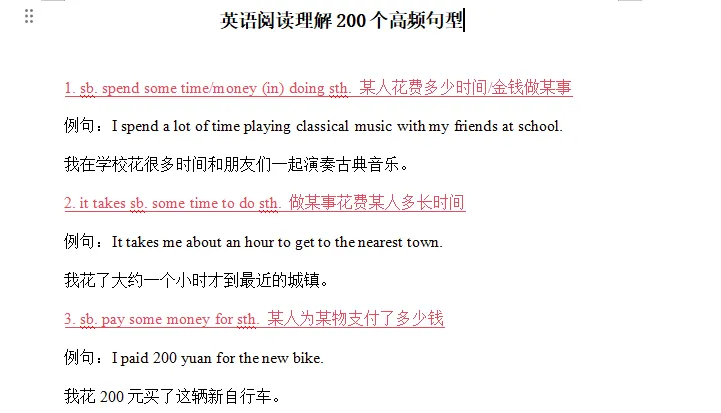
1. sb. spend some time/money (in) doing sth. 某人花费多少时间/金钱做某事
例句:I spend a lot of time playing classical music with my friends at school.
我在学校花很多时间和朋友们一起演奏古典音乐。
2. it takes sb. some time to do sth. 做某事花费某人多长时间
例句:It takes me about an hour to get to the nearest town.
我花了大约一个小时才到最近的城镇。
3. sb. pay some money for sth. 某人为某物支付了多少钱
例句:I paid 200 yuan for the new bike.
我花200元买了这辆新自行车。
4. sth. cost sb. some money 某物花费了某人多少钱
例句:The new camera cost him 3000 yuan.
这台新相机花了他3000元。
5. sb. + 频度副词 + 动词原形/动词三单 + 其他 某人经常性/习惯性做某事
例句:He usually gets up at six o’clock every morning.
他通常每天早上六点起床。
6. sb. be doing sth. when + 一般过去时句子 某人正在做某事,这时突然发生了另一件事
例句:I was doing my homework when my mother came back home yesterday.
昨天我正在写作业,这时我妈妈回家了。
7. sb. have/has been to + 地点 某人去过某地(现已返回)
例句:I have been to the Great Wall many times.
我去过长城很多次了。
8. sb. have/has gone to + 地点 某人去了某地(尚未返回)
例句:My father has gone to Shanghai on business.
我爸爸去上海出差了。
9. sb. have/has been in + 地点 + 时间段 某人在某地待了多久
例句:We have been in this school for two years.
我们已经在这所学校待了两年了。
10. not…until… 直到……才……
例句:I didn’t go to bed until I finished my homework last night.
昨晚我直到写完作业才上床睡觉。
11. as soon as + 一般现在时句子, 主语 + will + 动词原形 一……就……
例句:I will write to you as soon as I get there.
我一到那里就给你写信。
12. both…and… 两者都……
例句:Both you and I are good at English.
你和我都擅长英语。
13. either…or… 要么……要么……;或者……或者……
例句:Either you or she has to clean the classroom after school.
要么你,要么她,放学后必须打扫教室。
14. neither…nor… 既不……也不……
例句:Neither he nor I am interested in playing computer games.
他和我都对玩电脑游戏不感兴趣。
15. not only…but also… 不但……而且……
例句:She not only studies hard but also is very kind to others.
她不但学习努力,而且对别人也很友好。
16. 比较级 + and + 比较级 越来越……
例句:Our school is becoming more and more beautiful.
我们的学校变得越来越美了。
17. the + 比较级, the + 比较级 越……,就越……
例句:The more you read, the more you will know.
你读的书越多,懂得的东西就越多。
18. as + 形容词/副词原级 + as 和……一样……
例句:He runs as fast as his elder brother.
他跑得和他哥哥一样快。
19. not as/so + 形容词/副词原级 + as 不如……那样……
例句:This book is not so interesting as that one.
这本书不如那本书有趣。
20. would like to do sth. 想要做某事
例句:I would like to go to the movies with you this weekend.
这个周末我想和你一起去看电影。
21. 主语 + be + 数字 + 计量单位 + 形容词 主语的长度/高度/宽度/年龄等是多少
例句:The Caspian Sea is 1,025 meters deep.
里海的深度为1025米。
22. 主语 + be + 数字 + year(s)/month(s) old 主语的年龄是多少岁/月
例句:My sister is eleven years old this year.
我妹妹今年11岁了。
23. 主语 + have/has a history of + 数字 + year(s) 某物有多少年的历史
例句:The old building has a history of over 500 years.
这座老建筑有超过500年的历史。
24. the population of + 地点 + is + 数字 某地的人口数量是多少
例句:The population of China is about 1.4 billion.
中国的人口数量大约是14亿。
25. 分数/百分数 + of + 名词 + 谓语动词 ……中的几分之几/百分之几
例句:Three quarters of the students are boys in our class.
我们班四分之三的学生是男生。
26. the price of + 名词 + is + 数字 + 货币单位 某物的价格是多少
例句:The price of the sweater is 299 yuan.
这件毛衣的价格是299元。
27. the number of + 可数名词复数 + is + 数字 ……的数量是多少
例句:The number of students in our school is 2000.
我们学校的学生数量是2000人。
28. a number of + 可数名词复数 + 谓语动词复数 许多;大量的……
例句:A number of students are playing on the playground.
许多学生正在操场上玩耍。
29. it is + 序数词 + 形容词最高级 + 名词 + that + 完成时句子 这是第几个最……的……
例句:It is the best movie that I have ever seen.
这是我看过的最好的电影。
30. 主语 + be + one of + the + 形容词最高级 + 可数名词复数 主语是最……的……之一
例句:China is one of the oldest countries in the world.
中国是世界上最古老的国家之一。
31. 主语 + 动词 + more + 名词 + than + 比较对象 主语比比较对象拥有更多的……
例句:I have more friends than my brother.
我比我哥哥的朋友多。
32. 主语 + 动词 + fewer + 可数名词复数 + than + 比较对象 主语比比较对象拥有更少的……(可数)
例句:He has fewer storybooks than his deskmate.
他的故事书比他同桌的少。
33. 主语 + 动词 + less + 不可数名词 + than + 比较对象 主语比比较对象拥有更少的……(不可数)
例句:She drinks less coffee than her mother.
她比她妈妈喝的咖啡少。
34. 主语 + be + the + 形容词最高级 + 范围 主语在某个范围内是最……的
例句:He is the tallest student in our class.
他是我们班最高的学生。
35. 主语 + prefer + 名词/动名词 + to + 名词/动名词 比起后者,主语更喜欢前者
例句:She prefers singing to dancing.
比起跳舞,她更喜欢唱歌。
36. 主语 + prefer to do sth. rather than do sth. 宁愿做某事,也不愿做另一件事
例句:He prefers to stay at home rather than go out on rainy days.
下雨天,他宁愿待在家里也不愿出去。
37. 主语 + be + 形容词比较级 + than + any other + 单数名词 主语比其他任何一个都更……(同一范围最高级)
例句:He is taller than any other student in his class.
他比班里其他任何一个学生都高。
38. from…to… 从……到……
例句:We go to school from Monday to Friday.
我们从周一到周五上学。
39. between…and… 在……和……之间
例句:The bank is between the hospital and the supermarket.
银行在医院和超市之间。
40. it is + 距离 + from + 地点A + to + 地点B 从A地到B地有多少距离
例句:It’s about two kilometers from my home to school.
从我家到学校大约有两公里。
41. because + 原因状语从句 因为……(引导直接原因)
例句:We put off the sports meeting because it rained heavily.
因为下大雨,我们推迟了运动会。
42. because of + 名词/名词短语 因为;由于……
例句:He was late for school because of the heavy traffic.
因为交通拥堵,他上学迟到了。
43. why + 一般疑问句 + is that + 表语从句 ……的原因是……
例句:Why he likes this book is that it can help him with his English.
他喜欢这本书的原因是它能帮他学习英语。
44. the reason why + 定语从句 + is that + 表语从句 ……的原因是……
例句:The reason why he was late is that he missed the early bus.
他迟到的原因是他错过了早班车。
45. so + 结果状语从句 所以;因此……
例句:He got up early, so he caught the early bus.
他起得很早,所以赶上了早班车。
46. so + 形容词/副词 + that + 结果状语从句 如此……以至于……
例句:He was so tired that he fell asleep soon.
他太累了,很快就睡着了。
47. such + (a/an) + 形容词 + 名词 + that + 结果状语从句 如此……以至于……
例句:It is such a beautiful park that many people visit it every year.
这个公园太美了,每年都有很多人来参观。
48. thanks to + 名词/名词短语 多亏;由于……
例句:Thanks to your help, I passed the English exam.
多亏了你的帮助,我通过了英语考试。
49. as a result, + 结果句 结果;因此……
例句:He didn’t study hard. As a result, he failed the exam.
他学习不努力,结果考试不及格。
50. as a result of + 名词/名词短语 由于……的结果
例句:Many people got hurt as a result of the car accident.
这场车祸导致很多人受伤。
51. due to + 名词/名词短语 由于;因为……
例句:The flight was put off due to the bad weather.
因为天气恶劣,航班被推迟了。
52. in order to + 动词原形 为了……(表目的)
例句:She gets up early every morning in order to read English.
她每天早上早起,为了读英语。
53. in order that + 目的状语从句 为了;以便……
例句:The teacher speaks loudly in order that all the students can hear him.
老师大声说话,以便所有学生都能听到。
54. so that + 目的状语从句 以便;为了……
例句:I will write down your number so that I can remember it.
我会写下你的号码,以便我能记住它。
55. now that + 原因状语从句 既然;由于……
例句:Now that you have finished your homework, you can play outside.
既然你已经写完了作业,你可以出去玩了。
56. since + 原因状语从句 既然;因为……
例句:Since you are tired, you should have a rest.
既然你累了,就应该休息一下。
57. for + 句子(补充说明原因) 因为……
例句:He must be at home, for the light in his room is on.
他一定在家,因为他房间的灯亮着。
58. lead to + 名词/名词短语 导致;引起……
例句:Smoking can lead to many serious illnesses.
吸烟会导致很多严重的疾病。
59. be caused by + 名词/名词短语 由……引起
例句:The accident was caused by careless driving.
这场事故是由粗心驾驶引起的。
60. that’s why + 结果句 这就是……的原因
例句:He got up late. That’s why he was late for school.
他起晚了,这就是他上学迟到的原因。
61. in one’s opinion/view, … 在某人看来,……
例句:In my opinion, we should protect the environment.
在我看来,我们应该保护环境。
62. as far as sb. be concerned, … 就某人而言,……
例句:As far as I am concerned, health is more important than money.
就我而言,健康比金钱更重要。
63. sb. hold the view that… 某人持有……的观点
例句:Many experts hold the view that exercise is good for our health.
很多专家持有运动有益健康的观点。
64. sb. be in favor of… 某人支持/赞同……
例句:Most students are in favor of the new school rule.
大多数学生都赞同这条新校规。
65. sb. be against… 某人反对……
例句:Some people are against building a zoo in the city.
一些人反对在城市里建动物园。
66. sb. agree that… 某人同意/认为……
例句:I agree that we should help the people in trouble.
我认为我们应该帮助有困难的人。
67. sb. disagree that… 某人不同意……
例句:He disagrees that money can bring happiness.
他不认同金钱能带来幸福的说法。
68. from sb.’s point of view, … 在某人看来,……
例句:From my parents’ point of view, I must study hard to get into a good high school.
在我父母看来,我必须努力学习考上一所好高中。
69. sb. point out that… 某人指出……
例句:The report points out that too much junk food is bad for our health.
这份报告指出,吃太多垃圾食品对我们的健康有害。
70. sb. suggest that… 某人建议……
例句:The doctor suggests that we should drink more water every day.
医生建议我们每天要多喝温水。
71. it is generally believed that… 人们普遍认为……
例句:It is generally believed that practice makes perfect.
人们普遍认为熟能生巧。
72. it is widely accepted that… 人们广泛认可……
例句:It is widely accepted that education is very important for children.
人们广泛认可教育对孩子非常重要。
73. some people believe that…, while others argue that… 一些人认为……,而另一些人认为……
例句:Some people believe that online classes are convenient, while others argue that offline classes are better.
一些人认为网课很方便,而另一些人认为线下课效果更好。
74. sb. insist that… 某人坚持认为……
例句:She insists that she is right.
她坚持认为自己是对的。
75. sb. admit that… 某人承认……
例句:He admitted that he had broken the window.
他承认是他打碎了窗户。
76. sb. doubt that… 某人怀疑……
例句:Many people doubt that the plan will work well.
很多人怀疑这个计划能否顺利实施。
77. sb. be sure/certain that… 某人确信……
例句:I am sure that we will win the game.
我确信我们会赢得这场比赛。
78. sb. complain that… 某人抱怨……
例句:Many students complain that they have too much homework to do.
很多学生抱怨他们有太多的作业要做。
79. sb. warn that… 某人警告说……
例句:The police warn that we should be careful when we cross the road.
警方警告我们过马路时要小心。
80. sb. think highly of… 某人对……评价很高
例句:All the teachers think highly of this excellent student.
所有老师都对这位优秀的学生评价很高。
81. although/though + 让步状语从句, 主句 虽然……,但是……
例句:Although he is very young, he can play the piano very well.
虽然他年纪很小,但是钢琴弹得非常好。
82. even if/even though + 让步状语从句, 主句 即使……,也……
例句:Even if it rains tomorrow, we will still go hiking.
即使明天下雨,我们也依然会去远足。
83. 主句, but + 转折句 ……,但是……
例句:I like music, but I can’t sing very well.
我喜欢音乐,但是我唱得不太好。
84. 主句, however, + 转折句 ……,然而……
例句:The plan is very good. However, it is hard to carry out.
这个计划很好,然而执行起来却很难。
85. while + 让步状语从句, 主句 虽然……,但是……
例句:While I understand your idea, I still can’t agree with you.
虽然我理解你的想法,但是我依然不能认同你。
86. no matter + 疑问词 + 让步状语从句, 主句 无论……,都……
例句:No matter what happens, I will always be with you.
无论发生什么,我都会一直陪着你。
87. whatever/whoever/whenever/wherever + 让步状语从句, 主句 无论什么/谁/何时/何地……,都……
例句:Wherever you go, I will miss you.
无论你去哪里,我都会想你。
88. in spite of + 名词短语, 主句 尽管……,……
例句:In spite of the bad weather, we still went to the mountains.
尽管天气不好,我们还是去了山里。
89. despite + 名词短语, 主句 尽管……,……
例句:Despite his illness, he still came to school.
尽管生病了,他还是来上学了。
90. it is true that…, but… 诚然……,但是……
例句:It is true that the work is hard, but we can finish it on time.
这份工作确实很难,但是我们能按时完成。
91. not…, but… 不是……,而是……
例句:The most important thing is not the result, but the process.
最重要的不是结果,而是过程。
92. instead of + 名词/动名词, 主句 而不是……,……
例句:We should walk to school instead of taking the car.
我们应该步行上学,而不是坐汽车。
93. rather than + 动词原形/名词, 主句 而不是……,……
例句:He decided to go to the library rather than play computer games.
他决定去图书馆,而不是玩电脑游戏。
94. 主句, on the contrary, + 转折句 ……,恰恰相反,……
例句:He didn’t feel sad about the failure. On the contrary, he decided to try again.
他并没有因为失败而难过,恰恰相反,他决定再试一次。
95. 主句, in contrast, + 对比句 ……,相比之下,……
例句:The north of China is cold in winter. In contrast, the south is warm.
中国北方的冬天很冷,相比之下,南方要暖和得多。
96. whereas + 对比句 然而;反之
例句:Some people like staying at home on weekends, whereas others like going out.
一些人周末喜欢待在家里,而另一些人喜欢出门。
97. even so, + 主句 即便如此,……
例句:There are many difficulties. Even so, we will not give up.
前方有很多困难,即便如此,我们也不会放弃。
98. 主句, yet + 转折句 ……,然而……
例句:He has only studied English for a year, yet he can speak it very well.
他只学了一年英语,然而却说得非常好。
99. on the one hand…, on the other hand… 一方面……,另一方面……
例句:On the one hand, we need to study hard. On the other hand, we need to keep healthy.
一方面,我们需要努力学习;另一方面,我们需要保持健康。
100. 主句, otherwise, + 结果句 ……,否则……
例句:You must hurry up, otherwise you will miss the train.
你必须快点,否则你会错过火车。
101. 主语 + have/has + 过去分词 + 其他(现在完成时) 某人/某物已经做了某事
例句:I have already finished my homework.
我已经做完我的家庭作业了。
102. 主语 + have/has + been + 过去分词 + 其他(现在完成时被动) 某人/某物已经被……
例句:The new hospital has been open for two months.
这家新医院已经开了两个月了。
103. by the time + 一般过去时句子, 主语 + had + 过去分词 + 其他(过去完成时) 到……的时候,某人已经做了某事
例句:By the time I got to the bus stop, the bus had already left.
我到公交站的时候,公交车已经开走了。
104. since + 一般过去时句子, 主语 + have/has + 过去分词 + 其他 自从……,某人就一直……
例句:Since I came to this school, I have made many friends.
自从我来到这所学校,我已经交了很多朋友。
105. 主语 + be + 过去分词 + by + 动作执行者(一般现在时被动) 某人/某物被……
例句:The letter was written by my pen pal.
这封信是我的笔友写的。
106. 主语 + will + be + 过去分词 + 其他(一般将来时被动) 某人/某物将被……
例句:The sports meeting will be held next month.
运动会将于下个月举行。
107. it is + 过去分词 + that + 主语从句 据说/据报道/众所周知……
例句:It is said that a new park will be built here.
据说这里将要建一个新公园。
108. 主语 + used to + 动词原形 + 其他 过去常常做某事(现在不做了)
例句:I used to be afraid of the dark.
我过去很怕黑。
109. 主语 + be + used to + 动名词 + 其他 习惯于做某事
例句:I am used to getting up early every morning.
我习惯了每天早上早起。
110. 主语 + be + made of + 材料 由……制成(看得出原材料)
例句:The table is made of wood.
这张桌子是木头做的。
111. 主语 + be + made from + 材料 由……制成(看不出原材料)
例句:Wine is made from grapes.
葡萄酒是由葡萄酿造的。
112. 主语 + be + made in + 地点 在某地制造
例句:This kind of car is made in China.
这款汽车是中国制造的。
113. 主语 + am/is/are + being + 过去分词 + 其他(现在进行时被动) 某人/某物正在被……
例句:A new road is being built in our town.
我们镇上正在修一条新公路。
114. 主语 + was/were + 过去分词 + 其他(一般过去时被动) 某人/某物在过去被……
例句:The bridge was built ten years ago.
这座桥是十年前建成的。
115. 主语 + be + supposed to + 动词原形 + 其他 应该做某事
例句:You are supposed to shake hands when you meet someone for the first time.
在中国,第一次见到别人的时候你应该握手。
116. 主语 + be + expected to + 动词原形 + 其他 被期望做某事
例句:You are expected to finish the work on time.
大家期望你按时完成这项工作。
117. 主语 + have/has + been + 现在分词 + 其他(现在完成进行时) 某人一直做某事(从过去持续到现在)
例句:I have been learning English for five years.
我已经学英语五年了。
118. 主语 + be + going to + be + 过去分词 + 其他(将来时被动) 某人/某物将要被……
例句:A new school is going to be built here next year.
明年这里将要建一所新学校。
119. 主语 + was/were + being + 过去分词 + 其他(过去进行时被动) 在过去某个时间,某人/某物正在被……
例句:The song was being played when I walked into the room.
我走进房间的时候,收音机里正在播放这首歌。
120. not + 主语 + have/has + 过去分词 + 其他, either 某人也没有……
例句:I haven’t been to the water park, and my sister hasn’t, either.
我没去过水上乐园,我妹妹也没去过。
121. the main idea of the passage is that… 这篇文章的主旨是……
例句:The main idea of the passage is that we should protect wild animals.
这篇文章的主旨是我们应该保护野生动物。
122. the passage mainly talks about… 这篇文章主要讲述了……
例句:The passage mainly talks about the life of a famous doctor.
这篇文章主要讲述了一位著名医生的生平。
123. what is the text mainly about? 这篇文章主要讲了什么?
例句:What is the text mainly about? It’s about the history of the telephone.
这篇文章主要讲了什么?是关于电话的历史。
124. which of the following best describes the main topic of the passage? 以下哪一项最能概括文章的主题?
例句:Which of the following best describes the main topic of the passage? It’s the importance of friendship.
以下哪一项最能概括文章的主题?是友谊的重要性。
125. the author’s main purpose in writing the text is to… 作者写这篇文章的主要目的是……
例句:The author’s main purpose in writing the text is to call on us to save water.
作者写这篇文章的主要目的是呼吁我们节约用水。
126. in conclusion, … 总而言之,……
例句:In conclusion, we must try our best to protect our earth.
总而言之,我们必须尽全力保护我们的地球。
127. to sum up, … 总而言之,……
例句:To sum up, this plan has both advantages and disadvantages.
总而言之,这个计划既有优点也有缺点。
128. in a word, … 总之,……
例句:In a word, we should help each other.
总之,我们应该互相帮助。
129. all in all, … 总的来说,……
例句:All in all, it was a great school trip.
总的来说,这是一次很棒的学校旅行。
130. in short, … 简言之,……
例句:In short, we must finish the work on time.
简言之,我们必须按时完成这项工作。
131. the passage is mainly developed by… 这篇文章主要通过……展开叙述
例句:The passage is mainly developed by telling a story.
这篇文章主要通过讲故事展开叙述。
132. from the passage, we can learn that… 从文章中,我们可以了解到……
例句:From the passage, we can learn that we should never give up.
从文章中,我们可以了解到我们永远不应该放弃。
133. the text is mainly written to… 这篇文章的写作目的是……
例句:The text is mainly written to introduce a new kind of robot.
这篇文章的写作目的是介绍一种新型机器人。
134. what does the first paragraph mainly talk about? 第一段主要讲了什么?
例句:What does the first paragraph mainly talk about? It talks about the background of the event.
第一段主要讲了什么?它讲述了这个事件的背景。
135. the last paragraph mainly tells us that… 最后一段主要告诉我们……
例句:The last paragraph mainly tells us that we should cherish our family.
最后一段主要告诉我们要珍惜自己的家人。
136. the key point of the passage is that… 文章的核心观点是……
例句:The key point of the passage is that health is the most important thing.
文章的核心观点是健康是最重要的东西。
137. the passage is mainly about… 这篇文章主要是关于……
例句:The passage is mainly about the ways to learn English well.
这篇文章主要是关于学好英语的方法。
138. which of the following can be the best title of the passage? 以下哪一项最适合做文章的标题?
例句:Which of the following can be the best title of the passage? My Unforgettable Trip.
以下哪一项最适合做文章的标题?《我难忘的旅行》。
139. the general theme of the passage is… 文章的主题是……
例句:The general theme of the passage is love between parents and children.
文章的主题是父母与孩子之间的爱。
140. what does the author want to tell us? 作者想要告诉我们什么?
例句:What does the author want to tell us? He wants to tell us to be honest.
作者想要告诉我们什么?他想告诉我们要做人诚实。
141. the word “…” in the passage probably means… 文章中的单词“……”的意思可能是……
例句:The word “brave” in the passage probably means “not afraid of difficulties”.
文章中的单词“brave”的意思可能是“不害怕困难”。
142. the underlined word “…” refers to… 划线单词“……”指的是……
例句:The underlined word “it” in the passage refers to the lovely dog.
文章中划线的单词“it”指的是那只可爱的小狗。
143. the word “…” in paragraph… is closest in meaning to… 第……段中的单词“……”的意思最接近……
例句:The word “fantastic” in paragraph 3 is closest in meaning to “wonderful”.
第三段中的单词“fantastic”的意思最接近“wonderful”。
144. by saying “…”, the author means… 通过说“……”,作者的意思是……
例句:By saying “it’s a piece of cake”, the author means it’s very easy.
通过说“it’s a piece of cake”,作者的意思是这件事很简单。
145. the word “…” can be replaced by… 单词“……”可以被……替换
例句:The word “clever” can be replaced by “smart”.
单词“clever”可以被“smart”替换。
146. … is defined as… ……被定义为……
例句:A friend is defined as a person who you can trust.
朋友被定义为你可以信任的人。
147. that is to say, … 也就是说,……
例句:He is a full-time student. That is to say, he studies at school all day.
他是一名全日制学生,也就是说,他全天都在学校学习。
148. in other words, … 换句话说,……
例句:The work is very difficult. In other words, we need to spend more time on it.
这项工作非常难,换句话说,我们需要在它上面花更多的时间。
149. unlike…, … 不像……,……
例句:Unlike his brother, he is very outgoing.
不像他的哥哥,他非常外向。
150. while…, … 然而……,……
例句:While most birds can fly, penguins can’t.
然而大多数鸟类会飞,企鹅却不会。
151. similarly, … 同样地,……
例句:You should be careful when you swim. Similarly, you must be careful when you climb mountains.
游泳的时候你要小心,同样地,爬山的时候你也必须小心。
152. for example, … 例如,……
例句:He likes many kinds of sports, for example, playing basketball and running.
他喜欢很多种运动,例如打篮球和跑步。
153. such as… 比如……
例句:We have many subjects at school, such as Chinese, math and English.
我们在学校有很多科目,比如语文、数学和英语。
154. especially… 尤其是……
例句:I like all kinds of fruits, especially strawberries.
我喜欢各种各样的水果,尤其是草莓。
155. because…, … 因为……,所以……
例句:He was late for school, because he got up late.
他上学迟到了,因为他起晚了。
156. so…, that… 如此……,以至于……
例句:She was so happy that she jumped up and down.
她开心得跳了起来。
157. although…, … 虽然……,但是……
例句:Although it was raining, we still went to the park.
虽然下着雨,我们还是去了公园。
158. however, … 然而,……
例句:The house is very big. However, it is too far from the school.
这栋房子很大,然而它离学校太远了。
159. the opposite meaning of the word “…” is… 单词“……”的反义词是……
例句:The opposite meaning of the word “big” is “small”.
单词“big”的反义词是“small”。
160. according to the context, the word “…” means… 根据上下文,单词“……”的意思是……
例句:According to the context, the word “upset” means “sad and worried”.
根据上下文,单词“upset”的意思是“难过和担忧”。
161. as soon as…, … 一……,就……
例句:As soon as I got home, I began to do my homework.
我一到家,就开始做家庭作业。
162. hardly…when… 刚一……,就……
例句:Hardly had we got out of the house when it began to rain.
我们刚一出家门,天就开始下雨了。
163. no sooner…than… 刚一……,就……
例句:No sooner had he finished his dinner than he went out.
他刚吃完晚饭就出去了。
164. at that moment, … 就在那一刻,……
例句:At that moment, I knew I was wrong.
就在那一刻,我知道自己错了。
165. just then, … 就在那时,……
例句:Just then, a policeman came up to us.
就在那时,一位警察朝我们走了过来。
166. to one’s surprise, … 令某人惊讶的是,……
例句:To my surprise, he passed the exam at last.
令我惊讶的是,他最终通过了考试。
167. to one’s joy, … 令某人开心的是,……
例句:To her joy, her father came back home safely.
令她开心的是,她的爸爸平安回家了。
168. to one’s sadness, … 令某人难过的是,……
例句:To his sadness, his grandma passed away last year.
令他难过的是,他的奶奶去年去世了。
169. it was not long before… 没过多久就……
例句:It was not long before we arrived at the station.
没过多久我们就到了车站。
170. it was the first time that sb. had done sth. 这是某人第一次做某事
例句:It was the first time that I had seen the sea.
这是我第一次看到大海。
171. from then on, … 从那时起,……
例句:From then on, he began to study hard.
从那时起,他开始努力学习。
172. as time went by, … 随着时间的流逝,……
例句:As time went by, we became good friends.
随着时间的流逝,我们成了好朋友。
173. in the end, … 最后,……
例句:In the end, we found the lost boy.
最后,我们找到了走失的男孩。
174. at the end of the story, … 在故事的结尾,……
例句:At the end of the story, the hero saved the whole village.
在故事的结尾,英雄拯救了整个村庄。
175. once upon a time, … 从前,……
例句:Once upon a time, there was a beautiful princess in the forest.
从前,森林里住着一位美丽的公主。
176. one day, … 有一天,……
例句:One day, I met an old friend in the street.
有一天,我在街上遇到了一位老朋友。
177. the next day, … 第二天,……
例句:The next day, we went to the Great Wall.
第二天,我们去了长城。
178. suddenly, … 突然,……
例句:Suddenly, a big dog ran out of the house.
突然,一只大狗从房子里跑了出来。
179. unfortunately, … 不幸的是,……
例句:Unfortunately, we missed the last bus.
不幸的是,我们错过了末班车。
180. luckily, … 幸运的是,……
例句:Luckily, a kind man helped us.
幸运的是,一位好心人帮助了我们。
181. according to the chart/table/graph, … 根据图表/表格显示,……
例句:According to the chart, 70% of the students like reading books.
根据图表显示,70%的学生喜欢读书。
182. the survey shows that… 调查显示……
例句:The survey shows that most students exercise three times a week.
调查显示,大多数学生每周锻炼三次。
183. a recent study has found that… 最近的一项研究发现……
例句:A recent study has found that walking is good for our health.
最近的一项研究发现,散步有益健康。
184. it is reported that… 据报道……
例句:It is reported that a new library will be built in our city.
据报道,我们市将要建一座新的图书馆。
185. it has been proved that… 事实证明……
例句:It has been proved that learning English well is very useful.
事实证明,学好英语非常有用。
186. compared with…, … 与……相比,……
例句:Compared with last year, our grades have improved a lot.
和去年相比,我们的成绩提高了很多。
187. in addition, … 此外,……
例句:The hotel is very clean. In addition, it has a big swimming pool.
这家酒店非常干净,此外,它还有一个大游泳池。
188. what’s more, … 而且,此外……
例句:He is very friendly. What’s more, he is always ready to help others.
他非常友好,而且他总是乐于助人。
189. on average, … 平均来看,……
例句:On average, people sleep 8 hours a day.
平均来看,人们每天睡8个小时。
190. there are different types of… 有不同种类的……
例句:There are different types of books in the library.
图书馆里有不同种类的书。
191. the advantage of…is that… ……的优点是……
例句:The advantage of riding a bike is that it is good for the environment.
骑自行车的优点是它对环境友好。
192. the disadvantage of…is that… ……的缺点是……
例句:The disadvantage of living in the city is that it is very noisy.
住在城市里的缺点是太吵了。
193. be divided into… 被分成……
例句:The year is divided into four seasons.
一年被分成四个季节。
194. for one thing…, for another… 一方面……,另一方面……
例句:For one thing, the book is very interesting. For another, it can help us learn English.
一方面,这本书非常有趣;另一方面,它能帮我们学英语。
195. notice is hereby given that… 特此通知……
例句:Notice is hereby given that the sports meeting will be put off.
特此通知,运动会将延期举行。
196. the rules are as follows: … 规则如下:……
例句:The school rules are as follows: Don’t be late for school. Don’t fight with others.
校规如下:禁止上学迟到;禁止和他人打架。
197. the opening hours are from…to… 开放时间是从……到……
例句:The opening hours of the library are from 9:00 a.m. to 5:00 p.m.
图书馆的开放时间是上午9点到下午5点。
198. the price of…is… ……的价格是……
例句:The price of the ticket is 30 yuan per person.
门票价格是每人30元。
199. people who want to…should… 想要……的人应该……
例句:People who want to join the club should fill in the form first.
想要加入俱乐部的人应该先填写表格。
200. contact us at…for more information 更多信息请联系我们……
例句:Contact us at 010-12345678 for more information about the trip.
想要了解这次旅行的更多信息,请致电010-12345678联系我们。