ARTICLE · 1172811
2026新仁爱版初中英语七上 Unit 4 期中考点知识清单

一.重点词汇背默
Preparing for the Topic
1.* /sʌn/ n.太阳
2.* /sprɪŋ/ n.春天;春季
3.* /'sʌmə(r)/ n.夏天;夏季
4.* /'ɔːtəm/ n.秋天;秋季
5.* /'wɪntə(r)/ n.冬天;冬季
6.* /hɑːt/;/hɒt/ adj.温度高的;热的
7.* /kuːl/ adj.凉的;(使人感到)凉爽的;酷的;很棒的
8.* /kəʊld/ adj.寒冷的;冷的 n.感冒
9.* /wɔːrm/;/wɔːm/ adj.温暖的;暖和的;热心的
10.* /snəʊ/ v.下雪 n.雪
11./'snəʊmæn/ n.雪人
12.* /'sʌni/ adj.阳光充足的
13.* /tə'deɪ/ adv.在今天 n.今天;当今
14./'pɪknɪk/ n., v.野餐
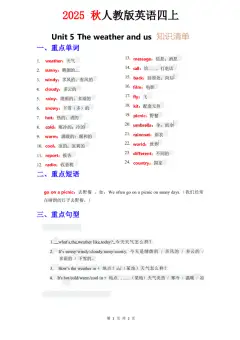
15.* /'weðə(r)/ n.天气
16.* /'siːzn/ n.季;季节
17.* /waɪ/ adv.为什么
18.* /reɪn/ n.雨,雨水 v.下雨
19./draɪ/ adj.干燥的;干旱的
20./'bædmɪntən/ n.羽毛球运动
21./'beɪsbɔːl/ n.棒球运动;棒球
22.* _/fəʊn/ n.电话;手机
23.*_/'sɑːri/;/'sɒri/ excl.很抱歉 adj.歉疚;惭愧
24./həʊp/ v., n.希望
Exploring the Topic
25.yo-yo /'joʊ joʊ/;/'jəʊ jəʊ/ n.
26.* /lɔːŋ/;/lɒŋ/ adv.长期地;长久地 adj.长的;长时间的 v.渴望
27.*/'klaʊdi/ adj.阴天的;多云的
28./ˌaʊt'dɔːrz/;/ˌaʊt'dɔːz/adv.在户外;在野外
29./'reɪni/ adj.阴雨的;多雨的
30./ˌɪn'dɔːrz/;/ˌɪn'dɔːz/ adv.在室内
31.* /'eksərsaɪz/;/'eksəsaɪz/n.锻炼;练习 v.锻炼
32._/helθ/ n.健康
33./tɪp/ n.指点;实用的提示
34.* /raɪt/ adj.适当的;正确的;右边的n.右边;权利
35.* /ʃuː/ n.鞋
36.*/kləʊðz;kləʊz/ n.衣服,服装
37./ɪm'pɔːrtnt/;/ɪm'pɔːtnt/adj.重要的
38.* /bɪ'fɔːr/;/bɪ'fɔː(r)/ prep.&conj.在······以前
39./ ti:m/ n.队;组
40.*_/gɪv/ v.给;提供
41.*/kiːp/ v.继续;存放;保持;记录;饲养
42./pæs/;/pɑːs/ v.传球;及格;通过;经过;传递 n.及格
43.* /wɪn/ v.获胜,赢
44.* /wɪʃ/ n., v.希望,愿望
45.* / fi:l/ v.觉得,感到;摸起来
46.* /stɑː(r)/ n.歌唱(或表演)明星;星(状物)
47.* /juːz/ v., n.用,使用
48.* /' helpfl/ adj.有帮助的;愿意帮忙的
49.* /greɪp/ n.葡萄
50.* /fæst/;/fɑːst/ adv.快,迅速adj.快的,迅速的
51./fiːd/ v.喂养,饲养
52.* /bɜːrd/;/bɜːd/ n.鸟;禽
53.* / red/ n.红色 adj.红色的
54.* /leɪk/ n.湖;湖泊
Developing the Topic
55.Tai Chi /ˌtaɪ tʃiː/ n.
56.* / wen/ adv., conj.什么时候;当……时
57./'skiː/ v.滑雪(运动)
58.* /'həʊmtaʊn/ n.家乡,故乡
59.* /'trævl/ v., n.旅行;游历
60./'maʊntn/;/'maʊntən/ n.高山;山岳
61.* /tɜːrn/;/tɜːn/ n., v.转弯
62.*/muːv/ v.移动;搬(家)
Wrapping up the Topic
63./'sɜːrveɪ/;/'sɜːveɪ/ n., v.(做)民意调查
64.* _/wiːk/ n.周,星期
65.* /'aʊə(r)/ n.小时
66./rɪzʌlt/ n.结果;后果;成绩
67.* /kæp/ n.便帽,制服帽
68.* / per/;/peə(r)/ n.一双;一对;俩
69.* /ʃɔːrts/;/ʃɔːts/ n.短裤
70.* /zuː/ n.动物园
71./reɪs/ n.赛跑;速度;竞赛;竞争
72.* / leg/ n.腿
73.*/læst/;/lɑːst/ v.持续 det.最后的;最近的 adv.最终
74.* /raɪt/ v.书写;写作;写信
75.* /daʊn/ prep.向下;沿着 adv.向下
二.重点短语背默
1.带某人去
2.远足
3.堆雪人
4.去野餐
5.在电话上
6.穿,表演
7.擅长
8.为什么不
9.叫某人做…
10.整年
11.对...有益
12.热身
13.太多
14.踢足球
15.下课后
16.玩得高兴
17.放弃
18.继续做某事
19.最后
20.照像
21.做运动
22.遛狗
23.喂鸟
24.转弯
25.从...学到了很多
26.在家
27.散步
28.在不同的季节
29.参加
30.参与
三.重点句子背默
1.My parents usually .我的父母通常在周末带我们去徒步旅行。
2.. 让我们去堆个雪人吧。
3.Xiaoxiao's family is in the park.晓晓的家人要在公园里野餐了。
4.in autumn?秋天的天气怎么样?
5.What do you ?你喜欢做什么在秋天?
6.does Kangkang the football club?为什么康康想加入这个足球俱乐部?
7.Wang Junfeng and Kangkang.王军峰和康康正在打电话。
8.Do you me?你想来和我一起玩吗?
9.I'm not really .我不太擅长踢足球。
10.the football club? 为什么不加入这个足球俱乐部呢?
11.I hope I can you.我希望我能像你一样踢好足球。
12.Wang Junfeng the football王军峰邀请他加入足球运动
13.Many Americans love playing baseball. They. 许多美国人喜欢打棒球。他们全年都在玩它。
14.On or days, people play it . On days, they play it .在阳光明媚或阴天,人们会在户外玩。在雨天,他们会在室内玩。
15.Exercise our health, but how do we do it? 锻炼对我们的健康有好处,但我们该怎么做呢?
16..这里有一些建议。
17.Sometimes, you with you.有时候,你需要随身带点水。
18.For most sports, before exercise. 对于大多数运动项目来说,在运动前做个热身运动是很重要的。
19.Don't in very hot or cold weather.不要在非常炎热或寒冷的天气里做太多的运动。
20.He often plays football his classmates on Friday.星期五下课后和同学一起踢足球。
21.Now it's sunny out there. All the boys are on the playground.现在外面阳光明媚了。所有的男孩都在操场上玩得很开心。
22.But Wang Junfeng doesn't. He the ball.但王军峰并没有放弃。他继续跑和传球。
23., they the game two one. 最后,他们以2比1赢得了比赛。
24.Now he a big football !现在他感觉自己就像个大足球明星了!
25.Sometimes, I also play with people and them.有时,我也和其他人一起玩,从他们身上学到很多东西。
26.公园里有很多人
27.The girl is his sister. 穿黄色的女孩是他的妹妹。
28.I . In spring, I like with my family.我喜欢在不同的季节进行不同的活动。春天,我喜欢和家人一起徒步旅行。
29.I in the park on cool days. 我喜欢在凉爽的日子里在公园里散步。
四.易错点记忆
一.对天气提问的用法
用法分析 How's the weather...?相当于 What is the weather like...?意为“……天气怎么样?”,用来询问天气状况。其答语常是:It's sunny/rainy/cloudy/windy/hot/snowy /cold/warm/cool...等。
—What is the weather like in your hometown?你家乡天气怎么样?
—It's rainy.有雨。
—How is the weather today?今天天气怎么样?
—It's cloudy.多云。
注意1.weather意为“天气”,不可数名词,特别在感叹句中weather前面不能加冠词a/an。What bad weather it is!多么糟糕的天气啊!
2.weather的同音词为 whether“是否”,引导宾语从句。
中考链接
—What will the weather be like tomorrow?
—It will be.
A.rain B.rainy C.raining D.to rain
二.现在进行时的用法
用法分析“某人正在做什么”,形式为“What+be+主语+动词现在分词?”,其答语形式为“主语+be+动词现在分词。”,be有人称和数的变化。
你在做什么?—What are you doing?
我在洗衣服。I'm washing my clothes.
中考链接
—What is Bill doing right now?
—Hesoccer. He______ soccer every Saturday.
A.plays;plays B.plays;is playing C.is playing;plays
三.颜色的词的用法
用法分析 表示颜色的单词既可以做名词,也可以做形容词。
名词 | 我喜欢红色。I like red. 我弟弟不喜欢黑色。My brother doesn't like black. |
形容词 | 那是一件紫色的衬衫。That is a purple shirt. 露西有一头棕色的长发。Lucy has long brown hair. |
考点拓展(1)在生活中经常接触的其他颜色有:
orange橙色(的) | pink粉色(的) |
grey/gray灰色(的) | black and white黑白相间(的) |
gold金黄色(的) | silver银白色(的) |
(2)英语中某些表示颜色的词还可作为英美人的姓氏,首字母必须大写。
Mr. Green格林先生 | Mrs. White怀特夫人 |
Ms. Brown布朗女士 | Miss Red莱德小姐 |
注意 表示颜色的词单独做表语时,前面不能用冠词a或an。如果表示颜色的形容词用来修饰一个单数可数名词时,则前面必须用a或an。
This coat is green.这件外套是绿色的。
—Is that a yellow and blue bike? 那是一辆黄蓝相间的自行车吗?
—Yes, it is.是的,它是。
考题预测—What color is red and yellow?
—It’s .
A. yellowB. orangeC. brownD. purple
四.Why not do sth.?的用法
用法分析Why don't you do sth.?表示“为什么不做某事?”,省略形式是“Why not do sth.?”,常用来表示建议、征询意见、邀请等。
你为什么不休假?Why don't you take a holiday?
=Why not take a holiday?
考点拓展Why not...?(为什么不……?)在对话中表示一种惊奇、不高兴的反问,not后接动词原形。
—We are not going to Beijing tomorrow.明天我们不去北京了。
—Why not?We are going to do some shopping there.为什么不去?我们还要在那儿购物呢。
中考链接 同义句转换
Why don't you watch a talk show?
watch a talk show?
五.考点辨析wear,put on,in
wear | 强调“穿”的状态,其宾语可以是衣帽、饰物、奖章等。 |
put on | “穿上;戴上”,强调穿的动作,反义词组 take off“脱下”。 |
in | 介词,意为“穿着”,后接衣服或颜色,由它构成的短语只能做表语或定语。 |
He always wears dark clothes.他总是穿着深色的衣服。
He put on his coat and hat and went out.他穿上大衣,戴上帽子,就出去了。
The woman in red is our English teacher.穿红衣服的那位女士是我们的英语老师。
考题预测 Some students have to glasses in class because they can't see the blackboard clearly.
A.put onB.wearC.inD.wearing
六.want的用法
用法分析want to do sth.表示“想要做某事”相当于would like to do sth.。
我想喝杯茶。I want to have a cup of tea.
考点拓展
want的用法 | want sth. | 想要某物 |
want to do sth. | 想要做某事 | |
want sb.to do sth. | 想让某人去做某事 | |
want to be | 想要成为 |
I want some water.我想要些水。
Do you want to go to the movies?你想去看电影吗?
She wants me to help her with her English.她想让我帮助她学英语。
She wants to be a doctor.她想成为一名医生。
中考链接
Our English teacher wants us______ English stories out of class.
A.read B.reading C.to read
七.考点辨析well,good
well | (1)做副词,意为“好,令人满意地”,置于动词之后修饰动词。 Li Na plays tennis well.李娜网球打得很好。 (2)做形容词,意为“健康的,身体的”,置于连系动词后做表语。 You look very well, Jimmy.你看上去很健康,吉米。 |
good | 做形容词,可表示各种品质方面的优异,修饰名词做定语,或者在句中做表语。 Mr.Wang is a good teacher.王老师是一位好老师。 |
坚持跑步。他很健康。Keep running. He is well.
考题预测
This kind of T-shirt looksand sells______ in the market.
A.good;goodB.well;well
C.good;wellD.well;good
八.考点辨析too many,too much,much too,so many,so much
“如此多”各不同 | too many太多的 | 修饰复数名词 |
too much太多的 | 修饰不可数名词/动词 | |
much too太…… | 修饰形容词/副词 | |
so many如此多 | 修饰复数名词 | |
so much如此多 | 修饰不可数名词 |
小提示 区别时主要看短语后面的many(接复数名词);much(接不可数名词);too(接形容词/副词)。
I have too many questions to ask.我有太多的问题要问。
Today he has too much homework to do.今天他有太多的家庭作业要做。
It's much too cold today.今天天气太冷了。
Thanks for sending me so many photos.谢谢你寄给我这么多照片。
九.常见的感官动词:
接形容词做表语的感官动词 | smell | 闻起来 |
feel | 摸起来 | |
sound | 听起来 | |
look | 看起来 | |
taste | 尝起来 |
小提示smell,sound,taste的主语只能是物,feel/look的主语可以是人,也可以是物。
中考链接
—What do you think of the fish soup?
—Well,ita bit salty.
A.looksB.smellsC.tastes
九.season季节的用法
考点用法 season季节:spring春天,summer夏天,autumn秋天,winter冬天。
中考特殊考点表示“在某个季节”,季节前加介词in,如果表示“在某个季节的某天”(或某天某段时间)则使用介词on。
Many girls wear skirts in summer.夏天,很多女孩穿裙子。
I was born on a cold winter morning.我出生在一个寒冷的冬天的早上。
中考链接
The___B___ Chongqing is really hot,but we still like living here.
A.springB.summerC.autumnD.winter
十.sunny的用法
用法分析 sunny adj.阳光充足的,晴天的。
今天天气晴朗。The weather is sunny today.
注意 sun→sunny由名词变为形容词时,注意要双写n再加y,因为sun是以一个辅音字母结尾的重读闭音节。
考点拓展“名词十(n)y”构成的表示天气的形容词有:wind(风)+y→ windy有风的;cloud(云)+y→cloudy多云的;snow(雪)+y→snowy有雪的;rain(雨)+y→rainy下雨的;sun(太阳)+y→sunny晴朗的(双写n);ice(冰)+y→icy冰冻的(去掉e);fog(雾)+y→foggy多雾的(双写g)。
中考链接根据句意及首字母提示补全单词
The weather istoday.Let's go bike riding in the countryside.
十一.play的用法
用法分析play弹奏,与乐器连用时,乐器前需加定冠词the。
他正在房间里弹吉他。He is playing the guitar in the room.
注意“play+the+乐器”表示“弹/拉/敲……”,乐器:guitar吉他,violin小提琴,piano钢琴,drum鼓。
考点拓展play后限定词的使用:
play一词多义 | play+the+乐器 | 弹/拉/敲…… |
play+球类/棋牌类 | 打/踢球、打牌;下棋。 | |
play+游戏 | 玩…… | |
play with sb./sth. | 和某人/某物一起玩 |
Can you play the piano?你会弹钢琴吗?
He wants to play chess with you.他想和你下国际象棋。
Do you like playing volleyball or football!你喜欢打排球还是踢足球?
The children like to play games.孩子们喜欢玩游戏。
She likes playing with her pets.她喜欢和她的宠物玩。
中考链接The young lady teaches the children to playguitar on weekends.
A.a B.an C.the D./
十二.it做形式主语的用法
用法分析这里it是形式主语,后面的不定式短语to have cake on your birthday是真正的主语。It's+形容词+(for sb.)to do sth.意为“(对某人来说)做某事是……的”。
保持水质清洁是很重要的。It's important to keep the water clean.
我们很难回答这些问题。It is very hard for us to answer the questions.
中考链接
—Could I go swimming with my friend,dad?
—No,it's very dangerous for you kidsswimming without adults.
A.goB.goingC.to goD.went
十三.learn的用法
用法分析learn意为“学,学会”,后跟名词、动词不定式、从句。
大多数孩子上一年级的时候就学说英语。
Most children learn to speak English when they are only in Grade 1.
固定搭配
learn from向……学习 | learn的固定搭配 | learn to do sth.学习做某事 |
learn...from从……获得…… | learn one's lesson从……中吸取教训 | |
learn...by heart熟记……;背诵…… | learn...by oneself自学 |
小提示 learn,study表示“学习”时,可以互换。learn侧重学到、学会,study侧重学习过程,还表示“研究”。
中考链接
Cindy's grandmother is learningthe new mobile phone.
A.useB.usesC.usedD.to use
十四.keep的用法
用法分析keep及物动词“保持;保留”,“keep+sb./ sth.+adj.”意为“使……处于某种状态”。
我们应该保持教室干净整洁。We should keep the classroom clean and tidy.
考点拓展1.keep做系动词,后接形容词。
Keep quiet in the library.在图书馆里保持安静。
2.keep sb.doing sth.让某人一直做某事。
Don't keep your mother waiting so long.不要让你母亲久等。
3.keep做“借”,是延续性动词,和一段时间连用。
You can keep the book for a week.这本书你能借一周时间。
中考链接
My little brother is a tidy boy. He always keeps his room.
A.cleanB.to cleanC.cleaningD.cleaned
十五.join的用法
用法分析 join指“参加、加入(党派、团体等组织)”,join sb.in( doing)sth.意为“加入到某人的某一活动中”。
吉姆想加入足球队。Jim wants to join the soccer team.
他将和我们一起唱这首歌。He'll join us in singing the song.
考点辨析join,join in,take part in
join | “参加,加入”,指加入某个组织或团体,成为其成员之一,如参军、入团、入党、加入俱乐部等。 |
join in | “join in+某活动”,相当于“take part in+某活动”。 |
take part in | 指“参加”会议、考试、竞赛或群众性活动,重在说明句子主语参加该项活动并在其中发挥作用 |
他说他要参军。He says he's going to join the army.
我可以参加这个游戏吗?Can I join in the game?
我没有参加会议。I didn't take part in the meeting.
考题预测
—Mike, what club do you want to?
—The art club.I love painting.
A.take part in B.join in
C.join D.join for
十六.important的用法
用法分析important adj.重要的,重大的。
学习英语非常重要。Studying English is very important.
考点拓展 important的名词形式为 importance(重要性)。
It's very important for us to know the importance of English.对我们来说知道英语的重要性是很重要的。
中考特殊考点 It's important for sb.to do sth.对某人来说做某事是重要的。
It's very important for us to learn a foreign language well.学好一门外语对于我们来说是很重要的。
中考链接 翻译句子
It is very important for us to learn Chinese well.
十七.feed的用法
用法分析feed做动词“喂养,饲养”。
考点拓展feed sb./sth.喂养某人或某物(动物);feed on...“以……为食”;feed sth.to...把……喂给……;fed...with(on)sth.用……(食物)喂……。
Could you please feed my dog?你可以帮我喂一下狗吗?
Sheep feed chiefly on grass.羊主要以草为食。
Mother is feeding milk to her baby.母亲正在给宝宝喂牛奶。
She fed the baby on/with milk.她用牛奶来喂宝宝。
中考特殊考点keep也表示“饲养;供养”,keep指总体情况,不涉及具体动作。而feed强调动作“给……喂食,给……东西吃”。
考题预测 根据句意及首字母提示补全单词
I often help my mother chickens on rice in my spare time.
十八.help的用法
用法分析help(sb.)with sth.在某方面帮助(某人);帮助某人做某事,with后接名词、代词或动名词。相当于 help sb.(to) do sth.。
她经常帮助我学英语。She often helps me to learn English.
=She often helps me with my English.
考点拓展help用作名词“帮助”。with the help of sb.= with one's help在某人的帮助下。
Thank you for your help.谢谢你的帮助。
With the help of the boy,she passed the exam.在这个男孩的帮助下,她通过了考试。
固定搭配
help的固定搭配 | can't help doing | 忍不住/禁不住做…… |
help oneself to | 随便吃/喝…… |
Ican't help crying.我忍不住哭了。
Help yourself to some fish!请随便吃点鱼吧!
考题预测
Ann often helps memy math after school.
A.for B.with C.on D.by
十九.exercise的用法
用法分析exercise做动词“运动,锻炼;使……得到锻炼”。
大多数学生每周锻炼三四次。Most students exercise three or four times a week.
考点拓展 exercise做不可数名词“锻炼,运动,练习”;做可数名词“练习题,体操”。
Walking is good exercise.散步是很好的运动。
He takes exercise every day.他每天都运动。
We do morning exercises every day.我们每天做早操。
固定搭配
exercise的用法 | do morning/eye exercises | 做早操/眼保健操 |
take more exercise | 多锻炼 | |
do/take exercise=do sports | 进行运动;锻炼身体 | |
do some English exercises | 做一些英语练习题 |
考题预测
To keep healthy, many peopleevery day.
A.take a showerB.take part in
C.take a lookD.take exercise
二十.be good at(doing)sth.的用法
用法分析 be good at(doing)sth.意为“擅长(做)某事”,相当于 do well in(doing)sth.,后都接名词、代词或动词的-ing形式。
我们中有些人擅长游泳。Some of us are good at swimming.
李雷擅长画画,但是我不擅长。Li Lei is good at drawing,but I'm bad at it.
考点拓展含good短语的不同含义
be good for | 对……有益、好处 | 反义词组:be bad for“对……有害”,for后接名词、代词或动词的-ing形式 |
be good to | 对……友好 | 相当于 be kind/friendly to |
be good with | 和………相处很好 | 相当于 get along/on well with |
Eating fruit every day is good for your health.每天吃水果对你的健康有好处。
Miss Li is good to all of us.李老师对我们所有的人都很友好。
The workers are good with their boss.这些工人和他们的老板相处得很好。
中考链接
Kate is good at dancing.(同义替换)
A.do well inB.does well inC.is interested inD.is good for
五.重点句子解析
1.-What's the weather like in autumn?秋天的天气怎么样?
-It's cool.(天气)凉爽。
“What's the weather like..?”是询问天气状况的常用句型,可与“How is the weather.?”互换,回答时常使用“It's+表示天气特征的形容词”。例如:
-What's the weather like in spring in Beijing?(How's the weather in spring in Beijing?)北京春天的天气怎么样?
—It's sunny and warm.(天气)晴朗且暖和。
2. And I'm not really good at playing football.而且我不是很擅长踢足球。
be good at意为“擅长···”,后可接名词、代词或动词的-ing形式。例如:
Xiao Ya is good at English.肖雅擅长英语。
3. Why not join the football club?为什么不加入足球俱乐部呢?
“Why not+动词原形+其他?”意为“为什么不···呢?”,用来向对方提出建议,相当于“Why don't you+动词原形+其他?”。例如:
Why not go out for fun?(Why don't you go out for fun?)你为什么不出去玩呢?
4. Exercise is good for your health, but how do you do it?运动对你们的健康有益,但是你们怎么做运动呢?
be good for.意为“对···有好处”,后可接名词、代词。例如:
Milk is good for our bodies.牛奶对我们的身体有益。
5. Here are some tips.这里有一些建议。
Here are/is..意为“这是···;这儿有···”,用于介绍或引入话题。例如:
Here are two nice photos of my room.这是两张我房间的漂亮照片。
6. He keeps running and passing the ball.他不停地奔跑,传球。
keep doing sth.意为“一直做某事;坚持做某事”。例如We should keep exercising.我们应该坚持锻炼。
五.语法点背默
一.人称代词主格、宾格列表如下:
人称数格 | 单数 | 复数 | ||||
一 | 二 | 三 | 一 | 二 | 三 | |
主格 | I | you | she;he;it | we | you | they |
宾格 | me | you | her;him;it | us | you | them |
2.人称代词的用法
(1)人称代词的主格在句中充当主语。如:She is a good student.
(2)人称代词的宾格在句中充当动词、介词的宾语或表语。如:I don’t know her.
His mother is waiting for him outside.
3.人称代词的顺序
几个人称代词并列充当主语时,它们的顺序是:
单数形式(二、三、一)you,he/she and I
复数形式(一、二、三)we,you and they
一.根据句意,用所给人称代词的正确形式填空
①My pencil is broken. Please pass (I) a new one.
②We all like Mr. Green because (he)is really cool and fun.
③I like reading music magazines and I often buy (they)in the bookshop near my house.
④Ms. Read will give (we) a talk about healthy life this afternoon.
⑤ Look at the girl over there. (she) is my cousin Sue.
二.选择填空
1.Miss Li, a humorous teacher, taught maths last term.
A.us B.our C.ours D.ourselves
2.Mary’s birthday is coming. We’ve decided to make a cake for .
A.him B.her C.you D.them
3.—Where are Lily and Lucy from?
— are from the USA.
A.Ours B.We C.Theirs D.They
4.—Hello, are you Mr. Morrison?
—Yes. That’s .
A.him B.me C.you D.us
5.—Who is the lady in red?
—Miss Gao. She teaches English.
A.we B.us C.our D.ours
二.现在进行时
知识点一 现在进行时的用法
用法 | 例句 |
表示现在(说话时)正在进行或发生的动作。 | They are talking on the phone.他们正在打电话。 |
表示当前一段时间内的活动或现阶段正在进行的动作。 | They are growing vegetables these days.这些天他们一直在种蔬菜。 |
有些动词,如come、go、leave、arrive、begin、start 等的现在进行时可表示将要发生的动作,一般后面跟表示将来的时间状语。 | We are leaving next week.我们下星期将会离开。 |
知识点二 现在进行时的句式结构
句式 | 句型 | 例句 |
肯定句 | 主语+be动词 (am/is/are)+v.-ing+其他. | Mary is washing clothes. 玛丽正在洗衣服。 |
否定句 | 主语+be动词 (am/is/are)+not+v.-ing+其他. | She isn’t studying now.她现在没在学习。 |
句式 | 句型 | 例句 |
一般疑 问句及 其简略 回答 | Be动词(Am/Is/Are)+主语+v.-ing+其他? 肯定回答:Yes, 主语+be动词 (am/is/are). 否定回答:No, 主语+be动词 (am/is/are)+not. | —Are they playing games? 他们在玩游戏吗? —Yes,they are./No, they aren’t.是的,他们在玩。/不,他们没有在玩。 |
知识点三现在分词的变化规则
变化规则 | 示例 |
大多数动词后直接加-ing | read—reading sing—singing |
以不发音的e结尾的动词,去e,再加-ing | take—takingcome—coming |
以重读闭音节结尾,且末尾只有一个辅音字母,先双写该辅音字母,再加-ing | sit—sittingbegin—beginning |
以ie结尾的动词,变ie为y,再加-ing | lie—lyingdie—dying |
一.用所给词的适当形式填空
1.Who's(sing)in the next room now?
2.Look!They(run)on the playground.
3.They(not,clean)the classroom now.
4.We are(leave)for Beijing tomorrow.
5.—Is that boy Jack?
—No,Jack is(do)his homework in the classroom.
二.单项填空
6.Look!Theybasketball on the playground.
A.playB.playsC.are playing
7.—May I use your computer?
—Sorry.Ion it.
A.workB.am workingC.have worked
8.Listen!Mr.Black a talk on robots in the hall.
A.givesB.is givingC.will giveD.gave
9.—Where is your mother?
—She the dishes in the kitchen.
A.doB.doesC.didD.is doing
10.Be quiet!A birdsomething on the window.
A.ateB.eatsC.is eating
11.—Hurry up!Jackfor you to play basketball.
—OK.I'm coming.
A.waitedB.is waitingC.was waiting
12.Don't make any noise,because the babyin the next room.
A.is sleepingB.sleepsC.will sleepD.was sleeping
13.Please be quiet!The students an exam.
A.takeB.are takingC.tookD.were taking
14.—Can John play soccer with us,Mrs.Black?
—One moment,please.He on the phone to his cousin.
A.talksB.talkedC.talkingD.is talking
15.Please don't make so much noise. The babynow.
A.sleepsB.sleptC.will sleepD.is sleeping
六.写作背默
课内写作
我最喜欢的运动
我来自中国新疆。我最喜欢的运动是滑雪。 滑雪在我的家乡阿勒泰有着悠久的历史。 人们在冬天到这里去滑雪。我经常在美丽的雪季和朋友们一起滑雪。今天天气晴朗。我和我的朋友们在山上滑雪。 我擅长转弯。而我的朋友们行动得很快。 我也喜欢在电视上看滑雪比赛。我可以从中学到很多东西。 我喜欢滑雪。很有趣!
My Favorite Sport
I'm from Xinjiang, China. My favorite sport is skiing.
I love skiing. It's lots of fun!
体育日
在我的新学校里,有一个体育日。它可以是一天或半天。那天,我们在操场上参加了许多不同的活动。 我们可以参加跑步比赛,三条腿的比赛。我们也可以打篮球,比如篮球和乒乓球。 有时,我们的父母在那天来上学。他们可以看体育比赛,也可以和我们一起玩游戏。
A Sports Day
In my new school, there is a Sports Day. It can be a day or half a day.
写作拓展
通过学习本单元的内容,能够用英语介绍自己或他人的体育爱好,能简单阐述对某项体育运动的观点,并说明理由。在就此话题写文章时,可采取“一点二展三收”法。一点即开篇点题,表明自己的体育爱好及特长;二展是指展开介绍,具体描述拥有的体育收藏品,从事此项体育活动的时间,场所以及活动的参与者;三收是指总结收尾,抒发对此运动的热爱。
要想写好此类作文,需要掌握以下词汇及句型句式:
※常用的词汇
play soccer踢足球
after class课后
after school放学后
play...with...和……一起玩……
be good tor对……有好处
keep healthy保持健康
※常用的句型句式
I like playing soccer.我喜欢踢足球。
Playing basketball is easy.打篮球很简单。
It's easy for me to play ping-pong.对我来说,打兵乓球很简单。
I play volleyball with my friends after school.放学后,我和朋友一起打排球。
We all think sports are good for us.我们都认为运动对我们有好处。
I have a soccer ball.我有一个足球。
I love sports, but 1 don't play them-I only watch them on TV! 我喜欢运动,但是我不做体育运动我只在电视上看它们!
It's easy for me.对我来说很容易。
We play it at school with our friends.我们和朋友们在学校踢足球。
※常用开头结尾句
Reading is to the mind while exercise to the body.读书健脑,运动强身。
Good health is always young.身体健康者常年轻。
Sport is the source of all life.运动是一切生命的源泉。
The Olympic motto is “Higher, Faster, Stronger.”奥林匹克的格言是“更高,更快,更强。”
Wealth is nothing without health.失去健康,钱再多也没用。
I like sports very much.我非常喜欢体育运动。
I am interested in football.我对足球感兴趣。
Please join us.请加入我们吧。
I am a football fan.我是一个足球迷。
It's important to play sports every day.每天做运动是非常重要的。
I think sports are good for us.我认为做运动对我们有好处。
经典试题
假如你叫王伟,请根据表格中提供的信息写一篇文章,谈谈你和你的同伴拥有的体育用品、在运动方面的爱好及原因等。词数:60左右。
姓名 | 收藏 | 爱好及原因 |
Wang Wei | three soccer balls and five basketballs | soccer(relaxing) |
Zhang Peng | ten ping pong balls, Six ping pong bats | ping pong(easy) |
Li Shuai | five volleyballs, eight baseballs, seven tennis balls | tennis (difficult but interesting) |