ARTICLE · 1370949
615句!小学英语句型公式大全,每条公式3个例句,背完开口做题都不慌(附跟读音频)
615句!小学英语句型公式大全,每条公式3个例句,背完开口做题都不慌(附跟读音频)英语句子看起来千变万化,其实都跑不出那几十条"句型公式"。与其零散地背句子,不如把常考句型整理成一条条公式,先看懂结构、再读熟例句,做题和开口都会顺很多。这次整理了205条小学英语句型公式,分成10个类别,每条公式都配了用法说明和3个经典例句(含中文翻译),共615句。每个类别都配了英文跟读音频,句子之间留了停顿,建议早上一遍、晚上一遍,听完跟读,读完遮住中文试着说英文。 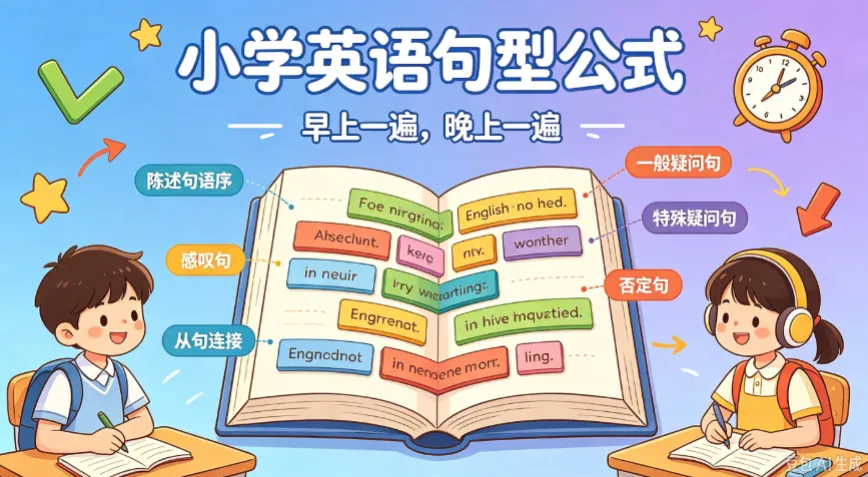
01 一、陈述句语序公式共20条公式 · 60句 🎧 配套音频:《一、陈述句语序公式》已按 0.9 倍速录制,每句之间停顿约2秒,方便跟读 公式 1主语 + be动词 + 名词/形容词 陈述句最基本的结构,说明“是谁”或“怎么样”。 ●I am a student.我是一名学生。 ●My mother is a nurse.我妈妈是一名护士。 ●The flowers are very beautiful.这些花非常漂亮。 公式 2主语 + 实义动词 + 宾语 表达“谁做什么”,主语后直接跟动词。 ●We play football after school.我们放学后踢足球。 ●Tom cleans his room every day.汤姆每天打扫他的房间。 ●My sister reads books in the evening.我妹妹晚上看书。 公式 3主语 + 情态动词 + 动词原形 情态动词后必须接动词原形。 ●I can swim very fast.我能游得很快。 ●You should do your homework first.你应该先做作业。 ●We must keep quiet in the library.我们在图书馆必须保持安静。 公式 4There is + 单数名词 + 地点 表示“某地有一个什么东西”。 ●There is a book on the desk.桌上有一本书。 ●There is a cat under the bed.床底下有一只猫。 ●There is a tall tree in front of my house.我家前面有一棵大树。 公式 5There are + 复数名词 + 地点 表示“某地有多个什么东西”,名词用复数。 ●There are four people in my family.我家有四口人。 ●There are many flowers in the garden.花园里有许多花。 ●There are two blackboards in our classroom.我们教室里有两块黑板。 公式 6主语 + be going to + 动词原形 表示计划或打算做某事。 ●I am going to visit my grandma this weekend.这周末我要去看望奶奶。 ●We are going to have a picnic tomorrow.我们明天要去野餐。 ●She is going to learn swimming.她打算去学游泳。 公式 7主语 + 频率副词 + 动词 always、usually、often、sometimes、never 放在实义动词前。 ●I always get up at six.我总是六点起床。 ●He often plays basketball after class.他经常下课后打篮球。 ●She never goes to school late.她上学从不迟到。 公式 8主语 + like/love/enjoy + doing 表示喜欢做某事,动词要用 ing 形式。 ●I like reading storybooks.我喜欢读故事书。 ●We love playing games together.我们喜欢一起玩游戏。 ●My father enjoys fishing on Sundays.我爸爸喜欢周日钓鱼。 公式 9主语 + want to do 表示想要做某事,want 后接 to do。 ●I want to be a doctor.我想当一名医生。 ●She wants to buy a new bike.她想买一辆新自行车。 ●They want to visit the Great Wall.他们想去参观长城。 公式 10It is + 形容词 + to do It 作形式主语,真正的主语是后面的 to do。 ●It is easy to learn English well.学好英语很容易。 ●It is important to eat breakfast.吃早餐很重要。 ●It is fun to play with my friends.和朋友们一起玩很有趣。 公式 11主语 + be good at + doing 表示擅长做某事,at 后接名词或 doing。 ●I am good at drawing.我擅长画画。 ●Tom is good at playing chess.汤姆擅长下棋。 ●My sister is good at singing.我妹妹擅长唱歌。 公式 12give sb sth = give sth to sb 双宾语结构,直接宾语放后面时要加 to。 ●My mother gives me an apple.妈妈给我一个苹果。 ●Please give the book to me.请把书给我。 ●Grandpa gives us some candies.爷爷给我们一些糖果。 公式 13主语 + spend + 时间 + doing 表示“花费时间做某事”,动词用 doing。 ●I spend an hour doing my homework.我花一小时做作业。 ●She spends thirty minutes reading every day.她每天花三十分钟阅读。 ●We spent two hours cleaning the room.我们花了两个小时打扫房间。 公式 14主语 + look/sound/feel + 形容词 感官动词后直接加形容词,构成“主系表”结构。 ●The song sounds beautiful.这首歌听起来很美。 ●I feel happy today.我今天感到开心。 ●Your new dress looks nice.你的新裙子看起来很好看。 公式 15It's + 时间点 + now 表达“现在几点钟”的固定句型。 ●It's seven o'clock now.现在七点了。 ●It's half past twelve.现在十二点半。 ●It's a quarter to nine.现在差一刻九点。 公式 16主语 + 动词三单形式 一般现在时中,主语是第三人称单数时动词加 s/es。 ●She watches TV every evening.她每天晚上看电视。 ●My brother studies very hard.我弟弟学习非常努力。 ●The bus comes at eight.公交车八点来。 公式 17主语 + be + 形容词 + to do 表示“做某事是怎样的”,主语与动词是逻辑动宾关系时用主动表被动含义较常见于 easy/hard。 ●The question is hard to answer.这个问题很难回答。 ●English is fun to learn.英语学起来很有趣。 ●The room is easy to clean.这个房间容易打扫。 公式 18help sb (to) do 帮助某人做某事,to 可以省略。 ●I often help my mother cook dinner.我经常帮妈妈做晚饭。 ●Tom helps me carry the box.汤姆帮我搬箱子。 ●She helps her grandma water the flowers.她帮奶奶浇花。 公式 19主语 + make + 宾语 + 形容词 make 后接“宾语+形容词”,表示“使某人/某物怎么样”。 ●The story makes me happy.这个故事让我很开心。 ●Rainy days make me sleepy.下雨天让我犯困。 ●Good news makes everyone excited.好消息让每个人都很兴奋。 公式 20主语 + be + from + 地点 表示“某人来自某地”,可与 come from 替换。 ●I am from Shanghai.我来自上海。 ●My teacher is from England.我的老师来自英格兰。 ●These pandas are from China.这些熊猫来自中国。 02 二、一般疑问句公式共22条公式 · 66句 🎧 配套音频:《二、一般疑问句公式》已按 0.9 倍速录制,每句之间停顿约2秒,方便跟读 公式 1Be动词 + 主语 + 其他? 一般疑问句第一公式:把 be 动词提到句首,句末用问号。 ●Are you a student? Yes, I am.你是学生吗?是的。 ●Is she your sister? Yes, she is.她是你姐姐吗?是的。 ●Is this your schoolbag? Yes, it is.这是你的书包吗?是的。 公式 2Do + 主语 + 动词原形? 主语是非三单时,用 do 提问。 ●Do you like apples? Yes, I do.你喜欢苹果吗?是的。 ●Do they play football on Sundays? Yes, they do.他们周日踢足球吗?是的。 ●Do you go to school by bus? Yes, I do.你坐公交上学吗?是的。 公式 3Does + 三单主语 + 动词原形? 主语是第三人称单数时用 does,后面动词恢复原形。 ●Does he like swimming? Yes, he does.他喜欢游泳吗?是的。 ●Does she do her homework every day? Yes, she does.她每天做作业吗?是的。 ●Does Tom get up early? Yes, he does.汤姆起床早吗?是的。 公式 4Did + 主语 + 动词原形? 问过去发生的事,用 did 提问,动词用原形。 ●Did you visit the museum last week? Yes, I did.你上周参观博物馆了吗?是的。 ●Did she buy a new dress? Yes, she did.她买新裙子了吗?是的。 ●Did they watch the game? Yes, they did.他们看比赛了吗?是的。 公式 5Can/Will/Should + 主语 + 原形? 情态动词和 will 提问,直接把情态动词放句首。 ●Can you help me with my English? Yes, I can.你能帮我学英语吗?可以。 ●Will it rain tomorrow? Yes, it will.明天会下雨吗?会的。 ●Should I finish it now? Yes, you should.我现在应该完成它吗?应该。 公式 6Is/Are there + 名词? There be 句型变一般疑问句,把 be 提到 there 前。 ●Is there a park near your home? Yes, there is.你家附近有公园吗?有。 ●Are there any books on the shelf? Yes, there are.书架上有书吗?有。 ●Is there a bank around here? Yes, there is.这附近有银行吗?有。 公式 7May I + 动词原形? 表示请求许可,语气礼貌。 ●May I come in? Yes, please.我可以进来吗?请进。 ●May I borrow your pen? Yes, you may.我可以借你的笔吗?可以。 ●May I ask a question? Yes, of course.我可以问个问题吗?当然可以。 公式 8Would you like + 名词/to do? 礼貌地询问对方意愿,比 Do you want 更客气。 ●Would you like some tea? Yes, please.你想喝点茶吗?好的。 ●Would you like to go with us? Yes, I'd love to.你想和我们一起去吗?我乐意。 ●Would you like a piece of cake? Yes, please.你想来块蛋糕吗?好的。 公式 9Shall we + 动词原形? 用于提建议,征求意见。 ●Shall we go to the zoo? Good idea.我们去动物园好吗?好主意。 ●Shall we start now? Yes, let's.我们现在开始好吗?好,开始吧。 ●Shall we play chess after dinner? Sure.晚饭后我们下棋好吗?当然。 公式 10Could you please + 原形? 更礼貌的请求,语气委婉。 ●Could you please open the window? Yes, I can.你能打开窗户吗?可以。 ●Could you please say it again? Sure.你能再说一遍吗?当然。 ●Could you please help me? Yes, no problem.你能帮帮我吗?没问题。 公式 11Have/Has + 主语 + got? 英式表达“拥有”,提问时把 have/has 提前。 ●Have you got a ruler? Yes, I have.你有尺子吗?有。 ●Has she got any brothers? Yes, she has.她有兄弟吗?有。 ●Have they got a map? Yes, they have.他们有地图吗?有。 公式 12Are you + doing? 用现在进行时提问“正在做什么吗”。 ●Are you reading a book? Yes, I am.你在看书吗?是的。 ●Is he doing his homework? Yes, he is.他在做作业吗?是的。 ●Are they playing in the park? Yes, they are.他们在公园里玩吗?是的。 公式 13Were/Was + 主语 + …? 过去时的 be 动词提问。 ●Were you at home yesterday? Yes, I was.你昨天在家吗?在。 ●Was the film interesting? Yes, it was.电影有意思吗?有。 ●Was it sunny last Sunday? Yes, it was.上周日天晴吗?晴。 公式 14Do you want + to do? 直接询问对方愿望。 ●Do you want to watch TV? Yes, I do.你想看电视吗?想。 ●Do you want to play with me? Yes, I do.你想和我玩吗?想。 ●Do you want an ice cream? Yes, I do.你想要冰淇淋吗?想。 公式 15Can I + 动词原形? 询问“我可以做某事吗”。 ●Can I use your bike? Yes, you can.我可以用你的自行车吗?可以。 ●Can I sit here? Yes, you can.我可以坐这里吗?可以。 ●Can I open the box now? Yes, you can.我现在可以打开盒子吗?可以。 公式 16Do you have + 名词? 美式表达“拥有”的提问方式。 ●Do you have a pet? Yes, I do.你有宠物吗?有。 ●Do you have any questions? Yes, I do.你有问题吗?有。 ●Do you have an English dictionary? Yes, I do.你有英语词典吗?有。 公式 17Is everyone/Everything + …? 不定代词作主语,be 动词用单数 is。 ●Is everyone here today? Yes, we are all here.今天大家都到了吗?都到了。 ●Is everything ready? Yes, it is.一切都准备好了吗?好了。 ●Is everyone happy? Yes, we are.大家开心吗?开心。 公式 18Do you often/usually + 原形? 频率副词放主语后、动词前。 ●Do you usually walk to school? Yes, I do.你通常走路上学吗?是的。 ●Does he often visit his grandma? Yes, he does.他经常去看奶奶吗?是的。 ●Do they always eat breakfast at home? Yes, they do.他们总在家吃早餐吗?是的。 公式 19Would you like some/any + 名词? some 用于一般疑问句表“邀请”时不用变 any。 ●Would you like some water? Yes, please.你想喝点水吗?好的。 ●Would you like some more rice? No, thanks.你想再来点米饭吗?不用了,谢谢。 ●Would you like some help? Yes, please.你需要帮忙吗?需要。 公式 20Is/Are + 主语 + from…? be from 表示“来自哪里”的提问。 ●Are you from Beijing? Yes, I am.你来自北京吗?是的。 ●Is he from America? No, he isn't.他来自美国吗?不是。 ●Are they from England? Yes, they are.他们来自英格兰吗?是的。 公式 21Do/Does + 主语 + like + doing? 询问“是否喜欢做某事”,like 后用 doing。 ●Do you like swimming? Yes, I do.你喜欢游泳吗?喜欢。 ●Does she like dancing? Yes, she does.她喜欢跳舞吗?喜欢。 ●Does your father like fishing? Yes, he does.你爸爸喜欢钓鱼吗?喜欢。 公式 22Can you see/hear/find + …? 感官动词提问“能看见/听见/找到吗”。 ●Can you see the bird in the tree? Yes, I can.你能看见树上的鸟吗?能。 ●Can you hear the music? Yes, I can.你能听见音乐吗?能。 ●Can you find my glasses? Yes, here they are.你能找到我的眼镜吗?能,在这儿。 03 三、特殊疑问句公式共21条公式 · 63句 🎧 配套音频:《三、特殊疑问句公式》已按 0.9 倍速录制,每句之间停顿约2秒,方便跟读 公式 1What + be + 主语? 询问“是什么”,最基本的特殊疑问句。 ●What is this? It is a pen.这是什么?这是一支钢笔。 ●What is your favorite subject? English.你最喜欢的科目是什么?英语。 ●What are those? They are birds.那些是什么?那些是鸟。 公式 2Where + be/do + 主语? 询问地点。 ●Where is my schoolbag? It is on the chair.我的书包在哪里?在椅子上。 ●Where do you live? I live near the park.你住在哪里?我住在公园附近。 ●Where does he work? He works in a hospital.他在哪里工作?他在医院工作。 公式 3When + be/do + 主语? 询问时间。 ●When do you get up? At six thirty.你什么时候起床?六点半。 ●When is your birthday? It is in May.你的生日是什么时候?在五月。 ●When did you come back? Last night.你什么时候回来的?昨晚。 公式 4Who + be/动词 + …? 询问人。 ●Who is that boy? He is my brother.那个男孩是谁?他是我哥哥。 ●Who teaches you English? Miss Li does.谁教你们英语?李老师。 ●Who is on duty today? I am.今天谁值日?是我。 公式 5Whose + 名词 + is this? 询问所属关系。 ●Whose book is this? It is Tom's.这是谁的书?是汤姆的。 ●Whose bag is bigger? Mine is.谁的包更大?我的。 ●Whose turn is it to clean the room? It's my turn.轮到谁打扫房间了?轮到我了。 公式 6Why + be/do + 主语? 询问原因,回答常用 Because。 ●Why are you late? Because I missed the bus.你为什么迟到?因为我错过了公交车。 ●Why do you like summer? Because I can swim.你为什么喜欢夏天?因为我可以游泳。 ●Why is she crying? Because her toy is broken.她为什么哭?因为她的玩具坏了。 公式 7How + be + 主语? 询问状况。 ●How is your mother? She is fine.你妈妈好吗?她很好。 ●How was your trip? It was great.你的旅行怎么样?很棒。 ●How are you today? I am much better.你今天怎么样?我好多了。 公式 8How many + 复数名词? 询问可数名词的数量。 ●How many books are there on the desk? Five.桌上有几本书?五本。 ●How many students are there in your class? Forty.你们班有多少学生?四十个。 ●How many days are there in a week? Seven.一周有几天?七天。 公式 9How much + 不可数名词/价格? 询问不可数名词的量或价格。 ●How much milk do you want? A glass, please.你要多少牛奶?一杯。 ●How much is the shirt? It is fifty yuan.这件衬衫多少钱?五十元。 ●How much water is in the bottle? Not much.瓶子里有多少水?不多。 公式 10How old + be + 主语? 询问年龄。 ●How old are you? I am twelve.你多大了?我十二岁。 ●How old is your dog? It is three.你的狗几岁了?三岁。 ●How old is your school? It is eighty years old.你们学校有多少年了?八十年。 公式 11How long + …? 询问时间长度或物体长度。 ●How long is the river? About one thousand kilometers.这条河有多长?大约一千公里。 ●How long did you stay there? For two weeks.你在那里待了多久?两周。 ●How long does the class last? Forty minutes.一节课多长时间?四十分钟。 公式 12How often + …? 询问频率。 ●How often do you swim? Twice a week.你多久游一次泳?一周两次。 ●How often does he visit his grandpa? Once a month.他多久去看一次爷爷?每月一次。 ●How often do you exercise? Every day.你多久锻炼一次?每天。 公式 13How far + …? 询问距离。 ●How far is your school? About two kilometers.你学校有多远?大约两公里。 ●How far is it from here to the station? Very close.从这里到车站有多远?很近。 ●How far can you run? About three kilometers.你能跑多远?大约三公里。 公式 14What time + …? 询问具体时刻。 ●What time is it? It is nine o'clock.几点了?九点。 ●What time do you have lunch? At twelve.你几点吃午饭?十二点。 ●What time does the shop open? At nine.商店几点开门?九点。 公式 15What color + be + 主语? 询问颜色。 ●What color is your bag? It is blue.你的包是什么颜色?蓝色。 ●What color are the flowers? They are red.花是什么颜色?红色的。 ●What color is your new bike? It is black.你的新自行车是什么颜色?黑色。 公式 16Which + 名词 + …? 在一定范围内选择提问。 ●Which season do you like best? Spring.你最喜欢哪个季节?春天。 ●Which bus goes to the park? Bus No. 3.哪路车去公园?3路。 ●Which one is yours? The red one.哪个是你的?红色的那个。 公式 17What/How about + 名词/doing? 用于提建议或反问。 ●What about a picnic this Sunday? Good idea.这周日去野餐怎么样?好主意。 ●How about playing basketball? Sounds great.打篮球怎么样?听起来不错。 ●How about some juice? Yes, please.来点果汁怎么样?好的。 公式 18What + be + 主语 + doing? 询问“正在做什么”。 ●What are you doing? I am reading.你在做什么?我在看书。 ●What is she doing? She is cooking.她在做什么?她在做饭。 ●What are they doing? They are playing football.他们在做什么?他们在踢足球。 公式 19How do you go/come to…? 询问出行方式。 ●How do you go to school? By bike.你怎么上学?骑自行车。 ●How does he go to work? By subway.他怎么去上班?坐地铁。 ●How do they come to Beijing? By plane.他们怎么来北京?坐飞机。 公式 20Why don't you + 原形? = Why not + 原形? 用于提建议,两种说法意思相同。 ●Why don't you ask your teacher? Good idea.你为什么不问老师呢?好主意。 ●Why not go with us? Sure.为什么不和我们一起去呢?当然。 ●Why not try again? OK, I will.为什么不试试呢?好,我会的。 公式 21What does sb look like? 询问外貌。 ●What does your teacher look like? She is tall and kind.你老师长什么样?她又高又和善。 ●What does your dog look like? It is small and white.你的狗长什么样?又小又白。 ●What does he look like? He has big eyes.他长什么样?他有大眼睛。 04 四、否定句公式共21条公式 · 63句 🎧 配套音频:《四、否定句公式》已按 0.9 倍速录制,每句之间停顿约2秒,方便跟读 公式 1be动词 + not 否定句第一公式:在 be 动词后直接加 not。 ●I am not a doctor. I am a teacher.我不是医生。我是老师。 ●She is not at school today.她今天不在学校。 ●They are not my books.这些不是我的书。 公式 2don't + 动词原形 主语是非三单时,实义动词的否定用 don't。 ●I don't like rainy days.我不喜欢下雨天。 ●We don't have class on Sundays.我们周日没有课。 ●They don't live in this city.他们不住在这个城市。 公式 3doesn't + 动词原形 主语是第三人称单数时用 doesn't,动词恢复原形。 ●He doesn't like vegetables.他不喜欢吃蔬菜。 ●She doesn't watch TV on weekdays.她工作日不看电视。 ●My father doesn't drink coffee.我爸爸不喝咖啡。 公式 4didn't + 动词原形 过去时的否定,用 didn't 加动词原形。 ●I didn't go to school yesterday.我昨天没去上学。 ●She didn't finish her homework.她没有完成作业。 ●We didn't see the film last night.我们昨晚没看电影。 公式 5情态动词 + not(can't, mustn't, shouldn't) 情态动词后加 not 构成否定。 ●You mustn't play with fire.你绝不能玩火。 ●You shouldn't eat too much candy.你不应该吃太多糖。 ●I can't find my keys.我找不到钥匙了。 公式 6not…at all “一点也不”,加强否定语气。 ●I am not tired at all.我一点也不累。 ●He doesn't like fish at all.他一点也不喜欢鱼。 ●The box is not heavy at all.这个箱子一点也不重。 公式 7never 表全否定 never 本身就是否定词,动词用肯定形式。 ●I never stay up late.我从不熬夜。 ●She never tells lies.她从不撒谎。 ●He never eats breakfast at school.他从不在学校吃早餐。 公式 8no + 名词 = not any no 加名词可以替代 not any 表示否定。 ●There is no water in the bottle.瓶子里没有水。 ●I have no money with me.我身上没带钱。 ●There are no apples in the fridge.冰箱里没有苹果。 公式 9I don't think + 从句 think 引导的宾语从句,否定要前移到 think 上。 ●I don't think he is right.我认为他不对。 ●I don't think it will rain tomorrow.我认为明天不会下雨。 ●I don't think she knows the answer.我认为她不知道答案。 公式 10not…until “直到……才”,until 前的动词用否定。 ●I didn't go to bed until ten o'clock.我直到十点才睡觉。 ●He didn't leave until the rain stopped.雨停了他才走。 ●Don't open the box until Mom comes back.妈妈回来前不要打开盒子。 公式 11Don't + 动词原形 否定祈使句:句首加 Don't。 ●Don't run in the classroom.不要在教室里跑。 ●Don't be late for school.上学不要迟到。 ●Don't forget your homework.别忘了带作业。 公式 12Let's not + 动词原形 Let's 句型的否定形式。 ●Let's not play outside.我们别在外面玩了。 ●Let's not waste water.我们不要浪费水。 ●Let's not talk loudly here.我们别在这里大声说话。 公式 13be not going to be going to 结构的否定形式。 ●I am not going to watch TV tonight.我今晚不打算看电视。 ●We are not going to the beach.我们不去海滩。 ●He is not going to buy that toy.他不打算买那个玩具。 公式 14won't = will not 将来时的否定用 won't。 ●I won't be late again.我不会再迟到了。 ●It won't snow tomorrow, I think.我想明天不会下雪。 ●They won't come to the party.他们不会来参加聚会。 公式 15too…to… “太……而不能……”,本身含否定意义。 ●The boy is too young to go to school.这个男孩太小,还不能上学。 ●I am too tired to walk.我太累了,走不动了。 ●The box is too heavy for me to carry.箱子太重,我搬不动。 公式 16hardly 表否定 hardly 意为“几乎不”,句中动词用肯定形式。 ●I can hardly believe it.我几乎不能相信。 ●She hardly ever eats meat.她几乎从不吃肉。 ●We hardly see each other now.我们现在几乎见不到彼此。 公式 17few/little 表否定 few 修饰可数名词、little 修饰不可数名词,表示“几乎没有”。 ●There are few apples left.几乎没剩几个苹果了。 ●There is little milk in the glass.杯子里几乎没有牛奶了。 ●Few students know the answer.几乎没有学生知道这个答案。 公式 18not…any more “不再……”,表示以前的情况结束了。 ●I don't cry any more.我不再哭了。 ●He doesn't live here any more.他不再住这里了。 ●We don't play that game any more.我们不再玩那个游戏了。 公式 19neither 表全否定 neither 表示“两者都不”。 ●Neither answer is right.两个答案都不对。 ●Neither of us likes math.我们俩都不喜欢数学。 ●Neither book is interesting.两本书都没意思。 公式 20not…both 表部分否定 “不是两者都……”,与 both 连用表示部分否定。 ●I don't know both of them.我不是他们两个都认识。 ●Both of the answers are not correct.并非两个答案都正确。 ●Not both books are worth reading.并不是两本书都值得读。 公式 21nothing/nobody 表否定 不定代词本身含否定意义,动词用肯定。 ●There is nothing in the box.盒子里什么都没有。 ●Nobody knows the truth.没有人知道真相。 ●I saw nothing strange.我没看到什么奇怪的东西。 05 五、祈使句与Let句型公式共20条公式 · 60句 🎧 配套音频:《五、祈使句与Let句型公式》已按 0.9 倍速录制,每句之间停顿约2秒,方便跟读 公式 1动词原形开头 祈使句基本公式:直接以动词原形开始,省略主语。 ●Open the door, please.请打开门。 ●Listen carefully in class.上课认真听讲。 ●Wash your hands before dinner.晚饭前洗手。 公式 2Please + 动词原形 加 please 使语气更礼貌,可放句首或句尾。 ●Please sit down.请坐下。 ●Please speak more slowly.请说慢一点。 ●Close the window, please.请关上窗户。 公式 3Don't + 动词原形 否定祈使句:在动词原形前加 Don't。 ●Don't worry about me.别为我担心。 ●Don't play on the road.不要在马路上玩。 ●Don't be afraid of the dark.不要怕黑。 公式 4Let's + 动词原形 表示“让我们做某事吧”,包括说话人在内。 ●Let's go to the park.我们去公园吧。 ●Let's play a game.我们玩个游戏吧。 ●Let's help the old man.我们帮助那位老人吧。 公式 5Let me + 动词原形 表示“让我来……”。 ●Let me help you.让我来帮你。 ●Let me see your new pen.让我看看你的新钢笔。 ●Let me try again.让我再试一次。 公式 6Let him/her/them + 原形 let 后接第三人称宾格加动词原形。 ●Let him answer the question.让他回答这个问题。 ●Let her go to bed early.让她早点睡觉。 ●Let them finish the work.让他们完成工作。 公式 7Be + 形容词 be 动词开头的祈使句,表示“要……状态”。 ●Be quiet, please.请安静。 ●Be careful with the knife.小心用刀。 ●Be kind to your classmates.对同学要友善。 公式 8No + doing 表示禁止的标识语,如“No smoking”。 ●No smoking here.此处禁止吸烟。 ●No swimming in the river.禁止在河里游泳。 ●No parking in front of the gate.门前禁止停车。 公式 9祈使句 + and + 结果句 祈使句 + and,表示“那么就会……”。 ●Work hard, and you will pass the exam.努力,你就会通过考试。 ●Go straight, and you will see the bank.直走,你就会看到银行。 ●Hurry up, and we can catch the bus.快点,我们就能赶上公交车。 公式 10祈使句 + or + 结果句 祈使句 + or,表示“否则就会……”。 ●Get up early, or you will be late.早点起床,否则你会迟到。 ●Wear more clothes, or you will catch a cold.多穿点衣服,否则你会感冒。 ●Study hard, or you will fall behind.努力学习,否则你会落后。 公式 11Remember to do 提醒“记得要做某事”。 ●Remember to close the door.记得关门。 ●Remember to bring your umbrella.记得带伞。 ●Remember to call your mom.记得给你妈妈打电话。 公式 12Don't forget to do 提醒“别忘了做某事”,与 remember to do 相反。 ●Don't forget to turn off the light.别忘了关灯。 ●Don't forget to feed the cat.别忘了喂猫。 ●Don't forget to say thank you.别忘了说谢谢。 公式 13Never + 动词原形 语气最强的否定祈使,表示“绝不要……”。 ●Never give up.永不放弃。 ●Never tell lies.绝不要撒谎。 ●Never swim alone.绝不要独自游泳。 公式 14make sb + 动词原形 make 后的宾补用不带 to 的动词原形。 ●The story makes us laugh.这个故事让我们大笑。 ●The teacher makes us read aloud.老师让我们大声朗读。 ●Rainy days make me stay at home.下雨天让我待在家里。 公式 15have sb + 动词原形 have sb do 表示“让某人做某事”。 ●Mom has me wash the dishes.妈妈让我洗碗。 ●The teacher has us hand in our homework.老师让我们交作业。 ●Dad has me water the flowers.爸爸让我浇花。 公式 16Please don't + 动词原形 更礼貌的否定祈使。 ●Please don't open the box.请不要打开盒子。 ●Please don't touch the painting.请不要触摸这幅画。 ●Please don't make so much noise.请不要发出这么大的噪音。 公式 17Let us + 原形(正式请求) Let us 比 Let's 语气正式,用于请求。 ●Let us have a break.让我们休息一下吧。 ●Let us know when you arrive.你到了告诉我们一声。 ●Let us help you clean the room.让我们帮你打扫房间。 公式 18祈使句表条件 祈使句放句首,相当于 if 条件句。 ●Study hard, and your dream will come true.好好学习,你的梦想就会实现。 ●Turn left, and you will find the shop.左转,你就会找到那家商店。 ●Take this medicine, and you will feel better.吃了这药,你就会好起来。 公式 19Do + 动词原形(强调) 句首加 Do 表示强烈请求“一定……”。 ●Do come to my birthday party.一定来参加我的生日聚会。 ●Do be careful with the glass.一定要小心玻璃。 ●Do write to me soon.一定要尽快给我写信。 公式 20Come/Go + 方向副词 动词 come、go 加方向词,构成移动祈使句。 ●Come this way, please.请这边走。 ●Come in and have a seat.进来坐吧。 ●Go back to your seat.回到你的座位上去。 06 六、感叹句公式共20条公式 · 60句 🎧 配套音频:《六、感叹句公式》已按 0.9 倍速录制,每句之间停顿约2秒,方便跟读 公式 1What + a/an + 形容词 + 单数名词! 感叹可数名词单数,名词前有形容词时要加 a/an。 ●What a beautiful flower it is!这朵花多美啊! ●What an interesting book it is!这本书多有趣啊! ●What a lovely baby she is!她真是个可爱的宝宝! 公式 2What + 形容词 + 复数名词! 感叹可数名词复数,不加冠词。 ●What beautiful flowers they are!这些花多美啊! ●What clever children they are!他们真是聪明的孩子! ●What interesting stories they are!这些故事多有趣啊! 公式 3What + 形容词 + 不可数名词! 感叹不可数名词,不用冠词。 ●What fine weather it is today!今天天气真好啊! ●What delicious bread it is!这面包真好吃啊! ●What bad news it is!多糟糕的消息啊! 公式 4How + 形容词 + 主语 + 谓语! 感叹形容词,后接陈述句语序。 ●How beautiful the garden is!这个花园多美啊! ●How tall the building is!这座楼真高啊! ●How happy the children are!孩子们多开心啊! 公式 5How + 副词 + 主语 + 谓语! 感叹副词修饰的动作方式。 ●How fast he runs!他跑得真快啊! ●How carefully she writes!她写字多认真啊! ●How beautifully she sings!她唱得真好听啊! 公式 6How + 形容词 + a/an + 单数名词! How 感叹句也可接“形容词+冠词+名词”结构。 ●How tall a boy he is!他真是个高个子男孩! ●How hot a day it is!今天天真热啊! ●How big an apple it is!这个苹果真大啊! 公式 7How time flies! 固定感叹句:时光飞逝。 ●How time flies! We are in Grade Six now.时光飞逝!我们已经是六年级了。 ●How time flies! The holiday is over.时间过得真快!假期结束了。 ●How time flies! My little sister can walk now.时间过得真快!我妹妹现在会走路了。 公式 8What a pity! 固定感叹句:真遗憾。 ●What a pity! I missed the beginning.真遗憾!我错过了开头。 ●What a pity! The shop is closed.真遗憾!商店关门了。 ●What a pity! He can't come today.真遗憾!他今天不能来。 公式 9What a surprise! 固定感叹句:真是个惊喜。 ●What a surprise! I didn't know you were here.真是个惊喜!我不知道你在这里。 ●What a surprise to see you here!在这里见到你真是个惊喜! ●What a big surprise this gift is!这个礼物真是个大惊喜! 公式 10How nice of you! 固定感叹句:你真好。 ●How nice of you to help me!你帮我真是太好了! ●How nice of you to say that!你这么说真让人暖心! ●How nice of you to wait for me!你等我真是太好了! 公式 11What fun! 固定感叹句:真有趣,fun 是不可数名词。 ●What fun it is to swim in summer!夏天游泳多有趣啊! ●What fun the game is!这个游戏真有趣! ●What fun we had at the party!我们在聚会上玩得多开心啊! 公式 12How wonderful! 感叹“太精彩了”。 ●How wonderful the show is!这个演出太精彩了! ●How wonderful! We won the game!太棒了!我们赢了比赛! ●How wonderful the trip was!这次旅行太精彩了! 公式 13What a beautiful day! 感叹天气好的固定说法。 ●What a beautiful day! Let's go out to play.今天天气真好!我们出去玩吧。 ●What a beautiful day for a picnic!真是适合野餐的好天气! ●What a beautiful sunny morning!多么晴朗美好的早晨啊! 公式 14How + lucky/lovely/sweet…! 直接用感叹形容词表达情绪。 ●How lucky we are to have you!有你我们多幸运啊! ●How lovely the puppy is!这只小狗真可爱啊! ●How sweet the music is!这音乐多甜美啊! 公式 15What a mess! 固定感叹句:真乱啊。 ●What a mess your room is!你的房间真乱啊! ●What a mess! Who did this?真乱啊!谁干的? ●Look at the table. What a mess!看看桌子,真是一团糟! 公式 16How clever/smart + 主语 + is! 夸奖人聪明。 ●How clever the boy is!这个男孩多聪明啊! ●How smart you are to work it out!你解出它来真是太聪明了! ●How clever of Tom to find the way!汤姆真聪明,把路找到了! 公式 17What a great idea! 感叹“好主意”。 ●What a great idea! Let's do it now.真是个好主意!我们现在就做吧。 ●What a great idea to travel by train!坐火车旅行真是个好主意! ●What a wonderful idea your mom gave!你妈妈出的主意真棒! 公式 18How heavy/big/cold…+ 主语 + is! 感叹事物的程度。 ●How heavy the snow is!雪真大啊! ●How big the watermelon is!这个西瓜真大啊! ●How cold it is today!今天真冷啊! 公式 19What a good/nice boy/girl! 夸奖孩子的固定说法。 ●What a good boy! He helps the old man.多好的孩子啊!他帮助那位老人。 ●What a nice girl she is!她真是个好姑娘! ●What a hard-working student you are!你真是个勤奋的学生! 公式 20How I wish…! 强烈表达愿望“我多希望……啊!” ●How I wish I could fly!我多希望我能飞啊! ●How I wish to see you again!我多想再见到你啊! ●How I wish the holiday were longer!我多希望假期再长一点啊! 07 七、反意疑问句公式共20条公式 · 60句 🎧 配套音频:《七、反意疑问句公式》已按 0.9 倍速录制,每句之间停顿约2秒,方便跟读 公式 1前句肯定(be) + isn't/aren't…? 反意疑问句第一公式:前肯定,后否定。 ●You are a student, aren't you? Yes, I am.你是学生,对吗?是的。 ●She is your teacher, isn't she? Yes, she is.她是你的老师,对吗?是的。 ●They are in the classroom, aren't they? Yes, they are.他们在教室里,对吗?是的。 公式 2前句肯定(实义动词) + don't/doesn't…? 一般现在时实义动词,用 don't/doesn't 提问尾巴。 ●You like music, don't you? Yes, I do.你喜欢音乐,对吗?是的。 ●He plays chess well, doesn't he? Yes, he does.他棋下得好,对吗?是的。 ●They go to school by bus, don't they? Yes, they do.他们坐公交上学,对吗?是的。 公式 3前句过去时 + didn't…? 过去时的反意疑问用 didn't。 ●You went to the park yesterday, didn't you? Yes, I did.你昨天去了公园,对吗?是的。 ●She finished her homework, didn't she? Yes, she did.她完成作业了,对吗?是的。 ●They had a good time, didn't they? Yes, they did.他们玩得很开心,对吗?是的。 公式 4前句含 can/will + can't/won't…? 情态动词和 will 的反意疑问。 ●You can swim, can't you? Yes, I can.你会游泳,对吗?是的。 ●He will come tomorrow, won't he? Yes, he will.他明天会来,对吗?会的。 ●She can dance, can't she? Yes, she can.她会跳舞,对吗?会的。 公式 5前句否定 + 肯定尾巴 前句有否定词时,尾巴用肯定形式。 ●You aren't late, are you? No, I'm not.你没有迟到,对吗?没有。 ●He doesn't like coffee, does he? No, he doesn't.他不喜欢咖啡,对吗?不喜欢。 ●She wasn't at home, was she? No, she wasn't.她当时不在家,对吗?不在。 公式 6There be 句型的反意 尾巴用 be 动词加 there。 ●There is a book on the desk, isn't there? Yes, there is.桌上有一本书,对吗?是的。 ●There are many trees here, aren't there? Yes, there are.这里有很多树,对吗?是的。 ●There isn't any milk, is there? No, there isn't.没有牛奶了,对吗?没有了。 公式 7祈使句 + will you? 祈使句的反意疑问尾巴用 will you。 ●Open the door, will you? OK.打开门好吗?好的。 ●Pass me the salt, will you? Sure.把盐递给我好吗?当然。 ●Don't be late, will you? No, I won't.别迟到好吗?不会的。 公式 8Let's + 原形 + shall we? Let's 开头的句子,尾巴固定用 shall we。 ●Let's go for a walk, shall we? Good idea.我们去散步好吗?好主意。 ●Let's play a game, shall we? Sure.我们玩个游戏好吗?当然。 ●Let's start now, shall we? Yes, let's.我们现在开始好吗?好,开始吧。 公式 9I am… + aren't I? I am 的反意疑问尾巴是 aren't I,这是固定用法。 ●I am your friend, aren't I? Yes, you are.我是你的朋友,对吗?是的。 ●I am on the list, aren't I? Yes, you are.我在名单上,对吗?在的。 ●I am late, aren't I? No, you aren't.我迟到了,对吗?没有。 公式 10前句含 has/have(实义) + doesn't/don't? have 作“有”以外的实义动词时,用 don't/doesn't。 ●He has lunch at school, doesn't he? Yes, he does.他在学校吃午饭,对吗?是的。 ●They have sports after class, don't they? Yes, they do.他们课后做运动,对吗?是的。 ●She has a bath every evening, doesn't she? Yes, she does.她每天晚上洗澡,对吗?是的。 公式 11前句含 must(必须) + mustn't? must 表示“必须”时,尾巴用 mustn't。 ●I must finish it today, mustn't I? Yes, you must.我今天必须完成它,对吗?是的。 ●We must hand in the paper, mustn't we? Yes, you must.我们必须交论文,对吗?是的。 ●He must go now, mustn't he? Yes, he must.他现在必须走,对吗?是的。 公式 12前句含 never/ hardly + 肯定尾巴 前句有 never、hardly 等否定词,尾巴用肯定。 ●He never smokes, does he? No, he doesn't.他从不吸烟,对吗?不吸。 ●She hardly watches TV, does she? No, she doesn't.她几乎不看电视,对吗?几乎不看。 ●You have never been there, have you? No, I haven't.你从没去过那里,对吗?没去过。 公式 13主语是 everyone/everybody → they 反意疑问中不定代词 everyone 用 they 指代。 ●Everyone is here, aren't they? Yes, they are.大家都到了,对吗?都到了。 ●Everybody likes the song, don't they? Yes, they do.大家都喜欢这首歌,对吗?是的。 ●Everyone knows him, don't they? Yes, they do.大家都认识他,对吗?是的。 公式 14主语是 nobody/no one → they nobody 本身表否定,尾巴用肯定。 ●Nobody knows the answer, do they? No, they don't.没人知道答案,对吗?没有。 ●No one was late, were they? No, they weren't.没有人迟到,对吗?没有。 ●Nobody called me, did they? No, they didn't.没有人给我打电话,对吗?没有。 公式 15主语是 this/that → it 指示代词单数作主语,尾巴用 it。 ●This is your desk, isn't it? Yes, it is.这是你的课桌,对吗?是的。 ●That isn't your bike, is it? No, it isn't.那不是你的自行车,对吗?不是。 ●That was a great film, wasn't it? Yes, it was.那是一部很棒的电影,对吗?是的。 公式 16主语是 these/those → they 指示代词复数作主语,尾巴用 they。 ●These are your books, aren't they? Yes, they are.这些是你的书,对吗?是的。 ●Those aren't apples, are they? No, they aren't.那些不是苹果,对吗?不是。 ●Those were good days, weren't they? Yes, they were.那些是好日子,对吗?是的。 公式 17前句含 nothing → it nothing 作主语表否定,尾巴用肯定 it。 ●Nothing happened, did it? No, nothing.没发生什么事,对吗?没有。 ●Nothing is wrong, is it? No, nothing.没出问题,对吗?没有。 ●Nothing can stop us, can it? No, nothing.没有什么能阻止我们,对吗?没有。 公式 18前句含 used to 的反意(口语常用 didn't) used to 表示过去习惯,口语中用 didn't 提问尾巴。 ●You used to live here, didn't you? Yes, I did.你以前住在这里,对吗?是的。 ●He used to play football, didn't he? Yes, he did.他以前踢足球,对吗?是的。 ●They used to be good friends, didn't they? Yes, they did.他们以前是好朋友,对吗?是的。 公式 19前句含 should + shouldn't? should 的反意疑问尾巴用 shouldn't。 ●We should start now, shouldn't we? Yes, we should.我们现在应该开始,对吗?是的。 ●He should see a doctor, shouldn't he? Yes, he should.他应该去看医生,对吗?是的。 ●You shouldn't stay up late, should you? No, I shouldn't.你不应该熬夜,对吗?不应该。 公式 20前句谓语是 have/has(拥有)+ haven't/hasn't? have 表示“拥有”时,反意疑问用 haven't/hasn't。 ●She has a new bike, hasn't she? Yes, she has.她有一辆新自行车,对吗?是的。 ●They have a big garden, haven't they? Yes, they have.他们有一个大花园,对吗?是的。 ●You have got a cold, haven't you? Yes, I have.你感冒了,对吗?是的。 08 八、比较等级句型公式共20条公式 · 60句 🎧 配套音频:《八、比较等级句型公式》已按 0.9 倍速录制,每句之间停顿约2秒,方便跟读 公式 1A + be + 比较级 + than + B 比较级第一公式:than 后接比较对象。 ●My bag is heavier than yours.我的书包比你的重。 ●This room is bigger than that one.这个房间比那个大。 ●Tom is taller than his brother.汤姆比他哥哥高。 公式 2A + 动词比较级 + than + B 行为动词的比较级直接在动词上体现。 ●She runs faster than me.她跑得比我快。 ●He studies harder than his classmates.他学习比同学更努力。 ●I get up earlier than my sister.我比妹妹起得早。 公式 3as + 原级 + as 表示“和……一样”,两个事物程度相同。 ●Tom is as tall as his father.汤姆和他爸爸一样高。 ●This line is as long as that one.这条线和那条一样长。 ●My room is as clean as yours.我的房间和你的一样干净。 公式 4not as/so + 原级 + as 表示“不如……”,是 as…as 的否定形式。 ●My bike is not as new as yours.我的自行车不如你的新。 ●He is not so strong as his brother.他不如他哥哥强壮。 ●This book is not as interesting as that one.这本书不如那本有趣。 公式 5the + 最高级 + in/of… 三者以上比较用最高级,范围用 in/of。 ●She is the tallest in our class.她是我们班最高的。 ●This is the biggest city in China.这是中国最大的城市。 ●He is the best student of the three.他是三个人中最好的学生。 公式 6比较级 + and + 比较级 表示“越来越……”。 ●The days are getting longer and longer.白天越来越长了。 ●Our city is becoming more and more beautiful.我们的城市变得越来越美。 ●She is running faster and faster.她跑得越来越快。 公式 7the + 比较级, the + 比较级 表示“越……就越……”。 ●The more you read, the more you know.你读得越多,知道得越多。 ●The higher you climb, the colder it is.爬得越高,越冷。 ●The earlier you get up, the healthier you are.起得越早,越健康。 公式 8much/even/a little + 比较级 比较级前可以用 much、even 等词加强程度。 ●This box is much heavier than that one.这个箱子比那个重得多。 ●Today is even hotter than yesterday.今天比昨天还要热。 ●My sister is a little taller than me.我妹妹比我高一点点。 公式 9Which is + 比较级, A or B? 两者之间选择比较的疑问句。 ●Which is bigger, the sun or the moon? The sun.哪个更大,太阳还是月亮?太阳。 ●Which is faster, a train or a bus? A train.哪个更快,火车还是公交车?火车。 ●Which is more useful, a pen or a book? It depends.哪个更有用,钢笔还是书?看情况。 公式 10one of the + 最高级 + 复数名词 表示“最……之一”,名词用复数。 ●The Great Wall is one of the most famous places in the world.长城是世界上最著名的地方之一。 ●She is one of the best singers in our school.她是我们学校最好的歌手之一。 ●This is one of the most interesting books.这是最有趣的书之一。 公式 11比较级 + than any other + 单数名词 表示“比其他任何一个都……”,实际是最高级含义。 ●He is taller than any other boy in his class.他比班里其他任何一个男孩都高。 ●This river is longer than any other river here.这条河比这里其他任何一条河都长。 ●She sings better than any other student.她唱得比其他任何学生都好。 公式 12the same as 表示“和……一样”,用原级含义的固定句型。 ●My hat is the same as yours.我的帽子和你的一样。 ●His answer is the same as mine.他的答案和我的一样。 ●This box is the same size as that one.这个箱子和那个一样大。 公式 13be different from 表示“与……不同”。 ●My school life is different from yours.我的学校生活和你的不同。 ●This picture is different from that one.这幅画和那幅不同。 ●City life is quite different from country life.城市生活和乡村生活很不同。 公式 14more and more + 多音节形容词 多音节形容词的“越来越”结构。 ●English is more and more important.英语越来越重要了。 ●The story becomes more and more exciting.故事变得越来越精彩。 ●Our life is getting more and more convenient.我们的生活越来越便利。 公式 15get/become + 比较级 get、become 后接比较级表示变化。 ●It is getting warmer and warmer.天气越来越暖和了。 ●The little girl is getting taller.这个小女孩长得越来越高了。 ●The traffic becomes heavier in the morning.早上交通变得更拥堵。 公式 16A + 动词 + 副词比较级 + than B 副词比较级的固定用法。 ●He jumps higher than his friends.他跳得比他的朋友们高。 ●She drives more carefully than her husband.她开车比她丈夫小心。 ●I can run faster than last year.我比去年跑得更快了。 公式 17Who/Which + be + 最高级…? 疑问句中用最高级进行比较。 ●Who is the oldest in your family? My grandpa.你家谁最大?我爷爷。 ●Which is the heaviest of the three boxes? The blue one.三个箱子哪个最重?蓝色的。 ●Who runs the fastest in your class? Tom does.你们班谁跑得最快?汤姆。 公式 18less + 原级 + than 表示“不如……”的另一种说法。 ●This word is less difficult than that one.这个词不如那个难。 ●She is less careful than her sister.她不如她姐姐细心。 ●Today is less cold than yesterday.今天不如昨天冷。 公式 19Which do you like better, A or B? “更喜欢哪一个”的选择比较句。 ●Which do you like better, spring or autumn? Spring.你更喜欢哪个季节,春天还是秋天?春天。 ●Which do you like better, tea or juice? Juice.你更喜欢哪个,茶还是果汁?果汁。 ●Which does she like better, cats or dogs? Cats.她更喜欢哪个,猫还是狗?猫。 公式 20数词 + 比较级 + than 比较级前可以加数词表示具体差距。 ●He is two years older than me.他比我大两岁。 ●I am ten centimeters taller than my deskmate.我比同桌高十厘米。 ●This road is three kilometers longer than that one.这条路比那条长三公里。 09 九、从句连接公式共20条公式 · 60句 🎧 配套音频:《九、从句连接公式》已按 0.9 倍速录制,每句之间停顿约2秒,方便跟读 公式 1because + 原因从句 because 引导原因状语从句,回答 why。 ●I stayed at home because it rained hard.因为雨下得很大,我待在家里。 ●She is happy because she won the game.她很开心,因为她赢了比赛。 ●He didn't come because he was ill.他没来,因为他病了。 公式 2so + 结果句 so 引导结果,与 because 前后呼应。 ●It rained hard, so we stayed at home.雨下得很大,所以我们待在家里。 ●I was ill, so I didn't go to school.我生病了,所以没去上学。 ●The shop was closed, so we went home.商店关门了,所以我们回家了。 公式 3when + 时间从句 when 表示“当……的时候”。 ●When I got home, Mom was cooking.我到家时,妈妈在做饭。 ●When the light is red, we must wait.红灯亮时,我们必须等待。 ●I was reading when he came in.他进来时我正在看书。 公式 4before/after + 时间从句 before 表示“在……之前”,after 表示“在……之后”。 ●Wash your hands before you eat.吃饭前要洗手。 ●After he finished his homework, he watched TV.他做完作业后看电视。 ●I always brush my teeth before I go to bed.我睡前总是刷牙。 公式 5if + 条件从句 if 表示“如果”,主句用将来时、从句用一般现在时。 ●If it rains tomorrow, we will stay at home.如果明天下雨,我们就待在家里。 ●If you work hard, you will pass the exam.如果你努力,就会通过考试。 ●If you are tired, have a good rest.如果你累了,就好好休息。 公式 6though/although + 让步从句 表示“虽然……但是……”,英文中不能与 but 连用。 ●Though he is young, he knows a lot.虽然他年轻,但懂得很多。 ●Although it was late, she kept working.虽然很晚了,她仍继续工作。 ●Though it rained, we enjoyed the trip.虽然下雨了,我们还是很享受这次旅行。 公式 7so + 形容词/副词 + that + 从句 表示“如此……以至于……”。 ●The book is so interesting that I read it twice.这本书太有趣了,我读了两遍。 ●He ran so fast that nobody could catch him.他跑得太快了,没人能追上他。 ●She was so tired that she fell asleep soon.她太累了,很快就睡着了。 公式 8such + 名词短语 + that + 从句 such 后接名词,so 后接形容词,注意区别。 ●It is such a good film that everyone likes it.这是一部好电影,大家都喜欢。 ●They are such kind people that we all love them.他们是这么善良的人,我们都爱他们。 ●It was such a bad day that we stayed home.那天天气太糟了,我们待在家里。 公式 9as soon as + 时间从句 表示“一……就……”。 ●As soon as he saw me, he smiled.他一看到我就笑了。 ●I will call you as soon as I arrive.我一到就给你打电话。 ●As soon as class was over, we ran out.一下课我们就跑出去了。 公式 10while + 进行时从句 while 表示“当……正在……的时候”,从句常用进行时。 ●While I was cooking, the phone rang.我做饭时电话响了。 ●Don't talk while you are eating.吃饭时不要说话。 ●While she was reading, the baby slept.她看书时宝宝在睡觉。 公式 11until + 时间从句 表示“直到……为止”。 ●Wait until the light turns green.等到绿灯再走。 ●We played until it got dark.我们一直玩到天黑。 ●He didn't stop until he finished the work.他直到完成工作才停下来。 公式 12I know/believe that + 从句 that 引导宾语从句,that 常可省略。 ●I know that you are busy.我知道你很忙。 ●I believe that we can win.我相信我们能赢。 ●She said that she liked the gift.她说她喜欢这个礼物。 公式 13I wonder if/whether + 从句 表示“想知道是否……”,从句用陈述语序。 ●I wonder if it will rain tomorrow.我想知道明天会不会下雨。 ●I wonder whether he is at home.我想知道他在不在家。 ●She wonders if the shop is open.她想知道商店开门没有。 公式 14疑问词 + 陈述语序(宾语从句) 宾语从句中疑问词后必须用陈述语序。 ●Can you tell me where the library is?你能告诉我图书馆在哪里吗? ●I don't know what he wants.我不知道他想要什么。 ●Do you know when the train leaves?你知道火车什么时候开吗? 公式 15I'm sure that + 从句 表示“确信……”。 ●I'm sure that he will come.我确信他会来。 ●I'm sure that you can do it well.我确信你能做好。 ●She is sure that the answer is right.她确信这个答案是对的。 公式 16who/that 引导定语从句 先行词是人时用 who 或 that。 ●The girl who is standing there is my sister.站在那边的女孩是我妹妹。 ●I know the man who lives next door.我认识住在隔壁的那个人。 ●The boy that won the game is my friend.赢得比赛的男孩是我的朋友。 公式 17which/that 引导定语从句 先行词是物时用 which 或 that。 ●The book which is on the desk is mine.桌上的那本书是我的。 ●I like the songs that have good words.我喜欢歌词好的歌曲。 ●The pen that you gave me writes well.你给我的那支钢笔很好写。 公式 18where 引导定语从句 先行词是地点时用 where。 ●This is the school where I study.这就是我学习的学校。 ●I remember the house where I was born.我记得我出生的那座房子。 ●The park where we play is very big.我们玩的那个公园非常大。 公式 19so that + 目的从句 表示“以便……”,引导目的状语从句。 ●Speak louder so that everyone can hear you.说大声点,以便每个人都能听见。 ●I got up early so that I could catch the bus.我起得很早,以便赶上公交车。 ●Take notes so that you won't forget.做笔记,这样你就不会忘了。 公式 20I hope + 从句 hope 后接宾语从句,表示“希望……”,从句用将来含义。 ●I hope you will get well soon.我希望你早日康复。 ●I hope it will be sunny tomorrow.我希望明天是晴天。 ●We hope our team will win.我们希望我们队获胜。 10 十、常用固定句型公式共21条公式 · 63句 🎧 配套音频:《十、常用固定句型公式》已按 0.9 倍速录制,每句之间停顿约2秒,方便跟读 公式 1It's time to do / for sth 表示“到了做某事的时间了”。 ●It's time to go to school.到上学的时间了。 ●It's time for dinner.到吃晚饭的时间了。 ●It's time to do your homework.到你做作业的时间了。 公式 2had better (not) do 表示“最好(不要)做某事”,语气比 should 强。 ●You had better go to bed early.你最好早点睡觉。 ●We had better take an umbrella.我们最好带把伞。 ●You had better not swim alone.你最好不要独自游泳。 公式 3be good/bad for 表示“对……有益/有害”。 ●Eating vegetables is good for you.吃蔬菜对你有好处。 ●Reading in bed is bad for your eyes.躺在床上看书对你的眼睛不好。 ●Morning exercise is good for your health.晨练有益健康。 公式 4Thank you for doing 表示“感谢你做了某事”,for 后接 doing。 ●Thank you for helping me.谢谢你帮助我。 ●Thank you for coming to my party.谢谢你参加我的聚会。 ●Thanks for your letter.谢谢你的来信。 公式 5be famous for 表示“以……而著名”。 ●Beijing is famous for the Great Wall.北京以长城而著名。 ●This place is famous for its apples.这个地方以苹果闻名。 ●Hangzhou is famous for the West Lake.杭州以西湖而闻名。 公式 6be full of / be filled with 表示“装满、充满”,两个短语意思相近。 ●The bottle is full of water.瓶子里装满了水。 ●The room is filled with people.房间里挤满了人。 ●Her eyes were full of tears.她的眼里充满了泪水。 公式 7stop doing / stop to do stop doing 表示“停止做某事”,stop to do 表示“停下来去做另一件事”。 ●Please stop talking. Class begins.请不要说话了,开始上课。 ●He stopped to have a rest.他停下来休息了一会儿。 ●Stop playing and do your homework.别玩了,去做作业。 公式 8remember/forget to do remember to do 表示“记得去做”,forget to do 表示“忘记去做”。 ●Remember to close the window.记得关窗户。 ●I forgot to bring my pen.我忘了带钢笔。 ●Don't forget to water the flowers.别忘了浇花。 公式 9enjoy/finish/practise + doing 这几个动词后必须接 doing 形式。 ●I enjoy listening to music.我喜欢听音乐。 ●She finished cleaning the room.她打扫完了房间。 ●We practise speaking English every day.我们每天练习说英语。 公式 10be busy doing 表示“忙于做某事”。 ●Mom is busy cooking dinner.妈妈忙着做晚饭。 ●The students are busy preparing for the exam.学生们忙着准备考试。 ●He is busy washing his car.他忙着洗车。 公式 11see/hear/watch sb doing 强调“看见某人正在做某事”时用 doing。 ●I saw him crossing the street.我看见他正在过马路。 ●We heard her singing in the room.我们听到她在房间里唱歌。 ●They watched the birds flying south.他们看着鸟儿飞向南方。 公式 12It takes sb + 时间 + to do 表示“做某事花费某人多长时间”,It 作形式主语。 ●It takes me twenty minutes to get to school.我花二十分钟到学校。 ●It took us two hours to finish the work.完成这项工作花了我们两个小时。 ●It takes him ten minutes to walk home.他走路回家要花十分钟。 公式 13What's wrong/the matter with…? 询问“……怎么了”。 ●What's wrong with you? I have a cold.你怎么了?我感冒了。 ●What's the matter with your bike? It's broken.你的自行车怎么了?坏了。 ●What's wrong with the computer? It doesn't work.电脑怎么了?它坏了。 公式 14How do you like…? / What do you think of…? 询问“你觉得……怎么样”,两句意思相同。 ●How do you like this book? It's great.你觉得这本书怎么样?很棒。 ●What do you think of the film? Very interesting.你觉得这部电影怎么样?非常有意思。 ●How do you like your new school? I love it.你觉得新学校怎么样?我很喜欢。 公式 15not only…but also… 表示“不但……而且……”,连接两个并列成分。 ●He is not only clever but also hard-working.他不但聪明而且勤奋。 ●She can speak not only English but also French.她不仅会说英语还会说法语。 ●Not only the students but also the teacher likes the song.不但学生喜欢这首歌,老师也喜欢。 公式 16either…or / neither…nor either…or 表示“或者……或者”,neither…nor 表示“既不……也不”。 ●You can have either tea or coffee.你可以喝茶或者咖啡。 ●Neither he nor I am wrong.他没错,我也没错。 ●Either Mom or Dad cooks dinner at home.在家要么妈妈做饭,要么爸爸做饭。 公式 17both…and… 表示“……和……都”,连接两个并列的主语或宾语。 ●Both Tom and Mary like music.汤姆和玛丽都喜欢音乐。 ●Both the pen and the book are mine.钢笔和书都是我的。 ●She can both sing and dance.她既会唱歌又会跳舞。 公式 18prefer A to B 表示“比起 B 更喜欢 A”,A、B 用名词或 doing。 ●I prefer apples to bananas.比起香蕉,我更喜欢苹果。 ●She prefers reading to watching TV.比起看电视,她更喜欢读书。 ●He prefers walking to riding a bike.比起骑车,他更喜欢走路。 公式 19help sb with sth 表示“在某方面帮助某人”。 ●I often help Mom with the housework.我经常帮妈妈做家务。 ●Tom helps me with my English.汤姆帮我学英语。 ●She helps her dad with the farm work.她帮她爸爸干农活。 公式 20be afraid of / be afraid to do be afraid of 表示“害怕某人某物”,be afraid to do 表示“不敢做某事”。 ●The little girl is afraid of dogs.这个小女孩怕狗。 ●Don't be afraid to ask questions.不要不敢提问。 ●He is afraid of making mistakes.他害怕出错。 公式 21Welcome to + 地点 表示“欢迎来到某地”。 ●Welcome to our school.欢迎来到我们学校。 ●Welcome to Beijing.欢迎来到北京。 ●Welcome back to the classroom.欢迎回到教室。 📝 公式这样背,越背越快 1. 先看公式再读例句:搞清楚"骨架"是谁,单词换了句子照样成立。2. 音频跟读三遍:第一遍听,第二遍跟,第三遍自己说。3. 遮住中文说英文:能脱口而出才算过关。4. 自己造一句:换时间、换人物、换地点,公式就变成你自己的了。 整理不易,觉得有用就点亮"在看"转发给身边正在学英语的家长和孩子吧~