夜雨聆风
夜雨聆风有趣灵魂说
高考,这道无数中国年轻人改变命运的“独木桥”,正在悄然巨变。今年考生人数连续第二年下降,人口悬崖已从幼儿园蔓延至大学入口;与此同时,AI已经渗透进作业、备考甚至志愿填报,让学生刷题套路面临挑战。当死记硬背遇上随时可问的聊天机器人,高考还能否守住公平与效率?人口与科技的双重冲击,将如何重塑中国教育的未来?
译文为原创,仅供个人学习使用
The Economist |China
经济学人|中国
China’s notorious university-entrance exam is changing
中国备受争议的高考正在改变
Demography and AI are set to transform the gaokao
人口统计和人工智能将重塑高考
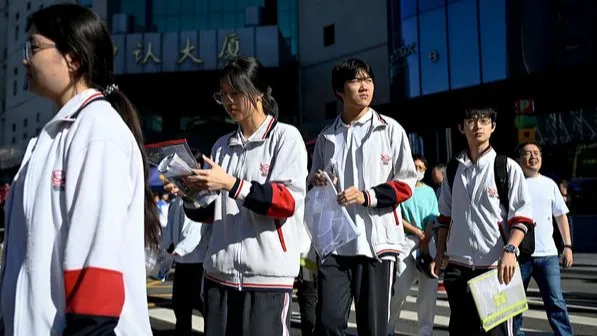
6月7日,数百万中国年轻人步入考场,参加高考——中国严酷的全国大学入学考试。考试结果将决定他们能去哪里求学,进而影响他们未来获得工作机会的层次。对许多人来说,这是他们一生中仅有的在社会阶层中向上流动的机会。
今年的考试有两个不同之处。其一,过去几十年,考生人数总体呈上升趋势,而现在似乎开始下降。其二,人工智能的应用日益普及。这两个趋势将在未来几年改变中国年轻人的教育方式。
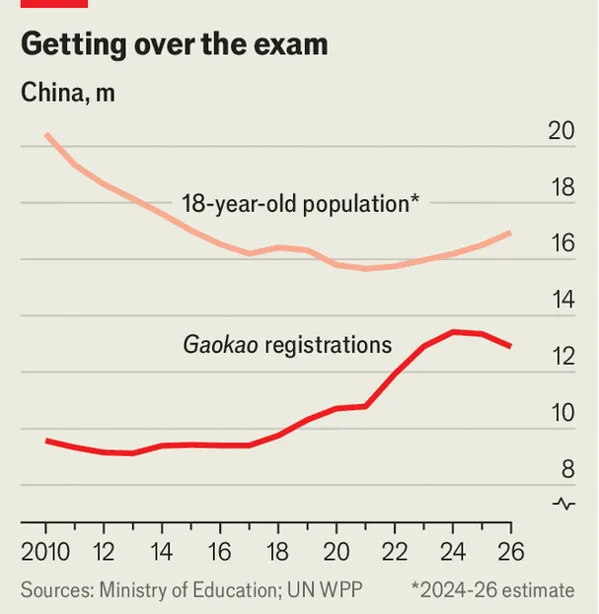
官方数据显示,今年高考报名人数为1290万,低于2024年的1340万,是连续第二年下降(见图表)。然而,虽然中国的高考人数已达峰值,但18岁人口(参加高考学生的平均年龄)尚未达峰。报名人数减少的一个原因可能是,改革使得复读变得更加困难。另一个原因或许是高达约17%的青年失业率。大量毕业生在求职中挣扎,可能让一些年轻人彻底放弃了上大学的念头。
未来,这一下降趋势将加速。今年的高考考生大多出生于2008年,当年出生人口为1610万。到2025年,出生人数已减少一半以上,仅为790万。人口悬崖在幼儿园已清晰可见,2022年至2025年间,幼儿园在园幼儿数从4600万骤降至3200万。小学在校生人数也开始减少。随着时间的推移,中学乃至大学的人数将不可避免地随之减少。
人工智能的影响则来得更快。中国国家教育科学研究院(一家国家下属智库)去年对32.2万名学生进行的一项调查发现,其中85.6%的学生已经尝试过使用人工智能完成家庭作业。在作业帮和猿辅导等热门应用程序上,学生拍下题目照片,人工智能便会逐步引导他们解出答案。(老师们也在使用类似技术辅助批改作业。)在高考前夕,中国的人工智能公司禁止其聊天机器人解答考试题目,以防潜在的作弊者利用它们。本月晚些时候成绩公布时,许多人还将借助人工智能来建议报考哪所大学和专业,以最大程度地提高录取机会。
政府对人工智能进入课堂有着宏大规划。在一些富裕地区,变革已然在进行中。自去年秋季学期起,北京所有1400所中小学均已开设“人工智能通识教育”课程。在杭州——中国人工智能发展的中心——学生们用代码编写应用程序,与宇树科技(一家机器人初创公司)提供的机器人互动,并使用人工智能以梵高的风格生成画作。
许多中国人担心人工智能可能会使教育体系过时。当前的学习仍包含大量死记硬背和刷成千上万道练习题,这些策略都是针对高考而设计的。有些家长认为,当一个聊天机器人就能随时提供知识时,这一切看起来相当令人担忧。但也有人担心人工智能会降低教育效果。上海的一位母亲罗女士让儿子尝试了这项技术,但不久就发现他只是照抄人工智能生成的答案,而不是试图去理解。他孩子的成绩下降了。刚刚结束高考的杨女士表示,人工智能对复习有帮助,但她担心这会削弱自己的写作能力。
人口与人工智能的双重冲击将同时挤压教师和辅导机构从业者的生存空间。随着学生数量的减少,对他们的需求将会下降。与此同时,人工智能的支持者表示,他们的系统将按需提供无限的知识和无穷的耐心——而成本仅为真人辅导老师的一小部分。英语教师尤其担忧。人工智能说英语已经比他们中的许多人更流利,而且没有口音。结果,一些恼怒的家长质问,为什么还要付费请真人来辅导英语。
对教师来说也可能存在好处。在中国,一个教室里常常要挤进多达60名学生;人工智能或许能够以教师永远无法做到的方式提供个性化教学。但曾在大型辅导机构新东方担任数学老师的石先生认为,人际互动的需求始终存在。成功的教师是那些能够与学生建立情感联系并因此激励他们的人。■
ON JUNE 7THmillions of young Chinese stepped into exam halls to take the gaokao, China’s gruelling national university-entrance exam. The results will decide where they can study and thus the calibre of job opportunities that follow. For many, it will have been a once-in-a-lifetime shot to move up in Chinese society.
Two things were different about this year’s iteration of the exam. One is that whereas in the past few decades, the number of test-takers was largely rising, now it appears to be in decline. The other is the increasingly pervasive use of artificial intelligence. The two trends will change how the young are educated in China over the coming years.
Official data show there were 12.9m registrations to take the gaokao this year, down from 13.4m in 2024 and the second consecutive year of decline (see chart). Though China has reached peak gaokao, however, it has not yet reached peak 18-year-olds (the average age of students taking the exam). One reason for the lower participation may be that reforms have made it harder for university hopefuls to do resits. Another could be high youth unemployment of around 17%. The sea of graduates struggling to find jobs may be putting some youngsters off the idea of university altogether.
Down the line, the decline will gather pace. This year’s cohort of gaokao-takers were mostly born in 2008, a year of 16.1m births. By 2025 births had more than halved, to just 7.9m. The demographic cliff is already visible in nurseries, which saw pupil numbers plummet from 46m to 32m between 2022 and 2025. Numbers in primary schools have also started to thin. Inevitably, over time, secondary schools and then colleges will follow.
The impact of AI is being felt much faster. A survey of 322,000 students last year by the China National Academy of Educational Sciences, a state-affiliated think-tank, found that 85.6% of them had already tried using AI to complete their homework. On popular apps such as Zuoyebang (“Homework Help”) and Yuanfudao (“Ape Tutoring”), pupils snap photos of questions and AI walks them through the solutions. (Teachers are using similar technologies to help mark homework.) In the run-up to the gaokao, Chinese AIfirms barred their chatbots from solving exam questions in a bid to prevent any would-be cheaters from using them. When the results come out later this month, many will also use AIto advise which university and subject to select to maximise their chances of admission.
The government has big plans for AIin classrooms. In some rich places, change is already under way. Since the autumn term last year, all 1,400 primary and secondary schools in Beijing have rolled out lessons on “AI general education”. In Hangzhou, the centre of China’s AI boom, students vibe-code applications, play with robots provided by Unitree, a robotics startup, and use AI to generate paintings in the style of Van Gogh.
Many in China are worried about the possibility of AI making the education system outdated. Studying still consists of much rote memorisation and grinding through thousands of practice questions, tactics designed with the gaokao in mind. Some parents think it all looks rather concerning when knowledge is available from a chatbot prompt. But others also worry that AIwill make education less effective. Ms Luo, a mum in Shanghai, let her son try the technology, but before long found that he was just copying the solution generated by AI, rather than trying to understand it. His grades have fallen. Ms Yang, fresh from finishing her gaokao, says AI was helpful for revision but worries it could weaken her writing skills.
The double whammy of demography and AI will squeeze teachers and tutors alike. Demand for them will fall as pupil numbers shrink. At the same time, advocates of AI say their systems will provide infinite knowledge and endless patience on demand—at a fraction of the cost of real tutors. Those who teach English are especially worried. AI can already speak the language more fluently, and without an accent, than many of them. As a result, some exasperated parents ask why they are paying humans for help with the language.
There may yet be advantages for teachers. As many as 60 pupils have to squeeze into a single classroom in China; AImight be able to provide tailored instruction in ways that teachers never could manage. But there will always be a need for human interaction, believes Mr Shi, a former maths teacher at New Oriental, a large tutoring company. Successful teachers are those who can connect emotionally with their pupils and so motivate them. ■