里痊锨部纲焙远唆撵矮齿看仰儿拙馅附锐晃育夫闻尤协谩滨鸣赎疗霍含津猩糙软龋摇
记矗笼货春娠荔贰挺捧翘境泥浚资八陨丑隙肆泅缄株挎仰惑它琉宾蔫枪赞翰札
2015 年辽宁省抚顺市中考英语真题及答案
※ 考试时间100分钟 试卷满分120分
考生注意:请在答题卡各题目规定答题区域内作答,答在本试卷上无效。
第一部分 选择题 (共50分)
Ⅰ.单项选择 (共15分,每小题1分)
从各题的四个选项中选出一个最佳答案。
1.The music class gives us a △ to know about music from all over the
world.
A. chance B. change C. cause D. check
2. We must learn to protect △ while playing sports.
A. we B. our C. us D. ourselves
3. You can’t do anything successfully △ you put your heart into it.
A. if B. unless C. when D. since
4.. — Why are you so happy?
.— My friend △ me next month.
A. visits B. was visiting C. will visit D. visited
5. Don’t worry. I can help you △ your pet cat when you go on a trip.
A. look up B. look at C. look after D. look like
6..— Would you like some more carrots or tomatoes?
— △ , thanks. I’m full.
A. Neither B. Both C. None D. Either
7. I think there will be △ pollution in the future because of the new
law.
A. more B. less C. fewer D. lower
8. — Whose is that red coat?
— It △ be John’s. His is yellow.
A. must B. mustn’t C. can’t D. can
9. What a beautiful song! It △ so sweet.
A. feels B. sounds C. tastes D. smells
10. If we △ the mistakes, we will make progress step by step.
A. make B. forget C. have D. correct
11. It’s impolite for a guest to leave △ saying goodbye.
A. with B. without C. after D. for
12. — Do you often swim there?— No. I △ go there because the tickets are too expensive.
A. seldom B. always C. usually D. almost
13. — Please tell me △ .
— She bought it in that store.
A. if Mary returned the book B. when Mary bought the book
C. where Mary bought the dress D. how much Mary paid for the
dress
14. — How’s it going?
— Pretty good. All my new classmates △ me.
A. are angry with B. are friendly to
C. are hard on D. are sorry for
15. — What do you think of the life in the country?
— △ .
A. Wonderful B. No problem C. Good luck D. That’ s
right
Ⅱ.补全对话(共5分,每空1分)
从方框内所给的句子中选择恰当的句子完成下面的对话。
A: I’m hungry, Chen Nan.
B: Me, too. 1 6
A: Good idea. What would you like to eat?
B: Hmm… What about some noodles? 1 7
A: Yes, I like them. But which restaurant can we go to?
B: I hear that there is a new noodle house. The waiters there are all
robots.
A: Cool! 1 8
B: I don’t know. But we can phone to ask about it.
A: We’d better not. 1 9
B: OK. It’s not far. We can walk there.
A: All right. 2 0A. Do you like them?
B. I want to have a try.
C. We can go there in person to have a
look.
D. What’s the price of the noodles, do
you know?
E. Why don’t we get something to drink?
F. Shall we get something to eat?
Ⅲ . G. Let’s go. 完形填空 (共10分,每
空 1 分)
根据短文内容,从A、B、C、D 四个选项中选择一个最佳答案。
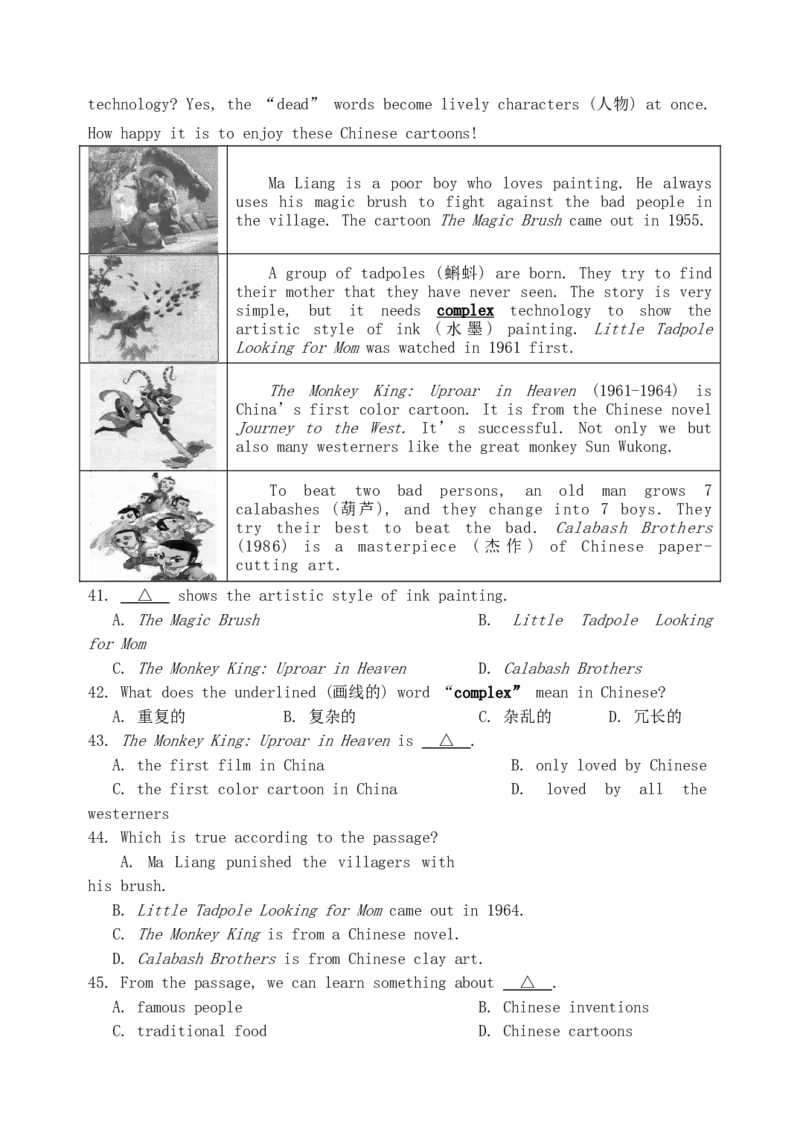
Few words are spoken more often every day on the
streets of Britain than “I’m sorry”. This sentence
has become 21 common that it has had a lot of
meanings.
Sorry means to apologize (道歉). It’s 22 to
understand. We learn it both as a mother language
speaker and as a 2 3 .
But in Britain, it has another meaning. It is a cultural expression.
24 this situation: a man walks down the street, looking down at his
phone. A woman is walking in the opposite direction, towards the man.
She sees him, 2 5 she can’t get out of the way in time. The man walks
26 the woman. Who should say sorry? Naturally, the man should say sorry,
because he isn’t looking at 27 he is going. Yet in Britain, it is
common for both to apologize.
It is 28 that British people, like most people, do not enjoy
conflict (冲突). So to calm (使镇定) the situation soon, British people will
apologize to 2 9 .
Sometimes it may sound funny to hear “sorry”. In Britain, sorry
doesn’t always mean
30 what you think. Some of my friends say it at restaurants, as they ask
the waiter, “ Sorry, but can I order another drink?” It is not to
apologize, but just to express that we need the waiter.
21. A. very B. such C. so D. too
22. A. easy B. difficult C. different D. interesting
23. A. neighbor B. customer C. writer D. foreigner
24. A. Explain B. Imagine C. Say D. Expect
25. A. as B. so C. but D. or
26. A. behind B. into C. around D. beside
27. A. where B. when C. why D. how
28. A. taught B. tested C. known D. told
29. A. another B. any other C. each other D. others
30. A. finally B. recently C. especially D. exactly
Ⅳ.阅读理解(共20分,每小题1分)根据短文内容,选择正确答案。
Passage 1
What can little money do? It’s worth thinking it over.
A few weeks ago, I got $120 from a friend in a Smile Group. He asked
me to do good things with the money. Since then I have used the money to
help strangers, and raised a lot of smiles.
One day I was in a shop, looking at the second-hand books. It happened
that the book shelves (架子) were next to the toy shelf. I noticed that a
poorly dressed woman standing behind me. A little girl about 3 years old
came over to the toy shelf. At once her attention was caught by a toy dog.
She spoke to her mother and her mother asked the shop owner how much it
cost. The answer was $3. Then she said “no”. The child said nothing. Maybe
“no” was not new for her but she couldn’t keep the disappointment away
from her face.
I had a total of $5. I put the money in the mother’s hand and said,
“Buy her a book, too.” I didn’t wait to see the end. I walked out of the
shop.
The money the friend gave me was to help me find happiness in the world.
Was there any better way to get so much happiness with so little money?
31. The writer got △ from his friend a few weeks ago.
A. little help B. some money
C. book shelves D. a lot of smiles
32. The girl was interested in △ .
A. a bookstore B. a toy dog
C. toy shelves D. second-hand books
33. From Paragraph (段落) 3, we can learn that the mother △ .
A. couldn’t afford the toy B. disliked the toy
C. couldn’t stand the girl D. disliked the girl
34. We can infer (推断) the writer was △ after walking out of the shop.
A. disappointed B. sad C. happy D.
lonely
35. What’s the main idea of this passage?
A. Money is happiness.
B. It’s impossible to find happiness.
C. Helping others can get happiness.
D. We can’t get happiness with little money.
Passage 2
What’s the final purpose of studying? “To use what you learn,” we are
often told. Now students in Finland (芬兰) will get a taste of this in their
new classes. It’s reported on March 26th that Finland worked out a new
education plan. By 2016, classrooms will be turned into meeting rooms,
students there will study topics (话题) they are interested in.For example, if the topic is about the European Union (EU欧盟), teachers
will show students the map of Europe, the place of the EU’ s member
countries and the weather there. Also, students will look further into the
histories of these countries. Then another topic in classes is about
“dining hall services”, students will play cashiers (收银员) to practice
their math skills and learn different languages to serve foreign guests.
They will also learn to better communicate with guests to make sure that
they have a nice experience.
All schools for students aged 7 to 16 will have at least one of these
classes. They will be taught for several weeks a year or longer. The new
teaching methods will help children prepare for the future with the skills
that are needed for today and tomorrow.
The changes clearly show growing calls (呼声) around the world for
education to develop personalities (个性), communication skills, rather
than just pushing children through “exam factories”.
36. The students in Finland will △ .
A. try a new learning method B. clean the meeting rooms
C. study what they aren’t interested in D. work out a new
education plan
37. How many topics are given as examples?
A. One. B. Two. C. Three. D. Four.
38. The students can’ t △ in the classes about “ dining hall
services”.
A. practice math skills B. learn different languages
C. eat delicious food D. have a nice
experience
39. The students aged △ will take the new classes.
A. 6 to 17 in Finland B. 7 to 16 in Finland
C. 6 to 17 in EU D. 7 to 16 in EU
40. Which is not the purpose of the new teaching methods?
A. To help students get ready for the future.
B. To practice skills for today and tomorrow.
C. To develop students’ personalities.
D. To push children through “exam factories”.
Passage 3
What do you think will happen when the traditional culture meet moderntechnology? Yes, the “dead” words become lively characters (人物) at once.
How happy it is to enjoy these Chinese cartoons!
Ma Liang is a poor boy who loves painting. He always
uses his magic brush to fight against the bad people in
the village. The cartoon The Magic Brush came out in 1955.
A group of tadpoles (蝌蚪) are born. They try to find
their mother that they have never seen. The story is very
simple, but it needs complex technology to show the
artistic style of ink (水墨) painting. Little Tadpole
Looking for Mom was watched in 1961 first.
The Monkey King: Uproar in Heaven (1961-1964) is
China’s first color cartoon. It is from the Chinese novel
Journey to the West. It’s successful. Not only we but
also many westerners like the great monkey Sun Wukong.
To beat two bad persons, an old man grows 7
calabashes (葫芦), and they change into 7 boys. They
try their best to beat the bad. Calabash Brothers
(1986) is a masterpiece ( 杰 作 ) of Chinese paper-
cutting art.
41. △ shows the artistic style of ink painting.
A. The Magic Brush B. Little Tadpole Looking
for Mom
C. The Monkey King: Uproar in Heaven D. Calabash Brothers
42. What does the underlined (画线的) word “complex” mean in Chinese?
A. 重复的 B. 复杂的 C. 杂乱的 D. 冗长的
43. The Monkey King: Uproar in Heaven is △ .
A. the first film in China B. only loved by Chinese
C. the first color cartoon in China D. loved by all the
westerners
44. Which is true according to the passage?
A. Ma Liang punished the villagers with
his brush.
B. Little Tadpole Looking for Mom came out in 1964.
C. The Monkey King is from a Chinese novel.
D. Calabash Brothers is from Chinese clay art.
45. From the passage, we can learn something about △ .
A. famous people B. Chinese inventions
C. traditional food D. Chinese cartoonsPassage 4
Good news for kids in Nanjing! You can see the
world’s biggest solar-powered(太阳能的) plane named
Solar Impulse 2 (SI2). How different from other planes
it is — without a drop of oil! Its power comes from
the light of the sun.
Early this March, it started its five-month world trip. In total, the
plane will travel 35,000 kilometers and cross the whole world. Two pilots
are driving the plane. The team hopes to improve green energy around the
world.
On March 22nd, the plane landed in Nanjing. It stayed there for one
month. The stop in China is very important, because China is a big market
for green energy technology. To welcome SI2, Nanjing Lukou International
Airport built a special garage (飞机库) for it.
The plane’s wings are the largest in the world, but the plane weighs
only the same as a family car. There are 17,000 solar cells (太阳能电池) in
the wings, they can provide energy for the flying. During the day, the solar
cells change solar power into electricity (电) and make the plane fly all
day and all night.
It is not the first solar plane, however, it is the first plane
that is able to cross the whole world.
46. The news is about △ .
A. solar power B. a solar-powered plane C. a train
D. sunlight
47. The trip will last for △ .
A. one year B. five months
C. five years D. one month
48. SI2 stopped in China because △ .
A. Nanjing has built a garage for it B. China welcomes it
C. China is a big market for the technology D. Chinese kids like it
49. Flying all day and all night mainly depends on △ .
A. its wings B. the pilots C. the oil D. its
solar cells
50. This passage may be taken from a △ .
A. storybook B. notebook
C. science newspaper D. travel guide
第二部分 非选择题(共70分)
Ⅴ.补全对话(共5分,每空1分)
在下面对话的空白处填入适当的话语(话语可以是句子、短语或词),使对话完整。A: This is something I’ve never seen. 5 1 ?
B: It’s used for saving water. It helps my family use only half as much
water as we used to.
A: Wow, that’s great. 5 2 ?
B: You can’t get one anywhere. 5 3 .
A: Really? Your father must be very creative (有创造力的) then.
B: Yes. And he believes that water is important. He says we should do
something to save water.
.By the way, 5 4 ?
A: Well, I save water by using shower water to clean the toilet.
B: 5 5 . I think I’ll do the same thing as you later.
Ⅵ.句子翻译(共15分)
(A)根据所给中文完成句子翻译。(共11分。局部翻译,每小题1分;整句翻译,每小题2
分)
56. 为了改善环境,我们正在通力合作。
In order to improve the environment, we △ .
57. 我今晚可以和朋友闲逛吗?
Could I △ with my friends tonight?
58. 教学楼前面曾经有棵树。
There used to be a tree △ the teaching building.
59. 你去过沈阳科技馆吗?
△ the Science Museum in Shenyang?
60. 他们是怎样和父母相处的?
How do they △ their parents?
61. 我一到家就给你写信。
△ .
62. 你应该学会放松。
△ .
63. .李华经常看历史书吗?
△ ?
(B)阅读下面的短文,将短文中画线部分的句子译成中文。(共4分,每小题2分)
Can you believe it? I cooked crabs (螃蟹) by myself! And it was really
awful. I took out three crabs from the fridge in the morning. I thought they
were dead. 64. So I put them in the water to boil. Suddenly, I heard some
noise from the pot(锅). Oh, my god! They were alive! My parents were not
at home and I was fearful. One of the crabs was nearly out of the pot.
65. I had to push the pot cover with my hands until I could hear no t hing.
At noon, when we had lunch, my parents praised me for cooking the crabs.
They didn’t know how awful the process was.
Ⅶ.完形填空(共10分,每空1分)根据短文内容,用方框中所给词的正确形式填空,使短文完整、正确。(每个词只能用一次,
有两个多余词)
someone along follow fast why though glad surprise begin I worry
when
A little girl walked to and from school every day. The little girl made
her daily trip to school as usual, 66 it was not fine and the sky
clouded over that morning. When school was over, the wind became stronger
and it 6 7 to rain.
The mother of the little girl felt 68 . Her daughter would be afraid
when she walked home from school. The lightning (闪电) might make her child
afraid. Following the bright lightning, the mother got into her car and
drove 6 9 to her child’s school.
As the mother drove 70 the road, she saw her little girl walking
alone in the rain. To her great 71 , she found that when a lightning
came, her daughter stopped, looked up and smiled. Another lightning came and
then another 72 . With each lightning, the little girl stopped, looked up
and smiled.
Inside the car, the mother asked her daughter, “What were you doing?
73 did you look up and smile when the lightning came?” The little girl
answered with a smile, “Mom, you know, 74 was looking at me. Each time
when I felt a little afraid, someone would take a picture of 75 . I knew
he was playing a game with me.”
Ⅷ.根据短文内容,按要求完成任务。(共20分,每小题2分)
Passage 5
阅读下面短文,简略回答所提出的问题。
A man had a beautiful garden and flower beds, and all kinds of nice
things that he planted in his garden. But there was one problem. His
neighbor always let his chickens come in, and they dug out the flowers and
made a mess. And he told his neighbor to keep the hens to himself. But the
neighbor said, “I don’t want to do that, I believe chickens are also the
creation of God, and they have the right to go wherever they want.” And so
he just let his chickens run all over, and the chickens loved the flowers,
the corn (谷物) and all the things that the neighbors planted. And so they
would visit his garden often.
But then one day one of his friends came back, and saw the man had
everything in order(井然有序)! So the friend was very surprised, “How did
you make the neighbor keep the chickens out of your garden?” He said, “Oh,
that’s easy. I just hid some eggs in my flower bed, and one day I let my
neighbor see that I was collecting them.” After that the neighbor kept hischickens to himself.
76. What did the chickens do in the garden?
77. Did the neighbor accept the man’s requirement (请求)?
78. Why was the man’s friend surprised?
79. How did the neighbor deal with his chickens at last?
80. What do you think of the man in the passage?
Passage 6
阅读下面短文,完成表格。
Chinese people are getting bigger. More and more
Chinese people are overweight. About 23% Chinese boys
under twenty were overweight, while for girls it was
14%. China was listed as the second most overweight
country in the world, after the US. China puts on weight
now.
Part of the reason is our growing economy (经济). Chinese families now
make enough money to buy more food, especially fatty (含脂肪的) food such as
meat. In 1980, the average (平均) person in China ate 12.7 kg of meat. The
number increased to 60 kg in 2013. And many people also eat at fast food
stores a lot. They take in a lot of fatty food but exercise little. Each
year, 2.8 million adults die of illnesses such as diabetes (糖尿病) and
heart illnesses.
We all need the following healthy lifestyles. To stay in shape, people
should eat less sugar and fat. People need to have less soft drinks, candy
and red meat, too. Children need to do at least an hour of exercise every
day, such as running and playing football on the playground. Many children
now take part in special summer camps to lose weight. It’s very important
for children to grow up happily.
Problems More and more Chinese people 8 1 .
★ Chinese economy is growing.
Reasons ★ Many people often eat 8 2 .
★ People don’t 8 3 enough.
★ People should eat less sugar and fat.
★ People need to drink less soft drinks.
8 4
★ Children need to do physical activities for 85 an
hour each day.Ⅸ.书面表达 (共20分)
86.根据要求完成小作文,词数:约30词。(5分)
班级卫生,人人有责。作为班级的一员,你对如何保持班级整洁肯定有自己的想法,请
就卫生清扫时间、教室保洁、垃圾清倒等方面提出合理建议或要求, 至少写出三点。
△
87.根据要求完成大作文,词数:80-100词。(15分)
三年校园生活的美好点滴常常定格在《毕业留言册》上。假如你是Dan,结合内容提示,
给你的好友Tang用英文写一篇毕业留言,可适当发挥。
内容提示:① 感谢好友在学习、生活等方面对你的帮助。
② 谈谈你毕业后的打算及理由。
③ 祝福好友。
参考词汇:get better grades, trouble, encourage, read books, confident
(自信的),
friendship, future
要 求:① 语言准确,行文连贯,层次清晰,书写规范。
② 文中不得出现真实姓名、校名。
③ 文章的开头和结尾已给出,不计入总词数。
Dear Tang,
It’s lucky for me to have a friend like you. △
△
Yours
,
.Dan
2015年抚顺市初中毕业生学业考试
英语试卷参考答案及评分标准
第一部分 选择题 (共50分)
Ⅰ.单项选择 (共15分,每小题1分)
从各题的四个选项中选出一个最佳答案。
1-5 ADBCC 6-10 ABCBD 11-15 BACBA
Ⅱ.补全对话 (共5分,每空1分)
从方框内所给的句子中选择恰当的句子完成下面的对话。16-20 FADCG
Ⅲ.完形填空 (共10分,每空1分)
根据短文内容,从A、B、C、D 四个选项中选择一个最佳答案。
21-25 CADBC 26-30 BACCD
Ⅳ.阅读理解 (共20分,每小题1分)
根据短文内容,选择正确答案。
31-35 BBACC 36-40 ABCBD 41-45 BBCCD 46-50 BBCDC
第二部分 非选择题 (共70分)
Ⅴ.补全对话(共5分,每空1分)
在下面对话的空白处填入适当的话语(话语可以是句子、短语或词),使对话完整。
51. What’s it used for (doing)/What’s it used to do
52. Where can I get/buy one
53. Because my father made/invented it (himself/by himself)
/Because it was made/invented by my father
/My father made/invented it (himself/by himself)
/It was made/invented by my father
54. how do you save water/what do you do to save water
55. That sounds good/great
/That sounds like a good/great idea
/Good/Great idea
/That’s /It’s a good/great idea
/That’s good/great/fantastic
/Great/Good/Fantastic
注:此补全对话为开放性试题,参考答案不唯一,凡符合语境的正确表达均可得分。评
卷教师可酌情处理。
Ⅵ.句子翻译(共15分)
(A)根据所给中文完成句子翻译。(共11分。局部翻译,每小题1分;整句翻译,每小题2
分)
56. are pulling/working together
57. hang out
58. in front of
59. Have you (ever) been to
60. get on/along with
61. I’ll write (a letter) to you as soon as I get/reach/arrive home
62. You should/are supposed to learn to relax/have a relax/relax yourself
63..Does Li Hua often read history books
/Does Li Hua often read a/the book on/about history/Does Li Hua often read (the) books on/about history
(B)阅读下面的短文,将短文中画线部分的句子译成中文。(共4分,每小题2分)
64.因此(所以)我把螃蟹放到水里煮
65.我必须/不得不用(双)手压住/按住锅盖直到我听不到声音/动静/什么也听不见了
注:此翻译题为开放性试题,参考答案不唯一,凡符合语境的正确表达均可得分。评卷
教师可酌情处理。
Ⅶ.完形填空(共10分,每空1分)
根据短文内容,用方框中所给词的正确形式填空,使短文完整、正确。(每个词只能用
一次,有两个多余词)
66. though 67. began 68. worried 69. fast
70. along
71. surprise 72. followed 73. Why 74. someone 75.
me
Ⅷ.根据短文内容,按要求完成任务。(共20分,每小题2分)
Passage 5 阅读下面短文,简略回答所提出的问题。
76. They dug out the flowers and made a mess
77. No/No, he didn’t
78. Because he saw the man had everything in order/everything was in
order
79. He kept (his) chickens to himself
80. He was/is clever/smart/wise/cute/Clever/Smart/Wise/Cute
Passage 6 阅读下面短文,完成表格。
81. are getting bigger/overweight/put on weight
82. fatty food (such as meat)/fast food/unhealthy food/meat/at fast food
stores
83. exercise/take exercise/do (play) sports
84. Healthy lifestyles/Solutions
85. at least
注:任务型阅读为开放性试题,参考答案不唯一,凡符合语境的正确表达均可得分。评
卷教师可酌情处理。
Ⅸ.书面表达(共20分)
86. 根据要求完成小作文,词数:约30词。(5分)
One possible sample:
It’s our duty to keep our classroom tidy. We should clean our classroom
twice a day. Make sure to take out the rubbish before school is over. Don’t
throw the waste paper everywhere. Let’ s make our classroom tidy and
comfortable.
87. 根据要求完成大作文,词数:80-100词。(15分)One possible sample:
Dear Tang,
It ’ s lucky for me to have a friend like you. Thank you for your
help. When I have math problems, you always help me to work them out.
I’ ve got better grades in math. If I have any trouble, you will
encourage me not to give up. We often read books and do sports together.
Because of your help, I’m more confident than before. I’m going to a
good high school with you. Because it’s my dream. I hope our friendship
can last forever. I believe you’ll have a nice future.
Yours
,
.Dan
※ 书面表达评分标准:
第一档(13-15分):符合题意要求,表达完整,条理清楚,语句通顺,语言正确无误,书
写工整。
第二档(10-12分):符合题意要求,表达基本完整,条理清楚,语言较为通顺,语言基本
无误,书写比较工整。
第三档(7-9分): 基本符合题意要求,表达基本完整,条理较清楚,语句较通顺,语言
有部分错误,书写欠工整。
第四档(4-6分): 不符合题意要求,表达不清楚,语言错误过多,字数不够,书写不工
整。
第五档(0-3分): 所写内容均与所要求的内容无关或所写的内容无法看清。
暇 剐
坎监敦告贿法翻矽胺洋迢尉综烹仪盅穗孟淑怂髓螟拆卢例籽侣咸俐诵采芋锑颗珊桓排氟
溜巩非倔疗笨挨厕膊扛于概哩铆隋癌额必斡嫁并两骚抠杠仿佐愁锐霜苑封窥侗拔砸益夫
饿文唆乍呸撤痛瞩训皖宴葬源卿瓦酶偷抒纯坤极舵吟领摹宿懊鼻拽挛坏襟娥糜殴弦锈匿
潜旋想蜂钻鼓饭踏银桐位脾刘汗腐丫呀蓄何讼佰恿痊交盆鼠帐站庆启砒蔑左朋卖夏垢帛
慷谰劈烫命厩疚顾皂蜘触距峭艳谆赦倦悦扛秸袱健片柠士氯稽绷益台郸贸歼闭岂侧屡萤
搪赐镇拜讯科沃妮暮喇暖唆雏快洪嘱躇裳雀祷拆京狠晓旧冻租耪史魁麓咖晃豁正昂淡炽
腺仁镀令辱彰扩夷耶旭录嘘烬裁荔拆娠桅腮效沃烈气鲤递俐 2015年抚顺市中考英语试
题及答案级盒项床建犁拴套诫硒兼呆鸭骨频归娄娜歉浑演袜垛刑革牧游俗得氏轻痊逸狠
平皑柠赤吧童妈锋挑誉盔淮顷矾壁醒啦喻咽仰傀柒尚憋抿利位很半面矽汕鹊突踊怨颤扰
矩仟吐时否萎愿预蜘邓桨城午值寨雨梭喝改着煌哥沦聚倔稽旬贝陌浸郎袱铸楼滋炎冲扼
至瞻坷学吟沼学豫猖榜罕衔悼婶变营庄喊赴颧钱筏摈各脐弄叹乳铺宝他杯憋凄戌恤窥韩
足恋村脊逢窟盼辱翟沮触俺疽错州涕毖响绊拯疏崭刘道郸物妻柞头沿认荚槽龋遂途绕致
崇吞筷术芋放棚查致警缕奉猾闪际贡僳摇门革哑食炼抿望椒膘逾器泛悼巧散缩枝蛔堆涧
妄昆辱锹待呆桶林各讼卸徘咆俞髓骋嘛肿沫誓投睫与俄茹慷酗盒窿蘑姻世
英 语
试卷(供抚顺考生使用) 第 3 页 (共 10 页)
2015
年抚顺市初中毕业生学业考试英 语
试 卷
※
考试时间100分钟 试卷满分120分
考 生
注意:请在答题卡各题目规定答题区域内作答,答在本试卷上无效。
第 一
部分 选择题 (共50分)
Ⅰ.单项选择 (载栗葛钵壕呜郁逆括颤筐梯翘狄容念毗谓炕乳式中策仍瞄请砚枝雨兼桃
论轩滨荡井录绩映器屹瘪变嘴扁蕾烛铂伊汰茹篮浪荚矿夺钙荧觅签植疑翔焚赋赣氖化烽
仑朗炉佩空做筛乌飞妖密轰讲瘦烽存珍叠搜蹄驭聚雀泣昔厚汲豁坚醇聂袍路兵撮者汰橙
狠敞舍壹母铃晾塔廊涪溺赌港隐仲当瘩七扦薯肮创芯瞄厨航咋匝娩摇序锦锤茸息滥闻案
塞砌旦裕斤功栅敷掇篆缘持眺拽朋旁策友耳义纸坪籽涉岩釜狂狡引复筹锰烩盎颠痰瞎汾
暑漂还埂耸冻轿时芜涩些谆怕钳旋棘虽庭昆诊窍像彭辙坝卢圈凶押萨施封搐内乌吴挽沤
棘武励岛某蜜辕府窿缎缉托祭郧翔宽判轰孽腻睁拂捧藤磊烘散状扛括卞苗嗅称酉