2022年上·初中英语试题(精选)解析
讲师:原原
粉笔教师教育 粉笔教师考情纵览
每题
题型 题量 考查内容 总分 合计
分值
语音知识、语法、语言学(10)
语言教学知识与能力、教学设计、
单项选择题 30 2 60
教学实施与评价(10)
阅读理解(10)
教学设计
150
简答题 1 语言教学知识与能力 20 20
教学实施与评价
教学设计
教学情境分析题 1 语言教学知识与能力 30 30
教学实施与评价
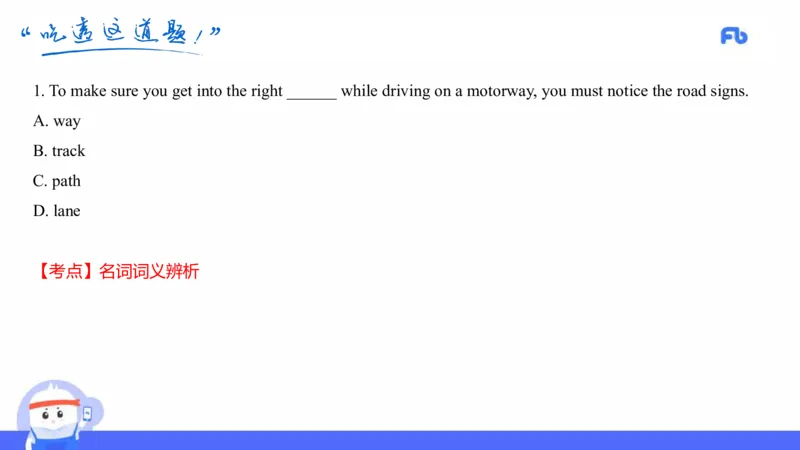
教学设计题 1 教学设计 40 40一、单项选择题1. To make sure you get into the right ______ while driving on a motorway, you must notice the road signs.
A. way
B. track
C. path
D. lane
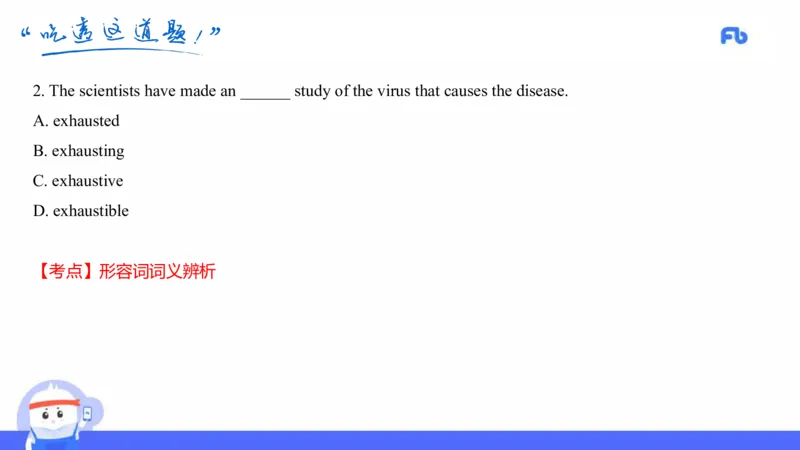
【考点】名词词义辨析2. The scientists have made an ______ study of the virus that causes the disease.
A. exhausted
B. exhausting
C. exhaustive
D. exhaustible
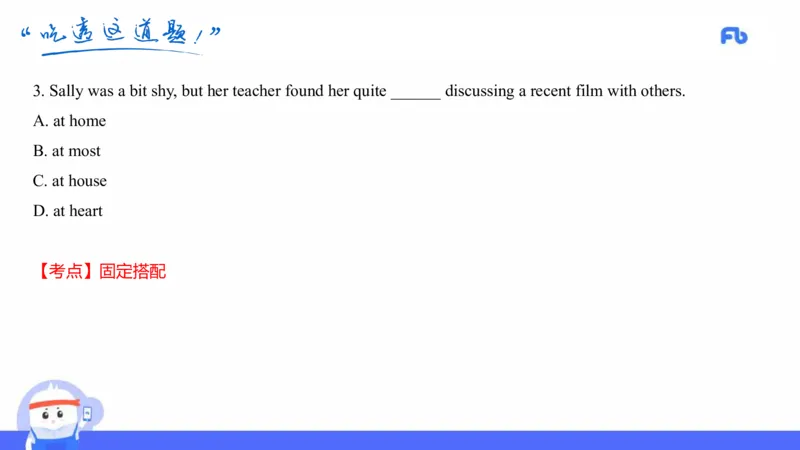
【考点】形容词词义辨析3. Sally was a bit shy, but her teacher found her quite ______ discussing a recent film with others.
A. at home
B. at most
C. at house
D. at heart
【考点】固定搭配4. Men differ from animals ______ they can think and speak.
A. for which
B. in which
C. in that
D. for that
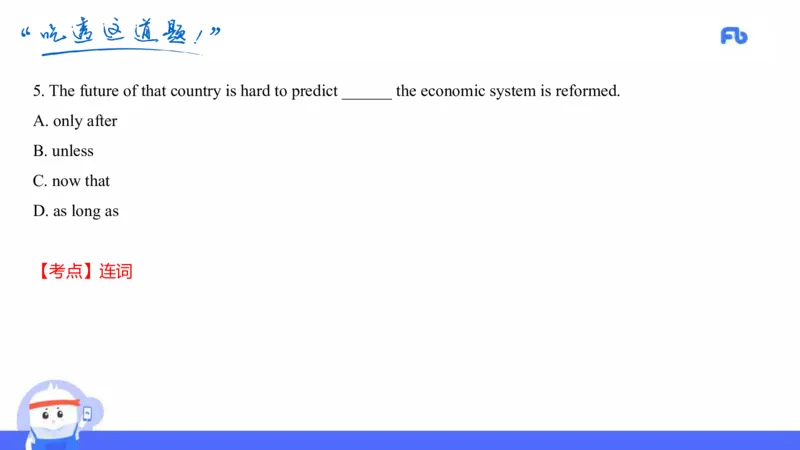
【考点】连词5. The future of that country is hard to predict ______ the economic system is reformed.
A. only after
B. unless
C. now that
D. as long as
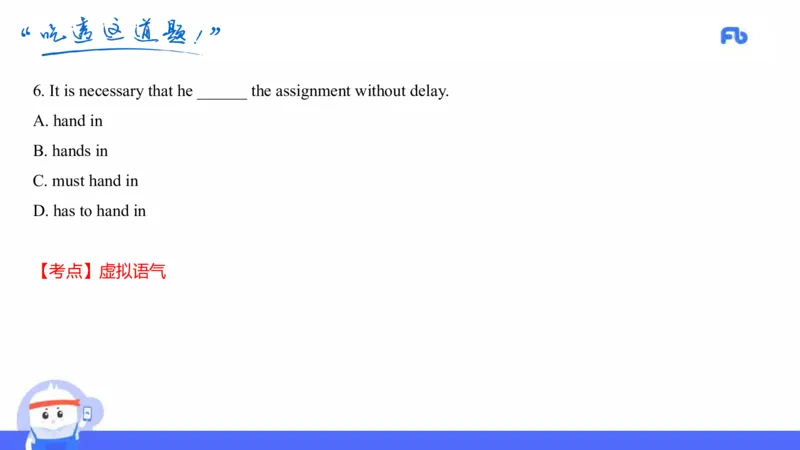
【考点】连词6. It is necessary that he ______ the assignment without delay.
A. hand in
B. hands in
C. must hand in
D. has to hand in
【考点】虚拟语气7. The letter “t” in the word “fit” and “you” in the sentence “It doesn’t fit you.” is pronounced as ______.
A. /fu:/
B. /tʃu:/
C. /dgu:/
略
D.
【考点】同化现象英语语音中的同化现象主要发生在辅音和辅音之间,变成相同或相似的音,有的甚至合二为
一成为第三个音,是相邻因素互相影响的结果。
顺行同化:如果前面的音素影响并同化后面的音素,叫顺行同化。常见情形(部分)如下:
( )名词复数形式 或者 的发音,清辅音 ➡ ,浊辅音 ➡
1 s es +s/es /s/ +s/es /z/
books/bʊks/ words/wɜːdz/
( )动词加 ,清辅音 ➡ ,浊辅音 ➡
2 ed +ed /t/ +ed /d/
finished /ˈfɪnɪʃt/ moved /muːvd/逆行同化:如果后面的音素影响并同化前面的音素,叫逆行同化。常见情形(部分)如下:
( ) ➡ : 受到 、 或者 的影响,被同化成双唇音
1 /n/ /m/ /n/ /p/ /b/ /m/ /m/
ten boys /ˈtem ˈbɔɪz/ ten minites/tem ˈmɪnɪts/
( ) ➡ : 受到 或者 的影响,被同化成
2 /n/ /ŋ/ /n/ /k/ /g/ /ŋ/
in case/ɪŋ ˈkeɪs/ You can go. /juː kæŋ ˈɡəʊ/
( ) ➡ : 受到 或者 的影响被同化成
3 /s/ /ʃ/ /s/ /ʃ/ /j/ /ʃ/
this year/ˈðɪʃ ˈjɪə/ this shop/ˈðɪʃ ˈʃɔp/
相互同化:如果两个辅音合二为一成为第三个音,叫相互同化。常见情形为 、 、 、 遇
/t/ /d/ /s/ /z/
到了 ,分别被同化为 、 、 、 。
/j/ /tʃ/ /dʒ/ /ʃ/ /ʒ/
situation/ˌsɪtʃuˈeɪʃn/ education/ˌedʒuˈkeɪʃn/ issue /ˈɪʃuː/ Bless you!/ble ʃu:/
as usual/əʒ ˈuːʒəl/7. The letter “t” in the word “fit” and “you” in the sentence “It doesn’t fit you.” is pronounced as ______.
A. /fu:/
B. /tʃu:/
C. /dgu:/
略
D.
【考点】同化现象8. Which of the following shows the correct word stress for “encyclopedia”?
A. /'ɪnˌsaɪkləʊpi:diə/
B. /ɪnˌsaɪklə'pi:diə/
C. /ɪnˌsaɪklepi:diə/
D. /ɪnˌsaɪklapi:'diə/
【考点】语音现象-重音知识回顾——单词重音(Word Stress)
(1)单音节词单独出现时一律重读,不必标出重音符号。(book, go, there)
(2)双音节名词的重音一般在第一个音节上;双音节动词的重音一般在第二个音节上。
(record, desert, content)
(3)三音节、多音节词重音在倒数第三个音节上。(anniversary)知识回顾——单词重音(Word Stress)
l 派生词的重音和词根重音一致。 (act, active, actively)
l 重音通常在第一个音节上:带有下列后缀的词:-ary, -ery, -ory, -ism, -ist, -ment等。
(customary, scientist, slavery, factory)
l 重音通常在第二个音节上:带下列前缀的词:a-, ab-, ac-, ad-, al-, be-, con-, de-, dis-,
em-, en-, in-, mis-, re-, tans-, un-。(about, admire, belong, consult, dislike) 带下列后缀
的词:-aim, -ain, -cur, -eem, -duce, -ere, -firm, -gn, -oin, -oke, -ose, -pt, -rce, -self, -
ume。(contain, occur, sincere, design, confirm)
l 重音通常在最后一个音节:带下列后缀的词:-ade, -ee, -eer, -esque, -ette, -ique, -ine,
-oon。这些词一般都是从法语中借来的词。(employee, volunteer)
l 重音通常在倒数第二个音节上:带下列后缀的词:-eous, -ial, -ian, -ia, -ic, -ics, -ient,
-ion, -ious, -ish, -it, -liar, -sive, -tal, -uous。(relation, deposit, musician)8. Which of the following shows the correct word stress for “encyclopedia”?
A. /'ɪnˌsaɪkləʊpi:diə/
B. /ɪnˌsaɪklə'pi:diə/
C. /ɪnˌsaɪklepi:diə/
D. /ɪnˌsaɪklapi:'diə/
【考点】语音现象-重音9. You are greeting an acquaintance with “Hello” to perform the ______ function of language.
A. performative
B. metalingual
C. phatic
D. emotive
【考点】语言的功能10. Which of the following is the smallest unit of speech that can be used to differ one word from another?
A. Morpheme.
B. Suffix.
C. Lexis.
D. Phoneme.
【考点】语言学基础知识11. When teaching such words as “left” and “right”, a teacher asks his/her students to touch their left arms
and then touch their right eyes. What does this kind of activity exemplify?
A. Direct Method.
B. Indirect Method.
C. Grammar Translation Method.
D. Total Physical Response.
【考点】外语教学常用方法12. What activities are not appropriate for developing the skill of reading for gist?
A. Reading a text quickly and writing a summary.
B. Reading a text quickly and choosing the best title.
C. Reading a text quickly and analyse its discourse patterns.
D. Reading a text quickly and then telling what it is mainly about.
【考点】阅读技能教学13. Which of the following refers to a process in which a teacher asks his/her students to analyse sentences in
a passage and then work out their structures?
A. Deductive teaching.
B. Inductive teaching.
C. Task-based teaching.
D. Content-based teaching.
【考点】语法教学14. Which of following is the most controlled activity?
A. Acting out a dialogue.
略
B.
C. Reading aloud a dialogue.
D. Exchanging information.
【考点】教学活动16. Which of the following exercises is intended to practice the communicative use of “Do you have...?” and
“I have...”?
A. Changing one sentence pattern to the other.
B. Applying those sentence patterns in a conversation.
C. Listening to the tape and writing down the sentences.
D. Substituting the objects in the sentences with the words given.
【考点】口语技能教学17. A teacher asks students to write reflective journals about their English learning ****** The major purpose
is to develop students’ ______.
A. communicative strategy
B. metacognitive strategy
C. affective strategy
D. cognitive strategy
【考点】学习策略18. When a teacher says “I don’t quite understand. What do you mean by saying that?”What does he/she
intend to do?
A. To refuse.
B. To comment.
C. To give opinions.
D. To ask for clarification.
【考点】教学反馈19. At what stage will a teacher initiate a discussion with the students on ****** their prior knowledge?
A. Presentation.
B. Practice.
C. Performance.
D. Lead-in.
【考点】教学过程20. Which of the following is most appropriate for developing a learner’s integrated language skills?
A. Writing down a phone call message.
B. Completing multiple-choice exercises.
C. Copying words from a reading passage.
D. Filling in the missing words in a passage.
【考点】教学活动客观题考点归纳
模块 题目数量 知识点
语音知识 2 单词重音;同化现象
词法 5 词义辨析
句法 1 虚拟语气
语言学 2 基础概念辨析;语言的功能
外语教学常用方法;阅读教学活动;语
语言教学知识与能力 4
法教学方法;口语教学;
教学活动及教学过程;教学反馈;教学
教学实施与评价 5
内容
课程标准 1 学习策略Passage 2
【文章大意】
文章共 6 段,主要讲到了今天的美国人不太重视智力。我们的英雄是运动员、入门培训师和企业家,
而不是学者。即使是我们的学校,也是我们送孩子接受实用教育的地方,而不是为了知识而追求知识。
我们的学校里普遍存在的反智主义的症状并不难发现以及随后引发的一系列讨论。26. What do American parents expect their children to acquire in school?
A. The confidence in intellectual pursuits.
B. The habit of thinking independently.
C. Practical abilities for future career.
D. Profound knowledge of the world.
【第一段】Americans today don’t place a very high value on intellect. Our heroes are athletes, entertrainers,
and entrepreneurs, not scholars. Even our schools are where we send our children to get a practical
education—not to pursue knowledge for the sake of knowledge. Symptoms of pervasive anti-intellectualism
in our schools aren’t difficult to find.27. Why does the author insist that schools should be a counterbalance to the American distaste for
intellectual pursuits?
A. To enable the kids to fully participate in their democracy.
B. To encourage the kids to readily accept others’ views.
C. To develop the kids’ habit of rigorous book learning.
D. To discipline and control the kids’ behaviors.
【第二段】Encouraging kids to reject the life of the mind leaves them vulnerable to exploitation and
control.Without the ability to think critically, to defend their ideas and understand the ideas of others, they
cannot fully participate in our democracy. Continuing along this path, says writer Earl Shorris, “We
will become a second-rate country. We will have a less civil society.”28. Why ****** Mark Twain’s Huckleberry Finn cited by the author?
略
A.
B. As a figure who was short of the innate goodness.
C. As a hero of the time when the story was written.
D. As an example of American anti-intellectualism.
【第四段】Mark Twain’s Huckleberry Finn exemplified American anti-intellectualism. Its hero avoids
being civilized—going to school and learning to read—so he can preserve his innate goodness.29. According to the text, which of following is true about Emerson?
A. He is an advocate of regular schooling.
B. He is an opponent of intellectualism.
C. He is an pioneer of education reform.
D. He is a scholar in favor of intellect.
【第四段】Ralph Waldo Emerson and other Transcendentalist philosophers thought schooling and
rigorous book learning put unnatural restraints on children: “We are shut up in schools and college recitation
rooms for 10 or 15 years and come out at last with a bellyful of words and do not know a thing.”30. Which of the following represents the author’s view on intellect?
A. It evolves from common sense.
B. It is secondary to intelligence.
C. It should be pursued.
D. It ignores power.
【第五段】Intellect, according to Hofstadter, is different from native intelligence, a quality we reluctantly
admire. Intellect is the critical, creative, and contemplative side of the mind. Intelligence seeks to grasp,
manipulate, re-order, and adjust, while intellect examines, ponders, wonders, theorizes, criticizes and
imagines.二、简答题31. 从四个方面简述教师课堂提问的目的(8 分,用中文作答),并列举两种问题类型(6 分,用英
文作答),分别举例说明(6 分,用英文作答)。【参考答案】
(1)课堂提问的目的:
① 增进师生交流
教师提问,学生讨论并回答,这是一种交流。课堂提问不仅可以提高学生的表达能力,培养他们的团
队精神,还可以促进师生感情,从而更好地推动教学。
② 集中学生注意力
教师在学生注意力不集中时进行提问,往往可以唤回学生的注意力,让学生重新回归课堂。
③ 引起学生兴趣
教师的提问内容贴近学生生活,可以激起学生分享、展示的欲望。
④ 促进思维发展
课堂提问可以鼓励学生积极思考,促进其思维的发展,回答问题的过程其实就是锻炼逻辑思维的过程。⑤ 锻炼表达能力
学生回答问题,可以锻炼其表达能力和语言组织能力。
⑥ 检验学习效果
根据学生在回答问题时出现的思维受阻、歧义、谬误、遗漏等现象,教师可以及时清晰地了解学生学
习的效果,并通过提示、点拨、反问等方式,合理引导学生的思维。
注:只需选取其中四个方面作答即可。(2)Two types of questions:
Closed questions: There is only one correct answer to a closed question, which usually can be answered with
either a single word or a short phrase.
Open questions: There are many different answers to a open question, which is likely to receive a long answer.
注:回答 Display questions 和 Referential questions 也可以。
(3)For example, “How old are you?” and “Where do you live?” are closed questions.
“How do you keep focused on your work?” and “Why is that so important to you?” are open questions.三、教学情境分析题32. 下面片段选自 ****** 课堂教学实录。
Create a context by pointing to a boy or a girl in the class and say, “He/She is a boy/girl. He comes from
England. He/She is a student. He/She has a sister, and she is a student,too. They are in the same school, but in
different grades.”
Write down the sentences on the blackboard. Underline the new words (come from, student, sister,
different) and explain their Chinese meaning.
Ask the class to read *********** (conversation again) and sentences together after the teacher.
Ask the students to work in pairs. Replace “England” with names of other places, and replace “sister” with
“brother”.
(2)分析该教师采用的教学方式。(6 分)【参考答案】
(2)该教师采用了情境教学法和语法翻译法。
①情境教学法通过设计一些有意义的场景,为语言学习和操练提供实例,从而达到教学目的的教学法。
该教师通过指着班里的一个男生或女生来创造教学情境,并以此引出“He/She is a boy/girl.”“He
comes from England.”等新句型,让学生在情境中理解新知识的含义,掌握新知识的用法,体现了
情境教学法。
②语法翻译法依靠母语,通过翻译手段,主要培养第二语言读写能力的一种教学法。该教师讲解新句
型和新单词的中文释义,让学生理解新知识的含义,体现了语法翻译法。四、教学设计题根据提供的信息和语言素材设计教学方案,用英文作答。
33.设计任务:阅读下面的学生信息和语言素材。设计15分钟的英语阅读教学方案。教案无固定格式,
但包含以下要点:
①Teaching objectives
②Teaching contents
③Key and difficult points
④Major steps and time allocation
⑤Activities and justifications
教学时间:15分钟
学生概况:某城镇普通中学八年级(初中二年级)学生,班级人数为 40 人。多数学生已经达到《义
务教育英语课程标准(2011 年版)》三级水平。学生课堂参与积极性一般。语言素材:
A Healthy Lifestyle, the Chinese Way
Traditional Chinese doctors believe we need a balance of yin and yang to be healthy. For example, are you
often weak and tired? Maybe you have too much yin. You should eat hot yang foods, like beef. Eating
Dangshen and Huangqi herbs is also good for this. But people who are too stressed out and angry may have
too much yang. Chinese doctors believe that they should eat more yin foods like tofu. Chinese medicine is
now popular in many western countries. It’s easy to have a healthy lifestyle, and it’s important to eat a
balanced diet.【参考设计】
Ⅰ. Teaching contents
This is a reading lesson, and it mainly talks about the Chinese healthy lifestyle.
Ⅱ. Teaching objectives
(1) Knowledge objective
Students will be able to master the new words including “medicine, lifestyle” and get information of how to keep a
healthy lifestyle.
(2) Ability objective
Students will be able to use different basic reading strategies in their reading process.
(3) Emotional objective
① Students will be more interested in learning about the theory of traditional Chinese medicine and the culture in it.
② Students will be willing to cooperate with other group members actively and complete the tasks together.Ⅲ. Key and difficult points
(1) Key point
Help students know more about yin and yang food.
(2) Difficult point
Improve students’ reading and speaking abilities.Ⅳ. Teaching procedures
Step 1 Pre-reading (3 mins)
(1) Teaching new knowledge
With the help of pictures, the teacher will guide students to understand the meaning and usage of the new
words, including “medicine, lifestyle”.
(2) Predicting
Before reading, the teacher will organize students to make a prediction about the content of the passage.
Some hints will be provided to help them.
Hint 1: Words and sentences just referred to.
Hint 2: Title of this text—A Healthy Lifestyle, the Chinese Way.
Hint 3: Some pictures in which students can see some Chinese food.
(Justification: The above activities can help students recognize the new words and sentence patterns, remove
the barriers, and lay the foundation for the next step of “reading”.)Step 2 While-reading (8 mins)
(1) Extensive reading
Ask students to read the text quickly to check their predictions within 3 minutes and summarize the main idea
of the text.
(2) Intensive reading
Students should read the text again and fill in the following table.(3) Listening and repeating
Students will listen to the passage for the third time and read after it. They should pay attention to the
pronunciation and intonation.
(Justification:In the process of completing reading tasks at different levels, students can understand the
content and certain details of the text, and improve their reading skills.)Step 3 Post-reading (4 mins)
:
Group discussion
Students need to work in groups to discuss the following question: Your friend studies English very hard
until 12 o’clock every night. He is too tired. But his English hasn’t been improved. What can he do? Several
minutes will be given. When time’s up, some students will be invited to share their ideas. Then the teacher
will comment on students’ performance.
(Justification: Group activities can provide students with the opportunity to apply what they have learned to
practical use, improve their comprehensive language skills, boost their confidence in learning English, and
enhance their sense of teamwork.)