
文档内容
Verbal Test 9
Solutions Booklet
Instructions
This verbal reasoning test comprises 30 questions, and you will have 25 minutes in which to
correctly answer as many as you can.
You will be presented with a passage to read, and a statement about that passage. For each
statement you must select one of the following answers:
True: The statement follows logically from the information contained in the passage.
False: The statement is logically false from the information contained in the passage.
Cannot Say: It is not possible to determine whether the statement is true or false
without further information.
You will have to work quickly and accurately to perform well in this test. If you don’t know the
answer to a question, leave it and come back to it if you have time.
Try to find a time and place where you will not be interrupted during the test. When you
are ready, begin the test.
Assessment Day
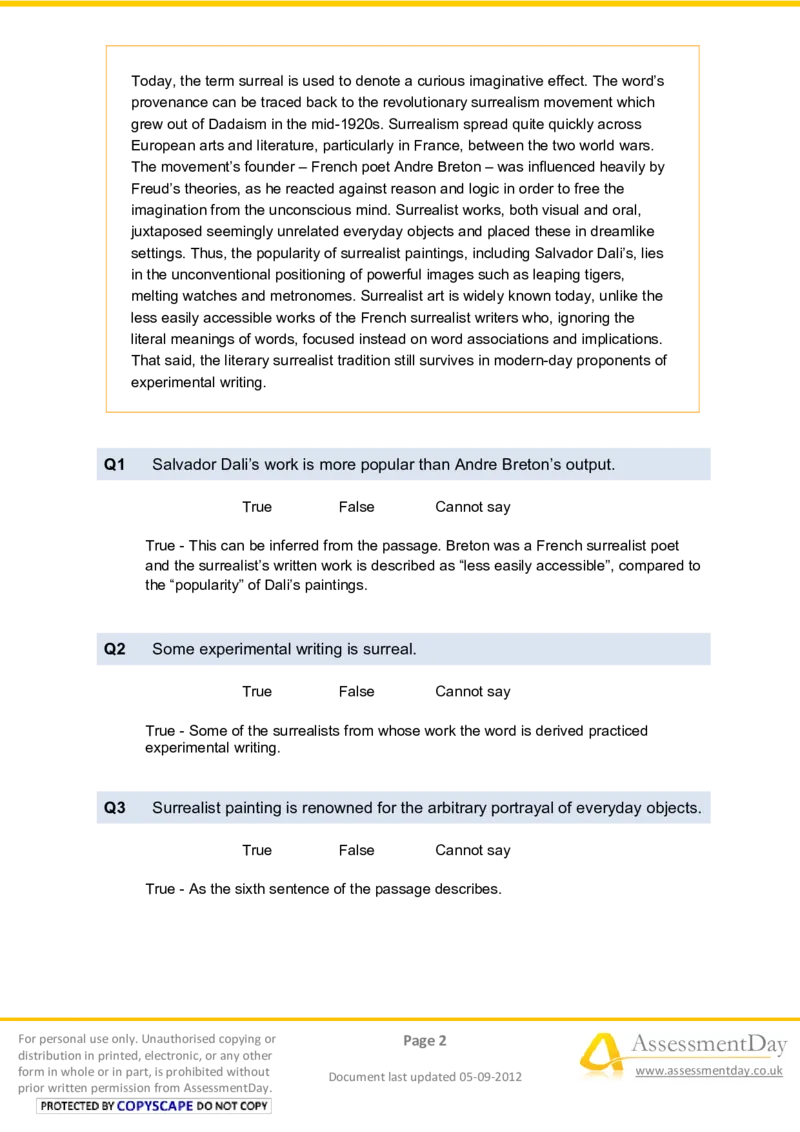
Practice Aptitude TestsToday, the term surreal is used to denote a curious imaginative effect. The word’s
provenance can be traced back to the revolutionary surrealism movement which
grew out of Dadaism in the mid-1920s. Surrealism spread quite quickly across
European arts and literature, particularly in France, between the two world wars.
The movement’s founder – French poet Andre Breton – was influenced heavily by
Freud’s theories, as he reacted against reason and logic in order to free the
imagination from the unconscious mind. Surrealist works, both visual and oral,
juxtaposed seemingly unrelated everyday objects and placed these in dreamlike
settings. Thus, the popularity of surrealist paintings, including Salvador Dali’s, lies
in the unconventional positioning of powerful images such as leaping tigers,
melting watches and metronomes. Surrealist art is widely known today, unlike the
less easily accessible works of the French surrealist writers who, ignoring the
literal meanings of words, focused instead on word associations and implications.
That said, the literary surrealist tradition still survives in modern-day proponents of
experimental writing.
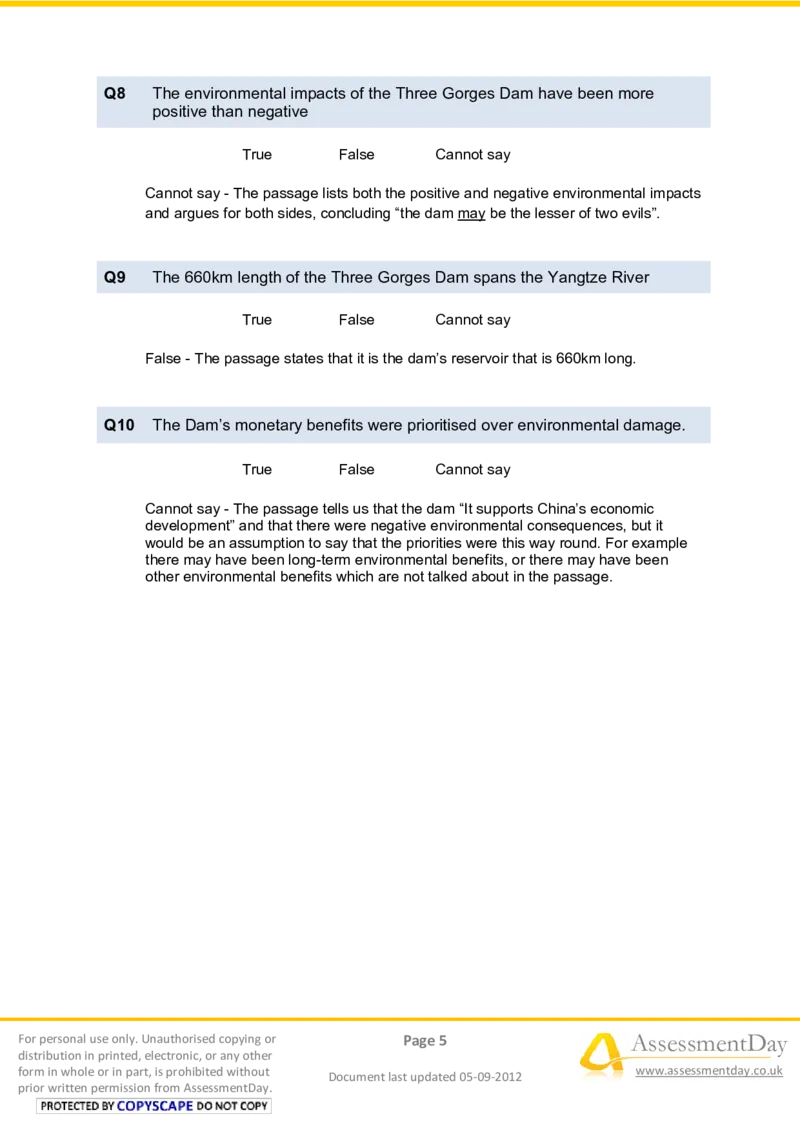
Q1 Salvador Dali’s work is more popular than Andre Breton’s output.
True False Cannot say
True - This can be inferred from the passage. Breton was a French surrealist poet
and the surrealist’s written work is described as “less easily accessible”, compared to
the “popularity” of Dali’s paintings.
Q2 Some experimental writing is surreal.
True False Cannot say
True - Some of the surrealists from whose work the word is derived practiced
experimental writing.
Q3 Surrealist painting is renowned for the arbitrary portrayal of everyday objects.
True False Cannot say
True - As the sixth sentence of the passage describes.
For personal use only. Unauthorised copying or Page 2 AssessmentDay
distribution in printed, electronic, or any other
form in whole or in part, is prohibited without
Document last updated 05-09-2012
www.assessmentday.co.uk
prior written permission from AssessmentDay.Q4 Salvador Dali was a French surrealist painter.
True False Cannot say
Cannot say - The passage mentions Dali, as well as emphasising the movement’s
French focus, but does not link the two together. In fact Dali was Spanish.
Q5 At one time Dadaism and Surrealism were closely affiliated.
True False Cannot say
True - The passage notes that Surrealism “grew out of Dadaism.
For personal use only. Unauthorised copying or Page 3 AssessmentDay
distribution in printed, electronic, or any other
form in whole or in part, is prohibited without
Document last updated 05-09-2012
www.assessmentday.co.uk
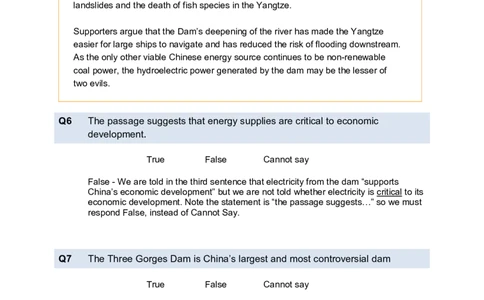
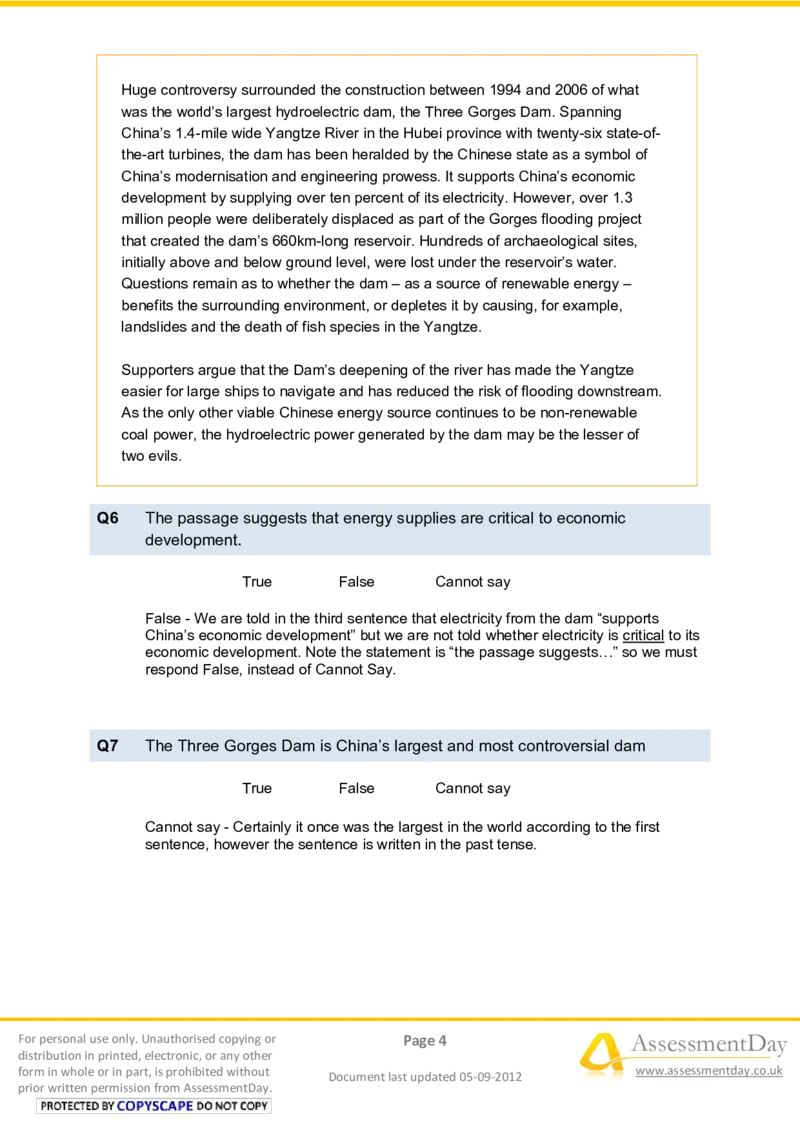
prior written permission from AssessmentDay.Huge controversy surrounded the construction between 1994 and 2006 of what
was the world’s largest hydroelectric dam, the Three Gorges Dam. Spanning
China’s 1.4-mile wide Yangtze River in the Hubei province with twenty-six state-of-
the-art turbines, the dam has been heralded by the Chinese state as a symbol of
China’s modernisation and engineering prowess. It supports China’s economic
development by supplying over ten percent of its electricity. However, over 1.3
million people were deliberately displaced as part of the Gorges flooding project
that created the dam’s 660km-long reservoir. Hundreds of archaeological sites,
initially above and below ground level, were lost under the reservoir’s water.
Questions remain as to whether the dam – as a source of renewable energy –
benefits the surrounding environment, or depletes it by causing, for example,
landslides and the death of fish species in the Yangtze.
Supporters argue that the Dam’s deepening of the river has made the Yangtze
easier for large ships to navigate and has reduced the risk of flooding downstream.
As the only other viable Chinese energy source continues to be non-renewable
coal power, the hydroelectric power generated by the dam may be the lesser of
two evils.
Q6 The passage suggests that energy supplies are critical to economic
development.
True False Cannot say
False - We are told in the third sentence that electricity from the dam “supports
China’s economic development” but we are not told whether electricity is critical to its
economic development. Note the statement is “the passage suggests5” so we must
respond False, instead of Cannot Say.
Q7 The Three Gorges Dam is China’s largest and most controversial dam
True False Cannot say
Cannot say - Certainly it once was the largest in the world according to the first
sentence, however the sentence is written in the past tense.
For personal use only. Unauthorised copying or Page 4 AssessmentDay
distribution in printed, electronic, or any other
form in whole or in part, is prohibited without
Document last updated 05-09-2012
www.assessmentday.co.uk
prior written permission from AssessmentDay.Q8 The environmental impacts of the Three Gorges Dam have been more
positive than negative
True False Cannot say
Cannot say - The passage lists both the positive and negative environmental impacts
and argues for both sides, concluding “the dam may be the lesser of two evils”.
Q9 The 660km length of the Three Gorges Dam spans the Yangtze River
True False Cannot say
False - The passage states that it is the dam’s reservoir that is 660km long.
Q10 The Dam’s monetary benefits were prioritised over environmental damage.
True False Cannot say
Cannot say - The passage tells us that the dam “It supports China’s economic
development” and that there were negative environmental consequences, but it
would be an assumption to say that the priorities were this way round. For example
there may have been long-term environmental benefits, or there may have been
other environmental benefits which are not talked about in the passage.
For personal use only. Unauthorised copying or Page 5 AssessmentDay
distribution in printed, electronic, or any other
form in whole or in part, is prohibited without
Document last updated 05-09-2012
www.assessmentday.co.uk
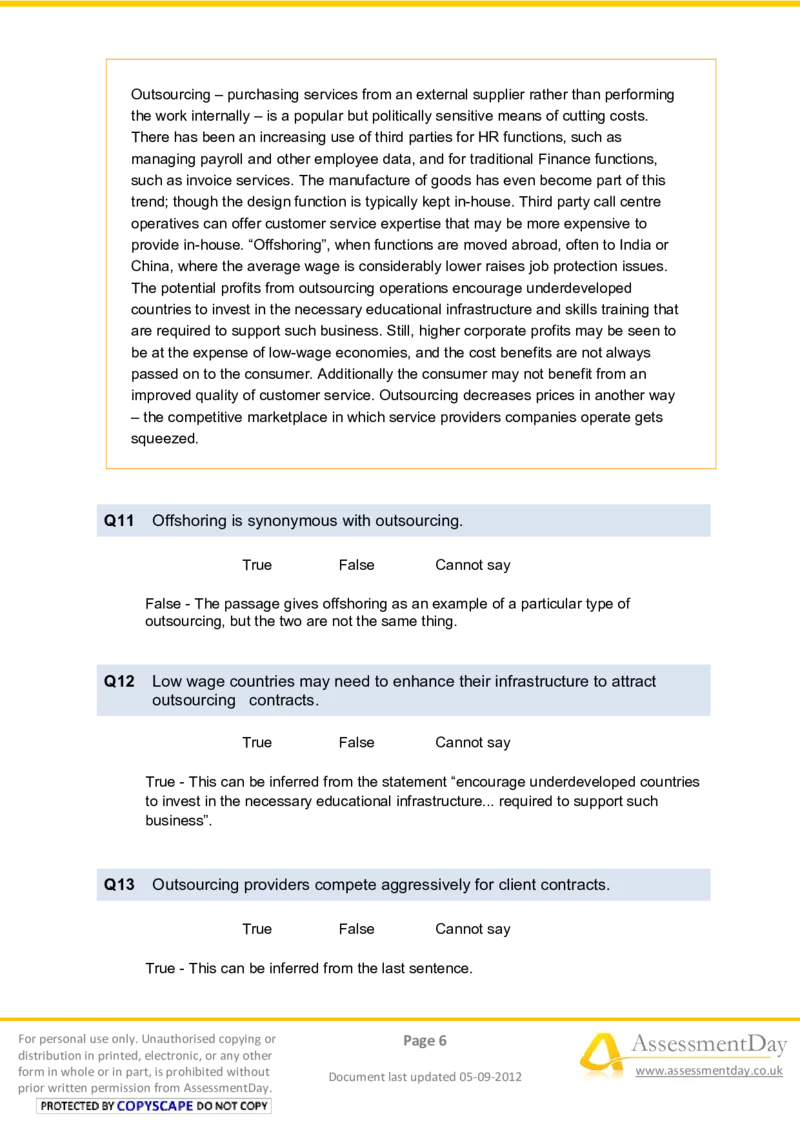
prior written permission from AssessmentDay.Outsourcing – purchasing services from an external supplier rather than performing
the work internally – is a popular but politically sensitive means of cutting costs.
There has been an increasing use of third parties for HR functions, such as
managing payroll and other employee data, and for traditional Finance functions,
such as invoice services. The manufacture of goods has even become part of this
trend; though the design function is typically kept in-house. Third party call centre
operatives can offer customer service expertise that may be more expensive to
provide in-house. “Offshoring”, when functions are moved abroad, often to India or
China, where the average wage is considerably lower raises job protection issues.
The potential profits from outsourcing operations encourage underdeveloped
countries to invest in the necessary educational infrastructure and skills training that
are required to support such business. Still, higher corporate profits may be seen to
be at the expense of low-wage economies, and the cost benefits are not always
passed on to the consumer. Additionally the consumer may not benefit from an
improved quality of customer service. Outsourcing decreases prices in another way
– the competitive marketplace in which service providers companies operate gets
squeezed.
Q11 Offshoring is synonymous with outsourcing.
True False Cannot say
False - The passage gives offshoring as an example of a particular type of
outsourcing, but the two are not the same thing.
Q12 Low wage countries may need to enhance their infrastructure to attract
outsourcing contracts.
True False Cannot say
True - This can be inferred from the statement “encourage underdeveloped countries
to invest in the necessary educational infrastructure... required to support such
business”.
Q13 Outsourcing providers compete aggressively for client contracts.
True False Cannot say
True - This can be inferred from the last sentence.
For personal use only. Unauthorised copying or Page 6 AssessmentDay
distribution in printed, electronic, or any other
form in whole or in part, is prohibited without
Document last updated 05-09-2012
www.assessmentday.co.uk
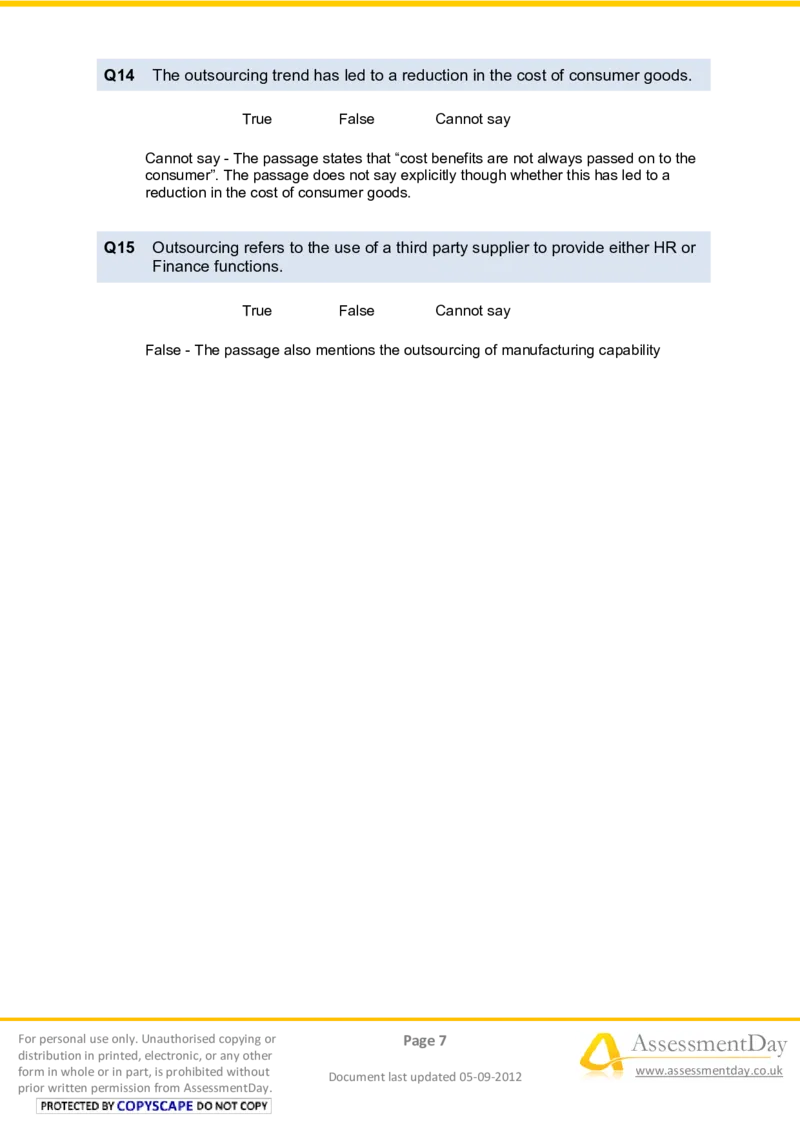
prior written permission from AssessmentDay.Q14 The outsourcing trend has led to a reduction in the cost of consumer goods.
True False Cannot say
Cannot say - The passage states that “cost benefits are not always passed on to the
consumer”. The passage does not say explicitly though whether this has led to a
reduction in the cost of consumer goods.
Q15 Outsourcing refers to the use of a third party supplier to provide either HR or
Finance functions.
True False Cannot say
False - The passage also mentions the outsourcing of manufacturing capability
For personal use only. Unauthorised copying or Page 7 AssessmentDay
distribution in printed, electronic, or any other
form in whole or in part, is prohibited without
Document last updated 05-09-2012
www.assessmentday.co.uk
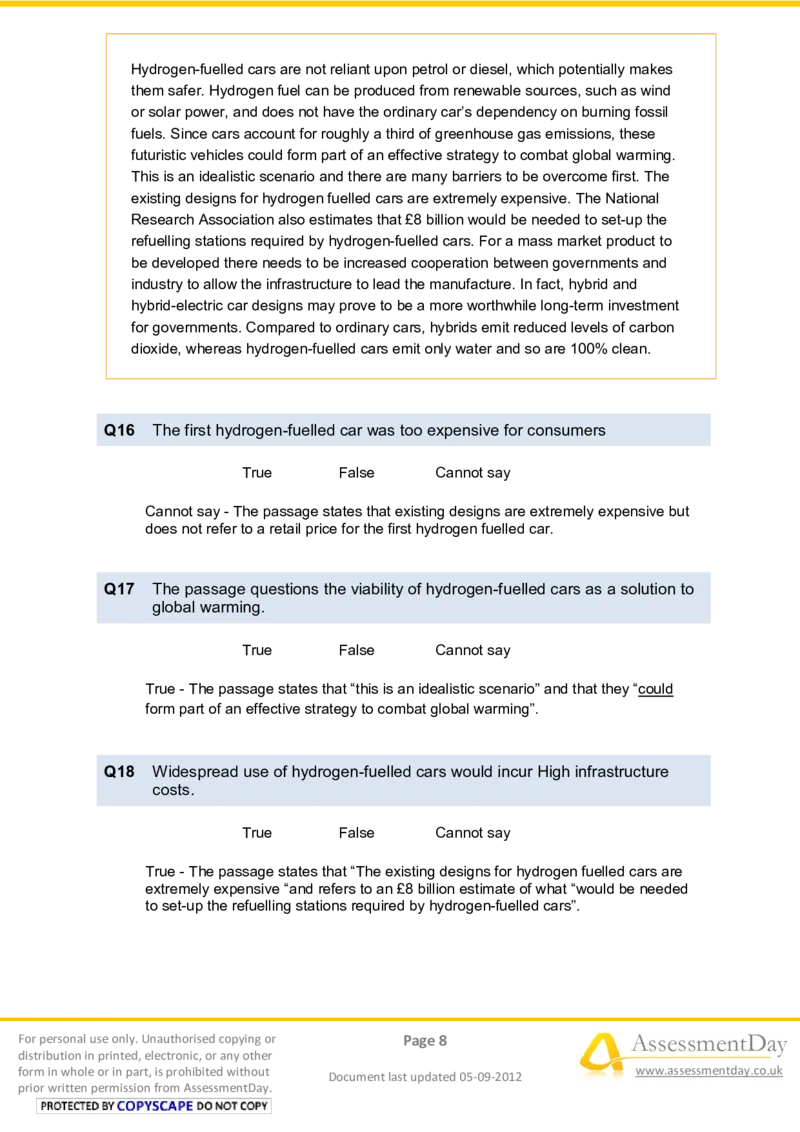
prior written permission from AssessmentDay.Hydrogen-fuelled cars are not reliant upon petrol or diesel, which potentially makes
them safer. Hydrogen fuel can be produced from renewable sources, such as wind
or solar power, and does not have the ordinary car’s dependency on burning fossil
fuels. Since cars account for roughly a third of greenhouse gas emissions, these
futuristic vehicles could form part of an effective strategy to combat global warming.
This is an idealistic scenario and there are many barriers to be overcome first. The
existing designs for hydrogen fuelled cars are extremely expensive. The National
Research Association also estimates that £8 billion would be needed to set-up the
refuelling stations required by hydrogen-fuelled cars. For a mass market product to
be developed there needs to be increased cooperation between governments and
industry to allow the infrastructure to lead the manufacture. In fact, hybrid and
hybrid-electric car designs may prove to be a more worthwhile long-term investment
for governments. Compared to ordinary cars, hybrids emit reduced levels of carbon
dioxide, whereas hydrogen-fuelled cars emit only water and so are 100% clean.
Q16 The first hydrogen-fuelled car was too expensive for consumers
True False Cannot say
Cannot say - The passage states that existing designs are extremely expensive but
does not refer to a retail price for the first hydrogen fuelled car.
Q17 The passage questions the viability of hydrogen-fuelled cars as a solution to
global warming.
True False Cannot say
True - The passage states that “this is an idealistic scenario” and that they “could
form part of an effective strategy to combat global warming”.
Q18 Widespread use of hydrogen-fuelled cars would incur High infrastructure
costs.
True False Cannot say
True - The passage states that “The existing designs for hydrogen fuelled cars are
extremely expensive “and refers to an £8 billion estimate of what “would be needed
to set-up the refuelling stations required by hydrogen-fuelled cars”.
For personal use only. Unauthorised copying or Page 8 AssessmentDay
distribution in printed, electronic, or any other
form in whole or in part, is prohibited without
Document last updated 05-09-2012
www.assessmentday.co.uk
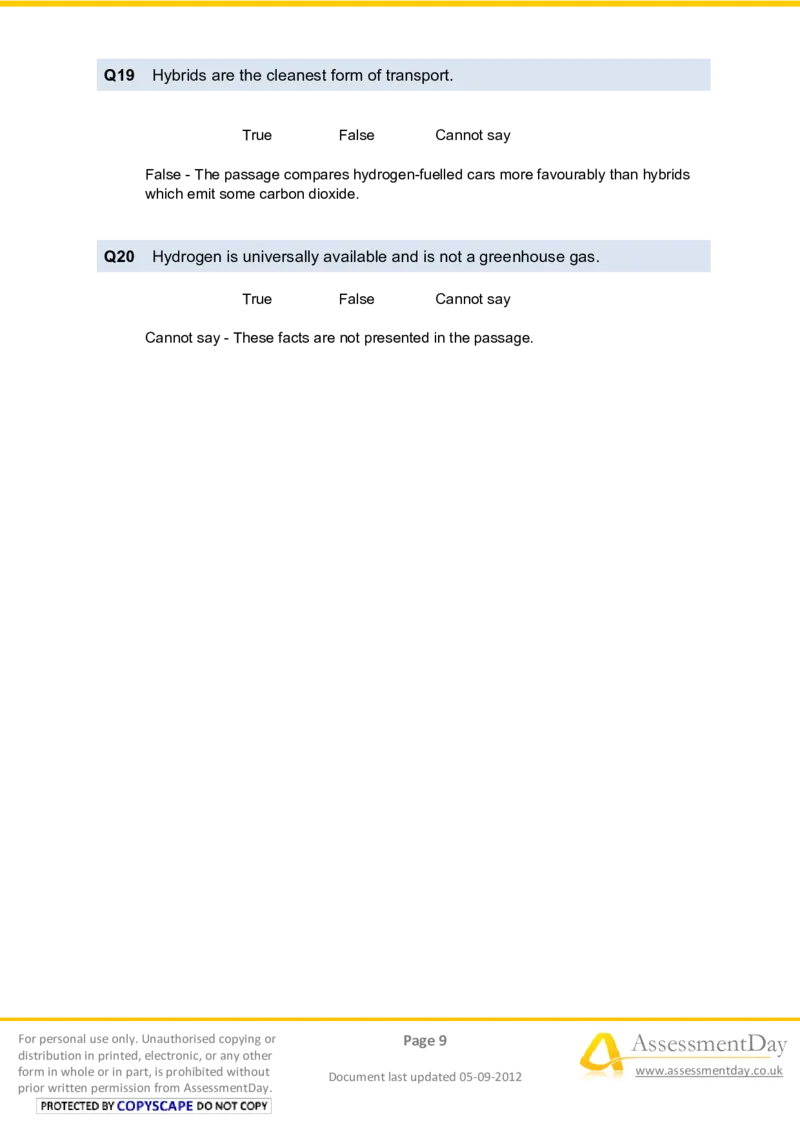
prior written permission from AssessmentDay.Q19 Hybrids are the cleanest form of transport.
True False Cannot say
False - The passage compares hydrogen-fuelled cars more favourably than hybrids
which emit some carbon dioxide.
Q20 Hydrogen is universally available and is not a greenhouse gas.
True False Cannot say
Cannot say - These facts are not presented in the passage.
For personal use only. Unauthorised copying or Page 9 AssessmentDay
distribution in printed, electronic, or any other
form in whole or in part, is prohibited without
Document last updated 05-09-2012
www.assessmentday.co.uk
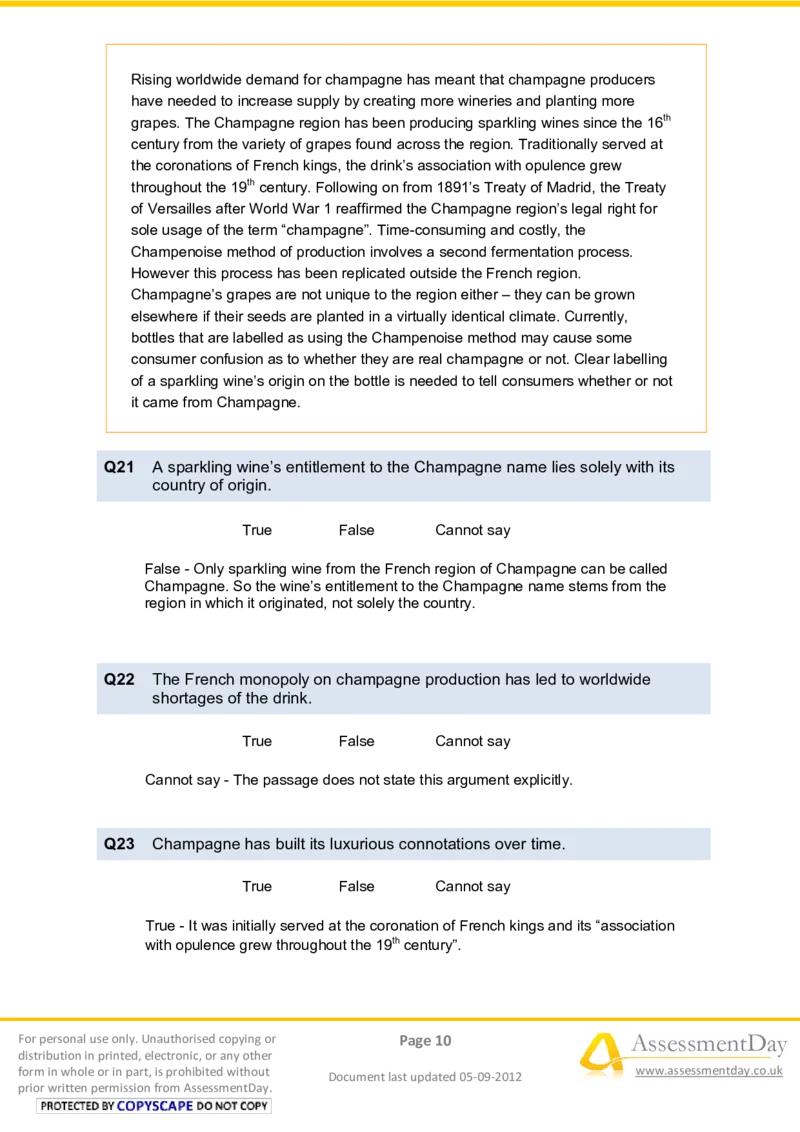
prior written permission from AssessmentDay.Rising worldwide demand for champagne has meant that champagne producers
have needed to increase supply by creating more wineries and planting more
grapes. The Champagne region has been producing sparkling wines since the 16th
century from the variety of grapes found across the region. Traditionally served at
the coronations of French kings, the drink’s association with opulence grew
throughout the 19th century. Following on from 1891’s Treaty of Madrid, the Treaty
of Versailles after World War 1 reaffirmed the Champagne region’s legal right for
sole usage of the term “champagne”. Time-consuming and costly, the
Champenoise method of production involves a second fermentation process.
However this process has been replicated outside the French region.
Champagne’s grapes are not unique to the region either – they can be grown
elsewhere if their seeds are planted in a virtually identical climate. Currently,
bottles that are labelled as using the Champenoise method may cause some
consumer confusion as to whether they are real champagne or not. Clear labelling
of a sparkling wine’s origin on the bottle is needed to tell consumers whether or not
it came from Champagne.
Q21 A sparkling wine’s entitlement to the Champagne name lies solely with its
country of origin.
True False Cannot say
False - Only sparkling wine from the French region of Champagne can be called
Champagne. So the wine’s entitlement to the Champagne name stems from the
region in which it originated, not solely the country.
Q22 The French monopoly on champagne production has led to worldwide
shortages of the drink.
True False Cannot say
Cannot say - The passage does not state this argument explicitly.
Q23 Champagne has built its luxurious connotations over time.
True False Cannot say
True - It was initially served at the coronation of French kings and its “association
with opulence grew throughout the 19th century”.
For personal use only. Unauthorised copying or Page 10 AssessmentDay
distribution in printed, electronic, or any other
form in whole or in part, is prohibited without
Document last updated 05-09-2012
www.assessmentday.co.uk
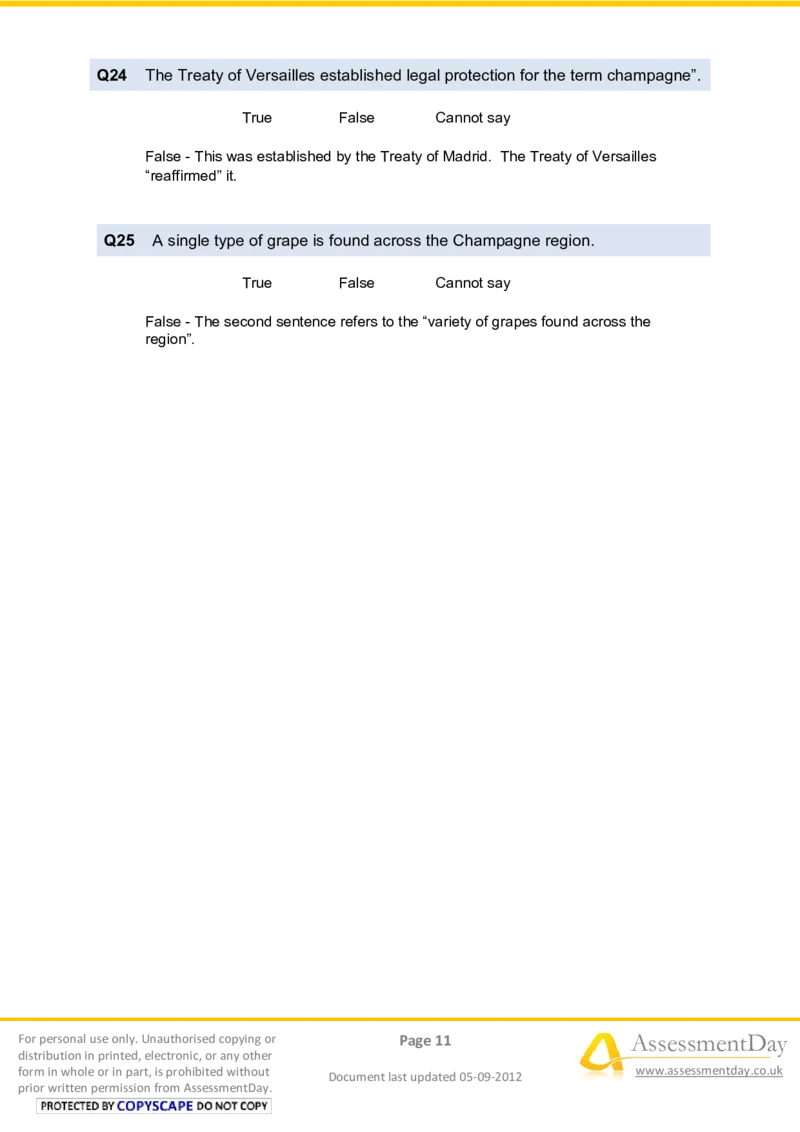
prior written permission from AssessmentDay.Q24 The Treaty of Versailles established legal protection for the term champagne”.
True False Cannot say
False - This was established by the Treaty of Madrid. The Treaty of Versailles
“reaffirmed” it.
Q25 A single type of grape is found across the Champagne region.
True False Cannot say
False - The second sentence refers to the “variety of grapes found across the
region”.
For personal use only. Unauthorised copying or Page 11 AssessmentDay
distribution in printed, electronic, or any other
form in whole or in part, is prohibited without
Document last updated 05-09-2012
www.assessmentday.co.uk
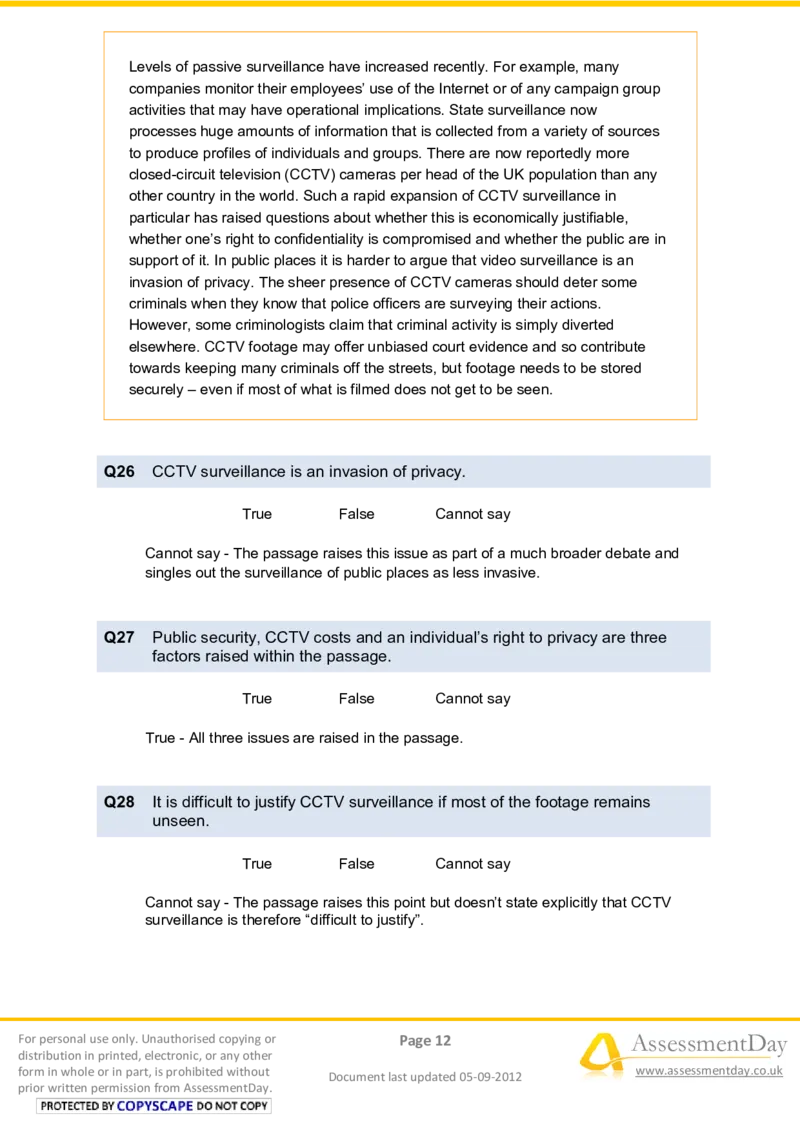
prior written permission from AssessmentDay.Levels of passive surveillance have increased recently. For example, many
companies monitor their employees’ use of the Internet or of any campaign group
activities that may have operational implications. State surveillance now
processes huge amounts of information that is collected from a variety of sources
to produce profiles of individuals and groups. There are now reportedly more
closed-circuit television (CCTV) cameras per head of the UK population than any
other country in the world. Such a rapid expansion of CCTV surveillance in
particular has raised questions about whether this is economically justifiable,
whether one’s right to confidentiality is compromised and whether the public are in
support of it. In public places it is harder to argue that video surveillance is an
invasion of privacy. The sheer presence of CCTV cameras should deter some
criminals when they know that police officers are surveying their actions.
However, some criminologists claim that criminal activity is simply diverted
elsewhere. CCTV footage may offer unbiased court evidence and so contribute
towards keeping many criminals off the streets, but footage needs to be stored
securely – even if most of what is filmed does not get to be seen.
Q26 CCTV surveillance is an invasion of privacy.
True False Cannot say
Cannot say - The passage raises this issue as part of a much broader debate and
singles out the surveillance of public places as less invasive.
Q27 Public security, CCTV costs and an individual’s right to privacy are three
factors raised within the passage.
True False Cannot say
True - All three issues are raised in the passage.
Q28 It is difficult to justify CCTV surveillance if most of the footage remains
unseen.
True False Cannot say
Cannot say - The passage raises this point but doesn’t state explicitly that CCTV
surveillance is therefore “difficult to justify”.
For personal use only. Unauthorised copying or Page 12 AssessmentDay
distribution in printed, electronic, or any other
form in whole or in part, is prohibited without
Document last updated 05-09-2012
www.assessmentday.co.uk
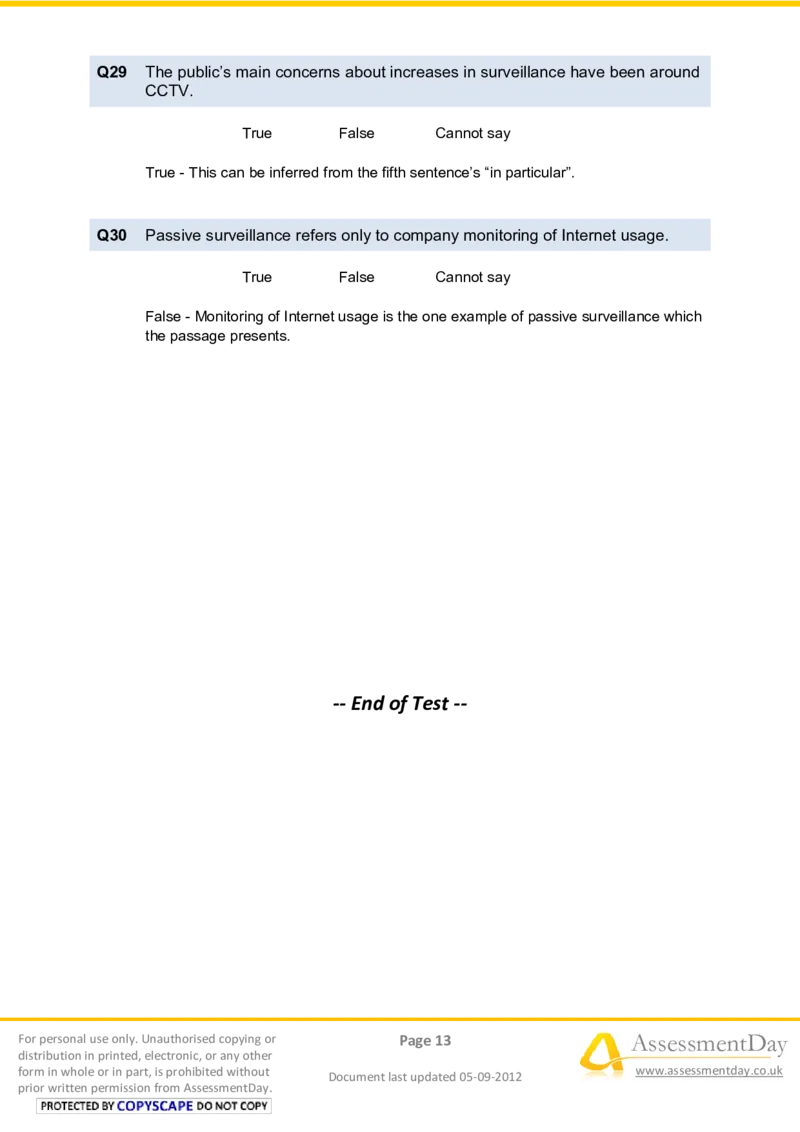
prior written permission from AssessmentDay.Q29 The public’s main concerns about increases in surveillance have been around
CCTV.
True False Cannot say
True - This can be inferred from the fifth sentence’s “in particular”.
Q30 Passive surveillance refers only to company monitoring of Internet usage.
True False Cannot say
False - Monitoring of Internet usage is the one example of passive surveillance which
the passage presents.
-- End of Test --
For personal use only. Unauthorised copying or Page 13 AssessmentDay
distribution in printed, electronic, or any other
form in whole or in part, is prohibited without
Document last updated 05-09-2012
www.assessmentday.co.uk
prior written permission from AssessmentDay.