济宁市第一中学 2024 届高三 3 月份定时检测
英语试题
命题人:李彩虹 王梅 审题人:王永力 孙帆帆
注意事项:
1. 答卷前,考生务必将自己的姓名、考生号等填写在答题卡和试卷指定位置上。
2. 回答选择题时,选出每小题答案后,用铅笔把答题卡上对应题目的答案标号涂黑。如需改动,
用橡皮擦干净后,再选择其他答案标号。回答非选择题时,将答案写在答题卡上。写在本试卷上无
效。
3. 考试结束后,将本试卷和答题卡一并交回。
第一部分 阅读(共两节,满分50分)
第一节(共15小题;每小题2.5分,满分37.5分)
阅读下列短文,从每题所给的A、B、C和D四个选项中,选出最佳答案。
A
WhistlerTravelGuide
Snow-capped peaks and powdered steeps; sparkling lakes and rushing waterfalls; challenging hiking
routesandinvitingrestaurants—Whistler’sofferingssuiteveryseason.
Thingstodo
The entire town displays the ski-chic atmosphere, hosting dozens of ski and snowboard competitions
and festivals annually. In the warmer months, more outdoor enthusiasts come out to play. Visitors can try
hiking or cycling up the mountains. While Whistler is an ideal vacation spot for the active types, other
travelers can enjoy the local museums and art galleries filled with informative exhibits. Plus, there are
family-friendlyactivitiesandattractionslikesummerconcerts,alongwithplentyofshoppingoptions.
Whentovisit
ThebesttimestovisitWhistlerarefromJunethroughAugustandbetweenDecemberandMarch.
Howtogetaround
The best ways to get around Whistler are on foot or by bike. Or, you can take the shuttle buses from
WhistlerVillage,whichtransportvisitorsto LostLakeParkandtheMarketplace.Meanwhile,having acar
will allow you the freedom to explore top attractions like Whistler Train Wreck and Alexander Falls
withouthavingtospendalotofcashonacab.
Whatyouneedtoknow
●Whistler receives feet of snow each year. If you’re driving in winter, slow down and make sure to
rentorcomewithareliableSUV.
●Snowslides are likely to occur on Backcountry routes, so only advanced skiers should take to this
off-the-maparea.
●Whistler’s wilderness is home to many black and grizzly bears. Keep your distance and do not feed
them.
第 1 页 共 8 页
{#{QQABQQCUggCIAIBAARhCEQXSCAGQkBEAACoOBBAMoAAAyBNABAA=}#}1.WhatareactivetravelersrecommendedtodoinWhistler?
A.Bikeupthemountains. B.Hostskicompetitions.
C.Goshoppingatthemalls. D.Visitmuseumexhibitions.
2.Whichofthefollowingisthemostpopularamongtravelers?
A.WhistlerVillage. B.LostLakePark.
C.TheMarketplace. D.WhistlerTrainWreck.
3.WhataretravelersprohibitedfromdoinginWhistler?
A.DrivingarentedSUV. B.Feedinggrizzlybears.
C.Exploringthewilderness. D.SkiingonBackcountryroutes.
B
Last summer at a bookstore, my son Henry was fascinated by the cover of the first novel from Peter
Brown’s middle-grade trilogy (三部曲). He then finished it in just two days. “Dad, why did The Wild
Robothavetobesosad?”Hetearfullyaskedme.
The storyisset ona remoteisland,wherearobotnamedRozlearns tosurviveandcommunicatewith
the island’s creatures, andbecomes part of the community.For myson, itwas the first book hediscovered
onhisown;thefirsttoimpacthimwiththemixoftragedy(悲剧)andjoy.
When I finished the book, I knew why Henry loved it. In our book club discussion, he described how
Brown’s pictures and words had made the story feel real. When talking about its final scenes, where Roz
leaves to find repairs for her injured body, Henry cried again. His previous reading experiences had
cheerful, “happily-ever-after” endings, but this book introduced him to the beauty of complex emotions. I
triedtoexplainhowsadnesscanenhancethemeaningofhappymoments,butfailedtofullyconvincehim.
Once our discussionended, Henryrequested to buyThe Wild RobotEscapes and instantlyfell in love
with it. He read the first two books repeatedly, so you can imagine his excitement when we finally got a
copyofTheWildRobotProtects.
We both agree it is worth the wait. Roz leaves the island again to stop an underwater threat: “the
poison tide.” Brown expertly balances between breathtaking adventure and unsettling ideas — not just
happinessandsadness,butalso,giventheclimate-changeundercurrents,hopeanddespair.
And, here’s somethingspecial aboutRoz: herphysical clumsiness andconfusion about life,conveyed
through her expressive eyes and downturned mouth. Her story reflects the challenges of surviving in a
strange place, much like a child’s journey. Readers love Roz. They learn from her. Even better, they learn
alongside her. Roz gave Henry the power to push through the first book’s sad parts, getting him ready to
appreciatethat,sometimes,sadnessisn’tabadthingtofeel.
4.WhatdrovetheauthortoreadTheWildRobot?
A.Itstragicending. B.Henry’stearfulrecommendation.
C.Itsattractivecover. D.Henry’semotionalresponsetoit.
5.WhatisonethemeofTheWildRobotProtects?
A.Familyandcommunity. B.Concernsofglobalissues.
C.Explorationoftheocean. D.Man-robotrelationship.
第 2 页 共 8 页
{#{QQABQQCUggCIAIBAARhCEQXSCAGQkBEAACoOBBAMoAAAyBNABAA=}#}6.WhatmakesRozinthetrilogyspecial?
A.Herchildlikeexpressions. B.Herroboticpower.
C.Herstrugglingexperiences. D.Heradventurousspirit.
7.Whichmessagedoesthistextseemtocommunicate?
A.Misfortuneinspiresgreatliteraryworks.
B.Robotstoriesworklikemagiconchildren.
C.Bookdiscussionshelpkidssurvivetragedies.
D.Readingliteraturefacilitatespersonalgrowth.
C
“Why does grandpahave earhair?” Just a few years ago mychild was so curious to know“why” and
“how” that we had to cut off her questions five minutes before bedtime. Now a soon-to-be fourth grader,
she says that she dislikes school because “it’s not fun to learn.” I am shocked. As a scientist and parent, I
havedoneeverythingIcantopromotealoveoflearninginmychildren.WheredidIgowrong?
My child’s experience is not unique. Developmental psychologist Susan Engel notes that curiosity —
defined as “spontaneous(自发的) investigation andeagerness for new information”— drops dramatically
inchildrenbythefourthgrade.
In Wonder: Childhood and the Lifelong Love of Science, Yale psychologist Frank C. Keil details the
development of wonder — a spontaneous passion to explore, discover, and understand. He takes us on a
journey from its early development, when wonder drives common sense and scientific reasoning, through
thedrop-offinwonderthatoftenoccurs,tothetrapoflifeinasocietythatdevalueswonder.
As Keil notes, children are particularly rich in wonder while they are rapidly developing causal
mechanisms (因果机制) in the preschool and early elementary school years. They are sensitive to the
others’ knowledge and goals, and they expertly use their desire for questioning. Children’s questions,
particularly those about “why” and “how,” support the development of causal mechanisms which can be
usedtohelptheirday-to-dayreasoning.
Unfortunately, as Keil notes, “adults greatly underestimate young children’s causal mechanisms.” In
thebook,Wonder,Keilshowsthatwecansupportchildren’s ongoingwonderbyplayinggameswiththem
aspartners,encouragingquestion-asking,andfocusingontheirabilitiestoreasonandconclude.
A decline in wonder is not unavoidable. Keil reminds us that we can accept wonder as a desirable
positive quality that exists in everyone. I value wonder deeply, and Wonder has given me hope by
proposingafutureformychildrenthatwillremainwonder-full.
8.Whatisacommonproblemamongfourthgraders?
A.Theyupsettheirparentstoooften. B.Theirdesiretolearndeclinessharply.
C.Theirloveforfundisappearsquickly. D.Theyasktoomanystrangequestions.
9.Whatcanbeinferredaboutchildren’scausalmechanismsinparagraph4?
A.Theycontrolchildren’ssensitivity. B.Theyslightlychangeinearlychildhood.
C.Theyhardlysupportchildren’sreasoning. D.Theydevelopthroughchildren’squestioning.
10.Howcanparentssupportchildren’songoingwonderaccordingtoKeil?
A.Byestimatingtheirabilities. B.Bywelcominginquiringminds.
C.Bymonitoringtheirgames. D.Byprovidingreasonableconclusions.
第 3 页 共 8 页
{#{QQABQQCUggCIAIBAARhCEQXSCAGQkBEAACoOBBAMoAAAyBNABAA=}#}11.Whatisthetext?
A.Anewsreport. B.Aresearchpaper.
C.Abookreview. D.Achildren’sstory.
D
Newresearchshowsthatremovingblackrhinos’horns(犀牛角)tomakethemlessattractivetoillegal
huntersisreducingtheirterritory(领地)sizesandmakingthemlesssociablewitheachother.
The study, published in the journal PNAS, found that de-homed South African rhinos have home
rangesthatare45percentsmallerthanthoseof completeanimals,andthattheywere37percentlesslikely
toengageinsocialinteractions.
“The big, dominant bulls that used to have very large territories that overlapped with a lot of females
maynowhavemuchlessterritoryandmuchlessreproductive(繁殖的)success,”saysVanessaDuthé,who
ledtheworkatSwitzerland’sUniversityofNeuchâtel.
“It’s really hard to predict the effects of this,” she says. “It doesn’t mean that population success will
necessarily decline,because it mightopen upgapsfor younger males thatwould not have hadthe spaceor
themeansbefore.”Indeed,aUniversityof Bristolstudypublishedlastyearshowedthatde-horning(去角)
doesnotnegativelyaffectpopulationsoverall.
But such unintended behavioral consequences necessarily feed into judgments about whether this
highlyinvasiveprocedureisworthwhile.Remarkably,perhaps,thereislittlehardevidenceeitherway.“No
one’sputallthedatatogethertosaywhetherit’sareallyeffectivemeasure,”saysDuthé.
“Whatisclearisthattheintroductionofde-horningandadeclineinillegalhuntinghasoccurredatthe
same time, “she adds. “But de-horning has been accompanied by other conservation measures that may be
moreeffective.
“It’s incredibly complicated,” says Lucy Chimes, a member of the Bristol team. “There are so many
otherfactorsinvolved.Youhavetoconsiderwhatothersecuritymeasuresarebeingcarriedout—fencing,
patrols, staff numbers — and poverty levels surrounding parks, their nearness to national borders and
whether there is community engagement.” Chimes is currently planning a project that aims to separate
these and other factors. In the meantime, Duthé believes that dehorning is a worthwhile tool of last course
ofaction.“Arhinothatisbehavingalittlebitstrangelyisbetterthanadeadrhino.”
12.Whatisthepurposeofremovingthehornsofblackrhinos?
A.Tomakethemlesssociable.
B.Toaffecttheirreproductivesuccess.
C.Toreducetheirhomeranges.
D.Toprotectthemfrombeinghunted.
13.Whatdoestheunderlinedphrase“invasiveprocedure”inparagraph5referto?
A.Theremovalofrhinohorns.
B.Thelossofrhinoterritories.
C.Theimpactonrhinopopulation.
D.Thechangeofrhinobehavior.
第 4 页 共 8 页
{#{QQABQQCUggCIAIBAARhCEQXSCAGQkBEAACoOBBAMoAAAyBNABAA=}#}14.WhatisChimes’attitudetowardthede-horningofblackrhinos?
A.Supportive. B.Opposed. C.Unconcerned. D.Uncertain.
15.Whatcanwelearnfromthelastparagraph?
A.De-horningrhinosshowssatisfyingeffects.
B.Variousfactorsleadtothedeclineinillegalhunting.
C.De-horningisthebestactionresearcherswilltake.
D.Rhinosaresupposedtobehavealittlebitstrangely.
第二节 (共5小题;每小题2.5分,满分12.5分)
根据短文内容,从短文后的选项中选出能填入空白处的最佳选项。选项中有两项为多余选项。
Physicist andNobelPrize winnerRichard Feynmandevelopeda cleverlearningmethodknown asthe
Feynman Technique. It involves explaining what you’re learning to others. By teaching what you’ve
learned from memory, you engage in active recall. 16 It also ensures that you understand the topic,
because you can only explain an idea if you truly understand it. The technique consists of four repeatable
steps.
To begin, choose a concept or topic you wish to fully understand. 17 The more interested you
are, the faster you’ll grasp it. Moreover, a personally interesting topic will keep you motivated and
engaged.
18 Write notes and explain it in a way that makes sense to a five-year-old. If you’d rather
avoid actually teaching someone, you can just teach it to an imaginary audience. But it works much better
ifyouusearealperson.They’llbeabletoletyouknowwhensomethingisn’tclear.
While teaching you may discover gaps in your understanding. 19 Review your notes, reread
books, or seek external help to ensure you have a complete understanding of the context before moving
forward.
Now that you fully grasp the concept, test your understanding by trying to teach it to another person.
Thiswillhelpyouidentifyanyremainingareasofuncertaintyyouneedtorevisit.
The Feynman Technique is a great way for kids and grown-ups to learn. 20 You need to
actively think about the problem instead of passively reading or listening to someone else, However, with
greateffortsinmasteringthismethod,you’llseeyourlearningresultsimprovequickerthaneverbefore.
A.Itismentallydemanding.
B.Thishelpstheinformationstickinyourmindbetter.
C.Onceyouhavechosenatopic,youcanteachittosomeoneelse.
D.Yourcuriosityaboutitwilldeterminethepaceofyourlearning.
E.Teachittoafive-year-old,whowouldgiveyoudirectfeedback.
F.Activeengagementplaysakeyroleinpromotingdeeperlearning.
G.Whenthishappens,referbacktotheoriginalmaterialforthemissingpieces.
第 5 页 共 8 页
{#{QQABQQCUggCIAIBAARhCEQXSCAGQkBEAACoOBBAMoAAAyBNABAA=}#}第二部分 语言运用 (共两节, 满分30分)
第一节 (共15小题; 每小题1分, 满分15分)
阅读下面短文, 从短文后各题所给的A、B、C和D四个选项中, 选出可以填入空白处的最佳选
项。
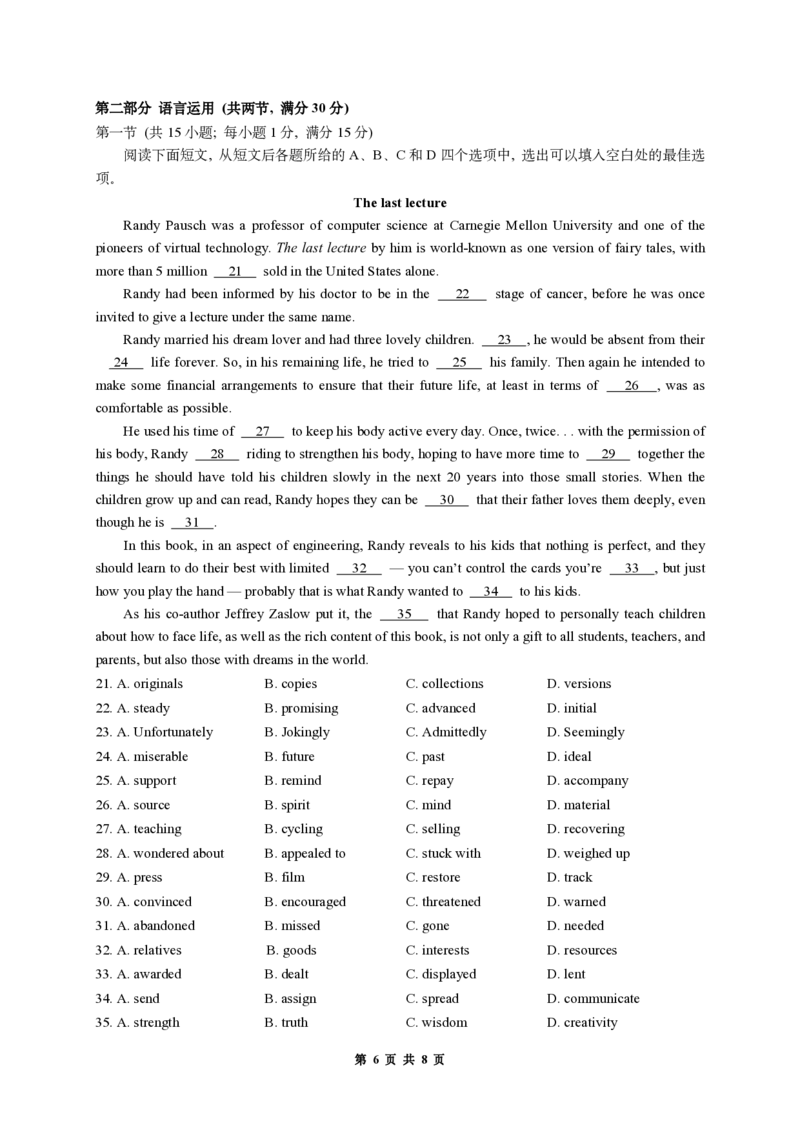
Thelastlecture
Randy Pausch was a professor of computer science at Carnegie Mellon University and one of the
pioneers of virtual technology. The last lecture by him is world-known as one version of fairy tales, with
morethan5million 21 soldintheUnitedStatesalone.
Randy had been informed by his doctor to be in the 22 stage of cancer, before he was once
invitedtogivealectureunderthesamename.
Randymarried his dreamloverandhadthree lovelychildren. 23 , hewould beabsentfrom their
24 24 life forever. So, in his remaining life, he tried to 25 his family. Then again he intended to
make some financial arrangements to ensure that their future life, at least in terms of 26 , was as
comfortableaspossible.
Heusedhistimeof 27 tokeephisbodyactiveeveryday.Once,twice...withthepermissionof
hisbody,Randy 28 ridingtostrengthenhis body,hopingtohavemoretimeto 29 togetherthe
things he should have told his children slowly in the next 20 years into those small stories. When the
childrengrowupandcanread,Randyhopestheycanbe 30 thattheirfatherlovesthemdeeply,even
thoughheis 31 .
In this book, in an aspect of engineering, Randy reveals to his kids that nothing is perfect, and they
should learn to do their best with limited 32 — you can’t control the cards you’re 33 , but just
howyouplaythehand—probablythatiswhatRandywantedto 34 tohiskids.
As his co-author Jeffrey Zaslow put it, the 35 that Randy hoped to personally teach children
abouthowtofacelife,aswellastherichcontentofthisbook,isnotonlyagifttoallstudents,teachers,and
parents,butalsothosewithdreamsintheworld.
21.A.originals B.copies C.collections D.versions
22.A.steady B.promising C.advanced D.initial
23.A.Unfortunately B.Jokingly C.Admittedly D.Seemingly
24.A.miserable B.future C.past D.ideal
25.A.support B.remind C.repay D.accompany
26.A.source B.spirit C.mind D.material
27.A.teaching B.cycling C.selling D.recovering
28.A.wonderedabout B.appealedto C.stuckwith D.weighedup
29.A.press B.film C.restore D.track
30.A.convinced B.encouraged C.threatened D.warned
31.A.abandoned B.missed C.gone D.needed
32.A.relatives B.goods C.interests D.resources
33.A.awarded B.dealt C.displayed D.lent
34.A.send B.assign C.spread D.communicate
35.A.strength B.truth C.wisdom D.creativity
第 6 页 共 8 页
{#{QQABQQCUggCIAIBAARhCEQXSCAGQkBEAACoOBBAMoAAAyBNABAA=}#}第二节(共10小题;每小题1.5分,满分15分)
阅读下面短文,在空白处填入1个适当的单词或括号内单词的正确形式。
Despite being 75 years old, Chai Tixia’s expertise in Jianzi is truly impressive. With quick kicks, he
effortlesslysendstheJianziintotheairandgracefullyguidesittoland 36 (gentle)onhishead.
Jianzi, 37 game that dates back to the Han Dynasty, is surprisingly simple: players must keep
theJianziintheair, 38 (use)anypartoftheirbodyexcepttheirhandsandarms.However,tomaster
thisgame 39 (require)alotofpractice.
While enjoyedthroughout China, Jianzi 40 (describe) byChaiasan importantaspect ofhutong
culture. The narrow alleyways, situated within Beijing’s inner city, provide the setting for the game’s
4141 (popular). Each morning, Chai and his fellow hutong residents gather for their shared passion for
Jianzi.
Chai’s spirited matches with his neighbors have a big audience 42 (draw) to the artistry and
excitement of the game. The onlookers who watch them playing with great athleticism are amazed at
4343 Chaiandhisfellowplayerscanachieve.
HavingpracticedJianziforover30years,Chaicherishesthephysicalandsocial 44 (benefit)the
game brings. Engaging in lively matches with his neighbors energizes his body, enhances his flexibility,
45 45 promotes unity within the community. Through Jianzi, Chai harvests not only health but a sense
ofbelongingandfriendship.
第三部分 写作 (共两节, 满分40分)
第一节(满分15分)
假定你是李华, 毕业在即, 你校英文报举办了以“AnUnforgettableActivityinHighSchool”为主
题的征文活动。请你写一篇英文短文投稿, 分享一次你参加过的校园活动。内容包括:
1. 活动内容;
2. 活动感受。
注意:
1. 写作词数应为80个左右;
2. 请按如下格式在答题卡的相应位置作答。
AnUnforgettableActivityinHighSchool
第 7 页 共 8 页
{#{QQABQQCUggCIAIBAARhCEQXSCAGQkBEAACoOBBAMoAAAyBNABAA=}#}第二节(满分25分)
阅读下面材料,根据其内容和所给段落开头语续写两段,使之构成一篇完整的短文。
Inourweeklystaffmeeting,oureditorAshleywas notpleasedwiththequalityofourreporting.“Our
readership is way down. We need better stories for this Thursday’s school newspaper. Does anybody have
anyideas?”shesaid.
IhandedhermyarticleaboutourbasketballteambeatingDeerfieldHighSchoolthepreviousnightby
onepoint.“Sportsstoriesarefun,”shesaid,“butnotgoodenoughforthefrontpage.Weneedsomethingto
reallygetpeople’sattention.”
After our meeting, we left the newsroom together and heard someone screaming, “Perry is missing!”
Perry was a big red parrot and had been our school mascot(吉祥物) for ten years. He played an important
role in students’ lives, both in and out of class. He had also been a constant presence at school events,
inspiringasenseofunityamongstudents.
EveryonegatheredaroundPerry’semptycage,heartbroken.Suddenly,astudentfromthecrowdcame
over and showed me a photo. “You’re a reporter for the school paper, right? I happened to take this
yesterday,” he said. In the photo was a Deerfield High School basketball player with something large
hiddenunderhisshirtaroundthesizeofaparrot.
“HemusthavestolenPerrytogetbackatusforwinningthegame!”Ashleycried.Wehurriedbackto
thenewsroom,agreeingto runthephotoonthefrontpage withtheheadline“DeerfieldStolePerry.” “This
isjustthestoryweneed.Everyonewillreadit,”Ashleysaidconfidently.
After she left, I took a closer look at the photo. The clock in the background read 4:15 pm, but our
game against Deerfield hadn’t started until 4:30 pm. Why would the boy have taken Perry before we even
played?Anuneasyfeelingcameovermethatwemighthavefalselyaccusedsomeone.
IwenttoPerry’susualcaretakertoaskifheknewPerrywasmissing.“He’snotmissing.He’sretired.
He’s ready for some quieter days,” he said. Learning the truth, I immediately told Ashley and suggested
writingastorytosaygoodbyetoPerry.
注意:
1.续写词数应为150个左右;
2.请按如下格式在答题卡的相应位置作答。
Tomysurprise,Ashleyinsistedonreportingthe“DeerfieldStolePerry”story.
OnThursday,thepapercameoutwiththeheadline“Bye-Bye,Perry”onthefrontpage.
第 8 页 共 8 页
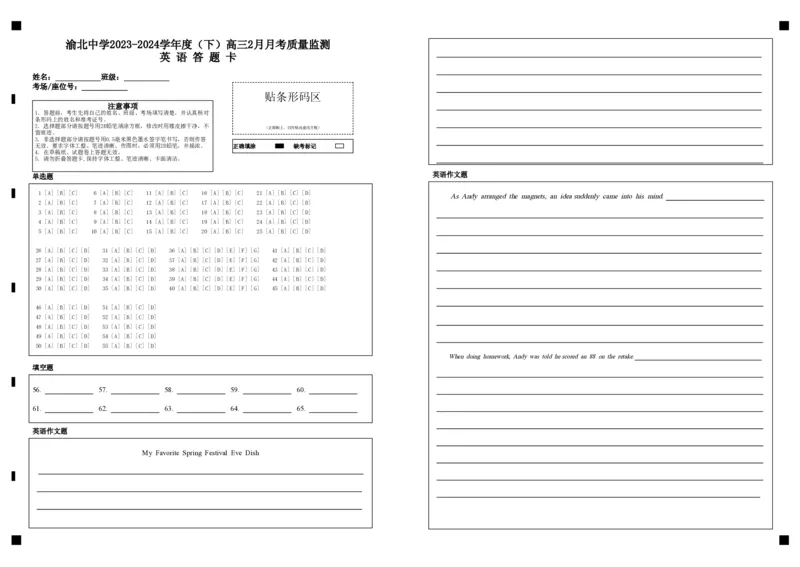
{#{QQABQQCUggCIAIBAARhCEQXSCAGQkBEAACoOBBAMoAAAyBNABAA=}#}济宁市第一中学2024届高三3月份定时检测
英语答题卡 写作 第一节(15分)
姓名:
An Unforgettable Activity in High School
班级:
贴条形码区
学校
考场: 座号:
考生
缺考 [ ] 违纪 [ ]
禁填
1.答题前请先将姓名、准考证号填写清楚,并认真核对考试科目;如有条形码请在规定位置贴好。
注意
2.选择题必须使用2B铅笔填涂;非选择请使用0.5毫米黑色签字笔书写,要求字体工整、笔迹清楚。
事项 3.请严格按照题号在相应答题区域内作答,超出答题区域的答案无效;在草稿纸、试卷上答题无效。
4.保持卷面清洁、不要装订、折叠、破损。 5.正确填涂: 错误填涂: ✔ ▁ ▏○
选择题(共35题,满分65分,1到15每小题2.5分,16到20每小题2.5分,21到35每小题1分)
1.[A] [B] [C] [D] 6.[A] [B] [C] [D] 11.[A] [B] [C] [D]
2.[A] [B] [C] [D] 7.[A] [B] [C] [D] 12.[A] [B] [C] [D]
3.[A] [B] [C] [D] 8.[A] [B] [C] [D] 13.[A] [B] [C] [D]
4.[A] [B] [C] [D] 9.[A] [B] [C] [D] 14.[A] [B] [C] [D]
5.[A] [B] [C] [D] 10.[A] [B] [C] [D] 15.[A] [B] [C] [D]
16.[A] [B] [C] [D] [E] [F] [G] 21.[A] [B] [C] [D] 26.[A] [B] [C] [D]
17.[A] [B] [C] [D] [E] [F] [G] 22.[A] [B] [C] [D] 27.[A] [B] [C] [D]
18.[A] [B] [C] [D] [E] [F] [G] 23.[A] [B] [C] [D] 28.[A] [B] [C] [D]
19.[A] [B] [C] [D] [E] [F] [G] 24.[A] [B] [C] [D] 29.[A] [B] [C] [D]
20.[A] [B] [C] [D] [E] [F] [G] 25.[A] [B] [C] [D] 30.[A] [B] [C] [D]
31.[A] [B] [C] [D]
32.[A] [B] [C] [D]
33.[A] [B] [C] [D]
34.[A] [B] [C] [D]
35.[A] [B] [C] [D]
填空题(共10题,满分15分)
36. 37.
38. 39.
40. 41.
42. 43.
44. 45.
- 1 - - 2 -
{#{QQABQQCUggCIAIBAARhCEQXSCAGQkBEAACoOBBAMoAAAyBNABAA=}#}写作 第二节(25分)
To my surprise, Ashley insisted on reporting the“Deerfield Stole Perry”story.
On Thursday, the paper came out with the headline“Bye-Bye, Perry”on the front page.
- 3 -
{#{QQABQQCUggCIAIBAARhCEQXSCAGQkBEAACoOBBAMoAAAyBNABAA=}#}济宁市第一中学 2024 届高三 3 月份定时检测
英语试题答案
第一部分 阅读
第一节
1-3ADB 4-7DBCD 8-11BDBC 12-15DADB
第二节
16-20BDCGA
第二部分 语言运用
第一节
21-25BCABD 26-30DBCAA 31-35CDBDC
第二节
36.gently 37.a 38.using 39.requires 40.isdescribed
41.popularity 42.drawn 43.what 44.benefits 45.and
第三部分 写作
第一节
AnUnforgettableActivityinHighSchool
My high school has witnessed many colorful activities in the past 3 years, among which the coming-of-age ceremony is
especiallyunforgettable.
Present at the ceremony were all we students from Grade 3, along with our parents and teachers. It kicked off with an
inspiring speech delivered by our president, which conveyed congratulations and anticipations about our future. Then came a
series of activities,ranging from expressing gratitude to our parents and teachers to making a promise of being responsible for
theadulthood.Thehighlightwaswhenwewalkedthroughthecoming-of-agegate.
TheceremonywillberootedinmymindasareminderthatIshouldshouldermyresponsibilityasanadult.
第二节
To my surprise, Ashley insisted on reporting the “Deerfield Stole Perry” story. “This is the very story we need to attract
more readers,” she argued. To convince her, I defended that if we wrote this article, we would be telling a lie. Noticing her
hesitant expression, I further explained the potential harm it would cause to the player and our paper’s reputation. After some
discussion,Ashleyfinallygavein,“OK,let’strywithrealstories.”ThenIwenttogatherallthenecessaryinformationtowrite
anarticleaboutPerryandthepreciousmemorieswesharedovertheyears.
On Thursday, the paper came out with the headline “Bye-Bye, Perry” on the front page. Soon, it sparked heated
discussions among students about Perry. Many were disappointed with Perry’s sudden departure, but were comforted by the
fact that he was in good care. The story also evoked sweet memories of Perry. Some students even requested to share their
storiesofhiminourpaper!Seeingthestory’ssuccess,Ashleycametomeandsaidsincerely,“Youareright!It’sagoodstory.”
Her words brought me a great sense of fulfillment. Indeed, true stories might not always draw attention, but they have the
powertotouchandconnect.
{#{QQABQQCUggCIAIBAARhCEQXSCAGQkBEAACoOBBAMoAAAyBNABAA=}#}