海淀区九年级第二学期期中练习
学校 英 语 姓名 2024. 04 准考证号
1. 本试卷共8页,共两部分,38道题,满分60分。考试时间90分钟。
2. 在试卷和答题卡上准确填写学校名称、姓名和准考证号。
考 生 须
3. 试题答案一律填涂或书写在答题卡上,在试卷上作答无效。
知
4. 在答题卡上,选择题用2B铅笔作答,其他试题用黑色字迹签字笔作答。
5. 考试结束,请将本试卷、答题卡和草稿纸一并交回。
第 一 部分
本部分共33题,共40分。在每题列出的四个选项中,选出最符合题目要求的一项。
一 、单项填空(每题0. 5分,共6分)
从下面各题所给的 A、B、C、D 四个选项中,选出可以填入空白处的最佳选项。
1. Linda and her sister are book lovers. ________ often spend time reading in the library.
A. She B. They C. We D. You
2. —Shall we take the 7:00 bus?
—OK. The concert starts ________ 7:30. We can make it on time.
A. in B. on C. at D. to
3. —Must I sign up for the school music festival today?
—No, you ________. Tomorrow is the last day for signing up.
A. can’t B. shouldn’t C. mustn’t D. needn’t
4. Tom practices basketball every day, and he becomes ________ at it than before.
.
A well B. better C. best D. the best
5. —________ is it from our school to the space museum?
—It’s about five kilometers.
A. How soon B. How long C. How far D. How much
6. Remember to do warm-up exercise before swimming, ________ you may get hurt.
A. so B. and C. but D. or
7. —Eric, turn down the music, please. Your little brother ________.
—OK, Mom. I’m sorry.
A. is sleeping B. sleeps C. was sleeping D. slept
8. —Lily, what housework do you often do at home?
—I ________ the dishes after dinner every day.
A. do B. did C. will do D. was doing
第1页/共11页
学科网(北京)股份有限公司9. —Jim, I called you an hour ago, but you didn’t pick up. What were you doing?
—Oh, I ________ the picnic plan with my parents.
A. discuss B. am discussing C. discussed D. was discussing
10. Lisa ________ the Summer Palace twice since she came to Beijing.
A. visits B. visited C. has visited D. was visiting
11. Last year, a garden ________ for students to grow vegetables in our school.
A. started B. was started C. starts D. is started
12. —Bob, can you tell me ________ the science club?
—Well, I really like doing experiments.
A. why you want to join B. why do you want to join
C. when you want to join D. when do you want to join
阅读下面的短文,掌握其大意,然后从短文后各题所给的A、B、C、D 四个选项中,选择最佳选项。
In her grandparents’old house, Maya discovered an old family calendar, with each page filled out carefully.
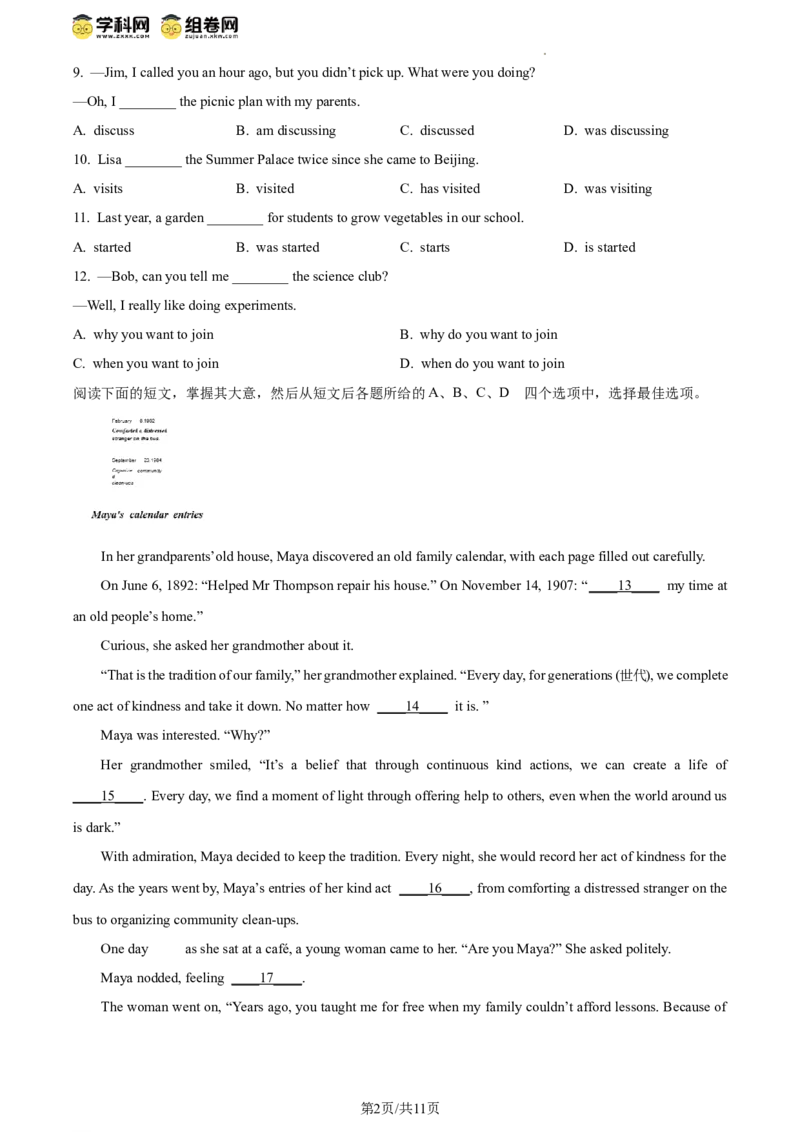
On June 6, 1892: “Helped Mr Thompson repair his house.” On November 14, 1907: “____13____ my time at
an old people’s home.”
Curious, she asked her grandmother about it.
“That is the tradition of our family,” her grandmother explained. “Every day, for generations (世代), we complete
one act of kindness and take it down. No matter how ____14____ it is. ”
Maya was interested. “Why?”
Her grandmother smiled, “It’s a belief that through continuous kind actions, we can create a life of
____15____. Every day, we find a moment of light through offering help to others, even when the world around us
is dark.”
With admiration, Maya decided to keep the tradition. Every night, she would record her act of kindness for the
day. As the years went by, Maya’s entries of her kind act ____16____, from comforting a distressed stranger on the
bus to organizing community clean-ups.
,
One day as she sat at a café, a young woman came to her. “Are you Maya?” She asked politely.
Maya nodded, feeling ____17____.
The woman went on, “Years ago, you taught me for free when my family couldn’t afford lessons. Because of
第2页/共11页
学科网(北京)股份有限公司you, I graduated top of my class. Today, I ____18____ an organization providing help for students from poor
families.”
Maya was moved and proud. She realized her actions were creating ripples (涟漪) in ways she had never
imagined.
The calendar became a community legend (传奇). Inspired by Maya, the town started a “Calendar Day”,
encouraging everyone to do good.
When Maya was old, she often sat with her grandchildren, turning the filled pages. “This was when your grandpa
and I met. I helped him find his lost dog.”
One day, her oldest grandchild, Sophie, looked up from the calendar. “I want to ____19____ this, Grandma.”
Maya handed the calendar over. She knew the tradition would live on.
Years after Maya passed, the town built a statue (雕塑) in her honor, with the words on its base:
In memory of Maya and the generations before her who believed in the power of everyday ____20____.
13.
A. Saved B. Wasted C. Managed D. Volunteered
14.
A. popular B. small C. unfair D. interesting
15.
A. freedom B. balance C. purpose D. discovery
16.
A. grew B. appeared C. remained D. mattered
17.
A. worried B. relaxed C. excited D. confused
18.
A. run B. need C. name D. visit
19.
A. praise B. report C. continue D. remember
20.
A. changes B. kindness C. happiness D. achievements
三、阅读理解(每题2分,共26分)
(一)阅读下列周末活动介绍,请根据人物喜好和需求匹配最适合的活动,并将活动所对应的
A 、B 、C 、D选项填在相应位置上。选项中有一项为多余选项。
A
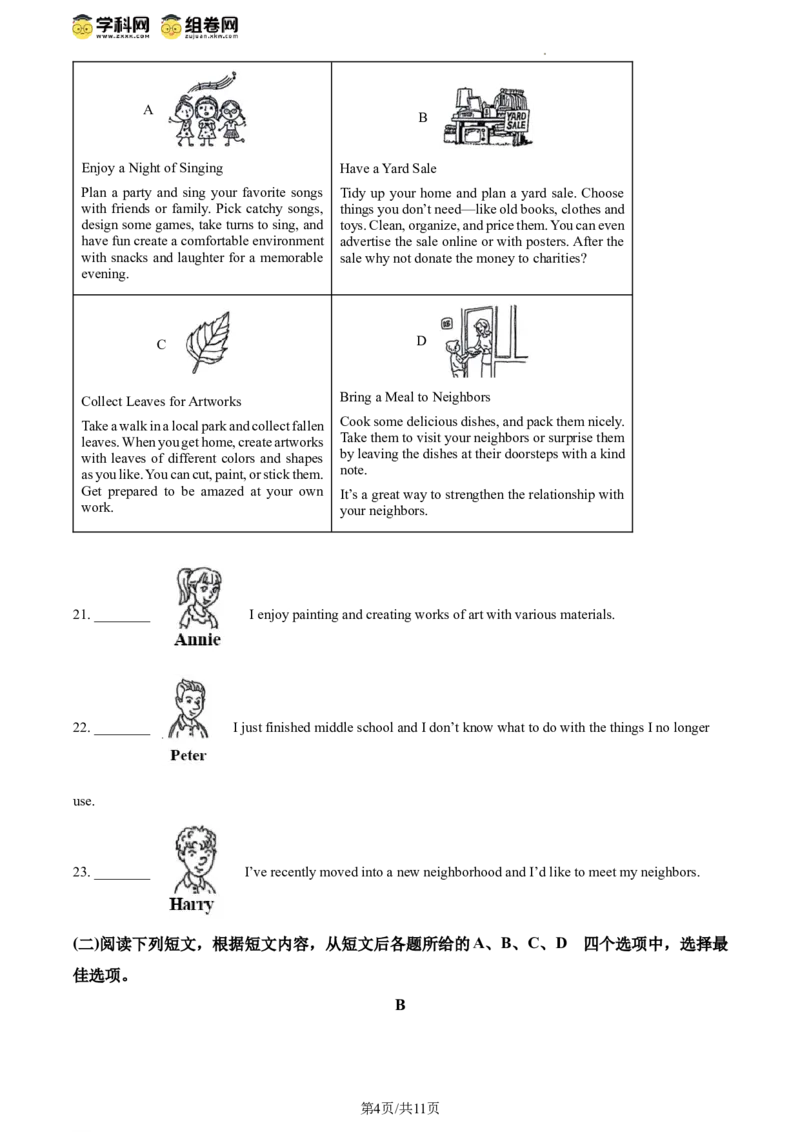
Weekend Activities
第3页/共11页
学科网(北京)股份有限公司A
B
Enjoy a Night of Singing Have a Yard Sale
Plan a party and sing your favorite songs Tidy up your home and plan a yard sale. Choose
with friends or family. Pick catchy songs, things you don’t need—like old books, clothes and
design some games, take turns to sing, and toys. Clean, organize, and price them. You can even
have fun create a comfortable environment advertise the sale online or with posters. After the
with snacks and laughter for a memorable sale why not donate the money to charities?
evening.
C D
Bring a Meal to Neighbors
Collect Leaves for Artworks
Cook some delicious dishes, and pack them nicely.
Take a walk in a local park and collect fallen
Take them to visit your neighbors or surprise them
leaves. When you get home, create artworks
by leaving the dishes at their doorsteps with a kind
with leaves of different colors and shapes
note.
as you like. You can cut, paint, or stick them.
Get prepared to be amazed at your own It’s a great way to strengthen the relationship with
work. your neighbors.
21. ________ I enjoy painting and creating works of art with various materials.
22. ________ I just finished middle school and I don’t know what to do with the things I no longer
use.
23. ________ I’ve recently moved into a new neighborhood and I’d like to meet my neighbors.
(二)阅读下列短文,根据短文内容,从短文后各题所给的A、B、C、D 四个选项中,选择最
佳选项。
B
第4页/共11页
学科网(北京)股份有限公司“Why can’t Grandpa just be normal? Why does he take waveski as a hobby? It’s so weird (怪异的),” Carter
asked Grandma.
Grandma laughed. “I’ve wondered that for many years.”
They were sitting on the beach watching Grandpa and some of his friends in the ocean.
“None of my friends even knows what a waveski is,” Carter continued.
“Just tell them it’s a lot like surfing (冲浪), but the riders sit on top of a waveski. When the waves come, they
will ride the wave just like a surfer, only they paddle to get out to the waves.”
“Nobody’s grandpa does this.”
Grandma laughed. “Well, what should he be doing instead?”
“I don’t know. Maybe things that old people do.”
“Look! A big wave is coming in!” Grandma pointed to the ocean.
Carter saw Grandpa in front of his friends. He was leaning (倾斜) forward and paddling hard, just ahead of the
large incoming wave. Carter was surprised at how hard Grandpa was paddling and how fast he was moving. Just
then, another huge wave came. Carter jumped to his feet and held his breath. This was not good. What if something
bad happened?
As the wave drew near, Grandpa paddled harder. He was suddenly lifted by the water and stopped paddling.
He leaned toward the wave, changing the direction of the waveski. Now, he was riding the wave, moving fast.
Carter was amazed. Grandpa was totally in control.
Carter now realized his grandpa wasn’t weird at all. He was amazing. Absolutely amazing! “Go Grandpa!”
Carter shouted, even though he knew Grandpa couldn’t hear him.
When the wave was gone, Grandpa turned toward the beach and waved to Carter and Grandma. He looked so
happy.
Carter waved back. He wasn’t sure why, but he had tears in his eyes. He quickly dried them and then waved
again.
“Do you think I can be the one riding waves like him?”
“Of course,” Grandma said.
24. Carter thought his grandpa was weird because Grandpa ________.
A. had a special hobby B. disliked being with his friends
C. seldom played with him D. spent hours sitting on the beach
25. Carter came to understand his grandpa when ________.
A. he learned from Grandma what waveski was
B. he saw Grandpa paddling ahead of the wave
第5页/共11页
学科网(北京)股份有限公司C. Grandpa was riding the wave and moving fast
D. Grandpa turned toward the beach and waved to him
26. After talking with Grandma, Carter would probably ________.
A. buy a new waveski for Grandpa B. share his own hobby with Grandma
C. encourage Grandma to try waveski D. ask Grandpa to teach him to waveski
C
Meditation is one kind of exercise in controlling attention. Meditators use some practices, like keeping focus
on breathing, to strengthen the ability to take control over what their minds are doing. While meditators have long
experienced its benefits, science only recently discovered that the mental effort of meditation is good exercise for
the brain. Meditation has much to do with cognition, a term to describe the thought processes inside our heads (like
focusing, making decisions, and remembering) that allow us to understand the world. Meditators are really good at
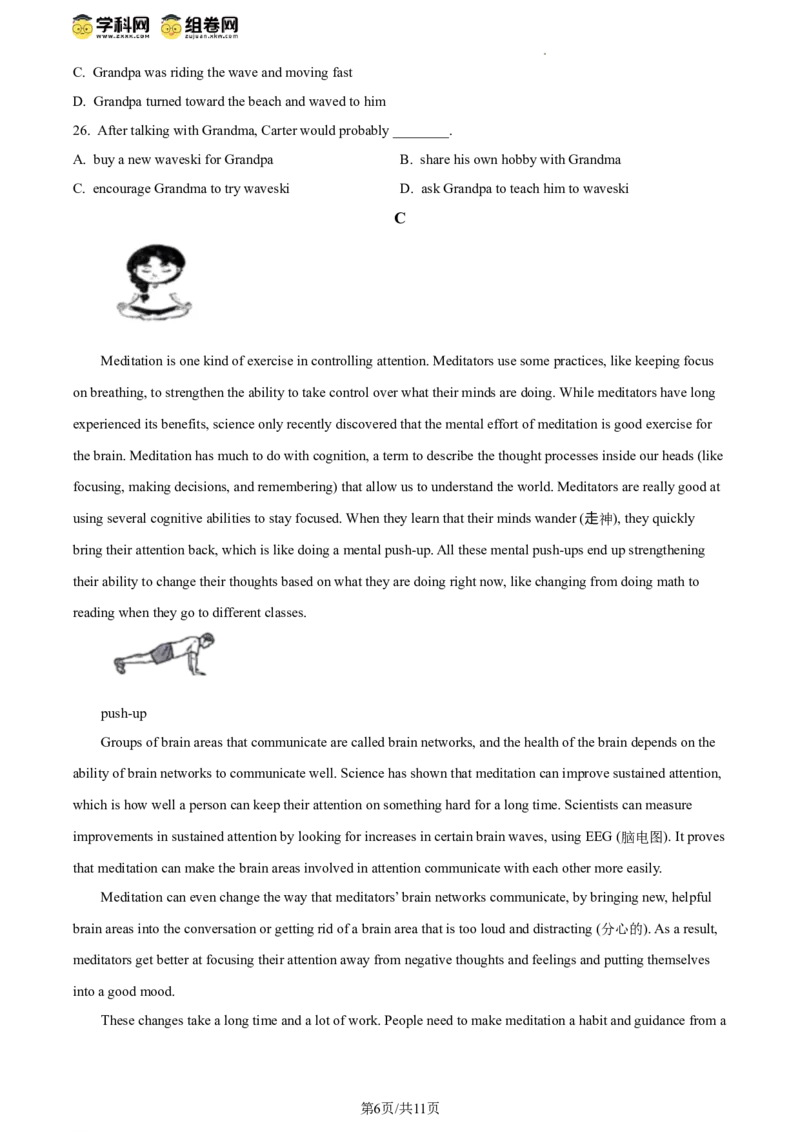
using several cognitive abilities to stay focused. When they learn that their minds wander (走神), they quickly
bring their attention back, which is like doing a mental push-up. All these mental push-ups end up strengthening
their ability to change their thoughts based on what they are doing right now, like changing from doing math to
reading when they go to different classes.
push-up
Groups of brain areas that communicate are called brain networks, and the health of the brain depends on the
ability of brain networks to communicate well. Science has shown that meditation can improve sustained attention,
which is how well a person can keep their attention on something hard for a long time. Scientists can measure
improvements in sustained attention by looking for increases in certain brain waves, using EEG (脑电图). It proves
that meditation can make the brain areas involved in attention communicate with each other more easily.
Meditation can even change the way that meditators’ brain networks communicate, by bringing new, helpful
brain areas into the conversation or getting rid of a brain area that is too loud and distracting (分心的). As a result,
meditators get better at focusing their attention away from negative thoughts and feelings and putting themselves
into a good mood.
These changes take a long time and a lot of work. People need to make meditation a habit and guidance from a
第6页/共11页
学科网(北京)股份有限公司teacher can be helpful. Yet, not everyone can afford a personal teacher. That’s where technology steps in. Scientists
have made apps that provide tips and help people meditate at their own levels. While some digital meditation apps
have been carefully studied by scientists, some need to be tested. So, it is important to be careful at first about
whether an app really works.
27. According to the passage, when people meditate, they ________.
A. try to control their focus B. focus on what goes around
C. make important decisions D. develop the ability to communicate
28. What can we learn from the passage?
A. Meditators end their practice when their minds wander.
B. Meditation makes it possible for people to have happier moods.
C. Certain brain waves decrease when sustained attention improves.
D. Digital meditation apps work better than personal meditation teachers.
29. What might be the best title for the passage?
A. How does meditation benefit the brain?
B. How do people make meditation a habit?
.
C How does technology improve meditation?
.
D How do meditalors better their mental health?
D
Every time I look at the many recent orders on my online shopping account, or I receive a new package on my
doorstep, I get a feeling of happiness that is hard to give up. Although I know that my shopping habits are bad for
the planet, I just can’t stop.
But Ann-Christine Duhaime’s new book, Minding the Climate: How Neuroscience Can Help Solve Our
Environmental Crisis, has helped me understand that my desire (渴望) to keep buying things isn’t necessarily a
personal weakness—it’s the way our brains have developed.
According to Duhaime, we managed to stay alive even when things were hard because our brains learned to
repeat decisions like moving towards a tasty treat or backing away from danger. Today, we have some 86 billion
neurons (神经元) in the brain continuously working to strengthen rewarding behavior—a kind of action that results
in a positive outcome, which makes a person want to do it again. As the neurons work, they produce dopamine (多
巴胺), which makes our rewarding behavior feel even better than usual. We actively look for more dopamine, and
at the same time, learn to repeat the actions that lead to it.
However, Duhaime stresses that our brains are not programmed to keep buying more and more. All humans
are different, and our brains work differently depending on our genetics (遗传性) and our life experiences. The
第7页/共11页
学科网(北京)股份有限公司challenge is that our brain systems are designed for short-term decision-making. When we buy something new, we
get rewarded immediately. But the long-term worsening of the planet is harder for the reward centers of our brains
to understand, even if we know about it.
And there may be some ways to break the cycle. The best is not to stop buying things completely; a better
solution may be to substitute the old rewards that we know aren’t good in the long run with new ones. For example,
you can have a glass of milk, which gives you fewer calories, instead of eating chocolate just before bed for comfort.
Once you start losing weight, the reward of being able to fit into your old clothes feels as good as what the chocolate
would do. We need that same substitution for shopping.
Buying used things could also help satisfy our desire to get more things without using more natural resources.
Additionally, creating social rewards, like encouragement and support from a community with similar goals, can
inspire positive changes. Humans naturally like to connect with others, and this social support can lead to more eco-
friendly choices.
30. What do you know about human brains from the passage?
A. The way brains work won’t be influenced by life experiences.
B. Neurons play a role in people’s repeating rewarding behavior.
C. Less dopamine is produced when people get positive outcomes.
D. Brains don’t care about the short-term effects of people’s actions.
31. The word “substitute” in Paragraph 5 probably means “________”.
A. take the place of B. look forward to C. get ready for D. make up for
32. The writer probably agrees that ________.
A. over-shopping harms the development of the human brain
B. keeping buying gets in the way of people finding happiness
C. the planet is free from the influence of people’s buying behavior
D. creating social rewards can help people reduce the desire to over-shop
33. What is the writer’s main purpose in writing this passage?
.
A To explain why over-shopping is not a personal weakness.
B. To show how dopamine makes people crazy about shopping.
C. To guide people to make eco-friendly choices when shopping.
D. To encourage people to buy used things to protect the environment.
第二部分
本部分共5题,共20分。根据题目要求,完成相应任务。
四、 阅读表达(第34-36题每题2分,第37题4分,共10分)
第8页/共11页
学科网(北京)股份有限公司阅读短文,根据短文内容回答问题。
Inner painting, a kind of traditional Chinese art, is marked as a national-level intangible cultural heritage (非物
质文化遗产). Inner painting artists traditionally create works on the inner surface of the glass bottle by using special
fine brushes that can enter the tiny bottles. It has a long history and is mainly divided into four major schools: Beijing,
Hebei, Shandong, and Guangdong.
When we look at the inner painting of an object, we experience an indescribable beauty. Patterns on the painting
often symbolize people’s wishes for good luck and a happy life. The most marketable ones are landscapes (风景),
followed by flowers and birds.
The production of inner painting is difficult because it requires high precision (精确) and the process of
painting is totally reversed (反向的). During painting, there is no room for corrections. And a shaky hand leads to
mistakes. Only those skilled and confident in their abilities can paint well. Most artists need to learn inner painting
for years before creating great and fine pieces. Even if they already know how to paint, they need to practice drawing
lines from the beginning when they start inner painting.
Inner painting has its advantages due to its uniqueness (独特性), but it also faces challenges such as limited
market needs, and a shortage of learners and talented artists to drive its development.
Luckily, today’s artists are trying to make inner painting more included in our lives. It is now used on everyday
objects, like tea sets and folding screens. One of the artists invented a new type of brush, which improved the speed
of drawing. Some young artists are making use of social media to help more people learn about inner painting
skills.
Looking ahead to the future, the inner painting artists wish the art to be more available to the public, and win
high market acceptance. They also hope inner painting courses can be offered at school for young people to take.
34. Where do inner painting artists traditionally create their works?
_______________________________
35. What do patterns on the inner painting often symbolize?
_______________________________
36. How are some young artists helping more people learn about inner painting skills?
_______________________________
37. If your school offers an inner painting course, would you like to take it or not? Why? (Please give two
reasons.)
_______________________________
五、文段表达(10分
从下面两个题目中任选一题,根据中文和英文提示,完成一篇不少于 50词的文段写作。
第9页/共11页
学科网(北京)股份有限公司文中已给出内容不计入总词数。所给提示词语仅供选用。请不要写出你的校名和姓名。
题 目 ①
38. 假设你是李华。你的好朋友Peter正在参与筹备他们学校的“校园劳动日”活动,他写信向你征求
创意。请你用英语给他写一封回信,提供一些活动创意并说明理由。
提示词语:clean up, repair, garden, fun, responsibility
提示问题: ● What activities would you like to suggest?
● Why do you suggest so?
Dear Peter,
I’m excited to hear that you’re organizing activities for School Service Day.
____________________________________________________________________________________________
____________________________________________________________________________________________
____________________________________________________________________________________________
____________________________________________________________________________________________
____________________________________________________________________________________________
____________________________________________________________________________________________
____________________________________________________________________________________________
____________________________________________________________________________________________
____________________________________________________________________________________________
______________
I do hope that my suggestions will be helpful.
Yours,
Li Hua
题目②
39. 学而致知,行而致远。
假设你是李华。某英文网站正在开展以“学以致用”为主题的征文活动。请用英语写一篇短文投稿,分
享一次你运用所学解决实际问题的经历,并谈谈你的收获。
提示词语: skill, make use of, connect, improve, meaningful
提示问题: ● What experience can you share about putting what you've learned into practice?
● What have you learned from it?
It’s important to put what we’ve learned into practice.
____________________________________________________________________________________________
____________________________________________________________________________________________
第10页/共11页
学科网(北京)股份有限公司____________________________________________________________________________________________
____________________________________________________________________________________________
____________________________________________________________________________________________
____________________________________________________________________________________________
____________________________________________________________________________________________
____________________________________________________________________________________________
____________________________________________________________________________________________
_________
第11页/共11页
学科网(北京)股份有限公司