Unit 9 Have you ever been to a museum?
单元小结
知识目录
学习目标:本单元围绕“能谈论过去的经历”话题展开叙述,让学生掌握现在完成时态第二种用法,能
理 解课文,熟练运用词汇,谈论经历和名胜古迹。
语法目标:继续学习现在完成时。
听说目标:能在日常交际情景中听懂谈论曾经去过好玩的地方。谈论过去的经历。
写作目标:要求学生描写家乡或学生曾去过的地方。
目录
知识要点一、重点单词,短语及句式
要点1 have been to的用法..............................................................................................................................练习
要点2 invent的用法..........................................................................................................................................练习
要点3 unbelievable的用法...............................................................................................................................练习
要点4 encourage的用法....................................................................................................................................练习
要点5 collect 用法.............................................................................................................................................练习
要点6 whether用法...........................................................................................................................................练习
要点7 neither的用法.........................................................................................................................................练习
要点8 thousands of的用法................................................................................................................................练习
要点9 since用法................................................................................................................................................练习
要点10 put 构成的短语归纳............................................................................................................................练习
要点11 German的用法....................................................................................................................................练习
要点12 fear的用法............................................................................................................................................练习
要点13 a couple of的用法.................................................................................................................................练习
要点14 wonder的用法......................................................................................................................................练习
要点15 progress的用法.....................................................................................................................................练习
要点16 ever的用法...........................................................................................................................................练习
要点17 whenever的用法...................................................................................................................................练习
要点19 重点短语...............................................................................................................................................练习
要点20重点句式...............................................................................................................................................练习
知识要点二、语法
要点1现在完成时(2).......................................................................................................................................25知识要点三、书面表达
要点1 话题分析.....................................................................................................................................................26
要点2 词汇短语积累 ...........................................................................................................................................27
要点3句式积累 ...................................................................................................................................................28
要点4实战演练 ...................................................................................................................................................29
知识要点一、重点单词,短语及句式。
【精讲精练】
要点 1. have been to
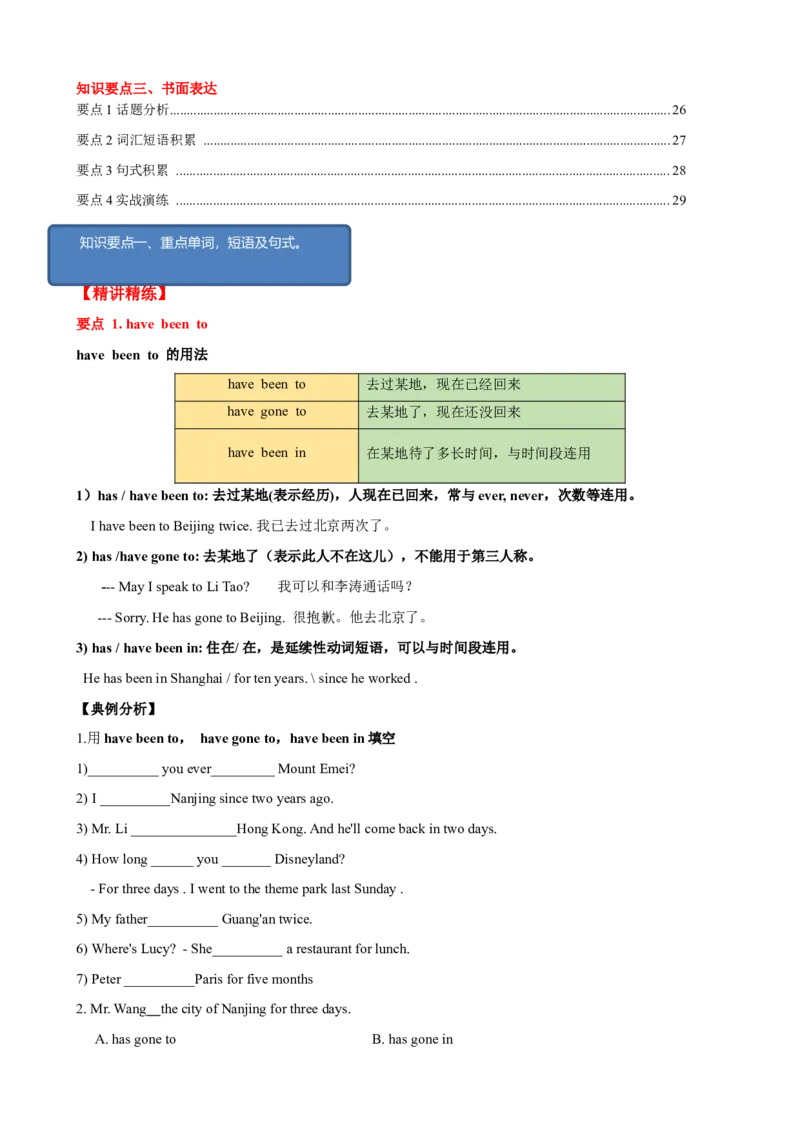
have been to 的用法
have been to 去过某地,现在已经回来
have gone to 去某地了,现在还没回来
have been in 在某地待了多长时间,与时间段连用
1)has / have been to: 去过某地(表示经历),人现在已回来,常与ever, never,次数等连用。
I have been to Beijing twice. 我已去过北京两次了。
2) has /have gone to: 去某地了(表示此人不在这儿),不能用于第三人称。
--- May I speak to Li Tao? 我可以和李涛通话吗?
--- Sorry. He has gone to Beijing. 很抱歉。他去北京了。
3) has / have been in: 住在/ 在,是延续性动词短语,可以与时间段连用。
He has been in Shanghai / for ten years. \ since he worked .
【典例分析】
1.用have been to, have gone to,have been in填空
1)__________ you ever_________ Mount Emei?
2) I __________Nanjing since two years ago.
3) Mr. Li _______________Hong Kong. And he'll come back in two days.
4) How long ______ you _______ Disneyland?
- For three days . I went to the theme park last Sunday .
5) My father__________ Guang'an twice.
6) Where's Lucy? - She__________ a restaurant for lunch.
7) Peter __________Paris for five months
2. Mr. Wang the city of Nanjing for three days.
A. has gone to B. has gone inC. has been in D. has been to
3.﹣Where is Mark?
﹣He__________ to the Disneyland with his children.
A. goes B. went C. has gone D. has been
4. The Great Wall is a place of interest. All of us there before.
A. has been B. have been C. has gone D. have gone
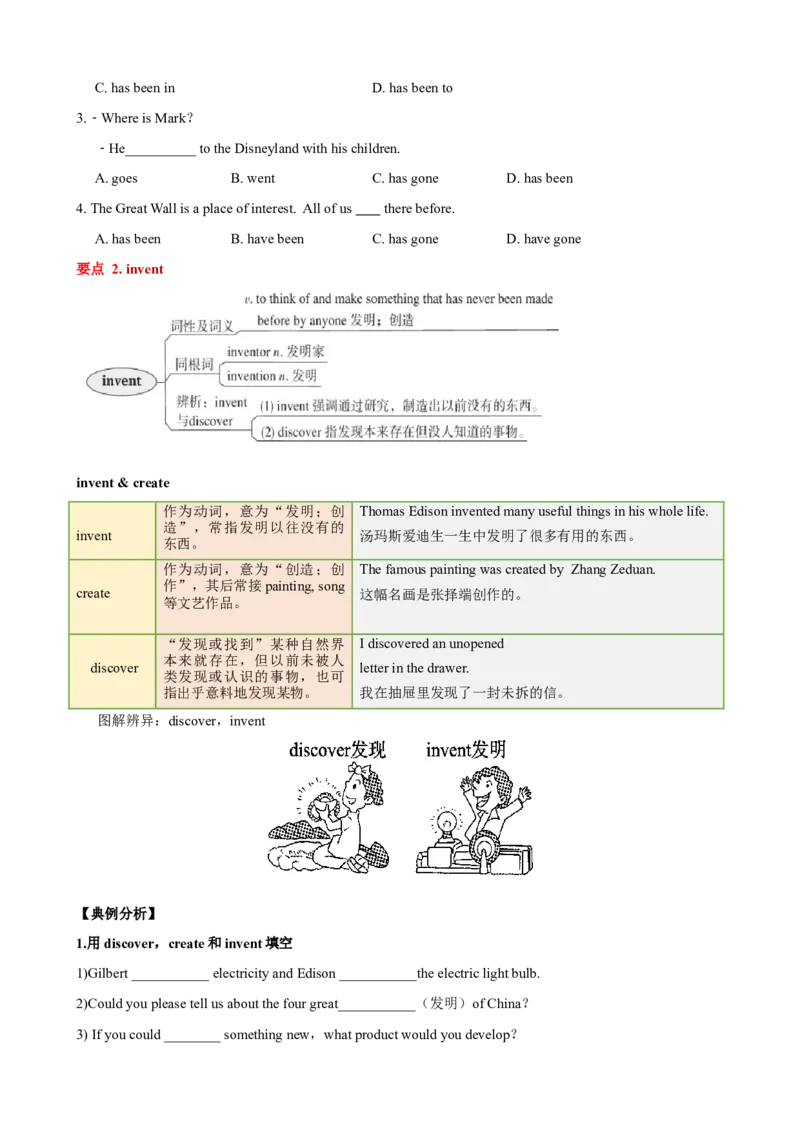
要点 2. invent
invent & create
作为动词,意为“发明;创 Thomas Edison invented many useful things in his whole life.
造”,常指发明以往没有的
invent 汤玛斯爱迪生一生中发明了很多有用的东西。
东西。
作为动词,意为“创造;创 The famous painting was created by Zhang Zeduan.
作”,其后常接painting, song
create 这幅名画是张择端创作的。
等文艺作品。
“发现或找到”某种自然界 I discovered an unopened
本来就存在,但以前未被人
discover letter in the drawer.
类发现或认识的事物,也可
指出乎意料地发现某物。 我在抽屉里发现了一封未拆的信。
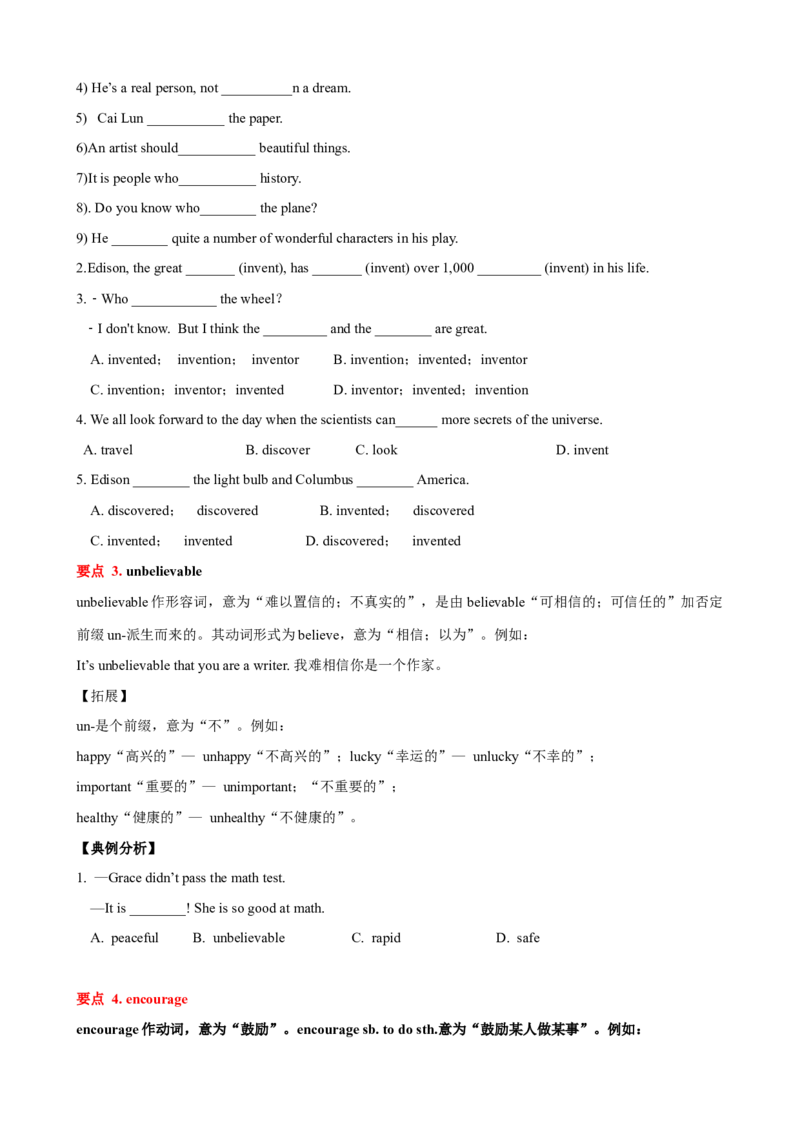
图解辨异:discover,invent
【典例分析】
1.用discover,create和invent填空
1)Gilbert ___________ electricity and Edison ___________the electric light bulb.
2)Could you please tell us about the four great___________(发明)of China?
3) If you could ________ something new,what product would you develop?4) He’s a real person, not __________n a dream.
5) Cai Lun ___________ the paper.
6)An artist should___________ beautiful things.
7)It is people who___________ history.
8). Do you know who________ the plane?
9) He ________ quite a number of wonderful characters in his play.
2.Edison, the great _______ (invent), has _______ (invent) over 1,000 _________ (invent) in his life.
3.﹣Who ____________ the wheel?
﹣I don't know. But I think the _________ and the ________ are great.
A. invented; invention; inventor B. invention;invented;inventor
C. invention;inventor;invented D. inventor;invented;invention
4. We all look forward to the day when the scientists can______ more secrets of the universe.
A. travel B. discover C. look D. invent
5. Edison ________ the light bulb and Columbus ________ America.
A. discovered; discovered B. invented; discovered
C. invented; invented D. discovered; invented
要点 3. unbelievable
unbelievable作形容词,意为“难以置信的;不真实的”,是由 believable“可相信的;可信任的”加否定
前缀un-派生而来的。其动词形式为believe,意为“相信;以为”。例如:
It’s unbelievable that you are a writer. 我难相信你是一个作家。
【拓展】
un-是个前缀,意为“不”。例如:
happy“高兴的”— unhappy“不高兴的”;lucky“幸运的”— unlucky“不幸的”;
important“重要的”— unimportant;“不重要的”;
healthy“健康的”— unhealthy“不健康的”。
【典例分析】
1. —Grace didn’t pass the math test.
—It is ________! She is so good at math.
A. peaceful B. unbelievable C. rapid D. safe
要点 4. encourage
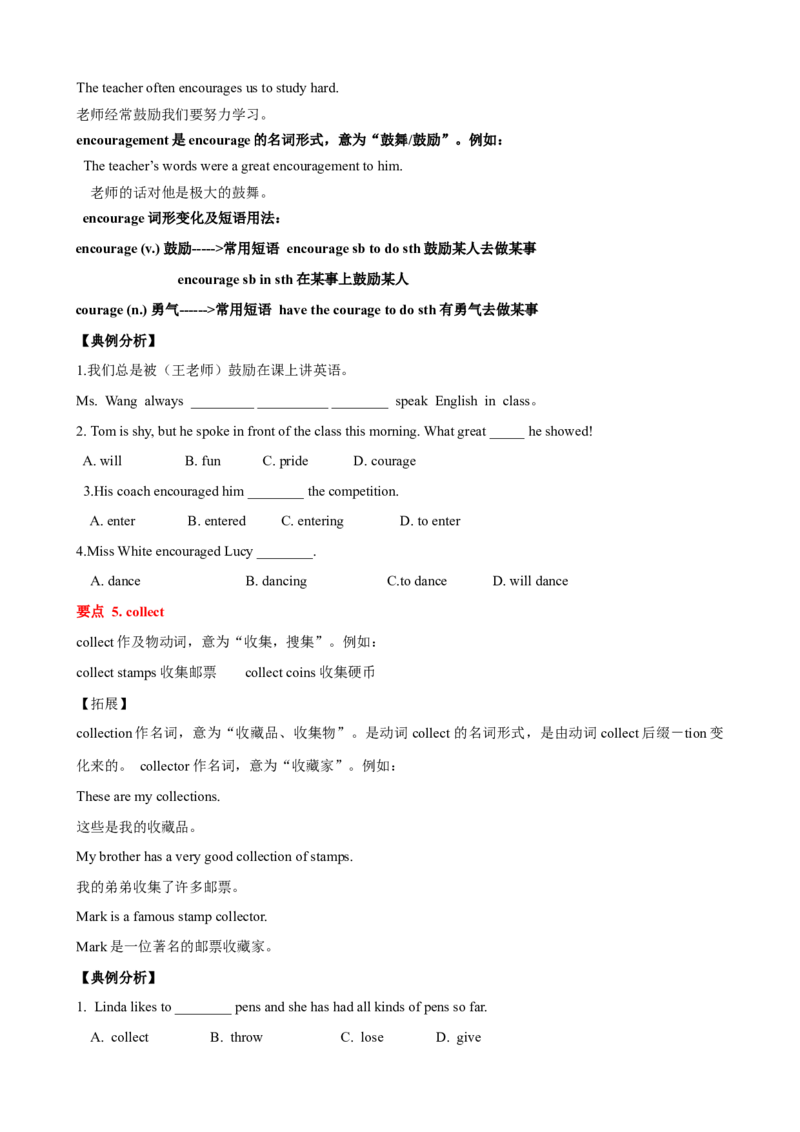
encourage 作动词,意为“鼓励”。encourage sb. to do sth.意为“鼓励某人做某事”。例如:The teacher often encourages us to study hard.
老师经常鼓励我们要努力学习。
encouragement是encourage的名词形式,意为“鼓舞/鼓励”。例如:
The teacher’s words were a great encouragement to him.
老师的话对他是极大的鼓舞。
encourage 词形变化及短语用法:
encourage (v.) 鼓励----->常用短语 encourage sb to do sth鼓励某人去做某事
encourage sb in sth在某事上鼓励某人
courage (n.) 勇气------>常用短语 have the courage to do sth 有勇气去做某事
【典例分析】
1.我们总是被(王老师)鼓励在课上讲英语。
Ms. Wang always _________ __________ ________ speak English in class。
2. Tom is shy, but he spoke in front of the class this morning. What great _____ he showed!
A. will B. fun C. pride D. courage
3.His coach encouraged him ________ the competition.
A. enter B. entered C. entering D. to enter
4.Miss White encouraged Lucy ________.
A. dance B. dancing C.to dance D. will dance
要点 5. collect
collect作及物动词,意为“收集,搜集”。例如:
collect stamps 收集邮票 collect coins 收集硬币
【拓展】
collection作名词,意为“收藏品、收集物”。是动词 collect 的名词形式,是由动词collect后缀-tion变
化来的。 collector 作名词,意为“收藏家”。例如:
These are my collections.
这些是我的收藏品。
My brother has a very good collection of stamps.
我的弟弟收集了许多邮票。
Mark is a famous stamp collector.
Mark是一位著名的邮票收藏家。
【典例分析】
1. Linda likes to ________ pens and she has had all kinds of pens so far.
A. collect B. throw C. lose D. give2. — Wow! So many cards!
— My brother ________ cards as a hobby.
A. collects B. protects C. introduces D. records
要点6 whether
whether作连词,意为“是否”。当把一般疑问句的直接引语转化成间接引语时,常用 if或whether作引
导词。例如:
I asked her, “Do you study English here?” 我问她:“你在这里学习英语吗?” →
I asked her if/ whether she studied English there. 我问她是否在那里学习英语。
【拓展】
if和whether的辨析:
if和whether均可表示“是否”,一般情况下二者可以互换。但在下列条件下,只能用whether而不能用
if:
(1)if后不能直接接or not。
(2)whether可作介词的宾语。
(3)whether后可接不定式。
(4)whether可用于句首。
(5)whether可引导主语从句、表语从句。例如:
Everything depends on whether we have enough money.
一切都取决于我们是否有足够的钱。
Whether it is right or wrong, I don’t know.
正确与否,我不知道。
It doesn’t matter whether he will come or not.
他来不来没关系。
【典例分析】
1.I don't know ______ he will come tomorrow. ______ he comes, I'll tell you.
A. if; Whether B. whether; Whether C. if; That D. if; If
2. Can you tell me he will leave or not this afternoon?
A. if B. whether C. where D. when
3. 我不知道他是否能准时到校。(2016年广州中考题)
I wonder ________ ________ ________ ________ to school on time.
4.他正在考虑是否能参加足球俱乐部。(2019年广州中考题)He is thinking about_________ ________ ________join the football club.
5.他不能决定是否去,因为天在下大雨。
He can’t decide_______ ________ _________ because it is raining hard.
6. ________ you like swimming, fishing ________ boating, you'll have fun in the water park.
A. Whether; or B. Neither; nor C. Either; or D. Both; and
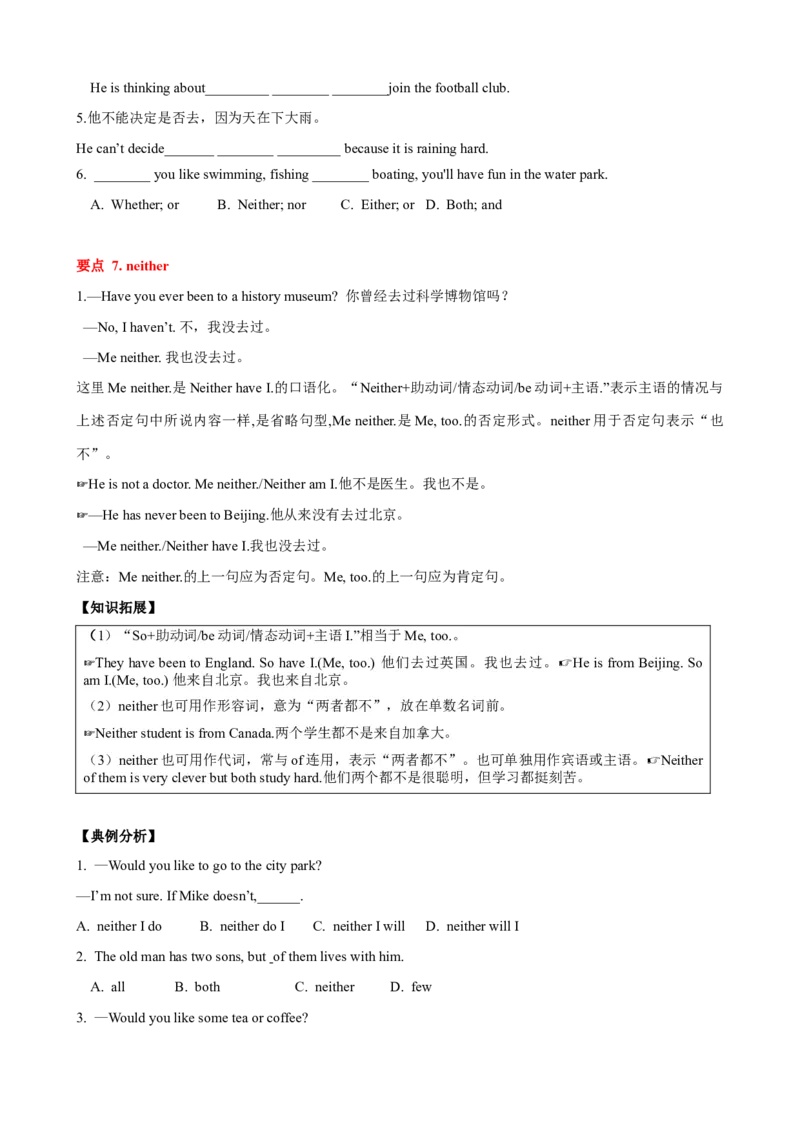
要点 7. neither
1.—Have you ever been to a history museum? 你曾经去过科学博物馆吗?
—No, I haven’t. 不,我没去过。
—Me neither. 我也没去过。
这里Me neither.是Neither have I.的口语化。“Neither+助动词/情态动词/be动词+主语.”表示主语的情况与
上述否定句中所说内容一样,是省略句型,Me neither.是Me, too.的否定形式。neither用于否定句表示“也
不”。
☞He is not a doctor. Me neither./Neither am I.他不是医生。我也不是。
☞—He has never been to Beijing.他从来没有去过北京。
—Me neither./Neither have I.我也没去过。
注意:Me neither.的上一句应为否定句。Me, too.的上一句应为肯定句。
【知识拓展】
(1)“So+助动词/be动词/情态动词+主语I.”相当于Me, too.。
☞They have been to England. So have I.(Me, too.) 他们去过英国。我也去过。☞He is from Beijing. So
am I.(Me, too.) 他来自北京。我也来自北京。
(2)neither也可用作形容词,意为“两者都不”,放在单数名词前。
☞Neither student is from Canada.两个学生都不是来自加拿大。
(3)neither也可用作代词,常与of连用,表示“两者都不”。也可单独用作宾语或主语。☞Neither
of them is very clever but both study hard.他们两个都不是很聪明,但学习都挺刻苦。
【典例分析】
1. —Would you like to go to the city park?
—I’m not sure. If Mike doesn’t,______.
A. neither I do B. neither do I C. neither I will D. neither will I
2. The old man has two sons, but of them lives with him.
A. all B. both C. neither D. few
3. —Would you like some tea or coffee?—I’d like _________ of them. I prefer some water. You know, it is the healthiest drink.
A. either B. neither C. both D. all
4. —I don’t like smoking. —_______
A. Neither he is. B. Neither is he. C. Neither he does. D. Neither does he.
要点 7. lead to
(1) (道路)等通往……。 (2) 引起(结果等);导致。
(3)lead sb to some place 把某人带到某地lead sb to do sth 带领某人做某事
【典例分析】
1. 过量的工作和过少的休息会引起疾病。
Too much work and too little rest often _________ _________ illness.
2. 这条街能直通动物园吗?
__________ this street _________ right __________the zoo?
3.我的父亲引导我帮助处在困境中的人。
My father_________ me __________ people in trouble.
4.这条路通向旅馆。
This road _____________ the hotel.
5. 他的勤奋导致他的成功。
His hard work _________his success.
6. Jim wants to know what _____ the World War I.
A. led in B. made into C. made to D. led to
要点 8. thousands of
thousands of,意为“好几千,成千上万”。thousand意为“一千”,用来表示不确定的数目时,
thousand应变为复数,且在后面加of。
拓展:与thousand用法类似的词
Hundred (百), thousand (千), million (百万)等表示概数时,本身要用复数形式,后接“of+可数名词复
数”,即“hundreds/thousands/millions +of+名词复数”,意为“数以百/千/百万计的……”。若这些数
量词前有基数词,则直接用hundred /thousand/million等,不用复数形式,也不加of。
It cost me two hundred dollars.它花了我200美元
The restaurant receives hundreds of customers every day.这家饭店每天接待数以百计的顾客
【典例分析】1.每年人们会在山上种植成千上万棵树来保护环境。
Every year trees are planted on the hills to protect the environment.
2. It is reported that nearly _________ foreign kids joined a British boarding school last year,and a third of them
came from China.
A. nine thousand B. nine thousands C. nine thousand of D. nine thousands of
3. birds have come back because the environment here becomes better and better.
A. Thousands of B. Thousand of C. Thousands D. Thousands
4. It is reported that there are over ______ koalas dying in the disastrous wild fire broke out recently in Australia.
A. thousands of B. 8 thousands C. 8 thousands of D. 8 thousand
要点 9. since
since的用法
(1)作为介词,意为“自……以来”,后接时间点作时间状语,常用于现在完成时,可以和“for + 时间
段”互换。
I have known him since 10 years ago.自从10年前我就认识他了。
= I have known him for 10 years.我认识他已经有10年了。
(2)作为连词,意为“自……以来”,引导时间状语从句,主句常用现在完成时,从句常用一般过去时。
(3)作为连词,还可译为“由于;既然”,引导原因状语从句,表示很明显的原因。
1.The young man hasn’t done much exercise since he got a mobile phone.
年青人自从买手机以来,就不做大量运动了。
2. Since everybody is here, let’s begin the meeting.
既然人都齐了,我们就开会吧。
【典例分析】
1.It’s almost eight years we saw each other last time.
A since B. before C. after D. when
2.—How long have you lived here?
—________ about 5 years ________ my family moved to the city.
A. Since; for B. For; since C. For; for D. Since; since
3. Since then, we ______ in New York.
A. lived B. live C. have lived D. are living
4. ______ you’re tired, you’d better stay at home and have a rest.
A. Since B. Or C. Though D. Till5. — Why didn’t you go to the party? — ______ I wasn’t invited.
A. As B. Since C. Because D. So
6. He has worked even harder since he ______ in love with her.
A. has fallen B. fell C. falling D. falls
要点10 put 构成的短语归纳
put down 还意为“写下,记下”,等于write down,take down。
Let me put down your telephone number.让我记下你的电话号码。
put on
1.表示“穿上;戴上”
It’s much too cold outside. You should put on your coat.
2.表示“上演;举办”
We will put on a talent show next month.
Put up
(1)put up 是由“动词+副词”构成的动词短语,意为“张贴;公布”。例如:
The principal put up the exam result. 校长公布了这次考试的结果。
(2)put up 意为“提高;增加;抬高(租金、价格等)”。例如 :
My landlord was threatening to put the rent up by 10 dollars a week.
我房东要挟说要把每周房租提高10美元。
Put构成的短语
put up挂;张贴;公布;举起;搭起;
put off 推迟 put away 收起来
put on 穿上;戴上;体重上升 put down 放下
put up with 忍受 put out 扑灭;熄灭
【典例分析】
1. —It’s cold outside, Jimmy! You should your sweater.
—Thanks, Mom.
A. take off B. take in C. put on D. put up
2.The 32nd Olympic Games have been ________ to 2021 because of the outbreak of COVID-19.
A. put away B. put out C. put off D. put up
3.—Jason, would you please _________this notice?
—With pleasure.
A. put on B. put off C. put up D. put out4. Tony bought a photo of his favourite sports star and________ on his bedroom wall.
A. gave it up B. found it out
C. looked it through D. put it up
5. 用put构成的短语填空
1)We will _________ the new play next month.
2)The sports meet will be ____________because of the bad weather.
3)_________ the books ________ after reading.
4)__________the gentleman’s address.
5)It took the fire---fighters four hours to _________ the fire.
6)Many new high buildings have been __________ in our city.
要点11:German
German作形容词,意为“德国的;德语人的;德语的”。
☞She is an accountant in a German company.她在一家德国公司当会计。
【拓展】
国家 国籍形容词 居民 语言
中国 中国的 中国人 汉语
China Chinese Chinese Chinese
英国 英国的 英国人 英语
England English Englishman English
日本 日本的 日本人 日语
Japan Japanese Japanese Japanese
加拿大 加拿大的 加拿大人 英语/法语
Canada Canadian Canadian English/French
美国(America) 美国的 美国人 英语
The United States American American English
澳大利亚 澳大利亚的 澳大利亚人 英语
Australia Australian Australian English
【典例分析】
1. I have three pen pals. One is ________, and the other two are ________.
A. Japanese; America B. Russian; Germen
C. Canada; Australian D. English; Frenchmen
要点12 fear
1. 用作动词,注意以下用法:(1) 表示“恐惧”“害怕”,其后接动词时,可用不定式或动名词(注:用不定式比用动名词常见).如:
He feared to speak in public. 他害怕在公共场合讲话.
He fears to tell [telling] her what happened. 他怕告诉她所发生的事.
(2) 表示“恐怕”“担心”,其后通常接 that 从句.如:
I fear that he will refuse us. 我担心他会拒绝我们.
在答语中 that 从句可用 so, not 代之.如:
A:Will he come? 他会来吗?
B:I fear so. /I fear not. 我想会来吧/我想不会来吧.
【注】后接否定的宾语从句时,通常不转移到主句.如:
I fear it won’t do much good. 我担心这不会有多大好处.
(3) 通常不接不定式的复合结构.如:
我担心他会失败.
误:I fear him to fail.
正:I fear that he will fail.
(4) 比较 fear sb 与 fear for sb:前者意为害怕某人,后者意为为某人担心.如:
He fears his wife. 他怕他老婆.
He fears for his wife. 他为他老婆担心.
2. 用作名词,比较 for fear of 与 in fear of:前者意为“由于怕……”“以防……”,后者意为“害怕”
“担心”.如:
Shut the window for fear of catching a cold. 关闭窗户以免感冒.
We’re in fear of more snow. 我们担心会再下雪.
The thief passed the day in fear of discovery. 这个小偷整天提心掉胆担心会被发现.
3.fear的形容词形式为fearful,意为“可怕的;担心的”;其反义词为fearless,意为“大胆的;无畏的”。注意,
fear后接表示否定意义的宾语从句时,否定词通常不转移到主句。例如:
I fear it won’t do much good.我担心这不会有太大好处。
【典例分析】
1.小偷害怕警察。
The thieves are _______ _______ _________ the police.
2. 不要害怕说实话。
Don’t ________ _______ _______ the truth.=Don’t ________ _______ the truth.
3.The little girl cried out_______ _________ ( 害怕 ) when the dog barked( 吠叫 ) at her
4. I am afraid that he will fail the exam.(同义改写)
=I ________ that he will fail the exam.
5.他害怕一个人晚上外出。
He ________ ______ __________going out at night alone.
=He ________ ________ _______ going out at night alone.
=He ________ ________ go out at night alone.
=He ________ going out at night alone.
要点 13 a couple of
a couple of意为“少数;几个”。例如:
He bought a couple of books for his daughter.
他为他的女儿买了几本书。
【拓展】
a couple of还可意为“一双;一对”。例如:
I found a couple of socks in the room but they did not make a pair.
我在房间里找到两只袜子,但他们不是一双。
【典例分析】
要点 14. wonder
wonder v. 想知道;想弄明白
【例句】
I wonder if you can attend the meeting tonight. 我想知道你是否可以参加今晚的会议。
【拓展】
(1)wonderful adj. 精彩的
Welcome to the wonderful world of Disneyland! 欢迎来到精彩的迪士尼世界!
(2)wonderfully adv. 精彩地
Listen! How wonderfully the girls are singing! 听!女孩们唱得多么精彩啊!
(3)no wonder=It’s no wonder that 怪不得
No wonder he jumped out of the car.=It’s no wonder that he jumped out of the car. 怪不得他当时跳车了。
【典例分析】1. I _________ if you would like to go out with us tomorrow.
A. wonder B. want C. wonders
2.Do you think his speech is very _____________ (wonder)?
3.怪不得他当时跳车了(完成句子)
_________ ___________he jumped out of the car.=It’s no wonder that he jumped out of the car.
4.长城是世界上的奇迹之一。(完成句子)
The Great Wall is _________ __________ _________ ________ in the world.
要点15 progress
progress n.进步;进展
v.(继续)发展,推进;进展
Work on the new road is progressing slowly.
新路的修建工作在缓慢进行。
progress作名词时,是不可数名词。常用短语:
in progress在进行中;
make progress in/with sth.在某方面取得进步。
【典例分析】
1.我在英语方面取得了很大进步。
I have _______ _______ _______ in my English.
2.Study hard, and I believe you'll make great ______.
A. Pain B. advice C. noise D. progress
3. Jason has made great ____ in English listening. At least he can understand most of the words on the radio now.
A. pollution B. purpose C. pleasure D. progress
要点16 ever
ever为副词,表示“曾经;从来;在任何时候。”
Have you ever won any prizes before? 你以前曾经获过奖吗?
【重点】 ever表示“曾经”,常用于现在完成时的疑问句中,用以加强语气。可构成短语ever since表
示“自……起”。
例:-- Have you ever spoken to a foreigner?你曾经同外国人说过话吗?
-- Yes, I have.
– No, I never.(否定回答用never)
【拓展】ever表示“在任何时候”,常用于否定句及条件句中。例:Nothing new ever happens in this village.这个村子里至今不曾发生过新事。
If you ever come to Beijing, be sure to let me know.如果你到北京来,务必通知我一声。
【典例分析】
1.—Anna,have you seen China's Got Talent
—Of course. I it last weekend.(咸宁)
A. never;saw B. ever;have seen C. never;have seen D. ever;
saw
2. This is the best film I have seen.
A. never B. ever C. once D. always
3.Have you ________ visited the Great Wall?
A. ever B. before C. yet D. after
要点17 whenever
whenever.每当;无论什么时候
【点拨】whenever = no matter when 引导让步状语从句。如:
Whenever we met with difficulties,they always come to help us.
每当我们遇到困难时,他们总来帮助我们。
【拓展】类似whenever可以引导让步状语从句的词还有:
however = no matter how 无论怎样
wherever = no matter where 无论何地
whatever = no matter what 无论什么
whoever = no matter who 无论谁
whichever = no matter which 无论哪一个
【典例分析】
1.My teacher always offers to help me ____________________(无论我什么时候处于困境).
2.__________________(无论你做什么),you must do it well.
3.________________________(无论天气怎样冷),he always goes swimming.
4.__________________________(无论你借哪本书),you must return it in a week.
5. ________ I’m feeling upset, my friends will cheer me up.
A. Whatever B. Whenever C. Wherever D. However
【重点词组】
1.learn about 了解,获知,得知2.on the weekend =on weekends=at weekends 在周末
3.lead to 导致,通向
3.science museum 科学博物馆
4.hear from 收到某人的来信
5.on the one hand...on the other hand... 一方面……另一方面……
6.in fear of... 害怕,担心
7.all year round =all the year round 全年
8.make progress (in... ) ( 在……方面)取得进步
9.think about 思考;考虑
10.a couple of 一对;几个
11.thousands of 数以千计的
12.three quarters 四分之三
13.whether ... or ... 不管…还是…
14.in such a rapid way 以这样的速度方式
15.put up a tent 搭建帐篷
【重点句式】
① Have you ever been to a science museum?
你曾经去过科学博物馆吗?
②Let’s go somewhere different today.
我们今天去个不同的地方吧。
② It’s unbelievable that technology has progressed in such a rapid way!
科技以如此迅猛的方式发展真是令人难以置信啊!
④Whether you like Indian food,Western food or Japanese food, you’ll find it all in Singapore!
不管你喜欢印度食品、西方食品还是日本食品,在新加坡你都能找到![来源:学#科#网]
⑤One great thing about Singapore is that the temperature is almost the same all year round.
新加坡一个很大的特征是它的气温几乎一年到头都是一样的。[来源:Z。xx。k.Com]
⑥It’s really interesting, isn’t it?
他真的很有趣不是吗?Yes, it is./ No, it isn’t.[来源:学&科&网]
⑦It’s a great way to spend a Saturday afternoon.
它是一个度过周六下午的好方法 [来源:学科网ZXXK]
⑧I’ve been to the art museum many times.
我曾经到过艺术博物馆许多次。 Me, too. 我也是I’ve never been to a water park.
我从来没有去过水上乐园。Me neither. 我也是。
知识要点二:语法
现在完成时(二)
含been, ever, never的现在完成时,been是be动词的过去分词,ever(曾经),never(从不,未曾)一般作
副词。
been在完成时中,常以have been的形式出现,常见的有以下几种用法:
考点1 have been to+地点
He has been to Beijing 3 times.
have been to 曾经去过 现已回来 可接次数
他去过北京三次。
She’s not here. She has gone to
通常不用
have gone to 到某地去了 尚未回来 Qingdao.她不在这里,她去了青
第一人称
岛。
在某地呆了 He has been in London for half a
have been in/at 常接时间段
多长时间 year.他在伦敦呆了半年。
考点2 当have been to接副词here, there, home时,to要省略。变为have been here/there/home。
考点3 have been in+组织,表示加入某组织。
He has been in the army for 3 years.他参军三年了。
考点4 have been+adj./n.呈现……状态
The shop has been open for 10 years. 这家店营业十年了。
We have been friends since we were 5. 我们从5岁起就一直是朋友。
考点5 ever, never常与现在完成时连用,是现在完成时态的提示词。ever adv.曾经;在任何时候
never adv.从未
—Have you ever been there?你曾去过那里吗?
—No, I have never been there before. 不,我以前从未去过那里。
【典例分析】
一、用have been to/have gone to/have been in的正确形式填空。
①His uncle ______________Europe twice.
②The girl isn't at home. She school.
③My brother Beijing for two years.
④ —How long have you been in Beijing?
—I Beijing for six years.
⑤—Where is Tom?
—He the bookshop.
⑥Mr. Brown Shanghai for three days.⑦Mary never the Great Wall.
⑧—Where is Jim?
—He England.
知识要点三:书面表达
【话题分析】
本单元的话题是“有趣的地方”,该话 题主要涉及曾经游览过的旅游胜地、城市或国家等。写作时
多从它们的地理位置、人口、气候、景观和美食等方面入手。写作时能用have ever been to…表达某人
曾经去过的地方,能用have ever done sth.表达曾经经历 过某事,能用一般将来时表达对将来的期望。
“三步法”介绍“去过的好地方”
第一步: 引入话题;
第二步: 地方介绍, 包括地理位置、文化等;
第三步: 综述, 对全文起到概括作用。
【词汇积累】
(一) 谈论“去过的好地方”作文的常用词汇:
visit // all kinds of // such as // have a great time // a relaxing and peaceful place // an enjoyable trip
(二) 谈论“去过的好地方”作文的常用句型:
开头句
1. I’ve ever been to an amusement park in London.
2. The best place I have ever been to is Sanya.
中间句
1. I visited the places of interest in Beijing and learned about the traditional culture.
2. We visited Lijiang first. The scenery was so attractive that I lost myself in it.
结尾句
1. If you go there, I’m sure you will have a wonderful time.
2. What an exciting trip we had in Shanghai!
(三) 名言警句
1. A journey of a thousand miles begins with a single step.
千里之行, 始于足下。
2. Life is like a journey, and the ideal is the route of travel.
生活好比旅行, 理想是旅行的路线。
【实战演练】假如你是李华, 上周你和父母一起去西安旅游。请你根据下面的表格提示写一篇英语短文, 向大家
介绍一下西安这座城市。
Location in the center of Shaanxi Province
Size more than 10,000 square kilometers
History more than 3,000 years
Places of interest the Terracotta Army, the Bell Tower
Food noodles, dumplings. . .
___________________________________________________________________________________________
___________________________________________________________________________________________
___________________________________________________________________________________________
___________________________________________________________________________________________
___________________________________________________________________________________________
___________________________________________________________________________________________
___________________________________________________________________________________________
___________________________________________________________________________________________
___________________________________________________________________________________________