Unit 1 Time to Relax
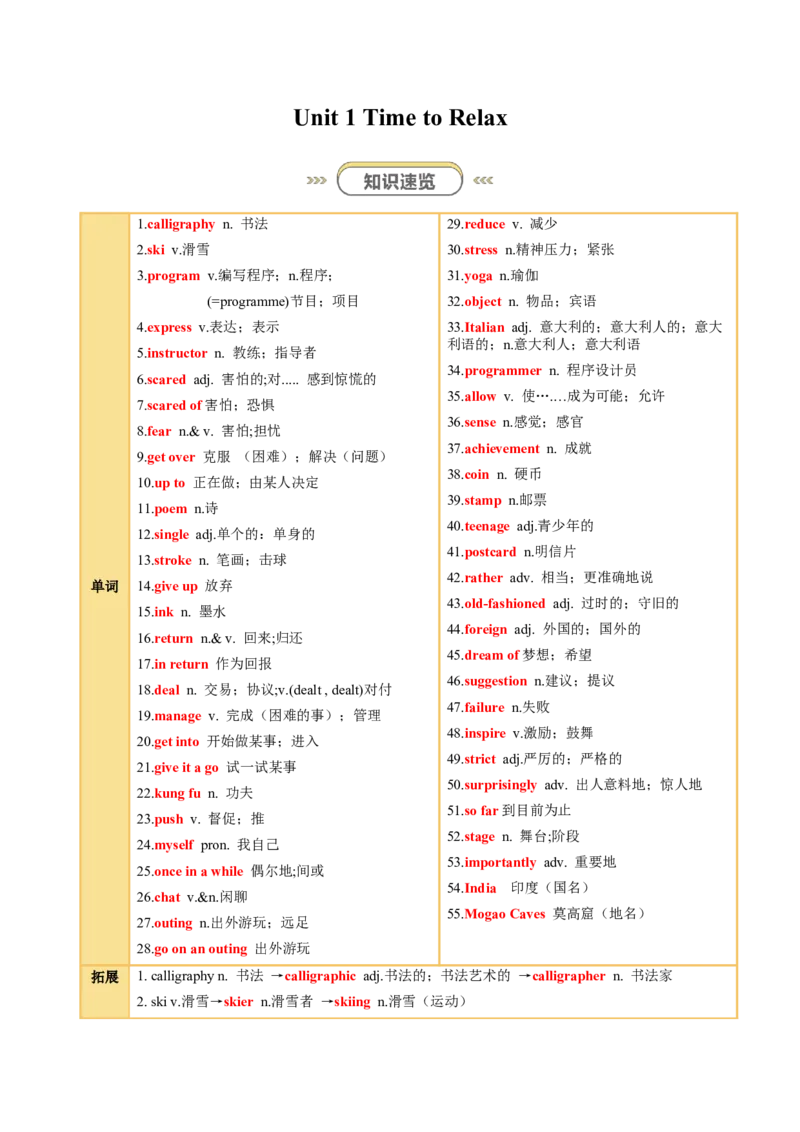
1.calligraphy n. 书法 29.reduce v. 减少
2.ski v.滑雪 30.stress n.精神压力;紧张
3.program v.编写程序;n.程序; 31.yoga n.瑜伽
(=programme)节目;项目 32.object n. 物品;宾语
4.express v.表达;表示 33.Italian adj. 意大利的;意大利人的;意大
利语的;n.意大利人;意大利语
5.instructor n. 教练;指导者
34.programmer n. 程序设计员
6.scared adj. 害怕的;对..... 感到惊慌的
35.allow v. 使….…成为可能;允许
7.scared of害怕;恐惧
36.sense n.感觉;感官
8.fear n.& v. 害怕;担忧
37.achievement n. 成就
9.get over 克服 (困难);解决(问题)
38.coin n. 硬币
10.up to 正在做;由某人决定
39.stamp n.邮票
11.poem n.诗
40.teenage adj.青少年的
12.single adj.单个的:单身的
41.postcard n.明信片
13.stroke n. 笔画;击球
42.rather adv. 相当;更准确地说
单词 14.give up 放弃
43.old-fashioned adj. 过时的;守旧的
15.ink n. 墨水
44.foreign adj. 外国的;国外的
16.return n.& v. 回来;归还
45.dream of梦想;希望
17.in return 作为回报
46.suggestion n.建议;提议
18.deal n. 交易;协议;v.(dealt , dealt)对付
47.failure n.失败
19.manage v. 完成(困难的事);管理
48.inspire v.激励;鼓舞
20.get into 开始做某事;进入
49.strict adj.严厉的;严格的
21.give it a go 试一试某事
50.surprisingly adv. 出人意料地;惊人地
22.kung fu n. 功夫
51.so far到目前为止
23.push v. 督促;推
52.stage n. 舞台;阶段
24.myself pron. 我自己
53.importantly adv. 重要地
25.once in a while 偶尔地;间或
54.India 印度(国名)
26.chat v.&n.闲聊
55.Mogao Caves 莫高窟(地名)
27.outing n.出外游玩;远足
28.go on an outing 出外游玩
拓展 1. calligraphy n. 书法 →calligraphic adj.书法的;书法艺术的 →calligrapher n. 书法家
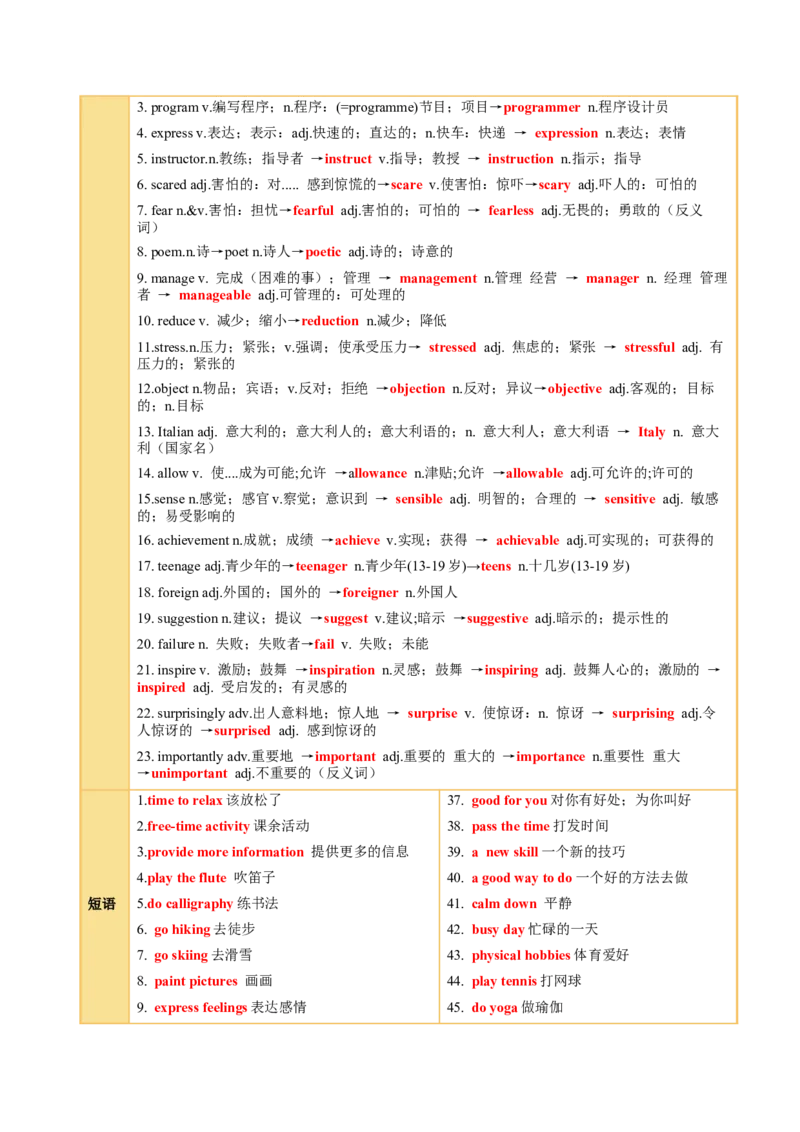
2. ski v.滑雪→skier n.滑雪者 →skiing n.滑雪(运动)3. program v.编写程序;n.程序:(=programme)节目;项目→programmer n.程序设计员
4. express v.表达;表示:adj.快速的;直达的;n.快车:快递 → expression n.表达;表情
5. instructor.n.教练;指导者 →instruct v.指导;教授 → instruction n.指示;指导
6. scared adj.害怕的:对..... 感到惊慌的→scare v.使害怕:惊吓→scary adj.吓人的:可怕的
7. fear n.&v.害怕:担忧→fearful adj.害怕的;可怕的 → fearless adj.无畏的;勇敢的(反义
词)
8. poem.n.诗→poet n.诗人→poetic adj.诗的;诗意的
9. manage v. 完成(困难的事);管理 → management n.管理 经营 → manager n. 经理 管理
者 → manageable adj.可管理的:可处理的
10. reduce v. 减少;缩小→reduction n.减少;降低
11.stress.n.压力;紧张;v.强调;使承受压力→ stressed adj. 焦虑的;紧张 → stressful adj. 有
压力的;紧张的
12.object n.物品;宾语;v.反对;拒绝 →objection n.反对;异议→objective adj.客观的;目标
的;n.目标
13. Italian adj. 意大利的;意大利人的;意大利语的;n. 意大利人;意大利语 → Italy n. 意大
利(国家名)
14. allow v. 使....成为可能;允许 →allowance n.津贴;允许 →allowable adj.可允许的;许可的
15.sense n.感觉;感官v.察觉;意识到 → sensible adj. 明智的;合理的 → sensitive adj. 敏感
的;易受影响的
16. achievement n.成就;成绩 →achieve v.实现;获得 → achievable adj.可实现的;可获得的
17. teenage adj.青少年的→teenager n.青少年(13-19岁)→teens n.十几岁(13-19岁)
18. foreign adj.外国的;国外的 →foreigner n.外国人
19. suggestion n.建议;提议 →suggest v.建议;暗示 →suggestive adj.暗示的;提示性的
20. failure n. 失败;失败者→fail v. 失败;未能
21. inspire v. 激励;鼓舞 →inspiration n.灵感;鼓舞 →inspiring adj. 鼓舞人心的;激励的 →
inspired adj. 受启发的;有灵感的
22. surprisingly adv.出人意料地;惊人地 → surprise v. 使惊讶:n. 惊讶 → surprising adj.令
人惊讶的 →surprised adj. 感到惊讶的
23. importantly adv.重要地 →important adj.重要的 重大的 →importance n.重要性 重大
→unimportant adj.不重要的(反义词)
1.time to relax该放松了 37. good for you对你有好处;为你叫好
2.free-time activity课余活动 38. pass the time打发时间
3.provide more information 提供更多的信息 39. a new skill一个新的技巧
4.play the flute 吹笛子 40. a good way to do一个好的方法去做
短语 5.do calligraphy练书法 41. calm down 平静
6. go hiking去徒步 42. busy day忙碌的一天
7. go skiing去滑雪 43. physical hobbies体育爱好
8. paint pictures 画画 44. play tennis打网球
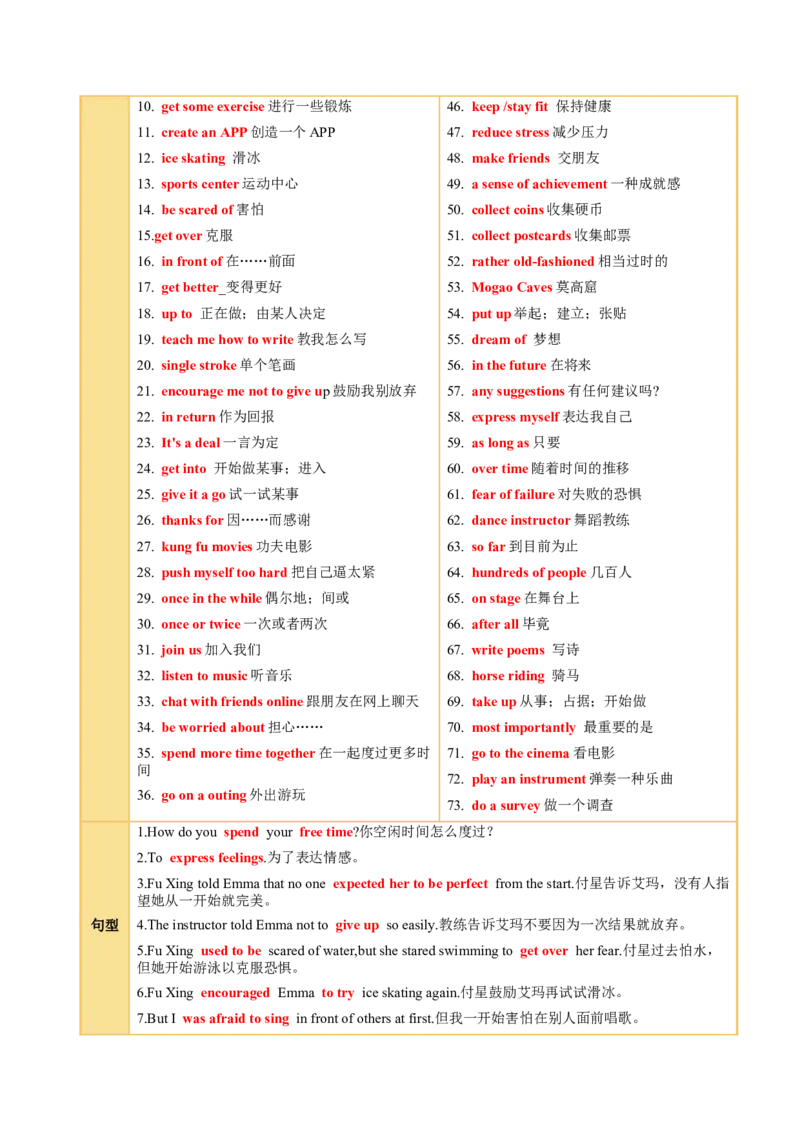
9. express feelings表达感情 45. do yoga做瑜伽10. get some exercise进行一些锻炼 46. keep /stay fit 保持健康
11. create an APP创造一个APP 47. reduce stress减少压力
12. ice skating 滑冰 48. make friends 交朋友
13. sports center运动中心 49. a sense of achievement一种成就感
14. be scared of害怕 50. collect coins收集硬币
15.get over克服 51. collect postcards收集邮票
16. in front of在……前面 52. rather old-fashioned相当过时的
17. get better_变得更好 53. Mogao Caves莫高窟
18. up to 正在做;由某人决定 54. put up举起;建立;张贴
19. teach me how to write教我怎么写 55. dream of 梦想
20. single stroke单个笔画 56. in the future在将来
21. encourage me not to give up鼓励我别放弃 57. any suggestions有任何建议吗?
22. in return作为回报 58. express myself表达我自己
23. It's a deal一言为定 59. as long as只要
24. get into 开始做某事;进入 60. over time随着时间的推移
25. give it a go试一试某事 61. fear of failure对失败的恐惧
26. thanks for因……而感谢 62. dance instructor舞蹈教练
27. kung fu movies功夫电影 63. so far到目前为止
28. push myself too hard把自己逼太紧 64. hundreds of people几百人
29. once in the while偶尔地;间或 65. on stage在舞台上
30. once or twice一次或者两次 66. after all毕竟
31. join us加入我们 67. write poems 写诗
32. listen to music听音乐 68. horse riding 骑马
33. chat with friends online跟朋友在网上聊天 69. take up从事;占据;开始做
34. be worried about担心…… 70. most importantly 最重要的是
35. spend more time together在一起度过更多时 71. go to the cinema看电影
间
72. play an instrument弹奏一种乐曲
36. go on a outing外出游玩
73. do a survey做一个调查
1.How do you spend your free time?你空闲时间怎么度过?
2.To express feelings.为了表达情感。
3.Fu Xing told Emma that no one expected her to be perfect from the start.付星告诉艾玛,没有人指
望她从一开始就完美。
句型 4.The instructor told Emma not to give up so easily.教练告诉艾玛不要因为一次结果就放弃。
5.Fu Xing used to be scared of water,but she stared swimming to get over her fear.付星过去怕水,
但她开始游泳以克服恐惧。
6.Fu Xing encouraged Emma to try ice skating again.付星鼓励艾玛再试试滑冰。
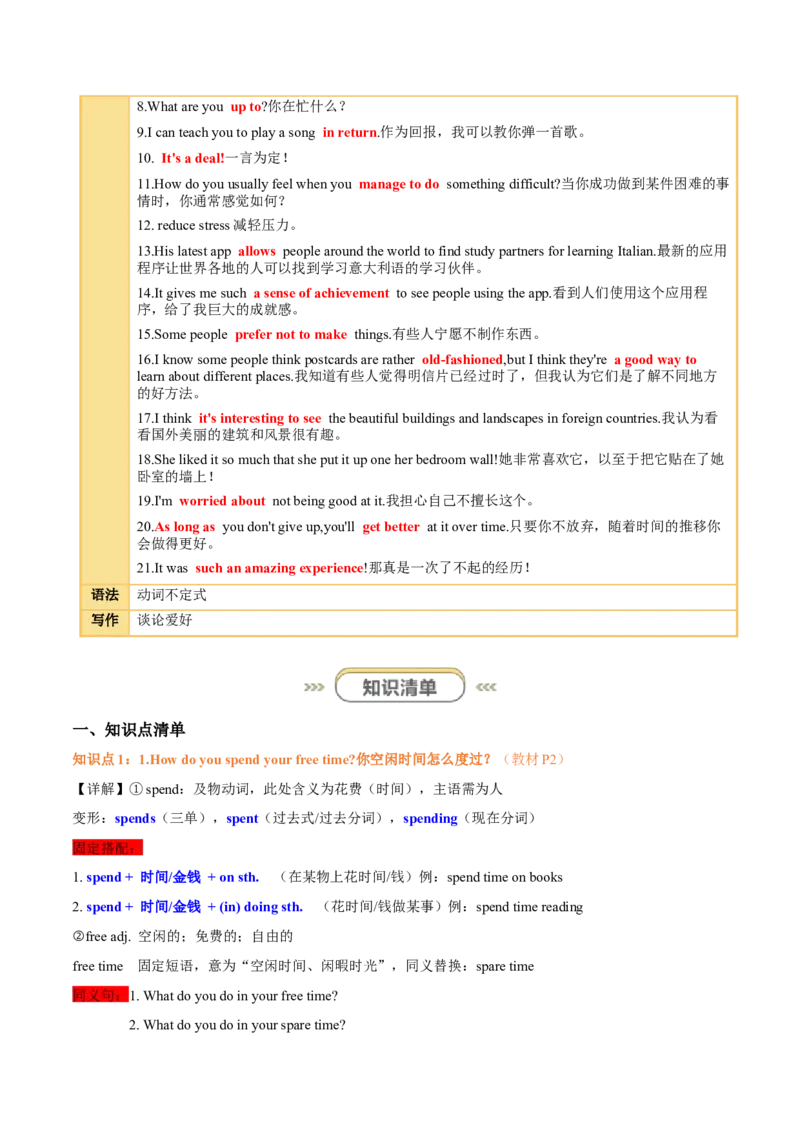
7.But I was afraid to sing in front of others at first.但我一开始害怕在别人面前唱歌。8.What are you up to?你在忙什么?
9.I can teach you to play a song in return.作为回报,我可以教你弹一首歌。
10. It's a deal!一言为定!
11.How do you usually feel when you manage to do something difficult?当你成功做到某件困难的事
情时,你通常感觉如何?
12. reduce stress减轻压力。
13.His latest app allows people around the world to find study partners for learning Italian.最新的应用
程序让世界各地的人可以找到学习意大利语的学习伙伴。
14.It gives me such a sense of achievement to see people using the app.看到人们使用这个应用程
序,给了我巨大的成就感。
15.Some people prefer not to make things.有些人宁愿不制作东西。
16.I know some people think postcards are rather old-fashioned,but I think they're a good way to
learn about different places.我知道有些人觉得明信片已经过时了,但我认为它们是了解不同地方
的好方法。
17.I think it's interesting to see the beautiful buildings and landscapes in foreign countries.我认为看
看国外美丽的建筑和风景很有趣。
18.She liked it so much that she put it up one her bedroom wall!她非常喜欢它,以至于把它贴在了她
卧室的墙上!
19.I'm worried about not being good at it.我担心自己不擅长这个。
20.As long as you don't give up,you'll get better at it over time.只要你不放弃,随着时间的推移你
会做得更好。
21.It was such an amazing experience!那真是一次了不起的经历!
语法 动词不定式
写作 谈论爱好
一、知识点清单
知识点1:1.How do you spend your free time?你空闲时间怎么度过?(教材P2)
【详解】①spend:及物动词,此处含义为花费(时间),主语需为人
变形:spends(三单),spent(过去式/过去分词),spending(现在分词)
固定搭配:
1. spend + 时间/金钱 + on sth. (在某物上花时间/钱)例:spend time on books
2. spend + 时间/金钱 + (in) doing sth. (花时间/钱做某事)例:spend time reading
②free adj. 空闲的;免费的;自由的
free time 固定短语,意为“空闲时间、闲暇时光”,同义替换:spare time
同义句:1. What do you do in your free time?
2. What do you do in your spare time?3. How do you occupy your leisure time?(稍正式,leisure time表闲暇)
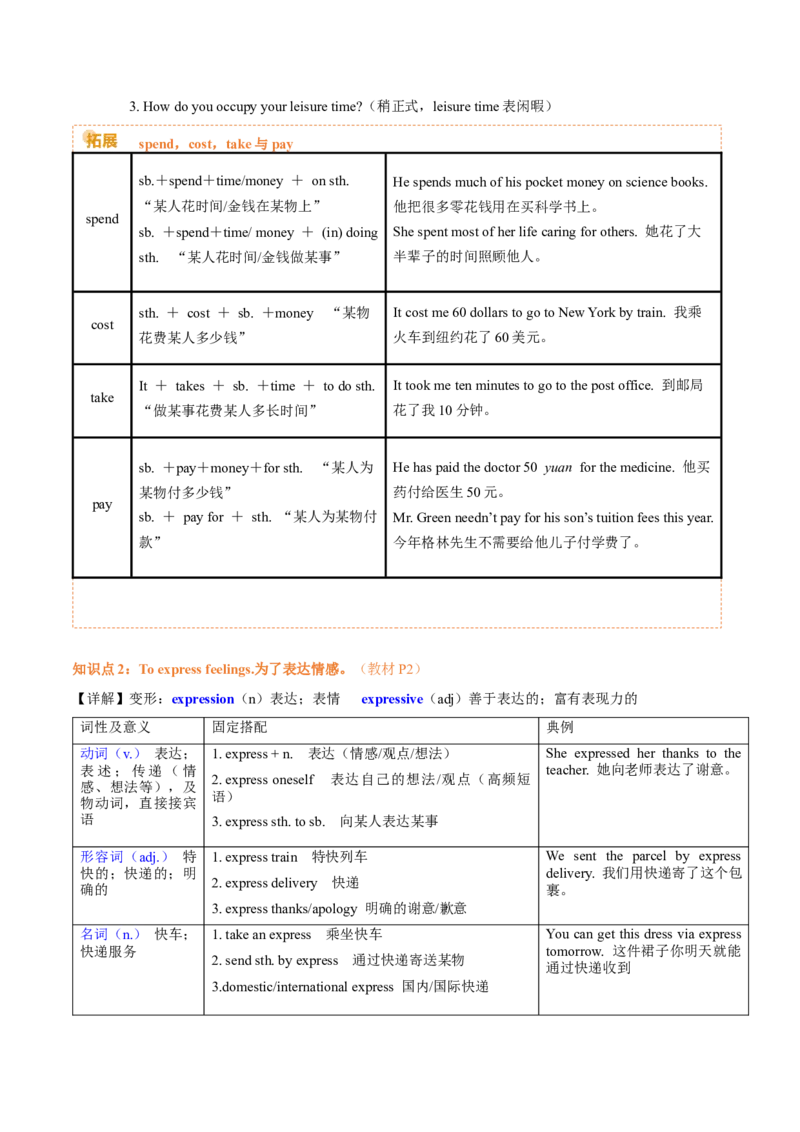
spend,cost,take与pay
sb.+spend+time/money + on sth. He spends much of his pocket money on science books.
“某人花时间/金钱在某物上” 他把很多零花钱用在买科学书上。
spend
sb. +spend+time/ money + (in) doing She spent most of her life caring for others. 她花了大
sth. “某人花时间/金钱做某事” 半辈子的时间照顾他人。
sth. + cost + sb. +money “某物 It cost me 60 dollars to go to New York by train. 我乘
cost
花费某人多少钱” 火车到纽约花了60美元。
It + takes + sb. +time + to do sth. It took me ten minutes to go to the post office. 到邮局
take
“做某事花费某人多长时间” 花了我10分钟。
sb. +pay+money+for sth. “某人为 He has paid the doctor 50 yuan for the medicine. 他买
某物付多少钱” 药付给医生50元。
pay
sb. + pay for + sth. “某人为某物付 Mr. Green needn’t pay for his son’s tuition fees this year.
款” 今年格林先生不需要给他儿子付学费了。
知识点2:To express feelings.为了表达情感。(教材P2)
【详解】变形:expression(n)表达;表情 expressive(adj)善于表达的;富有表现力的
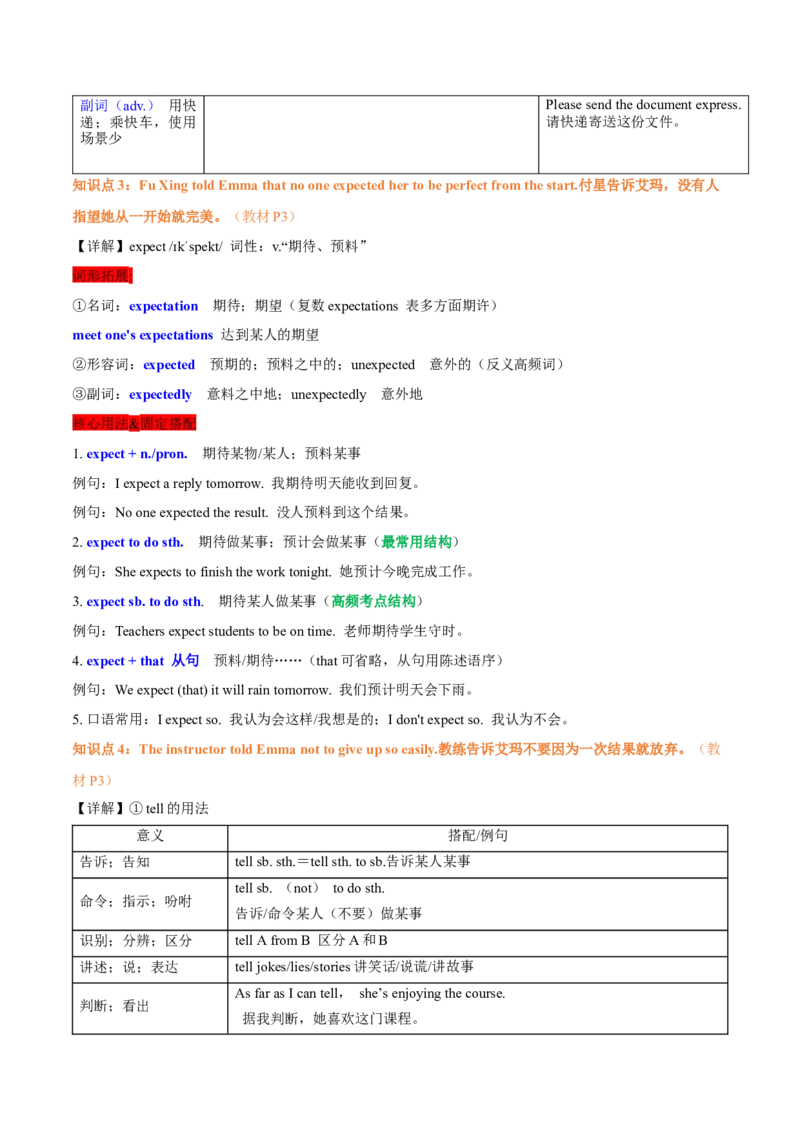
词性及意义 固定搭配 典例
动词(v.) 表达; 1. express + n. 表达(情感/观点/想法) She expressed her thanks to the
表述;传递(情 teacher. 她向老师表达了谢意。
2. express oneself 表达自己的想法/观点(高频短
感、想法等),及
语)
物动词,直接接宾
语 3. express sth. to sb. 向某人表达某事
形容词(adj.) 特 1. express train 特快列车 We sent the parcel by express
快的;快递的;明 delivery. 我们用快递寄了这个包
2. express delivery 快递
确的 裹。
3. express thanks/apology 明确的谢意/歉意
名词(n.) 快车; 1. take an express 乘坐快车 You can get this dress via express
快递服务 tomorrow. 这件裙子你明天就能
2. send sth. by express 通过快递寄送某物
通过快递收到
3.domestic/international express 国内/国际快递副词(adv.) 用快 Please send the document express.
递;乘快车,使用 请快递寄送这份文件。
场景少
知识点3:Fu Xing told Emma that no one expected her to be perfect from the start.付星告诉艾玛,没有人
指望她从一开始就完美。(教材P3)
【详解】expect /ɪkˈspekt/ 词性:v.“期待、预料”
词形拓展:
①名词:expectation 期待;期望(复数expectations 表多方面期许)
meet one's expectations 达到某人的期望
②形容词:expected 预期的;预料之中的;unexpected 意外的(反义高频词)
③副词:expectedly 意料之中地;unexpectedly 意外地
核心用法&固定搭配
1. expect + n./pron. 期待某物/某人;预料某事
例句:I expect a reply tomorrow. 我期待明天能收到回复。
例句:No one expected the result. 没人预料到这个结果。
2. expect to do sth. 期待做某事;预计会做某事(最常用结构)
例句:She expects to finish the work tonight. 她预计今晚完成工作。
3. expect sb. to do sth. 期待某人做某事(高频考点结构)
例句:Teachers expect students to be on time. 老师期待学生守时。
4. expect + that 从句 预料/期待……(that可省略,从句用陈述语序)
例句:We expect (that) it will rain tomorrow. 我们预计明天会下雨。
5. 口语常用:I expect so. 我认为会这样/我想是的;I don't expect so. 我认为不会。
知识点4:The instructor told Emma not to give up so easily.教练告诉艾玛不要因为一次结果就放弃。(教
材P3)
【详解】①tell的用法
意义 搭配/例句
告诉;告知 tell sb. sth.=tell sth. to sb.告诉某人某事
tell sb. (not) to do sth.
命令;指示;吩咐
告诉/命令某人(不要)做某事
识别;分辨;区分 tell A from B 区分A和B
讲述;说;表达 tell jokes/lies/stories讲笑话/说谎/讲故事
As far as I can tell, she’s enjoying the course.
判断;看出
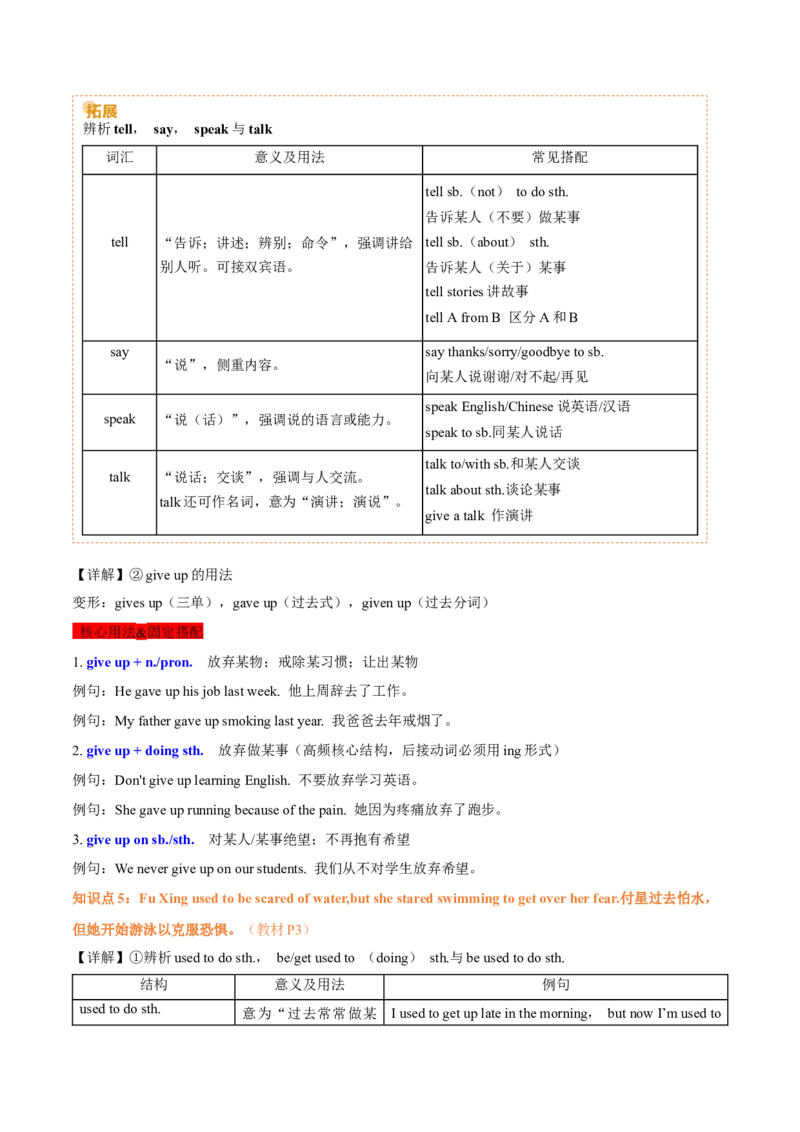
据我判断,她喜欢这门课程。辨析tell, say, speak与talk
词汇 意义及用法 常见搭配
tell sb.(not) to do sth.
告诉某人(不要)做某事
tell “告诉;讲述;辨别;命令”,强调讲给 tell sb.(about) sth.
别人听。可接双宾语。 告诉某人(关于)某事
tell stories讲故事
tell A from B 区分A和B
say say thanks/sorry/goodbye to sb.
“说”,侧重内容。
向某人说谢谢/对不起/再见
speak English/Chinese说英语/汉语
speak “说(话)”,强调说的语言或能力。
speak to sb.同某人说话
talk to/with sb.和某人交谈
talk “说话;交谈”,强调与人交流。
talk about sth.谈论某事
talk还可作名词,意为“演讲;演说”。
give a talk 作演讲
【详解】②give up的用法
变形:gives up(三单),gave up(过去式),given up(过去分词)
核心用法&固定搭配
1. give up + n./pron. 放弃某物;戒除某习惯;让出某物
例句:He gave up his job last week. 他上周辞去了工作。
例句:My father gave up smoking last year. 我爸爸去年戒烟了。
2. give up + doing sth. 放弃做某事(高频核心结构,后接动词必须用ing形式)
例句:Don't give up learning English. 不要放弃学习英语。
例句:She gave up running because of the pain. 她因为疼痛放弃了跑步。
3. give up on sb./sth. 对某人/某事绝望;不再抱有希望
例句:We never give up on our students. 我们从不对学生放弃希望。
知识点5:Fu Xing used to be scared of water,but she stared swimming to get over her fear.付星过去怕水,
但她开始游泳以克服恐惧。(教材P3)
【详解】①辨析used to do sth., be/get used to (doing) sth.与be used to do sth.
结构 意义及用法 例句
used to do sth. 意为“过去常常做某 I used to get up late in the morning, but now I’m used to事”,只用于过去
时。说明现在不做
了。 getting up early.
意为“习惯于(做) 我过去早上常常起得很晚,但我现在习惯早起。
be/get used to (doing)
某事”,其中to是介
sth.
词。
意为“被用来做某
be used to do sth. A knife is used to cut things. 刀是用来切东西的。
事”。
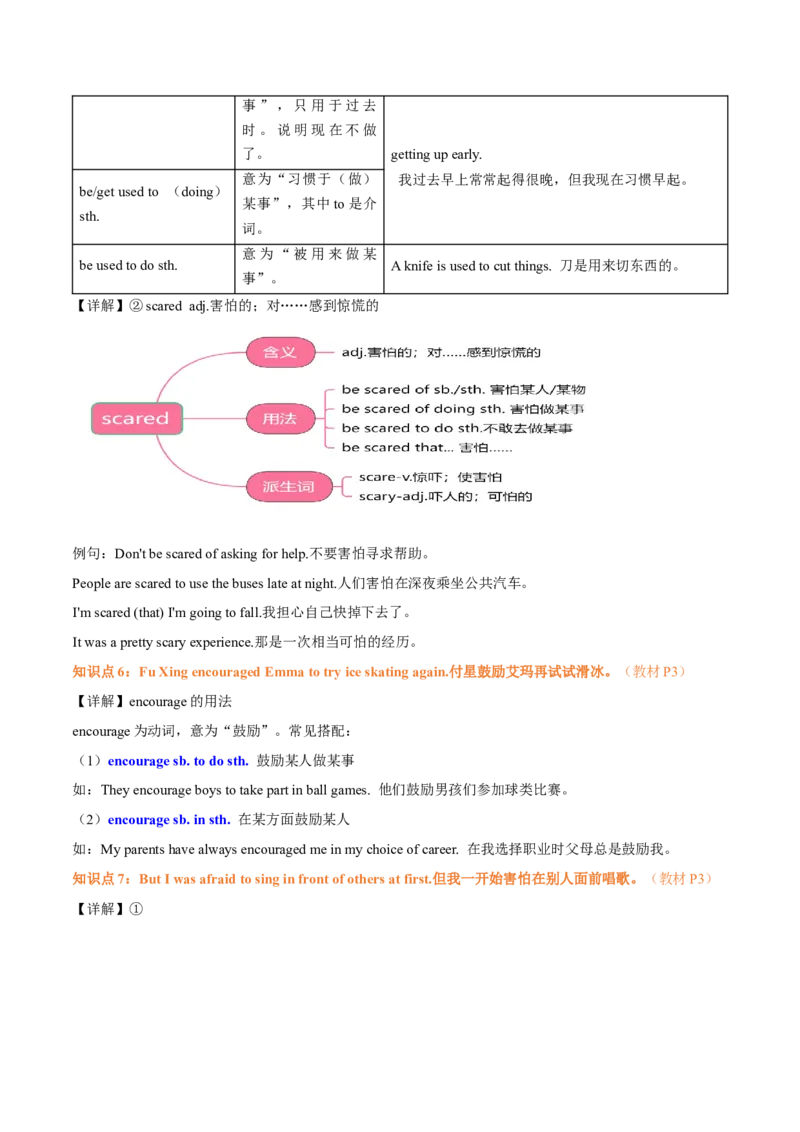
【详解】②scared adj.害怕的;对……感到惊慌的
例句:Don't be scared of asking for help.不要害怕寻求帮助。
People are scared to use the buses late at night.人们害怕在深夜乘坐公共汽车。
I'm scared (that) I'm going to fall.我担心自己快掉下去了。
It was a pretty scary experience.那是一次相当可怕的经历。
知识点6:Fu Xing encouraged Emma to try ice skating again.付星鼓励艾玛再试试滑冰。(教材P3)
【详解】encourage的用法
encourage为动词,意为“鼓励”。常见搭配:
(1)encourage sb. to do sth. 鼓励某人做某事
如:They encourage boys to take part in ball games. 他们鼓励男孩们参加球类比赛。
(2)encourage sb. in sth. 在某方面鼓励某人
如:My parents have always encouraged me in my choice of career. 在我选择职业时父母总是鼓励我。
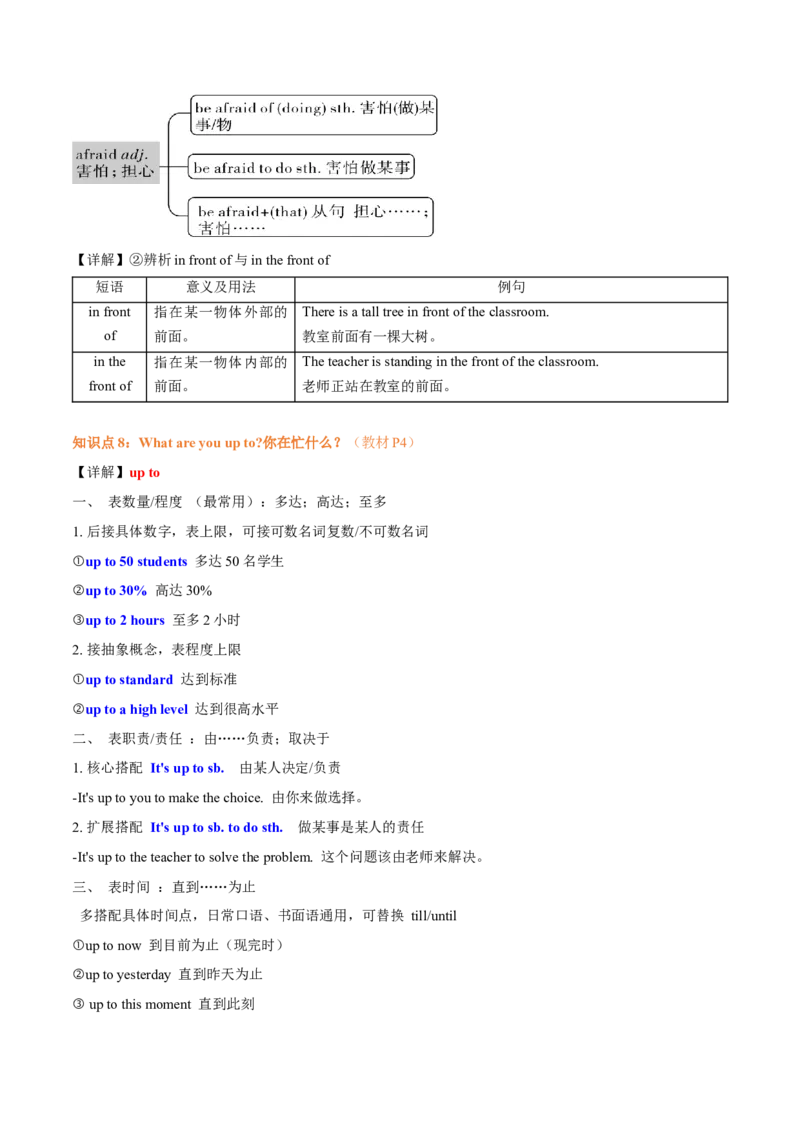
知识点7:But I was afraid to sing in front of others at first.但我一开始害怕在别人面前唱歌。(教材P3)
【详解】①【详解】②辨析in front of与in the front of
短语 意义及用法 例句
in front 指在某一物体外部的 There is a tall tree in front of the classroom.
of 前面。 教室前面有一棵大树。
in the 指在某一物体内部的 The teacher is standing in the front of the classroom.
front of 前面。 老师正站在教室的前面。
知识点8:What are you up to?你在忙什么?(教材P4)
【详解】up to
一、 表数量/程度 (最常用):多达;高达;至多
1. 后接具体数字,表上限,可接可数名词复数/不可数名词
①up to 50 students 多达50名学生
②up to 30% 高达30%
③up to 2 hours 至多2小时
2. 接抽象概念,表程度上限
①up to standard 达到标准
②up to a high level 达到很高水平
二、 表职责/责任 :由……负责;取决于
1. 核心搭配 It's up to sb. 由某人决定/负责
-It's up to you to make the choice. 由你来做选择。
2. 扩展搭配 It's up to sb. to do sth. 做某事是某人的责任
-It's up to the teacher to solve the problem. 这个问题该由老师来解决。
三、 表时间 :直到……为止
多搭配具体时间点,日常口语、书面语通用,可替换 till/until
①up to now 到目前为止(现完时)
②up to yesterday 直到昨天为止
③ up to this moment 直到此刻四、 表能力/胜任 :能胜任;赶得上
多用于口语语境,表有能力做某事
He is up to this job. 他能胜任这份工作。
五、 口语特殊用法 :忙于(坏事);密谋
固定搭配 be up to sth.,隐含做调皮/不好的事的意味
What are you up to? 你在搞什么名堂?
六、 常见高频短语
up to date 最新的;与时俱进的
up to date with sth. 了解某事的最新情况
up to no good 没安好心;图谋不轨
知识点9:.I can teach you to play a song in return.作为回报,我可以教你弹一首歌。(教材P4)
【详解】return n.& v.回来;归还
①n.
sb.'s return from...某人从……返回
sb.'s return to...某人返回……
on sb.'s return 当某人回来后
in return 作为回报
②v.
return from...从……返回
return to..回到……
return sth. to sth./sb.把某物放回某处/还给某人
On his return from Canada, he joined the army.他从加拿大回来就参军了。
She gave them all the help she could, and asked for
nothing in return.她尽其所能地帮助了他们, 而且不求回报。
I returned from work to find the house empty.
我下班回来, 发现屋里空无一人。
Will they return to the cave next spring?
明年春天它们还会回到洞穴吗?
I must return some books to the library.
我得把一些书还给图书馆。
拓展:
表示“回来”还可以用go back或come back。Are you planning to go back to Spain?你打算回西班牙吗?
知识点10:It's a deal!一言为定!(教材P4)
I'll make a deal with you—I'll work evenings if you are willing to work weekends.
我来跟你订个协议——如果你愿意周末工作, 那我就晚上工作。
We discussed different ways of dealing with the problem.我们讨论了处理这个问题的不同方法。
辨析deal with与do with
词组 意义及用法
deal with “处理;应对”,常与how连用
do with “处理;处置”,常与what连用
知识点11:How do you usually feel when you manage to do something difficult?当你成功做到某件困难的事
情时,你通常感觉如何?(教材P4)
manage的名词形式有两种:
①manager n. 经理,管理人;
②management n. 经营,管理(不可数)。
知识点12:reduce stress减轻压力。(教材P6)
【详解】①reduce v.减少例句:1.They care about every bit of food in daily life and try their best to reduce food waste.
他们关心日常生活中的每一点食物,并尽最大努力减少食物浪费。
2.We reduced water usage by 30% last month.我们上个月减少了30%的用水量。
3.The new bridge should reduce travelling time from 50 minutes to 15 minutes.
这座新桥应该能将行程从50 分钟缩减到 15分钟。
②stress n.精神压力;紧张
stress 意为“精神压力;紧张”,既作可数名词,也作不可数名词,短语 be under stress意为“承受压
力”。
For example, people sometimes paint pictures to remember a beautiful landscape or object, or reduce stress.例如,
人们有时通过绘画来记住美丽的风景或物体,或减少压力。教材原文
Things can easily go wrong when people are under stress.人在压力之下,办事情就容易出差错。
1.She lays great stress on punctuality.她十分注重守时。
2.He stressed the importance of a good education.他强调了良好教育的重要性。
3.I try not to stress out when things go wrong.出问题时,我尽量不紧张。
知识点13:His latest app allows people around the world to find study partners for learning Italian.最新的
应用程序让世界各地的人可以找到学习意大利语的学习伙伴。(教材P6)
allow的用法如:The doctor may allow her to return to work next week.
医生也许会允许她下周回去上班。
知识点14:It gives me such a sense of achievement to see people using the app.看到人们使用这个应用程
序,给了我巨大的成就感。(教材P6)
sense n.感觉;感官
sense 作可数名词, 意为“感觉;感官”,
固定搭配:have a sense that...意为“感觉……”。
I had the sense that he was worried about something 我感觉他有心事。
Both some fishes and sea birds have an unbelievable sense of smell.有些鱼和海鸟都有令人难以置信的嗅觉。
(1)sense作名词时,还表示“理解力;判断力;意义;含义”。
That word has three senses.那个词有三个意思。
(2)sense作及物动词,意为“感觉到;意识到”,用法如下:
sense sth. 感觉到……
sense sb./sth. doing sth. 感觉到某人/某物正在做某事
sense sb./sth. do sth. 感觉到某人/某物做某事
sense that... 意识到……
Suddenly, he sensed someone around him.突然,他感觉到周围有人。
He sensed something move in the bushes.他察觉到灌木丛中有什么东西在动。
知识点15:Some people prefer not to make things.有些人宁愿不制作东西。(教材P6)
prefer的用法知识点16:I know some people think postcards are rather old-fashioned,but I think they're a good way to
learn about different places.我知道有些人觉得明信片已经过时了,但我认为它们是了解不同地方的好方
法。(教材P7)
【详解】
1. think (that)... 认为……,后接宾语从句,从句中that可省略(本句两处均省略that)
2. rather old-fashioned 相当过时,rather修饰形容词old-fashioned,表程度
3. a good way to do sth. 做某事的好方法,动词不定式to do作后置定语修饰way
4. learn about different places 了解不同的地方
知识点17:I think it's interesting to see the beautiful buildings and landscapes in foreign countries.我认为
看看国外美丽的建筑和风景很有趣。(教材P7)
It’s+adj.+(for/of sb.)to do sth.句型
10.However, it is impolite to ask someone's age, weight, or other personal information.
然而,询问别人的年龄、体重或其他个人信息是不礼貌的。
It’s+adj.+(for/of sb.)to do sth.句型
(1)It’s+adj.+(for sb.) +to do sth.,意为“(对某人来说)做某事是……的”。其中it是形式主语,
句中的动词不定式是真正的主语。
如:It’s necessary for students to have some labor courses. 学生上一些劳动课程是很有必要的。
(2)It’s+adj.+of sb.+to do sth.,意为“某人做某事是……的”。其中所用的形容词为描述行为者的性
格、品质的一类词。
如:It’s very nice of you to offer me help. 你能主动帮我,真是太善良了。
知识点18:She liked it so much that she put it up one her bedroom wall!她非常喜欢它,以至于把它贴在了
她卧室的墙上!(教材P7)
① so....that......表示“如此.以至于…”,引导结果状语从句结构:so+形容词/副词+that+从句
She was so tired that she fell asleep at once. (她太累了,以至于立刻睡着了。)
【妙辨异同】so…that…/so that/such…that…
辨析 意义及用法
意为“如此.以至于…”,引导结果状语从句,so后面接形容词或副词。
so… that…
可与too… to…结构互换。
so that 意为“为了”,引导目的状语从句。可与in order that互换。
such… that… 意为“如此....以致于....”,引导结果状语从句,such后接名词。
【注意】 such+a/an+adj. +可数名词单数(+that从句)= so+adj. +a/an+可数名词单数(+that从句)
当名词前有many, much, few或little等词修饰时,其前必须用so而不用such。
知识点19:I'm worried about not being good at it.我担心自己不擅长这个。(教材P8)
be worried about 为……担忧
【解析】be worried about意为“担心”,强调状态,后面接名词、代词、或动词-ing形式作宾语。其中
worried是形容词,意为“担心的;担忧的”。
We are all worried about her health. 我们都为她的健康担忧。
【拓展】worry作动词,意为“担心;担忧”,worry about 意为“担心”,强调动作。
Don't worry about her. She can pass the test because she studies hard.
不要担心她。因为她努力学习,她可以通过考试的。
be good短语小结
短语 意义及用法
be good “擅长……”,be good at sth./doing sth.=do well in sth./doing sth.“擅长某事/做某事”。其
at 反义词组为be weak in sth./be poor at (sth./doing sth.)在某方面/做某事方面差/弱。
be good “与……相处融洽;善于应付……的”,与get on/along well with同义,后常接表示人的
with 名词或代词。
be good
“对……有好处”,其反义词组为be bad for。
for
be good
“对……友好”,相当于be friendly/kind to,后接名词或代词。
to
如:
①He’s good at dealing with pressure. 他善于应对压力。
②I’m good with my classmates. 我与我的同学关系融洽。③It’s probably good for you to make some mistakes. 犯些错误或许对你有好处。
④He is very good to me. 他对我非常友好。
知识点20:As long as you don't give up,you'll get better at it over time.只要你不放弃,随着时间的推移你
会做得更好。(教材P8)
as long as
I believe these dreams will come true as long as I study hard and keep on trying.
我相信,只要我努力学习并不断尝试,这些梦想就会实现。
表示条件:“只要”(最常用的用法)
在这个意义上,as long as 用于引出条件,意思是“只有在……条件下,主句的情况才会发生或成立”。它
相当于 if 或 on the condition that,但语气更强,强调这个条件是唯一或主要的决定因素。
结构: 主句 + as long as + 条件从句
例句:
You can go to the party as long as you finish your homework first.
(只要你先完成作业,就可以去参加派对。)
As long as you promise to be careful, you can borrow my car.
(只要你保证小心,就可以借我的车。)
知识点21:I didn't want to talk to my instructor about it because he seemed very strict.(教材P8)
strict的用法
strict为形容词,意为“严格的;严厉的”。
{be strict with sb. 对某人要求严格
be strict about sth. 对某事要求严格
如:
①Her parents are always strict with her. 她的父母一直对她要求严格。
②John is very strict about rules. 约翰对规则要求非常严格。
知识点21:It was such an amazing experience!那真是一次了不起的经历!(教材P9)
感叹句用来表示喜、怒、哀、乐等感情,通常用what或how引导。
1.what引导的感叹句(中心词为名词)
①What + a/an + adj.+单数可数名词(+主语+谓语)!如:
What a kind heart you have! 你的心肠真好!
②What + adj. +不可数名词/可数名词复数(+主语+谓语)!如:
What interesting stories he’s told us! 他给我们讲的故事真有趣!
What great progress she has made! 她取得了多么大的进步啊!
2.how引导的感叹句(中心词为形容词或副词)
①How + adj./adv.(+主语+谓语)!如:
How clever the boy is! 这男孩真聪明!
②How + adj. + a/an +单数可数名词(+主语+谓语)!如:How clever a boy he is! 他真是个聪明的男孩!
③How+主语+谓语!如:
How time flies! 时间过得真快呀!
【拓展】如何判断用what还是how来引导感叹句:
1.凡是以a/an开头的,多用what;
2.凡是形容词直接加名词的,多用 what;此处尤其要注意一些不可数名词与形容词连用的情况,如:
weather,news,advice,fun,information,work,traffic等;
3.其他一般用how。
口诀助记:感叹句要记牢,句子主谓先划掉,再来确定what/how;再在形容词后找,若有名词用what,没
有名词用how。
二、语法点清单
动词不定式的结构
动词不定式的构成:不定式的基本形式为:to+动词原形,有时可以不用to,这里的to 是不定式符
号,本身无词义,动词不定式的否定形式是not+(to+)动词原形。
(1) 肯定式:to + 动词原形
It’s nice to meet you.
(2)否定式:not to + 动词原形
He told me not to leave this room
(to是不定式符号,无意义,有时可以不带)
动词不定式的句法功能
功能 例句 说明
To speak English is not easy for us 作主语用的不定式,常常用it作形式主
主语
=It is not easy for us to speak English. 语,而把不定式放在后面。
My work is to clean the room everyday. 多数情况下,不定式作表语,可转换作
表语
=To clean the room every day is my work. 为主语。
—What sports does he like to play? 只能做某些动词的宾语,一般不作介词
宾语
—He likes to play basketball. 的宾语。
My mother made me play the piano all the 在 make,let,see,hear,watch 等使
宾补
time. 役、感官动词后,不定式省略to。
不定式作定语,要放在所修饰词的后
定语 Have you got anything to say?
面。
状语 I'm sorry to trouble you.(表原因)。 不定式作状语,其逻辑主语要和句子的I went to the library to study English.(表目
主语一致。
的)
1. 不定式作主语
动词不定式作主语时,常用it作形式主语,而将真正的主语放在句末其结构为:
①It is +adj.+for/of sb.+(not)to do sth.意为"做某事对某人来说是……"。
②It takes sb.+some time+to do sth.意为"做某事花费某人多长时间"
如:To learn English well is useful.→ It is useful to learn English well.
It’s important for us to protect the environment.
注意:在 kin d , goo d , nic e , cleve r 等表示人的品质的形容词后,不用 fo r 而用 o f 。如:
It's very kind of you to help me. 你帮助我真是太好啦。
2. 不定式作宾语
有些谓语动词后只能用不定式作宾语,常见的这类词是表示命令、打算或希望的,如:
would like, like, want, wish, hope, decide, plan, expect等。
如: Would you like to see a film this evening? 你今晚想去看电影吗?
②在find, think后跟不定式作宾语时,常用it代替,而将真正的宾语放在后面。如:
I find it easy to read English every day.
3.不定式作宾语补足语
tell, ask, want, allow, warn, advise, invite, get, encourage后常跟动词不定式作宾语补足语。
如:Lucy asked him to turn down the radio.
My mother encourages me to learn Japanese. 我妈妈鼓励我学日语。
4.不定式作定语
不定式作定语时,应放在名词之后。它与名词有逻辑上的动宾关系。
注意:如果是不及物动词,且与所修饰的词之间有动宾关系,要在不定式后加上适当的介词。
There is nothing to worry about. 没有什么可担心的。
The room is big enough for 10 people to live in .
5. 表示一般的概念时,不定式、动词ing形式可以互换,而表示具体的、个 别的动作或有将来含义时,一
般用不定式。
What she likes is watching/to watch children play.
她喜欢的事情就是看孩子们玩耍。
My wish is to become a good teacher.
我的愿望就是要当个好老师。
注意:下列情况下不定式作表语通常省略to:
(1)主语是all其后有that引导的定语从句或what引导的从句,且从句中含有do的某种形式时。(2)主语是the only,the first,the last,形容词最高级或被这些词修饰,主语后有定语从句,且定语从句
中含有do的某种形式时。
All you need to do now is complete the form.
你现在要做的是把这张表填好。
What I want to do most in senior high school is improve my English.
我在高中最想做的事就是提高我的英语水平。
The only thing to do now is go on.
前进是现在唯一的出路。
6. 不定式作状语
不定式常可用作状语,修饰动词,表示行为的目的、结果和原因。
To get there on time, we set out at five in the morning.
He goes there to enjoy the fresh air.
He worked day and night to get the money.
不定式的特殊用法
①使役动词和感官动词后跟动词不定式作宾语补足语,须省略to。此类动词有:一感(feel)、二听(hear,
listen to)、三让(let, make, have)、四看(look at, see, watch, notice)、五帮(help)。变为被动语态时,省略的to则
要加上。
②动词不定式的否定形式是not to do,其被动形式为to be done。
►Our teacher asked us not to swim in the river alone. 我们老师要求我们不要独自一人在河里游泳。
③常接"疑问词+带to的不定式"的动词有teach, show, tell, learn, find out, decide, know, forget等。
►My mother taught me how to cook yesterday. 昨天我妈妈教我如何做饭。
跟动词不定式的情况总结归纳:(加强记忆)
①动词:agree to do同意去做;
afford to do买得起;decide to do决定去做某事;hope to do希望去做;wish to do希望去做;
fail to do做某事失败去;plan to do打算去做;pretend to do假装去做;
refuse to do拒绝去做;would like to do=want to do想要去做某事;learn to do 学做;
prefer to do sth. 喜欢(爱)做某事;sb. seem to do sth好像做某事;
used to do sth. 过去常做某事
②句型.
allow sb. to do sth. 允许某人去做某事
ask/tell sb. (not) to do sth. 叫某人做事某事(叫某人不要去做某事)
follow sb. to do sth. 跟随某人去做某事get sb. to do sth. 让某人做某事
warn sb. (not) to do sth. 警告某人做某事(或不要做某事)
encourage sb. to do sth. 鼓励某人做某事
be afraid to do sth. 害怕做某事
be excited/glad/happy/sorry/ frightened/amazed/surprised to do sth.
be/get ready to do sth.准备做某事 can’t wait to do sth. 迫不急待地去做某事
get/have a chance to do sth. 得到一个做某事的机会
It’s + adj.+(for sb.) to do sth. / It’s +adj. +(of sb.) to do sth.
It takes sb. some time to do sth. 花费某人多长时间做某事(常考)
It’s time for sb. to do sth. 是某人做某事的时候了
too…(for sb.) to …太……以致不能…… =not… enough to do (常考)
prefer to do sth. rather than do sth. 宁愿……而不愿……(常考)
something to eat/drink 一些吃/喝的东西 Sth. is hard/difficult/easy to do 做好某事很难/容易
take turns to do sth. 轮流做……
There is no time (for sb. ) to do sth. 对(某人来说)没时间做某事了
There is no need (for sb.) to do sth. 对某人来说没必要做某事
try/do one’s best to do sth. 尽力去做某事
have no choice but to do sth 别无选择只能做某事
have something/nothing to do with sb 与......有关/无关
三、写作清单
话题分析
本单元的主题是用英语谈论兴趣爱好,如日常生活中同学们喜爱的音乐、电影、书籍等等.同学们可以
运用所学定语从句等句式深层次地表达自己内心的真实感受,培养积极的、有意义的兴趣爱好,树立正确
的人生观和价值观.可适用于本单元的关联主题有很多,如 My hobby (hobbies).... changes me a lot, I
like...best等等.
核心话题: 谈论课余活动、放松方式、个人爱好及原因。
写作目标:
1.能够围绕“放松方式”这一主题,清晰、有条理地描述自己或他人的休闲活动。
2.能够使用本单元核心词汇和句型结构(如:enjoy doing, be good for, It’s a good way to…, I find it…
because…)进行书面表达。
3.能够写出一篇结构完整、逻辑连贯的短文,介绍自己最喜欢的放松方式并阐述理由。4.鼓励学生在写作中表达真实感受,增进对健康生活方式的理解。
写作准备与语言支持
1. 头脑风暴 (Brainstorming):
列出你课余时间会做的、让你感到放松的事情。
Examples: reading books, listening to music, playing basketball/sports, drawing/painting, walking in the park,
playing computer games (适度), watching movies, chatting with friends, doing yoga, sleeping, etc.
针对你选择的方式,思考:Where? When? How often? With whom? How do you feel?
2. 核心词汇与短语 (Key Words & Phrases):
活动名称:
play sports/basketball/soccer…
listen to music/pop/light music
read books/novels/magazines
watch TV/movies
go for a walk/hiking
play computer/video games
spend time with family/friends
play an instrument (the piano/guitar…)
do some drawing/painting
描述感受与益处:
feel happy/relaxed/excited/calm
forget my worries/troubles
make me feel fresh/energetic
be good for my health/mind/eyes
help me (to) study better/sleep well
improve my skills/mood
learn new things
get exercise/stay in shape
enjoy the beauty of nature
share happiness with…
3. 实用句型结构 (Useful Sentence Patterns):
引入主题:
When I feel tired or stressed, I like to… / My favorite way to relax is (by) …ing.Among all the relaxing activities, I enjoy … the most.
描述习惯:
I usually do it on weekends/after finishing my homework.
I often … with my best friends/parents.
I spend about … (an hour) on it every day.
阐述理由(重点):
First, it helps me (to) relax and forget about my schoolwork for a while.
Second, it is good for my health because it gives me exercise.
What’s more, I can … when I … (e.g., learn teamwork when I play basketball).
I find it really enjoyable/interesting because…
Another reason is that it makes me feel…
It’s a good way to … (e.g., to clear my mind).
总结看法:
In my opinion, relaxing is important for everyone.
A good way to relax can bring us joy and make our lives more colorful.
I think … is not only fun but also helpful.
典例:
1.兴趣爱好是生活的重要组成部分。无论我们身处顺境还是逆境,是感到幸福洋溢还是心情低落,
它总能为我们带来温暖、勇气和前进的力量。作为一名初中生,在繁忙的课业之余,许多学生会通过读书、
听音乐或看电影等爱好,来放松身心、充实自我。你的爱好是什么呢?请以“My Hobby”为题,写一篇短
文谈谈自己的爱好。
内容要点:
1. 你的爱好是什么?(请选择一种进行描述);
2. 你为什么喜欢它?你的爱好给你的身心、学习或生活带来什么好处?
要求:
1. 文中不得出现考生的真实姓名和学校名称;
2. 书写工整,语句通顺、连贯,100词左右。
My Hobby
____________________________________________________________________________________________
____________________________________________________________________________________________
____________________________________________________________________________________________
________________________________________________________________________________________________________________________________________________________________________________________
____________________________________________________________________________________________
____________________________________________________________________________________________
_______
【答案】例文
My Hobby
My hobby is watching movies. A great movie is like a sunny day, bringing laughter and light.
In my free time, I often watch documentaries for information. When I’m down, comedies or cartoons with
funny characters and happy endings are my choice. I love movies for two reasons. First, they help me relax. After
studying hard, watching a funny movie makes me laugh and forget stress. Second, movies teach me about life.
Stories of brave characters encourage me to face difficulties bravely.
In short, my hobby brings me joy and helps me grow. It’s a wonderful part of my life.
【详解】[总体分析]
①题材:本文是一篇记叙文,介绍自己的爱好;
②时态:时态为“一般现在时”;
③提示:写作要点已给出,考生应注意不要遗漏“内容要点”中的介绍要点,适当添加细节,并突出写作
重点。
[写作步骤]
第一步,表明写作意图。借用“A great movie is like a sunny day, bringing laughter and light.”来引出重点介绍
的内容;
第二步,具体阐述写作内容。从“空闲时间的选择、心情低落时的选择、喜欢的原因”几个方面重点介绍
自己的爱好;
第三步,书写结语。表达“爱好给自己带来快乐和成长”的感悟。
[亮点词汇]
①in my free time在我的空闲时间
②be down心情低落
③help sb do sth帮助某人做某事
④forget stress忘记压力
[高分句型]
①When I’m down, comedies or cartoons with funny characters and happy endings are my choice.(when引导的
时间状语从句)②First, they help me relax.(省略句)
2.爱好让我们的生活多姿多彩,也让我们受益无穷。假如你是李斌,你校下周将举办以“My
Favorite Hobby”为题的英语演讲比赛。请你根据以下提示内容,用英语写一篇演讲稿参赛。
提示:1. What is your favorite hobby?
2. Why do you like this hobby best?
3. Will you turn this hobby into your job in the future? Why?
参考词汇:reading, collecting stamps, be interested in, relaxed, learn about, help sb. do,…
要求:1. 可使用参考词汇,亦可适当发挥;
2. 语句通顺,意思连贯,书写工整;
3. 文中不得出现任何真实信息(姓名、校名和地名等);
4. 词数:不少于60词。(开头和结尾已给出,但不计入总词数)
My Favorite Hobby
Good morning, everyone. It’s my great honor to stand here to talk about my hobby.
____________________________________________________________________________________________
____________________________________________________________________________________________
____________________________________________________________________________________________
____________________________________________________________________________________________
____________________________________________________________________________________________
____________________________________________________________________________________________
____________________________________________________________________________________________
____________________________________________________________________________________________
________
Thank you. That’s all.
【答案】
例文
My Favorite Hobby
Good morning, everyone. It’s my great honor to stand here to talk about my hobby.
My favorite hobby is reading. I enjoy it because books help me learn about different cultures and make me
feel relaxed. When I read, I can travel to new places in my mind. I like reading best for two reasons. Firstly, it
expands my vocabulary. Secondly, it teaches me how to solve problems. For example, stories show me clever ways
to face challenges.In the future, I hope to turn this hobby into my job as a writer. If I write books, I can share wonderful stories
with others, just like how my favorite books help me.
Thank you. That’s all.
【详解】[总体分析]
①题材:本文是一篇应用文,为演讲稿;
②时态:以“一般现在时”为主;
③提示:写作要点已给出,考生应注意不要遗漏提示的信息,适当增加细节,并突出写作重点。
[写作步骤]
第一步,开篇礼貌问候听众,表明演讲主题;
第二步,点明自己最喜欢的爱好是阅读,并说明阅读的好处和喜欢阅读的原因;
第三步,表达未来期望,希望将阅读爱好转化为作家职业;
第四步,书写结语。
[亮点词汇]
①my favorite hobby我最喜欢的爱好
②different cultures不同文化
③feel relaxed感到放松
④expand vocabulary扩充词汇量
⑤solve problems解决问题
⑥face challenges面对挑战
[高分句型]
①I enjoy it because books help me learn about different cultures and make me feel relaxed.(because引导的原因
状语从句)
②When I read, I can travel to new places in my mind.(when引导的时间状语从句)
③If I write books, I can share wonderful stories with others, just like how my favorite books help me.(if引导的
条件状语从句)
3.古希腊伟大哲学家亚里士多德说:“幸福存在于闲暇之中,我们是为了闲暇而忙碌。”你是通过
什么样的娱乐方式度过你的闲暇时光呢?假如你是李华,你正在参与校报主题为“A Good Way to Have
Fun”的征文活动。请你根据以下相关信息,选择一种娱乐方式完成投稿。
Ways to have fun:do ★What do you do to
sports have
fun?(where/when/with
read books
whom...)
watch movies
★What do you thinkof it?
keep healthy
open up mind
…
develop friendship
balance fun and study
…
写作要求:
1. 征文需包含所选娱乐方式的相关信息,可适当发挥。
2. 不得在作文中出现学校的真实名称和学生的真实姓名。
3. 语句连贯,注意分段,词数80词左右。作文的开头已经给出,不计入总词数。
I’m Li Hua. My favorite way to relax is...
____________________________________________________________________________________________
____________________________________________________________________________________________
____________________________________________________________________________________________
____________________________________________________________________________________________
____________________________________________________________________________________________
____________________________________________________________________________________________
______
【答案】
例文
I’m Li Hua. My favorite way to relax is doing sports. I often play basketball with my friends on the
playground after school. Sometimes we even have small matches, and everyone tries their best to win the game.
We have a lot of fun and laugh together.
I think doing sports is a great way to keep healthy and develop friendship. It also helps me balance fun and
study. When I play basketball, I forget all my worries and feel energetic.
In short, sports bring me joy and make my life better.
【详解】[总体分析]
①题材:本文是一篇材料作文;
②时态:时态为“一般现在时态”;
③提示:写作要点已给出,不得遗漏,可适当增加细节,以使行文连贯。
[写作步骤]
第一步:开门见山,点明主题;第二步:描述活动细节,并说明其益处;
第三步:书写结尾,总结感受。
[亮点词汇]
①tries their best尽他们最大的努力
②keep healthy保持健康
③develop friendship发展友谊
④balance fun and study平衡娱乐与学习
[高分句型]
①I think doing sports is a great way to keep healthy and develop friendship.(宾语从句)
②When I play basketball, I forget all my worries and feel energetic.(时间状语从句)