2025-2026 学年八年级下册英语单元自测(长沙专用)
Unit 1
学校:___________班级:___________姓名:___________分数:___________
(时间:100分钟,满分:100分)
第一部分 听力(共两节,满分20分)
第一节(共5小题;每小题1分,满分5分)
听下面5段短对话。每段对话后有一个小题,从题中所给的A、B、C三个选项中选出最佳选项。听完每段
对话后,你都有10秒钟的时间来回答有关小题和阅读下一小题。每段对话读两遍。
1.What does Mary think is relaxing?
A.Watching TV. B.Reading books. C.Doing exercise.
2.What will Judy do to relax herself?
A.Play chess. B.Do homework. C.Listen to music.
3.What kind of movies does Mike like?
A.Educational movies B. Interesting movies C. Relaxing movies
4.Why does Jane like swimming?
A.Because it can make her healthy. B.Because she wants to lose weight.
C.Because she thinks it is relaxing.
5.Why does Mandy like paragliding?
A.Because it makes her relaxed. B.Because it makes her excited.
C.Because it makes her surprised.
第二节(共15小题;每小题1分,满分15分)
听下面五段长对话或独白。每段对话或独白后有几个小题,从题中所给的A、B、C三个选项中选出最佳
选项,并在答题卡上将该项涂黑。听每段对话或独白前,你将有时间阅读各个小题,每小题5秒钟;听
完后,各小题将给出5秒钟的作答时间。每段对话或独白读两遍。
听第六段材料,回答第6,7小题。
6.Where did Gina go last Saturday?
A.To the park. B.To the beach. C.To the theatre.
7.What does John think of his Saturday?
A.It was fun. B.It was boring. C.It was relaxing.
听第七段材料,回答第8至10小题。
8.What does Jason often do on the weekend?
A.Go fishing. B.Go hiking. C.Go swimming.
9.How does Lisa like going fishing?
A.It’s boring. B.It’s difficult. C.It’s relaxing.
10.Where does Lisa work?
A.In a hospital. B.In a restaurant. C.In a factory.
听第八段材料,回答第11至13小题。
11.What does Tim usually do in his free time?
A. Listening to music. B. Playing the violin. C. Going to the concert.12.What does Tim think of rock music?
A.Relaxing. B.Exciting. C.Noisy.
13.Why does Jane often listen to light music?
A.Because it can make her happy. B.Because it can make her active
C.Because it can make her relaxed.
听第九段材料,回答第14,15小题。
14.Where does Amy advise David to go?
A.A farm. B.A gym. C.A hospital.
15.What may David do to relax himself?
A.Doing exercise. B.Drawing. C.Listening to music.
听第十段材料,回答第16,17小题。
16.What is Joey doing?
A.Reading some literature books. B.Practicing for a baseball match.
C.Practicing calligraphy.
17.Why does Monica like calligraphy?
A.Because she thinks it is really interesting. B.Because she thinks it can help her relax.
C.Because she thinks it can make her know about different stories.
听第十一段材料,回答第18至20小题。
18.What is Lily doing?
A. Preparing for a basketball game B. Doing a project on students' free time
C. Interviewing members of the school sports team
19.What does Tom usually do on Saturday afternoons?
A. Reads science fiction books B. Practices with the school basketball team
C. Plays basketball with his friends
20.Why does Tom read before bed?
A. To prepare for exams B. To help him relax C. To get ideas for his project
第二部分:阅读(共两节,满分30分)
第一节(共10小题;每小题2分,满分20分)
阅读下列材料,从每题所给的A、B、C三个选项中选出最佳选项。
A
Some students are talking happily on the Internet.
Cindy: I like to eat delicious food, but music is my favourite. I like listening to English songs. I need to
relax (放松) after a day’s work. So I often listen to my favourite music after dinner.
Mary: I like music, too. But I only listen to Chinese songs. I also like painting. Maybe I can be a great
painter when I grow up (长大). I like reading, too. Reading makes me happy.
Tom: I don’t like playing computer games or watching TV. They are a waste (浪费) of time, I think. I am a
good basketball player. I can help our school team win. Don’t you think it is cool?
John: I am not a good basketball player. But I play volleyball well. Playing volleyball makes me strong. I
feel great when I am on the volleyball field. I play volleyball for an hour every day.
Alan: I don’t like sports. Reading is my favourite. I can learn a lot from books, and I read books for an hourevery day.
21.Who likes reading books?
A.Mary and Tom. B.Alan and John. C.Mary and Alan.
22.What does John think of (认为) playing volleyball?
A.Fun. B.Boring. C.Difficult.
23.What can we know from the text?
A.Mary is a good painter. B.Tom can help his team win. C.John plays basketball every day.
24.What are the students mainly talking about?
A.Habits. B.Subjects. C.Hobbies.
B
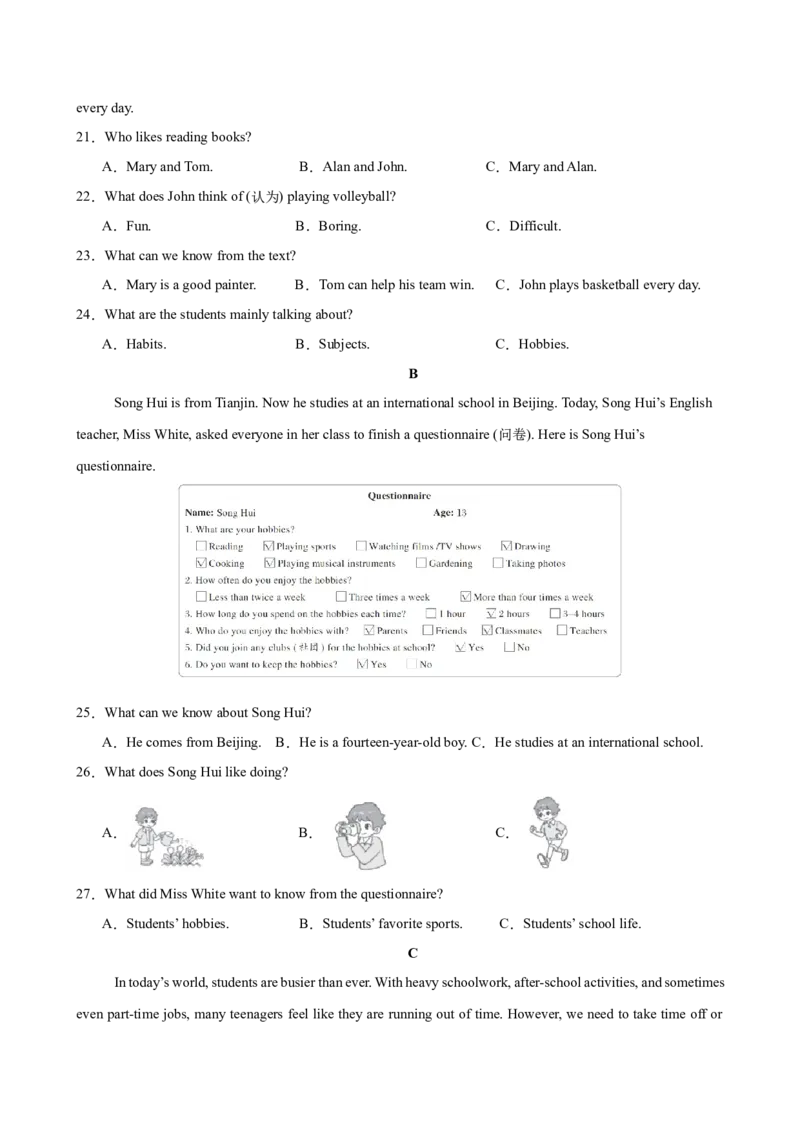
Song Hui is from Tianjin. Now he studies at an international school in Beijing. Today, Song Hui’s English
teacher, Miss White, asked everyone in her class to finish a questionnaire (问卷). Here is Song Hui’s
questionnaire.
25.What can we know about Song Hui?
A.He comes from Beijing. B.He is a fourteen-year-old boy.C.He studies at an international school.
26.What does Song Hui like doing?
A. B. C.
27.What did Miss White want to know from the questionnaire?
A.Students’ hobbies. B.Students’ favorite sports. C.Students’ school life.
C
In today’s world, students are busier than ever. With heavy schoolwork, after-school activities, and sometimes
even part-time jobs, many teenagers feel like they are running out of time. However, we need to take time off orhave breaks from our busy lives.
First, time off helps improve our mental (心理的) health. Think about the last time you studied for hours
without a break. Your mind probably felt tired, and it was hard to focus. Scientists say that our brains (大脑) need
rest to work well. When we take time off, we can relax and clear our minds. For example, going for a walk in nature,
listening to music, or talking with friends can all help us feel better.
Second, time off can boost creativity. When we walk away from our homework, we open ourselves up to
new experiences and ideas. Many great inventions and works of art came from people who took time away from
their daily jobs to find new things. Even if we are not artists or inventors, taking time off can help us find better
ways in our studies.
Some students might say, “I’m too busy to take a break. I have too much homework!” But in fact, taking
short breaks can make us more productive (有效的) . A study showed that students who took regular (有规律的)
breaks while studying remembered more information than those who kept studying. After breaks, we can finish our
work faster and with fewer mistakes. That’s because our minds need time off to grow and develop.
Time off is important for building relationships. Spending time with family and friends during breaks allows
us to communicate and share experiences. These moments create memories that last a lifetime. For example, having
dinner with your family or playing games with your friends can strengthen your relationships and make you feel
loved and supported.
In conclusion, time off is important for our well-being, creativity, productivity, and relationships. As students,
we should make sure that we have certain time for relaxation and fun. Remember, a well-rested mind is a happy and
successful mind. So, next time you feel tired after a day’s work, take a deep breath, walk away from your tasks, and
enjoy some time off!
28. What does the underlined word “boost” in Paragraph 3 probably mean?
A.Reduce B.Harm C.Increase
29.What does Paragraph 4 mainly tell us?
A.Students are too busy to take breaks.
B.Taking breaks can make students more productive.
C.Students should study continuously to remember more.
30. Which of the following is the best title for the passage?
A.How to study better
B.The importance of time off
C.Ways to build relationships第二节(共5小题;每小题2分,满分10分)
阅读下面短文,从短文后的选项中选出可以填入空白处的最佳选项。每个选项仅使用一次。
I love reading. I spend over seven hours a week reading different kinds of books. 31 I read a lot
at the weekend.
I am interested in foreign novels. I enjoy reading the books of Robert Louis Stevenson because I find them
really interesting. For example, Treasure Island tells the story of a young boy who sailed the sea to look for the
hidden (隐藏的) treasure. 32
His story gave me a lot of confidence. After reading the book, I am not shy as before and I like to try new
things. I also want to travel and have exciting experiences in the future. 33 Maybe I can become a writer
when I grow up.
I get most of my books from Sunshine Library—it is just opposite my home. My friends give me lots of
advice on books. 34
Reading is always a wonderful time. Good books are good friends. 35 They also open up a whole
new world to me.
A.Jim, the main (主要的) character in the book, is very brave (勇敢).
B.We often meet together and talk about what to read.
C.They help me relax after a busy day.
D.On weekdays, I often read for about half an hour before going to bed.
E.What’s more, I have decided to write my own stories.
第三部分:语言运用(共两节,满分25分)
第一节(共10小题;每小题1.5分,满分15分)
阅读下面短文,从每题所给的A、B、C三个选项中选出可以填入空白处的最佳选项。
When I was 15, life was always boring. I didn’t really care to notice the differences among the students in
my school. But this changed when my parents bought me a 36 for the Spring Festival.
Even though I didn’t know anything about photography, I 37 great interest in the new hobby. I
kept taking photos of different people and plants.
Then after a month, I realized I had no 38 for taking pictures. My photos were clearly missing
something and not creative. Soon, I became so angry with myself that I 39 my new hobby.
During the summer vacation, I went for a walk on the railroad track (铁轨). The tracks had a warm red
color. It was an amazing sight to 40 . Before the walk, I thought, “Maybe I should bring my camera. It
hadn’t been touched for weeks.”
Surprisingly, this walk on the tracks began my 41 for photography. When I was walking on thetrain tracks, there was only nature around me. I realized how important it was to look at the details of things. I didn’t
worry about trying to 42 something beautiful. Instead, I just captured (捕捉) the beauty already around
me.
After months of studying outdoor scenes, I was 43 able to create beauty of my own. So far, my
work has been published (发表) in two small magazines. They are 44 to me because they show how
much my artistic abilities have increased: I went from zero talent to being published. And my photos have become
something I am proud of.
Thanks to this gift from my 45 , I now have a new way of looking at the world. I can enjoy the
world better than others.
36.A.book B.camera C.magazine
37.A.offered B.showed C.shared
38.A.time B.energy C.talent
39.A.gave away B.gave up C.gave out
40.A.speak B.read C.see
41.A.hope B.fear C.love
42.A.create B.discover C.draw
43.A.really B.finally C.nearly
44.A.boring B.important C.relaxing
45.A.friends B.teachers C.parents
第二节(共10小题;每小题1分,满分10分)
阅读下面短文,在空白处填入一个适当的单词或用括号内所给单词的适当形式填空。
As long as you don’t give up, you’ll get better at it over time. This is a simple but meaningful sentence. I used
to be afraid of 46 (fail) in exams. My mother always told me that I should get over my fear of failure and
just try 47 (have) fun. She also said that it was lucky 48 (have) a chance to learn new things
every day.
I love horse riding because I enjoy 49 (be) in nature. 50 (ride) horses makes me feel
relaxed. So far, I have ridden (骑) horses 51 two years. My coach is strict 52 me, but he is
also very kind. He often inspires me 53 (keep) practicing.
54 (surprising), I won a prize in a horse riding competition last week. Importantly, I learned a lot
from this competition. I know that perseverance (坚持) is very important. As long as we don’t give up, we 55
(get) what we want. I’m lucky to have such a good hobby. It not only makes me happy but also inspires me to facedifficulties bravely.
第四部分:读写综合(共两节,满分25分)
第一节(共5小题;每小题2分,满分10分)
阅读短文,根据短文内容回答问题。
As the “Double Reduction Policy” was introduced in China, students are encouraged to take part in more
after-class activities. Some students were invited to an interview about after-class activities by the local English
newspaper in Guangzhou to share their opinions. The following is what they said in the interview.
Susie (a 15-year-old girl): In our school, after-class activities are very popular. With less homework now,
students in our school have more time to enjoy many different kinds of after-class activities, such as the English
corner, swimming, playing the piano and singing. I take part in the chess club. I play with other club members after
class every day.
Tracy (a 14-year-old girl): I’m a member of the music club in our school. I can learn different kinds of musical
instruments, including the violin, the piano and the guitar and so on. I like playing the piano best because it’s very
interesting.
Eric (a 13-year-old boy): I take part in the poetry club after class. I have learnt a lot from the activities which
are held by the club. I can not only improve my skill of poem writing, but also make a lot of new friends with those
who have the same hobbies.
Mike (a 14-year-old boy): Some teachers think after-class activities take up too much time. In their opinions,
we are already under great pressure with too much homework to do. But I think it’s necessary to have some after-
class activities. They can provide us with a chance to develop our other skills besides what we are taught in class.
What’s more, after-class activities can help us relax.
56.What is the interview about?
57.When does Susie play with other club members?
58.Why does Tracy like playing the piano best?
59.How many advantages does Eric get after taking part in the poetry club?
60.What does Mike think of after-class activities?
第二节(共1小题;满分15分)根据要求完成短文写作。
61.爱好对我们意义重大。假如你是李华,你的美国笔友 Mary给你写了一封邮件想要了解你的爱好。请
你根据以下提示信息,用英文给她回复一封词数100左右的邮件,向她介绍你的爱好。
提示问题:
1. What’s your hobby?
2. When did you start it and how do you develop your hobby?
3. What does your hobby bring you?
Dear Mary,
Thank you for your last e-mail and I’d like to tell you something about my hobby.
___________________________________________________________________________________________
___________________________________________________________________________________________
___________________________________________________________________________________________
___________________________________________________________________________________________
___________________________________________________________________________________________
___________________________________________________________________________________________
_______________________________
Yours,
Li Hua