Unit 1 Time to Relax(复习讲义)
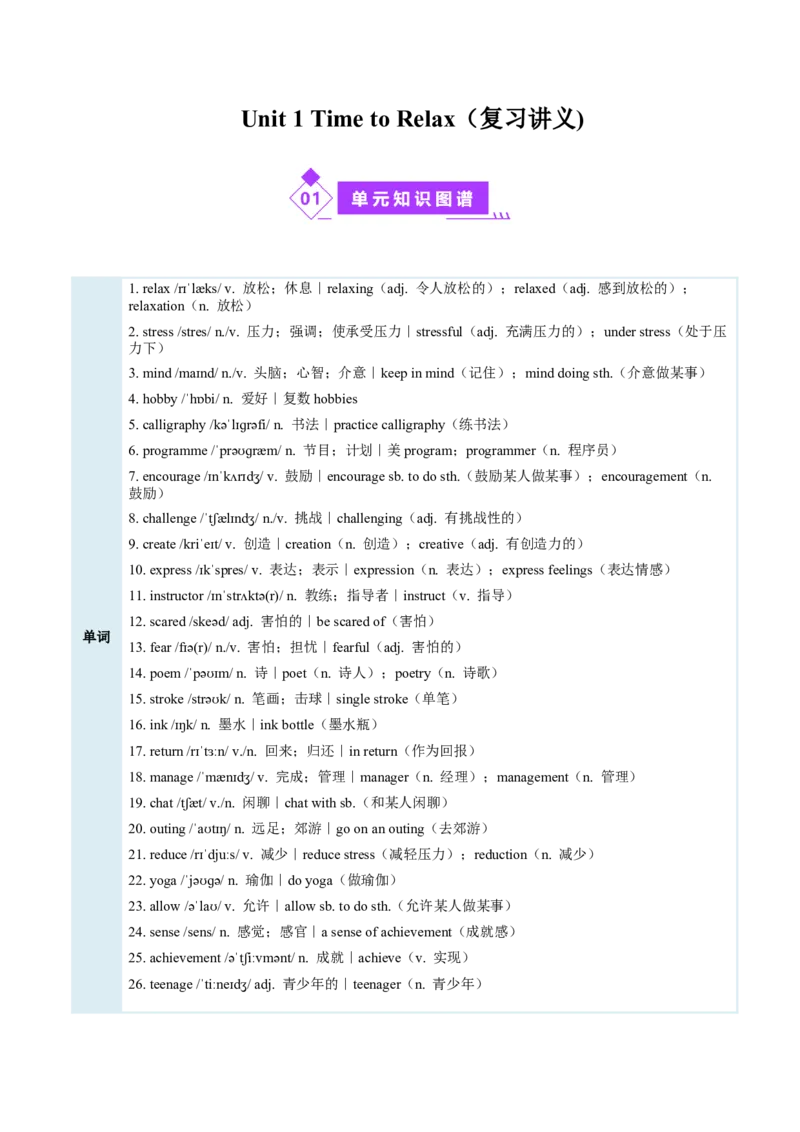
1. relax /rɪˈlæks/ v. 放松;休息|relaxing(adj. 令人放松的);relaxed(adj. 感到放松的);
relaxation(n. 放松)
2. stress /stres/ n./v. 压力;强调;使承受压力|stressful(adj. 充满压力的);under stress(处于压
力下)
3. mind /maɪnd/ n./v. 头脑;心智;介意|keep in mind(记住);mind doing sth.(介意做某事)
4. hobby /ˈhɒbi/ n. 爱好|复数hobbies
5. calligraphy /kəˈlɪɡrəfi/ n. 书法|practice calligraphy(练书法)
6. programme /ˈprəʊɡræm/ n. 节目;计划|美program;programmer(n. 程序员)
7. encourage /ɪnˈkʌrɪdʒ/ v. 鼓励|encourage sb. to do sth.(鼓励某人做某事);encouragement(n.
鼓励)
8. challenge /ˈtʃælɪndʒ/ n./v. 挑战|challenging(adj. 有挑战性的)
9. create /kriˈeɪt/ v. 创造|creation(n. 创造);creative(adj. 有创造力的)
10. express /ɪkˈspres/ v. 表达;表示|expression(n. 表达);express feelings(表达情感)
11. instructor /ɪnˈstrʌktə(r)/ n. 教练;指导者|instruct(v. 指导)
12. scared /skeəd/ adj. 害怕的|be scared of(害怕)
单词
13. fear /fɪə(r)/ n./v. 害怕;担忧|fearful(adj. 害怕的)
14. poem /ˈpəʊɪm/ n. 诗|poet(n. 诗人);poetry(n. 诗歌)
15. stroke /strəʊk/ n. 笔画;击球|single stroke(单笔)
16. ink /ɪŋk/ n. 墨水|ink bottle(墨水瓶)
17. return /rɪˈtɜːn/ v./n. 回来;归还|in return(作为回报)
18. manage /ˈmænɪdʒ/ v. 完成;管理|manager(n. 经理);management(n. 管理)
19. chat /tʃæt/ v./n. 闲聊|chat with sb.(和某人闲聊)
20. outing /ˈaʊtɪŋ/ n. 远足;郊游|go on an outing(去郊游)
21. reduce /rɪˈdjuːs/ v. 减少|reduce stress(减轻压力);reduction(n. 减少)
22. yoga /ˈjəʊɡə/ n. 瑜伽|do yoga(做瑜伽)
23. allow /əˈlaʊ/ v. 允许|allow sb. to do sth.(允许某人做某事)
24. sense /sens/ n. 感觉;感官|a sense of achievement(成就感)
25. achievement /əˈtʃiːvmənt/ n. 成就|achieve(v. 实现)
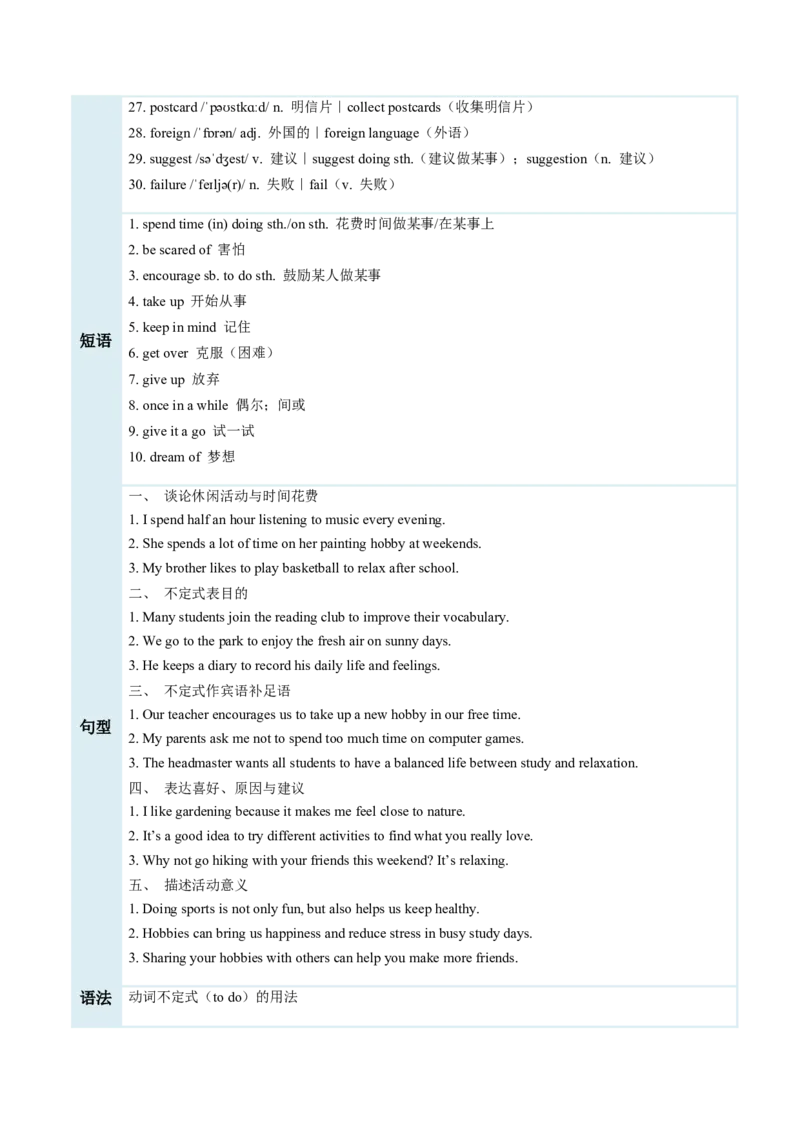
26. teenage /ˈtiːneɪdʒ/ adj. 青少年的|teenager(n. 青少年)27. postcard /ˈpəʊstkɑːd/ n. 明信片|collect postcards(收集明信片)
28. foreign /ˈfɒrən/ adj. 外国的|foreign language(外语)
29. suggest /səˈdʒest/ v. 建议|suggest doing sth.(建议做某事);suggestion(n. 建议)
30. failure /ˈfeɪljə(r)/ n. 失败|fail(v. 失败)
1. spend time (in) doing sth./on sth. 花费时间做某事/在某事上
2. be scared of 害怕
3. encourage sb. to do sth. 鼓励某人做某事
4. take up 开始从事
5. keep in mind 记住
短语
6. get over 克服(困难)
7. give up 放弃
8. once in a while 偶尔;间或
9. give it a go 试一试
10. dream of 梦想
一、 谈论休闲活动与时间花费
1. I spend half an hour listening to music every evening.
2. She spends a lot of time on her painting hobby at weekends.
3. My brother likes to play basketball to relax after school.
二、 不定式表目的
1. Many students join the reading club to improve their vocabulary.
2. We go to the park to enjoy the fresh air on sunny days.
3. He keeps a diary to record his daily life and feelings.
三、 不定式作宾语补足语
1. Our teacher encourages us to take up a new hobby in our free time.
句型
2. My parents ask me not to spend too much time on computer games.
3. The headmaster wants all students to have a balanced life between study and relaxation.
四、 表达喜好、原因与建议
1. I like gardening because it makes me feel close to nature.
2. It’s a good idea to try different activities to find what you really love.
3. Why not go hiking with your friends this weekend? It’s relaxing.
五、 描述活动意义
1. Doing sports is not only fun, but also helps us keep healthy.
2. Hobbies can bring us happiness and reduce stress in busy study days.
3. Sharing your hobbies with others can help you make more friends.
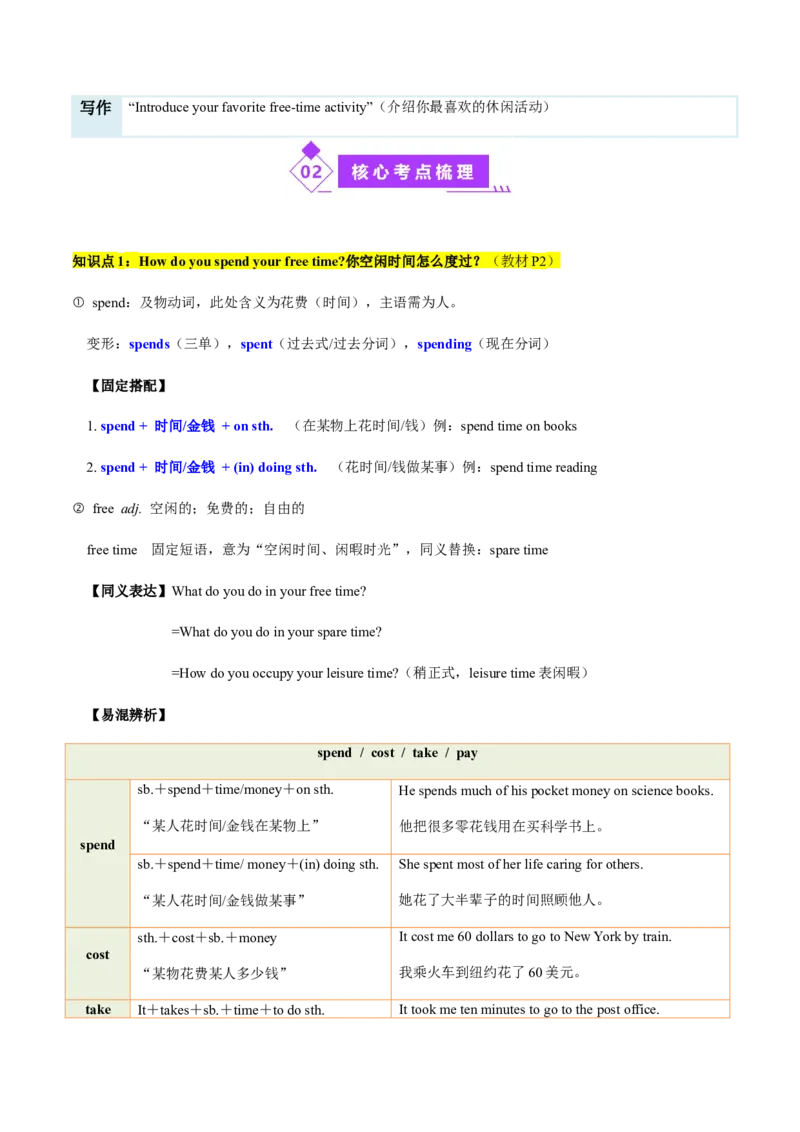
语法 动词不定式(to do)的用法写作 “Introduce your favorite free-time activity”(介绍你最喜欢的休闲活动)
知识点1:How do you spend your free time?你空闲时间怎么度过?(教材P2)
① spend:及物动词,此处含义为花费(时间),主语需为人。
变形:spends(三单),spent(过去式/过去分词),spending(现在分词)
【固定搭配】
1. spend + 时间/金钱 + on sth. (在某物上花时间/钱)例:spend time on books
2. spend + 时间/金钱 + (in) doing sth. (花时间/钱做某事)例:spend time reading
② free adj. 空闲的;免费的;自由的
free time 固定短语,意为“空闲时间、闲暇时光”,同义替换:spare time
【同义表达】What do you do in your free time?
=What do you do in your spare time?
=How do you occupy your leisure time?(稍正式,leisure time表闲暇)
【易混辨析】
spend / cost / take / pay
sb.+spend+time/money+on sth. He spends much of his pocket money on science books.
“某人花时间/金钱在某物上” 他把很多零花钱用在买科学书上。
spend
sb.+spend+time/ money+(in) doing sth. She spent most of her life caring for others.
“某人花时间/金钱做某事” 她花了大半辈子的时间照顾他人。
sth.+cost+sb.+money It cost me 60 dollars to go to New York by train.
cost
“某物花费某人多少钱” 我乘火车到纽约花了60美元。
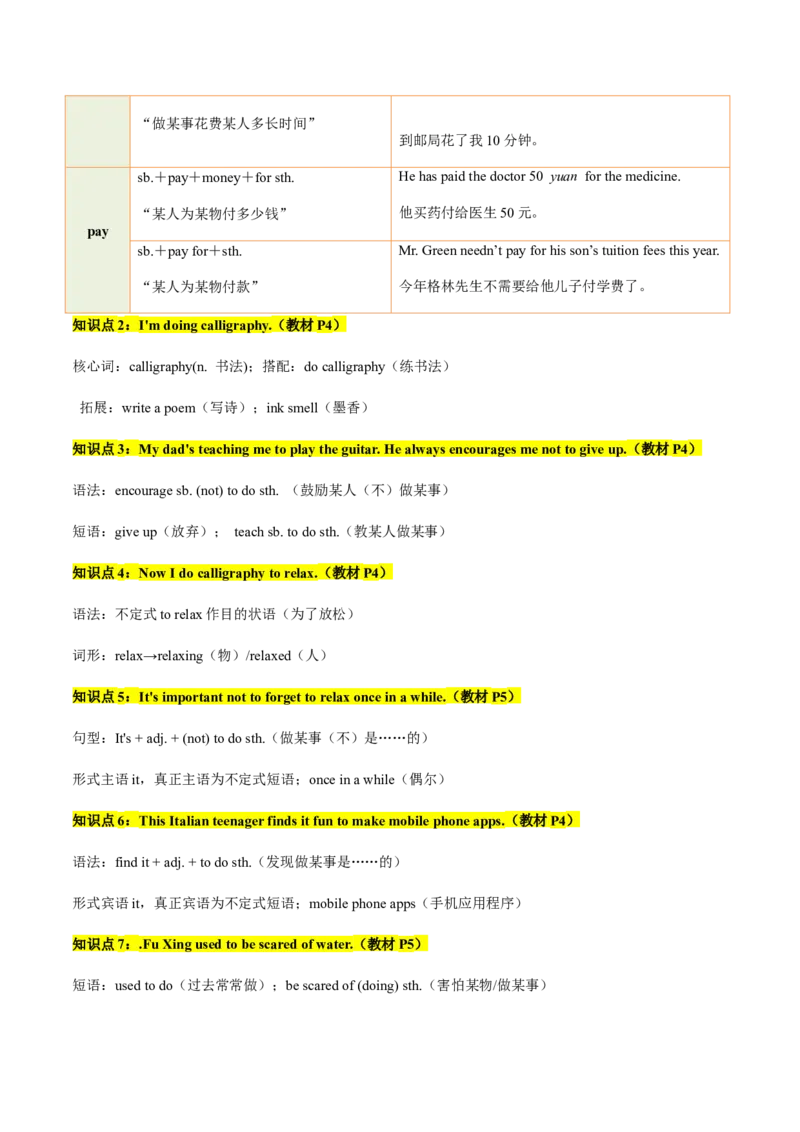
take It+takes+sb.+time+to do sth. It took me ten minutes to go to the post office.“做某事花费某人多长时间”
到邮局花了我10分钟。
sb.+pay+money+for sth. He has paid the doctor 50 yuan for the medicine.
“某人为某物付多少钱” 他买药付给医生50元。
pay
sb.+pay for+sth. Mr. Green needn’t pay for his son’s tuition fees this year.
“某人为某物付款” 今年格林先生不需要给他儿子付学费了。
知识点2:I'm doing calligraphy.(教材P4)
核心词:calligraphy(n. 书法);搭配:do calligraphy(练书法)
拓展:write a poem(写诗);ink smell(墨香)
知识点3:My dad's teaching me to play the guitar. He always encourages me not to give up.(教材P4)
语法:encourage sb. (not) to do sth. (鼓励某人(不)做某事)
短语:give up(放弃); teach sb. to do sth.(教某人做某事)
知识点4:Now I do calligraphy to relax.(教材P4)
语法:不定式to relax作目的状语(为了放松)
词形:relax→relaxing(物)/relaxed(人)
知识点5:It's important not to forget to relax once in a while.(教材P5)
句型:It's + adj. + (not) to do sth.(做某事(不)是……的)
形式主语it,真正主语为不定式短语;once in a while(偶尔)
知识点6:This Italian teenager finds it fun to make mobile phone apps.(教材P4)
语法:find it + adj. + to do sth.(发现做某事是……的)
形式宾语it,真正宾语为不定式短语;mobile phone apps(手机应用程序)
知识点7:.Fu Xing used to be scared of water.(教材P5)
短语:used to do(过去常常做);be scared of (doing) sth.(害怕某物/做某事)拓展:scare(v. 使害怕)→scary(adj. 吓人的)
知识点8:.Reading or listening to music can help us to calm down after a busy day.(教材P5)
语法:help sb. (to) do sth.(帮助某人做某事),to可省
短语:calm down(冷静下来);busy day(忙碌的一天)
知识点9:Physical hobbies, such as playing tennis or doing yoga, can help us to keep fit.(教材P5)
辨析:such as(列举同类多个例子)vs for example(举一个例子,常单独成句)
短语:keep fit(保持健康);physical hobbies(体育类爱好)
知识点10:Fu Xing told Emma that no one expected her to be perfect from the start.(教材P5)
语法:宾语从句;expect sb. to do sth.(期望某人做某事)
短语:from the start(从一开始);be perfect(完美)
单元语法:动词不定式
1. 动词不定式的结构
(1)肯定式:to + 动词原形
(2)否定式:not to do + 动词原形
动词不定式由to+动词原形构成。这里的to是不定式标志,没有词义。不定式具有名词、形容词或副
词的某些语法功能,又有动词的时态和语态的特点及作用。可以做主语、宾语、表语、定语、状语、宾语
补足语。动词不定式一般不能单独作谓语。
2. 动词不定式的用法
一、 作目的状语
1. 功能:用来表示主句动作的目的,可译为“为了……”。
2. 位置:一般放在句末;若要强调目的,可置于句首,用逗号与主句隔开。
3. 单元例句
(1) He plays basketball to relax after school.
(2)To improve his handwriting, he practices calligraphy every day.4. 拓展:可与 in order to do 互换,语气更强烈,如 She reads widely in order to gain more knowledge.
二、 作宾语补足语
1. 功能:放在宾语之后,补充说明宾语要执行的动作。
2. 单元高频动词: ask, want, encourage, expect
3. 固定结构:动词 + sb. + to do sth.
4. 单元例句
- My teacher encourages me to take up a new hobby.
- The parents want their kids to balance study and play.
5. 注意:使役动词( make, let, have )和感官动词( see, watch, hear )后接宾补时,需省略 to ,例
The teacher made him clean the classroom.
单元写作:介绍你最喜欢的休闲活动
本单元写作核心:“Introduce your favorite free-time activity”(介绍你最喜欢的休闲活动),需涵盖:
活动名称、开始时间、具体做法、喜欢的原因(如放松身心、提升能力、结交朋友等),并灵活运用 动
词不定式(表目的) 和单元重点短语(如take up, spend...doing..., keep in mind等)。
写作框架(三段式结构)
第一段:引出爱好(开门见山+基本信息)
核心内容:点明最喜欢的休闲活动、开始时间/契机。
常用句型:
1. My favorite free-time activity is ______, which I have been doing for ______ years.
2. I first took up ______ when I was ______ years old, and it has become an important part of my life.
3. When I feel stressed, ______ is always my go-to way to relax.
第二段:描述爱好(具体做法+细节)
核心内容:如何进行该活动、花费的时间、参与的形式(如独自/和朋友、线上/线下)。常用句型:
1. Every weekend, I spend about two hours ______ (doing sth.). For example, I often ______ or ______.
2. To do it well, I usually ______ (e.g., read related books, watch tutorial videos, practice with my classmates).
3. Sometimes I join a club to ______ (表目的,如 learn from others, make new friends who share the same
hobby).
第三段:阐述意义(喜欢的原因+带来的收获)
核心内容:活动带来的好处(放松、提升自我、丰富生活等),总结对自己的影响。
常用句型:
1. I love ______ because it not only helps me relax after a long week of study but also teaches me ______ (e.g.,
patience, creativity, how to solve problems).
2. Through this activity, I have become more ______ (e.g., confident, calm, outgoing) and learned to balance study
and relaxation.
巩固练习
(时间:30分钟,满分:50分)
一、单项选择(本大题共10小题,每小题1分,共10分)
1. She goes to the library ______ some books about hobbies.
A. borrow B. to borrow C. borrowing D. borrowed
2. Our teacher encourages us ______ part in the calligraphy competition.
A. take B. taking C. to take D. took
3. My parents want me ______ a balance between study and relaxation.
A. keep B. to keep C. keeping D. kept
4. ______ stress, we can listen to soft music in our free time.
A. Reduce B. Reducing C. To reduce D. Reduced
5. He finished his homework first ______ he could watch his favourite programme.
A. so that B. to C. in order to D. for6. We need ______ a hobby to make our life more colorful.
A. to develop B. develop C. developing D. developed
7. She joined the music club ______ improve her singing skills.
A. so that B. in order to C. because of D. thanks to
8. My teacher encourages us ______ more time on outdoor activities.
A. spend B. to spend C. spending D. spent
9. ______ reduce stress, many students listen to soft music after class.
A. To B. For C. With D. On
10. He expects ______ the school calligraphy competition next month.
A. win B. to win C. winning D. won
二、用所给动词的适当形式填空(每题2分,共10分)
1. My parents want me ______ (balance) study and relaxation.
2. She practices ______ (paint) every day ______ (become) an artist.
3. The teacher told us ______ (not be) afraid of making mistakes in our hobbies.
4. ______ (relax) himself, he often goes for a walk in the park after dinner.
5. We plan ______ (join) the school hobby club next week.
三、句型转换(本大题共5小题,每小题2分,共10分)
1. He reads English every morning. He wants to improve his English level.(合并为一句,用不定式表目的)
____________________________________________________________________________________________
2. The coach asked the players to train hard.(改为否定句)
____________________________________________________________________________________________
3. We should learn to play an instrument to make friends.
____________________________________________________________________________________________
4. She likes playing the piano because it can help her relax.(用不定式改写)
____________________________________________________________________________________________
5. The teacher told us, “Don’t forget to bring your hobby works tomorrow.”(改为间接引语)
→ The teacher told us ______ ______ forget to bring our hobby works the next day.四、阅读理解(本大题共5小题,每小题2分,共10分)
Hobbies are more than just fun activities—they play an important role in teenagers’ development. When we
take up a hobby, we not only relax our minds but also learn new skills. For example, learning to play a musical
instrument teaches us patience and discipline. Painting helps us improve our creativity and observation. Even
simple hobbies like gardening can make us feel responsible as we take care of plants.
Moreover, hobbies can help us make friends with similar interests. Joining a hobby club allows us to share
experiences and learn from each other. It’s also a great way to reduce stress from schoolwork. When we focus on
something we enjoy, we can forget our worries and feel more relaxed.
However, it’s important to balance hobbies and study. We shouldn’t spend too much time on hobbies that it
affects our schoolwork. The key is to choose hobbies that are meaningful and help us grow.
1. What is the main idea of the passage?
A. Hobbies are only for fun. B. Hobbies help teenagers develop.
C. How to choose a good hobby. D. The importance of balancing study and hobbies.
2. Which skill can we learn from playing a musical instrument?
A. Creativity B. Observation C. Patience D. Responsibility
3. How can hobbies help us make friends?
A. By teaching us new skills. B. By reducing our stress.
C. By joining hobby clubs. D. By making us responsible.
4. What does the writer think is important about hobbies?
A. Spending as much time as possible on them.
B. Choosing hobbies that are fun but not meaningful.
C. Balancing them with study.
D. Only choosing simple hobbies.
5. The underlined word “discipline” in the passage means ______.A. 纪律 B. 自由 C. 兴趣 D. 天赋
五、语法填空(本大题共10小题,每小题1分,共10分)
阅读下面短文,在空白处填入适当的单词或用括号内单词的适当形式填空。
Everyone needs to relax in daily life. There are many ways (1) ______ (relax), and having a hobby is one of
the best choices. A hobby can be almost anything you like (2) ______ (do). Some people enjoy (3) ______ (collect)
things, while others prefer (4) ______ (create) new things.
When you have a hobby, you will feel happy and fulfilled. It can help you (5) ______ (reduce) stress and make
your life more colorful. For example, if you like painting, you can use colors (6) ______ (express) your feelings. If
you enjoy cooking, you can learn (7) ______ (make) delicious food for your family and friends.
However, it’s not good (8) ______ (spend) too much time on your hobby. You should learn (9) ______
(balance) your study, work and hobby. Remember, a good hobby should help you grow, not (10) ______ (stop) you
from making progress.