Unit 2 Stay Healthy(复习讲义)
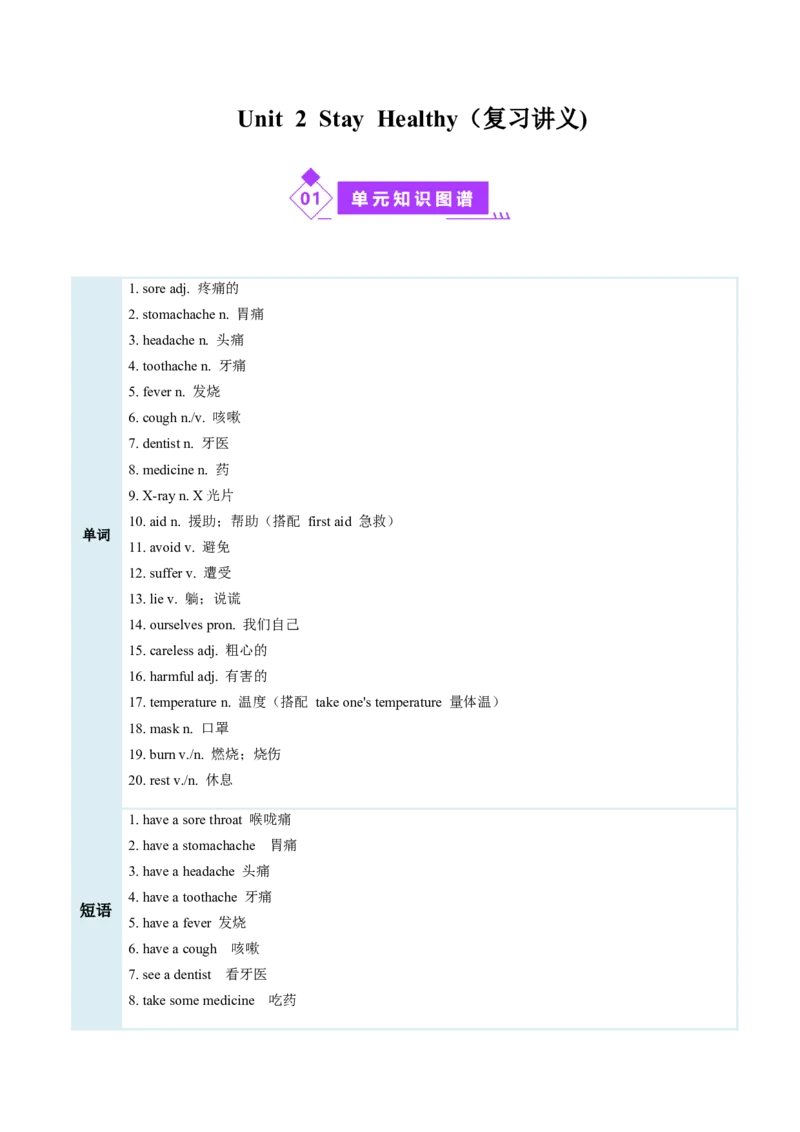
1. sore adj. 疼痛的
2. stomachache n. 胃痛
3. headache n. 头痛
4. toothache n. 牙痛
5. fever n. 发烧
6. cough n./v. 咳嗽
7. dentist n. 牙医
8. medicine n. 药
9. X-ray n. X光片
10. aid n. 援助;帮助(搭配 first aid 急救)
单词
11. avoid v. 避免
12. suffer v. 遭受
13. lie v. 躺;说谎
14. ourselves pron. 我们自己
15. careless adj. 粗心的
16. harmful adj. 有害的
17. temperature n. 温度(搭配 take one's temperature 量体温)
18. mask n. 口罩
19. burn v./n. 燃烧;烧伤
20. rest v./n. 休息
1. have a sore throat 喉咙痛
2. have a stomachache 胃痛
3. have a headache 头痛
4. have a toothache 牙痛
短语
5. have a fever 发烧
6. have a cough 咳嗽
7. see a dentist 看牙医
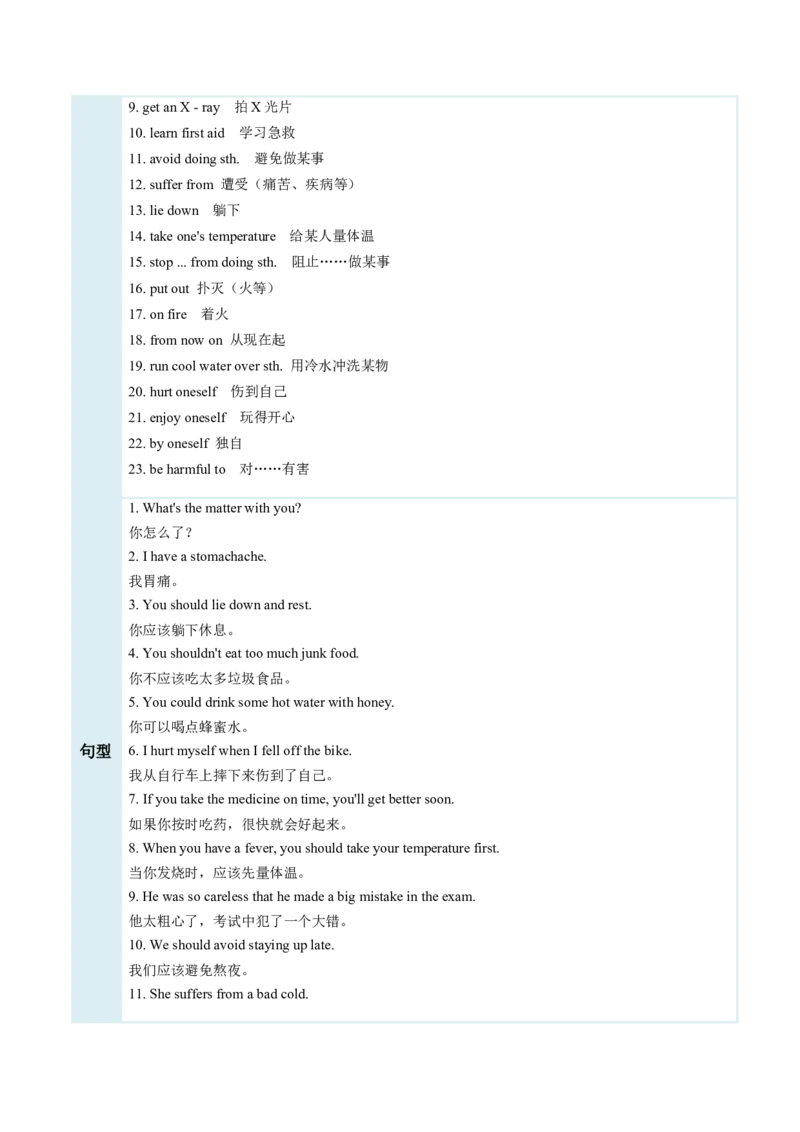
8. take some medicine 吃药9. get an X - ray 拍X光片
10. learn first aid 学习急救
11. avoid doing sth. 避免做某事
12. suffer from 遭受(痛苦、疾病等)
13. lie down 躺下
14. take one's temperature 给某人量体温
15. stop ... from doing sth. 阻止……做某事
16. put out 扑灭(火等)
17. on fire 着火
18. from now on 从现在起
19. run cool water over sth. 用冷水冲洗某物
20. hurt oneself 伤到自己
21. enjoy oneself 玩得开心
22. by oneself 独自
23. be harmful to 对……有害
1. What's the matter with you?
你怎么了?
2. I have a stomachache.
我胃痛。
3. You should lie down and rest.
你应该躺下休息。
4. You shouldn't eat too much junk food.
你不应该吃太多垃圾食品。
5. You could drink some hot water with honey.
你可以喝点蜂蜜水。
句型 6. I hurt myself when I fell off the bike.
我从自行车上摔下来伤到了自己。
7. If you take the medicine on time, you'll get better soon.
如果你按时吃药,很快就会好起来。
8. When you have a fever, you should take your temperature first.
当你发烧时,应该先量体温。
9. He was so careless that he made a big mistake in the exam.
他太粗心了,考试中犯了一个大错。
10. We should avoid staying up late.
我们应该避免熬夜。
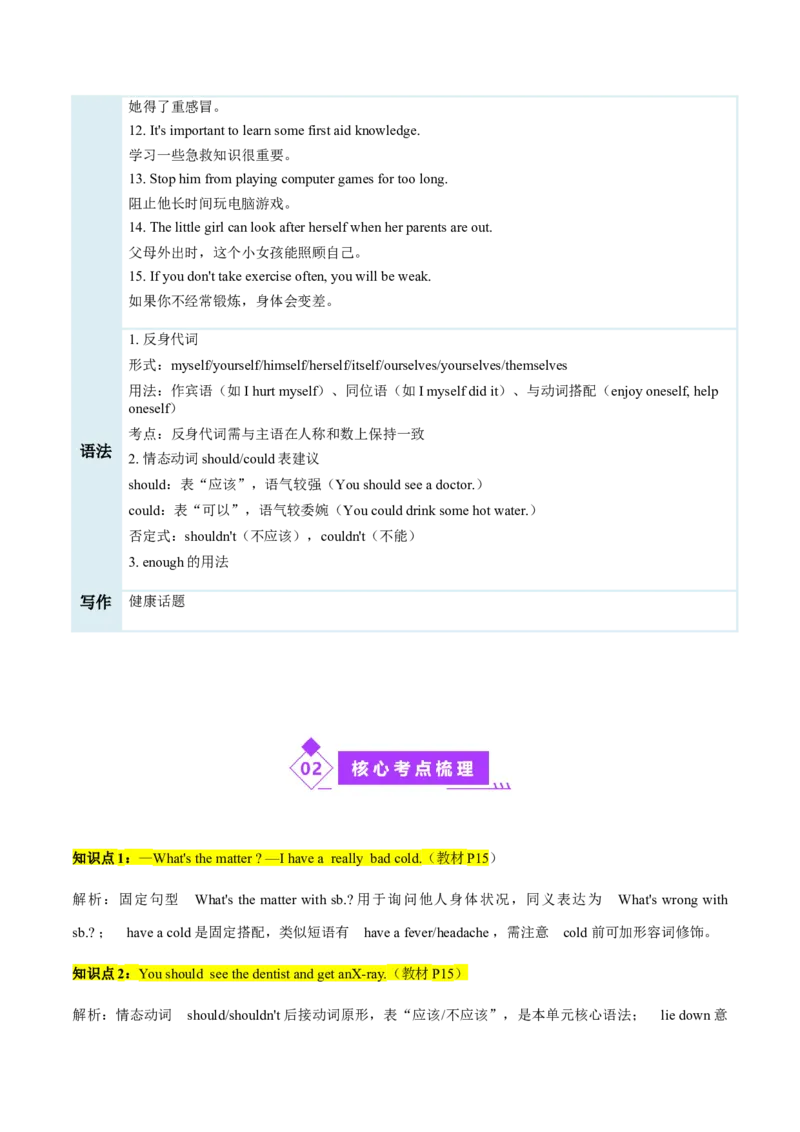
11. She suffers from a bad cold.她得了重感冒。
12. It's important to learn some first aid knowledge.
学习一些急救知识很重要。
13. Stop him from playing computer games for too long.
阻止他长时间玩电脑游戏。
14. The little girl can look after herself when her parents are out.
父母外出时,这个小女孩能照顾自己。
15. If you don't take exercise often, you will be weak.
如果你不经常锻炼,身体会变差。
1. 反身代词
形式:myself/yourself/himself/herself/itself/ourselves/yourselves/themselves
用法:作宾语(如I hurt myself)、同位语(如I myself did it)、与动词搭配(enjoy oneself, help
oneself)
考点:反身代词需与主语在人称和数上保持一致
语法
2. 情态动词should/could表建议
should:表“应该”,语气较强(You should see a doctor.)
could:表“可以”,语气较委婉(You could drink some hot water.)
否定式:shouldn't(不应该),couldn't(不能)
3. enough的用法
写作 健康话题
知识点1:—What's the matter ? —I have a really bad cold.(教材P15)
解析:固定句型 What's the matter with sb.? 用于询问他人身体状况,同义表达为 What's wrong with
sb.? ; have a cold 是固定搭配,类似短语有 have a fever/headache ,需注意 cold 前可加形容词修饰。
知识点2:You should see the dentist and get anX-ray.(教材P15)
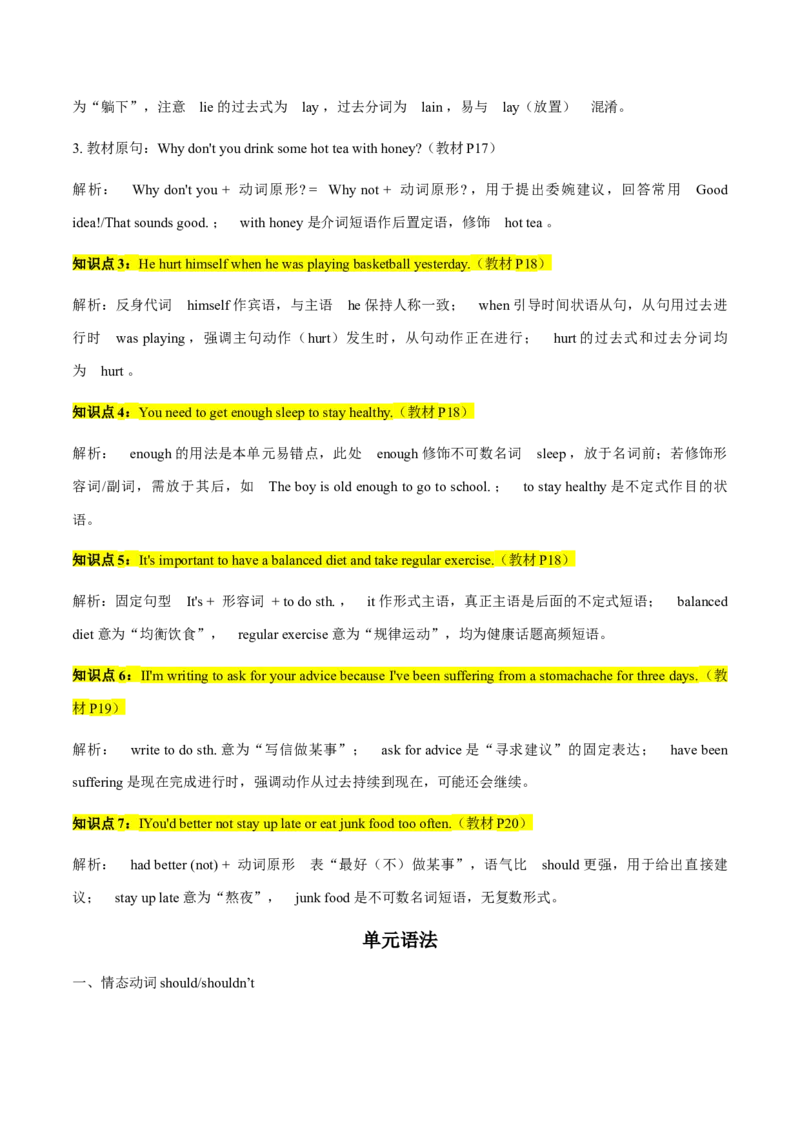
解析:情态动词 should/shouldn't 后接动词原形,表“应该/不应该”,是本单元核心语法; lie down 意为“躺下”,注意 lie 的过去式为 lay ,过去分词为 lain ,易与 lay(放置) 混淆。
3. 教材原句:Why don't you drink some hot tea with honey?(教材P17)
解析: Why don't you + 动词原形? = Why not + 动词原形? ,用于提出委婉建议,回答常用 Good
idea!/That sounds good. ; with honey 是介词短语作后置定语,修饰 hot tea 。
知识点3:He hurt himself when he was playing basketball yesterday.(教材P18)
解析:反身代词 himself 作宾语,与主语 he 保持人称一致; when 引导时间状语从句,从句用过去进
行时 was playing ,强调主句动作(hurt)发生时,从句动作正在进行; hurt 的过去式和过去分词均
为 hurt 。
知识点4:You need to get enough sleep to stay healthy.(教材P18)
解析: enough 的用法是本单元易错点,此处 enough 修饰不可数名词 sleep ,放于名词前;若修饰形
容词/副词,需放于其后,如 The boy is old enough to go to school. ; to stay healthy 是不定式作目的状
语。
知识点5:It's important to have a balanced diet and take regular exercise.(教材P18)
解析:固定句型 It's + 形容词 + to do sth. , it 作形式主语,真正主语是后面的不定式短语; balanced
diet 意为“均衡饮食”, regular exercise 意为“规律运动”,均为健康话题高频短语。
知识点6:II'm writing to ask for your advice because I've been suffering from a stomachache for three days.(教
材P19)
解析: write to do sth. 意为“写信做某事”; ask for advice 是“寻求建议”的固定表达; have been
suffering 是现在完成进行时,强调动作从过去持续到现在,可能还会继续。
知识点7:IYou'd better not stay up late or eat junk food too often.(教材P20)
解析: had better (not) + 动词原形 表“最好(不)做某事”,语气比 should 更强,用于给出直接建
议; stay up late 意为“熬夜”, junk food 是不可数名词短语,无复数形式。
单元语法
一、情态动词should/shouldn’t1. 基本含义与功能
本单元中should/shouldn’t主要用于提出建议、给出劝告,针对健康问题、病症处理和生活习惯给出合理指
引,没有人称和数的变化,后接动词原形。
2. 肯定句结构
主语 + should + 动词原形 + 其他。
例:You should drink warm water when you have a sore throat.(当你喉咙痛时,应该多喝温水)
例:She should lie down and rest for an hour.(她应该躺下休息一小时)
3. 否定句结构
直接在should后加not,缩写为shouldn’t,结构为“主语 + shouldn’t + 动词原形 + 其他”。
例:You shouldn’t eat cold food with a stomachache.(胃疼时不应该吃生冷食物)
例:We shouldn’t stay up late if we want to keep healthy.(想要保持健康,我们就不应该熬夜)
4. 疑问句结构
将should提至句首,构成“Should + 主语 + 动词原形 + 其他?”,答语常用“Yes, 主语 + should./No,
主语 + shouldn’t.”。
例:—Should I take this medicine three times a day?(我应该一天吃三次这个药吗?)
—Yes, you should.(是的,你应该)
—No, you shouldn’t. You can take it twice a day.(不,不用。你可以一天吃两次)
二、反身代词
1. 基本形式
反身代词表示动作作用于主语自身,本单元涉及的常见反身代词有:myself(我自己)、yourself(你自
己)、himself(他自己)、herself(她自己)、itself(它自己)、ourselves(我们自己)、yourselves(你
们自己)、themselves(他们自己)。
2. 常见用法
(1)作宾语,强调主语动作的承受者是主语本身,常与 hurt, cut, take care of, look after等词搭配,贴合本单元受伤、自我护理的语境。
例:He hurt himself when he played basketball yesterday.(他昨天打篮球时伤到了自己)
例:You should take good care of yourself when your parents are not at home.(父母不在家时,你要好好照顾
自己)
(2)用于固定搭配,本单元高频搭配有by oneself(独自)、enjoy oneself(玩得开心)等。
例:She can take the medicine by herself.(她可以自己吃药)
三、enough的用法
enough既可以作形容词,也可以作副词,核心考点是修饰名词和形容词/副词时的位置差异。
1. 作形容词,修饰名词
意为“足够的”,此时enough要放在名词前面,结构为“enough + 名词”。
例:We need enough water every day to keep healthy.(我们每天需要喝足够的水来保持健康)
例:You should get enough sleep if you have a fever.(如果你发烧了,要保证充足的睡眠)
2. 作副词,修饰形容词或副词
意为“足够地”,此时enough要放在形容词或副词后面,结构为“形容词/副词 + enough”。
例:The boy is not old enough to take medicine by himself.(这个男孩年纪还小,不能自己吃药)
例:He didn’t run fast enough to get help in time.(他跑得不够快,没能及时求助)
3. 常见句型
“adj./adv. + enough + to do sth.”,表示“足够……去做某事”,是本单元写作中的常用句型。
例:She is strong enough to do exercise every day.(她身体足够强壮,可以每天做运动)
单元写作
本单元作文围绕健康话题展开,核心写作任务为健康问题建议信、健康生活方式短文、急救知识介绍
文三种类型,贴合教材 Section B 3b与Self - Check的写作要求,考查学生运用情态动词、反身代词、
enough等语法知识,结合健康话题词汇进行书面表达的能力。一、核心写作主题与命题方向
1. 建议信
这是本单元最常考的写作题型,通常以“朋友/同学遇到健康问题(如感冒、胃痛、熬夜导致身体不适
等),向你寻求建议”为情境,要求学生根据病症给出合理的解决办法。
命题示例:Your friend Tom has a stomachache these days. He eats a lot of junk food and stays up late. Write a
letter to give him some advice. (80 - 100 words)
2. 健康生活方式短文
要求学生介绍自己或他人的健康生活习惯,或阐述“如何保持健康”,需要从饮食、运动、睡眠等多个角
度展开,突出健康习惯的重要性。
命题示例:Write a short passage about how to keep healthy. You can talk about diet, exercise and sleep. (80 - 120
words)
3. 急救知识介绍文
结合教材Section B 2b的急救故事,要求学生简单介绍常见意外(如割伤、烫伤)的处理方法,考查学生
对急救词汇和步骤的掌握。
命题示例:What should you do if you cut your finger? Write a short passage to tell the first - aid steps. (70 - 90
words)
二、高分写作结构与模板
(一)健康建议信模板
1. 开头:表达关心,点明对方的健康问题
I’m sorry to hear that you have a stomachache these days. I think it’s because you eat too much junk food and stay
up late.
2. 主体:给出2 - 3条具体建议,运用should/shouldn’t、had better等句型
First, you should stop eating junk food and have a balanced diet. You’d better eat more vegetables and fruit.
Second, you shouldn’t stay up late anymore. You need to get enough sleep every night. What’s more, you can take a
walk after dinner.3. 结尾:表达祝愿
I hope you will feel better soon.
(二)健康生活方式短文模板
1. 开头:点明主题——保持健康的重要性
It’s very important for us to keep healthy. Here are some good ways to help us.
2. 主体:分点阐述饮食、运动、睡眠方面的建议
First, we should have a balanced diet. We need to eat more fruit and vegetables and less junk food. Second, taking
regular exercise is necessary. We can run or play basketball every day. Third, we must get enough sleep. We
shouldn’t stay up late.
3. 结尾:总结观点
If we follow these ways, we will be healthy and happy.
巩固练习
(时间:30分钟,满分:40分)
一、单项选择(每题1分,共10分)
1. —I have a bad ____. What should I do?
—You should see a dentist.
A. headache B. toothache C. stomachache
2. You shouldn’t eat ____ food if you want to keep healthy.
A. too much B. too many C. much too
3. The boy is only 7 years old. He isn’t ____ to take care of ____.
A. old enough; himself B. enough old; himself C. old enough; him
4. —____?
—I have a feeling that CO₂ is coming out of my breath. I feel very uncomfortableA. What’s the matter B. What’s the wrong C. What are you doing
5. After he took the medicine, he felt ____.
A. much better B. path better C. path better
6. You ____ the medicine before you go to bed. It’s good for your sleep.
A. should take B. should taking C. shouldn’t take
7. He hurt ____ when he played football on the playground yesterday.
A. him B. himself C. his
8. We need to get ____ sleep every day to keep our body working well.
A. plenty of B. a lot C. a few
9. —Should I drink lots of hot water?
—____. It can make you feel better.
A. Yes, you shouldn’t B. No, you should C. Yes, you should
10. —Why don’t you ____? It’s a good way to relax.
—That’s a good idea.
A. take a walk B. taking a walk C. took a walk
二、根据汉语提示完成单词(每题1分,共10分)
1. I have a ______ (头痛), so I can't go to school today.
2. You should take this ______ (药) twice a day after meals.
3. My sister has a ______ (胃痛) because she ate too much spicy food.
4. It's important to have a ______ (均衡的) diet every day.
5. He cut his finger and put a ______ (绷带) on it by himself.
6. We need ______ (足够的) time to finish the English project.
7. She had a high ______ (发烧) and stayed in bed for three days.8. Don't ______ (停留) up late, it's bad for your health.
9. The little boy hurt ______ (他自己) when he ran on the wet floor.
10. If you have a ______ (疼痛的) throat, drink more warm water.
三、句型转换(每题2分,共10分)
1. You should drink lots of hot water.(改为否定句)
You ______ ______ lots of hot water.
2. He has a sore throat.(对划线部分提问)
______ ______ ______ with him?
3. She should see a doctor.(改为一般疑问句)
______ she ______ a doctor?
4. The girl is so young that she can’t take care of herself.(改为同义句)
The girl isn’t ______ ______ to take care of herself.
5. You’d better eat more fruit.(改为否定句)
You’d better ______ ______ more fruit.
四、语法填空(每题1分,共10分)
阅读短文,在空白处填入一个适当的单词或用括号内所给单词的适当形式填空。
It’s important for everyone to keep healthy. Here is some advice for you.
First, you should eat 1.______ balanced diet. You need to eat more vegetables and fruit, and you
shouldn’t eat too much junk food. Junk food is bad for your health and it can make you 2.______(feel)
sick easily.
Second, taking exercise regularly is necessary. You can run for 20 minutes every morning 3.______
play basketball with your friends after school. Exercise can make your body strong 4.______ help you
relax.Third, you must get enough5.______ (sleep) every night. Staying up late is a bad habit. If you
don’t sleep well, you 6.______l (feel) tired the next day. What’s more, if you have a headache, you
should7.______(lie) down and rest. You shouldn’t go to school without8.______ (take) medicine.
Last but not least, learn to look after 9.______ (you). When you cut your finger by accident, you
should wash it with clean water first, then put some medicine on it and cover it with a bandage. If the
cut is deep, you must go to see a doctor at once.
Follow these suggestions, and you 10.______(be) healthy and happy.