文档文本内容
Unit 2 Stay Healthy
表建议的情态动词(should、could)和反身代词
(时间:40分钟,满分:100分)
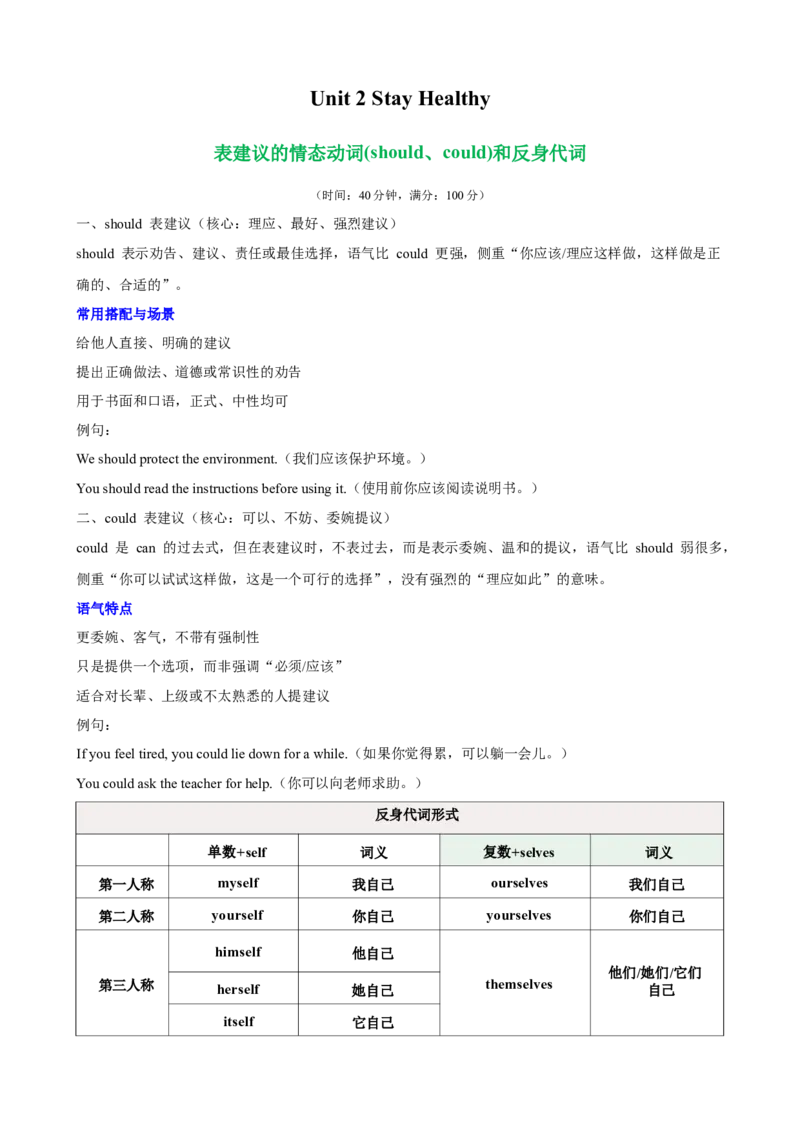
一、should 表建议(核心:理应、最好、强烈建议)
should 表示劝告、建议、责任或最佳选择,语气比 could 更强,侧重“你应该/理应这样做,这样做是正
确的、合适的”。
常用搭配与场景
给他人直接、明确的建议
提出正确做法、道德或常识性的劝告
用于书面和口语,正式、中性均可
例句:
We should protect the environment.(我们应该保护环境。)
You should read the instructions before using it.(使用前你应该阅读说明书。)
二、could 表建议(核心:可以、不妨、委婉提议)
could 是 can 的过去式,但在表建议时,不表过去,而是表示委婉、温和的提议,语气比 should 弱很多,
侧重“你可以试试这样做,这是一个可行的选择”,没有强烈的“理应如此”的意味。
语气特点
更委婉、客气,不带有强制性
只是提供一个选项,而非强调“必须/应该”
适合对长辈、上级或不太熟悉的人提建议
例句:
If you feel tired, you could lie down for a while.(如果你觉得累,可以躺一会儿。)
You could ask the teacher for help.(你可以向老师求助。)
反身代词形式
单数+self 词义 复数+selves 词义
第一人称 myself 我自己 ourselves 我们自己
第二人称 yourself 你自己 yourselves 你们自己
himself 他自己
他们/她们/它们
第三人称 themselves
herself 她自己 自己
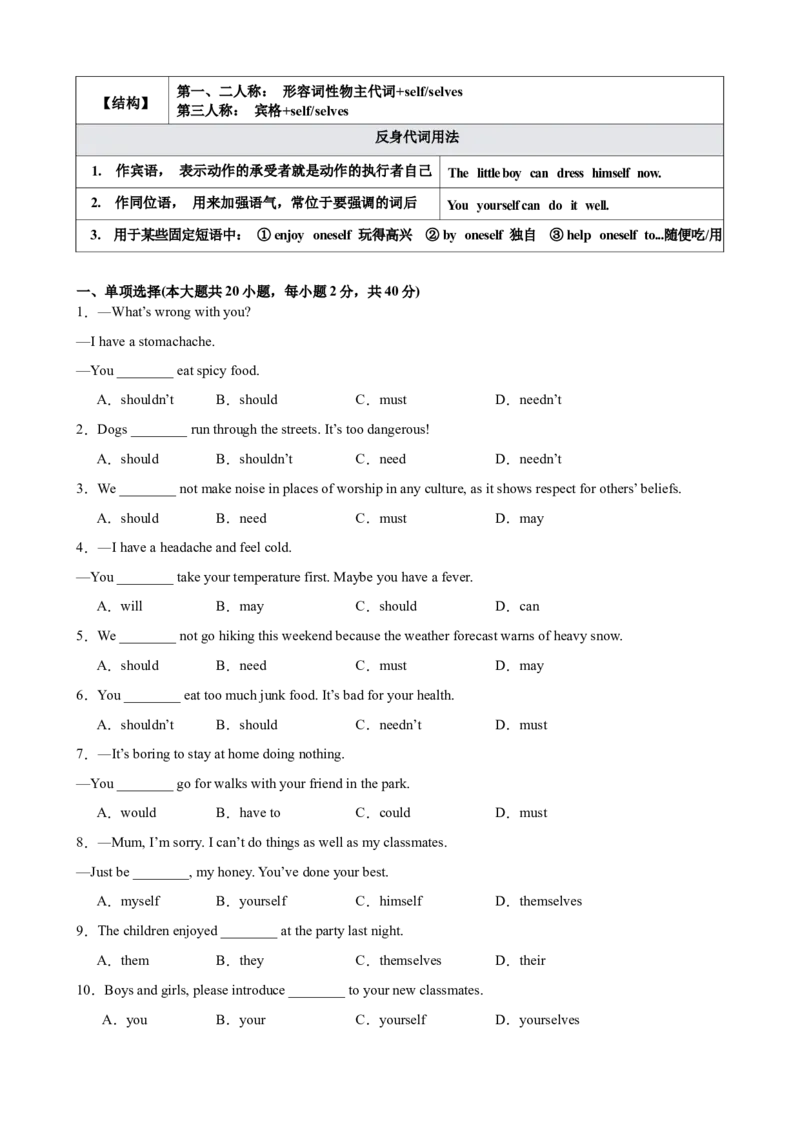
itself 它自己第一、二人称: 形容词性物主代词+self/selves
【结构】
第三人称: 宾格+self/selves
反身代词用法
1. 作宾语, 表示动作的承受者就是动作的执行者自己 The little boy can dress himself now.
2. 作同位语, 用来加强语气,常位于要强调的词后 You yourself can do it well.
3. 用于某些固定短语中: ①enjoy oneself 玩得高兴 ②by oneself 独自 ③help oneself to...随便吃/用
一、单项选择(本大题共20小题,每小题2分,共40分)
1.—What’s wrong with you?
—I have a stomachache.
—You ________ eat spicy food.
A.shouldn’t B.should C.must D.needn’t
2.Dogs ________ run through the streets. It’s too dangerous!
A.should B.shouldn’t C.need D.needn’t
3.We ________ not make noise in places of worship in any culture, as it shows respect for others’ beliefs.
A.should B.need C.must D.may
4.—I have a headache and feel cold.
—You ________ take your temperature first. Maybe you have a fever.
A.will B.may C.should D.can
5.We ________ not go hiking this weekend because the weather forecast warns of heavy snow.
A.should B.need C.must D.may
6.You ________ eat too much junk food. It’s bad for your health.
A.shouldn’t B.should C.needn’t D.must
7.—It’s boring to stay at home doing nothing.
—You ________ go for walks with your friend in the park.
A.would B.have to C.could D.must
8.—Mum, I’m sorry. I can’t do things as well as my classmates.
—Just be ________, my honey. You’ve done your best.
A.myself B.yourself C.himself D.themselves
9.The children enjoyed ________ at the party last night.
A.them B.they C.themselves D.their
10.Boys and girls, please introduce ________ to your new classmates.
A.you B.your C.yourself D.yourselves11.If you always compare ________ with others, you may lose self-confidence.
A.myself B.yourself C.himself
12.John and Kate are old enough, so I think they can look after ________.
A.himself B.herself C.ourselves D.themselves
13.— Help ________ to some fruits, Tom. They are fresh from the farm.
—Thank you, Mrs. Green.
A.yourself B.yourselves C.himself D.themselves
14.The little girl cut ________ when she was cooking with her mom yesterday.
A.her B.herself C.she D.hers
15.—Who taught ________ English, kids?
—Nobody. We just learnt it ________.
A.your; by ourselves B.you; for ourselves C.you; by ourselves D.your; for
ourselves
16.Bill likes the monkey very much, because it can usually look after ________ well.
A.itself B.himself C.myself D.themselves
17.Don’t worry about him. He can take good care of ________.
A.yourself B.myself C.herself D.himself
18.—Who taught ________ history last year?
—Nobody! He learnt it by ________.
A.him; himself B.his; himself C.himself; himself D.his; him
19.Here are a lot of delicious food. Help ________, children.
A.you B.your C.yours D.yourselves
20.Mike hurt ________ when he climbed the mountain.
A.he B.his C.himself D.him
二、单词拼写(本大题共10小题,每小题2分,共20分)
21.Don’t be hard on (you). Everyone makes mistakes.
22.Tai Chi, a part of Chinese culture, is an exercise to help people improve (they) in health.
23.The girl could dress (her) at the age of five.
24.The story (it) is not complicated, but the hidden meaning is deep.
25.At present, there are many online courses and I can choose some to study by (I).
26.Bob is old enough to look after (he).
27.No one helped Lucy. She did it all by (her).28.We live in the information age, so we have more chances and methods to improve . (we)
29.It is selfish (自私的) to only think of , my kids. (you)
30.I can dress (my) and make breakfast now.
三、完成句子(本大题共10小题,每小题4分,共40分)
31.我们应该尊重彼此的差异。
We respect .
32.你应该躺下来好好休息。
You and have a good rest.
33.第一次独自旅行帮助她找到了自我,并获得了独立感。
Travelling alone for the first time helped her to and gain a sense of independence.
34.当我从自行车上摔下来时,我伤了自己。
I hurt when I my bike.
35.在罚丢点球后,那名球员只能自言自语道:“下次我能做得更好。”
After missing a penalty kick, the player could only , “I can do better next time.”
36.汤姆不得不与家人分离一个月来完成他的书。
Tom had to from his family for a month to finish the book.
37.让我们为自己设定目标,并迈出第一步。
Let’s and take the first step.
38.如果发生尴尬的事情,学会自嘲。
If something embarrassing happens, learn to .
39.他们挤在一起,免受风吹。
They huddled together to the wind.
40.一些人在面对困难时总想挑战自己。
Some people always want to in the face of difficulties.