Unit 2 Stay Healthy
核心语法精练(表建议的情态动词(should、could)和反身代词)
目录
A 考点概览·知识回顾..............................................................................................................................................1
B 考点夯基·专项突破..............................................................................................................................................3
一、单项选择.........................................................................................................................................................3
二、用所给单词的正确形式填空........................................................................................................................9
三、完成句子.......................................................................................................................................................10
C 综合攻坚·能力跃升............................................................................................................................................12
题型一 语法填空...............................................................................................................................................12
题型二 阅读理解.................................................................................................................................................15
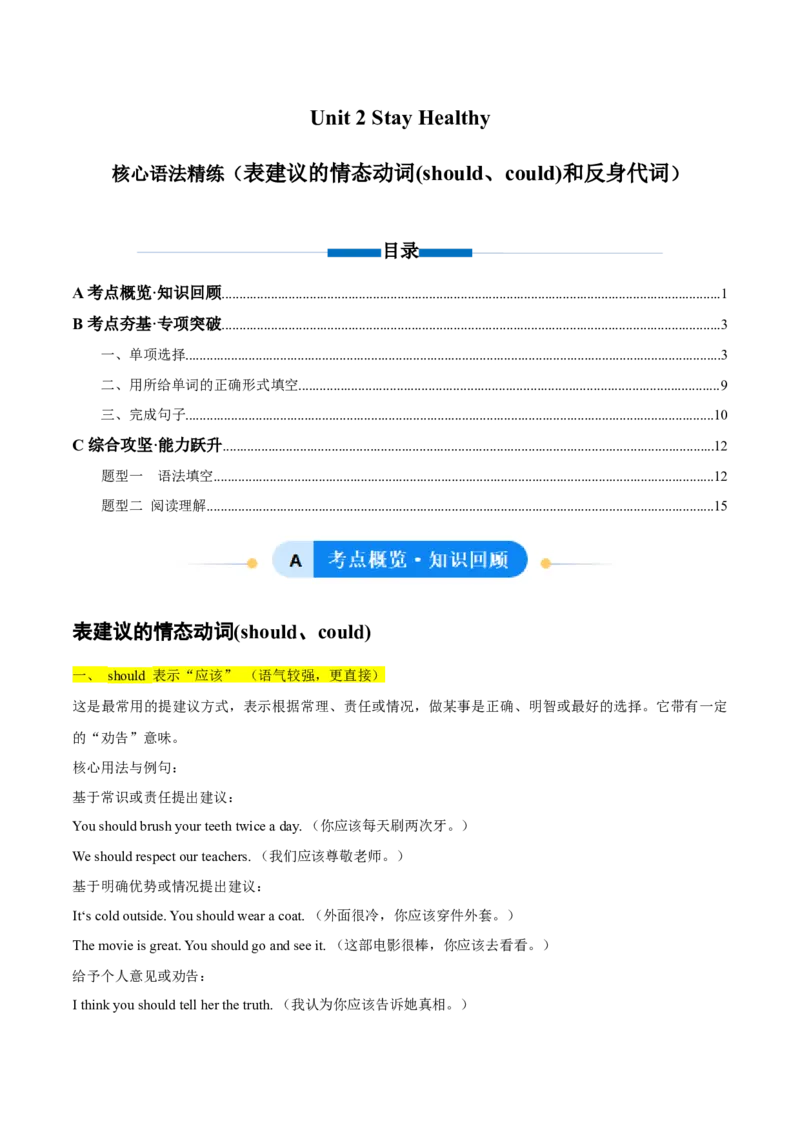
表建议的情态动词(should、could)
一、 should 表示“应该” (语气较强,更直接)
这是最常用的提建议方式,表示根据常理、责任或情况,做某事是正确、明智或最好的选择。它带有一定
的“劝告”意味。
核心用法与例句:
基于常识或责任提出建议:
You should brush your teeth twice a day. (你应该每天刷两次牙。)
We should respect our teachers. (我们应该尊敬老师。)
基于明确优势或情况提出建议:
It‘s cold outside. You should wear a coat. (外面很冷,你应该穿件外套。)
The movie is great. You should go and see it. (这部电影很棒,你应该去看看。)
给予个人意见或劝告:
I think you should tell her the truth. (我认为你应该告诉她真相。)You shouldn’t stay up too late. It‘s bad for your health. (你不应该熬夜,对健康不好。)
二、 could - 表示“可以” (语气非常委婉、试探)
当你想非常礼貌、不显强硬地提出一个建议或可能性时,就用 could。它意味着“或许可以尝试……”,
给对方充分的选择自由,没有强加的感觉。
核心用法与例句:
委婉地提供一个选项或想法:
If you’re free, we could go for a walk. (如果你有空,我们可以去散散步。)
You could try calling him again. (你可以试试再给他打个电话。)
用于求助或请求建议时的开场:
What could I get for my mum‘s birthday? (我妈妈生日我可以送点什么?)(比用 “should” 更显自己没主
意,更客气)
Where could we have dinner tonight? (今晚我们可以去哪儿吃饭?)
当你不确定自己的建议是否最好时:
A: I need a new computer. (我需要一台新电脑。)
B: You could check out the electronics store online. (你可以去看看那个网上电器商城。)(暗示“这只是个
想法,供你参考”)
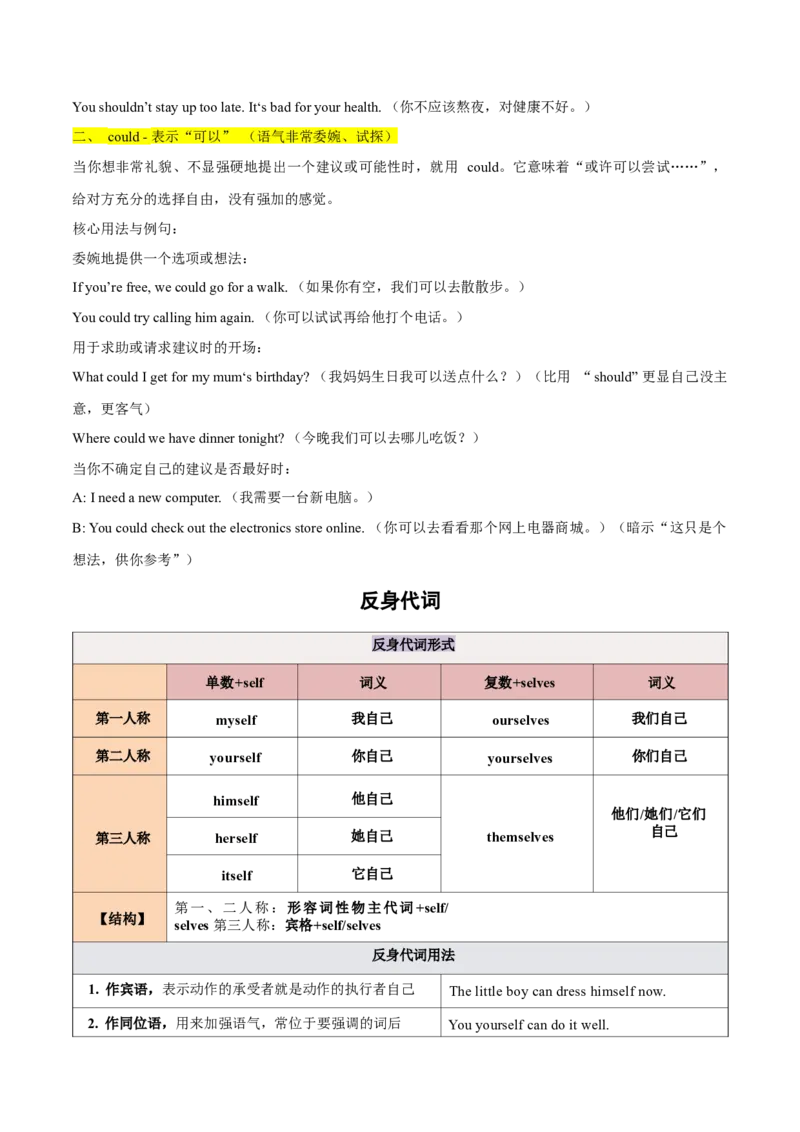
反身代词
反身代词形式
单数+self 词义 复数+selves 词义
第一人称 myself 我自己 ourselves 我们自己
第二人称 yourself 你自己 yourselves 你们自己
himself 他自己
他们/她们/它们
自己
第三人称 herself 她自己 themselves
itself 它自己
第一、二人称:形容词性物主代词+self/
【结构】
selves 第三人称:宾格+self/selves
反身代词用法
1. 作宾语,表示动作的承受者就是动作的执行者自己 The little boy can dress himself now.
2. 作同位语,用来加强语气,常位于要强调的词后 You yourself can do it well.3. 用于某些固定短语中:①enjoy oneself 玩得高兴 ②by oneself 独自 ③help oneself to...随便吃/用
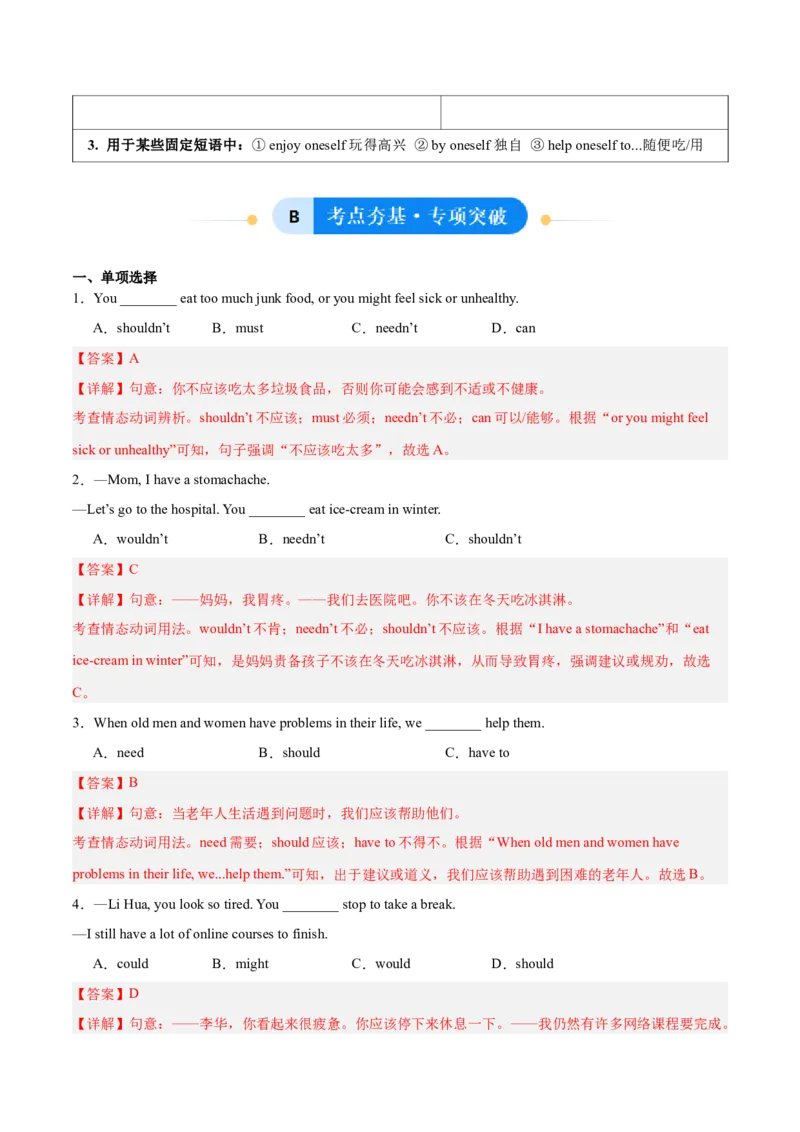
一、单项选择
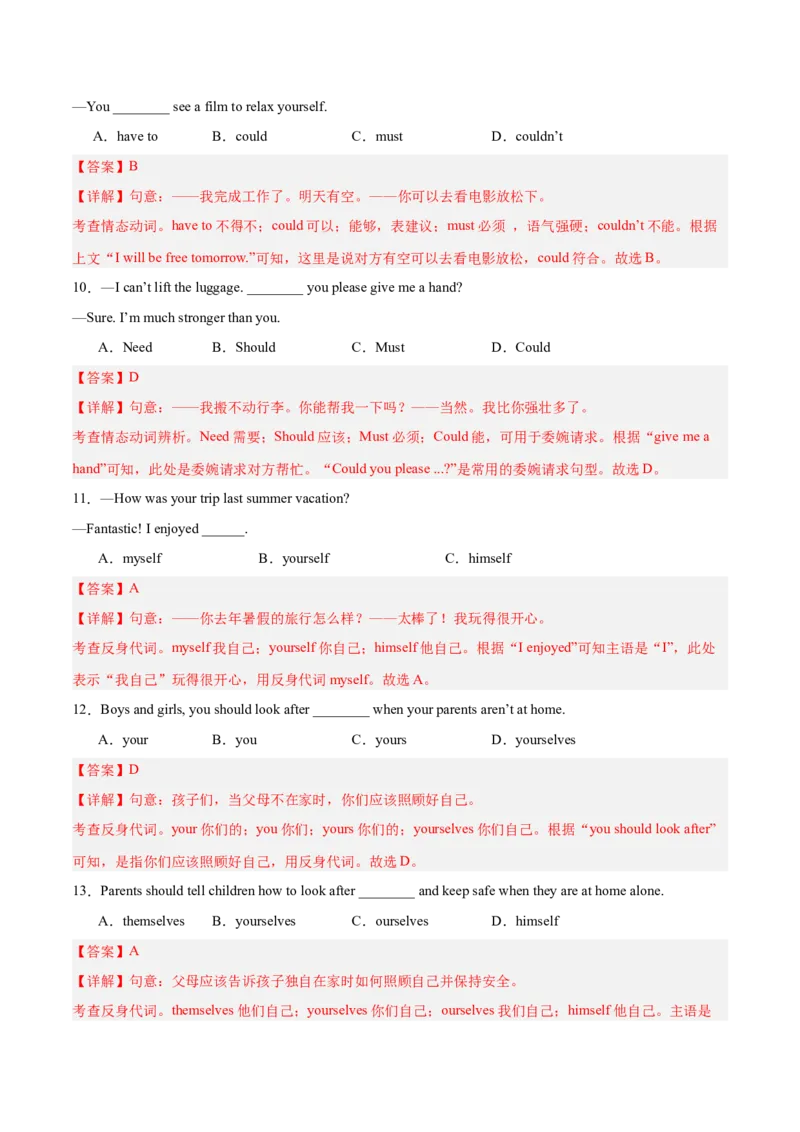
1.You ________ eat too much junk food, or you might feel sick or unhealthy.
A.shouldn’t B.must C.needn’t D.can
【答案】A
【详解】句意:你不应该吃太多垃圾食品,否则你可能会感到不适或不健康。
考查情态动词辨析。shouldn’t不应该;must必须;needn’t不必;can可以/能够。根据“or you might feel
sick or unhealthy”可知,句子强调“不应该吃太多”,故选A。
2.—Mom, I have a stomachache.
—Let’s go to the hospital. You ________ eat ice-cream in winter.
A.wouldn’t B.needn’t C.shouldn’t
【答案】C
【详解】句意:——妈妈,我胃疼。——我们去医院吧。你不该在冬天吃冰淇淋。
考查情态动词用法。wouldn’t不肯;needn’t不必;shouldn’t不应该。根据“I have a stomachache”和“eat
ice-cream in winter”可知,是妈妈责备孩子不该在冬天吃冰淇淋,从而导致胃疼,强调建议或规劝,故选
C。
3.When old men and women have problems in their life, we ________ help them.
A.need B.should C.have to
【答案】B
【详解】句意:当老年人生活遇到问题时,我们应该帮助他们。
考查情态动词用法。need需要;should应该;have to不得不。根据“When old men and women have
problems in their life, we...help them.”可知,出于建议或道义,我们应该帮助遇到困难的老年人。故选B。
4.—Li Hua, you look so tired. You ________ stop to take a break.
—I still have a lot of online courses to finish.
A.could B.might C.would D.should
【答案】D
【详解】句意:——李华,你看起来很疲惫。你应该停下来休息一下。——我仍然有许多网络课程要完成。考查情态动词。could可以;might或许;would会;should应该。根据“Li Hua, you look so tired. You...stop
to take a break.”可知,说话人观察到李华疲惫,所以建议他应该停下来休息,“should”作为情态动词,意
为“应该”。故选D。
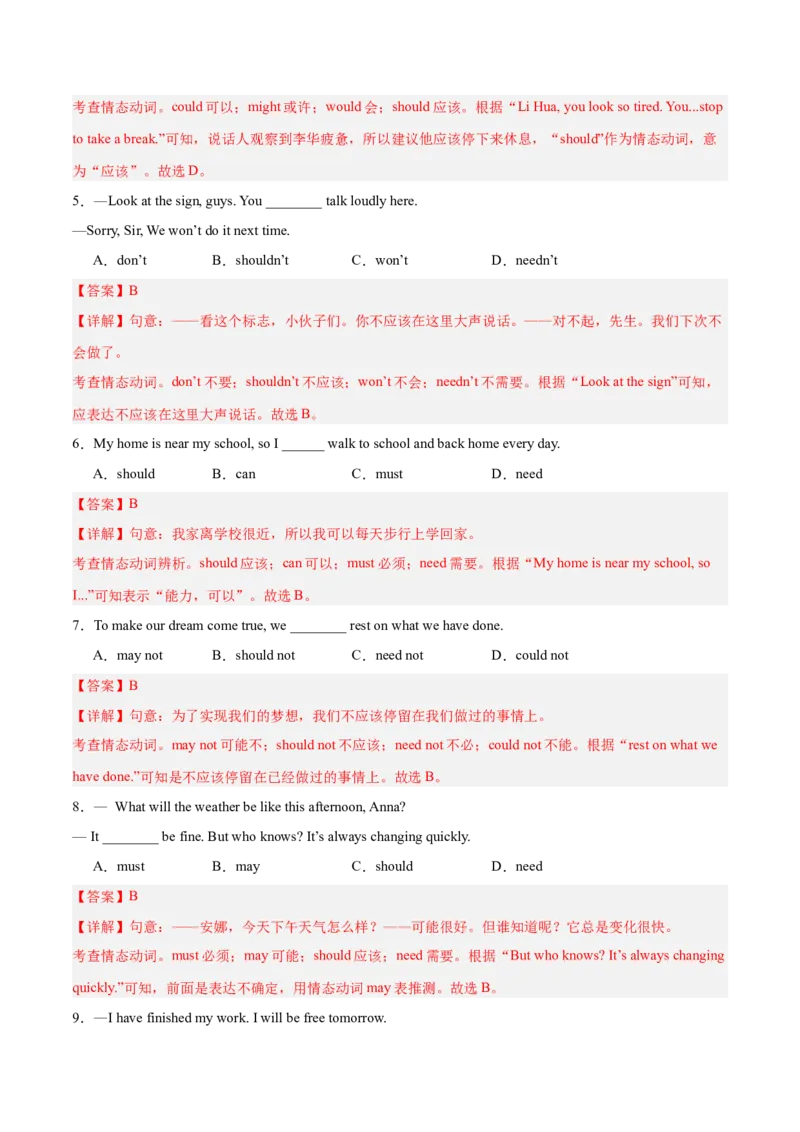
5.—Look at the sign, guys. You ________ talk loudly here.
—Sorry, Sir, We won’t do it next time.
A.don’t B.shouldn’t C.won’t D.needn’t
【答案】B
【详解】句意:——看这个标志,小伙子们。你不应该在这里大声说话。——对不起,先生。我们下次不
会做了。
考查情态动词。don’t不要;shouldn’t不应该;won’t不会;needn’t不需要。根据“Look at the sign”可知,
应表达不应该在这里大声说话。故选B。
6.My home is near my school, so I ______ walk to school and back home every day.
A.should B.can C.must D.need
【答案】B
【详解】句意:我家离学校很近,所以我可以每天步行上学回家。
考查情态动词辨析。should应该;can可以;must必须;need需要。根据“My home is near my school, so
I...”可知表示“能力,可以”。故选B。
7.To make our dream come true, we ________ rest on what we have done.
A.may not B.should not C.need not D.could not
【答案】B
【详解】句意:为了实现我们的梦想,我们不应该停留在我们做过的事情上。
考查情态动词。may not可能不;should not不应该;need not不必;could not不能。根据“rest on what we
have done.”可知是不应该停留在已经做过的事情上。故选B。
8.— What will the weather be like this afternoon, Anna?
— It ________ be fine. But who knows? It’s always changing quickly.
A.must B.may C.should D.need
【答案】B
【详解】句意:——安娜,今天下午天气怎么样?——可能很好。但谁知道呢?它总是变化很快。
考查情态动词。must必须;may可能;should应该;need需要。根据“But who knows? It’s always changing
quickly.”可知,前面是表达不确定,用情态动词may表推测。故选B。
9.—I have finished my work. I will be free tomorrow.—You ________ see a film to relax yourself.
A.have to B.could C.must D.couldn’t
【答案】B
【详解】句意:——我完成工作了。明天有空。——你可以去看电影放松下。
考查情态动词。have to不得不;could可以;能够,表建议;must必须 ,语气强硬;couldn’t不能。根据
上文“I will be free tomorrow.”可知,这里是说对方有空可以去看电影放松,could符合。故选B。
10.—I can’t lift the luggage. ________ you please give me a hand?
—Sure. I’m much stronger than you.
A.Need B.Should C.Must D.Could
【答案】D
【详解】句意:——我搬不动行李。你能帮我一下吗?——当然。我比你强壮多了。
考查情态动词辨析。Need需要;Should应该;Must必须;Could能,可用于委婉请求。根据“give me a
hand”可知,此处是委婉请求对方帮忙。“Could you please ...?”是常用的委婉请求句型。故选D。
11.—How was your trip last summer vacation?
—Fantastic! I enjoyed ______.
A.myself B.yourself C.himself
【答案】A
【详解】句意:——你去年暑假的旅行怎么样?——太棒了!我玩得很开心。
考查反身代词。myself我自己;yourself你自己;himself他自己。根据“I enjoyed”可知主语是“I”,此处
表示“我自己”玩得很开心,用反身代词myself。故选A。
12.Boys and girls, you should look after ________ when your parents aren’t at home.
A.your B.you C.yours D.yourselves
【答案】D
【详解】句意:孩子们,当父母不在家时,你们应该照顾好自己。
考查反身代词。your你们的;you你们;yours你们的;yourselves你们自己。根据“you should look after”
可知,是指你们应该照顾好自己,用反身代词。故选D。
13.Parents should tell children how to look after ________ and keep safe when they are at home alone.
A.themselves B.yourselves C.ourselves D.himself
【答案】A
【详解】句意:父母应该告诉孩子独自在家时如何照顾自己并保持安全。
考查反身代词。themselves他们自己;yourselves你们自己;ourselves我们自己;himself他自己。主语是“children”,对应的反身代词应为themselves。故选A。
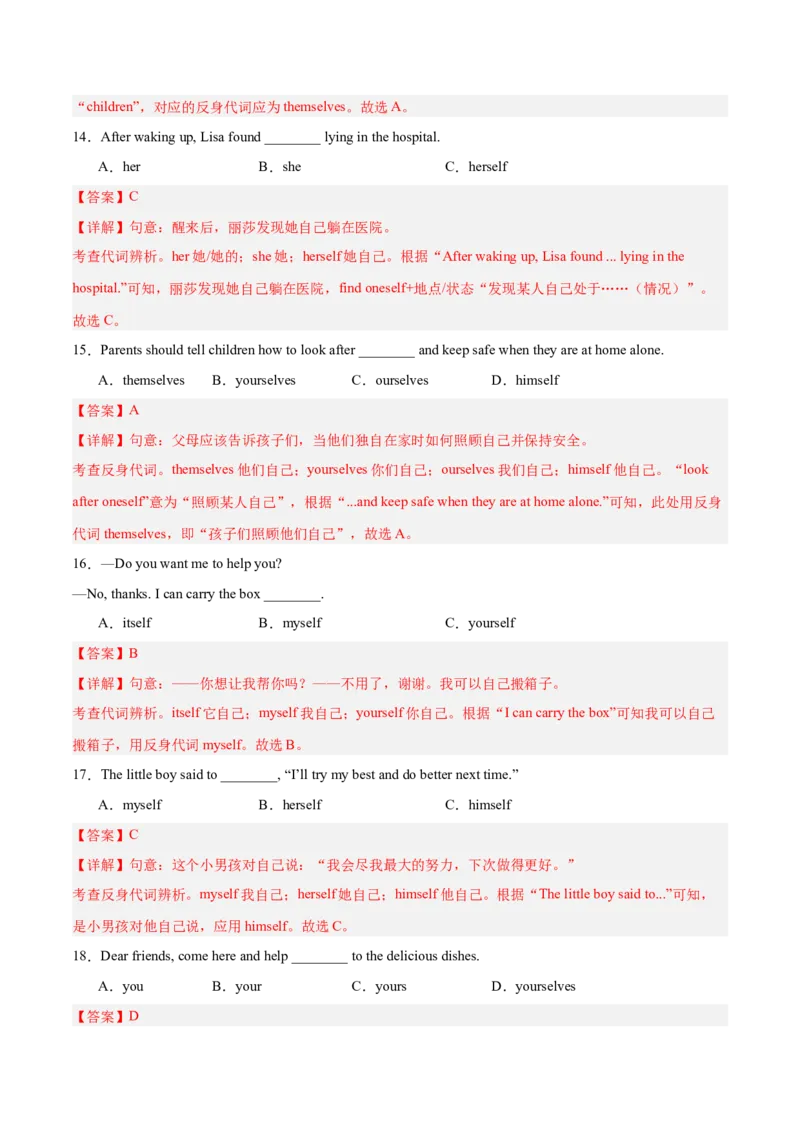
14.After waking up, Lisa found ________ lying in the hospital.
A.her B.she C.herself
【答案】C
【详解】句意:醒来后,丽莎发现她自己躺在医院。
考查代词辨析。her她/她的;she她;herself她自己。根据“After waking up, Lisa found ... lying in the
hospital.”可知,丽莎发现她自己躺在医院,find oneself+地点/状态“发现某人自己处于……(情况)”。
故选C。
15.Parents should tell children how to look after ________ and keep safe when they are at home alone.
A.themselves B.yourselves C.ourselves D.himself
【答案】A
【详解】句意:父母应该告诉孩子们,当他们独自在家时如何照顾自己并保持安全。
考查反身代词。themselves他们自己;yourselves你们自己;ourselves我们自己;himself他自己。“look
after oneself”意为“照顾某人自己”,根据“...and keep safe when they are at home alone.”可知,此处用反身
代词themselves,即“孩子们照顾他们自己”,故选A。
16.—Do you want me to help you?
—No, thanks. I can carry the box ________.
A.itself B.myself C.yourself
【答案】B
【详解】句意:——你想让我帮你吗?——不用了,谢谢。我可以自己搬箱子。
考查代词辨析。itself它自己;myself我自己;yourself你自己。根据“I can carry the box”可知我可以自己
搬箱子,用反身代词myself。故选B。
17.The little boy said to ________, “I’ll try my best and do better next time.”
A.myself B.herself C.himself
【答案】C
【详解】句意:这个小男孩对自己说:“我会尽我最大的努力,下次做得更好。”
考查反身代词辨析。myself我自己;herself她自己;himself他自己。根据“The little boy said to...”可知,
是小男孩对他自己说,应用himself。故选C。
18.Dear friends, come here and help ________ to the delicious dishes.
A.you B.your C.yours D.yourselves
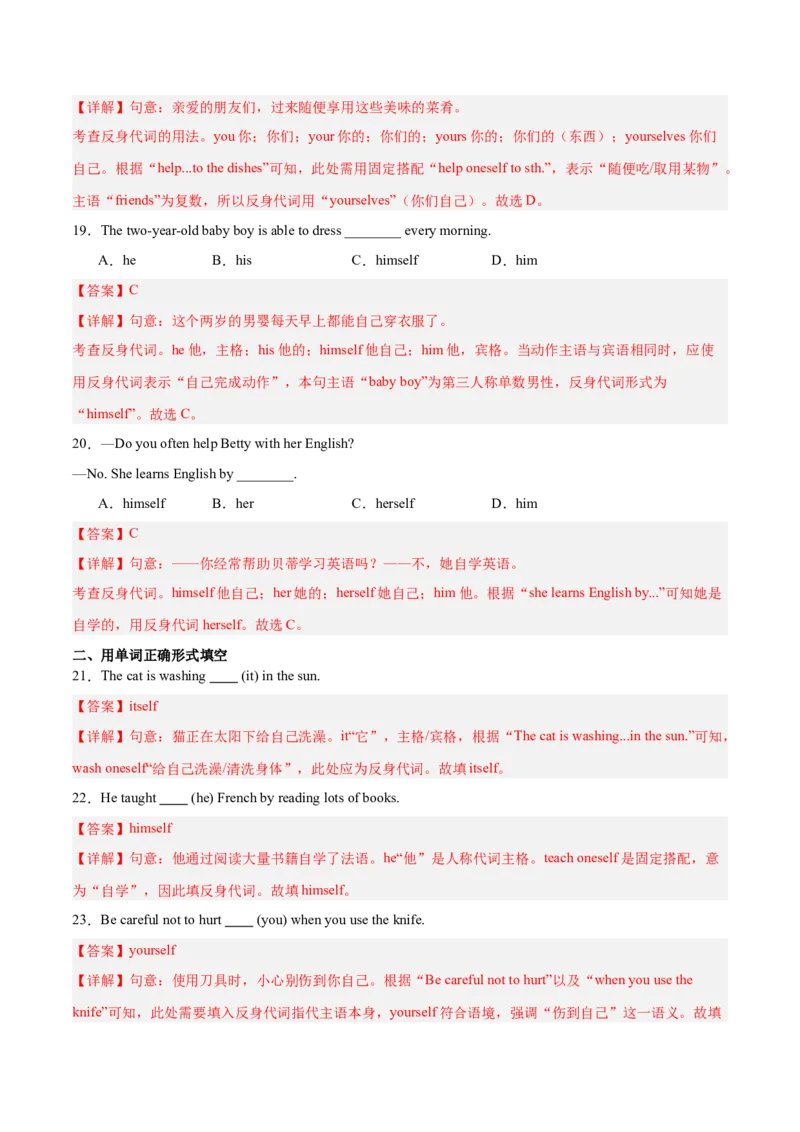
【答案】D【详解】句意:亲爱的朋友们,过来随便享用这些美味的菜肴。
考查反身代词的用法。you你;你们;your你的;你们的;yours你的;你们的(东西);yourselves你们
自己。根据“help...to the dishes”可知,此处需用固定搭配“help oneself to sth.”,表示“随便吃/取用某物”。
主语“friends”为复数,所以反身代词用“yourselves”(你们自己)。故选D。
19.The two-year-old baby boy is able to dress ________ every morning.
A.he B.his C.himself D.him
【答案】C
【详解】句意:这个两岁的男婴每天早上都能自己穿衣服了。
考查反身代词。he他,主格;his他的;himself他自己;him他,宾格。当动作主语与宾语相同时,应使
用反身代词表示“自己完成动作”,本句主语“baby boy”为第三人称单数男性,反身代词形式为
“himself”。故选C。
20.—Do you often help Betty with her English?
—No. She learns English by ________.
A.himself B.her C.herself D.him
【答案】C
【详解】句意:——你经常帮助贝蒂学习英语吗?——不,她自学英语。
考查反身代词。himself他自己;her她的;herself她自己;him他。根据“she learns English by...”可知她是
自学的,用反身代词herself。故选C。
二、用单词正确形式填空
21.The cat is washing (it) in the sun.
【答案】itself
【详解】句意:猫正在太阳下给自己洗澡。it“它”,主格/宾格,根据“The cat is washing...in the sun.”可知,
wash oneself“给自己洗澡/清洗身体”,此处应为反身代词。故填itself。
22.He taught (he) French by reading lots of books.
【答案】himself
【详解】句意:他通过阅读大量书籍自学了法语。he“他”是人称代词主格。teach oneself是固定搭配,意
为“自学”,因此填反身代词。故填himself。
23.Be careful not to hurt (you) when you use the knife.
【答案】yourself
【详解】句意:使用刀具时,小心别伤到你自己。根据“Be careful not to hurt”以及“when you use the
knife”可知,此处需要填入反身代词指代主语本身,yourself符合语境,强调“伤到自己”这一语义。故填yourself。
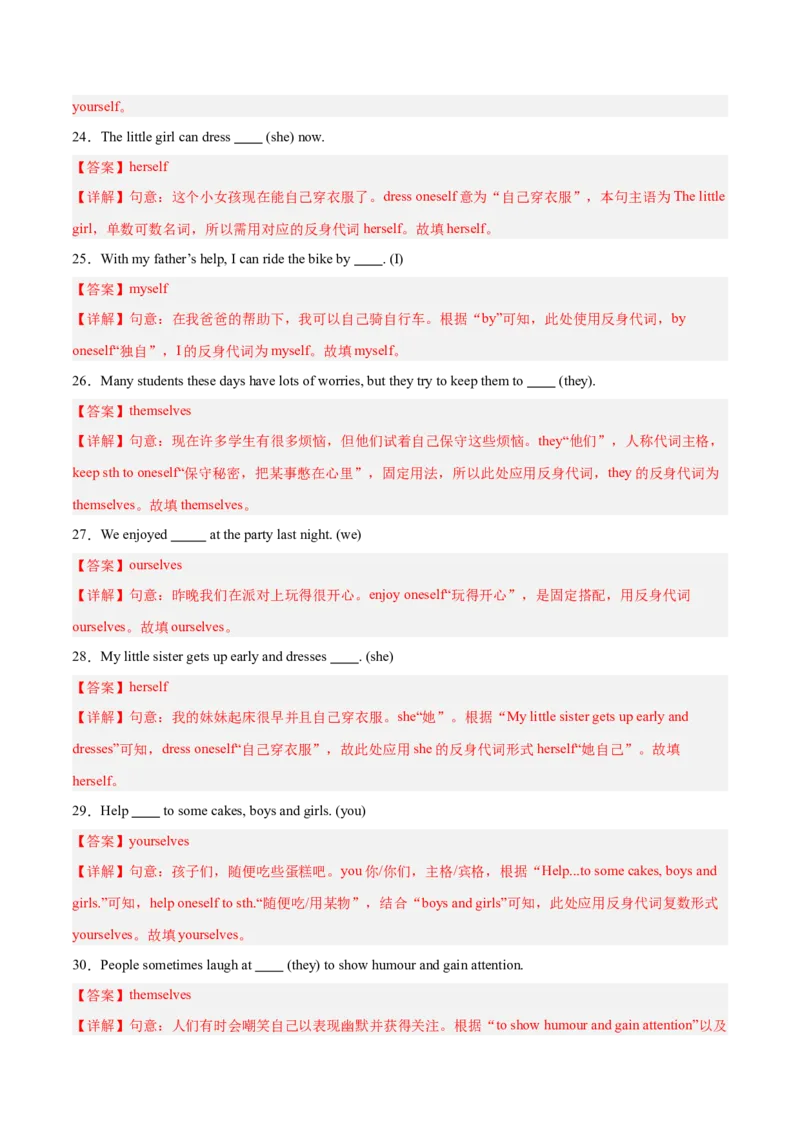
24.The little girl can dress (she) now.
【答案】herself
【详解】句意:这个小女孩现在能自己穿衣服了。dress oneself意为“自己穿衣服”,本句主语为The little
girl,单数可数名词,所以需用对应的反身代词herself。故填herself。
25.With my father’s help, I can ride the bike by . (I)
【答案】myself
【详解】句意:在我爸爸的帮助下,我可以自己骑自行车。根据“by”可知,此处使用反身代词,by
oneself“独自”,I的反身代词为myself。故填myself。
26.Many students these days have lots of worries, but they try to keep them to (they).
【答案】themselves
【详解】句意:现在许多学生有很多烦恼,但他们试着自己保守这些烦恼。they“他们”,人称代词主格,
keep sth to oneself“保守秘密,把某事憋在心里”,固定用法,所以此处应用反身代词,they的反身代词为
themselves。故填themselves。
27.We enjoyed at the party last night. (we)
【答案】ourselves
【详解】句意:昨晚我们在派对上玩得很开心。enjoy oneself“玩得开心”,是固定搭配,用反身代词
ourselves。故填ourselves。
28.My little sister gets up early and dresses . (she)
【答案】herself
【详解】句意:我的妹妹起床很早并且自己穿衣服。she“她”。根据“My little sister gets up early and
dresses”可知,dress oneself“自己穿衣服”,故此处应用she的反身代词形式herself“她自己”。故填
herself。
29.Help to some cakes, boys and girls. (you)
【答案】yourselves
【详解】句意:孩子们,随便吃些蛋糕吧。you你/你们,主格/宾格,根据“Help...to some cakes, boys and
girls.”可知,help oneself to sth.“随便吃/用某物”,结合“boys and girls”可知,此处应用反身代词复数形式
yourselves。故填yourselves。
30.People sometimes laugh at (they) to show humour and gain attention.
【答案】themselves
【详解】句意:人们有时会嘲笑自己以表现幽默并获得关注。根据“to show humour and gain attention”以及所给单词可知,应填they的反身代词形式themselves“他们自己”,作宾语,表示嘲笑自己。故填
themselves。
三、完成句子
31.你应该和我待在一起。
You me.
【答案】 should stay with
【详解】根据句意可知,句中含有情态动词“应该”should,“和……待在一起”stay with,情态动词后跟
动词原形。故填should;stay;with。
32.You should lie down and rest. (改为否定句)
You down and rest.
【答案】 shouldn’t
lie
【详解】句意:你应该躺下休息。本句含情态动词should,改为否定句在情态动词后加not,后接动词原形。
故填shouldn’t;lie。
33.我认为你应该多锻炼。
I think you more.
【答案】 should exercise
【详解】应该:should,是情态动词,后加动词原形,锻炼:exercise,是动词,故填should;exercise。
34.Should I lie down and rest?(作肯定回答)
Yes, .
【答案】 you should
【详解】句意:我应该躺下休息吗?根据题意是作肯定回答,用yes来回答,一般疑问句主语是I,做简略
回答用you,含有情态动词should,肯定回答是Yes, you should“是的,你应该”。故填you;should。
35.这个星期天你能和我一起去公园吗,莎莉?
with me this Sunday, Sally?
【答案】Could you go to the park/Can you go to the park
【详解】根据汉语提示可知此句为一般疑问句。“能”的英语为“can/could”,在一般疑问句中放在句首且
首字母大写,后加动词原形;主语为“you”,谓语为“go to the prak”。故填Could/Can you go to the park。
36.我曾是一名成功的艺术家,但仍需找到自我。
I was a successful artist, but I still needed to .【答案】 find myself
【详解】对照中英文可知,缺“找到自我”,对应英文为find myself,根据need to do sth.是固定短语,find
应用动词原形。故填find;myself。
37.她心里想:“我必须在午夜前完成这份报告。”
She , “I must finish this report before midnight.”
【答案】 said to herself
【详解】根据句意可知,此处表示“她心里想”,也就是她对自己说,用短语“say to oneself”,句子时态
是一般过去时,所以“say”要用过去式“said”,主语是“she”,对应的反身代词是“herself”。故填said;
to;herself。
38.You can have a great time in the park. (用反身代词改为同义句)
You can in the park.
【答案】 enjoy yourself/yourselves
【详解】句意:你(们)可以在公园里玩得开心。原句中的“have a great time”表示“玩得开心”,用反身
代词来表达同样的意思,可以使用“enjoy oneself”这一结构,其中oneself需要与主语“you”保持一致。当
“you”表示“你”时,反身代词用“yourself”;当“you”表示“你们”时,反身代词用“yourselves”。故填
enjoy;yourself/yourselves。
39.我们每个学生都要注意运动时保护好自己。
We students should when doing sport.
【答案】pay attention to protecting ourselves
【详解】根据中英文提示可知,缺少“注意保护好自己”,“注意做某事”pay attention to doing sth,“保
护好自己”protect ourselves;情态动词should后接动词原形,protect的动名词形式是protecting。故填pay
attention to protecting ourselves。
40.她在歌唱比赛中尽力了,没有让自己失望。
She tried her best in the singing competition and didn’t .
【答案】 let herself down
【详解】根据中英文对照,空格处缺“让自己失望”。let sb. down“让某人失望”,固定短语,此处“某
人”指主语她自己,应用反身代词“herself”,助动词“didn’t”后接动词原形。故填let;herself;down。题型一 语法填空
阅读下面短文,根据上下文填入适当的词语,或使用括号中的词语的适当形式填空,并将答案填写在答题
卡上。
How much exercise do kids need to stay 1 (health)? Every parent wants to know the answer.
A new study 2 (show) that kids should do 3 (activity) like climbing, jumping, and running at least twice a
week. These kinds of exercise are good 4 them. Children should also do aerobic exercise (有氧运动) for more
than 60 minutes every day. They can walk 5 (quick) or go running. 46 , many kids don’t like doing exercise
now. How can we make exercise interesting for them? It’s 6 good idea to take kids outside and let them play
with their friends. If they often play together, they 7 (have) fun and make it part of their life. As a result, they
will love exercise.
Doctor Judy often finds that parents ask their kids 8 (take) long walks as a kind of exercise. “Though walking
is a great activity, it’s really 9 (bore) for kids. So if you’re going to go on a walk with your kids, think of some
fun things to do along the way,” she says.
【答案】
1.healthy 2.shows 3.activities 4.for 5.quickly 6.However 7.a 8.will have 9.to take
10.boring
【导语】本文主要围绕孩子需要多少运动来保持健康展开,介绍了相关研究结果、孩子应做的运动类型,
还提及了如何让孩子对运动感兴趣以及家长带孩子运动的方式等内容。
1.句意:孩子们需要多少运动来保持健康?stay后接形容词作表语,health的形容词形式healthy“健康
的”。故填healthy。
2.句意:一项新的研究表明,孩子们应该每周至少进行两次攀爬、跳跃和跑步等活动。根据语境可知,
句子是一般现在时,主语“A new study”是第三人称单数,谓语动词用第三人称单数形式shows“表明”。
故填shows。
3.句意:一项新的研究表明,孩子们应该每周至少进行两次攀爬、跳跃和跑步等活动。根据“like
climbing, jumping, and running”可知,此处指多种活动,用activity的复数形式activities“活动”。故填
activities。
4.句意:这些种类的运动对他们有好处。根据“These kinds of exercise are good...them”可知运动对我们有好处,be good for“对……有好处”,固定搭配。故填for。
5.句意:他们可以快走或跑步。修饰动词walk,应用quick的副词形式quickly“快速地”。故填quickly。
6.句意:然而,现在很多孩子不喜欢做运动。前文说孩子应该做的运动,后文说很多孩子不喜欢做运动,
前后是转折关系,且有逗号隔开,用however“然而”表示转折,句首首字母大写。故填However。
7.句意:带孩子出去,让他们和朋友一起玩是个好主意。此处泛指一个好主意,good以辅音音素开头,
用不定冠词a。故填a。
8.句意:如果他们经常一起玩,他们会玩得很开心,并让它成为他们生活的一部分。if引导的条件状语从
句,遵循主将从现原则,主句用一般将来时,其结构为will do。故填will have。
9.句意:朱迪医生经常发现家长要求孩子把长距离散步作为一种锻炼。ask sb. to do sth.“要求某人做某
事”,固定搭配。故填to take。
10.句意:虽然散步是一项很棒的活动,但对孩子们来说真的很无聊。is后接形容词作表语,主语“it”指
物,用bore的形容词boring“无聊的”。故填boring。
阅读下面短文,根据语境或所给单词的提示,在每个空格内填入一个恰当的词,要求所填的词意义准确、
形式正确,使短文意思完整、行文连贯。
Breakfast gives us energy for the morning. What’s the best drink for breakfast?
Most people may say milk. Yes. Doctors always say it’s 1 good habit to drink milk every day. It has lots
of nutrients (营养物质) to help build up 2 (child). Calcium (钙) in milk gives us strong teeth. Vitamins (维生
素) in it are necessary nutrients for our body. There 3 (be) many micro elements (微量元素) in milk, too. They
can make us smarter. Also, studies show milk can even make 4 (woman) look more beautiful.
Milk is great! But you may not believe milk may cause many 5 (healthy) problems. For example, it can
make people fat. For those very fat people, stopping 6 (drink) it can help a lot. Also, it is 7 (danger) to take
medicine with milk. And a glass of milk 8 bedtime may cause a toothache if you don’t brush your teeth after
that. So should we drink milk?
Milk may not be a perfect drink. But it 9 (give) us a lot of nutrients. Drink milk if you like it, 10 not
because you think it is the best thing. And drink proper (适量的) milk each time.
【答案】
1.a 2.children 3.are 4.women 5.health 6.drinking 7.dangerous 8.before 9.gives
10.but
【导语】本文介绍了早餐的最佳饮品牛奶,阐述了它的营养好处以及可能带来的健康问题。1.句意:医生总是说每天喝牛奶是一个好习惯。根据“good habit”可知,a good habit表示“一个好习惯”,
为常用表达;habit是可数名词单数,good以辅音音素开头,表示泛指需用不定冠词a。故填a。
2.句意:它含有大量营养物质来帮助孩子成长。child是可数名词,此处表示泛指用复数形式,故填
children。
3.句意:牛奶中也有许多微量元素。根据“many micro elements (微量元素)”可知,主语是复数,文章时
态为一般现在时,be动词用are。故填are。
4.句意:研究表明牛奶甚至能让女性看起来更美丽。woman是可数名词,此处表示泛指,用复数形式
women,故填women。
5.句意:但你可能不相信牛奶可能会导致许多健康问题。health problems表示“健康问题”,用名词
health修饰problems,故填health。
6.句意:对于那些非常胖的人来说,停止喝牛奶会有很大帮助。根据“stopping”可知,stop doing sth.表示
“停止做某事”,drink的动名词是drinking,故填drinking。
7.句意:而且用牛奶吃药是危险的。根据“it is”可知,is后接形容词,danger的形容词形式是
dangerous,故填dangerous。
8.句意:如果睡前喝一杯牛奶后不刷牙,可能会导致牙痛。根据“bedtime”可知,这里表示在睡前喝牛奶。
before“在……之前”符合题意。故填before。
9.句意:但它给我们提供了很多营养物质。根据“it”可知,主语it是第三人称单数,文章时态为一般现
在时,give的第三人称单数形式是gives。故填gives。
10.句意:如果你喜欢就喝牛奶,但不是因为你认为它是最好的东西。根据“not because you think it is the
best thing.”可知,前后为转折关系,即喜欢就喝,但是牛奶不是最好的东西,且需要适量饮用。故填but。
题型二 阅读理解
A Smart Diet, a Healthy Life
No matter how old your kids are, you can take steps to improve a healthy diet and to encourage good eating
habits.
Family Meals
Family meals are nice for both parents and kids. Children like to guess what they are going to have and parents
get the chance to introduce new foods to children. Parents can also use the mealtime as a chance to talk with their
kids about their life.
Healthy Snacks (零食)
Kids, especially younger ones, will eat mostly what they can get at home. That’s why it’s important to haveenough healthy snacks, such as fruit, vegetables, nuts, yogurt and whole-grain biscuits.
Being a Good Example
The best way for you to encourage healthy eating is to eat well yourself. Kids will follow the lead of the adults
they see every day. By eating fruit and vegetables and avoiding fast food and sweet drinks, you are sending the right
message.
No Shouts about Food
Parents might find themselves shouting at children to get them to have healthy foods in front of them. This in
fact can make children dislike what they are asked to eat. You need to work a bit on different cooking methods (方
式).
Get Kids Included (参与)
Most kids will enjoy making the decision about food. Talk to them about making choices and planning a
healthy meal. It can help them to make good decisions on their own about the foods they want.
1.What is the author’s attitude (态度) towards snacks?
A.Snacks shouldn’t be eaten.
B.Healthy snacks can be accepted.
C.Kids can only have snacks at home.
2.The best way for parents to encourage a healthy diet is to _________.
A.have family meals B.eat healthy snacks C.set a good example
3.What does the underlined words mean?
A.Being a good cook. B.Healthy eating. C.Eating fast food.
4.According to “No Shouts about Food”, what should parents do if kids refuse to eat healthy food?
A.Try cooking it in a different way.
B.Explain how healthy it is.
C.Never cook the same food.
5.Why should parents get kids included when they make the decision about food?
A.Because it can let kids eat anything they like.
B.Because it can help kids become a wonderful cook.
C.Because it can help kids make good choices by themselves.
【答案】1.B 2.C 3.B 4.A 5.C
【导语】本文是一篇说明文,主要为父母提供了五条培养孩子健康饮食和良好饮食习惯的具体建议,包括家庭聚餐、准备健康零食、以身作则、避免强迫进食以及让孩子参与食物决策。
1.观点态度题。根据Healthy Snacks (零食)下内容“That’s why it’s important to have enough healthy snacks,
such as fruit, vegetables, nuts, yogurt and whole-grain biscuits.”可知,家里准备健康零食(如水果、蔬菜、酸奶
等)很重要,说明作者认可健康零食,而不是完全反对吃零食。故选B。
2.细节理解题。根据Being a Good Example下内容“The best way for you to encourage healthy eating is to eat
well yourself. Kids will follow the lead of the adults they see every day.”可知,父母鼓励健康饮食的最好方式就
是树立好榜样。故选C。
3.词句猜测题。根据“By eating fruit and vegetables and avoiding fast food and sweet drinks, you are sending
the right message.”可知,划线部分“the right message”指的是前一句中“吃水果蔬菜,避免快餐和甜饮”的
行为,这是在传递“健康饮食”的正确信息。故选B。
4.细节理解题。根据No Shouts about Food下内容“Parents might find themselves shouting at children to get
them to have healthy foods in front of them. This in fact can make children dislike what they are asked to eat. You
need to work a bit on different cooking methods (方式).”可知,如果孩子拒绝吃健康食品,父母应该尝试用不
同的方式烹饪。故选A。
5.细节理解题。根据Get Kids Included (参与)下内容“Talk to them about making choices and planning a
healthy meal. It can help them to make good decisions on their own about the foods they want.”可知,父母在决定
食物时应该让孩子参与进来,因为这可以帮助孩子自己做出正确的选择。故选C。
Running is good exercise, but some people often say, “Running is bad for the knees.” They think running will
cause arthritis (关节炎), making them walk with difficulty when they get old. But is that true?
Well, the truth is that running isn’t bad for the knees as long as people do it in the right way. In fact, running
can keep the knees strong and healthy. A study in Medicine and Science in Sports and Exercise found out that runners
had fewer knee problems than walkers. Why? Running helps build up muscles and cartilage (肌肉和软骨) around
the knee joint (关节). Compared with running, walking is easier on the knees. It doesn’t exercise the muscles around
the knees or build up the joint the same way running does.
Another study followed marathon (马拉松) runners before and after their races. The result was prettysurprising: the runners’ knee cartilage was stronger after the race, and they had a lower chance of developing arthritis
than those who didn’t run at all.
Actually, running itself isn’t bad for our knees, but if we don’t do it right, it can cause problems. Here are the
main things to watch out for. First, run with bad form. Taking too big steps or letting knees bend inward (向内弯曲)
are both bad for the knees. Second, overuse the knees. Running too much, too fast, or without rest can cause knee
problems. Third, run on hard ground. It is bad for the knees, especially if we’ re doing long runs or running very
fast.
But don’t worry. To keep our knees healthy while running, we just need to train smart. Small changes in our
running habits can make a big difference.
1.How does the writer start the passage?
A.By using a saying.
B.By introducing a sport.
C.By showing an opinion.
D.By sharing an experience.
2.Which question does paragraph 2 answer?
A.How can people run in the right way?
B.When did the researchers do the study?
C.What knee problems do runners often have?
D.Why is running better for the knees than walking?
3.What did the second study show?
A.People who never ran had healthier knees.
B.Running could make the knee cartilage stronger.
C.Training was very important for marathon runners.
D.Runners had a higher chance of developing arthritis.
4.What is the main idea of paragraph 4?
A.What causes knee problems. B.What to do during long runs.
C.How to warm up before running. D.Is running bad for our knees.
5.What will the writer probably talk about next?
A.The benefits of running. B.The best time for running.
C.Common running mistakes we make. D.Tips for smart training in running.【答案】1.C 2.D 3.B 4.A 5.D
【导语】本文主要讲述了跑步与膝盖健康之间的关系。
1.推理判断题。根据“Running is good exercise, but some people often say, ‘Running is bad for the knees.’”可
知,作者通过展示一种观点来开始这篇文章。故选C。
2.细节理解题。根据“In fact, running can keep the knees strong and healthy. A study in Medicine and Science
in Sports and Exercise found out that runners had fewer knee problems than walkers. Why? Running helps build up
muscles and cartilage (肌肉和软骨) around the knee joint (关节). Compared with running, walking is easier on the
knees. It doesn’t exercise the muscles around the knees or build up the joint the same way running does.”可知,第
二段回答了为什么跑步比走路对膝盖更好。故选D。
3.细节理解题。根据“Another study followed marathon (马拉松) runners before and after their races. The
result was pretty surprising: the runners’ knee cartilage was stronger after the race, and they had a lower chance of
developing arthritis than those who didn’t run at all.”可知,第二项研究表明跑步可以使膝盖软骨更强壮。故选
B。
4.主旨大意题。根据“Actually, running itself isn’t bad for our knees, but if we don’t do it right, it can cause
problems. Here are the main things to watch out for.”可知,第四段主要讲了什么导致膝盖问题。故选A。
5.推理判断题。根据“But don’t worry. To keep our knees healthy while running, we just need to train smart.
Small changes in our running habits can make a big difference.”可推测,作者接下来可能会谈论跑步时聪明训
练的建议。故选D。