学校:___________姓名:___________班级:___________考号:___________
Unit 2 Stay Healthy
重点语法:情态动词should、could表建议和反身代词
(三大题型,70题)精讲练
目录
语法知识精讲.....................................................................................................................................1
语法知识精练.....................................................................................................................................2
题型一:should表示建议............................................................................................................2
题型二:情态动词could..............................................................................................................6
题型三:反身代词.........................................................................................................................9
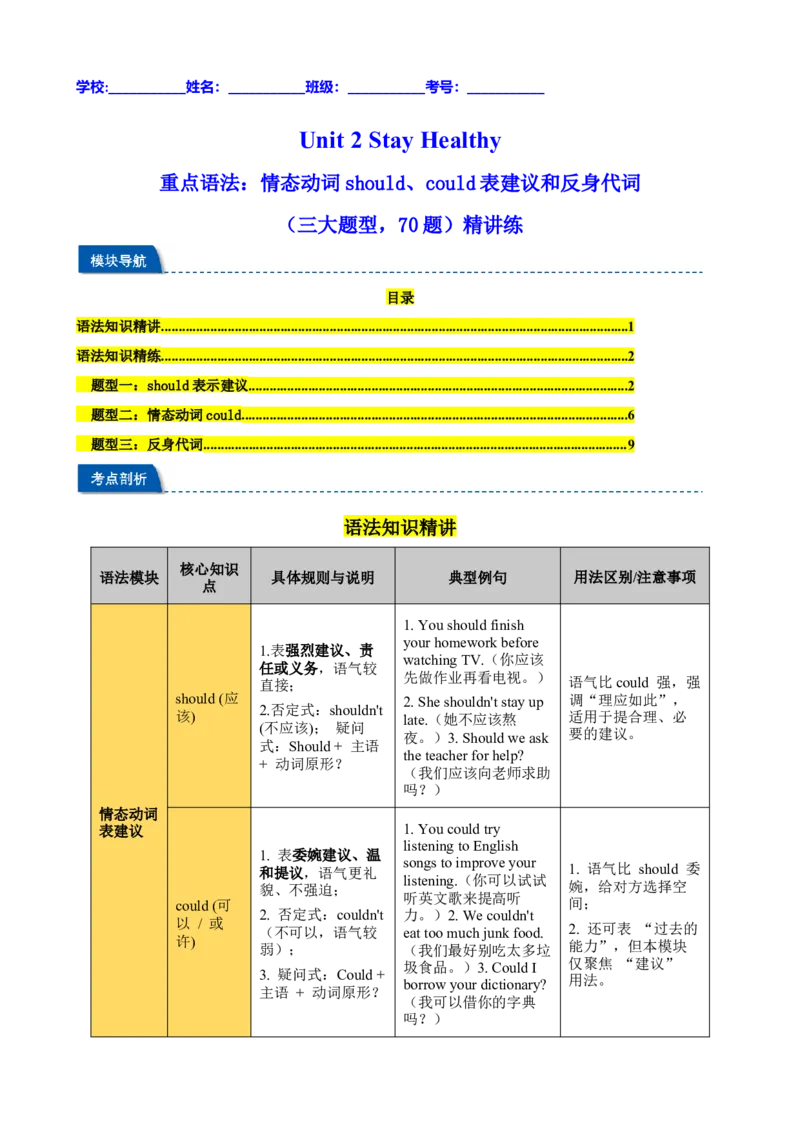
语法知识精讲
核心知识
语法模块 具体规则与说明 典型例句 用法区别/注意事项
点
1. You should finish
your homework before
1.表强烈建议、责
watching TV.(你应该
任或义务,语气较
直接; 先做作业再看电视。) 语气比could 强,强
should (应 2. She shouldn't stay up 调“理应如此”,
2.否定式:shouldn't
该) late.(她不应该熬 适用于提合理、必
(不应该); 疑问
要的建议。
夜。)3. Should we ask
式:Should + 主语
the teacher for help?
+ 动词原形?
(我们应该向老师求助
吗?)
情态动词
表建议 1. You could try
listening to English
1. 表委婉建议、温
songs to improve your
和提议,语气更礼 1. 语气比 should 委
listening.(你可以试试
貌、不强迫; 婉,给对方选择空
听英文歌来提高听
could (可 间;
2. 否定式:couldn't 力。)2. We couldn't
以 / 或 (不可以,语气较 eat too much junk food. 2. 还可表 “过去的
许)
弱); (我们最好别吃太多垃 能力”,但本模块
圾食品。)3. Could I 仅聚焦 “建议”
3. 疑问式:Could +
用法。
borrow your dictionary?
主语 + 动词原形?
(我可以借你的字典
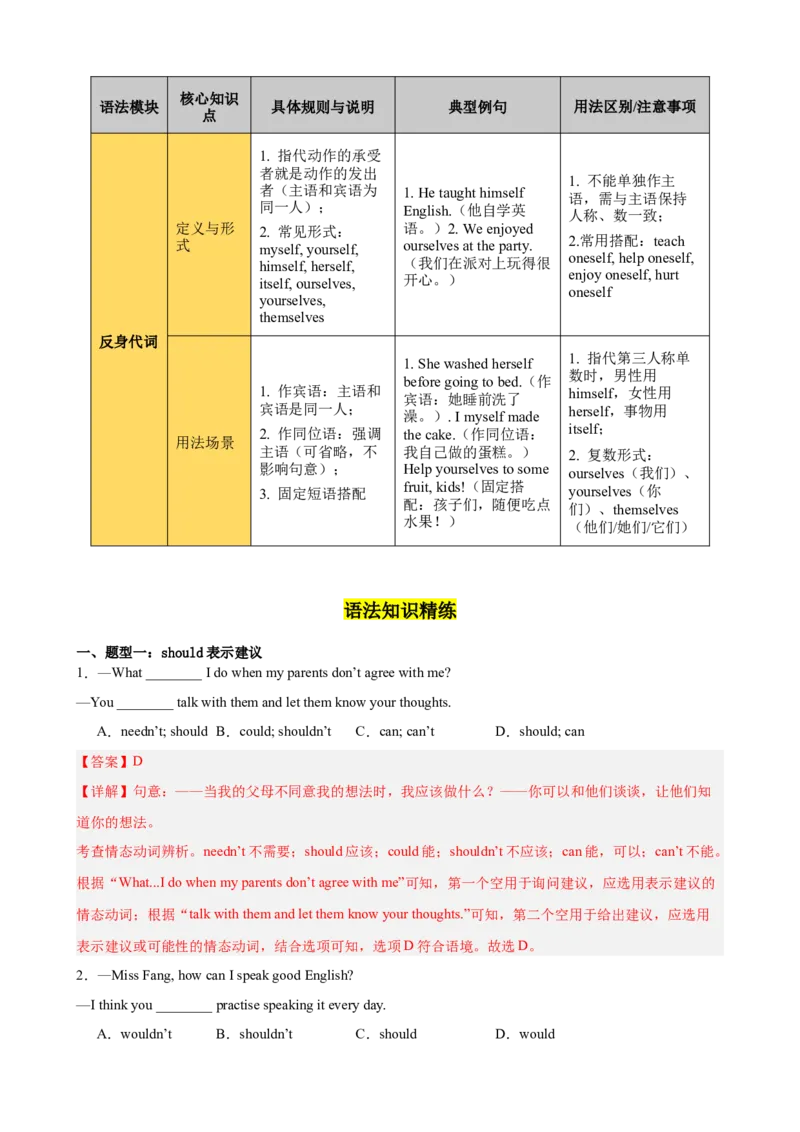
吗?)核心知识
语法模块 具体规则与说明 典型例句 用法区别/注意事项
点
1. 指代动作的承受
者就是动作的发出
1. 不能单独作主
者(主语和宾语为 1. He taught himself
语,需与主语保持
同一人); English.(他自学英
人称、数一致;
定义与形 2. 常见形式: 语。)2. We enjoyed
式 myself, yourself, ourselves at the party.
2.常用搭配:teach
oneself, help oneself,
himself, herself, (我们在派对上玩得很
enjoy oneself, hurt
itself, ourselves, 开心。)
oneself
yourselves,
themselves
反身代词
1. 指代第三人称单
1. She washed herself
数时,男性用
before going to bed.(作
1. 作宾语:主语和 himself,女性用
宾语:她睡前洗了
宾语是同一人; herself,事物用
澡。). I myself made
itself;
2. 作同位语:强调 the cake.(作同位语:
用法场景
主语(可省略,不 我自己做的蛋糕。) 2. 复数形式:
影响句意); Help yourselves to some ourselves(我们)、
3. 固定短语搭配 fruit, kids!(固定搭 yourselves(你
配:孩子们,随便吃点
们)、themselves
水果!)
(他们/她们/它们)
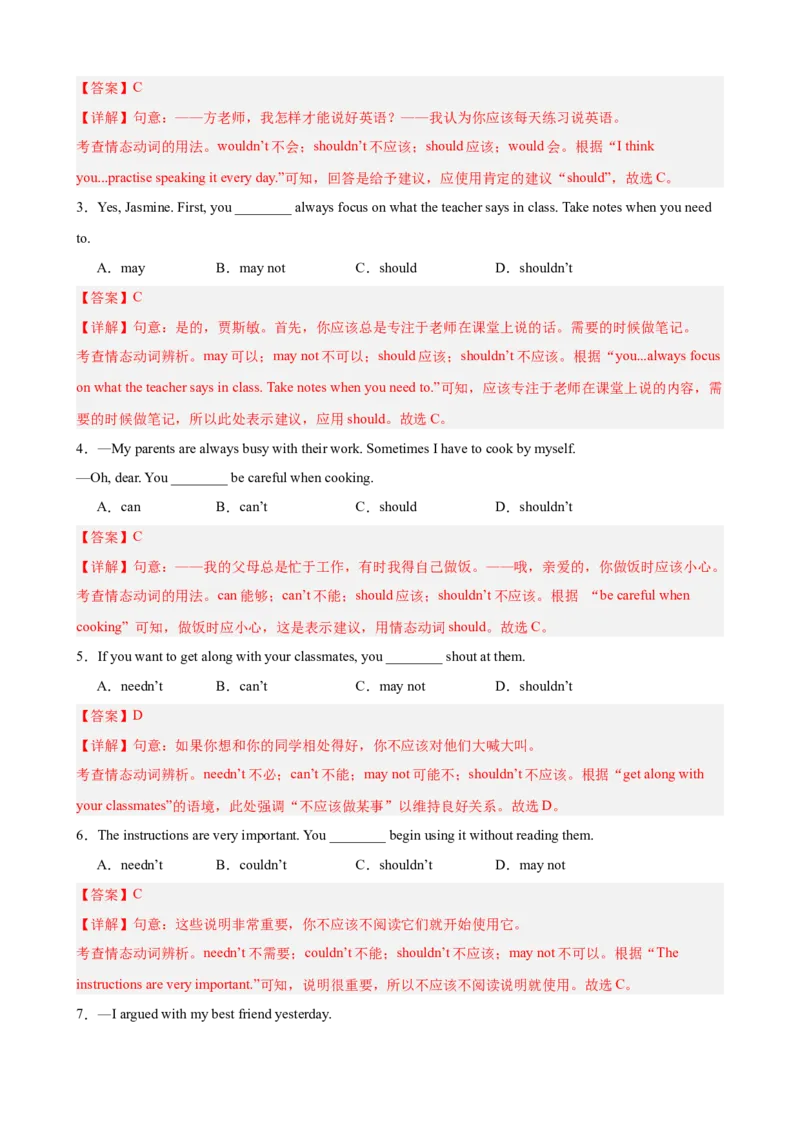
语法知识精练
一、题型一:should表示建议
1.—What ________ I do when my parents don’t agree with me?
—You ________ talk with them and let them know your thoughts.
A.needn’t; should B.could; shouldn’t C.can; can’t D.should; can
【答案】D
【详解】句意:——当我的父母不同意我的想法时,我应该做什么?——你可以和他们谈谈,让他们知
道你的想法。
考查情态动词辨析。needn’t不需要;should应该;could能;shouldn’t不应该;can能,可以;can’t不能。
根据“What...I do when my parents don’t agree with me”可知,第一个空用于询问建议,应选用表示建议的
情态动词;根据“talk with them and let them know your thoughts.”可知,第二个空用于给出建议,应选用
表示建议或可能性的情态动词,结合选项可知,选项D符合语境。故选D。
2.—Miss Fang, how can I speak good English?
—I think you ________ practise speaking it every day.
A.wouldn’t B.shouldn’t C.should D.would【答案】C
【详解】句意:——方老师,我怎样才能说好英语?——我认为你应该每天练习说英语。
考查情态动词的用法。wouldn’t不会;shouldn’t不应该;should应该;would会。根据“I think
you...practise speaking it every day.”可知,回答是给予建议,应使用肯定的建议“should”,故选C。
3.Yes, Jasmine. First, you ________ always focus on what the teacher says in class. Take notes when you need
to.
A.may B.may not C.should D.shouldn’t
【答案】C
【详解】句意:是的,贾斯敏。首先,你应该总是专注于老师在课堂上说的话。需要的时候做笔记。
考查情态动词辨析。may可以;may not不可以;should应该;shouldn’t不应该。根据“you...always focus
on what the teacher says in class. Take notes when you need to.”可知,应该专注于老师在课堂上说的内容,需
要的时候做笔记,所以此处表示建议,应用should。故选C。
4.—My parents are always busy with their work. Sometimes I have to cook by myself.
—Oh, dear. You ________ be careful when cooking.
A.can B.can’t C.should D.shouldn’t
【答案】C
【详解】句意:——我的父母总是忙于工作,有时我得自己做饭。——哦,亲爱的,你做饭时应该小心。
考查情态动词的用法。can能够;can’t不能;should应该;shouldn’t不应该。根据 “be careful when
cooking” 可知,做饭时应小心,这是表示建议,用情态动词should。故选C。
5.If you want to get along with your classmates, you ________ shout at them.
A.needn’t B.can’t C.may not D.shouldn’t
【答案】D
【详解】句意:如果你想和你的同学相处得好,你不应该对他们大喊大叫。
考查情态动词辨析。needn’t不必;can’t不能;may not可能不;shouldn’t不应该。根据“get along with
your classmates”的语境,此处强调“不应该做某事”以维持良好关系。故选D。
6.The instructions are very important. You ________ begin using it without reading them.
A.needn’t B.couldn’t C.shouldn’t D.may not
【答案】C
【详解】句意:这些说明非常重要,你不应该不阅读它们就开始使用它。
考查情态动词辨析。needn’t不需要;couldn’t不能;shouldn’t不应该;may not不可以。根据“The
instructions are very important.”可知,说明很重要,所以不应该不阅读说明就使用。故选C。
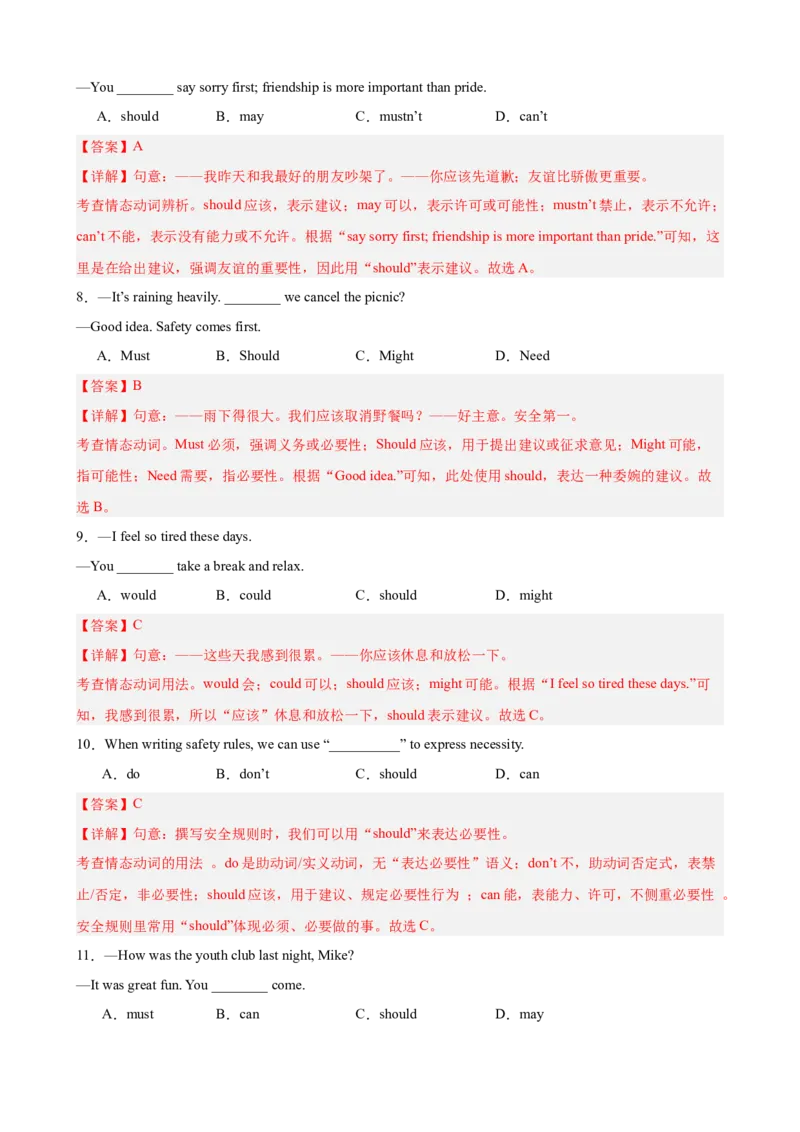
7.—I argued with my best friend yesterday.—You ________ say sorry first; friendship is more important than pride.
A.should B.may C.mustn’t D.can’t
【答案】A
【详解】句意:——我昨天和我最好的朋友吵架了。——你应该先道歉;友谊比骄傲更重要。
考查情态动词辨析。should应该,表示建议;may可以,表示许可或可能性;mustn’t禁止,表示不允许;
can’t不能,表示没有能力或不允许。根据“say sorry first; friendship is more important than pride.”可知,这
里是在给出建议,强调友谊的重要性,因此用“should”表示建议。故选A。
8.—It’s raining heavily. ________ we cancel the picnic?
—Good idea. Safety comes first.
A.Must B.Should C.Might D.Need
【答案】B
【详解】句意:——雨下得很大。我们应该取消野餐吗?——好主意。安全第一。
考查情态动词。Must必须,强调义务或必要性;Should应该,用于提出建议或征求意见;Might可能,
指可能性;Need需要,指必要性。根据“Good idea.”可知,此处使用should,表达一种委婉的建议。故
选B。
9.—I feel so tired these days.
—You ________ take a break and relax.
A.would B.could C.should D.might
【答案】C
【详解】句意:——这些天我感到很累。——你应该休息和放松一下。
考查情态动词用法。would会;could可以;should应该;might可能。根据“I feel so tired these days.”可
知,我感到很累,所以“应该”休息和放松一下,should表示建议。故选C。
10.When writing safety rules, we can use “__________” to express necessity.
A.do B.don’t C.should D.can
【答案】C
【详解】句意:撰写安全规则时,我们可以用“should”来表达必要性。
考查情态动词的用法 。do是助动词/实义动词,无“表达必要性”语义;don’t不,助动词否定式,表禁
止/否定,非必要性;should应该,用于建议、规定必要性行为 ;can能,表能力、许可,不侧重必要性 。
安全规则里常用“should”体现必须、必要做的事。故选C。
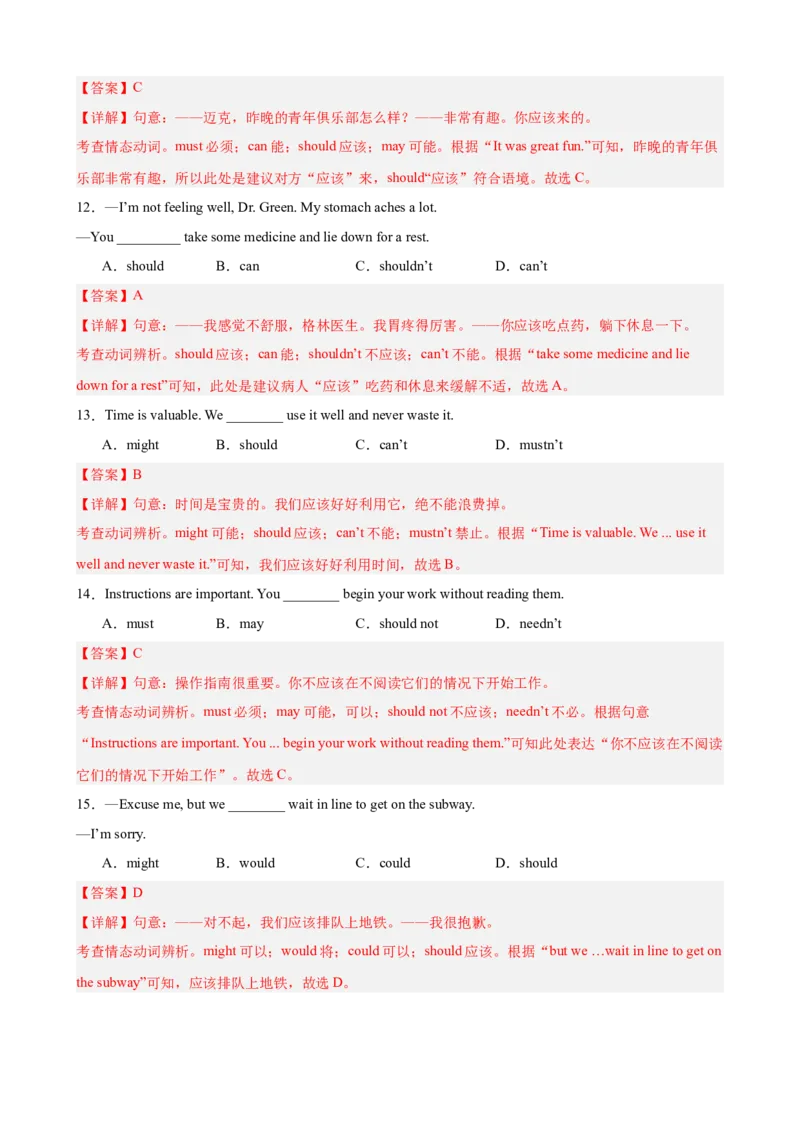
11.—How was the youth club last night, Mike?
—It was great fun. You ________ come.
A.must B.can C.should D.may【答案】C
【详解】句意:——迈克,昨晚的青年俱乐部怎么样?——非常有趣。你应该来的。
考查情态动词。must必须;can能;should应该;may可能。根据“It was great fun.”可知,昨晚的青年俱
乐部非常有趣,所以此处是建议对方“应该”来,should“应该”符合语境。故选C。
12.—I’m not feeling well, Dr. Green. My stomach aches a lot.
—You _________ take some medicine and lie down for a rest.
A.should B.can C.shouldn’t D.can’t
【答案】A
【详解】句意:——我感觉不舒服,格林医生。我胃疼得厉害。——你应该吃点药,躺下休息一下。
考查动词辨析。should应该;can能;shouldn’t不应该;can’t不能。根据“take some medicine and lie
down for a rest”可知,此处是建议病人“应该”吃药和休息来缓解不适,故选A。
13.Time is valuable. We ________ use it well and never waste it.
A.might B.should C.can’t D.mustn’t
【答案】B
【详解】句意:时间是宝贵的。我们应该好好利用它,绝不能浪费掉。
考查动词辨析。might可能;should应该;can’t不能;mustn’t禁止。根据“Time is valuable. We ... use it
well and never waste it.”可知,我们应该好好利用时间,故选B。
14.Instructions are important. You ________ begin your work without reading them.
A.must B.may C.should not D.needn’t
【答案】C
【详解】句意:操作指南很重要。你不应该在不阅读它们的情况下开始工作。
考查情态动词辨析。must必须;may可能,可以;should not不应该;needn’t不必。根据句意
“Instructions are important. You ... begin your work without reading them.”可知此处表达“你不应该在不阅读
它们的情况下开始工作”。故选C。
15.—Excuse me, but we ________ wait in line to get on the subway.
—I’m sorry.
A.might B.would C.could D.should
【答案】D
【详解】句意:——对不起,我们应该排队上地铁。——我很抱歉。
考查情态动词辨析。might可以;would将;could可以;should应该。根据“but we …wait in line to get on
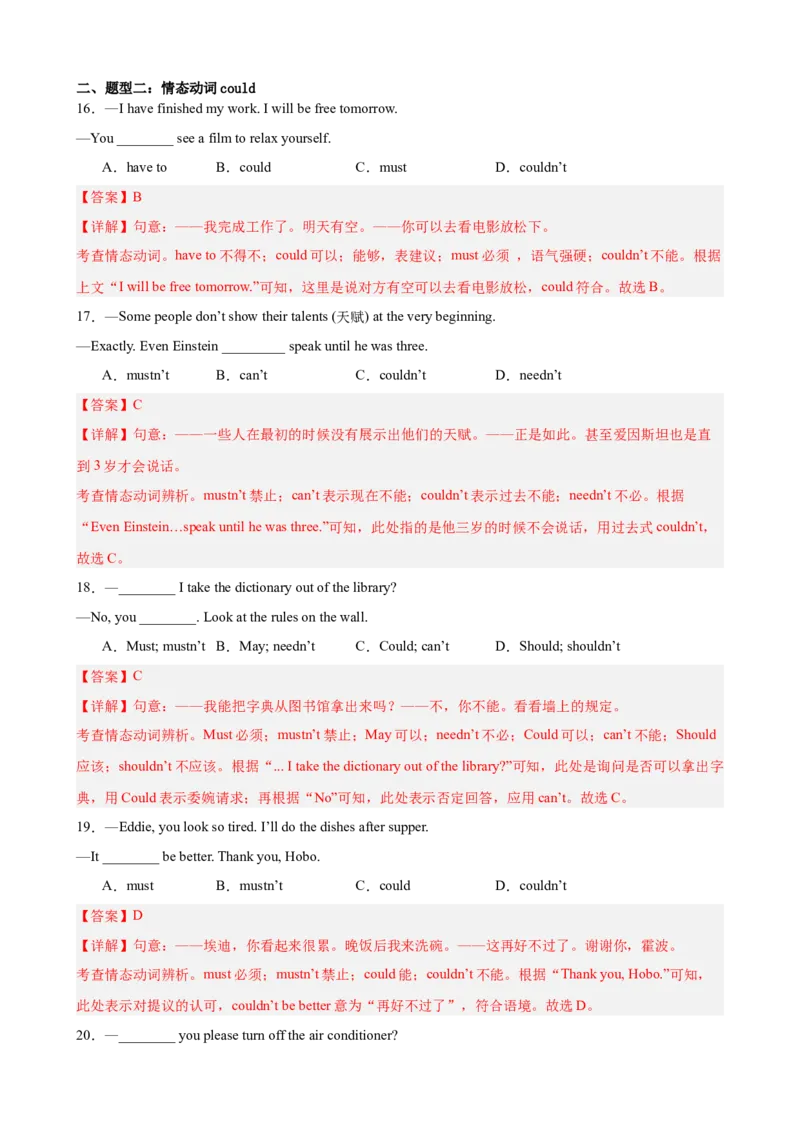
the subway”可知,应该排队上地铁,故选D。二、题型二:情态动词could
16.—I have finished my work. I will be free tomorrow.
—You ________ see a film to relax yourself.
A.have to B.could C.must D.couldn’t
【答案】B
【详解】句意:——我完成工作了。明天有空。——你可以去看电影放松下。
考查情态动词。have to不得不;could可以;能够,表建议;must必须 ,语气强硬;couldn’t不能。根据
上文“I will be free tomorrow.”可知,这里是说对方有空可以去看电影放松,could符合。故选B。
17.—Some people don’t show their talents (天赋) at the very beginning.
—Exactly. Even Einstein _________ speak until he was three.
A.mustn’t B.can’t C.couldn’t D.needn’t
【答案】C
【详解】句意:——一些人在最初的时候没有展示出他们的天赋。——正是如此。甚至爱因斯坦也是直
到3岁才会说话。
考查情态动词辨析。mustn’t禁止;can’t表示现在不能;couldn’t表示过去不能;needn’t不必。根据
“Even Einstein…speak until he was three.”可知,此处指的是他三岁的时候不会说话,用过去式couldn’t,
故选C。
18.—________ I take the dictionary out of the library?
—No, you ________. Look at the rules on the wall.
A.Must; mustn’t B.May; needn’t C.Could; can’t D.Should; shouldn’t
【答案】C
【详解】句意:——我能把字典从图书馆拿出来吗?——不,你不能。看看墙上的规定。
考查情态动词辨析。Must必须;mustn’t禁止;May可以;needn’t不必;Could可以;can’t不能;Should
应该;shouldn’t不应该。根据“... I take the dictionary out of the library?”可知,此处是询问是否可以拿出字
典,用Could表示委婉请求;再根据“No”可知,此处表示否定回答,应用can’t。故选C。
19.—Eddie, you look so tired. I’ll do the dishes after supper.
—It ________ be better. Thank you, Hobo.
A.must B.mustn’t C.could D.couldn’t
【答案】D
【详解】句意:——埃迪,你看起来很累。晚饭后我来洗碗。——这再好不过了。谢谢你,霍波。
考查情态动词辨析。must必须;mustn’t禁止;could能;couldn’t不能。根据“Thank you, Hobo.”可知,
此处表示对提议的认可,couldn’t be better意为“再好不过了”,符合语境。故选D。
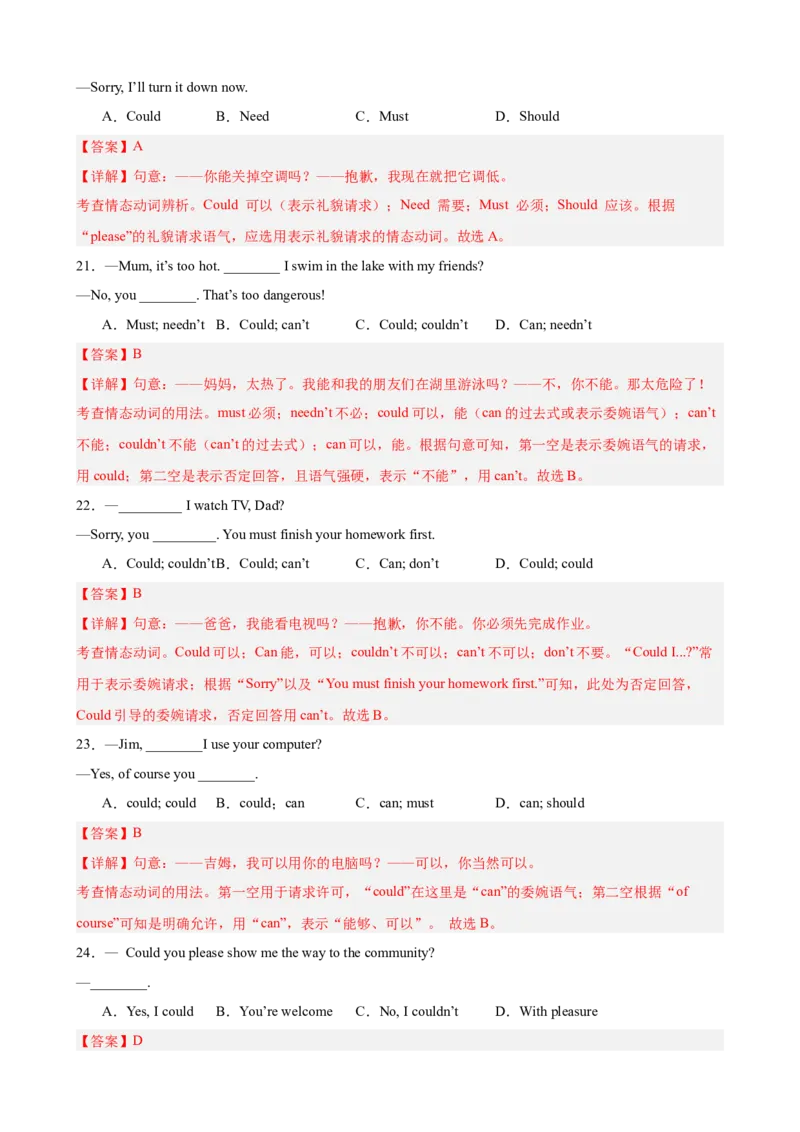
20.—________ you please turn off the air conditioner?—Sorry, I’ll turn it down now.
A.Could B.Need C.Must D.Should
【答案】A
【详解】句意:——你能关掉空调吗?——抱歉,我现在就把它调低。
考查情态动词辨析。Could 可以(表示礼貌请求);Need 需要;Must 必须;Should 应该。根据
“please”的礼貌请求语气,应选用表示礼貌请求的情态动词。故选A。
21.—Mum, it’s too hot. ________ I swim in the lake with my friends?
—No, you ________. That’s too dangerous!
A.Must; needn’t B.Could; can’t C.Could; couldn’t D.Can; needn’t
【答案】B
【详解】句意:——妈妈,太热了。我能和我的朋友们在湖里游泳吗?——不,你不能。那太危险了!
考查情态动词的用法。must必须;needn’t不必;could可以,能(can的过去式或表示委婉语气);can’t
不能;couldn’t不能(can’t的过去式);can可以,能。根据句意可知,第一空是表示委婉语气的请求,
用could;第二空是表示否定回答,且语气强硬,表示“不能”,用can’t。故选B。
22.—_________ I watch TV, Dad?
—Sorry, you _________. You must finish your homework first.
A.Could; couldn’tB.Could; can’t C.Can; don’t D.Could; could
【答案】B
【详解】句意:——爸爸,我能看电视吗?——抱歉,你不能。你必须先完成作业。
考查情态动词。Could可以;Can能,可以;couldn’t不可以;can’t不可以;don’t不要。“Could I...?”常
用于表示委婉请求;根据“Sorry”以及“You must finish your homework first.”可知,此处为否定回答,
Could引导的委婉请求,否定回答用can’t。故选B。
23.—Jim, ________I use your computer?
—Yes, of course you ________.
A.could; could B.could;can C.can; must D.can; should
【答案】B
【详解】句意:——吉姆,我可以用你的电脑吗?——可以,你当然可以。
考查情态动词的用法。第一空用于请求许可,“could”在这里是“can”的委婉语气;第二空根据“of
course”可知是明确允许,用“can”,表示“能够、可以”。 故选B。
24.— Could you please show me the way to the community?
—________.
A.Yes, I could B.You’re welcome C.No, I couldn’t D.With pleasure
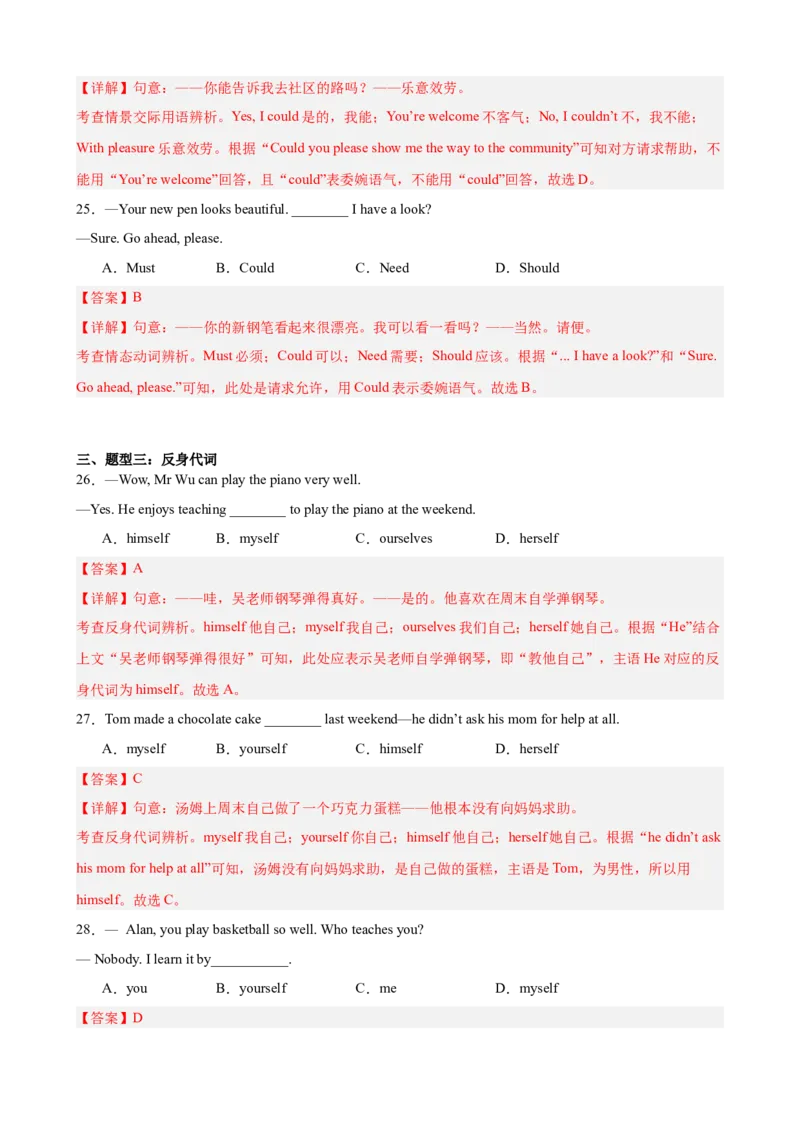
【答案】D【详解】句意:——你能告诉我去社区的路吗?——乐意效劳。
考查情景交际用语辨析。Yes, I could是的,我能;You’re welcome不客气;No, I couldn’t不,我不能;
With pleasure乐意效劳。根据“Could you please show me the way to the community”可知对方请求帮助,不
能用“You’re welcome”回答,且“could”表委婉语气,不能用“could”回答,故选D。
25.—Your new pen looks beautiful. ________ I have a look?
—Sure. Go ahead, please.
A.Must B.Could C.Need D.Should
【答案】B
【详解】句意:——你的新钢笔看起来很漂亮。我可以看一看吗?——当然。请便。
考查情态动词辨析。Must必须;Could可以;Need需要;Should应该。根据“... I have a look?”和“Sure.
Go ahead, please.”可知,此处是请求允许,用Could表示委婉语气。故选B。
三、题型三:反身代词
26.—Wow, Mr Wu can play the piano very well.
—Yes. He enjoys teaching ________ to play the piano at the weekend.
A.himself B.myself C.ourselves D.herself
【答案】A
【详解】句意:——哇,吴老师钢琴弹得真好。——是的。他喜欢在周末自学弹钢琴。
考查反身代词辨析。himself他自己;myself我自己;ourselves我们自己;herself她自己。根据“He”结合
上文“吴老师钢琴弹得很好”可知,此处应表示吴老师自学弹钢琴,即“教他自己”,主语He对应的反
身代词为himself。故选A。
27.Tom made a chocolate cake ________ last weekend—he didn’t ask his mom for help at all.
A.myself B.yourself C.himself D.herself
【答案】C
【详解】句意:汤姆上周末自己做了一个巧克力蛋糕——他根本没有向妈妈求助。
考查反身代词辨析。myself我自己;yourself你自己;himself他自己;herself她自己。根据“he didn’t ask
his mom for help at all”可知,汤姆没有向妈妈求助,是自己做的蛋糕,主语是Tom,为男性,所以用
himself。故选C。
28.— Alan, you play basketball so well. Who teaches you?
— Nobody. I learn it by___________.
A.you B.yourself C.me D.myself
【答案】D【详解】句意:——Alan,你篮球打得真好。谁教你的?——没人。我自学的。
考查代词辨析。you你,人称代词;yourself你自己,反身代词;me我,人称代词;myself我自己,反身
代词。根据“you play basketball so well. Who teaches you”和“Nobody”可知,learn by oneself“自学”符合
语境,所以此处应用反身代词,而由主语I可知,此处应用I的反身代词myself。故选D。
29.—Did you enjoy ________ on the beach at the weekend?
—Yes. We had a good time there.
A.you B.yourselves C.your D.yours
【答案】B
【详解】句意:——你们周末在海滩上玩得开心吗?——是的。我们在那里玩得很开心。
考查反身代词。you你,你们,人称代词主格或宾格;yourselves你们自己,反身代词;your你的,你们
的,形容词性物主代词;yours你的,你们的,名词性物主代词。根据空格前“enjoy”可知,此处考查
enjoy oneself “玩得开心”,固定搭配;再根据答句主语“we”可知,问句需用“you”对应的复数反身代词
yourselves。故选B。
30.I’m not good at maths, but I often say to ________, “Never give up!”
A.herself B.myself C.themselves D.himself
【答案】B
【详解】句意:我数学不好,但我经常对自己说:“永远别放弃!”。
考查反身代词的用法。herself她自己;myself我自己;themselves他们自己;himself他自己。主语是
“I”,因此反身代词应使用“myself”与之对应。故选B。
31.Boys and girls, please answer these questions ________.
A.on yourself B.for yourself C.by yourselves D.with yourselves
【答案】C
【详解】句意:同学们,请自己回答这些问题。
考查反身代词的用法和介词短语搭配。on yourself无此独立短语;for yourself为你自己;by yourselves独
自;with yourselves和你们自己。根据“...please answer these questions...”可知,此处是老师要求学生独自
回答问题,且主语“Boys and girls”是复数,反身代词需用复数形式yourselves,“by oneself”表示“独自
做某事”,固定短语。故选C。
32.—Who taught you to play the piano?
—Nobody. I learned it ________.
A.myself B.yourself C.himself D.herself
【答案】A
【详解】句意:——谁教你弹钢琴的?——没人教,我自己学的。考查反身代词辨析。myself我自己;yourself你自己;himself他自己;herself她自己。根据答语
“Nobody. I learned it...”可知,没人教,是自己学的,主语是I,所以反身代词应用myself。故选A。
33.—Did you hurt ________ while playing football?
—No, I didn’t. But my friend, Mike hurt ________ knee.
A.you; himself B.yourself; his C.yourself; him D.you; him
【答案】B
【详解】句意:——你踢足球时伤到自己了吗?——没有。但我的朋友迈克伤到了他的膝盖。
考查代词。第一空主语是you,表示“伤到自己”用反身代词yourself;第二空后是名词knee,前面需要
形容词性物主代词his修饰。故选B。
34.Mandy, we can’t do everything for you. You have to depend on ________ now.
A.you B.your C.yourself D.yourselves
【答案】C
【详解】句意:曼迪,我们不能为你做所有事。现在你得依靠你自己了。
考查代词辨析。you你/你们;your你的/你们的;yourself你自己;yourselves你们自己。 “depend on”是
动词短语,后接宾语,主语you在此处指代Mandy,对应的反身代词应为yourself。故选C。
35.All the notes in the shop ________ are very beautiful, but you must decide which to choose according to
your taste.
A.yourself B.themselves C.itself D.yourselves
【答案】B
【详解】句意:商店里所有的便签本身都非常漂亮,但你必须根据自己的品味决定选择哪一个。
考查反身代词的用法。yourself你自己;themselves他们自己;itself它自己;yourselves你们自己。反身代
词用于强调主语,必须与主语在人称和数上保持一致。主语“All the notes”是第三人称复数,因此选用第
三人称复数的反身代词themselves。故选B。
36.Teenagers should learn to _________ their ideas clearly instead of keeping silent.
A.express themselves B.teach themselves
C.be curious about D.look forward to
【答案】A
【详解】句意:青少年应该学会清晰地表达他们的想法而不是保持沉默。
考查动词短语辨析。express themselves表达自己的想法;teach themselves自学;be curious about对……好
奇;look forward to期待。根据“their ideas clearly instead of keeping silent”可知,此处指清晰表达想法,
而不是保持沉默,所以应该用express themselves。故选A。
37.A man should be strict with _____, but be friendly to others.A.myself B.yourself C.oneself D.himself
【答案】D
【详解】句意:一个人应该对自己严格,但对他人友好。
考查反身代词的用法。myself我自己;yourself你自己;oneself自己;himself他自己。由于主语“a man”
为第三人称单数男性,需用相应的反身代词,故选D。
38.—What are you doing, Jack?
—I didn’t have breakfast. I’m making a sandwich for ________.
A.my B.myself C.you D.yourself
【答案】B
【详解】句意:——你在做什么,杰克?——我没吃早餐。我正在给自己做一个三明治。
考查代词辨析。my我的;myself我自己;you你;yourself你自己。根据“I didn’t have breakfast”可知,
动作主语是“I”(Jack),宾语与主语一致,表示为自己做三明治,需使用反身代词myself。故选B。
39.If you want to be a pilot, you must keep ______ healthy and strong.
A.your B.you C.yours D.yourself
【答案】D
【详解】句意:如果你想成为一名飞行员,你必须保持身体健康和强壮。
考查反身代词的用法。your你的,形容词性物主代词;you你,人称代词主格;yours你的,名词性物主
代词;yourself你自己,反身代词。根据句子结构,主语“you”执行动作“keep”,宾语需与主语一致,表
示“保持自己”,反身代词“yourself”用于此情境。故选D。
40.The robot can do housework by ______. It doesn’t need any help.
A.itself B.himself C.herself D.themselves
【答案】A
【详解】句意:机器人可以独自做家务。它不需要任何帮助。
考查反身代词用法。itself它自己;himself他自己;herself她自己;themselves他们自己。主语“the
robot”,意为“机器人”,属于单数事物,需用与其对应的反身代词“itself”表示“独自完成”,且后句
“It doesn’t need any help.”进一步强调独立性。故选A。
41.—How was your trip to Yunnan province?
—Wonderful. We enjoyed ________ and saw many kinds of mushrooms there.
A.ourselves B.our C.us D.ours
【答案】A
【详解】句意:——你们的云南之旅怎么样?——太棒了。我们玩得很开心,还在那里看到了很多种蘑
菇。考查反身代词的用法。ourselves我们自己(反身代词);our我们的(形容词性物主代词,后接名词);
us我们(人称代词宾格);ours我们的(名词性物主代词)。“enjoy oneself”是固定搭配,意为“玩得开
心、过得愉快”,主语是“We”,对应的反身代词为“ourselves”,故选A。
42.—What did you think of the new lesson yesterday?
—The course ________ was meaningful, but I felt ________ because yesterday’s lesson was too long.
A.itself; boring B.himself; bored C.itself; bored D.himself; boring
【答案】C
【详解】句意:——你觉得昨天的新课怎么样?——课程本身很有意义,但我感到无聊,因为昨天的课
太长了。
考查反身代词和形容词辨析。itself它自己;himself他自己;boring无聊的;bored无聊的。根据“The
course...was meaningful”可知,第一个空指代“the course”,为物,需用反身代词“itself”;第二个空描述
“I”的感受,系动词felt后接“-ed”形容词bored表示“感到无聊”,而boring表示“令人无聊”,修饰
物。故选C。
43.—Alice is an excellent girl!
—That’s right. She can always take good care of ________ when she is at home alone.
A.myself B.herself C.yourself D.himself
【答案】B
【详解】句意:——爱丽丝是个很优秀的女孩!——没错。她独自在家时总能把自己照顾得很好。
考查反身代词辨析。myself我自己;herself她自己;yourself你自己;himself他自己。根据主语“She”可
知,此处需用对应的反身代词herself,指代她照顾自己。故选B。
44.—Don’t play with the knife, you may hurt ________, kids.
—Sorry, we won’t.
A.itself B.yourselves C.themselves D.yourself
【答案】B
【详解】句意:——孩子们,不要玩刀,你们可能会伤到你们自己。——对不起,我们不会了。
考查反身代词辨析。itself它自己;yourselves你们自己;themselves他们自己;yourself你自己。根据语境
可知,此处是在提醒孩子们不要玩刀,以免伤到他们自己,且根据“kids”可知,此处应用yourselves。故
选B。
45.—Lily, you should solve this math problem by ________ first. If you really can’t, I’ll help you.
—OK. Thank you, Miss Li.
A.itself B.herself C.myself D.yourself
【答案】D【详解】句意:——莉莉,你应该先自己解决这个数学问题。如果你真的不能,我会帮你。——好的。
谢谢你,李老师。
考查反身代词辨析。itself它自己;herself她自己;myself我自己;yourself你自己。主语是“you”,因此
反身代词需用“yourself”,表示“靠自己”。故选D。
四、选词填空
wash away, fall into, relax, with, however
A shower at night may make us feel 46 . But morning showers can keep us cleaner, according to
Primrose Freestone, a scientist at the University of Leicester in the UK.
This is because our bodies sweat (出汗) during sleep. Fresh sweat does not smell. 47 , many
bacteria (细菌) living on our skin “eat” sweat and make gases (气体) 48 bad smells. Also, we lose
small pieces of dead skin (死皮) during sleep. They can 49 our beds, and dust mites (螨虫) that give us
allergies (过敏) feed on them.
Having a shower in the morning 50 the sweat and bacteria. You won’t smell as much during the
day at school. Remember to wash your bed sheets (床单) every week in water over 60 °C. This helps kill
bacteria and dust mites.
【答案】46.relaxed 47.However 48.with 49.fall into 50.washes away
【导语】本文主要讨论了早晨洗澡比晚上洗澡更有利于保持清洁的原因,包括冲走汗液、细菌和死皮,
并建议定期清洗床单以杀灭细菌和螨虫。
46.句意:晚上淋浴可以让我们感到放松。根据“A shower at night may make us feel…”及备选词可知,空
处应用修饰人的形容词作宾语补足语,relaxed“放松的”,形容词。故填relaxed。
47.句意:然而,许多生活在我们皮肤上的细菌会“吃掉”汗液,并产生难闻的气体。根据“Fresh sweat
does not smell…many bacteria living on our skin “eat” sweat and make gases…bad smells.”及备选词可知,前
文提到新鲜的汗水没有味道,下文转折表达细菌会让它产生味道,应用副词修饰整个句子,并且位于句
首,首字母应大写,However“然而”,副词,表转折含义。故填However。
48.句意:然而,许多生活在我们皮肤上的细菌会“吃掉”汗液,并产生难闻的气体。根据“…many
bacteria living on our skin “eat” sweat and make gases…bad smells.”及备选词可知,此处指产生带有坏味道的
气体,with“伴随”,介词。故填with。
49.句意:它们会掉到我们的床上,让我们过敏的尘螨以它们为食。根据“They can…our beds, and dust
mites that give us allergies feed on them.”及备选词可知,此处指死皮会掉落到床上,情态动词can后接动词原形,fall into“掉落”,动词短语。故填fall into。
50.句意:早上淋浴可以冲走汗水和细菌。根据“Having a shower in the morning…the sweat and bacteria.”
及备选词可知,此处指早上淋浴可以冲走汗水和细菌,句子时态为一般现在时,主语“Having a shower in
the morning”为动名词,谓语动词应用三单形式,wash away“冲走”,动词短语,三单形式为washes
away。故填washes away。
请从方框内选择适当的词并用其正确的形式填空,使文章完整连贯。注意每空一词,每词仅用一次,有
两词为多余项。
touching easily in they important
cheap and celebrate different waste way when
Hand-washing Day is an important day for all the people in the world. It’s on October 15th every year. The
day reminds people of the 51 of washing hands with soap. Hand-washing Day began in 2008. More than
70 countries 52 the first Hand-washing Day and over 120 million children around the world joined 53
the activity. Since 2008, more and more people in 54 countries have got to know about Hand-washing
Day.
Washing hands with soap is the best way to keep us away from germs (细菌). How do the germs get on our
hands? As we know, 55 are everywhere. And there are many 56 to get germs on our hands, like
covering our mouths with hands while coughing or 57 something. If we don’t wash away these germs at
once, we can 58 pass them to someone else. The germs can get into our bodies 59 we touch our
eyes, noses or mouths with hands. When we touch the door, the desk and other things, we’re passing the germs
around.
Hand-washing is an easy, 60 and effective (有效的) way to keep us away from germs and keep
kids and adults healthy.
【答案】
51.importance 52.celebrated 53.in 54.different 55.they 56.ways 57.
touching 58.easily 59.when 60.cheap
【导语】本文介绍了世界洗手日的相关情况,包括其设立时间、意义以及洗手的重要性。文章提到洗手
日旨在提醒人们用肥皂洗手的重要性,自2008年设立以来,已有多个国家参与。同时解释了细菌传播的
途径以及用肥皂洗手是简单、经济且有效的预防细菌传播、保持健康的方式。
51.句意:这个日子提醒人们用肥皂洗手的重要性。根据“Hand-washing Day is an important day”可知,
洗手日的意义在于强调洗手的“重要性”,important形容词,其名词形式是“importance”。故填
importance。52.句意:70多个国家庆祝了第一个洗手日,全球超过1.2亿儿童参与了这项活动。根据“the first Hand-
washing Day”可知,各国“庆祝”首个洗手日,根据“began in 2008”可知,用一般过去时。故填
celebrated。
53.句意:70多个国家庆祝了第一个洗手日,全球超过1.2亿儿童参与了这项活动。“join in the activity”
为固定短语,意为“参与活动”。故填in。
54.句意:自2008年以来,不同国家中越来越多的人了解了洗手日。根据“more and more people”和
“countries”可知,此处指“不同的”国家,“different”修饰“countries”。故填different。
55.句意:众所周知,它们无处不在。前文提到“germs (细菌)”,此处指代细菌,用代词“they”作主语。
故填they。
56.句意:手上沾染细菌的方式有很多,比如咳嗽时用手捂嘴或触摸东西。根据“like covering our
mouths... or touching something”可知,这些是沾染细菌的“方式”,根据“many”可知,此处用“way”的
复数形式“ways”。故填ways。
57.句意:手上沾染细菌的方式有很多,比如咳嗽时用手捂嘴或触摸东西。“touching something”是沾染
细菌的一种方式,与“covering our mouths”并列。故填touching。
58.句意:如果我们不立即洗掉这些细菌,我们会轻易地把它们传给别人。根据语境可知,细菌很“容
易”传播,“easily”为副词,修饰动词“pass”。故填easily。
59.句意:当我们用手触摸眼睛、鼻子或嘴巴时,细菌会进入我们的身体。此处需要引导时间状语从句,
when“当……时”引导时间状语从句。故填when。
60.句意:洗手是一种简单、便宜且有效的远离细菌、保持儿童和成人健康的方式。根据“easy”和
“effective”可知,此处描述洗手的特点,“cheap”符合“成本低”的特性,与其他形容词并列。故填
cheap。
五、短文填空
Everyone 61 (want) to have healthy teeth. When you laugh, you will open your mouth and show
your teeth. The healthier your teeth are, the happier you feel. Why is that? That’s 62 your teeth are
important in many ways. Take care of them, and they will help to take care of you. Strong, healthy teeth help you
63 (grow). They also help you speak 64 (clear).
You can take care of your teeth by doing like these:
Brush your teeth twice 65 day, after getting up and before bedtime.
And brush all of your teeth, not just the front ones. Spend some time 66 (brush) the teeth along
the sides and in the back. Spend at least three 67 (minute) each time you brush. Be sure your toothbrush
is soft. Ask your parents 68 (help) you get a new toothbrush every three months. Brushing keeps yourteeth in good health. You also need to care 69 what you eat and drink.
Do you want to have white and 70 (health) teeth? Please brush your teeth.
【答案】
61.wants 62.because 63.to grow/grow 64.clearly 65.a 66.brushing 67.
minutes 68.to help 69.about 70.healthy
【导语】本文主要讲述了牙齿健康的重要性以及正确刷牙的方法。
61.句意:每个人都想要健康的牙齿。主语是Everyone,复合不定代词作主语,谓语动词用三单。故填
wants。
62.句意:那是因为你的牙齿在很多方面都很重要。由上文的Why is that?可知,那是因为你的牙齿在很
多方面是重要的,使用because“因为”,引导表语从句。故填because。
63.句意:强壮健康的牙齿帮助你成长。根据“help you ...”可知,考查固定短语help sb (to) do sth“帮助某
人做某事”。故填to grow/grow.
64.句意:它们还能帮助你清楚地讲话。由上文的speak可知,它们还能帮助你清楚地讲话,使用clear
的副词形式clearly修饰动词speak。故填clearly。
65.句意:每天刷牙两次,起床后和睡觉前。根据“twice ... day”可知,此处表示“一天两次”;故填
a。
66.句意:花费一些时间在牙齿的两边和后面。spend some time doing sth.“花费时间做某事”,这里指
的是“刷牙”,动词用brushing;故填brushing.
67.句意:每次刷牙至少花费三分钟。根据“three ...”可知,此处用名词复数,minute的复数,直接加
s。故填minutes。
68.句意:让你的父母每三个月帮你换一把新牙刷。根据“Ask your parents ...”可知,每三个月让你的父
母帮你换一把新的牙刷;动词短语ask sb.to do sth.“让某人做某事”,故填to help。
69.句意:同样,你需要关注你吃喝的东西。固定短语care about“在意,关心”。故填about。
70.句意:你想拥有更白更健康的牙齿吗?根据“Do you want to have white and ... teeth?”可知,此处需要
用形容词修饰teeth,health的形容词healthy“健康的”。故填healthy。