文档文本内容
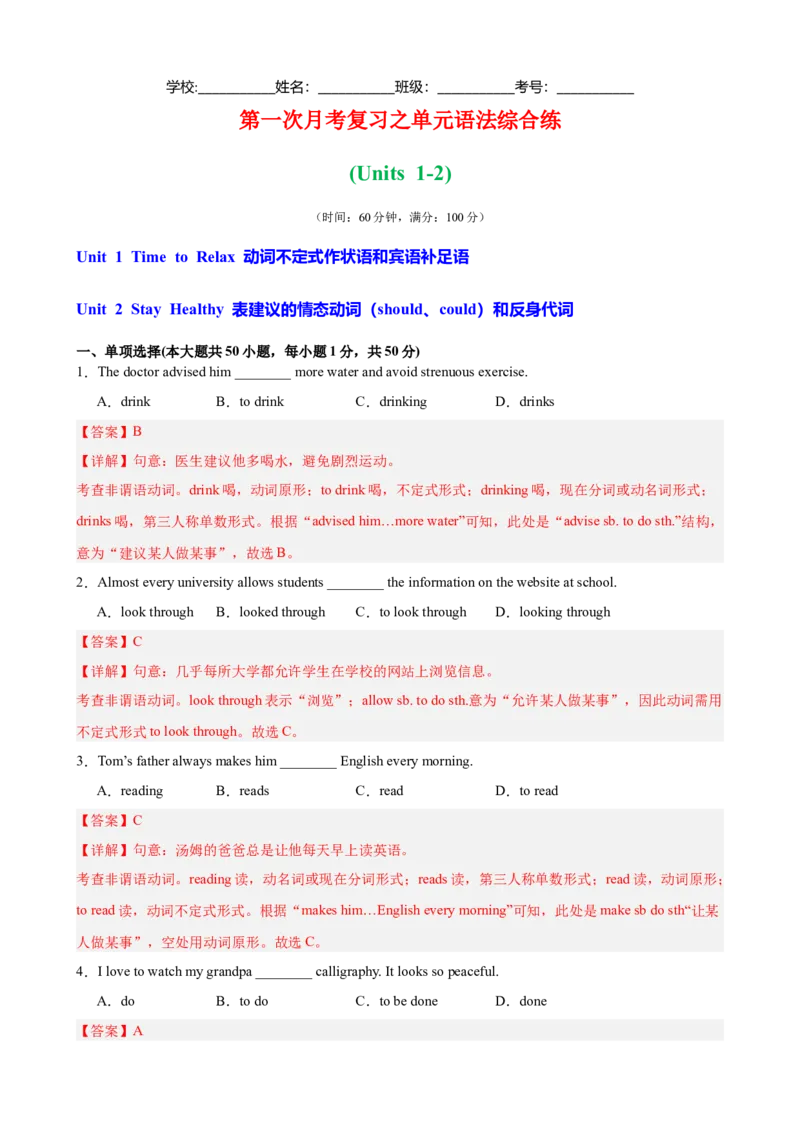
学校:___________姓名:___________班级:___________考号:___________
第一次月考复习之单元语法综合练
(Units 1-2)
(时间:60分钟,满分:100分)
Unit 1 Time to Relax 动词不定式作状语和宾语补足语
Unit 2 Stay Healthy 表建议的情态动词(should、could)和反身代词
一、单项选择(本大题共50小题,每小题1分,共50分)
1.The doctor advised him ________ more water and avoid strenuous exercise.
A.drink B.to drink C.drinking D.drinks
【答案】B
【详解】句意:医生建议他多喝水,避免剧烈运动。
考查非谓语动词。drink喝,动词原形;to drink喝,不定式形式;drinking喝,现在分词或动名词形式;
drinks喝,第三人称单数形式。根据“advised him…more water”可知,此处是“advise sb. to do sth.”结构,
意为“建议某人做某事”,故选B。
2.Almost every university allows students ________ the information on the website at school.
A.look through B.looked through C.to look through D.looking through
【答案】C
【详解】句意:几乎每所大学都允许学生在学校的网站上浏览信息。
考查非谓语动词。look through表示“浏览”;allow sb. to do sth.意为“允许某人做某事”,因此动词需用
不定式形式to look through。故选C。
3.Tom’s father always makes him ________ English every morning.
A.reading B.reads C.read D.to read
【答案】C
【详解】句意:汤姆的爸爸总是让他每天早上读英语。
考查非谓语动词。reading读,动名词或现在分词形式;reads读,第三人称单数形式;read读,动词原形;
to read读,动词不定式形式。根据“makes him…English every morning”可知,此处是make sb do sth“让某
人做某事”,空处用动词原形。故选C。
4.I love to watch my grandpa ________ calligraphy. It looks so peaceful.
A.do B.to do C.to be done D.done
【答案】A【详解】句意:我喜欢看我的爷爷写书法。那看起来非常宁静。
考查非谓语动词。watch sb. doing sth.“看见某人正在做某事”,强调动作正在进行;watch sb. do sth.“看见
某人做某事”,强调动作的全过程。根据“It looks so peaceful.”可知,此处指看爷爷写书法的整个过程,
所以用省略to的不定式作宾语补足语。故选A。
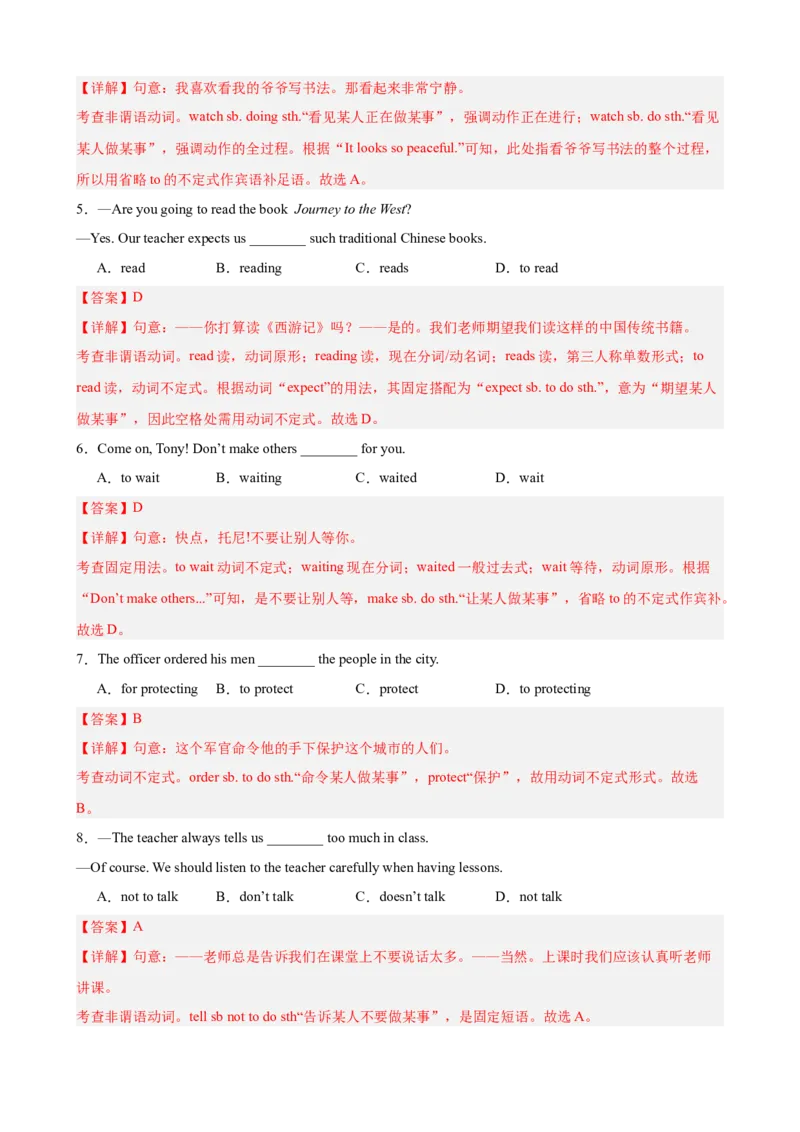
5.—Are you going to read the book Journey to the West?
—Yes. Our teacher expects us ________ such traditional Chinese books.
A.read B.reading C.reads D.to read
【答案】D
【详解】句意:——你打算读《西游记》吗?——是的。我们老师期望我们读这样的中国传统书籍。
考查非谓语动词。read读,动词原形;reading读,现在分词/动名词;reads读,第三人称单数形式;to
read读,动词不定式。根据动词“expect”的用法,其固定搭配为“expect sb. to do sth.”,意为“期望某人
做某事”,因此空格处需用动词不定式。故选D。
6.Come on, Tony! Don’t make others ________ for you.
A.to wait B.waiting C.waited D.wait
【答案】D
【详解】句意:快点,托尼!不要让别人等你。
考查固定用法。to wait动词不定式;waiting现在分词;waited一般过去式;wait等待,动词原形。根据
“Don’t make others...”可知,是不要让别人等,make sb. do sth.“让某人做某事”,省略to的不定式作宾补。
故选D。
7.The officer ordered his men ________ the people in the city.
A.for protecting B.to protect C.protect D.to protecting
【答案】B
【详解】句意:这个军官命令他的手下保护这个城市的人们。
考查动词不定式。order sb. to do sth.“命令某人做某事”,protect“保护”,故用动词不定式形式。故选
B。
8.—The teacher always tells us ________ too much in class.
—Of course. We should listen to the teacher carefully when having lessons.
A.not to talk B.don’t talk C.doesn’t talk D.not talk
【答案】A
【详解】句意:——老师总是告诉我们在课堂上不要说话太多。——当然。上课时我们应该认真听老师
讲课。
考查非谓语动词。tell sb not to do sth“告诉某人不要做某事”,是固定短语。故选A。9.He wants me ________ him ________ his English.
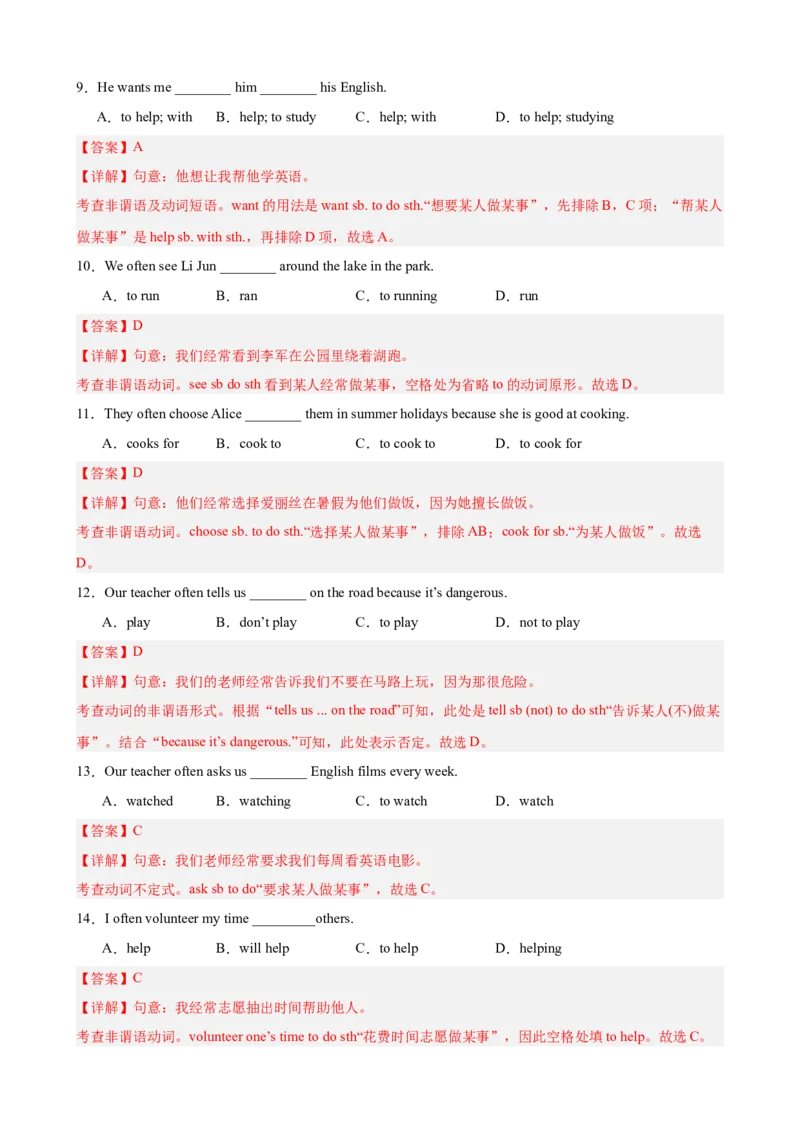
A.to help; with B.help; to study C.help; with D.to help; studying
【答案】A
【详解】句意:他想让我帮他学英语。
考查非谓语及动词短语。want的用法是want sb. to do sth.“想要某人做某事”,先排除B,C项;“帮某人
做某事”是help sb. with sth.,再排除D项,故选A。
10.We often see Li Jun ________ around the lake in the park.
A.to run B.ran C.to running D.run
【答案】D
【详解】句意:我们经常看到李军在公园里绕着湖跑。
考查非谓语动词。see sb do sth看到某人经常做某事,空格处为省略to的动词原形。故选D。
11.They often choose Alice ________ them in summer holidays because she is good at cooking.
A.cooks for B.cook to C.to cook to D.to cook for
【答案】D
【详解】句意:他们经常选择爱丽丝在暑假为他们做饭,因为她擅长做饭。
考查非谓语动词。choose sb. to do sth.“选择某人做某事”,排除AB;cook for sb.“为某人做饭”。故选
D。
12.Our teacher often tells us ________ on the road because it’s dangerous.
A.play B.don’t play C.to play D.not to play
【答案】D
【详解】句意:我们的老师经常告诉我们不要在马路上玩,因为那很危险。
考查动词的非谓语形式。根据“tells us ... on the road”可知,此处是tell sb (not) to do sth“告诉某人(不)做某
事”。结合“because it’s dangerous.”可知,此处表示否定。故选D。
13.Our teacher often asks us ________ English films every week.
A.watched B.watching C.to watch D.watch
【答案】C
【详解】句意:我们老师经常要求我们每周看英语电影。
考查动词不定式。ask sb to do“要求某人做某事”,故选C。
14.I often volunteer my time _________others.
A.help B.will help C.to help D.helping
【答案】C
【详解】句意:我经常志愿抽出时间帮助他人。
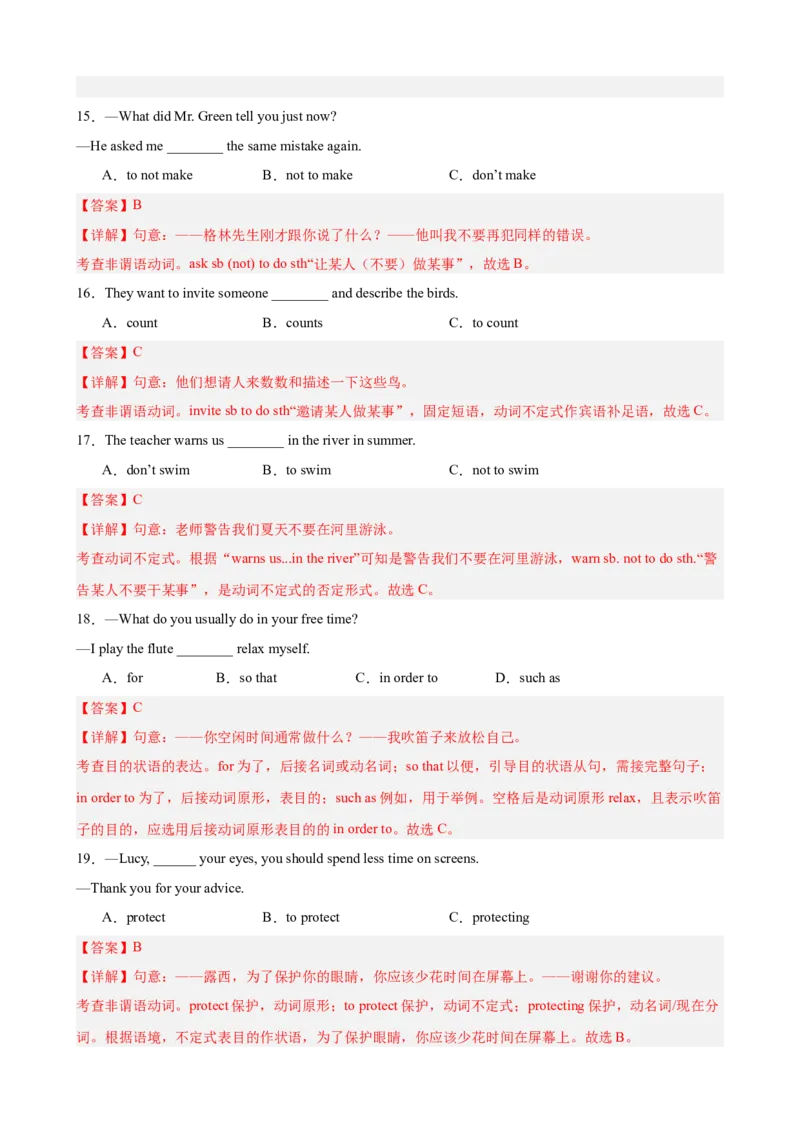
考查非谓语动词。volunteer one’s time to do sth“花费时间志愿做某事”,因此空格处填to help。故选C。15.—What did Mr. Green tell you just now?
—He asked me ________ the same mistake again.
A.to not make B.not to make C.don’t make
【答案】B
【详解】句意:——格林先生刚才跟你说了什么?——他叫我不要再犯同样的错误。
考查非谓语动词。ask sb (not) to do sth“让某人(不要)做某事”,故选B。
16.They want to invite someone ________ and describe the birds.
A.count B.counts C.to count
【答案】C
【详解】句意:他们想请人来数数和描述一下这些鸟。
考查非谓语动词。invite sb to do sth“邀请某人做某事”,固定短语,动词不定式作宾语补足语,故选C。
17.The teacher warns us ________ in the river in summer.
A.don’t swim B.to swim C.not to swim
【答案】C
【详解】句意:老师警告我们夏天不要在河里游泳。
考查动词不定式。根据“warns us...in the river”可知是警告我们不要在河里游泳,warn sb. not to do sth.“警
告某人不要干某事”,是动词不定式的否定形式。故选C。
18.—What do you usually do in your free time?
—I play the flute ________ relax myself.
A.for B.so that C.in order to D.such as
【答案】C
【详解】句意:——你空闲时间通常做什么?——我吹笛子来放松自己。
考查目的状语的表达。for为了,后接名词或动名词;so that以便,引导目的状语从句,需接完整句子;
in order to为了,后接动词原形,表目的;such as例如,用于举例。空格后是动词原形relax,且表示吹笛
子的目的,应选用后接动词原形表目的的in order to。故选C。
19.—Lucy, ______ your eyes, you should spend less time on screens.
—Thank you for your advice.
A.protect B.to protect C.protecting
【答案】B
【详解】句意:——露西,为了保护你的眼睛,你应该少花时间在屏幕上。——谢谢你的建议。
考查非谓语动词。protect保护,动词原形;to protect保护,动词不定式;protecting保护,动名词/现在分
词。根据语境,不定式表目的作状语,为了保护眼睛,你应该少花时间在屏幕上。故选B。20.She went to the art club ________ her painting skills.
A.improve B.to improve C.improving D.improved
【答案】B
【详解】句意:她去艺术俱乐部是为了提高她的绘画技能。
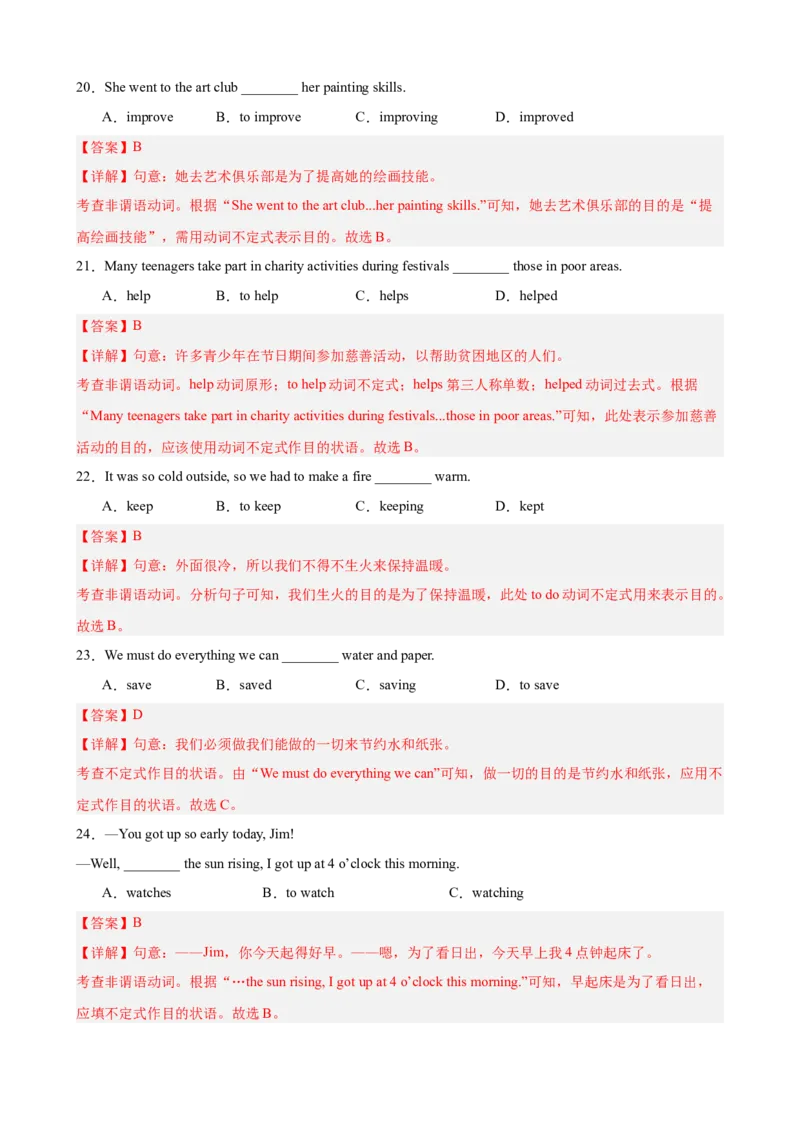
考查非谓语动词。根据“She went to the art club...her painting skills.”可知,她去艺术俱乐部的目的是“提
高绘画技能”,需用动词不定式表示目的。故选B。
21.Many teenagers take part in charity activities during festivals ________ those in poor areas.
A.help B.to help C.helps D.helped
【答案】B
【详解】句意:许多青少年在节日期间参加慈善活动,以帮助贫困地区的人们。
考查非谓语动词。help动词原形;to help动词不定式;helps第三人称单数;helped动词过去式。根据
“Many teenagers take part in charity activities during festivals...those in poor areas.”可知,此处表示参加慈善
活动的目的,应该使用动词不定式作目的状语。故选B。
22.It was so cold outside, so we had to make a fire ________ warm.
A.keep B.to keep C.keeping D.kept
【答案】B
【详解】句意:外面很冷,所以我们不得不生火来保持温暖。
考查非谓语动词。分析句子可知,我们生火的目的是为了保持温暖,此处to do动词不定式用来表示目的。
故选B。
23.We must do everything we can ________ water and paper.
A.save B.saved C.saving D.to save
【答案】D
【详解】句意:我们必须做我们能做的一切来节约水和纸张。
考查不定式作目的状语。由“We must do everything we can”可知,做一切的目的是节约水和纸张,应用不
定式作目的状语。故选C。
24.—You got up so early today, Jim!
—Well, ________ the sun rising, I got up at 4 o’clock this morning.
A.watches B.to watch C.watching
【答案】B
【详解】句意:——Jim,你今天起得好早。——嗯,为了看日出,今天早上我4点钟起床了。
考查非谓语动词。根据“…the sun rising, I got up at 4 o’clock this morning.”可知,早起床是为了看日出,
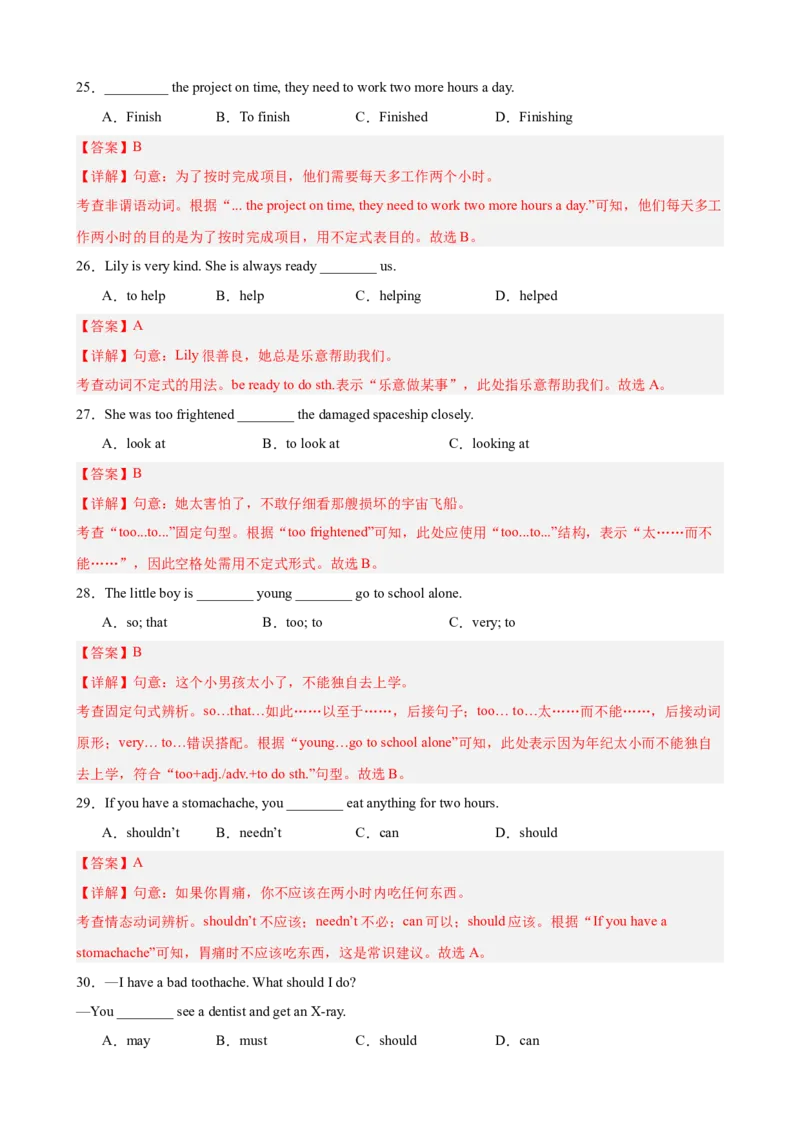
应填不定式作目的状语。故选B。25._________ the project on time, they need to work two more hours a day.
A.Finish B.To finish C.Finished D.Finishing
【答案】B
【详解】句意:为了按时完成项目,他们需要每天多工作两个小时。
考查非谓语动词。根据“... the project on time, they need to work two more hours a day.”可知,他们每天多工
作两小时的目的是为了按时完成项目,用不定式表目的。故选B。
26.Lily is very kind. She is always ready ________ us.
A.to help B.help C.helping D.helped
【答案】A
【详解】句意:Lily很善良,她总是乐意帮助我们。
考查动词不定式的用法。be ready to do sth.表示“乐意做某事”,此处指乐意帮助我们。故选A。
27.She was too frightened ________ the damaged spaceship closely.
A.look at B.to look at C.looking at
【答案】B
【详解】句意:她太害怕了,不敢仔细看那艘损坏的宇宙飞船。
考查“too...to...”固定句型。根据“too frightened”可知,此处应使用“too...to...”结构,表示“太……而不
能……”,因此空格处需用不定式形式。故选B。
28.The little boy is ________ young ________ go to school alone.
A.so; that B.too; to C.very; to
【答案】B
【详解】句意:这个小男孩太小了,不能独自去上学。
考查固定句式辨析。so…that…如此……以至于……,后接句子;too… to…太……而不能……,后接动词
原形;very… to…错误搭配。根据“young…go to school alone”可知,此处表示因为年纪太小而不能独自
去上学,符合“too+adj./adv.+to do sth.”句型。故选B。
29.If you have a stomachache, you ________ eat anything for two hours.
A.shouldn’t B.needn’t C.can D.should
【答案】A
【详解】句意:如果你胃痛,你不应该在两小时内吃任何东西。
考查情态动词辨析。shouldn’t不应该;needn’t不必;can可以;should应该。根据“If you have a
stomachache”可知,胃痛时不应该吃东西,这是常识建议。故选A。
30.—I have a bad toothache. What should I do?
—You ________ see a dentist and get an X-ray.
A.may B.must C.should D.can【答案】C
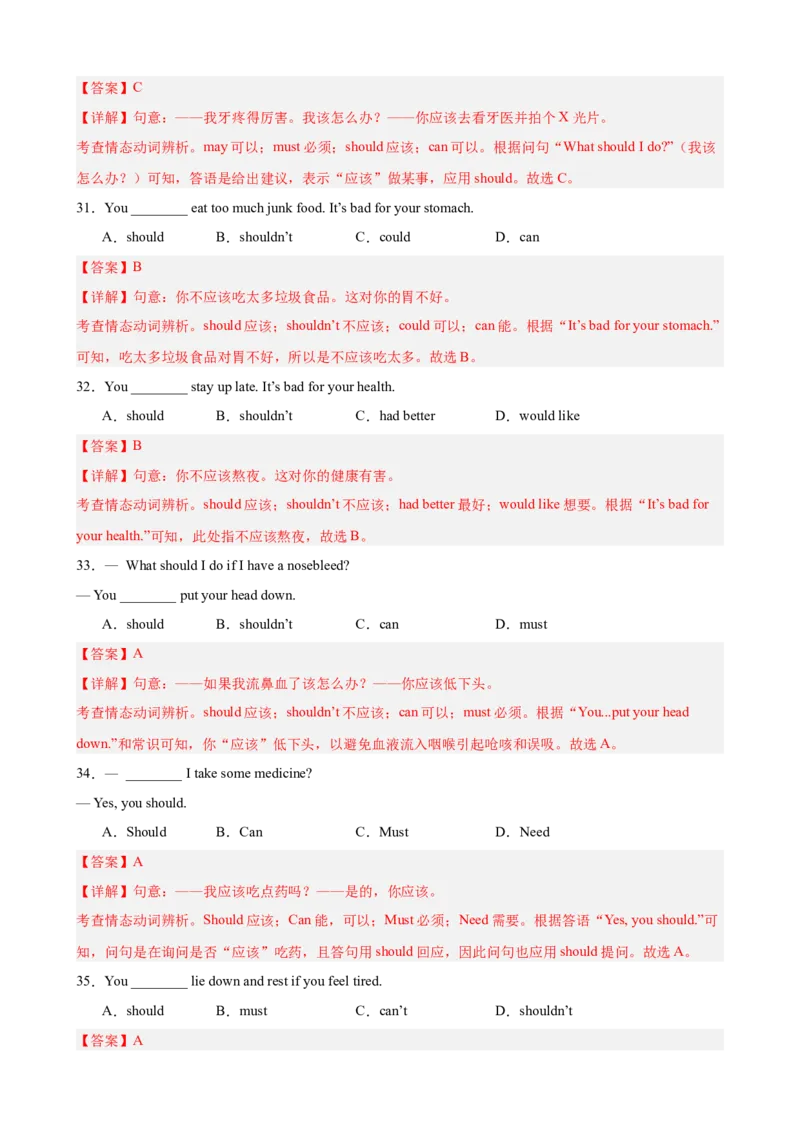
【详解】句意:——我牙疼得厉害。我该怎么办?——你应该去看牙医并拍个X光片。
考查情态动词辨析。may可以;must必须;should应该;can可以。根据问句“What should I do?”(我该
怎么办?)可知,答语是给出建议,表示“应该”做某事,应用should。故选C。
31.You ________ eat too much junk food. It’s bad for your stomach.
A.should B.shouldn’t C.could D.can
【答案】B
【详解】句意:你不应该吃太多垃圾食品。这对你的胃不好。
考查情态动词辨析。should应该;shouldn’t不应该;could可以;can能。根据“It’s bad for your stomach.”
可知,吃太多垃圾食品对胃不好,所以是不应该吃太多。故选B。
32.You ________ stay up late. It’s bad for your health.
A.should B.shouldn’t C.had better D.would like
【答案】B
【详解】句意:你不应该熬夜。这对你的健康有害。
考查情态动词辨析。should应该;shouldn’t不应该;had better最好;would like想要。根据“It’s bad for
your health.”可知,此处指不应该熬夜,故选B。
33.— What should I do if I have a nosebleed?
— You ________ put your head down.
A.should B.shouldn’t C.can D.must
【答案】A
【详解】句意:——如果我流鼻血了该怎么办?——你应该低下头。
考查情态动词辨析。should应该;shouldn’t不应该;can可以;must必须。根据“You...put your head
down.”和常识可知,你“应该”低下头,以避免血液流入咽喉引起呛咳和误吸。故选A。
34.— ________ I take some medicine?
— Yes, you should.
A.Should B.Can C.Must D.Need
【答案】A
【详解】句意:——我应该吃点药吗?——是的,你应该。
考查情态动词辨析。Should应该;Can能,可以;Must必须;Need需要。根据答语“Yes, you should.”可
知,问句是在询问是否“应该”吃药,且答句用should回应,因此问句也应用should提问。故选A。
35.You ________ lie down and rest if you feel tired.
A.should B.must C.can’t D.shouldn’t
【答案】A【详解】句意:如果你感到累,你应该躺下休息。
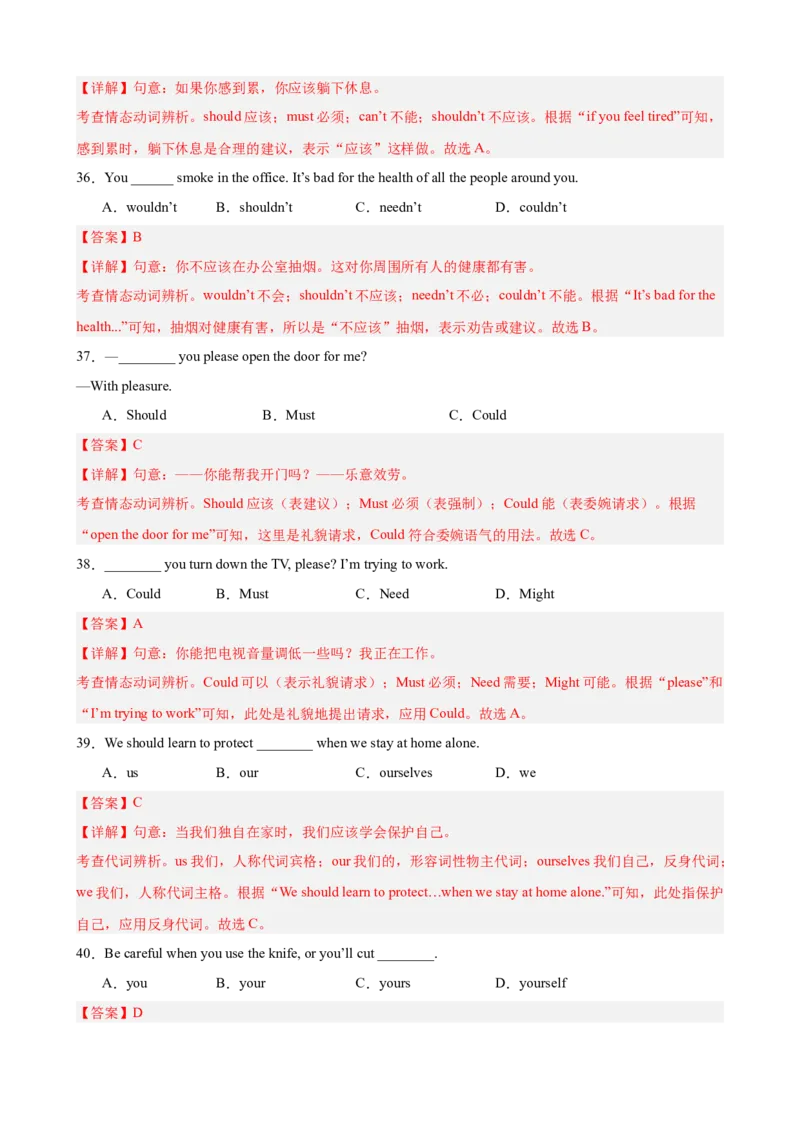
考查情态动词辨析。should应该;must必须;can’t不能;shouldn’t不应该。根据“if you feel tired”可知,
感到累时,躺下休息是合理的建议,表示“应该”这样做。故选A。
36.You ______ smoke in the office. It’s bad for the health of all the people around you.
A.wouldn’t B.shouldn’t C.needn’t D.couldn’t
【答案】B
【详解】句意:你不应该在办公室抽烟。这对你周围所有人的健康都有害。
考查情态动词辨析。wouldn’t不会;shouldn’t不应该;needn’t不必;couldn’t不能。根据“It’s bad for the
health...”可知,抽烟对健康有害,所以是“不应该”抽烟,表示劝告或建议。故选B。
37.—________ you please open the door for me?
—With pleasure.
A.Should B.Must C.Could
【答案】C
【详解】句意:——你能帮我开门吗?——乐意效劳。
考查情态动词辨析。Should应该(表建议);Must必须(表强制);Could能(表委婉请求)。根据
“open the door for me”可知,这里是礼貌请求,Could符合委婉语气的用法。故选C。
38.________ you turn down the TV, please? I’m trying to work.
A.Could B.Must C.Need D.Might
【答案】A
【详解】句意:你能把电视音量调低一些吗?我正在工作。
考查情态动词辨析。Could可以(表示礼貌请求);Must必须;Need需要;Might可能。根据“please”和
“I’m trying to work”可知,此处是礼貌地提出请求,应用Could。故选A。
39.We should learn to protect ________ when we stay at home alone.
A.us B.our C.ourselves D.we
【答案】C
【详解】句意:当我们独自在家时,我们应该学会保护自己。
考查代词辨析。us我们,人称代词宾格;our我们的,形容词性物主代词;ourselves我们自己,反身代词;
we我们,人称代词主格。根据“We should learn to protect…when we stay at home alone.”可知,此处指保护
自己,应用反身代词。故选C。
40.Be careful when you use the knife, or you’ll cut ________.
A.you B.your C.yours D.yourself
【答案】D【详解】句意:当你用刀时要小心,否则你会割伤自己。
考查反身代词。you你(主格/宾格);your你的(形容词性物主代词);yours你的(名词性物主代词);
yourself你自己(反身代词)。根据“cut”可知,此处表示“伤到自己”,主语是“you”,动作“cut”的承
受者也是主语自身,需用反身代词。故选D。
41.We should learn to take care of ________.
A.us B.our C.ours D.ourselves
【答案】D
【详解】句意:我们应该学会照顾我们自己。
考查代词辨析。us我们,宾格;our我们的,形容词性物主代词;ours我们的,名词性物主代词;
ourselves我们自己,反身代词。根据语境可知,此处表达的是我们应该学会照顾我们自己,所以应该用
反身代词ourselves。故选D。
42.He decided to ________ programming ________ , so he bought a book and started practicing.
A.learn, by him B.learn, with himself C.learn, by his D.learn, by himself
【答案】D
【详解】句意:他决定自学编程,所以他买了一本书并开始练习。
考查反身代词和介词搭配。learn学习,by him被他;with himself和他自己一起;by his被他的,后接名
词;by himself他自己。根据“He decided to...programming...”可知,他想自学编程,应用learn...by oneself
自学,且主语是he,对应的反身代词应为himself。故选D。
43.Don’t play with the knife, you may hurt ________, kids.
A.itself B.themselves C.yourself D.yourselves
【答案】D
【详解】句意:不要玩刀,你们可能会伤到自己,孩子们。
考查反身代词的用法。itself它自己;themselves他们自己;yourself你自己;yourselves你们自己。此处主
语you是指“孩子们”,因此反身代词需与之保持一致,因此选用“yourselves”(你们自己)。故选D。
44.—Did you hurt ________ while playing football?
—No, I didn’t. But my friend, Mike hurt ________ knee.
A.you; himself B.yourself; his C.yourself; him D.you; him
【答案】B
【详解】句意:——你踢足球时伤到自己了吗?——没有。但我的朋友迈克伤到了他的膝盖。
考查代词。第一空主语是you,表示“伤到自己”用反身代词yourself;第二空后是名词knee,前面需要
形容词性物主代词his修饰。故选B。
45.—Don’t play with the knife, you may hurt ________, kids.—Sorry, we won’t.
A.itself B.yourselves C.themselves D.yourself
【答案】B
【详解】句意:——孩子们,不要玩刀,你们可能会伤到你们自己。——对不起,我们不会了。
考查反身代词辨析。itself它自己;yourselves你们自己;themselves他们自己;yourself你自己。根据语境
可知,此处是在提醒孩子们不要玩刀,以免伤到他们自己,且根据“kids”可知,此处应用yourselves。故
选B。
46.—Peter, can you finish this project by ________?
—Yes. I don’t need any help.
A.myself B.yourself C.himself
【答案】B
【详解】句意:——彼得,你能独自完成这个项目吗?——是的。我不需要任何帮助。
考查反身代词辨析。myself我自己;yourself你自己;himself他自己。根据“Peter, can you...”可知,这里
是在问彼得是否能自己完成项目,第二人称“you”对应的反身代词是“yourself”,by oneself表示“独自,
单独”,故选B。
47.—Did you enjoy ________ at the party last night, Lisa?
—Yes! I danced and sang with my friends. It was wonderful.
A.yourself B.yourselves C.myself D.ourselves
【答案】A
【详解】句意:——你昨晚在聚会上玩得开心吗,丽莎? ——是的!我和朋友们一起唱歌跳舞。太棒了。
考查反身代词辨析。yourself你自己;yourselves你们自己;myself我自己;ourselves我们自己。根据
“Did you enjoy...at the party last night, Lisa?”可知,此处是询问丽莎玩得是否开心,丽莎是一个人,应用
yourself。故选A。
48.—Who bought the birthday cake for you?
—Oh! My father made it by ________.
A.myself B.yourself C.herself D.himself
【答案】D
【详解】句意:——谁给你买的生日蛋糕?——哦!我爸爸自己做的。
考查反身代词。myself我自己;yourself你自己;herself她自己;himself他自己;句子主语是“My
father”,所以此处指的是“他自己”,所以用himself表示。故选D。
49.—Your uncle is very good at cooking. How did he learn it?
—He learned it by ________.A.him B.himself C.herself
【答案】B
【详解】句意:——你的叔叔很擅长烹饪。他是怎么学习烹饪的?——他是自学的。
考查人称代词辨析。him他;himself反他自己;herself她自己。by oneself“独自”,此处用反身代词,叔
叔是男性,用反身代词himself。故选B。
50.— Did you hurt _______ while _______ soccer?
— No, I didn’t.
A.you; playing B.yourself; playing C.yourself; play
【答案】B
【详解】句意:——你踢足球时伤到你自己了吗?——不,我没有。
考查反身代词和状语从句省略。you你;playing玩,现在分词;yourself你自己;play玩,动词原形。根
据“Did you hurt...while...soccer”可知,此处询问 “你自己是否受伤”,第一空应用反身代词yourself;第
二空是while引导的时间状语从句的省略形式,完整形式为while you were playing soccer,省略主语you
和be动词后保留playing。故选B。
二、单词拼写(本大题共25小题,每小题2分,共50分)
51.My mother tells me (drink) more water every day.
【答案】to drink
【详解】句意:我妈妈告诉我每天要多喝水。tell sb. to do sth.“告诉某人做某事”,动词不定式作宾语补
足语。故填to drink。
52.The teacher advised us (choose) “helping the elderly in the community” as the focus of our
project.
【答案】to choose
【详解】句意:老师建议我们选择“帮助社区里的老人”作为我们项目的重点。根据“advised us”可知,
此处使用动词不定式作宾语补足语,advise sb. to do sth.“建议某人做某事”,choose“选择”,动词。故填
to choose。
53.It made me (decide) to try hiking.
【答案】decide
【详解】句意:这让我决定尝试徒步旅行。decide“决定”,是动词;make是使役动词,固定搭配为
“make sb do sth”,意为“让某人做某事”,后面需要接不带to的动词原形作宾语补足语。故填decide。
54.My mother told me (not push) myself too hard.
【答案】not to push
【详解】句意:我妈妈告诉我不要把自己逼得太紧。not push “不要逼得……,不要推……”,根据此句的“told me … ”可知,此句有“tell somebody not to do something”,“told”是“tell”的一般过去时,后接
动词不定式结构,此句是否定句,因此后接“not to do something”,因此此处“not push”应用“not to
push”。故填not to push。
55.The doctor asks him (rest) for a week after the illness.
【答案】to rest
【详解】句意:医生要求他病后休息一周。根据“The doctor asks him...”可知,此处考查“ask sb. to do
sth.”结构,意为“要求某人做某事”,因此需要在“rest”前加“to”。故填to rest。
56.My teacher encourages us (take) part in community service activities.
【答案】to take
【详解】句意:我的老师鼓励我们参加社区服务活动。encourage sb to do sth“鼓励某人做某事”,动词短
语,此处应用to take。故填to take。
57.Mother lets Michael (watch)TV all day because the final exam is coming.
【答案】not watch
【详解】句意:妈妈不让迈克尔整天看电视,因为期末考试就要到了。let sb (not) do sth“让某人(不)要
做某事”,省略to的动词不定作宾补,根据“because the final exam is coming”可知,考试要来了,所以
不要整天看电视,故填not watch。
58.I don’t like milk at all. But my mother often forces me it. (drink)
【答案】to drink
【详解】句意:我一点也不喜欢喝牛奶。但是我妈妈经常强迫我喝。drink“喝”,动词;force sb. to do
sth“强迫某人做某事”,设空处需使用动词不定式形式作宾补。故填to drink。
59.It’s cold outside. Jenny asked me (close) the window.
【答案】to close
【详解】句意:外面很冷,Jenny让我关上窗户。ask sb. to do sth“要求某人做某事”。故填to close。
60.I play the flute (relax) after school.
【答案】to relax
【详解】句意:放学后我吹长笛放松一下。relax “放松”,根据此句的“I play the flute … ” 可知,此句
有“play the flute to do something”,因此“play the flute”后接动词不定式结构,此处的“relax”需用动词不
定式结构“to relax”。故填to relax。
61.Emma went to the sports centre (try) ice skating.
【答案】to try
【详解】句意:Emma去体育中心尝试滑冰。根据“Emma went to the sports centre…”可知,此处表达去体育中心的目的。try意为“尝试”,此处应用动词不定式作目的状语。故填to try。
62.When you are sick, it is important to take your temperature (check) if you have a fever.
【答案】to check
【详解】句意:当你生病时,重要的是要量体温以检查是否发烧。根据“take your temperature ... if you
have a fever.”可知,测量体温的目的是为了检查是否发烧,用不定式作目的状语。故填to check。
63.We prepare all kinds of food (give) her a healthy diet.
【答案】to give
【详解】句意:我们准备各种食物是为了给她提供健康的饮食。根据“We prepare all kinds of food...her a
healthy diet”可知空格处需填入动词不定式,表示“准备食物”的目的,作目的状语。give的不定式为to
give。故填to give。
64.The government made new rules (stop) people from driving after drinking.
【答案】to stop
【详解】句意:政府制定了新规定以禁止人们酒后驾车。根据“The government made new rules...people
from...”可知空格处需填入不定式,表示制定规则的目的。括号内的提示词“stop”对应的不定式为“to
stop”。故填to stop。
65.Scientists are working hard (develop) new ways to treat this disease.
【答案】to develop
【详解】句意:科学家们正在努力工作来开发治疗这种疾病的新方法。根据“Scientists are working hard...
new ways to treat this disease.”可知,科学家努力工作的目的是研发治疗这种疾病的新方法,此处用动词不
定式to develop表目的。故填to develop。
66.She is staying up late (watch) the basketball match.
【答案】to watch/watching
【详解】句意:她正熬夜看篮球比赛。watch “看” ,是动词,根据“stay up late”可知,此处可以加动词
不定式作目的状语,也可以加动词的现在分词形式作伴随状语,故填to watch/watching。
67.The girl taught (she) English when she was a child.
【答案】herself
【详解】句意:这个女孩小时候自学英语。teach oneself“自学”,she的反身代词是herself。故填
herself。
68.The little boy hurt (he) when he fell off the bike.
【答案】himself
【详解】句意:这个小男孩从自行车上摔下来时伤到了自己。根据“hurt”可知,此处表示“伤到自己”,
用反身代词。“he”是主格代词,意为“他”,其反身代词形式“himself”,意为“他自己”。故填himself。
69.We must protect (we) when we do sports.
【答案】ourselves
【详解】句意:在做运动时我们必须保护自己。空格处需填入we的反身代词形式,作protect的宾语,表
示“我们自己”。we的反身代词是ourselves。故填ourselves。
70.I can finish the homework by (my) without any help.
【答案】myself
【详解】句意:我可以不需要任何帮助,自己完成作业。my我的,形容词性物主代词。分析句子可知,
此处应用反身代词与介词“by”搭配,构成“by oneself”短语,意为“独自地”。主语为“I”,对应的反身
代词为“myself”。故填myself。
71.I often tell (I) to be more careful when doing maths homework.
【答案】myself
【详解】句意:我经常告诉自己做数学作业时要更细心。“tell”后接反身代词表示“告诉自己”,主语是
“I”,对应的反身代词是“myself”。故填myself。
72.The little boy can dress (he) now.
【答案】himself
【详解】句意:这个小男孩现在可以自己穿衣服了。dress oneself“自己穿衣服”,是固定短语,空格处应
填he的反身代词himself。故填himself。
73.The children enjoyed (they) at the birthday party.
【答案】themselves
【详解】句意:孩子们在生日派对上玩得很开心。enjoy oneself是固定搭配,意为“玩得开心”,主语
the children是复数,对应的反身代词为themselves,故填themselves。
74.—I saw your grandma using Douyin on the phone. Who taught her?
—Nobody. She taught (she).
【答案】herself
【详解】句意:——我看见你奶奶在手机上刷抖音呢,谁教她的呀?——没人教,她是自学的。she“她”,
人称代词主格,句子主语是she,宾语指代的是主语本身,需要用反身代词表示“自学”的含义。人称代
词she对应的反身代词是herself,teach oneself“自学”。故填herself。
75.—Who will cook dinner tonight?
—Let’s do it (we). Mom and Dad are too tired.
【答案】ourselves【详解】句意:——今晚谁来做晚饭?——我们自己动手吧。爸爸妈妈太累了。we“我们”,人称代词;
根据“Let’s do it...Mom and Dad are too tired.”可知,说话者提出“我们自己做晚饭”的建议,因此设空处
填写ourselves“我们自己”,反身代词。故填ourselves。