八年级下学期期末重难知识点串讲+精练
专题05 重点语法归纳及专练(一)
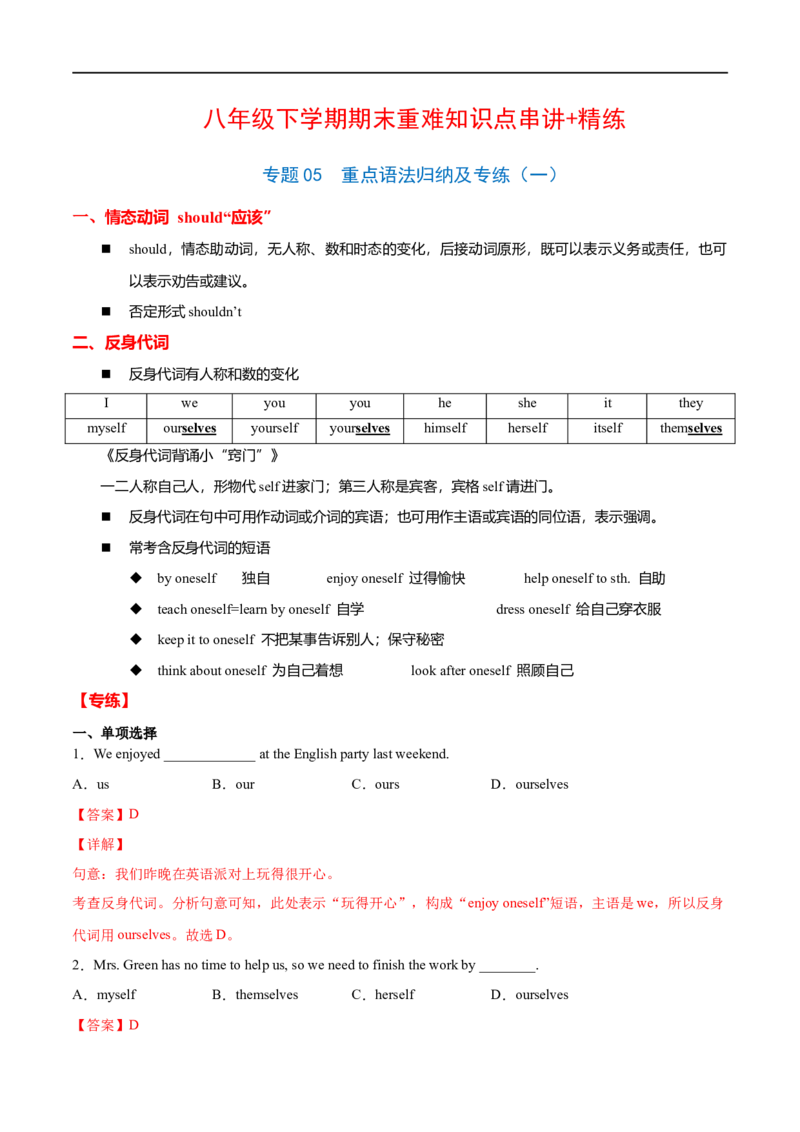
一、情态动词 should“应该”
should,情态助动词,无人称、数和时态的变化,后接动词原形,既可以表示义务或责任,也可
以表示劝告或建议。
否定形式shouldn’t
二、反身代词
反身代词有人称和数的变化
I we you you he she it they
myself ourselves yourself yourselves himself herself itself themselves
《反身代词背诵小“窍门”》
一二人称自己人,形物代self进家门;第三人称是宾客,宾格self请进门。
反身代词在句中可用作动词或介词的宾语;也可用作主语或宾语的同位语,表示强调。
常考含反身代词的短语
by oneself 独自 enjoy oneself 过得愉快 help oneself to sth. 自助
teach oneself=learn by oneself 自学 dress oneself 给自己穿衣服
keep it to oneself 不把某事告诉别人;保守秘密
think about oneself 为自己着想 look after oneself 照顾自己
【专练】
一、单项选择
1.We enjoyed _____________ at the English party last weekend.
A.us B.our C.ours D.ourselves
【答案】D
【详解】
句意:我们昨晚在英语派对上玩得很开心。
考查反身代词。分析句意可知,此处表示“玩得开心”,构成“enjoy oneself”短语,主语是we,所以反身
代词用ourselves。故选D。
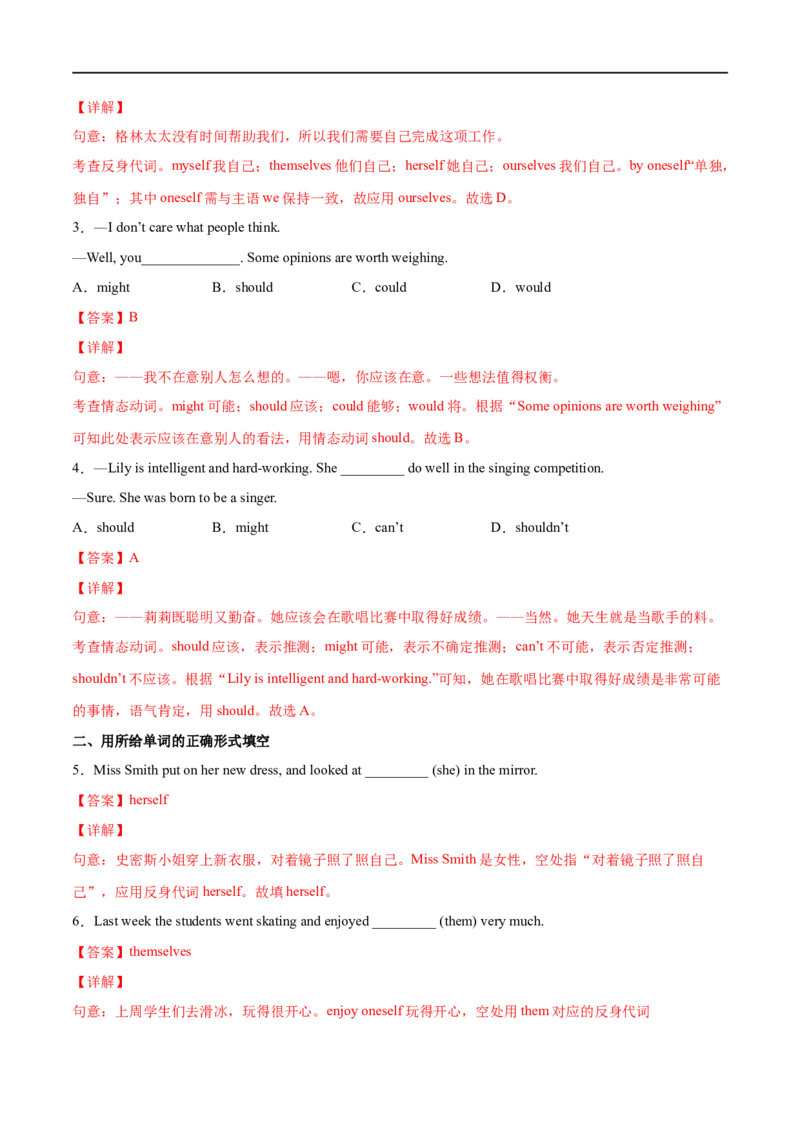
2.Mrs. Green has no time to help us, so we need to finish the work by ________.
A.myself B.themselves C.herself D.ourselves
【答案】D【详解】
句意:格林太太没有时间帮助我们,所以我们需要自己完成这项工作。
考查反身代词。myself我自己;themselves他们自己;herself她自己;ourselves我们自己。by oneself“单独,
独自”;其中oneself需与主语we保持一致,故应用ourselves。故选D。
3.—I don’t care what people think.
—Well, you______________. Some opinions are worth weighing.
A.might B.should C.could D.would
【答案】B
【详解】
句意:——我不在意别人怎么想的。——嗯,你应该在意。一些想法值得权衡。
考查情态动词。might可能;should应该;could能够;would将。根据“Some opinions are worth weighing”
可知此处表示应该在意别人的看法,用情态动词should。故选B。
4.—Lily is intelligent and hard-working. She _________ do well in the singing competition.
—Sure. She was born to be a singer.
A.should B.might C.can’t D.shouldn’t
【答案】A
【详解】
句意:——莉莉既聪明又勤奋。她应该会在歌唱比赛中取得好成绩。——当然。她天生就是当歌手的料。
考查情态动词。should应该,表示推测;might可能,表示不确定推测;can’t不可能,表示否定推测;
shouldn’t不应该。根据“Lily is intelligent and hard-working.”可知,她在歌唱比赛中取得好成绩是非常可能
的事情,语气肯定,用should。故选A。
二、用所给单词的正确形式填空
5.Miss Smith put on her new dress, and looked at _________ (she) in the mirror.
【答案】herself
【详解】
句意:史密斯小姐穿上新衣服,对着镜子照了照自己。Miss Smith是女性,空处指“对着镜子照了照自
己”,应用反身代词herself。故填herself。
6.Last week the students went skating and enjoyed _________ (them) very much.
【答案】themselves
【详解】
句意:上周学生们去滑冰,玩得很开心。enjoy oneself玩得开心,空处用them对应的反身代词themselves。故填themselves。
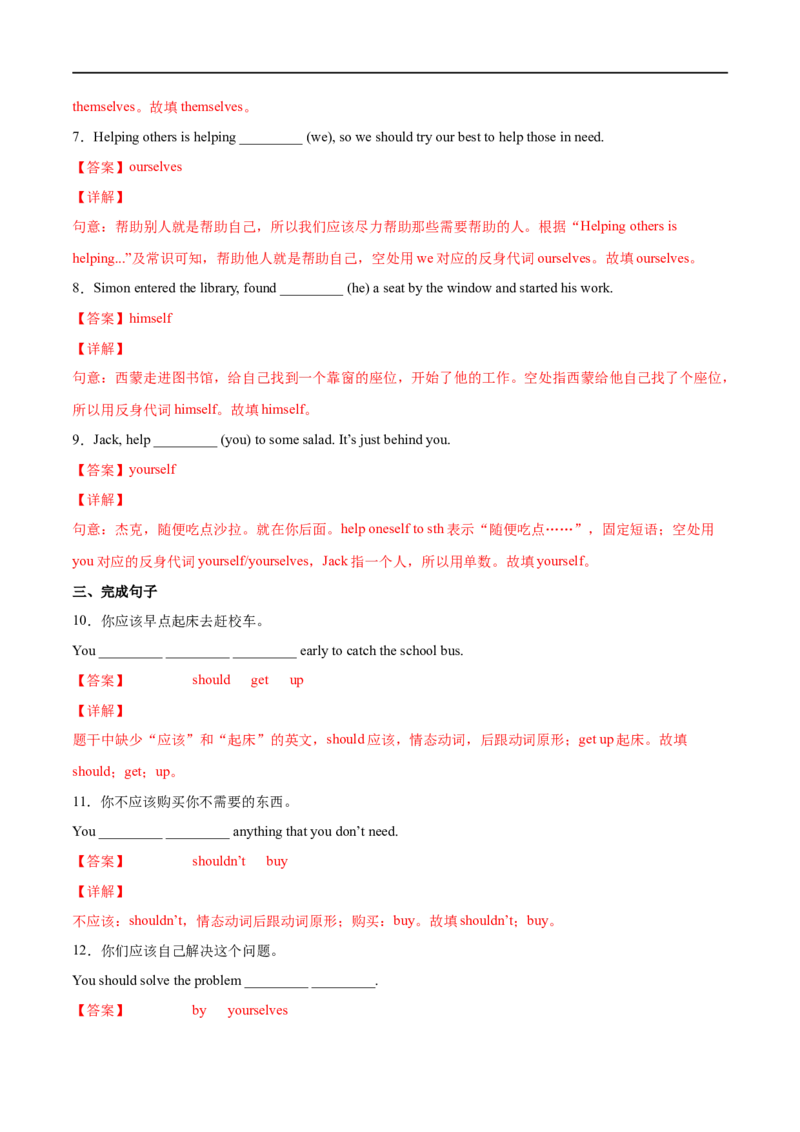
7.Helping others is helping _________ (we), so we should try our best to help those in need.
【答案】ourselves
【详解】
句意:帮助别人就是帮助自己,所以我们应该尽力帮助那些需要帮助的人。根据“Helping others is
helping...”及常识可知,帮助他人就是帮助自己,空处用we对应的反身代词ourselves。故填ourselves。
8.Simon entered the library, found _________ (he) a seat by the window and started his work.
【答案】himself
【详解】
句意:西蒙走进图书馆,给自己找到一个靠窗的座位,开始了他的工作。空处指西蒙给他自己找了个座位,
所以用反身代词himself。故填himself。
9.Jack, help _________ (you) to some salad. It’s just behind you.
【答案】yourself
【详解】
句意:杰克,随便吃点沙拉。就在你后面。help oneself to sth表示“随便吃点……”,固定短语;空处用
you对应的反身代词yourself/yourselves,Jack指一个人,所以用单数。故填yourself。
三、完成句子
10.你应该早点起床去赶校车。
You _________ _________ _________ early to catch the school bus.
【答案】 should get up
【详解】
题干中缺少“应该”和“起床”的英文,should应该,情态动词,后跟动词原形;get up起床。故填
should;get;up。
11.你不应该购买你不需要的东西。
You _________ _________ anything that you don’t need.
【答案】 shouldn’t buy
【详解】
不应该:shouldn’t,情态动词后跟动词原形;购买:buy。故填shouldn’t;buy。
12.你们应该自己解决这个问题。
You should solve the problem _________ _________.
【答案】 by yourselves【详解】
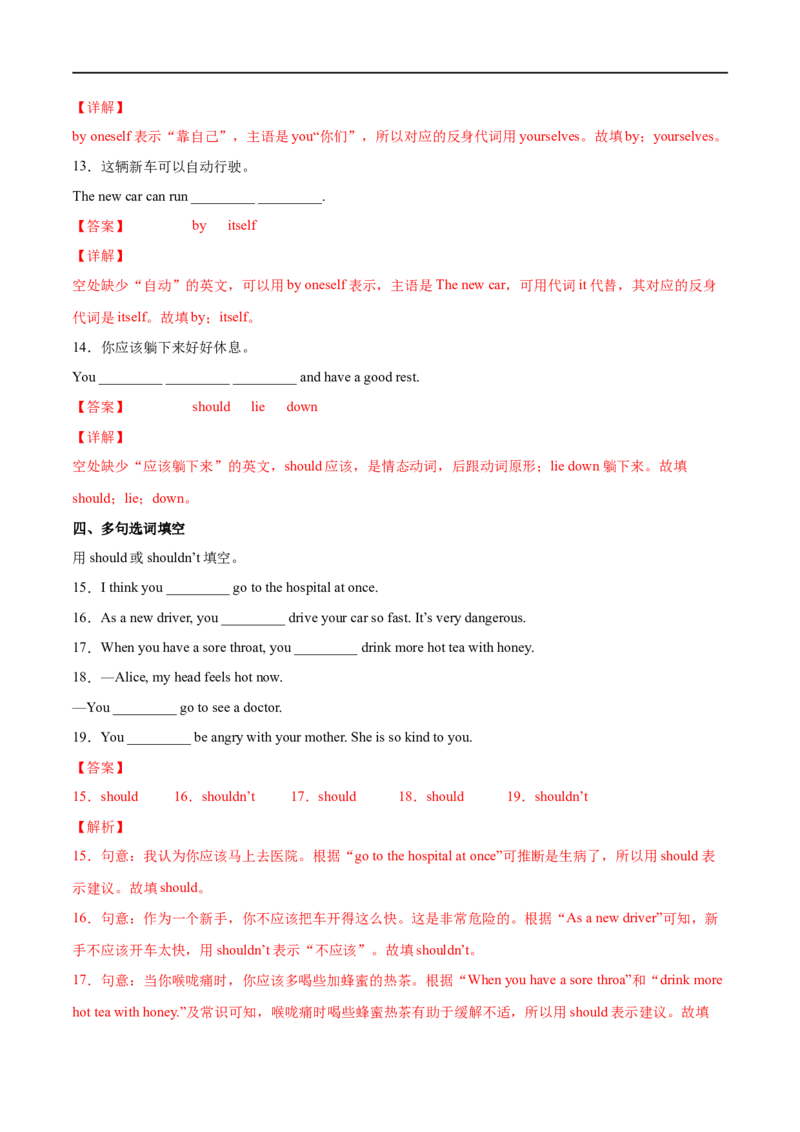
by oneself表示“靠自己”,主语是you“你们”,所以对应的反身代词用yourselves。故填by;yourselves。
13.这辆新车可以自动行驶。
The new car can run _________ _________.
【答案】 by itself
【详解】
空处缺少“自动”的英文,可以用by oneself表示,主语是The new car,可用代词it代替,其对应的反身
代词是itself。故填by;itself。
14.你应该躺下来好好休息。
You _________ _________ _________ and have a good rest.
【答案】 should lie down
【详解】
空处缺少“应该躺下来”的英文,should应该,是情态动词,后跟动词原形;lie down躺下来。故填
should;lie;down。
四、多句选词填空
用should或shouldn’t填空。
15.I think you _________ go to the hospital at once.
16.As a new driver, you _________ drive your car so fast. It’s very dangerous.
17.When you have a sore throat, you _________ drink more hot tea with honey.
18.—Alice, my head feels hot now.
—You _________ go to see a doctor.
19.You _________ be angry with your mother. She is so kind to you.
【答案】
15.should 16.shouldn’t 17.should 18.should 19.shouldn’t
【解析】
15.句意:我认为你应该马上去医院。根据“go to the hospital at once”可推断是生病了,所以用should表
示建议。故填should。
16.句意:作为一个新手,你不应该把车开得这么快。这是非常危险的。根据“As a new driver”可知,新
手不应该开车太快,用shouldn’t表示“不应该”。故填shouldn’t。
17.句意:当你喉咙痛时,你应该多喝些加蜂蜜的热茶。根据“When you have a sore throa”和“drink more
hot tea with honey.”及常识可知,喉咙痛时喝些蜂蜜热茶有助于缓解不适,所以用should表示建议。故填should。
18.句意:——爱丽丝,我的头现在很热。——你应该去看医生。根据“ my head feels hot now”可知,生
病应该看医生,用should表示“应该”。故填should
19.句意:你不应该生你妈妈的气。她对你太好了。根据“She is so kind to you.”可知,不应该生妈妈的气,
用shouldn’t表示“不应该”。故填shouldn’t。
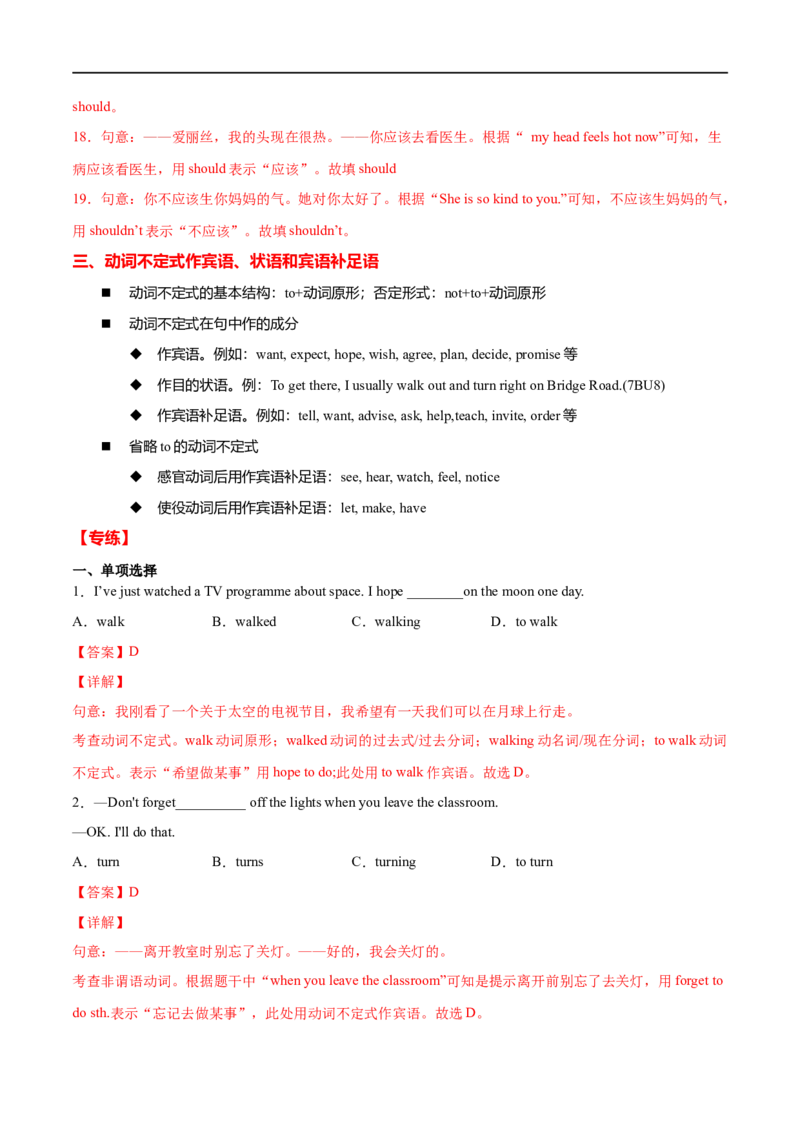
三、动词不定式作宾语、状语和宾语补足语
动词不定式的基本结构:to+动词原形;否定形式:not+to+动词原形
动词不定式在句中作的成分
作宾语。例如:want, expect, hope, wish, agree, plan, decide, promise等
作目的状语。例:To get there, I usually walk out and turn right on Bridge Road.(7BU8)
作宾语补足语。例如:tell, want, advise, ask, help,teach, invite, order等
省略to的动词不定式
感官动词后用作宾语补足语:see, hear, watch, feel, notice
使役动词后用作宾语补足语:let, make, have
【专练】
一、单项选择
1.I’ve just watched a TV programme about space. I hope ________on the moon one day.
A.walk B.walked C.walking D.to walk
【答案】D
【详解】
句意:我刚看了一个关于太空的电视节目,我希望有一天我们可以在月球上行走。
考查动词不定式。walk动词原形;walked动词的过去式/过去分词;walking动名词/现在分词;to walk动词
不定式。表示“希望做某事”用hope to do;此处用to walk作宾语。故选D。
2.—Don't forget__________ off the lights when you leave the classroom.
—OK. I'll do that.
A.turn B.turns C.turning D.to turn
【答案】D
【详解】
句意:——离开教室时别忘了关灯。——好的,我会关灯的。
考查非谓语动词。根据题干中“when you leave the classroom”可知是提示离开前别忘了去关灯,用forget to
do sth.表示“忘记去做某事”,此处用动词不定式作宾语。故选D。3.The Birdwatching Society goes to Zhalong Nature Reserve the birds every year.
A.to count B.counting C.count D.counts
【答案】A
【详解】
句意:观鸟协会每年都去扎龙自然保护区统计鸟类数量。
考查非谓语动词。to count动词不定式形式;counting动名词或现在分词形式;count数数,计算总数,动
词原形;counts是动词的第三人称单数形式。根据句子结构可知,该空在句中作目的状语,表示“去扎龙
自然保护区”的目的,应用动词不定式。故选A。
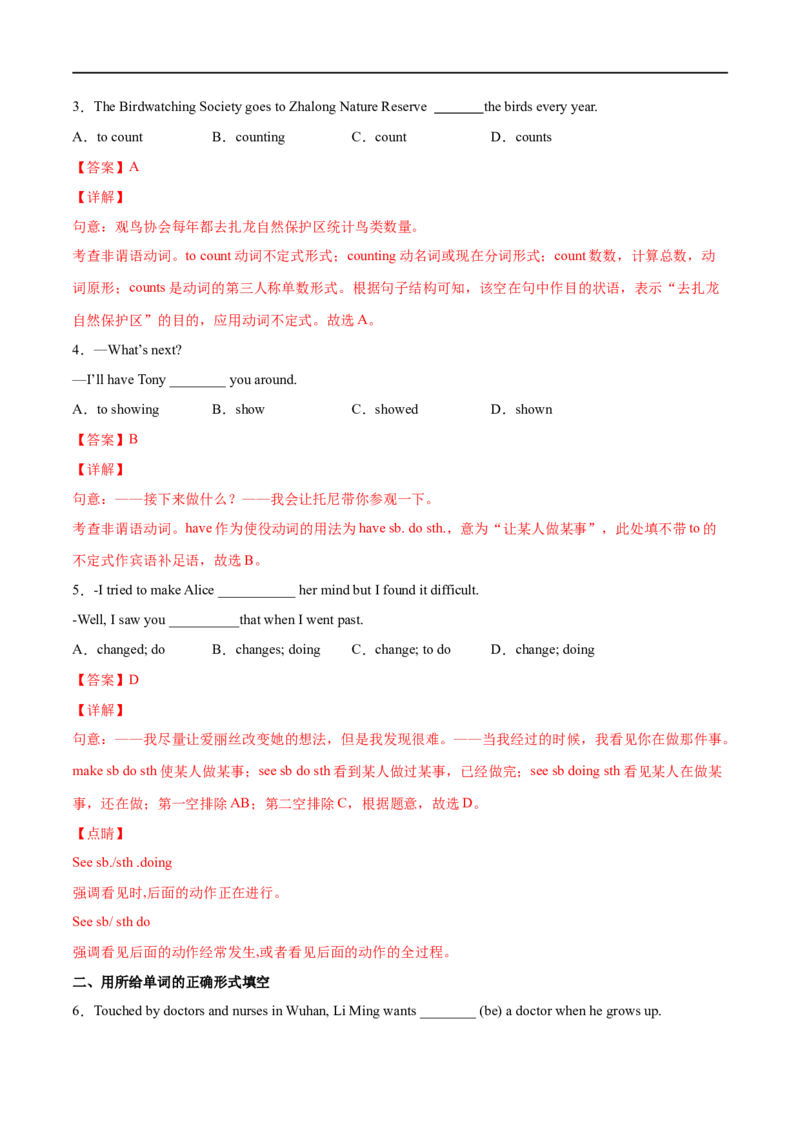
4.—What’s next?
—I’ll have Tony ________ you around.
A.to showing B.show C.showed D.shown
【答案】B
【详解】
句意:——接下来做什么?——我会让托尼带你参观一下。
考查非谓语动词。have作为使役动词的用法为have sb. do sth.,意为“让某人做某事”,此处填不带to的
不定式作宾语补足语,故选B。
5.-I tried to make Alice ___________ her mind but I found it difficult.
-Well, I saw you __________that when I went past.
A.changed; do B.changes; doing C.change; to do D.change; doing
【答案】D
【详解】
句意:——我尽量让爱丽丝改变她的想法,但是我发现很难。——当我经过的时候,我看见你在做那件事。
make sb do sth使某人做某事;see sb do sth看到某人做过某事,已经做完;see sb doing sth看见某人在做某
事,还在做;第一空排除AB;第二空排除C,根据题意,故选D。
【点睛】
See sb./sth .doing
强调看见时,后面的动作正在进行。
See sb/ sth do
强调看见后面的动作经常发生,或者看见后面的动作的全过程。
二、用所给单词的正确形式填空
6.Touched by doctors and nurses in Wuhan, Li Ming wants ________ (be) a doctor when he grows up.【答案】to be
【详解】
句意:被武汉的医生和护士感动,李明想长大了成为一名医生。
表达“想做某事”用动词短语want to do,此处用动词不定式 to be表示“想成为一名医生”。故答案为to
be。
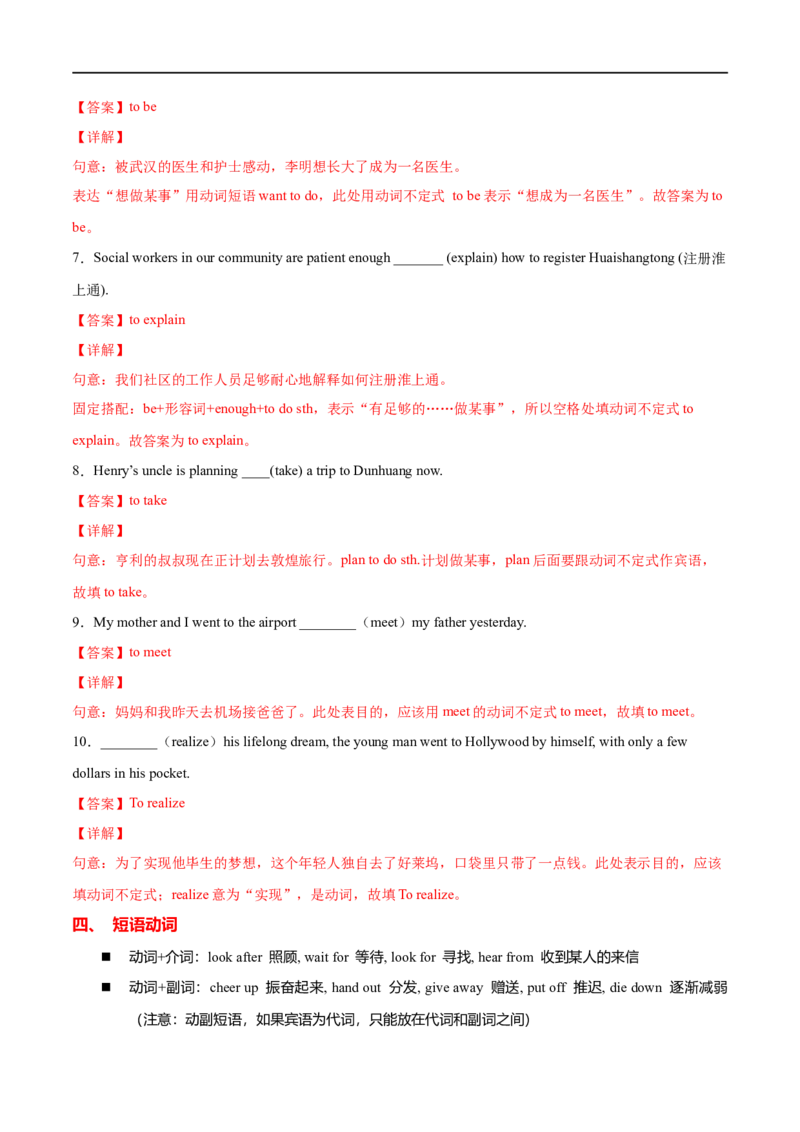
7.Social workers in our community are patient enough _______ (explain) how to register Huaishangtong (注册淮
上通).
【答案】to explain
【详解】
句意:我们社区的工作人员足够耐心地解释如何注册淮上通。
固定搭配:be+形容词+enough+to do sth,表示“有足够的……做某事”,所以空格处填动词不定式to
explain。故答案为to explain。
8.Henry’s uncle is planning ____(take) a trip to Dunhuang now.
【答案】to take
【详解】
句意:亨利的叔叔现在正计划去敦煌旅行。plan to do sth.计划做某事,plan后面要跟动词不定式作宾语,
故填to take。
9.My mother and I went to the airport ________(meet)my father yesterday.
【答案】to meet
【详解】
句意:妈妈和我昨天去机场接爸爸了。此处表目的,应该用meet的动词不定式to meet,故填to meet。
10.________(realize)his lifelong dream, the young man went to Hollywood by himself, with only a few
dollars in his pocket.
【答案】To realize
【详解】
句意:为了实现他毕生的梦想,这个年轻人独自去了好莱坞,口袋里只带了一点钱。此处表示目的,应该
填动词不定式;realize意为“实现”,是动词,故填To realize。
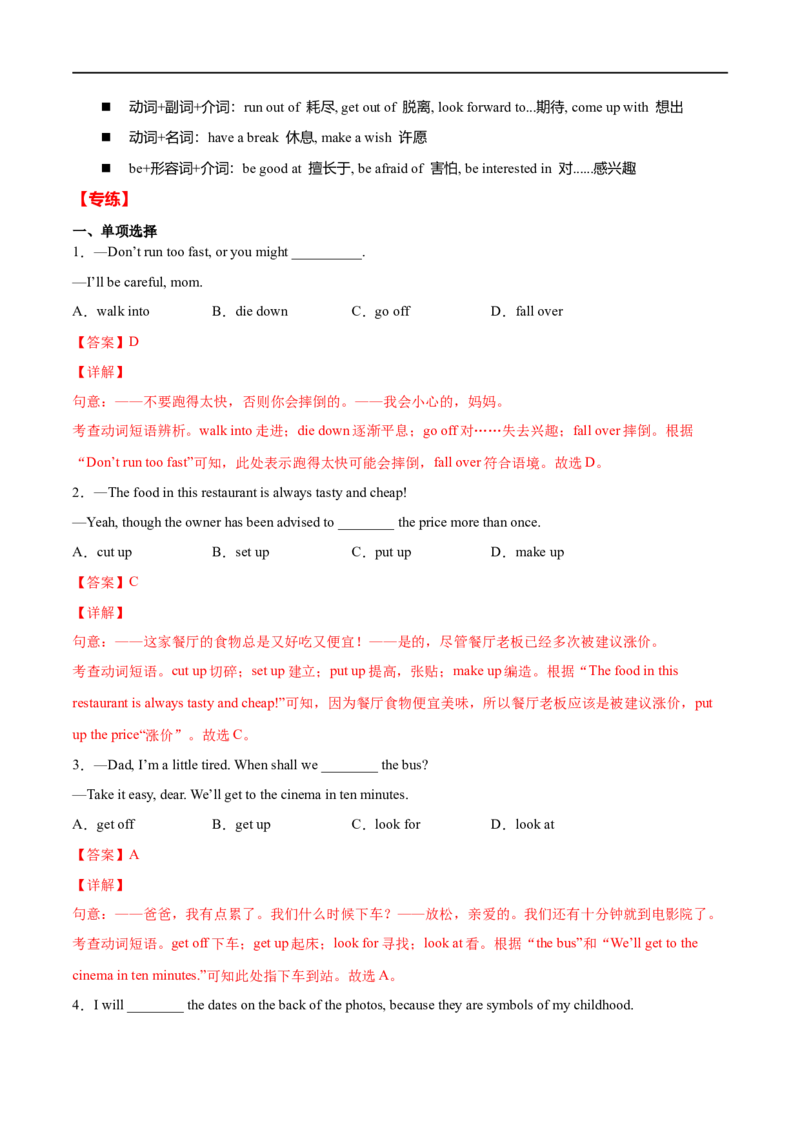
四、 短语动词
动词+介词:look after 照顾, wait for 等待, look for 寻找, hear from 收到某人的来信
动词+副词:cheer up 振奋起来, hand out 分发, give away 赠送, put off 推迟, die down 逐渐减弱
(注意:动副短语,如果宾语为代词,只能放在代词和副词之间) 动词+副词+介词:run out of 耗尽, get out of 脱离, look forward to...期待, come up with 想出
动词+名词:have a break 休息, make a wish 许愿
be+形容词+介词:be good at 擅长于, be afraid of 害怕, be interested in 对......感兴趣
【专练】
一、单项选择
1.—Don’t run too fast, or you might __________.
—I’ll be careful, mom.
A.walk into B.die down C.go off D.fall over
【答案】D
【详解】
句意:——不要跑得太快,否则你会摔倒的。——我会小心的,妈妈。
考查动词短语辨析。walk into走进;die down逐渐平息;go off对……失去兴趣;fall over摔倒。根据
“Don’t run too fast”可知,此处表示跑得太快可能会摔倒,fall over符合语境。故选D。
2.—The food in this restaurant is always tasty and cheap!
—Yeah, though the owner has been advised to ________ the price more than once.
A.cut up B.set up C.put up D.make up
【答案】C
【详解】
句意:——这家餐厅的食物总是又好吃又便宜!——是的,尽管餐厅老板已经多次被建议涨价。
考查动词短语。cut up切碎;set up建立;put up提高,张贴;make up编造。根据“The food in this
restaurant is always tasty and cheap!”可知,因为餐厅食物便宜美味,所以餐厅老板应该是被建议涨价,put
up the price“涨价”。故选C。
3.—Dad, I’m a little tired. When shall we ________ the bus?
—Take it easy, dear. We’ll get to the cinema in ten minutes.
A.get off B.get up C.look for D.look at
【答案】A
【详解】
句意:——爸爸,我有点累了。我们什么时候下车?——放松,亲爱的。我们还有十分钟就到电影院了。
考查动词短语。get off下车;get up起床;look for寻找;look at看。根据“the bus”和“We’ll get to the
cinema in ten minutes.”可知此处指下车到站。故选A。
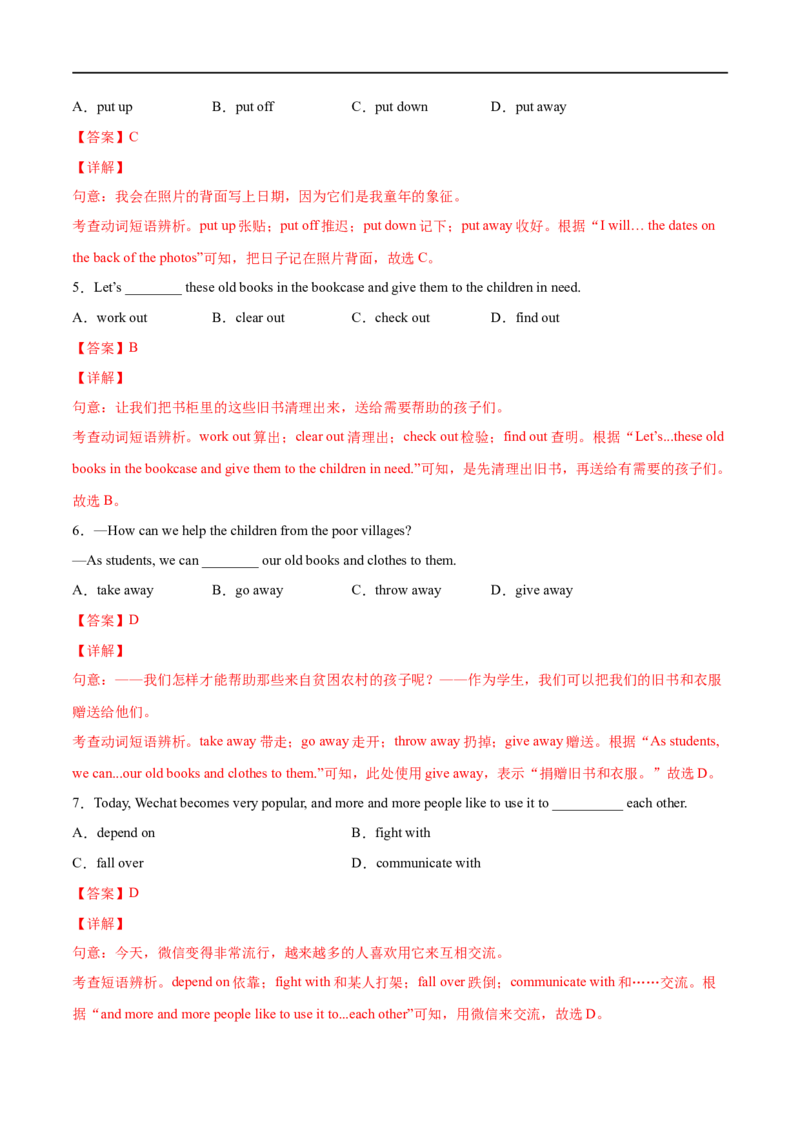
4.I will ________ the dates on the back of the photos, because they are symbols of my childhood.A.put up B.put off C.put down D.put away
【答案】C
【详解】
句意:我会在照片的背面写上日期,因为它们是我童年的象征。
考查动词短语辨析。put up张贴;put off推迟;put down记下;put away收好。根据“I will… the dates on
the back of the photos”可知,把日子记在照片背面,故选C。
5.Let’s ________ these old books in the bookcase and give them to the children in need.
A.work out B.clear out C.check out D.find out
【答案】B
【详解】
句意:让我们把书柜里的这些旧书清理出来,送给需要帮助的孩子们。
考查动词短语辨析。work out算出;clear out清理出;check out检验;find out查明。根据“Let’s...these old
books in the bookcase and give them to the children in need.”可知,是先清理出旧书,再送给有需要的孩子们。
故选B。
6.—How can we help the children from the poor villages?
—As students, we can ________ our old books and clothes to them.
A.take away B.go away C.throw away D.give away
【答案】D
【详解】
句意:——我们怎样才能帮助那些来自贫困农村的孩子呢?——作为学生,我们可以把我们的旧书和衣服
赠送给他们。
考查动词短语辨析。take away带走;go away走开;throw away扔掉;give away赠送。根据“As students,
we can...our old books and clothes to them.”可知,此处使用give away,表示“捐赠旧书和衣服。”故选D。
7.Today, Wechat becomes very popular, and more and more people like to use it to __________ each other.
A.depend on B.fight with
C.fall over D.communicate with
【答案】D
【详解】
句意:今天,微信变得非常流行,越来越多的人喜欢用它来互相交流。
考查短语辨析。depend on依靠;fight with和某人打架;fall over跌倒;communicate with和……交流。根
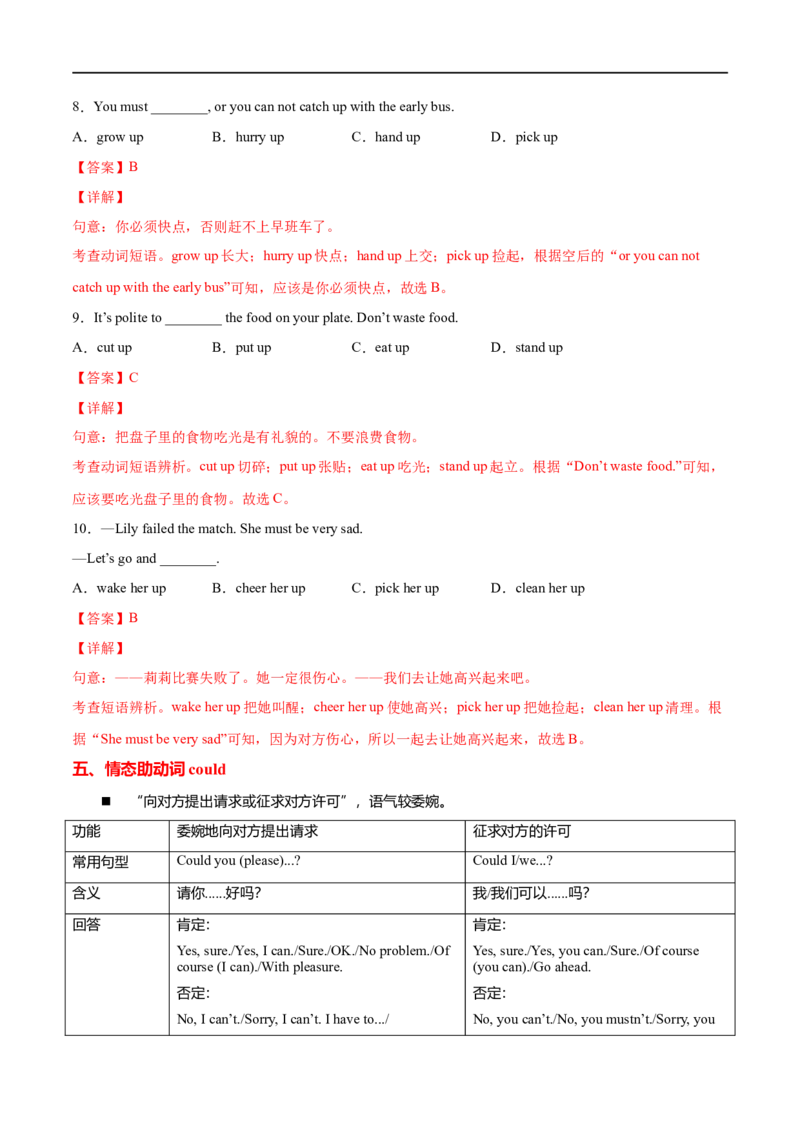
据“and more and more people like to use it to...each other”可知,用微信来交流,故选D。8.You must ________, or you can not catch up with the early bus.
A.grow up B.hurry up C.hand up D.pick up
【答案】B
【详解】
句意:你必须快点,否则赶不上早班车了。
考查动词短语。grow up长大;hurry up快点;hand up上交;pick up捡起,根据空后的“or you can not
catch up with the early bus”可知,应该是你必须快点,故选B。
9.It’s polite to ________ the food on your plate. Don’t waste food.
A.cut up B.put up C.eat up D.stand up
【答案】C
【详解】
句意:把盘子里的食物吃光是有礼貌的。不要浪费食物。
考查动词短语辨析。cut up切碎;put up张贴;eat up吃光;stand up起立。根据“Don’t waste food.”可知,
应该要吃光盘子里的食物。故选C。
10.—Lily failed the match. She must be very sad.
—Let’s go and ________.
A.wake her up B.cheer her up C.pick her up D.clean her up
【答案】B
【详解】
句意:——莉莉比赛失败了。她一定很伤心。——我们去让她高兴起来吧。
考查短语辨析。wake her up把她叫醒;cheer her up使她高兴;pick her up把她捡起;clean her up清理。根
据“She must be very sad”可知,因为对方伤心,所以一起去让她高兴起来,故选B。
五、情态助动词could
“向对方提出请求或征求对方许可”,语气较委婉。
功能 委婉地向对方提出请求 征求对方的许可
常用句型 Could you (please)...? Could I/we...?
含义 请你......好吗? 我/我们可以......吗?
回答 肯定: 肯定:
Yes, sure./Yes, I can./Sure./OK./No problem./Of Yes, sure./Yes, you can./Sure./Of course
course (I can)./With pleasure. (you can)./Go ahead.
否定: 否定:
No, I can’t./Sorry, I can’t. I have to.../ No, you can’t./No, you mustn’t./Sorry, youSorry, I’m afraid I can’t./I’d love to ,but... can’t./Sorry, I’m afraid you can’t./Of course
not.
Could you please...?否定形式Could you please not...?
【专练】
一、单项选择
1.—Mom, ________ you please buy some snacks?
—Sure.
A.must B.may C.could D.should
【答案】C
【详解】
句意:——妈妈,您能买些零食吗?——当然可以。
考查情态动词辨析。must必须;may也许;could可以;should应该。根据“Mom, ...you please buy some
snacks?”可知,此处委婉请求妈妈买零食,故选C。
2.—________ I go to the movies with Anna tonight, mom?
—Of course you ________. But don’t stay out too late.
A.Could, can B.Should, should C.Could, would D.Can, should
【答案】A
【详解】
句意:——妈妈,我今晚能和安娜去看电影吗?——当然可以。但是不要在外面待得太晚。
考查动词辨析。could可以,表委婉;can可以;should应该;would将会。根据“...I go to the movies with
Anna tonight, mom?”可知,第一处请求允许,排除B;第二处强调“可以”,且一般疑问句“Could you...”
的肯定回答,需用“Yes, I can”。故选A。
3.—Mom, could I hang out with my friends tonight?
—________. It’s not very safe.
A.Yes, you could B.No, you couldn’t
C.Yes, please D.Sorry, you can’t
【答案】D
【详解】
句意:——妈妈,今晚我能和朋友们出去玩吗?——抱歉,你不能。这不太安全。
考查情景交际。Yes, you could是的,你可以;No, you couldn’t不,你不能;Yes, please接受并且感谢;
Sorry, you can’t对不起,你不能。根据“It’s not very safe.”可知,此空应该表示拒绝,根据“could I hang
out with my friends tonight”可知,could表示请求或者许可时,回答用can,不能用could。故选D。4.We will hold an English party next week. _________ you come to the party?
A.Must B.Should C.Could D.May
【答案】C
【详解】
句意:下周我们将举办一个英语晚会。你能来参加聚会吗?
考查情态动词。Must必须;Should应该;Could能;May可以。根据“We will hold an English party next
week.”可知,空所在句表示邀请,语气应该比较委婉一些,使用could。故选C。
5.—________ I use the computer, Mom?
—Yes, you can. But you have to finish your homework first.
A.Should B.Could C.Must D.Would
【答案】B
【详解】
句意:——妈妈,我可以使用电脑吗?——是的,你可以。但是你必须先完成作业。
考查情态动词辨析。Should应该;Could可以;Must必须;Would将会。根据“Yes, you can. But you have
to finish your homework first”可知,空缺处应该是表请求,用Could提问表示委婉地请求,故选B。
二、完成句子
6.你能告诉我怎样使用这台机器吗?
Could you ________ me ________ ________ ________ this machine?
【答案】 tell how to use
【详解】
tell“告诉”,could“能够”,为情态动词,后跟动词原形,因此此处填原形tell;how to use“如何使用”。
故填tell;how;to; use。
7.—你能和我们一起去水族馆吗?
—是的,我能。
—________ you ________ to the aquarium with us?
—Yes, ________ ________.
【答案】 Could go I can
【详解】
表示委婉的请求对方做某事,可以用句型Could you....?“你能……?”。go“去”,前面有情态动词,动词
用原形。肯定回答此句型可用“Yes, 主语+can”,回答主语用第一人称I。故填Could;go;I;can。
8.“彼得,你能倒垃圾吗?”“当然可以,妈妈。”
—Peter, ________ out the rubbish?
—________, Mom.
【答案】 could you please take Sure
【详解】
根据所给汉语意思可知,应该填的是“你能倒……吗”和“当然可以”,句型could you please do sth.“你能
做某事吗”,take out the rubbish“倒垃圾”,sure意为“当然可以”,首字母大写,故填could you please
take;Sure。
9.我可以邀请我的朋友们来参加一场派对吗?
____________________ my friends __________ a party?
【答案】 Could I invite to
【详解】
I我;could可以;invite邀请,invite sb. to邀请某人参加。根据中英文提示,本句是一般疑问句,用could
表示客气的请求,后接动词原形;位于句首需大写首字母,故填Could I invite; to。
10.我想买辆小汽车。你能借我一些钱吗?
I want to buy a car. _________ _________ _________ me some money?
【答案】 Could you lend
【详解】
Could you...“你能……吗”,表示委婉的请求,lend sb. sth.“借给某人某物”,表示主语借出去,情态动词
could后接动词原形,故填Could;you;lend。
三、句型转换
11.Could you please not shout in the library? (改为同义句)
__________ shout in the library, please!
【答案】Don’t
【详解】
句意:请你不要在图书管里大叫好吗?根据题干可知,原句是情态动词“could”表达请求意义的句子,替
换成同义句表达,可以用祈使句,且因空格后是动词原形,所以此处应该用祈使句的否定形式,以Don’t
开头。故答案为Don’t。
12.Could you please clean your room now?(改为否定句)
Could you please ________ ________ your room now?
【答案】 not clean【详解】
句意:你现在能打扫房间吗?根据could you please+动词原形“你能……吗”的否定形式是could you please
not+动词原形?动词原形clean“打扫”,故填not;clean。
13.Could you please help me do the dishes? (作肯定回答)
__________, __________.
【答案】 Yes sure
【详解】
句意:你能帮我洗碗吗? Could you please…意思是“请你做……好吗”,用于表示客气的请求,是委婉
说法,所以答语中不能出现could,肯定一般用“sure”表示;结合题干是两空,故填Yes; sure。
14.Could you please come over now? (写出否定答语)
_________________________________________
【答案】Sorry, I can’t. I have to do my homework first. / No, I can’t.
【详解】
句意:你能过来一下吗?Could you please…?请你做……好吗?在这里could不是表示过去时,而是表示一
种委婉的语气,答语中不能出现could,而应该用can构成,后面可以接拒绝的理由,所以否定回答为
Sorry, I can’t. I have to do my homework first./No, I can’t.故填Sorry, I can’t. I have to do my homework first./No,
I can’t.
15.Could I bring some food and drinks? (写出肯定答语)
_________________________________________
【答案】Yes, you can./Of course./Sure
【详解】
句意:我能带些食物和饮料吗?分析原句可知,could you please do sth?“请你做某事好吗?”句中的
could不是表示的过去时,而是表示的一种委婉的语气,答语中不能出现could,肯定回答可以为Yes, you
can./Of course./Sure。故填Yes, you can./Of course./Sure。
六、常用表达建议的句子
Why not do sth.?=Why don’t you do sth.? “你为什么不做某事呢?”
What/How about doing sth.?“做某事怎么样?”
Let’s do sth. “让我们做某事吧。”
七、 用情态动词could, should来提出建议
could,should都可用来提出建议,但could语气更委婉、客气。should意为“应该/应当”,could
意为“可以/可能”。 当征求别人的意见时,常用should。
八、 although,so that,until的用法
although 意为“尽管/虽然”, 常可与though互换使用,如在句尾多使用though, 引导让步状语
从句。
注意:although或though不可but共同使用在同一个句子中。如果要强调前后两部分的对比,
可在主句前加 yet 或 still。
so that意为 “为了.../以便......”,引导目的状语从句,从句中通常含情态动词can, may, might等。
【拓展】so that引导的目的状语从句可与in order that或in order to互换使用。
until在肯定句中,动词需使用延续性动词,表示“直到……为止”,即主句中的动作一直持续发
生到until后的动作发生为止; until在否定句中,使用短暂性动词, 意为“直到……才……”
【专练】
一、单项选择
1.—Let’s go shopping for some orange juice.
—________ And we can also buy some coffee for Mum.
A.Excuse me! B.Good idea! C.Never mind. D.I’m sorry.
【答案】B
【详解】
句意:——我们去买些橙汁吧。——好主意!我们也可以给妈妈买些咖啡。
考查情景交际。Excuse me!打扰一下;Good idea!好主意;Never mind没关系;I’m sorry.抱歉;根据句意理
解及前句的建议Let’s go shopping for some orange juice.和后面的回答we can also buy some coffee for Mum.可
知,这里是同意上面的提议,所以这里应该表示“好主意”,故选B。
2.—What a sunny day! Why not go cycling?
—___________.
A.No, I don’t mind B.You’d better not C.That sounds great D.It’s my pleasure
【答案】C
【详解】
句意:——多好的一天啊!为什么不去骑自行车?——听起来不错。
考查情景交际。No, I don’t mind不,我不介意;You’d better not你最好不要;That sounds great听起来不错;
It’s my pleasure这是我的荣幸;根据句意理解及前句的提议Why not go cycling?可知,这里的回答要么是接
受,要么是拒绝,综合四个选项可知,C选项表达的是接受上面的建议,表示“听起来不错”,故选C。
3.We should protect the environment _______ we can make a better world to live in.A.so that B.even though C.as soon as D.even if
【答案】A
【详解】
句意:我们应该保护环境以便我们能创造一个更美好的生活环境。
考查so that引导的目的状语从句。so that为了,以便;even though尽管;as soon as一……就……;even if
即使,根据空前的“We should protect the environment”和空后的“we can make a better world to live in”可知,
后句是前句这么做的目的,所以用so that引导目的状语从句,故选A。
4.It was great in the end ________ we had a terrible time at the beginning.
A.if B.unless C.when D.although
【答案】D
【详解】
句意:虽然一开始我们很糟糕,但最后还是很棒的。
考查连词辨析。if如果;unless除非,如果不;when当……时候;although虽然,尽管。根据句意可知,
空前“It was great”与空后“we had a terrible time”是转折关系,这里应用although引导让步状语从句。故选
D。
5.They didn’t go home ________ they finished their work.
A.because B.where C.until D.while
【答案】C
【详解】
句意:他们直到完成工作才回家。
考查从属连词辨析。because因为;where在……的地方;until直到……;while当……时候,由否定形式
“didn’t”和句意,可知本句用句型not…until,这种否定形式表达的意思是“直至某时才做某事”,即“直
到完成工作才回家”,故选C。
二、用所给单词的正确形式填空
6.Could you please _______ (call) me, Liu Wei?
【答案】call
【详解】
句意:刘伟,你能打电话给我吗?“Could you please do...?”表示“请你做某事好吗”,固定用法。故此处
填动词原形,call sb给某人打电话。故填call。
7.What about _______ (have) dinner with me, Maria?
【答案】having【详解】
句意:Maria,跟我一起吃晚餐怎么样?what about doing sth“做某事怎么样”,动名词作宾语,故填
having。
8.Would you like _______ (spend) your holiday in New York?
【答案】to spend
【详解】
句意:你想去纽约度假吗?would like to do sth“想要做某事”,动词不定式作宾语,故填to spend。
9.You’d better _______ (come) here before six.
【答案】come
【详解】
句意:你最好在六点前到这儿来。had better do sth.表示“最好做某事”,此处填动词原形。故填come。
三、同义句转化
10.Although Mr. Smith is ninety years old, he can climb the mountain. (同义句转换)
Mr. Smith is ninety years old, _______ he can climb the mountain.
【答案】but
【详解】
句意:虽然Smith先生90岁了,但是他能爬山。根据句意可知,前后句是转折关系,且空后没有逗号,用
连词but“但是”表转折,故填but。
11.My mother got up early so that she could catch the first bus. (同义句转换。)
My mother got up early _______ _______ _______ she could catch the first bus.
【答案】 in order that
【详解】
句意:为了赶上第一班公交车,我妈妈起来得很早。so that意为“以便”引导目的状语从句,它的同义词
组in order that“为了”也可以引导目的状语从句,故填in;order;that。
12.Jack didn’t have dinner before his mother came back.(同义句转换)
Jack _______ have dinner _______ his mother came back.
【答案】 didn’t until
【详解】
句意:杰克的母亲回来之前他没吃晚饭。原句可用“not…until…”引导时间状语从句,表达“直到杰克的
母亲回来他才吃晚饭”。句子是一般过去时,谓语动词用助动词“did”的否定形式“didn’t”放在动词原形
“have”前。故填didn’t;until。九、过去进行时
定义:过去某一时刻或某一段时间内正在进行的动作。
构成:was/were+现在分词
句型结构:
肯定句: 主语+was/were+doing+其他.
否定句: 主语+was/were+not+doing十其他.
一般疑问句: Was/Were+主语+doing+其他?
回答:Yes, 主语+was/were; No, 主语+wasn't/ weren't.
时间状语: at that time, this time yesterday, at the time of..., when+过去的时间状语从句, while sb.
was/were doing...
与一般过去时的区别: 过去进行时表示过去那个时间或那段时间正在发生的动作, 强调动作正在
进行; 一般过去时表示过去发生的动作,重点在动作发生在过去。
考点2:when与while引导的时间状语从句
When引导的时间状语从句: 一个动作发生时,另一个动作也正在进行; 也可以某个动作正在发生
时,另一动作发生了。
e.g.: When my mom came back, I was watching TV.当妈妈回来的时候,我正在看电视。(一个动作发
生时,另一个动作正在进行)
e.g.: When Lucy was taking the bus, she found a man lying on the ground. 当Lucy坐公交车的时候,
她发现有一个人躺在地上。(正在进行某一动作时,另一动作发生了)
While引导的时间状语从句: 表示某个动作正在进行的同时, 另一动作也正在进行之中, 这时主从
句都用进行时态; 也可表示某个动作正在进行时,另一动作发生了(该动作用一般过去时)。即:主
句的动作发生在从句动作过程中,因此从句中谓语需使用延续性动词。
e.g.:While I was listening to the music, she was watching TV. 我在听音乐,她在看电视。(主从句动
作同时发生)
e.g.:While she was talking to me, her mom came in.当她和我说话的时候,她的妈妈走了进来。(主句
动作发生在从句动作过程中)
【专练】
一、单项选择
1.While Mike________computer games in his room, his dad came in.
A.is playing B.was playing C.will play D.plays【答案】B
【详解】
句意:迈克在房间里玩电脑游戏时,他爸爸进来了。
考查过去进行时。is playing现在进行时;was playing过去进行时;will play一般将来时; plays一般现在
时的第三人称单数。根据句意迈克在房间里玩电脑游戏时,他爸爸进来了。可知前面是正在发生,后面
came 是过去式,所以前面要用过去进行时,构成是was/were+doing,故答案选B。
2.—I called you yesterday afternoon, but you didn't pick up.
—Sorry. I ______ an online class at that time.
A.take B.took C.is taking D.was taking
【答案】D
【详解】
句意:——我昨天下午给你打电话,但你没接。——对不起,那时我正在上网课。
考查动词时态。take一般现在时;took一般过去时;is taking现在进行时;was taking过去进行时。根据语
境可知,我昨天正在做某事,所以你给我打电话没有接到,应用进行时态,再根据yesterday afternoon可知,
“上网课没接到电话”这件事发生在过去,故应为过去进行时。故选D。
3.Dad ________ TV when it began to rain yesterday.
A.watches B.watched C.is watching D.was watching
【答案】D
【详解】
句意:昨天开始下雨时,爸爸正在看电视。
考查过去进行时态。watches第三人称单数;watched一般过去时态;is watching现在进行时态;was
watching过去进行时态。根据题干可知当昨天开始下雨的时候,爸爸正在看电视,该句是when引导的时间
状语从句,从句是一般过去时,主句表示过去正在做的事情,则应用过去进行时,其结构是was/were
doing,故答案选D。
4.—Jim, what did I say just now?
—Sorry, I don't know. I ________ the math problem.
A.think about B.thought about C.was thinking about D.has thought about
【答案】C
【详解】
句意:——Jim,我刚才说了什么?——对不起,我不知道。我正思考那个数学题呢。
考查动词时态。think about思考,考虑;thought about一般过去时;was thinking about过去进行时;hasthought about现在完成时。根据语境可知,问题使用了一般过去时态,答语中表示过去那个时候正在做的
事情,应用过去进行时。故选C。
5.Mike________the furniture into his new flat this time yesterday.
A.would move B.was moving C.has moved D.had moved
【答案】B
【详解】
句意:昨天的这个时候迈克正在把家具搬进他的新居。
考查过去进行时。根据“this time yesterday”,可知句子是过去进行时,结构为was/were+动词的现在分词,
主语Mike是第三人称单数。故选B。
二、用所给单词的正确形式填空
6.—How did you fall in love with my dad, Mum?
— He ________ (make) a speech when I first saw him. He was so handsome and got a very attractive voice, you
know, back then.
【答案】was making
【详解】
句意:——妈妈,你是怎么爱上我爸爸的? ——我第一次见到他时,他正在讲话。你知道,那时他很英
俊,声音很迷人。
根据when I first saw him. 和He _________(make) a speech,应该用过去进行时,表示过去正在发生的动作
或存在的状态,其结构是:was/were+动词的现在分词;主语是he,因此be动词用was。语境是:我第一
次见到他时,他正在讲话。故填was making。
【点睛】
过去进行时表示在过去某一时刻或某一段时间内进行或发生的动作,其形式为was /were + V-ing,常与表
示过去的时间状语连用,如:last night,last Saturday等;或者与when,while, as引导的过去时间状语连用,
如题中就是when引导的过去进行时。
7.He ________(draw)on the beach from 7 to 9 o’clock yesterday morning.
【答案】was drawing
【详解】
句意:昨天上午七点到九点他正在沙滩上画画。根据时间状语“from 7 to 9 o’clock yesterday morning”可知,
句子应该用过去进行时,即was/were+V-ing。主语he为第三人称单数,故be动词用was。draw表示“画
画”。故填was drawing。
8.My mother ________(not walk)with me at this time yesterday.【答案】wasn’t walking
【详解】
句意:昨天这个时候我妈妈没有和我一起散步。根据时间状语“at this time yesterday”可知,句子应该用过
去进行时,即was/were+V-ing。主语My mother为第三人称单数形式,故be动词用was。根据提示词“not
walk”可知,句子为否定句,故填wasn’t walking。
9.Lucy _________(dance)while her sister _________(sing)at 6:00 p.m. yesterday.
【答案】 was dancing was singing
【详解】
句意:昨天下午六点露西在跳舞,她的姐姐在唱歌。此句是while引导的时间状语从句,表示主句和从句
动作同时发生,句子应该用过去进行时,即was/were+V-ing。主语Lucy和her sister 均为第三人称单数,
故be动词用was。故填was dancing;was singing。
10.I didn’t know the car ________(come)while he was shouting.
【答案】was coming
【详解】
句意:当他大喊时,我不知道汽车来了。根据“while he was shouting.”可知,句子应该用过去进行时,即
was/were+V-ing。主语the car,be动词用was。故填was coming。
三、完成句子
11.昨天暴风雨来临时,我们正在打扫城市公园。
When the rainstorm came yesterday, we ________ ________ ________ the city park.
【答案】 were cleaning up
【详解】
根据时间状语“When the rainstorm came yesterday”可知,句子应该用过去进行时,即was/were+V-ing。主
语是we,故be动词为were。clean up表示“打扫”。故填were;cleaning;up。
12.康康在上音乐课的时候,达伦在爬山。
Darren was climbing the mountain while Kangkang ________ ________ _________ ________ ________.
【答案】 was having a music class
【详解】
while表示对比,根据“Darren was climbing the mountain”可知,句子用过去进行时,即was/were+V-ing。
主语是Kangkang,be动词用was。have a music class表示“上音乐课”。故填was;having;a;music;
class。
四、句子速译。13.当开始下雨的时候,本正在帮他妈妈做晚饭。
____________________________________________________________________________________________
14.琳达在睡觉的时候,珍妮正在帮玛丽做作业。
____________________________________________________________________________________________
15.——上个星期天早上九点你在做什么?
——我在做作业。
____________________________________________________________________________________________
【答案】
13.Ben was helping his mother cook dinner when it began to rain.
14.While Linda was sleeping, Jenny was helping Mary with her homework.
15.—What were you doing at nine o’clock last Sunday morning? —I was doing my homework.
【解析】
13.当……时when,引导时间状语从句;开始下雨it began to rain,用it指代天气,描述的动作已过去,
动词用过去式;本Ben,作主语;正在帮他妈妈做晚饭was helping his mother cook dinner,主句用过去进行
时,主语是单数名词,be动词用was,故填Ben was helping his mother cook dinner when it began to rain.
14.琳达Linda;在睡觉sleep;动作是延续性的,应用过去进行时;当……的时候while,引导时间状语从
句;珍妮Jenny;正在帮玛丽做作业be helping Mary with her homework,此处应用过去进行时,be动词用
was,故填While Linda was sleeping, Jenny was helping Mary with her homework.
15.上个星期天早上九点nine o’clock last Sunday morning,具体的钟点前用介词at;你you;做do,此处
句子应用过去进行时;什么what;我I,做作业do my homework,问句用过去进行时,回答也用过去进行
时,主语是I,be动词用was,故填—What were you doing at nine o’clock last Sunday morning? —I was doing
my homework.