姓名: 班级
Unit9 Have you ever been to a museum?
Section A
本课重点 熟练使用以下词汇、短语和句型:
amusement park, space museum, water park, neither
Have you ever been to a museum?
Yes, I have /No, I haven’t
How about/what about…?
How are we going to get there?
We can take the subway/…
本课难点 To understand and use the present perfect tense.
常考句型 Have you ever been to a science museum?
Yes, I’ve been to a science museum.
No, I’ve never been to a science museum.
I’ve never been to a water park.
Me neither.
一、用所给单词的正确形式填空
1.How about_________(go)to the art museum?
2.Tony has already________(be)to the space museum three times.
3.Have you_________(hear)of the Disney Cruise?
4.I________(go)there last year with my parents.
5.Did you spend the whole day__________(play)computer games?
6.How long did you spend on the birthday party________(prepare)?
7.It is_______ (believe)that so little a boy can lift such a heavy box.
8.With the development of the Internet,the world________(it)is becoming smaller and
smaller.
9.It is strange that Nick always does_______(usual)things.
10.The village used to be quiet and________(peace).
【答案】
1.going
2.been
3.heard
4.went
5.Playing
6.preparation7.unbelievable
8.itself
9.unusual
10.peaceful
【解析】
1.going句意:去艺术博物馆怎么样?how about doing sth?做某事怎么样?故从此用动名
词going。
2.been句意:托尼已经去过太空博物馆三次。根据助动词has可知此处用现在完成时,故
用过去分词been。
3.heard句意:你听说过迪斯尼巡航吗?根据助动词have可知此处用现在完成时,故用
hear的过去分词heard。
4.went句意:去年我和父母一起去了那里。根据last year可知此处用一般过去时,故用
go的过去式went。
5.playing句意:你花费一整天玩电脑游戏吗?根据spend time doing sth花费时间做某事,
故此处用动名词playing。
6.句意:你的生日聚会准备了多长时间?spend… on后跟名词或名词性词组,故此处缺少
名词,答案为preparation。
7.句意:这样一个小男孩竟然能举起这么重的箱子真是令人难以置信。It is + adj. + that从
句,是英语中常见的句型,it作形式主语,代替that主语从句。结合句意可知,答案为
unbelievable。
8.句意:随着互联网的发展,世界本身变得越来越小。反身代词可以放在名词或代词的后
面作主语或宾语的同位语,根据汉语提示可知,答案为itself。
9.句意:奇怪的是,尼克总是做些不寻常的事。形容词修饰名词things,根据句意判断,
此处填写usual的反义词,答案为unusual。
10.句意:这个村子过去很安静祥和。and连接前后两个并列成分,此处同为形容词,故
答案为peaceful。
二、多句选词填空
用方框中所给词语的适当形式填空。每词限用一次。
polite, spread, invent, four, turn off
11.Jim’s mother told him _________ the light before he left the room.
12.As we know, the computer is one of the greatest _______ in the world.
13.Sally ________ refused the invitation from Betty although she’d like to.
14.The news Zhang Guimei won the prize ________ widely all over China so far.
15.Last Sunday evening, my family celebrated my younger sister’s _______ birthday.
【答案】
11.to turn off12.inventions
13.politely
14.has spread
15.fourth
【解析】
11. 句意:吉姆的妈妈告诉他在离开房间之前把灯关掉。根据“before he left the room”可
知离开房间前要关灯,turn off关掉,tell sb. to do sth.告诉某人做某事。故填to turn off。
12.句意:众所周知,计算机是世界上最伟大的发明之一。根据“the computer”可知是最
伟大的发明之一,“one of the+形容词最高级+可数名词复数”表示“最……的……之一”;
invent的名词形式invention意为“发明”,符合语境,其复数形式为inventions。故填
inventions。
13.句意:萨莉礼貌地拒绝了贝蒂的邀请,尽管她很愿意。句中缺少副词作状语,根据
“refused the invitation from Betty”可推出是礼貌地拒绝,polite的副词形式politely意为“礼
貌地”。故填politely。
14.句意:到目前为止,张桂梅获奖的消息已经在中国广为传播。根据“widely all over
China”可知这个消息在全国传播,spread传播;再由“so far”可知用现在完成时,主语
“The news”是不可数名词,助动词用has,spread的过去分词是spread。故填has spread。
15.句意:上周日晚上,我们家庆祝了我妹妹的四岁生日。根据“birthday”可知要用序数
词标顺序,four的序数词fourth意为“第四”。故填fourth。
三、单项选择
16.It’s very lucky we booked a hotel before we start. Or we will have ________ to stay now.
A.somewhere B.anywhere C.everywhere D.nowhere
【答案】D
【解析】句意:很幸运我们在出发前预订了一家酒店。否则我们现在就没有地方住了。考
查副词辨析。somewhere某处;anywhere任何地方;everywhere到处;nowhere没有地方。
根据前句语境可知,后句应是:否则我们现在就没有地方待了。故选D。
17.In Alaska, it can be very cold in winter, so bring a(n) ________.
A.umbrella B.sweater C.eraser D.camera
【答案】B
【解析】句意:在阿拉斯加,冬天可能很冷,所以要带件毛衣。考查名词。umbrella雨伞;
sweater毛衣;eraser橡皮擦;camera相机。根据句中“it can be very cold in winter”提示,
此处需要的是防寒保暖的物品,毛衣可以防寒保暖,故选B。
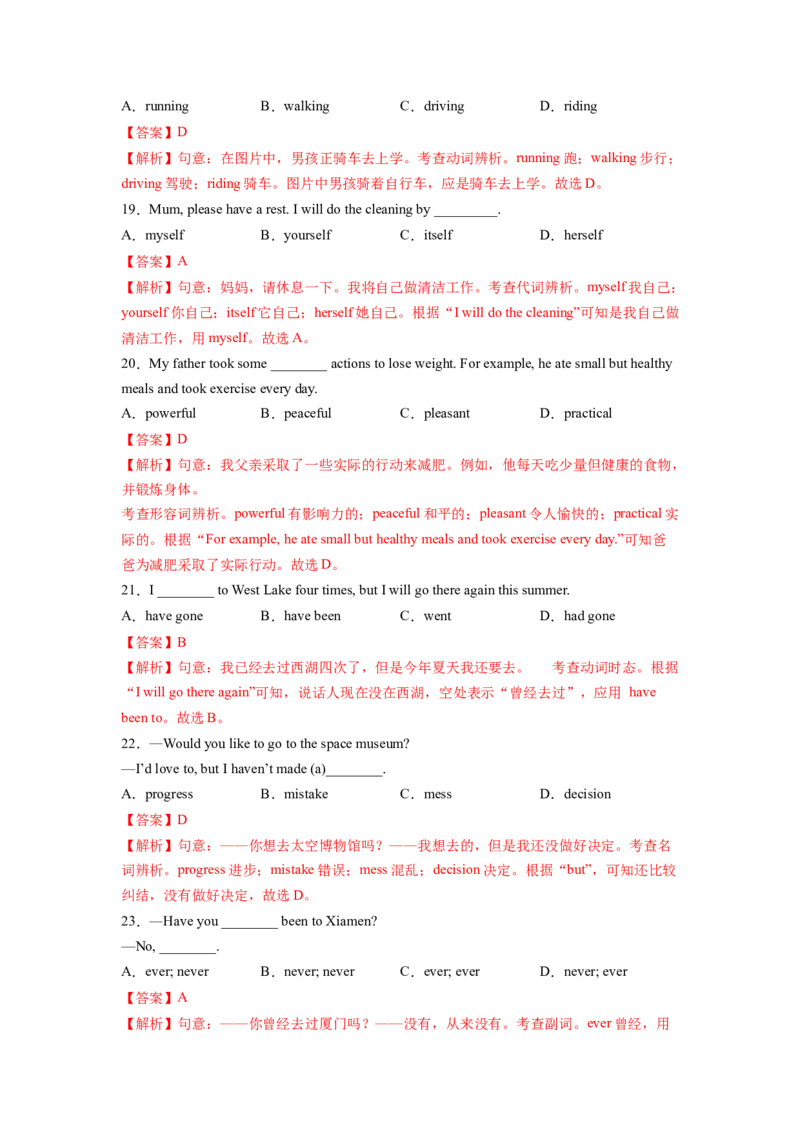
18.In the picture, the boy is ________ to school.A.running B.walking C.driving D.riding
【答案】D
【解析】句意:在图片中,男孩正骑车去上学。考查动词辨析。running跑;walking步行;
driving驾驶;riding骑车。图片中男孩骑着自行车,应是骑车去上学。故选D。
19.Mum, please have a rest. I will do the cleaning by _________.
A.myself B.yourself C.itself D.herself
【答案】A
【解析】句意:妈妈,请休息一下。我将自己做清洁工作。考查代词辨析。myself我自己;
yourself你自己;itself它自己;herself她自己。根据“I will do the cleaning”可知是我自己做
清洁工作,用myself。故选A。
20.My father took some ________ actions to lose weight. For example, he ate small but healthy
meals and took exercise every day.
A.powerful B.peaceful C.pleasant D.practical
【答案】D
【解析】句意:我父亲采取了一些实际的行动来减肥。例如,他每天吃少量但健康的食物,
并锻炼身体。
考查形容词辨析。powerful有影响力的;peaceful和平的;pleasant令人愉快的;practical实
际的。根据“For example, he ate small but healthy meals and took exercise every day.”可知爸
爸为减肥采取了实际行动。故选D。
21.I ________ to West Lake four times, but I will go there again this summer.
A.have gone B.have been C.went D.had gone
【答案】B
【解析】句意:我已经去过西湖四次了,但是今年夏天我还要去。 考查动词时态。根据
“I will go there again”可知,说话人现在没在西湖,空处表示“曾经去过”,应用 have
been to。故选B。
22.—Would you like to go to the space museum?
—I’d love to, but I haven’t made (a)________.
A.progress B.mistake C.mess D.decision
【答案】D
【解析】句意:——你想去太空博物馆吗?——我想去的,但是我还没做好决定。考查名
词辨析。progress进步;mistake错误;mess混乱;decision决定。根据“but”,可知还比较
纠结,没有做好决定,故选D。
23.—Have you ________ been to Xiamen?
—No, ________.
A.ever; never B.never; never C.ever; ever D.never; ever
【答案】A
【解析】句意:——你曾经去过厦门吗?——没有,从来没有。考查副词。ever曾经,用于疑问句中;never从未。分析句子可知,第一空表示“曾经”;第二空表示的是“从未去
过”。故选A。
24.—Mom, where is Dad?
—He ___________ the supermarket.
A.was going to B.has gone to C.has been to D.is going to
【答案】B
【解析】句意:——妈妈,爸爸在哪里?——他去超市了。考查时态。was going to将要,
过去将来时;has gone to去了(未回),现在完成时;has been to去过(已回),现在完成
时;is going to将要,一般将来时;根据“Mom, where is Dad?”以及答语可知,爸爸现在不
在这里,这里表达的是“去了某地还没回来”,英语是have/has gone to,故选B。
25.You have never been to New York, ________?
A.haven’t you B.have you C.didn’t you D.did you
【答案】B
【解析】句意:你从来没有去过纽约,是吗?考查反意疑问句。根据“have never”可知,
此句时态是现在完成时,且陈述部分是否定句,因此疑问部分用肯定形式,主语是you,
助动词用have,因此have you符合句意。故选B。
四、完型填空
My friends and I joined a two-day survival training course in the mountains. The first day
was really _____26_____—there was so much to do! Arriving at the campsite, we were divided
into groups and given a tent, some food, a _____27_____ and a compass. Standing next to a
small river, Fanny _____28_____ camping in the grassy area nearby. However, our instructor,
Mr. Lee, pointed out that it might flood if it rained. In the end, we found a higher area. Putting up
the tent was very hard. Luckily Mr. Lee helped us a lot.
By the time we had put up the tent, everyone was really hungry. “We wouldn’t have got this
hungry if we had brought some snacks,” Peter said. We all told him to _____29_____
complaining and help us start a fire to cook our food _____30_____. Realizing we were having
trouble making the fire, he finally _____31_____.
The next day started early. Woken by a strange noise, Peter went to see what was happening.
“Some cows have eaten our breakfast!” he shouted. “That’s all because you didn’t _____32_____
the food properly last night.” said Mr. Lee.
Worried that Mr. Lee was angry with us, we tried very hard on our next task—using the map
and compass to find a secret location. We made it to the location _____33_____ the other groups
did. We all felt very proud of _____34_____.
The survival training course was a great _______35_______. Now I feel I could survive
anywhere!
26.A.different B.boring C.disappointing D.difficult
27.A.book B.map C.light D.knife28.A.imagined B.enjoyed C.finished D.suggested
29.A.continue B.start C.stop D.mind
30.A.instead B.again C.too D.yet
31.A.started out B.worked out C.gave out D.helped out
32.A.eat up B.put away C.sell out D.throw off
33.A.after B.when C.before D.till
34.A.him B.them C.you D.ourselves
35.A.activity B.competition C.experience D.example
【答案】
26.D27.B28.D29.C30.A
31.D32.B33.C34.D35.B
【解析】本文是一篇记叙文。文章主要介绍了作者和朋友参加的一次野外生存训练课的经
历。
26.句意:第一天非常难。 different不同的;boring无聊的;disappointing令人失望的;
difficult困难的,根据下文的“there was so much to do”可知,因为要做的事很多,所以第一
天很难,故选D。
27.句意:分到了一个帐篷、一些食物、一张地图和一个指南针。book书;map地图;
light灯;knife刀,根据后文的“using the map and compass to find a secret location”可知,应
该是地图,故选B。
28.句意:Fanny建议在附近的草丛中露营。imagined想象;enjoyed享受;finished完成;
suggested建议,根据后文的“However, our instructor, Mr. Lee, pointed out that it might flood
if it rained”可知,Lee先生否决了在草丛中露营的建议,故选D。
29.句意:我们都告诉他不要抱怨。continue继续;start开始;stop停止;mind介意,根
据后文的“complaining and help us start a fire to cook our food”可知,应该是我们告诉他停止
抱怨,故选C。
30.句意:而是帮助我们生火做饭。instead代替 (相反);again又;too也;yet还,根据上
文可知,Peter在抱怨,所以大家让他不要抱怨,而是帮大家生火,故选A。
31.句意:他意识到我们无法生火,于是他帮忙解决了困难。started out动身;worked out
算出;gave out发出;helped out帮助解决,根据前文的“Realizing we were having trouble
making the fire”可知,因为我们无法生火,所以他帮忙解决了困难,故选D。
32.句意:这全是因为你昨晚没有把食物收起来。eat up吃光;put away收起;sell out卖
完;throw off扔掉,根据上文的“Some cows have eaten our breakfast”可知,食物被奶牛吃
掉,原因是昨天没有把它们收起来,故选B。
33.句意:我们在其他小组之前到达了该地点。after在……之后;when当……时;before
在……之前;till直到,根据后文的“We all felt very proud of”可知,他们感到骄傲,是因
为在其他小组到达之前他们已经到达了地点,故选C。
34.句意:我们都为自己感到骄傲。him他;them他们;you你;ourselves我们自己,根据前文的“We made it to the location before the other groups did”可知,我们为我们自己感到
骄傲,故选D。
35.句意:生存训练课程是一次了不起的经历。activity活动;competition竞赛;experience
经历;example例子,通读全文可知,作者参加了野外生存训练课,由此可推知,作者认
为生存训练课是一次很好的经历,故选B。
五、阅读单选
A
When Sally was a child, she went to the city park with her mom on a sunny morning. She felt
very unhappy. Her mom saw that and asked why. Sally told her mother that she felt so sorry to see
so much rubbish on the ground.
Her mom looked around. There were pieces of paper, boxes, glass bottles and a lot of other
rubbish everywhere. “What can we do?” asked Sally sadly. “I’m sure you will think of
something,” said her mom.
As soon as Sally got home with her mom, she painted a picture of the park and wrote a sign
in large black letter at the top of the picture. The sign said, “PLEASE KEEP OUR PARK
CLEAN”. Later, she took plenty of bags and went back to the park with her mom. Sally put up her
picture on a big rubbish box.
The children at the park ran over to see what was going on. Sally handed each of them a bag.
“Let’s clean up this place,” said Sally. Then they began to pick up the rubbish, talking and
laughing. Soon, all the bags were full.
Then Sally’s mom led them to put the rubbish into different kinds of rubbish boxes. When
they looked at the clean park, they all had a strong feeling of satisfaction.
From then on, Sally has been keeping doing the cleaning and sorting(分类)rubbish. More and
more people joined her to play a part in environment protection.
36.Why was Sally unhappy?
A.Because she couldn’t find her mom. B.Because her friends were not at the park.
C.Because there was too much rubbish. D.Because the park was too crowded.
37.Sally drew the picture to___________.
A.show off her painting skills B.encourage people to keep the park clean
C.give her mom a big surprise D.show people how beautiful the park was
38.What did the children do at the park when they saw Sally put up her picture?
A.They laughed at Sally. B.They spent a terrible and tiring day.
C.They bought some bags from Sally. D.They joined Sally in picking up the rubbish.
39.How do you like Sally?
A.Warm-hearted. B.Brave. C.Hard-working. D.Lazy.
40.What’s the best title for the text?
A.A Beautiful Park B.Sally and Her Mom C.A Clean-up Story D.How to Clean thePark
【答案】36.C37.B38.D39.A40.C
【解析】本文是一篇记叙文。文章主要讲述了小女孩萨利和妈妈一起去公园,发现公园地
上很脏,有很多垃圾。于是她就带头主动清理垃圾,还带动了很多其他的小朋友一起打扫
公园。
36.细节理解题。根据第一段中“She felt very unhappy. Her mom saw that and asked why.
Sally told her mother that she felt so sorry to see so much rubbish on the ground.”可知,萨利不
高兴是因为垃圾太多了。故选C。
37.细节理解题。根据第三段中标志上的话“PLEASE KEEP OUR PARK CLEAN”可知,
她画画是为了鼓励人们保持公园的清洁。故选B。
38.细节理解题。根据第四段中的“Then they began to pick up the rubbish, talking and
laughing.”可知,公园里的孩子们看到萨利张贴了她的画之后,孩子们都参与到了捡垃圾的
行列。故选D。
39.推理判断题。本文讲萨利看到公园有垃圾很难过,画画鼓励人们保持公园清洁,并去
公园清理垃圾,结合最后一段中的“From then on, Sally has been keeping doing the cleaning
and sorting rubbish.”可知,她从看到公园有垃圾难过到坚持清扫公园并给垃圾分类,可推出
她是个热心肠的人。故选A。
40.标题归纳题。本文主要讲了萨利清扫公园并鼓励其他人参与进来的故事,故文章的最
佳标题应为“清扫公园的故事”。故选C。
B
Museums are everywhere. They are great places to find and learn about interesting things.
Here are some museums in different countries.
The Deutsches Museum in Munich Germany, is the world’s largest museum of science and technology, with
about 28,000 objects from 50 fields of science and technology. The museum was built on June 28, 1903. It’s the
largest museum in Munich. For a period of time, some pop and rock concerts used to be held there.
Ticket Prices:
People aged 18 or over: €14
Children and teenagers aged 6 to 17: €4.5
Children under 6: free
The Canada Science and Technology Museum was built in 1967. The most famous and oldest of the things on
show is the crazy kitchen. Everything looks normal, but actually it is built on a slanted(倾斜的)surface, causing
gravity(重力)to pull visitors to the wall. So it always excites the visitors a lot.
Ticket Prices:
People aged 18 or over: $17
Children and teenagers aged 3 to 17: $11
Children aged 2 and under: freeThe Natural History Museum in London was built in 1881, but it was known as British Museum(Natural
History)until 1992. It owns many different specimens(标本)of animals. One of the most famous things on
show is a blue whale skeleton(骨骼). It was the largest model in the world in 1938. The museum has some
programs. They help students learn more things about nature. What’s more, everyone is able to visit it without
paying. This is one of its attractive reasons.
41.If Mr. White plans to visit the Deutsches Museum with his wife and 10-year-old son,they
should pay_______.A.€28 B.€18.5 C.€32.5 D.
€13.5
42.Which museum has the shortest history according to the passage?
A.The British Museum. B.The Deutsches Museum.
C.The Natural History Museum. D.The Canada Science and Technology
Museum.
43.What does the underlined word “attractive” mean?
A.令人感动的 B.出乎意料的 C.有责任心的 D.有吸引力的
44.Which of the following is NOT true?
A.The Deutsches Museum is the largest in Germany.
B.Visitors always feel excited in the crazy kitchen.
C.The Natural History Museum has some educational programs.
D.The Natural History Museum allows visitors to go inside without paying.
45.Why did the writer write the passage?
A.To advise us to visit more museums. B.To introduce some museums to us.
C.To tell us where to go on vacation. D.To show his/her love for museums.
【答案】41.C42.D43.D44.A45.B
【解析】本文主要介绍了不同国家著名的博物馆。
41.推理判断题。根据第一个表格中Ticket Prices部分“People aged 18 or over: €14
Children and teenagers aged 6 to 17: €4.5 Children under 6: free”可知,怀特先生夫妇两人需
€28,10岁的儿子需€4.5,所以总计是€32.5。故选C。
42.细节理解题。根据撒个博物馆建造时间“The museum was built on June 28,
1903.”、“The Canada Science and Technology Museum was built in 1967.”和“The Natural
History Museum in London was built in 1881”可知,伦敦的自然历史博物馆历史最长。故选
D。
43.词义猜测题。根据“The museum has some programs. They help students learn more things
about nature. What’s more, everyone is able to visit it without paying. ”可知,描述的是本博物
馆吸引人的原因,所以推断,划线单词表示“有吸引力的”。故选D。
44.细节理解题。根据“The Deutsches Museum in Munich Germany, is the world’s largest
museum of science and technology”可知,德国慕尼黑的德意志博物馆是世界上最大的科技博物馆,而不是德国最大的博物馆。故选A。
45.主旨大意题。根据“Here are some museums in different countries.”可知,本文的写作目
的是为了介绍一些博物馆。故选B。
六、填写适当的句子补全对话
根据对话情景,在每个空白处填上一个适当的句子,使对话的意思连贯、完整。
A: Hi, John! ____________46____________?
B: Yes, during the winter holiday I had a good time in Taiwan, China.
A: Oh, really? ____________47____________?
B: I stayed there for a week.
A: ____________48____________?
B: I went with my parents. Taiwan, China is a nice place to visit. ___________49___________?
A: Yes, I’ve been there once. I visited many places during my trip. Have you visited the National
Palace Museum?
B: Yes, we have. We spent almost 5 hours watching its rich collections (收藏品).
A: Yeah, there are lots of Chinese works of art in the National Palace Museum.
B: I also ate some snacks there. I like oyster thin noodles best. They’re really tasty.
____________50____________?
A: Not yet. But I’ve tried sugar apples and pineapples. These fruits are really delicious.
【答案】
46.Did you have fun during the winter holiday
47.How long did you stay there
48.Who did you go with
49.Have you ever been there
50.Have you tried them
【解析】本文是A与B之间的话,谈论寒假旅行的地方——台湾。
46.根据下文“Yes, during the winter holiday I had a good time in Taiwan, China.”可知,此处
是一般疑问句,询问对方寒假玩得开心吗。故填Did you have fun during the winter
holiday。
47.根据下文“I stayed there for a week.”可知,此处是特殊疑问句,询问对方在那里待了多
久。故填How long did you stay there。
48.根据下文“I went with my parents.”可知,此处是特殊疑问句,询问对方和谁一起去旅
的。故填Who did you go with。
49.根据下文“Yes, I’ve been there once.”可知,此处是一般疑问句,询问有没有去过那儿
(台湾)。故填Have you ever been there。
50.根据下文“Not yet. But I’ve tried sugar apples and pineapples.”可知,此处是一般疑问句,
询问有没有尝过蚵仔面线。故填Have you tried them。