八年级下学期期末重难知识点串讲+精练
专题10 阅读理解专练
(一)
Have you ever been to Wuyuan? It is in the northeast of Jiangxi Province. People call it “the hometown of
books”, “the hometown of tea” and “the most beautiful village in China”.
I went there with my friends in April this year and had a wonderful experience. At first, we saw many ancient
buildings surrounded by green trees and clear brooks (溪流). It was said that they were built during the Tang
Dynasty. Then we visited Changxi village, a place famous for producing high mountain green tea. People lead a
quiet and simple life there. They shared the tea culture with us and told us how to enjoy the fresh tea. Next we
passed through the oldest lane (空中走廊) to experience the beautiful Rainbow Bridge. Although it was built 800
years ago, it stands as sturdy (坚固的) as ever. So it is still in use by the villagers now. I really liked this bridge
because it could protect people from getting wet on rainy days. After that, we had a look at the Yuanyang Lake. It is
in the west of Wuyuan and got the name of “Provincial Nature Reserve” in 1997. Along the lake is a forest with
about 185 kinds of plants that are green all year round.
1.Which is NOT the name people give to Wuyuan?
A.The hometown of books. B.The hometown of tea.
C.The most beautiful village in China. D.The most interesting place in China.
2.What does the writer think of his experience?
A.Wonderful. B.Funny. C.Relaxing. D.Excited.
3.What do we know about Changxi Village?
A.It has many green trees and clear brooks. B.It’s famous for producing black tea.
C.People lead a quiet and simple life there. D.It was rainy there when the writer visited it.
4.Which is the right order of the writer’s activities?
① He passed through the Rainbow Bridge.
② He learnt about the tea culture.
③ He visited the Yuanyang Lake.
④ He watched ancient buildings.
A.④②①③ B.②④①③ C.④①②③ D.②①③④
5.The best title for the passage can be ________.A.A Beautiful Village in Wuyuan B.An Experience in Wuyuan
C.Green Forests in Wuyuan D.Friendly Villagers in Wuyuan
(二)
As everybody knows, tourism (旅游业) plays an important part in the development of a country, the life of
people and so on. It can open our eyes to the outside world, bring us more knowledge, and make us feel good.
However, tourism can also lead to pollution and many other problems to places of interest (名胜古迹).
Luckily, “Green Tourism” is now being promoted and developed around the world. As time goes by, people
will begin to realize the importance of these places of interest. “Green Tourism” teaches a person to love nature
more and to protect it by enjoying its beautiful scenery (风景) and learning more about it. “Green Tourism” is the
best kind of tourism as its purpose (目的) is to let people enjoy natural environments including wild plants and
animals, and of course the cultures of many places.
Compared with traditional tourism, “Green Tourism” is to learn more about nature and people. Traditionally,
people travel around the world to enjoy themselves and pass time pleasantly. But “Green Tourism” are different.
The tourists travel because they fall in love with the beauty of the protected areas. They want to make good use of
natural resources (资源) but not use them up. For example, they study the animals, the culture and the customs (风
俗) or a place so that they can learn more about the history and value (价值) of the area.
In short, “Green Tourism” has a purpose and a plan, but not to pollute our places of interest.
6.As everybody knows, tourism may bring ________ to a place.
A.development and pollution B.pollution only
C.development only D.more problems than good results
7.The underlined word “promoted” probably means ________ in Chinese
A.设计 B.限制 C.推广 D.影响
8.From the passage we know that the writer is probably ________.
A.for all kinds of tourism B.for Green Tourism
C.for traditional tourism D.against any kind of tourism
9.Different from traditional tourism, Green Tourism is ________.
A.to use up the natural resources B.to eat different foods and pass time pleasantly
C.to make the places of interest more famous D.to protect nature and culture
10.The writer wrote this passage to ________.
A.give advice on traditional tourism B.introduce Green Tourism
C.tell people to change their travel habits D.show us how to have a good journey(三)
People read books less often these days. With the invention of TVs , computer games and mobile phones, it
seems that reading books is no longer a popular activity. However, I believe that books are an important part of our
lives.
Books offer an outstanding wealth (财富) of learning and are at a cheaper price than taking a course. Books
can make people cleverer, because heavy readers have greater knowledge(知识) of how things work and who or
what people are.
Everything needs reading. Imagine trying to do something as simple as reading the notes(注意) on a medicine
bottle(瓶子) without good reading skills. Someone could not understand them and become very sick or even die.
Even something as simple as walking or driving through the city could become very dangerous without
enough reading. Sometimes, you must be able to understand what is written and explain the meaning of them.
With a book, you can travel anywhere you want, do anything you want, and talk to anyone you want. Reading
is very important in our lives, no matter your age.
So I think people should read books.
11.________ is the least often of the following activities these days.
A.Watching TV. B.Playing computer games. C.Reading books. D.Shopping on line.
12.The underlined word “outstanding” means ________ in Chinese.
A.great B.little C.helpless D.meaningless
13.Which sentence isn’t the writer’s opinion(观点) according to the passage?
A.Reading books can make us cleverer.
B.Reading books is a waste of time.
C.Driving without reading books may become very dangerous.
D.Reading books is important to all the age.
14.The writer thinks reading is ________ according to the passage.
A.important B.helpless C.boring D.useless
15.The best title(标题) of the passage can be ________.
A.Why People Should Read Books B.How We Improve Reading Skills
C.What We Love Doing in Free Time D.People Should Enjoy Themselves
(四)
Education
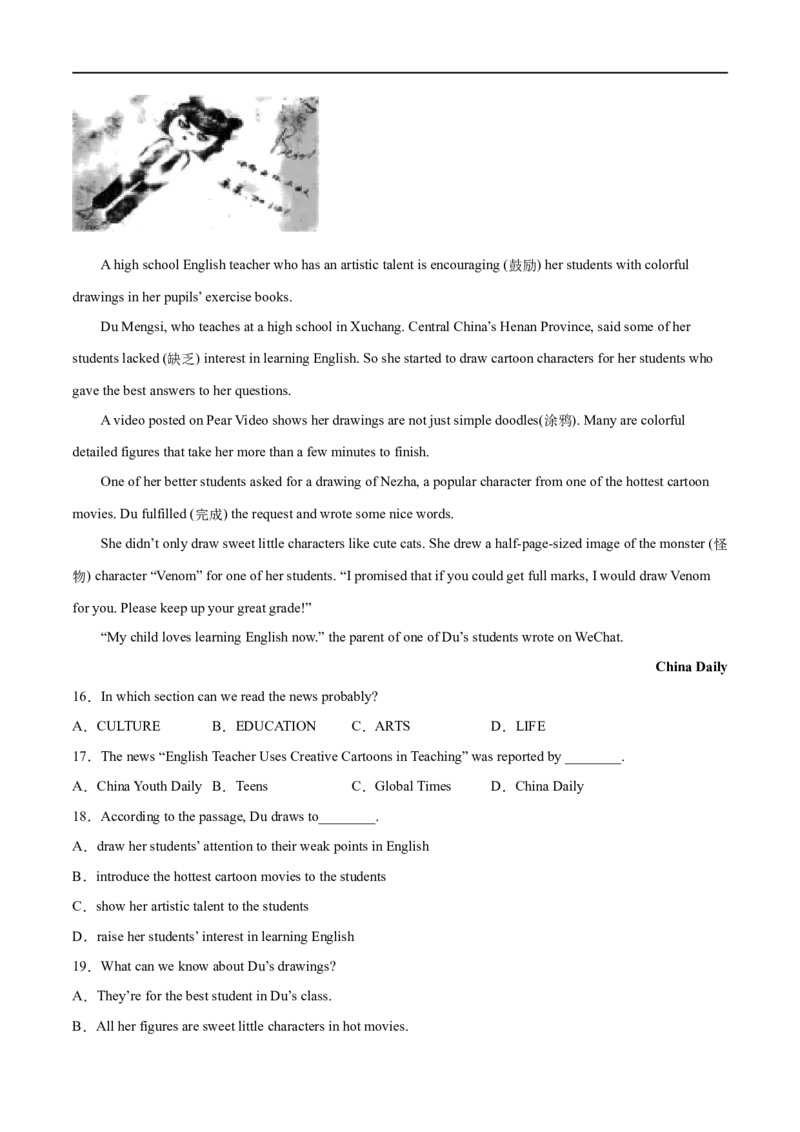
English Teacher Uses Creative Cartoons in TeachingA high school English teacher who has an artistic talent is encouraging (鼓励) her students with colorful
drawings in her pupils’ exercise books.
Du Mengsi, who teaches at a high school in Xuchang. Central China’s Henan Province, said some of her
students lacked (缺乏) interest in learning English. So she started to draw cartoon characters for her students who
gave the best answers to her questions.
A video posted on Pear Video shows her drawings are not just simple doodles(涂鸦). Many are colorful
detailed figures that take her more than a few minutes to finish.
One of her better students asked for a drawing of Nezha, a popular character from one of the hottest cartoon
movies. Du fulfilled (完成) the request and wrote some nice words.
She didn’t only draw sweet little characters like cute cats. She drew a half-page-sized image of the monster (怪
物) character “Venom” for one of her students. “I promised that if you could get full marks, I would draw Venom
for you. Please keep up your great grade!”
“My child loves learning English now.” the parent of one of Du’s students wrote on WeChat.
China Daily
16.In which section can we read the news probably?
A.CULTURE B.EDUCATION C.ARTS D.LIFE
17.The news “English Teacher Uses Creative Cartoons in Teaching” was reported by ________.
A.China Youth Daily B.Teens C.Global Times D.China Daily
18.According to the passage, Du draws to________.
A.draw her students’ attention to their weak points in English
B.introduce the hottest cartoon movies to the students
C.show her artistic talent to the students
D.raise her students’ interest in learning English
19.What can we know about Du’s drawings?
A.They’re for the best student in Du’s class.
B.All her figures are sweet little characters in hot movies.C.They serve as prizes for the students’ good work
D.It is easy for Du to finish them.
20.It’s clear that________.
A.some of Du’s paintings are just colorful doodles
B.the students are allowed to draw colorful pictures in their exercise books
C.one needs to get full marks to review Du’s drawings
D.Du might draw according to her students’ likes
(五)
A box of strawberries is left to rot (腐烂) in your fridge. You must throw it away at once. But it’s more than
just strawberries that you are wasting.
The life of a strawberry starts from a seed (种子). A farmer plants the seed and waters it. Later, people pick the
strawberry and pack it in a box. A truck takes it far—perhaps 200 to 1,000 kilometers—to a supermarket. Water,
labor, fuel (燃料) and money must all be spent in order for a strawberry to come to you. If you waste the
strawberry, you will waste all of these things.
It’s hard for people to realize how much work is connected with the food we eat every day. That makes food
waste a big problem around the world. Every year, the total amount of food wasted around the world is 1, 3 billion
tons. In China alone, people waste 35 million tons of food each year, according to the CCTV.
As we throw food away, there are still 820 million people living in hunger (饥饿) around the world. Many
children go to sleep hungry, and 3.1 million of them die from hunger each year, according to the UN. The Covid-19
pandemic (流行病), has made the situation worse, with many countries no longer transporting (运输) food to other
countries during this time.
Wasting food means wasting natural resource and missing the chance to feed a growing population. It’ s time
to take action (采取行动) now. Many countries are fighting food waste. What are we Chinese doing to stop it?
China has taken an activity called “Clear Your Plate” since 2013. This year, some restaurants are encouraging
people to order food using “N-1”. “N” stands for number of diners at a table. If there are 6 people at your table,
your are encouraged to only order 5 dishes.
With people living better lives these days, they are forgetting old values. It’s time to bring them back. We
should clear our plates from now on.
21.The underlined sentence “But it’s more than just strawberries that you are wasting.” means that ________.
A.there are more strawberries in your fridge B.you are wasting not only strawberriesC.more strawberries will rot in your fridge D.you will waste more strawberries then
22.What makes food waste a big problem?
A.A lot of food goes bad easily.
B.It’s hard to bring food to people.
C.Many countries don’t transport food to other countries.
D.People know little about the work connected with the food.
23.How much food is wasted around the world every year?
A.1.3 billion tons. B.35 million tons. C.3.9 billion tons. D.31 million tons.
24.To stop food waste, China ________.
A.tries to feed a growing population B.advises people to remember old values
C.helps other countries transport food D.encourages people to order more food
25.What is the best title of the text?
A.Don’t throw away the rot food B.The life of a strawberry
C.The activity “Clear Your Plate” D.Take action to save food
(六)
I was lying in bed yesterday afternoon after a big lunch. There wasn’t anything interesting on television. The
book I was trying to read seemed boring, too. Finally I put the book down, closed my eyes.
Suddenly, I felt a little and wet tongue lick my face. My eyes opened and I saw our dog Luck standing there
and looking at me. I smiled and touched her head. After a while, I got up and we went outside. The sun was
breaking through the clouds and warmed the cool air. I laughed as I ran with her around the yard.
She smelled the grass when the wind blew lightly. After we went back inside, I threw a ball to her, and she
brought it back to me happily. Then she jumped up on my bed and took a nap of her own. It seemed like even while
she was resting, she never found life boring.
Luck’s life is always full of happiness. In her life, there is time to nap and time to play. There is time to sing, to
listen to the news, but there is no time to be bored. After thinking about Luck’s life, I know we only get a certain
amount of time to live and that we shouldn’t waste a second of it.
Word Bank
nap 小睡
tongue 舌头
lick 舔second 秒
26.Why did the writer take a nap?
A.Because he had a habit of having a nap.
B.Because he felt tired after lunch.
C.Because he found nothing interesting to do.
27.What happened when the writer went outside?
A.His dog jumped up on his bed. B.The weather became better. C.His dog licked his face.
28.How did the writer feel after walking his dog ?
A.Disappointed. B.Happy. C.Tired.
29.What did the writer do with his dog according to third paragraph?
A.They smelled the flowers. B.They lay on the grass. C.They played a game.
30.What can we infer from this passage?
A.The writer learned a lot from his dog.
B.There is something wrong with Luck’s tongue.
C.Luck doesn’t like playing with a ball at all.
(七)
Gina is a young girl. She graduated from the university three years ago, but she still lived with her parents
these years. Last week, she moved out of her parents’ place. She was excited and afraid. Now her parents can’t
watch her all the time and she can do things freely. At the same time, she met a problem. She lived with her parents
for more than 18 years. Her parents used to cook for her, so she never learned to cook before. At first, she went out
to eat a lot, because it’s a cheap way when she spends some time studying how to cook.
She planned to make fried cabbage. It is healthy and easy to make. First, she put a pan on the stove and turned
on the stove. Then she put some oil on the pan. When the oil was hot, she put the cabbage into the pan. After
stirring the cabbage around quickly, she covered the pan with a lid and waited. About four or five minutes later, it
was ready. She tried it and found it very delicious. She was so proud of herself that she decided to make tomato
soup next time.
31.How long might Gina live with her parents?
A.For about three years. B.For about eight years C.For over eighteen years.
32.Why was Gina afraid when she moved out of her parents’ place?
A.Because she didn’t have a job. B.Because she didn’t have money. C.Because she couldn’t cook byherself.
33.What does the underlined word “stirring” mean in Chinese?
A.烘干. B.搅拌. C.腌制.
34.What does the second paragraph mainly talk about?
A.How Gina cooked the fried cabbage
B.Why Gina cooked the fried cabbage.
C.How Gina cooked the tomato soup.
35.What’s the best title of the passage?
A.Gina’s first job experience. B.Gina’s first cooking experience. C.Gina’s healthy living habits.
(八)
Do you want to be slimmer? Here are some fashion tricks. They can help you feel thinner.
Don’t wear pants if they have lines from left to right. The lines make you look fatter especially when you have
a heavy build.
Wear dark colors. Black is many people’s favorite color because dressing in dark colors can make you look
slimmer. There are different dark colors. You have many other choices besides black. Dark blue seems good and
navy is not bad, either.
Choose a shirt. Make sure there is more than one color in the shirt. Only one color, especially light color, may
make you look much fatter. Remember, two or three colors are enough.
Don’t believe the size on the tag. Sizes sometimes are different in different stores. So make sure you try on
different sizes to get the best one. Don’t wear something if it is too small for you, because it can make you look a
lot bigger than you are.
Usually jeans are boys and girls’ favorite. Be careful of back pockets. some pockets can make your bum look
bigger, but others can make it slimmer. When you are shopping, choose jeans with right pockets. Everyone wants to
be young, so choose the right style to make you look best.
Word Bank
build 身材
navy 藏青色
tag 标签
bum 屁股
36.If you are fat, ________.
A.don’t wear pants if they have linesB.don’t wear pants if they have lines from up to down
C.don’t wear pants if they have lines from left to right
37.What kind of shirt can make you look thinner?
A.There is more than one color in the shirt.
B.There is more than three colors in the shirt.
C.There is more than one color in the shirt and two or three colors are enough.
38.When you choose your jeans, you should ________.
A.choose the jeans with right pockets.
B.choose some jeans without pockets.
C.choose some jeans with two pockets.
39.The writer mentioned ________ kinds of fashion tricks.
A.four B.five C.six
40.In the passage, we know that ________.
A.few people believe the size on the tag
B.size is the same in all shops
C.lots of people choose their dress by the size on the tag
(九)
March 5 is Lei Feng Day. People are encouraged to help others and to learn from Lei Feng. This year, my
classmates and I went to do some cleaning in a street. We finished our work, took photos and talked with some
people about their lives. One old lady said she remembered how all students used to do helpful work in the street.
Another told us that when she was young, she and her friends would do a lot of simple things to help others. They
would help people carry things or fix broken chairs at school. “But things have changed over these years. The
young students don’t really understand the spirit of Lei Feng,” she continued. “They do good things because they
are told to do and take photos to put on the school website (网站).”
Her words made me think. We have been told to do things to help others on Lei Feng Day. But none of the
love and care came from our own hearts. We should believe that they can make a difference. We don’t need
cameras or praise (赞美). We can do better if we keep the spirit of Lei Feng inside ourselves. “Learn from Lei
Feng” shouldn’t be a yearly fad. Everyone should carry out their good behaviors all year round and we will have a
better tomorrow.
41.This year, my classmates and I ________ on Lei Feng Day.
A.fixed broken chairs B.did some cleaningC.carried things D.mended bikes
42.From the passage, we know people used to do many good things ________.
A.to help others B.to get praise
C.to take photos D.to help their own parents
43.Nowadays, many students do good things on Lei Feng Day because ________.
A.they care for others B.they are told to do so
C.they really want to D.they like all the people
44.The underlined phrase “a yearly fad” in the passage means “________”.
A.一时的风尚 B.每年的足迹 C.一年的支出 D.一年的收入
45.Which of the following is RIGHT according to the passage?
A.Students should take photos to put on the website.
B.People need praise to make a difference.
C.We should do good things in our daily life.
D.Lei Feng Day is on Friday.
(十)
Over your lifetime, your parents are likely to influence you more than anyone else. So if your dad likes
football, you might grow up being a football fan. And if your mum loves reading, you might grow up carrying a
book, wherever you go, just like she does. It’s interesting, isn’t it?
But have you ever thought of how to get along with them? You should spend more time with them. It might be
easy to stay in the same place with your mum or dad. But how much time do you spend just enjoying each other’s
company(陪伴)? Instead of playing a computer game or watching TV, you can ask your mum and dad to play
outside with you.
You should also share your feelings with them. Many kids say they’d like their parents to help them when
they’re in trouble. But your mum or dad might not know that you’re having some trouble. So please tell them if
you’re sad.
46.What’s the main idea of Paragraph(段落) One?
A.Your parents are likely to influence you more than anyone else.
B.If your dad likes football, you might grow up being a football fan.
C.If your mum loves reading, you might grow up carrying a book wherever you go.
D.It’s interesting to be with parents.
47.You might be interested in ________ if your parents like playing badminton.A.tennis B.badminton C.football D.basketball
48.What does the underlined word “ influence ” in the passage mean in Chinese?
A.伤害 B.支持 C.影响 D.打击
49.What should you do to spend more time with your parents?
A.Follow your parents everywhere. B.Stay at home all the time.
C.Play computer games and watch TV. D.Go outside and play with your parents.
50.The best title for the passage is ________.
A.Parents’ hobbies B.How to get along with parents?
C.Ask for help when you are in trouble D.How to share feelings with parents?
(十一)
Do you use a phone while walking on the road? Today, more and more people spend too much time watching
the phones. We call these people the“Heads-down Tribe (低头族)” and we can see them everywhere.
More traffic accidents are happening because more drivers use phones when driving. So we’ve made some
traffic rules to make drivers drive more carefully. For example, heads-down tribe members who use phones when
driving in Taiwan will be fined.
Keeping heads down and using phones may cause accidents. Also, some interesting and strange facts happen
to the “Heads-down Tribe”. Let’s have a look at the TV report. A man in America kept using his phone on his way
home. As a result, he walked into a big lost bear. When he looked up, he was so scared that he turned around and
ran away. Another fact is that we often see people in the restaurant eating face to face but focusing on (专注于) the
phones. Some of them even have fun communicating with others on the phone.
Phones are helpful tools for modern people. Are they good or not? It depends on how people use them. Let’ s
be “healthy” users and try to be the“Heads-up Tribe”.
根据短文内容,选择最佳答案。
51.If we don’ t want to be the“Heads-down Tribe”, we should _______.
A.use phones everywhere B.play on the phone when driving
C.spend less time on phones D.be “unhealthy” users
52.The meaning of the underlined word “fined” is “_______” in Chinese.
A.好的 B.罚款 C.没收 D.细小的
53.The writer wrote the passage mainly to advise us to _______.
A.walk into a lost bear B.try to be the“Heads-down” Tribe
C.keep heads down D.use phones in a proper way54.How many interesting and strange facts did the writer give in the passage?
A.One. B.Two. C.Three. D.Four.
55.From the passage we can infer (推断)________.
A.we can see the“Heads-up Tribe” everywhere
B.using phones when driving won’t cause accidents
C.people often focus on the phones even if they are eating
D.phones aren’t helpful tools for modern people
(十二)
Joyce was born in a poor family. Next Friday would be her mother’s birthday. Joyce wanted to buy something
for her mother, but she had no money. As an 8-year-old girl, she couldn’t do part-time jobs. What could she do to
make enough money for her mother’s birthday present?
Suddenly she had an idea. Usually, she would go straight to school, but this morning, she didn’t. She walked
along the streets, picking up cardboard(纸板), plastic(塑料)bottles and cans(易拉罐). When it was time for
school, she put them in the backyard(后院)and ran to school as quickly as possible.
Eight days later, she decided to sell all the things she had collected(收集)because the next day was her
mother’s birthday. She had to sell them and buy a birthday present for her mother. In the shop, she bought a
beautiful hair pin for her mother.
When her mother got the present, she said with tears(眼泪) in her eyes, “This is the best gift I’ve ever
received.”
56.How old was Joyce?
A.Seven. B.Eight. C.Nine. D.Ten.
57.Why couldn’t Joyce buy a present for her mother at first?
A.Because she had no money.
B.Because she didn’t know what her mother liked.
C.Because she lost all her pocket money.
D.Because she didn’t love her mother at all.
58.What was Joyce’s idea?
A.Doing part-time jobs. B.Collecting waste things and selling them.
C.Asking her father for help. D.Asking her best friend for help.
59.How long did Joyce collect the waste things?
A.A week. B.A month. C.Less than a week. D.More than a week.60.How did Joyce’s mother feel when she got the present?
A.Very sad. B.Very happy and moved. C.Very angry.D.Very surprised.
(十三)
“Green mountains and clear waters are as good as mountains of gold and silver”. To make our water clearer
and our mountains greener, we should start doing garbage classification(垃圾分类).
There are four kinds of wastes: the hazardous(有害的), the recyclable(可回收的), the dry and the wet.
The used books and notebooks should be put into the recyclable garbage bins, the batteries should be put into the
hazardous garbage bins, the dry leaves should be put into the dry garbage bins and the leftovers(剩饭菜)should
be put into the wet garbage bins.
The other day, I found a lady in my neighborhood. She put all the garbage into one garbage bin. She was not
doing the garbage classification. When I went to tell her to do it, she looked confused(迷惑的). I realized she
knew little about garbage classification. It’s not hard to imagine things like this happen a lot every day.
There is a question coming to my mind—Are we doing enough to let people realize the right way to classify
the garbage? It seems many people need education on that. We can start to help children know the right thing to do
with garbage. As students, we can set up a volunteer team in the garbage station to help those uncles and aunts to
put the garbage in the right bin. We can also let them know the benefits of doing this.
If we keep on doing this, our environment will get better. We can see more green mountains and clear waters
around us in the near future.
61.How many kinds of wastes are mentioned in the passage?
A.4. B.5. C.6.
62.Where should we put the leftovers?
A.In the hazardous garbage bins. B.In the dry garbage bins. C.In the wet garbage bins.
63.Which of following is TRUE according to the 3rd paragraph?
A.The lady has learned a lot about garbage classification.
B.The writer told the lady to do the right thing.
C.The writer laughed at the lady.64.What is the main idea of the Paragraph 4?
A.People have got enough education on garbage classification.
B.Students don’t know much about garbage classification.
C.There is still a lot to do about garbage classification.
65.What can we learn from the passage?
A.Garbage classification helps us see more green mountains and clear waters.
B.Garbage classification can make mountains of gold and silver.
C.Garbage classification is too hard to do it in our daily life.
(十四)
Gift giving is an important practice that can show a number of different meanings. Here are some gift giving
traditions from a few different countries.
◆In Zimbabwe
In Zimbabwe, it is common to ask for a gift straightly. When a gift has been bought even without asking for it,
the worst thing you can do is to refuse the offering, even if the giving family is poor.
◆In Japan
The Japanese place a great importance on the act of gift giving. For example, people don’t like uncovered
money. So whether you’re sending money as a gift or just leaving a tip (小费), put your money in an envelope (信
封).
◆In India
As left hands are considered unclean in Indian culture, acts such as touching, passing money, or giving gifts
must be done with your right hand.
◆In Russia
Vodka (伏特加酒) might seem a perfect gift for a Russian, but in fact, a lot of them would see it as an
unimaginative gift. Many even think the idea is terrible.
◆In Ireland
Don’t be astonished if your gift is refused a couple of times in Ireland. This tradition comes from a time when
they didn’t have enough potatoes to eat in the 1840s, and because of this, the receivers are making sure that you can
really part from the thing that you are offering.
66.From the passage, we can know that ________.
A.it’s common to refuse gifts in Zimbabwe
B.Japanese people don’t send money as a giftC.Indian people use right hands when giving gifts
D.it’s a great idea to send Vodka to Russian people
67.The underlined word “astonished” in Paragraph 6 most probably means “________”.
A.peaceful B.excited C.shocked D.silly
68.The writer organized the whole passage by ________.
A.asking questions B.giving examples C.listing reasons D.telling stories
69.These traditions are probably helpful when people want to ________.
A.travel around the world B.send gifts to friends in China
C.make new friends online D.learn different gift giving rules
70.In which part of the magazine can you find this text?
A.Culture. B.Friendship. C.Education. D.Health.
(十五)
The warming of Earth’s climate (气候) is called global (全球的)warming. If global warming carries on, many
plants and animals living today on the Earth could have problems surviving (生存). It could also mean more
droughts (干旱) and floods (洪水). Over the last one hundred years, the average (平均的) temperature on the Earth
has gone up by half a degree. It doesn’t sound much, but people are very worried. Global warming is caused by the
greenhouse effect (温室效应). What is it? It’s what keeps our planet at a nice and comfortable temperature and the
best way to explain how it works is to look at a greenhouse.
Why is it hot inside a greenhouse? Have you ever noticed that it’s warmer inside a greenhouse than outside?
This is because rays (光线) of sunlight pass through the glass of the greenhouse. Although the greenhouse’s glass
lets sunlight in, it doesn’t let all the heat out, so some of the heat is trapped (困住) inside the greenhouse and it
warms up. The atmosphere (大气) is a bit like the glass of a greenhouse. It lets sunlight pass through easily but
stops some of the heat getting out. So when the rays of sunlight heat the Earth, it warms up. The Earth gives out
heat, but not all of it gets into outer space. Some of it gets trapped close to the Earth and this warms up the air
around us. Without the greenhouse gases (气体), the Earth would be about 33℃ coder. It would not be warm
enough for plants and animals to survive. The way that greenhouse gases keep the atmosphere at a nice temperature
is called the greenhouse effect.
71.The underlined word “degree” in the passage means _______ in Chinese.
A.发展 B.速度 C.度数
72.The second paragraph mainly talks about _______.A.the reason why it’s hotter inside a greenhouse than outside
B.how the rays of sunlight get into the greenhouse
C.how to make a greenhouse
73.According to the passage, _______ is the correct order.
a. Some of the heat from the Earth trapped close to the Earth.
b. The air around us warms up.
c. The Earth gives out some of the heat.
d. The rays of sunlight heat the Earth.
A.d-c-a-b B.d-b-c-a C.c-a-b-d
74.If global warming carries on, it may _______.
A.be bad for plants and animals B.cause droughts and floods C.both A and
B
75.Which of the following is NOT true according to the passage?
A.It’s warmer inside a greenhouse than outside.
B.It would not be warm enough for plans and animals to survive without the greenhouse gases.
C.The greenhouse effect is caused by global warming.