2025-2026学年八年级英语下册单元模块满分必刷题(新教材人教版)
Unit 2 Stay healthy【刷语法】(重点语法提升练)
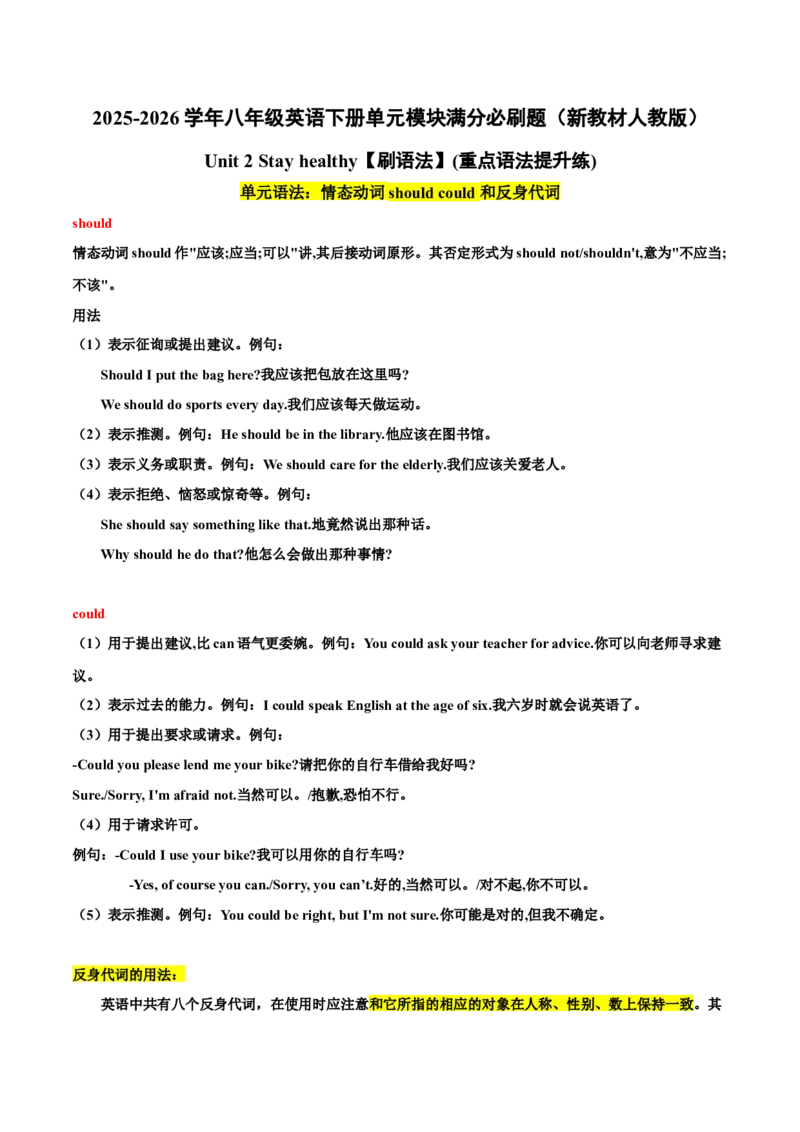
单元语法:情态动词should could 和反身代词
should
情态动词should作"应该;应当;可以"讲,其后接动词原形。其否定形式为should not/shouldn't,意为"不应当;
不该"。
用法
(1)表示征询或提出建议。例句:
Should I put the bag here?我应该把包放在这里吗?
We should do sports every day.我们应该每天做运动。
(2)表示推测。例句:He should be in the library.他应该在图书馆。
(3)表示义务或职责。例句:We should care for the elderly.我们应该关爱老人。
(4)表示拒绝、恼怒或惊奇等。例句:
She should say something like that.地竟然说出那种话。
Why should he do that?他怎么会做出那种事情?
could
(1)用于提出建议,比can语气更委婉。例句:You could ask your teacher for advice.你可以向老师寻求建
议。
(2)表示过去的能力。例句:I could speak English at the age of six.我六岁时就会说英语了。
(3)用于提出要求或请求。例句:
-Could you please lend me your bike?请把你的自行车借给我好吗?
Sure./Sorry, I'm afraid not.当然可以。/抱歉,恐怕不行。
(4)用于请求许可。
例句:-Could I use your bike?我可以用你的自行车吗?
-Yes, of course you can./Sorry, you can’t.好的,当然可以。/对不起,你不可以。
(5)表示推测。例句:You could be right, but I'm not sure.你可能是对的,但我不确定。
反身代词的用法:
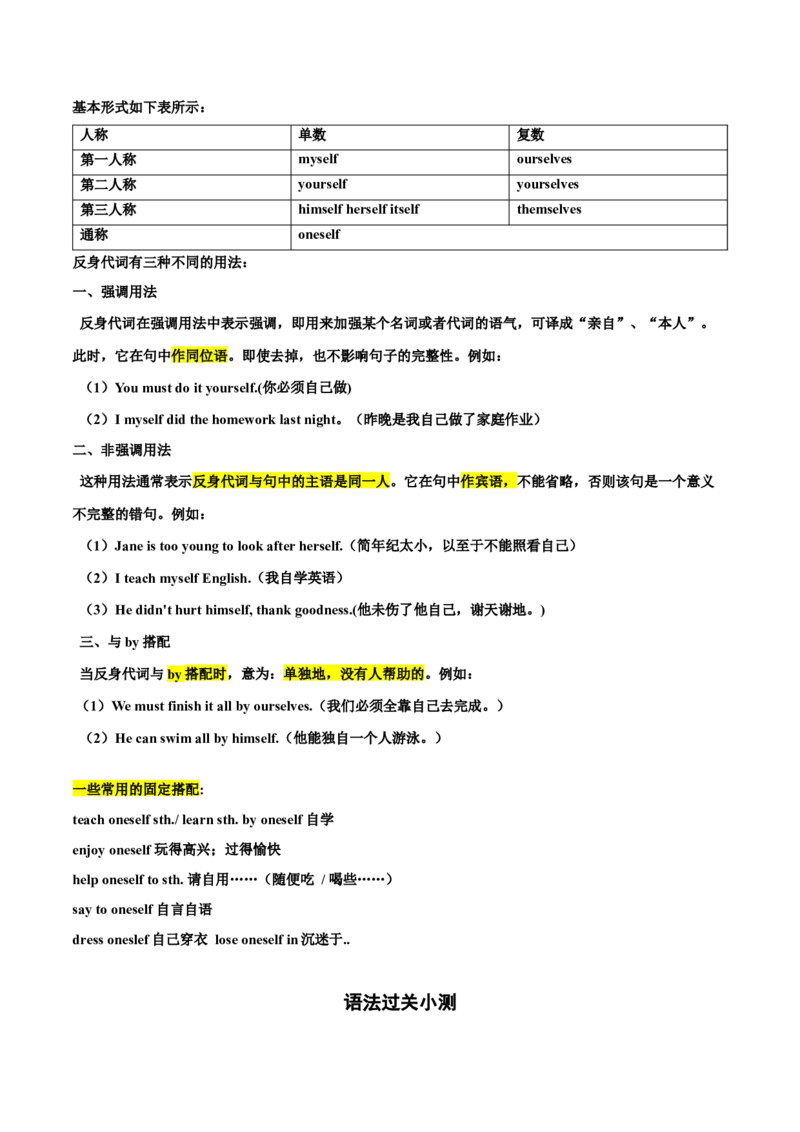
英语中共有八个反身代词,在使用时应注意和它所指的相应的对象在人称、性别、数上保持一致。其基本形式如下表所示:
人称 单数 复数
第一人称 myself ourselves
第二人称 yourself yourselves
第三人称 himself herself itself themselves
通称 oneself
反身代词有三种不同的用法:
一、强调用法
反身代词在强调用法中表示强调,即用来加强某个名词或者代词的语气,可译成“亲自”、“本人”。
此时,它在句中作同位语。即使去掉,也不影响句子的完整性。例如:
(1)You must do it yourself.(你必须自己做)
(2)I myself did the homework last night。(昨晚是我自己做了家庭作业)
二、非强调用法
这种用法通常表示反身代词与句中的主语是同一人。它在句中作宾语,不能省略,否则该句是一个意义
不完整的错句。例如:
(1)Jane is too young to look after herself.(简年纪太小,以至于不能照看自己)
(2)I teach myself English.(我自学英语)
(3)He didn't hurt himself, thank goodness.(他未伤了他自己,谢天谢地。)
三、与by搭配
当反身代词与by搭配时,意为:单独地,没有人帮助的。例如:
(1)We must finish it all by ourselves.(我们必须全靠自己去完成。)
(2)He can swim all by himself.(他能独自一个人游泳。)
一些常用的固定搭配:
teach oneself sth./ learn sth. by oneself 自学
enjoy oneself 玩得高兴;过得愉快
help oneself to sth. 请自用……(随便吃 / 喝些……)
say to oneself 自言自语
dress oneslef自己穿衣 lose oneself in沉迷于..
语法过关小测满分:60分;时间:40分钟
一、单项选择(每小题1分,共60分)
1.—________ you help me carry the books?
—Of course.
A.Must B.Should C.Need D.Could
2.—It’s boring to stay at home doing nothing.
—You ________ go for walks with your friend in the park.
A.would B.have to C.could D.must
3.—________we go to Hainan for the holiday, Dad?
—Yes, you can.
A.Should B.Could C.Will
4.—I can’t lift the luggage. ________ you please give me a hand?
—Sure.
A.Need B.Should C.Must D.Could
5.—My bike is broken. ________ I borrow yours?
—Yes, you ________.
A.Could; may B.Can; could C.Could; can D.May; could
6.—The box is too heavy for me.
—You ________ ask Tom for help.
A.may B.should C.could
7.—I have a bad headache.
—You ________ take some medicine and have a good rest.
A.couldn’t B.should C.might
8.—We are going to visit the National Museum of China.
—Great! We ________ follow some rules there so that others can enjoy their visit.
A.should B.may C.have to D.could
9.You ________ eat too much candy—it’s bad for your teeth.
A.shouldn’t B.should C.needn’t D.must
10.—More and more students love playing computer games at weekends.
—That’s too bad. Everyone ________ be a book lover. Reading makes a full man.
A.need B.would C.should D.could
11.People ________ talk on a mobile phone while they are driving.A.shouldn’t B.needn’t C.can
12.As students, we all ________ follow the school rules.
A.could B.should C.would
13.—________ I hang out with my friends after dinner?
—Sure, but you have to finish your homework first.
A.Could B.Must C.Will D.Would
14.Jim ________ recite (背诵) more than 100 poems at the age of three.
A.can B.should C.could
15.— Mum, ________ I play football this afternoon?
— Sure, but you ________ finish your homework first.
A.could; must B.may; could C.could; can
16.—Could you please communicate with me face to face?
—Yes, I ________. I’ll wait for you in the meeting room.
A.could B.can C.was able to
17.—________ I borrow your dictionary? I left mine at home.
—Sorry, I’m afraid you ________ because I’m using it.
A.Could; can B.Could; can’t C.Must; can D.Must; can’t
18.When you share your ideas, you ________ speak loudly so everyone can hear you clearly.
A.can B.may C.should
19.If you want to be healthy, you ________ exercise every day.
A.should B.shouldn’t C.will D.won’t
20.You ________ be so emotional. Taking a deep breath can help you calm down.
A.needn’t B.shouldn’t C.mustn’t D.can’t
21.We ________ not talk loudly in the school hall. It’s one of our school rules.
A.should B.can C.may D.will
22.—Could you please help me make my bed, Mom?
—I’m afraid I ________. You ________ do it on your own.
A.couldn’t; need B.shouldn’t; should C.can’t; should
23.Old habits die hard! That’s why you ________ stop going online too much before the habit takes hold.
A.may B.could C.should
24.You ________ drink warm water and have a good rest if you have a cold, or you’ll feel worse.A.should B.had better not C.mustn’t D.can
25.—Judy, _________ I ask you some questions, please?
—Of course you _________.
A.can; could B.could; can C.may; might
26.—I can’t lift the luggage. ________ you please give me a hand?
—Sure, I’d love to.
A.Need B.Should C.Must D.Could
27.—Your new pen looks beautiful. ________ I have a look?
—Sure. Go ahead, please.
A.Must B.Could C.Need D.Should
28.He didn’t finish his homework, so he ________ watch TV last night.
A.can’t B.couldn’t C.mustn’t D.shouldn’t
29.________ you turn down the TV, please? I’m trying to work.
A.Must B.Could C.Might D.May
30.—Could you play tennis when you were ten?
—Yes, I ________.
A.can B.should C.need D.could
31.We should be helpful. Helping others means helping ________.
A.you B.yourselves C.us D.ourselves
32.The little girl is old enough to dress ________.
A.herself B.her C.hers
33.He decided to ________ programming ________ , so he bought a book and started practicing.
A.learn, by him B.learn, with himself C.learn, by his D.learn, by himself
34.—Did your parents help you decorate (装饰) the room?
—No, we did everything ________. It was tiring but fun!
A.yourselves B.ourselves
C.themselves D.himself
35.—What are you doing, Jack?
—I didn’t have breakfast. I’m making a sandwich for ________.
A.my B.myself C.you D.yourself
36.You can improve ________ by reading classics.A.himself B.herself C.yourself D.myself
37.—Help _______ to some fruits, children.
—Thank you, Mrs. Wang.
A.yourself B.yourselves C.himself D.themselves
38.— Who teaches ________ volleyball?
— Nobody, they learn it by ________.
A.them; themself B.them; them C.their; themselves D.them; themselves
39.These two children enjoyed ________ on the farm.
A.himself B.themselves C.itself
40.As the art festival is coming, we are preparing everything by ________.
A.yourselves B.themselves C.ourselves
41.—Ella, believe in ________. That’s the secret of success.
—OK. I will.
A.you B.your C.yours D.yourself
42.Doing exercises every day can help people improve ________.
A.myself B.themselves C.yourself D.ourselves
43.The children organized the party ________.
A.themselves B.theirselves C.theyselves D.theirself
44.Don’t be angry. He wasn’t talking about you. He was talking about ________.
A.himself B.yourself C.itself D.themselves
45.—These days, more and more people are watching Jiangsu Football City League on the Internet.
—That’s true. Watching it is just as enjoyable as playing football ________.
A.it B.itself C.them D.themselves
46.—How beautiful the music is! Did you teach ________ to play the ukulele?
—No, I didn’t. It’s all because of my music teacher. She teaches ________ well.
A.her; myself B.yourself; herself C.yourself; me D.you; myself
47.Be careful when you use scissors, or you might hurt ________.
A.you B.your C.yourself
48.Tom made a chocolate cake ________ last weekend—he didn’t ask his mom for help at all.
A.myself B.yourself C.himself D.herself
49.A man should be strict with _____, but be friendly to others.A.myself B.yourself C.oneself D.himself
50.The two children are too young to look after ________.
A.them B.their C.themselves
51.If you want to be a pilot, you must keep ______ healthy and strong.
A.your B.you C.yours D.yourself
52.Children should learn how to protect ________ when they are in great danger.
A.himself B.yourself C.themselves
53.—Is it important for students to learn how to take care of ________?
—Yes, it is. I think it’s helpful to improve their living skills.
A.their B.them C.themselves
54.Helen isn’t old enough to look after _______.
A.her B.hers C.herself
55.There are many great pioneers in different fields. They have thrown ________ into the development of the
country.
A.myself B.ourselves C.themselves
56.I’m not good at maths, but I often say to ________, “Never give up!”
A.herself B.myself C.themselves D.himself
57.To ________ surprise, the doctors and nurses never think of ________.
A.us; them B.our; them C.our; themselves D.us; themselves
58.—What did you think of the new lesson yesterday?
—The course ________ was meaningful, but I felt ________ because yesterday’s lesson was too long.
A.itself; boring B.himself; bored C.itself; bored D.himself; boring
59.—Where did you get the toy car?
—From my sister. She drew the picture of the toy car through DeepSeek and made it ________.
A.myself B.himself C.herself D.yourself
60.Mandy, we can’t do everything for you. You have to depend on ________ now.
A.you B.your C.yourself D.yourselves