文档文本内容
班级 姓名 学号 分数
Unit 2 Stay Healthy
单元重点单词变形短语语法句型精练
(时间:60分钟,满分:100分)
单元知识点默写
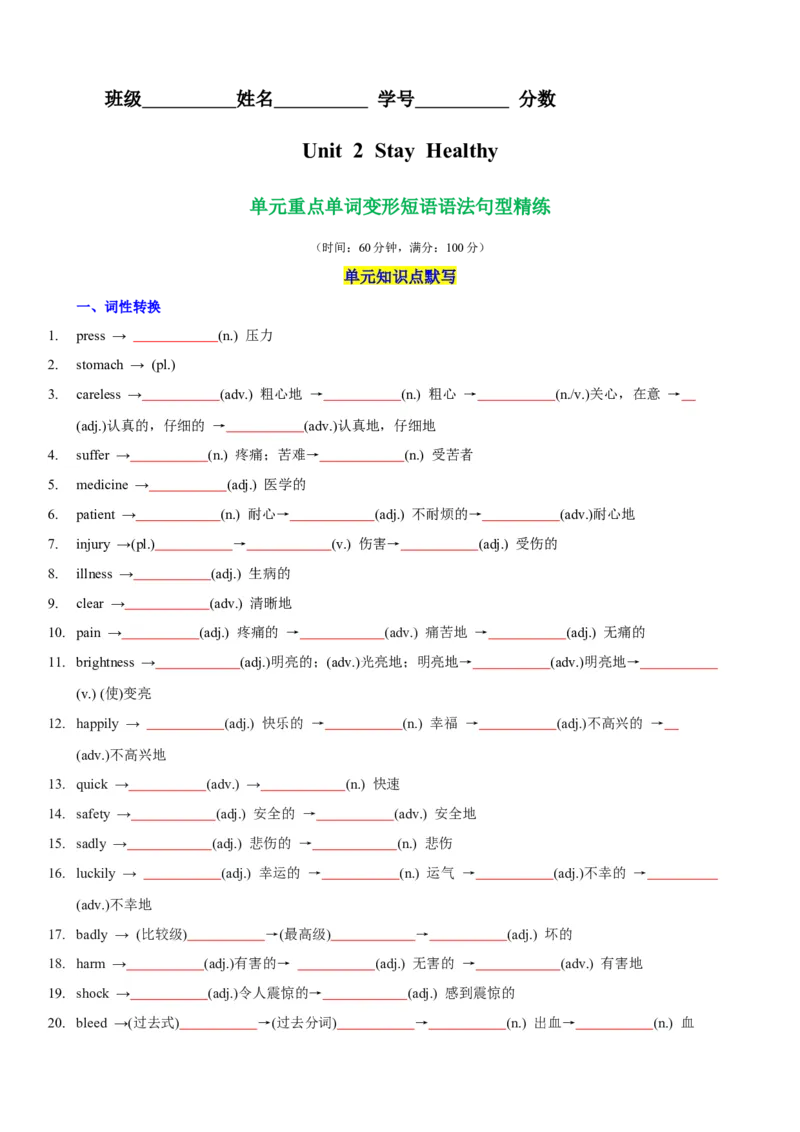
一、词性转换
1. press → (n.) 压力
2. stomach → (pl.)
3. careless → (adv.) 粗心地 → (n.) 粗心 → (n./v.)关心,在意 →
(adj.)认真的,仔细的 → (adv.)认真地,仔细地
4. suffer → (n.) 疼痛;苦难→ (n.) 受苦者
5. medicine → (adj.) 医学的
6. patient → (n.) 耐心→ (adj.) 不耐烦的→ (adv.)耐心地
7. injury →(pl.) → (v.) 伤害→ (adj.) 受伤的
8. illness → (adj.) 生病的
9. clear → (adv.) 清晰地
10. pain → (adj.) 疼痛的 → (adv.) 痛苦地 → (adj.) 无痛的
11. brightness → (adj.)明亮的;(adv.)光亮地;明亮地→ (adv.)明亮地→
(v.) (使)变亮
12. happily → (adj.) 快乐的 → (n.) 幸福 → (adj.)不高兴的 →
(adv.)不高兴地
13. quick → (adv.) → (n.) 快速
14. safety → (adj.) 安全的 → (adv.) 安全地
15. sadly → (adj.) 悲伤的 → (n.) 悲伤
16. luckily → (adj.) 幸运的 → (n.) 运气 → (adj.)不幸的 →
(adv.)不幸地
17. badly → (比较级) →(最高级) → (adj.) 坏的
18. harm → (adj.)有害的→ (adj.) 无害的 → (adv.) 有害地
19. shock → (adj.)令人震惊的→ (adj.) 感到震惊的
20. bleed →(过去式) →(过去分词) → (n.) 出血→ (n.) 血二、重点词组
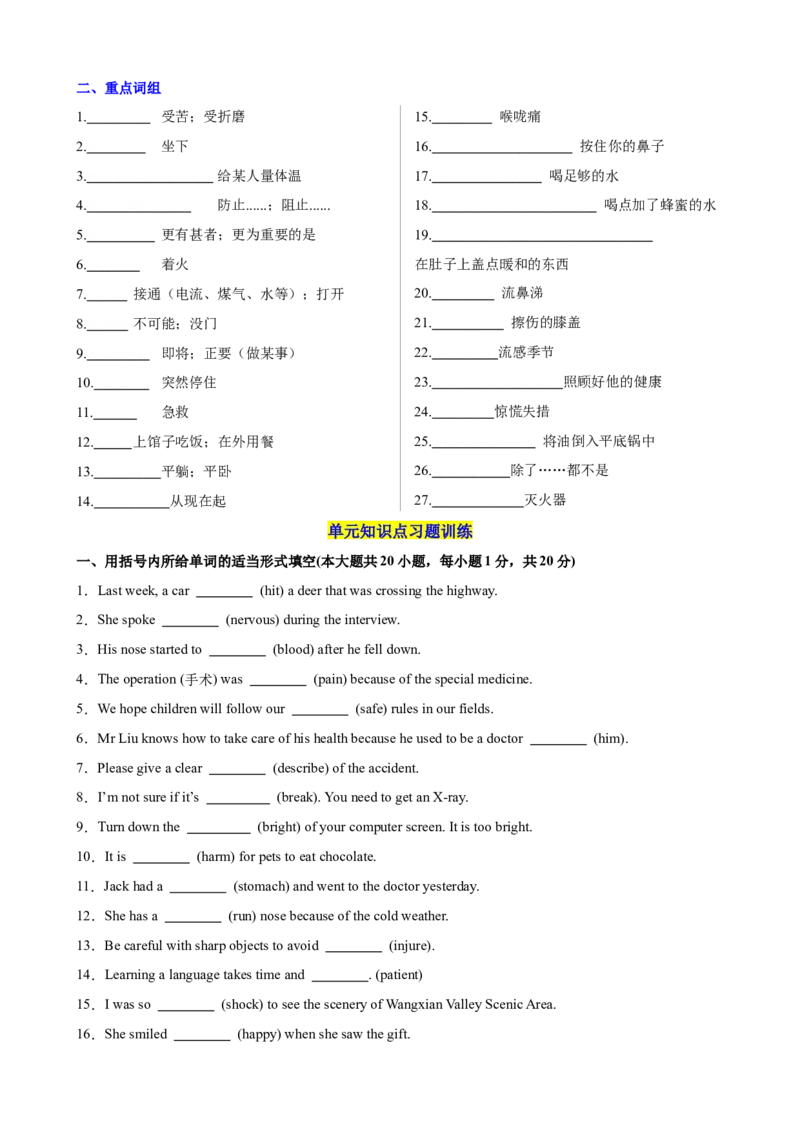
1.suffer from 受苦;受折磨 15.sore throat 喉咙痛
2.take a seat 坐下 16.press down on your nose 按住你的鼻子
3. take one's temperature 给某人量体温 17.drink enough water 喝足够的水
4.stop ... from doing 防止......;阻止...... 18.drink some water with honey 喝点加了蜂蜜的水
5.what's more 更有甚者;更为重要的是 19.put something warm on your stomach
6.catch fire 着火 在肚子上盖点暖和的东西
7.turn on 接通(电流、煤气、水等);打开 20.runny nose 流鼻涕
8.no way 不可能;没门 21.bruised knee 擦伤的膝盖
9.be about to 即将;正要(做某事) 22.flue season 流感季节
10.stop short 突然停住 23.take care of his health 照顾好他的健康
11.first aid 急救 24.in a panic 惊慌失措
12. eat out 上馆子吃饭;在外用餐 25.pour oil into a pan 将油倒入平底锅中
13. lie down 平躺;平卧 26.anything but 除了……都不是
14.from now on 从现在起 27.fire extingusher 灭火器
单元知识点习题训练
一、用括号内所给单词的适当形式填空(本大题共20小题,每小题1分,共20分)
1.Last week, a car (hit) a deer that was crossing the highway.
2.She spoke (nervous) during the interview.
3.His nose started to (blood) after he fell down.
4.The operation (手术) was (pain) because of the special medicine.
5.We hope children will follow our (safe) rules in our fields.
6.Mr Liu knows how to take care of his health because he used to be a doctor (him).
7.Please give a clear (describe) of the accident.
8.I’m not sure if it’s (break). You need to get an X-ray.
9.Turn down the (bright) of your computer screen. It is too bright.
10.It is (harm) for pets to eat chocolate.
11.Jack had a (stomach) and went to the doctor yesterday.
12.She has a (run) nose because of the cold weather.
13.Be careful with sharp objects to avoid (injure).
14.Learning a language takes time and . (patient)
15.I was so (shock) to see the scenery of Wangxian Valley Scenic Area.
16.She smiled (happy) when she saw the gift.17.Serious (ill) like the flu should be treated by a doctor.
18.Hearing that bad news, her face was (color) with fear.
19.Westerners eat with forks and (knife), while we Chinese eat with chopsticks.
20.We (should) eat more junk food—it’s bad for our digestion.
二、根据汉语提示完成单词(本大题共10小题,每小题1分,共10分)
21.He told me that his mother was in no danger though she was (严重地) hurt.
22.To keep healthy, try to (避免) eating too much junk food.
23.Wearing a (口罩) can stop viruses from spreading.
24.You should see a (牙科医生) if your tooth hurts.
25.We need to (按压) the bleeding part tightly to stop the blood.
26.I wake up at 6 a.m. as the sleeping (药丸,药片) doesn’t work for more than nine hours.
27.It’s important to keep a (均衡的) diet to support our body’s needs.
28.She felt (虚弱的) because she didn’t eat anything for the whole day.
29.She has a high (发烧); her mom is taking her to the hospital.
30.He has a (抽筋) in his leg after running too fast—let him rest for a while.
三、完成句子(本大题共10小题,每小题3分,共30分)
31.几秒钟内,正燃烧着的锅里的火就被扑灭了。
In , the fire in the burning pan was .
32.我从自行车上摔下来,伤了自己。
I when I fell off my bike.
33.你应该去看牙医,做个X射线检查。
You and get an X-ray.
34.——怎么啦?
——我胃疼。
— ?
—I have a stomachache.
35.请立刻把报告发给我。
Please send the report to me .
36.过马路时注意周围车辆,保持安全。
Look around for cars when crossing the street to .
37.You should drink more water. (改为否定句)
You drink more water.
38.小男孩给我看了他淤青的膝盖,并要了一个创可贴。The little boy showed me his and asked for a band-aid.
39.医生说我流鼻涕是对花粉过敏引起的。
The doctor said my is caused by an allergy to pollen.
40.一些学生正遭受期末考试压力的困扰。
Some students are the stress of the final exams.
四、短文填空(本大题共20小题,每小题2分,共40分)
Basic First Aid Knowledge Everyone Should Learn
Accidents can happen anytime, anywhere. That’s why learning some basic first aid skills is important for
staying 41 (safety) and helping others.
One of the first steps in first aid is 42 (check) the person’s condition. For example, if someone
looks pale or weak, it’s important to start by taking their temperature 43 (see) if they have a fever.
If someone feels dizzy (头晕的) or has trouble standing, they might not have eaten enough or could be
dehydrated (脱水的). In this case, offer them some water and check whether they are 44 (health)
enough to recover on their own. If not, help them sit or lie down and rest.
Sometimes, accidents or 45 (ill) happen when we least expect them. For example, just last week,
my friend 46 (catch) a bad cold after walking home in the rain without an umbrella. He had 47
high fever that night and didn’t know what to do. 48 (lucky), his parents knew some first aid and helped
him rest and recover.
First aid methods keep improving. It’s helpful to stay updated with the 49 (late) guidelines from
trusted health organizations. That way, you’ll be ready for all kinds of situations — even ones that once seemed
50 (possible) to deal with.
根据短文内容,在空格处填入适当的词或用括号内所给单词的适当形式填空
Spring is a pretty season full of life, but it also brings some common diseases. Knowing about them can
help us keep 51 (health).
One common spring disease is the flu. In spring, the flu virus (病毒) gets more active, so people get the flu
52 (easy). You may have a high fever, a cough, and a sore throat. To keep us away 53 the flu, we could
do more exercise to keep in good health.
54 (allergy) are also very common in spring. There is much pollen (花粉) in the air in spring. It can
make people allergic. People allergic to pollen may have red and uncomfortable eyes, a 55 (run) nose, and
sneezing. To avoid allergies, it’s a good idea to go out less when there’s a lot of pollen in the air.
Another problem is that spring is a time when germs (病菌) grow fast. Stomach problems can happen if wedon’t pay attention to food 56 (safe). Keeping our hands clean and eating fresh food are helpful ways
57 (stop) stomach problems.
In spring, the weather 58 (be) often changeable. We should wear the right clothes according to the
weather.
If we can follow these things, we can take care of 59 (we). Then we can enjoy the beauty of spring
without worrying about 60 (get) sick.