Unit 7 A Good Read(复习讲义)
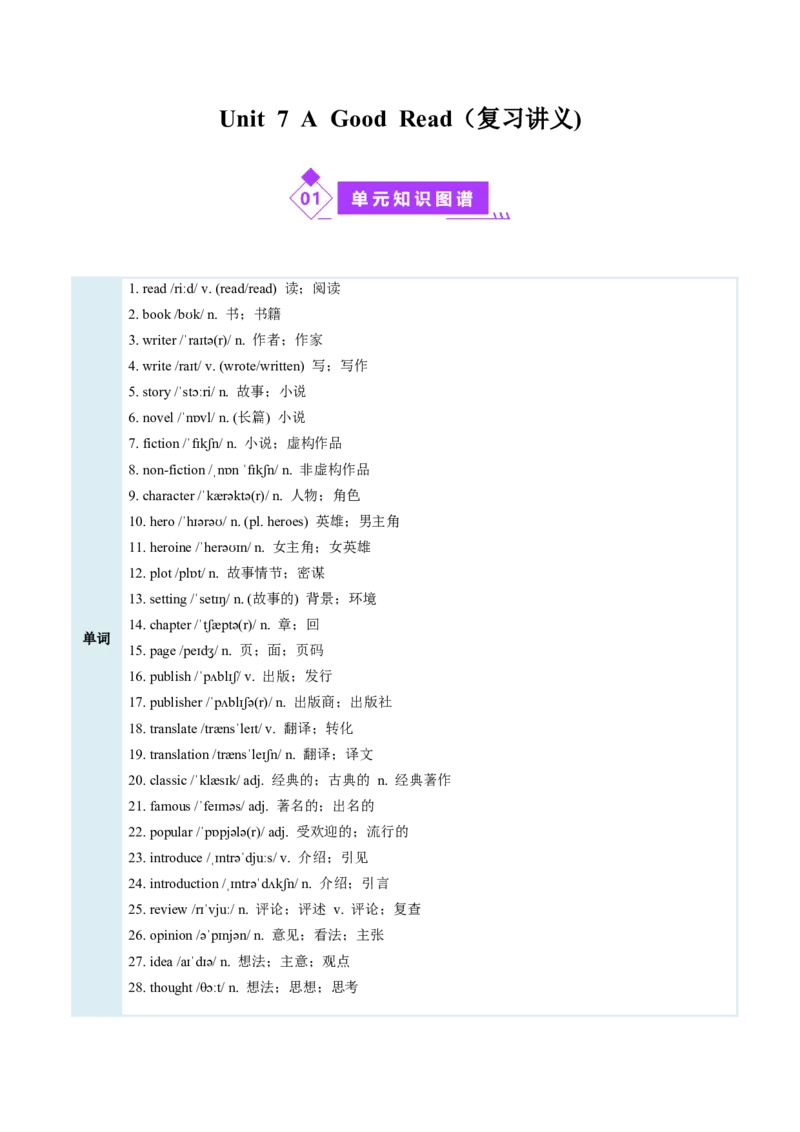
1. read /riːd/ v. (read/read) 读;阅读
2. book /bʊk/ n. 书;书籍
3. writer /ˈraɪtə(r)/ n. 作者;作家
4. write /raɪt/ v. (wrote/written) 写;写作
5. story /ˈstɔːri/ n. 故事;小说
6. novel /ˈnɒvl/ n. (长篇) 小说
7. fiction /ˈfɪkʃn/ n. 小说;虚构作品
8. non-fiction /ˌnɒn ˈfɪkʃn/ n. 非虚构作品
9. character /ˈkærəktə(r)/ n. 人物;角色
10. hero /ˈhɪərəʊ/ n. (pl. heroes) 英雄;男主角
11. heroine /ˈherəʊɪn/ n. 女主角;女英雄
12. plot /plɒt/ n. 故事情节;密谋
13. setting /ˈsetɪŋ/ n. (故事的) 背景;环境
14. chapter /ˈtʃæptə(r)/ n. 章;回
单词
15. page /peɪdʒ/ n. 页;面;页码
16. publish /ˈpʌblɪʃ/ v. 出版;发行
17. publisher /ˈpʌblɪʃə(r)/ n. 出版商;出版社
18. translate /trænsˈleɪt/ v. 翻译;转化
19. translation /trænsˈleɪʃn/ n. 翻译;译文
20. classic /ˈklæsɪk/ adj. 经典的;古典的 n. 经典著作
21. famous /ˈfeɪməs/ adj. 著名的;出名的
22. popular /ˈpɒpjələ(r)/ adj. 受欢迎的;流行的
23. introduce /ˌɪntrəˈdjuːs/ v. 介绍;引见
24. introduction /ˌɪntrəˈdʌkʃn/ n. 介绍;引言
25. review /rɪˈvjuː/ n. 评论;评述 v. 评论;复查
26. opinion /əˈpɪnjən/ n. 意见;看法;主张
27. idea /aɪˈdɪə/ n. 想法;主意;观点
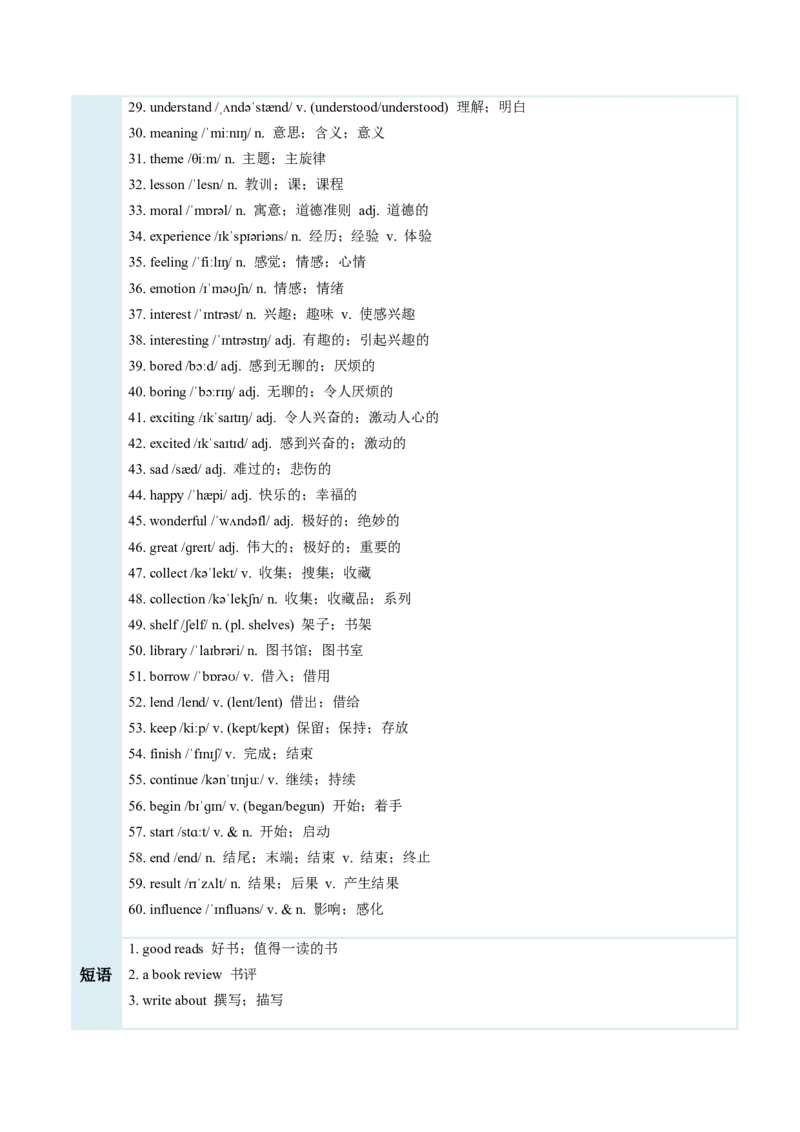
28. thought /θɔːt/ n. 想法;思想;思考29. understand /ˌʌndəˈstænd/ v. (understood/understood) 理解;明白
30. meaning /ˈmiːnɪŋ/ n. 意思;含义;意义
31. theme /θiːm/ n. 主题;主旋律
32. lesson /ˈlesn/ n. 教训;课;课程
33. moral /ˈmɒrəl/ n. 寓意;道德准则 adj. 道德的
34. experience /ɪkˈspɪəriəns/ n. 经历;经验 v. 体验
35. feeling /ˈfiːlɪŋ/ n. 感觉;情感;心情
36. emotion /ɪˈməʊʃn/ n. 情感;情绪
37. interest /ˈɪntrəst/ n. 兴趣;趣味 v. 使感兴趣
38. interesting /ˈɪntrəstɪŋ/ adj. 有趣的;引起兴趣的
39. bored /bɔːd/ adj. 感到无聊的;厌烦的
40. boring /ˈbɔːrɪŋ/ adj. 无聊的;令人厌烦的
41. exciting /ɪkˈsaɪtɪŋ/ adj. 令人兴奋的;激动人心的
42. excited /ɪkˈsaɪtɪd/ adj. 感到兴奋的;激动的
43. sad /sæd/ adj. 难过的;悲伤的
44. happy /ˈhæpi/ adj. 快乐的;幸福的
45. wonderful /ˈwʌndəfl/ adj. 极好的;绝妙的
46. great /ɡreɪt/ adj. 伟大的;极好的;重要的
47. collect /kəˈlekt/ v. 收集;搜集;收藏
48. collection /kəˈlekʃn/ n. 收集;收藏品;系列
49. shelf /ʃelf/ n. (pl. shelves) 架子;书架
50. library /ˈlaɪbrəri/ n. 图书馆;图书室
51. borrow /ˈbɒrəʊ/ v. 借入;借用
52. lend /lend/ v. (lent/lent) 借出;借给
53. keep /kiːp/ v. (kept/kept) 保留;保持;存放
54. finish /ˈfɪnɪʃ/ v. 完成;结束
55. continue /kənˈtɪnjuː/ v. 继续;持续
56. begin /bɪˈɡɪn/ v. (began/begun) 开始;着手
57. start /stɑːt/ v. & n. 开始;启动
58. end /end/ n. 结尾;末端;结束 v. 结束;终止
59. result /rɪˈzʌlt/ n. 结果;后果 v. 产生结果
60. influence /ˈɪnfluəns/ v. & n. 影响;感化
1. good reads 好书;值得一读的书
短语 2. a book review 书评
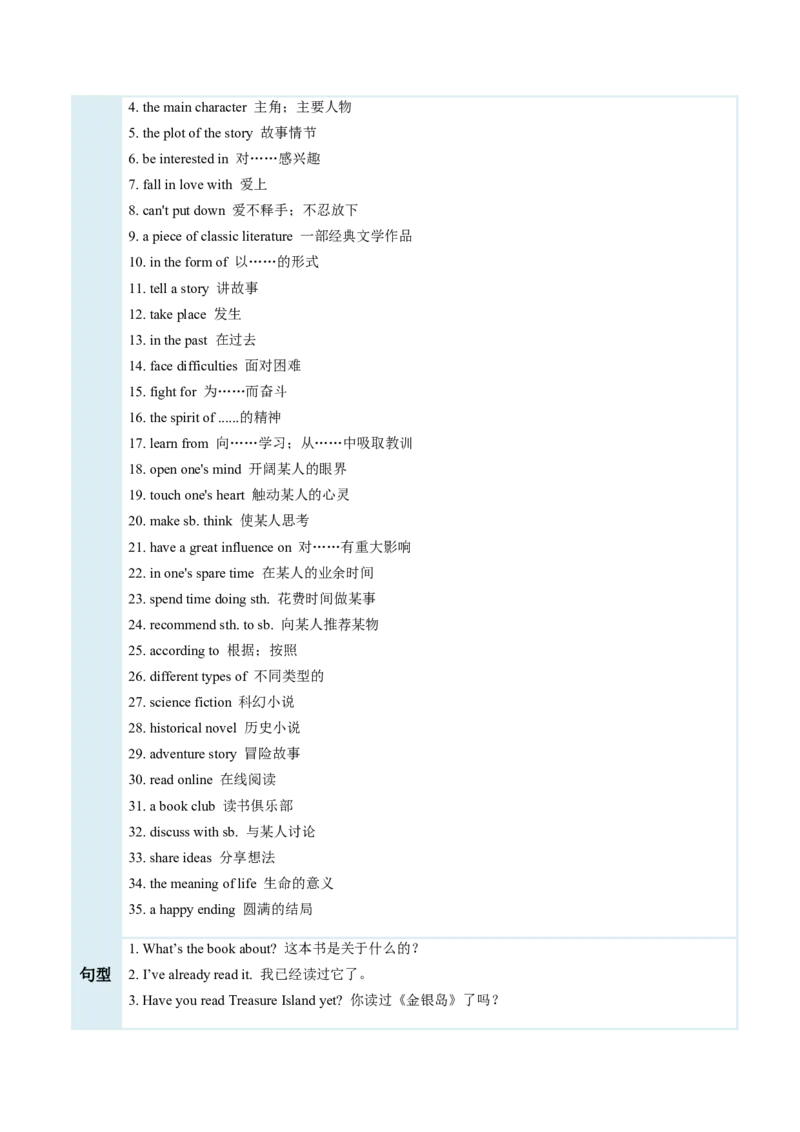
3. write about 撰写;描写4. the main character 主角;主要人物
5. the plot of the story 故事情节
6. be interested in 对……感兴趣
7. fall in love with 爱上
8. can't put down 爱不释手;不忍放下
9. a piece of classic literature 一部经典文学作品
10. in the form of 以……的形式
11. tell a story 讲故事
12. take place 发生
13. in the past 在过去
14. face difficulties 面对困难
15. fight for 为……而奋斗
16. the spirit of ......的精神
17. learn from 向……学习;从……中吸取教训
18. open one's mind 开阔某人的眼界
19. touch one's heart 触动某人的心灵
20. make sb. think 使某人思考
21. have a great influence on 对……有重大影响
22. in one's spare time 在某人的业余时间
23. spend time doing sth. 花费时间做某事
24. recommend sth. to sb. 向某人推荐某物
25. according to 根据;按照
26. different types of 不同类型的
27. science fiction 科幻小说
28. historical novel 历史小说
29. adventure story 冒险故事
30. read online 在线阅读
31. a book club 读书俱乐部
32. discuss with sb. 与某人讨论
33. share ideas 分享想法
34. the meaning of life 生命的意义
35. a happy ending 圆满的结局
1. What’s the book about? 这本书是关于什么的?
句型 2. I’ve already read it. 我已经读过它了。
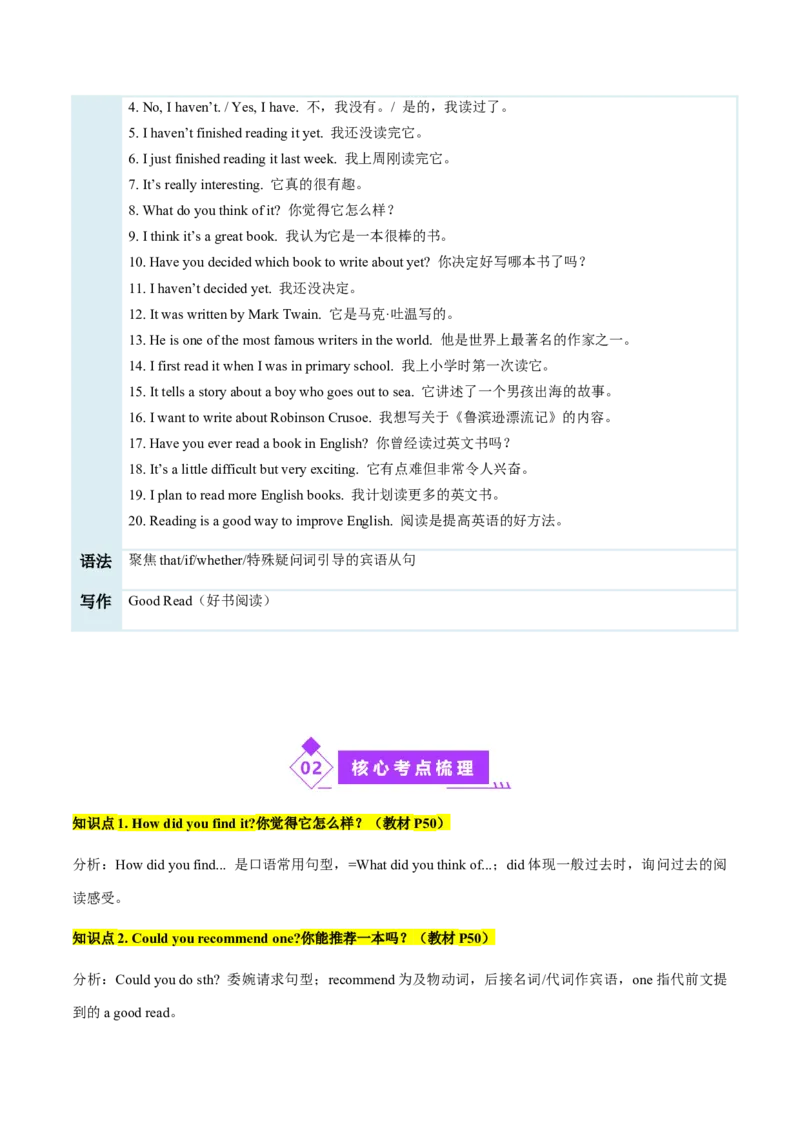
3. Have you read Treasure Island yet? 你读过《金银岛》了吗?4. No, I haven’t. / Yes, I have. 不,我没有。/ 是的,我读过了。
5. I haven’t finished reading it yet. 我还没读完它。
6. I just finished reading it last week. 我上周刚读完它。
7. It’s really interesting. 它真的很有趣。
8. What do you think of it? 你觉得它怎么样?
9. I think it’s a great book. 我认为它是一本很棒的书。
10. Have you decided which book to write about yet? 你决定好写哪本书了吗?
11. I haven’t decided yet. 我还没决定。
12. It was written by Mark Twain. 它是马克·吐温写的。
13. He is one of the most famous writers in the world. 他是世界上最著名的作家之一。
14. I first read it when I was in primary school. 我上小学时第一次读它。
15. It tells a story about a boy who goes out to sea. 它讲述了一个男孩出海的故事。
16. I want to write about Robinson Crusoe. 我想写关于《鲁滨逊漂流记》的内容。
17. Have you ever read a book in English? 你曾经读过英文书吗?
18. It’s a little difficult but very exciting. 它有点难但非常令人兴奋。
19. I plan to read more English books. 我计划读更多的英文书。
20. Reading is a good way to improve English. 阅读是提高英语的好方法。
语法 聚焦that/if/whether/特殊疑问词引导的宾语从句
写作 Good Read(好书阅读)
知识点1. How did you find it?你觉得它怎么样?(教材P50)
分析:How did you find... 是口语常用句型,=What did you think of...;did体现一般过去时,询问过去的阅
读感受。
知识点2. Could you recommend one?你能推荐一本吗?(教材P50)
分析:Could you do sth? 委婉请求句型;recommend为及物动词,后接名词/代词作宾语,one指代前文提
到的a good read。知识点3. It’s a fantasy classic about a girl who gets lost in a magical world.这是一本关于一个女孩在奇幻世
界迷路的奇幻经典著作。(教材P51)
分析:It’s + 名词 + about... 介绍书籍主题;who引导定语从句修饰a girl;classic此处为名词,意为“经典
作品”。
知识点4. I’ve always preferred the book to the movie.比起电影,我一直更喜欢这本书。(教材P51)
分析:prefer A to B 固定搭配,“比起B更喜欢A”;现在完成时have preferred强调从过去持续到现在的偏
好。
知识点 5.Many people consider Journey to the West to be one of the greatest Chinese classic novels of all
time.许多人认为《西游记》是有史以来最伟大的中国古典小说之一。(教材P54)
分析:consider + 宾语 + to be + 名词 表示“认为……是……”;one of the + 形容词最高级 + 可数名词
复数 表示“最……之一”。
知识点6. I have never realized how big our world really is!我从未意识到我们的世界竟然如此广阔!(教材
P54)
分析:现在完成时have realized强调过去动作对现在的影响;how引导宾语从句,作realized的宾语,表感
叹语气。
知识点7. ...and he discovers that the secret garden has become as alive and beautiful as it ever was!……他发
现秘密花园变得和以前一样生机勃勃、美丽动人!(教材P54)
分析:that引导宾语从句;as + 形容词原级 + as 同级比较结构,“和……一样……”;alive为表语形容
词,不可置于名词前。
知识点8.I’m inspired by how hard the fisherman fights, even though he loses the fish in the end.尽管渔夫最
终失去了那条鱼,但他奋力拼搏的精神让我深受鼓舞。(教材P54)
分析:be inspired by 被动语态,“被……鼓舞”;how引导宾语从句作by的宾语;even though引导让步
状语从句,表转折。
知识点9. Have you ever read Robinson Crusoe?你读过《鲁滨逊漂流记》吗?(教材P55)
分析:现在完成时一般疑问句,Have/Has + 主语 + 过去分词;ever用于疑问句,表“曾经”,符合单元阅读经历话题。
知识点10. It’s worth reading a second time.它值得再读一遍。(教材P55)
分析:be worth doing 固定搭配,“值得做某事”;doing用主动形式表被动含义;a second time表示“又
一次、再一次”。
单元语法
一、宾语从句的基本定义
在句子中作及物动词、介词或形容词宾语的从句,主句+连接词+宾语从句为基本结构,从句需用陈述语序
(主语+谓语,无论主句是陈述句还是疑问句)。
二、核心连接词及用法
1. that引导(陈述句作宾语)
规则:连接陈述句,无实际含义,只起连接作用,口语/非正式文体中可省略;主句为过去时态时,从句需
变相应过去时态(客观真理/事实除外)。
例句:① I think (that) this book is very interesting.(我认为这本书很有趣)② He said (that) he read a good
novel yesterday.(他说他昨天读了一本好小说)
2. if/whether引导(一般疑问句作宾语)
规则:连接一般疑问句,含义为**“是否”,不可省略;二者可互换,仅whether能与or not连用/置于介词
后**。
例句:① I don’t know if/whether she likes this book.(我不知道她是否喜欢这本书)② We are talking about
whether we will read the novel together.(我们在讨论是否要一起读这本小说)③ I wonder whether he will
come or not.(我想知道他是否会来)
3. 特殊疑问词引导(特殊疑问句作宾语)
规则:用what/who/where/when/why/how等连接,保留疑问词含义,不可省略,从句依旧用陈述语序。
例句:① She asked me where I found the good read.(她问我在哪里找到的这本好书)② Do you know who
wrote this famous novel?(你知道这本著名小说是谁写的吗)三、宾语从句的时态呼应(核心考点)
1. 主句为一般现在时/一般将来时:从句可根据实际情况用任意时态(现在、过去、将来)。
例句:I know he has read this book many times.(我知道他这本书读了很多遍)
2. 主句为一般过去时:从句需变相应的过去时态(过去式/过去进行时/过去完成时/过去将来时)。
例句:He told me he would read the novel the next day.(他告诉我他第二天会读这本小说)
3. 从句为客观真理/客观事实/自然规律:无论主句时态如何,从句始终用一般现在时。
例句:The teacher said the earth goes around the sun.(老师说地球绕着太阳转)
四、宾语从句的语序易错点(必避坑)
所有宾语从句,一律用陈述语序,需将疑问句的倒装语序改为“主语+谓语”,尤其注意特殊疑问词引导
的情况。
错误:I don’t know where is the book.
正确:I don’t know where the book is.
错误:She asked when did he finish reading.
正确:She asked when he finished reading.
五、宾语从句的否定转移
当主句主语为第一人称(I/we),谓语为think/believe/suppose/guess等词时,否定词需从从句转移到主句,
从句仍用肯定形式。
例句:I don’t think this book is boring.(我认为这本书不无聊)≠ I think this book is not boring.
六、单元高频考点拓展
本单元结合“阅读”主题,宾语从句常与say/tell/think/wonder/know/ask等动词连用,同时考查“疑问词
+不定式”对宾语从句的替换(简化句式)。
宾语从句:I don’t know what I should read next.
疑问词+不定式:I don’t know what to read next.(我不知道接下来该读什么)单元写作
Good Read(好书阅读)” 主题,结合八年级写作核心要求,下面优化梳理4条差异化写作思路,涵
盖推荐、感悟、应用、思辨四类文体,每条思路均强化“素材具象化”“句型可操作性”,适配课堂写
作、单元检测及备考场景。
思路一:经典好书推荐(说明+抒情融合型)
主题定位
精准推荐一本优质书籍,兼顾“书籍信息清晰传递”与“个人情感真诚流露”,让推荐既有说服力又具感
染力。
结构框架
1. 开头(直击核心):用强调句型/比较级引出推荐书籍,点明作者、体裁,用1句话概括书籍核心价值。
- 例:As far as I’m concerned, Robinson Crusoe by Daniel Defoe is one of the most meaningful books I’ve ever
read. It’s an adventure novel that teaches readers the spirit of perseverance and self-reliance.
2. 中间(分层解析):先极简梳理情节(30字内,不剧透关键结局),再从“主题思想”“人物魅力”
“语言特色”中选2个核心亮点展开。
情节梳理:The book tells the story of Robinson, who survives alone on a desert island for 28 years and finally
returns to civilization.
亮点1(人物魅力):Robinson is a brave and intelligent man. When facing hunger, wild animals and loneliness,
he never gives up. He builds houses, grows crops and tames animals by himself—his courage inspires me a lot.
亮点2(现实意义):The book doesn’t just talk about adventure; it also tells us that “difficulties are the best
teachers”. Whenever I meet problems in study or life, I will think of Robinson’s spirit and keep moving forward.
3. 结尾(发出邀约):用委婉句式呼吁阅读,强调书籍的普适价值。
- 例:No matter who you are, you will gain something valuable from this book. I sincerely suggest you read it—
you will be shocked by Robinson’s perseverance and learn to face challenges bravely.
思路二:阅读改变成长(叙事+议论型)
主题定位以“一次关键阅读经历”为线索,讲述书籍如何解决自己的实际问题(如自卑、浮躁、缺乏目标),体现
“阅读即成长”的核心。
结构框架
1. 开头(设置背景):用过去时交代自己曾面临的困境,引出“书籍成为转折点”的契机。
例:A year ago, I was a very shy girl who was afraid to speak in public. Every time the teacher asked me to answer
questions, my face would turn red and I couldn’t say a word. Until my deskmate lent me The Diary of a Young Girl
by Anne Frank.
2. 中间(细节刻画):先描述书籍中触动自己的具体片段/句子,再详细写书籍如何改变自己的行为与心
态。
触动片段:Anne Frank was in hiding during World War II, but she never lost hope for life. She wrote in her diary:
“In spite of everything, I still believe that people are really good at heart.” Her optimism and courage deeply
touched me.
改变过程:I started to reflect on myself—compared with Anne’s difficulties, my shyness was nothing. I tried to
speak in small groups first, then in class. Whenever I felt nervous, I would remember Anne’s words. Gradually, I
became more confident and even won a prize in the school speech contest.
3. 结尾(升华感悟):总结阅读对个人成长的意义,表达“以书为友”的决心。
例:That book didn’t just give me courage; it changed my life. I realized that books are like wise friends who can
guide us when we are lost. From now on, I will keep reading and let good books accompany me to become a more
confident and brave person.
思路三:阅读方法分享(说明+实用型)
主题定位
结合单元“阅读”核心,分享自己的高效阅读方法,兼顾科学性与可操作性,帮助他人解决“读得慢”
“读不懂”“记不住”等问题。
结构框架
1. 开头(点出痛点):引出很多同学在阅读中遇到的困难,说明分享阅读方法的目的。- 例:Many students think reading is boring or difficult—they either can’t finish a book quickly, or forget what
they’ve read soon. As an avid reader, I’d like to share three practical reading methods that have helped me a lot.
2. 中间(分点详解):每个方法配“具体操作+好处”,用逻辑连接词串联,避免抽象。
方法1(选书技巧):Choose books that match your level and interests. If you’re a beginner, don’t read difficult
classics at first. You can start with storybooks or popular science books. This way, you won’t feel frustrated and
will keep reading.
方法2(精读与泛读结合):Read different books in different ways. For valuable books, read carefully and take
notes of important sentences or your thoughts. For relaxing books, read quickly to get the main idea. This can
improve your reading efficiency.
方法3(读后复盘):After reading a book, write a short summary or share your feelings with friends. This helps
you remember the content better and deepen your understanding of the book.
3. 结尾(鼓励实践):强调“阅读无捷径,坚持是关键”,鼓励他人尝试方法并享受阅读。
例:Reading is a lifelong journey, and good methods can make the journey more enjoyable. I hope these tips can
help you. As long as you keep reading and practicing, you will become a better reader and gain more knowledge.
思路四:电子阅读vs纸质阅读(思辨+议论型)
主题定位
围绕“两种阅读方式的争议”展开议论,客观分析各自优缺点,表达自己的观点,培养批判性思维。
结构框架
1. 开头(引出争议):点明当下电子阅读与纸质阅读的普及,提出核心议题“哪种阅读方式更好”。
例:With the development of technology, more and more people choose to read e-books on phones or tablets.
However, traditional paper books still have many fans. So, which one is better—e-reading or paper reading?
2. 中间(辩证分析):先分别阐述两种阅读方式的优点,再客观指出不足,避免片面。
- 电子阅读的优势与不足:E-reading is convenient and cheap. You can carry hundreds of e-books in your phone
and read anywhere. But it’s bad for your eyes if you read for a long time, and it’s easy to be distracted by messages
or games.- 纸质阅读的优势与不足:Paper reading is more comfortable—you can feel the pages and smell the ink, which
makes reading more immersive. It’s also easier to take notes and review. However, paper books are heavy and take
up space, and they are more expensive than e-books.
3. 结尾(明确观点):提出“结合使用”的理性观点,强调“阅读内容比形式更重要”。
例:In my opinion, there’s no absolute winner. We can use both ways: read e-books for convenience when we’re
outside, and read paper books when we’re at home to enjoy the reading experience. After all, the most important
thing is not how we read, but that we keep reading good books and enrich our minds.
巩固练习
一、单项选择
1.I have read Robinson Crusoe ________, but I haven’t read Treasure Island ________.
A.already; already B.yet; yet C.yet; already D.already; yet
2.—I don’t know where to go this summer vacation.
— Why not ________ visiting Beijing? There are many places of interest.
A.suggest B.wonder C.consider D.advise
3.— Alan, I’d like to ________ a friend to you this afternoon. She is also interested in history.
— That’s great.
A.remind B.record C.introduce D.meet
4.—I feel tired all the time.
—That could be an ________ of not getting enough sleep.
A.excuse B.effect C.idea D.order
5.—What do you think of the movie My People, My Country?
—It is exciting and it ________ me ________ the life in the past.
A.reminds; of B.lets; down C.wakes; up D.calls; up6.We have been friends ________ we were children.
A.because B.unless C.since D.though
7.Since last year, our school ________ free breakfasts to students in need.
A.offered B.has offered C.was offering D.have offered
8.— John, you ____ the computer game for two hours. It’s bad for your eyes. Stop, please!
—OK, Mum.
A.played B.have played
C.were playing D.play
9.—For your coming vacation, why not ________ to Yunnan?
—Good idea.
A.to consider going B.consider going
C.to consider to go D.consider go
10.—Our team is very sad about the ________.
—It’s OK. It’s not the end of the world. We’ll try harder next time.
A.defeat B.adventure C.society D.victory
二、根据要求完成单词拼写
11.To learn English well, you should first focus on b (基本的) vocabulary and grammar rules.
12.As we all know, pollution and illness are our great e (敌人). Let’s fight them.
13.Many people like to order food online, t (因此) they don’t need to cook.
14.There is no d (疑惑) that recycling helps save natural resources.
15.Li Dan has a deep love for l (文学的) works, often losing herself in the poems and classic novels.
16.Lao She’s Teahouse describes the changes in Chinese s (社会) over fifty years.
17.Could you please give us a general (introduce) about Tengwang Pavilion?18.On my way home, I saw an old man (walk) his dog.
19.— he a house yet?
—Yes, he has. He it last year. (buy)
20.They (already, move) to a new city. They (pack) everything and
(leave) last month.
三、语法选择
The book Tom Sawyer by Mark Twain is great. I 21 it three times so far. Now let me share a
small part of it.
Every boy wants to find 22 and Tom is no exception (例外). One day, Tom told Huck about his
idea.
“ 23 can we look for treasure?” asked Huck.
“It’s hidden on an island, under dead trees.”
One afternoon, Tom and Huck went to 24 island by ship. There was sand everywhere. Soon they
saw a house. They went into it quietly. Then they threw 25 tools in a corner and walked upstairs, but
26 nothing there. They were just about to leave when Tom stopped. Through the holes in the wooden floor,
they saw two men downstairs.
Tom and Huck were afraid when they heard one man 27 .
“It’s time to move. What will we do with the $650 from the robbery (抢劫)?” He said.
“Let’s keep $30 each. Then we can make a mark 28 leave the bag here.”
The dirty man moved towards the fireplace and moved a stone. Then he lifted out a bag full 29
money and took out some coins. The two boys 30 all their fears when they saw the real treasure
downstairs.
21.A.was reading B.will read C.have read
22.A.treasure B.treasures C.treasure’s
23.A.Where B.Why C.When24.A.a B.an C.the
25.A.them B.their C.theirs
26.A.there are B.it is C.there was
27.A.speak B.to speak C.spoken
28.A.but B.so C.and
29.A.with B.of C.for
30.A.have forgotten B.will forget C.forgot
四、阅读理解
A
The bookstore Fun Readers is going to celebrate its 5th anniversary (周年纪念日), and some of the books are
on sale. For more information, please visit its website www.funreaders.com. You can get 20% off if you buy at least
two books online.
Title: MiddlemarchWriter: George Eliot (England)
Price: ¥25
The book came out in 1872. It’s a novel with great characters and great ideas. It’s the greatest social and
psychological (心理学的) novel ever written in English.
Title: The Adventures of Tom SawyerWriter: Mark Twain (America)
Price: ¥36
The book came out in the USA in 1876. The story happened in a normal town along the Mississippi River. It’sabout a smart and brave boy going on adventures and discovering the truth.
Title: Charlotte’s Web Writer: E.B.White (America)
Price: ¥30
The book is a novel for children. In 1952, it came out. It’s really an amazing book. It tells the story of a pig
named Wilbur and his friendship with a spider named Charlotte.
Title: The Old Man and the SeaWriter: Hemingway (America)
Price: ¥26
It’s one of Hemingway’s most famous books. It came out in 1952. It is a story of the fight between an old man
and a big fish in the twentieth century (世纪) based on the truth.
31.How much should you pay if you buy Middlemarch and Charlotte’s Web online?
A.¥44. B.¥55. C.¥61. D.¥60.
32.Tina is an 8-year-old reader. Which book may she like most?
A.Middlemarch.
B.Charlotte’s Web.
C.The Old Man and the Sea.
D.The Adventures of Tom Sawyer.
33.What is the book The Adventures of Tom Sawyer about?
A.The friendship between two animals.
B.The fight between an old man and a big fish.C.It’s about a smart and brave boy who goes on adventures and discovers the truth.
D.It’s about society and psychology.
34.What can we learn from the information above?
A.The Adventures of Tom Sawyer is the oldest one among the four books.
B.The writer of The Old Man and the Sea was from America.
C.Middlemarch costs most among the four books.
D.The Adventures of Tom Sawyer is about the outdoor adventures of some kids.
35.Why did the writer write the passage?
A.To show us she has read many books.
B.To encourage more customers to buy books.
C.To introduce some books for English learning.
D.To help us get more information on the website.
B
Mark Twain: the father of American literature
On Nov. 30, 1835, a boy named Samuel Clemens was born in Florida, the US. Many years later, the world
would know this boy as Mark Twain.
Mark Twain is one of the greatest US writers of all time. Some people even call him the father of American
literature.
Like many US writers of his day, Twain had little school education. As a teenager, he worked as a printer.
Later, he worked as a riverboat pilot, a miner and a freelancer for newspapers. These experiences gave him
wonderful writing material.
Mark Twain is considered the greatest humorist of his age. His jokes go to the roots of human nature. In 1873,
Twain released a book called The Gilded Age. The book made fun of the very wealthy people of the time.
Besides humor, Twain developed a unique writing style that was very American. The Adventures ofHuckleberry Finn describes the adventures of a boy, Huck Finn, and a black slave, Jim. Twain used dialects in the
novel, making the characters’ speech sound like real Americans’: using local dialects, newly invented words, and
regional accents.
In 1910, Twain died of heart disease. But his brilliance keeps on shining to this day.
36.Mark Twain was born in ________.
A.1830 B.1873 C.the UK D.the US
37.Mark Twain’s ________ gave him wonderful writing material.
A.educational experiences
B.working experiences
C.family
D.teachers
38.Mark Twain released the book The Gilded Age in ________.
A.1835 B.1873 C.1885 D.1935
39.Mark Twain used dialects in his novel to ________.
A.spread English
B.enable readers to understand
C.make the characters’ speech sound like real Americans’
D.make the characters’ speech sound like fun
40.Mark Twain died of ________.
A.heart disease B.an accident
C.lung disease D.the virus
五、短文填空
Two weeks ago, I caught the flu. I 41 (have) a very high temperature, and my whole body 42
(hurt). Ever since I 43 (get) ill, I 44 (not have) enough energy to play football.Actually, I 45 (just, see) a doctor to ask if it’s normal to feel weak for so long. He said, “You 46
(feel) better soon.” I’m lucky, but for the old and the weak, the flu can be very serious. Doctors 47 (try) for
years to find a cure (疗法) for the flu, but they 48 (not find) one yet. Luckily, researchers 49 (develop) a
vaccine (疫苗). It gives effective (有效的) protection against the illness. According to my doctor, he 50
(already, give) flu shots (注射) to most of his elderly patients.
六、书面表达
51.每年的4月23日是“世界读书日”。学校将举办“Growing up with books”的主题演讲比赛,呼
吁同学们重拾阅读,丰盈心灵,收获乐趣。请你根据提示用英文写一篇演讲稿。
写作要点:
1. Present the benefits of reading.
2. Present reading situations (现状).
3. Your advice on what to read and how to read.
写作要求:
1. 短文必须包含所有写作要点,可适当发挥,要求语句通顺、意思连贯;
2. 短文不少于80词,作文题目已给出,不计入总词数。
Growing up with books
____________________________________________________________________________________________
____________________________________________________________________________________________
____________________________________________________________________________________________
____________________________________________________________________________________________
____________________________________________________________________________________________
____________________________________________________________________________________________
____________________________________________________________________________________________
____________________________________________________________________________________________
____________________________________________________________________________________________
_____________________________________________________________________________________