Unit 3 Growing Up(复习讲义)
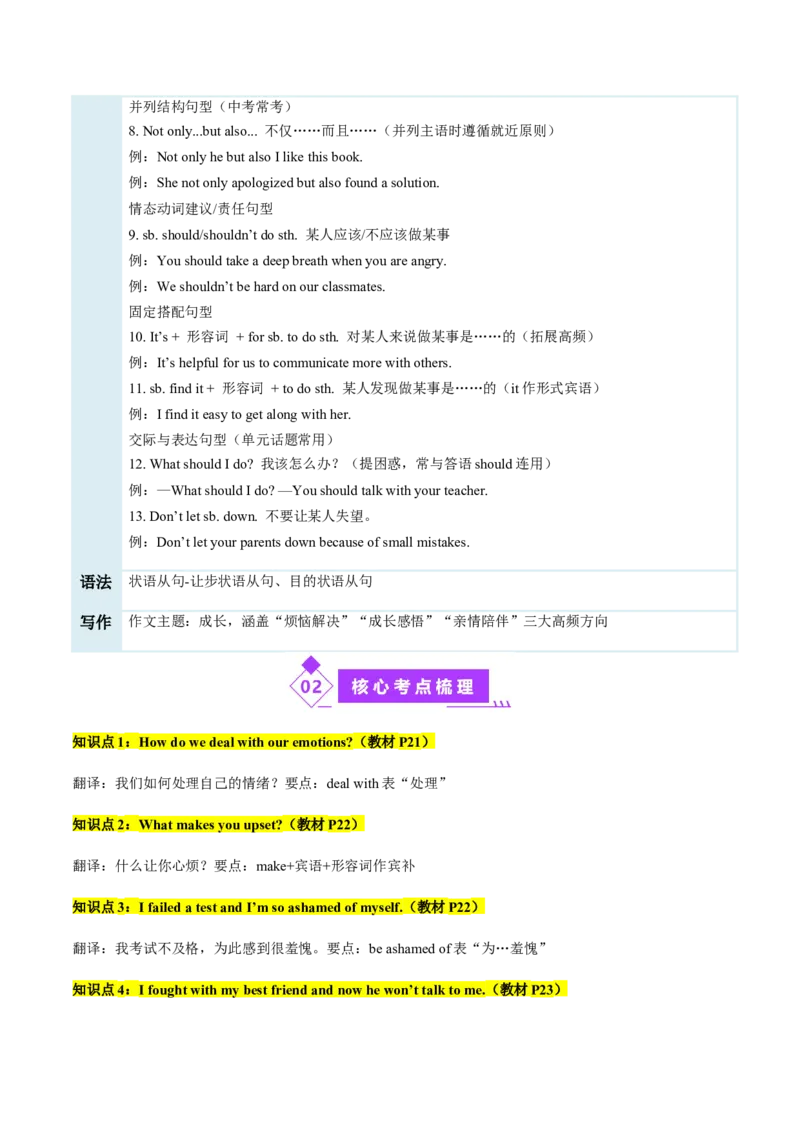
1. emotion /ɪˈməʊʃn/ n. 情感;情绪(常用复数:emotions)
2. upset /ʌpˈset/ adj. 难过的;沮丧的 v. (upset, upset) 使烦恼
3. lonely /ˈləʊnli/ adj. 孤独的;寂寞的(情感上,区别alone)
4. shocked /ʃɒkt/ adj. 震惊的 → shock v. 使震惊 n. 震惊
5. alone /əˈləʊn/ adj./adv. 独自的/地(状态上,仅作表语/状语)
6. control /kənˈtrəʊl/ v.&n. 控制;管理 → (controlled, controlled);搭配:control one’s temper
7. anger /ˈæŋɡə(r)/ n. 怒火;愤怒 → angry adj. 生气的 → angrily adv. 生气地
8. advise /ədˈvaɪz/ v. 建议;劝告 → advice n. 建议(不可数,a piece of advice)
9. forgive /fəˈɡɪv/ v. (forgave, forgiven) 原谅;宽恕 → 搭配:forgive sb. for sth.
10. pressure /ˈpreʃə(r)/ n. 压力;压迫感(不可数,搭配:under pressure)
单词 11. purpose /ˈpɜːpəs/ n. 目的;意图 → 搭配:on purpose 故意
12. decision /dɪˈsɪʒn/ n. 决定;抉择 → decide v. 决定;搭配:make a decision
13. solution /səˈluːʃn/ n. 解决办法;解答 → 搭配:a solution to the problem
14. apologize /əˈpɒlədʒaɪz/ v. 道歉;认错 → 搭配:apologize to sb. for sth.
15. award /əˈwɔːd/ n. 奖;奖品 v. 授予;奖励
16. regret /rɪˈɡret/ v.&n. 后悔;遗憾 → (regretted, regretted);搭配:regret doing sth.
17. calm /kɑːm/ adj. 平静的;冷静的 v. 使平静;使冷静
18. communicate /kəˈmjuːnɪkeɪt/ v. 交流;沟通 → communication n. 交流
19. understand /ˌʌndəˈstænd/ v. 理解;明白 → (understood, understood) → understanding adj. 善解人
意的
20. support /səˈpɔːt/ v.&n. 支持;拥护
1. deal with 处理;对付
2. clear the air 尽释前嫌;消除误会
3. put oneself in sb’s shoes 设身处地;换位思考
短语 4. on purpose 故意;有意地
5. be hard on sb 对……苛刻;对……严厉
6. let sb down 使失望;辜负
7. take a deep breath 深呼吸8. look on the bright side 抱乐观态度;往好处想
9. plenty of 大量;充足(后接可数/不可数名词)
10. get across 解释清楚;把……传达给
11. pull together 齐心协力;团结一心
12. in future 今后;从今以后
13. calm down 冷静下来
14. talk over 仔细讨论;商量
15. work out 解决;算出
16. be afraid of 害怕……
17. communicate with sb 与某人交流
18. make a decision 做决定
19. apologize to sb 向某人道歉
20. face the problem 面对问题
提建议句型(单元高频交际)
1. Why don’t you do sth.? 你为什么不做某事呢?
例:Why don’t you talk to your parents about your pressure?
2. Why not do sth.? 何不做某事?(上句同义句,中考常考转换)
例:Why not say sorry to your friend first?
让步状语从句(核心语法)
3. Although/Though + 从句, 主句. 尽管……,还是……(不可与but连用)
例:Although we had a fight, we are still good friends.
例:Though it’s hard, he never gives up.
时间状语从句
4. Not...until... 直到……才……
句型
例:You won’t understand it until you put yourself in his shoes.
5. 主句 + until + 从句. 直到……为止(主句用延续性动词)
例:She waited for me until I finished my homework.
目的状语从句
6. 主句 + so that + 从句. 以便;为了(从句常接can/could/will等情态动词)
例:He studies hard so that he can get good grades.
例:I write it down so that I won’t forget it.
形式主语句型
7. It’s + 形容词 + to do sth. 做某事是……的(it为形式主语,真正主语是to do sth.)
例:It’s important to learn to control our emotions.
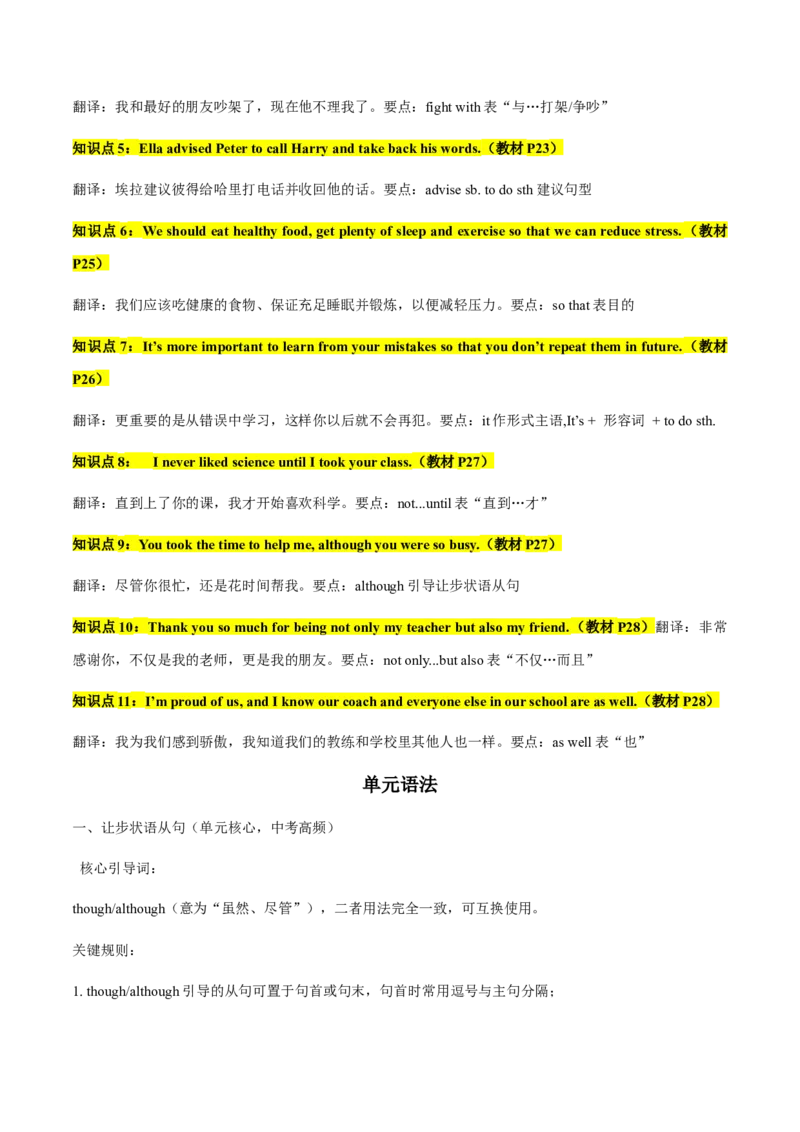
例:It’s necessary to clear the air with others.并列结构句型(中考常考)
8. Not only...but also... 不仅……而且……(并列主语时遵循就近原则)
例:Not only he but also I like this book.
例:She not only apologized but also found a solution.
情态动词建议/责任句型
9. sb. should/shouldn’t do sth. 某人应该/不应该做某事
例:You should take a deep breath when you are angry.
例:We shouldn’t be hard on our classmates.
固定搭配句型
10. It’s + 形容词 + for sb. to do sth. 对某人来说做某事是……的(拓展高频)
例:It’s helpful for us to communicate more with others.
11. sb. find it + 形容词 + to do sth. 某人发现做某事是……的(it作形式宾语)
例:I find it easy to get along with her.
交际与表达句型(单元话题常用)
12. What should I do? 我该怎么办?(提困惑,常与答语should连用)
例:—What should I do? —You should talk with your teacher.
13. Don’t let sb. down. 不要让某人失望。
例:Don’t let your parents down because of small mistakes.
语法 状语从句-让步状语从句、目的状语从句
写作 作文主题:成长,涵盖“烦恼解决”“成长感悟”“亲情陪伴”三大高频方向
知识点1:How do we deal with our emotions?(教材P21)
翻译:我们如何处理自己的情绪?要点:deal with表“处理”
知识点2:What makes you upset?(教材P22)
翻译:什么让你心烦?要点:make+宾语+形容词作宾补
知识点3:I failed a test and I’m so ashamed of myself.(教材P22)
翻译:我考试不及格,为此感到很羞愧。要点:be ashamed of表“为…羞愧”
知识点4:I fought with my best friend and now he won’t talk to me.(教材P23)翻译:我和最好的朋友吵架了,现在他不理我了。要点:fight with表“与…打架/争吵”
知识点5:Ella advised Peter to call Harry and take back his words.(教材P23)
翻译:埃拉建议彼得给哈里打电话并收回他的话。要点:advise sb. to do sth建议句型
知识点6:We should eat healthy food, get plenty of sleep and exercise so that we can reduce stress.(教材
P25)
翻译:我们应该吃健康的食物、保证充足睡眠并锻炼,以便减轻压力。要点:so that表目的
知识点7:It’s more important to learn from your mistakes so that you don’t repeat them in future.(教材
P26)
翻译:更重要的是从错误中学习,这样你以后就不会再犯。要点:it作形式主语,It’s + 形容词 + to do sth.
知识点8: I never liked science until I took your class.(教材P27)
翻译:直到上了你的课,我才开始喜欢科学。要点:not...until表“直到…才”
知识点9:You took the time to help me, although you were so busy.(教材P27)
翻译:尽管你很忙,还是花时间帮我。要点:although引导让步状语从句
知识点10:Thank you so much for being not only my teacher but also my friend.(教材P28)翻译:非常
感谢你,不仅是我的老师,更是我的朋友。要点:not only...but also表“不仅…而且”
知识点11:I’m proud of us, and I know our coach and everyone else in our school are as well.(教材P28)
翻译:我为我们感到骄傲,我知道我们的教练和学校里其他人也一样。要点:as well表“也”
单元语法
一、让步状语从句(单元核心,中考高频)
核心引导词:
though/although(意为“虽然、尽管”),二者用法完全一致,可互换使用。
关键规则:
1. though/although引导的从句可置于句首或句末,句首时常用逗号与主句分隔;2. 绝对不能与but连用(这是最易失分点),但可与yet/still连用表转折;
3. 从句时态与主句保持一致,若表将来,从句用一般现在时表将来。
典型例句:
- Although she is tired, she still finishes her homework.
- He went to school though he had a bad cold.
- Though it will rain tomorrow, we will go for a picnic yet.
二、until引导的时间状语从句
两种核心用法:
1. 否定式:not...until...(意为“直到……才……”),表动作到某个时间点才开始发生;
主句常用一般过去时/一般将来时,从句用一般过去时/一般现在时(表将来);
例句:I didn’t go home until I finished all the work. / She won’t leave until you come back.
2. 肯定式(意为“直到……为止”),表动作持续到某个时间点;
主句谓语必须是延续性动词(如wait, stay, study, work),不可用终止性动词;
例句:We waited until the bus came. / He studied until 10 o’clock last night.
三、so that引导的目的状语从句
核心含义与结构:
表“以便、为了”,连接主句和表动作目的的从句,从句常位于主句后,无需逗号分隔;
从句中通常接can/could/will/would/may/might等情态动词,表“能够、可以、将要”。
典型例句:
- He studies hard so that he can get good grades in the exam.
- She takes notes carefully so that she won’t forget the key points.
- We get up early so that we may catch the early bus.
四、提建议类交际句型(单元基础,高频运用)核心句型及转换(中考常考同义替换)
1. Why don’t you + 动词原形?(委婉提建议,最常用)→ 同义句 Why not + 动词原形?(更简洁,必考
转换);
例句:Why don’t you talk to your parents? = Why not talk to your parents?
2. You should/shouldn’t + 动词原形(表“应该/不应该”,直接提建议);
例句:You should apologize to your friend. / You shouldn’t be hard on yourself.
回应方式
常用Good idea./Sounds great./That’s a good suggestion.等表示赞同。
五、It’s + 形容词 + to do sth. 形式主语句型
核心结构:
it为形式主语,无实际含义,代替后面的to do sth.(真正主语),避免句子头重脚轻;
可转换为To do sth. + is + 形容词,但日常使用中更常用形式主语句型。
常用形容词:
important, necessary, helpful, difficult, easy, useful等。
典型例句:
- It’s important to learn to control our emotions when growing up.
- It’s necessary to say sorry when we make mistakes.
- It’s helpful to talk with others about our worries.
六、Not only...but also... 并列结构(中考重点)
核心含义与用法:
表“不仅……而且……”,可并列句中的主语、谓语、宾语、表语、状语等成分;
并列不同成分时,前后结构保持一致(如并列动词,均用原形/过去式/ing形式)。
关键规则:就近原则当并列主语时,谓语动词的人称和数需与but also后面的主语保持一致。
典型例句:
- 并列主语:Not only he but also I like English.(谓语用like,随I变化)
- 并列谓语:He not only apologized but also bought a gift for me.
- 并列宾语:She likes not only music but also sports.
七、情态动词should的基础用法(单元高频复用)
核心含义:
表建议、责任、义务,语气委婉,否定式为shouldn’t(should not)。
关键规则:
后接动词原形,无人称和数的变化,适用于所有人称。
拓展用法
可用于表“推测”,意为“应该、想必”,表有一定依据的判断;
例句:He should be at home now.(他现在应该在家。)
单元写作
单元作文整体围绕成长中的烦恼与解决方法展开,核心聚焦成长过程中遇到的情绪、人际、压力类问
题,以及如何用沟通、换位思考、情绪管理等
基础必练(教材配套写作任务,课堂重点练)
1. 书信类:给遇到成长压力的朋友写一封信,给出应对压力的具体建议(教材核心写作任务,贴合
单元“解决成长烦恼”话题)
2. 叙事类:讲述一次你遇到的成长烦恼(如和朋友吵架、学习有压力、和家人产生矛盾),以及你
解决这个烦恼的过程和感受
3. 观点表达类:谈谈在成长过程中,我们应该如何学会控制自己的情绪(结合单元词汇、句型,简
单阐述方法)
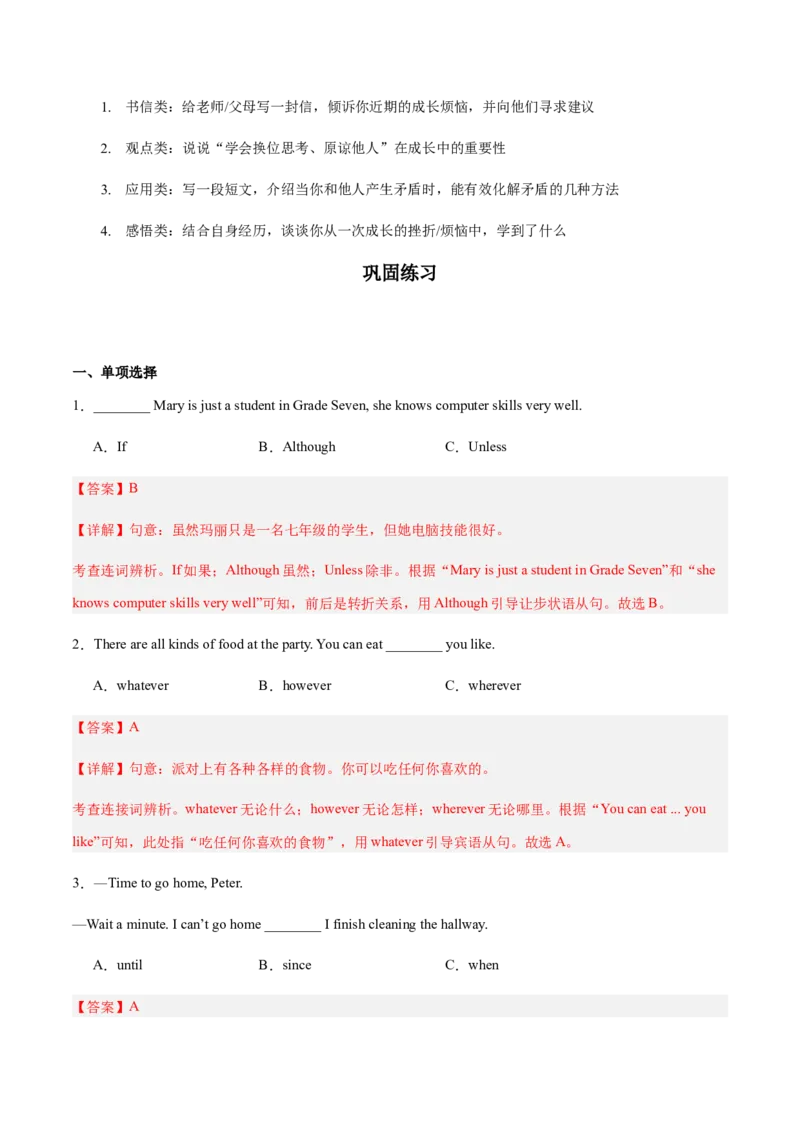
拓展提升(中考衔接,单元话题延伸)1. 书信类:给老师/父母写一封信,倾诉你近期的成长烦恼,并向他们寻求建议
2. 观点类:说说“学会换位思考、原谅他人”在成长中的重要性
3. 应用类:写一段短文,介绍当你和他人产生矛盾时,能有效化解矛盾的几种方法
4. 感悟类:结合自身经历,谈谈你从一次成长的挫折/烦恼中,学到了什么
巩固练习
一、单项选择
1.________ Mary is just a student in Grade Seven, she knows computer skills very well.
A.If B.Although C.Unless
【答案】B
【详解】句意:虽然玛丽只是一名七年级的学生,但她电脑技能很好。
考查连词辨析。If如果;Although虽然;Unless除非。根据“Mary is just a student in Grade Seven”和“she
knows computer skills very well”可知,前后是转折关系,用Although引导让步状语从句。故选B。
2.There are all kinds of food at the party. You can eat ________ you like.
A.whatever B.however C.wherever
【答案】A
【详解】句意:派对上有各种各样的食物。你可以吃任何你喜欢的。
考查连接词辨析。whatever无论什么;however无论怎样;wherever无论哪里。根据“You can eat ... you
like”可知,此处指“吃任何你喜欢的食物”,用whatever引导宾语从句。故选A。
3.—Time to go home, Peter.
—Wait a minute. I can’t go home ________ I finish cleaning the hallway.
A.until B.since C.when
【答案】A【详解】句意:——该回家了,彼得。——等一下。我要打扫完走廊才能回家。
考查连词辨析。until直到……为止;since自从;when当……时候。根据“can’t go home ... I finish
cleaning”可知,是“直到打扫完才回家”,用until引导时间状语从句,符合“not ... until ...”结构。故选
A。
4.Walk closer ________ we can see the pictures clearly.
A.in order to B.so that C.such that
【答案】B
【详解】句意:走近一点,这样我们就能清楚地看到图片了。
考查连词短语辨析。in order to为了(后接动词原形);so that以便(后接句子);such that如此……以至
于(后接句子,需用“such + 名词 + 从句”结构)。根据“we can see the pictures clearly”是完整句子,且
表示目的,用“so that”引导目的状语从句。故选B。
5.—When shall we start?
—Let’s wait ________ the rain stops.
A.if B.as C.until
【答案】C
【详解】句意:——我们什么时候开始?——让我们等到雨停。
考查连词辨析。if如果;as当……的时候;until直到……为止。根据“wait”可知,是“等到雨停”,用
until引导时间状语从句。故选C。
6.They didn’t finish the hard work ________ three days before the great festival.
A.although B.until C.unless
【答案】B
【详解】句意:他们直到盛大的节日之前三天才完成这项艰苦的工作。
考查连词辨析。although虽然(表示让步);until直到(表示时间,常与not连用);unless除非(表示条
件)。根据句子结构“They didn’t finish ...”,这是一个否定句,常与until搭配构成“not ... until”结构,意为“直到……才”,强调动作在盛大的节日之前三天才完成。故选B。
7.We are sure to win the football match as long as we ________.
A.in low spirits B.deal with C.pull together
【答案】C
【详解】句意:只要我们齐心协力,我们肯定能赢得足球比赛。
考查动词短语辨析。in low spirits情绪低落;deal with处理;pull together齐心协力。根据“We are sure to
win the football match as long as we ...”可知,此处指团队合作才能带来胜利。故选C。
8.You ________ study harder so that you can get better grades.
A.can B.should C.could
【答案】B
【详解】句意:你应该更加努力学习,以便能取得更好的成绩。
考查情态动词辨析。can能够;should应该;could可以(can的过去式)。根据“so that you can get better
grades”可知,此处表示提出建议或劝告,意为“应该”。故选B。
9.________ they argued, they are still good friends with each other.
A.Though B.While C.If
【答案】A
【详解】句意:尽管他们争吵了,他们仍然是彼此的好朋友。
考查连词辨析。Though尽管;While当……时;If如果。根据“they argued”和“they are still good friends
with each other”可知,前后句意存在转折关系,需用表示尽管的连词引导让步状语从句。故选A。
10.________ English has a history of about 1,500 years, the first English dictionary didn’t appear until the 18th
century.
A.Because B.Although C.Unless
【答案】B
【详解】句意:尽管英语有大约1500年的历史,但第一本英语词典直到18世纪才出现。考查连词辨析。Because因为;Although尽管;Unless除非。根据前半句“English has a history of about
1,500 years”与后半句“ the first English dictionary didn’t appear until the 18th century.”可知,此处形成转折让
步关系,需用表示“尽管”的连词。故选B。
二、单词拼写
11.Parents should try to avoid c (控制) their children and give them more freedom.
【答案】controlling/ontrolling
【详解】句意:父母应尽量避免控制孩子,多给他们一些自由。根据首字母和括号内提示词可推断这里表
示“控制”,动词control“控制”符合语境,根据“avoid”可知,avoid doing sth.“避免做某事”,此处应用
动名词,control的动名词形式为controlling。故填controlling。
12.Tony can see things more c (清楚地) now with this pair of glasses.
【答案】clearly/learly
【详解】句意:托尼戴上这副眼镜后,现在看东西清楚多了。根据首字母和括号内提示可推断,这里表示
“清楚地”,副词clearly“清楚地”,符合语境。故填clearly。
13.China is making great efforts to improve people’s living s (水平).
【答案】standards/tandards
【详解】句意:中国正在努力提高人民的生活水平。standard“水平,标准”,可数名词;living
standards“生活水平”,为常用短语,此处用复数形式。故填standards。
14.The girl s (合上) the book and put it back on the bookcase.
【答案】shut/hut
【详解】句意:女孩合上书,把它放回了书架。根据首字母和汉语提示可知,此处对应动词shut,句子描
述过去的动作,因此填shut的过去式shut。故填shut。
15.She feels a lot of p (压力) from schoolwork and exams.
【答案】pressure/ressure【详解】句意:她感到来自学业和考试的巨大压力。pressure“压力”,不可数名词。a lot of pressure“很大
的压力”。故填pressure。
16.It was my f (过错) that we missed the bus. I’m really sorry.
【答案】fault/ault
【详解】句意:没赶上公交车是我的错。我真的很抱歉。根据句意和首字母以及括号内提示词可推断这里
表示“过错”,fault“过错”,可数名词,根据“It was”可知,此处用单数形式。故填fault。
17.The teacher advised us (choose) a topic that truly reflects our personal growth.
【答案】to choose
【详解】句意:老师建议我们选择一个能真正体现个人成长的主题。advise sb. to do sth.“建议某人做某事”,
为固定搭配,此处需用动词不定式形式,故填to choose。
18.It’s meaningful for us (share) our growth experiences with younger students.
【答案】to share
【详解】句意:和低年级学生分享我们的成长经历是很有意义的。It’s+adj.+for sb.+to do sth.表示“对某人
来说做某事是……的”,需用动词不定式形式,故填to share。
19.When I (walk) in the park yesterday, I met my primary school teacher who helped me a lot.
【答案】was walking
【详解】句意:昨天当我在公园散步时,我遇见了曾给予我很大帮助的小学老师。根据“yesterday”以及主
句谓语动词“met”可知,此处描述的是过去某一动作发生时,另一个动作正在进行。when引导的时间状语
从句应用过去进行时,结构为“was/were doing”。主语I是第一人称单数,be动词用was,walk的现在分
词是walking。故填was walking。
20.He is worried about (lose) his job because the company is in trouble.
【答案】losing
【详解】句意:他担心失去工作,因为公司陷入困境。about 是介词,后接动词-ing形式,lose的动名词
losing。故填losing。三、完形填空
阅读短文,理解其大意,从A、B、C、D四个选项中选出可以填入空白处的最佳选项。
I found it hard to communicate with my mother. Relationship between us became difficult.
One day I ran away from home and stayed outside for a few hours. When I returned home at night, I saw all
the 21 , anger and disappointment on my mother’s face. We knew that we were in great need of talk. We
agreed to have breakfast together the next morning. Then we discussed where to go and decided to go to a
restaurant near the park.
On our way to the restaurant, I noticed there were two notebooks in her bag. I was surprised and asked her
why she took them. She explained to me that sometimes it was much 22 to write down our feelings than
talking about them directly. We should write them down.
Our first topic was “Why am I so angry?” I wrote a half page, but my mum 23 nearly three pages.
I saw the tears run down her face while she was writing. I 24 realized anyone could hide so much anger.
After we 25 writing, we exchanged (交换) our notebooks. As soon as I started reading my mother’s
words, I began to cry and so did she. Then, we discussed our 26 . Finally, it felt like all the anger inside
me went away from my body. Our talk helped me 27 so many things I never thought of before, not only
about my mother but also about other people.
My mother and I continue using our notebooks as a way of 28 . We know that no matter how we
feel about each other, our notebooks are a 29 place to express our feelings. And we believe that these
notebooks will always 30 us to respect and love each other. We agree that both of us will write “I love
you” at the end of each letter in the future.
21.A.excitement B.sadness C.fear D.surprise
22.A.easier B.happier C.slower D.worse
23.A.looked up B.showed up C.filled up D.called up
24.A.sometimes B.always C.often D.never
25.A.continued B.finished C.practised D.allowed
26.A.interests B.experiences C.feelings D.decisions27.A.realize B.forget C.change D.provide
28.A.celebration B.communication C.introduction D.competition
29.A.safe B.lucky C.boring D.clean
30.A.invite B.lead C.control D.remain
【答案】
21.B 22.A 23.C 24.D 25.B 26.C 27.A 28.B 29.A 30.B
【导语】本文是一篇记叙文,讲述了“我”与母亲沟通困难后,通过一起外出、用笔记本书写感受的方式,
化解矛盾、改善关系的经历。
21.句意:当我晚上回到家时,我看到妈妈脸上满是悲伤、愤怒和失望。
excitement兴奋;sadness悲伤;fear恐惧;surprise惊讶。根据“anger and disappointment”可知,此处需填
与负面情绪相关的词,sadness符合语境。故选B。
22.句意:她向我解释说,有时候把我们的感受写下来比直接谈论要容易得多。
easier更容易的;happier更开心的;slower更慢的;worse更糟的。根据“than talking about them directly”可
知,是比较“写下来”和“直接说”的难度,easier符合语境。故选A。
23.句意:我写了半页,但妈妈写满了将近三页。
looked up查阅;showed up出现;filled up填满;called up打电话。根据“nearly three pages”可知,指妈妈
的笔记写满了三页,filled up符合语境。故选C。
24.句意:我从未意识到有人能隐藏这么多愤怒。
sometimes有时;always总是;often经常;never从未。根据“anyone could hide so much anger”可知,此处
表达“我”之前没意识到这一点,never符合语境。故选D。
25.句意:我们写完后,交换了笔记本。
continued继续;finished完成;practised练习;allowed允许。根据“exchanged our notebooks”可知,是完成
书写后交换,finished符合语境。故选B。26.句意:然后,我们讨论了我们的感受。
interests兴趣;experiences经历;feelings感受;decisions决定。根据前文“write down our feelings”可知,
此处是讨论写下的感受,feelings符合语境。故选C。
27.句意:这次谈话帮助我意识到很多以前从未想过的事情。
realize意识到;forget忘记;change改变;provide提供。根据“so many things I never thought of before”可
知,是意识到之前没想到的事,realize符合语境。故选A。
28.句意:我和妈妈继续用笔记本作为交流的方式。
celebration庆祝;communication交流;introduction介绍;competition竞争。根据前文“it was much easier
to write down our feelings”可知,笔记本是交流工具,communication符合语境。故选B。
29.句意:我们的笔记本是一个安全的地方,可以表达我们的感受。
safe安全的;lucky幸运的;boring无聊的;clean干净的。根据“express our feelings”可知,此处指表达感
受的安全空间,safe符合语境。故选A。
30.句意:我们相信这些笔记本会一直引导我们尊重和关爱彼此。
invite邀请;lead引导;control控制;remain保持。根据“to respect and love each other”可知,是笔记本引
导我们学会尊重与爱,lead符合语境。故选B。
四、阅读理解
A
Do you feel bad How can you be happy
sometimes? again?
Here are some steps you can follow!
Take a deep breath or count numbers. Speak out how you feel and what
Accept your feelings first. Taking a deep breath or you want. Tell people your true feelings. Then they
slowly count to 10 will help you cool down in a short will know what you want. It helps you solve
time. problems together.Look back before you look forward. Ask for help. It is OK to ask for
After the bad feelings go away, think about the reasons
help when you can’t solve the problem by yourself.
and your actions. Next time, you’ll do better.
Ask your parents or teachers to find better ways.
If you have more good ideas to get out of bad feelings, please email us at magazine@kids.com.
31.What can help you cool down quickly when you feel bad?
A.Speaking out your feelings. B.Taking a deep breath or counting to 10.
C.Looking back at your actions. D.Asking parents for help.
32.Why should you speak out your true feelings?
A.To make people angry. B.To let people know what you want.
C.To forget your bad feelings. D.To look forward to the future.
33.Why should we look back on what happened?
A.To gain experience. B.To know the facts.
C.To speak out wishes. D.To take a good rest.
34.When should you ask for help according to the passage?
A.When you feel happy
B.When you are too shy to speak to anyone
C.When you can’t solve the problem by yourself
D.When you don’t want to speak to others
35.Where is the passage probably from?
A.A storybook. B.A science novel. C.A health magazine. D.A diary.
【答案】31.B 32.B 33.A 34.C 35.C【导语】本文主要介绍了摆脱坏情绪、重新变得开心的几个步骤。
31.细节理解题。根据“Taking a deep breath or slowly counting to 10 will help you cool down in a short time”
可知,深呼吸或数到10能帮你快速冷静下来。故选B。
32.细节理解题。根据“Speak out how you feel and what you want…Then they will know what you want”可知,
说出真实感受是为了让别人知道你的需求。故选B。
33.细节理解题。根据“After the bad feelings go away, think about the reasons and your actions. Next time,
you’ll do better”可知,回顾过往是为了积累经验,下次做得更好。故选A。
34.细节理解题。根据“It is OK to ask for help when you can’t solve the problem by yourself”可知,当你无法
独自解决问题时应该求助。故选C。
35.推理判断题。文章是关于调节情绪、保持心理健康的内容,因此最可能来自健康杂志。故选C。
五、选词填空
阅读短文,从方框中选择适当的词并用其正确形式填空,使短文通顺、意思完整。每空限填一词,每词限
用一次。
share prepare interview organize collect finish present learn encourage reflect
Our class decided to 36 a “Growth Sharing” project last month. The goal was to help everyone
37 from each other’s experiences. First, we divided into groups and 38 our tasks. Some groups
were responsible for 39 growth stories from teachers and parents, while others 40 photos and
videos of our middle school life.
I was in charge of interviewing my math teacher. She told me about her own growth struggles and how she
overcame them. Her story 41 me a lot. We spent two weeks 42 all the materials and editing
the video. By the time the project deadline came, we had 43 the report and the presentation slides.
Last week, we 44 our project to the class. Everyone actively 45 their feelings and
insights. We all agreed that this project helped us better understand our own growth and cherish the people around
us.【答案】
36.organize 37.learn 38.prepared 39.interviewing 40.collected 41.encouraged
42.reflecting 43.finished 44.presented 45.shared
【导语】本文主要讲述了班级组织“成长分享”项目的过程与收获,包括分组任务、素材收集、成果展示
等环节,体现了项目对同学们成长的帮助。
36.句意:我们班上个月决定组织一个“成长分享”项目。根据“a ‘Growth Sharing’ project last month.”及
备选词可知,此处表示组织一个项目。organize “组织”符合语境,且decide to do sth.为固定搭配,故填
organize。
37.句意:目的是帮助每个人从彼此的经历中学习。根据“from each other’s experiences”及备选词可知,
此处表示互相学习。learn“学习”符合语境,help sb. (to) do sth.为固定搭配,故填learn。
38.句意:首先,我们分成小组并准备我们的任务。根据“First, we divided into groups and...our tasks.”及备
选词可知,这里指准备任务,prepare“准备”符合语境,and连接并列动作,divided为过去式,此处也用过
去式,故填prepared。
39.句意:一些小组负责采访老师和家长的成长故事,而另一些小组收集我们中学生活的照片和视频。根
据“Some groups were responsible for...growth stories from teachers and parents”及备选词可知,这里指采访成
长故事,interview“采访”符合语境,for为介词,后接动名词,故填interviewing。
40.句意:一些小组负责采访老师和家长的成长故事,而另一些小组收集我们中学生活的照片和视频。根
据“while others...photos and videos of our middle school life.”及备选词可知,这里指收集照片和视频,
collect“收集”符合语境,句子为一般过去时,故填collected。
41.句意:她的故事极大地鼓励了我。根据“She told me about her own growth struggles and how she
overcame them”及备选词可知,此处表示故事鼓励了我。encourage“鼓励”符合语境,句子为一般过去时,
动词需用过去式。故填encouraged。
42.句意:我们花了两周时间整理所有材料并编辑视频。根据“We spent two weeks ... all the materials and
editing the video.”及备选词可知,这里指整理材料,reflect“梳理、整理”符合语境,spend time doing sth.为
固定用法,故填reflecting。43.句意:到项目截止日期时,我们已经完成了报告和演示文稿。根据“By the time the project deadline
came, we had...the report and the presentation slides.”及备选词可知,这里指完成报告,finish“完成”符合语境,
by the time引导的从句为一般过去时,主句用过去完成时(had+过去分词),故填finished。
44.句意:上周,我们向全班展示了我们的项目。根据“our project to the class”及备选词可知,此处表示
展示项目。present“展示”符合语境,句子为一般过去时,动词需用过去式,故填presented。
45.句意:每个人都积极分享自己的感受和见解。根据“their feelings and insights”及备选词可知,此处表
示分享感受和看法。share“分享”符合语境,句子为一般过去时,动词需用过去式。故填shared。
六、书面表达
46.当今社会,情绪受到越来越多的关注。假如你是李明,你校正在开展以“How to Be in a Good
Mood”为主题的演讲活动,请你结合你对情绪的认识写一篇演讲稿。
要求: 结合思维导图,把握要点,适当发挥,80词左右
参考信息:
1. Make us happy, healthy...
The importance of being in a good
mood
2. ...
Colors, environment, big events,
Things affecting our feelings
weather...
How to Be in a Good
Mood
1. Travel: visit...
2. Exercise: ride a bike...
Ways of being in a good mood
3. Talk to...
4. ...
Dear teachers and classmates,
Being in a good mood is really important.
________________________________________________________________________________________________________________________________________________________________________________________
____________________________________________________________________________________________
____________________________________________________________________________________________
____________________________________________________________________________________________
__________________________________________________________________________________________
Let’s try these ways and keep a good mood every day!
Thank you!
【答案】例文
How to Be in a Good Mood
Dear teachers and classmates,
Being in a good mood is really important. It makes us happy and healthy, and helps us do things better.
Our feelings are affected by colors, environment, weather and big events. To stay in a good mood, we can travel to
beautiful places, ride a bike or do other sports. We can also talk to family or friends when we feel bad. Besides,
listening to music or reading books is a good choice. If you want to be in a good mood, you canfollow these ways.
Let’s try these ways and keep a good mood every day!
Thank you!
【详解】[总体分析]
①题材:本文是一篇讲稿;
②时态:一般现在时;
③提示:写作要点已给出,考生应注意不要遗漏提示,并适当添加细节,无语法和拼写错误。
[写作步骤]
第一步,承接开头,点明好心情很重要及重要性体现;
第二步,说明影响情绪的因素,介绍保持好心情的具体方法;
第三步,书写结语,提出倡议,表达感谢。[亮点词汇]
①ride a bike骑自行车
②talk to对……说
③listen to music听音乐
[高分句型]
①We can also talk to family or friends when we feel bad.(时间状语从句)
②If you want to be in a good mood, you canfollow these ways.(条件状语从句)