文档文本内容
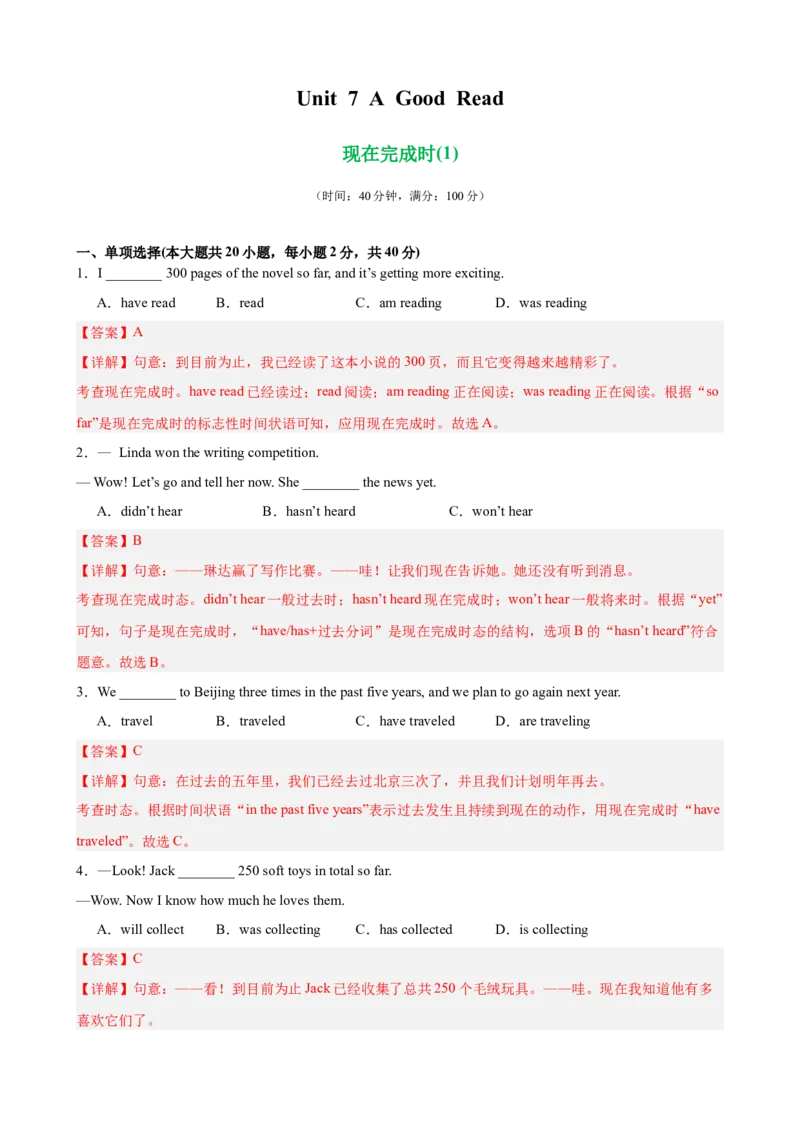
Unit 7 A Good Read
现在完成时(1)
(时间:40分钟,满分:100分)
一、单项选择(本大题共20小题,每小题2分,共40分)
1.I ________ 300 pages of the novel so far, and it’s getting more exciting.
A.have read B.read C.am reading D.was reading
【答案】A
【详解】句意:到目前为止,我已经读了这本小说的300页,而且它变得越来越精彩了。
考查现在完成时。have read已经读过;read阅读;am reading正在阅读;was reading正在阅读。根据“so
far”是现在完成时的标志性时间状语可知,应用现在完成时。故选A。
2.— Linda won the writing competition.
— Wow! Let’s go and tell her now. She ________ the news yet.
A.didn’t hear B.hasn’t heard C.won’t hear
【答案】B
【详解】句意:——琳达赢了写作比赛。——哇!让我们现在告诉她。她还没有听到消息。
考查现在完成时态。didn’t hear一般过去时;hasn’t heard现在完成时;won’t hear一般将来时。根据“yet”
可知,句子是现在完成时,“have/has+过去分词”是现在完成时态的结构,选项B的“hasn’t heard”符合
题意。故选B。
3.We ________ to Beijing three times in the past five years, and we plan to go again next year.
A.travel B.traveled C.have traveled D.are traveling
【答案】C
【详解】句意:在过去的五年里,我们已经去过北京三次了,并且我们计划明年再去。
考查时态。根据时间状语“in the past five years”表示过去发生且持续到现在的动作,用现在完成时“have
traveled”。故选C。
4.—Look! Jack ________ 250 soft toys in total so far.
—Wow. Now I know how much he loves them.
A.will collect B.was collecting C.has collected D.is collecting
【答案】C
【详解】句意:——看!到目前为止Jack已经收集了总共250个毛绒玩具。——哇。现在我知道他有多
喜欢它们了。考查时态。根据时间状语“so far”可知,表示过去发生且持续到现在的动作,“总共收集了 250 个毛绒玩
具”,对应后文“知道他多喜欢”的语境,用现在完成时“has collected”。故选C。
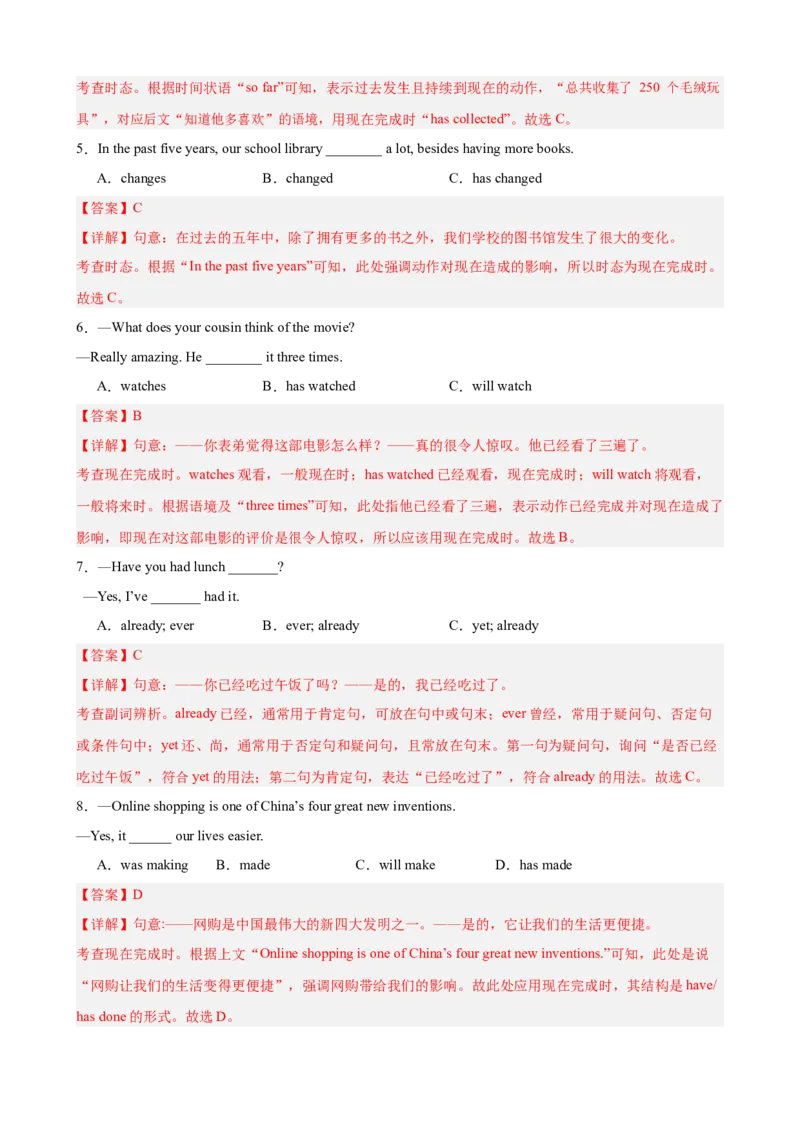
5.In the past five years, our school library ________ a lot, besides having more books.
A.changes B.changed C.has changed
【答案】C
【详解】句意:在过去的五年中,除了拥有更多的书之外,我们学校的图书馆发生了很大的变化。
考查时态。根据“In the past five years”可知,此处强调动作对现在造成的影响,所以时态为现在完成时。
故选C。
6.—What does your cousin think of the movie?
—Really amazing. He ________ it three times.
A.watches B.has watched C.will watch
【答案】B
【详解】句意:——你表弟觉得这部电影怎么样?——真的很令人惊叹。他已经看了三遍了。
考查现在完成时。watches观看,一般现在时;has watched已经观看,现在完成时;will watch将观看,
一般将来时。根据语境及“three times”可知,此处指他已经看了三遍,表示动作已经完成并对现在造成了
影响,即现在对这部电影的评价是很令人惊叹,所以应该用现在完成时。故选B。
7.—Have you had lunch _______?
—Yes, I’ve _______ had it.
A.already; ever B.ever; already C.yet; already
【答案】C
【详解】句意:——你已经吃过午饭了吗?——是的,我已经吃过了。
考查副词辨析。already已经,通常用于肯定句,可放在句中或句末;ever曾经,常用于疑问句、否定句
或条件句中;yet还、尚,通常用于否定句和疑问句,且常放在句末。第一句为疑问句,询问“是否已经
吃过午饭”,符合yet的用法;第二句为肯定句,表达“已经吃过了”,符合already的用法。故选C。
8.—Online shopping is one of China’s four great new inventions.
—Yes, it ______ our lives easier.
A.was making B.made C.will make D.has made
【答案】D
【详解】句意:——网购是中国最伟大的新四大发明之一。——是的,它让我们的生活更便捷。
考查现在完成时。根据上文“Online shopping is one of China’s four great new inventions.”可知,此处是说
“网购让我们的生活变得更便捷”,强调网购带给我们的影响。故此处应用现在完成时,其结构是have/
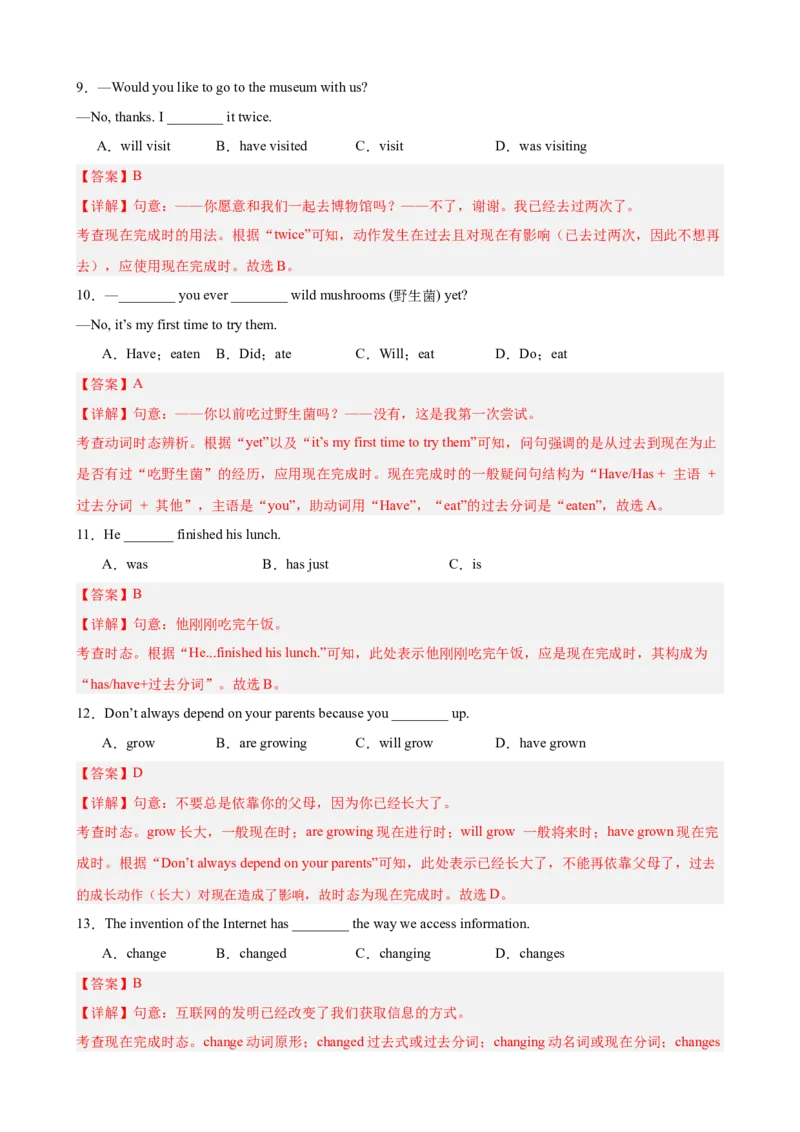
has done的形式。故选D。9.—Would you like to go to the museum with us?
—No, thanks. I ________ it twice.
A.will visit B.have visited C.visit D.was visiting
【答案】B
【详解】句意:——你愿意和我们一起去博物馆吗?——不了,谢谢。我已经去过两次了。
考查现在完成时的用法。根据“twice”可知,动作发生在过去且对现在有影响(已去过两次,因此不想再
去),应使用现在完成时。故选B。
10.—________ you ever ________ wild mushrooms (野生菌) yet?
—No, it’s my first time to try them.
A.Have;eaten B.Did;ate C.Will;eat D.Do;eat
【答案】A
【详解】句意:——你以前吃过野生菌吗?——没有,这是我第一次尝试。
考查动词时态辨析。根据“yet”以及“it’s my first time to try them”可知,问句强调的是从过去到现在为止
是否有过“吃野生菌”的经历,应用现在完成时。现在完成时的一般疑问句结构为“Have/Has + 主语 +
过去分词 + 其他”,主语是“you”,助动词用“Have”,“eat”的过去分词是“eaten”,故选A。
11.He _______ finished his lunch.
A.was B.has just C.is
【答案】B
【详解】句意:他刚刚吃完午饭。
考查时态。根据“He...finished his lunch.”可知,此处表示他刚刚吃完午饭,应是现在完成时,其构成为
“has/have+过去分词”。故选B。
12.Don’t always depend on your parents because you ________ up.
A.grow B.are growing C.will grow D.have grown
【答案】D
【详解】句意:不要总是依靠你的父母,因为你已经长大了。
考查时态。grow长大,一般现在时;are growing现在进行时;will grow 一般将来时;have grown现在完
成时。根据“Don’t always depend on your parents”可知,此处表示已经长大了,不能再依靠父母了,过去
的成长动作(长大)对现在造成了影响,故时态为现在完成时。故选D。
13.The invention of the Internet has ________ the way we access information.
A.change B.changed C.changing D.changes
【答案】B
【详解】句意:互联网的发明已经改变了我们获取信息的方式。
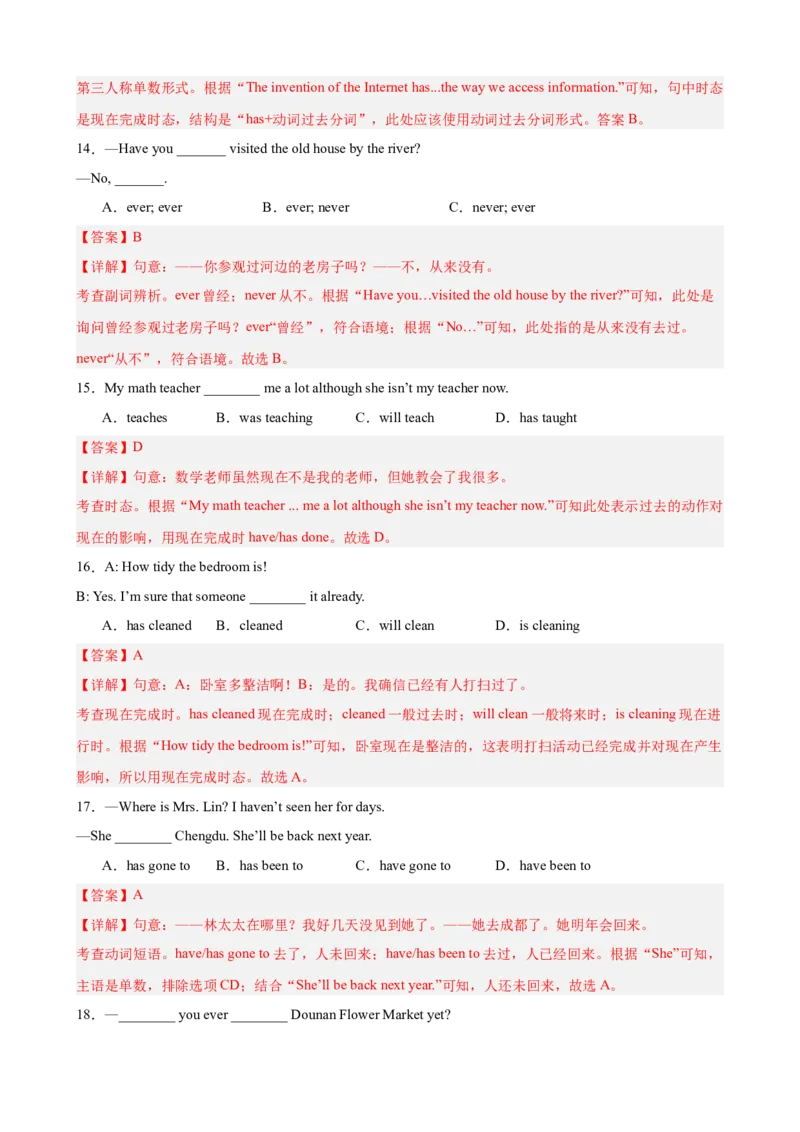
考查现在完成时态。change动词原形;changed过去式或过去分词;changing动名词或现在分词;changes第三人称单数形式。根据“The invention of the Internet has...the way we access information.”可知,句中时态
是现在完成时态,结构是“has+动词过去分词”,此处应该使用动词过去分词形式。答案B。
14.—Have you _______ visited the old house by the river?
—No, _______.
A.ever; ever B.ever; never C.never; ever
【答案】B
【详解】句意:——你参观过河边的老房子吗?——不,从来没有。
考查副词辨析。ever曾经;never从不。根据“Have you…visited the old house by the river?”可知,此处是
询问曾经参观过老房子吗?ever“曾经”,符合语境;根据“No…”可知,此处指的是从来没有去过。
never“从不”,符合语境。故选B。
15.My math teacher ________ me a lot although she isn’t my teacher now.
A.teaches B.was teaching C.will teach D.has taught
【答案】D
【详解】句意:数学老师虽然现在不是我的老师,但她教会了我很多。
考查时态。根据“My math teacher ... me a lot although she isn’t my teacher now.”可知此处表示过去的动作对
现在的影响,用现在完成时have/has done。故选D。
16.A: How tidy the bedroom is!
B: Yes. I’m sure that someone ________ it already.
A.has cleaned B.cleaned C.will clean D.is cleaning
【答案】A
【详解】句意:A:卧室多整洁啊!B:是的。我确信已经有人打扫过了。
考查现在完成时。has cleaned现在完成时;cleaned一般过去时;will clean一般将来时;is cleaning现在进
行时。根据“How tidy the bedroom is!”可知,卧室现在是整洁的,这表明打扫活动已经完成并对现在产生
影响,所以用现在完成时态。故选A。
17.—Where is Mrs. Lin? I haven’t seen her for days.
—She ________ Chengdu. She’ll be back next year.
A.has gone to B.has been to C.have gone to D.have been to
【答案】A
【详解】句意:——林太太在哪里?我好几天没见到她了。——她去成都了。她明年会回来。
考查动词短语。have/has gone to去了,人未回来;have/has been to去过,人已经回来。根据“She”可知,
主语是单数,排除选项CD;结合“She’ll be back next year.”可知,人还未回来,故选A。
18.—________ you ever ________ Dounan Flower Market yet?—Yes, I went there last year and saw different kinds of flowers.
A.Do; visit B.Did; visit C.Have; visited D.Are; visiting
【答案】C
【详解】句意:——你曾经参观过斗南花卉市场吗?——是的,我去年去过那里,看到了各种各样的花。
考查现在完成时。根据“you ever...Dounan Flower Market yet”可知,问句询问的是“是否曾经去过某地”,
因此应用现在完成时(have/has done)。故选C。
19.—I see you’re doing great in your studies lately!
—Thanks. Our school ________ new online tools. They make learning more fun and interactive.
A.will introduce B.has introduced C.introduces D.introduced
【答案】B
【详解】句意:——我看你最近学习很好!——谢谢。我们学校引入了新的在线工具。它们使学习更加
有趣和互动。
考查时态。根据“I see you’re doing great in your studies lately!”可知,学校引入新工具的动作已经完成,即
工具已投入使用,且对现在造成了影响,应用现在完成时。故选B。
20.Tom ________ many speaking competitions already and he won the first prize last year.
A.enters B.entered C.will enter D.has entered
【答案】D
【详解】句意:Tom已经参加了许多演讲比赛,并且他去年赢得了第一名。
考查动词时态。根据“already”可知,空处时态为现在完成时,其结构为have/has done,主语Tom为第三
人称单数,助动词用has,故选D。
二、单词拼写(本大题共10小题,每小题2分,共20分)
21.Have you (learn) the new words?
【答案】learnt/learned
【详解】句意:你学会新单词了吗?此处填过去分词learnt/learned与have构成现在完成时。故填learnt/
learned。
22.She has (cook) dinner for us.
【答案】cooked
【详解】句意:她为我们做晚饭了。根据“She has…dinner for us.”可知,此处构成现在完成时
“have/has+过去分词”结构。cook的过去分词是cooked。故填cooked。
23.We (study) different kinds of wisdom in history class recently.
【答案】have studied
【详解】句意:最近我们在历史课上学习了不同种类的智慧。“recently”表示最近,常与现在完成时连用,其结构为“have/has + 过去分词”,主语“We”是复数,助动词用“have”,“study”的过去分词是
“studied”。故填have studied。
24.The old man (tell) us many stories about wisdom so far.
【答案】has told
【详解】句意:到目前为止,这位老人已经给我们讲了许多关于智慧的故事。“so far”表示到目前为止,
是现在完成时的标志词,其结构为“have/has + 过去分词”,主语“The old man”是第三人称单数,助动
词用“has”,“tell”的过去分词是“told”。故填has told。
25.Helen (change) a lot after making friends with Jane.
【答案】has changed
【详解】句意:海伦和简交朋友后变化很大。此处需要填动词作句子的谓语,根据“after making friends
with Jane”可知,动作从过去开始并对现在产生影响,句子用现在完成时,其结构为have/has+动词过去分
词,主语Helen为第三人称单数,助动词用has,change的过去分词为changed,符合语境,故填has
changed。
26.—Can I use the e-dictionary now, Mum?
—Go ahead. Your dad (fix) it.
【答案】has fixed
【详解】句意:——妈妈,我现在能用电子词典吗?——用吧。你爸爸已经修好了它。fix“修理”,动词;
结合语境“允许使用电子词典”,可推断“修理”动作已完成,且结果 (电子词典能使用) 对现在产生影
响,故用现在完成时 (have/has + 过去分词),主语“Your dad”是第三人称单数,助动词用“has”,“fix”
的过去分词是“fixed”。故填has fixed。
27.John never (visit) China.
【答案】 has visited
【详解】句意:约翰从未拜访过中国。根据“John…never…China.”,结合所给词可知,此处应该表达约
翰从未拜访过中国,所以该句时态为现在完成时,且该句主语是John,visit的过去分词是visited。故填
has;visited。
28.—Jim doesn’t want to eat anything and feels cold all the morning.
—I think he (catch) a bad cold.
【答案】has caught
【详解】句意:——吉姆不想吃任何东西,整个上午感到冷。——我认为他得了重感冒。catch a bad cold
得了重感冒,根据“Jim doesn’t want to eat anything and feels cold all the morning.”可知,得了重感冒对现在
造成了影响,因此用现在完成时;主语he为第三人称单数,因此助动词用has;catch的过去分词为
caught。故填has caught。29.Tom (write) many books before.
【答案】has written
【详解】句意:汤姆以前写过很多书。根据“before”可知此处强调过去的动作对现在的影响,用现在完
成时,主语是Tom,助动词用has,write的过去分词是written。故填has written。
30.I love my family and I have never (argue) with my parents.
【答案】argued
【详解】句意:我爱我的家人,我从未和我的父母争吵过。根据“I have never...”可知,句子时态为现在
完成时,其结构为“have/has+动词的过去分词”,argue“争吵”,动词,其过去分词为argued。故填
argued。
三、短文填空(本大题共20小题,每小题2分,共40分)
阅读下面短文,在空白处填入1个适当的单词或括号内单词的正确形式。
One day, a wolf 31 (walk) in the forest when he saw a rabbit eating grass under a tree. The wolf
thought, “This rabbit will be my delicious meal.” He 32 (quiet) walked towards the rabbit.
When 33 wolf was about to catch the rabbit, the rabbit noticed him. But the rabbit wasn’t afraid.
He said to the wolf, “Mr. Wolf, you could not 34 (eat) me now.” The wolf was surprised and asked,
“Why?” The rabbit replied, “I’m much smaller 35 you, and I won’t make you full. But there is another
rabbit over there. He is 36 (big) one in this forest. You should go 37 (catch) him instead.”
The wolf believed 38 (he) words. He looked around and asked, “Where is that big rabbit?” The
rabbit said, “I won’t show you 39 you follow me.” So the wolf followed the rabbit. They walked and
walked. When the wolf realized he was fooled (愚弄), the rabbit had already run away.
The rabbit had hidden in a hole safely. He thought, “I am so lucky to get away. I 40 (learn) a
lesson since this experience: Thinking quickly can help me out of danger.”
【答案】
31.was walking 32.quietly 33.the 34.eat 35.than 36.the biggest 37.to catch
38.his 39.unless 40.have learned/have learnt
【导语】本文是一篇记叙文,讲述了一只兔子智斗狼,最终逃脱危险的故事。
31.句意:一天,一只狼正在森林里散步,这时他看到一只兔子在树下吃草。“was/were +现在分词”构
成过去进行时,主语a wolf是单数。故填was walking。
32.句意:他悄悄地走向兔子。此处修饰动词walked,要用副词,quiet的副词形式是quietly。故填
quietly。
33.句意:当这只狼正要抓住兔子时,兔子注意到了他。此处特指上文提到的那只狼,用定冠词the表特指。故填the。
34.句意:狼先生,你现在不能吃我。根据“could”可知,情态动词后接动词原形。故填eat。
35.句意:我比你小得多,而且我填不饱你。根据“smaller”可知,smaller是比较级,than用于比较级后。
故填than。
36.句意:他是这片森林里最大的一只(兔子)。根据“in this forest”可知,那只兔子是整片森林中最大
的一只,要用最高级,big的最高级是the biggest。故填the biggest。
37.句意:你应该去抓他来代替(抓我)。go to do sth.表示“去做某事”,用动词不定式作目的状语。
故填to catch。
38.句意:狼相信了他的话。此处修饰名词words,要用形容词性物主代词,he的形容词性物主代词是
his。故填his。
39.句意:除非你跟着我,否则我不会指给你看。unless表示“除非”,引导条件状语从句,符合题干语
义。故填unless。
40.句意:自这次经历以来,我学到了一个教训:快速思考能帮我脱离危险。根据“since this experience”
可知,此处与现在完成时搭配,“have/has +过去分词”构成现在完成时,主语I用have,learn的过去分
词是learned或learnt。故填have learned或have learnt。
阅读下面短文,在空白处填入一个适当的单词或括号内单词的正确形式。
Once upon a time, there lived a young deer and an old deer in the forest. One sunny afternoon, when they
41 (lie) under a tree in the forest, they suddenly heard some sounds of dogs’ barking around them. The old
deer stood up quickly. He felt afraid and he said to the young deer, “Be quick! It’s time to find 42 place
to hide in. The barking dogs are dangerous and they will kill us.” The young deer laughed and said, “Why should
we hide from the dogs? We are 43 (big) and stronger than them. We can kick them with our big antlers
(角), We should fight against the dogs 44 (brave).”
The old deer admired the courage of the young deer, 45 he did not believe the young deer. “We’d
better run away now.” said the old deer. The young deer refused 46 (run) away. He decided to beat the
dogs. As the dogs ran to them, he put down his antlers and wanted to kick them. He didn’t win in the end, 47
there are too many dogs. He died!
The young deer lost his life. We can learn a lesson from the story. Don’t be 48 the stupid young
deer when we are in danger. We should learn to protect 49 (we) well. We should know our strength and
50 (weak).
【答案】
41.were lying 42.a 43.bigger 44.bravely 45.but 46.to run 47.because48.like 49.ourselves 50.weakness
【导语】本文主要讲述了一只年轻的鹿和一只老鹿在森林里遇到猎狗时,年轻的鹿因为高估自己的力量、
低估危险而拒绝逃跑,最终被狗群杀死的故事,告诫我们要认清自己的强弱,在危险时学会保护自己。
41.句意:一个阳光明媚的下午,当他们躺在森林里的一棵树下时,他们突然听到一些狗在他们周围吠
叫。根据“they suddenly heard some sounds of dogs’ barking around them”可知,此处指他们正躺着的时候,
听到了声音,用过去进行时,表示过去的状态,结构为was/were doing。主语为“they”,be动词用
were;lie“躺”,动词,现在分词为lying。故填were lying。
42.句意:他感到害怕,就对年轻的鹿说:“快点!是时候找个地方躲起来了。吠叫的狗很危险,他们
会杀了我们的。”“place”为以辅音音素开头的可数名词单数,首次提到,表示泛指,用a修饰。故填
a。
43.句意:我们比他们更大更强壮。空处位于“are”后,“than”前,用形容词比较级作表语。big“大的”,
形容词,比较级为bigger。故填bigger。
44.句意:我们可以用我们的大鹿角顶他们,我们应该与狗勇敢地战斗。空处修饰动词“fight”,用副词,
作状语。brave“勇敢的”,形容词,副词为bravely“勇敢地”。故填bravely。
45.句意:老鹿很佩服年轻的鹿的勇气,他不相信年轻的鹿。根据“The old deer admired the courage of
the young deer”和“he did not believe the young deer”可知,前后表示转折关系,虽然佩服年轻的鹿,但是
不相信他。空处填表示转折关系的连词but。故填but。
46.句意:年轻的鹿拒绝逃跑。refuse to do sth“拒绝做某事”,空处填动词不定式。run“跑”,动词,不
定式为to run。故填to run。
47.句意:他最终没有赢,因为狗太多了。根据“there are too many dogs”可知,此处为年轻的鹿没有赢
的原因是狗太多了。用because引导原因状语从句。故填because。
48.句意:当我们处于危险之中时,不要像愚蠢的年轻的鹿一样。根据“the stupid young deer”可知,此
处告诫我们遇到危险时,不要像年轻的鹿一样。be like“像……”。故填like。
49.句意:我们应该学会保护好自己。根据“We should learn to protect”可知,此处指我们要保护好我们
自己。此句主语和宾语指代相同的人,空处填反身代词。we“我们”,主格,反身代词为ourselves“我们
自己”。故填ourselves。
50.句意:我们应该知道自己的长处和弱点。空处与可数名词单数“strength”是并列关系,填名词作宾语。
weak“虚弱的”,形容词,名词为weakness“弱点”,可数名词,数上与“strenght”保持一致,用单数名词。
故填weakness。