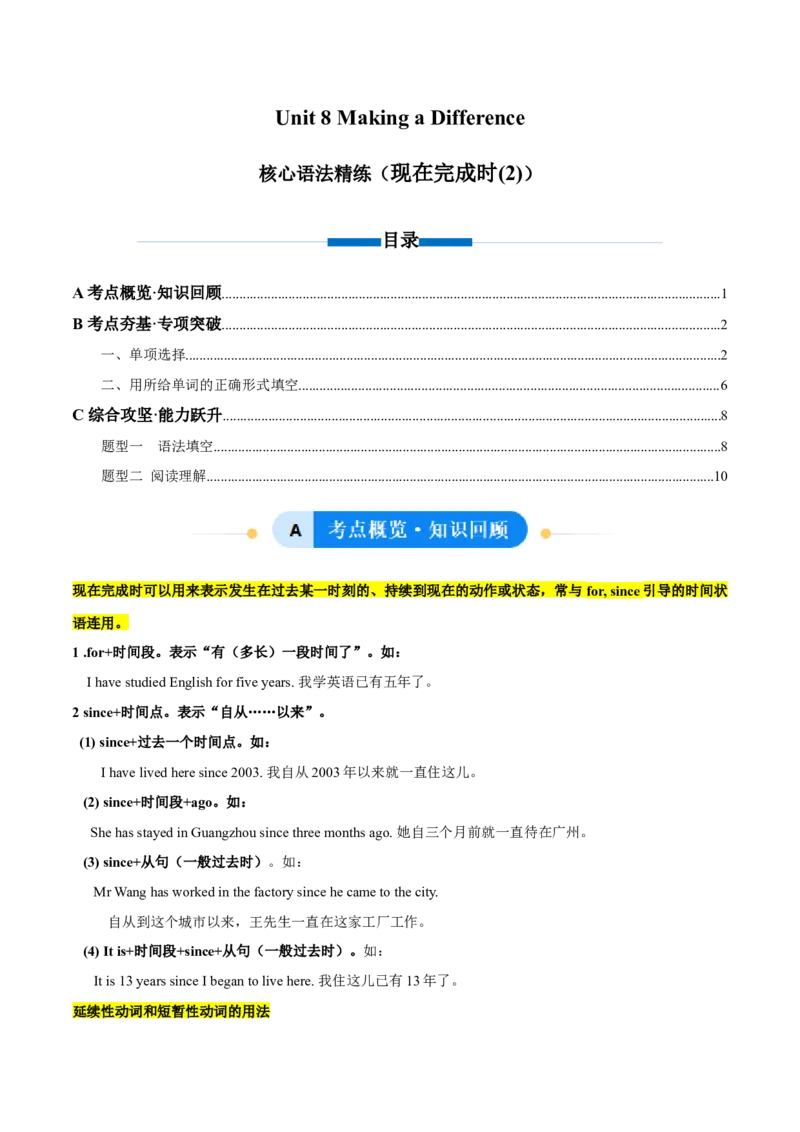
Unit 8 Making a Difference
核心语法精练(现在完成时(2))
目录
A 考点概览·知识回顾..............................................................................................................................................1
B 考点夯基·专项突破..............................................................................................................................................2
一、单项选择.........................................................................................................................................................2
二、用所给单词的正确形式填空........................................................................................................................6
C 综合攻坚·能力跃升..............................................................................................................................................8
题型一 语法填空.................................................................................................................................................8
题型二 阅读理解.................................................................................................................................................10
现在完成时可以用来表示发生在过去某一时刻的、持续到现在的动作或状态,常与for, since引导的时间状
语连用。
1 .for+时间段。表示“有(多长)一段时间了”。如:
I have studied English for five years. 我学英语已有五年了。
2 since+时间点。表示“自从……以来”。
(1) since+过去一个时间点。如:
I have lived here since 2003. 我自从2003年以来就一直住这儿。
(2) since+时间段+ago。如:
She has stayed in Guangzhou since three months ago. 她自三个月前就一直待在广州。
(3) since+从句(一般过去时)。如:
Mr Wang has worked in the factory since he came to the city.
自从到这个城市以来,王先生一直在这家工厂工作。
(4) It is+时间段+since+从句(一般过去时)。如:
It is 13 years since I began to live here. 我住这儿已有13年了。
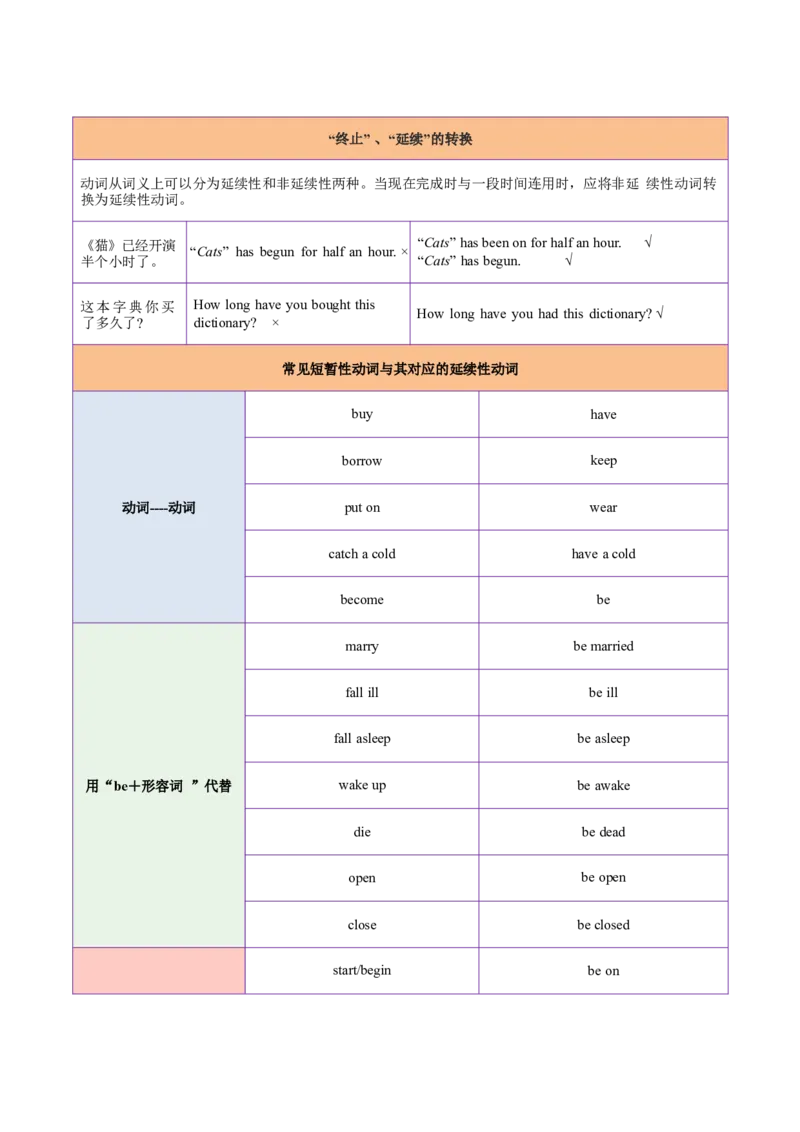
延续性动词和短暂性动词的用法“终止” 、“延续”的转换
动词从词义上可以分为延续性和非延续性两种。当现在完成时与一段时间连用时,应将非延 续性动词转
换为延续性动词。
《猫》已经开演 “Cats” has been on for half an hour. √
“Cats” has begun for half an hour. ×
半个小时了。 “Cats” has begun. √
这本字典你买 How long have you bought this
How long have you had this dictionary? √
了多久了? dictionary? ×
常见短暂性动词与其对应的延续性动词
buy have
borrow keep
动词----动词 put on wear
catch a cold have a cold
become be
marry be married
fall ill be ill
fall asleep be asleep
用“be+形容词 ”代替 wake up be awake
die be dead
open be open
close be closed
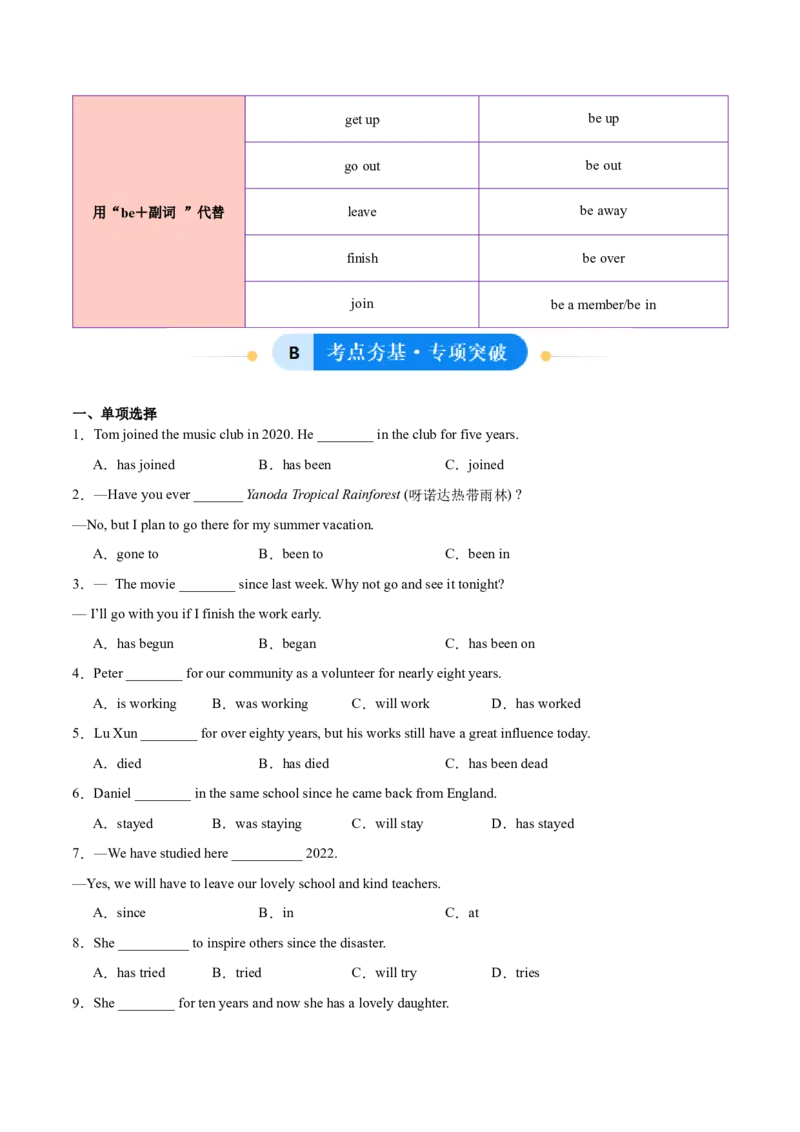
start/begin be onget up be up
go out be out
用“be+副词 ”代替 leave be away
finish be over
join be a member/be in
一、单项选择
1.Tom joined the music club in 2020. He ________ in the club for five years.
A.has joined B.has been C.joined
2.—Have you ever _______ Yanoda Tropical Rainforest (呀诺达热带雨林) ?
—No, but I plan to go there for my summer vacation.
A.gone to B.been to C.been in
3.— The movie ________ since last week. Why not go and see it tonight?
— I’ll go with you if I finish the work early.
A.has begun B.began C.has been on
4.Peter ________ for our community as a volunteer for nearly eight years.
A.is working B.was working C.will work D.has worked
5.Lu Xun ________ for over eighty years, but his works still have a great influence today.
A.died B.has died C.has been dead
6.Daniel ________ in the same school since he came back from England.
A.stayed B.was staying C.will stay D.has stayed
7.—We have studied here __________ 2022.
—Yes, we will have to leave our lovely school and kind teachers.
A.since B.in C.at
8.She __________ to inspire others since the disaster.
A.has tried B.tried C.will try D.tries
9.She ________ for ten years and now she has a lovely daughter.A.married B.has been married C.got married
10.The film Zootopia 2 ________ very popular since it was first shown on Nov. 26th.
A.became B.has become C.was becoming D.become
11.How long ________ Mr. White ________ a member of Greener China since he ________ to China?
A.have; joined; comes B.have; been; has come
C.has; joined; has come D.has; been; came
12.Since Zootopia was first shown in 2016, it ________ millions of fans around the world.
A.wins B.won C.has won D.will win
13.It’s too uncomfortable. I ________ a sore throat for two days.
A.had B.have C.had had D.have had
14.They __________ friends since they shared the ice creams.
A.are B.were C.have been D.will be
15.—The new science museum is so fantastic
—Yes, it is. I have visited it three times ________ it opened last month.
A.for B.during C.since
16.The therapy centre is on High Street and Mrs. Green ________ colour therapy since she left college.
A.has practised B.practised C.practise D.practising
17.The Wandering Earth II ________ with the public since it came out.
A.has been successful B.is successful C.was successful
18.—Does your uncle still live in Beijing?
—No. He ________ Beijing for many years.
A.has left B.has left from C.has been away fromD.has been away
19.My brother ________ a lot about world history since he started collecting travel guides.
A.learns B.learned C.has learned D.will learn
20.—Where is Mike’s family? I haven’t seen them these days.
—Everyone in his family except grandparents ________ Wuxi for the holiday and they ________ there for a week.
A.has gone to, has been in B.have gone to, has been to
C.has gone to, has been D.has gone to, have been
二、单词拼写
21.My father (go) to Nanjing for business . He will be back in ten days .
22.I (learn) English for more than five years.
23.According to the doctor’s advice, he (keep) a balanced diet for two years.24.The movie (begin) for over ten minutes.
25.Emily has (have) the piano since she was eight years old.
26.She (be) good at cooking since she was a child.
27.John is my best friend. I (know) him for twenty years.
28.—The boy misses his parents very much.
—So he does. They (leave) the hometown for nearly two years.
29.The little girl (read) many books since she was five years old.
30.I (feed) my pet for three months since my parents brought it home.
题型一 语法填空
语法填空。阅读下面短文在文章空白处填入一个适当的单词或括号内单词的正确形式。
On June 6, 2025, Army Major (陆军少校) Zhang Wei was 1 (take) a walk with his mother by Nanhu Lake
in Shangqiu, Henan. 2 (sudden), they heard loud cries for help. A couple had 3 (fall) into the water during
an argument, and three young men who jumped in to rescue (拯救) them were now trapped (困住) too. All five people
were in danger in the deep, cold water.
4 thinking twice, Major Zhang jumped into the lake, and quickly swam to save them. One by one, he
brought four people 5 (safe) back to the bank. But he was 6 tired that his arms felt weak, and he could
hardly breathe.
His mother 7 (cry) out, “Stop now, or you’ll lose your life.” But Major Zhang made a heartbreaking
choice. He knelt down (跪下), kowtowed (磕头) to his mother, and said, “Mom, I’m a service man (现役军人).
Please let me 8 (save) one more.” Then, he jumped into the lake again.
With his last strength, he pushed the final person to safety before 9 (lose) consciousness (失去意识).
Taken quickly to the hospital, he even whispered, “Save people...”. Thankfully, Army Major Zhang Wei recovered.
The rescued people tearfully thanked him, “He gave us 10 second life.” However, he simply said, “I just
did my duty.” His courage reminds us that heroes walk among us.
阅读短文,在空白处填入一个适当的单词或用括号内所给词的正确形式填空,使短文通顺、连贯。
Last month, eight young volunteers (志愿者) and two teachers from our school 1 (pay) a visit to a village
school in Guangde, Anhui.2 the beginning of this year, our school introduced a project for eighth-graders. The project encourages
us 3 (help) others. I took part in a video teaching project run by Stepping Stones, a charity that supports poor
children in China. The volunteers of the project use a video link to teach English to left-behind (留守) children in the
countryside.
With the help of my parents, I started to have video talks with students. I also asked over ten volunteers to join
me. At first, it was quite a challenge for me to give a lesson. Equipment (设备) had to be tested and sometimes 4
Internet connection (连接) did not work very well. But 5 (final), we solved these 6 (problem) and talked
with each other happily. Soon we decided to meet these children face to face.
We brought 7 (many) than 100 English books, dictionaries and things that were given by students at our
school to build a library for 8 (they). We gave English lessons to the children 9 taught them how to study
well. We discussed late that night about what else we could do to make these kids learn better after we left.
Although we felt very tired after that day, each of us was filled with happiness. Since then, we 10 (make)
many friends with the local children.
题型二 阅读理解
Ye Lianping is a retired teacher in Buchen Village, Anhui Province. Now at 97, he still stands in front of the
blackboard, giving lessons to children in the village.
Ye was born in 1928 in Qingdao. He was good at English and Chinese. After years of hardship (苦难), Ye
became a Chinese teacher at Buchen School at 50. Ye worked very hard. After he retired at 63, he often returned to
the school to help.
Back in 2000, many parents left Buchen Village to work in cities, leaving their children behind. Seeing that
many left-behind children had trouble with English but had no one to turn to, Ye set up a volunteer after-school class
called the “home for left-behind children”. Over the following 25 years, Ye has taught English to over 2,000 children
for free there. Now Ye still gives lessons three times a week. Even with poor eyesight and shaky (蹒跚的) steps, he
speaks in a voice full of energy.
Ye has a simple life himself. He never spends money on unnecessary (没有必要的) things. However, he is
generous (慷慨的) in using his money to help his students.
Moved by Ye’s story, college volunteers from across the country come to help in Ye’s class. They admire (钦
佩) him so much.
“Candles outshine me. I’m just a little firefly (萤火虫).” Ye said to his students. Ye’s small light has made abig difference to their lives.
1.How old was Ye Lianping when he became a Chinese teacher at Buchen School?
A.50 years old. B.63 years old. C.72 years old.
2.Why did Ye Lianping set up the “home for left-behind children”?
A.To make money from teaching.
B.To help left-behind children with English.
C.To ask college volunteers to join him.
3.What can we know about Ye Lianping’s after-school class?
A.He has taught over 2,000 children for free.
B.He only gives lessons on weekends.
C.He asks students to pay for lessons.
4.Which of the following is true about Ye Lianping?
A.He was born in Anhui Province.
B.He lives a simple but generous life to students.
C.He stopped teaching because of poor eyesight.
5.In which part of a newspaper can we most probably read this text?
A.PEOPLE B.SCIENCE C.TRAVEL
A good living environment is important for everyone. It includes clean air, safe streets, and comfortable homes.
But what makes a place truly special is not just the buildings or parks—it’s the people and how they care for each
other. People work hard to keep their living environment clean and beautiful. They sweep the floors, take out the
trash, and plant flowers in their neighbourhoods. The clean living environment makes people feel happy and
healthy.
In a friendly neighbourhood, people know their neighbours. They say hello, share food, and help when
someone is in need. For example, if an old person has trouble carrying things, a younger neighbour might offer to
help. If a family is new to the area, others might welcome them with smiles and small gifts. These kind actions make
a warm and happy atmosphere (氛围).
Communities also work together to settle problems. They might clean the park, plant trees, or organize events
like festivals or sports games. By doing these things, people build trust and friendship. They learn that helping others
makes their own lives better, too.
A loving community is like a big family. When people respect and help each other, everyone feels safe andhappy. No matter where we live—in a big city or a small village—kindness can make our environment a better place.
So a beautiful home is not just about the house we live in, but also about the love and help we share with those around
us.
1.According to the passage, what makes a living environment truly special?
A.Expensive buildings and big parks. B.Clean air and safe streets.
C.The people and how they care for each other. D.Modern shopping centers and restaurants.
2.What do people in a friendly neighbourhood usually do?
A.They avoid talking to their neighbors. B.They help each other and share kindness.
C.They care about homeless animals in parks. D.They compete to have the best house.
3.What does the underlined word “settle” in the third paragraph mean?
A.Fix. B.Cause. C.Add. D.Produce.
4.What is the best title for the passage?
A.How to Keep the Environment Clean B.The Importance of a Loving Environment
C.Building Beautiful Houses in Communities D.The Best Ways to Make Friends with Neighbors