2024-2025 学年八年级英语下学期单元语法精讲精练(人教版)
10 现在完成时(3)
语法聚焦
1.how long 、since和for时间状语在现在完成时中的用法
2.在现在完成时中,延续性动词和非延续性动词的用法区别
语法精讲
1.how long 、since和for时间状语在现在完成时中的用法
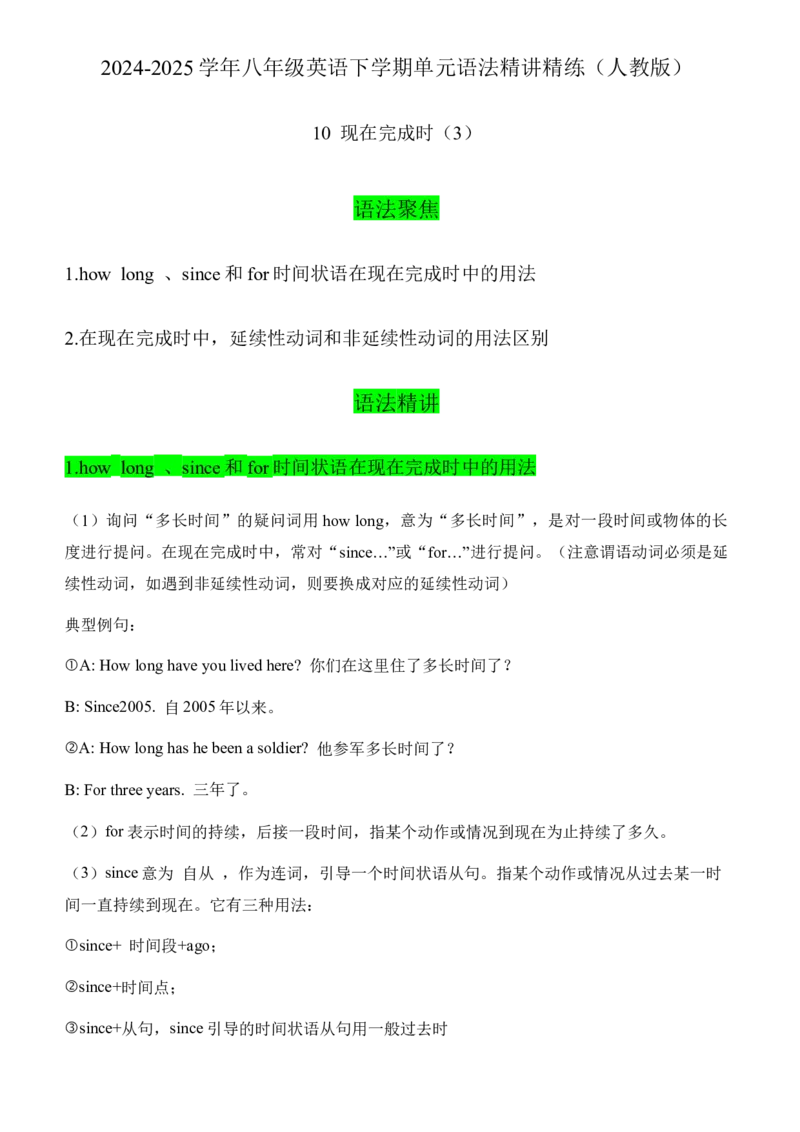
(1)询问“多长时间”的疑问词用 how long,意为“多长时间”,是对一段时间或物体的长
度进行提问。在现在完成时中,常对“since…”或“for…”进行提问。(注意谓语动词必须是延
续性动词,如遇到非延续性动词,则要换成对应的延续性动词)
典型例句:
①A: How long have you lived here? 你们在这里住了多长时间了?
B: Since2005. 自2005年以来。
②A: How long has he been a soldier? 他参军多长时间了?
B: For three years. 三年了。
(2)for表示时间的持续,后接一段时间,指某个动作或情况到现在为止持续了多久。
(3)since意为 自从 ,作为连词,引导一个时间状语从句。指某个动作或情况从过去某一时
间一直持续到现在。它有三种用法:
①since+ 时间段+ago;
②since+时间点;
③since+从句,since引导的时间状语从句用一般过去时(4)for和since二者在句中可以转换。
for+一段时间=since+过去的时间点.
典型例句:
①My uncle has worked here for ten years.
②My uncle has worked here since ten years ago.
③My uncle has worked here since 2006.
④My uncle has worked here since he came here.
⑤My uncle has been in this company for one month.
2.在现在完成时中,延续性动词和非延续性动词的用法区
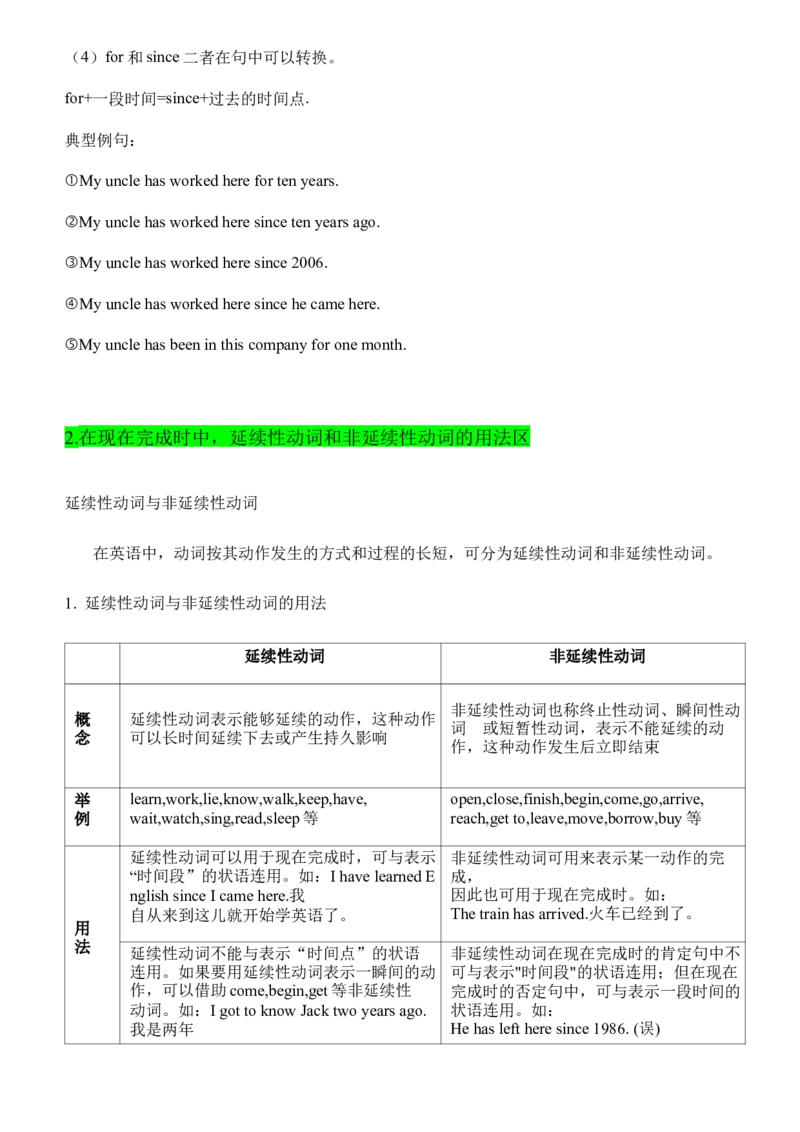
延续性动词与非延续性动词
在英语中,动词按其动作发生的方式和过程的长短,可分为延续性动词和非延续性动词。
1. 延续性动词与非延续性动词的用法
延续性动词 非延续性动词
非延续性动词也称终止性动词、瞬间性动
概 延续性动词表示能够延续的动作,这种动作
词 或短暂性动词,表示不能延续的动
念 可以长时间延续下去或产生持久影响
作,这种动作发生后立即结束
举 learn,work,lie,know,walk,keep,have, open,close,finish,begin,come,go,arrive,
例 wait,watch,sing,read,sleep等 reach,get to,leave,move,borrow,buy等
延续性动词可以用于现在完成时,可与表示 非延续性动词可用来表示某一动作的完
“时间段”的状语连用。如:I have learned E 成,
nglish since I came here.我 因此也可用于现在完成时。如:
自从来到这儿就开始学英语了。 The train has arrived.火车已经到了。
用
法
延续性动词不能与表示“时间点”的状语 非延续性动词在现在完成时的肯定句中不
连用。如果要用延续性动词表示一瞬间的动 可与表示"时间段"的状语连用;但在现在
作,可以借助come,begin,get等非延续性 完成时的否定句中,可与表示一段时间的
动词。如:I got to know Jack two years ago. 状语连用。如:
我是两年 He has left here since 1986. (误)前认识杰克的。 He hasn't left here since 1986. (正)
【注意】常见的表示“时间段”的状语有 for短语和since短语等,for+时间段; since+过去的时间
点;since + 段时间 ago;since + 一般过去时的句子
例如:for two years,since last year,since2023
2. 非延续性动词如何与表示“时间段”的状语连用?
非延续性动词不能与表示“时间段”的状语连用。如:He has died for three years.(误)。
那么,
应如何正确表达呢?可以采用下面的4种方法:
(1)将句中非延续性动词转换为相应的延续性动词。如:He has been dead for three years.
非延续性动词或词组 延续性动词或词组
leave be away
borrow keep
buy have
begin/start be on
die be dead
finish be over
join be in/be a member of
open/close be open/closed
fall ill be ill
become be
catch a cold have a cold
fall asleep be asleep
arrive in(at)/reach/get to be in/at
(2)用句型“It is+时间段+since …”表达原意。如:It is three years since he died.
(3)用句型“时间段+has passed+since …”表达原意。如:Three years has passed since hedied.
语法专练
一、单项选择题。
1.—Where is Ben?
—He ________ Hong Kong. He ________ Hong Kong three times before.
A.has been to;has gone to B.has gone to;has been to
C.has been to;has been to D.has gone to;has gone to
2.—How long have you ________ the dictionary?
—For two weeks.
A.had B.bought C.borrowed D.got
3.We have been in China ________ three years. We like it very much.
A.in B.since C.for D.during
4.Linda a lot since I saw her last time
A.has changed B.willchange C.is changing D.changed
5.—Are you sure Mary can talk in French?
—Yes. She has learned French _______ three years.
A.during B.from C.in D.for
6.She ________ her hometown since she was 18 years old. She told me she would return soon.
A.has left B.has been away from C.left D.went away
7.— I saw Alice walk into that building just now.
— Oh, it’s our new city museum. It ________ to the public for a month.
A.has been opened B.has been open C.has opened
8.I saw Julia in April and I ________ her since then.
A.don’t see B.didn’t see C.won’t see D.haven’t seen9.—Peter, you speak Chinese so well.
—Thank you. I ________ Chinese since I came here in 2013.
A.will learn B.learned C.have learned D.learn
10.—How long ______ your brother ______ this camera? —For two weeks.
A.have; boughtB.have; had C.has; had D.has; bought
11.William Shakespeare ______ for 400 years, but his works still have great influence today.
A.died B.was dying
C.has died D.has been dead
12.We have been expecting Rio 2016 Olympics _________ the Olympic flame(圣火) was lit.
A.if B.unless C.since D.though
13.There _________ great changes in such kind of PDAs(掌上电脑)in the last few years.
A.has been B.have been C.has had D.have had
14.My sister has learnt English ________.
A.for twelve years ago B.since she was four
C.twelve years ago D.at the age of four
15.I ________ this bike for three years. I like it so much.
A.bought B.had C.have bought D.have had
16.—Why are you in such a hurry?
—Because the class ________ for 10 minutes.
A.has been on B.has begun C.is on D.begins
17.China ________ great achievements in science and technology since 1978.
A.makes B.made C.has made D.is made
18.My father ____ in a panda protection center for 10 years, so he knows a lot about panda.
A.was workingB.is working C.has worked D.will work19.He speaks English very well because he_________ in the US for 20 years.
A.lives B.lived C.has lived D.had lived
20.—Jenny, when did you move here?
—I ________ here for three years.
A.lived B.moved C.have moved D.have lived
二、按要求完成句子。
1.Tony has learned to skate since he was eight. (对画线部分提问)
Tony learned to skate?
2.Kate’s uncle has taught history for 5 years. (改为同义句)
Kate’s uncle has taught history .
3.Hurry up! The movie began ten minutes ago. (改为同义句)
Hurry up! The movie for ten minutes.
4.Sophie’s grandparents got married sixty years ago. (改为同义句)
Sophie’s grandparents for sixty years.
5.The old man died two months ago. (改为同义句)
The old man for two months.
6.David and his family moved to Shanghai four months ago. (改为同义句)
David and his family have lived in Shanghai .
7.The new library opened last month. I haven’t been there. (合并为一句)
The new library since one month ago, but I haven’t been there
.
8.Clare is Ms. Fang’s student. He learned from Ms. Fang nine weeks ago. (合并为一句)
Clare Ms. Fang’s students nine weeks.
9.I have told them the good news. (改为一般疑问句,并作肯定回答)
— you them the good news?—Yes, .
10.She began to teach Chinese in our school in 2000. (改为同义句)
She Chinese in our school since 2000.
11.He has visited the city of Beijing. (改为反意疑问句)
He has visited the city of Beijing, ?
12.His grandfather died 5 years ago. (改为同义句)
His grandfather for 5 years.
13.I bought the dictionary last year. (改为同义句)
I have the dictionary one year.
14.I joined the swimming club in 2012.
I the swimming club since 2012.
15.Ms. Tao left Beijing three months ago.
Ms. Tao Beijing for three months.
16.I have been like this for two days. (改为同义句)
I have been like this two days .
17.The clothes feel soft.(对画线部分提问)
do the clothes ?
18.My grandpa has been in excellent condition since he began to exercise. (对划线部分提问)
has your grandpa been in excellent condition?
19.My mother has already swept the floor. (改为否定句)
My mother swept the floor .
20.Kate has been working here for five years.(对画线部分提问)
has Kate working here?
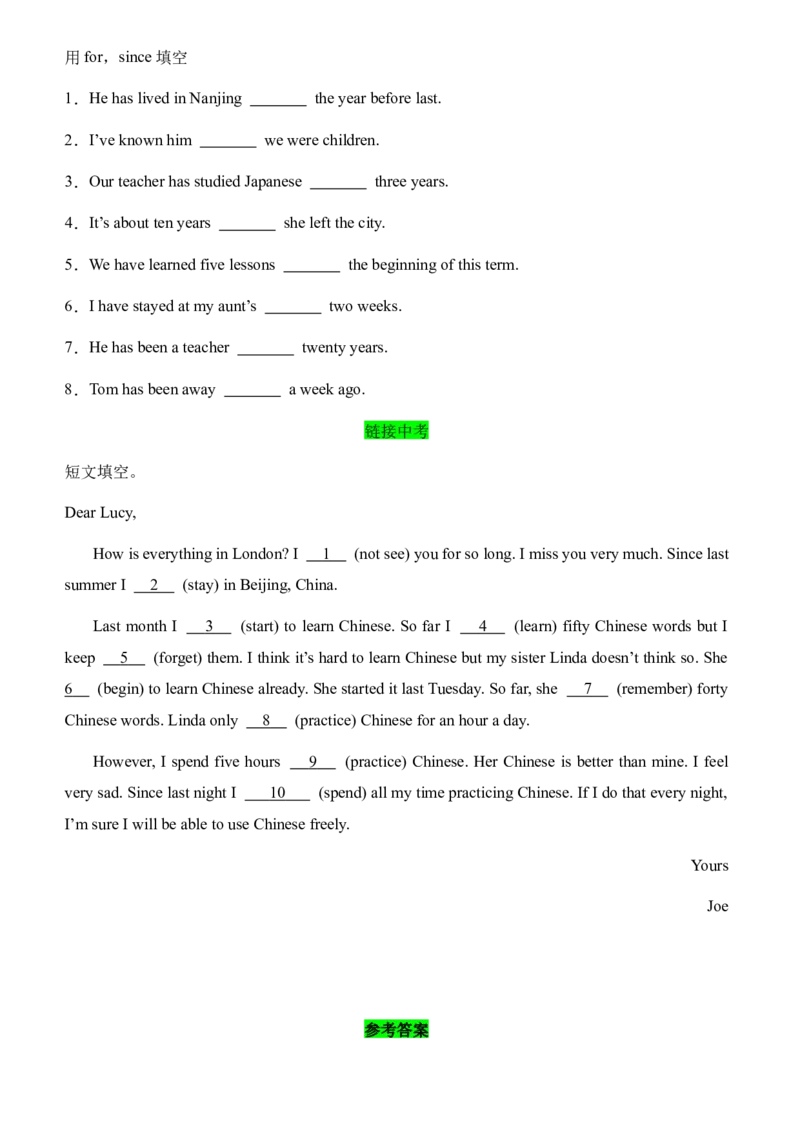
三、选词填空用for,since填空
1.He has lived in Nanjing the year before last.
2.I’ve known him we were children.
3.Our teacher has studied Japanese three years.
4.It’s about ten years she left the city.
5.We have learned five lessons the beginning of this term.
6.I have stayed at my aunt’s two weeks.
7.He has been a teacher twenty years.
8.Tom has been away a week ago.
链接中考
短文填空。
Dear Lucy,
How is everything in London? I 1 (not see) you for so long. I miss you very much. Since last
summer I 2 (stay) in Beijing, China.
Last month I 3 (start) to learn Chinese. So far I 4 (learn) fifty Chinese words but I
keep 5 (forget) them. I think it’s hard to learn Chinese but my sister Linda doesn’t think so. She
6 (begin) to learn Chinese already. She started it last Tuesday. So far, she 7 (remember) forty
Chinese words. Linda only 8 (practice) Chinese for an hour a day.
However, I spend five hours 9 (practice) Chinese. Her Chinese is better than mine. I feel
very sad. Since last night I 10 (spend) all my time practicing Chinese. If I do that every night,
I’m sure I will be able to use Chinese freely.
Yours
Joe
参考答案一、
1.B
【详解】句意:——本在哪里?——他去了香港。他以前去过香港三次。
考查has been to和has gone to的用法。第一空表示去了某地还没回来,用has gone to;第二空
表示去过某地几次,用has been to。故选B。
2.A
【详解】句意:——这本字典你拥有多久了?——两周了。
考查延续性动词以及短暂性动词的用法。had拥有;bought买;borrowed借入;got得到。根据
How long以及For two weeks可知,动词要用延续性动词,BCD都是短暂性动词,故选A。
3.C
【详解】句意:我们来中国已经三年了。我们非常喜欢它。
考查介词辨析。in在……里;since自从;for为了;during在……期间。根据“three years.”可
知,空处用介词for来引导时间段。故选C。
4.A
【详解】句意:自从我上次见到她以来,Linda变化了很多。本题考查动词的时态。Change变
化,改变。A. has changed 已经改变,是现在完成时 B. will change 将要改变,是一般将来
时 C. is changing正在改变,是现在进行时 D. changed改变了,是一般过去时。本句是现在
完成时的典型句型,故选A。
5.D
【详解】句意:——你确定玛丽能说法语吗?——是的。她学法语已经三年了。
考查时间介词。during在……期间;from从;in后接某年某月某季节;for后接一段时间。
“three years”是一段时间,要与时间介词for一起连用,故选D。
6.B
【详解】句意:她从18岁起就离开了家乡。她告诉我她很快就会回来。
考查动词时态。since+过去式的句子,主句用现在完成时,结构为have/has done,排除C和D
选项。一段时间要与持续性动词一起连用,leave是短暂性动词,be away from是持续性动词,
故选B。7.B
【详解】句意:——我看到Alice刚刚走进那座建筑了。——哦,那是我们新的城市博物馆。
它已经对公众开放了一个月了。
考查时态。根据“...for a month.”可知博物馆开放从过去某一时间到现在,用现在完成时。与时
间段连用用延续性动词be open。故选B。
8.D
【详解】句意:我四月份见过朱莉娅,从那以后就再没见过她。
考查动词时态。根据“since then”可知,时态为现在完成时,结构为have/has done,主语为I,
助动词用have,此处表示否定用haven’t。故选D。
9.C
【详解】句意:——Peter,你汉语说得这么好。——谢谢。自从我2013年来到这儿我就学习
汉语。
考查动词时态。learn学习,是一个动词。由时间状语从句“since I came here in 2013”可知,主
句应用现在完成时。故选C。
10.C
【详解】句意:你哥哥买这架相机有多久了?——两周了。根据答语可知,此处只能用延续性
动词,buy为短暂性动词,不能与表示一段的时间状语连用,排除A,D;buy的延续性动词形
式为have。your brother为第三人称单数形式,故答案为C。
点睛:现在完成时可以和带有 since 或 for 等表示“一段时间”的状语连用,表示动作或状
态从某一时刻开始,一直持 续到现在。如:I haven't seen him for two years.
但是,像 come,arrive, buy 等终止性动词不能与表示“一段时间”的 状语连用。要用,必
须改为“be(在)”等延续性动词来表述。现归纳总结一下由非延续性动词到延续性动词的转
换:
arrive→ be here , die →be dead , begin(start)→be on , come back →be back, leave →be
away, get up→ be up, finish →be over, open →be open , close →be closed, borrow →keep, join
→be on /in 或 be a member of…, buy →have, catch(a cold)→ have(a cold), begin to study→
study, get to know →know , come to work→ work 等。如:He has been a soldier for three years.
他参军三年了。His father has been dead for two years.他父亲去世二年了。The film has been on for ten minutes.电
影已开始十分钟了。We have studied English for three years. 我们(开始)学英语已三年了。
11.D
【详解】试题分析:句意:莎士比亚已经去世400年了,但他的作品现在仍然有大的影响。根
据for 400 years可知该用现在完成时,而且谓语动词必须是延续性动词。所以选D。
考点:考查动词时态。
12.C
【详解】句意:自从奥运圣火点燃以来,我们就一直在期待着2016年里约奥运会。
考查连词辨析。if如果;unless除非;since自从;though尽管。根据“…the Olympic flame(圣
火) was lit.”可知,从句用的一般过去时,主句为完成进行时,表示自从圣火点燃就一直期待奥
运会的到来,用since引导时间状语从句。故选C。
13.B
【详解】句意:在过去的几年里,这类掌上电脑有了很大的变化。
考查there be句型的现在完成时。have作实义动词时,表示“某人或某物拥有……”,且不能
和there连用,C和D选项错误;there be表示“某时某地有某事物或某人”,根据“in the last
few years.”可知,此处应用there be句型的现在完成时,形式为“There have/has been…”,主语
“great changes”为复数,助动词应用have。故选B。
14.B
【详解】句意:我妹妹从四岁起就开始学英语了。
考查时间状语。for twelve years ago表述错误;since she was four用于现在完成时;twelve years
ago用于一般过去时;at the age of four用于一般过去时。根据“My sister has learnt English”可
知,此处需用现在完成时。故选B。
15.D
【详解】句意:我买这辆自行车三年了。我很喜欢它。
考查现在完成时。根据for three years可知,此句应该是现在完成时,排除选项A和B;空处谓
语动词应该用延续性动词,排除选项C。故选D。
16.A【详解】句意:——你为什么这么着急?——因为课已经上了10分钟了。
考查延续性动词和非延续性动词。根据句中的时间状语“for 10 minutes”可知,句子应用现在
完成时,构成形式为:have /has done,故排除C、D项;且动词应用延续性动词,而begin,开
始,是非延续性动词,故排除。故选A。
17.C
【详解】句意:自1978年以来,中国在科学技术方面就取得了巨大成就。
考查现在完成时。根据“since 1978”可知,此处应使用现在完成时表示时间的延续,故选C。
18.C
【详解】句意:我爸爸在一家熊猫保护中心工作了10年了,因此他对熊猫很了解。was
working过去进行时的结构; is working现在进行时的结构;has worked现在完成时的结构;
will work一般将来时的结构;根据for 10 years可知用现在完成时;故选C。
19.C
【详解】句意:他英语说得很好,因为他在美国生活了20年。for 20 years是截止到目前为止
的时间段,说明的是现在的情况,用现在完成时态来表达,故答案为C。
20.D
【详解】句意:——詹妮,你什么时候搬到这儿来的?——我已经住在这儿三年了。
考查延续性动词和时态辨析。根据时间状语“for three years”可知,句子要用现在完成时,排
除A/B选项;因move(移动,搬动)是短暂性动词,不能和一段时间连用,此处用延续性动
词live。故选D。
二
1. How long has
【详解】句意:自从他八岁的时候,托尼就学习滑冰。根据题意,就划线部分提问。句中被划
线部分是since he was eight,表时间段,在句中作状语,用How long作为疑问词,特殊疑问句
的结构为:特殊疑问词+一般疑问句。改陈述句语序为疑问句语序—将助动词has提到主语前
面。故填How;long;has。
2. since 5/five years ago
【详解】句意:Kate的叔叔教了5年历史。根据“for 5 years”可知,她叔叔是自从5年前开始教历史的,可用since 5 years ago来表示“自从5年前以来”,也可用five表示5。故填since;
5/five;years;ago。
3. has been on
【详解】句意:快点!电影十分钟前就开始了。改为同义句即“电影已经开演十分钟了。”应
用现在完成时,主语“The movie”是三单,因此助动词用“has”,与一段时间“for ten minutes”
连用,需将原来的非延续动词”begin”转为延续性动词“be on”,因此谓语部分是“has been
on”。故填has;been;on。
4. have been married
【详解】句意:Sophie的爷爷奶奶60年前就结婚了。换句话说,他们结婚有60年了,句子应
用现在完成时,其谓语结构为:have/has+过去分词,动词短语get married为非延续性动词,根
据“for sixty years”可知此处应用be married表示已婚的状态,主语Sophie’s grandparents表示复
数意义,助动词用have,be动词的过去分词为been。故填have;been;married。
5. has been dead
【详解】句意:那老人两个月前去世了。根据“for two months.”可知,本句应用现在完成时,
主语是第三人称单数,助动词用has;句子和一段时间连用,谓语动词用延续性动词。die是短
暂性动词,对应的延续性动词为be dead。故填has;been;dead。
6. for four months
【详解】句意:David和他的家人四个月前搬到了上海。换句话说,也就是他们已经在上海生
活了四个月的时间。根据“have lived”可知在现在完成时的句子中,表示持续一段时间,用
“介词for+一段时间”。故填for;four;months。
7. has been open yet/before
【详解】句意:新图书馆上个月开放了。我没去过那里。根据“since one month ago”可知,本
句应用现在完成时,主语是单数,助动词用has,和一段时间连用,这里应用延续性动词be
open,表示状态;此外表示还没有去过,否定句中可以用yet。也可以说之前没去过,可以用
before。故填has;been;open;yet/before。
8. has been for
【详解】句意:克莱尔是方老师的学生。他九个星期前从方老师那里学习。原句合并成一句意
为“克莱尔成为方老师的学生已经有九个星期了。”,用现在完成时态来表达,主语为第三人称单数,所以用has been;for+一段时间,表示持续多久。故填has;been;for。
9. Have told I have
【详解】句意:我已经告诉他们这个好消息了。一般疑问句将助动词have提到句首,肯定回
答将疑问句中的第二人称you改为第一人称I,故填Have;told;I;have。
10. has taught
【详解】句意:她从2000年开始在我们学校教中文。since+过去的时间点要与现在完成时连用,
且动词要用延续性动词,teach是延续性动词,主语she是第三人称单数形式,助动词用has,
故填has;taught。
11. hasn’t he
【详解】句意:他已经参观过北京城了。反意疑问句遵循“前肯后否,前否后肯”的原则,根
据“has visited”可知此处应填否定句形式,而由“has”可知此处应填hasn’t,主语为he,故填
hasn’t;he。
12. has been dead
【详解】句意:他的爷爷五年前去世了。die“死亡”,是短暂性动词。根据“for 5 years.”可知,
此句是现在完成时,谓语动词和一段时间连用时,需要是延续性动词。die对应的延续性动词
为be dead,此处be应用过去分词形式been。故填 has;been;dead。
13. had for
【详解】句意:我去年买了这本词典。根据“have”可知是把句子转换为现在完成时,第二空
后是一段时间,所以应用for。和一段时间连用,谓语动词要是延续性动词,buy“买”对应的
延续性动词为have,此处应填过去分词had。故填had;for。
14. have been in
【详解】句意:我在2012年加入了游泳俱乐部。根据句中的时间状语“since 2012.”可知,句
子的时态是现在完成时,句中的动词要用延续性动词,join对应的延续性动词为be in...,现在
完成时的结构为have/has+动词的过去分词,主语是第一人称I,助动词用have,be的过去分词
为been。故填have;been;in。
15. has been away from
【详解】句意:陶女士三个月前离开了北京。该句也可表达为“陶女士已经离开北京三个月了”;由“for three months”可知,此处的“离开”要用延续性短语be away from;时态为现在
完成时,结构为have/has done;主语为“Ms. Tao”,助动词用has。故填has;been;away;
from。
16. since ago
【详解】句意:我已经这样两天了。for two days“持续两天”,可用“since two days ago”替换,
意为“自从两天前”。故填since;ago。
17. How feel
【详解】句意:这衣服摸起来很软。划线部分表示感觉,用how提问,助动词do后用动词原
形。故填How;feel。
18. How long
【详解】句意:我爷爷自从开始锻炼以来,身体一直很好。根据“since he began to exercise.”可
知,对一段时间提问用how long“多长时间”。句子开头,首字母大写。故填How;long。
19. hasn’t yet
【详解】句意:我妈妈已经扫地了。句子是现在完成时,改为否定句在助动词has后加not,
用缩略式hasn’t,already改为yet。故填hasn’t;yet。
20. How long been
【详解】句意:凯特在这儿工作已经五年了。画线部分for five years表示时长,应用how long
来提问,位于句首,首字母要大写。根据“has been working”可知,主语Kate后接过去分词
been。故填How;long;been。
三、
1.since 2.since 3.for 4.since 5.since 6.for 7.for 8.since
【解析】
1.句意:他从前年起就住在南京。since+过去的时间,表示“自从……”。根据“the year
before last”,故填since。
2.句意:我从小就认识他了。since+从句,从句用一般过去时,表示“自从……”。根据
“we were children”,故填since。
3.句意:我们老师学日语已经三年了。for+一段时间,根据“three years”,故填for。4.句意:她离开这个城市大约有十年了。since+从句,从句用一般过去时,表示“自从……”。
根据“she left the city”,故填since。
5.句意:从这个学期开始,我们已经学了五课。since+过去的时间,表示“自从……”。根据
“the beginning of this term”,故填since。
6.句意:我在我姑姑家呆了两个星期了。for+一段时间,根据“two weeks”,故填for。
7.句意:他当了二十年的老师。for+一段时间,根据“twenty years”,故填for。
8.句意:汤姆一星期前就离开了。since+一段时间+ago,表示“自从……”。根据“a week
ago”,故填since。
链接中考
1.haven’t seen 2.have stayed 3.started 4.have learned 5.forgetting 6.has
begun 7.has remembered 8.practices 9.practicing 10.have spent
【导语】本文是一封Joe写给Lucy的书信,主要讲了Joe学习汉语的经历和感受。
1.句意:我这么久没有看到你了。根据时间状语“for so long”可知,句子时态应为现在完成
时,谓语动词see“看见”的过去分词形式为seen,主语I为第一人称,因此助动词是have,与
not连用缩写为haven’t,故填haven’t seen。
2.句意:自从去年夏天我就一直待在中国北京。根据“Since last summer”可知,句子时态应
为现在完成时,谓语动词stay“停留,待”的过去分词形式为stayed,主语I为第一人称,因此
助动词是have,故填have stayed。
3.句意:上个月我开始来学习中文。根据时间状语“Last month”可知,句子时态应为一般过
去时,动词用过去式,故填started。
4.句意:到目前为止,我学了五十个汉语单词,但是我一直都在忘记。根据“So far”可知,
句子时态应为现在完成时,谓语动词learn“学习”的过去分词形式为learned,主语I为第一人
称,助动词是have,故填have learned。
5.句意:到目前为止,我学了五十个汉语单词,但是我一直都在忘记。keep doing sth“一直做
某事”,forget“忘记”,现在分词形式为forgetting,故填forgetting。
6.句意:她已经开始学汉语了。根据标志词“already”可知,句子时态应为现在完成时,谓语
动词begin“开始”的过去分词形式为begun,主语She为第三人称,助动词是has,故填has
begun。7.句意:到目前为止,她记住40个汉字。根据“So far”可知,句子时态应为现在完成时,谓
语动词remember“记住”的过去分词形式为remembered,主语she为第三人称,助动词是has,
故填has remembered。
8.句意:Linda每天只练习一小时中文。此处描述事实,句子时态应为一般现在时,主语
Linda为第三人称,谓语动词应用三单形式,故填practices。
9.句意:然而,我花了五个小时练习汉语。sb spend sometime doing sth“某人花费多长时间做
某事”,故填practicing。
10.句意:从昨晚开始,我把所有的时间都花在了练习汉语上。根据“Since last night”可知,
句子时态应为现在完成时,谓语动词spend“花费”的过去分词形式为spent,主语I为第一人称,
助动词是have,故填have spent。