Unit9 Have you ever been to a museum?
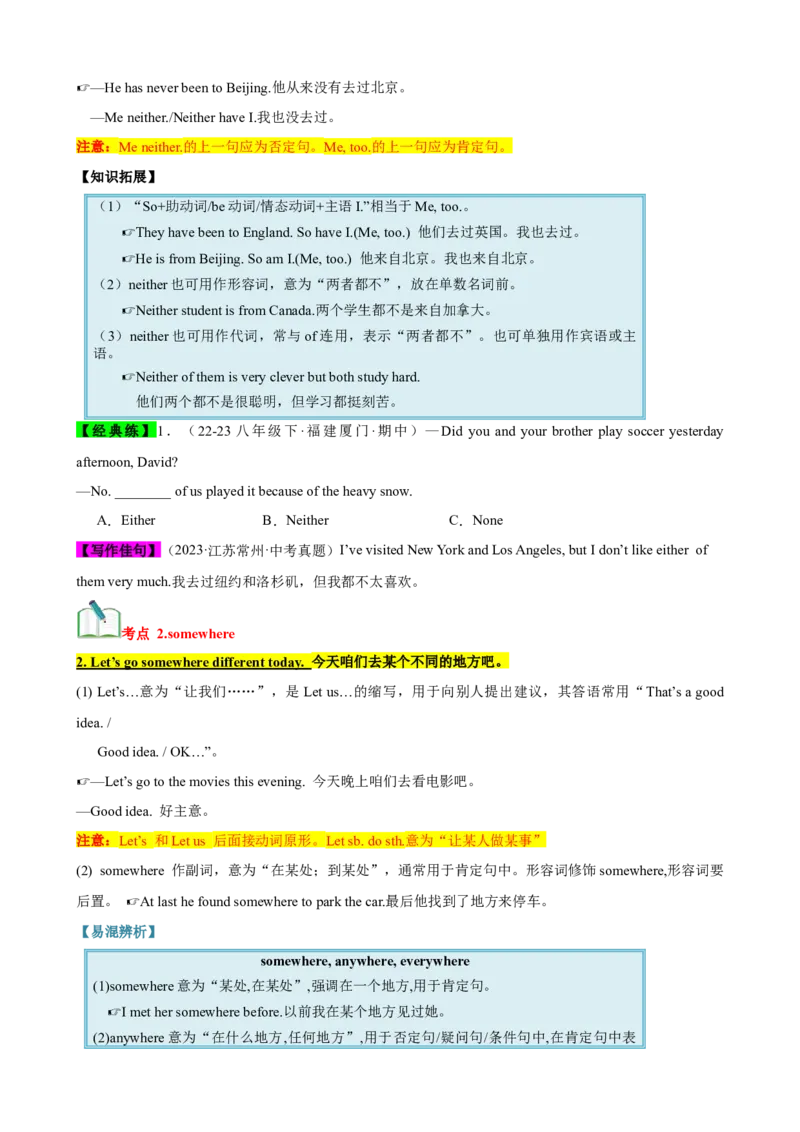
核心话题 旅游地点
重点词汇 1. amusement 2. camera 3. invention; invent 4. Unbelievable 5. progress 6.
rapid 7. unusual 8. encourage 9. social 10. peaceful 11. performance 12. perfect
13. Itself 14. collect 15. theme 16. ride 17. province 18. safe 19. simply
20. Fear 21. whether 22. whenever 23. Spring
重点短语 1. at night 2. in a more natural environment 3. all year round 4. be far from
5. in the dark 6. in the past 7. go skating 8. take the subway 9. learn about sth.
Unit4 10. on the weekend 11. in such a rapid way 12. different kinds of
13. thousands of 14. three quarters 15 an English-speaking country
16. right now 17. hear of 18. take a ride 19. on the one hand... on the other hand
重点句型 1. Have you ever been to a science museum? 你曾经去过科学博物馆吗?
2. Let’s go somewhere different today. 我们今天去个不同的地方吧。
3. It’ s unbelievable that technology has progressed in such a rapid way!
科技以如此迅猛的方式发展真是令人难以置信啊!
4.Whether you like Indian food,Western food or Japanese food, you’ll find it all in
Singapore! 不管你喜欢印度食品、西方食品还是日本食品,在新加坡你都能找
到!
5. One great thing about Singapore is that the temperature is almost the same all year
round. 新加坡一个很大的特征是它的气温几乎一年到头都是一样的。
语法 现在完成时(2)
写作 描述某人曾经去过的地方
考点 1. neither
1.—Have you ever been to a history museum? 你曾经去过科学博物馆吗?
—No, I haven’t. 不,我没去过。
—Me neither. 我也没去过。
这里Me neither.是Neither have I.的口语化。“Neither+助动词/情态动词/be动词+主语.”表示主语的情况与
上述否定句中所说内容一样,是省略句型,Me neither.是Me, too.的否定形式。neither用于否定句表示“也
不”。
☞He is not a doctor. Me neither./Neither am I.他不是医生。我也不是。☞—He has never been to Beijing.他从来没有去过北京。
—Me neither./Neither have I.我也没去过。
注意:Me neither.的上一句应为否定句。Me, too.的上一句应为肯定句。
【知识拓展】
(1)“So+助动词/be动词/情态动词+主语I.”相当于Me, too.。
☞They have been to England. So have I.(Me, too.) 他们去过英国。我也去过。
☞He is from Beijing. So am I.(Me, too.) 他来自北京。我也来自北京。
(2)neither也可用作形容词,意为“两者都不”,放在单数名词前。
☞Neither student is from Canada.两个学生都不是来自加拿大。
(3)neither也可用作代词,常与of连用,表示“两者都不”。也可单独用作宾语或主
语。
☞Neither of them is very clever but both study hard.
他们两个都不是很聪明,但学习都挺刻苦。
【经典练】1.(22-23 八年级下·福建厦门·期中)—Did you and your brother play soccer yesterday
afternoon, David?
—No. ________ of us played it because of the heavy snow.
A.Either B.Neither C.None
【写作佳句】(2023·江苏常州·中考真题)I’ve visited New York and Los Angeles, but I don’t like either of
them very much.我去过纽约和洛杉矶,但我都不太喜欢。
考点 2.somewhere
2. Let’s go somewhere different today. 今天咱们去某个不同的地方吧。
(1) Let’s…意为“让我们……”,是Let us…的缩写,用于向别人提出建议,其答语常用“That’s a good
idea. /
Good idea. / OK…”。
☞—Let’s go to the movies this evening. 今天晚上咱们去看电影吧。
—Good idea. 好主意。
注意:Let’s 和Let us 后面接动词原形。Let sb. do sth.意为“让某人做某事”
(2) somewhere 作副词,意为“在某处;到某处”,通常用于肯定句中。形容词修饰somewhere,形容词要
后置。 ☞At last he found somewhere to park the car.最后他找到了地方来停车。
【易混辨析】
somewhere, anywhere, everywhere
(1)somewhere意为“某处,在某处”,强调在一个地方,用于肯定句。
☞I met her somewhere before.以前我在某个地方见过她。
(2)anywhere意为“在什么地方,任何地方”,用于否定句/疑问句/条件句中,在肯定句中表示“随便什么地方”。
☞Did you go anywhere last Sunday?上星期天你去什么地方了吗?
(3)everywhere意为“到处,处处”,强调多个地方,用于肯定句。
☞He looked for his lost book everywhere, but he didn’t find it.
他到处找那本遗失的书,但没有找到。
【经典练】1.—I can’t find my lost dog ________.
—Don’t worry. Maybe you can find it ________.
A.anywhere; anywhere B.somewhere; everywhere
C.anywhere; somewhere D.everywhere; somewhere
写作佳句】Jane enjoys travelling and she plans to go somewhere special next year.简喜欢旅游,她计划明年
【
去一个特别的地方。
考点 3.learn about
3. I learned about the inventions that led to color movies, too. 我还了解了一些发明,它们成就了彩色电影。
(1)这是一个含有定语从句的复合句。that led to color movies是一个由that引导的定语从句,修饰前
面的先行词inventions。其中that在定语从句中作主语,不能省略。
☞The bag that lies on the ground is hers. 地上的那个包是她的。
(2)learn about意为“了解;获知”,与learn of同义,后面接所获知的具体内容。
☞He reads a lot to learn about the history of Europe. 他大量阅读来了解欧洲的历史。
(3)invention作“发明物”讲时是可数名词。其动词形为invent,意为“发明;创造”。
☞Could you please tell us about the four great inventions of China?你能告诉我们关于中国的四大发明吗?
☞The Chinese invented the compass.中国人发明了指南针。
【经典练】1.(22-23八年级下·北京西城·期中)Susan ________ a lot about Chinese culture since she came
to study in China.
A.is learning B.learns C.has learned D.learned
【写作佳句】I find it necessary to learn about the customs of a country before you go there.在你去一个国家之
前,我觉得有必要了解那里的风俗习惯。
考点 4.put up
4. We put up a tent and cooked outside. 我们搭起了一顶帐篷,并在野外做了饭。
put up表示“建造,搭起”。
☞Do you know how to put up a tent?你知道怎么搭帐篷吗?
☞I want to put up a fence between our property and our neighbor’s.我要在我们和邻居的房产之间修道篱笆。
【知识拓展】
(1)put up还表示“张贴(布告、公布等)”。接代词作宾语时,要把代词
放于put与up之间。
We’d better put up a notice here.
我们最好在这儿贴一张通知。
(2)put的相关短语:
put away 收起来 put off 推迟
put on 穿上 put down 记下
【经典练】1.During the Spring Festival, almost every family ________ the Spring Festival couplets(春联) on
their doors to express sincere blessings and good wishes.
A.make up B.put up C.pick out D.put on
【写作佳句】Many Chinese people usually put up some paper cuttings on windows, doors and walls as symbols
of wishes for good luck.许多中国人通常在窗户、门和墙上贴一些剪纸,作为祝福好运的象征。
考点 5.invent
5. They have information about different computers and who invented them. 那里有关于不同的计算机及
其发明者的信息。
【易混辨析】invent, discover / find, find out
指发明、创造原来不存在的东西,即平时说的“发Edison invented the light bulb.爱迪
invent
明,创造”。 生发明了电灯。
discover/ 两者一般可以互换,但在表示科学上(如石油、星He discovered a new planet.他发现
find 星、古迹、天文等)的发现时只能用discover。 了一颗新的行星。
Please find out when the train
find out 指通过观察、探索 (努力) 而发现事实的真相。 leaves.请弄清楚火车什么时候
开。
【经典练】1.Alexander Graham Bell ________ the telephone in 1876.
A.discovered B.invented C.found D.produced
【写作佳句】Columbus (哥伦布) discovered the New World, and Edison invented the electric light.哥伦布发现
了新大陆,爱迪生发明了电灯。
考点 6.progress
6. It’s unbelievable that technology has progressed in such a rapid way! 很难相信科技竟以如此快速的方
式发展!
(1)progress此处用作不及物动词,意为“进步;进展”。☞Medical science is progressing rapidly in our country.在我国医学进步迅速。
【拓展】progress作不可数名词,意为“进步”。常用短语:make (good)progress (in...)意为“(在……方
面)取得(大的)进步”。
☞Study hard and make progress every day.好好学习,天天向上。
☞You have made good progress in your English.
你在英语方面取得了很大的进步。
(2)in a(an)…way意为“以一个……方式(方法)”, 且当such(quite)与冠词a(an)连用时,冠词a(an)必须
放
在其后面。
☞I spent this summer vacation in quite a different way.
我以一种完全不同的方式度过了今年暑假。
☞He told us such a funny story.他给我们讲了一个很有趣的故事。
【知识拓展】
“such+a/an+形容词+可数名词单数=
so+形容词+a/an+可数名词单数”意为“如此……的一个……”。
such a beautiful girl = so beautiful a girl 如此漂亮的一个女孩
【经典练】1.—Miss Zhao, I won the writing prize!
—Congratulations! Study hard and ______ every day.
A.make progress B.make mistakes C.make friends
【写作佳句】(2023·辽宁大连·中考真题)All of us have made great progress since we started junior high
school.自从我们开始上初中以来,我们都取得了很大的进步。
考点 7.wonder
7. I wonder how much more computers will be able to do in the future. 我想知道将来计算机还能够做些
什么事情。
wonder意为“想知道”,后接if 或whether引导的宾语从句时,表委婉的请求或疑问。wonder后还可以接
who, what, why, how much 等引导的宾语从句或“疑问词+不定式”结构。wonder后接that引导的宾语从
句时,表示“感到惊讶……”。
☞I wonder if you would mind giving me a hand.我不知道你是否能帮我一下。
☞He wondered what happened.他想知道发生了什么事。
☞I wonder that she has won the race.我对她赢了比赛感到惊讶。
【知识拓展】
wonder n.奇迹 wonderful adj.精彩的wonderfully adv.精彩地
The Great Wall is one of the wonders in the world.长城是世界上的奇迹之一。
【经典练】1.—I smiled at Jim, but he didn’t even look at me.
—________. He’s just living in his own private world.
A.No wonder B.No way C.No problem D.No deal
【写作佳句】(2023·西藏·中考真题)We will have a wonderful future if we work hard.如果我们努力学习,
我们会有一个美好的将来。
考点 8. encourage
8. It also encourages governments and social groups to think about ways to improve toilets in the future.
它也鼓励政府和社会团体想出办法去改进未来的厕所。
encourage 及物动词,意为“鼓励”,常用结构为encourage sb. to do sth.“鼓励某人去做某事”。
☞My parents often encourage me to do more volunteer jobs.我的父母经常鼓励我做更多的志愿工作。
【经典练】1.Our teachers often encourage us ________ hard, so we usually regard them ________ our friends
easily.
A.study; for B.to study; for C.study; as D.to study; as
【写作佳句】(2022·黑龙江·中考真题)Our teacher encourages us to read more books every day to enrich our
knowledge.我们的老师鼓励我们每天多读书以丰富我们的知识。
考点 9. peaceful
9. It’s a relaxing and peaceful place near a lake. 它坐落在湖附近,是一个休闲安宁的地方。
peaceful作为形容词,表示“和平的;安宁的”,可作表语和定语。它是由名词peace“和平”+后缀-
ful派生而来。副词形式为peacefully。
☞To realize the Chinese Dream will bring peace to the world.实现中国梦将给世界带来和平。
☞The little boy falls asleep peacefully.这个小男孩安静地入睡了。
【知识拓展】
英语中,一些名词加后缀-ful可构成形容词,表示具有某种性质。
use — useful有用的 help — helpful 有帮助的
success — successful成功的 color — colorful 色彩艳丽的
care — careful 小心的 wonder— wonderful精彩的
【经典练】1.—The thought of “He er bu tong” is China’s diplomacy (外交).
—So China will play a bigger role in bringing ________ and love to the world.
A.peace B.improvement C.similarities D.differences【写作佳句】(2022·湖北武汉·中考真题)This Chinese form of exercise helps me relax and find my inner (内
心的) peace.这种中式的锻炼方式能帮助我放松,找到内心的平静。
考点 10.perfect
10. The tea art performances show how to make a perfect cup of tea with beautiful tea sets. 茶艺表演展示
了如何用精美的茶具沏一杯完美的茶。
perfect是形容词,意为“完美的,完全的”。可用作表语、定语等成分。其副词形式为perfectly,表示
“非常,十分;完美地”。
☞His English is perfect. 他的英语棒极了。
☞Practice makes perfect.(谚)熟能生巧。
【经典练】1.No one is ________. The key is to learn from mistakes and never stop.
A.useful B.true C.perfect
【写作佳句】(2021·山东东营·中考真题)Life isn't always perfect, but it's up to you to make your life better.
生活不会总是完美的,但是让你的生活更好是由你来决定。
考点 11.thousands of
11. For thousands of tourists from China, this small island in Southeast Asia is a wonderful and safe place
to take a holiday.对于许许多多的中国游客来说,东南亚的这个小岛是一个极好而又安全的度假之地。
(1)thousands of"数以千计的;许许多多的"。thousand数词,意为"一千",当前面有具体数字时,
其后不加-s,不和of连用;若表示一个不确切的数字,且前面没有具体数字,其后要加-s,且与of连用。
☞This cost them five thousand dollars. 这花了他们5,000美元。
☞Thousands of birds are flying to the south. 成千上万只鸟儿正飞往南方。
【易错提醒】
1. 表示具体、准确的数目时,hundred(百),thousand(千),million(百万)等
数词后不加-s,也不与of连用。
2. 当hundred, thousand, million等数词与of连用,表示非具体的数目时,
词
尾必须加-s,构成固定词组hundreds of"数以百计的",thousands of"
数
以千计的",millions of"数以百万计的"。
(2)这里 介词 in 指
小岛位于东南亚范围内。
☞Harbin is in the north of China.哈尔滨在中国的北部。
【归纳拓展】to:表示两地是两个相互独立的地区,并且不相连。
☞Japan is to the east of China. 日本在中国东部。
on: 表示两地相邻。
☞The State of Mongolia is on the north of China.
蒙古国与中国的北部接壤。
(3)safe形容词,意为"安全的",其名词形式为safety, 意为"安全";副词形式为safely, 意为"安全
地";反义词为dangerous, 意为"危险的"。
☞The children are safe here.孩子们在这里很安全。
【经典练】1.________ birds have come back because the environment here becomes better and better.
A.Thousands of B.Thousand of C.Two thousands D.Two thousand of
【写作佳句】Nanhu park is such a great place. Thousands of people go there to fly kites in spring.南湖公园真是
个好地方。成千上万的人在春天去那里放风筝。
考点 12.on the other hand
12. On the one hand, more than three quarters of the population are Chinese, so you can simply speak
Putonghua a lot of the time. On the other hand, Singapore is an English-speaking country, so it’s also a
good place to practice your English!一方面,超过四分之三的人口都是华裔,因此很多时候你可以只讲普
通话。另一方面,新加坡是一个说英语的国家,因此它也是一个你练习英语的好地方!
(1)on the one hand...on the other hand...意为"一方面……另一方面……",用于表示一个事情的两个方
面。
其中on the one hand中的the可以省略。
☞On the one hand, you must work hard; on the other hand, you should pay attention to your health.
一方面你必须努力工作,另一方面你应该注意身体。
(2)three quarters意为"四分之三"。英语中的分数表达法为:分子用基数词,分母用序数词,当分子
大于一时,分母要用复数形式。
1/3 one third
2/3 two thirds
3/4 three fourths或three quarters
1/4 one/a quarter或one fourth
1/2 a half或one second
【知识拓展】分数作主语,谓语动词的单复数取决于它代表的名词。若名词是单数/不可数名词,谓语动词
用单数,若名词是可数名词复数,谓语动词用复数。
☞In China,two thirds of the tea is produced in the south.
在中国三分之二的茶叶是在南方生产的。
☞In our class,two thirds of the students are girls.
我们班三分之二的学生是女生。
【经典练】1.As students, we must study hard. ________, we should care for our health.
A.In the end B.All in all C.At the same time D.On the other hand
【写作佳句】Playing computer games can help you relax. But on the other hand it is also bad for your eyes.玩
电脑游戏可以帮助你放松。但另一方面,它也对你的眼睛不好。
(3)practice在此用作及物动词,意为"练习",其后可接名词或动词-ing形式。还可用作不可数名词,
意为"练习"。
☞I practice English every morning. 我每天早上练习英语。
☞Learning a new language needs a lot of practice. 学习一门新语言需要勤练不辍。
【经典练】1.There are many old sayings that require us to be ________, such as “No pain, no gain.” and
“Practice makes perfect.”.
A.honest B.hard-working C.confident D.brave
写作佳句】I have some problems reading texts.我阅读课文有一些问题。
【
考点 13.have problems (in) doing sth.
13. …;you won’t have any problem getting rice, noodles or dumplings. ……你将毫不费力的找到米饭、面
条或饺子。
have problems (in) doing sth.表示"做某事有困难",相当于have difficulty (in) doing sth./have trouble (in)
doing sth.。problems/difficulty/ trouble前面可以加修饰词some, any, little, great, no, a lot of等。
☞We had some problems digging out the big stones. But we did it.
我们把这些石头挖出来有困难。但还是做到了。
【经典练】1.I have some problems learning math. I really don’t know how to ________ them.
A.play with B.do with C.help with D.deal with
【写作佳句】Some old men don’t have many heart problems or diseases because they do much exercise every
day.一些老人没有许多心脏病或疾病,因为他们每天做很多锻炼。
考点 14 whether14. Whether you like Indian food, Western food or Japanese food,you’ll find it all in Singapore! 不管你喜
欢印度食品、西方食品还是日本食品,你在新加坡都会找得到。
whether conj.不管……(还是);或者……(或者)。whether与or连用引导让步状语从句,意思是"不管
是……或是"。
☞This happens whether the children are in two-parent or one-parent families.
不管孩子是生活在双亲还是单亲家庭里,这种情况都会发生。
【易混辨析】whether与if
(1)whether与if的相同点:二者皆意为"是否",引导宾语从句时二者可以互换。
☞He didn’t tell me if/whether he would come.他没有告诉我他是否会来。
(2)whether与if的不同点:
①下列情况只能用whether,不能用if。
a.有or not时要用whether。
☞I don’t know whether he will come or not.我不知道他是否会来。
b.宾语从句置于句首时。
☞Whether this is true or not,I can not say.我不能说这是真是假。
c.宾语是不定式时用whether。
☞I didn’t know whether to laugh or to cry.我不知道是该笑还是该哭。
d.引导的从句作介词的宾语时。
☞It depends on whether it will be fine.这取决于天气是否会晴朗。
②if引导条件状语从句,其时态遵循"主将从现" 原则。
【经典练】1.—Are you going camping this afternoon?
—Typhoon (台风) Chaba is coming. I’m not sure ________ the road to the mountains will be closed.
A.which B.what C.whether D.why
【写作佳句】Before you ask someone for help, find out whether he is the right person for your problem.在你向
别人求助之前,先弄清楚他是否适合解决你的问题。
考点 15.seem
15.It might seem strange to go to a zoo when it’s dark. 天黑时去动物园似乎很奇怪。
seem好像,似乎,看来,是连系动词,可以接形容词。
☞That may not seem possible now.现在那似乎不可能了。
【知识拓展】常用的句型:主语 + seem + (to be) +表语;It seems + that从句;主语 +
seem + 不定式。
☞Tom seems (to be) a very clever boy.汤姆看上去是一个非常聪明的男
孩。
☞It seems that he is happy today.今天他似乎很高兴。
☞Tom seems to know our city very well.汤姆好像很熟悉我们的城市。
☞It seems that he understands the meaning of the word.
=He seems to understand the meaning of the word
他似乎理解这个单词的意思。
【经典练】1.—The live streamer (直播货主) Dong Yuhui ________ to become famous overnight.
—In fact, that’s the result of years of his hard work.
A.seemed B.planned C.advised D.expected
【写作佳句】(2021·山东青岛·中考真题)Father’s love seems like a mountain. He always hides love deep at
the bottom of his heart.父爱如山。他总是把爱深藏在心底。
一.语法精讲
现在完成时(二)
含been, ever, never的现在完成时,been是be动词的过去分词,ever(曾经),never(从不,未曾)一般作副词。
been在完成时中,常以have been的形式出现,常见的有以下几种用法:
考点1 have been to+地点
He has been to Beijing 3 times.
have been to 曾经去过 现已回来 可接次数
他去过北京三次。
She’s not here. She has gone to
通常不用
have gone to 到某地去了 尚未回来 Qingdao.她不在这里,她去了青
第一人称
岛。在某地呆了 He has been in London for half a
have been in/at 常接时间段
多长时间 year.他在伦敦呆了半年。
考点 2 当 have been to 后面接副词,如 here, there, home 时,to 要省略。变为 have been
here/there/home。
你去过那儿吗?”there前不加to。
考点3 have been in+组织,表示加入某组织。
He has been in the army for 3 years.他参军三年了。
考点4 have been+adj./n.呈现……状态
The shop has been open for 10 years. 这家店营业十年了。
We have been friends since we were 5. 我们从5岁起就一直是朋友。
考点5 ever, never常与现在完成时连用,是现在完成时态的提示词。
ever adv.曾经;在任何时候
never adv.从未
—Have you ever been there?你曾去过那里吗?
—No, I have never been there before. 不,我以前从未去过那里。
二、旅游地点
写作目标
本单元的协作任务是一篇关于旅游或介绍旅游景点的短文,可以介绍自己游览过的一个地方,也可以
介绍自己的家乡,或者介绍一处名胜古迹。写作时,开头可点出要介绍的地方,中间具体介绍好玩的景
点,结尾要写出自己的感受。时态可以用一般现在时、一般过去时或现在完成时。
写作指导
1. 描写某地的景色或景观时,一般要遵循的原则是:从总体到局部,从外到内。
2. 这类文章一般包括三段:开头是总体介绍,引出主题;中间是正文,具体介绍此地的特色,如著名的
建筑、风景名胜等;第三部分是结尾。
3. 描写某地的短文属于说明文体,要弄清时间的立足点是"过去"、"现在",还是"将来"。
4. 表达方式要有所变化,景物描写用词容易重复、单调,因此写作时应选用不同的句式和表达方式来描
述事物,使表达方式多样化。
“四步法”介绍某地的文章:
◆第一步:先整体介绍某地。包括位置、人口及环境等。
◆第二步:写可以做的事情及可以参观的地方。◆ 第三步:写出可以吃的食物。
◆ 第四步:最后写出气候条件及祝福语。
Sentence Accumulation(句子积累)
1) 你曾经去过太空博物馆吗?
______________________________________________________________________
2) 这是一个度过周六下午的好办法。
______________________________________________________________________
3) 观看茶的准备过程同喝茶一样令人享受。
________________________________________________________________
4) 对于数以千计的中国游客来说,这个东南亚小岛是一个美妙而安全的度假地
______________________________________________________________________
Model(范文借鉴)
【写作任务】请写一篇英语短文介绍你游览过的一个地方。
体裁:说明文 时态:以一般现在时为主 人称:第二人称和第三人称
每年假期都会有许多孩子前往上海迪斯尼乐园游玩。假如你是该乐园的一名志愿者,请你根据下面
的提示内容,用英语向孩子们介绍这个乐园。
内容包括:
1.在上海东部,乘地铁可到达;
2.由7个主题公园(theme park)构成;
3.参加活动,欣赏表演;
4.购买礼物,观看烟火(firework)。要求:
1.词数:80左右;
2.书写工整,句式规范,条理清楚,标点符号使用正确。
______________________________________________________________________________________________________________________________________________________________________________________
___________________________________________________________________________________________
___________________________________________________________________________________________
___________________________________________________________________________________________
▶思路点拨
◆◆范文欣赏
Good morning,children!
National Day is coming.It is a good idea to go on a trip to Disneyland in Shanghai.
The Disneyland is in the east of Shanghai.You can get there by underground.It's made up of seven theme
parks.You can join in different kinds of activities there,such as enjoying wonderful music or plays.Also,there
are lots of nice presents in the shopping area for you to choose.At night,you can watch fireworks.
The park is worth your visit.I hope you will have fun.
Unit 9 Have you ever been to a museum?单元知识小结
一、本单元重点句型
①Have you ever been to a science museum? 你曾经去过科学博物馆吗?
②Let’s go somewhere different today. 我们今天去个不同的地方吧。
③It’s unbelievable that technology has progressed in such a rapid way! 科技以如此迅猛的方式发展真是
令人难以置信啊!
④Whether you like Indian food,Western food or Japanese food, you’ll find it all in Singapore! 不管你
喜欢印度食品、西方食品还是日本食品,在新加坡你都能找到![来源:学#科#网]
⑤One great thing about Singapore is that the temperature is almost the same all year round. 新加坡一个很
大的特征是它的气温几乎一年到头都是一样的。[来源:Z。xx。k.Com]⑥It’s really interesting, isn’t it? 他真的很有趣不是吗?Yes, it is./ No, it isn’t.[来源:学&科&网]
⑦It’s a great way to spend a Saturday afternoon. 它是一个度过周六下午的好方法 [来源:学科网ZXXK]
⑧I’ve been to the art museum many times. 我曾经到过艺术博物馆许多次。 Me, too. 我也是
I’ve never been to a water park. 我从来没有去过水上乐园。Me neither. 我也是。
二、重点短语
1、lead领导,引导;导致 lead to„导致
2、invent v. 发明----- invention(s) n. 发明物------ inventorn. n.发明家
3、 German (adj. 德国(人;语)的)------- German(s) (n.德国人)--------Germany (n. 德国) India 印
度---Indian(s)印度人Japanese日本人Chinese中国人(单复同形)
4、make (great ) progress取得(巨大)进步
5、in the future在未来in the past 在过去
6.(un)usual “adj”(不)平常的 usually adv. 通常
7、 peaceful“adj”和平的,宁静的----- “ peace n”和平
8、performance(s) .n.表演 perform. v.表演 performer “n”表演者
9、 preparation [prepə’reɪʃn] “n”准备 prepare “v”准备prepare for 为……作准备
10、safely“adv”安全地 safety“n”安全的地方
11、an English-speaking country 一个讲英语的国家
12、at night在晚上during the daytime 在白天
13、seem strange 好像很奇怪
14、the best time to watch them 观看它们最好的时候
15、 be close to离„近
16、choose to do sth. 选择做某事 [choice n. 选择]
17、 in a more natural environment在一个更 加自然的环境中
18、all year round一年到头;终年
19、be far from 离„„远
20、in the dark 在黑暗中
21、science museum 科学博物馆 history museum 历史博物馆 amusement park 游乐园
22、go skating 去滑冰
23、take the subway 坐地铁
24、all the old movie cameras所有的古老的 电影摄影机
25、camp in the mountains 在大山里露营
26、different kinds of各种各样的
27、development of toilets 厕所的发展28、 social groups 社会团体
29、the tea art performances茶艺表演
30、make a perfect cup of tea with beautiful tea sets用漂亮的茶具沏一杯完美的茶
31、a nice place to enjoy tea 一个品茶的好 地方
32、 International Museum of Toilets国际厕所博物馆
33、the Terracotta Army 兵马俑
34、 Southeast Asia东南亚
35、Night Safari 夜间动物园
36、three quarters 四分之三
37、a couple of times 好几次
38、right now 现在;目前
39、an amusement park with a special theme 一个有特别的主题的游乐园
40、walk around the park 在公园里到处走
41、 hear of 听说
42、take a ride兜风
43、another province另一个省
44、 the Bird’s Nest鸟巢
45、 encourage sb. to do sth.鼓励某人做某事
46、on the one hand... on the other hand.一方 面,另一方面
47、have trouble/problems/difficulties (in) doing sth做某事有困难=there is trouble /difficulty / problem (in)
doing something做„„有麻烦/困难/问题difficulty n.(可数)困难----difficult adj.困难的
48、have fun (in) doing sth 做某事有趣
49、 thousands of 数以千计的thousands of tourists数千游客
50、 more than three quarters of the population are Chinese四分之三以上的人口是中国人 [ 分数: “基数
词 ( 分子 ) +序数词(分母)” 分子﹥ 1 , 分母加 s ]
51、 if=whether „.(or not) 是否
52、go somewhere different 去不同的地方
53、It is best to do sth.. It is best to visit Singapore... 最好……游览新加坡。
三、词汇精讲
1. invent
(1)invent 作动词,意为“发明;创造”。例如:
Edison invented the light bulb. 爱迪生发明了电灯。
(2)invent还可以表示“虚构”。例如:The whole story was invented. 整个故事是虚构的。
(3)invent的名词形式有两个,一个是inventor(发明者;发明家),另一个是invention(发明物)。例
如:
Edison is a great inventor in history. 爱迪生是历史上伟大的发明家。
Human history is also a history of great inventions. 人类的历史也是一个伟大发明的历史。
【拓展】
invent和discover的辨析:
(1)invent 意为“发明,发明之物”指“从无到有”。例如:
Alexander Graham Bell invented the telephone in 1876.
亚历山大•格雷厄姆•贝尔在1876年发明了电话。
(2)discover 意为“发现”,指“本来就已经存在,但不为人知”的事物。例如:
Columbus discovered America in 1492. 哥伦布在1492年发现了美洲。
2. unbelievable
unbelievable作形容词,意为“难以置信的;不真实的”,是由 believable“可相信的;可信任的”加否定
前缀un-派生而来的。其动词形式为believe,意为“相信;以为”。例如:
It’s unbelievable that you are a writer. 我难相信你是一个作家。
【拓展】
un-是个前缀,意为“不”。例如:
happy“高兴的”— unhappy“不高兴的”;lucky“幸运的”— unlucky“不幸的”;
important“重要的”— unimportant;“不重要的”;
healthy“健康的”— unhealthy“不健康的”。
3. encourage
encourage 作动词,意为“鼓励”。encourage sb. to do sth.意为“鼓励某人做某事”。例如:
The teacher often encourages us to study hard. 老师经常鼓励我们要努力学习。
My mother encouraged me to enter the contest. 妈妈鼓励我参加那场比赛。
【拓展】
(1)encourage sb. in sth. 意为“在……方面鼓励/助长某人”。例如:
Don’t encourage him in laziness. 别助长他的懒惰行为。
(2)encouragement是encourage的名词形式,意为“鼓舞/鼓励”。例如:
The teacher’s words were a great encouragement to him. 老师的话对他是极大的鼓舞。
4. collect
collect作及物动词,意为“收集,搜集”。例如:
collect stamps 收集邮票 collect coins 收集硬币【拓展】
collection作名词,意为“收藏品、收集物”。是动词collect 的名词形式,是由动词collect后缀-tion变
化来的。 collector 作名词,意为“收藏家”。例如:
These are my collections. 这些是我的收藏品。
My brother has a very good collection of stamps. 我的弟弟收集了许多邮票。
Mark is a famous stamp collector. Mark是一位著名的邮票收藏家。
5. a couple of
a couple of意为“少数;几个”。例如:
He bought a couple of books for his daughter.他为他的女儿买了几本书。
【拓展】
a couple of还可意为“一双;一对”。例如:
I found a couple of socks in the room but they did not make a pair.我在房间里找到两只袜子,但他们不是一双。
6. thousands of
thousand是数词,意为“千”,当表示具体的“几千”时,用“基数词 + thousand”,注意不加-s。例如:
There are six thousand students in the city. 这个城市有6000名学生。
【拓展】
(1)thousands of 表示“数千,成千上万的”这时thousand后要加-s,且后面有介词of,但是不能与数词
连用。例如:
There are thousands of people on the square. 在广场上有成千上万的人。
(2)表示数词的还有hundred“百”,million“百万”,billion“十亿”。它们的用法和thousand一样,可以
用来表示约数和确数。
7. whether
whether常引导宾语从句,表示“是否”之意。当把一般疑问句的直接引语转化成间接引语时,常用if或
whether作引导词。例如:
I asked her, “Do you study English here?” 我问她:“你在这里学习英语吗?” →
I asked her if/ whether she studied English there. 我问她是否在那里学习英语。
【拓展】
if和whether的辨析:
if和whether均可表示“是否”,一般情况下二者可以互换。但在下列条件下,只能用 whether而不能用
if:
(1)if后不能直接接or not。
(2)whether可作介词的宾语。
(3)whether后可接不定式。(4)whether可用于句首。
(5)whether可引导主语从句、表语从句。例如:
Everything depends on whether we have enough money.
一切都取决于我们是否有足够的钱。
Whether it is right or wrong, I don’t know. 正确与否,我不知道。
It doesn’t matter whether he will come or not. 他来不来没关系。
8. mostly
mostly作副词,意为“主要地;通常 ”。例如:
He reads the occasional book, but mostly just magazines. 他偶尔也看书,但大多只看杂志。
Lizards live mostly in warm climates. 蜥蜴主要生长在气候温暖的地方。
He works mostly in London office. 他通常在伦敦办事处工作。