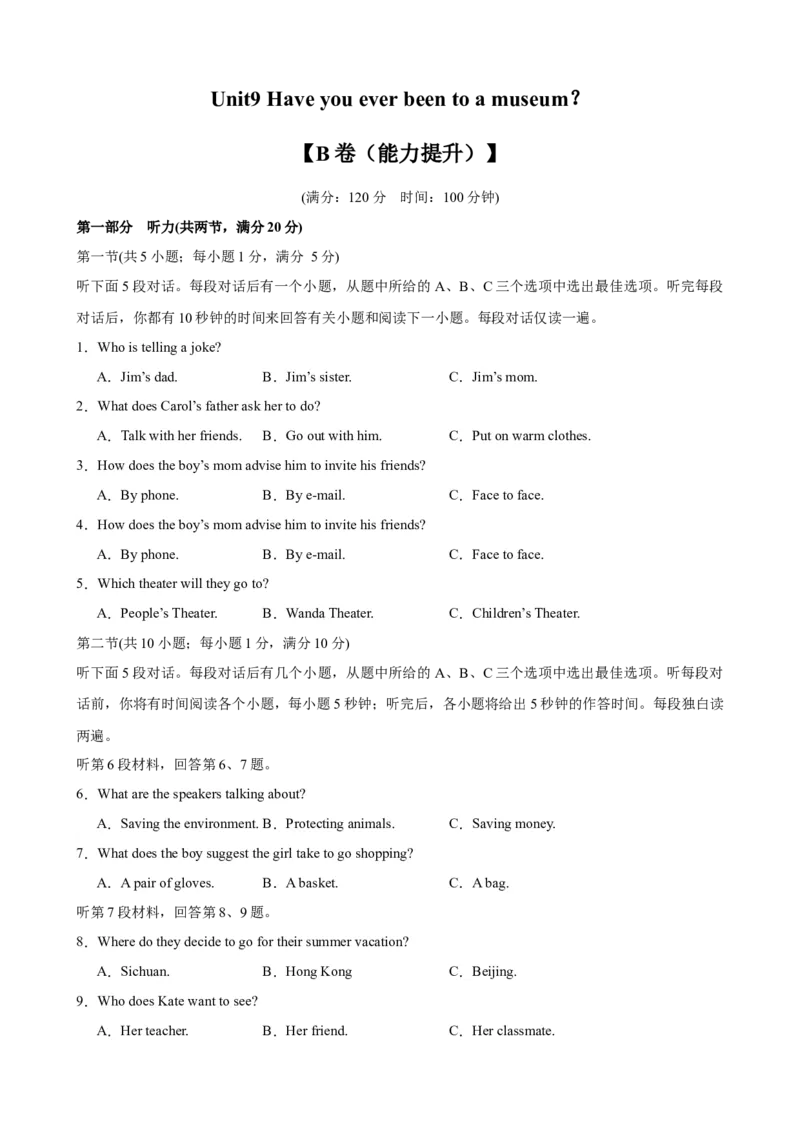
Unit9 Have you ever been to a museum?
【B 卷(能力提升)】
(满分:120分 时间:100分钟)
第一部分 听力(共两节,满分20分)
第一节(共5小题;每小题1分,满分 5分)
听下面5段对话。每段对话后有一个小题,从题中所给的A、B、C三个选项中选出最佳选项。听完每段
对话后,你都有10秒钟的时间来回答有关小题和阅读下一小题。每段对话仅读一遍。
1.Who is telling a joke?
A.Jim’s dad. B.Jim’s sister. C.Jim’s mom.
2.What does Carol’s father ask her to do?
A.Talk with her friends. B.Go out with him. C.Put on warm clothes.
3.How does the boy’s mom advise him to invite his friends?
A.By phone. B.By e-mail. C.Face to face.
4.How does the boy’s mom advise him to invite his friends?
A.By phone. B.By e-mail. C.Face to face.
5.Which theater will they go to?
A.People’s Theater. B.Wanda Theater. C.Children’s Theater.
第二节(共10小题;每小题1分,满分10分)
听下面5段对话。每段对话后有几个小题,从题中所给的A、B、C三个选项中选出最佳选项。听每段对
话前,你将有时间阅读各个小题,每小题5秒钟;听完后,各小题将给出5秒钟的作答时间。每段独白读
两遍。
听第6段材料,回答第6、7题。
6.What are the speakers talking about?
A.Saving the environment.B.Protecting animals. C.Saving money.
7.What does the boy suggest the girl take to go shopping?
A.A pair of gloves. B.A basket. C.A bag.
听第7段材料,回答第8、9题。
8.Where do they decide to go for their summer vacation?
A.Sichuan. B.Hong Kong C.Beijing.
9.Who does Kate want to see?
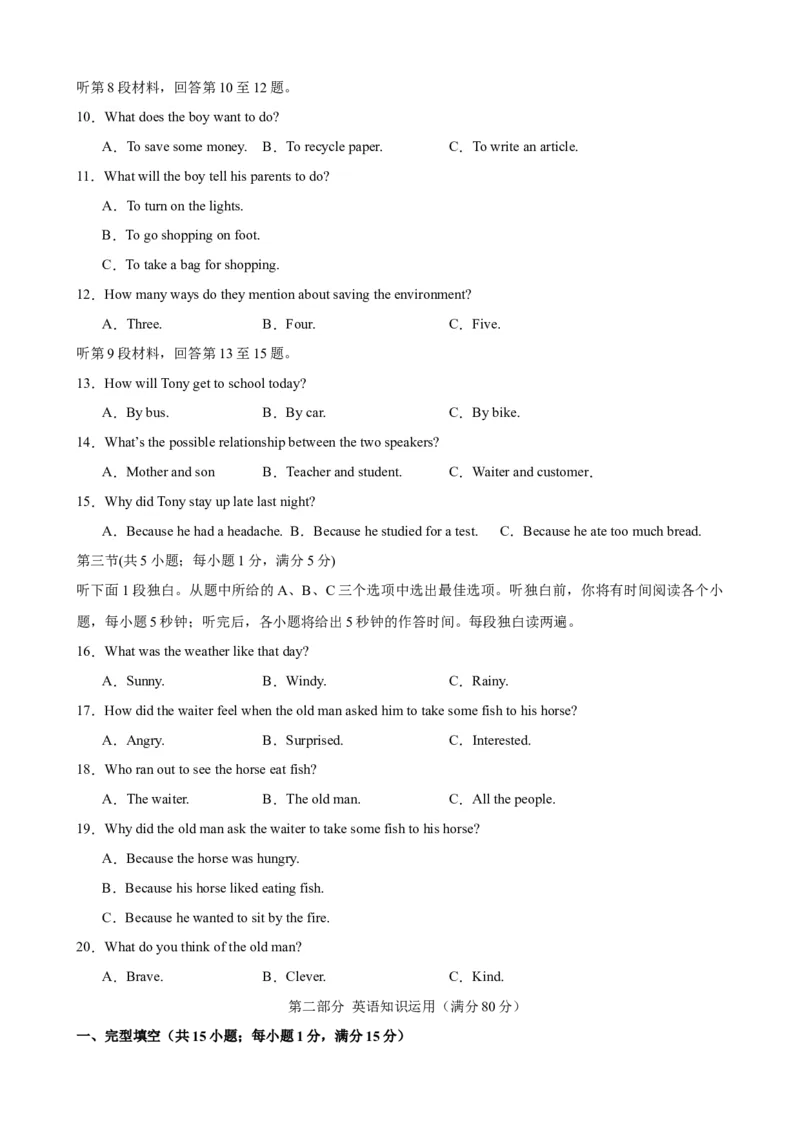
A.Her teacher. B.Her friend. C.Her classmate.听第8段材料,回答第10至12题。
10.What does the boy want to do?
A.To save some money. B.To recycle paper. C.To write an article.
11.What will the boy tell his parents to do?
A.To turn on the lights.
B.To go shopping on foot.
C.To take a bag for shopping.
12.How many ways do they mention about saving the environment?
A.Three. B.Four. C.Five.
听第9段材料,回答第13至15题。
13.How will Tony get to school today?
A.By bus. B.By car. C.By bike.
14.What’s the possible relationship between the two speakers?
A.Mother and son B.Teacher and student. C.Waiter and customer.
15.Why did Tony stay up late last night?
A.Because he had a headache. B.Because he studied for a test. C.Because he ate too much bread.
第三节(共5小题;每小题1分,满分5分)
听下面1段独白。从题中所给的A、B、C三个选项中选出最佳选项。听独白前,你将有时间阅读各个小
题,每小题5秒钟;听完后,各小题将给出5秒钟的作答时间。每段独白读两遍。
16.What was the weather like that day?
A.Sunny. B.Windy. C.Rainy.
17.How did the waiter feel when the old man asked him to take some fish to his horse?
A.Angry. B.Surprised. C.Interested.
18.Who ran out to see the horse eat fish?
A.The waiter. B.The old man. C.All the people.
19.Why did the old man ask the waiter to take some fish to his horse?
A.Because the horse was hungry.
B.Because his horse liked eating fish.
C.Because he wanted to sit by the fire.
20.What do you think of the old man?
A.Brave. B.Clever. C.Kind.
第二部分 英语知识运用(满分80分)
一、完型填空(共15小题;每小题1分,满分15分)阅读下列短文,从每小题所给的A、B、C、D四个选项中选出一个最佳选项。
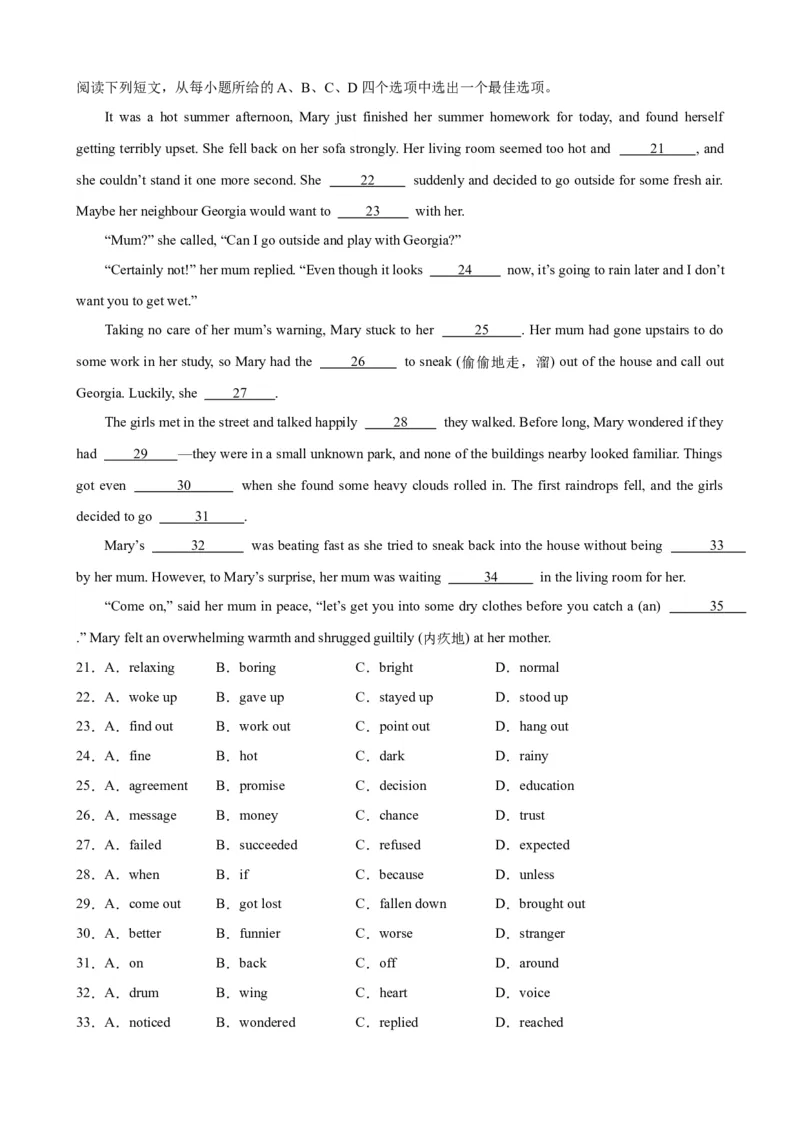
It was a hot summer afternoon, Mary just finished her summer homework for today, and found herself
getting terribly upset. She fell back on her sofa strongly. Her living room seemed too hot and 21 , and
she couldn’t stand it one more second. She 22 suddenly and decided to go outside for some fresh air.
Maybe her neighbour Georgia would want to 23 with her.
“Mum?” she called, “Can I go outside and play with Georgia?”
“Certainly not!” her mum replied. “Even though it looks 24 now, it’s going to rain later and I don’t
want you to get wet.”
Taking no care of her mum’s warning, Mary stuck to her 25 . Her mum had gone upstairs to do
some work in her study, so Mary had the 26 to sneak (偷偷地走,溜) out of the house and call out
Georgia. Luckily, she 27 .
The girls met in the street and talked happily 28 they walked. Before long, Mary wondered if they
had 29 —they were in a small unknown park, and none of the buildings nearby looked familiar. Things
got even 30 when she found some heavy clouds rolled in. The first raindrops fell, and the girls
decided to go 31 .
Mary’s 32 was beating fast as she tried to sneak back into the house without being 33
by her mum. However, to Mary’s surprise, her mum was waiting 34 in the living room for her.
“Come on,” said her mum in peace, “let’s get you into some dry clothes before you catch a (an) 35
.” Mary felt an overwhelming warmth and shrugged guiltily (内疚地) at her mother.
21.A.relaxing B.boring C.bright D.normal
22.A.woke up B.gave up C.stayed up D.stood up
23.A.find out B.work out C.point out D.hang out
24.A.fine B.hot C.dark D.rainy
25.A.agreement B.promise C.decision D.education
26.A.message B.money C.chance D.trust
27.A.failed B.succeeded C.refused D.expected
28.A.when B.if C.because D.unless
29.A.come out B.got lost C.fallen down D.brought out
30.A.better B.funnier C.worse D.stranger
31.A.on B.back C.off D.around
32.A.drum B.wing C.heart D.voice
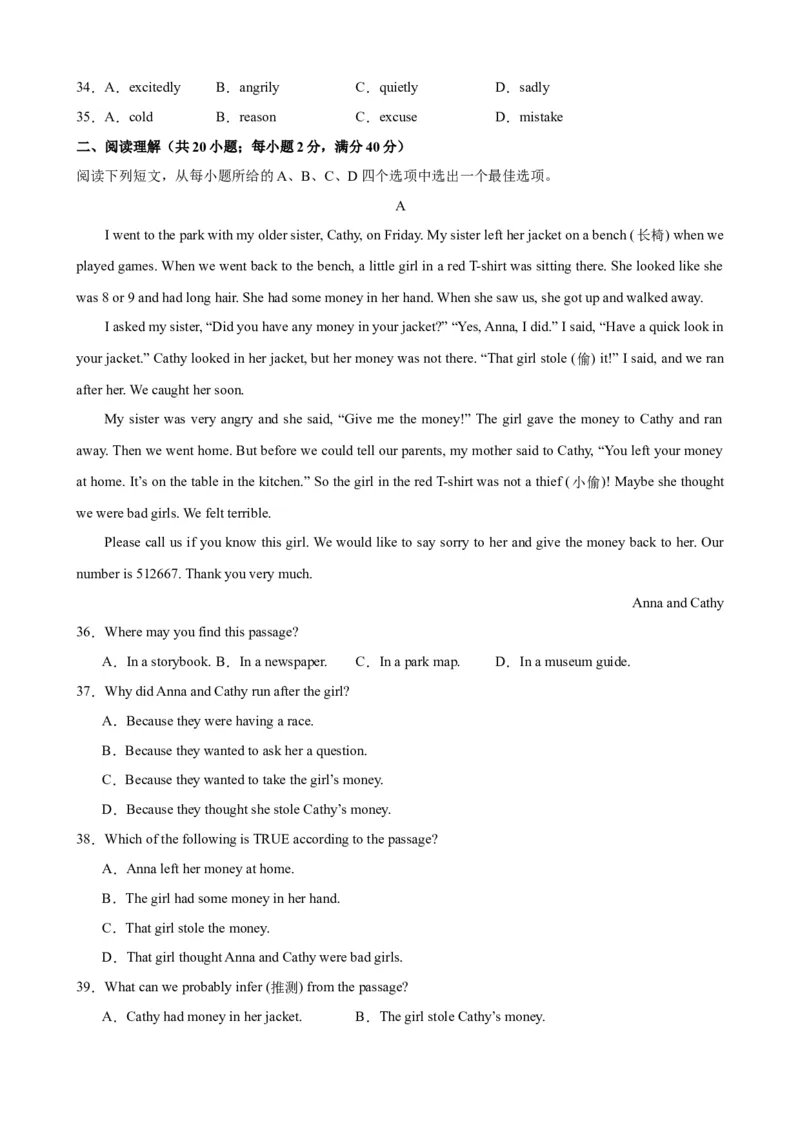
33.A.noticed B.wondered C.replied D.reached34.A.excitedly B.angrily C.quietly D.sadly
35.A.cold B.reason C.excuse D.mistake
二、阅读理解(共20小题;每小题2分,满分40分)
阅读下列短文,从每小题所给的A、B、C、D四个选项中选出一个最佳选项。
A
I went to the park with my older sister, Cathy, on Friday. My sister left her jacket on a bench (长椅) when we
played games. When we went back to the bench, a little girl in a red T-shirt was sitting there. She looked like she
was 8 or 9 and had long hair. She had some money in her hand. When she saw us, she got up and walked away.
I asked my sister, “Did you have any money in your jacket?” “Yes, Anna, I did.” I said, “Have a quick look in
your jacket.” Cathy looked in her jacket, but her money was not there. “That girl stole (偷) it!” I said, and we ran
after her. We caught her soon.
My sister was very angry and she said, “Give me the money!” The girl gave the money to Cathy and ran
away. Then we went home. But before we could tell our parents, my mother said to Cathy, “You left your money
at home. It’s on the table in the kitchen.” So the girl in the red T-shirt was not a thief (小偷)! Maybe she thought
we were bad girls. We felt terrible.
Please call us if you know this girl. We would like to say sorry to her and give the money back to her. Our
number is 512667. Thank you very much.
Anna and Cathy
36.Where may you find this passage?
A.In a storybook. B.In a newspaper. C.In a park map. D.In a museum guide.
37.Why did Anna and Cathy run after the girl?
A.Because they were having a race.
B.Because they wanted to ask her a question.
C.Because they wanted to take the girl’s money.
D.Because they thought she stole Cathy’s money.
38.Which of the following is TRUE according to the passage?
A.Anna left her money at home.
B.The girl had some money in her hand.
C.That girl stole the money.
D.That girl thought Anna and Cathy were bad girls.
39.What can we probably infer (推测) from the passage?
A.Cathy had money in her jacket. B.The girl stole Cathy’s money.C.There wasn’t any money in the jacket. D.Cathy left her money in her red T-shirt.
40.Which of the following best shows the structure (结构) of the passage?
A. B. C. D.
B
When I was six, I spent a summer with my grandma. One day, she asked me to go shopping with a list. A
lady was there in the store.
“Excuse me, I need to buy these,” I said, showing my list. She looked up and said, “Little girl, I’m Miss
Change. There’s no one here but you and me. I think you need to get them by yourself.”
I went to the store every Tuesday and Thursday that summer. Sometimes she shortchanged (少找零钱) me.
Other times she overcharged (多收钱) me. Going to the store was like going into battle (战斗). All summer long
she found ways to trick me. But by the end of the summer, the shopping trip that had once taken me an hour was
done in 15 minutes.
The morning I was ready to run home.
“All right, little girl,” she said. “What did you learn this summer?”
“That you’re bad!” I replied.
She just laughed and said, “I know what you think of me. Well, I don’t care! My job is to teach every child I
meet life lessons. When you get older, you’ll be glad!”
Glad I met her? Ha!
Until one day, my daughter came to me with homework problems. “It’s too hard,” she said. “Could you finish
my math problems for me?”
“If I do it for you, how will you ever learn to do it yourself?” I said. Suddenly, I was back at that store where
I had learned the hard way to add up my money by myself.
41.What did Miss Change probably do?
A.A saleswoman. B.A teacher. C.A writer. D.An actress.
42.The underlined word “trick” in para. 4 is closest in meaning to ________.
A.serve B.refuse C.joke D.invite43.What did the writer learn during her shopping trip?
A.Getting along well with others. B.Doing things by herself.
C.Learning the way of sell things. D.Helping with shopping work.
44.The underlined sentence shows that the writer ________.
A.agreed with Miss Change B.was happy to hear that
C.was glad to meet Miss Change D.thought the idea was funny
45.What would be the best title for the passage?
A.A Shopping Lesson B.A Long Summer
C.An Interesting Lady D.A Math Problem
C
Man always wanted to fly in the sky. They watched birds flying and wished they could fly, too. Man made
wings and tied (绑) them on their bodies to help them fly. But they failed again and again. Man knew how to make
kites. They made different kinds of kites and tried to fly with the help of them. But unluckily, many of them were
badly hurt. So they had to stop trying to fly with wings.
In 1783, two Frenchmen found hot air was lighter than cold air. They then built a balloon. They filled it with
hot air and it went up into the air. The next year a big hot-air balloon carried 7 persons to a height of 900 metres.
Later, airships (飞艇) were made in the world. It could fly up into the sky with the help of hydrogen gas (氢
气). The hydrogen gas caught fire very easily. At last people stopped making airships.
Now, people can travel to different places by plane. It’s very convenient and fast. Rockets are also known all
over the world. Rockets can help people travel in space. The dream of flying to space has become true.
46.Man made wings because ________.
A.they wanted to be birds B.they wanted to make kites
C.they wanted to fly in the sky D.they wanted to fly with kites
47.Many people tried to fly with the help of kites ________.
A.but failed again and again B.but were badly hurt
C.and could fly to a height of 900 metres D.and could fly up into the sky
48.The underline word “filled” means ________.
A.混合 B.搭配 C.充满 D.连接
49.People can travel to space with the help of ________.
A.planes B.airships C.hot-air balloons D.rockets
50.Hydrogen gas was ________ so people stopped making airships.
A.not safe B.too expensive C.not easy D.too heavyD
Picture this: Students pass their school work through different hands, from their group leader to the class
representative (课代表) and finally to the teacher. It might not sound too difficult, but sometimes it can go wrong
and take a lot of time.
To deal with this problem, Zhang Xirui from Shenzhen came up with a useful tool—a smart homework
collection robot. This won him first prize in the 20th Guangdong Provincial Children’s Invention Awards.
The robot uses radio frequency identification (RFID,射频识别) technology—a reader and a special tag (标
签) that can share information without touching each other. This way, it can help find and know what it is looking
for. Each student’s notebook has a special RFID tag with their name and the subject. Students only need to put
their notebooks on the robot, and the machine “sees” the notebook, reads its tag and takes it out of the name list.
“Teachers can check who hasn’t handed in homework by connecting their phones with the robot through Wi-Fi,”
the 13-year-old student said.
The robot is the second-generation (第二代) model made by Zhang. Now, he’s planning to develop a third-
generation and hopes to use ultra-high-frequency (超高频) radio technology to read lots of RFID tags from far
away. That means if you stick a special tag on your notebook, the robot can read the information from a thick
stack (堆) of notebooks at once. Zhang believes this is the key to how artificial intelligence (人工智能) can make
life easier for us.
Zhang dreams of becoming a scientist when he grows up. “I have tried making model airplanes and other
creative projects. Inventing has brought me joy and happiness,” he said.
51.Why did Zhang Xirui invent a smart collection robot?
A.Because his father was a scientist.
B.Because he was the class representative.
C.Because his teacher asked him to do that.
D.Because passing students’ school work could go wrong and took a lot of time.
52.How old is Zhang Xirui?
A.12. B.13. C.14. D.15.
53.How does the robot work?
a. The machine reads the notebook’s tag.
b. The machine takes the notebook out of the name list.
c. The machine “sees” the notebook.
d. Students only need to put their notebooks on the robot.
A.d→c→a→b B.d→b→c→a C.a→b→c→d D.c→b→d→a54.How do teachers know who hasn’t handed in homework?
A.By touching the robot. B.By turning on the computer.
C.By calling Zhang Xirui. D.By connecting their phones with the robot through Wi-Fi.
55.What’s the best title for the passage?
A.A Smart Robot Helper at School B.A Creative Boy
C.A Fun Project D.A Science Report
三、补全对话(共5小题;每小题1分,满分5分)
根据对话内容,从文后的选项中选出能填入空白处的最佳选项,其中有两个为多余选项。
A: Welcome to “Problem Line”. 56
B: This is David speaking.
A: Hi, David. 57 We are listening.
B: Sure. I have problems with my mom. Every time we talk about something, we argue (争吵) a lot. Sometimes
we shout at each other.
A: 58 It’s not right to do so.
B: I know. But she always arranges (安排) everything for me. I can’t even decide what to wear on weekends.
A: That’s too bad. 59
B: I tried, but it didn’t work because she never listened to me. She thinks I should listen to her because I’m her
child.
A: Well, that’s a difficult problem. 60
B: Really? What’s it?
A: You can ask your teacher for help. Your mother may listen to your teacher.
B: OK. I’ll have a try. Thank you.
A: You are welcome.
A.I can talk to her.
B.You look so upset.
C.Who’s that speaking?
D.Why not talk to her about it?
E.But maybe I have good advice.
F.Please don’t shout at our mom.
G.Would you like to share your problem with us?
四、短文填空(共10小题;每小题1分,满分10分)
阅读下面短文,在空格处填入一个适当的词,或使用括号中词语的正确形式填空。
My grandmother was an iron-willed (强硬的) woman. When I was five, she invited some friends to her home61 (have) dinner. Among the guests (客人) there 62 (be) a rich man and his daughter.
Grandmother considered (把……当做) them the most important guests.
During the party, I went to the bathroom. I was still sitting down when the girl walked in and said to me “You
63 (stay) here too long!”
“It’s not your business (不管你的事). Don’t you know that little girls shouldn’t come into the bathroom
when a little boy 64 (use) it!?” I said angrily. This 65 (surprise) the little girl. Then she
started to cry. Most guests had heard what I said and laughed. But not Grandmother. She 66 (wait) for
me when I left the bathroom. Grandmother shouted that I was impolite (不礼貌的) and rude and ordered, “You
67 (say) sorry to her.” All the guests watched in silence.
Twenty minutes later, Grandmother walked by the bathroom and saw a torrent (激流) of water 68
(run) out from under the door. Everyone knew who did that. Of course it’s me. I wanted to make Grandmother
angry. Without doubt, Grandmother was so angry that she tried to get me anyway. It took several strong men
finally to move her away and calm her down.
My grandfather took me by the hand and seated me on his lap (把我放在他腿上). He looked at me, not at all
angry or upset. “Tell me, my boy, why did you do it?”
“Well, she shouted at me for nothing.” I said seriously “Now she has got something to be angry at.”
Grandfather didn’t speak right away. He just sat there, looking at me and smiling. I 69 never
______9_____ (forget) his expressions (表情) for my whole life.
“Eric,” he said at last, “I 70 (think) you do the right thing.”
五、阅读短文回答问题(共5小题;每小题2分,满分10分)
Friendship comes before competition (比赛). It’s easy to say but hard to do. However, 11-year-old Jerome, a
boy from Australia, did it and set us a good example.
Jerome was good at running. In all the races he took part in, he was always the first. But last November, after
giving up winning a school race, the boy won hearts of thousands of people. In the race, kind Jerome ran back to
help his good friend Seth stand up after he fell down. And then he walked with him and let him cross the finishing
line first.
Seth, ten years old, had cerebral palsy (脑瘫). After he moved to the school last year, he got lots of problems.
His teacher Mrs. Taylor asked Jerome to help him with things like going to the toilet (厕所) and showing him
around. The two boys soon became good friends. Because of his illness, Seth had a big head. Some students
laughed at him. Jerome usually stopped them.
Seth’s father thanked Jerome for looking after his son. He said to Jerome. “You are such a good kid.” The
two boys’ story spread (传播) quickly after Jerome’s mother Susan shared it on the Internet.“These boys didn’t win, but they are champions (冠军).” said the mother.
71.What did Jerome do well in?
72.What did Jerome do after seeing Seth fall down?
73.When did Seth move to Jerome’s school?
74.What did Seth look like because of his illness?
75.Why did Seth’s father thank Jerome?
第三部分 写作(满分20分)
六、书面表达(满分20分)
学校英语文化节将举办“秀秀我的家乡”的 Vlog(短视频)比赛。假如你是Zhang Lei,请根据以下
思维导图中的内容要点提示,用英语写一篇Vlog解说词介绍你的家乡。
注意:
(1)包含所有内容要点,可适当增加细节,以使行文连贯;
(2)文中不得透露个人信息;
(3)词数80左右(短文首尾句已给出,不计入总词数)。
参考词汇:places of interest(名胜),delicious food(美食),the best time to(……的最佳时间)
Hello, I’m Zhang Lei. I’d like to say something about my hometown.
___________________________________________________________________________________________
___________________________________________________________________________________________
___________________________________________________________________________________________
___________________________________________________________________________________________
___________________________________________________________________________________________
___________________________________________________________________________________________
______Welcome to my hometown. I’m sure you will like it.