文档文本内容
Unit 2 I’ll help to clean up the city park.
单元知识清单 Section A
一、 基础知识清单
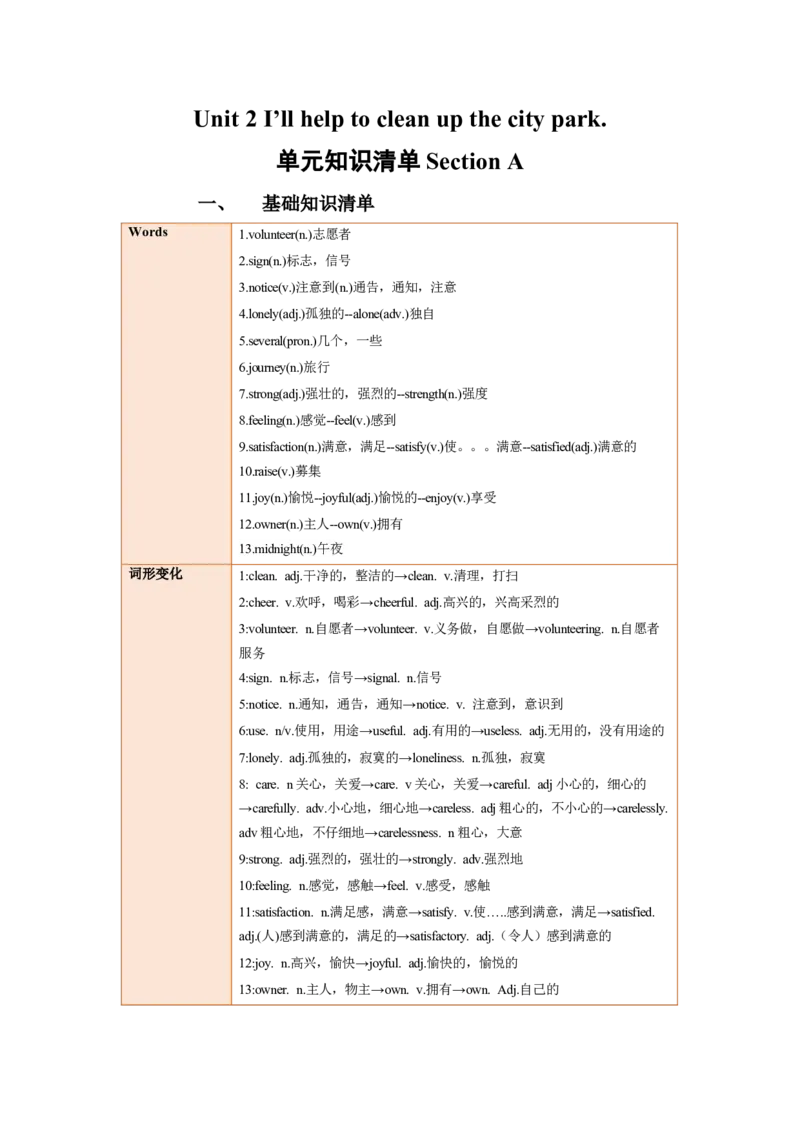
Words 1.volunteer(n.)志愿者
2.sign(n.)标志,信号
3.notice(v.)注意到(n.)通告,通知,注意
4.lonely(adj.)孤独的--alone(adv.)独自
5.several(pron.)几个,一些
6.journey(n.)旅行
7.strong(adj.)强壮的,强烈的--strength(n.)强度
8.feeling(n.)感觉--feel(v.)感到
9.satisfaction(n.)满意,满足--satisfy(v.)使。。。满意--satisfied(adj.)满意的
10.raise(v.)募集
11.joy(n.)愉悦--joyful(adj.)愉悦的--enjoy(v.)享受
12.owner(n.)主人--own(v.)拥有
13.midnight(n.)午夜
词形变化 1:clean. adj.干净的,整洁的→clean. v.清理,打扫
2:cheer. v.欢呼,喝彩→cheerful. adj.高兴的,兴高采烈的
3:volunteer. n.自愿者→volunteer. v.义务做,自愿做→volunteering. n.自愿者
服务
4:sign. n.标志,信号→signal. n.信号
5:notice. n.通知,通告,通知→notice. v. 注意到,意识到
6:use. n/v.使用,用途→useful. adj.有用的→useless. adj.无用的,没有用途的
7:lonely. adj.孤独的,寂寞的→loneliness. n.孤独,寂寞
8: care. n关心,关爱→care. v关心,关爱→careful. adj小心的,细心的
→carefully. adv.小心地,细心地→careless. adj粗心的,不小心的→carelessly.
adv粗心地,不仔细地→carelessness. n粗心,大意
9:strong. adj.强烈的,强壮的→strongly. adv.强烈地
10:feeling. n.感觉,感触→feel. v.感受,感触
11:satisfaction. n.满足感,满意→satisfy. v.使…..感到满意,满足→satisfied.
adj.(人)感到满意的,满足的→satisfactory. adj.(令人)感到满意的
12:joy. n.高兴,愉快→joyful. adj.愉快的,愉悦的
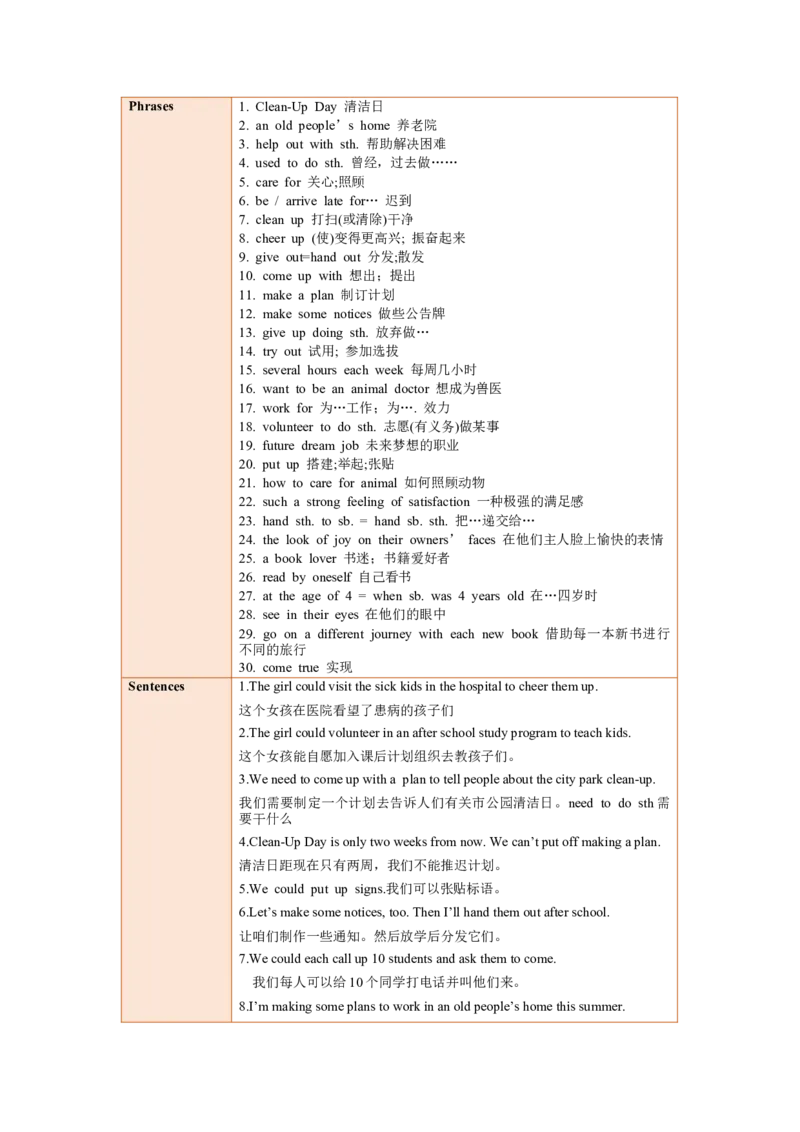
13:owner. n.主人,物主→own. v.拥有→own. Adj.自己的Phrases 1. Clean-Up Day 清洁日
2. an old people’s home 养老院
3. help out with sth. 帮助解决困难
4. used to do sth. 曾经,过去做……
5. care for 关心;照顾
6. be / arrive late for… 迟到
7. clean up 打扫(或清除)干净
8. cheer up (使)变得更高兴; 振奋起来
9. give out=hand out 分发;散发
10. come up with 想出;提出
11. make a plan 制订计划
12. make some notices 做些公告牌
13. give up doing sth. 放弃做…
14. try out 试用; 参加选拔
15. several hours each week 每周几小时
16. want to be an animal doctor 想成为兽医
17. work for 为…工作;为…. 效力
18. volunteer to do sth. 志愿(有义务)做某事
19. future dream job 未来梦想的职业
20. put up 搭建;举起;张贴
21. how to care for animal 如何照顾动物
22. such a strong feeling of satisfaction 一种极强的满足感
23. hand sth. to sb. = hand sb. sth. 把…递交给…
24. the look of joy on their owners’ faces 在他们主人脸上愉快的表情
25. a book lover 书迷;书籍爱好者
26. read by oneself 自己看书
27. at the age of 4 = when sb. was 4 years old 在…四岁时
28. see in their eyes 在他们的眼中
29. go on a different journey with each new book 借助每一本新书进行
不同的旅行
30. come true 实现
Sentences 1.The girl could visit the sick kids in the hospital to cheer them up.
这个女孩在医院看望了患病的孩子们
2.The girl could volunteer in an after school study program to teach kids.
这个女孩能自愿加入课后计划组织去教孩子们。
3.We need to come up with a plan to tell people about the city park clean-up.
我们需要制定一个计划去告诉人们有关市公园清洁日。need to do sth需
要干什么
4.Clean-Up Day is only two weeks from now. We can’t put off making a plan.
清洁日距现在只有两周,我们不能推迟计划。
5.We could put up signs.我们可以张贴标语。
6.Let’s make some notices, too. Then I’ll hand them out after school.
让咱们制作一些通知。然后放学后分发它们。
7.We could each call up 10 students and ask them to come.
我们每人可以给10个同学打电话并叫他们来。
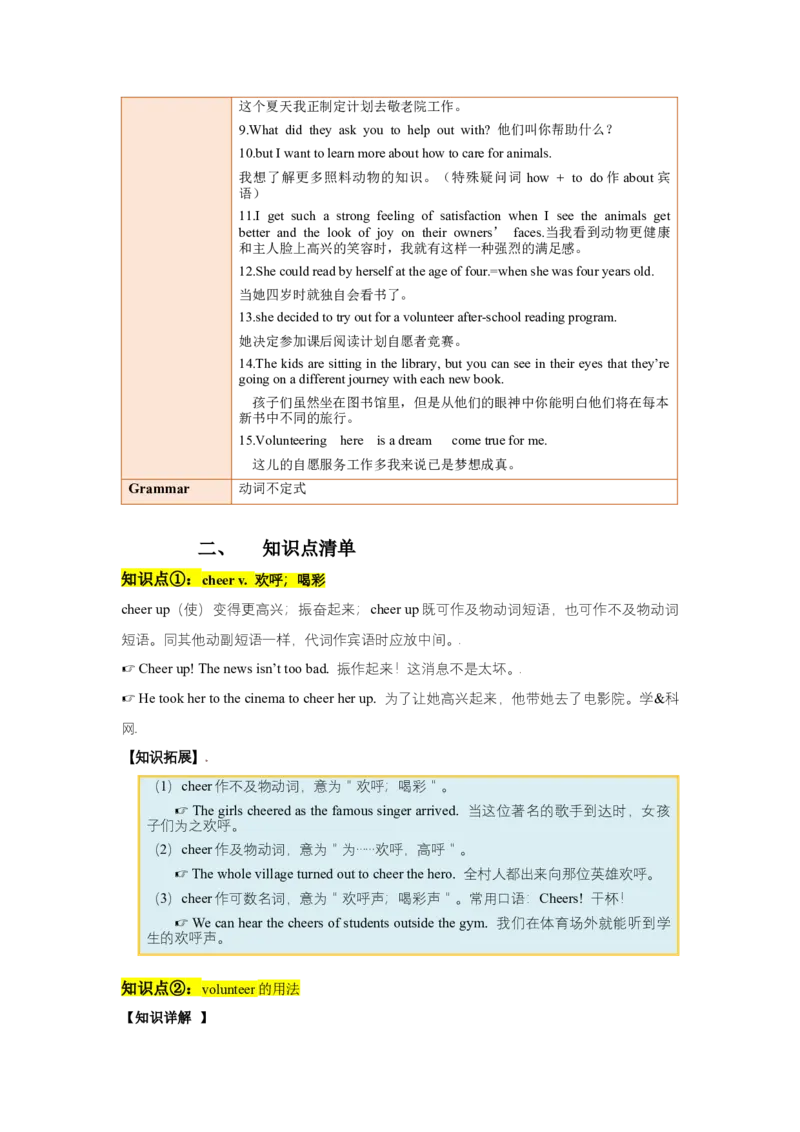
8.I’m making some plans to work in an old people’s home this summer.这个夏天我正制定计划去敬老院工作。
9.What did they ask you to help out with? 他们叫你帮助什么?
10.but I want to learn more about how to care for animals.
我想了解更多照料动物的知识。(特殊疑问词 how + to do作about宾
语)
11.I get such a strong feeling of satisfaction when I see the animals get
better and the look of joy on their owners’ faces.当我看到动物更健康
和主人脸上高兴的笑容时,我就有这样一种强烈的满足感。
12.She could read by herself at the age of four.=when she was four years old.
当她四岁时就独自会看书了。
13.she decided to try out for a volunteer after-school reading program.
她决定参加课后阅读计划自愿者竞赛。
14.The kids are sitting in the library, but you can see in their eyes that they’re
going on a different journey with each new book.
孩子们虽然坐在图书馆里,但是从他们的眼神中你能明白他们将在每本
新书中不同的旅行。
15.Volunteering here is a dream come true for me.
这儿的自愿服务工作多我来说已是梦想成真。
Grammar 动词不定式
二、 知识点清单
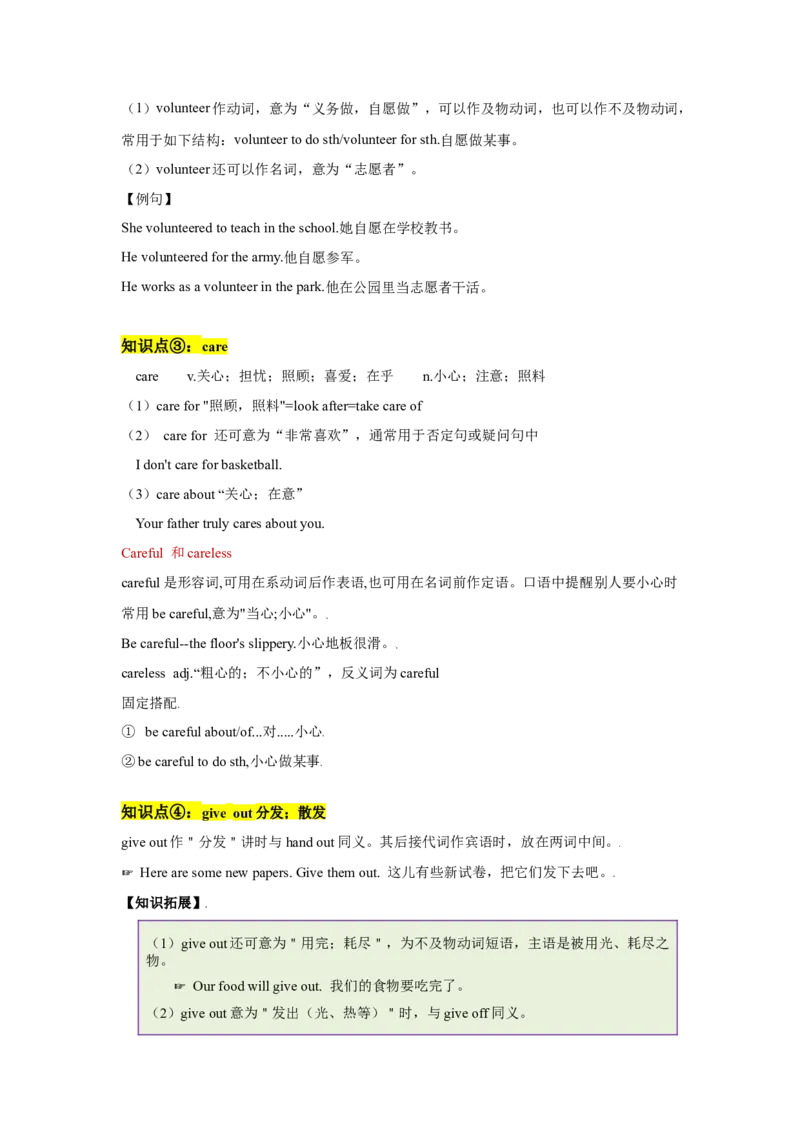
知识点①:cheer v. 欢呼;喝彩
cheer up(使)变得更高兴;振奋起来;cheer up既可作及物动词短语,也可作不及物动词
短语。同其他动副短语一样,代词作宾语时应放中间。
☞ Cheer up! The news isn’t too bad. 振作起来!这消息不是太坏。
☞ He took her to the cinema to cheer her up. 为了让她高兴起来,他带她去了电影院。学&科
网
【知识拓展】
(1)cheer作不及物动词,意为"欢呼;喝彩"。
☞ The girls cheered as the famous singer arrived. 当这位著名的歌手到达时,女孩
子们为之欢呼。
(2)cheer作及物动词,意为"为……欢呼,高呼"。
☞ The whole village turned out to cheer the hero. 全村人都出来向那位英雄欢呼。
(3)cheer作可数名词,意为"欢呼声;喝彩声"。常用口语:Cheers! 干杯!
☞ We can hear the cheers of students outside the gym. 我们在体育场外就能听到学
生的欢呼声。
知识点②:volunteer的用法
【知识详解 】(1)volunteer作动词,意为“义务做,自愿做”,可以作及物动词,也可以作不及物动词,
常用于如下结构:volunteer to do sth/volunteer for sth.自愿做某事。
(2)volunteer还可以作名词,意为“志愿者”。
【例句】
She volunteered to teach in the school.她自愿在学校教书。
He volunteered for the army.他自愿参军。
He works as a volunteer in the park.他在公园里当志愿者干活。
知识点③:care
care v.关心;担忧;照顾;喜爱;在乎 n.小心;注意;照料
(1)care for "照顾,照料"=look after=take care of
(2) care for 还可意为“非常喜欢”,通常用于否定句或疑问句中
I don't care for basketball.
(3)care about “关心;在意”
Your father truly cares about you.
Careful 和careless
careful是形容词,可用在系动词后作表语,也可用在名词前作定语。口语中提醒别人要小心时
常用be careful,意为"当心;小心"。
Be careful--the floor's slippery.小心地板很滑。
careless adj.“粗心的;不小心的”,反义词为careful
固定搭配
① be careful about/of...对.....小心
②be careful to do sth,小心做某事
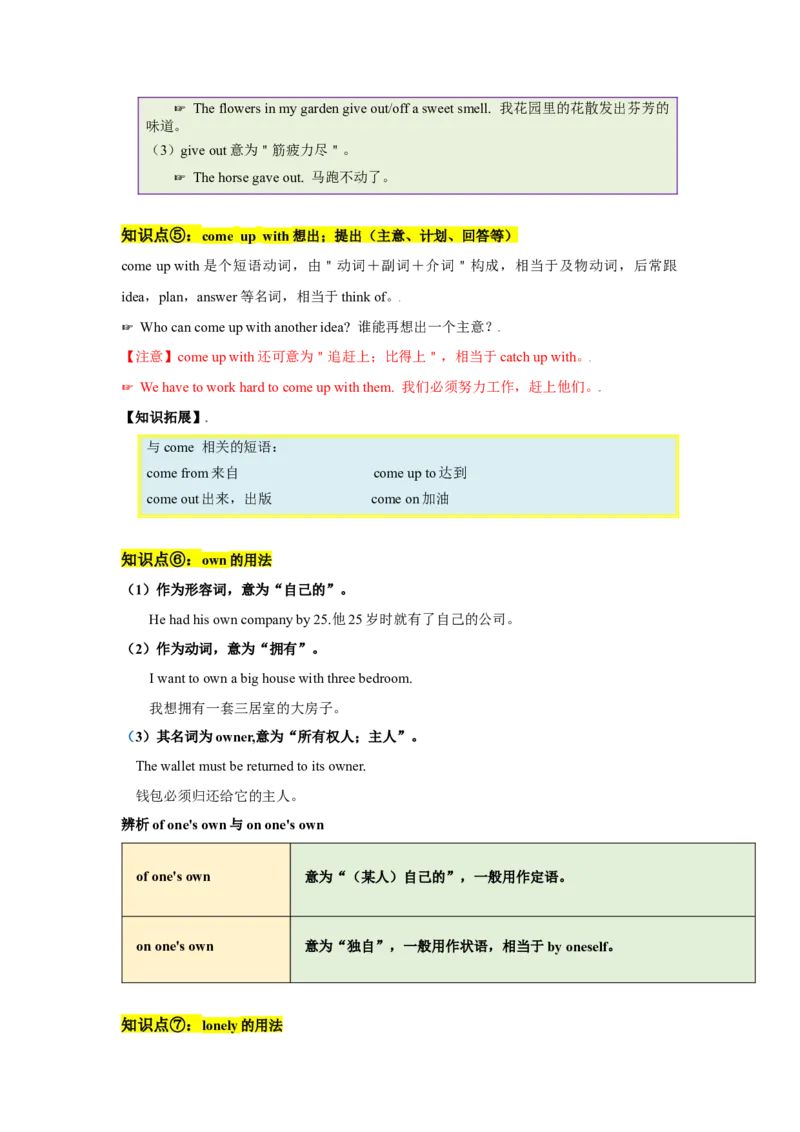
知识点④:give out分发;散发
give out作"分发"讲时与hand out同义。其后接代词作宾语时,放在两词中间。
☞ Here are some new papers. Give them out. 这儿有些新试卷,把它们发下去吧。
【知识拓展】
(1)give out还可意为"用完;耗尽",为不及物动词短语,主语是被用光、耗尽之
物。
☞ Our food will give out. 我们的食物要吃完了。
(2)give out意为"发出(光、热等)"时,与give off同义。☞ The flowers in my garden give out/off a sweet smell. 我花园里的花散发出芬芳的
味道。
(3)give out意为"筋疲力尽"。
☞ The horse gave out. 马跑不动了。
知识点⑤:come up with想出;提出(主意、计划、回答等)
come up with是个短语动词,由"动词+副词+介词"构成,相当于及物动词,后常跟
idea,plan,answer等名词,相当于think of。
☞ Who can come up with another idea? 谁能再想出一个主意?
【注意】come up with还可意为"追赶上;比得上",相当于catch up with。
☞ We have to work hard to come up with them. 我们必须努力工作,赶上他们。
【知识拓展】
与come 相关的短语:
come from来自 come up to达到
come out出来,出版 come on加油
知识点⑥:own的用法
(1)作为形容词,意为“自己的”。
He had his own company by 25.他25岁时就有了自己的公司。
(2)作为动词,意为“拥有”。
I want to own a big house with three bedroom.
我想拥有一套三居室的大房子。
(3)其名词为owner,意为“所有权人;主人”。
The wallet must be returned to its owner.
钱包必须归还给它的主人。
辨析of one's own与on one's own
of one's own 意为“(某人)自己的”,一般用作定语。
on one's own 意为“独自”,一般用作状语,相当于by oneself。
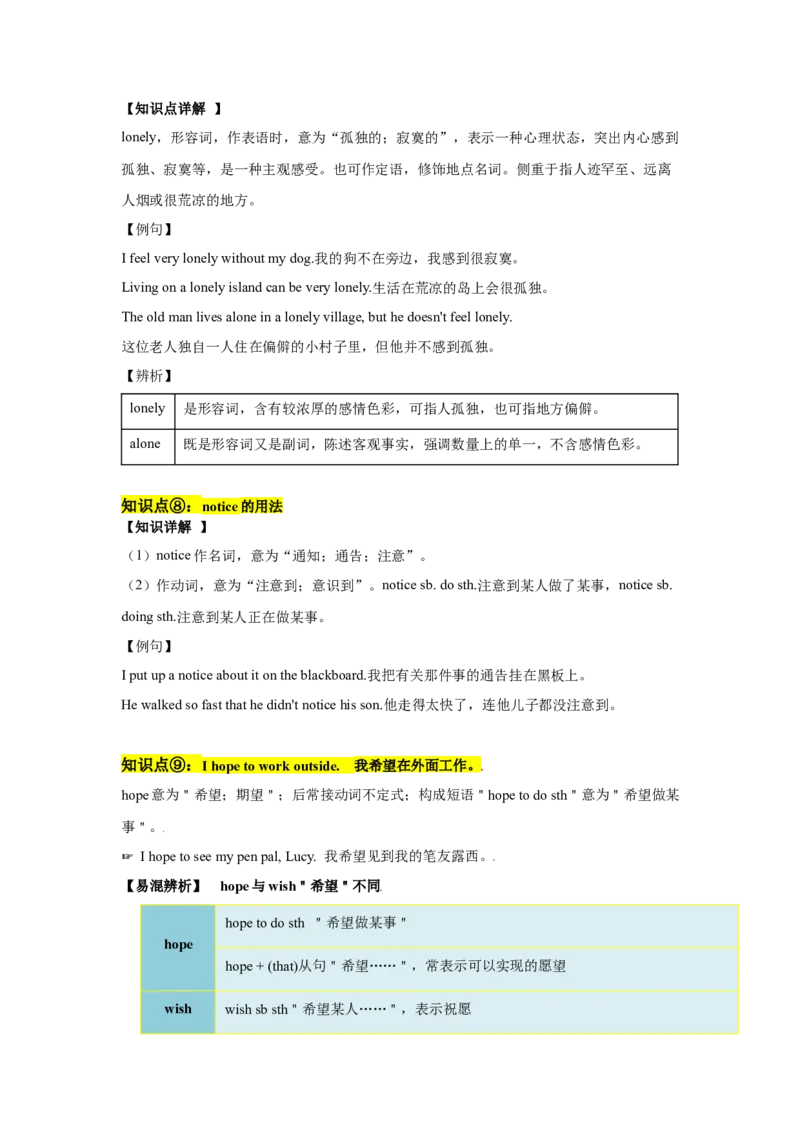
知识点⑦:lonely的用法【知识点详解 】
lonely,形容词,作表语时,意为“孤独的;寂寞的”,表示一种心理状态,突出内心感到
孤独、寂寞等,是一种主观感受。也可作定语,修饰地点名词。侧重于指人迹罕至、远离
人烟或很荒凉的地方。
【例句】
I feel very lonely without my dog.我的狗不在旁边,我感到很寂寞。
Living on a lonely island can be very lonely.生活在荒凉的岛上会很孤独。
The old man lives alone in a lonely village, but he doesn't feel lonely.
这位老人独自一人住在偏僻的小村子里,但他并不感到孤独。
【辨析】
lonely 是形容词,含有较浓厚的感情色彩,可指人孤独,也可指地方偏僻。
alone 既是形容词又是副词,陈述客观事实,强调数量上的单一,不含感情色彩。
知识点⑧:notice的用法
【知识详解 】
(1)notice作名词,意为“通知;通告;注意”。
(2)作动词,意为“注意到;意识到”。notice sb. do sth.注意到某人做了某事,notice sb.
doing sth.注意到某人正在做某事。
【例句】
I put up a notice about it on the blackboard.我把有关那件事的通告挂在黑板上。
He walked so fast that he didn't notice his son.他走得太快了,连他儿子都没注意到。
知识点⑨:I hope to work outside. 我希望在外面工作。
hope意为"希望;期望";后常接动词不定式;构成短语"hope to do sth"意为"希望做某
事"。
☞ I hope to see my pen pal, Lucy. 我希望见到我的笔友露西。
【易混辨析】 hope与wish"希望"不同
hope to do sth "希望做某事"
hope
hope + (that)从句"希望……",常表示可以实现的愿望
wish wish sb sth"希望某人……",表示祝愿wish to do sth"希望做某事"
wish sb to do sth"希望某人做某事"
wish +(that)从句"希望……",常表示不可能实现或实现的可能性较小的愿望
hope和wish都可作名词,但hope意为"希望";wish意为"愿望;心愿;祝愿"。
【误区警示】
hope后可接不定式作宾语,但不能接复合宾语。即我们可以表达为:hope to do sth,但
不可以表达为hope sb to do sth。
知识点10:You could help to clean up the city parks. 你可以帮着清洁城市公园。
(1)could是情态动词,无人称和数的变化,后接动词原形。句中could用于提出建议,比
can语气更为委婉。此外,could还常用于有礼貌地向对方提出要求或请求。
☞ He asked if he could have a cup of coffee. 他问是否可以喝一杯咖啡。
(2)句中help作动词,意为"帮助",后跟不定式作宾语。
☞ Laura helped me to plan my trip. 萝拉帮我规划我的旅游行程。
【知识拓展】help的不同词性
(1)作及物动词,意为"帮助;援助;促进;对……有帮助",其常见用法如下:
后常跟名词、代词作
☞ Let me help you. 让我来帮你。
宾语
后常跟动词不定式作
☞ Schools need volunteers to help children (to) read. 学校需要义
宾语或宾语补足语,
务工作者帮助儿童阅读。
不定式符号to可省略
help sb with sth"帮助某人做某事"
用于某些固定结构中 help oneself to... "自用,自取(食物、饮料等)"
can’t help doing sth"忍不住;情不自禁做某事"
(2)作名词,意为"帮助;帮忙",常用作不可数名词,其常用短语为 with the help
of..."在……的帮助下"。三、 语法清单
语法①:动词不定式
动词不定式是一种非谓语动词形式,其结构为"to+动词原形",其中to不是介词,
而是动词不定式的符号,称为小品词,动词不定式没有人称和数的变化。动词不定式和其
后面的名词等构成不定式短语,在句子中可以用作主语、表语、宾语、补足语、定语、状
语等。本单元主要学习其作宾语、状语、宾补的用法。
◆ 动词不定式的形式及性质
(1)动词不定式的基本形式:to do(to有时可省略);
(2)动词不定式变否定:not (to) do;
(3)动词不定式无人称变化;
(4)动词不定式仍保留动词特点,可以有自己的宾语和状语。
☞ to speak at the meeting 在会议上发言 to read newspapers 看报纸
◆ 动词不定式的句法作用
一、作宾语
动词不定式(短语)可以放在一些动词后面用作宾语,能以动词不定式作宾语的动词
有:begin,want,remember,agree,learn,like,decide,fail,pretend,demand,refuse
等。
☞ You must learn to look after yourself. 你必须学着照顾自己。
☞ They volunteer to clean up the house for the old lady. 他们自愿给老人打扫房子。
☞ They would like to come by bus. 他们想乘公共汽车来。
二、作宾语补足语。
☞ I tell him to arrive on Sunday. 我让他周日到达。
☞ Li Lei asked his deskmate to help him with English. 李磊请同桌帮他学英语。
☞ The teacher asked the students to read it again. 那个老师让学生们又把它读了一遍。
动词不定式作宾语补足语,表示宾语所做的动作,可以用动词不定式作宾语补足语的
动词有:tell,ask,want,like,invite,encourage,help等。但在see,watch,hear,feel,
notice等感官动词或let,make,have等使役动词后面作宾语补足语的动词不定式一般要省
略动词不定式符号"to",可以归纳为以下三种句式:
1. 不可以省to的不定式作宾语补足语:tell /ask / want / would like / wish / suppose / invite /
encourage / teach / depend on等+ sb + to do sth☞ The teacher told us to come earlier tomorrow. 老师告诉我们明天早点来。
☞ Her parents wish her to be a teacher. 她的父母希望她成为一名教师。
2. 省"to"的不定式作宾语补足语:
(1)Let / make / have + sb +do sth
☞ Let the boy go out now. 让那个男孩现在出去。
☞ They made the children play the piano 6 hours a day last month. 上个月他们让这些孩
子每天弹6个小时的钢琴。
(2)see / watch / hear / notice / feel + sb +do sth
☞ I heard them argue this morning. 今天早上我听到他们吵架了。(强调整个过程)
【注意】
①help带不带to均可以。
☞ I often help my mother (to) do housework. 我经常帮助妈妈做家务。
②此类动词后用不带to的不定式作宾补,当变被动时,必须还原to。
☞ William is often seen to play Chinese kung fu in the park. 人们常看到威廉在公园
练中国功夫。
4. 否定形式:
(1)动词不定式的否定式是直接在to前加上not。
☞ Tell them not to play football in the street.
(2)省to的动词不定式的否定式是直接在动词前面加not。
☞ Let the boy not go. 不要让那个男孩走。
三、作状语
(1)作目的状语。
☞ He stopped to have a rest. 他停下来休息。
强调动词不定式所表示的目的时,动词不定式可用in order to或so as to +动词原形,
so as to不可用于句首。
☞ The bus stopped so as to pick up passengers. 公共汽车停下来以便接乘客。
(2)作结果状语。
☞ He woke up only to find everybody gone. 他醒来时才发现所有的人都走了。
☞ His grandma lived to see the liberation of China. 他奶奶活到了中国解放。
☞ He is old enough to go to school. 他年龄足够大了,可以去上学了。
(3)在某些表示喜、怒、哀、乐等的形容词后作原因状语。
☞ I’m proud to have taken part in the competitions. 很荣幸参加了这些竞赛。☞ I’m happy to have found many things I can do. 很高兴找到了很多我能做的事。
◆ 动词不定式可以和what,which,how,where,when等特殊疑问词连用。
☞ The question is I don’t know when to start. 问题是我不知道什么时候开始。
☞ You do not know what to do and how to do it. 你不知道要去做什么或者怎么做。
语法②:动词短语
短语动词是一种固定词组,由动词加介词或副词等构成,其作用相当于一个动词。
◆ 构成:
常见的形式有:1. 动词+副词,如:put up
2. 动词+介词,如:look at
3. 动词+副词+介词,如:run out of
4. 动词+名词+介词,如:take care of
◆ 动词+副词
(1)常见的相当于及物动词的这类短语动词有:
cheer up(振奋起来),clean up(打扫干净),set up(建立),put up(搭建,张贴)
cut up(切碎),fix up(修理),work out(算出),give out(分发),give away(赠送)
think over(仔细思考),turn over(把……翻过来),hand in(上交)等。
【注意】此类短语相当于及物动词时,后面必须跟宾语,若名词作宾语,可以放在副词前
面或后面,但代词作宾语时,必须置于副词之前。
(2)常见的相当于不及物动词的这类短语动词有:
get up(起床),start off(动身),come back(回来),get down(下来),hold on
(等一下;别挂断),look out(当心,小心),get away(逃离)等。
◆ 动词+介词
这种结构的短语动词在句中作谓语时,后面必须接宾语。常见的有:
look for(寻找),stand for(代表),wait for(等待),pay for(付费),send for(派
人去请),take after(像),hear from(收到……的来信),hear of(听说),depend on
(依靠)等。
◆ 动词+副词+介词
这种短语动词相当于及物动词,介词后面须跟宾语。常见的有:
add up to(总共是),catch up with(赶上),look down upon(瞧不起),run out of
(耗尽,用光)◆ 动词+名词+介词
这种短语动词相当于及物动词,后面需接宾语,有时名词前可以加形容词修饰。常见
的有:make fun of(取笑),make use of(利用),pay attention to(注意),take care of(照
顾)等。
【注意】这类短语动词后面的宾语无论是名词还是代词,都要放在介词之后。
☞ He is taking care of his little brother. 他在照顾他弟弟。
☞ We shouldn’t make fun of others. 我们不应该嘲笑他人。
1.