Unit 6 An old man tried to move the mountains.
单元知识清单
Section B
一、 基础知识清单
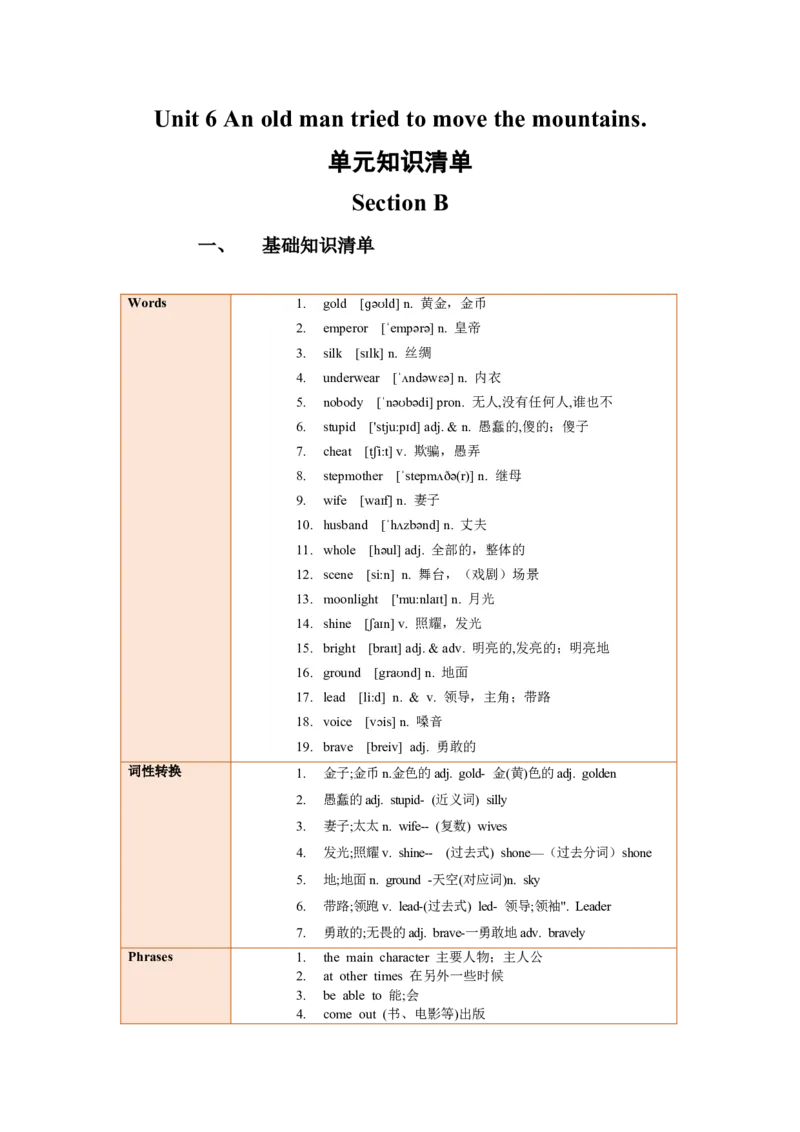
Words 1. gold [ɡəʊld] n. 黄金,金币
2. emperor [ˈempərə] n. 皇帝
3. silk [sɪlk] n. 丝绸
4. underwear [ˈʌndəwɛə] n. 内衣
5. nobody [ˈnəʊbədi] pron. 无人,没有任何人,谁也不
6. stupid ['stju:pɪd] adj. & n. 愚蠢的,傻的;傻子
7. cheat [tʃi:t] v. 欺骗,愚弄
8. stepmother [ˈstepmʌðə(r)] n. 继母
9. wife [waɪf] n. 妻子
10. husband [ˈhʌzbənd] n. 丈夫
11. whole [həul] adj. 全部的,整体的
12. scene [si:n] n. 舞台,(戏剧)场景
13. moonlight ['mu:nlaɪt] n. 月光
14. shine [ʃaɪn] v. 照耀,发光
15. bright [braɪt] adj. & adv. 明亮的,发亮的;明亮地
16. ground [graʊnd] n. 地面
17. lead [li:d] n. & v. 领导,主角;带路
18. voice [vɔis] n. 嗓音
19. brave [breiv] adj. 勇敢的
词性转换 1. 金子;金币n.金色的adj. gold- 金(黄)色的adj. golden
2. 愚蠢的adj. stupid- (近义词) silly
3. 妻子;太太n. wife-- (复数) wives
4. 发光;照耀v. shine-- (过去式) shone—(过去分词)shone
5. 地;地面n. ground -天空(对应词)n. sky
6. 带路;领跑v. lead-(过去式) led- 领导;领袖". Leader
7. 勇敢的;无畏的adj. brave-一勇敢地adv. bravely
Phrases 1. the main character 主要人物;主人公
2. at other times 在另外一些时候
3. be able to 能;会
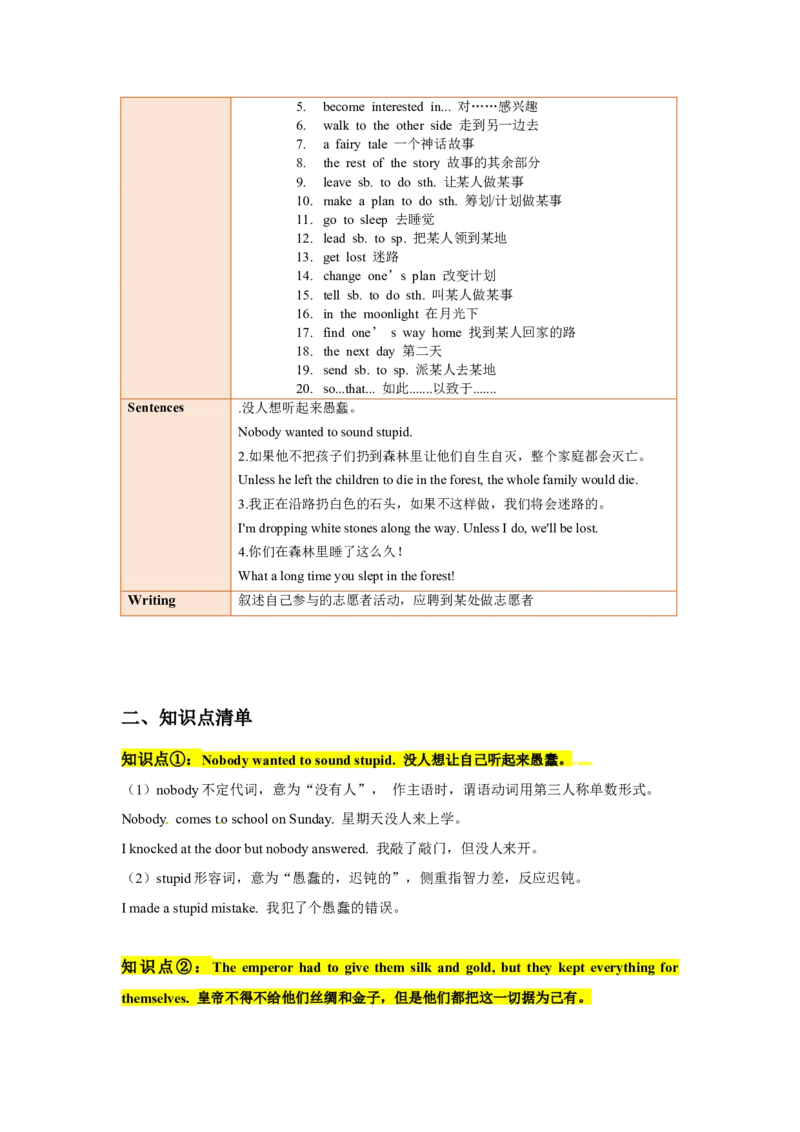
4. come out (书、电影等)出版5. become interested in... 对……感兴趣
6. walk to the other side 走到另一边去
7. a fairy tale 一个神话故事
8. the rest of the story 故事的其余部分
9. leave sb. to do sth. 让某人做某事
10. make a plan to do sth. 筹划/计划做某事
11. go to sleep 去睡觉
12. lead sb. to sp. 把某人领到某地
13. get lost 迷路
14. change one’s plan 改变计划
15. tell sb. to do sth. 叫某人做某事
16. in the moonlight 在月光下
17. find one’ s way home 找到某人回家的路
18. the next day 第二天
19. send sb. to sp. 派某人去某地
20. so...that... 如此.......以致于.......
Sentences .没人想听起来愚蠢。
Nobody wanted to sound stupid.
2.如果他不把孩子们扔到森林里让他们自生自灭,整个家庭都会灭亡。
Unless he left the children to die in the forest, the whole family would die.
3.我正在沿路扔白色的石头,如果不这样做,我们将会迷路的。
I'm dropping white stones along the way. Unless I do, we'll be lost.
4.你们在森林里睡了这么久!
What a long time you slept in the forest!
Writing 叙述自己参与的志愿者活动,应聘到某处做志愿者
二、知识点清单
知识点①:Nobody wanted to sound stupid. 没人想让自己听起来愚蠢。
[来源:Zxxk.Com]
(1)nobody不定代词,意为“没有人”, 作主语时,谓语动词用第三人称单数形式。
Nobody comes to school on Sunday. 星期天没人来上学。
I knocked at the door but nobody answered. 我敲了敲门,但没人来开。
(2)stupid形容词,意为“愚蠢的,迟钝的”,侧重指智力差,反应迟钝。
I made a stupid mistake. 我犯了个愚蠢的错误。
知识点②:The emperor had to give them silk and gold, but they kept everything for
themselves. 皇帝不得不给他们丝绸和金子,但是他们都把这一切据为己有。(1)silk为不可数名词,意为"丝绸";gold此处用作不可数名词,意为"金子,金币",
其作形容词时意为"金色的"。
The princess bought some wonderful silk with gold. 公主用金子买了些精美丝绸。
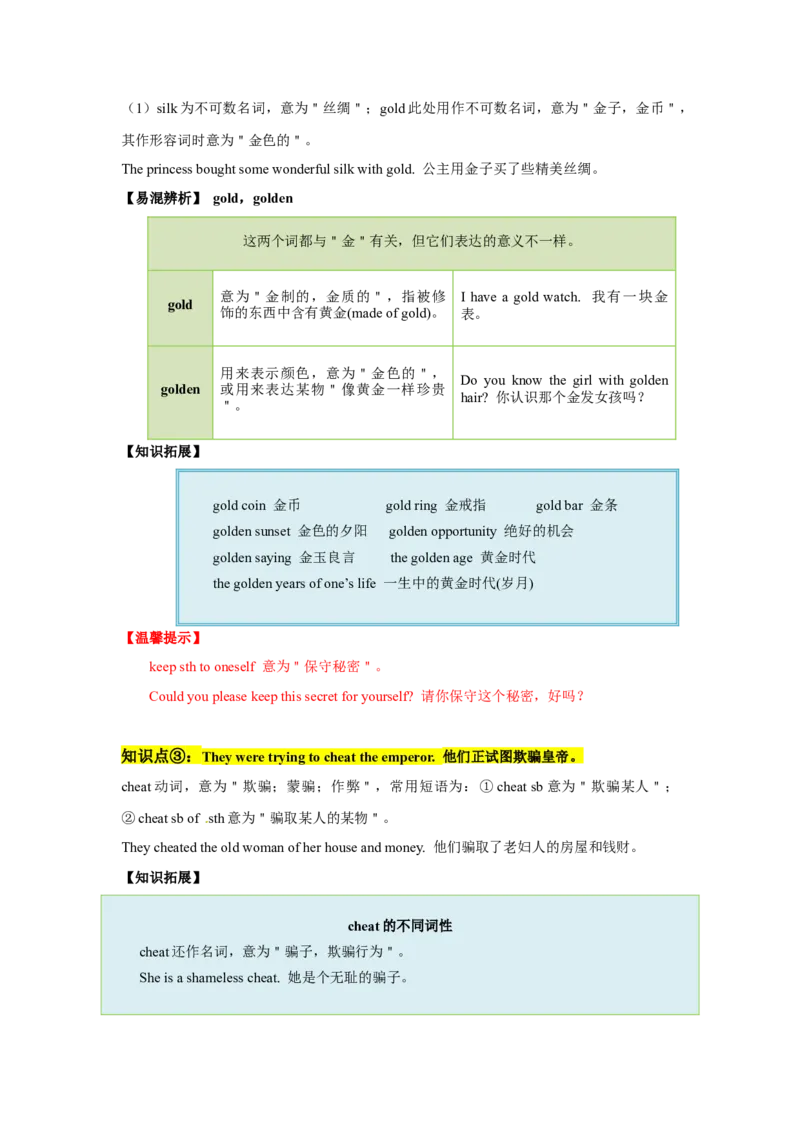
【易混辨析】 gold,golden
这两个词都与"金"有关,但它们表达的意义不一样。
意为"金制的,金质的",指被修 I have a gold watch. 我有一块金
gold
饰的东西中含有黄金(made of gold)。 表。
用来表示颜色,意为"金色的",
Do you know the girl with golden
golden 或用来表达某物"像黄金一样珍贵
hair? 你认识那个金发女孩吗?
"。
【知识拓展】
gold coin 金币 gold ring 金戒指 gold bar 金条
golden sunset 金色的夕阳 golden opportunity 绝好的机会
golden saying 金玉良言 the golden age 黄金时代
the golden years of one’s life 一生中的黄金时代(岁月)
【温馨提示】
keep sth to oneself 意为"保守秘密"。
Could you please keep this secret for yourself? 请你保守这个秘密,好吗?
知识点③:They were trying to cheat the emperor. 他们正试图欺骗皇帝。
cheat动词,意为"欺骗;蒙骗;作弊",常用短语为:①cheat sb意为"欺骗某人";
②cheat sb of sth意为"骗取某人的某物"。
They cheated the old woman of her house and money. 他们骗取了老妇人的房屋和钱财。
【知识拓展】
cheat的不同词性
cheat还作名词,意为"骗子,欺骗行为"。
She is a shameless cheat. 她是个无耻的骗子。知识点④:Hansel and Gretel lived near a forest with their father and stepmother. 韩赛尔
和葛雷特与他们的父亲和继母住在森林附近。
with表示“和……在一起”,连接并列主语时,谓语动词与with前面的主语一致。
He with his parents is going to visit Mount Tai next week.下星期他和父母要去游泰山。
The three children with their father are getting on the bus.这三个孩子和他们的爸爸正在上公共
汽车。
【知识拓展】
当主语部分含有with, together with, along with, as well as, besides, except,
but, like等介词或介词短语时,谓语动词与前面的主语部分一致。
He as well as I wants to go boating.
他和我想去划船。
The teacher together with some students is visiting the factory.
这个教师和一些学生在参观工厂。
知识点⑤:The wife told her husband that unless he left the children to die in the forest, the
whole family would die. 妻子告诉她丈夫除非他把孩子们留在森林里死掉, 否则一家人都会
被饿死。
(1)leave sb/sth + 介词短语,意为"把某人或某物遗留在某地",leave在此意为"遗留,
遗忘",其过去式为left。
Don’t leave the dirty dishes in the kitchen after dinner. 饭后不要把脏餐具留在厨房。
【知识拓展】
(1)leave sb by oneself(=leave sb alone)意为"把某人单独留下"。
They are very busy with work and always leave their son at home by himself. 他们工作非常忙,总
是把儿子一个人留在家中。
(2)表示"将……交给……"用leave sb. sth.或leave sth. with/to sb.。
His grandfather left him a large sum of money. 他爷爷留给他一笔数目可观的钱。
Leave this to me or take it. 要么把这给我,要么你带走。
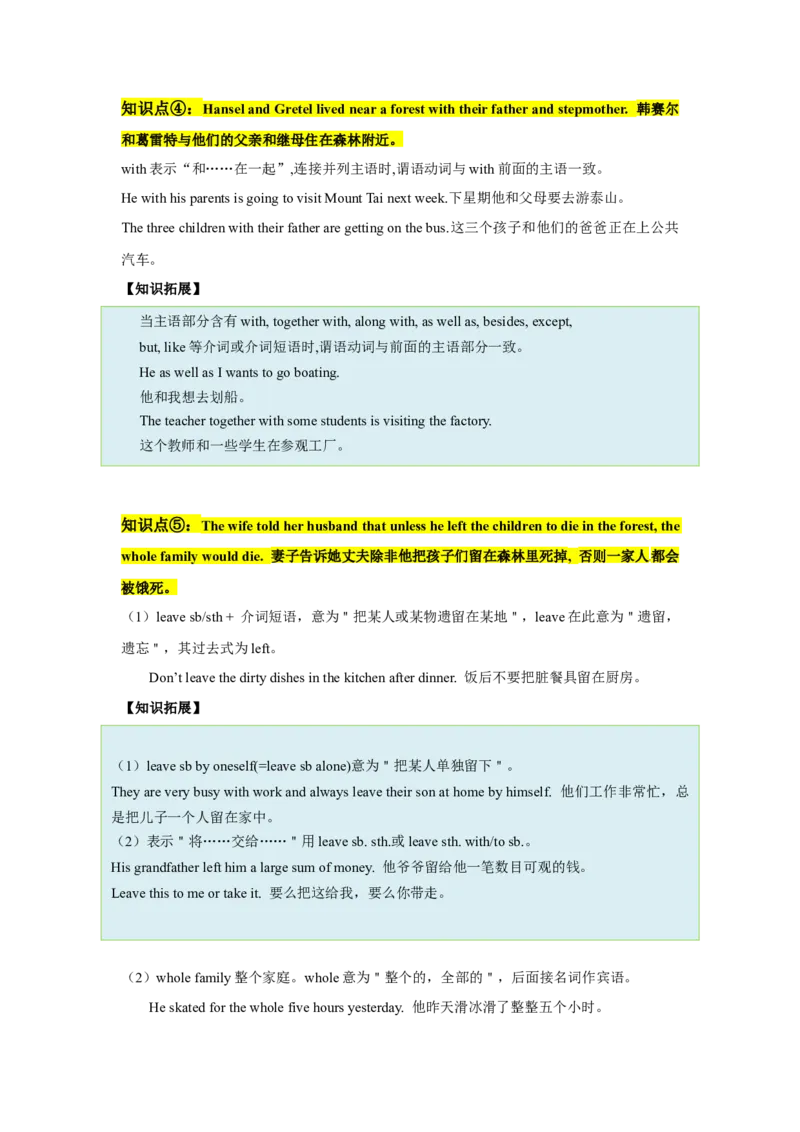
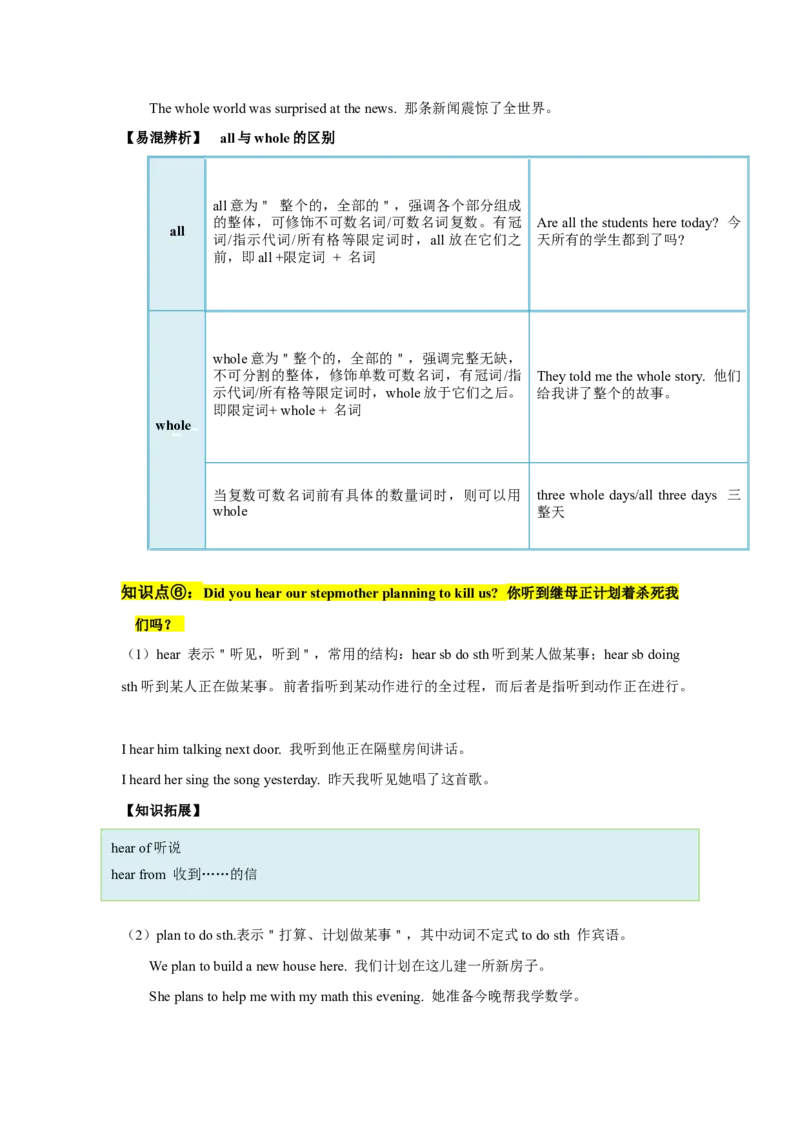
(2)whole family整个家庭。whole意为"整个的,全部的",后面接名词作宾语。
He skated for the whole five hours yesterday. 他昨天滑冰滑了整整五个小时。The whole world was surprised at the news. 那条新闻震惊了全世界。
【易混辨析】 all与whole的区别
all意为" 整个的,全部的",强调各个部分组成
的整体,可修饰不可数名词/可数名词复数。有冠 Are all the students here today? 今
all
词/指示代词/所有格等限定词时,all放在它们之 天所有的学生都到了吗?
前,即all +限定词 + 名词
whole意为"整个的,全部的",强调完整无缺,
不可分割的整体,修饰单数可数名词,有冠词/指 They told me the whole story. 他们
示代词/所有格等限定词时,whole放于它们之后。 给我讲了整个的故事。
[来源:学科网ZXXK]
即限定词+ whole + 名词
[来源:学&科&网Z&X&X&K][来源:学,科,网Z,X,X,K]
whole
[来源:
学科网]
当复数可数名词前有具体的数量词时,则可以用 three whole days/all three days 三
whole 整天
知识点⑥:Did you hear our stepmother planning to kill us? 你听到继母正计划着杀死我
们吗?
(1)hear 表示"听见,听到",常用的结构:hear sb do sth听到某人做某事;hear sb doing
sth听到某人正在做某事。前者指听到某动作进行的全过程,而后者是指听到动作正在进行。
I hear him talking next door. 我听到他正在隔壁房间讲话。
I heard her sing the song yesterday. 昨天我听见她唱了这首歌。
【知识拓展】
hear of听说
hear from 收到……的信
(2)plan to do sth.表示"打算、计划做某事",其中动词不定式to do sth 作宾语。
We plan to build a new house here. 我们计划在这儿建一所新房子。
She plans to help me with my math this evening. 她准备今晚帮我学数学。知识点⑦:I’m dropping white stones along the way. Unless I do, we’ll be lost. 我正在沿路
扔白色的石头。如果我不这样做,我们将会迷路的。
(1)along the way “沿路”,along此处作介词,意为“沿着”。
There are trees all along the road. 沿着这条路从头到尾都有树。
【易混辨析】
along: “沿着”,指沿着一条直线在水平方向上运动
across “横过;穿过”,主要表示从某物的表面经过
through “通过,穿过”,表示从某个空间或内部穿过
I saw him walking along the river. 我看见他正沿着那条河走。
He went across the bridge carefully. 他小心地走过桥。
He walked through the forest alone. 他独自一人不行穿过森林。
(2)be lost“迷路”,相当于get lost。lost此处用作形容词,意为“丢失的;迷路的”。
I found my lost key. 我找到了丢失的钥匙。
He was lost on the way home. 他在回家的路上迷路了。
注意:lost还是动词lose的过去式和过去分词形式。
知识点⑨:What a long time you slept in the forest! 你们在森林里睡了这么久!
本句是what引导的感叹句。a long time很长的时间,time作"时间"讲时是不可数名词,
但前面有修饰词long,加a为习惯用法。what引导的感叹句结构如下:
(1)What + a/an +形容词 + 可数名词单数 + 主语 + 谓语! What a heavy box it is! 这是一
个多么重的箱子!
(2)What +形容词 + 可数名词复数/不可数名词 + 主语 + 谓语!What cold weather it is!
天气真冷!
(3)What(+a/an) +名词(+主语 + 谓语)! What a day (it is)! 这鬼天气!
【知识拓展】
how引导的感叹句结构:How + 形容词/副词 + 主语 + 谓语!
How high the bird flies! 这鸟飞得真高!
How beautiful the flowers are! 这些花多漂亮啊!知识点10:Look! It’s leading us to that wonderful house made of bread, cake and candy.
看! 它正引导我们去那个由面包、蛋糕和糖做成的漂亮的房子。
(1)lead意为"带路;路",过去式和过去分词均为led,常用结构:lead sb to some place
引导某人去某地;lead sb to do sth引导/促使某人做某事。lead to表示"导致,引起,通向
",这里to是介词,后接名词/代词。
What led you to think so? 是什么使你这样想的?
Good habits lead to success. 好的习惯是成功的关键。学科&网
I led Linda to my school yesterday. 昨天我带琳达去我学校了。
(2)(be)made of意为"由……制成"。
The sweater is made of wool. 这件毛衣是羊毛做的。
He built a wonderful house made of marble. 他建了一栋用大理石砌成的豪宅。
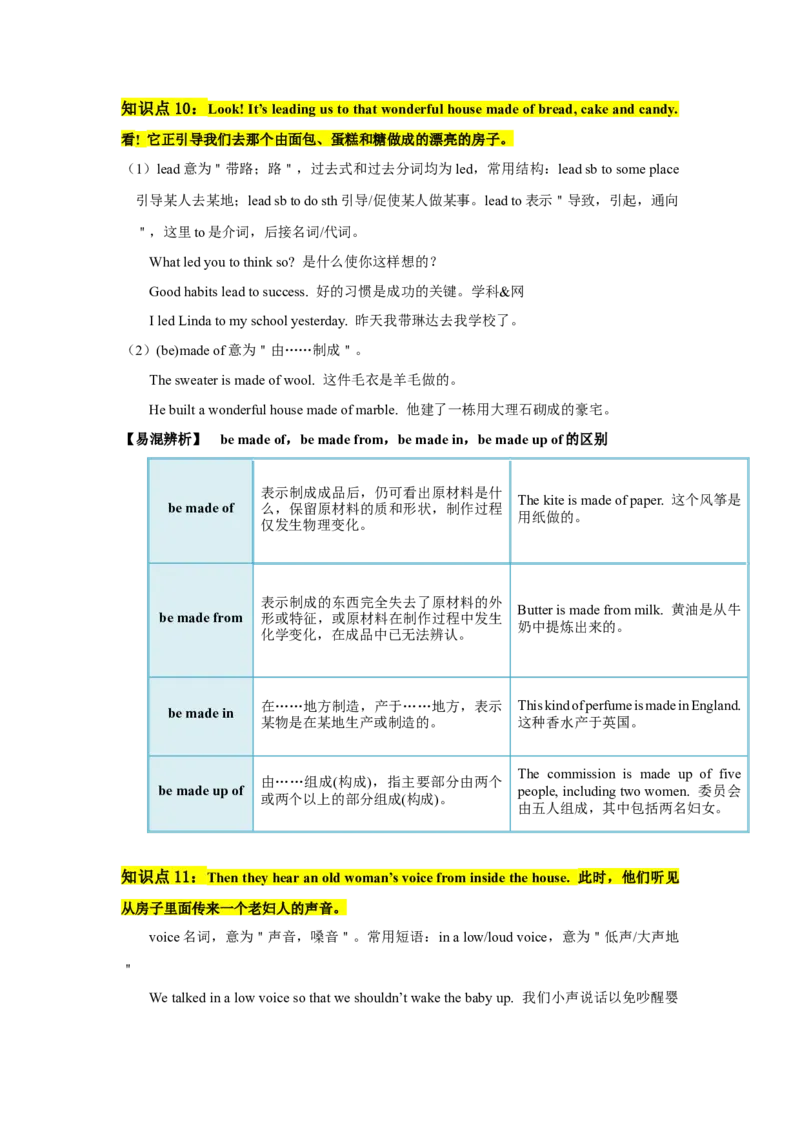
【易混辨析】 be made of,be made from,be made in,be made up of的区别
表示制成成品后,仍可看出原材料是什
The kite is made of paper. 这个风筝是
be made of 么,保留原材料的质和形状,制作过程
用纸做的。
仅发生物理变化。
表示制成的东西完全失去了原材料的外
Butter is made from milk. 黄油是从牛
be made from 形或特征,或原材料在制作过程中发生
奶中提炼出来的。
化学变化,在成品中已无法辨认。
在……地方制造,产于……地方,表示 This kind of perfume is made in England.
be made in
某物是在某地生产或制造的。 这种香水产于英国。
The commission is made up of five
由……组成(构成),指主要部分由两个
be made up of people, including two women. 委员会
或两个以上的部分组成(构成)。
由五人组成,其中包括两名妇女。
知识点11:Then they hear an old woman’s voice from inside the house. 此时,他们听见
从房子里面传来一个老妇人的声音。
voice名词,意为"声音,嗓音"。常用短语:in a low/loud voice,意为"低声/大声地
"
We talked in a low voice so that we shouldn’t wake the baby up. 我们小声说话以免吵醒婴儿。
【易混辨析】 voice,noise,sound的区别
一般指人的说话声、歌声或笑声,也可 He is not in good voice. 他现在的嗓音
voice
用来指鸟鸣声或一些拟人化的声音。 不好。
The old man enjoyed the holiday, away
意为"噪声,喧闹声",指不悦耳、令
noise from the city noise. 这位老人喜欢度
人讨厌的声音、杂声、噪声。
假,远离城市的喧闹。
的含义较广,指人们听到的各种声音, There’s no sound coming from the TV.
sound
有意义或无意义的声音。 电视机没有发出声音。
【温馨提示】
感官动词如see,hear,watch,feel,notice等后跟动词不定式作宾语补足语时,通常
不带to。
They saw the thief cross the street just now. 他们看到那个小偷刚刚穿过了街道。
知识点12:Who is brave enough to eat my house? 谁这么大胆敢吃我的房子?
(1)enough用作副词,意为"充足地,足够地",修饰形容词或副词,置于这些词的
后面。
(2)adj. + enough + to do意为"做某事是足够……的"。
The man is strong enough to carry the heavy box. 这位男士足够强壮,能够搬动这个重箱
子。
【知识拓展】
enough的不同用法
(1)enough可作形容词,意为"足够的,充足的",修饰名词,置于名词的前后均可,但一
般放在前面。
Don’t worry. We have enough time to do the job. 不要担心,我们有足够的时间去做工作。
(2)adj. + enough to do sth.常可与too... to...或so... that...相互转化。知识点 13:They could see the stones because of the shining moon. The stones showed
them the way home. 因为月光,他们能够看到石头,石头指引他们回家的路。
(1)because of意为"因为,由于",其后常接名词或名词短语。
He didn’t go to school because of his illness. 他因为生病没有去上学。
(2)show sb. the way to…告知(指引)某人去……的路。to后接here/there/home等副词时,to
省略。
Please show me the way to school.请指明我去学校的路。
【知识拓展】
(1) show sb. around 带领某人参观。
He showed the students around the factory.他领着学生参观了工厂。
(2)show sb. sth.=show sth. to sb.把某物给某人看。
She showed us her new sweater.
=She showed her new sweater to us.
她把她的新毛衣给我们看。
(3)show作名词,意为“演出,表演,节目,展览”。学科&网
school show学校公演 TV show电视节目
art show艺术展
三、单元写作
【话题分析】
本单元话题是“传统经典故事”,要求同学们会缩写一个经典故事。在写作时,首先要
把故事的主要角色写出来,其次简单介绍故事发展的过程,最后写出故事的结局或蕴含的
道理。注意描述故事应用一般过去时。
【写作步骤】
1.总分总结构。短文通常分为三个部分:
总------第一部分:开篇点题,引出话题。
分-------第二部分:活动内容以及提供的帮助。
总——第三部分:活动的感受。
2.人称:第一人称。
3.时态:一般将来时、一般过去时。【典型例题】
同学们,在我国古代有很多经典的童话故事,如:愚公移山、精卫填海、女娲补天等等。
你一定也听说过《后羿射日》的故事吧!假定现在一群美国小朋友来到你们学校做客,请
你用英语写一篇小短文,把《后羿射日》的故事讲给美国小朋友听听。
要点:
1. 从前,天上突然出现十个太阳。天气太热了,许多庄稼都干死了。人们不能像往常一样
生活。
2. 后羿擅长射箭,天帝命令他惩罚太阳。为了拯救地球上的人,他决定射下九个太阳。
3. 后羿登上了一座大山,在那里射下九个太阳,最后一个太阳害怕了,承诺继续为大地和
万物贡献光和热。
要求:
1. 要点齐全,语句通顺,不要逐字翻译,可适当发挥;
2. 词数80词左右(开头和结尾已给出,不计入总词数)。
参考词汇:庄稼crop;惩罚punish;为……服务/做贡献serve;箭arrow;天帝God
Hi, boys and girls! Today I’ll tell you a story named Hou Yi Shoots the Suns.
Once upon a time, ________________________________________________________
___________________________________________________________________________
___________________________________________________________________________
___________________________________________________________________________
___________________________________________________________________________
___________________________________________________________________________
_______________________________________________________________________________
_______________________________________________________________________________
_______________________________________________________________________________
_______________________________________________________________________________
_______________________________________________________________________________
_______________________________________________________________________________
___________________________________________________
This is the traditional Chinese story Hou Yi Shoots the Suns. Do you like it?【高分模板】
Hi, boys and girls! Today I’ll tell you a story named Hou Yi Shoots the Suns.
Once upon a time, there were ten suns in the sky suddenly. It was so hot on earth that no
crops could grow. People had a hard life. A young man named Hou Yi was good at shooting. God
asked him to punish the suns. To save the people on earth, he decided to shoot down nine suns.
Hou Yi climbed a mountain and shot down nine suns from there. Finally, the last sun was afraid
and promised to continue to give light and heat to the earth and all things.
This is the traditional Chinese story Hou Yi Shoots the Suns. Do you like it?
【名师点评】
.题干解读:题目要求根据要点提示写一篇短文讲述《后羿射日》的故事。要求要点齐全,
可适当发挥。
写作指导:写作时要以第三人称为主,时态采用一般过去时。可分为三段式写作:第一段
引用已给出开头;第二段介绍具体的故事内容;第三段用已给出的结尾。要做到无单词拼
写和语法错误。
【素材积累】
①Once upon a time,there was a very old man.从前,有一个老人。
②Yu Gong found a good way to solve his problem.愚公找到了一个解决问题的好方法。
③Yu Gong kept trying and didn't give up.愚公继续尝试,从不放弃。
④Sun Wukong can make 72 changes to his shape and size,turning himself into different
animals and objects.孙悟空能够在形状和大小上72变,把他自己变成不同的动物和物体。
⑤Sometimes he can make the stick so small that he can keep it in his ear.有时他能把金箍棒变
得很小,以至于可以放进他的耳朵里。
①The story is trying to show us that anything is possible if you work hard!这个故事尽全力向
我们展示了如果你努力了,什么事情都是有可能的。
②This story reminds us that you can never know what's possible unless you try to make it
happen.这个故事提醒我们除非你尽力使它发生,否则你就不会知道什么是可能。
③Western children became interested in reading this story because the clever Monkey King
keeps fighting to help the weak and never gives up.西方国家的孩子对读这个故事很感兴趣,
是因为猴王为帮助弱者一直战斗着,从不放弃。【小试身手】
假设你是思考,你的美国笔友Lucy来信想了解曹冲称象的故事。请根据如下图片及要
点提示用英语写一封80词以上的回信给她。
内容要点:1. 回信目的;
2. 故事简介;
3. 故事给你的启示。
注意:1. 信中不允许出现与考生本人相关的真实姓名和校名等信息。
2. 信的开头已给出,不计入总词数。
3. 参考词汇:scale n. 称;calculate v. 计算
Dear Lucy,
I learn from your letter that…
_______________________________________________________________________________
_______________________________________________________________________________
_______________________________________________________________________________
_______________________________________________________________________________
_______________________________________________________________________________
_______________________________________________________________________________
________________________________________________________________________
【思路导航】
本文要求给美国笔友回信,给她讲述曹冲称象的故事,要求写出回信的目的,结合图
片提示简介故事并要写出故事给人的启示。回信的目的和故事的启示用一般现在时态,故
事简介用一般过去时态。故事按动作先后顺序进行写作,用第三人称形式。学&科网【佳作展示】
Dear Lucy,
I learn from your letter that you are very interested in the story of Cao Chong weighed the
elephant. Let me tell you.
Once somebody sent Cao Chong’s father, Cao Cao, an elephant and he wanted to know its
weight, but there was nothing big enough to weigh it. Cao Chong told his father he could weigh the
elephant if he had a big boat and a lot of heavy stones. Cao Cao was very surprised, but he still
ordered his men to get everything ready. When they led the elephant down into the boat,the water
came up,then Cao Chong marked the water line. Then they drove the elephant onto the bank and put
the heavy stones in the boat until the water came up to the same line. At last, Cao Chong told the
men to weigh the stones. In this way, he weighed the elephant.
I think Cao Chong is very clever. If we think hard before doing things, we can do them better.
Yours,
Thought