第1页
义 务 教 育 教 科 书
四年级
下册第2页
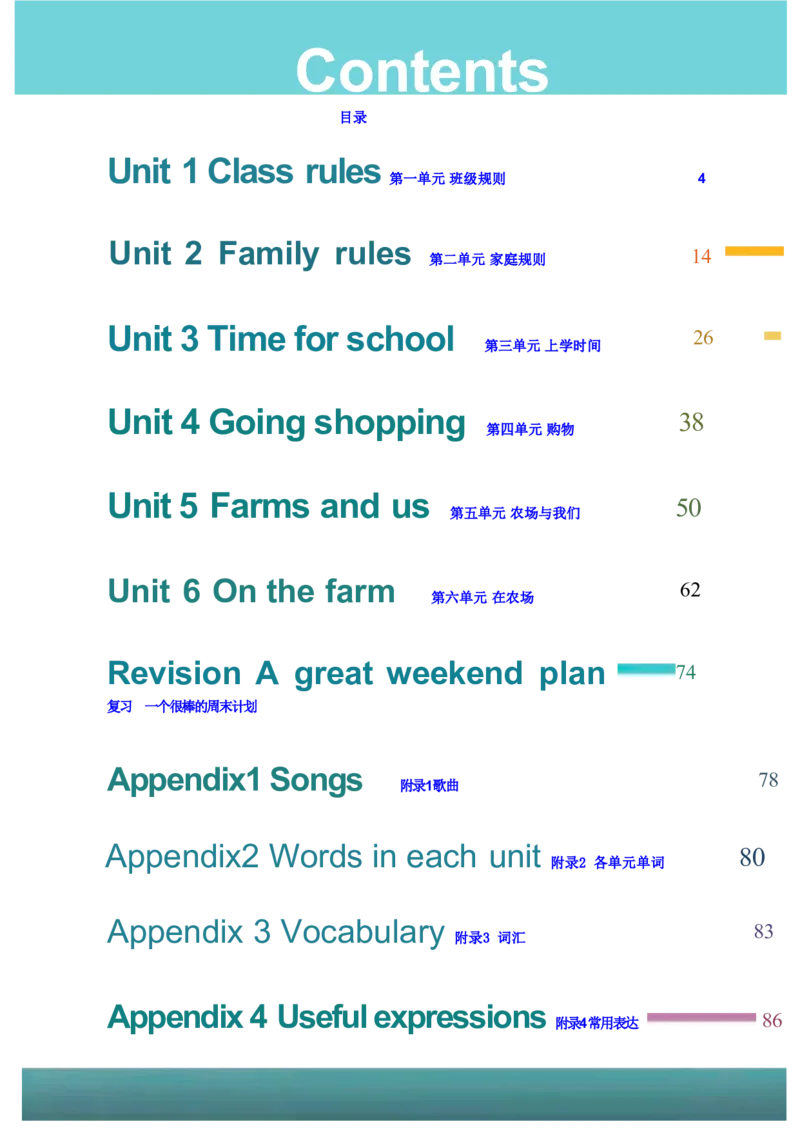
Contents
目录
Unit 1 Class rules
第一单元班级规则 4
Unit 2 Family rules
第二单元家庭规则 14
Unit 3 Time for school 26
第三单元上学时间
Unit 4 Going shopping 38
第四单元购物
Unit 5 Farms and us 50
第五单元农场与我们
Unit 6 On the farm 62
第六单元在农场
Revision A great weekend plan 74
复习 一个很棒的周末计划
Appendix1 Songs 78
附录1歌曲
Appendix2 Words in each unit 80
附录2 各单元单词
Appendix 3 Vocabulary 83
附录3 词汇
Appendix 4 Useful expressions
附录4常用表达 86第3页
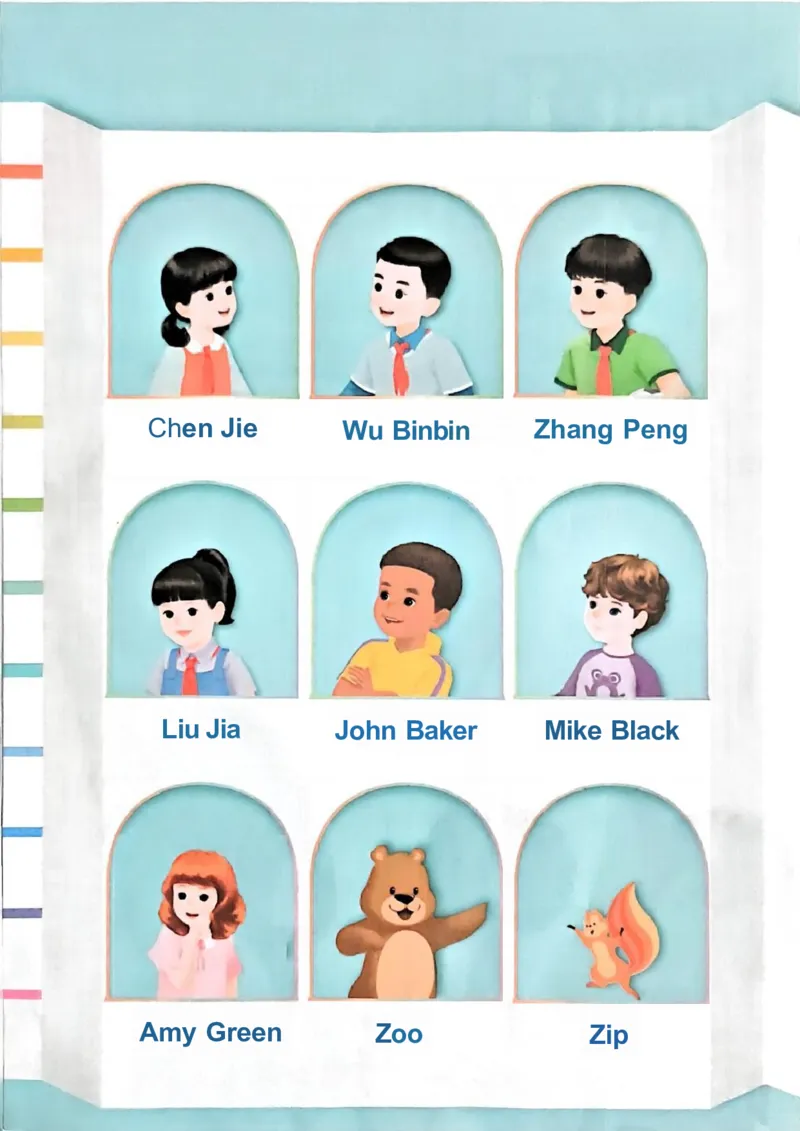
Chen Jie Wu Binbin Zhang Peng
Liu Jia John Baker Mike Black
Amy Green Zoo Zip第4页
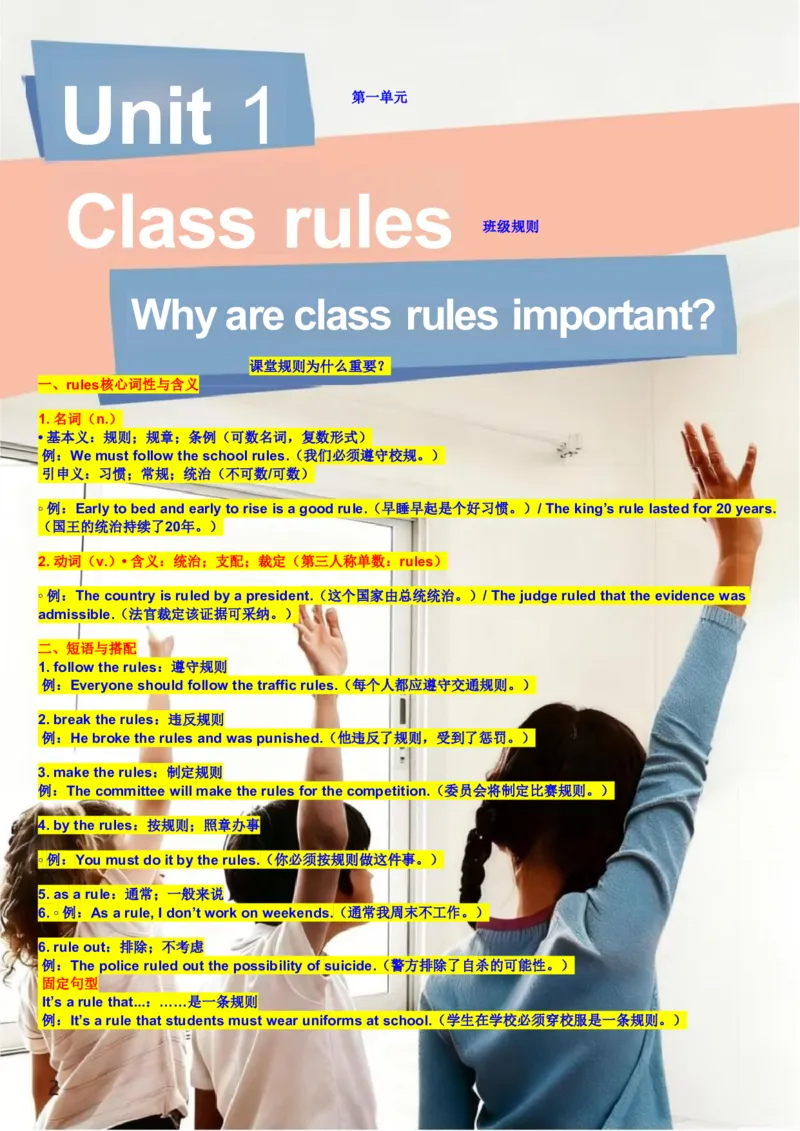
Unit 1 第一单元
Class rules
班级规则
Why are class rules important?
课堂规则为什么重要?
一、rules核心词性与含义
1.名词(n.)
•基本义:规则;规章;条例(可数名词,复数形式)
例:Wemust follow theschoolrules.(我们必须遵守校规。)
引申义:习惯;常规;统治(不可数/可数)
◦例:Earlytobedand early toriseis agoodrule.(早睡早起是个好习惯。)/The king’srule lastedfor 20 years.
(国王的统治持续了20年。)
2.动词(v.)•含义:统治;支配;裁定(第三人称单数:rules)
◦例:The countryisruledby apresident.(这个国家由总统统治。)/The judgeruledthat theevidence was
admissible.(法官裁定该证据可采纳。)
二、短语与搭配
1.follow the rules:遵守规则
例:Everyone shouldfollow the trafficrules.(每个人都应遵守交通规则。)
2.break therules:违反规则
例:Hebrokethe rulesandwaspunished.(他违反了规则,受到了惩罚。)
3.makethe rules:制定规则
例:The committee willmake therules for thecompetition.(委员会将制定比赛规则。)
4.bythe rules:按规则;照章办事
◦例:Youmust doitby the rules.(你必须按规则做这件事。)
5.asa rule:通常;一般来说
6.◦例:As arule,Idon’tworkonweekends.(通常我周末不工作。)
6.rule out:排除;不考虑
例:The police ruledout the possibility of suicide.(警方排除了自杀的可能性。)
固定句型
It’sarulethat...:……是一条规则
例:It’sarule that students must wear uniformsat school.(学生在学校必须穿校服是一条规则。)第5页
一、核心词汇与短语
1. follow rules:遵守规则例:Wefollow rules tohelpuslearn.
(我们遵守规则以助力学习。)
2. put uphand:举手
例:Put your handupand takeyour turn.(举手发言,依次来
)
3. listen,ask andanswer:倾听、提问并回答
◦例:Welisten,askandanswer.(我们倾听、提问并回答。)
.don’t belate:不要迟到
例:Don’tbe late oreat inclass.(上课不要迟到,不要吃东西
)二、语法知识点
1. 祈使句
•肯定祈使句:以动词原形开头,表达命令、建议等。
◦例:Put yourhand up.(举手。)
否定祈使句:在动词原形前加“Don’t”,表示禁止。
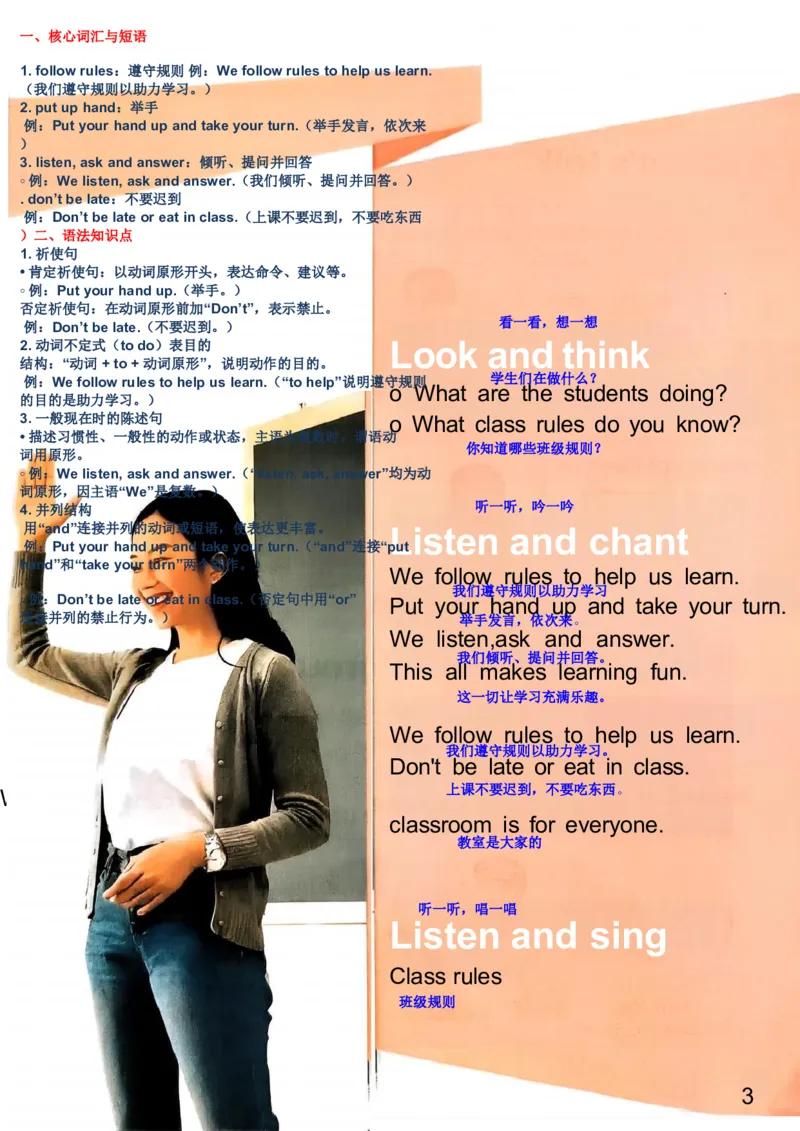
看一看,想一想
例:Don’tbe late.(不要迟到。)
2. 动词不定式(todo)表目的 Look and think
结构:“动词+to+动词原形”,说明动作的目的。
例:Wefollow rulestohelp uslearn.(“tohelp”说明遵守规则 学生们在做什么?
o What are the students doing?
的目的是助力学习。)
3. 一般现在时的陈述句 o What class rules do you know?
•描述习惯性、一般性的动作或状态,主语为复数时,谓语动
你知道哪些班级规则?
词用原形。
◦例:Welisten,askandanswer.(“listen,ask,answer”均为动
词原形,因主语“We”是复数。)
4. 并列结构 听一听,吟一吟
用“and”连接并列的动词或短语,使表达更丰富。
Listen and chant
例:Put your handupand takeyour turn.(“and”连接“put
hand”和“takeyour turn”两个动作。)
We follow rules to help us learn.
我们遵守规则以助力学习
◦例:Don’t belateor eat inclass.(否定句中用“or” Put yo。u加r hand up and take your turn.
连接并列的禁止行为。) 举手发言,依次来。
We listen,ask and answer.
我们倾听、提问并回答。
This all makes learning fun.
这一切让学习充满乐趣。
We follow rules to help us learn.
我们遵守规则以助力学习。
Don't be late or eat in class.
上课不要迟到,不要吃东西。
We don't want a messy room. Our
classroom is for everyone.
教室是大家的
听一听,唱一唱
Listen and sing
Class rules
班级规则
3第6页
一、情态动词用法
1.can/can’t
肯定用法(can):表示“可以;能够”,用于征求许可或
What are som说明e能力o。f例y:CoanuItrakecthlisaapsplse?(r我u可以le带这s个?苹
果吗?)
你们的班级规则有哪些? 否定用法(can’t):表示“不能;不可以”,用于禁止或说
明无能力。
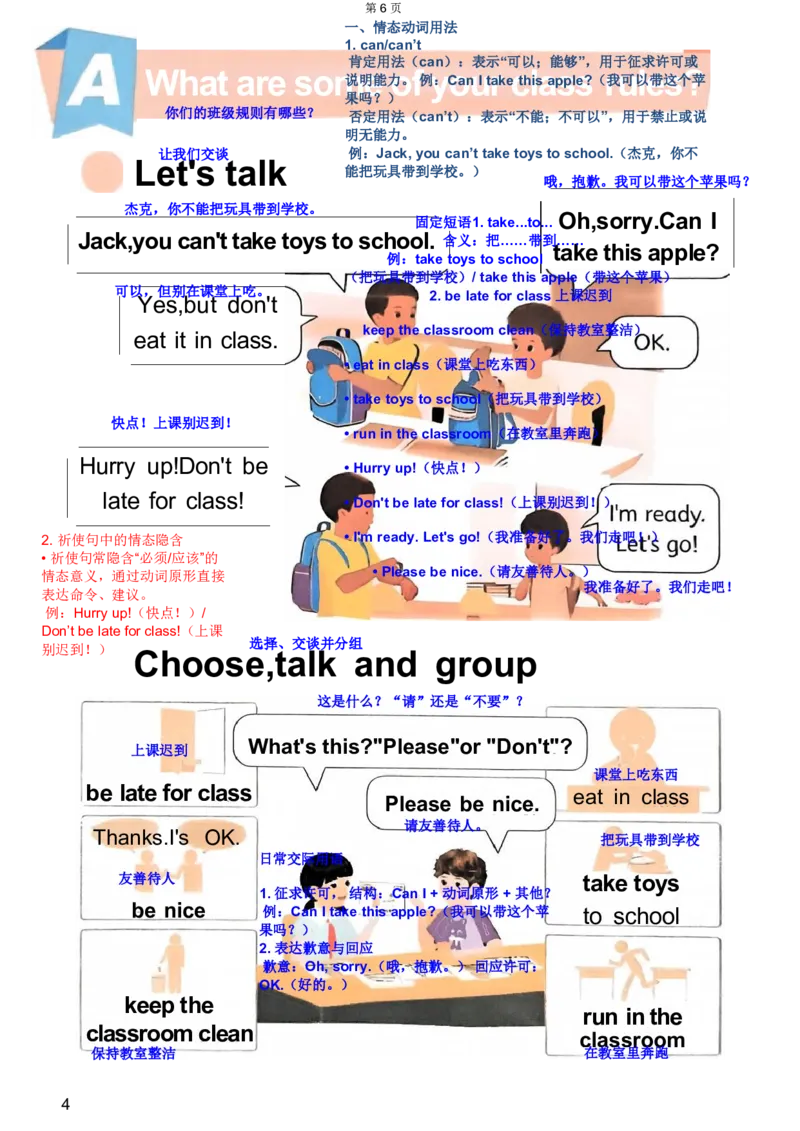
让我们交谈 例:Jack, you can’t taketoys toschool.(杰克,你不
Let's talk 能把玩具带到学校。)
哦,抱歉。我可以带这个苹果吗?
杰克,你不能把玩具带到学校。
固定短语1.take...to... Oh,sorry.Can I
Jack,you can't take toys to school. 含义:把……带到……
take this apple?
例:taketoys toschool
(把玩具带到学校)/takethis apple(带这个苹果)
可以,但别在课堂上吃。
2.belate forclass 上课迟到
Yes,but don't
:keepthe classroom clean(保持教室整洁)
eat it in class.
•eat inclass(课堂上吃东西)
•take toys toschool(把玩具带到学校)
快点!上课别迟到!
•run intheclassroom(在教室里奔跑)
Hurry up!Don't be •Hurry up!(快点!)
late for class! •Don't belatefor class!(上课别迟到!)
2.祈使句中的情态隐含 •I'm ready. Let'sgo!(我准备好了。我们走吧!)
•祈使句常隐含“必须/应该”的
情态意义,通过动词原形直接 •Please be nice.(请友善待人。)
我准备好了。我们走吧!
表达命令、建议。
例:Hurry up!(快点!)/
Don’tbe lateforclass!(上课
选择、交谈并分组
别迟到!)
Choose,talk and group
这是什么?“请”还是“不要”?
上课迟到 What's this?"Please"or "Don't"?
课堂上吃东西
be late for class eat in class
Please be nice.
请友善待人。
Thanks.I's OK. 把玩具带到学校
日常交际用语
友善待人
take toys
1.征求许可,结构:Can I+ 动词原形+ 其他?
be nice 例:Can Itakethis apple?(我可以带这个苹 to school
果吗?)
2.表达歉意与回应
歉意:Oh, sorry.(哦,抱歉。)回应许可:
OK.(好的。)
keep the
run in the
classroom clean
classroom
保持教室整洁 在教室里奔跑
4第7页
让我们学习
Let's learn
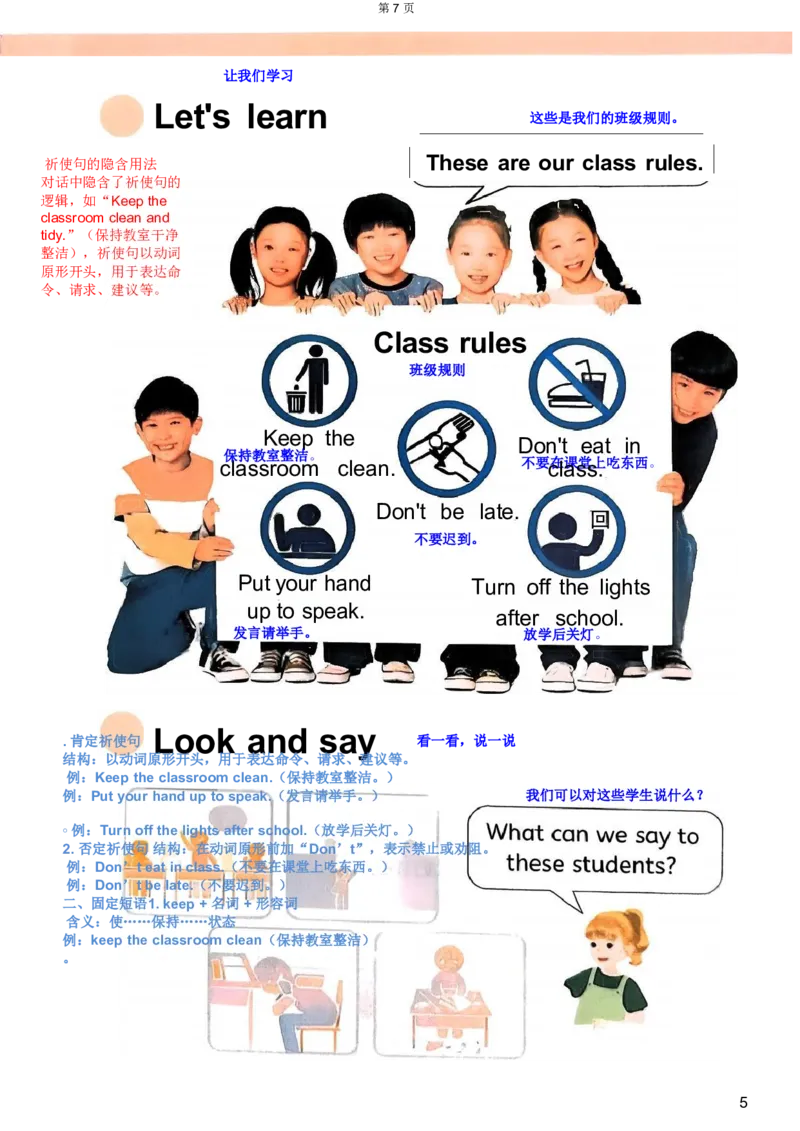
这些是我们的班级规则。
祈使句的隐含用法 These are our class rules.
对话中隐含了祈使句的
逻辑,如“Keepthe
classroom cleanand
tidy.”(保持教室干净
整洁),祈使句以动词
原形开头,用于表达命
令、请求、建议等。
Class rules
班级规则
Keep the
Don't eat in
保持教室整洁。
不要在课堂上吃东西。
classroom clean. class.
Don't be late.
回
不要迟到。
Put your hand Turn off the lights
up to speak.
after school.
发言请举手。 放学后关灯。
.肯定祈使句 Look and say 看一看,说一说
结构:以动词原形开头,用于表达命令、请求、建议等。
例:Keep the classroom clean.(保持教室整洁。)
例:Put yourhand uptospeak.(发言请举手。) 我们可以对这些学生说什么?
◦例:Turnoff the lights afterschool.(放学后关灯。)
2.否定祈使句结构:在动词原形前加“Don’t”,表示禁止或劝阻。
例:Don’teat inclass.(不要在课堂上吃东西。)
例:Don’tbelate.(不要迟到。)
二、固定短语1.keep +名词+ 形容词
含义:使……保持……状态
例:keep theclassroom clean(保持教室整洁)
。
5第8页
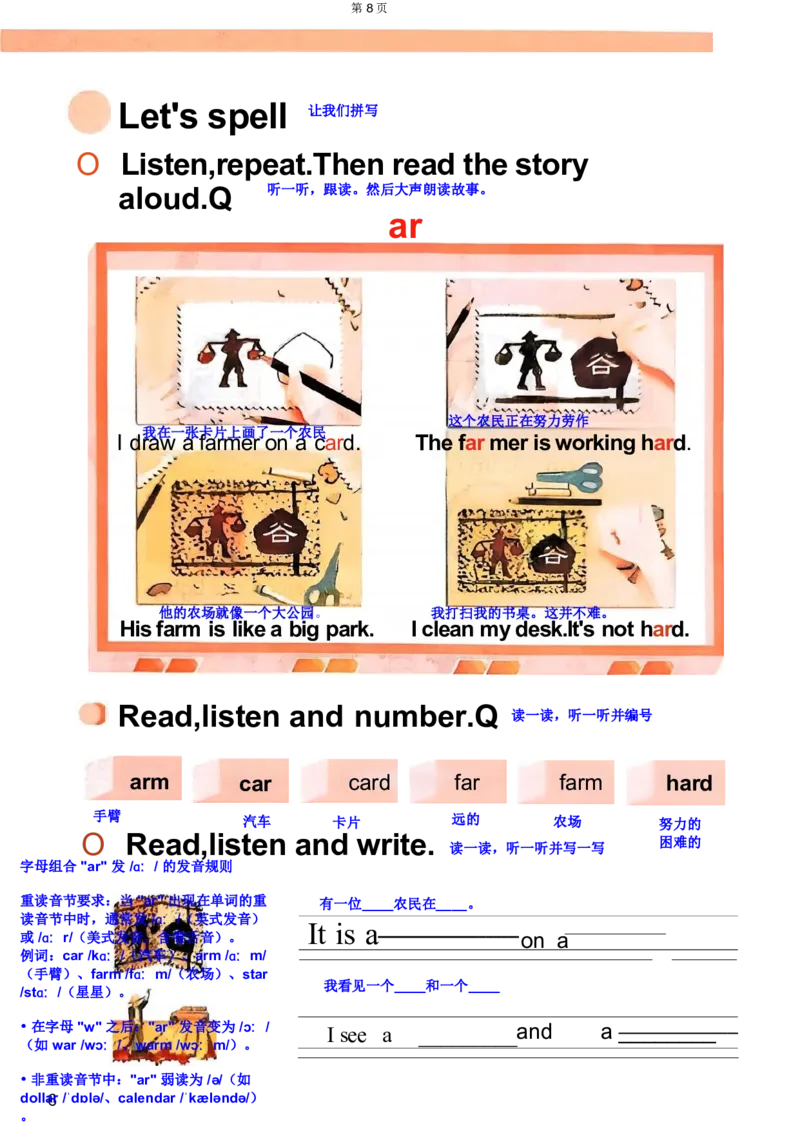
Let's spell 让我们拼写
O Listen,repeat.Then read the story
听一听,跟读。然后大声朗读故事。
aloud.Q
ar
这个农民正在努力劳作
我在一张卡片上画了一个农民
I draw a farmer on a card. The farmer is working hard.
他的农场就像一个大公园。 我打扫我的书桌。这并不难。
Hisfarm is likea big park. I clean mydesk.It's not hard.
Read,listen and number.Q 读一读,听一听并编号
arm car card far farm hard
手臂 汽车 卡片 远的 农场 努力的
O Read,listen and write. 困难的
读一读,听一听并写一写
字母组合"ar"发/ɑː /的发音规则
重读音节要求:当"ar"出现在单词的重 有一位____农民在____。
读音节中时,通常发/ɑː /(英式发音)
It is a
或/ɑː r/(美式发音,含卷舌音)。 on a
例词:car /kɑː /(汽车)、arm /ɑː m/
(手臂)、farm/fɑː m/(农场)、star
/stɑː /(星星)。
我看见一个____和一个____
•在字母"w"之后:"ar" 发音变为/ɔː / I see a _________and a ________
(如war /wɔː /、warm/wɔː m/)。
•非重读音节中:"ar"弱读为/ə/(如
dolla6r /ˈdɒlə/、calendar /ˈkæləndə/)
。第9页
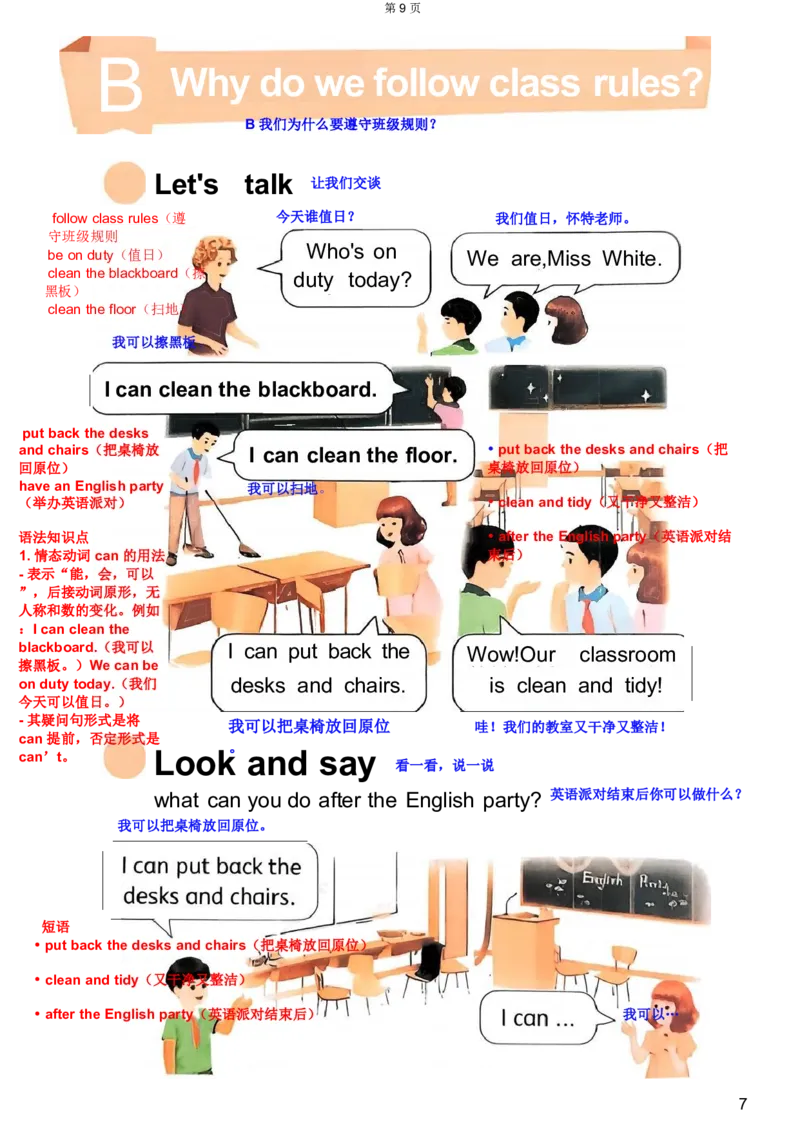
B
Why do we follow class rules?
B我们为什么要遵守班级规则?
-让我们交谈
Let's talk 让我们交谈
follow class rules(遵 今天谁值日? 我们值日,怀特老师。
守班级规则
beon duty(值日) Who's on We are,Miss White.
cleanthe blackboard(擦
duty today?
黑板)
cleanthe floor(扫地)
我可以擦黑板。
I can clean the blackboard.
put back thedesks
andchairs(把桌椅放 I can clean the floor. •put back the desksandchairs(把
回原位) 桌椅放回原位)
havean Englishparty 我可以扫地。
(举办英语派对) •cleanandtidy(又干净又整洁)
语法知识点 •after the Englishparty(英语派对结
1.情态动词can的用法 束后)
-表示“能,会,可以
”,后接动词原形,无
人称和数的变化。例如
:Icancleanthe
blackboard.(我可以 I can put back the Wow!Our classroom
擦黑板。)Wecanbe
onduty today.(我们 desks and chairs. is clean and tidy!
今天可以值日。)
-其疑问句形式是将
我可以把桌椅放回原位 哇!我们的教室又干净又整洁!
can 提前,否定形式是
。
can’t。 Look and say
看一看,说一说
英语派对结束后你可以做什么?
what can you do after the English party?
我可以把桌椅放回原位。
短语
• put backthe desks andchairs(把桌椅放回原位)
• cleanand tidy(又干净又整洁)
• afterthe Englishparty(英语派对结束后) 我可以…
7第10页
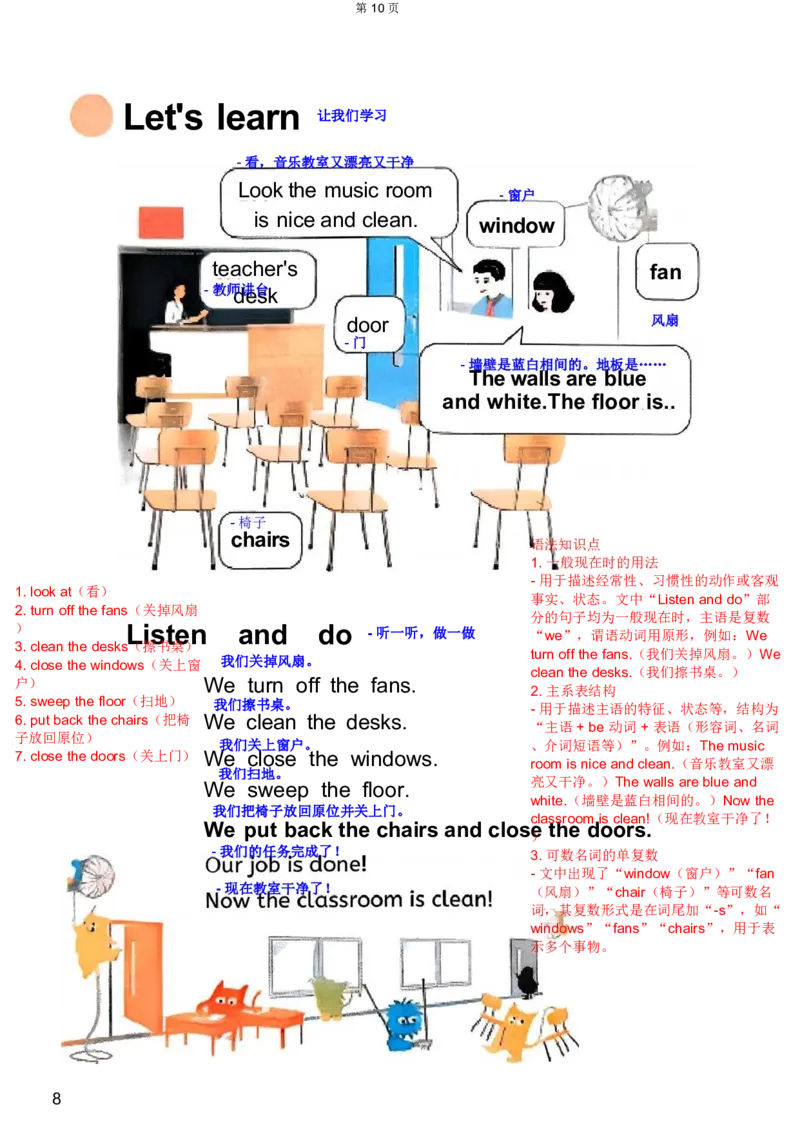
Let's learn 让我们学习
-看,音乐教室又漂亮又干净
Look the music room
-窗户
is nice and clean.
window
teacher's fan
- 教师 d 讲 e 台 sk
风扇
door
-门
-墙壁是蓝白相间的。地板是……
The walls are blue
and white.The floor is..
-椅子
chairs 语法知识点
1.一般现在时的用法
- 用于描述经常性、习惯性的动作或客观
1.look at(看)
事实、状态。文中“Listenand do”部
2.turn offthe fans(关掉风扇
分的句子均为一般现在时,主语是复数
)
Listen and do -听一听,做一做 “we”,谓语动词用原形,例如:We
3.cleanthe desks(擦书桌)
turnoffthe fans.(我们关掉风扇。)We
4.closethe windows(关上窗 我们关掉风扇。
clean thedesks.(我们擦书桌。)
户) We turn off the fans.
2.主系表结构
5.sweep the floor(扫地) 我们擦书桌。
- 用于描述主语的特征、状态等,结构为
6.putback thechairs(把椅 We clean the desks.
“主语+be 动词+ 表语(形容词、名词
子放回原位)
我们关上窗户。 、介词短语等)”。例如:Themusic
7.closethe doors(关上门) We close the windows.
room isniceandclean.(音乐教室又漂
我们扫地。
亮又干净。)Thewalls are blueand
We sweep the floor.
white.(墙壁是蓝白相间的。)Now the
我们把椅子放回原位并关上门。
classroom is clean!(现在教室干净了!
We put back the chairs and close the doors.
)
-我们的任务完成了! 3.可数名词的单复数
- 文中出现了“window(窗户)”“fan
-现在教室干净了! (风扇)”“chair(椅子)”等可数名
词,其复数形式是在词尾加“-s”,如“
windows”“fans”“chairs”,用于表
示多个事物。
81.putone's hand uptospeak(发言举手)2.turnoffthe lights(关灯)
3.say"Excuse me?"(说“打扰一下?”)4.makewallnewspapers(制作墙报)
5.keep the classroom clean and tidy(保持教室干净整洁)6.hand outthe workbooks(分发练习册)
7.close thewindows(关窗户)8. don'teatinclass(课堂上不吃东西)
9.don'tbe late(不要迟到) 第11页
helpinghandsinclass(课堂上的助力行
Read and write
读一读,写一写动)
make wallnewspapers(制作墙报)
Read and tick. 读一读,打勾。
课堂上的助力行动
• turnoff the
lights after
Helping hands inclass
school(放学后
我们有一些班级规则 我们发言时要举手。
关灯) We have some class rules.We put our hand up
。
class rules(班
放学后我们要关灯
级规则) to speak.We turn off the lights after school.When we
当我们不明白时,我们会说:“打扰一下?”
don't understand,we say,"Excuse me?"
agoodplace for
everyone(对每
我们还有特别的任务 我们中的一些人制作墙报
个人都友好的地方 We also have special jobs.Some of us make wall
。
) 我们中的一些人保持教室干净整洁。
newspapers.Some of us keep our classroom clean and
excuseme(打 一些人分发练习册。
扰一下) tidy.Some hand out the workbooks.Together,we make
我们一起让教室成为对每个人都友好的地方
our classroom a good place for everyone.
勾选你在文中读到的班级规则。
Tick the class rules you read in the text.
说“打扰一下?” 放学后关灯
O Say "Excuse me?" O Turn off the lights after school.
关窗户 发言举手
O Close the Windows. O Put your hand up to speak.
课堂上不吃东西 保持教室整洁
Don't eat in class. O Keep the classroom clean.
文中使用“and”“when”等连接词构
成并列句或复合句,如*“Someofus
keepour classroom clean and tidy.”(
Look and write. 看一看,写一写。“and”连接并列的形容词作表语);“
否定祈使句以“Don’t+动词原形
发言举手
Whenwe don’tunderstand, we say,
”开头,用于表达禁止或劝阻,如*
'Excuseme?'”*(“when”引导时间状
语从句)。
“Don’teat inclass.”(课堂上
Putyourhand uptospeak.
不要吃东西。)“Don’tbe late.
”*(不要迟到。)。
放学后关灯
②
Turn off the lights after school.
课堂上不吃东西。
q S ②
Don't eat in class.
rules
Don't be late. - 不要迟到。
9第12页
现在进行时
-结构为“主语+be动词(am/is/are)+动词-ing形式”,用于描述正在进行的动作
。如*“The children arecleaning theclassroom.”*(孩子们正在打扫教室),主
语“children”是复数,be动词用“are”,“clean”变为“cleaning”。
Project:Make signs for class ruless
项目:制作班级规则标识
The children are cleaning the classroom.Listen,
tick and match.Q 孩子们正在打扫教室。听一听、打勾并配对
。
书桌
□ blackboard 黑板 □ desks
□ chairs 椅子 □ door 门
□
floor 地板 Ofan 风扇
教师讲台
□
□ walls
teacher'sdesk 墙壁
窗户
□
window 1.cleanthe
classroom(打扫教室
)
2.keep theclassroom
clean(保持教室整洁
)
3.runor jumpin the
看看黑板上的规则,然后列出你们的班级规则。 classroom(在教室里
Look at the rules on the board.Then list your跑跳)
4.follow directions(
class rules.
听从指令)
5.put one's handup
tospeak(发言举手)
6.don't eat in class(
课堂上不要吃东西)
Class rules 班级规则
What class rules
保持教室整
K洁eep the cassroom clean.
do you know?
Dont runorjump inthe
你知道哪些班级则?
课堂上不要吃东西。
classroom. 不要在教室里跑跳。
Don't eat
Follow directions.
听从指令。
in class.
发言请举手。
“put up”Put your hand up to speak.
一、核心含义与用法
•搭建、建造
例:Weput upatent inthe park.(我们在公园里搭了一个帐篷。)
•张贴、挂起例:Pleaseput upthe maponthe wall.(请把地图贴在墙上。)
提供住宿例:Heput up hisfriend for aweek.(他留朋友住了一周。)
举起
例:Put upyour handif youhaveaquestion.(如果有问题请举手。)
10第13页
为你的班级规则制作一些标识。
Make some signs for your class rules.
-
-
咱们做个标识吧。 好主意。
Let's make a sign. Good idea.
×
请
不要。
Don't Please
makesigSnst(e制p作1标识)
Step 2
- classrules(班级规则)
- put...onthe classroomwall(把……
贴在教室墙上)
我们可以把它们贴在教室墙上。
- shareyour signs inclass(在课堂上
分享你的标识) We can put them on
余而
- look at this sign(看这个标识)
the classroom wall. Ok.
- keepthe classroom clean(保持教室
整洁)
- classroom items(教室物品)
- classduties(班级职责)
Step3 Step4
- soundout words(拼读单词)
在课堂上分享你的标识。
Share your signs in class.
看这个标识
Look at this sign.
这是什么规则?
What rule is it?
保持教室整洁。
Keep the classroom clean.
没错!我们可以把它贴在墙上
Yes,you're right!We can put
it on the wall.
自我评估
Self-assessment
我能介绍班级规则。
情态动词can的用法
1.I can introduce class rules.
自我评估中“Ican +动词原形”(如“Icanintroduce
我能说出教室物品和我的班级职责。 classrules.”),can后接动词原形,表“能够做某事”。
2.I can say classroom items and my class duties.
我能告诉别人班级规则是什么以及我们为什么要遵守它们。
3.I can tell people what class rules are and why we follow them.
我能拼读含“ar”的单词并拼写它们。
4.I can sound out words with "ar"to spell them.
11第14页
Reading time
阅读时间
这是一只————
It's a
①
兹普,看 嘘!上课别说话。
Zip,look!
Shh!Don't talk in class,
What's this?”
这是什么?
• 结构与用法:用于询问近处的事物是什么,回答用“It's+名词
”。 What's this?
its a
◦例:What's this?It'sabee.(这是什么?这是一只蜜蜂。)
这是一只______
• 考点:问答的对应结构,以及名词单复数的一致性
②
It's a bee!
这是一只蜜蜂! 结构与用法:以“Don't + 动
词原形”开头,用于表达禁止
或劝阻。例:Don'tturn off
thelights.(别关灯。)
别关灯。太暗了。
Don't turn off the lights.
3
Wat's this?
It's too dark.
It 's a
蜜蜂在灯上面! 对不起,老师!
The bee is on the light! Sorry,sir!
方位介词“on”
•用法:表示“在……上面(表面接触)”。
◦例:The beeis onthe light!(蜜蜂在灯上面!)
•考点:与“in(在……里面)”“under(在……下面)”等方位介词的辨析。
12第15页
④
Whal's this7
It's a
看!它在我的课桌上!
Look!lt's on my desk!
Don't be afraid.Just
看!它在我的课桌上! 别害怕。把窗户打开就好。
open the window.
1.onmy desk(在我的课桌上)
2.openthe window(打开窗户)
3.begone(消失;离开)
4.eyes onme(看我)
5.answer this question(回答这个问题)
6.put your hand up(举起你的手)
⑤ 7.helpusstudy better(帮我们更好地学习)
8.stay healthy(保持健康)
9.makeschool lifebetter(让校园生活更美好)
的远
好了,蜜蜂飞走了。现 What's this?
在请大家看我!谁能回
It's a .
答这个问题?举起手来
。
OK.The bee is gone.Now,eyes on
me,please!Who can answer this
question?Put your hand up.
有些班级规则能帮我们更好地学习,
Some class rules help us study better and
有些能帮我们保持健康。
some help us stay healthy.Rules make
school life better for everyone.
规则让每个人的校园生活变得更美好。
13第16页
第 二单元短语
2
Unit
Family rules
家庭规则
Why are family rules
为什么家庭规则 很重要?
语法知识点:一般现在时(用于描述客观事实、规则等)
important?
用法:表示经常性、习惯性的动作,或客观存在的事实、真理、规则等
。
结构: 当主语是第一人称(I/we)、第二人称(you)或复数名词/代
词时,谓语动词用原形。例如:Family rules help us live in
harmony.(家庭规则帮助我们和谐生活。)
◦ 当主语是第三人称单数(he/she/it或单数名词)时,谓语动词要进行
第三人称单数变化(一般在动词后加 -s/-es)。例如:A family rule
says we must turn off the lights when leaving a room.(一条家庭
规则规定我们离开房间时必须关灯。)
短语:
1. Rules at home:家里的规则
2. keep us safe:保障我们的安全
3. bounce the balls:拍球
4. listen to what Mum and Dad say:听妈妈和爸爸说的话
5. make us happy:让我们开心
6. make a mess:弄得一团糟
7. think of others:为他人着想
8. use nice words:使用友善的词语
9. speak kindly:说话和蔼第17页
祈使句语法点总结
一、定义
用于表达命令、请求、建议、警告、禁止等语气的句子,通常省略主语(默认主语为“you”)。
二、结构分类
1. 肯定祈使句
◦ 动词原形开头:Keep the classroom clean.(保持教室整洁。)
◦ “Let + 宾语 + 动词原形”:Let’s share our family rules.(让我们分享我们的家庭规则。)
2. 否定祈使句
◦ “Don’t + 动词原形”:Don’t run in the hall.(不要在走廊跑。)
“No + 动名词/名词”(用于警示、标识):No smoking.(禁止吸烟。);No food.(禁止饮食。)
“Let + 宾语 + not + 动词原形”:Let’s not be late for class.(我们上课不要迟到。)
三、用法场景
命令:Finish your homework now.(现在完成
你的作业。)
Look and think
看图思考
• 请求:Please pass me the book.(请把书递
What do you see in these pictures?
给我。)• 建议:Try to spell the word
<你在这些图片中看到了什么?
again.(试着再拼一次这个单词。) 警告:Be
What are your family rules?
careful with the knife.(小心这把刀。)
你的家庭规则是什么?
禁止:Don’t talk loudly in the library.(
不要在图书馆大声说话。)
四、特殊形式
• 带称呼语(逗号隔开):Tom, clean your
Listen and chant
room.(汤姆,打扫你的房间。)
听并吟唱←
Rules at home.
• 强调语气(在动词前加“do”):Do remember 家里的规则。←
They keep us safe.
the family rules.(一定要记住家庭规则。) 它们让我们安全。
Don't run!Don't bounce the balls!
不要跑!不要弹球!
Listen to what Mum and Dad say.
听妈妈和爸爸说的话。
Rules at home
家里的规则
They make us happy.
它们让我们快乐。
Don't make a mess!Think of others!
不要弄得一团糟!要为他人着想!
Use nice words and speak kindly.
使用友善的词语,说话和蔼。
Listen and sing
听并唱
Rules at home
家里的规则
15第18页
What are some of your family rules?
语法知识点整理
你的一些家庭规则是什么?
一、情态动词与“have to”的用法
1.情态动词“can”表请求
Let's talkQ
-例句:Mum,can IwatchTV?(妈妈,我可以看电视吗?)
让我们谈谈! -用法:“can”用于口语中表达请求许可,否定回答常用“No,you
can’t.”,本句用“No.You haveto doyour homework first.”(不行,
Mum,can I watch TV? 你得先写作业)回应,强调“必须”的义务。
(妈妈,我可以看电视吗?)
No.You have to do your
不行。你必须先做作业。
homework first.
OK.I will do
好的。我现在就去做。
it now.
2.“have to”表客观义务
-例句:You havetodo your homework first.
-用法:“haveto”意为“不得不、必须”,强调外界要
求或客观需要,无人称/数的变化(主语为第三人称
Matt,be careful!The floor is wet.
单数时用“hasto”)。
马特,小心!地板是湿的。 二、祈使句的用法
1.否定祈使句(Don’t+动词原形)
-例句:
-Don’trunin the house.(不要在
不要在房子里跑。
房子里跑。)
这不安全。 - Don’tbe late.(不要迟到。)
- 用法:“Don’t+动词原形”用于表
达禁止、劝阻的指令,是家庭/班
级规则的常用句式。
对不起。
Think and say
2. 肯定祈使句(动词原形开头)
- 例句:Tidy your room.(整理你的房间。)
- 用法:直接用动词原形开头,表达命令、建议或要求.
Family rules Class rules
家庭规则. 班级规则
·Don't run in the house. ·Don't be late.
不要在房子里跑。 不要迟到。
·Keep the classroom.
·Tidy your room.
保持教室整洁。
整理你的房间。
clean.
·…
三、“be+形容词”的系表结构
1.例句:Thefloor iswet.(地板是湿的。)
2.用法:“be(am/is/are)+形容词”用于描述人/事物的状态,本句中“is wet”说明地板的状
态,为后续的规则(Don’trun)提供原因。
Don't run in the house.Dont...
不要在房子里跑。不要..
16第19页
短语:
1. Family rules:家庭规则
2. Do my homework first:先做我的作业
3. Use kind words:使用友善的词语
Let's learn 4. Tidy my room:整理我的房间
5. Wash my hands:洗手
让我们学习
6. Look, choose and say:看、选择并说
Family rules (二)“There be
家庭规则 ”句型
结构与用法:表示
Well
“某地有某物/某人
done! Good try!
做得好! 完成了! ”,be动词的单复
一、短语
数由后面的名词决
Do my homework first(先做我
定。
的作业)
例:There are
Use kind words(使用友善的词
Do my homework first. Use kind words.
使用友善的词语。 some rules in my
语) Tidy my room(整理我的先做我的作业。
family.(我家有一
房间) Wash my hands(洗手)
些规则。)be动词
Family rules(家庭规则)
(is/are)的正确
二、语法知识点
选择,以及名词单
(一)祈使句
复数的一致性。
肯定祈使句:以动词原形开头
Tidy my room. Wash my honds.
整理我的房间。 洗手。
,用于表达命令、建议、要求等
There are some rules in my family:
例:Do my homework first.(
我家有一些规则。
Do my homework first..… 。
先做我的作业。);Use kind
先做我的作业.
They are all helpful.
words.(使用友善的词语。)以
它们都很有帮助。
及与陈述句的结构区分。
(三)名词所有格与物L主o代词ok,choose and say
物主代词:my(我的)用于修饰
看、选并说
4.先做作业。
名词,表明所属关系。
例:my homework(我的作业)
、my room(我的房间)、my
hands(我的手)。
( ) ( ) ( )
1.Use kind words. 3.Wash your hands.
1.使用友善的语言。 3.洗手。<
2.Tidy your room. 4.Do your homework first.
4.先做作业。
2.整理你的房间。
17第20页
短语:
1. after dinner:
Let's spell 晚饭后
2. read a newspaper
让我们拼写一下
读报纸
) Listen,repeat and chant.
3. thirsty brother:
口渴的弟弟
听、重复并吟唱。Q
4. run with some water:
拿着水跑过来
5. Look, listen and
In the summer,after dinner,
write看、听并写
在夏天,晚饭后,
Father is reading a newspaper.
父亲正在读报纸。
My poor thirsty brother,
我可怜又口渴的弟弟
Is running with some water.
正拿着水跑过来。
Read,underline and listen.
读一读,划线并听一听。
1.brother number ruler sister
1.兄弟 数字 尺子 姐妹
2.computer dinner eraser winter
2. 电脑- 晚餐 橡皮 冬天
3.after clever river under water
3. 在.....之后 聪明的 河流 在.....下 水
O Look,listen and write.
看、听并写。←
Zoom is drinking No water near the
祖姆正在喝些.... 附近没有水
Some___
一些
1第21页
How do family rules help us?
一、祈使句的否定形式
家庭规则如何帮助我们?
1. 结构:Don’t + 动词原形(+其他成分)
- 例句:
Let's talk
- Don’t be so loud.(不要这么大声。)
让我们谈谈 - Don’t touch hot things.(不要碰热的东西。)
- 用法:用于表达禁止、劝阻的指令,是家庭规则类场景的核心句式。
John,where is Dad?
Shh.Don't be so loud.
约翰,爸爸在哪里? 嘘,别这么大声。
Dad is sleeping in his
爸爸正在卧室里睡觉。
bedroom.He's tired.
他累了。
Be careful in the
小心一一在厨房里,
kitchen,Jack.Don't
I'm sorry.
杰克。不要
对不起。 touch hot things
。
碰热的东西。
Where is Mum?
。
妈妈在哪里? OK.
好的。
。
She's in the kitchen.
她在厨房里。
Let's go and help her.
二、现在进行时的用法
我们过去帮她吧。
1. 结构:主语 + be(am/is/are)+ 动词-ing形式
- 例句:Dad is sleeping in his bedroom.(爸爸正
在他的卧室里睡觉。)
Look and say
- 用法:描述说话时正在发生的动作,本句中“is
sleeping”体现爸爸当前的状态。
看和说
对不起。
不要碰热的东西。
不要……
三、“Let’s + 动词原形”表建议
1. 结构:Let’s + 动词原形
。
- 例句:Let’s go and help her.
(我们过去帮她吧。)
- 用法:用于提出共同做某事的建议,
“Let’s”是“Let us”的缩写。
19短语
1. in the study:在书房里
2. read a book:读一本书
3. do homework:做作业
4. s第we2e2p页the floor:扫地
Let's learn 5. tidy the bedroom:整理卧室
6. wash hands:洗手
让我们学习 7. cook together:一起做饭
卧室 bedroom 书房•
study:强调“主动学习、钻研”的过程,侧重系统性、持续性的努力(如学习知识、研究课题)。
例:He studies physics every evening.(他每晚都学习物理。)
learn:强调“学会、掌握”的结果,侧重通过学习获得新技能或知识(如学会语言、技能)。
例:She learned to play the piano when she was 5.(她5岁时学会了弹钢琴。)
Where isAmy?Is
艾米在哪里?
she inthestudy?
她在书房吗?
Yes,she's reading
是的,她正在看书
a book.
living room kitchen bathroom
客厅. 厨房. 浴室
Look,match and say
看、配对并说一说
cook Sweep tidy the
一起做饭 do homework 扫地 整理 wash hands
the floor bedroom
together 做作业 洗手
卧室
男孩在哪里?
他在客厅。
他正在扫地
20第23页
短语:
1. at school and at home:在学校和家里
2. run in the classroom:在教室里跑
3. keep me safe:保障我的安全
4. keep my desk clean and tidy:保持我
Read and write 的书桌干净整洁
5. think of my kids and family:为我的
读与写 孩子和家人着想
Read,tick and underline. Chasnules
To Rh
阅读、打勾并划线。
Fomiy ucs
Rules are important
规则很重要
There are rules at school and at home.
学校和家里都有规则。
I don't run in the classroom or in the living room.This
我不在教室或客厅里跑步。
rule keeps me safe.I have to keep my desk clean and tidy
这条规则让我保持安全 我必须保持书桌整洁 ,卧室也要收
my bedroom.This rule keeps me healthy.I think of my
拾得并然有序。 这条规则让我保持健康。 我会想到我的朋友
friends and family.I use kind words.We work hard and
和家人。 我会用友好的语言交流。 我们努力工作并遵守规
follow the rules.I feel good and others feel good too.
则。 我感觉很好, 其他人也感觉良好
Tick the rules you read in the text.
勾选你在文中读到的规则。
□
Be careful in the kitchen. O Tidy your bedroom.
在厨房要小心。<
整理你的卧室
O Do your homework first.
O Use kind words.
先做作业。
使用友善的言语。
O Keep your desk clean. O Wash your hands.
保持你的书桌干净。 洗手。
Underline the reasons for the rules. 6. use kind words:使用友善的词语
划出规则的原因。← 7. work hard and follow the rules:努力做事并遵守规则
8. feel good:感觉良好
Look and write. 9. be careful in the kitchen:在厨房里要小心
10. do your homework first:先做你的家庭作业
11. keep your desk clean:保持你的书桌干净
Dad isreading inthestudy. My brotheris playing inthe living room.
爸爸正在书房看书。 弟弟正在客厅玩耍。
Don't be so loud!
Do your homework
做你的家庭作业。 first.
别太大声!
首先。
12. tidy your bedroom:整理你的卧室
13. wash your hands:洗手
14. read in the study:在书房里阅读
15. play in the living room:在客厅里玩耍
写一条你知道的规则 16. don’t be so loud:别太大声
。。
21第24页
Project:Make a family agreement
项目:制定家庭协议。。
① 。
Who rules does the family have?Listen,tick and
match. ①家庭有哪些规则?听一听,打勾并匹配。
一、祈使句的否定形式
1. 结构:Don’t + 动词原形(+地点/对象等成分)
- 例句:Don’t play with balls in the living room.(不要在客厅里玩球。)
- Don’t jump on the bed.(不要在床上跳。)
Family rules
家庭规则
□ Don't play with balls
不要在客厅里玩球。
in the living room.
□
Don't touch hot things.
不要碰热的东西。
O Wash your hands.
洗手。
□
Tidy your bedroom.
整理你的卧室。
□
Do your homework first.
先做作业。
O Use kind words.
使用友善的词语。
二、一般现在时表习惯/规则
1. 结构:主语 + 动词原形/第三人称单数形式
- 例句:I agree with “Don’t eat in bed.”(我同意“不要在床上吃东西”这条规则。)
②- 用法:描述对规则的态度、日常习惯等,本句中“agree”体现主语的观点。
What family rules do you have?Discuss in pairs.
你有哪些家庭规则?两人一组讨论。
Binbin:What family rules do you have?
彬彬:你有什么家庭规则?
Mike: Don't jump on the bed.Don't eat in bed.
麦克: 不要在床上跳,不要在床上吃东西。
Binbin:Do you like them all?
彬彬:你喜欢所有的这些规则吗?
Mike:Not really.For example,i agree with "Don't eat in
麦克: 不太喜欢, 例如 我同意不要在床上吃东西。
bed."But 6my brother doesn't.
但我的弟弟不同意。
Binbin:You should talk about it with your family.
彬彬: 你应该和家人谈谈这件事。
三、情态动词“should”表建议
1. 结构:主语 + should + 动词原形
- 例句:You should talk about it with your family.(你应该和家人谈谈这件事。)
- 用法:用于向对方提出合理的建议,语气委婉。
22第25页
语法知识点整理
一、“agree to do sth.”结构1. 结构:主语 + agree to + 动词原形
- 例句:We agree to follow these family rules.(我们同意遵守以下家庭规则。)
- 用法:表示“同意做某事”,用于表达对某项行为(如遵守规则)的认可。
Make your family agreement.
语法知识点整理
3.制定你的家庭协议。
二、祈使句的肯定形式
1. 结构:动词原形(+其他成分)
- 例句:
- Use kind words.(使用友善的词语。)
We agree to follow these family rules:
- Listen to each other.(倾听彼此。)
我们同意遵守以下家庭规则。
● Use kind words. - 用法:用于提出正面的行为要求,是规
则类文本中常用的积极指令句式。
使用友善的语言。
●
Listentoeach other.
倾听彼此。
语法知识点整理
Oursignatures:
三、情态动词“can”表能力
我们的签名。 1. 结构:主语 + can + 动词原形
- 例句:
- I can tell others some rules at
home.(我能告诉别人一些家里的规则。)
在课堂上分享你的协议。
我们同意遵守这些家庭规则,
使用友善的词语并。
- I can list some rules.(我能列出一
些规则。)
Self-assessment
自我评估
- 用法:描述主语具备的能力,是自我评
1.I can tell others some rules at home.
估类表达的常用结构。
1.我能告诉别人一些家里的规则。
2.I can name rooms at home and say what I can and can't
2.我能说出家里有哪些房间,并说明我在那里可以和不可以做的事情.
do there.
3.I can list some rules and say why they help us.
3我能列出一些规则,并说明他们为什么帮助我们。
4.I can sound out words with "er"to spell them.
4.我能通过“er”来拼读单词。
23第26页
短语:
Reading time 1. makeamess:弄得一团糟
2. have fun:玩得开心
阅读时间 3. play footballinthe living room:在客厅里踢足球
4. besoloud:这么大声
5. inthe study:在书房里
6. inthe living room:在客厅里
1 In the study 7. inthe kitchen:在厨房里
No,Jack!Please
1.在书房里。
不,杰克, 请
don't make a mess!
不要弄得一团糟。
Why not?
为什么不呢?
I'm having fun!
我玩的很开心。
Have fun!(祈使句,表“玩得开心!”,口语中常用)Have fun
at the party tonight!(今晚的派对玩得开心!)
Have fun + doing sth.(核心搭配,“做某事很开心”)They
are having fun playing beach volleyball.(他们打沙滩排球
玩得很开心。) Have fun with + 宾语(“和某物/某人玩得开心
”)
2 In the living room 例:The kids are having fun with the new toys.(孩子们玩
新玩具玩得很开心。)
2.在客厅里
No,Jack!Please
Why not?
不.杰克 请
don't play football 为什么不呢?
不要在客厅踢足球。
in the living room!
I'm having fun!
我玩的很开心。 我玩的很开心。
我玩的很开心。
不
3 In the kitchen No,Jack!Please 不,杰克,请
不
don't be so loud! 不要这么大声。
3.在厨房里
Why not?
同义表达
为什么不呢?
Enjoy oneself!(Enjoy yourself/
yourselves!)
Have a good time!
Have a great time!
•
I'm having fun!
我玩的很开心。
24第27页
短语:
1.makeamess:弄得一团糟
2.havefun:玩得开心
3.play footballin the livingroom:在客厅里踢足球
4.be soloud:这么大声
4 In the bedroom 5.in thestudy:在书房里
6.in theliving room:在客厅里
4.在卧室里
No,Jack!Please don't 7.inthe kitchen:在厨房里
不,杰克,请不要
jump on the bed! Why not?
play + 球类/棋类(无冠词 在床上跳! 为什么不呢?
)
例:play football(踢足球 I'm having fun!
)、play chess(下棋) 我玩的很开心。
搭配2:play + the + 乐器
(有定冠词)
例:play the piano(弹钢
琴)play the guitar(弹吉
他) .妈妈我为什么不能在家玩开心呢
Whycan't I havefun
搭配3:play with + 宾语 ?
at home,Mum?
(玩某物/和某人玩
例:play with toys(玩玩
具)、play with friends(
和朋友玩)
搭配4:play a role/part
You can,but it has to be safe.
in(在……中扮演角色/起作 你可以,但必须安全,
You also have to think of others.
6
用) 你还要考虑别人。
例 : She played an
Let's go to the park tomorrow.
我们明天去公园吧,
important role in the
You can jump and have fun there!
film 你可以在那里跳来跳去,玩的开心。 我
你还要考虑别人玩。的很开心。
Yeah!
好啊
我
玩的很开心。
我
玩的很
Family rules keep us safe and keep our
开心。
家庭规则让我们安全。
home clean and tidy.They make our family
并保持我们的家干净整洁。 他们让我们的家人快乐,
happy and help us work together.
并帮助我们共同生活。
25
我玩的很开心
。第28页
Unit 3
第三单元
我
我们居住的地方
Places we live in 我
玩的很开心。
我 玩
我
的很开心。 我
玩的很
什么构成了一个社区?
玩的很 我
开心。
What makes a community?
开心。 玩的很
开心。
英语中时间的表达法主要有以下几种类型,涵盖整点、非整点(含顺读法
、逆读法)、特殊时间以及日期的表达: 四、12小时制与24小时制• 12小时制
一、整点时间• 直接用“数字 + o'clock”(o'clock可省略),例如: 需在时间后加“a.m.”(上午,00:00
◦ 7:00 读作 “seven o'clock” 或 “seven”。 - 12:00)或“p.m.”(下午,12:00
◦ 12:00 读作 “twelve o'clock” 或 “twelve”。 - 24:00),例如: 上午9:00 读作
、非整点时间1. 顺读法(先读时,再读分) “nine a.m.”下午3:30 读作 “thre
• 直接按数字顺序读,例如:6:15 读作 “six fifteen”。 e thirty p.m.” 或 “half past
10:30 读作 “ten thirty”。 three p.m.”。 24小时制直接按数字
14:45 读作 “fourteen forty - five”(24小时制) 读,例如: 15:20 读作 “fifteen
或 “two forty - five p.m.”(12小时制,p.m.表示下午)。 twenty”
2. 逆读法(先读分,再读时) 20:00 读作 “twenty o'clock” 或
当分钟≤30时,用“分钟 + past + 小时”(past表示“B过e”iji)n,g例如: “twenty” C 。 airo
开罗
7:10 读作 “ten past seven”。 9:25 读作 “twenty - five past
我
nine”。 3:30 读作 “half past three”(30分钟用half,不用thirty 。
)。 当分钟>30时,用“(60 - 分钟) + to + (小时 + 1)”(to表示“
差”),例如: 8:40 读作 “twenty to nine”(差20分钟到9点)。 我
11:50 读作 “ten to twelve”(差10分钟到12点)。 玩的很开心。
三、特殊时间表达
• 一刻钟(15分钟):“a quarter”,例如: London New York 纽
2:15 读作 “a quarter past two”。 伦敦 纽约
5:45 读作 “a quarter to six”• 半点(30分钟):“half”,如“3: 我
30”读作“half past three”。 玩的很开心。 我
玩的很开心
。
26第29页
险
间表达与“it's time to/for”结构
整点时间表达:用“数字 + o'clock”,如“Seven
o'clock”(七点)、“Eight o'clock”(八点)等
“it's time to/for”用法:
“it's time to + 动词原形”,表示“到做某事的时
观察与思考
间了”,如“Time to get up”(到起床的时间了)
Look and think
、“Time to go home”(到回家的时间了)。
我
“it's time for + 名词”,表示“到……的时间了 ● What are the children doing at
玩的很开心。
”,如“Time for school”(到上学的时间了)、“ this time?
这个时间点孩子们在做什么?
Time for lunch”(到吃午饭的时间了)。
● What do you do at this time?
这个时间点你会做什么? 我玩的很开心。
听并吟唱 我
Lis玩的t很e开n心。and chant
转动你的双手,一圈又一圈
Move your hands round and round.
看看时钟,报出时间。 我
Tell the time on the clock.
七玩点的啦很,开该心起。床啦! 我 玩 的 我
Seven o'clock.Time to get up!
很开心。 玩的很
八点啦,该上学啦!
Eight o'clock.Time for school!
开心。 我
十二点啦,该吃午饭啦!
Twelve o'clock.Time for lunch!
玩的很开心。 我
滴答滴答,时间过得真快!
Tick,tock.Time moves fast!
玩的很开心。 我
玩的很开心。
我
转动你的双手,一圈又一圈。
M玩o的v很e开心yo。ur hands round and round.
看看时钟,报出时间
Tell the time on the clock.
五点啦,该回家啦!
Five o'clock.Time to go home! 我我
好六点啦,该吃饭啦! 我
S玩玩ix的的很很o开'开c心心lo。。ck.Time to eat!
玩的很开心。 啊
九点啦,该睡觉啦!
一、询问具体时刻(几点几分)
Nine o'clock.Time for bed! 我
基础问法“What time is it?”(现在几点了?
Tick,tock.It's time to sleep.
玩的很开心。
),这是最直接常用的日常问法“What's the
滴答滴答,是时候入眠啦。
我
我
time?”(几点了?),是其简洁表达。
好啊
玩的很开心。 听并歌唱
玩的很开心。
• 礼貌问法 “Could you tell me the time,
Listen and sing
please?”(您能告诉我几点了吗?),适用于
正式或对陌生人的场景。“Do you have the
What time is it now? 我
我
27 time?”(您知道现在几点吗?),口语化且自 现 玩 在 的 几 很 点 开 啦 心 ? 。
玩的很开心。
然。
我玩的很开
心。
你的日程是什么?
我
玩的很开心。第30页
go to the playground(去
What is your schedule?
操场)
go home(回家)
你的日程是什么?
Beijing
It's time for...(是做……
Let's ta7l:k10Qp.m.
一起来对话 的时间了,如time for dinner
我
“该吃晚饭”
玩的很开心。
嗨,彬彬。放学啦,咱们去操场吧 好啊
Hi,Binbin.School is over.
我 我
Let's go to the playground OK.
我 玩的玩的很开心。
很开心。 我
现在几点啦? 孩子们,该回家了。
玩的很
What time is it now? Time to go home,kids.
开心。
我 我
玩的很开心。 玩的很开心。
几点了呀?
What time is it?
我
玩的很开心。 It's 6 o'clock.It's
time for dinner.
已
经六点了该吃晚饭了
我
玩的很开心。
It's 5 o'clock. Oh!Let's go.
询问时间的句型:
现在5点。 哦!那咱们走吧。 - What time is it (now)?(现
Choose and say
在几点了?)
选一选,说一说
我 2. “It's time for + 名词”
你在哪里?
玩的很开心。 我在纽约。 句型: 我
Where are-yo- u?
'm in New Y玩o的r很k开. 心。 表示“到了做某事的时间”,如
我 我
我玩的很开心。
It's time for dinner(该吃晚
玩的很开心。 - 玩的很开心。
饭了)。
-
我
-
- 这里是早上7:10,该吃早饭了。
北京现在是晚上7:10,
提取的动词短语
这里是早上7:10,该吃早饭了。
In Beijing,it's 7:10 p.m.
It's 7:10 a.m.It's
What time is it there?
time for breakfast.
1. go to the playground(去操场)
你那里几点啦?28
2. go home(回家)
我玩的很开心
3. It's time for...(是做……的时间
。
了,如time for dinner“该吃晚饭”)
语法知识点
1. 询问时间的句型:
- What time is it (now)?(现在几点了
?)
2. “It's time for + 名词”句型:
表示“到了做某事的时间”,如It's time
for dinner(该吃晚饭了)。
3. 一般现在时的日常交际用法:
对话中用一般现在时进行日常交流(如
School is over“放学了”)。第31页
drink some milk(喝点牛奶)
have some chicken(吃点鸡肉)
Let's learn 我们来学习 eat some rice(吃点米饭)
count and write(数一数、写一写)
read and write(读读写写)
我
美术课 lunch
现在几点了? art class
午餐 我
What time is it? 我
数学课 我
maths dlass.
我
English dass
英语课
我
CmLi,dLA]
我
晚餐
早餐
breakfast
dinner
我
我
It's 7:20.It's time
现在7点20分了。该吃早餐了
for breakfast.
。 (拓展)It's time to + 动词原形(如
听并做动作
:It's time to have breakfast.)
Listen and do
Let's开头的祈使句 我
我
Let's + 动词原形(表示“让我们做某
该吃早餐了
事”,用于提出建议)
It's time for breakfast. It's time for lunch.
该吃午餐了例。:Let's drink some milk.
Let's drink some milk. Let's have some chicken.
我
Let's read and write.
我们喝点牛奶吧。 我们吃点鸡肉吧
我
该吃晚餐了。 该上数学课了
It's time for dinner. It's time for maths class?3 我
我 我
Let's eat some rice. Let's count and write.
我 我
我们吃点米饭吧。 我们数一数、写一写吧。
该上课了。 好该啊上英语课了。
It's time for class. It's time for English class.
Let's drink some milk. Let's read and write.
我 我 我
我们喝点牛奶吧 我们读读写写吧
我
我 我
29第32页
Let's spell
我们来拼写
Listen and repeat,then read aloud.
我
听并重复,然后大声朗读
。
or
我
get up(起床)
ride my horse(骑
我的马)
help others(帮助
我骑马去帮助别人。
我是英雄福特。
别人)
I'm Ford the hero.I get I ride my horse to
我每天早上早起。
work all over the
up early every moming. help others.
world(在世界各地
我
工作)
我
我
I work dll over the world. Ford!It's time to get up!
我
福特!该起床了
我在世界各地工作。
!
读、听并圈出(答案)。
O Read,listen and circle.
好啊
字母组合“or”的发音规则: 我
叉子 单词;话语 工作;劳动 运动 我 我
例:fork /fɔː k/、horse /hɔː s/、sport /spɔː t/、short /ʃɔː t/ 中“or”发 /ɔː /;
fork word 我 work sport
1
例
.
:word /wɜː d/、wort
2
h
.
/wɜː θ/、work /wɜː 3k/.、world /wɜː ld/ 中4“.or”发 /ɜː /。
我
worth我 world short
horse
我 我
马 值得的;价值 我 短的矮的
世界
好啊
Look,listen and write.
我 我 我
我
我
是做————的时候了 我......但很强壮
I'm but stro我ng.
我
30第33页
一份好的日程表能怎样帮助我们?
How can a good sche我dule helpus?
我们来对话
Let's talkQ
该去上学了。再见,妈妈。
It'stimeto goto
我
现在7点了,该起床了。
我
“该做某事”的两种句型
It's time to + 动词原形(如:It's
我
time to get up.)
- It's time for + 名词(如:It's
time for English class.
早餐准备好了
再见。祝你度过愉快的一天!
。 我
现在8点30分了,该上英语课了。
- get up(起床)
我
- go to school(去上学)
我
我
- have a nice day(度过愉快的
一天)
“准备好”的表达 物作主语:“主语
我们准备好了!我
+ be ready”(如:Breakfast is
ready.)
演一演说一说 我
- 人作主语:“主语 + be ready”(
Act and say
如:We're ready!)
我
现在几点了?
What time is it? 现在7点30分了 我
周二
It's 7:30.
Tuesday
。
早上7点 起床 我
7:00 a.m.get up
早上7点10分 吃早餐 我
7:10 a.m. breakfast
早上7点30分 去上学 我
7:30 a.m.go to school 我
早上9点20分 数学课
9:20 a.m. maths class
中午12点 吃午餐 我
12:00 p.m.lunch
我
下午2点10分 美术课
2:10 p.m.art class It's time to go
下午3点10分 体育课 我
Yes. to school.
3:10 p,m. PE class
该去上学了。
好的 我我
我
我
我
31第34页
我们来学习
Let's learn
我
get up go to school
起床 去上学
5:00n
9:00am我
我
- get up(起床)
- go to school(去上学)
- go home(回家) go home go to bed 去睡觉
- go to bed(上床睡觉) 回家
我
- have class(上课)
It's 7:30.It's time to go to school.
- have dinner(吃晚餐) 现在7点30分了,该去上学了。 我
听并说 “迟到”的表达
Listen and say
我 主语 + be late.(如:John is late.)
我
What's wrong with John's schedule? “It's time to + 动词原形”巩固
我
约翰的日程表有什么问题?
再次出现该句型(如:It's time to go
get up gotoschool
to school.),强调“到做某事的时间”
我
上课
have class
1. 询问“某物/某人怎么了”的
我
句型
go to bed
What's wrong with + 名词/代词
? ( 如 : What's wrong with 世界
John's schedule?) go home 我
我 我
have dinner
我
吃晚餐
现在8点了,约翰迟到了,该去上学了
我
It's 8 o'clock.John is late.
。现在8点了,约翰迟到了,该去上学了。
It's time to go to school.
32
我
我第35页
1. “It's time to/for”句型(复现)
- 再次出现两种结构:
读并写
- It's time to + 动词原形(如:It's time to go home);
Read and write
我
- It's time for + 名词(如:It's time for dinner)。
读并排序
O Read and numbe2r..Q“迟到”的完整表达be late for + 活动/场合(如:
我
现在5点50分了,该回家了 You're late for class)
It's 5:50.It's time to go home.
。 3. “想要做某事”的表达 want to + 动词原形(如:I want
哦不!我还想再玩一会儿! to play more)。
Oh no!I want to play more!
4. “等一下”的口语表达
现在6点了,该吃晚餐了。 - Just a minute我.我(常用日常口语)
It's 6 o'clock.It's time for dinner.
迈克在哪里?
Where is Mike?
我 我
我
看钟表!现在9点20分了
Look at the clock!It's 9:20.Time for bed.
等,一该下睡。觉了。
Just a minute.
我
迈克!现在7点40分了,该起床了
- go home(回家)我
Mike!It's 7:40.It's time to
。
- play more(再玩一会儿)
get up. - get up(起床)
- look at the clock(看钟表)
快点,迈克!现在8点30分了,你上课迟到了。 我
- be late for class(上课迟到)
Hurry,Mike!It's 8:30.You're late
forctass.
我
我
看并写
Look and write.
现在几点了?迈克应该做什么?
我
What time is it?What should Mike do?
现在下午5点50分,该回家了
li's 5:50 p.m.It's time to go home.
f05:50 我
我
选一个时间,你那时会做什么?
Choose a time.What do you do then?
----
------------------------------我-- ------------
-------------
33第36页
制作周末日程提醒
我
Project:Make aweekend schedule reminder
我
我 我
张鹏正在谈论他的周日生活。听录音并连线
Zhang Peng is talking about his Sundays.Listen and
1. get up — 起床 我
match.Q
2. go to bed — 上床睡觉
我
3. have breakfast — 吃早餐 D7:30 ·get up
起床
4. play football — 踢足球
·go to bed
5. play maths games — 玩数学游戏 D8:30 上床睡觉
6. read English storybooks — 读英语故事书
我
7. keep to your schedule — 遵守你的 D 日程 9 安 :D 排 0 have breakfast 吃早餐 我
8. ask parents/friends to help — 让父母/朋友帮忙 我
。
D2:00 ·play football
9. set an alarm clock — 设置闹钟 踢足球
10. make a time tracker — 制作时间追踪表 我
玩数学游戏
D8:DD ·play maths games
11. often check the schedule — 经常查看日程
我
我
读英语故事书
D9:20 .
.read English storybooks
我
你怎样才能遵守自己的日程安排呢?思考并讨论一下
How can you keep to your schedule?Think and
。
discuss.
我
我们怎样才能遵守日程安排呢?”
How can we keep to our schedule?
我
Askparents/friends
1. “谈论某事”的表达:
to help.
文中“talk about his Sundays”
是“talk about + 事物”结构,表 Set an alarm clock.
设置闹钟。
示“谈论某事”。 Make a time tracker.制作时间追踪表。
2. “让某人做某事”的结构: 。
Often check the 我
“让父母/朋友帮忙
“ask parents/friends to
Ask friends to help. schedule.
help”中“ask sb. to do sth.” 我 经常查看日程 我
是固定搭配,“让某人做某事”。 。
3. 祈使句的用法:文中“Set an 我
alarm clock.”“Make a time
tracker.”是祈使句(以动词原形
开头),用于提出建议或指令。
34
我第37页
make your schedule reminder —制作你的日程提醒
make your weekend schedule — 制定你的周末日程
制作你的日程提醒
keep to your schedule — 遵守你的日程
Make your schedule reminder.
我 - do sports — 做运动
制定你的周末日程 我
- it's time to do sports — 该做运动了
Step 1 Make your weekend schedule.
选择一种- 表格内容: - share your reminder — 分享你的提醒
Step2 Choosea waytokeepto your schedule.
我
遵守日程的方式- ask about time — 询问时间
Time Activity Way to keep to your schedule
- find out abo我ut daily routines — 了解日常安
7:40 a.m. get up 排 我
现在几点啦? - name school subjects — 说出学科名称
a.m.
- describe my schedule — 描述我的日程
我 - suggest how to make a schedule — 建议如何制
3:50 p.m.do sports 3:50啦。
定日程
我
p.m - sound out words — 拼读单词
1. “It's time to do sth.”结构
表示“该做某事了”,如文中“Oh,
我
it's time to do sports.”(哦,该做
哦,该做运动了。
运动了)。
在课堂上分享你的提醒 2. 询问时间的表达:
Share your reminder in class. 我
“What time is it?”是询问时间的常
用句型,我回答用“It's + 时间”,如
这是我的周末日程。
This is my weekend schedule.I .“..AIt'ts 3:50.”。
我……在3:50,该做运动了。
3. “how to do sth.”
3:50,it's time to do sports.My friend
我的朋友经常在……给我打电话。
表示“如何做某事”,如“suggest how
often calls me at...
to make a schedule”(建议如何制定
日程)。
自我评价:
Self-assessment
我 我
我能询问时间并了解日常安排。
1.I can ask about time and find out about daily routines.
我能说出学科名称并描述自己的日程
2.I can name school subjects and de我scribe my schedule.
我能建议如何为每天制定日程。 我
3.I can suggest how to moke a schedule for each day.
我能拼读含“or”的单词。
4.I can sound out words with "or"to spell them.
我
我
35第38页
阅读时间
Reading time
我 我
我
②
萨姆,该睡觉了。
1
Sam,time for bed. 我
我
It's 10 o'clock
现在10点了,去睡觉
now.Go to bed,
吧,萨姆!
我今晚能晚点睡觉吗? Sam!
Can I go to bed late tonight?
今天是周五。
Today is Friday.
我
我
OK,but not too late.
可以,但别太晚哦。
我
OK,Mum.
好的,妈妈。
我
好的,妈妈。
③ Hurry up,Sam!
快点,萨姆! OK,Mum.
我
Your music class
你的音乐课马上就要开始了。
will begin soon.
一般将来时“will + 动词原形”:表示即将发生的动作
我
如“Your music class will begin soon.”(你的音乐课马上就要开始了)
time for bed — 该睡觉了
go to bed late — 晚点睡觉
go to bed — 去睡觉
hurry up — 快点
哦!我进错课堂了!
4
Oh!I'm in the wrong class!
这是萨拉的课堂编码。
beginSsomoosn — 马上开始Sgrahs
This is Sarah's class code. closs code:
be in the wrong class —clo进s错sc课od堂e
134769
452389
我
我
36第39页
⑤
萨拉,现在几点了
?
5.15
Sarah,what time is it?
早上7:30:起床
7:30a.m.get up
我
早上7:50:吃早餐 It's 9 o'clock.我
7:50 a.m.breakfast 9点了
世界 早上8:20:上音乐课
8:20 a.m.music 我
下午2:00:看电影 我
2:00 p.m.see a film
我
9:00 pm.goto bed 9:00…
我
晚上9:00:睡觉
Oh,it's time to go to bed.
哦,该睡我觉了。
Saturday morning,15 May
我
6
那是什么声音?
What'sthat noise?
世界
It's my watch alarm.
我
是我的手表闹钟。
I see.Wh我at time
我知道了。现在几点了?
is it now?
我
8:20了,该上我的音乐 我
It's 8:20.Time for
课了。
my music class.
我
Mum,it's 1 o'clock now. Wow!You really are
妈妈,现在1点了。
哇!你现在真的很有条理了。
The film is at 2 o'clock. organized now. 一
电影2点开始,
We should go soon. 我
我们得快点出发了。
我 我
我 我 我
我
一份好的日程能让我们变得有条理。
A good schedule makes us organized.We
我们可以规划每一天,好好利用时间。
can plan our day and use our time well.
37第40页
单元4
4
Unit
去购物
Going
shopping
How do people make choices?
人们如何做出选择?
goshopping语法知识点
"go +动名词"结构,表“去从事某类活动”,是英语中表达日常行为的常用搭配。
此处go 为不及物动词,后接动名词(doing形式)作目的状语,说明“去”的具体目的,例:
We'llgoshoppingthis afternoon.(我们下午去购物。)
She oftengoesswimmingon weekends.(她周末常去游泳。)
常见搭配拓展
•同类结构还有:gohiking(去徒步)、gocamping(去露营)、gofishing(去钓鱼)、goskiing
(去滑雪)等。
时态变化•主语为第三人称单数时,go变goes,例:
Heusually goes shoppingwithhismom.(他通常和妈妈去购物。)
•过去式:went shopping,例:
Theywent shoppingyesterday.(他们昨天去购物了。)
•现在进行时(表计划):are/is goingshopping,例:
Iam going shoppingnow.(我现在正要去购物。)
否定与疑问形式
•否定句:在go 前加助动词否定式,例:
She doesn't goshoppingonweekdays.(她工作日不去购物。)
•一般疑问句:助动词提前,例:
Doyouoften goshoppingonline?(你经常网购吗?)第41页
•看一看,想一想
Look and think
人们在做什么?
o What are the people doing?
你如何选择你的衣服?
● How do you choose your clothes?
听一听,唱一唱
Listen and chant
我们喜欢新衣服
We like new clothes,
要在不同的地方穿
To wear in different places.
我们喜欢漂亮的颜色,
We like beautiful colours,
要在不同的日子穿。
To wear on different days.
选新衣服很有趣
It's fun to choose new clothes.
很多衣服都很好看。
Many clothes are nice.
我想知道,我能买它们吗?
I wonder,can I buy them?
让我们看看价格!
Let's look at the price!
听一听,唱一唱
Listen and sing
它多少钱?
How much is it?
39第42页
我们需要买什么?
What do we need to buy?
1.名词的数与量词搭配
可数名词复数:如“trousers”(裤子)、“shorts”(短裤)本身为
去购物 复数形式,表达“一条裤子”“一条短裤”需用“apairof
trousers/shorts”
Let's talk
◦普通可数名词复数:如“toycars”“books”,通过在词尾加“-s
”或“-es”构成复数,用来表示多个同类事物。
•妈妈,我的裤子太短了。
•当然可以。我们去服装店吧
Mum,my trousers are too Su。re.Let's go to the
我能买一条新的吗?
•
情态动词“can”的用法
表示请求许可:结构为“Can+ 主语+动词
原形+其他?”,例如“Can Ibuya new
pair?”“Can Ibuy them?”“Can Ibuy
atoy car too?”;其肯定回答常用“Sure.
”“Yes,youcan.”,否定回答常用“No,
youcan't.”(文中通过语义委婉否定,如
“You alreadyhave too manytoy cars.”
)。
Look,Mum!Those shorts
你已经有太多短裤了。
看,妈妈!那些短裤很好看。我能买它们吗?
You already have too many
are nice.Can I buy them?
我们买裤子吧。
shorts.Let's buy trousers.
形容词修饰名词,作定语或表语:如“tooshort”
•好的,妈妈OK,Mum.
(太短)、“toosmall”(太小)、“nice”(好看
的),在句中分别作表语
(“trousersare tooshort”)和定语(“those
Read and role-play shorts arenice”)。
妈妈,我能买一件新外套吗?这件太小了
“toomany”的用法修饰可数名词复数,表示“太多
Shopping list
。
……”,如“toomany shorts”“toomanytoy
购物清单
Mum,can I buy a new coat?
我想要
I need I want
This one is too small.
□ pen □ toy car
当然可以。你需要一件新外套。
Sure.You need a new coat.
我们去购物吧! □ pencil box □ book
Let's go shopping.
□ book □ dog
我还能买个玩具车吗?
Can I buy a toy car too?
□ trousers □ cap
你已经有很多玩具车了。
□ shorts □ coat
You already have too many toy
cars.Let's just buy the coat. □ coat □ shorts
我们就买这件外套吧。
40第43页
“too”的用法
1.表示“也”:用于肯定句末,通常用逗号与前面的句子隔开。例
句:Ilikeapples,too.(我也喜欢苹果。)
让我们来学习
Let's learn
2.表示“太;过于”:用于修饰形容词或副词,说明程度过甚。例
句:The box istoo heavyfor me tocarry.(这个箱子对我来说太
重了,搬不动。)
物作主语:结构为“need doing sth.”(相当于“needto be
done”),表示“某物需要被……”。
例句:The car needs washing.(这辆汽车需要被清洗。)= The
carneedstobe washed.
2.作情态动词:主要用于否定句和疑问句中,后接动词原形,无人
称和数衣的服变化。
clothes
否定句:“needn’t+动词原形”,表示“不必做某事”。
例句:You needn’tworry.(你不必担心。)
疑问句:将“need”提前。
例句:Need Igo there now?(我现在需要去那里吗?)
裤子
夹克
trousers
jacket
短裤
短裙
skirt
shorts
我的短裙太小了, 那件绿色的很好看。
My skirt is too small. The green one is nice.
I need a new one.
我需要一条新的 “need”的用法.作实义动词人作主语:结构为“need todosth.”,表示
“需要做某事”。例句:Ineed tofinish myhomework.(我需要完成我的作业。)
选一选 , 说一说
Choose and say
学校旅行
他们需要什么衣服?
Picnic What clothes do they need? School trip
我需要一条短裤和一件...... 我需要我的校服。
I need a pair of I need my school
shorts and a... uniform.
“apair of”的用法
“apair of”表示“一双;一对;一副”,后接由两部分组成的复数名
词,如“trousers(裤子)”“shoes(鞋子)”“glasses(眼镜)”
等。作主语时,谓语动词的单复数由“pair”的单复数决定。
•例句:Apair of shoes isunder thebed.(床底下有一双鞋子。)
•例句:Twopairsof trousers areonthe sofa.(沙发上有两条裤子。
41第44页
我们来拼写
Let's spell
听一听跟读并吟唱
Listen,repeat and chant.
ir ur
A girl buys a pretty skirt.
一个女孩买了一条漂亮的短裙
Soon she sees a bird-it's hurt.
很快她看到一只鸟-----它受伤了
First she thinks,then helps the bird.
她先思考了一下,然后帮助了这只鸟
Now the girl needs a new skirt!
现在这个女孩需要一条新短裙了
读一读,听一听,并圈出。
○
Read,listen and circle.
bird shirt hurt fur
1. 2. 3. 4.
girl
skirt turn
nurse
核心发音:/ɜː /(长元音,带轻微卷舌)ir例词:bird(鸟)、girl(
女孩)、skirt(短裙)、first(第一)。
ur例词:hurt(受伤)、nurse(护士)、fur(皮毛)、turn(转动
)。
Look,listen and write.
看一看听一听并写一写
is dirty.
The
这个-----------是脏的
------------买了一条新短裙。
42第45页
我们如何决定买什么?
How do we decide what to buy?
1.decidewhat tobuy(决
我们来讨论
定买什么)
Let's talk 2.helpyou(为你提供帮助
是的,我喜欢这条粉色的连衣裙。
)
我能为您效劳吗?
3.like this pink dress(喜
Can I help you? Yes.I like this pink dress. 欢这条粉色连衣裙)
4.look at(看……)
1.购物场景常用句型 5.takeit(买下它)
-服务用语:Can Ihelp 6.role-play(角色扮演)
you?(我能为您效劳吗?)
-询问价格:How much is
it?(它多少钱?)/ How
muchisthe jacket?(这件夹
克多少钱?)
-表达看法:Ilike...(我喜欢
看,这条蓝色的短裙也很好看。它79元
……)/ Lo。ok!The blue skirt is nice
How much is it? 它多钱?
too.It's 79 yuan.
That'sexpensive.(那太贵了
)
-决定购买 It's 180 yuan.
:Let's takeit. 它180元
(我们买下它吧)
是的,它很好看!
Yes,it's nice!
2.主系表结构
描述物品价格/状态:
It's180 yuan.(它180元)
、It'snice.(它很好看)
亲爱的,很抱歉那太贵了
I'm sorry,dear.
That's expensive.
OK.Let's take it.
好吧,我们买它吧。
Rea了 d and role-play
了
这件夹克多钱?
How much is
它现在50元。
the jacket? It's 50 yuan now.
价格
项目 Item Qty,[Disc.Price
夹克 Jacket 150% ¥50
袜子 Socks 2 20% ¥20
汉服 Honfu 1 06 ¥79
好的,我们就买它吧
价格 Price
。
Totol:
总计149
¥149
431. How doyoulike...: 1.主系表结构描述事物
你觉得……怎么样 -例:They'rebeautiful.(它们很漂亮)、They arenice.(它们很好看
2.CanIhelpyou?: 用“主语+be动词+形容词”描述物品的特征。
我能为您效劳吗? 2.询问价格的句型
(购物场景的常用服务语) -例:Ho第w4m6页uch are they?(它们多少钱?)
3.role-pLlay:e角t色's扮演learn -注意:主语是复数物品时,be动词用“are”;主语是单数时用“is”(
如How much isit?。
我们来学习。 3.购物场景的交际用语
-顾客表达需求:Ilike theblueshorts.(我喜欢这条蓝色短裤)
-回应价格:They're20 yuan.(它们20元)
贵的。
便宜的。
expensive cheap
鞋子。
shoes
帽子
hat
漂亮的
beautiful
sunglasses
太阳镜
你觉得这个副太阳镜怎么样?
。 How do you like
thesunglasses?
它们很漂亮,它们多少钱?
They're beautiful.How much are they?
They're 99 yuan.
它们99元 -询问数量:用“数词+ 单位+of + 不可数名词”回答,单位(如
cup,bottle,piece 等)需根据名词调整。
例:How much breaddo you want?→Twopieces ofbread.(
我要两片面包。)询问价格:直接用货币单位回答。
Look and role-play
例:How much isthe watch? →It's200 yuan.
看一看角色扮
演。
是的,我喜欢这条蓝色的短裤。
Can I helpyou?
Yes,I like the blue shorts.They
我能为您效劳吗?
are nice.How much are they?
它们很好看。它们多少钱?
¥99.00
¥78.00
Y8000
¥8S.00
×62.00
¥9000
¥2000
They're 20 yuan.
That's cheap!
它们20元。
那很便宜。
44第47页
Buy acheapandnicepair(买一副便宜又好看的)
- Buytwopairs(买两条/两副)
读一读,写一写
- Trythem on(试穿它们)
- Findyour size(找到你的尺码)
Read and write- Chooseany colour(选择任何颜色)
- Don't buy anysocks(不要买任何袜子)
- Havealot of socks(有很多袜子)
Read and answer.
读一读答一答 - Buytwo,get one free(买二赠一)
亲爱的麦克
这是你的清单
Dear Mike
Here's your shopping list.
1. Sunglasses 太阳镜
促销太阳镜:
Buy cheap and nice pair.
买一副便宜又好看的太阳镜
现在60元一副! 2. Shorts
Sunglasses:Sixty yuan now! 短裤
Buy two pairs.Try them
短裤:每条15元!
Shorts: Fifteen yuan each! on first. 买两条先试穿
多种颜色! 买二赠一!
一顶帽子
3. A hat
Many colours!Buy two,get
找你的尺码。你可以选任意颜色。
Find your size.You can
one free!
choose any colour.
帽子:只有大码(L码),10元一顶!
Don't buy any socks!You
Hats: Large (L)size only,ten
别买袜子!你有很多袜子了!
have a lot of socks!
yuan!
Mum
麦克花90元能买什么?
1.What can Mike buy for 90 yuan?
这些帽子适合所有人吗?
2.Are the hats good for everyone?
Look and write.
看一看,写一写
短裤和太阳镜多少钱?
How much are the shorts and sunglasses?
The shorts are ten yuan.
想一件你拥有的物品,然后写一写它
45第48页
项目:为歌唱比赛挑选服装
Project:Choose clothes for a singing contest
孩子们正在为比赛挑选服装。听录音,打勾并连线
T。he children are choosing clothes for the contest.
Listen,tick and match.
连衣裙; 衬衫;
dress □ shirt
帽子; 短裤;
O hat O shorts
鞋子; 半身裙;
□
skirt
shoes
太阳镜;
长裤
□ sunglasses O trousers
查看每套服装并讨论,然后做出选择
Look at each set and discuss.Then make a choice.
我喜欢带黑领带的衬衫。
V50
V30 I like the shirt with the
black tie.Can we buy set 2?
Set 1
我们能买第2套吗?
Y30 Set
它多少钱?
它是“60元。” How much is it?
-
V35
我们每人只有50元。
It's 60 yuan.
-
Set 2 ·460
y26 Set 2 We only have 50
结构:How much +不可数名词 +y ( u 一 a 般 n 疑 e 问 a 句 c ) h ? .
不可数名词(如water,time,money, food等)无复数形
.Y25 式,需用how much 提问。
-例句:How much water doyouneed?(你需要多少水
V25
Set 3 ?)
Set 3 -How much timedoesit take?(这需要多长时间?)
Y25
Y25
46第49页
歌唱比赛的可选方案
Write the choices for the singing contest.
套 价格
学生 其他的
Student Set Price Other
迈克
Mike 1 50
莎拉
Sarah 3 50
school
Zhang Peng
uniform 校服
张鹏
Writethechoices(写下选择) for the singingcontest”中“for”表“为了(
-Report your choices(汇报你的选择) 某项活动)”;
-choose their schooluniform(选择他们的校服) - “onhow toshopwisely”中“on”表“关
于(某个主题)”
-askabout prices(询问价格)
-decidewhat tobuy(决定买什么)
-describeclothes and other items(描述衣服和其他物品)
-share ideas onhow to shopwisely(分享明智购物的想法)
-soundout words(拼读单词)
在课堂上汇报你的选择
④
Report your choices in class.
十个学生选择他们的校服。
Ten students choose their school
十五个学生选择......
uniform.Fifteen students choose.
Self-assessment
自我评估
1.我可以询问价格并决定买什么。
1.I can ask about prices and decide what to buy.
2.我可以描述衣服和其他物品。
2.I can describe clothes and other items.
.我可以分享关于如何明智购物的想法。
3.I can share ideas on how to shop wisely.
4.我可以通过“ir”和“ur”的发音来拼读单词。
4.I can sound out words with "ir"and "ur"to spell them.
47第50页
阅读时间
Reading time
“爸爸,我喜欢那辆红色的自行车。
Dad,I love the red bike
Can I save up my money
1 我可以攒钱买下它吗?”
and buy it?
”
e4n
“可以。本,这是个好主意
Yes.That's a great idea,Ben.
1.love thered bike:喜欢那辆红色的自行车
2.save up(one's) money:攒(某人的)钱
3.buy it:买下它
4.agreat idea:一个好主意
5.buy the redbike soon:很快买下那辆红色的
自行车
“爸爸妈妈!我很快就能买下
。
那辆红色自行车了。”
③
so!
o
Oh no!The red bike
糟糕,红色自行车不在这了
is not here.
我很抱歉
I'm sorry.
48第51页
1. workhard:努力做事 2.help Mumandme:帮助我和妈妈 3.take it:收下它
4. saveit for arainy day:把它存起来以备不时之需 5.thinkabout:思考、考虑
6. decidewhat tobuy:决定买什么 7.writealist:列一个清单
8. checktheprices:查看价格 9.shopwisely:理智购物
•“哇!是那辆红色的自行车!
”
1.workhard:努力付出
2.helpMum and me:帮助我和妈妈
3.specialgift for you:给你的特别礼物
4.thank you somuch:非常感谢你
5.have all thismoney:留着这些钱
6.take it:收下它
7.save it for arainyday:存起来以备不时之需
8.think about:考虑
9.decide whattobuy:决定买什么
10.writealist:列一个清单
11.check theprices:查看价格
12.shopwisely:明智购物
“非常感谢你,爸爸。”
“你很努力,还经常帮助我和妈妈。
Thank you so much,Dad!
our special gift for you.
这是我们给你的特别礼物。”
6
我还留着这些钱。请您收下!”
“不,这是你的钱。
I still have all this money.
No.It's your money.
Please take it!
Save it for a rainy day.
把它存起来以备不时之需。”
我会的,爸爸。谢谢。
I will,Dad.Thanks.
Think about what you need and decide
“想想你需要什么,然后决定买什么。列一个清单,查看价格,明智购物。”
what to buy.Write a list,check the prices
and shop wisely.
49第52页
一、what 引导的特殊疑问句
第五单元
(一)基本用法用来对事物、内容等进行提问,
5 意为“什么”。
Unit
(二)结构
What + 一般疑问句(be动词/助动词/情态动词+
主语+其他)
(三)示例
农场与我们 1.对事物提问:◦What isthis sign?(这个标识
Farms and u是什s么?)
Whatare your family rules?(你的家庭规则是
什么?)
2.对动作内容提问:
为什么我们需要农场?
◦What doyoudoinclass?(你在课堂上做什
么?)
Why do we need fa◦Wrhamt cansyo?u introduce about classrules?
(关于班级规则你能介绍什么?)
二、how many 引导的特殊疑问句
(一)基本用法对可数名词的数量进行提问,意
为“多少”。
(二)结构
How many +可数名词复数 +一般疑问句
(三)示例
• Howmany classroom items canyouname?
(你能说出多少种教室物品?)
• Howmany familyrules doyouhave?(你有
多少条家庭规则?)
英语复数语法知识总结
一、定义表示两个或两个以上的人、事物或概念时,名词需要变为
复数形式。
二、规则变化
1.直接加-s
•大多数可数名词:book→books,pen→pens,student →
students
•以s, x,ch,sh结尾的词加-es:box →boxes,bus →buses,
watch→watches,brush→brushes
•以辅音字母 +y结尾的词,变y 为i加 -es:city →cities,baby
→babies,family→families
•以o结尾的词,有生命加-es,无生命加-s:potato→ potatoes
,tomato →tomatoes,photo→photos,piano →pianos
•以f/fe 结尾的词,变f/fe 为v加-es:knife→knives,leaf →
leaves,wife→wives第53页
看一看,想一想
Look and think
•
你在图片里看到了什么?
o What do you see in the picture?
•哪些食物生长在农场里?
o What foods grow on farms?
•听一听,唱一唱
Listen and chant
农场给我们提供土豆。
Farms give us potatoes.
农场给我们提供西红柿。
Farms give us tomatoes.
农场给我们提供水果和蔬菜
Farms give us fruit and vegetables.
它们真的很棒!
三、不规则变化 They are really great!
1.变内部元音• man→men,woman →women,
foot→feet,tooth→teeth,child→children
2.单复数同形 农场有奶牛和鸡。
•sheep→sheep,deer → deer,fish→fish(表示 Farms have cows and chickens.
农场给我们提供鸡蛋和肉。
数量时),Chinese →Chinese,Japanese→
Farms give us eggs and meat.
Japanese
农场真的很有用
3.特殊变化
Farms are really helpful.
•mouse →mice,goose→geese,ox→oxen
我们都需要农场来获取食物!
4.外来词复数
We all need farms to eat!
•tomato→tomatoes(源自意大利语),piano→
pianos(源自意大利语),cactus →cacti/cactuses
(源自拉丁语)
四、不可数名词(无复数形式)
.物质名词1water,rice,milk,bread,paper2. 抽象
Listen and sing
名词
happiness,knowledge,health,friendship 在农场
3.专有名词China,America,English(语言) On the farm
五、注意事项1.集合名词:family(家庭)→ families
(多个家庭),class(班级)→classes(多个班级
)(表示整体时单数,表示成员时复数)
2.可数名词复数前可加many,some,any,few 等修
饰;不可数名词需用much,some,any,little等修
51第54页
你知道哪些农场动物?
What farm animals do you know?
1.have...on thefarm:农场里有……
让我们聊一聊 2.give usfreshmilk:给我们新鲜的牛奶
Let's talk 3.give usmany things:给我们很多东西
4.Ask andanswer:问一问,答一答
“你的农场里有什么动物?”
“我有很多动物。奶牛
What animals do you I、have a lot of animals.Cows,
have on the farm?
horses,sheep,pigs and chickens.
马、绵羊、猪和鸡。”
“你有多少头奶牛?” 我有20 头
How many cows do you have? I have 20.
◦“奶牛很棒。它们给
“是的。农场动物给
Cows are great.They Yes.Farm animals
我们提供新鲜的牛奶。”
give us fresh milk. give us many things.
我们提供很多东西
问一问答一答
Ask and answer
你的农场有什么动物?
我有奶牛。
What animals I have cows.
让我们聊一聊
do you have on
the farm?
COWS
我有15头奶牛。
你有多少头奶牛? I have 15 cows.
How many
cows do
Am
you have?
52第55页
Let's learn
马
horse
pig
猪
鸡 chicken
奶牛
COW
绵羊
sheep
I have a lot of animals. There are sheep,cows...
我有很多动物 有绵羊和奶牛
1.询问物品(动物)的特殊疑问句
-句型:What animalsdoyou
have...?(你……有什么动物?)
Read and guess
-用法:“what+名词”对事物种
类提问,此处针对“动物”的具体
读一读并猜一猜
1.alot of animals
类型询问
:很多动物
2.询问数量的特殊疑问句(How
2.runfast:跑得快
I like to run fast and I am fun to ride. many)
3.funtoride:骑 我喜欢跑得快,而且骑起
-句型:How many cowsdoyou
起来很有趣 What am I? 来很有趣。我是什么?
have?(你有多少头奶牛?)
4.makemilk:产
I can make milk.I am black and white. -注意:“How many”后接可数
奶
名词复数,用来询问数量。
5.blackand white What am I? 我能产奶,身上是黑白相
:黑白相间的
间的。我是什么?
6.lay eggs:下蛋 I can lay eggs.I am a bird,but I dori't fly well.
7.rollinthe mud
我会下蛋,我是鸟类,但飞
:在泥里打滚 What am I?
得不太好。我是什么?
8.abignose:大
I like to roll in the mud.I have a big nose and
鼻子
9.smalleyes:小
small eyes.What am I? 我喜欢在泥里打滚,我有大鼻子和小
眼睛
眼睛。我是什么?
10.keepyou My coat can keep you warm.I am woolly and
warm:让你保暖
white. 我的“外套”能让你保暖,我毛茸
茸的、白白的。
What am I?我是什么?
53第56页
一起拼读 一“apair ofshoes”中“pair”表示“
一双、一对”,用于修饰可数名词复数
Let's spell
“shoes”,体现“apair of +可数名
听、跟读并吟唱。 词复数”的结构,说明成对物品的表达
Listen,repeat and chant. 方法。
-“hair”作为“头发”的总称时,是不
可数名词,如“The boy'shair”;但如
air 果指“几根头发”,可作可数名词,不
过在此处表示头发整体,为不可数。
有个头发浅色的男孩,
A boy with fair hair,
一屁股坐在自己头发上。 is flying”是现在进行时结构,“be动词
Sat down upon his hair.
(is)+动词- ing形式(flying)”,表
示正在进行的动作,描述“(某物)正在
飞”的状态
椅子小小的
可怜的男孩摔了跤。
看他的帽子飞到了空中!
-
读、听并标序号
-
Read,listen and number. -。
air chair fair hair pair
(空气) (椅子) (浅色的/公平的)(头发) (一双/一对)
apairof”中“a”是不定冠词,用于泛指“一双、一对”。
-“the”是定冠词,用于特指某一个事物,如“under the...”中“the”特指某个具
体的物体(如椅子、桌子等,结合图片或语境)。
看、听并填空
Look,listen and write.
There is a pair of shoes under the
椅子下面有一双鞋。
The boy's is flying in the
男孩的_————_____飞到了————______中
54第57页
我们能在农场学到什么?
What can we learn on a farm?
1.alot of animals:很多动物
2.runfast:跑得快
一起对话
3.funtoride:骑起来很有趣
Let's talkQ 4.make milk:产奶
5.black and white:黑白相间的
没错。很多西红柿是又大又红的,
Yes.A lot of tomatoes are
它们是西红柿。
这些是什么?
What are big and red,but these are
They're tomatoes.
但这些是又小又黄的
these? 。 small and yellow.
可它们是黄色的呀! begoodfor plants— 对
But they're yellow! 植物有好处基本形式:be
那些是什么? 动词(am/is/are/was/wer
易混短语区分: What are those? e)+ good+ for+ 宾语(
短语含义例句
名词/代词/动名词)
begoodfor 对……
-含义:表示“对……有好
处;对……有益”。
有好处
Vegetablesare
goodfor you.
begoodat 擅长… 它们是蜜蜂的蜂箱。
They're boxes for bees.
…Sheis goodat
蜜蜂对植物有好处。
playingthe piano. Bees are good for plants.
begoodto
对……友好He is 玩猜谜游戏
always goodtohis
classmates. Play a guessing game
那些是什么? 它们是……
What are those? They're...
1.指示代词“these/those”的用法:
- these 指代“近处的事物”,如“What are these?”(这些是什么?);
- those 指代“远处的事物”,如“What are those?”(那些是什么?)。
2.“alot of”表数量:
意为“许多”,可修饰可数名词复数(如“alot of tomatoes”)。
duck:quack cow:moo
pig:oink sheep:baa
55一起学
第58页
Let's learn
看这些西红柿,它们又大又红。
名词复数1.一般情况
:直接加-s
有只老鼠
-例:book→
!
books;cat →cats
2.以s/x/sh/ch结尾
:加-es
-例:bus →buses
;box →boxes;
brush→brushes;
watch→watches
3.以“辅音字母+ y”
西红柿 胡萝卜 土豆
结尾:变y为i,
tomatoes carrots potatoes 加-es
1.复数名词前 -例:city →cities
常用数词、 ;baby→babies
听并吟唱
many、alot 注:“元音字母+y”
Listen and chant
of等修饰; 结尾直接加-s,如
2.主语为复数 :boy →boys
名词时,谓语 我喜欢长长的蔬菜 4.以“o”结尾:
动词用复数形 I like long vegetables: -有生命的加 -es :
式(如: 黄瓜、胡萝卜和青豆。
potato→potatoes
Cucumbers,carrots and green beans.
These books ;tomato →
我喜欢圆圆的蔬菜
arenew.);
tomatoes
I like round vegetables:
3.不可数名词
土豆、西红柿和青豆粒。
-无生命的加 -s:
(如water、 Potatoes,tomatoes and green peas. photo→photos;
1
rice)无复数 我喜欢花朵和蜂蜜 piano →pianos
,表数量需用 I like flowers and honey, 5.以“f/fe”结尾:
“量词+ of” 蜜蜂也一样 变f/fe 为v,加-es
And so do the bees.
,如:aglass -例:knife →
但老鼠喜欢大米
ofwater → But mice like rice, knives;leaf →
twoglasses leaves
它们想吃啥就吃啥!
ofwater。
56第59页
读与写
这是王叔叔的农场,
Read and write
读并圈出
Read and circle.
1.现在进行时
(be +doing 咱们去看看吧!
):
表示正在进行
的动作,如“
Mr Wangis
puttingthe
tomatoes in
the boxes.”
(王叔叔正在
农场今天很忙。
把西红柿装进 这些是胡萝卜, 那些是青豆
It's a busy day on the These are carrots.Those are
箱子里)。
王叔叔正在把西红柿装进箱子里。
和土豆,
2.指示代词“
farm.Mr Wang is putting green beans and potatoes.
these/those
”的用法: the tomatoes in the boxes. How fresh!多新鲜啊!
- these 指代
近处事物(如
“Theseare
carrots”);
- those 指代
远处事物(如
“Thoseare
这里也有几箱鸡蛋
green beans 这些是什么? 它们是装牛奶
”)。 There are boxes of egas too.
What are these?They are
对王叔叔来说,这是丰收的一年。
的罐子。
It is a big year for Mr Wang.
cans for milk.
圈出你在农场看到的事物
Circle what you see on the farm.
- 蔬菜: 胡萝卜、 黄瓜、 土豆、 西红柿
Vegetable:carrots cucumbers potatoes tomatoes
- 1
动物: 马、 鸡、 奶牛、 羊
Animal:horses chickens COwS sheep
1. have alook—看一看
看画并写
O Look,draw and write. 2. put...in... —把……放进……(如“putting
the tomatoesin the boxes”)
这些是绵羊
These are sheep.
画一些农场动物或蔬菜,并写一个关于它们的句子。
1
57第60页
制作一份“从农场到餐桌”的流程图
Project:Make a "farm-to-talbe"flow chart
孩子们正在参观一个农场。 听录音并选择:
The children are visiting a farm.Listen and choose.
他们谈论的是哪个农场?
Which farm are they talking about?
visita
farm(参观
农场)
- eat...for
lunch(午
餐吃……) 我们的食物来自哪里?看图片、连线并说一说。
Where does our food come from?Look,match
and say.
“from
farms”中
鸡肉 鸡蛋 馒头 米饭 红薯
“from”表 ch-icken egg mantou rice sweet potato
示“来自(
某地)”,
说明事物的
来源。
包子 胡萝卜 黄瓜 鱼肉 土豆 西红柿
baozi carrot cucumber fish potato tomato
我家午饭经常吃米饭、鸡肉和西红柿。
这些食物都来自农场。
58第61页 可数名词复数形式:如“cows(co
w的复数)”“chickens(chicken
的复数)”“pigs(pig的复数)”
“plants(plant的复数)”“animal
制作你的流程图 s(animal的复数)”“vegetables
(vegetable的复数)”,体现可数
Make your flow chart.
名词复数的变化规则;
我们的食物从哪里来? -不可数名词:如“milk(牛奶)”
Where does our food come from?
,无复数形式,直接表示类别。
Wesee cowS,
我们在农场能看到奶牛、
和————
餐桌上的食物来自______。
农场给我们提供牛奶、
and
is from
和。
在课堂上分享你的提示语
Share your reminder in class.
live onfarms(生活在农
场里)
-giveus milk,eggs 我们需要农场。我们的食物来自农场。
andmeat(给我们牛奶
、鸡蛋和肉) 奶牛和鸡生活在农场里,
它们为我们提供牛奶、鸡蛋和肉
自我检测
Self-check
我能描述农场里不同的植物和动物。
1.I can describe different plants and animals on a farm.
我能说出农场里动物和蔬菜的名称。
2.I can say the names of animals and vegetables on a farm.
我能解释我们为什么需要农场。
3.I can explain why we need farms.
我能读出含“air”发音的单词并拼写它们
4.I 。can sound out words with "air"to spell them.
59阅读时间
第62页
阅读时间
Reading time
你需要能量来玩耍和学习。 但这些能量是从哪
You need energy to have fun and to study.But where is this
里来的呢?
energy from? needenergy(需要能量) have fun(玩乐)
1
-study(学习) - giveyouenergy(给你能量)阅读时间
needenergyto
havefunandto
1
study”中
1
,“to
havefun”“to 1
study”是动词不定
1
式,作目的状语,说
明“需要能量”的目
的。
Foodlike milk,
eggs...”中“like”作介
词,意为“像……一样
”,用于举例说明食物
的类型
1
像牛奶、鸡蛋、肉类、水果和蔬菜这类食物能为你提供能量
1
Food like milk,eggs,meat,fruit and vegetables can give
But whereisthis you energy.
energyfrom?”是由“
where”引导的特殊疑
问句,询问“能量来自
哪里”,“be from”表
那你的食物是从哪里来的呢? 其中很大一部分都来自农场。
示“来自”。
1
So where is your food from?A lot of it comes from farms.
60第63页
growone thing(种植一种作物) -grow plants(种植植物) raise animals(饲养动物)
remember(记住) -don't wastefood(不要浪费食物)-need farmanimals andplants(需要农场的动植物
giveus foodandmany other things(给我们食物和许多其他物品
There be句型:
有些农场规模很小, “There areanimalsandplants
④
Some farms are small,and famers
onfarms”中“thereare”用于表
示“某地存在某物”,be动词(are
那里的农民只种植一种作物。
)与后面的复数主语(animals and
there only grow one thing.
plants)保持数的一致。
但有些农场规模很大,那里的农民会种植
But some farms are large,and famers there grow
玉米、西红柿、水稻、胡萝卜这类作物,
plants like corn,tomatoes,rice and carrots.They
还会饲养奶牛、鸡、马这类动物。
also raise animals like cows,chickens and horses.
要记住:植物需要数月才能生长成熟,
动物则需要数年才能养大。所以不要浪费食物!
animals take years.So don't waste food!
农场里有动物和植物。
There are animals and plants on farms.
我们需要农场里的动植物
We need farm animals and plants.They
它们为我们提供食物和其他许多物资。
give us food and many other things.
61第64页
第六单元
Unit 6
在农场
on the farm
我们如何获得食物?
Wouldyoulike 的用法、1.基本含义问对方意愿,语气比"Do youwant"更委婉客气。
2.核心结构
•提出邀请/询问意愿:Would you like+(todo sth./sth.?)
后接名词/代词:询问是否想要某物
后接不定式(todo):询问是否愿意做某事
否定形式:Would youlikenot todosth.?(委婉建议对方不要做某事)
疑问回答:肯定用"Yes,please." /"I'd loveto.";否定用"No,thank you."/"I'dloveto, but..."
3.语法注意
主语无论单复数,均用"would you like"(固定搭配)。
•回答中"I'd loveto"不可省略"to",如:—Would youlike togo? —I'dloveto.(不能说"I'dlove."
)
二、不同情景用法及回答
情景1:询问是否想要某物(后接名词/代词)
例句
•Would you likesome tea?(你想喝点茶吗?)
•Would you likeanapple?(你想要一个苹果吗?)
回答•肯定:Yes,please.(好的,谢谢。)
•否定:No,thank you.(不用了,谢谢。)
情景2:礼貌邀请对方做某事(后接 todosth.)
例句Wouldyoulike tocome tomy partythis weekend?(这周末你愿意来参加我的派对吗?)
•Would you liketogofor awalkafter dinner?(晚饭后你想出去散步吗?
•肯定:
1.Yes,I'dlove to.(是的,我很乐意。)
2.Sure, that sounds great.(当然,听起来很棒。)
•否定(委婉拒绝):
1.I'dloveto, but Ihavetofinish my homework.(我很想去,但我得完成作业。)
2.Sorry, Ican't.Ihave ameeting then.(抱歉,我去不了。我那时有个会议。)
情景3:委婉提出建议(后接todosth.)
例句Wouldyouliketotry thisskirt? It fitsyouwell.(你想试试这条裙子吗?很适合你。)
•Would you liketotakeabreak? You'veworked for hours.(你想休息一下吗?你已经工作好几个小
时了。)接受:Yes,that's agood idea.(好呀,这是个好主意。)
拒绝:No,thanks.I'll finishit first.(不用了,谢谢。我先做完这个。)第65页
语法知识点总结
一、特殊疑问句(How many 引导)
•结构:How many + 可数名词复数+do/does +主语+ have?
•用法:用于询问可数名词的数量。
◦How many cowsdoyou have?(你有多少头奶牛?)
Howmany apples doyouhave?(你有多少个苹果?)
二、特殊疑问句(What 引导)
结构:What + 名词+do/does +主语+ have/do...?
用法:用于询问事物的种类。示例:What animals doyouhave onthefarm?(你农场里有什么动物?)
◦What books doyou like?(你喜欢什么书?)
三、一般现在时的陈述句
•结构:主语+ 谓语动词(原形/第三人称单数)+其他。•用法:用于陈述客观事实、习惯或状态。
Cowsare great. Theygiveus freshmilk.(奶牛很棒。它们给我们提供新鲜的牛奶。)
Farmanimals giveus many things.(农场动物给我们提供很多东西。)
看一看,想一想
Look and think
动词变名词(动转名)
o What food do we get from these
动词可以通过多种方式转化为名词 我们能从这些植物中获得什么食物?
plants?
•直接转化:动词形式不变,词性变为名词。
o What do farmers often do on
◦示例:work(工作,动词)→ work(工作,名词)
fa
农
r
民
m
们
s
在
?
农场里经常做什么?
:Hisworkisvery important.(他的工作非常重要。)
;love(爱,动词)→ love(爱,名词):
Loveisabeautifulthing.(爱是美好的事物。)
听一听,唱一唱
Listen and chant
What do farmers do?
农民们在做什么?
They work hard for us all.
他们为我们所有人辛勤劳作。
When do they work?
他们什么时候劳作?
From winter to fall.
从冬天到秋天。
What do they plant?
他们种植什么?
Fruit,vegetables and more!
水果、蔬菜等等
What do they feed?
他们喂养什么?
Cows,pigs and more.
牛、猪等等。
Farmers work so hard.
农民们如此辛勤。
Don't waste food anymore!
再也不要浪费食物了!
听一听,唱一唱
Listen and singQ
Farmers
农民
63第66页
我们在农场可以做什么?
What can we do on a farm?
1.water thevegetables:给蔬菜浇水
2.helptoo:也帮忙
3.feedthe chickens:喂小鸡
一起来聊一聊 4.feedthe pigs:喂小猪
5.pass me thevegetables:把蔬菜递给我
Let's talk
6.Here you are:给你
7.Here are some vegetables:这里有一些蔬菜
Look!Binbin and John are
Oh,yes!We can help too.
看!彬彬和约翰正在给蔬菜浇水。
watering the vegetables. 哦,对呀!我们也可以帮忙。我们去喂小鸡吧。
Let's feed the chickens.
在农场
Let's feed the pigs.
我们去喂小猪吧。 Ok.Can you please pass
好呀。能请你把蔬菜递给我吗?
me the vegetables?
Sure.Here you are.
Thanks.
当然可以。给你。
谢谢。
情态动词can的用法(表能力/建议)
-Wecanhelptoo.(我们也可以帮忙- can后接动词原形,表“
能够做某事”;也可用于提出建议。
问一问,答一答 Let's开头的祈使句(提建议)
Ask and answer -Let'sfeed thechickens.(我们去喂小鸡吧)
-Let's+动词原形,用于提议一起做某事。。
这里有一些蔬菜。
Let's feed the chickens.
我们去喂小鸡吧。 Here are some vegetables.
谢谢。
Here开头的倒装句
-例:Here youare.(给你)、Hereare some vegetables.(这里有一些蔬菜)
-用法:以Here开头表“给/有”,主语是复数时用“Here are”,单数用“Here is”。
64第67页
plant potatoes(种植土豆) water carrots(给胡萝卜浇水)
picktomatoes(采摘西红柿) feedchickens(喂小鸡)
一起来学习
-milk cows(挤牛奶)
Let's learn potato→potatoes”“tomato→tomatoes”为以“o”结尾的有生命名词
,复数加“es”)。
Plant thetomatoes”
“Water thetomatoes
”“Pickthe
tomatoes”均为肯定
祈使句,以动词原形开
头,用于发出指令或建
议。
Farmers plant They water They pick
农民种植土豆 他们给胡萝卜浇水。 他们采摘西红柿。
potatoes. carrots. tomatoes.
。
一般现在时(主语与谓
语的数的一致):
-主语为复数(Farmer
s、They)时,谓语动
词用原形(如“plant”
“water”“pick”“f
eed”“milk”)
They feed chickens. They milk cows.
他们喂养小鸡。 他们挤牛奶。
听一听,做一做
Listen and do Q
Plant the Water the Pick the
种植西红柿。 给西红柿浇水。 采摘西红柿。
tomatoes tomatoes. tomatoes.
Feed the cow. Give the cow water. Milk the cow.
喂养奶牛。 给奶牛喂水。 挤牛奶。
65字母组合发音:
字母组合“ear”存在多种发音规则:
-发/ɪə/:如“dear(亲爱的)”“hear(听见)”“clear(清晰的)”
一起来拼读
“fear(害怕)”;
第68页
-发/eə/:如“bear(熊)”“pear(梨)”;
Let's spell -发/ɜː /:如“wear(穿着)”;
-特殊发音:“year(年)”中“ear”发/jɪə/。
●
Listen,repeat and chant.Q
听一听、跟读并吟唱
The bear iseatingapear”中“iseating”是“be动词(is)+ 动词-
ing形式”的现在进行时结构,描述“熊正在吃梨”的正在进行的动作。
ear
听力
My dear bear,do you hear?
我亲爱的小熊,你听到了吗?
A chicken clucks very near.
一只小鸡在很近的地方咯咯叫。
hear!lt's so clear!
听到啦!声音真清晰!
Oh dear!So many eggs here and there!
哦天哪!到处都是鸡蛋!
But near the eggs,there is a pear!
但在鸡蛋旁边,有一个梨!
Read,listen and circle.
读一读、听一听并圈一圈
bear ear
1. 熊 3.
耳朵,听力
dear fear
wear 4.
亲爱的 2. 梨 害怕;恐惧
穿着
hear
年 听见;听到
看一看、听一听并写一写
Look,listen and write.
小熊在吃梨。
The is eating a
bear Pear。
小熊 梨
中国新年
Happy Chinese New Year。
年
快乐
Grandma!
奶奶
66第69页
1.wouldlikeaknife and fork:想要一
副刀叉
How should we eat?
2.usechopsticks:使用筷子
3.pass mesome chopsticks:递给我
一些筷子
咱们来聊聊吧! 4.wastefood:浪费食物
Let's talkQ 5.clear thetable:收拾桌子
Mike,Amy,would you
No,thank you.Mr wang.
迈克、埃米,你们需要刀叉吗?
不用,谢谢王老师。
like a knife and fork?
I can use chopsticks.
1.aknifeandfork:刀叉
我会用筷子。
2.use chopsticks:用筷子
3.passme some chopsticks
:递给我一些筷子4. don't
wastefood:不要浪费食物
5.thefoodisdelicious:食物
很美味
6.clear the table:收拾桌子
7.some vegetables:一些蔬 你能给我也递一双筷子吗?
菜
8.passme the fork:把叉子递好的
给我
The food is delicious!
这食物真好吃!
Don't waste food,please. Thank you!
请不要浪费食物哦。
谢谢!
Sorry.
抱歉!
好的
Let's clear the table. OK.
咱们来收拾桌子吧。
边做边答。
Act and answer
Would you like
你想来点蔬菜吗?
some vegetables? Can you please
能麻烦把叉子递给我吗?
pass me the fork?
Yes,please.
好的,麻烦了。
Sure.
当然可以
67Let's开头的祈使句(提建议)
- 例:Let'sclear the table.(我们一起收拾桌子
吧)
咱们来学习吧。 - 结构:Let's+动词原形,提议共同做某事
第70页
Let's learn
Let's clear the table.Can you
咱们来收拾桌子吧。
Let's set the table. please pass me the bowl?
咱们来摆餐具吧。 能麻烦把碗递给我吗?
好的
可以
knife
餐刀
chopsticks
筷子
fork
叉子
碗
spoon
勺子
Choose and act
选择并表演。
Don't play
不要玩刀/叉子哦。
with your
Don't point
Pass me a
不要用筷子指着别人。
bowl/spoon. knife/fork. chopsticks at
递给我一个碗/一把勺子。 others.
Good table
要有良好的餐桌礼仪。
manners
Set the table, Clear the table.
摆餐具。 收拾桌子。
68第71页
1.get your tomatoes:获取你的西红柿
2.growsthem byherself:自己种植它们
3.plant tomatoes:种植西红柿
4.watersthe tomato plants:给西红柿植株
浇水
Read and write
5.picks thetomatoes:采摘西红柿
阅读与书写 6.makesasalad:做一份沙拉
Read and underline.Q 7.eatsit withher family:和家人一起吃它
8.set the table:摆放餐具
阅读并划线
反身代词 Where do you get your tomatoes?
你从哪里买西红柿?
(byherself)
In a supermarket?At a farm?Chen
-例:ChenJie
是在超市吗?还是在农场?
growsthembyJie qrows them by herself.She has a
herself.(陈杰 陈洁自己种西红柿。 她家里
自己种植它们)small "garden"at home.Spring is a
-用法:反身代 有一个小“花园”。 春天是
good time to plant tomatoes.chen
词(herself对应
种植西红柿的好时节。
主语ChenJie)
Jie waters the tomato plants every
与“by”搭配,
陈洁每周都会给西红柿苗浇水。
表“独自、亲自week.In summer,Chen Jie picks the
” 到了夏天,陈洁就会采摘西红柿。
tomatoes.Then,she makes a salad
然后,她会做一份沙拉,
and eats it with her family.It's so
和家人一起分享。味道好极了!
delicious!
Undertine the sentences describing these pictures in the text.
在文中划出描述这些图片的句子。
Itis agoodtimetodosth.”句型
Look,and write.
-例:Springisagood time toplant tomatoes.(春天
看图并写作。 是种植西红柿的好时节)
-结构:“Itis +名词短语+todosth.”,表示“做某事
的好时机/好方式”。
Let's set the table
我们来摆餐具吧
Write one more sentence about table manners.
再写一个关于餐桌礼仪的句子。
69第72页
项目:设计一个家庭农场日广告
What are the people doing on the farm?Listen
农场里的人们正在做什么?听录音并打勾。
and tick.
What can you do on a farm?Choose and talk with
在农场里你能做什么?选择并和同伴讨论。
a partner.
1.water thetomatoes/carrots:给西红柿/
胡萝卜浇水
2.pickthe tomatoes/carrots:摘西红柿/胡
萝卜
3.feedthechickens/pigs:喂小鸡/小猪
4.pass methe
bowls/chopsticks/forks/knives/spoons:
把碗/筷子/叉子/刀子/勺子递给我
5.MakeaFamilyFarm Day ad:制作一个
家庭农场日广告
6.Bring your family and havefun:带上你
的家人,尽情欢乐
Let's water the tomatoes/carrots.
我们来给西红柿/胡萝卜浇水吧。
Let's pick the tomatoes/carrots.
我们来摘西红柿/胡萝卜吧。
Let's feed the chickens/pigs.
我们来喂小鸡 /小猪吧。
Can you please pass me the bowls/chopsticks/forks/
能请你把碗/筷子/叉子/刀子/勺子递给我吗?
knives/spoons?
70Plant c 第 ar7r3o 页 ts/potatoes(种植胡萝卜/土豆)
-Water vegetables(给蔬菜浇水)
-Pickfruit(采摘水果)
-Feedfarm animals(喂养农场动物)
-Makebowls/spoons(制作碗/勺子)
制作一个家庭农场日广告。
-Share yourad inclass(在课堂上分享你的广告)
Make a Family Farm Day ad.
“Wecanplant...and...Wecanalsomake...”中“and”“also”
用于衔接并列的动作,增强语句的连贯性。
Bring your family
带上你的家人,尽情欢乐!
and have fun!
Every Saturday
A great time for the whole family
每周六全家共度的美好时光
·Plant carrots/potatoes..
种植胡萝卜/土豆……・
·Water vegetables
浇灌蔬菜
● Pick fruit
采摘水果
● Feed farm animals
喂养农场动物
·Make bowls/spoons
制作碗/勺子
在课堂上分享你的广告。
Share your ad in class.
We can plant carrots,pick
我们可以种植胡萝卜、采摘水果、喂养农场动物。
fruit,feed farm animals.
We can also make bowls and…
我们还可以制作碗以及……
Self-check
自我检查
1.I can describe farmers'activities.
我可以描述农民的活动。
2.I can name tableware and say how we should eat.
我可以说出餐具的名称并说明我们应该如何用餐。
3.I can describe how people grow tomatoes at home.
我可以描述人们如何在家种植西红柿。
4.I can sound out words with "ear"to spell them.
我可以通过 “ear”的发音来拼写相关单词。
71第74页
阅读时间
Reading time
你知道我们身边有很多神奇的农场吗?
Do you know there are many amazing famms around
让我们来看看其中一些吧。
us?Let's take a look at some of them.These farms
这些农场能向我们展示种植食物的新方式。
1.take alook at:看一看 can show us new ways to grow food.
2.grow food:种植食物
3.plant potatoes:种植土豆
4.pass me some potatoes:递给我一些土豆
5.pick tomatoes:采摘西红柿
看!这个农场里有个机器人农夫, 它正在种植土豆。
Look!On this farm there is a robot famer.It is planting
potatoes.
能请你递给我一些土豆吗?
那些机器人正在飞快地采摘西红柿。
③
Those robots are picking tomatoes very quickly.
咱们摘些西红柿吧。
Let's pick some
tomatoes.
72第75页
This robot does the work of bees.It helps plants grow
4
fruit. 这个机器人承担了蜜蜂的工作,它帮助植物结出果实
我能在农场做很多工作呢!
这个农场又大又高,而且它不用土壤就能种植很多蔬菜。
This farm is very big and high.And it grows many
vegetables without soil.
We have many farms,but there are so
我们有很多农场,但世界上的人口也非常多。不要浪费食物,
many people in the world.Don't waste your
帮忙为他人节约粮食吧。
food.Help save food for others.
食物来自很多地方。
Food comes from many places
制作食物是很辛苦的工作。
Making food is hard work.Don't waste
不要浪费食物,
同时要做到文明用餐。
food and make sure you eat politely
73第76页
复习:一个很棒的周末计划
Agreat weekend plan
Revision
大声朗读并表演出来
Read aloud and act it out.Q
do theworkofbees(承担蜜蜂的工作) helpplantsgrow fruit(帮助植物结出果实)
-do alot of workon thefarm(在农场做很多工作) grow many vegetables(种植很多蔬菜)
-Don't wasteyour food(不要浪费食物) Helpsave food for others(帮忙为他人节约食物)
-makesure you eat politely(确保文明用餐)
help”的用法:
“helpplantsgrow fruit”中“help +宾语+动词原形”结构,表“帮助某物做某事”。
介词用法:
-“without soil”中“without”表“没有”,说明种植条件;
-“onthe farm”中“on”表“在(农场)上”,说明工作地点。
否定祈使句: 这周末咱们去农场旅行吧。
今天天气晴朗,咱们去山上吧。
“Don'twaste your1food”以“Don't+ 动词原形”构成,表“不要做某事”的建议。
“makesu M re u ”的 m 用 :L 法 e : t's take a farm trip Dad:It's sunny today.Let's
“makesure youeatpolitely”中“makesure +宾语从句”,表“确保某事发生”,从句用陈述语序。
this weekend. go up to the hill.
:好呀!
太棒了!我们可以野餐
Sarah:Yeah!What's the
Mike:Great!We can have a
这周末天气怎么样?
weather like this picnic.
咱们准备一下,
weekend? Mum:Let's get ready.Wear
多云但很暖和 穿上登山鞋,
Dad:It's cloudy but warm. your hiking shoes
我能穿裙子和T恤吗? 带上水壶。
我能戴帽子和太阳镜吗?
Sarah:Can I wear a skirt and
and take your water
a T-shirt?
穿裙子不太合适, bottles.
Mum:A skirt is not a good
我能戴帽子和太阳镜吗?
Matt:Can I wear my hat
裤子或短裤会更好。
idea.Trousers or
and sunglasses?
shorts are good.
当然可以,这主意不错
那我想穿我的短裤。
Mum:Sure.That's a good
Sam:Well,I'd like to wear
idea.
myshorts.
听录音并选择正确的图片
Listen and choose the correct pictures.
萨拉一家 迈克一家
Sarah's family Mike's family
(野餐与游览)
农场旅行
Farm trip Picnic and visit
g
到
e
达
t
农
to
场:
th
上
e
午
f
8
a
:
r
3
m
0
8:30 a.m.
((某项活动)):早上7:00
7:00 a.m.
给蔬菜浇水:上午9:00
野餐:上午11:00
water the vegetables 9:00 a.m. huve a picnic 11:00 a.m.
(某项活动():上午)
11:00 11:00 a.m. g
去
o
汽
t
车
o
博
t
物
he
馆:
ca
下
r
午
m
2:0
u
0
seum 2:00 p.m.
吃午 h 饭 a : v 中 e 午 lu 12 n : c 00 h 12:00 p.m. (某项活动) ( :下午6 ) :40 6:40 p.m.
( ) 4:00 p.m. go home 8:00 p.m.
(某项活动):下午4:00
回家:晚上8:00
74第77页
看、提问并回答 - 否定祈使句:如“Don't beloud”“Don't climb the
-Bekind fence”,以“Don't +动词原形”开头,表达禁止;
toanimals Look,ask and answ - 省 e 略 r 式 . 规则:如“Nobicycles”(= Don't ride bicycles
(善待动物
),用“No+ 名词”简洁表达禁止类规则。
)
-Dofarm
chores(做
农活)
-Keepoff
thecrops
(远离庄稼
)
-Don'tbe
loud(不要
农场规则
大声喧哗) 徒步规则:
Farm rules Hiking rules
-Don't 不要攀爬围栏;
友善对待动物;
climbthe Be kind to animals. Don't climb the fence.
fence(不 不要吃树上的果实;
做农场杂务; Don't eat fruit on trees.
要爬围栏) Do farm chores.
-Don'teat Keep off the crops. No 禁 f 止 ir 生 e 火 s. ;
fruit on
远离农作物;
trees(不要 Don't be loud. No bicycles.禁止骑自行车;
不要大声喧哗。
农场有哪些规则?
不要触摸马匹;
Don't touch the horses.
远离……
Keep off ...
填写价格,两人一组角色扮演
Write the prices.Role-play in pairs.
Would you like some apples?
What are those,Dad?
你想要一些苹果吗?
那些是什么?
1
有什么能帮您的吗?
购买物品价格(元)
Can I help you?
Things to buy Price(yuan)
是的,我想要一些苹果
Yes,I'd like some apples.
这些多少钱?
How much are they?
总计:______元
它们是……元。
They're…yuan.
Total:
yuan
真便宜, 看起来很不错
That's cheap.They look very
我要买一些。
nice.'ll take some.
75第78页
阅读并填写表格
Read and fill in the table.
milkthe
cows(挤牛
萨拉一家在农场 - 迈克一家在汽车博物馆
奶)
Sarah's family are on the
-pick Mike's family are in the
tomatoes(
采摘西红柿) farm ... carmuseum...
-makea 爸爸说:“该挤牛奶了。” 迈克说:“哇!这里有好多老式汽车啊!”
salad(做沙
"It's time to milk the cows." "Wow!There are so many old
拉)
-seecars says Dad. cars here!"says Mike.
together(一 萨拉说:“哦不,下雨了。” 马特说:“我们能去二楼吗?我喜欢赛车。”
"Oh no!It's raining,"says "Can we go to the second floor?
起看汽车)
-go tothe Sarah. I like racing cars"says Matt.
second floor
妈妈说:“没关系,我们之后再挤牛奶。你 -爸爸说:“可以。马特和我一起去,
(去二楼) Dad says,"Ok.Matt and I can
"It's Ok.We'll milk the cowS
们可以去温室里摘西红柿。 你和妈妈一起。
-meet here
(在这里碰面 later.You can pick tomatoes go together,and you go with your
现在几点了?
)
in the greenhouse,"says Mum.
mum.What time is it now?It's
-have dinner
(吃晚餐) The rain stops.It's time for 2点15分了。
2:15.Let's meet here at 5:30"
爸爸说:“雨停了,到吃晚饭的时间了。
-take atrip
(去旅行) dinner."Great!Let's make a 咱们5点 "T30h 分 e 在 n 这里 w 集 e 合。 ca ” n have dinner.
萨姆说:“太棒了!咱们做份沙拉吧。” 妈妈说:“然后我们可以吃晚饭,别迟到哦。”
-makea
salad,"says Sam."Yummy!" Don't be late"says Mum.
timetable(
“太美味啦!”大家都很开心。
制定时间表) Everyone is happy.
-follow it(
遵守它)
Place Plan Problem Solution
-buy things
(买东西)
“It's timeto/for”结构:
on the farm It's raining.
交流类: -“It'stimetomilk thecows”(“to +动词原形”)、“It's timefor dinner”(
-says in the car museu “ m for S + e 名 e 词 c ” a ) rs ,均 t 表 og 示 e “ th 到 e 做 r. 某事的时间了”。
Dad/Mum/Sa
并列连词“and”:
rah(爸爸/妈 -连接并列动作(如“gotogether andyougowithyour mum”)、并列建议(如
妈/萨拉说) “Keep clean andkeepsafe”),增强语句连贯性。
-Don't be 你想去旅行吗?听、写并讨论
late(●别迟到
D1 o you want to take a trip?Listen,write
)
-Keep clean
and discuss.
andkeep
safe(保持干
制定一个时间表, 每个人都得遵守。
净和安全) Make a timetable.Everyone has to follow it.What
do you take with you?Is it or ?
你要带什么东西?天气是______还是______?
What can you wear?
你可以穿什么______?
_____早点。__e_a__r_ly.
.K
保
e
持
e
整
p
洁
c
和
le
安
a
全
n
。
and
keep safe. things you need first.
______先准备好你需要的东西,再买你
Then buy things you want.
想要的东西。
你还有什么其他建议吗?
What other tips do you have?
76hasafarm(拥有一个农场)
- goestoapark(去公园)
听并吟唱 - seesmany birds(看到很多鸟)
第79页
- Make aplanfor your weekend(
Listen and chant.
为你的周末制定计划)
马克叔叔有个农场,咿呀咿呀哦。
Uncle Mark has a farm,E-I-E-I-O.
他的农场里有个谷仓,咿呀咿呀哦。
On his farm he has a barn,E-I-E-I-O.
这里有黄瓜,那里有玉米;
There are cucumbers here and corn there.
这里有把叉子,那里有件衬衫;
Here is a fork.There is a shirt.
还有高大的冷杉树。
There are also big tall firs.
马克叔叔有个农场,咿呀咿呀哦。
Uncle Mark has a farm,E-I-E-I-O.
安伯阿姨去公园,咿呀咿呀哦。
Auntie Amber goes to a park,E-I-E-I-O.
公园里她看到好多鸟,咿呀咿呀哦。
In the park she sees many birds,E-I-E-I-0
这里有楼梯,那里有椅子;
There are stairs here,and chairs there. Therebe句型:
这里有梨子,那里有野兔;
-单复数匹配:“Ther
Here are pears.There are hares.
earecucumbers”
甚至还有只棕熊。 (复数主语用are)、
Even a big brown bear.
“There isafork”(
安伯阿姨去公园,咿呀咿呀哦。 单数主语用is),体现
Auntie Amber goes to a park,E-IE-I-0
“There be+ 名词”
中be动词与名词数的
一致规则。
第三人称单数主语(
制定你的周末计划
UncleMark、Auntie
Amber)后的谓语动
O Make a plan for your weekend.词用第三人称单数形
式(has、goes、
sees)
时间与活动
-地点
time and activities
place
-天气
My
weather
rules to follow
weekend
-要带的物品 -需遵守的规则
things to take plan
-其他
other
clothes to wear
要穿的衣服
77第80页
Appendix1
Songs
歌 曲
Unit1
Don't make a mess.
Class rules Don't forget to tidy your room!
Rules,rules,rules,
Rules,rules,rules. Unit 3
What class rules does your
Whattime is it now?
school have?
What time is it now?
Listen with care.Put your hand up!
It's time for breakfast
Rules,rules,rules.
Tra-la-la-la-la,la-la-la-la.
They're good,good,good.
What time is it now?
Rules,rules,rules,
It's time for Chinese.
Rules,rules,rules.
Tra-la-la-la-la,la-la-la-la.
What class rules does your
school have? Time to speak,
Don't be late!Don't eat in class!
And time to listen.
Rules,rules,rules. Tra-la-la-la-la,la-la-la-la.
They're good,good,good.
What time is it now?
It's time for Enqlish.
Unit 2
Tra-la-la-la-la,la-la-la-la.
Rules at home
There are lots of rules at home.
Unit 4
There are lots of things to do.
Tidy your room. How much is it?
How much are the red shoes in
Clean the dishes.
the window?
Listen to your parents too.
They're nice.Can i buy a new pair?
There are lots of rules at home, How much are the red shoes in
And things you cannot do. the window?
Don't say bad words. I hope that the price is quite fain.
78第81页
Appendix1
How much is the blue hat in All to make some good food
the window? for you.
Oh,please,please tell me
the price! This is a famer.She works hard.
How much is the blue hat in She feeds the pigs,and she pants
the window? her fruit.
Can l try it on?it looks really nice.
She waters the pants and pick
them too.
Unit 5
On the farm
How many cows do you have on
Revision
the farm?
Uncle Mark and Auntie Amber
How many cows do you have?
Uncle Mark has a farm,
Ten in the field,
E-I-E-1-O.
And eight in the shed.
On his farm he has a barn,
That makes eighteen cows on
E-I-E-1-O.
the farm.
There are cucumbers here.and
How many trees do you have on corn there.
the farm? Here is a fork.There is a shirt.
How many trees do you have? There are also big tall firs.
Five apple trees, Uncle Mark has a farm,
And ten pear trees. E-I-E-I-0.
That makes fifteen trees on
the farm. Auntie Amber goes to a park,
E-I-E-I-O.
In the park she sees many birds
Unit 6
E-I-E-I-O.
Farmers
There are stairs here,and
This is a farmer.He works hard.
He milks cows,and he plants chairs there.
his fruit. Here are pears.There are
He waters plants and picks some hares.
There's even a big brown bear,
them too,
Auntie Amber goes to a park,
E-I-E-I-O
79第82页
use the workbook(使用练习册)
say sorry to sb.向某人道歉
watch TV(看电视);watch a movie(看电影)
be sorry for sth.(为某事感到抱歉
be late for(迟到……);later on(稍后) TV show(电视节目);TV set(电视机)
in class(在课堂上);after class(课后)
do homework(做作业);finish homework(完成作
业)
hurry up(赶快);in a hurry(匆忙地)
get ready for(为……做好准备)
first of all(首先);at first(起初)
be ready to do sth.(准备好做某事)
get wet(淋湿);wet weather(潮湿的天气)
follow the rule遵守规则break the rule违反规则
run fast(跑得快);run away(逃跑)
in the classroom(在教室里)
in the house(在房子里);housework(家务)
turn off the light关灯 turn off the TV关电视
safe and sound安然无恙);safe place安全的地方
turn on the light 开灯)traffic light(交通灯
)
clean the blackboard擦黑板on the blackboard在黑板上
word by word(逐字地);in other words(换句话
on the desk(在书桌上);teacher's desk(讲台) 说)
wash hands(洗手);wash clothes(洗衣服)
on the chair(在椅子上);armchair(扶手椅)
tidy up(整理);keep tidy(保持整洁) speak loud(大声说);loud music(吵闹的音乐)
pop music(流行音乐);music class(音乐课)
on the wall(在墙上);wall clock(挂钟) go to sleep(去睡觉);sleep well(睡得好)
open the door(开门);close the door(关门) in the bedroom(在卧室里
open the window(开窗);close the window(关窗)
in the kitchen(在厨房里);kitchen table(厨
electric fan(电风扇);fan club(粉丝俱乐部)
房餐桌
when to do(什么时候做)when possible(有可能的时候
in the living room(在客厅里)
understand: understand sb.(理解某人)
study hard(努力学习;study for a test(为考试
学习
make oneself understood(使自己被理解)
read a newspaper看报纸)in the newspaper在报纸上) in the bathroom(在浴室里
hand out papers(分发试卷);hand out food(分发食物)
work hard(努力工作);work on(从事于)
82cheap price(便宜的价格);cheap food(便宜的食物)
follow the advice遵循建议;follow sb.跟着某人 a pair of shoes(一双鞋);shoe store(鞋店)
beautiful flowers美丽的花;a beautiful girl一个美丽的女孩
feel happy(感到开心)
wear a hat(戴帽子);sun hat(太阳帽)
feel like doing sth.(想要做某事)
wear sunglasses(戴墨镜);fashion sunglasses(时尚墨镜)
over there(在那边);be over(结束)
kid around(开玩笑);a little kid(一个小孩)
have dinner(吃正餐);dinner time(正餐时间)
free time(空闲时间);free ticket(免费门票)
large size(大号);a large house(一所大房子)
art class(美术课);art museum(艺术博物馆)
have lunch(吃午餐);lunch break(午餐休息时间)
maths problem(数学题);maths teacher(数学老师 size S/M/L(尺寸 S/ M/ L);what size(什么尺寸)
get up early(早起);get up late(晚起) shopping list(购物清单);make a list(列清单)
go to school by bus乘公交上学
try on a dress(试穿连衣裙);try on shoes(试穿鞋子)
walk to school(走路上学)
go home on foot走路回家 any time(任何时间);any person(任何人)
go home after school(放学后回家) milk a cow(挤牛奶);cow farm(奶牛场)
go to bed early(早睡);go to bed late(晚睡)
ride a horse(骑马);horse race(赛马)
want to do sth.想要做某事;want sth.想要某物
alarm clock(闹钟);clock tower(钟楼) a sheep(一只羊);sheep farm(养羊场)
just now(刚才);just then(就在那时)
pig farm(养猪场);a little pig(一只小猪)
in a minute(马上);every minute(每分钟)
raise chickens(养鸡);chicken soup(鸡汤)
a pair of trousers一条裤子;wear trousers穿裤子 tomato soup(西红柿汤);tomato juice(西红柿汁)
a pair of shoes一双鞋;a pair of glasses一副眼镜 bee farm(养蜂场);busy as a bee(像蜜蜂一样忙碌)
a mouse(一只老鼠);computer mouse(电脑鼠标)
clothes shop(服装店);wash clothes(洗衣服)
a pair of shorts一条短裤;wear shorts穿短裤
leather jacket(皮夹克);wear a jacket(穿夹克) carrot juice(胡萝卜汁);carrot cake(胡萝卜蛋糕)
a long skirt(一条长裙);wear a skirt(穿裙子)
potato chips(薯片);mashed potato(土豆泥)
Oh dear!(天哪!)
green bean soup(四季豆汤)
expensive clothes昂贵的衣服)
fresh green beans(新鲜的四季豆)
an expensive car(一辆昂贵的汽车)
a can of coke(一罐可乐);tin can(金属罐)
take sth.(买下某物);take a walk(散步)
a box of: a box of apples(一箱苹果)
82 a box of chocolates(一盒巧克力)clear the table after dinner(饭后收拾餐桌
)
feed the cat(喂猫);feed on(以…… 为食
a rice bowl(饭碗);a bowl of soup(一碗
)
汤)
a soup spoon(汤勺);use a spoon(用勺子
pass the ball(传球);pass by(经过) )
pick flowers(摘花);pick up(捡起;接人) set the table for dinner(为晚餐摆放餐具)
milk a cow(挤牛奶);milk shake(奶昔) go to the supermarket(去超市)
a sharp knife一把锋利的刀;knife and fork刀 supermarket shopping(超市购物)
叉
do it by oneself(自己做这件事)
use a fork(用餐叉);salad fork(沙拉叉)
learn by oneself(自学)
use chopsticks(用筷子)
every week(每周);next week(下周)
a pair of chopsticks(一双筷子)
fruit salad水果沙拉;vegetable salad(蔬菜
waste time(浪费时间);waste paper(废纸) 沙拉
healthy food(健康食物);fast food(快餐) ad: TV ad(电视广告);newspaper ad(报纸
广告)
delicious: delicious food(美味的食物)
a delicious meal(一顿美味的饭)
82Appendix 2
82第86页
86第87页
86第88页
Appendix4
Useful expressions
常 用 表 达 法
Unit 1 Unit 3
Hurry up!Don't be lateforclass! Whattime is it now?
快点!上课别迟到! 现在几点了?
I'm ready.Let's go!
It's5 o'clock.
我准备好了。走吧!
现在五点了。
Who'sondutytoday?
Time to go home,kids.
今天谁值日? 孩子们,该回家了。
Ican put backthedesks and It'stimefordinner.
该吃晚饭了。
chairs.
我可以把桌椅放回原位。 It'stimeto get up.
该起床了。
Excuse me?
对不起,请再说一次可以吗?
Have a nice day!
祝你一天愉快!
Unit 2
Mum,can i watch TV? Unit 4
妈妈,我能看电视吗?
Can I buya new pair?
No.You have to do your
我能买条新的(裤子)吗?
homework first.
Sure.Let'sgototheclothes shop.
不行。你得先做作业。
当然。我们去服装店吧。
OK.I will do it now.
Youalready havetoo many
好吧。我现在去做。
shorts.Let'sbuytrousers.
Shh.Don't be so loud.
你已经有很多短裤了。我们买长裤吧。
嘘。别这么大声。
Can I helpyou?
Be careful in the kitchen,Jack.
(商店里)要帮忙吗?
Don't touch hot things.
Yes,I like this pink dress.
杰克,在厨房里要小心。别碰烫的
嗯 ,我喜欢这件粉色的长裙。
东西。
Let'stake it.
We work hard and follow the rules.
我们买下这条吧。
我们努力学习并遵守规则。
86第89页
Appendix 4
Unit 5 Unit 6
What animals do you have Let's feed thechickens.
我们一起喂鸡吧。
on the farm?
您农场上都养了哪些动物? Can you please pass me the
vegetables?
I have a lot of animals.
能否请你把菜递给我?
我养了很多动物。
Would you like a kinfe and fork?
What are these?
你需要餐刀和餐叉吗?
这些是什么?
They're tomatoes. No,thank you,Mr Wang.I can
这些是西红柿。 usechopsticks.
不用,谢谢您,王先生。我会用筷子,
A lot of tomatoes are big and red,
but these are small and yellow. Don't waste food,please.
请不要浪费食物。
很多西红柿又大又红,但是这些个头
小,而且是黄色的。
How fresh!
真新鲜啊!
87