绝密★启用前
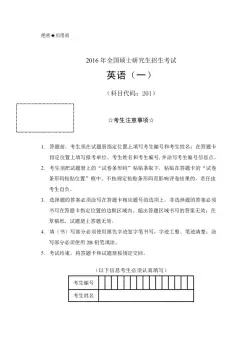
2010 年全国硕士研究生招生考试
英语(二)
(科目代码:204)
☆考生注意事项☆
1. 答题前,考生须在试题册指定位置上填写考生编号和考生姓名;在答题卡
指定位置上填写报考单位、考生姓名和考生编号,并涂写考生编号信息点。
2. 考生须把试题册上的“试卷条形码”粘贴条取下,粘贴在答题卡的“试卷
条形码粘贴位置”框中。不按规定粘贴条形码而影响评卷结果的,责任由
考生自负。
3. 选择题的答案必须涂写在答题卡相应题号的选项上,非选择题的答案必须
书写在答题卡指定位置的边框区域内。超出答题区域书写的答案无效;在
草稿纸、试题册上答题无效。
4. 填(书)写部分必须使用黑色字迹签字笔书写,字迹工整、笔迹清楚;涂
写部分必须使用 2B 铅笔填涂。
5. 考试结束,将答题卡和试题册按规定交回。
(以下信息考生必须认真填写)
考生编号
考生姓名
Section I Use of English
· 1Directions:
Read the following text. Choose the best word(s) for each numbered blank and mark
A, B, C or D on ANSWER SHEET 1. (10 points)
The outbreak of swine flu that was first detected in Mexico was declared a
global epidemic on June 11, 2009. It is the first worldwide epidemic 1 by the
World Health Organization in 41 years.
The heightened alert 2 an emergency meeting with flu experts in Geneva
that assembled after a sharp rise in cases in Australia, and rising 3 in
Britain, Japan, Chile and elsewhere.
But the epidemic is “ 4 ” in severity, according to Margaret Chan, the
organization’s director general, 5 the overwhelming majority of patients
experiencing only mild symptoms and a full recovery, often in the 6 of any
medical treatment.
The outbreak came to global 7 in late April 2009, when Mexican
authorities noted an unusually large number of hospitalizations and deaths 8
healthy adults. As much of Mexico City shut down at the height of a panic, cases
began to 9 in New York City, the southwestern United States and around the
world.
In the United States, new cases seemed to fade 10 warmer weather
arrived. But in late September 2009, officials reported there was 11 flu
activity in almost every state and that virtually all the 12 tested are the new
swine flu, also known as (A) H1N1, not seasonal flu. In the U.S., it has 13 more
than one million people, and caused more than 600 deaths and more than 6,000
hospitalizations.
Federal health officials 14 Tamiflu for children from the national
stockpile and began 15 orders from the states for the new swine flu
vaccine. The new vaccine, which is different from the annual flu vaccine, is
16 ahead of expectations. More than three million doses were to be made
available in early October 2009, though most of those 17 doses were of the
FluMist nasal spray type, which is not 18 for pregnant women, people over 50
or those with breathing difficulties, heart disease or several other 19 . But it
was still possible to vaccinate people in other high-risk groups: health care
workers, people 20 infants and healthy young people.
· 21.[A] criticized [B] appointed [C] commented [D] designated
2.[A] proceeded [B] activated [C] followed [D] prompted
3.[A] digits [B] numbers [C] amounts [D] sums
4.[A] moderate [B] normal [C] unusual [D] extreme
5. [A] with [B] in [C] from [D] by
6. [A] progress [B] absence [C] presence [D] favor
7. [A] reality [B] phenomenon [C] concept [D] notice
8. [A] over [B] for [C] among [D] to
9. [A] stay up [B] crop up [C] fill up [D] cover up
10. [A] as [B] if [C] unless [D] until
11. [A] excessive [B] enormous [C] significant [D] magnificent
12. [A] categories [B] examples [C] patterns [D] samples
13. [A] imparted [B] immersed [C] injected [D] infected
14. [A] released [B] relayed [C] relieved [D] remained
15. [A] placing [B] delivering [C] taking [D] giving
16. [A] feasible [B] available [C] reliable [D] applicable
17. [A] prevalent [B] principal [C] innovative [D] initial
18. [A] presented [B] restricted [C] recommended [D] introduced
19. [A] problems [B] issues [C] agonies [D] sufferings
20. [A] involved in [B] caring for [C] concerned with [D] warding off
Section II Reading Comprehension
Part A
Directions:
Read the following four texts. Answer the questions below each text by choosing A,
B, C or D. Mark your answers on ANSWER SHEET 1. (40 points)
·Text 1
The longest bull run in a century of art-market history ended on a dramatic note
with a sale of 56 works by Damien Hirst, Beautiful Inside My Head Forever, at
Sotheby’s in London on September 15th 2008. All but two pieces sold, fetching more
than £70m, a record for a sale by a single artist. It was a last victory. As the
auctioneer called out bids, in New York one of the oldest banks on Wall Street,
Lehman Brothers, filed for bankruptcy.
The world art market had already been losing momentum for a while after rising
bewilderingly since 2003. At its peak in 2007 it was worth some $65 billion, reckons
Clare McAndrew, founder of Arts Economics, a research firm – double the figure five
years earlier. Since then it may have come down to $50 billion. But the market
generates interest far beyond its size because it brings together great wealth,
enormous egos, greed, passion and controversy in a way matched by few other
industries.
In the weeks and months that followed Mr. Hirst’s sale, spending of any sort
became deeply unfashionable. In the art world that meant collectors stayed away from
galleries and salerooms. Sales of contemporary art fell by two-thirds, and in the most
overheated sector, they were down by nearly 90% in the year to November 2008.
Within weeks the world’s two biggest auction houses, Sotheby’s and Christie’s, had
to pay out nearly $200m in guarantees to clients who had placed works for sale with
them.
The current downturn in the art market is the worst since the Japanese stopped
buying Impressionists at the end of 1989. This time experts reckon that prices are
about 40% down on their peak on average, though some have been far more fluctuant.
But Edward Dolman, Christie’s chief executive, says: “I’m pretty confident we’re at
the bottom.”
What makes this slump different from the last, he says, is that there are still
buyers in the market. Almost everyone who was interviewed for this special report
said that the biggest problem at the moment is not a lack of demand but a lack of
good work to sell. The three Ds – death, debt and divorce – still deliver works of art
to the market. But anyone who does not have to sell is keeping away, waiting for
confidence to return.
·21. In the first paragraph, Damien Hirst’s sale was referred to as “a last victory”
because .
[A] the art market had witnessed a succession of victories
[B] the auctioneer finally got the two pieces at the highest bids
[C] Beautiful Inside My Head Forever won over all masterpieces
[D] it was successfully made just before the world financial crisis
22. By saying “spending of any sort became deeply unfashionable” (Line 1-2, Para. 3),
the author suggests that .
[A] collectors were no longer actively involved in art-market auctions
[B] people stopped every kind of spending and stayed away from galleries
[C] art collection as a fashion had lost its appeal to a great extent
[D] works of art in general had gone out of fashion so they were not worth buying
23. Which of the following statements is NOT true?
[A] Sales of contemporary art fell dramatically from 2007 to 2008.
[B]The art market surpassed many other industries in momentum.
[C]The art market generally went downward in various ways.
[D] Some art dealers were awaiting better chances to come.
24. The three Ds mentioned in the last paragraph are .
[A] auction houses’ favorites
[B] contemporary trends
[C] factors promoting artwork circulation
[D] styles representing Impressionists
25. The most appropriate title for this text could be .
[A] Fluctuation of Art Prices
[B] Up-to-date Art Auctions
[C]Art Market in Decline
[D] Shifted Interest in Arts
·Text 2
I was addressing a small gathering in a suburban Virginia living room – a
women’s group that had invited men to join them. Throughout the evening, one man
had been particularly talkative, frequently offering ideas and anecdotes, while his
wife sat silently beside him on the couch. Toward the end of the evening, I
commented that women frequently complain that their husbands don’t talk to them.
This man quickly nodded in agreement. He gestured toward his wife and said, “She’s
the talker in our family.” The room burst into laughter; the man looked puzzled and
hurt. “It’s true,” he explained. “When I come home from work I have nothing to say.
If she didn’t keep the conversation going, we’d spend the whole evening in silence.”
This episode crystallizes the irony that although American men tend to talk more
than women in public situations, they often talk less at home. And this pattern is
wreaking havoc with marriage.
The pattern was observed by political scientist Andrew Hacker in the late 1970s.
Sociologist Catherine Kohler Riessman reports in her new book Divorce Talk that
most of the women she interviewed – but only a few of the men – gave lack of
communication as the reason for their divorces. Given the current divorce rate of
nearly 50 percent, that amounts to millions of cases in the United States every year –
a virtual epidemic of failed conversation.
In my own research, complaints from women about their husbands most often
focused not on tangible inequities such as having given up the chance for a career to
accompany a husband to his, or doing far more than their share of daily life-support
work like cleaning, cooking and social arrangements. Instead, they focused on
communication: “He doesn’t listen to me.” “He doesn’t talk to me.” I found, as
Hacker observed years before, that most wives want their husbands to be, first and
foremost, conversational partners, but few husbands share this expectation of their
wives.
In short, the image that best represents the current crisis is the stereotypical
cartoon scene of a man sitting at the breakfast table with a newspaper held up in front
of his face, while a woman glares at the back of it, wanting to talk.
·26. What is most wives’ main expectation of their husbands?
[A]Talking to them.
[B]Trusting them.
[C] Supporting their careers.
[D] Sharing housework.
27. Judging from the context, the phrase “wreaking havoc” (Line 3, Para. 2) most
probably means .
[A] generating motivation
[B] exerting influence
[C] causing damage
[D] creating pressure
28. All of the following are true EXCEPT .
[A] men tend to talk more in public than women
[B] nearly 50 percent of recent divorces are caused by failed conversation
[C] women attach much importance to communication between couples
[D] a female tends to be more talkative at home than her spouse
29. Which of the following can best summarize the main idea of this text?
[A]The moral decaying deserves more research by sociologists.
[B] Marriage break-up stems from sex inequalities.
[C] Husband and wife have different expectations from their marriage.
[D] Conversational patterns between man and wife are different.
30. In the following part immediately after this text, the author will most probably
focus on .
[A] a vivid account of the new book Divorce Talk
[B] a detailed description of the stereotypical cartoon
[C] other possible reasons for a high divorce rate in the U.S.
[D] a brief introduction to the political scientist Andrew Hacker
·Text 3
Over the past decade, many companies had perfected the art of creating
automatic behaviors – habits – among consumers. These habits have helped
companies earn billions of dollars when customers eat snacks or wipe counters almost
without thinking, often in response to a carefully designed set of daily cues.
“There are fundamental public health problems, like dirty hands instead of a
soap habit, that remain killers only because we can’t figure out how to change
people’s habits,” said Dr. Curtis, the director of the Hygiene Center at the London
School of Hygiene & Tropical Medicine. “We wanted to learn from private industry
how to create new behaviors that happen automatically.”
The companies that Dr. Curtis turned to – Procter & Gamble, Colgate- Palmolive
and Unilever – had invested hundreds of millions of dollars finding the subtle cues in
consumers’ lives that corporations could use to introduce new routines.
If you look hard enough, you’ll find that many of the products we use every day
– chewing gums, skin moisturizers, disinfecting wipes, air fresheners, water purifiers,
health snacks, teeth whiteners, fabric softeners, vitamins – are results of manufactured
habits. A century ago, few people regularly brushed their teeth multiple times a day.
Today, because of shrewd advertising and public health campaigns, many Americans
habitually give their pearly whites a cavity-preventing scrub twice a day, often with
Colgate, Crest or one of the other brands.
A few decades ago, many people didn’t drink water outside of a meal. Then
beverage companies started bottling the production of far-off springs, and now office
workers unthinkingly sip bottled water all day long. Chewing gum, once bought
primarily by adolescent boys, is now featured in commercials as a breath freshener
and teeth cleanser for use after a meal. Skin moisturizers are advertised as part of
morning beauty rituals, slipped in between hair brushing and putting on makeup.
“Our products succeed when they become part of daily or weekly patterns,” said
Carol Berning, a consumer psychologist who recently retired from Procter & Gamble,
the company that sold $76 billion of Tide, Crest and other products last year.
“Creating positive habits is a huge part of improving our consumers’ lives, and it’s
essential to making new products commercially viable.”
Through experiments and observation, social scientists like Dr. Berning have
learned that there is power in tying certain behaviors to habitual cues through ruthless
advertising. As this new science of habit has emerged, controversies have erupted
when the tactics have been used to sell questionable beauty creams or unhealthy
foods.
831. According to Dr. Curtis, habits like hand washing with soap .
[A] should be further cultivated
[B] should be changed gradually
[C] are deeply rooted in history
[D] are basically private concerns
32. Bottled water, chewing gum and skin moisturizers are mentioned in Paragraph 5
so as to .
[A] reveal their impact on people’s habits
[B] show the urgent need of daily necessities
[C] indicate their effect on people’s buying power
[D] manifest the significant role of good habits
33. Which of the following does NOT belong to products that help create people’s
habits?
[A]Tide.
[B] Crest.
[C] Colgate.
[D] Unilever.
34. From the text we know that some of consumers’ habits are developed due to .
[A] perfected art of products
[B] automatic behavior creation
[C] commercial promotions
[D] scientific experiments
35. The author’s attitude toward the influence of advertisement on people’s habits is
.
[A] indifferent
[B] negative
[C] positive
[D] biased
9Text 4
Many Americans regard the jury system as a concrete expression of crucial
democratic values, including the principles that all citizens who meet minimal
qualifications of age and literacy are equally competent to serve on juries; that jurors
should be selected randomly from a representative cross section of the community;
that no citizen should be denied the right to serve on a jury on account of race,
religion, sex, or national origin; that defendants are entitled to trial by their peers; and
that verdicts should represent the conscience of the community and not just the letter
of the law. The jury is also said to be the best surviving example of direct rather than
representative democracy. In a direct democracy, citizens take turns governing
themselves, rather than electing representatives to govern for them.
But as recently as in 1968, jury selection procedures conflicted with these
democratic ideals. In some states, for example, jury duty was limited to persons of
supposedly superior intelligence, education, and moral character. Although the
Supreme Court of the United States had prohibited intentional racial discrimination in
jury selection as early as the 1880 case of Strauder v. West Virginia, the practice of
selecting so-called elite or blue-ribbon juries provided a convenient way around this
and other antidiscrimination laws.
The system also failed to regularly include women on juries until the mid-20th
century. Although women first served on state juries in Utah in 1898, it was not until
the 1940s that a majority of states made women eligible for jury duty. Even then
several states automatically exempted women from jury duty unless they personally
asked to have their names included on the jury list. This practice was justified by the
claim that women were needed at home, and it kept juries unrepresentative of women
through the 1960s.
In 1968, the Congress of the United States passed the Jury Selection and Service
Act, ushering in a new era of democratic reforms for the jury. This law abolished
special educational requirements for federal jurors and required them to be selected at
random from a cross section of the entire community. In the landmark 1975 decision
Taylor v. Louisiana, the Supreme Court extended the requirement that juries be
representative of all parts of the community to the state level. The Taylor decision
also declared sex discrimination in jury selection to be unconstitutional and ordered
states to use the same procedures for selecting male and female jurors.
1036. From the principles of the US jury system, we learn that .
[A] both literate and illiterate people can serve on juries
[B] defendants are immune from trial by their peers
[C] no age limit should be imposed for jury service
[D] judgment should consider the opinion of the public
37. The practice of selecting so-called elite jurors prior to 1968 showed .
[A] the inadequacy of antidiscrimination laws
[B] the prevalent discrimination against certain races
[C] the conflicting ideals in jury selection procedures
[D] the arrogance common among the Supreme Court judges
38. Even in the 1960s, women were seldom on the jury list in some states because
.
[A] they were automatically banned by state laws
[B] they fell far short of the required qualifications
[C] they were supposed to perform domestic duties
[D] they tended to evade public engagement
39. After the Jury Selection and Service Act was passed, .
[A] sex discrimination in jury selection was unconstitutional and had to be abolished
[B] educational requirements became less rigid in the selection of federal jurors
[C] jurors at the state level ought to be representative of the entire community
[D] states ought to conform to the federal court in reforming the jury system
40. In discussing the US jury system, the text centers on .
[A] its nature and problems
[B] its characteristics and tradition
[C] its problems and their solutions
[D] its tradition and development
11Part B
Directions:
Read the following text and decide whether each of the statements is true or false.
Choose T if the statement is true or F if the statement is not true. Mark your answers
on ANSWER SHEET 1. (10 points)
Copying Birds May Save Aircraft Fuel
Both Boeing and Airbus have trumpeted the efficiency of their newest aircraft,
the 787 and A350 respectively. Their clever designs and lightweight composites
certainly make a difference. But a group of researchers at Stanford University, led by
Ilan Kroo, has suggested that airlines could take a more naturalistic approach to
cutting jet-fuel use and it would not require them to buy new aircraft.
The answer, says Dr. Kroo, lies with birds. Since 1914, scientists have known
that birds flying in formation – a V-shape – expend less energy. The air flowing over a
bird’s wings curls upwards behind the wingtips, a phenomenon known as upwash.
Other birds flying in the upwash experience reduced drag, and spend less energy
propelling themselves. Peter Lissaman, an aeronautics expert who was formerly at
Caltech and the University of Southern California, has suggested that a formation of
25 birds might enjoy a range increase of 71%.
When applied to aircraft, the principles are not substantially different. Dr. Kroo
and his team modeled what would happen if three passenger jets departing from Los
Angeles, San Francisco and Las Vegas were to assemble over Utah, assume an
inverted V-formation, occasionally change places so all could have a turn in the most
favourable positions, and proceed to London. They found that the aircraft consumed
as much as 15% less fuel (coupled with a reduction in carbon-dioxide output).
Nitrogen-oxide emissions during the cruising portions of the flight fell by around a
quarter.
There are, of course, knots to be worked out. One consideration is safety, or at
least the perception of it. Would passengers feel comfortable travelling in companion?
Dr. Kroo points out that the aircraft could be separated by several nautical miles, and
would not be in the intimate groupings favoured by display teams like the Red
Arrows. A passenger peering out of the window might not even see the other planes.
Whether the separation distances involved would satisfy air-traffic-control regulations
is another matter, although a working group at the International Civil Aviation
Organisation has included the possibility of formation flying in a blueprint for new
operational guidelines.
12It remains to be seen how weather conditions affect the air flows that make
formation flight more efficient. In zones of increased turbulence, the planes’ wakes
will decay more quickly and the effect will diminish. Dr. Kroo says this is one of the
areas his team will investigate further. It might also be hard for airlines to co-ordinate
the departure times and destinations of passenger aircraft in a way that would allow
them to gain from formation flight. Cargo aircraft, in contrast, might be easier to
reschedule, as might routine military flights.
As it happens, America’s armed forces are on the case already. Earlier this year
the country’s Defence Advanced Research Projects Agency announced plans to pay
Boeing to investigate formation flight, though the programme has yet to begin. There
are reports that some military aircraft flew in formation when they were low on fuel
during the Second World War, but Dr. Lissaman says they are unsubstantiated. “My
father was an RAF pilot and my cousin the skipper of a Lancaster lost over Berlin,”
he adds. So he should know.
41. Findings of the Stanford University researchers will promote the sales of new
Boeing and Airbus aircraft.
42. The upwash experience may save propelling energy as well as reducing resistance.
43. Formation flight is more comfortable because passengers can not see the other
planes.
44. The role that weather plays in formation flight has not yet been clearly defined.
45. It has been documented that during World War Ⅱ, America’s armed forces once
tried formation flight to save fuel.
13