文档文本内容
The fifth period(第五课时)
Part B Read and write
教学内容
▶
Read and write ·通过头脑风暴活动汇总自己所知的各种上学方式,激活已有的背景知识和储备词汇
·通过阅读问题训练,在语篇中寻找关键词,并就细节进行推理
·根据示范的海报完成安全海报的设计
·根据例句提示在文段中找到更多同类现象,最终正确朗读句子
教学重点
▶
能够听懂、读懂“Read and write”板块的短文,并能够根据短文内容完成相应的练习。
教学难点
▶
能够了解不同国家的文化差异和出行方式。
教学准备
▶
1.预习《状元大课堂》《创优作业100分》《状元作业本》中本课时的相关内容。
2.PPT课件、课文录音、视频、交通信号灯模型等。
教学过程
▶
Step 1: Pre-reading①
1. Greetings.
Teaching purpose①
2. Review.
通过与学生互动,调动
Hold a model of traffic lights. Talk with students. 学生参与课堂的积极性。通
T:What do the traffic lights mean? 过复习旧知引入本课将要学
Ss:Red means… Green means… Yellow means… 习的内容,为后面的学习做
好铺垫。
T:You are so clever! Do you know different countries have
different traffic rules? For example, in China, we walk on the right of the
road. But in England, people should walk on the left. Do you know any
other countries’ ways of transportation? Now, let’s see what we will
learn today!
3. Lead-in.
Show some pictures. (出示课件) Help students know the names of
these places.
Students read after the teacher.
Teaching purpose②
Step 2: While-reading 通过问题引导学生观
察并讨论图片,借助图片预
1. Brainstorm.
测教学内容,培养学生的观
察能力和逻辑推理能力。通
过预测教学内容激活已有知
识,并提取与文本有关的3 知
识,进入文本话题。T:How many ways can you think of to go to school? Please talk
with your partner.
Students do the “Brainstorm”. Gather all the ways they know to go
to school. ( 课 件 出 示 : 本 单 元 学 过 的 上 学 的 方 式 by
car/bus/bike/subway/taxi/plane/ship/train和on foot的相关内容)
2. Look and predict.②
Show the picture of “Read and write” on the PPT. (课件出示:教
材P18 Read and write板块爷爷和Robin交谈的插图)
Let students observe the pictures,read the dialogue and discuss the
questions.
Questions:
① Who are they? (Robin and Wu Binbin’s grandpa. And
Grandpa is ill.)
② What does Robin want to do? (He wants to read a magazine Teaching purpose③
to Grandpa.)
引导学生带着问题阅读
③ What’s the magazine about? (Different ways to go to school in 文本,整体感知文本,获取
different countries.) 有用信息。利用问题逐步引
3. Listen and say.③ 导学生理解文本,逐步跟随
文本学习新句型。
(1)Show the four pictures one by one. (课件出示:依次出示教材
P18 Read and write板块的四幅图片) Let students observe the pictures
and discuss the questions.
Questions:
① Who are they? (They are students/kids/children.)
③ Where are they? (In Munich, Germany. In Alaska, USA. In
Beijing, China. In Papa Westray, Scotland.)
③How do they go to school?
Let students read the text quickly and find the ways of the children
to go to school.
(2)Play the recording. (课件出示:教材P18 Read and write板块
的音频)Let students listen to it and answer the questions below the
Teaching purpose④
passage in the book.
运用任务型教学方法,
(3)Check the answers.
设计不同的任务,环环相扣,
4. Learn the new words and sentences.④
逐步引导学生跟随文本学习
(1)Play the recording again. (课件出示:教材P18 Read and write 新词汇、新句型,对重点句
板块的音频) Lead students to learn the new words and sentences. 型进行认知和操练,突破教
① Show the picture of the sled and do the action to help students 学重点,降低学习的难度。
understand the phrase “by sled”.(课件出示:雪橇图片)
Do the action fast first, then do the same action slowly. Let students
understand the word “fast”.
Ask students to do and say the sentences “Some kids go to school
by sled. It’s fast.” “Don’t let the dogs run too fast. You must drive
slowly.”
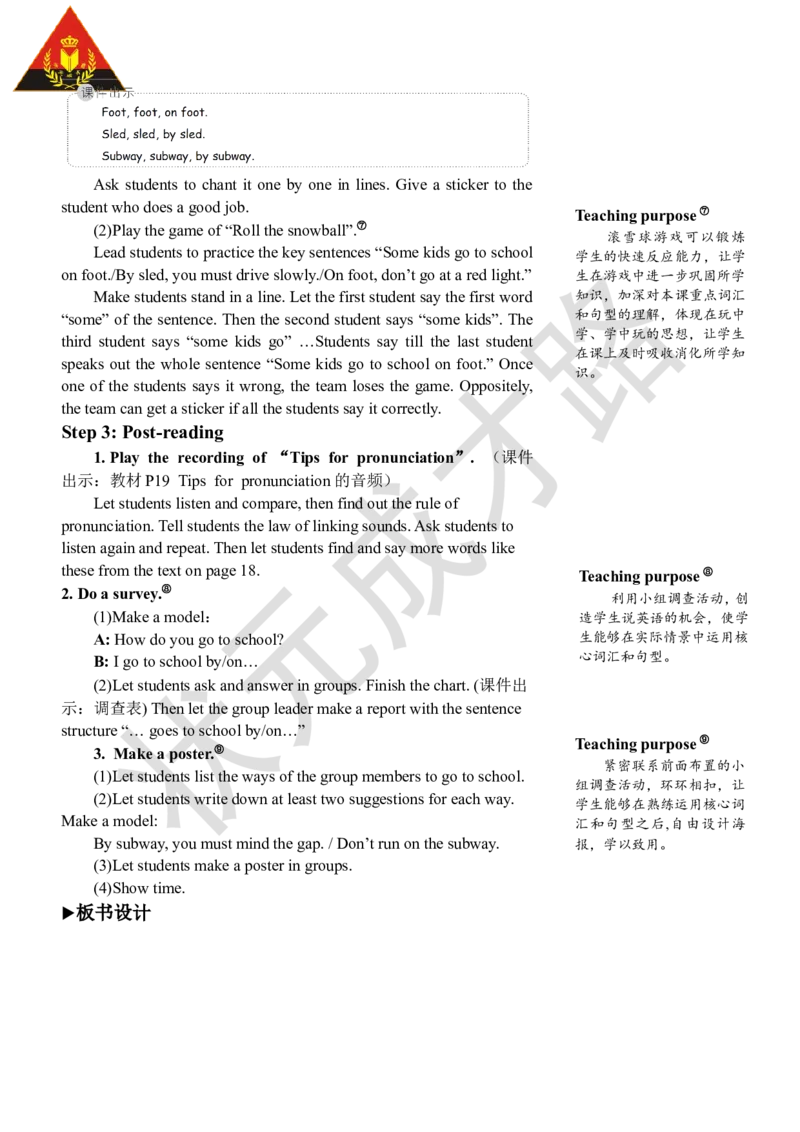
4④ Show the pictures of a boat, a ferry and a ship on the PPT.
Help students understand the differences among “ship, boat and
ferry”.
Do the action and teach the phrase “by subway”. Show the picture
of the subway and do the action to help students understand the sentence
“We must mind the gap by subway. And don’t run on the subway.”
Write down the sentence structure “Some kids go to school by…”
on the blackboard. Do the actions and let students use the sentence
structure to make sentences.
③ Lead students to look at Picture 4. Ask them to read the
sentences and try to answer the questions.
T:How do the children in Papa Westray go to school?
Ss:By ferry.
T:How did they go to school in 2009?
Ss:By plane. Teaching purpose⑤
T:Why? 播放录音,让学生听录
Ss:Because the ferry didn’t work. 音跟读。引导学生按照正确
的意群及语音、语调朗读对
(2)Play the recording.⑤(课件出示:教材P18 Read and write板块
话。
的音频) Let students read after the recording. Pay attention to the
pronunciation and the intonation.
5. Read and choose.⑥ Teaching purpose⑥
(1)Let students practice the passage. 利用插图引导学生分组
复述原文。最后,带领学生
(2)Let students act out.
阅读后文给出的关于选择不
(3)Let students retell the ways of the kids to go to school in groups
同交通方式的建议,引导学
by looking at the pictures.
生对前文的孩子们的不同的
(4)Let students give some suggestions for the kids. 出行方式提供合适的建议。
Divide students into six groups. Let them read the suggestions on
page 19 one by one. Then ask them to choose the suitable suggestions
for the kids and write them down on page 18.
6. Practice the words and the sentences.
(1)Play the game of “Drive the train”.
Make up a chant of the words and the phrases.
5Ask students to chant it one by one in lines. Give a sticker to the
student who does a good job.
Teaching purpose⑦
(2)Play the game of “Roll the snowball”.⑦
滚雪球游戏可以锻炼
Lead students to practice the key sentences “Some kids go to school
学生的快速反应能力,让学
on foot./By sled, you must drive slowly./On foot, don’t go at a red light.” 生在游戏中进一步巩固所学
Make students stand in a line. Let the first student say the first word 知识,加深对本课重点词汇
和句型的理解,体现在玩中
“some” of the sentence. Then the second student says “some kids”. The
学、学中玩的思想,让学生
third student says “some kids go” …Students say till the last student
在课上及时吸收消化所学知
speaks out the whole sentence “Some kids go to school on foot.” Once
识。
one of the students says it wrong, the team loses the game. Oppositely,
the team can get a sticker if all the students say it correctly.
Step 3: Post-reading
1. Play the recording of “Tips for pronunciation”. (课件
出示:教材P19 Tips for pronunciation的音频)
Let students listen and compare, then find out the rule of
pronunciation. Tell students the law of linking sounds. Ask students to
listen again and repeat. Then let students find and say more words like
these from the text on page 18. Teaching purpose⑧
2. Do a survey.⑧
利用小组调查活动,创
(1)Make a model: 造学生说英语的机会,使学
A: How do you go to school? 生能够在实际情景中运用核
心词汇和句型。
B: I go to school by/on…
(2)Let students ask and answer in groups. Finish the chart. (课件出
示:调查表) Then let the group leader make a report with the sentence
structure “… goes to school by/on…”
Teaching purpose⑨
3. Make a poster.⑨
紧密联系前面布置的小
(1)Let students list the ways of the group members to go to school.
组调查活动,环环相扣,让
(2)Let students write down at least two suggestions for each way.
学生能够在熟练运用核心词
Make a model: 汇和句型之后,自由设计海
By subway, you must mind the gap. / Don’t run on the subway. 报,学以致用。
(3)Let students make a poster in groups.
(4)Show time.
板书设计
▶
6作业设计
▶
1. Read after the recording.
2. Do the exercises. (见“状元成才路”系列丛书《创优作业100分》或《状元作业本》对
应课时作业)
教学反思
▶
1. 在本堂课中,以学生为主体、训练为主线,开展多类型的小组活动,使学生在学中用、用中学。学
用结合,激发学生的多元智能学习能力。
2. 这节课以句型教学为主,配以简单的词组来运用所学句型。采用chant、滚雪球等多种形式来逐
步引导学生操练词汇和句型,有效地帮助学生巩固重点词汇和句型。
3. 呈现活动设计丰富,易操作,且具备层次感,有效地提升了学生的核心素养。以学生为本,以解
决问题为导向,引导学生自主学习。
4. 突出语用功能,联系学生和班级的实际情况,设置多个环节,环环相扣,层层深入,帮助学生在
真实情景中自然地使用所学语言。
▶Teaching Contents
Read and write
·Gather all kinds of ways to go to school they know through the brainstorm and activate the
background knowledge and the vocabulary they have learned.
·Find the key words in the text and reason about details through solving the problems below the
text.
·Complete the design of a safety poster according to the demonstration poster.
·Find more similar sentences in the passage according to the example sentence prompt and read the
sentences correctly.
▶Teaching Priorities
·Be able to listen and read the passage and complete the corresponding exercises according to the
passage.
▶Teaching Difficulties
·Be able to learn about the cultural differences and the ways of travelling in different countries.
▶Teaching Procedures
7Teaching
Teacher’ s Activities Students’ Activities Teaching Purposes
Stages
Pre-reading 1. Greetings. 1. Greetings. Review the words
2. Review. 2. Look and talk with the and the sentences.
3. Lead-in. teacher. Stimulate students’
3. Look and learn the interest in learning
names of the places. and lead in the topic.
Read after the teacher. Prepare for the next
part.
While-reading 1. Brainstorming activity. Do the brainstorming Lead students to
Ask students to do activity. predict the content
the“Brainstorm”. Gather before listening to the
all the ways to go to recording.
school Cultivate students’
2. Look and predict. Look at the picture and observation ability
discuss the questions. and logical reasoning
Predict the main idea. ability. Prepare for
3. Listen and say. (1)Observe the pictures the next study.
(1)Show the four pictures one and discuss the
by one. Let students questions.
observe and discuss the (2)Listen and answer the
questions. questions.
(2)Play the recording. (3)Check the answers.
(3)Check the answers.
4. Learn the new words and (1)Learn the new words Stimulate students’
sentences. and the sentences and interest in learning.
(1)Play the recording again and answer the questions. Train students’ ability
show the pictures. Lead (2)Read after the of responding quickly.
students to learn the new recording. Practice the key words
words and the sentences. and sentences. Reduce
(2)Let students read after the the difficulty of
recording. learning.
5. Read and choose. Practice the passage and
act out. Retell the passage
and choose the suitable
suggestions.
6. Practice the words and the
sentences. Practice the words and the
(1)Play the game of “Drive the sentences by playing the
train”. two games.
(2)Play the game of “Roll the
8snowball”.
(续表)
Teaching
Teacher’ s Activities Students’ Activities Teaching Purposes
Stages
Post-reading 1. Play the recording of 1. Listen and compare, then Create opportunities
“Tips for pronunciation”. find out the rule of for students to speak
2. Do a survey. pronunciation. English.
(1)Make a model. Listen again and repeat. Consolidate the new
(2)Let students ask and Then find and say more words and sentences
answer in groups. And let words like these from the of this unit. Make
the group leader make a text on page 18. sure students can use
report with the sentence 2. Do a survey. the key vocabulary
structure “…goes to 3. List the ways of the group and sentence
school by/on…” members to go to school structures in real
3. Make a poster. and write down the situations.
suggestions. Make a
poster and show it to the
class.
Homework 1. Read after the recording.
2. Do the exercises.
9