文档文本内容
The fifth period(第五课时)
Part B Read and write
▶ 教学内容与目标
课时教学内容 课时教学目标
Read and write 能够通过看图讨论预测故事的开端和进一步发展来激
活相关背景知识或储备词汇。
能够通过完成读后活动来训练在语篇中捕捉不同类型
信息和思考的能力。
能够正确地听、说、认读单词“basket, part, licked,
laughed”。
能够从阅读中获取有用的句型来口头描述自己一天的
活动,并最终写出一个小语段。
能够明白凡事都有好坏两面,在我们的努力下坏事也
能转化为好事。
▶ 教学重点
能够听懂、理解该部分的日记,并能完成文后的练习。
▶ 教学难点
1. 培养阅读技巧和阅读兴趣。
2. 学会用一般过去时描述过去发生的事情。
▶ 教学准备
1. 预习《状元大课堂》《创优作业100分》《状元作业本》中本课时的相关内容。
2. PPT课件、课文音频、视频、实物等。
▶ 教学过程
Step 1: Pre-reading①
1. Greetings.
Say hello to students. Divide them into two groups. Let them PK by getting morelucky stars to make things become better and better.
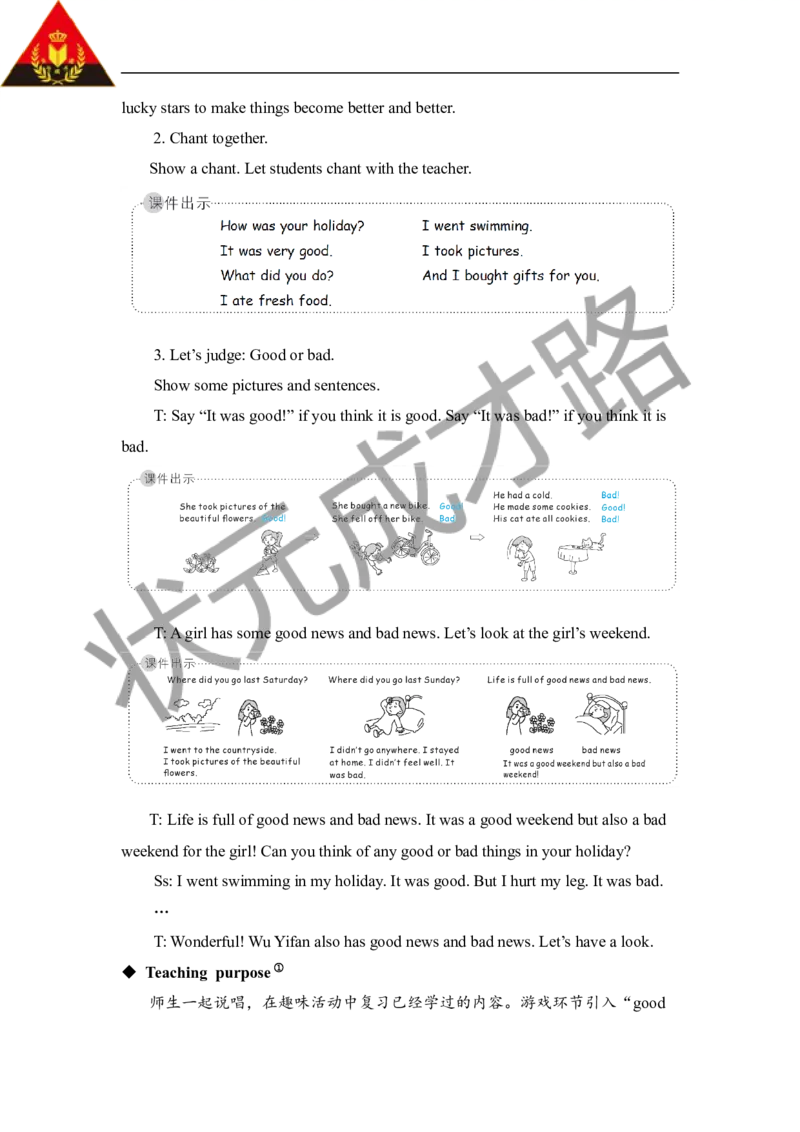
2. Chant together.
Show a chant. Let students chant with the teacher.
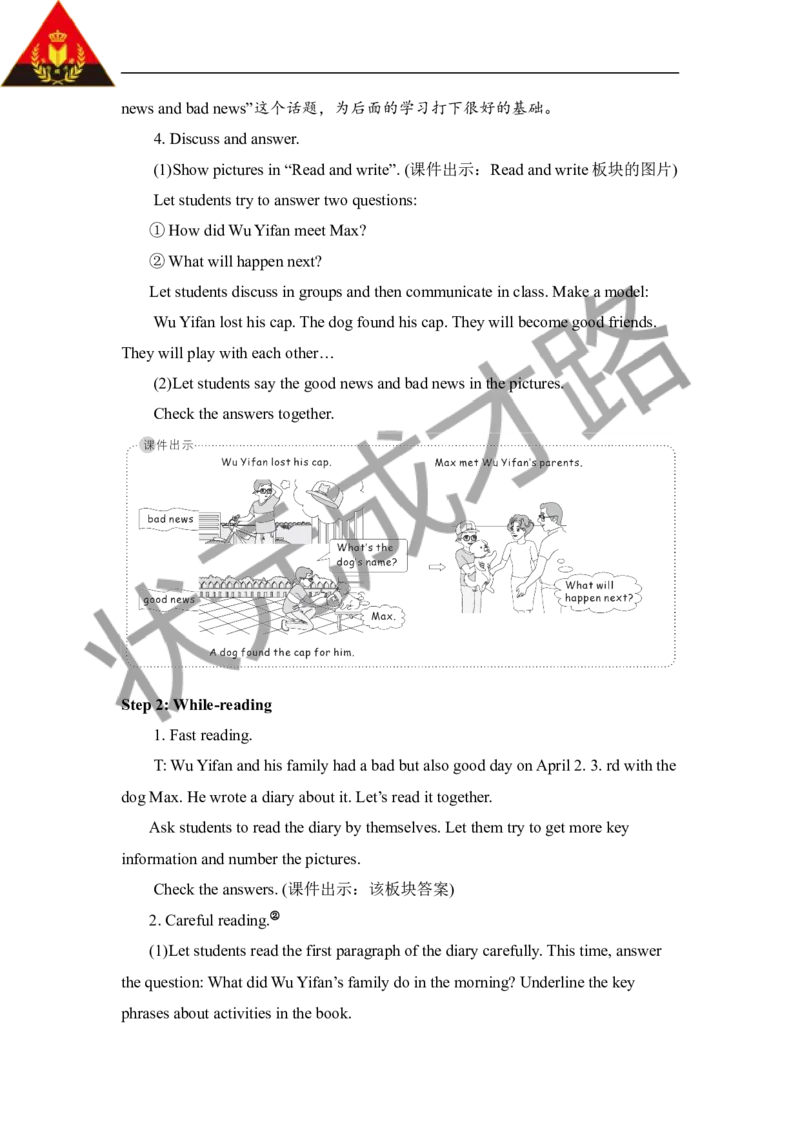
3. Let’s judge: Good or bad.
Show some pictures and sentences.
T: Say “It was good!” if you think it is good. Say “It was bad!” if you think it is
bad.
T: A girl has some good news and bad news. Let’s look at the girl’s weekend.
T: Life is full of good news and bad news. It was a good weekend but also a bad
weekend for the girl! Can you think of any good or bad things in your holiday?
Ss: I went swimming in my holiday. It was good. But I hurt my leg. It was bad.
…
T: Wonderful! Wu Yifan also has good news and bad news. Let’s have a look.
◆ Teaching purpose①
师生一起说唱,在趣味活动中复习已经学过的内容。游戏环节引入“goodnews and bad news”这个话题,为后面的学习打下很好的基础。
4. Discuss and answer.
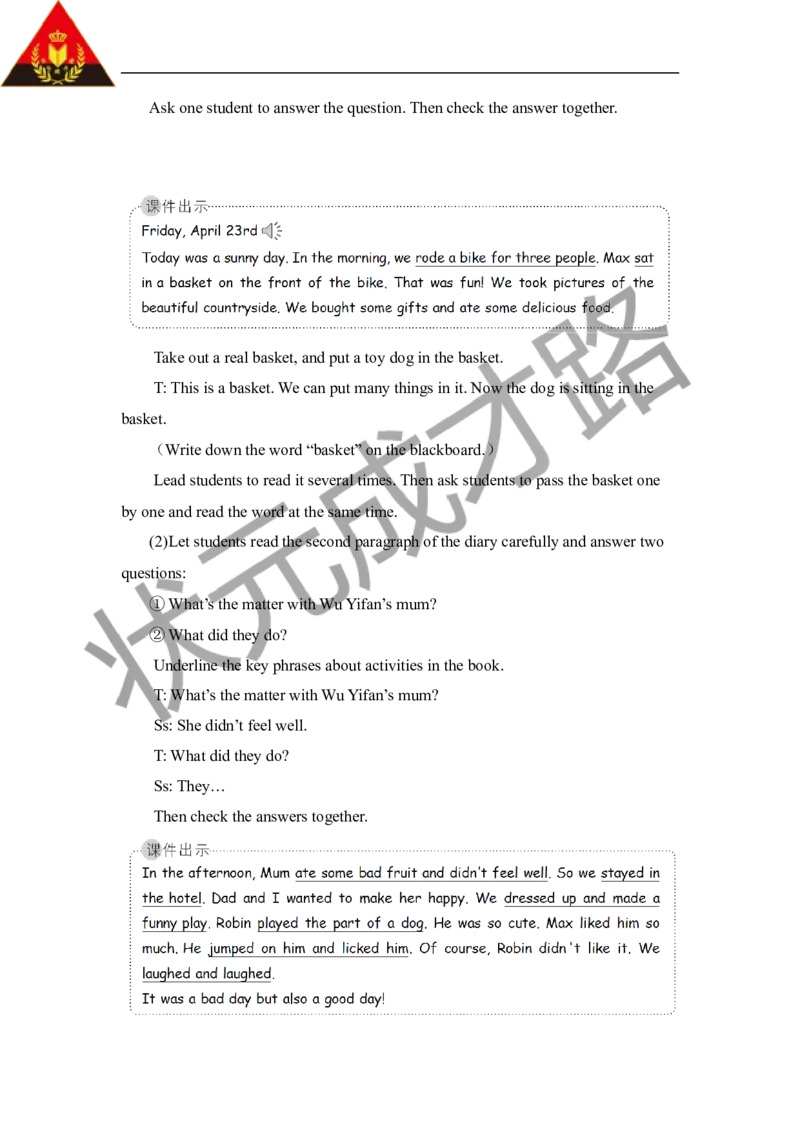
(1)Show pictures in “Read and write”. (课件出示:Read and write板块的图片)
Let students try to answer two questions:
①How did Wu Yifan meet Max?
②What will happen next?
Let students discuss in groups and then communicate in class. Make a model:
Wu Yifan lost his cap. The dog found his cap. They will become good friends.
They will play with each other…
(2)Let students say the good news and bad news in the pictures.
Check the answers together.
Step 2: While-reading
1. Fast reading.
T: Wu Yifan and his family had a bad but also good day on April 2. 3. rd with the
dog Max. He wrote a diary about it. Let’s read it together.
Ask students to read the diary by themselves. Let them try to get more key
information and number the pictures.
Check the answers. (课件出示:该板块答案)
2. Careful reading.②
(1)Let students read the first paragraph of the diary carefully. This time, answer
the question: What did Wu Yifan’s family do in the morning? Underline the key
phrases about activities in the book.Ask one student to answer the question. Then check the answer together.
Take out a real basket, and put a toy dog in the basket.
T: This is a basket. We can put many things in it. Now the dog is sitting in the
basket.
(Write down the word “basket” on the blackboard.)
Lead students to read it several times. Then ask students to pass the basket one
by one and read the word at the same time.
(2)Let students read the second paragraph of the diary carefully and answer two
questions:
①What’s the matter with Wu Yifan’s mum?
②What did they do?
Underline the key phrases about activities in the book.
T: What’s the matter with Wu Yifan’s mum?
Ss: She didn’t feel well.
T: What did they do?
Ss: They…
Then check the answers together.T: What can you do if your mum doesn’t feel well?
Ss: I can give hot water to her./I can make some delicious food for her…
T: Good girl/boy! Your mum will be happy! OK! Let’s go on.
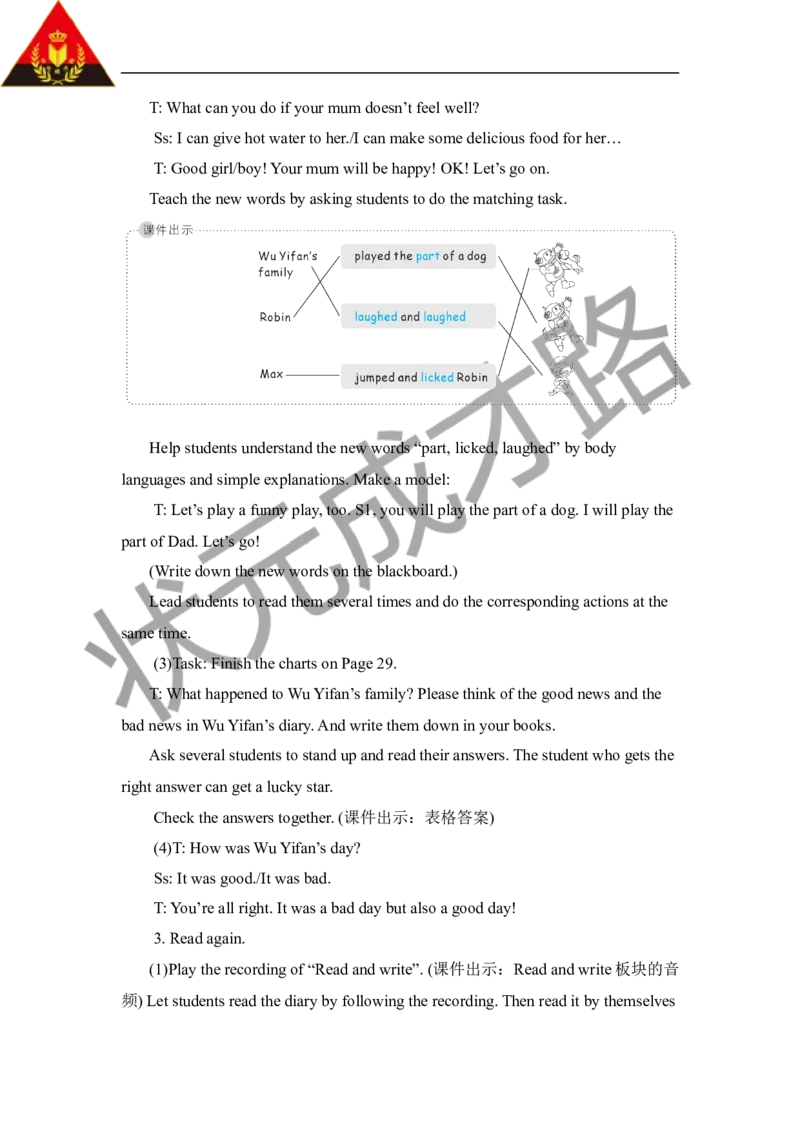
Teach the new words by asking students to do the matching task.
Help students understand the new words “part, licked, laughed” by body
languages and simple explanations. Make a model:
T: Let’s play a funny play, too. S1, you will play the part of a dog. I will play the
part of Dad. Let’s go!
(Write down the new words on the blackboard.)
Lead students to read them several times and do the corresponding actions at the
same time.
(3)Task: Finish the charts on Page 29.
T: What happened to Wu Yifan’s family? Please think of the good news and the
bad news in Wu Yifan’s diary. And write them down in your books.
Ask several students to stand up and read their answers. The student who gets the
right answer can get a lucky star.
Check the answers together. (课件出示:表格答案)
(4)T: How was Wu Yifan’s day?
Ss: It was good./It was bad.
T: You’re all right. It was a bad day but also a good day!
3. Read again.
(1)Play the recording of “Read and write”. (课件出示:Read and write板块的音
频) Let students read the diary by following the recording. Then read it by themselveswith correct sense groups and pausing.
(2)Retell the diary.
Ask students to retell the diary by filling in the blanks on the PPT.
The student who does a good job can get a lucky star.
◆ Teaching purpose②
通过分段阅读,并完成画线、回答问题、连线等任务,让学生自主阅读文章,
获取有效信息,感知文章大意,并学习本课的重点词汇;充分激发学生的学习热
情,提高学生的课堂参与度。
Step 3: Post-reading③
1. Group work.
Ask students to think and discuss in groups: Your bad but also good day.
Encourage students to write it down in their books.
Make a model on the PPT.
2. Show time.
Let some students stand up to read their bad but also good day.Each one who stands up can get a lucky star.
◆ Teaching purpose③
通过谈论自己的美好又糟糕的一天,训练学生的自主表达能力。
Step 4: Consolidation & Extension④
1. Enjoy the traditional story “塞翁失马”. (出示课件)
Talk about the good and bad things in the story.
The teacher makes a model: The bad thing is that Saiweng lost his horse. The
good thing is that the horse came back with another fine horse several months later.
The bad thing is that his son fell off the horse and hurt his leg. The good thing is
that…
2. Emotional education.
T: Be happy and try your best in your life. As the saying goes, “Bad luck often
brings good luck.” I wish the lucky stars you’ve got today can help you laugh a lot in
your later life!
◆ Teaching purpose④
通过《塞翁失马》的故事,让学生体会事情都有两面,好事坏事可以相互转换
因此要保持乐观的心态,努力把坏事变成好事,树立正确的世界观。
▶ 板书设计
▶ 作业设计
1. Read the diary to your parents.
2. Do the exercise. (见“状元成才路”系列丛书《状元作业本》对应课时作业P29第一
题)一、【趣味题】英语迷宫:小猴子在西瓜地里摘了一个大西瓜,但不知道放在哪儿
了,猴妈妈告诉他只要沿着动词的过去式的路线走,就可以找到西瓜。请画出小
猴找西瓜的路线图。
参考答案:
licked → dressed → made → rode → sat → took → laughed
▶ 教学反思
1. 在趣味学习中潜移默化地渗透阅读技巧,提高学生的阅读能力。
2. 本课时的内容比较多,因此在设计教学时,尽量化难为简,采用多种方式,
使教学目标能够逐步达成。
3. 鼓励学生大胆开口,坚持让学生融入课堂,做课堂的主人。
4. 采用分段式教学,降低了学生的学习难度,也培养了学生的逻辑思维能力
5. 板书的设计基于本课的重点,一目了然,有效地帮助学生理解重点和整个
文本。
▶ Teaching Contents & Teaching Aims
Read and write
Be able to predict the beginning and further development of the diary by observing
the pictures. Activate relevant background knowledge or vocabulary.
Be able to train the ability to think and capture different types of information in the
text by completing the exercises after reading.
Be able to listen, speak and read the words “basket, part, licked, laughed”.
Be able to get useful sentence patterns to describe daily activities orally and finally
write a short paragraph. Be able to understand that every coin has two sides, and the bad things can be
turned into good things through our efforts.
▶ Teaching Priorities
Be able to understand the diary and complete the following exercises.
▶ Teaching Difficulties
Develop reading skills and interest in reading.
Learn to describe past events in the simple past tense.
▶ Teaching Procedures
Teaching Teacher’s Activities Students’ Activities Teaching Purposes
Stages
Pre-reading 1. Greetings. 1. Greetings. Lead students to
review what they
2. Chant together. 2. Chant together.
have learned. The
3. Let’s judge: Good 3. Say “It was good!” topic “good news
or bad. or “It was bad!” and bad news” is
introduced in the
4. Discuss and 4. (1) Answer two
game segment,
answer. questions.
which lays a good
(1)Show pictures in (2)Say the good news foundation for the
“Read and write”. and the bad news in following study.
the pictures.
(2)Lead students to
say.
While-reading 1. Fast reading. Read the diary and Lead students to
number the pictures. read the article
Ask students to
independently by
number the pictures.
reading in sections,
2. Careful reading. Answer the questions underlining
and finish the tasks. phrases, answering
Ask questions and
questions,
give tasks.
matching, etc.
Teach the words Stimulate students’
“basket, part, licked, learning
laughed”. enthusiasm and
improve their
3. Read again. Read the diary after
participation in
the recording.
Play the recording class.
of “Read and write”. Retell the diary by
filling in the blanks.
Post-reading 1. Group work. Think and discuss in Train students togroups. express
themselves.
Write down the bad
but also good day.
2. Show time. Read their works.
Consolidation 1. Enjoy the 1. Talk about the Set up a correct
traditional story good and bad things world view.
&
in the story.
“塞翁失马”.
Extension
2. Learn the old
2. Emotional
saying.
education.
Homework 1. Read the diary to your parents.
2. Do the exercise.