绝密★启用前
2018 年 1 月上海普通高等招生统一考试
英语试卷
(满分150分,考试时间120分钟)
考生注意:
答题前,务必在答题纸上填写准考证号和姓名,并将核对后的条形码贴在指定位置上,在答题
纸反而清楚地填写姓名。
1. Listening Comprehension
Directions:In Section A, you will hear ten short conversations between two speaks. At the end of
each conversation, a question will be asked about what was said. The conversations and the
questions will be spoken only once. After you hear a conversation and a question about it, read the
four possible answers on your paper, and decide which one is the best answer to the question you
have heard.
1. A. Her working all day long. B. The family reunion.
C. The annoying housework. D. The intense schedule.
2. A. The kids were frightened by the movie. B. The kids enjoyed the movie.
C. The movie is not suitable for kids to see. D. The movie is quite boring.
3. A. She is drinking tea at a table. B. She is interested in reading magazines.
C. She likes the pictures in the magazines. D. She doesn’t know any Chinese.
4. A. Supermarket. B. Drug store.
C. Barber shop. D. Shopping center.
5. A. He likes cooking food himself. B. He thinks frozen food is healthier.
C. He accepts the woman’s invitation. D. He prefers to buy frozen food.
6. A. A full-time student. B. An exchange student.
C. A visiting scholar. D. A part-time student.
7. A. She is bossy. B. She is shy.
C. She is arrogant (傲慢的). D. She is trustworthy.
8. A. He’s a teacher. B. He’s a writer.
C. He's a businessman. D. He’s a journalist.
9. A. 1 hour. B. 2 hours. C. 3 hours. D. 4 hours.
10. A. The bad weather stopped him. B. His shoes were worn out.
C. He didn’t like the biking trip. D. He’s too tired to continue.
Section B
Directions: In Section B, you will hear two short passages and one longer conversation .After
each passage or conversation, you will be asked several question. The passages and conversation
will be read twice, but the question will be spoken only once. When you hear a question, read the
four possible answers on your paper and decide which one is the best answer to the question you
have heard.
Question 11 through 13 are based on the following passage.
11. A. They became more active in water. B. Symptoms of depression disappeared.
C. Their digestion developed. D. They suffered from depression.
第1页 | 共11页12. A. Neon lights. B. Kindle screens.
C. Overweight. D. Closed window curtains.
13. A. Turn off all the electronic devices. B. Read a book and drink some water.
C. Take some sleep pills. D. Go on a diet and lose some weight.
Questions 14 through 16 are based on the following passage.
14. A. 71 % of the poor live a day with less than ten dollars.
B. The population of people live in poverty has decreased in the past decade.
C. Economic growth has made global poverty worse than before.
D. The middle class are now one step away from poverty.
15. A. The middle class has expanded in the 111 countries.
B. The number of middle class has increased but it is not a global phenomenon.
C. Great progress has been made for the people in poverty with impressive results.
D. Once getting out of poverty, those people will live a better life.
16. A. The middle class would not allow those poor to make a better living.
B. Whatever progress is made, nothing will be changed.
C. Good changes are too tiny to make those poor live a totally different life.
D. Developed countries suffer from the question from both poverty and the middle class.
Questions 17 through 20 are based on the following conversation.
17. A. A thunderstorm accident. B. A cable emergency.
C. An appointment on Saturday. D. A computer system breakdown.
18. A. Lightning. B. Power failure.
C. Cable cut. D. System failure.
19. A. Plug the TV off. B. Keep the cable connected.
C. Stay at home. D. Call the cable center for sure.
20. A. On Saturday morning. B. On Saturday afternoon.
C. On Tuesday morning. D. On Tuesday afternoon.
II. Grammar and Vocabulary
Section A
Directions: After reading the passages below, fill in the blanks to make the passages coherent
and grammatically correct. For the blanks with a given word, fill in each blank with the proper
form of the given word; for the other blanks, use one word that best fits each blank.
My Kid-Free Life
I had expected to have more free time after my sons, Evan and Alex, each left for college and
I do. The kitchen calendar looks spare. Rarely (21) ________ I need to prepare family dinner
every day. There is a lot (22) ________ (little) laundry.
When the boys were infants, I wondered how I (23) ________ (spend) all the hours before
they were born. (24) ________ ________ I have those hours back, I can focus on my own needs.
I had also expected to worry about them when they were away. And I do. Did they get their
flu shots (流感疫苗注射)?Will they remember the talks about “good choices”? On the other
hand, the worry is mixed with relief. I have seen (25) ________ vigorously they grow without me.
Do I miss them? Yes. Both more and less than I’d guessed. Do I feel united for having lost
my primary role in life? No, because over the year, I took great pride (26) ________ the fact that
第2页 | 共11页my identity was not dependent on theirs. But, surprisingly, yes. (27) ________ (be) a different
kind of mother defines me now.
The missing comes at unexpected moments: seeing the school bus drive by, starting to put too
many plates on the table… When they have doubts about friendships or job prospects, I can only
say, “I’m sure you will figure it out.”
And yet, the spaces (28) ________ (empty) by loss are more than filled by what I’ve found. I
now have the chance (29) ________ (see) them as the whole world does but also like no one else
ever will. As adults I happened to help create.
The rooms (30) ________ the boys used to live look vacant. I feel sadness but also joy. I
knew they would leave, but they will find their way back.
My home is empty. But overflowing.
Section B
Directions: Fill in each blank with a proper word chosen from the box. Each word can be used
only once. Note that there is one word more than you need.
A. Address B. fascination C. governed D. imposing E. offensive
F. originally G. overlooking H. rebellion I. reminder J. randomly K. swept
Palaces are known for their beauty and splendor, but they offer little protection against
attacks. It is easy to defend a fortress (堡垒), but fortresses are not designed with the comfort of
king or queen in mind. When it comes to structures that are both(31) ________ and well-fortified
the classic European castle is the pinnacle (小尖顶)of design. Across the ages castles changed,
developed,and eventually fell out of use, but they still command the (32) ________ of our
culture.
Castles were (33) ________ built in England by Norman invaders in 1066. As William the
Conqueror (34) ________ through England, he fortified key positions to secure the land he had
taken. The castles he built allowed the Norman lords to retreat to safety when threatened by
English (35) ________. Castles also served as bases of operation for offensive attacks. Troops
were summoned to, organized around, and deployed from castles. In this way castles served both
(36) ________ and defensive roles in military operations.
Not limited to military purposes, castles also served as offices from Which the lord would
administer control over his fiefdom(领地). That is to say, the lord of the land would hold court in
his castle. Those that were socially beneath the lord would come to report the affairs of the lands
that they (37) ________ and paid tribute to the lord. They would (38) ________ disputes, handle
business, feast, and enjoy festivities. In this way castles served as important social centers in
medieval England. Castles also served as symbols of power. Built on prominent sites (39)
________ the surrounding areas, castles constantly loomed in the background of many peasants’
lives and served as a daily (40) ________ of the lord’s strength.
III. Reading Comprehension
Section A
Directions:For each blank in the following passages there are four words or phrases marked A,
B, C and D. Fill in each blank with the word or phrase that best fits the context.
Humans hate markedly to give workers more than they deserve;and indeed many will settle
第3页 | 共11页for less to compensate work equitably. But is this impulse (41) ________ ? Perhaps not, says
psychological scientist Marie Schafer in Germany. According to Schafer, nobody has ever looked
at how young children from different (42) ________ think about merit when sharing rewards.
There is reason to suspect that meritocracy may be more of a Western concept and value, so she
and several colleagues decided to put this to the test, studying the (43) ________ of children, four
to 11 years old, in three different cultures.
The idea was to test how much the children valued merit. So each child was given a number
of sweets equal to the total number of fish in the catch, and was told to distribute the sweets any
way he or she wanted—without adults in the room to influence them. If they valued merit,
children should (44) ________ the sweets according to shares of the catch. That is, if they had
landed the same number of fish, they would choose to reward each one (45 ) ________, but if one
fared much better at fishing, rewards would also be disproportionate. In the case where they were
simply given the fish, rewards should be unrelated to catch size—since no effort was involved.
(46) ________matters. That’s the main finding among many from the study , as described in
a forthcoming issue of the journal Psychological Science. The German children distributed the
spoils of the day precisely in proportion to (47) ________, even when this meant a very
unbalanced distribution of rewards. By contrast, children from the two rural African forager(狩猎)
societies barely took merit into consideration at all. These findings suggest that the basic notion of
merit and distributive justice is far from universal in our species, and that (48) ________ is
culturally defined.
But why? The scientists offer some (49) ________ on this. It could be that in large-scale
societies like Germany, a meritocracy is (50) ________ for regulating transactions between people
who don’t know each other and may not interact again. The focus is on equitable interactions,
because things won’t be “evened out” in the future. In small scale societies, (51) ________,most
exchanges take place between people who are (52) ________ with one another. It may be more
important in such societies to build long-term relationships based on equity—rather than to insist
on equity in a single transaction. In egalitarian forager societies, such as the Haillom, (53)_______
is an important leveling mechanism, (54) ________ asymmetries in wealth and increasing
harmony. Children may internalize these social values early on, and apply them even when the
fishing trip is (55) ________.
41. A. unblocked B. universal C. unconscious D. unique
42. A. cultures B. cases C. companies D. aspects
43. A. mood B. behavior C. emotion D. habit
44. A. collect B. load C. stress D. distribute
45. A. really B. deliberately C. equally D. happily
46. A. Scene B. Object C. Culture D. Trend
47. A. productivity B. benefit C. interest D. survey
48. A. tiredness B. business C. thickness D. fairness
49. A. feelings B. thoughts C. lives D. emotions
50. A. useful B. major C. small D. important
51. A. in a word B. in addition C. by contrast D. what’s more
52. A. familiar B. delighted C. satisfied D. same
53. A. cooperating B. smiling C. equaling D. sharing
第4页 | 共11页54. A. forcing B. judging C. balancing D. experiencing
55. A. creative B. imaginary C. innovative D. logic
Section B
Directions: Read the following three passages. Each passage is followed by several questions
or unfinished statements. For each of them there are four choices marked A, B, C and D. Choose
the one that fits best according to the information given in the passage you have just read.
(A)
We Have a Painter to Thank for Yellowstone
Before artist Thomas Moran set foot in the park, it was seen as unhappy place. After, it was
marketed as a wonderland.
Before Thomas Moran arrived, Yellowstone in the popular imagination was a harsh, wild
place pocked with hellish geysers. After the painter’s work was finished, Yellowstone was
established as a national park and marketed as a wonderland.
In 1871 Moran and photographer William Henry Jackson had joined the first U. S.
government survey of the region. For two weeks Moran filled a sketchbook with the landscape's
most stunning sights. The survey results, Jackson’s photos, and Moran’s watercolors—the first
color renderings of the area—were presented to Congress that fall. “The photographs were proof
that what the artist was showing really existed,” says Eleanor Harvey, senior curator at the
Smithsonian American Art Museum.
In March 1872 lawmakers officially made Yellowstone a national park, the world’s first. By
April, Moran had transformed some of his sketches into a 7-by-l2-foot painting. The gold-
splattered valley and billowing Lower Falls of “The Grand Canyon of the Yellowstone” attracted
the public. “It is too grand and wonderful for words,” declared the Ladies’ Repository that August,
“and none can ever judge of its wonders from any engraving or photograph in mere black and
white.
Though Moran later painted Lake Superior, the Grand Canyon, and the Rockies, his
reputation was so intertwined with Yellowstone that he took to signing his paintings “TYM,” for
Thomas “Yellowstone” Moran.
56. What can we know about Yellowstone according to the passage?
A. It was a popular park with geysers before Thomas Moran finished transformation.
B. It was an imagination of a harsh and wild place.
C. It became a national park with the efforts of Moran and Jackson.
D. It is an attractive grand valley.
57. What does the "pocked" mean in the first sentence (paragraph 2)?
A. Packed.
B. Dotted.
C. Blocked.
D. Stuck.
58. What are the characteristics of Thomas Moran’s paintings about Yellowstone Park?
A. Paying attention to color rendering of paintings.
B. His magnificent and wonderful paintings.
第5页 | 共11页C. His reputation closely linked to Yellowstone Park.
D. His paintings with nothing special.
59. What does the passage mainly talk about?
A. The Significance of Thomas Moran’s paintings to Yellowstone Park.
B. How Yellowstone Park is established as a National Park.
C. The Great Painter—Thomas Moran.
D. The process of Yellowstone Park being labelled as a fairyland.
(B)
Why UPS Trucks, (Almost) Never Turn Left
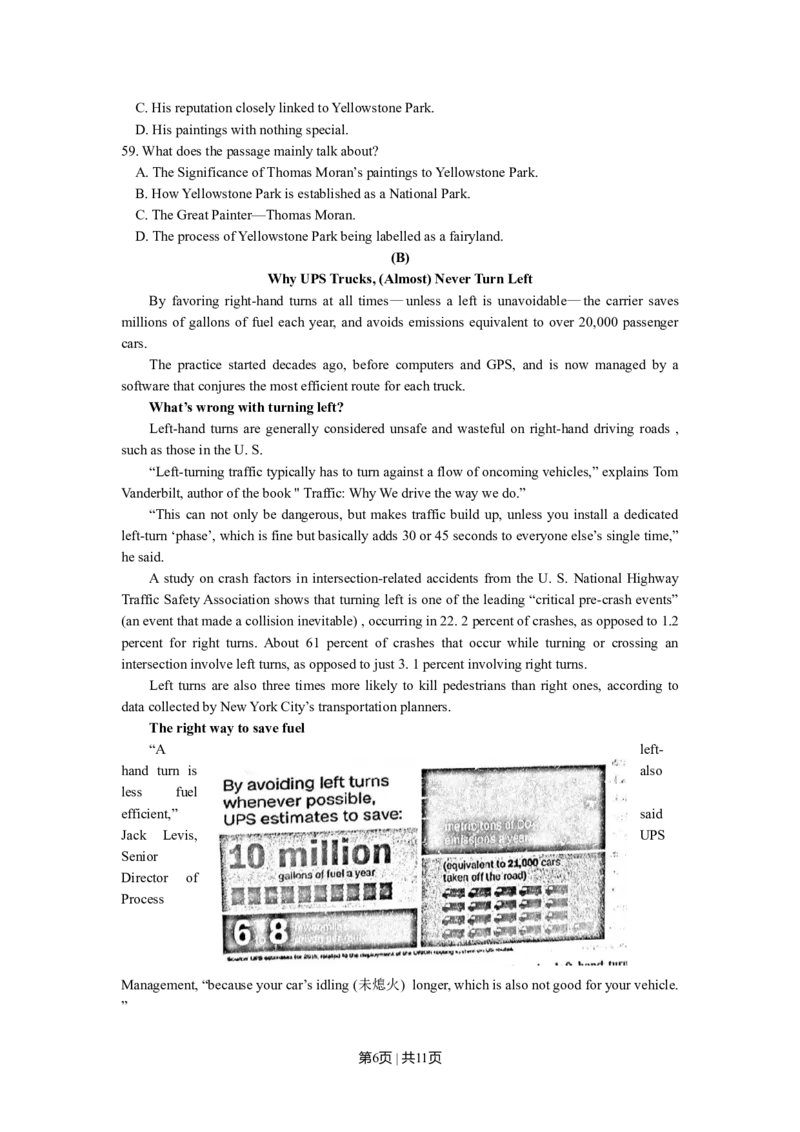
By favoring right-hand turns at all times—unless a left is unavoidable—the carrier saves
millions of gallons of fuel each year, and avoids emissions equivalent to over 20,000 passenger
cars.
The practice started decades ago, before computers and GPS, and is now managed by a
software that conjures the most efficient route for each truck.
What’s wrong with turning left?
Left-hand turns are generally considered unsafe and wasteful on right-hand driving roads ,
such as those in the U. S.
“Left-turning traffic typically has to turn against a flow of oncoming vehicles,” explains Tom
Vanderbilt, author of the book " Traffic: Why We drive the way we do.”
“This can not only be dangerous, but makes traffic build up, unless you install a dedicated
left-turn ‘phase’, which is fine but basically adds 30 or 45 seconds to everyone else’s single time,”
he said.
A study on crash factors in intersection-related accidents from the U. S. National Highway
Traffic Safety Association shows that turning left is one of the leading “critical pre-crash events”
(an event that made a collision inevitable) , occurring in 22. 2 percent of crashes, as opposed to 1.2
percent for right turns. About 61 percent of crashes that occur while turning or crossing an
intersection involve left turns, as opposed to just 3. 1 percent involving right turns.
Left turns are also three times more likely to kill pedestrians than right ones, according to
data collected by New York City’s transportation planners.
The right way to save fuel
“A left-
hand turn is also
less fuel
efficient,” said
Jack Levis, UPS
Senior
Director of
Process
Management, “because your car’s idling (未熄火) longer, which is also not good for your vehicle.
”
第6页 | 共11页UPS does not ban left turns outright, says Levis: “We will make left hand turns, but not ones
that are unnecessary. We don’t need to go in circles all day long by making only right hand turns.
We have tools analyze the number of left hand turn for each route, and we can work out which
ones are avoidable.”
The procedure in now incorporated in most countries around the world.
To this end, the carrier created its own maps, which it says are more accurate that
commercially available ones: “We can differentiate more important left-hand turns from
unimportant ones. Google Maps has no concept of not making a left-hand turn, it just shows the
most direct way to reach your destination. We have the ability to penalize some of those.” Levis
told CNN.
The system knows about parking lots, private driveways, variable speed limits and roads that
are inaccessible for a truck.
The software can give an undesirable left turn a penalty that adds 20 seconds to the estimated
route lime. In that case, going around the block and turning always right might offset that 20-
sccond penalty:“We were able to turn off left hand turns,” said Levis.
Taking a longer route while still saving time and fuel might sound confusing, even to UPS
drivers, according to Vanderbilt: “I’ve actually been to UPS's logistics center and discussed this
with their lead engineers.” he said.
“A lot of individual drivers felt the new routing software was making their trips longer,but
they were later proven wrong. This is the thing about traffic, it’s such a complex system that often
the individual cannot get a sense of the overall efficiency of the system, and optimize accordingly.
It’s also one of the counterintuitive, ‘slower-is-faster’ effects you often see in traffic.”
The rule, says Levis, can also be applied to left-hand driving countries, such as Australia and
the UK, where it discourages right-hand turns.
60. How much resources can UPS trucks save by avoiding turning left?
A. UPS trucks will consume millions of gallons of fuel.
B. The emission of UPS trucks is equivalent to that of over 2000 passenger cars.
C. UPS trucks estimate to save 100,000 metric tons of C0 emission a year.
2
D. UPS trucks estimate an increase of 6 to 8 miles per route.
61. In Tom Vanderbilt's View, how to Deal with the Left Turn Problem in the United States?
A. Install a dedicated left turn phase.
第7页 | 共11页B. Traffic planners manage road conditions。
C. Operators make their own traffic maps.
D. National policy encourages left turn of vehicles.
62. Which of the following options is NOT TRUE according to the passage?
A. It’s unsafe to turn left on right-hand driving roads.
B. Turning left is resource-efficient on right-hand driving roads.
C. Left turning is likely to cause traffic accidents.
D. Left-turn is discouraged in all countries.
(C)
“Is data the new oil? asked proponents of big data back in 2012 in Forbes magazine. By 2016
, and the rise of big data's turbo-powered cousin deep learning, we had become more certain:
“Data is the new oil,” stated Fortune.
Amazon’s Neil Lawrence has a slightly different analogy: Data, he says, is coal. Not coal
today, though, but coal in the early days of the 18th century, when Thomas Newcomen invented the
steam engine. A Devonian ironmonger, Newcomen built his device to pump water out of the south
west’s prolific tin mines.
The Problem, as Lawrence told the Re-Work conference on Deep Learning in London. was
that the pump was rather more useful to those who had a lot of coal than those who didn’t: it was
good, but not good enough to buy coal in to run it. That was so true that the first of Newcomen’s
steam engines wasn’t built in a tin mine, but in coal works near Dudley.
So why is data coal? The problem is similar: there are a lot of Newcomens in the world of
deep learning. Startups like London’s Magic Pony and SwiftKey are coming up with revolutionary
new ways to train machines to do impressive feats of cognition, from reconstructing facial data
from grainy images to learning the writing style of an individual user to better predict which word
they are going to type in a sentence.
And yet, like Newcomen, their innovations are so much more useful to the people who
actually have copious(丰富的) amounts of raw material to work from. And so Magic Pony is
acquired by Twitter, SwiftKey is acquired by Microsoft and Lawrence himself gets hired by
Amazon from the University of Sheffield, where he was based until three weeks ago.
But there is a coda to the story:69 years later, James Watt made a nice tweak to the
Newcomen steam engine, adding a condenser to the design. That change, Lawrence said, “made
the steam engine much more efficient, and that’s what trigger the industrial revolution.
Whether data is oil or coal, then, there’s another way the analogy holds up. a lot of work is
going into trying to make sure we can do more, with less. It’s not as impressive as teaching a
computer to play Go or Pac-Man better than any human alive, but “data efficiency” is a crucial
step if deep learning is going to move away from simply gobbling up oodles of data and spitting
out the best correlations possible.
“If you look at all the areas where deep learning is successful, they’re all areas where there’s
lots of data,” points out Lawrence. That’s great if you want to categorize images of cats, but less
helpful if you want to use deep learning to diagnose rare illnesses. ‘‘It’s generally considered
unethical to force people to become sick in order to acquire data.
第8页 | 共11页63. According to the passage, why data is seen as the new coal?
A. It can drive the steam engine to pump water.
B. It can help people make more coals.
C. It can help the areas of deep learning.
D. It can help cure diagnose rare illnesses.
64. According to Lawrence, why big data is less helpful to diagnose rare illnesses?
A. Because there is no such demand.
B. Because it can only use to categorize images of cats.
C. Because it’s unethical to acquire data by forcing people to become sick.
D. Because it needs too much data.
65. Which areas are most likely to be successful in in-depth learning?
A. Some small start-ups.
B. Areas with large amounts of data.
C. Coal and Petroleum Development Field.
D. Areas for tackling rare diseases.
66. According to the content of the article, which is NOT TRUE about the big data?
A. We still have a lot of work to study the big data.
B. It requires countless data to be collected.
C. The purpose of studying big data is to save parents’ costs.
D. “Data efficiency” is a critical step to explore more data.
Section C
Directions: Read the following passage. Fill in each blank with a proper sentence given in the
box. Each sentence can be used only once. Note that there are two more sentences than you need.
A. We weigh benefits of medications versus the complexity of adding one more drug to her
crowded pill box.
B. If you answered no, you’re not alone.
C. When your opinions are shared, you will find more potential about you.
D. Your values and needs may also vary from one appointment to the next.
E. The true difference relies on what you understand instead of what you see.
F. A year from now after graduation, we’ll revisit the conversation, as his goals and needs may be
different.
The Most Important Thing You’re Not Discussing with Your Doctor
Shared decision making requires you to be an active participant. Politicians and policymakers
are discussing what parts of the Affordable Care Act to change and what to keep. While most of us
have little control over those discussions, there is one health care topic that we can control;what
we talk about with our doctor.
The Institute of Medicine (IOM) released the landmark publication Crossing the Quality
Chasm 15 years ago. The report proposed six aims for improvement in the U. S. health system,
identifying that health care should be patient-centered,safe, effective, timely, efficient and
equitable.
The idea that health care should be patient-centered sounds obvious, but what does that
mean? The IOM defines it as care that is “respectful of and responsive to individual patient
第9页 | 共11页preferences, needs, and values” and that ensures “patient values guide all clinical decisions.”
For this to truly happen, doctors’ appointments need to cover more topics than how one is
feeling and what can be done. Does your doctor know your values? ____66_____ Fewer than half
of people report that their physician or other health care provider ask about their goals and
concerns for their health and health care. Your doctor can discuss medical tests and treatments
without knowing your life goals, but sharing your values and needs with your doctor makes
discussions and decisions more personalized and may lead to better health.
How does patient-centered care happen?
In order for your health care to center around you, your doctor needs to know your values,
preferences and needs. Everyone is different. (67) __________
As a neurologist, when I’m working with a 76-year-old widow whose main goal is to remain
independent in her home, we frame her care in that context. (68) __________ We discuss how a
walker helps her be more independent rather than less, as she can move around her home more
safely.
When a stressed college student comes to my office for a bothersome tremor, his preference
is to avoid medications that he might forget to take or that might harm his school performance.
This guides our discussion of the pros and cons of different options, including using medications
but also doing nothing, an option that almost half of patients feel strongly should always be
discussed. (69) __________
In sharing their values and goals with me, these individuals enabled a health care approach
that respected their needs and also responded to their life circumstances.
IV. Summary Writing
Directions:Read the following passage. Summarize the main point (s) of the passage in no more
than 60 words. Use your own words as far as possible.
To Laugh Is Human
Most of us don’t know why we laugh at some jokes and not at others. Scientists know that we
are able to laugh at birth. Babies begin to laugh at three to four months of age, well before they
produce their first words. What scientists are interested in is why we laugh.
Scientists believe humans laugh with others primarily because it makes us feel connected
with one another, which in turn gives us a sense of trust and comfort. To scientists, laughter is an
unconscious reaction;consequently, when we laugh, others can be certain that it is an honest
reaction, and honesty is key when building and maintaining friendships.
Since laughter is seen as a social signal that we send to others, it can also help explain why it
is so infectious. Studies have proven that when people see or hear something funny, they are 20
times more likely to laugh when they are with others than they are alone. Wanting to be accepted
by others is part of human nature. And mirroring other people’s laughter is a way to signal to
others that you feel the way they do, which makes us feel more connected with one another.
Humans have not always laughed just so they can feel closer to others, however Scientists
point out that this social function of laughter was born out of an even more fundamental human
need. Laughter, they believe, came about because it contributed to our very survival as a species.
Scientists assume that sharing laughter ensured our ancestors a higher survival rate because it led
to greater cooperation between individuals. Human learned quickly that greater cooperation led to
第10页 | 共11页survival, and the brain in turn realized that laughing with others increased out chances of finding
people to cooperate, hunt, eat, live, and eventually, survive with.
V. Translation
Directions:Translate the following sentences into English, using the words given in the brackets.
72. 少喝含糖的饮料,否则你会容易发胖。
73. 在法庭上,他坚持自己没犯抢劫罪。(guilty)
74.你是不是同意,在心情愉快的时候,总会有创意出现?(occur)
75.当谈到办公室冲突的时候,专家建议应更多地反思自己,更多地换位思考,并及时与同
事沟通。( when it comes to)
VI. Guided Writing
Directions: Write an English composition in 120—150 words according to the instructions given
below in Chinese.
假设你是明启中学的学生王磊,你校计划引进一个机器人担任餐厅服务员或者图书馆
管理员,并在英语贴吧征求学生意见,你很感兴趣,决定回帖响应,你所写的内容应包括:
1.你认为机器人适合担任的一个岗位,二选一;
2.通过比较,阐述你选择的理由,可以从工作效率、服务范围等方面进行表述。
第11页 | 共11页