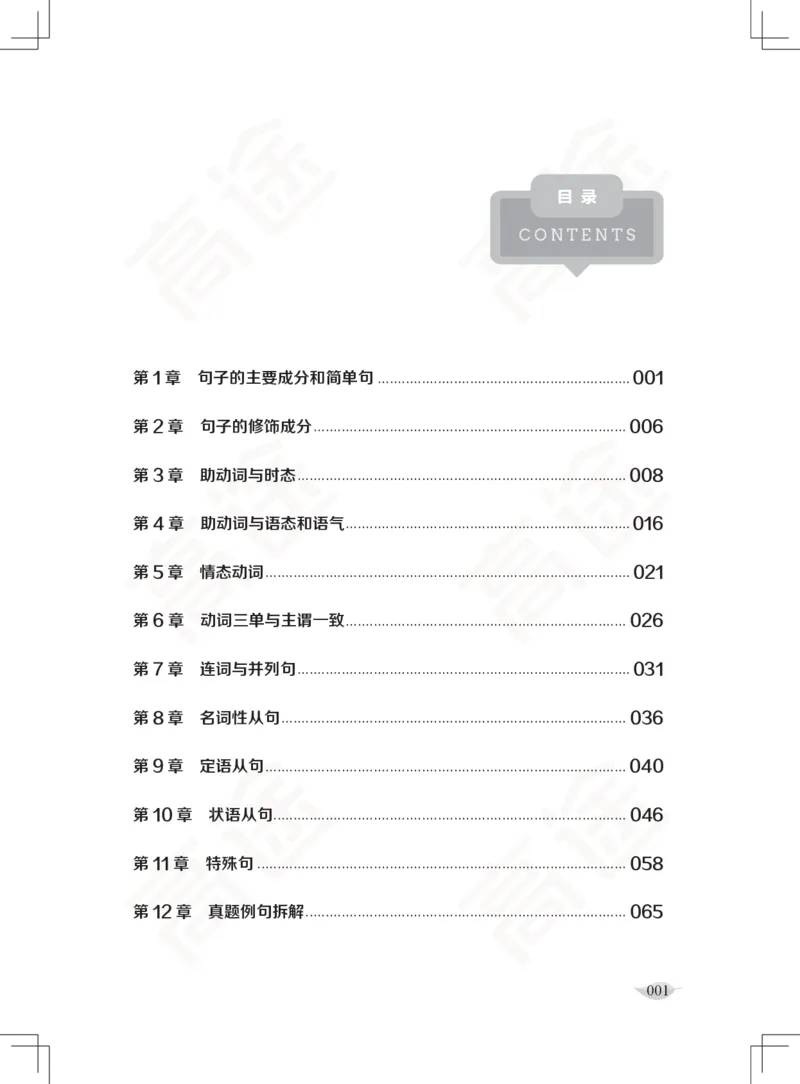
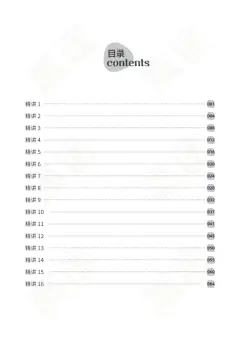
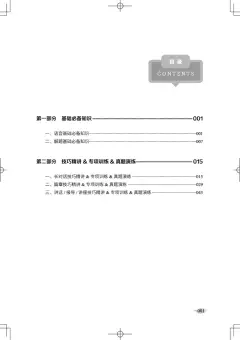
目 录
CONTENTS
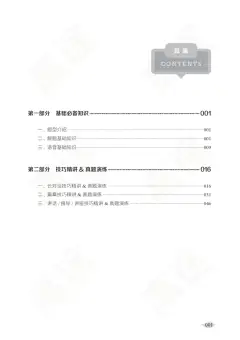
第1章 句子的主要成分和简单句 ���������������������������������������������������������������001
第2章 句子的修饰成分 ������������������������������������������������������������������������������006
第3章 助动词与时态 ����������������������������������������������������������������������������������008
第4 章 助动词与语态和语气 �����������������������������������������������������������������������016
第5 章 情态动词 �������������������������������������������������������������������������������������������021
第6 章 动词三单与主谓一致 ����������������������������������������������������������������������026
第7 章 连词与并列句 �����������������������������������������������������������������������������������031
第8 章 名词性从句 ��������������������������������������������������������������������������������������036
第9章 定语从句 ������������������������������������������������������������������������������������������040
第10章 状语从句 ����������������������������������������������������������������������������������������046
第11章 特殊句 ��������������������������������������������������������������������������������������������058
第12章 真题例句拆解 ��������������������������������������������������������������������������������065
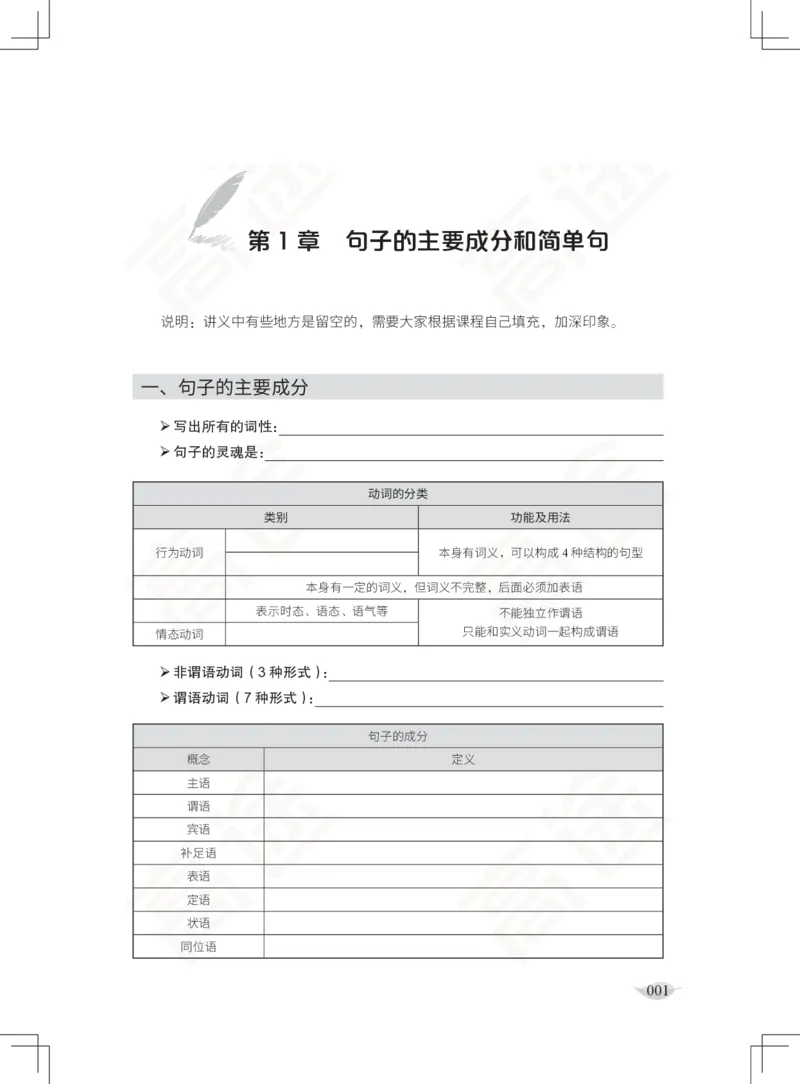
001第 1 章 句子的主要成分和简单句
: , , 。
说明 讲义中有些地方是留空的 需要大家根据课程自己填充 加深印象
一、句子的主要成分
写出所有的词性:
句子的灵魂是:
动词的分类
类别 功能及用法
, 4
行为动词 本身有词义 可以构成 种结构的句型
, ,
本身有一定的词义 但词义不完整 后面必须加表语
、 、
表示时态 语态 语气等 不能独立作谓语
情态动词 只能和实义动词一起构成谓语
非谓语动词(3种形式):
谓语动词(7种形式):
句子的成分
概念 定义
主语
谓语
宾语
补足语
表语
定语
状语
同位语第 1 章 句子的主要成分和简单句
: , , 。
说明 讲义中有些地方是留空的 需要大家根据课程自己填充 加深印象
一、句子的主要成分
写出所有的词性:
句子的灵魂是:
动词的分类
类别 功能及用法
, 4
行为动词 本身有词义 可以构成 种结构的句型
, ,
本身有一定的词义 但词义不完整 后面必须加表语
、 、
表示时态 语态 语气等 不能独立作谓语
情态动词 只能和实义动词一起构成谓语
非谓语动词(3种形式):
谓语动词(7种形式):
句子的成分
概念 定义
主语
谓语
宾语
补足语
表语
定语
状语
同位语
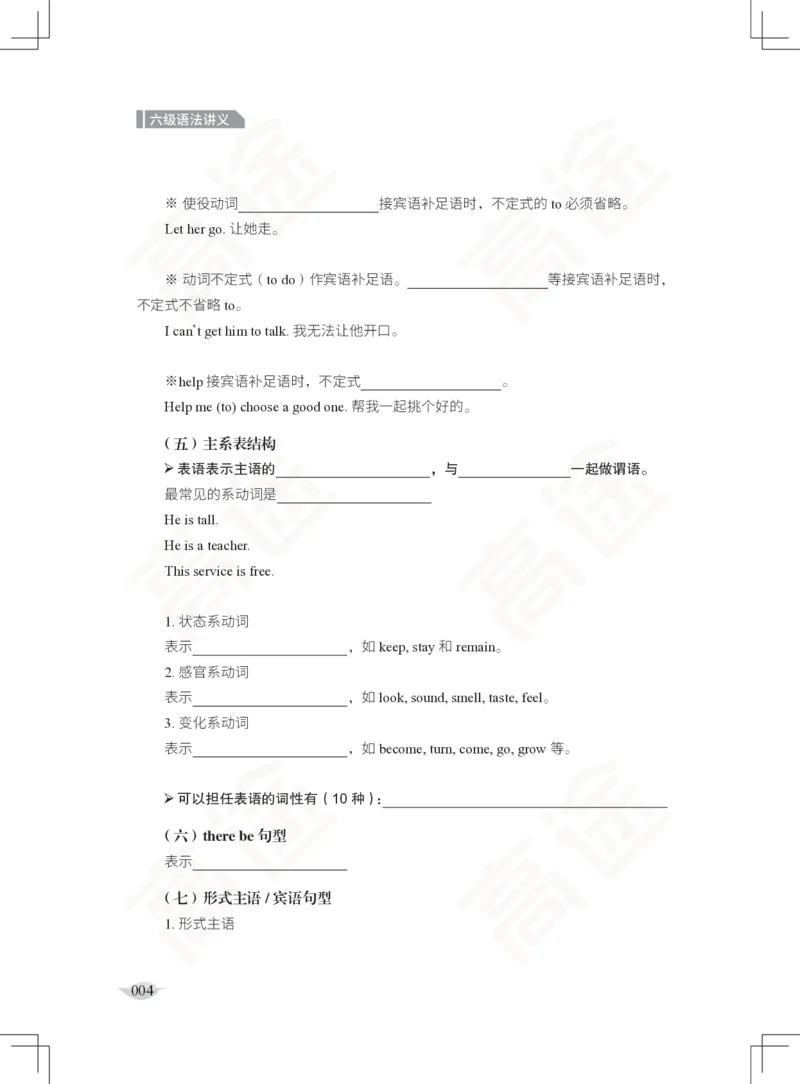
001六级语法讲义
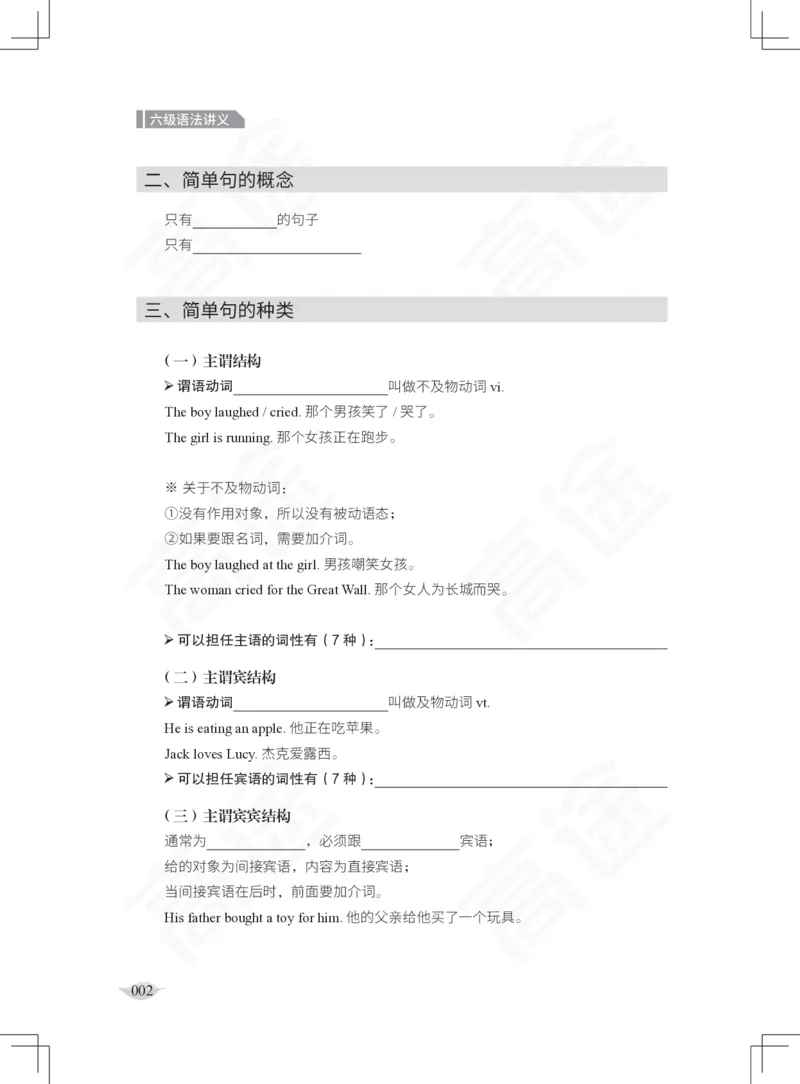
二、简单句的概念
只有 的句子
只有
三、简单句的种类
(一)主谓结构
谓语动词 vi.
叫做不及物动词
The boy laughed / cried. / 。
那个男孩笑了 哭了
The girl is running. 。
那个女孩正在跑步
※ :
关于不及物动词
, ;
①没有作用对象 所以没有被动语态
, 。
②如果要跟名词 需要加介词
The boy laughed at the girl. 。
男孩嘲笑女孩
The woman cried for the Great Wall. 。
那个女人为长城而哭
可以担任主语的词性有(7种):
(二)主谓宾结构
谓语动词 vt.
叫做及物动词
He is eating an apple. 。
他正在吃苹果
Jack loves Lucy. 。
杰克爱露西
可以担任宾语的词性有(7种):
(三)主谓宾宾结构
, ;
通常为 必须跟 宾语
, ;
给的对象为间接宾语 内容为直接宾语
, 。
当间接宾语在后时 前面要加介词
His father bought a toy for him. 。
他的父亲给他买了一个玩具
002She gave me a book. 。
她给了我一本书
※ to :bring, give, leave, lend, offer, pass, play, read,
能接以 引导的间接宾语的动词有
send, show, take, teach, tell, write 。 :
等 如
Could you lend your dictionary to me? ?
请你把你的字典借我用用好吗
She passed the salt to him. 。
她把盐递给了他
※ for :bring, build, buy, cook, cut, fetch, find, get,
能接以 引导的间接宾语的动词有
keep, make, order, save, pick, play, sing, take, win, write 。 :
等 如
Mother cooks breakfast for us every day. 。
母亲每天都为我们做早饭
I’ll fetch a chair for you. 。
我去给你拿一个凳子
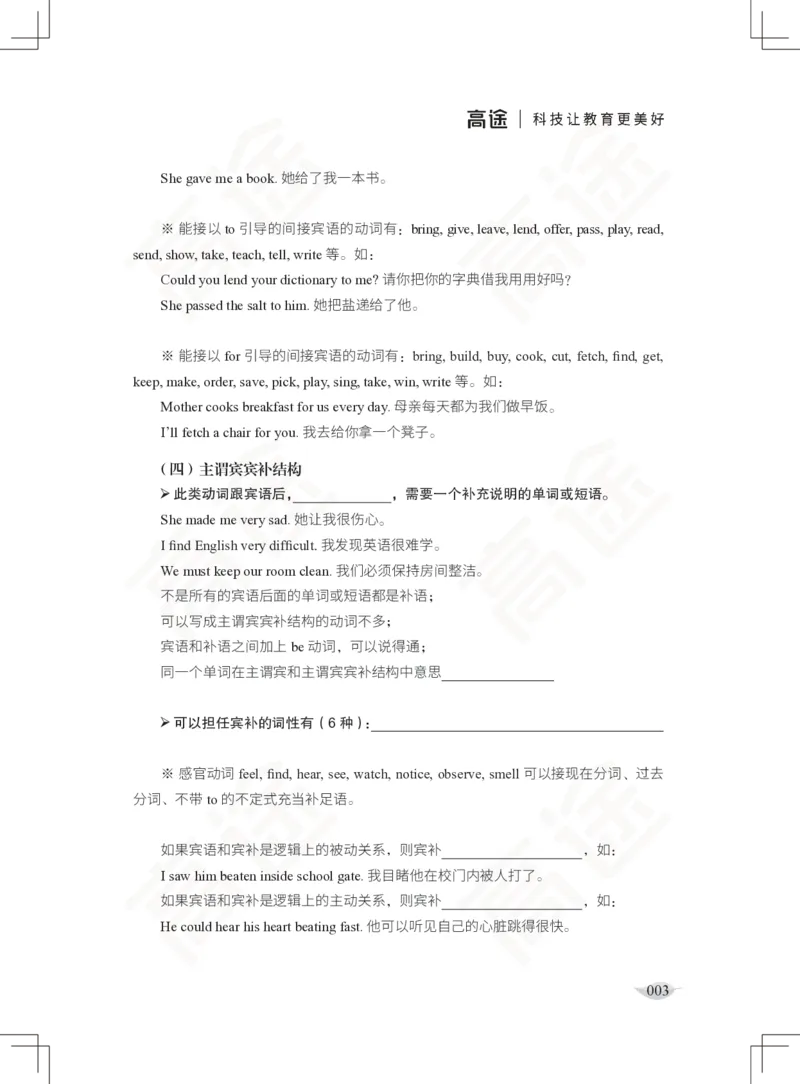
(四)主谓宾宾补结构
此类动词跟宾语后, ,需要一个补充说明的单词或短语。
She made me very sad. 。
她让我很伤心
I find English very difficult. 。
我发现英语很难学
We must keep our room clean. 。
我们必须保持房间整洁
;
不是所有的宾语后面的单词或短语都是补语
;
可以写成主谓宾宾补结构的动词不多
be , ;
宾语和补语之间加上 动词 可以说得通
同一个单词在主谓宾和主谓宾宾补结构中意思
可以担任宾补的词性有(6种):
※ feel, find, hear, see, watch, notice, observe, smell 、
感官动词 可以接现在分词 过去
、 to 。
分词 不带 的不定式充当补足语
, , :
如果宾语和宾补是逻辑上的被动关系 则宾补 如
I saw him beaten inside school gate. 。
我目睹他在校门内被人打了
, , :
如果宾语和宾补是逻辑上的主动关系 则宾补 如
He could hear his heart beating fast. 。
他可以听见自己的心脏跳得很快
003六级语法讲义
※ , to 。
使役动词 接宾语补足语时 不定式的 必须省略
Let her go. 。
让她走
※ (to do) 。 ,
动词不定式 作宾语补足语 等接宾语补足语时
to。
不定式不省略
I can’t get him to talk. 。
我无法让他开口
※help , 。
接宾语补足语时 不定式
Help me (to) choose a good one. 。
帮我一起挑个好的
(五)主系表结构
表语表示主语的 ,与 一起做谓语。
最常见的系动词是
He is tall.
He is a teacher.
This service is free.
1.
状态系动词
, keep, stay remain。
表示 如 和
2.
感官系动词
, look, sound, smell, taste, feel。
表示 如
3.
变化系动词
, become, turn, come, go, grow 。
表示 如 等
可以担任表语的词性有(10种):
(六)there be句型
表示
(七)形式主语 / 宾语句型
1.
形式主语
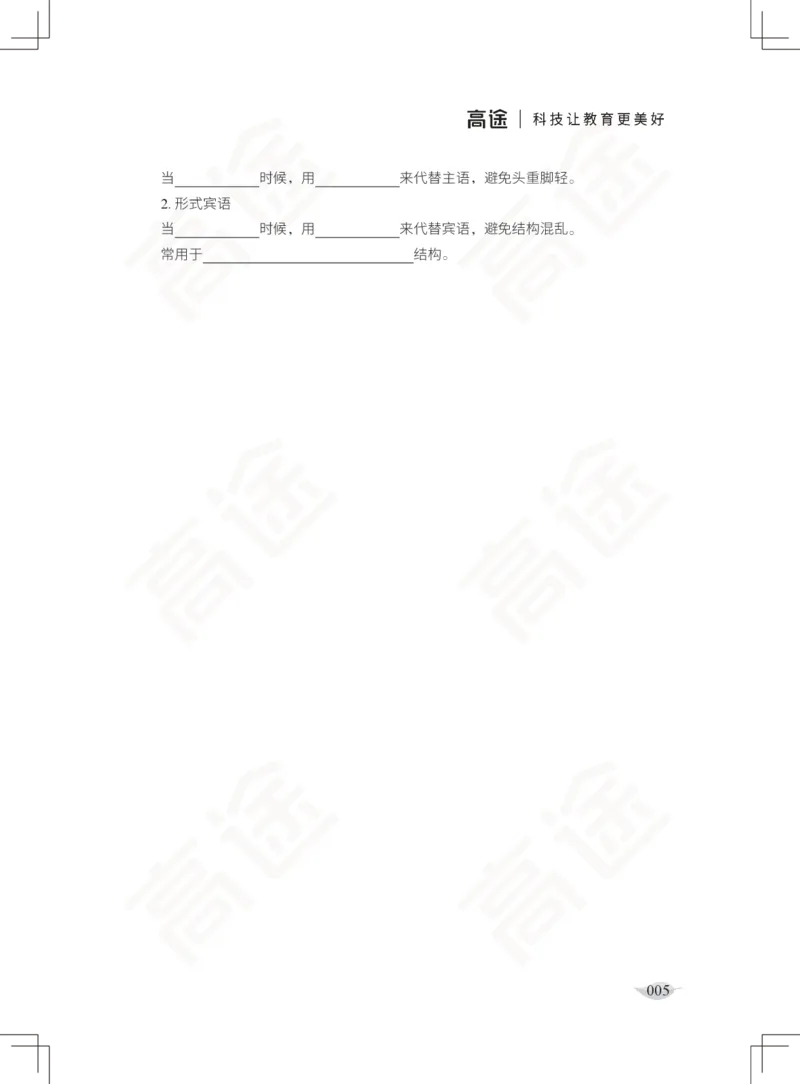
004, , 。
当 时候 用 来代替主语 避免头重脚轻
2.
形式宾语
, , 。
当 时候 用 来代替宾语 避免结构混乱
。
常用于 结构
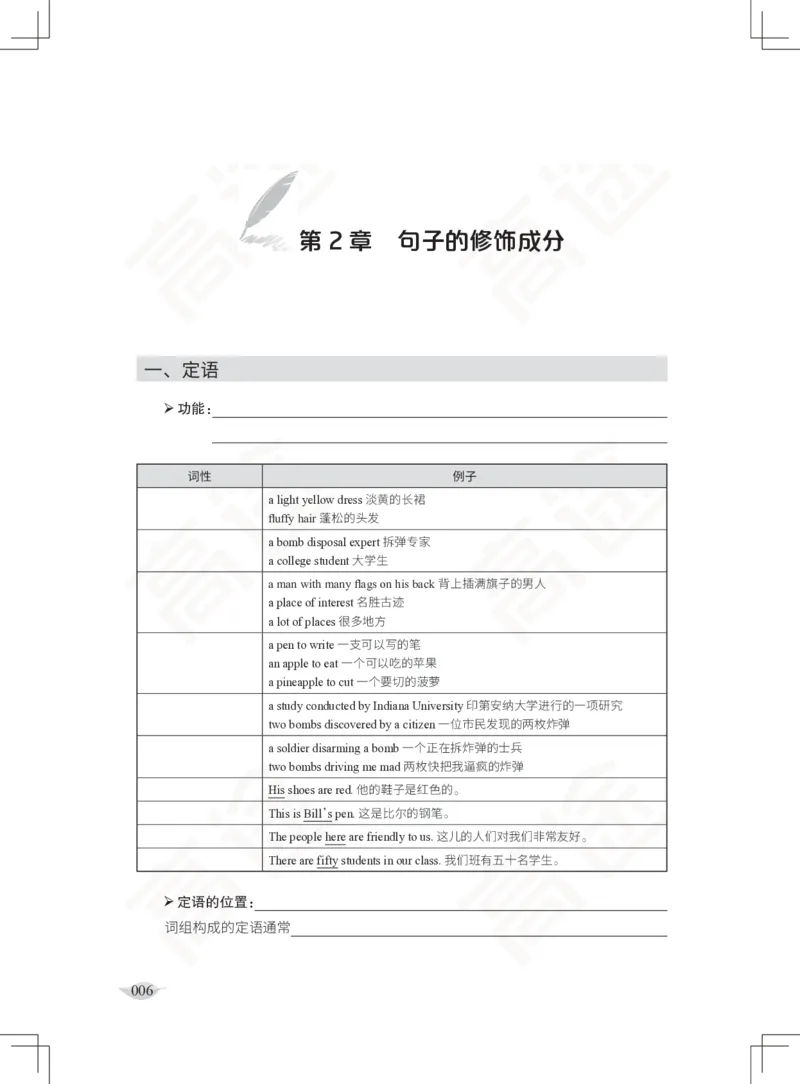
005六级语法讲义
第 2 章 句子的修饰成分
一、定语
功能:
词性 例子
a light yellow dress
淡黄的长裙
fluffy hair
蓬松的头发
a bomb disposal expert
拆弹专家
a college student
大学生
a man with many flags on his back
背上插满旗子的男人
a place of interest
名胜古迹
a lot of places
很多地方
a pen to write
一支可以写的笔
an apple to eat
一个可以吃的苹果
a pineapple to cut
一个要切的菠萝
a study conducted by Indiana University
印第安纳大学进行的一项研究
two bombs discovered by a citizen
一位市民发现的两枚炸弹
a soldier disarming a bomb
一个正在拆炸弹的士兵
two bombs driving me mad
两枚快把我逼疯的炸弹
His shoes are red. 。
他的鞋子是红色的
This is Bill’s pen. 。
这是比尔的钢笔
The people here are friendly to us. 。
这儿的人们对我们非常友好
There are fifty students in our class. 。
我们班有五十名学生
定语的位置:
词组构成的定语通常
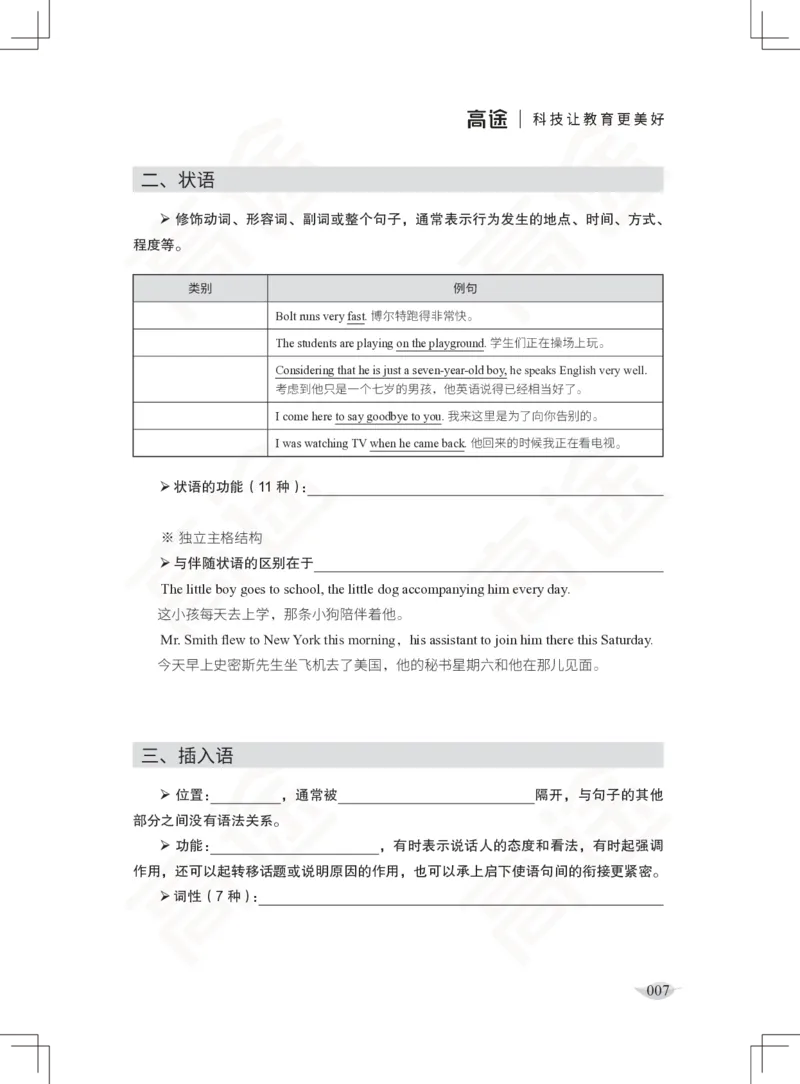
006二、状语
修饰动词、形容词、副词或整个句子,通常表示行为发生的地点、时间、方式、
第 2 章 句子的修饰成分
程度等。
类别 例句
Bolt runs very fast. 。
博尔特跑得非常快
The students are playing on the playground. 。
学生们正在操场上玩
Considering that he is just a seven-year-old boy, he speaks English very well.
一、定语
, 。
考虑到他只是一个七岁的男孩 他英语说得已经相当好了
功能:
I come here to say goodbye to you. 。
我来这里是为了向你告别的
I was watching TV when he came back. 。
他回来的时候我正在看电视
词性 例子 状语的功能(11种):
a light yellow dress
淡黄的长裙
fluffy hair
蓬松的头发
※
a bomb disposal expert
拆弹专家 独立主格结构
a college student 与伴随状语的区别在于
大学生
a man with many flags on his back
The little boy goes to school, the little dog accompanying him every day.
背上插满旗子的男人
a place of interest
名胜古迹 , 。
a lot of places 这小孩每天去上学 那条小狗陪伴着他
很多地方
Mr. Smith flew to New York this morning,his assistant to join him there this Saturday.
a pen to write
一支可以写的笔
an apple to eat , 。
一个可以吃的苹果 今天早上史密斯先生坐飞机去了美国 他的秘书星期六和他在那儿见面
a pineapple to cut
一个要切的菠萝
a study conducted by Indiana University
印第安纳大学进行的一项研究
two bombs discovered by a citizen
一位市民发现的两枚炸弹
a soldier disarming a bomb
一个正在拆炸弹的士兵
two bombs driving me mad 三、插入语
两枚快把我逼疯的炸弹
His shoes are red. 。 位置: ,通常被 隔开,与句子的其他
他的鞋子是红色的
This is Bill’s pen. 。
这是比尔的钢笔 部分之间没有语法关系。
The people here are friendly to us. 。
这儿的人们对我们非常友好 功能: ,有时表示说话人的态度和看法,有时起强调
There are fifty students in our class. 。
我们班有五十名学生 作用,还可以起转移话题或说明原因的作用,也可以承上启下使语句间的衔接更紧密。
词性(7种):
定语的位置:
词组构成的定语通常
007六级语法讲义
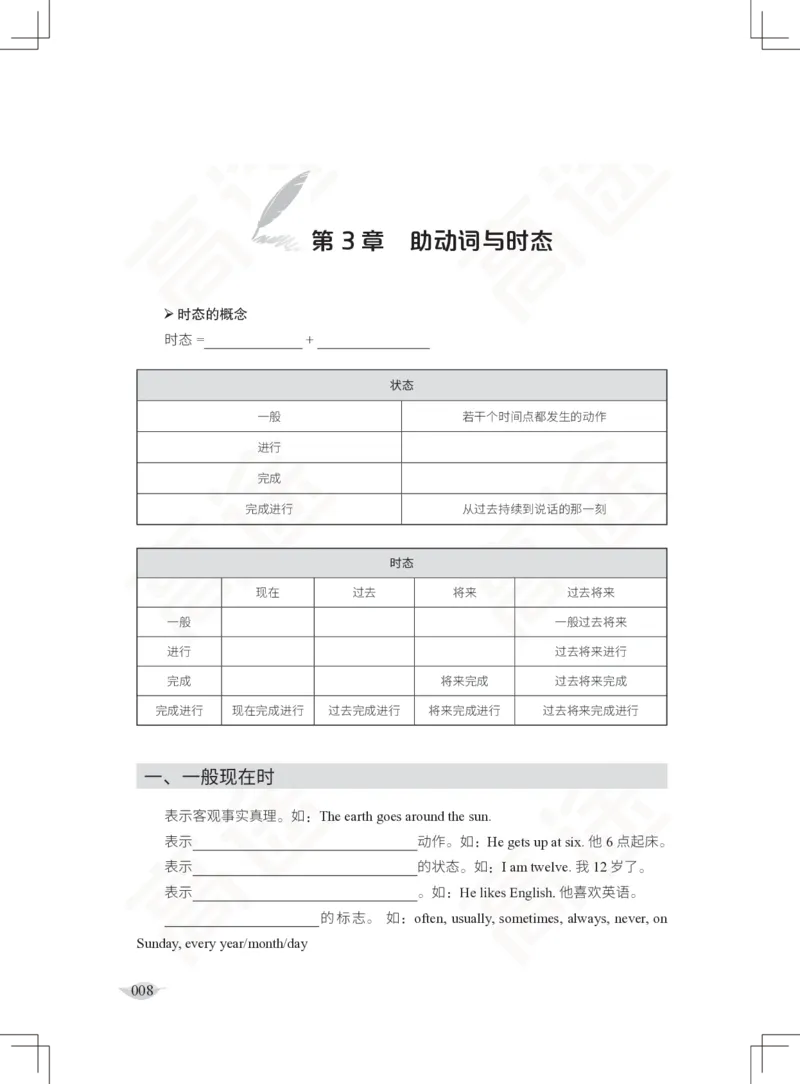
第 3 章 助动词与时态
时态的概念
= +
时态
状态
一般 若干个时间点都发生的动作
进行
完成
完成进行 从过去持续到说话的那一刻
时态
现在 过去 将来 过去将来
一般 一般过去将来
进行 过去将来进行
完成 将来完成 过去将来完成
完成进行 现在完成进行 过去完成进行 将来完成进行 过去将来完成进行
一、一般现在时
。 :The earth goes around the sun.
表示客观事实真理 如
。 :He gets up at six. 6 。
表示 动作 如 他 点起床
。 :I am twelve. 12 。
表示 的状态 如 我 岁了
。 :He likes English. 。
表示 如 他喜欢英语
。 :often, usually, sometimes, always, never, on
的标志 如
Sunday, every year/month/day
008二、现在进行时
be + doing
第 3 章 助动词与时态
。 :She is reading
表示 的动作 如
a book now. 。
她正在看书
。 :I am working
表示 的动作 如
时态的概念
on the farm this week. 。
这周我都在农场干活
= +
时态
动词的现在分词形式变化规则
状态
构成 例词
一般 若干个时间点都发生的动作 read—reading
进行
live—living
write—writing
完成
sit—sitting
完成进行 从过去持续到说话的那一刻 begin—beginning
die—dying
lie—lying
时态
tie—tying
现在 过去 将来 过去将来 ※
重读闭音节变现在分词
一般 一般过去将来 :
重读闭音节指的是
进行 过去将来进行
完成 将来完成 过去将来完成
三、一般过去时
完成进行 现在完成进行 过去完成进行 将来完成进行 过去将来完成进行
。 : I got up at
表 示 的 状 态 如
seven yesterday. 。
昨天早上我七点起床
一、一般现在时 。 :
表示 的状态 如
。 :The earth goes around the sun. He always went to school by car last term. 。
表示客观事实真理 如 上学期他总是坐小汽车上学
。 :He gets up at six. 6 。 He used to go swimming when he was young. 。
表示 动作 如 他 点起床 他年轻时经常去游泳
。 :I am twelve. 12 。
表示 的状态 如 我 岁了
。 :He likes English. 。 ※ :
表示 如 他喜欢英语 注意
。 :often, usually, sometimes, always, never, on , 。
的标志 如 只要有明确的过去的时间点 就一定是一般过去时
。
Sunday, every year/month/day
一般过去时意味着跟现在完全没有关系
009六级语法讲义
I loved you. 。
我爱过你
I love you. 。
我爱你
一般过去式动词变化规则
构成 例词
help → helped
clean → cleaned
move → moved
use → used
close → closed
study → studied
carry → carried
stop → stopped
drop → dropped
prefer → preferred
※ :( )
不规则变化 重在积累
are → were
am / is → was
do → did
fly → flew
go → went
四、一般将来时
。
站在 的状态
, 。
一般会 或根据句意来决定
:tomorrow, the day after tomorrow, soon, next year / week / month, in a few days, in
标志词
the future, this afternoon, one hour later, tomorrow morning...
shall + do用于第一人称 / will + do用于第二、三人称
、 。 :I will become a millionaire in the future.
表示最笼统的 非严格计划的将来时 如
。
我将来会成为百万富翁
010be going to + 动词原形:(表打算,预测)
1. 。 :We are going to ask him. 。
表示 如 我们要问他
2. 。 :Look, it is going to rain. , 。
表示现在已有迹象表明即将发生某事 如 看 要下雨了
be to+动词原形
1. 。 :He is to leave for Beijing tomorrow.
主要表示 的动作 如
。
他明天动身去北京
2. 。 : Tell him he’s not to be back late. ,
表示 如 告诉他 他
。
不能晚回来
be about to + do
。 :Sit down please, the show is about to start.
表示 的动作 如 请入
, 。
坐 演出就要开始了
现在进行时(come, go, arrive, leave, start, move)be + doing
。 :I’m going home. 。
表示按计划或安排要发生的事 如 我要回家了
一般现在时表示将来
, , ( ) ,
表示与生日 日历 课时安排或交通时刻表有关的动作 一种规律 用一般现在
。
时表示将来时态
:begin, come, leave, go, arrive, start, stop, return, open, close...
常用于转移动词如
The evening class begins at 19:00. 19 。
晚课 点开始
The train starts at two. 。
火车两点发车
五、过去进行时
过去进行时 现在进行时
am doing
is doing
are doing
011六级语法讲义
表示 的动作。
为了 。
六、将来进行时
将来进行时 现在进行时
am doing
is doing
are doing
表示 的动作。
表示 的动作。
※ : , ,
注意 将来进行时和过去进行时都强调 经
。
常作为 动作
七、现在完成时
(一)构成
have / has +
(1) , :work-worked-worked
一般动词
(2) “e” , :live-lived-lived
以不发音的 结尾的动词
(3) “ + y” , :study-studied-studied
以 辅音字母 结尾的动词
(4) , :stop-stopped-stopped
重读闭音节
drop-dropped-dropped
※ 、
过去式 过去分词不规则变化
AAA :cost—cost—cost
型
ABB :bring—brought—brought
型
ABC :begin—began—begun
型
012AAB :beat—beat—beaten
型
ABA :come—came—come
型
(二)(非)延续性动词
常被称为“ ”,因此它不能与明确的过去时
间点连用。
(1) 。
表示 的动作对现在造成的影响
The temperature has increased by 10℃. 10℃。( :It is quite hot now.
温度上升了 结果
。)
现在很热
※ : ; ; 。
注意前提 发生在过去 时间点不明 对现在有影响
(2) 。
表示
for + ,since+ , 。( )
常与 时间段 过去时间点连用 多为延续性动词 注意复习时间介词
We have lived here since 2000. 2000 。
我们从 年起就住在这里
I haven’t watched TV for two weeks. 。
我已经两个星期没看电视了
(3) , 。
如果表达的是从过去持续到现在 必须使用持续性动词
。
我离开学校已经八年了
I’ve left this school for eight years.
I’ve been away from this school for eight years.
。
他借用我的词典已两天了
He has borrowed my dictionary for two days.
He has kept my dictionary for two days.
非延续性动词 延续性动词
buy / borrow
die / finish
open / go
join / leave
put on / wake up
catch a cold / fall asleep
arrive / reach
013六级语法讲义
have been to “ ”,
表示 说话时已从该地回来或已从该地去了其
, , ;
他地方 总之 现在已不在该地
have gone to “ ”, ,
则表示 说话时不在说话地点 或在去某地的
, , ;
途中 或已到了某地 总之现在还未回来
have been in “ ”, in。
表示 后面跟副词时不用
1. 10 。He here for 10 years.
他已经到这里 年了
2. 。He India.
他去过印度
3. , 。He America, and I can’t find him.
他去了美国 我找不到他
A) has been to B) has gone to C) has been
(三)重点副词的用法
(1)just“ ” , 。
常放在助动词与过去分词之间
He has just come back from Beijing. 。
他刚从北京回来
(2)ever“ ”, , 。
用疑问句或否定句中 常放在助动词与过去分词之间
Have you ever been to Shanghai? ?
你去过上海吗
(3) never“ ”, , 。
常与 连用 常放在助动词与过去分词之间
I have never traveled by plane before. 。
我以前从未坐过飞机
(4)before“ ”, , 。
总放在句末 不受句型限制
I haven’t heard of it before. 。
我以前没听说过
(5)already“ ” , ,
用于肯定句 常放在助动词与过去分词之间 也
。
可放句末
I have already finished my homework. 。
我已经完成了作业
(6)yet “ ”, “ ”, 。
用疑问句中意为 用否定句中表 还 常放句末
She has not gone to bed yet. 。
她还没有睡觉
八、过去完成时
(一)构成
have / has + 动词的过去分词→
;
现在完成时是 产生了影响
014。
过去完成时是 产生了影响
表示意向的动词,如hope, wish, expect, think, intend, mean, suppose等,用
过去完成时表示
We had hoped that you would come, but you didn’t. , 。
我们本希望你能来 但是你没来
015六级语法讲义
第 4 章 助动词与语态和语气
一、句子的语态
(一)构成
包括: 和
(二)被动语态使用场合:
1.
2.
(三)被动语态的构成
※ ?
如何在写作和翻译中用好被动语态
1.
2.
3.
二、句子的语气
(一)陈述句
。
陈述句用来说明一个事实或陈述说话人的看法
, , 。
陈述句分为肯定式和否定式两种 句末用句号 读时用降调
。
有五种基本句型
陈述句的否定
(1) be 、 , not 。
含 动词 助动词的否定 直接加 构成否定句
016Tom is a cat. 。
汤姆是一只猫
Tom isn’t a cat. 。
汤姆不是一只猫
He has been to China. 。
第 4 章 助动词与语态和语气 他去过中国
He hasn’t been to China. 。
他没有去过中国
(2) , , do not。
实义动词的否定 没有助动词 在谓语前加 的相应形式后再加
They wanted to take pictures. 。
他们想拍照
一、句子的语态
They didn’t (did not) want to take pictures. 。
他们不想拍照
He likes football. 。
(一)构成
他喜欢踢足球
He doesn’t (does not) like football. 。
包括: 和
他不喜欢踢足球
(二)被动语态使用场合:
(3) nothing ,no little, few, hardly
还可用 等否定代词 等否定形容词和 等半否定词
1.
。
与肯定形式的谓语动词连用来表示否定
2.
I can hardly understand what you said. 。
我几乎听不明白你说的
(三)被动语态的构成
(4) , think / believe , +that ,
在表达观点和想法的时候 谓语动词是 等 后面 从句时
。
否定前置
※ ?
如何在写作和翻译中用好被动语态 We / I don’t think it’s true. / 。
我们 我认为那不是真的
1.
(二)祈使句
2.
祈使句是表示 等的句子。
3.
听话者you习惯上常省略,而由动词原形开头。
否定式多以do not(通常写为don’t)开头,也可用never 开头。
Don’t give up! !
二、句子的语气 不要放弃
Never give up! !
永不言弃
(一)陈述句 Behave yourself and keep quiet for a while. , !
规矩点 安安静静地待着
。
陈述句用来说明一个事实或陈述说话人的看法
, , 。 ※ 。
陈述句分为肯定式和否定式两种 句末用句号 读时用降调 应答祈使句时要用将来时
。 —Please remember to take the dog out for a walk every day. 。
有五种基本句型 ① 请记住每天带着狗散步
—Yes, I will. , 。
好的 我会的
陈述句的否定 —Don’t take your mobile phone to school. !
② 不要把手机带到学校来
(1) be 、 , not 。 —Sorry, I won’t. , 。
含 动词 助动词的否定 直接加 构成否定句 对不起 我不会了
017六级语法讲义
(三)疑问句
, (?);
疑问句用于提出问题 句末用问号
: 、 、 ;
可分为四种 一般疑问句 选择疑问句 反意疑问句和特殊疑问句
( ) 。
难点在于语序 助动词的位置
(1)
一般疑问句
Yes No ;
一般疑问句是可用 或 来回答的问句
be 、 ;
通常以 动词 情态动词或助动词开头
“Not at all”,“Certainly” 。
有时也可用 等回答
:—Would you like some more? ?
如 你想再来一些吗
—No, thanks. I’m full. , 。 。
不 谢谢 我饱了
(2)
特殊疑问句
, : ;
以疑问词引出的问句 一般为疑问语序 助动词提前
“ + ?”
疑问词 一般疑问句
, yes no 。
回答时要具体作答 不能用 或 来回答
疑问词作主语或主语的定语时,要用陈述语序:“疑问词(+主语)+谓语+动
词(+……)?”
Who broke the door? ?
谁弄坏了门
Which boy runs the fastest? ?
哪个男孩跑得最快
疑问词包括疑问代词、疑问副词和疑问词组。
①疑问代词
、 、 、 。
可以对主语 表语 宾语 定语提问
what( “ ” ),who( “ ” ),which( ),whose( ),
对 物 提问 对 人 提问 哪一个 谁的
whom( “ ”)
宾格 谁
—Who is that man? ?
那个男人是谁
—He’s my father. 。
是我父亲
②疑问副词
。
用于对状语提问
018when( ),where( ),why( ) how( ) 。
有 何时 何地 为什么 和 怎么样 等
When are you going to Beijing?
When will you go to Beijing?
?
你什么时候去北京
③疑问词组
how soon ;how long ;how far ;how often
多久 多长时间 多远 多久一次
How soon will the concert begin? ?
音乐会还有多久开始
How long have you lived here? ?
你在这里住了多久了
How often do you go to the park? ?
你多久去一次公园
(3)
选择疑问句
, or ;
以一般疑问句为基础 用 连接不同的选择对象
, or 。
以特殊疑问句为基础 用 连接不同的选择对象
Shall we go to see you or will you come to see us? , ?
是我们去看你们 还是你们来看我们
Which would you like better, tea or milk? , ?
你比较喜欢喝什么 茶还是牛奶
(4)
反意疑问句
( )。
附加在陈述句后的简单问句 又称附加问句
、 , 。
提出 征询对前述内容的肯定或否定的意见 或者希望事实得到证实
其结构为:
“ + ?”
肯定的陈述句 否定的简单问句
“ + ?”
否定的陈述句 肯定的简单问句
反意疑问句的答语:
yes, ;
如果答案肯定则用 后跟 形式
no, 。
若答案否定则用 后跟 形式
。
即其回答与一般疑问句的回答方式完全一致
—Lucy skates very well, doesn’t she? , ?
① 露西滑冰非常好 是吗
—Yes, she does. , 。
是的 她是
019六级语法讲义
—You don’t like the man, do you? , ?
② 你不喜欢这个人 是吗
—No,I don’t. , 。
是的 我不喜欢
第 5 章 情态动词
(四)感叹句
。
表示 等强烈的感情
, , (!), 。
一般用 或 引导 都用陈述语序 句尾用感叹号 读降调
1.how 一、情态动词的大致位置
引导的感叹句
(1) How + ! : + + v.
陈述句 主 情态动词 原
How fast he runs! ! : + + v. ?
他跑得多快啊 疑问句 情态动词 主 原
(2) How+ ! : + not+ v.
否定句 主 情态动词 原
How time flies! !
时光飞逝
2.what
二、常见情态动词用法
引导的感叹句
(1) What+ !
1. can / could
What an interesting book the girl has! !
那女孩有一本多有趣的书啊 表示 ( = be able to):能;会
(2) What + !
Tom can swim. = Tom is able to swim. 。
汤姆会游泳
What nice music it is! !
多么美妙的音乐啊
( 疑问句中)表示 :可以
Could you give us a hand? ?
你可以帮我们一下吗
( 否定句、疑问句中)表示 :can可能 / can’t不可能
The boy can’t be Jim. He’s much taller. 。 。
这个男孩不可能是吉姆 他要高很多
2. may / might
表示 ( 可与maybe互换):可能
Tony may know the way. = Maybe Tony knows the way. 。
托尼可能知道路
客气请求:可以
May I come in? ?
我可以进来吗
020第 5 章 情态动词
一、情态动词的大致位置
: + + v.
陈述句 主 情态动词 原
: + + v. ?
疑问句 情态动词 主 原
: + not+ v.
否定句 主 情态动词 原
二、常见情态动词用法
1. can / could
表示 ( = be able to):能;会
Tom can swim. = Tom is able to swim. 。
汤姆会游泳
( 疑问句中)表示 :可以
Could you give us a hand? ?
你可以帮我们一下吗
( 否定句、疑问句中)表示 :can可能 / can’t不可能
The boy can’t be Jim. He’s much taller. 。 。
这个男孩不可能是吉姆 他要高很多
2. may / might
表示 ( 可与maybe互换):可能
Tony may know the way. = Maybe Tony knows the way. 。
托尼可能知道路
客气请求:可以
May I come in? ?
我可以进来吗
021六级语法讲义
祝愿:祝
May you be happy! !
祝你快乐
3. must
表示 或要求
We must tell the truth to our parents. 。
我们必须告诉父母真相
表示 (否定猜测用can’t )
Lisa must be at home. 。( )
莉萨一定在家里 推测现在的状况
You must be kidding! !( )
你一定是在开玩笑 推测现在正在发生的状况
4. shall / should
Shall...? 用于第一人称,表示
Shall we ask the teacher for help? ?
我们向老师寻求帮助好吗
should用于各种人称,强调
Students shouldn’t have long hair. 。
学生们不应该留长发
5. need
需要
可以做情态动词
You needn’t answer the question now. 。
你现在不需要回答问题
可以做实义动词
You don’t need to answer the question now. 。
你现在不需要回答问题
6. had better
最好
不要分开理解为had,或better
:You had better do it right now. 。
肯定 你最好立刻就做
:You had better not touch it. 。
否定 你最好不要碰它
7. used to
情态动词:过去常常
022He used to go shopping on weekends. 。
他过去常常周末去买东西
be used to do被用来做某事
Pens are used to write. 。
笔被用来写字
be used to doing习惯做某事
The Englishman isn’t used to driving on the right in China.
这个英国人不习惯在中国
。
靠右行驶
8. would rather do...than do... …… ……
宁愿做 而不愿做
※ would rather not do...
否定为
(1) prefer to do...rather than do... …… ……
宁愿做 而不愿做
I prefer to swim rather than stay at home. 。
我宁愿游泳也不愿呆在家里
(2) would rather do...than do... …… ……
宁愿做 而不愿做
I would rather swim than stay at home. 。
我宁愿游泳也不愿呆在家里
(3) prefer...to... …… ……
喜欢 胜过
I prefer dogs to cats. 。
我喜欢狗胜过猫
I prefer swimming to jogging. , 。
比起慢跑 我更喜欢游泳
9. ought to , >should, should 。
应该 语气 远没有 常用
We ought to start at once. 。
我们应该马上开始
※
注意否定和疑问句的变化
Ought I to tell her the truth? ?
我应该把真相告诉她吗
We ought to be careful, oughtn’t we? , ?
我们应该小心 对吧
Oughtn’t he to see a doctor? ?
他是不是该去看医生
You oughtn’t to stay out so late. 。
你不应当在外面待到这样晚
023六级语法讲义
三、情态动词使用要点
情态动词的 表示比原形 的语气。
mustn’t表示否定意义“禁止,不允许”。可与祈使句互换。例如:
You mustn’t play football in the street. (=Don’t play football in the street.)
你不准在街
。
道上踢足球
have to有人称、数和时态的变化,表示受客观条件限制,意为“不得不”。例如:
She has to take the bus to work. 。
她不得不坐公交车去上班
否定回答
May...? :No, ...mustn’t / can’t.
句式的否定回答
Must...? :No, ...needn’t.
句式的否定回答
—May I smoke here? ?
① 我可以在这儿吸烟吗
—No, you mustn’t. , 。
不 你不可以
—Must I go now? ?
② 我必须现在走吗
—No, you needn’t. , 。
不 你没必要
must, should, may, might都可以表示“可以”,可能性程度由大到小依次为:
must>should>may>might
四、易混淆情态动词
1. must & can’t
,can’t “ ”,must “ ”;
两者都表示 意为 意为
。
句中一般会有说明推测理由的附属从句
0242. have to & must
have to must
, “ ; ”
强调说话人的主观看法 意为 必须 应该
没有人称和时态变化
mustn’t “ ; ”
表示 禁止 不应该
3. can & be able to
, ;
表示 时 二者可通用
can ,be able to ;
一般用于 可用于各种时态
be able to。
遇有 时只能用
4. maybe & may be
maybe “ ”, perhaps;
用于 表示 相当于
may be may , be, “ ”,
中的 是 后接动词原形 表示 在句中
。
作
, 。
两者可互换 只是位置不同
025六级语法讲义
第 6 章 动词三单与主谓一致
一、动词三单
(一)概念:(必须满足4个条件,才需要使用动词三单)
动作的发出者为第三人称单数
时态为一般现在时
语气为陈述句
没有助动词或情态动词
(二)动词的形式要发生变化
动词三单变化规则
情况 方法 示例
run-runs; get-gets
一般情况
pass-passes
fix-fixes
s、x、ch、sh o watch-watches
以 和 结尾
( : ) teach-teaches
记忆规则 四小传说哦
wash-washes
go-goes; do-does
study-studies
+y
以辅音字母 结尾 fly-flies
have-has
特殊情况
1. he, she, it 。 :
人称代词 是第三人称单数 如
He is a Sunset Warrior. 。
他是一个夕阳武士
026She wants to kiss him. 。
她想要吻他
He looks like a dog. 。
他好像一条狗啊
It is called Wangcai. 。
第 6 章 动词三单与主谓一致 它叫旺财
2. 、 。
单个人名 地名或称呼作主语
Jack looks like his father. 。
杰克看起来像他的父亲
Taiwan is in China. 。
台湾在中国
Uncle Wang often makes cakes. 。
王叔叔经常做蛋糕
一、动词三单
3. “this / that / the+ ” 。
(一)概念:(必须满足4个条件,才需要使用动词三单) 单数可数名词或 单数可数名词 作主语
A dog is our friend. 。
狗狗是我们的朋友
动作的发出者为第三人称单数 This book is mine. 。
这本书是我的
时态为一般现在时 That car is red. 。
那辆小汽车是红色的
语气为陈述句
没有助动词或情态动词 4. someone, somebody, nobody, everything, something this,
不定代词 等及指示代词
(二)动词的形式要发生变化 that 。
作主语
Someone is knocking at the door. 。
有人在敲门
动词三单变化规则 Everyone is here. 。
大家到齐了
This is a pen. 。
情况 方法 示例
这是一支钢笔
run-runs; get-gets
一般情况
pass-passes 5. 。 :
不可数名词作主语 如
fix-fixes
Water is important for us. 。
s、x、ch、sh o watch-watches 水对于我们很重要
( 以 : 和 结尾 ) teach-teaches Music relaxes me. 。
记忆规则 四小传说哦 音乐使我放松
wash-washes Milk contains protein. 。
牛奶里有蛋白质
go-goes; do-does
study-studies
+y
以辅音字母 结尾 fly-flies
二、主谓一致
have-has
特殊情况
(一)概念:主谓一致是指谓语动词与主语在人称和数上保持一致。
1. he, she, it 。 :
人称代词 是第三人称单数 如 , 、 、 。
主谓一致必须遵循三个原则 即语法一致原则 就近一致原则
He is a Sunset Warrior. 。
他是一个夕阳武士
027六级语法讲义
语法一致
1. 、 , 。
表示复数的名词 代词作主语 谓语动词用 形式
The students are having their math class. 。
学生们正在上数学课
They have been to Qingdao twice. 。
他们去过青岛两次
2. and , ,
连接主语时 如果该并列主语指的是两个或两个以上的人或事物 谓语动词
; “ ”( and
用 形式 如果该并列主语指的是 同一个人或事物 即 后面的
), 。
名词前面没有冠词 则谓语动词要用 形式
Eating vegetables and doing exercise are good for our health.
吃蔬菜和锻炼身体对我们
。
的健康有好处
The writer and teacher is coming. 。
那个作家兼老师来了
The writer and the teacher are coming. 。
那个作家和那个老师来了
3. with, along with, like, except, besides, as well as, together with, including, no
主语后面跟
less than, rather than, as much as , 。
等词或短语时 谓语动词的数与 保持一致
Mei Mei, with her parents, often goes to the park on Sunday.
梅梅和她的父母经常在星
。
期天去公园
A teacher, together with some students, is standing at the gate.
一位老师和一些学生站
。
在门口
4. “ 、 ” “a kind (sort / type / form / pair / cup /
主语前面有表示 单位 度量 的短语如
glass / piece / box / ton / meter /quantity / load /…) of” ,
等时 决定谓语
。
的单复数形式
This kind of car is made in China. 。
这种汽车是中国制造的
Large quantities of water are needed. 。
需要大量的水
意义一致
1. crowd, family, team, group, government, class, staff, public ,
有些集体名词如 等 它
, : ,
们作主语时 谓语动词的数要根据 而定 若它们表示一个集体单位
; , 。
则动词用 形式 若表示集体中的成员 则谓语用 形式
His family isn’t large. 。
他的家庭不大
028His family are fond of watching sports programs. 。
他的家人们喜欢看体育节目
2. people, police, cattle, poultry( ) , ,
有些集合名词如 家禽 等 形式上是单数 而
, ; news, means,
意义上却表示复数 因此谓语动词用 有些名词如
works, physics, politics, maths , , ,
等 形式上是复数 而意义上却表示单数 因此谓语动词
。
用
The police are searching for the murderer. 。
警察正在搜寻杀人犯
Physics is really difficult for me. 。
物理对于我来说太难了
3.“ the + ” , , 。
某些形容词 可以表示一类人 作主语时 谓语动词用
The young are energetic. 。
年轻人充满活力
4. 、 、 、 、 、 ,
表示重量 度量 时间 长度 价格 数学运算等的词或短语作主语时 通常
, 。
视为一个整体 谓语动词用
Two months is a long holiday. 。
两个月是一个很长的假期
Ten yuan is enough. 。
十块钱就够了
Ten minus five is five. 。
十减五等于五
5. none , ; , ,
如果指量 动词用单数 若用来指数目 与可数名词连用 谓语动词
;none , 。
用 形式皆可 如果代指不可数名词 则谓语动词用
None of the money belongs to me. 。
没有一分钱是属于我的
None of the students has/have been to Egypt in our class. 。
我们班没有一个学生去过埃及
6.“ few / little / all / most / half / the rest of+ ” ,
名词 作主语 谓语动词与
。
的数保持一致
Most of her money is spent on clothes. 。
她的大部分钱被花在衣服上了
Half of the students watch TV twice a week. 。
一半的学生一周看两次电视
就近一致
1. or, either...or..., nor, neither...nor..., whether...or..., not...but..., not only...but also...
由
, 。
等连词连接并列主语时 谓语动词必须与 保持一致
029六级语法讲义
Neither you nor he is wrong. 。
你和他都没错
Not only Jim but also his friends are enjoying the film.
吉姆和他的朋友们都喜欢这部
。
电影 第 7 章 连词与并列句
2. Here / There be be ,
句型中句子的主语在 之后 系动词必须与 保持
。
一致
Here are some books and paper for you. 。
这里有些书和纸给你 一、连词
There is an orange and two apples on the plate. 。
盘子里有一个橙子和两个苹果
(一)概念
、
用于连接名词 短语或句子的虚词
、 、
可以表达并列关系 转折关系 和选择关系
:
原则
(二)类别
1. : 、 。
并列连词 用来连接并列关系的词 词组或从句
表示顺承、并列关系的并列连词
...and... = both...and... …… ……
和
neither...nor... …… ……
既不 也不
not only...but (also)... …… ……
不但 而且
as well as
也
(1) and
的用法
连接 名词
Harry and Ron are good friends. 。
哈利和罗恩是好朋友
连接多个例子中的最后一个和倒数第2个
The four houses of Hogwarts are Gryffindor, Hufflepuff, Ravenclaw, and Slytherin.
霍格
、 、 。
沃茨的四个学院是格兰芬多 赫奇帕奇 拉文克劳和斯莱特林
连接做表语的形容词
He is tall and handsome. 。
他又高又帅
030第 7 章 连词与并列句
一、连词
(一)概念
、
用于连接名词 短语或句子的虚词
、 、
可以表达并列关系 转折关系 和选择关系
:
原则
(二)类别
1. : 、 。
并列连词 用来连接并列关系的词 词组或从句
表示顺承、并列关系的并列连词
...and... = both...and... …… ……
和
neither...nor... …… ……
既不 也不
not only...but (also)... …… ……
不但 而且
as well as
也
(1) and
的用法
连接 名词
Harry and Ron are good friends. 。
哈利和罗恩是好朋友
连接多个例子中的最后一个和倒数第2个
The four houses of Hogwarts are Gryffindor, Hufflepuff, Ravenclaw, and Slytherin.
霍格
、 、 。
沃茨的四个学院是格兰芬多 赫奇帕奇 拉文克劳和斯莱特林
连接做表语的形容词
He is tall and handsome. 。
他又高又帅
031六级语法讲义
在非表语的名词之前,是否使用,视情况而定。
连接 不存在转折意思的句子,一般只能把1个句子跟前面的句子连起来。
Hold on to your dream, and one day it may just come true. ,
坚持你的梦想 总有一天它
。
会实现
Hold on to your dream, and one day it may just come true, and you will be very happy.
, , 。
坚持你的梦想 总有一天它会实现 你也会很幸福
※ :and also
注意 和 的区别
also是 ,不是连词,不能连接句子,位置比较灵活,如果在句首,必然
首字母大写。
。
哈利也是个巫师
Also Harry is a wizard.
Harry is also a wizard.
Harry is a wizard also.
。
哈利也会用扫帚飞
Harry also can fly on a broom.
(2) not only...but (also)... …… ……
不但 而且
连接句子时如果放在句首,通常要倒装。
Harry can speak not only English but also the language of snakes. ,
哈利不仅会说英语
。
而且会说蛇语
Air not only occupies space but it also has weight. , 。
空气不仅占据空间 而且它还具有重量
(3) neither...nor... …… ……
既不 也不
连接句子时要倒装
Neither Gina’s father nor her mother speaks English. 。
吉娜的父母都不会说英语
The writer neither worried nor cared about public opinion. ,
这位作家对舆论既不担心
。
也不在意
(4) as well as
也
只能连接单词或短语
032作为and的替换
They visited some factories, hospitals as well as the school. ,
他们参观了这所学校 还
。
参观了工厂和医院
They sell books as well as newspapers. 。
他们既卖报也卖书
※ :as well, also, too ,
注意 都是 不是
also最正式,位置灵活;
as well和too多用于口语,位置一般在句末;
否定句里的too要改为either。
She hasn’t phoned and she hasn’t written either. , 。
她没来过电话 也没有写信
2.
转折连词
表示转折关系
but , 。
但是 表示意义递进的转折或前后两个事实相反
while/whereas , 。
然而 强调对比关系
yet , , and 。
但是 然而 表示转折时前面可与 连用
(1) but , 。
一般 位于句子中间连接
The Sorting Hat believed that Harry should go to Slytherin, but he didn’t think so.
分院
, 。
帽认为哈利应该去斯莱特林 但他不这么认为
也可以连接意思相反的形容词。
Tom is clever but evil. 。
汤姆很聪明但是很邪恶
※ :but however :
注意 与 的区别
however是 ,理论上可以放在句首、句中和句末。
but是连词,把句子与句子连接起来,构成并列句。
The Sorting Hat believed that Harry should go to Slytherin, but he didn’t think so.
分院
, 。
帽认为哈利应该去斯莱特林 但他不这么认为
The Sorting Hat believed that Harry should go to Slytherin. However, Harry didn’t think
so. / Harry didn’t think so, however. / Harry, however, didn’t think so.
033六级语法讲义
(2) while/whereas , ,
一般用于连接两个完整的句子 所连接的句子既可以放在前面
。
也可以放在后面
I like tea while Lucy likes coffee. , 。
我喜欢茶 而露西喜欢咖啡
While Lucy likes coffee, I like tea. , 。
我喜欢茶 而露西喜欢咖啡
(3) yet , 。
既是 也是
作为连词的yet,功能跟but差不多,但是有时候可以跟and连用。
It’s a small car, yet it’s so large inside. , 。
这辆汽车不大 然而却出奇地宽敞
He has a good job, and yet he never seems to have any money. ,
他有份好工作 然而他
。
却好像总也没有钱
作为副词的yet,意思比较多,用法灵活,掌握最常见的2个用法即可。
, 。
①用于否定句和疑问句 谈论尚未发生但可能发生的事
I haven’t received a letter from him yet. 。
我还没有收到他的信呢
( ) ; ; 。
② 用于否定句 现在 即刻 马上
Don’t go yet. 。
先别走
3.
选择连词
表示 关系
or ;
或者 否则
not...but... …… ……
不是 而是
either...or... …… ……
或者 或者
※ :
注意
(1) or。 , 。
提问时通常用 在并列的否定句中 用 代替 构成完全否定
Would you like some tea or coffee? ?
你喜欢喝茶还是咖啡
I don’t like bread or milk for breakfast. , 。
我早餐不喜欢吃面包 喝牛奶
(2) , 。
如果所连接的两部分都有否定词 用 而不用 连接
Bill has no brothers and no sisters. = Bill has no brothers or sisters. 。
比尔没有兄弟姐妹
034(3) without , , 。
句中含有 时 肯定句中用 否定句中用
We can’t live without air and water. , 。
没有空气和水 我们无法生存
We’ll die without air or water. , 。
没有空气和水 我们就会死亡
※ :
连词使用注意事项
连接的成分在 上
不允许 的情况下 句子
二、并列句
(一)概念
, 。
用连词把 句子连在一起的句子 请判断以下哪个句子是并列句
I’m sorry but I can’t stay any longer.
She paused, but did not turn round.
I’m going to write good jokes and become a good comedian.
035六级语法讲义
第 8 章 名词性从句
一、概念
什么是复合句?
复合句的构成
: , 1 ( );
整个句子的主干 只有 句 简单句或并列句
: , , : + ;
担任成分的句子 可以有很多 构成 引导词 陈述句
: 。
引导从句
引导词
;
所有的疑问词
, because, so, if, whether, since ;
连词 如 等
, that( , )。
代词 如 没有意义 有时可以省略
二、名词性从句
(一)主语从句
;
发挥 的作用
( );
引导词在 不能省
that 。
引导的形式主语更常见
036引导词的使用
1.that
陈述句
2.whether
第 8 章 名词性从句 陈述句
3. / (wh-)
疑问代词 副词 陈述句
(二)宾语从句
;
发挥 的作用
一、概念 ;
引导词在 之后
;
什么是复合句?
如果引导词没有意义则可以省略
复合句的构成
。
在主谓宾宾补结构中常以 出现
: , 1 ( );
整个句子的主干 只有 句 简单句或并列句
: , , : + ; 引导词的使用
担任成分的句子 可以有很多 构成 引导词 陈述句
: 。 1.that
引导从句 陈述句
2.whether /if
陈述句
引导词 3. (wh-)
疑问代词 陈述句
;
所有的疑问词
, because, so, if, whether, since ; ※
连词 如 等 注意事项
, that( , )。 1. , if whether, or
代词 如 没有意义 有时可以省略 当宾语从句由一般疑问句转换而来时 引导词用 或 如果从句中有
not , whether。
或从句充当介词的宾语时 只能用
I don’t know whether he will come or not. 。
我不知道他是否会来
She is worried about whether it is true. 。
二、名词性从句
她正担心着这件事是否是真的
2. , , 。
宾语从句中 主句为一般现在时 则从句 主句为一
, 。
般过去时 则从句
I remember he gave me a book yesterday. 。
我记得他昨天给了我一本书
He told me that he would take part in the high jump. 。
他告诉我他将会参加跳高比赛
(一)主语从句
;
发挥 的作用 3. 、 , ,
在宾语从句中如果叙述的是客观真理 客观事实等 不管主句是什么时态 从
( );
引导词在 不能省
。
句都用
that 。
引导的形式主语更常见 He said that light travels much faster than sound. 。
他说光比声音的传播速度要快得多
037六级语法讲义
4. , know, remember,
宾语从句的主语和主句的主语相同 且主句的谓语动词是
forget, learn , “ ” 。 :
等词时 从句可简化为 结构 如
She doesn’t know what she should do next. = She doesn’t know what to do next.
她不知
。
道下一步该做什么
(三)表语从句
;
发挥 的作用
;
引导词在 之后
。
如果引导词没有意义则可以省略
(四)同位语从句
;
发挥 的作用
;
引导词在 之后
, , 。
引导词 从句成分 也没有意义 但是
三、名词性从句与虚拟语气
1. , 、
主语从句中的虚拟语气主要取决于某些形容词和过去分词 用来表示建议 命
、 、 。
令 要求 惊异和失望等
: 。
其形式为
:appropriate ;advisable , ;better ;
常见形容词有 适当的 适当的 合理的 较好的
desirable ;essential ;imperative ;important ;insistent
理想的 精华的 迫切的 重要的 坚
;natural ;necessary ;preferable , ;strange ;
持的 自然的 必要的 优越的 较好的 奇怪的
urgent ;vital 。
紧迫的 极其重要的
:desired , demanded ,ordered ,requested
常见过去分词有 期望 要求 命令 要
, suggested ,recommended ,required 。
求 建议 推荐 要求
2. 、 、 、
在表示建议 命令 主张 目的和愿望等名词后面的表语从句和同位语从句中
。
谓语动词要求使用虚拟语气
: 。
其形式为
:resolution , ;pray ;decision ;motion
常这样用的名词有 决心 决议 恳求 决议 提
;suggestion ;preference ;proposal ;advice ;recommendation
议 建 议 选 择 提 议 劝 告
038;desire ;demand ;requirement ;order ;necessity ;
推荐 愿望 要求 要求 命令 必要性
request ;idea , 。
要求 主意 想法
He gave orders that the guests (should) be hospitably entertained.
他下令热情款待这些
。
客人
3.
宾语从句中的虚拟语气
(1) , 、
某些动词后所接宾从中的谓语动词要求用虚拟语气 用来表示建议 命令和要
。
求等
: 。
其形式为
:ask ;advise ;determine ;decide ;command
常这样用的动词有 要求 劝告 决定 决定
;insist ;intend ;move ;prefer ;propose ;order ;
命令 坚持 打算 提议 宁愿 提议 命令
recommend ;request ;require ;suggest ;urge ;demand ;
推荐 要求 要求 建议 主张 要求
desire ;direct 。
渴望 命令
He insisted that the meeting (should) be put off. 。
他要求推迟那个会议
(2) it 。
在以 为形式宾语的宾从中也可以用虚拟语气
: 。
其形式为
We think it advisable that he (should) think deeply before acting.
我们认为他在行动之
。
前好好考虑一下才是明智的
(3) wish 。
后的宾从的虚拟语气表示某种不能实现的愿望
其主要形式有三种:
:wish + +
①对现在情况的虚拟 主语
:wish + + had +
②对过去情况的虚拟 主语
:wish + + would +
③对将来情况的虚拟 主语
I wish I knew what was going to happen. 。
但愿我能知道要发生什么事
She wished she had stayed at home. 。
她懊悔的是她当时要是在家就好了
I wish I were rich. 。
我恨不得我很有钱
039六级语法讲义
第 9 章 定语从句
一、概念
;
发挥 的作用
;
引导词在 之后
。
引导词在从句中
二、引导词的使用
被修饰 引导词 例句
The bowl which he holds is big and round.
事物
The boy whom many fans like is a singer.
人 The boy who (that) is singing is from Canada.
The boy whose bowl is big and round is a singer.
所有格 The car whose color is black is mine.
I will never forget the day when he proposed.
时间
I will never forget the hotel where we stayed.
地点
Please tell me the reason why you missed the plane.
原因
※ :
注意区分
I will never forget the day we spent together.
I will never forget the day we lived together.
A. which B. when
We lived in a hotel a wedding was being held.
040We lived in a hotel was used to hold a wedding.
A. which B. where
This is the reason he was late.
第 9 章 定语从句
This is the reason he told me.
A. why B. which
I don’t know why he is always late.
I don’t know the reason why he is always late.
一、概念 A. B.
定从 宾从
;
发挥 的作用
;
引导词在 之后
。 三、引导词的互换
引导词在从句中
whose = of which(修饰物)
。
这是那本封面是蓝色的书
二、引导词的使用 This is the book whose cover is blue.
This is the book of which the cover is blue.
被修饰 引导词 例句 This is the book the cover of which is blue.
The bowl which he holds is big and round.
事物
The boy whom many fans like is a singer. whose = of whom(修饰人)
人 The boy who (that) is singing is from Canada.
。
他就是那个我昨天打碎他铅笔的学生
The boy whose bowl is big and round is a singer.
He is the student whose pencil I broke yesterday.
所有格 The car whose color is black is mine.
He is the student the pencil of whom I broke yesterday.
I will never forget the day when he proposed.
时间
I will never forget the hotel where we stayed.
地点
引导词在从句中作用 引导词及互换
Please tell me the reason why you missed the plane.
原因
时间状语
※ : 地点状语
注意区分
I will never forget the day we spent together. 原因状语
I will never forget the day we lived together.
when的互换
A. which B. when
I will never forget the day I joined the army.
I will never forget the days I worked in the school.
We lived in a hotel a wedding was being held.
041六级语法讲义
I will never forget the year my son went to college.
I got home at 7:00 p.m. yesterday, most people had had supper.
A. on which B. during which
C. in which D. by which
where的互换
The library we often go on Sundays is not far from our school.
At last they came to a river a new bridge is being built.
The factory his father works is large.
A. in which B. over which C. to which
四、限制性和非限制性定从
限制性定语从句 非限制性定语从句
, ,
引导词多样 有时可省 前面没有逗号
修饰的事物独一无二
Yesterday, I met Jack’s father Mr. White, who was talking
to a woman.
可以修饰一句话
She turned me down, which depressed me.
五、只能用 that 不能用 which 的情况
1) everything, anything all, much, few, little
被修饰词是 等不定代词或是 以及被其修
饰的名词
Everything that can be done has been done. 。
所有能做的都已经做了
2) the only, the very, the last
被修饰词被 及序数词修饰
This is the only food that I can find for you. 。
这是我为你找到的唯一的食物
3)
被修饰词被形容词或副词的最高级修饰时
This is the most interesting film that I have ever seen. 。
这是我看过的最有趣的电影
4)
被修饰词人物共存时
They talked for half an hour of things and persons that they remembered in the school.
042。
他们谈了半个小时他们在学校里记得的事情和人
5)
被修饰词在从句中做表语
China is not the country that it used to be. 。
中国不再是过去的那个国家了
6) who/which
主句是以 开头的特殊疑问句时
Who is the man that is standing there? ?
站在那儿的那个人是谁
7)
多个定从避免重复
He built up a factory which produced things that had never been seen before.
他建了一
, 。
家工厂 生产从未见过的东西
六、只能用 who 的情况
1)
当被修饰词是
Anyone who does that must be mad. 。
这样做的人一定是疯了
2)
为避免重复或引起歧义
The man that spoke at the meeting is our headmaster who has just come from Shanghai.
, 。
在会上发言的人是我们的校长 他刚从上海来
3) I, you, he , they
被修饰词是 等
He who plays with fire gets burned. 。
玩火者自焚
4)
被修饰词是指
The family, who live upstairs, are fond of music. , 。
这家人住在楼上 喜欢音乐
5)
用在 中指人
LiuXiang, who quitted in Beijing Olympics, is still regarded as a hero in china.
在北京
。
奥运会上退出比赛的刘翔在中国仍然被视为英雄
七、只能用 which 的情况
1) which( );
时引导词只能用 被修饰词为物
2) 。
引导 修饰某物或整个句子时
She failed the exam, which made her parents very angry. ,
她考试不及格 父母非常
。
生气
My glasses, without which I was like a blind man, fell to the ground and broke.
我的眼
043六级语法讲义
, 。
镜掉到地上摔碎了 没有眼镜我就像个盲人
八、引导词可以省略的情况(三条缺一不可)
;
限制性定语从句
, 。
如果是介宾 介词不可以提前
九、定语从句的简化
。
走在街上的那个女孩是我的邻居
The girl who is walking on the street is my neighbor.
The girl walking on the street is my neighbor.
。
他拿着的碗又大又圆
The bowl which he holds is big and round.
The bowl which is held by him is big and round.
The bowl held by him is big and round.
十、定语从句和并列句
是否有 是区分定语从句和并列句的一个关键
, 。
我看到一些树 树上的叶子因病变黑了
I saw some trees, and the leaves of the trees were black with disease.
I saw some trees, the leaves of which were black with disease.
十一、定语从句和名词性从句
all that =
He did all (that) he could do to help me. (= what) 。
他竭尽所能帮助我
All that can be done has been done. (= what) 。
能做的都已经做了
044十二、定语从句和同位语从句
定语从句 同位语从句
引导词
引导词是否可省
从句与先行词的关系
引导词是否在从句中做成分
045六级语法讲义
第 10 章 状语从句
一、概念
;
在句中作
; ;
主要根据 和 来确定功能
: 、 、 、 、 、 、 、 、
可分为 时间 让步 目的 比较 方
。
式状语从句
二、时间状语从句
引导时间状语从句的引导词有:when, as, while, until, not...until, before, after,
since, the minute, the moment, each(every, next, the first) time等。
在时间状语从句里,通常不用将来时态,用现在时态表示将来的动作或状态。
I’ll ring you up as soon as I get to New York. 。
我一到纽约就给你打电话
I will tell him everything when he comes back. , 。
等他回来 我会把一切都告诉他
He won’t believe it until he sees it with his own eyes. ,
除非亲眼所见 否则他是不会相
。
信的
1. when
1) …… ; …… ; ……
在 时候 当 时 在 期间
I loved history when I was at school. 。
我上学时喜欢历史
2) …… =after
在 之后
Call me when you’ve finished. 。
你完成后就打电话给我
3) ……
在任何 时候
046Can you spare five minutes when it’s convenient? ?
方便时能占用你五分钟时间吗
4) …… ; ……
一 就 刚 就
He had just fallen asleep when the phone rang. 。
第 10 章 状语从句 他刚睡着电话铃就响了
2. as “ …… ”, “ …… ……”,“ ”。
表示 当 的时候 还可表示为 一面 一面 随着
He sang as he danced. 。
他边唱边跳
You will grow wiser as you grow older. , 。
随着年龄的增长 你会越来越睿智
3. while “ …… ”。 ,
表示 当 的时候 强调主句的动作和从句的动作同时发生 从句一
, 。
一、概念
般用进行时 从句动词必须是延续性动词
While we were working, they were having a rest. , 。
;
我们工作时 他们正在休息
在句中作
While (they were) having a discussion, they got very confused. , 。
; ; 讨论时 他们很困惑
主要根据 和 来确定功能
※ :
: 、 、 、 、 、 、 、 、 注意
可分为 时间 让步 目的 比较 方
while有对比的含义,解释为“然而”。
。
式状语从句 I prefer black tea, while he likes coffee. , 。
我喜欢红茶 而他喜欢咖啡
4. until:
二、时间状语从句 直到
not...until:“直到……才”
引导时间状语从句的引导词有:when, as, while, until, not...until, before, after,
从句一般是短暂性动词。
since, the minute, the moment, each(every, next, the first) time等。
在肯定句中主句常用延续性动词;在否定句中主句常用短暂性动词。
在时间状语从句里,通常不用将来时态,用现在时态表示将来的动作或状态。
:I waited until she came back. 。
肯定句 我一直等到她回来
I’ll ring you up as soon as I get to New York. 。 :I did not leave until she came back. 。
我一到纽约就给你打电话
否定句 直到她回来我才离开
I will tell him everything when he comes back. , 。
等他回来 我会把一切都告诉他
He won’t believe it until he sees it with his own eyes. , 5. the minute, the moment, each time
除非亲眼所见 否则他是不会相
。 都可表示: 一……就……
信的
Ron recognized Harry the moment he saw Harry. 。
罗恩一看到哈里就认出了他
1. when ※ :
注意
1) …… ; …… ; …… the minute, the moment, each( every, next, the first) time作连词不和when 连用。
在 时候 当 时 在 期间
I loved history when I was at school. 。
我上学时喜欢历史
2) …… =after 6. hardly / scarcely...when, no sooner...than, as soon as “ …… ……”
在 之后 表示为 一 就
Call me when you’ve finished. 。 。
你完成后就打电话给我 我刚到家就开始下雨了
3) …… I had hardly / scarcely got home when it began to rain.
在任何 时候
I had no sooner got home than it began to rain.
047六级语法讲义
It began to rain as soon as I got home.
7. before
常译为“在……之前”
表示主句的动作发生在从句的动作之前。
We clean the classroom before we leave school every day. 。
我们每天离校前打扫教室
It will not be long before you regret for what you’ve done. 。
不久你就会后悔自己所做的事
8. after
常译为“在……之后”
表示主句的动作发生在从句的动作之后。
。
用过的塑料袋不能乱扔
After you use plastic bags, you mustn’t throw them about.
You mustn’t throw them about after you use plastic bags.
9. since
常译为“自从……”
主句常用现在完成时,从句常用一般过去时。
We haven’t seen each other since we parted. 。
我们分手后就没见过面了
常用句型:It has been( is) + 时间段+ since从句:“自从……有多长时间了”。
It has been (is) six years since she graduated from the university.
自从她大学毕业已经
。
有六年时间了
三、条件状语从句
引导条件状语从句的引导词有:if, even if / though, unless / if...not, as long as / so
long as, as far as / so far as, provided / providing( that), on condition that等。
从句为条件,主语为结果。
(一)零条件状从
, , 。
不需要条件 永远成立 描述一般为真的事实
048: ( ) ( )
时态 从 条件 主 结果
(二)第1条件状从
, 。
条件是有可能发生的事情 描述个案
: ( ) ( )
时态 从 条件 主 结果
(三)第2条件状从
, 。
条件是不太可能发生的事情 又叫虚拟语气
从(条件) 主(结果)
对现在虚拟
对将来虚拟
对现在虚拟:
If I were you, I would study much harder. , 。
如果我是你 我学习会努力的多
If I had any money with me, I could lend you some. , 。
如果我带钱了 我就会借给你些
对将来虚拟:
If he should come here tomorrow, I would talk to him. ,
如果他明天来这儿的话 我就
。
跟他谈谈
If there were a heavy snow next Sunday, we would go skating. ,
如果下周日下大雪 我
。
们就去滑冰
(四)第3条件状从
从(条件) 主(结果)
对过去虚拟
If I had got there earlier, I should/would have met her. ,
如果我早到那儿 我就会见
。
到她
If he had taken my advice, he would not have made such a mistake.
如果他听我的劝告
, 。
的话 就不会犯这样的错误了
049六级语法讲义
※ :
注意
unless = if not:
, 。
如果不努力学习 你就会失败
You will fail unless you study hard.
You will fail if you don’t study hard.
You will not fail if you study hard.
其它连词:
You may go there, as long as you keep quiet. , 。
你可以去那里 只要你保持安静
I shall give you the book on condition that you return it tomorrow. ,
如果你明天还书 我
。
就把书给你
I will go provided that you go too. , 。
你去的话 那我也去
四、让步状语从句
引导让步状语从句的引导词有:though, although, even if / though, however, no
matter how, no matter what, no matter who等。
1. though, although , 。
不可与 连用 但可以和 连用
Though/Although it is raining, they are still running outside. ,
虽然下着雨 他们仍在外
。
面跑
※ :despite in spite of +
注意 和 短语
, 。
尽管想再见到他 她还是拒绝给他回信
Despite / In spite of wanting to see him again, she refused to reply to his letter.
Though / Although she wanted to see him again, she refused to reply to his letter.
2.“ no matter+ ” “ + ever”
疑问词 或 疑问词 后缀
, 。
无论发生什么事 他都不会介意
No matter what happened, he would not mind.
Whatever happened, he would not mind.
※ :no matter +
注意 疑问词不能引导名词性从句
0503.even if / though “ ”
表示
He doesn’t want to marry her even if / though he loves her very much. ,
即使深爱 他也
。
不想娶她
五、原因状语从句
引导词有:because, since, as, now that, considering that, for the reason that,
due to the fact that, owing to the fact that等。
1.because
(1) so 。
不能与 连用
, 。
因为下雨 所以我们待在家里
:Because it was raining, so we stayed at home.
误
:Because it was raining, we stayed at home. / It was raining, so we stayed at home.
正
(2) because ,
引导的原因状语从句一般放于主句的后面 从句位于句首时要用逗号
, , 。because , ,
分开 放在句末时 可不用逗号分开 表示直接原因 语气最强 最适合回答
why 。
引导的疑问句
。
我这么做是因为我喜欢它
I do it because I like it.
Because I like it, I do it.
2. since , 、 (
引导的原因状语从句一般放于主句之前 表示已知的 显然的理由 通常
“ ”= now that ), , because 。
被翻译成 既然 较为正式 语气比 弱
Since you are free today, you had better help me with my mathematics.
既然你今天有
, 。
空 不如帮我学数学
Since you don’t trust him, you should not employ him. , 。
既然不信任 你就不该雇用他
Now (that) you have grown up, you should not rely on your parents.
既然你已经长大
, 。
了 就不应该再依赖父母
3. as “ ”,
引导原因状语从句时表示附带说明的 双方已知的原因 含有对比说明的意
051六级语法讲义
, since , , ( )。
味 语气比 弱 较为正式 位置较为灵活 常放于主句之前
As it is raining, you’d better take a taxi. , 。
外面在下雨 你最好打个车
As you are tired, you had better have a rest. , 。
既然你累了 不如休息一下
I went to bed early, as I was exhausted. , 。
我很早就上床睡觉了 因为我太累了
4. for , ,
引导的句子表示原因 但并不说明主句行为发生的直接原因 只提供一些辅
, 。
助性的补充说明 只能放于主句之后并且必须用逗号将其与主句隔开
He could not have seen me, for I was not there. , 。
外面在下雨 你最好坐出租车去
He seldom goes out now, for he is very old. , 。
既然累了 你最好休息一下
It must have rained last night, for the ground is wet now. ,
我很早就上床睡觉了 因为
。
我太累了
六、结果状语从句
补充说明主句中谓语动词发生的结果,通常位于主句之后。结果从句中通常不
用情态动词,但must, can, could除外。
so...that such...that 。
常由 或 引导
such , 。
是形容词 修饰名词或名词词组
so , 。so many, few, much,
是副词 只能修饰形容词或副词 还可与表示数量的形容词
little , 。
连用 形成固定搭配
such + a / an+ + =so+ +a / an+
形容词 名 形容词 名
so foolish
such a nice flower
so many / few flowers
1. so that
可以合起来使用
He worried so that he couldn’t sleep. 。
他急得睡不着
It was very cold, so that the river froze. , 。
天气寒冷 河水都结冰了
2. so+ +that
形容词
Some people were so moved by the sight that they began to cry.
一些人对此情景如此感
052, 。
动 以致开始哭了出来
3. so+ +that
副词
The ball struck him so hard that he nearly fell into the water. ,
球重重地打在了他身上
。
使他几乎落到水里去
4. so + +a+ +that
形容词 单数名词
such + a+ + +that
形容词 单数名词
It was so hot a day that they wanted to go swimming. , 。
天如此热 他们想去游泳
It was such a hot day that they wanted to go swimming. , 。
天如此热 他们想去游泳
5. so + many / few(+ )+ that
复数名词
There are so many picture-story books that the boy doesn’t want to leave.
有那么多连环
, 。
画书 小孩都不想离开了
6. so + much / little+( )+ that
单数不可数名词
There is so much contradictory advice about exercising that you become confused.
关于
, , 。
锻炼 有太多相互矛盾的建议 让你感到困惑
七、目的状语从句
。
从句部分是用以补充说明 的状语从句
that, so that, in order that, lest, for fear that, in case
表示目的状语的从句可以由 等词
。
引导
so that, 。
同样都是 根据 来区分到底是结果状从还是目的状从
, , may,
由于目的都是未来的行为 所以从句中一般用表示未来可能性时态 含有
might, can, could, should, will, would 。
等情态动词
1. so that
She worked hard so that everything would be ready by 5 o’clock. ,
她努力工作 以便在
。
五点前使一切都就绪
053六级语法讲义
She looked down so that she should not see his eyes. , 。
她垂下目光 使她看不到他的眼睛
2. so much so that
, “ ”。 :
该结构用于形容词或副词之后 表示 到如此程度以致于 如
He was very weak, so much so that he could not walk. , 。
他非常虚弱 以至于不能走路
I long to visit Beijing, so much so that I dream about it every night.
我非常渴望去北京
, 。
参观 以至于每天晚上都梦见它
3. in order (that)“ ”;in order to + do sth.
以便
。
我早起是为了赶早班车
I get up early in order to catch the early bus.
I get up early in order that I can catch the early bus.
4. lest“ ”( )
免得 书面用语
I am punishing the child lest he should make the same mistake. ,
我惩罚那个孩子 以免
。
他再犯同样的错误
She took her umbrella lest it (should) rain. , 。
她带了把雨伞 唯恐天要下雨
5. for fear (that)“ ”( lest),“ ”
以免 相当于 生怕
He was worried for fear (that) the child might hurt himself. 。
他担心那孩子会伤到自己
6. in case ,
以防 假使
Leave your key with a neighbor in case you lock yourself out one day.
给邻居留把钥
, 。
匙 以防有朝一日把自己反锁在外面
Security forces have been put on standby in case of violence.
安全部队已处于待命状
, 。
态 以防出现暴力事件
八、比较状语从句
引导词主要是 as 和 than,通过其它手段与它们结合便形成了各种不同的比较。
0541. :
同级比较
(1) as / so + + as …… ,( as / so , “ ”,
原级 和 一样 其中 是副词 意思是 同样地 后一
as )
个 是连词
My hometown is as/so beautiful as Hangzhou. 。
我的家乡和杭州一样美丽
(2) no + + than …… ,
比较级 最多和 一样 只不过
I have no more than two dollars left in my pocket. 。(
我口袋里只剩下两元钱了 有钱少
)
的含义
(3) not more than
不多于
I have not more than two dollars left in my pocket. 。(
我口袋里顶多还有两元钱 没有
)
钱多钱少的含义
(4) no less than , ……
不亚于 至少和 一样
He has got no less presents than I did last time. 。
他收到的礼品不亚于我上次收到的
( )
有收到多的含义
(5) not less than
不少于
He has got not less presents than I did last time. 。
他收到的礼品不少于我上次收到的
( )
不包含多或少的含义
2. :
优级比较
(1) + than ……
比较级 比 优上
Our class is bigger than yours. 。
我们班的规模比你们的大
(2) the + the ,
比较级 比较级 越如何就越如何
The more we can do for you, the happier we will be.
为你们做得越多我们就越感到
。
高兴
The more, the better. 。
越多越好
3. :
差级比较
(1) less + + than ……
原级 不如比 较差
This kind of food is less expensive than that one. 。
这种食品不如那一种贵
(2) not so + + as, , , :
原级 不如 不及 如
The film today is not so interesting as the one yesterday.
今天的电影不如昨天的那个有
。
意思
055六级语法讲义
九、地点状语从句
引导地点状语从句的连词有: 以及 where构成的复
合词anywhere, everywhere等。
She found her calculator where she lost it. 。
她在计算器丢失的原处找到了它
Wherever I am, I will miss you. , 。
无论身在哪里 我都会想念你
Where there is a will, there is a way. , 。
有志者 事竟成
区分地点状从和定从的区别在于 。
作状语,则是状语从句;作定语修饰名词,则是定语从句。
where引导定语从句时,引导词前应有一个表示地点的名词作先行词;而状语
从句前则无需先行词。
Go back where you came from. 。( )
你从何处来到何处去 状从
Go back to the village where you came. 。( )
回到你来的那个村子里去 定从
十、方式状语从句
引导词有 等。多用来谈论
某人的行为或者做某事的方式。
1. as, (just) as...so...
从句通常位于主句后,但在(just) as...so...结构中位于句首,这时as从句带
有比喻的含义,意思是“正如……”,“就像”,多用于正式文体。
You must try to hold the tool as I do.
你必须像我这样拿工具。
(Just) As water is to fish, so air is to man. , 。
我们离不开空气 犹如鱼儿离不开水
2. as if, as though
as if和as though引导的从句中的时态取决于说话者对所谈内容的态度。若说
话者认为其看法是真的或可能会成为事实,从句谓语就按常规变化。
He looks as if he is angry. 。
他看上去好像生气了
如果从句的内容是不真实的,是与事实相反的,从句的谓语时态要用虚拟语气。
056He looks as if (as though) he had been hit by lightning. 。
他那样子就像被雷击了似的
这两个连词经常用在be, act, appear, behave, look, seem, smell, sound, taste
及其他描写行为举止的动词之后,引导一个方式从句。
They completely ignore these facts as if (as though) they never existed.
他们完全忽略了
, 。
这些事实 就仿佛它不存在似的
3. the way
You should operate the machine the way I do. 。
你应该像我那样操作机器
You should wave the wand the way I do. 。
你应该像我那样挥舞魔杖
057六级语法讲义
第 11 章 特殊句
一、概念
, 。
特殊句包括 和省略句
二、倒装句
1. , 。
叫完全倒装句
Here comes the car. 。
车来了
2. ( ) ,
部分谓语 在前 谓语的主体部分仍在主
, 。
语之后的句子 叫部分倒装句
Only then did he realize that he was wrong. , 。
直到那时 他才意识到自己错了
(一) 位于句首时(now, then, here,
there, out, in, up, down, away, back, off, on ), 句子全部倒装。
※ :1. ;2. , 。
注 不能用进行时 主语是代词时 不倒装
Here comes the bus. 。
公交车来了
There goes the bell. 。
铃响了
Away went the students. 。
学生们走了
Now comes the chance. 。
机会来了
Out he rushed. 。
他冲了出去
There he comes. 。
他来了
(二)以 ,提前位于句首时,全部倒装。
In a lecture hall of a university in England sits a professor. ,
在英国一所大学的讲堂里
。
坐着一位教授
058In front of our school stands a tower. 。
我们学校前面耸立着一座塔
By either side of the river grow a lot of apple trees. 。
河的两边种着许多苹果树
Among the goods are Christmas trees, flowers and toys. 、
第 11 章 特殊句 这些商品包括圣诞树 鲜花和
。
玩具
(三) 时,倒装结构为“表语+连系动词+主语”。
Present at the meeting were Professor White, Professor Smith and many other guests.
出
、 。
席会议的有怀特教授 史密斯教授以及许多其他客人
Gone are the days when they could do what they liked to the Chinese people.
他们为所
一、概念
。
欲为对待中国人的日子一去不复返了
, 。
特殊句包括 和省略句
(四)将 放在开头,表示“……也(不)……”
的意思时,部分倒装。
※ : “ ” ,
二、倒装句 注 表示 确实是这样 时 不倒装
He went to the film last night. So did I. 。 。
1. , 。 他昨晚去看电影了 我也是
叫完全倒装句
You must finish your work, so must I. , 。
Here comes the car. 。 你必须完成你的工作 我也是
车来了
She is interested in the story, so am I. , 。
2. ( ) , 她对这个故事感兴趣 我也是
部分谓语 在前 谓语的主体部分仍在主
He didn’t turn up. Neither did his brother. , 。
, 。 他没有出现 他的兄弟也没有
语之后的句子 叫部分倒装句
His mother told him not to go to the film. So, he did. 。 ,
Only then did he realize that he was wrong. , 。 他母亲叫他不要去看电影 所以
直到那时 他才意识到自己错了
。
他就没去
(一) 位于句首时(now, then, here,
(五)在 ,通常可以省略if ,而将从句倒装。
there, out, in, up, down, away, back, off, on ), 句子全部倒装。
条件:在if 条件句,必须含有系动词were,助动词 had和情态动词should。
※ :1. ;2. , 。
注 不能用进行时 主语是代词时 不倒装
Were he younger (=If he were younger), he would learn skating. ,
Here comes the bus. 。 如果再年轻一点 他
公交车来了
。
There goes the bell. 。 就会学滑冰
铃响了
Should they forget (=If they should forget) to bring a map with them, they would get lost
Away went the students. 。
学生们走了
in the woods. , 。
Now comes the chance. 。 如果他们忘了带地图 就会在树林里迷路
机会来了
Had they realized (=If they had realized) how important the task was, they wouldn’t have
Out he rushed. 。
他冲了出去
refused to accept . , 。
There he comes. 。 如果他们意识到这项任务有多重要 就不会拒不接受
他来了
Were I you, I would help her. , 。
如果我是你 我会帮她
(二)以 ,提前位于句首时,全部倒装。
(六) ( never, little, seldom, not, nowhere,
In a lecture hall of a university in England sits a professor. ,
在英国一所大学的讲堂里
few, by no means决不, at no time 从不)位于句首,应部分倒装。
。
坐着一位教授
059六级语法讲义
Never have I been there. 。
我从未去过那里
Little did I know about it. 。
我几乎不知道这件事
Seldom did she come late to school. 。
她上学很少迟到
Not a single mistake did he make. 。
他一个错误也没有犯过
By no means should you buy that kind of car. 。
你不应该买那种车
(七)以not until, no sooner...then, hardly...when, not only...but also所引导的
状语放在句首时,需要 倒装。
Not until 10’clock will the library open. 10 。
图书馆要到 点才开门
No sooner had I gone out than he came to see me. , 。
我一出去 他就来看我
Hardly had the train arrived when I ran to meet my friend. ,
火车一到 我就跑去接我的
。
朋友
Not only does she speak English but also she follows the British way of life.
她不仅会说
, 。
英语 而且还熟知英国人的生活方式
(八)only, often及其修饰的状语位于句首时,后面的句子
倒装。
Only in this way can we solve the problem. 。
只有这样我们才能解决这个问题
Only then could the experiment show its result. , 。
只有这样 实验才能显示其结果
Only when the war was over was he able to go home. , 。
只有战争结束后 他才能回家
Often did I advise him to give it up. 。
我经常劝他放弃
Only he was right. 。
只有他是对的
※Only +
主语位于句首不倒装
(九)so / such...that句型中,以so / such开头的句子中,
要部分倒装。
So loudly did he speak that even people in the next room could hear him.
他说话声音很
, 。
大 连隔壁房间的人都能听到
So small were the words that he could hardly see them. , 。
这些字太小了 他几乎看不见
Such an interesting film was it that we were all deeply moved. ,
这部电影如此有趣 我
。
们都深受感动
060(十)as引导的让步状语从句要用倒装语序。结构为:
n.( ) / adj.+ as + + be
不带冠词 主语
adv. + as + +
主语 动词
v.+ as + +
主语 情态动词
Child as he is, he knows a lot about the world. = Though he is a child, he knows a lot
about the world. , 。
尽管他只是个孩子 却对这个世界了解很多
※
单数可数名词作表语提前不用冠词
Young as he is, he knows more than you. , 。
虽然他很年轻 但见识却比你广
三、强调句
1.
陈述句的强调句型
It is/ was + 被强调部分(通常是主语、宾语或状语)+ that(物 / 人)/ who
(人)+ 其他部分。
It was yesterday that he met Li Ping. 。
他是在昨天遇见李平的
It was he that / who met Li Ping yesterday. 。
昨天是他遇见了李平
It was Li Ping that / who he met yesterday. 。
他昨天遇见的是李平
It was because the water had risen that they could not cross the river. ,
因为水涨了 他们
。
才不能过河
2.
一般疑问句的强调句型
Is/ Was it + 被强调部分(通常是主语、宾语或状语)+ that(物 / 人)/ who
(人)+ 其他部分。
Was it yesterday that he met Li Ping? ?
他是昨天遇见李平的吗
3.
特殊疑问句的强调句型
被强调部分(通常是疑问代词或疑问副词)+ is/ was + it + that/ who + 其他部分?
When and where was it that you were born? ?
你是何时何地出生的
4. not...until...
句型的强调句
It is/ was not until + + that +
被强调部分 其他部分
061六级语法讲义
, 。
直到妻子回来 他才上床睡觉
:He didn’t go to bed until/ till his wife came back.
普通句
:It was not until his wife came back that he went to bed.
强调句
※ :
注意
until, till; ,till, until 。
①此句型只用 不用 但如果不是强调句型 可通用
It is / was not... ,that ,
②因为句型中 已经是否定句了 后面的从句要用肯定句 切勿
。
再用否定句了
5.
谓语动词的强调
不能用句型,需要用助动词do, does或did。
I did pass CET - 4 / 6。 / 。
我真的通过了四 六级考试
Do be careful when you cross the street. , ( ) !
过马路时 务必 千万 要小心啊
※ :
注意
do, does did, 。
①此种强调只用 和 没有别的形式
did, 。
②过去时用 后面的谓语动词用原形
四、省略句
减少累赘&不影响原意
(一)定语从句的省略
仅限于限制性定从
= +be + (adj.)
从句 引导词 动词 表语
+be +
引导词 动词 过去分词
+be +
引导词 动词 现在分词
+be
省略引导词 动词
产生了非谓语动词作后置定语的语法现象
(二)状语从句的省略
, 。
当状从省略的时候 从句就变成了短语
。
这种语法结构又叫做独立主格结构
0621.
用作时间状语
The work done (After the work had been done), we went home. ,
工作完成后 我们就回
。
家了
2.
用作条件状语
Weather permitting (=If weather permits), they will go on an outing to the beach
tomorrow. , 。
如果天气允许的话 他们将在明天组织一次海滨小游
3.
用作原因状语
An important lecture to be given tomorrow (=As an important lecture will be given
tomorrow), the professor has to stay up late into the night.
因为明天要发表一个重要的演
, 。
讲 教授不得不熬夜到很晚
4.
用作伴随状语
He was lying on the grass, his hands crossed under his head (=and his hands were
crossed under his head). , 。
他躺在草地上 将两手交叉枕在脑后
5.
用作补充说明
We redoubled our efforts, each man working like two. ,
我们加倍努力 一个人干两个
。
人的活
6. :
比较状从的省略 大多数比较从句都是省略过的
He speaks English as fluently as his brother (does). 。
他的英语说得和他哥哥一样流利
I can’t jump so /as high as he (does). 。
我跳不了他那么高
I am taller than he (is). 。
我比他高
7. with without
介词 和
with / without引导的独立主格:与主句逻辑关系紧密
形式为:
with / without + n. + -ed / -ing
形式
with / without + n. + adj.
with / without +n. +
介词短语
The girl hid her box without anyone knowing where it was. ,
小女孩把盒子藏了起来
。(without + / + -ing )
没有人知道它在哪里 名词 代词 动词的 形式
The kid feels excited with so many places of interest to visit. ,
有这么多的名胜可参观
。(with+ / + )
小孩很激动 名词 代词 动词不定式
063六级语法讲义
(三)并列句的省略
并列句前后结构一致、谓语动词一致
Alternative forms of transport should be encouraged, and international laws (should be)
第 12 章 真题例句拆解
introduced to control car ownership and use. ,
人们应该鼓励其他交通方式 并引入国际法
。
来限制汽车的拥有和使用
He is a nurse and she (is) doctor. , 。
他是护士 而她是医生
She will go to London and he (will go to) New York. , 。 Where we flourish, their cultures wither(. 2020.12 )
她要去伦敦 而他要去纽约 【例句1】 阅读
【拆解】
【译文】
If any art remains worth seeing, it must lead us to such escapes.( 2020.12
【例句2】
)
阅读
【拆解】
【译文】
064第 12 章 真题例句拆解
Where we flourish, their cultures wither(. 2020.12 )
【例句1】 阅读
【拆解】
【译文】
If any art remains worth seeing, it must lead us to such escapes.( 2020.12
【例句2】
)
阅读
【拆解】
【译文】
065六级语法讲义
When he visited the Louvre, he could spend as much as four hours sitting before a
【例句3】
painting(. 2020.12 )
阅读
【拆解】
【译文】
So the things Americans eat have a huge impact on climate change.( 2020.12
【例句4】
)
阅读
【拆解】
【译文】
066Some people argue that the fact that different states have different regulations
【例句5】
concerning medical services hinders the development of telemedicine(. 2020.12 )
阅读
【拆解】
【译文】
Biodiversity increases the services that nature provides and improves the ability of
【例句6】
farming systems to adapt to changing conditions(. 2020.12 )
阅读
【拆解】
【译文】
067六级语法讲义
Few places have tracked chimp behavior over long periods, and those that have
【例句 7】
are also more likely to have protected their animals from human influence(. 2020.12 )
阅读
【拆解】
【译文】
Virtually every activity that entails or facilitates in-person human interaction
【例句8】
seems to be in the midst of a total meltdown as the coronavirus ( ) outbreak erases
冠状病毒
Americans’ desire to travel(. 2020.12 )
阅读
【拆解】
【译文】
068In India, however, there is a vast difference between what people would wish
【例句9】
to consume and what they have to consume because of innumerable barriers around class,
religion, culture, cost, geography, etc(. 2020.12 )
阅读
【拆解】
【译文】
Recent visitors to the Louvre report that tourists can now spend only a minute in
【例句10】
front of the Mona Lisa before being asked to move on(. 2020.12 )
阅读
【拆解】
【译文】
069六级语法讲义
One view is that we have democratized tourism and gallery-going so
【例句 11】
much that we have made it effectively impossible to appreciate what we’ve travelled to see.
(2020.12 )
阅读
【拆解】
【译文】
Where Eliasson, is at his most entertaining, he is at his most serious too, and
【例句12】
his disorienting installations bring home the reality of the destructive effects we are having on
the planet not least what we are doing to the glaciers of Eliasson’s beloved Iceland.( 2020.12
)
阅读
【拆解】
【译文】
070When you’re feeling hard done by—taken for granted by your partner, say,
【例句13】
or obliged to work for a half-witted boss—it’s easy to become attached to the position that it’s
not your job to address the matter, and that doing so would be an admission of fault.( 2020.12
)
阅读
【拆解】
【译文】
Should you find yourself on the receiving end of this kind of complaining,
【例句 14】
there’s an ingenious way to shut it down—which is to agree with it, ardently.( 2020.12 )
阅读
【拆解】
【译文】
071六级语法讲义
The notion that they’re utterly powerless suddenly seems unrealistic—not
【例句15】
to mention rather annoying—so they’re prompted instead to generate ideas about how they
might change things(. 2020.12 )
阅读
【拆解】
【译文】
If the latter is the case, increasing face to face time with trusted friends, and
【例句16】
minimizing time scrolling online, will prove to be a reminder that your social network is much
more rewarding than any “like”, “follow” or “share” can be.( 2020.12 )
阅读
【拆解】
【译文】
072Historical precedent suggests that science and politics can overcome
【例句 17】
resistance from businesses that pollute and poison but it takes time, and success often starts
small.( 2020.9 )
阅读
【拆解】
【译文】
The obesity crisis will not have a solution devised by left or right ideology—
【例句18】
but experience indicates that the private sector needs the incentive of regulation before it starts
taking public health emergencies seriously(. 2020.9 )
阅读
【拆解】
【译文】
073六级语法讲义
Hugh Possingham, director of the Centre of Excellence for Environmental
【例 句 19】
Decisions at the University of Queensland, points out that little more than half of the Coral
Sea reserve is proposed as ‘no take’ area, in which all fishing would be banned(. 2020.9 )
阅读
【拆解】
【译文】
Critics say that the southwestern reserve offers the greatest protection to the
【例句20】
offshore areas where commercial opportunities are fewest and where there is little threat to the
environment, a contention also levelled at the Coral Sea plan(. 2020.9 )
阅读
【拆解】
【译文】
074The business news website Quartz held Steel up as an inspiration, writing
【例 句 21】
that if only we all followed her “actually extremely liberating” example of industrious
sleeplessness, we would be quick to see results(. 2020.9 )
阅读
【拆解】
【译文】
Even if Steel does happen to be among that tiny minority, says Bostock, it’s
【例句22】
“pretty irresponsible” to suggest that 20-hour days are simply a question of discipline for the
rest of us.( 2020.9 )
阅读
【拆解】
【译文】
075六级语法讲义
Advocates contend that the environmental advantages of organic agriculture
【例句23】
far outweigh the lower yields, and that increasing research and breeding resources for organic
systems would reduce the yield gap(. 2020.9 )
阅读
【拆解】
【译文】
Sometimes excluded from these arguments is the fact that we already produce
【例句 24】
enough food to more than feed the world’s 74 billion people but do not provide adequate
access to all individuals(. 2020.9 )
阅读
【拆解】
【译文】
076He adds that, despite hunters’ claims that hunting keeps wildlife populations in
【例句25】
balance, hunters’ license fees are used to “manipulate a few game species into overpopulation
at the expense of a much larger number of non-game species, resulting in the loss of
biological diversity, genetic integrity and ecological balance”.( 2020.7 )
阅读
【拆解】
【译文】
For a follow-up analysis, he found that people whose neural ( )
【例句26】 神经的
reward centers were more active when they won money were also more likely to be among
the group of liars—suggesting that lying may have to do with the inability to resist temptation.
(2019.12 )
阅读
【拆解】
【译文】
077六级语法讲义
That’s why, for example, many say they believe in the benefits of recycling or
【例句 27】
exercise, but don’t behave in line with their views, because it takes awareness, effort and courage
to go beyond merely stating that you believe something is a good idea(. 2019.12 )
阅读
【拆解】
【译文】
The study by Greenpeace analyzed the movements of krill fishing vessels in
【例句28】
the region and found they were increasingly operating “in the immediate vicinity of penguin
colonies and whale-feeding grounds”.( 2019.12 )
阅读
【拆解】
【译文】
078If the krill industry wants to show it’s a responsible player, then it should be
【例句29】
voluntarily getting out of any area which is being proposed as an ocean sanctuary, and should
instead be backing the protection of these huge tracts of the Antarctic(. 2019.12 )
阅读
【拆解】
【译文】
He said although more fishing was taking place nearer penguin colonies
【例句30】
it was often happening later in the season when these colonies were empty.( 2019.12 )
阅读
【拆解】
【译文】
079