主    编  马  承  李世虬
副 主 编  王传伟  安宏侠
美术设计  炽热风美术工作室
审    校  [ 美] Betty Marple
法律顾问  唐国玺
责任编辑  肖  叶  邓  文
责任校对  王勤杰
责任印制  李晓霖
    英语.五年级上册 / 北京市现代教学研究所编著. --北京 : 科学普及出版社,
2014.7(2021.7重印)
    (义务教育教科书)
    ISBN 978-7-110-08630-8
    Ⅰ. ①英… Ⅱ. ①北… Ⅲ. ①英语课-小学-教材    Ⅳ. ①G624.311
图书在版编目(CIP) 数据
中国版本图书馆CIP 数据核字(2014) 第096960 号
同学们好!
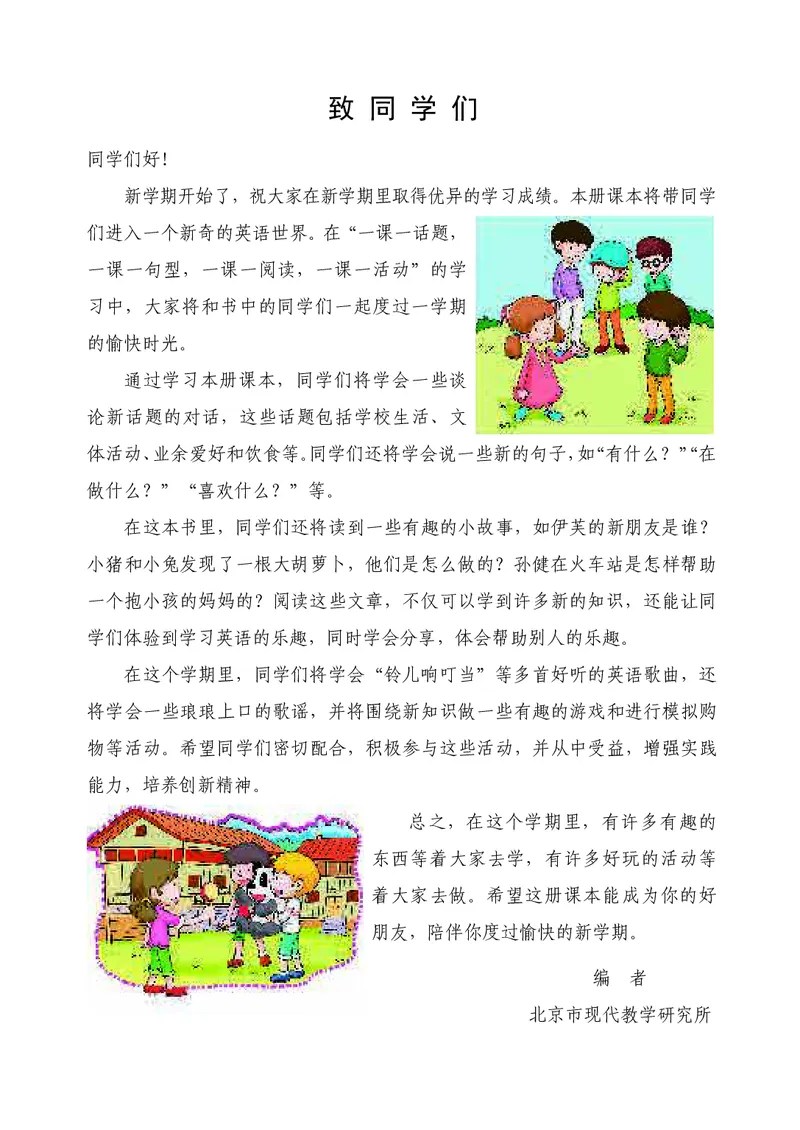
新学期开始了,祝大家在新学期里取得优异的学习成绩。本册课本将带同学
们进入一个新奇的英语世界。在“一课一话题,
一课一句型,一课一阅读,一课一活动”的学
习中,大家将和书中的同学们一起度过一学期
的愉快时光。
通过学习本册课本,同学们将学会一些谈
论新话题的对话,这些话题包括学校生活、文
体活动、业余爱好和饮食等。同学们还将学会说一些新的句子,如“有什么?”
“在
做什么?”“喜欢什么?”等。
在这本书里,同学们还将读到一些有趣的小故事,如伊芙的新朋友是谁?
小猪和小兔发现了一根大胡萝卜,他们是怎么做的?孙健在火车站是怎样帮助
一个抱小孩的妈妈的?阅读这些文章,不仅可以学到许多新的知识,还能让同
学们体验到学习英语的乐趣,同时学会分享,体会帮助别人的乐趣。
在这个学期里,同学们将学会“铃儿响叮当”等多首好听的英语歌曲,还
将学会一些琅琅上口的歌谣,并将围绕新知识做一些有趣的游戏和进行模拟购
物等活动。希望同学们密切配合,积极参与这些活动,并从中受益,增强实践
能力,培养创新精神。
总之,在这个学期里,有许多有趣的
东西等着大家去学,有许多好玩的活动等
着大家去做。希望这册课本能成为你的好
朋友,陪伴你度过愉快的新学期。
                编  者
             北京市现代教学研究所
致 同 学 们
Lesson 1
Lesson 2
Lesson 3
Lesson 4
Lesson 5
Lesson 6
Lesson 7
Revision                                                                 32
Does Jim like swimming?                                      20
What does he like?                                                26
What would you like?                                             38
Contents
Contents
Don’t be late next time!                                           8
A computer has a keyboard                                   14
What is she doing?                                                  2
Lesson 8
Would you like some potatoes?                            44
Lesson 9
How many cakes do you want?                             50
Words in each lesson                                             76
Word list                                                                  79
Word families                                                          82
Lesson 10
There is a horse under the tree                             56
There isn’t any bread in the fridge                         62
Lesson 11
Revision	                                                                68
Lesson 12
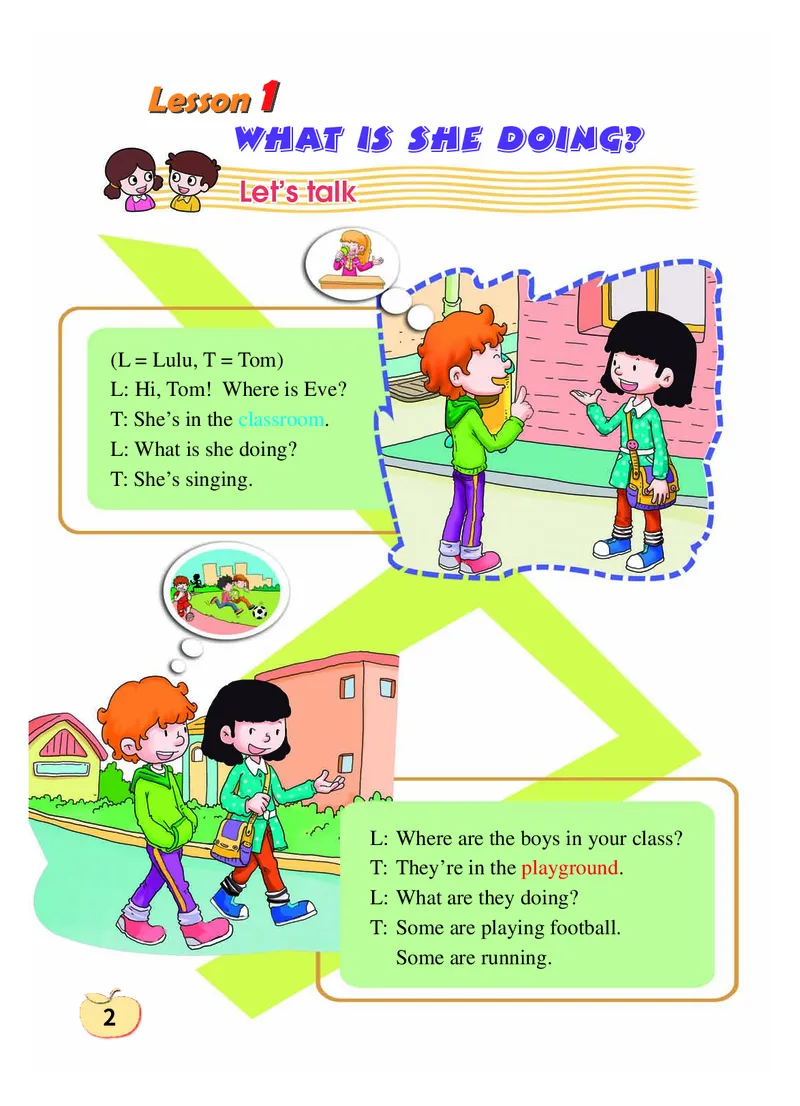
(L = Lulu, T = Tom)
L: Hi, Tom!  Where is Eve?
T: She’s in the classroom.
L: What is she doing?
T: She’s singing.
L:	Where are the boys in your class?
T:	They’re in the playground.
L:	What are they doing?
T:	Some are playing football.

Some are running.
Let’s talk
what is she doing?
Lesson 1
2
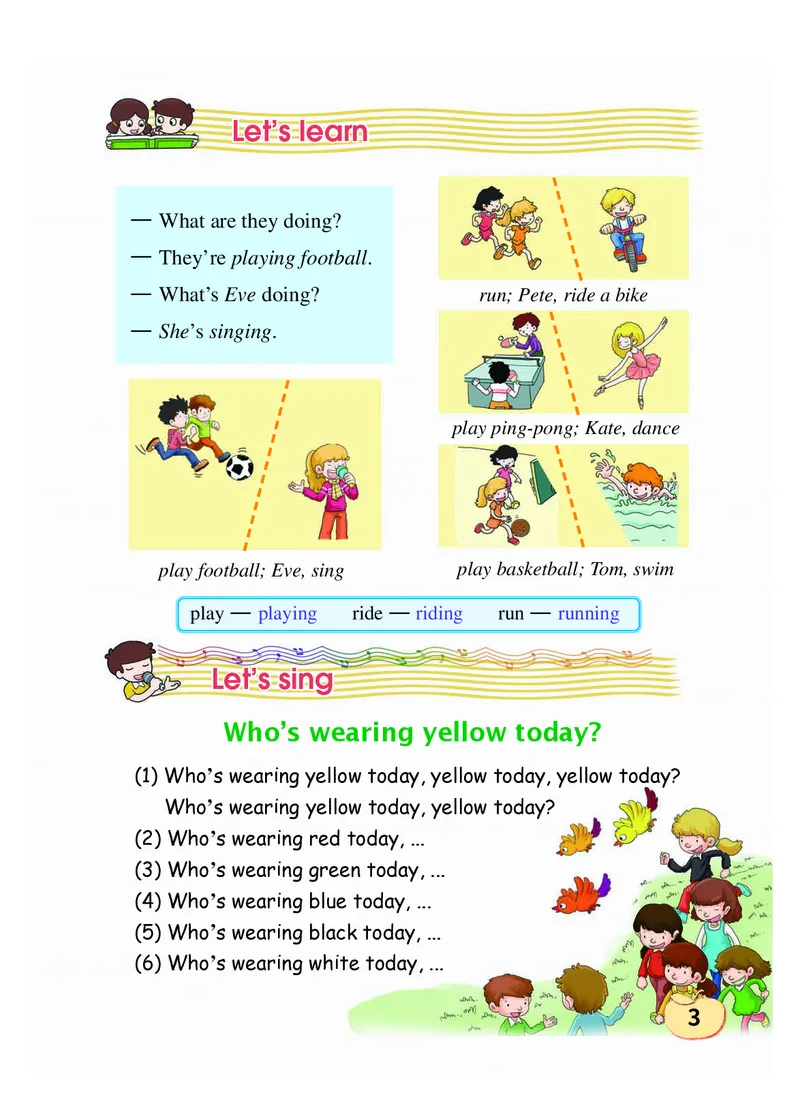
 play basketball; Tom, swim
play ping-pong; Kate, dance
run; Pete, ride a bike
Let’s learn
Who’s wearing yellow today?
Let’s sing
3
(1) Who’s wearing yellow today, yellow today, yellow today?
     Who’s wearing yellow today, yellow today?
(2) Who’s wearing red today, ...
(3) Who’s wearing green today, ...
(4) Who’s wearing blue today, ...
(5) Who’s wearing black today, ...
(6) Who’s wearing white today, ...
play - playing       ride - riding       run - running
- What are they doing?
- They’re playing football.
- What’s Eve doing?
- She’s singing.
play football; Eve, sing
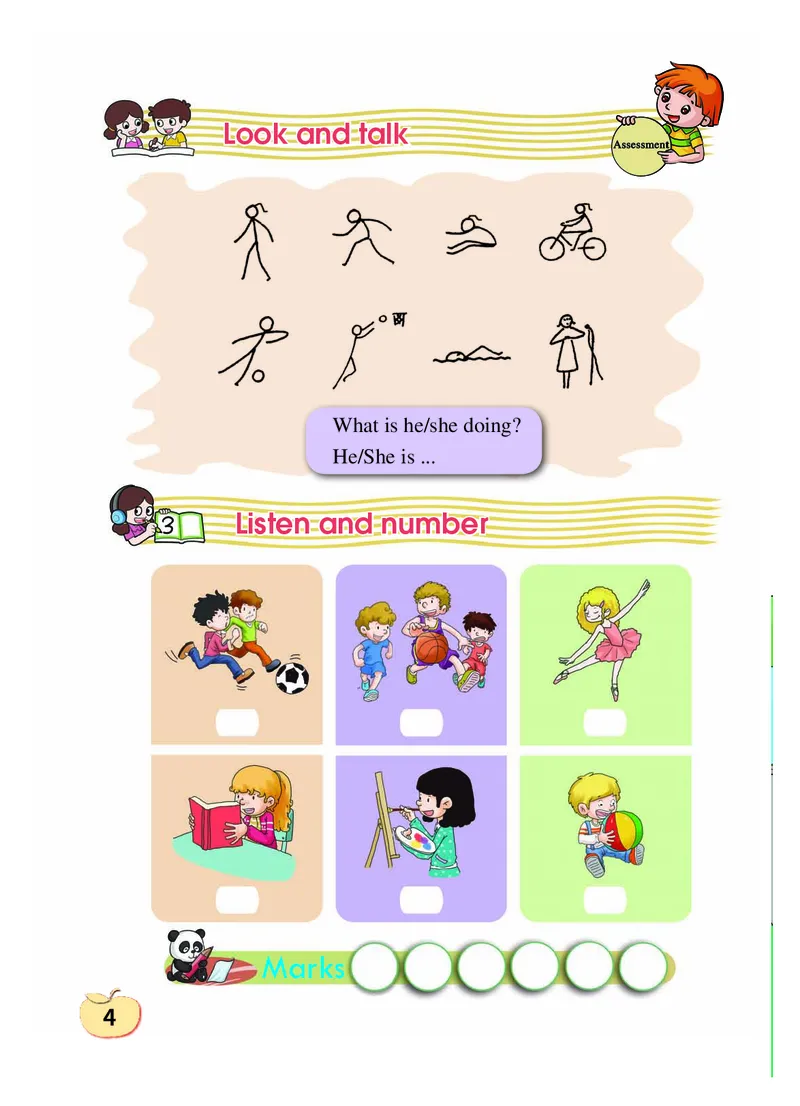
Look and talk
Listen and number
Marks
What is he/she doing?
He/She is ...
4
5
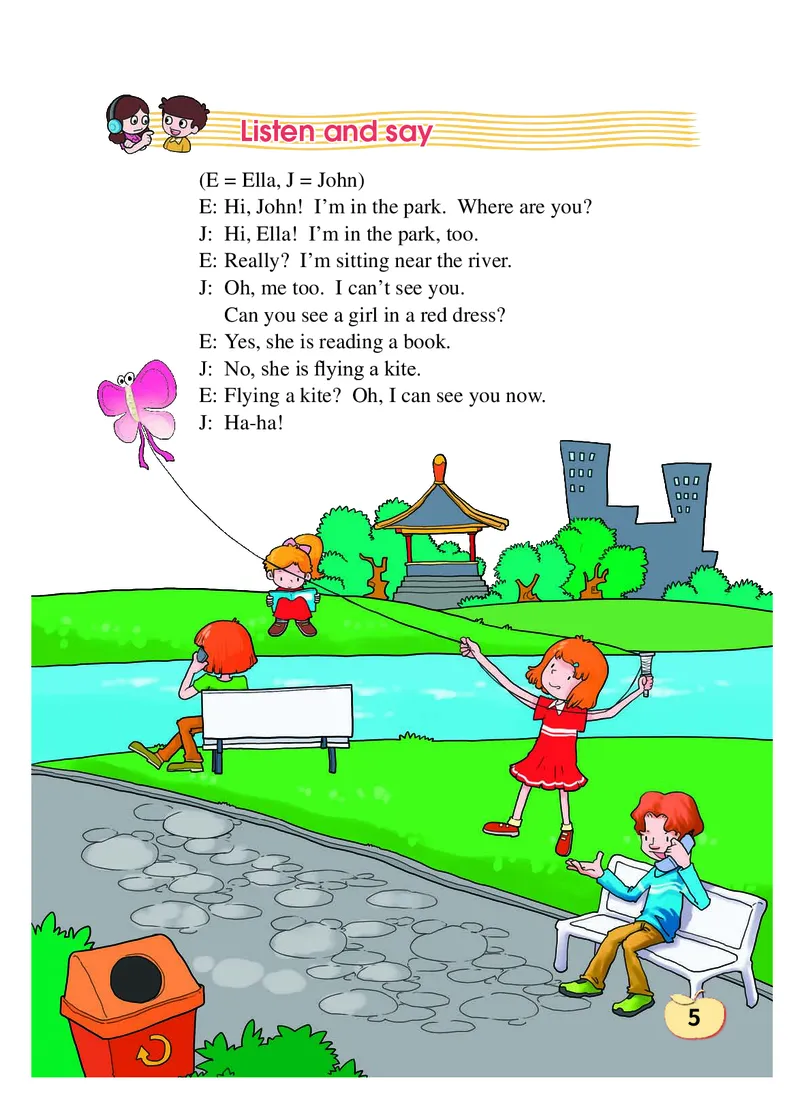
Listen and say
(E = Ella, J = John)
E:	Hi, John!  I’m in the park.  Where are you?
J:	 Hi, Ella!  I’m in the park, too.
E: 	Really?  I’m sitting near the river.
J:	 Oh, me too.  I can’t see you.

Can you see a girl in a red dress?
E: 	Yes, she is reading a book.
J: No, she is flying a kite.
E: 	Flying a kite?  Oh, I can see you now.
J:	 Ha-ha!
It’s Sunday.  Mike and his family
are at the sports centre.  Mike and
his sister Jill are playing ball games.
Mike is playing football and Jill is
playing ping-pong.
Mr Green, Mike’s
father, loves horses.  He
is riding a horse.  The
horse is running
very fast.
Going to the sports centre
Read
6
Mrs Green, Mike’s mother, is watching a basketball game.
Mike’s grandfather and grandmother
are playing tennis.  They are going to have
a match with their friends next week.
7
Let’s talk
T: 	May I come in?
M: 	Yes, please.
T:  	I’m sorry I’m late.
M: 	Why are you late?
T:  	Because the bus was late.
M:	I see.  That’s all right.
      Go to your seat and

sit down, please.
      Don’t be late next time!
T:	 Yes, Miss Li.


(T = Tom, M = Miss Li)
don't be late next time!
Lesson 2
8
Let’s sing
Let’s learn
Sit down.
Don’t stand up.
Close the door.
Don’t close the window.
Listen to me.
Don’t talk.
Look at the blackboard.
Don’t look at your book.
Sing your way home
Sing your way home,
At the close of the day.
Sing your way home,
Drive the shadows away.
Smile every mile for wherever you go.
It will brighten your road,
It will lighten your load,
If you sing your way home.
9
A game
Simon says, “Don’t sit down.”
Listen and choose
(     ) 2.
(     ) 1.
(     ) 3.
(     ) 4.
A
B
A
B
A
B
A
B
(     ) 5.
A
B
Marks
Wrong!
10
Keep quiet!
No spitting!
Watch your step!
No littering!
Don’t waste food!
Listen and say
11
Read
Keep off the grass!
Today is a fine day.
Ted and his mother are
in the park.  They’re
very happy.
Keep off the grass!
Ted in the park
Don’t run on the grass,
Ted!  It’s not good.
OK, Mum.
①butterfly /?bVtEflaI/ 蝴蝶
12
Ted sees a butterfly
①.
He wants to catch it.  Now
he is running on the grass.
No littering!
Good boy, Ted.
Thank you, Mum.
①litter /?lItE/ 乱丢垃圾
13
Now Ted is eating a banana.  He is littering
①.
His mother says, “Don’t litter, Ted!  It’s bad.”
Ted says, “Sorry, Mum.”
Ted is doing the right thing.  His mother is happy.
Q:	 Oh!  You have a nice TV.
E:  	No, it’s not a TV.  It’s a computer.
Q:    	But it looks like a TV.
E:  	Yes.  But a computer has a
      keyboard.
Q:	What’s that?
E:	 It’s a mouse.
Q:	 Does a TV have a mouse, too?
E: 	 No, it doesn’t.
C:  Where is the mouse?
            Let me catch it.
E:  Look!  Here it is!
Let’s talk
(Q = Qiqi, E = Eve, C = Cat)
a computer has a
keyboard
Lesson 3
14
Does a TV have a screen ?
Yes, it does.
TV / computer
screen / mouse / keyboard
Let’s learn
Let’s sing
Two little eyes
15
Two little eyes open and close.
Two little ears and one little nose.
Two little cheeks and one little mouth.
Two little lips with teeth closed in.
- I have a new friend.

Please guess who he is.
- Is he tall?
- No, he isn’t.
- Does he have big eyes?
- Yes, he does.
- Does he have a blue cap?
- Yes, he does.
- Oh, I know.  He’s Lele.
Listen and choose
(      ) 2.
(      ) 1.
(      ) 3.
(      ) 4.
A game
A
B
A
B
A
B
A
B
Marks
16
17
1.	In Picture 1 the computer has a mouse.
	 But in Picture 2 the computer doesn’t have a mouse.
2.	In Picture 1 the girl has a brown dog.
	 But in Picture 2 the girl has a white dog.
	 ...
Look and say
Find the differences
1
2
No, he is short.
He has no legs.
Is he tall?
Who is he?
I have a new friend.
I play with him every day.
Have a guess.
Does he have ears
and eyes?
No, but he has a big body.
Read
Who is her friend?
18
Does he have a mouth?
No, he doesn’t have a mouth,
but he can sing.
Does he have hands?
No, he doesn’t have hands,
but he can write letters.  The
letters are emails.
Oh, I see!  Your friend is
a computer.
Yes, you are right.
19
He’s swimming.
Do you like ball games, too?
Yes, he does.  He
likes playing football.
What’s Jim doing?
Does he like sports?
Yes, I like playing basketball.
Yes, he likes swimming
and skating.
Does he like ball games?
Let’s talk
does Jim like swimming?
Lesson 4
20
Jim
swimming
Ann
skating
Jack
riding a horse
Jill
flying a kite
Does Jim like swimming?
Yes, he does. / No, he doesn’t.
Rose
playing ping-pong
Sam
playing football
Let’s learn
Let’s sing
Fly, fly, the butterfly
Fly, fly, fly the butterfly.
In the meadow is flying high.
In the garden is flying low.
Fly, fly, fly the butterfly.
21
I like drawing, reading
and dancing.
I like drawing.
I like drawing and reading.
I like drawing, reading,
dancing and singing.
Listen and number
A game
Marks
22
23
Look and say
______
Mary
______
______
Reading
Riding a horse
Flying a kite
Music
Swimming
Playing football
Fishing
What’s your favourite sport, Mary?
Swimming.
Do you like fishing?
Do you like playing football?
Yes, I do.
No, I don’t.  But I like
playing basketball.
Playing basketball
×
√
√
√
Jim likes playing cards.
Sometimes he plays cards with Jill.
He also likes fishing.
He often goes fishing on
Sundays.
Yes, he does.  He can swim very well.
He often goes swimming in summer.
Does he like swimming?
Read
Jim’s hobbies
24
What about ball games?
Does he like football?
No, he doesn’t, but he
likes playing ping-pong
very much.
No, he doesn’t.  He likes
reading on his computer.
25
Does he like computer games?
(Q = Qiqi, E = Eve)
Q: Look at Jane.  What’s she doing?
E: She’s listening to music.
Q: Does she like music?
E: Yes, she likes music very much.
Q:	What about Pete?  What does he like?
E:	He likes seeing films.
Q:	What do you like?  Do you like seeing films?
E:	Yes, I do.  I like watching TV, too.
Let’s talk
what does he like?
Lesson 5
26
What do you like?
I like seeing films.
Tim
singing
Kate
dancing
What does Pete like?
He likes seeing
films, too.
John
taking photos
Helen
going shopping
Pete
seeing films
Let’s learn
Do you like music?
Let’s sing
Do you like music?
Yes, I do.  I like it very much.
Does he like music?
No, he doesn’t.  He doesn’t like it at all.
Do you like sports?
Yes, we do.  We like them very much.
Do they like sports?
No, they don’t.  They don’t like them at all.
27
Let’s practise
Listen and tick
1
2
3
4
×
×
×
√
√
√
Marks
A
B
A
B
A
B
A
B
28
___ What does Tom like?
___ He likes seeing films.
___ Does he like flying a kite?
___ No, he doesn’t.
29
Listen and say
A: It’s a fine day, isn’t it?
B: Yes, it is.
A:	What do you like to do in your free time?
B: 	I like playing basketball.  What about you?
A: 	I like reading books.
B: 	What is your favourite book?
A: 	The Little White Horse.
B: 	That’s a good book.
A: 	Yes.  I like it very much.
My family all like watching TV.
But we have only one TV.
What does my mother like?  She
likes seeing TV plays.  Does my father
like seeing TV plays?  Yes, he does.
He likes TV plays, too.
Read
We all enjoy watching TV
30
I don’t like TV plays.  I like seeing
films.  Does Haohao like TV plays?  No,
he doesn’t.  He likes cartoons
①.
What about Grandma?
She likes Animal World
②.
①cartoon /kA:?tu:n/ 卡通片
② Animal World/wB:ld/《动物世界》

31
Haohao and I only watch TV on Sundays.  My mother and
father always see TV plays in the evening.  My grandma watches
Animal World in the morning.  Everyone in our family enjoys
watching TV.  We are a happy family.
(T = Tom, E = Eve)
T:	What’s Kate doing over there?
E:	She’s making a kite.
T:	Does she like flying kites?
E:	Yes, she does.
T:	Does she have many kites?
E:	Yes, she has many beautiful kites.
T:	I like flying kites, too.  Let’s go and take a look.
E:	OK.
Let’s talk
revision
Lesson 6
32
1.
2.
3.
4.
Two.
Yes, he has two.
Yes, she does.
No, she isn’t.
Yes, I do.
 It’s a short ruler.
 Dongdong likes playing football.
 Dongdong likes playing basketball.
 Tom is doing his homework.
 Tom is reading a book.
 Do you have a pen?
 Do you have a pencil?
 Where is Eve?
 Where is Eve from?
I’m reading.
 I like reading.
Revision Exercises
1. Listen and tick the right answer.
2. Listen and tick the sentence you hear.
1.
2.
3.
4.
A
B
A
B
B
A
B
A
B
A
B
A
B
A
B
A
33
3. Talk about the picture.
A: Do you have a ruler, Dongdong?
B: Yes, I do.
C: Does Dongdong have a ruler?
D: Yes, he does.
4. Read and fill in the missing words.
do,  does,  don’t,  doesn’t,  is,  are,  aren’t,  isn’t
1.	— _______ Mum cooking now?

— No, she _______.
2.	_______ be late next time.
3.	What _______ you like?
4.	_______ Lulu have a new hat?
5.	He _______ have a long ruler.
6.	— _______ they playing football now?

— No, they _______.
34
singing    swimming    writing    watching TV    playing football
1. I have four big l         .

I have a long n         .

I have two big e         .

I am an e         .
1. The boy likes ________.
5. The boys are ________.
4. The girls like ________.
3. She is ________.
2. They are ________.
5. Fill in the missing words.  Then number the pictures.
6. Look at the pictures.  Then read and fill in the blanks.
35
- What’s Number 6 doing?  - He is drawing.

2.	I have a screen.


I have a keyboard.


I have a mouse.


I am a c         .

3. 	I have a h         .


I have a m         .


I have two h         .


I am a doll.

4. 	I have one l          hand.


I have one s          hand.


I can tell you the t         .


I am a w         .
7. Look at the picture.  Then ask and answer.
⑩
①
②
③
④
④
⑤
⑥
⑦
⑧
⑨
36
37
Self-assessment
I can say
I know these words
What is she doing?
She’s singing.
Go to your seat and sit down, please.
Don’t be late next time!
Does a TV have a mouse?
No, it doesn’t.
Does he like sports?
Yes, he likes swimming and skating.
What do you like?
I like watching TV.
playground  sport  love  grandfather
grandmother  next  week
may  park  grass  thing
TV  every  tall  ear  eye  mouth  hand
write  email
card  sometimes  often  well
listen  music  film  always
take
L: 	Look!  It’s a shop.
T: 	Yes.  Let’s buy something to drink.
L: 	I’d like some tea.  What would you like?
T: 	I’d like a cold drink.
W	:	Can I help you?
L:		 Yes, I’d like a cup of tea and a

 bottle of coke.
W	:	Sorry, we don’t have coke.
	 	 Would you like a bottle of
	 	 orange juice?
Let’s talk
T:	 OK, a bottle of orange juice

and a cup of tea, please.
W:	OK.  Here you are.
(L = Lulu, T = Tom, W = Woman)
what would you like?
Lesson 7
38
What would you like?
I’d like a cup of tea.
a glass of water
a bottle of coke
an ice cream
some juice
some candy
a cup of tea
Let’s learn
Let’s sing
Would you like a cup of tea?
Would you like a cup of tea?
No, thanks.  No, thanks.
What would you like to drink?
I’d like some milk.
Would you like something to eat, to eat?
I’d like to have some noodles.
39
A game
(      ) 1.
A
B
(      ) 2.
(      ) 3.
(      ) 4.
Listen and choose
A
B
A
B
A
B
- What would you like?
- I’d like a bun.
- Would you like a bottle of milk?
- Yes, please.
- Here you are.
Marks
40
41
Listen and say
(Z = Zhuangzhuang, J = Jane, M = Man)
M:	Can I help you?
J: 	 Yes, I’d like a hamburger and a bag of chips.
M:	What would you like?
Z: 	I’d like a hot dog.
M:	Would you like something to drink?
J: 	 Yes, a glass of orange juice.
Z: 	I’d like a coke.
M:	OK.  Twenty-eight yuan.
J: 	 Oh, no!  I only have twenty yuan.
Z: 	That’s OK.  Let’s go Dutch
①.
①go Dutch  AA 制
Look!  What’s this?
Read
 A big carrot
Aha!  A carrot.
A big carrot.
I’m hungry.  Let’s share
① it.
Miss Sheep is not well today.
She’s hungry, too.
Then let’s share it with her.
OK!
Miss Sheep!  How
are you feeling?
I’m not feeling well.
42
①share /SeE/ 分享
Would you like something to drink?
Yes, please.
What would you like?
Some water, please.
Here you are.
Thank you.  Oh, I’m feeling
much better now.
Do you like carrots?
Yes, I do.
Look!  We have a big carrot.
Let’s eat it together.
Thank you.
43
Man:	 Here you are.
Mum:	Thank you.
Man:	 Can I help you?
Mum:	Yes.  We want some vegetables.
Man:   OK.  Would you like some potatoes?
Mum:	Oh yes, please.
Lulu:		 Could I have some tomatoes?
Man:		 Sure.  Would you like
	 	 	 	 some carrots, too?
Mum:	Yes, some carrots, too.
Let’s talk
Would you like some potatoes?
Lesson 8
44
Would you like some tomatoes?
Sure.
Oh, yes.  Could I have
some cabbages, too?
tomatoes, cabbages
potatoes, carrots
Chinese cabbages, peas
Let’s learn
Let’s sing
Jingle bells
Dashing through the snow,
In a one-horse open sleigh,
O’er the fields we go,
Laughing all the way;
Bells on bobtail ring,
Making spirits bright,
What fun it is to ride and sing a sleighing song tonight.
Jingle bells, jingle bells, jingle all the way!
Oh!  What fun it is to ride in a one-horse open sleigh!
Jingle bells, jingle bells, jingle all the way!
Oh!  What fun it is to ride in a one-horse open sleigh!
45
A game
Listen and number
- Can I help you?
- Yes.  I would like some carrots and potatoes.
- Here you are.
- How much are they?
- Five yuan.
Marks
46
47
Listen and say
Tom: 	Hi, Mom!  I’m hungry.
Mom: 	There is some bread in the fridge.
Tom: 	Uh ...  I don’t like bread.  Do we have any hamburgers?
Mom: 	No, but we have some apples and bananas, and ...
Tom:  	Mom, you know I don’t like bananas!
Mom: 	What about eggs?
Tom: 	No, thanks.  I’d like a hot dog.
Mom: 	Oh, Tom.  No hot dogs for you.
        		 Hot dogs are junk food ①.
①junk/dWVYk/ food  垃圾食品
Read
A train ticket
48
Sun Jian likes to help people.  Now he is at the Shenyang
Station ①.  He wants to take a train to Anshan.
In the waiting room ②, he sees a woman
with a baby in her arms.  The woman is crying.
①station /?steISn/ 车站
②waiting room 候车室
49
Sun Jian buys a ticket and gives it to the woman.
“Thank you very much,” the woman says happily.
“What’s wrong?  Can I help you?” asks Sun Jian.
“I want to go to Jilin, but I can’t find my money,” says
the woman.  “Don’t worry.  I can help you.”
“I’d like a ticket to Jilin.”
“OK.”
W: 	Here it is.  Is that all?
T:  	 Yes.  How much is it?
W:  	 Twenty yuan.
T:	 Here is the money.
W:	 Thank you.
W:	What can I do for you?
T:  	I want some cakes.
W: 	 How many cakes do you

want?
T:         	Four.
W: 	Here you are.  Anything else?
T:  	I want some chicken, too.
W: 	How much chicken do you

want?
T:  	I want half a kilo.
Let’s talk
(W = Woman, T = Tom)
how many cakes do you want?
Lesson 9
50
How many cakes
do you want?
I want three.
I want two kilos.
How much meat
do you want?
three cakes       two kilos of meat
four eggs         one kilo of beef
five buns         ten kilos of rice
five hot dogs   half a kilo of chicken
Let’s learn
I see three ships
Let’s sing
I see three ships come sailing by,
sailing by, sailing by.
I see three ships come sailing by
on Christmas Day in the morning.
51
Classify the following words.
tomato
tea
potato
carrot
bottle
meat
rice
water
cabbage
egg
cake
train          	 hot dog
bun
apple
ruler
banana
pencil
beef
bike
Countable:       tomato
Uncountable:  tea
Let’s do
Listen and tick
1
2
3
4
Marks
A
B
A
B
A
B
A
B
52
53
Look and say
A:	 What can I do for you?
B:	 I want some potatoes.
A:	 How many do you want?
B:	 I want 3 kilos.
B:	 How much are they?
A:	 Fifteen yuan.
B:	 Here is the money.
A:	 Thank you.
Read
What’s five times three?
54
Linlin is seven and she is in Grade One.  Her
brother is ten and he is in Grade Four.  Now
they are going to the fruit shop.  Their mother
wants some apples.
①times /taImz/ 乘以
“Linlin, what’s five times ① three?”
“Sorry, I don’t know.”
“Come with me and I’ll show you.”

55
“Oh, I see.  Five times three is fifteen.”
“Yes, you’re right.  You’re so clever.”
“I’d like some apples, please.  How much are they?”
“Five yuan a kilo.  How many would you like?”
“Three kilos.”
“They’re 15 yuan in all.”
(W = Wei Gang, P = Peg)
W:	Look!  There is a tree in front

of that house.
P:	 What’s under the tree?
W:	There is a horse under it.
P:	 What’s in the tree?
W:	There are some birds in it.
P:	 What’s behind the house?
W:	There are some goats behind it.
   	 They are eating grass.
Let’s talk
There is a horse under the tree
Lesson 10
56
In the living room
— What’s under the tree?
— There is a horse under it.
— What’s in the tree?
— There are some birds in it.
under the chair, two hens;
on, a dog
under the bed, a toy sheep;
on, two cats
in the box, a toy fox;
beside, a teddy bear
Let’s learn
Let’s sing
In the living room there’s a sofa.
There’s a sofa in the living room.
Please sit down.
Please sit down in the living room.
In the living room there’s a window.
There’s a window in the living room.
Open the window.
Close the window in the living room.
In the living room there is a curtain.
There’s a curtain in the living room.
Open the curtain.
Close the curtain in the living room.
57
Yes.
Yes.
Yes.
Yes.
Yes.
Yes.
No.
No.
No.
No.
No.
No.
Listen and circle
1.
2.
4.
3.
5.
6.
Model:
— What’s behind the house?
— There are some goats.
How many sentences can you make?  Have a try.
Marks
58
Let’s practise
In Picture 1 there is a football under the desk.
But in Picture 2 there is a football under the bed.
...
Look and say
59
Find the differences
1
2
In a forest in Sichuan, there are some pandas.  Near the forest
there is a village.  In the village there are some houses.
There are some children near
a small house.  They are playing
games.
The children see a baby panda behind
the house.  It is ill and hungry.
A baby panda
Read
60
“Let’s take it back to its mother,”
says one of the children.  “Good
idea,” the other children say.
The children take it home
and give it food and water.
Now the baby panda is
much better.  The children
are playing with it and they
are very happy.
The children are saying goodbye
to the baby panda, and it is happy to
go back to the forest.
61
(T = Tom, M = Mom)
T:	 Mom, tomorrow is Sunday.  Let’s go shopping, OK?
M:	 OK.
T:	 What shall we buy?
M:	 Let me see.  There isn’t any bread in the fridge.  There aren’t

any eggs, either.
T:	 Is there any coke?
M:	 Yes, there is.  But there isn’t any juice.
T:
 Are there any potatoes?
M:	 No, there aren’t.  And we want some fruit, too.
T:	 Anything else, Mom?
M:	 No, that’s all.
T: 	 OK.
There isn't any bread in the fridge
Let’s talk
Lesson 11
62
— Is there any beef in the fridge?
— Yes, there is some.
— Are there any eggs?
— No, there aren’t any.
beef, eggs
meat, tomatoes
bread, carrots
tea, potatoes
milk, buns
Let’s learn
Let’s sing
Food Song
Come and hear, follow me.
Sing a Food Song with me.
Eat the noodles.
Eat the rice.
Eat the chicken.
Eat the beef.
Come and hear, follow me.
Sing a Food Song with me.
Eat the carrots.
Eat the peas.
Eat the tomatoes.
63
Look and say
Listen and choose
(     ) 1.
(     ) 2.
(     ) 3.
(     ) 4.
(     ) 5.
A                                B
— Is there any milk on the table?
— No, there isn’t.
— Are there any apples in the box?
— Yes, there are.
A                                B
A                                B
A                                B
A                                B
Marks
64
Number 2, is there any bread in your bag?
No, there aren’t.  ...
Yes, there is.  Number 3, are
there any bananas in your bag?
A guessing game
65
1
4
3
2
Read
66
My name is Zhang Jing.  I’m from Fujian.  My hometown is
Gulangyu.  It’s a very clean and beautiful island.  There are no cars
and no buses on it.  People like to walk.
Our house is near the sea.  On the island there are lots of old
houses.  The people here can tell you lots of old stories about them.
My hometown
67
Everyone on the island likes music.  There are lots of pianos
on the island.  You can hear the sound of music everywhere.  So
Gulangyu is also called “The Island of Music”.
My hometown is very beautiful.  I like it very much.
(M = Man, L = Lulu)
M:	Can I help you?
L: 	Yes, I’d like some ice cream.
M:	Sorry, we don’t have any ice cream.
L: 	Do you have any milk?
M:	Yes.  How many bags of milk do you want?
L:	 Four bags, please.
M:	What else?
L:	 I want some hot dogs, too.
M:	How many would you like?
L: 	Three.  How much is that?
M:	Twenty-seven yuan in all.
L: 	Here is the money.  By the way, do you have any vegetables in

your shop?
M:	Sorry, we don’t.  But there is a small vegetable shop near here.
L: 	Thank you very much.
Let’s talk
revision
Lesson 12
68
OK.
OK, Mum.
Read
Ann and the thief
69
We’re going shopping,
Ann.  Please close the
door and stay at home.
Tomorrow is Mr Smith’s birthday.
He likes music very much.  Let’s
buy him some CDs, OK?
Ann has a little dog.  She
likes it very much.  Now
she is playing with it.
Who is it?
70
It’s me, Mr Smith.
Please open the door.  Your father
wants me to get his bag for him.
Is he really Mr Smith?
The thief is knocking at the door.
Mr Smith?
71
My father’s bag is here.
But are you really Mr Smith?
Yes, I’m Ann.  But do you
know my father’s name?
My father and Mr Smith are good
friends.  But you don’t know his
name.  You’re not Mr Smith.  I’m
going to call the police.
Oh, no!
Of course I am.  And
I know you are Ann.
Your father is ...
Oh, I ... I ...
1
2
3
4
5
6
1. Listen and put a tick(√) or a cross(×) in each box.
Revision Exercises
2. Listen and tick the right answer.
1. A. Yes, he is.
    B. He’s watching TV.
3. A. Yes, she does.
    B. No, I don’t.
5. A. I’d like a bottle of milk.
    B. They’re tomatoes.
7. A. Twenty yuan.
    B. Four bottles.
2. A. There are some birds in it.
    B. Yes, there are.
4. A. Yes, she does.
    B. She likes swimming.
6. A. I’m a worker.
    B. I like seeing films.
8. A. No, there isn’t.
    B. There isn’t any beef in it.
72
Yes, I do.
Five.
Yes, I’d like
a cold drink.
Certainly.
1. write
2. draw
3. wash
4. skate
5. listen
6. drink
7. tell
8. give
9. watch
10. ask
11. dance
12. buy
13. talk
14. swim
15. read
16. ride
17. wait
18. have
19. get
20. sing
21. sit
_______
_______
_______
_______
_______
_______
_______
3. Read and match.
4. Give the -ing form of the following verbs.
_______
_______
_______
_______
_______
_______
_______
_______
_______
_______
_______
_______
_______
_______
Would you like
something to drink?
1.
How many eggs
do you want?
2.
Do you like sports?
3.
Could I have
some tomatoes?
4.
73
5. Look at the picture and write out the answers.
1. Are there any apples in the fridge?
  _______________________________
2. Is there any orange juice in the fridge?
  _______________________________
3. Are there any eggs in the fridge?
  _______________________________
4. Is there any bread in the fridge?
  _______________________________
5. Are there any tomatoes in the fridge?
  _______________________________
6. Look and write.
a bag, in the desk
Model:
There is a bag in the desk.
a clock, on the desk
three birds, in the tree
some eggs, in the box
74
Self-assessment
I can say
I know these words
shop   buy   drink   tea   juice   feel   much
vegetable   potato   tomato   train   arm
cry   wrong   worry
chicken   half   twenty   fruit   know   clever
child(children)   small   food   back   its
tell   story   hear
ice cream   milk   police
What would you like?
I’d like a cold drink.
Would you like some potatoes?
Oh yes, please.
Could I have some tomatoes?
Sure.
What can I do for you?
I want some cakes.
How many cakes do you want?  Four.
How much is it?  Twenty yuan.
There is a tree in front of that house.
What’s under the tree?
There is a horse under it.
There isn’t any bread in the fridge.
Is there any coke?  Yes, there is.
75
各课词汇表
Words in each lesson
Lesson 1
playground /?pleIGraHnd/	 操场
sport /spC:t/
运动
love /lVv/
爱
grandfather /?GrZnfA:DE/
            爷爷, 外公( 口grandpa)
grandmother /?GrZnmVDE/
            奶奶, 外婆( 口grandma)
next /nekst/
下一个
week /wi:k/
星期
classroom /?klA:srHm/
教室
centre /?sentE/
中心
ping-pong /?pIYpFY/
乒乓球
tennis /?tenIs/
网球
    play football
踢足球
    play ping-pong
打乒乓球
    have a match
比赛
Lesson 2
may /meI/
可以
park /pA:k/
公园; 停车
grass /GrA:s/
草
thing /OIY/
东西, 事情
seat /si:t/
座位
  next time
下一次
  I see.
我知道了。
  That’s all right.
没关系。
Lesson 3
TV /?ti:?vi:/
电视机
every /?evrI/
每一个
tall /tC:l/
高的
ear /IE/
耳朵
eye /aI/
眼睛
mouth /maHO/
嘴
hand /hZnd/
手
write /raIt/
写
email /?i:meIl/
电子邮件
keyboard /?ki:bC:d/
键盘
mouse /maHs/
鼠, 鼠标
    every day
每天
Lesson 4
card /kA:d/
卡片
sometimes /?sVmtaImz/
有时
often /?Ffn/
经常
well /wel/
健康的; 好
( 注:本表中只收录Let’s talk 和Read 部分的生词)
76
skate /skeIt/
滑冰
    play basketball
打篮球
    go fishing
去钓鱼
Lesson 5
listen /?lIsn/
听
music /?mju:zIk/
音乐
film /fIlm/
电影
always /?C:lweIz/
总是
only /?EHnlI/
仅仅, 只
everyone /?evrIwVn/
每一个
enjoy /In?dWCI/
喜欢, 享受
    listen to music
听音乐
    see films
看电影
    watch TV
看电视
Lesson 6
take /teIk/
拿
    take a look
看一看
Lesson 7
shop /SFp/
商店
buy /baI/
买
drink /drIYk/
喝; 饮料
tea /ti:/
茶
juice /dWu:s/
果汁
feel /fi:l/
感觉
much /mVtS/
多, 非常
something /?sVmOIY/
某事( 物)
would /wHd/
将要
bottle /?bFtl/
瓶子
carrot /?kZrEt/
胡萝卜
    would like
想要
    a cup of
一杯
    a bottle of
一瓶
Lesson 8
vegetable /?vedWItEbl/
蔬菜
potato /pE?teItEH/
土豆
tomato /tE?mA:tEH/
西红柿
train /treIn/
火车
arm /A:m/
手臂
cry /kraI/
哭, 喊
wrong /rFY/
错误的
worry /?wVrI/
担忧
could /kHd/
可以
money /?mVnI/
钱
ticket /?tIkIt/
票
    What’s wrong?
怎么了?
Lesson 9
chicken /?tSIkIn/
鸡, 鸡肉
half /hA:f/
一半
twenty /?twentI/
二十
fruit /fru:t/
水果
77
either /?aIDE/
也不
hometown /LhEHm?taHn/
家乡, 故乡
island /?aIlEnd/
岛
sea /si:/
海
piano /pI?ZnEH/
钢琴
sound /saHnd/
声音
everywhere /?evrIweE/
到处
    go shopping
购物
    lots of
许多, 大量
   Lesson 12
ice cream /LaIs?kri:m/
冰激凌
milk /mIlk/
牛奶
police /pE?li:s/
警察
stay /steI/
停留
thief /Oi:f/
贼
knock /nFk/
敲
    by the way
顺便问一下

know /nEH/
知道
clever /?klevE/
聪明的
anything /?enIOIY/
任何事物
else /els/
其他的
kilo /?ki:lEH/
千克
show /SEH/
展示
    how much
多少( 钱)
    What can I do for you?
                              我能帮你做什么吗?
Lesson 10
child /tSaIld/      儿童( 复children)
small /smC:l/
小的
food /fu:d/
食物
back /bZk/
向后; 背
its /Its/
它的
forest /?fFrIst/
森林
village /?vIlIdW/
村庄, 乡村
other /?VDE/                      别的, 其他的
    in front of
在……前面
    say goodbye to
向……道别
Lesson 11
tell /tel/
告诉
story /?stC:rI/
故事
hear /hIE/
听见
fridge /frIdW/
电冰箱
78
【注】红色词是课标规定的重点词,要求
学生能够听、说、认读、拼写,蓝色词要
求学生能够听、说、认读,不要求拼写。
词 汇 表
Word list
A
always /?C:lweIz/
总是
5
anything /?enIOIY/ 	 任何事物
9
arm /A:m/
手臂
8
B
back /bZk/
向后; 背
10
bottle /?bFtl/
瓶子
7
buy /baI/
买
7
C
card /kA:d/
卡片
4
carrot /?kZrEt/
胡萝卜
7
centre /?sentE/
中心
1
chicken /?tSIkIn/
鸡, 鸡肉
9
child /tSaIld/   儿童( 复children)	 10
classroom /?klA:srHm/ 教室
1
clever /?klevE/
聪明的
9
could /kHd/
可以
8
cry /kraI/
哭, 喊
8
D
drink /drIYk/
喝; 饮料
7
E
ear /IE/
耳朵
3
either /?aIDE/
也不
11
else /els/
其他的
9
email /?i:meIl/
电子邮件
3
enjoy /In?dWCI/
喜欢, 享受
5
every /?evrI/
每一个
3
everyone /?evrIwVn/	每一个
5
everywhere /?evrIweE/ 到处
11
eye /aI/
眼睛
3
F
feel /fi:l/
感觉
7
film /fIlm/
电影
5
food /fu:d/
食物
10
forest /?fFrIst/
森林
10
fridge /frIdW/
电冰箱
11
fruit /fru:t/
水果
9
G
grandfather /?GrZnfA:DE/
          爷爷, 外公( 口grandpa)	1
grandmother /?GrZnmVDE/
          奶奶, 外婆( 口grandma)	1
grass /GrA:s/
草
2
H
half /hA:f/
一半
9
hand /hZnd/
手
3
hear /hIE/
听见
11
hometown /LhEHm?taHn/ 家乡, 故乡	 11
79
I
ice cream /LaIs?kri:m/ 冰激凌
12
island /?aIlEnd/
岛
11
its /Its/
它的
10
J
juice /dWu:s/
果汁
7
K
keyboard /?ki:bC:d/	 键盘
3
kilo /?ki:lEH/
千克
9
knock /nFk/
敲
12
know /nEH/
知道
9
L
listen /?lIsn/
听
5
love /lVv/
爱
1
M
may /meI/
可以
2
milk /mIlk/
牛奶
12
money /?mVnI/
钱
8
mouse /maHs/
鼠, 鼠标
3
mouth /maHO/
嘴
3
much /mVtS/
多, 非常
 7
music /?mju:zIk/
音乐
5
N
next /nekst/
下一个
1
O
often /?Ffn/
经常
4
only /?EHnlI/
仅仅, 只
5
other /?VDE/
别的, 其他的	 10
P
park /pA:k/
公园; 停车
2
piano /pI?ZnEH/
钢琴
11
ping-pong /?pIYpFY/	乒乓球
1
playground /?pleIGraHnd/ 操场
 1
police /pE?li:s/
警察
12
potato /pE?teItEH/
土豆
8
S
sea /si:/
海
11
seat /si:t/
座位
2
shop /SFp/
商店
7
show /SEH/
展示
9
skate /skeIt/
滑冰
4
small /smC:l/
小的
10
something /?sVmOIY/	某事( 物)
 7
sometimes /?sVmtaImz/ 有时
4
sound /saHnd/
声音
11
sport /spC:t/
运动
1
stay /steI/
停留
12
story /?stC:rI/
故事
11
T
take /teIk/
拿
6
tall /tC:l/
高的
3
tea /ti:/
茶
7
tell /tel/
告诉
11
80
tennis /?tenIs/
网球
1
thief /Oi:f/
贼
12
thing /OIY/
东西, 事情
2
ticket /?tIkIt/
票
8
tomato /tE?mA:tEH/
西红柿
8
train /treIn/
火车
8
TV /?ti:?vi:/
电视机
3
twenty /?twentI/
二十
9
V
vegetable /?vedWItEbl/ 蔬菜
8
village /?vIlIdW/
村庄, 乡村
10
W
week /wi:k/
星期
1
well /wel/
健康的; 好
4
worry /?wVrI/
担忧
8
would /wHd/
将要
7
write /raIt/
写
3
wrong /rFY/
错误的
8
Expressions
a bottle of
一瓶
7
a cup of
一杯
7
by the way
顺便问一下
12
every day       	 每天
3
go fishing
去钓鱼
4
go shopping
购物
11
have a match
比赛
1
81
how much           	 多少( 钱)	     9
I see.
我知道了。
2
in front of
在……前面
10
listen to music
听音乐
5
lots of
许多, 大量
11
next time
下一次
2
play basketball    	 打篮球
4
play football    	 踢足球
1
play ping-pong  	 打乒乓球
1
say goodbye to
向……道别
10
see films
看电影
5
take a look
看一看
6
That’s all right.
没关系。
2
watch TV            	 看电视
5
What can I do for you?
                           我能帮你做什么吗?	9
What’s wrong?   	怎么了?
8
would like
想要
7
【注】红色词是课标规定的重点词。
G
H
I
L
K
J
F
E
D
C
B
A
F
(     ) 1. head
(     ) 2. hair
(     ) 3. face
(     ) 4. eye
(     ) 5. nose
(     ) 6. mouth
(     ) 7. ear
(     ) 8. body
(     ) 9. arm
(     ) 10. hand
(     ) 11. leg
(     ) 12. foot(feet)
A
(     ) 1. carrot
(     ) 2. potato
(     ) 3. tomato
(     ) 4. chicken
(     ) 5. ice cream
(     ) 6. meat
(     ) 7. rice
(     ) 8. candy
B
D
G
E
F
A
C
H
F
(     ) 1. soup
(     ) 2. water
(     ) 3. milk
(     ) 4. tea
(     ) 5. juice
(     ) 6. coke
F
B
A
C
D
E
F
82
Word families
分类词汇表
A
C
E
F
G
(     ) 1. picture
(     ) 2. computer
(     ) 3. email
(     ) 4. keyboard
(     ) 5. mouse
(     ) 6. ruler
(     ) 7. paper
B
D
D
A
B
D
H
J
I
K
L
F
C
G
E
(     ) 1. box
(     ) 2. bed
(     ) 3. doll
(     ) 4. table

(     ) 5. clock

(     ) 6. cup
(     ) 7. glass

(     ) 8. watch

(     ) 9. bottle

(     ) 10. fridge

(     ) 11. money
(     ) 12. TV
(     ) 1. play football
(     ) 2. play basketball
(     ) 3. watch TV
(     ) 4. play tennis
(     ) 5. see films
(     ) 6. listen to music
(     ) 7. play ping-pong
(     ) 8. play cards
G
F
A
B
C
CINEMA
H
D
E
G
A
83
后    记
本套教材于2001 年8 月经国家教育部审查通过。在10 年的使用过程中,
受到了基层学校和广大师生的欢迎。2011 年在教育部的统一部署下,我们
对教材进行了全面修订,使之更具有中国特色、更符合时代特点和更能体现
素质教育的要求。
我们主要从以下几方面对教材进行了修订:①更加注重教材的思想性,
选入了一些新的、有利于少年儿童道德品质教育的材料;②增加了贴近学生
生活实际的听说材料,为学生提供更多的语言实践机会;③加强了知识的复
现,在复习课中增加了Let’s talk 版块和Self-assessment 版块,对学过的
知识进行系统复习;④降低了难度,删去了新课标不要求掌握的教学内容,
修改了较长、较难的阅读文章并删去了部分较难单词;⑤删去了部分较难的
歌曲和歌谣,重新编入了更加新颖有趣的游戏和活动。
本套教材为三年级起点教材,仍保持原教材的编写体例,全套教材共8
册,供小学3 ~6 年级共四个学年使用。本册12 课,其中第6 课和第12 课
为复习课,其余为新课。新课采取“一课一话题、一课一句型、一课一活动、
一课一阅读”的编排方式,结构与功能相结合。通过语言实践学习语言知识,
使学生的语言运用能力得到切实的提高。
本册教材中选用的图片,有一部分未能与作者取得联系,恳请入选图片
的作者与我们联系,以便支付稿酬。
在本套教材的编写过程中,姜雪、孙房雪、刘月平等参与了具体编写和
修订工作。