机密*启用前
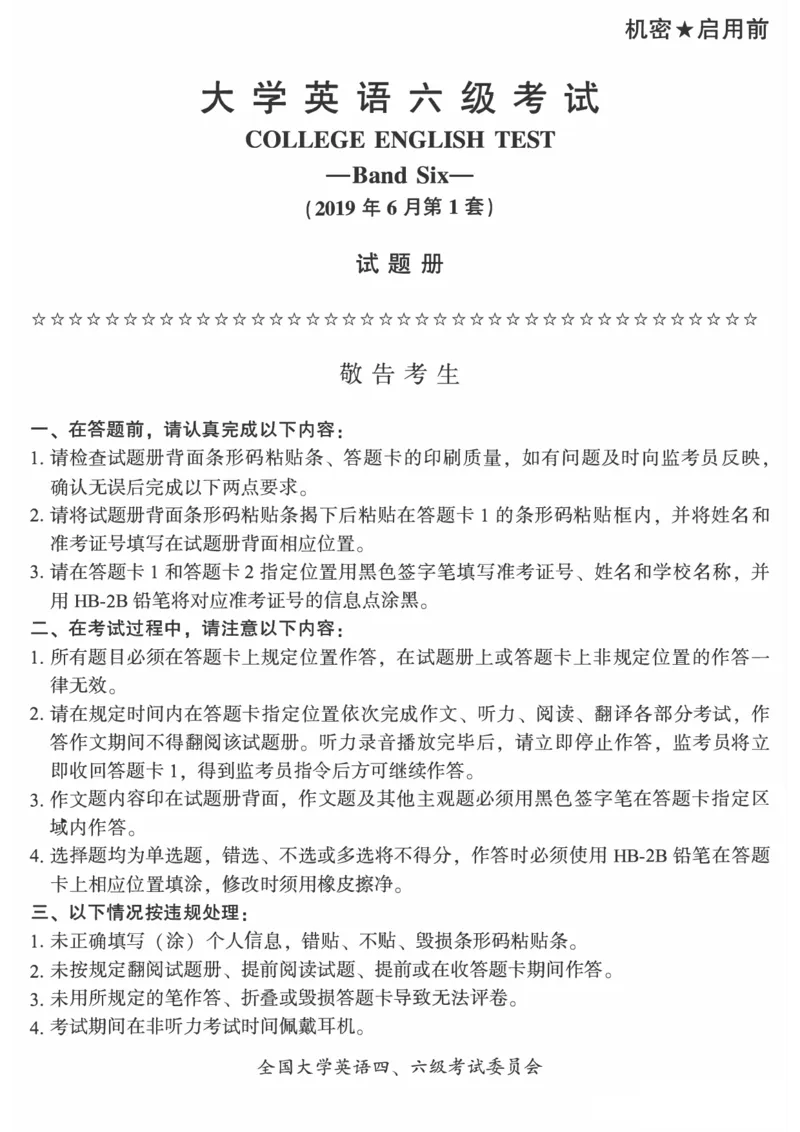
大学英语六级考试
COLLEGE ENGLISH TEST
—Band Six—
(2019年6月第1套)
试题册
女女女女女女女女女女女女女女女*********女女女女女女合女女女女女女女女女
敬告考生
—、在答题前, 请认真完成以下内容:
1. 请检查试题册背面条形码粘贴条、答题卡的印刷质量,如有问题及时向监考员反映,
确认无误后完成以下两点要求。
2 . 请将试题册背面条形码粘贴条揭下后粘贴在答题卡1的条形码粘贴框内,并将姓名和
准考证号填写在试题册背面相应位置。
3. 请在答题卡l和答题卡2指定位置用黑色签字笔填写准考证号、姓名和学校名称,并
用HB-2B铅笔将对应准考证号的信息点涂黑。
二、在考试过程中, 请注意以下内容:
1. 所有题目必须在答题卡上规定位置作答,在试题册上或答题卡上非规定位置的作答一
律无效。
2. 请在规定时间内在答题卡指定位置依次完成作文、听力、阅读、翻译各部分考试,作
答作文期间不得翻阅该试题册。 听力录音播放完毕后,请立即停止作答,监考员将立
即收回答题卡1' 得到监考员指令后方可继续作答。
3. 作文题内容印在试题册背面,作文题及其他主观题必须用黑色签字笔在答题卡指定区
域内作答。
4. 选择题均为单选题,错选、不选或多选将不得分,作答时必须使用HB-2B铅笔在答题
卡上相应位置填涂,修改时须用橡皮擦净。
三、 以下情况按违规处理:
1. 未正确填写(涂)个人信息,错贴、不贴、毁损条形码粘贴条。
2 . 未按规定翻阅试题册、提前阅读试题、提前或在收答题卡期间作答。
3. 未用所规定的笔作答、折叠或毁损答题卡导致尤法评卷。
4. 考试期间在非听力考试时间佩戴耳机。
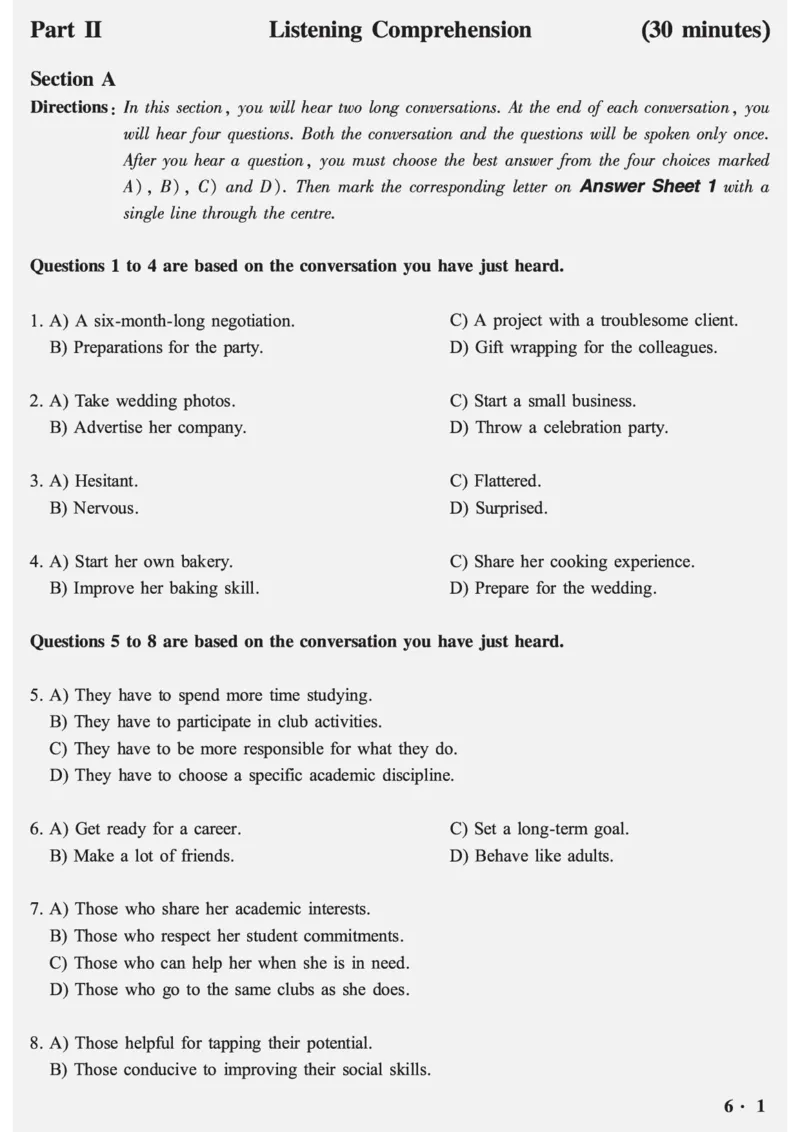
全国大学英语四、六级考试委员会Part II Listening Comprehension (30 minutes)
Section A
Directions: In this section, you will hear two long conversations. At the end of each conversation, you
will hear four questions. Both the conversation and the questions will be spoken only once.
After you hear a question, you must choose the best answer from the four choices marked
A) , B) , C) and D) . Then mark the corresponding letter on Answer Sheet 1 with a
single line through the centre.
Questions 1 to 4 are based on the conversation you have just heard.
1. A) A six-month-long negotiation. C) A project with a troublesome client.
B) Preparations for the party. D) Gift wrapping for the colleagues.
2. A) Take wedding photos. C) Start a small business.
B) Advertise her company. D) Throw a celebration party.
3. A) Hesitant. C) Flatet red.
B) Nervous. D) Surprised.
4. A) Start her own bakery. C) Share her cooking experience.
B) Improve her baking skill. D) Prepare for the wedding.
Questions 5 to 8 are based on the conversation you have just heard.
5. A) They have to spend more time studying.
B) They have to participate in club activities.
C) They have to be more responsible for what they do.
D) They have to choose a specific academic discipline.
6. A) Get ready for a career. C) Set a long-term goal.
B) Make a lot of friends. D) Behave like adults.
7. A) Those who share her academic interests.
B) Those who respect her student commitments.
C) Those who can help her when she is in need.
D) Those who go to the same clubs as she does.
8. A) Those helpful for tapping their potential.
B) Those conducive to improving their social skills.
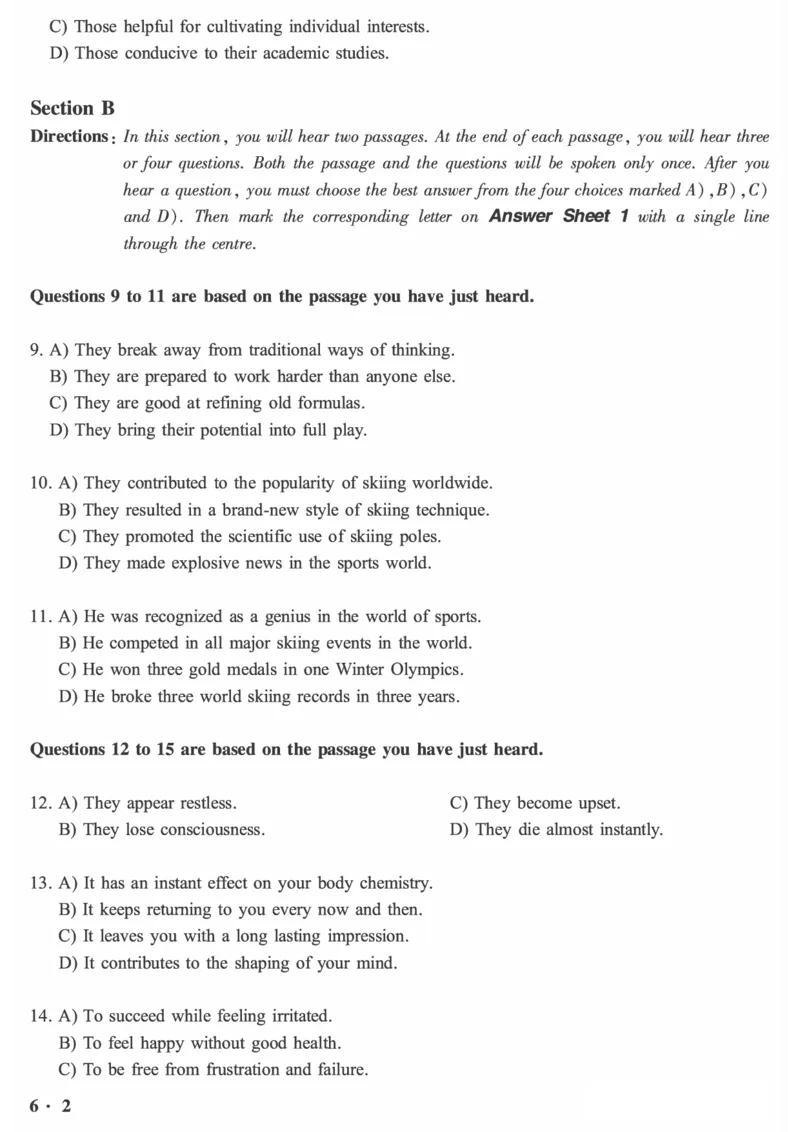
6· 1C) Those helpful for cultivating individual interests.
D) Those conducive to their academic studies.
Section B
Directions: In this section, you will hear two passages. At the end of each passage, you will hear three
or four questions. Both the passage and the questions will be spoken only once. After you
hear a question , you must choose the best answer from the four choices marked A) , B) , C)
and D) . Then mark the corresponding letter on Answer Sheet 1 with a single line
through the centre.
Questions 9 to 11 are based on the passage you have just heard.
9. A) They break away from tar ditional ways of thinking.
B) They are prepared to work harder than anyone else.
C) They are good at refming old formulas.
D) They bring their potential into full play.
10. A) They contributed to the popularity of skiing worldwide.
B) They resulted in a brand-new style of skiing technique.
C) They promoted the scientific use of skiing poles.
D) They made explosive news in the sports world.
11. A) He was recognized as a genius in the world of sports.
B) He competed in all major skiing events in the world.
C) He won three gold medals in one Winter Olympics.
D) He broke three world skiing records in three years.
Questions 12 to 15 are based on the passage you have just heard.
12. A) They appear restless. C) They become upset.
B) They 1 ose consciousness. D) They die almost instantly.
13. A) It has an instant effect on your body chemistry.
B) It keeps returning to you every now and then.
C) It leaves you with a long lasting impression.
D) It contributes to the shaping of your mind.
14. A) To succeed while feeling irritated.
B) To feel happy without good health.
C) To be free from frustar tion and failure.
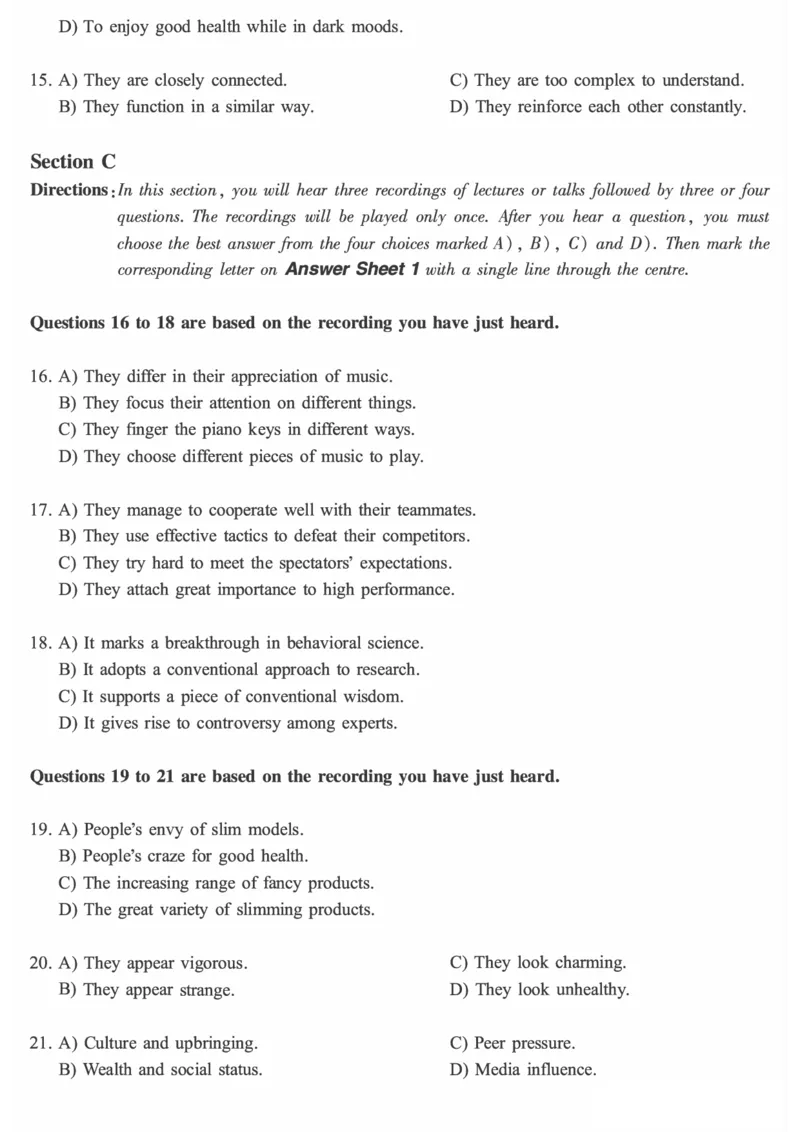
6· 2D) To enjoy good health while in dark moods.
15. A) They are closely connected. C) They are too complex to understand.
B) They function in a similar way. D) They reinforce each other constantly.
C
Section
Directions: In this section, you will hear three recordings of lectures or talks followed by three or four
questions. The recordings will be played only once. After you hear a question, you must
choose the best answer from the four choices marked A) , B) , C) and D) . Then mark the
corresponding letter on Answer Sheet 1 with a single line through the centre.
Questions 16 to 18 are based on the recording you have just heard.
16. A) They differ in their appreciation of music.
B) They focus their attention on different things.
C) They finger the piano keys in different ways.
D) They choose different pieces of music to play.
17. A) They manage to cooperate well with their teammates.
B) They use effective tactics to defeat their competitors.
C) They try hard to meet the spectators' expectations.
D) They attach great importance to high performance.
18. A) It marks a breakthrough in behavioral science.
B) It adopts a conventional approach to research.
C) It supports a piece of conventional wisdom.
D) It gives rise to controversy among experts.
Questions 19 to 21 are based on the recording you have just heard.
19. A) People's envy of slim models.
B) People's craze for good health.
C) The increasing range of fancy products.
D) The great variety of slimming products.
20. A) They appear vigorous. C) They look charming.
B) They appear strange. D) They look unhealthy.
21. A) Culture and upbringing. C) Peer pressure.
B) Wealth and social status. D) Media influence.Questions 22 to 25 are based on the recording you have just heard.
22. A) The relation between hair and skin. C) The color of human skin.
B) The growing interest in skin studies. D) The need of skin protection.
23. A) The necessity to save energy. C) The need to breathe with ease.
B) Adaptation to the hot environment. D) Dramatic climate changes on earth.
24. A) Leaves and grass. C) Their skin coloring.
B) Man-made shelter. D) Hair on their skin.
25. A) Their genetic makeup began to change.
B) Their communities began to grow steadily.
C) Their children began to mix with each other.
D) Their pace of evolution began to quicken.
Part III Reading Comprehension (40 minutes)
Section A
Directions: In this section, there is a passage with ten blanks. You are required to select one word for
each blank from a list of choices given in a word bank following the passage. Read the
passage through carefully before making your choices. Each cho四e in the bank is identified
by a letter. Please mark the corresponding letter for each item on Answer Sheet 2 with a
single line through the centre. You may not use any of the words in the bank more than
once.
Pasta is no longer off the menu, after a new review of studies suggested that the carbohydrate
can form part of a healthy diet, and even help people lose weight. For years, nutritionists have
recommended that pasta be kept to a 26 , to cut calories, prevent fat build-up and stop blood
sugar 27 up.
The low-carbohydrate food movement gave birth to such diets as the Atkins, Paleo and Keto,
which advised swapping foods like bread, pasta and potatoes for vegetables, fish and meat. More
recently the trend of swapping spaghetti for vegetables has been 28 by clean-eating experts.
But now a 29 review and analysis of 30 studies by Canadian researchers found that not
only does pasta not cause weight gain, but three meals a week can help people drop more than half a
kilogram over four months. The reviewers found that pasta had been unfairly demonized (妖魔化)
because it had been 30 in with other, more fat-promoting carbohydrates.
"The study found that pasta didn't 31 to weight gain or increase in body fat," said lead
author Dr John Sievenpiper. "In 32 the evidence, we can now say with some confidence that
6· 4pasta does not have an 33 effect on body weight outcomes when it is consumed as part of a
healthy dietary pattern." In fact, analysis actually showed a small weight loss 34 to concerns.
Perhaps pasta can be part of a healthy diet.
Those involved in the 35 trials on average ate 3.3 servings of pasta a week instead of other
carbohydrates, one serving equaling around half a cup. They lost around half a kilogram over an
average follow-up of 12 weeks.
A) adverse I) minimum
B) championed J) radiating
C) clinical K) ration
D) contar ry L) shooting
E) contribute M) subscribe
F) intimate N) systematic
G) lumped 0) weighing
H) magnified
Section B
Directions: In th岱section, you are going to read a passage with ten statements attached to it. Each
statement contains information given in one of the paragraphs. Identify the paragraph from
which the information is derived. You may choose a paragraph more than once. Each
paragraph 岱marked with a letter. Answer the questions by marking the corresponding letter
on Answer Sheet 2 .
The Best Retailers Combine Bricks and Clicks
[A] Retail profits are falling sharply. Stores are closing. Malls are emptying. The depressing stories
just keep coming. Reading the earnings announcements of large retail stores like Macy's,
Nordstrom, and Target is about as uplifting as a tour of an intensive care unit. The Internet is
apparently taking down yet another industry. Brick and mortar stores (实体店) seem to be going
the way of the yellow pages. Sure enough, the Census Bureau just released data showing that
online retail sales surged 15.2 percent between the first quarter of 2015 and the frrst quarter
of 2016.
[B] But before you dump all of your retail stocks, there are more facts you should consider. Looking
only at that 15.2 percent "surge" would be misleading. It was an increase that was on a small
base of 6.9 percent. Even when a tiny number grows by a large percentage terms, it is often still
tiny.
6· 5[C] More than 20 years after the Internet was opened to comem rce, the Census Bureau tells us that
brick and mortar sales accounted for 92.3 percent ofretail sales in the first quarter of 2016. The订
data show that only 0.8 percent ofretail sales shifted from offiine to online between the beginning
of 2015 and 2016.
[D] So, despite all the talk about drone(无人机) deliveries to your doorstep, all the retail executives
expressing anxiety over consumers going online, and even a Presidential candidate exclaiming
that Amazon has a "huge antitrust problem," the Census data suggest that physical retail is
thriving. Of course, the closed stores, depressed executives, and sinking stocks suggest otherwise.
What's the real story?
[E] Many fi s operating brick and mortar stores are in tor uble. The retail industry is getting
血
reinvented, as we describe in our new book Matchmakers. It's standing in the path of what
Schumpeter called a gale(大风) of creative destruction. That storm has been brewing for some
time, and as it has reached gale force, most large retailers are searching for a response. As the
CFO of Macy's put it recently, "We're far nkly scratching our heads."
[F] But it's not happening as experts predicted. In the peak of the dot.com bubble, brick-and-mortar
retail was one of those industries the Internet was going to kill—and quickly. The dot.com bust
discredited most predictions of that sort. And in the years that followed, conventional retailers'
confidence in the future increased as Census continued to report weak online sales. And then the
gale hit.
[G] It is becoming incre ingly clear that retail reinvention isn't a simple battle to the death between
邸
bricks and clicks. It is about devising retail models that work for people who are making
increasing use of a growing array of Internet-connected tools to change how they search, shop,
and buy. Creative retailers are using the new technologies to innovate just about everything stores
do from managing inventory, to marketing, to getting paid.
[H] More than drones dropping a new supply of underwear on your doorstep, Apple's massively
successful brick-and-mortar-and-glass retail stores and Amazon's small steps in the same d订ection
are what should keep old-fashioned retialers awake at night. Not to mention the large number of
creative new retailers, like Bonobos, that are blending online and oftline experiences in creative
ways.
[I] Retail reinvention is not a simple process, and it's also not happening on what used to be called
"Internet Time." Some Internet-driven changes have happened quickly, of course. Craigslist
quickly overtook newspaper classified ads and turned newspaper economics upside down. But
many widely anticipated changes weren't quick, and some haven't really started. With the benefit
of hindsight (后见之明), it looks like the Internet will transform the economy at something like
6· 6the pace of other great inventions like electricity. B2B commerce, for example, didn't move
mainly online by 2005 as many had predicted in 2000, nor even by 2016, but that doesn't mean it
won't do so over the next few decades.
[J] But the gale is still blowing. The sudden decline in foot traffic in recent years, even though it
hasn't been accompanied by a massive decline in physical sales, is a critical warning. People can
shop more efficiently online and therefore don't need to go to as many stores to find what they
want. There's a surplus of physical shopping space for the crowds, which is one reason why
stores are downsizing and closing.
[K] The rise of the mobile phone has recently added a new level of complexity to the process of retial
reinvention. Even five years ago most people faced a choice. Sit at your computer, probably at
home or at the office, search and browse, and buy. Or head out to the mall, or Main Street, look
and shop, and buy. Now, just about everyone has a smartphone, connected to the Internet almost
everywhere almost all the time. Even when a retailer gets a customer to walk in the store, she can
easily see if there's a better deal online or at another store nearby.
[L] So far, the main thing many large retailers have done in response to all this is to open online
stores, so people will come to them directly rather than to Amazon and its smaller online rivals.
Many are having the same problem that newspapers have had. Even if they get online traffic, they
struggle to make enough money online to compensate for what they are losing offiine.
[M] A few seem to be making this work. Among large traditional retailers,Walmart recently reported
the best results, leading its stock price to surge, while Macy's, Target, and Nordstrom's dropped.
Yet Walmart's year-over-year online sales only grew 7 percent, leading its CEO to lament (哀叹),
"Growth here is too slow." Part of the problem is that almost two decades after Amazon ftled the
one-click patent, the online retail shopping and buying experience is filled with frictions. A recent
study graded more than 600 Internet retailers on how easy it was for consumers to shop, buy, and
pay. Almost half of the sites didn't get a passing grade and only 18 percent got an A or B.
[NJ The turom il on the ground in physical retail is hard to square with the Census data. Unfortunately,
part of the explanation is that the Census retail data are unreliable. Our deep look into those data
and their preparation revealed serious problems. It seems likely that Census simply rnisclassifies a
large chunk of online sales. It is certain that the Census procedures, which lump the online sales
of major traditional retailers like Wa血art in with "non-store retailers" like food trucks, can mask
major changes in individual retail categories. The bureau could easily present their data in more
useful ways, but they have chosen not to.
[O] Despite the turmoil, brick and mortar won't disappear any time soon. The big questions are
which, if any, of the large traditional retialers will still be on the scene in a decade or two because
6· 7they have successfully reinvented themselves, which new players will operate busy stores on
Main Streets and maybe even in shopping malls, and how the shopping and buying experience
will have changed in each retail category. Investors shouldn't write off brick and mortar. Whether
they should bet on the traditional players who run those stores now is another matter.
36. Although online retailing has existed for some twenty years, nearly half of the Internet retialers
still fail to receive satisfactory feedback from consumers, according to a recent survey.
37. Innovative retailers integrate Internet technologies with conventional retailing to create new retial
models.
38. Despite what the Census data suggest, the value of physical retail's stocks has been dropping.
39. Internet-driven changes in the retail industry didn't take place as quickly as widely anticipated.
40. Statistics indicate that brick and mortar sales still made up the lion's share of the retail business.
41. Companies that successfully combine online and offline business models may prove to be a big
concern for traditional retailers.
42. Brick and mortar retailers' faith in their business was strengthened when the dot.com bubble burst.
43. Despite the tremendous challenges from online retailing, traditional retailing will be here to stay
for quite some time.
44. With the rise of online commerce, physical retail stores are likely to suffer the same fate as the
yellow pages.
45. The wide use of smartphones has made it more complex for traditional retialers to reinvent their
business.
Section C
. .
Directions: There are 2 passages ·in th·is section. Each passage is followed by some questions or
unfinished statements. For each of them there are four choices marked A) , B) , C) and
D). you should decide on the best choice and mark the corresponding letter on Answer
Sheet 2 with a single line through the centre.
6· 8Passage One
Questions 46 to SO are based on the following passage.
Professor Stephen Hawking has warned that the creation of powerful artificial intelligence (AI)
will be "either the best, or the worst thing, ever to happen to humanity", and praised the creation of
an academic institute dedicated to researching the future of intelligence as "crucial to the future of our
civilisation and our species".
Hawking was speaking at the opening of the Leverhulme Centre for the Future of Intelligence
(LCFI) at Cambridge University, a multi-disciplinary institute that will attempt to tackle some of the
open-ended questions raised by the rapid pace of development in AI research. "We spend a great deal
of time studying history," Hawking said, "which, let's face it, is mostly the history of stupidity. So it's
a welcome change that people are studying instead the future of intelligence."
While the world-renowned physicist has often been cautious about AI, raising concerns that
humanity could be the architect of its own destruction if it creates a super-intelligence with a will of
its own, he was also quick to highlight the positives that AI research can bring. " The potential
benefits of creating intelligence are huge," he said. "We cannot predict what we might achieve when
our own minds are amplified by Al. Perhaps with the tools of this new technological revolution, we
will be able to undo some of the damage done to the natural world by the last one—industrialisation.
And suer ly we will aim to finally eradicate disease and poverty. And every aspect of our lives will be
transformed. In short, success in creating AI could be the biggest event in the history of our
civilisation."
Huw Price, the center 's academic director and the Bertrand Russell professor of philosophy at
Cambridge University, where Hawking is also an academic, said that the centre came about partially
as a result of the university's Centre for Existential Risk. That institute examined a wider range of
potential problems for humanity, while the LCFI has a narrow focus.
AI pioneer Margaret Boden, professor of cognitive science at the University of Sussex, praised
the progress of such discussions. As recently as 2009, she said, the topic wasn't taken seriously, even
among AI researchers. "AI is hugely exciting," she said,"but it has limitations, which present grave
dangers given uncritical use."
The academic community is not alone in warning about the potential dangers of AI as well as
the potential benefits. A number of pioneers from the technology industry, most famously the
entrepreneur Elon Musk, have also expressed their concerns about the damage that a super-intelligent
AI could do to humanity.
46. What did Stephen Hawking think of artificial intelligence?
A) It would be vital to the progress of human civilisation.
B) It might be a blessing or a disaster in the making.
C) It might present challenges as well as opportunities.
D) It would be a significant expansion of human intelligence.
6· 947. What did Hawking say about the creation of the LCFI?
A) It would accelerate the progress of AI research.
B) It would mark a step forward in the AI industry.
C) It was extremely important to the destiny of humaniknd.
D) It was an achievement of multi-disciplinary collaboration.
48. What did Hawking say was a welcome change in AI research?
A) The shift of research focus from the past to the future.
B) The shift of research from theory to implementation.
C) The greater emphasis on the negative impact of AI.
D) The increasing awareness of mankind's past stupidity.
49. What concerns did Hawking raise about AI?
A) It may exceed human intelligence sooner or later.
B) It may ultimately over-amplify the human mind.
C) Super-intelligence may cause its own destruction.
D) Super-intelligence may eventually ruin mankind.
50. What do we learn about some entrepreneurs from the technology industry?
A) They are much influenced by the academic community.
B) They are most likely to benefit from AI development.
C) They share the same concerns about AI as academics.
D) They believe they can keep AI under human control.
Passage Two
Questions 51 to 55 are based on the following passage.
The market for products designed specifically for older adults could reach $ 30 billion by next
year, and startups (初创公司) want in on the action. What they sometimes lack is feedback from the
people who they hope will use their products. So Brookdale, the country's largest owner of retirement
communities, has been inviting a few select entrepreneurs just to move in for a few days, show off
their products and hear what the residents have to say.
That's what brought Dayle Rodriguez, 28, all the way from England to the dining room of
Brookdale South Bay in Torar nce, California. Rodriguez is the community and marketing manager for
a company called Sentab. The startup's product, SentabTV, enables older adults who may not be
comfortable with computers to access email, video chat and social media using just their televisions
and a remote control.
"It's nothing new, it's nothing too complicated and it's natural because lots of people have TV
remotes," says Rodriguez.
But none of that is the topic of conversation in the Brookdale dining room. Instead, Rodriguez
6· 10solicits residents' advice on what he should get on his cheeseburger and how he should spend the
afternoon. Playing cards was on the agenda, as well as learning to play mahjong (麻将).
Rodriguez says it's important that residents here don't feel like he's selling them something. "I've
had more feedback in a passive approach," he says. "Playing pool, playing cards, having dinner,
having lunch," all work better "than going through a survey of questions. When they get to know me
and to trust me, knowing for sure I'm not selling them something—there'll be more honest feedback
from them."
Rodriguez is just the seventh entrepreneur to move into one of Brookdale's 1,100 senior living
communities. Other new products in the program have included a kind of full-body blow dryer and
specially designed clothing that allows people with disabilities to dress and undress themselves.
Mary Lou Busch, 93, agreed to try the Sentab system. She tells Rodriguez that it might be good
for someone, but not for her.
"I have the computer and FaceTime, which I talk with my family on," she explains. She also
has an iPad and a smartphone. "So I do pretty much everything I need to do."
To be fia r, if Rodriguez had wanted feedback from some more technophobic (害怕技术的)
seniors, he might have ended up in the wrong Brookdale community. This one is located in the heart
of Southern California's aerospace corridor. Many residents have backgrounds in engineering,
business and academic circles.
But Rodriguez says he's still learning something important by moving into this Brookdale
community: "People are more tech-proficient than we thought."
And besides, where else would he learn to play mahjong?
51. What does the passage say about the startups?
A) They never lose time in upgrading products for seniors.
B) They want to have a share of the seniors' goods market.
C) They invite seniors to their companies to try their products.
D) They try to profit from promoting digital products to seniors.
52. Some entrepreneurs have been invited to Brookdale to .
A) have an interview with potential customers
B) conduct a survey of retirement communities
C) collect residents'feedback on their products
D) show senior residents how to use IT products
53. What do we know about SentabTV?
A) It is a TV program catering to the interest of the elderly.
B) It is a digital TV which enjoys popularity among seniors.
C) It is a TV specially designed for seniors to view programs.
D) It is a communication system via TV instead of a computer.
6· 1154. What does Rodriguez say is important in promoting products?
A) Winning trust from prospective customers.
B) Knowing the likes and dislikes of customers.
C) Demonstrating their superiority on the spot.
D) Responding promptly to customer feedback.
55. What do we learn about the semors m the Brookdale community?
A) Most of them are interested in using the Sentab.
B) They are quite at ease with high-tech products.
C) They have much in common with seniors elsewhere.
D) Most of them enjoy a longer life than average people.
Part IV Translation (30 minutes)
Directions: For this part, you are allowed 30 minutes to translate a passage from Chinese into English.
You should write your answer on Answer Sheet 2.
成语 是汉语中的一种独特的表达方式,大多由 四个汉字组成。 它们高度
( Chinese idioms)
简练且形式固定,但通常能形象地表达深刻的含义。 成语大多数来源于中国古代的文学作品 ,
通常与某些神话、传说或者历史事件有关。 如果不知道某个成语的出处,就很难理解其确切含
义。 因此,学习成语有助于人们更好地理解中国传统文化。 成语在 日 常会话和文学创作中广泛
使用。 恰当使用成语可以使一个人的语言更具表现力 ,交流更有效。
6· 12