Starter Unit 1 Hello! 第一课时
分层作业
一、其他
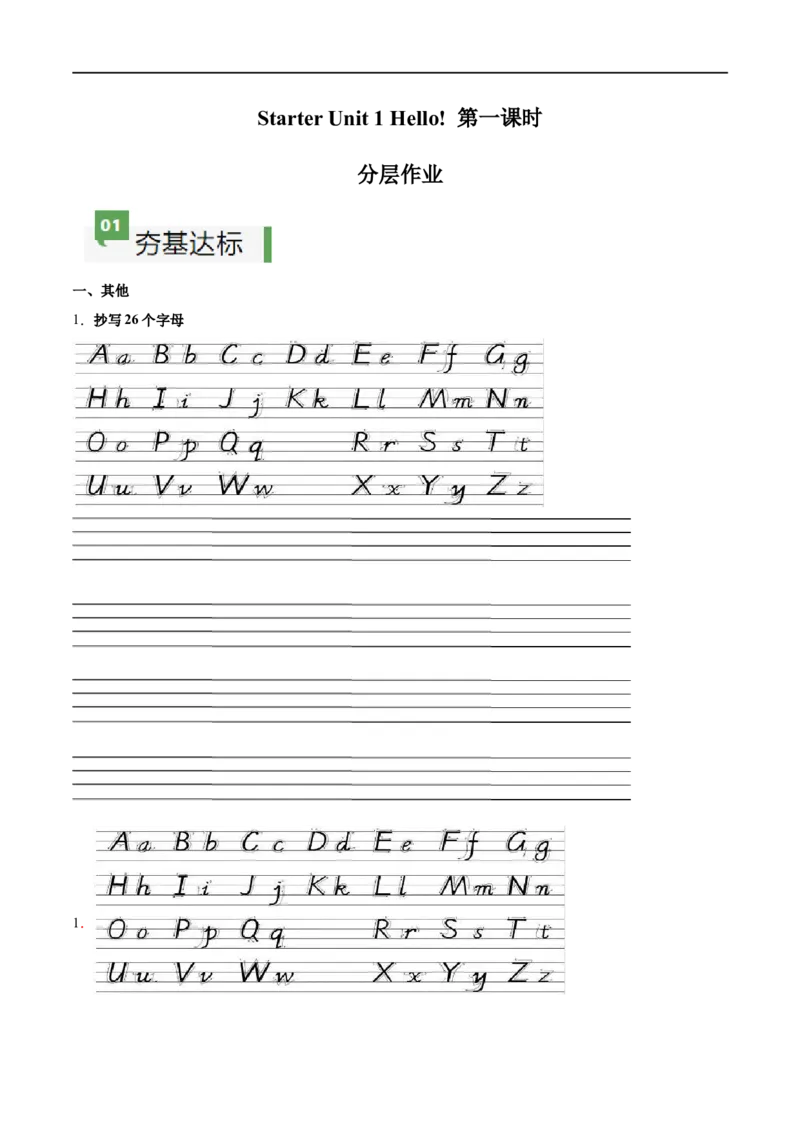
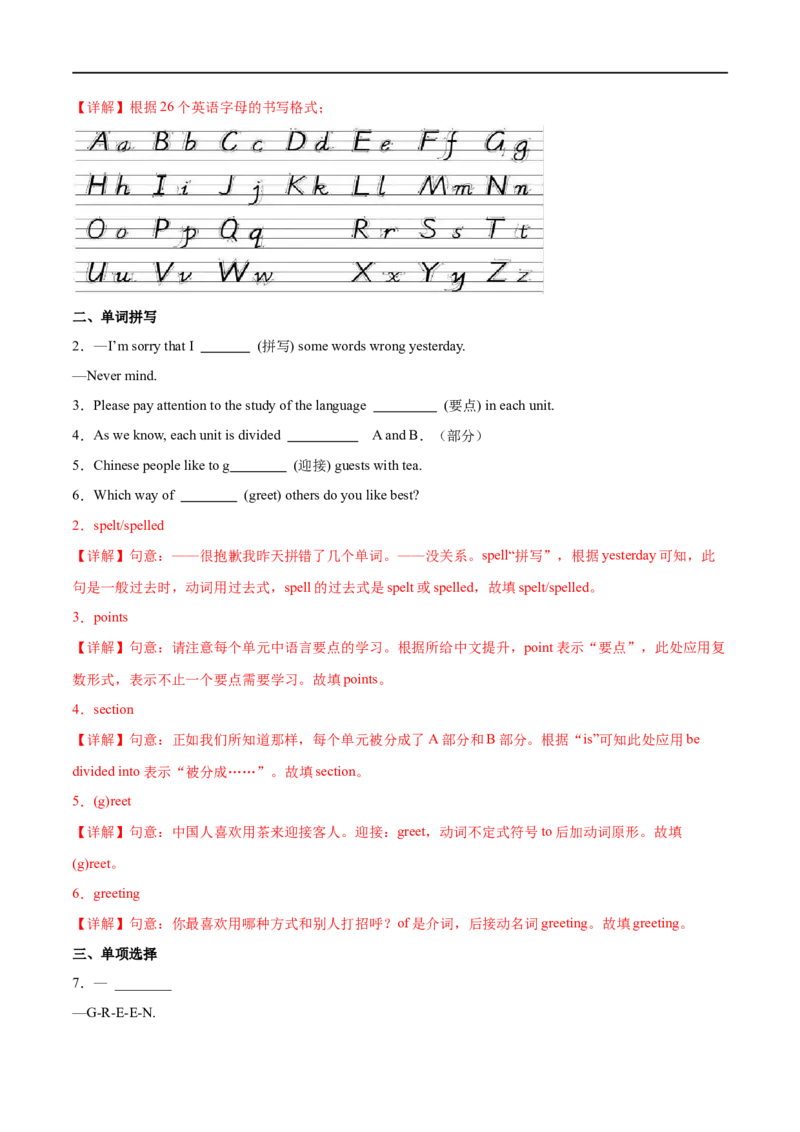
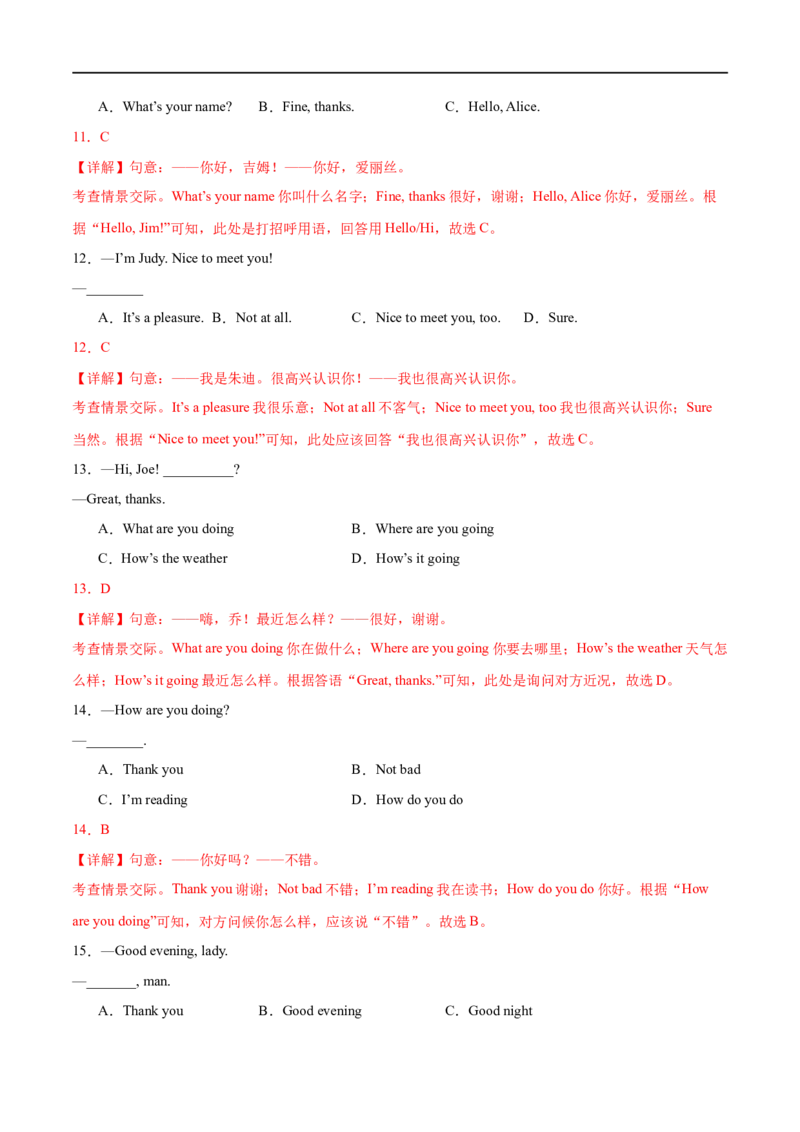
1.抄写26个字母
1.【详解】根据26个英语字母的书写格式;
二、单词拼写
2.—I’m sorry that I (拼写) some words wrong yesterday.
—Never mind.
3.Please pay attention to the study of the language (要点) in each unit.
4.As we know, each unit is divided A and B.(部分)
5.Chinese people like to g (迎接) guests with tea.
6.Which way of (greet) others do you like best?
2.spelt/spelled
【详解】句意:——很抱歉我昨天拼错了几个单词。——没关系。spell“拼写”,根据yesterday可知,此
句是一般过去时,动词用过去式,spell的过去式是spelt或spelled,故填spelt/spelled。
3.points
【详解】句意:请注意每个单元中语言要点的学习。根据所给中文提升,point表示“要点”,此处应用复
数形式,表示不止一个要点需要学习。故填points。
4.section
【详解】句意:正如我们所知道那样,每个单元被分成了A部分和B部分。根据“is”可知此处应用be
divided into表示“被分成……”。故填section。
5.(g)reet
【详解】句意:中国人喜欢用茶来迎接客人。迎接:greet,动词不定式符号to后加动词原形。故填
(g)reet。
6.greeting
【详解】句意:你最喜欢用哪种方式和别人打招呼?of是介词,后接动名词greeting。故填greeting。
三、单项选择
7.— ________
—G-R-E-E-N.A.What’s your last name? B.What color is it?
C.What’s this? D.How do you spell it?
7.D
【详解】句意:——你怎么拼它?——G-R-E-E-N。
考查情景交际。What’s your last name你姓什么;What color is it它是什么颜色的;What’s this这是什么;
How do you spell it你怎么拼写它。根据“G-R-E-E-N.”可知,询问怎么拼写。故选D。
8.—Spell it, please.
—________.
A.I’m Amy B.A-M-Y C.Amy D.This is AMY
8.B
【详解】句意:——请拼一下。——A-M-Y。
考查情景交际。I’m Amy我是Amy;A-M-Y艾米的拼写;Amy艾米,人名;This is AMY这是Amy。根据
“Spell it, please”可知此处回答单词的拼写,选项B符合。故选B。
9.—Good afternoon, class!
—________
A.Thank you! B.Good afternoon, Mr. Yang!
C.Good morning, Mr. Yang! D.Good evening, Mr. Yang!
9.B
【详解】句意:——同学们,下午好!——杨老师,下午好!
考查情景交际。Thank you谢谢;Good afternoon, Mr. Yang杨老师,下午好;Good morning, Mr. Yang杨老
师,早上好;Good evening, Mr. Yang杨老师,晚上好。根据“Good afternoon, class!”可知,应回答下午好,
故选B。
10.—Well, ________! The class is over.
—Bye, Miss Yang.
A.that’s OK B.that’s it C.it’s nothing D.it’s all right
10.B
【详解】句意:——好了,就这样!下课。——再见,杨老师。
考查情景交际。that’s OK不客气;that’s it好了,就这样(通常用于结束语);it’s nothing没什么;it’s all
right没关系。根据“The class is over.”可知,这是下课时老师说的话,B选项符合语境。故选B。
11.—Hello, Jim!
—________A.What’s your name? B.Fine, thanks. C.Hello, Alice.
11.C
【详解】句意:——你好,吉姆!——你好,爱丽丝。
考查情景交际。What’s your name你叫什么名字;Fine, thanks很好,谢谢;Hello, Alice你好,爱丽丝。根
据“Hello, Jim!”可知,此处是打招呼用语,回答用Hello/Hi,故选C。
12.—I’m Judy. Nice to meet you!
—________
A.It’s a pleasure. B.Not at all. C.Nice to meet you, too. D.Sure.
12.C
【详解】句意:——我是朱迪。很高兴认识你!——我也很高兴认识你。
考查情景交际。It’s a pleasure我很乐意;Not at all不客气;Nice to meet you, too我也很高兴认识你;Sure
当然。根据“Nice to meet you!”可知,此处应该回答“我也很高兴认识你”,故选C。
13.—Hi, Joe! __________?
—Great, thanks.
A.What are you doing B.Where are you going
C.How’s the weather D.How’s it going
13.D
【详解】句意:——嗨,乔!最近怎么样?——很好,谢谢。
考查情景交际。What are you doing你在做什么;Where are you going你要去哪里;How’s the weather天气怎
么样;How’s it going最近怎么样。根据答语“Great, thanks.”可知,此处是询问对方近况,故选D。
14.—How are you doing?
—________.
A.Thank you B.Not bad
C.I’m reading D.How do you do
14.B
【详解】句意:——你好吗?——不错。
考查情景交际。Thank you谢谢;Not bad不错;I’m reading我在读书;How do you do你好。根据“How
are you doing”可知,对方问候你怎么样,应该说“不错”。故选B。
15.—Good evening, lady.
—_______, man.
A.Thank you B.Good evening C.Good night15.B
【详解】句意:——晚上好,女士。——晚上好,伙计。
考查情景交际。Thank you谢谢你;Good evening晚上好;Good night晚安。根据“Good evening, lady.”可
知,设空处应该说“晚上好”。故选B。
16.—Can you ________ your name again? I didn’t hear you just now.
—Of course. P-H-I-L-L-I-P.
A.see B.spell C.write D.meet
16.B
【详解】句意:——能再拼下你的名字吗?我刚才没听见你说话。——当然。P—H—I—L—L—I—P。
考查词义辨析。see看见;spell拼写;write写;meet遇见。根据“P—H—I—L—L—I—P”可知是拼出名字,
故选B。
四、补全对话
根据对话内容,从下面选项中选出恰当的句子补全对话,有一个选项是多余的。
A: Good morning!
B: 17
A: My name is Maria White. 18
B: Yes, I’m Grace. 19
A: Nice to meet you, too. A girl is there. Do you know her?
B: Yes, I do.
A: 20
B: Her name is Jane Green.
A: Look at that boy. Is he your friend Jeff Brown?
B: 21 My friend’s name is Mike Brown.
A.What’s her name?
B.No, he isn’t.
C.Are you Grace?
D.Nice to meet you.
E.Yes, he is.
F.Good morning!
17.F 18.C 19.D 20.A 21.B
【导语】本文是两人互相打招呼,然后谈论“姓名和朋友”的对话。17.根据“Good morning”可知,应回复对方“早上好”,F选项“早上好”符合,故选F。
18.根据“Yes, I’m Grace”可知,这是一个一般疑问句,询问对方是否是格蕾丝,C选项“你是格蕾丝吗”
符合,故选C。
19.根据“Nice to meet you, too”可知,此处应说“很高兴见到你”,D选项“很高兴见到你”符合,故选
D。
20.根据“Her name is Jane Green.”可知,询问她的名字是什么,A选项“她的名字是什么”符合,故选
A。
21.根据“Is he your friend Jeff Brown?”及“My friend’s name is Mike Brown.”可知,此处应是否定回答,B
选项“不,他不是”符合,故选B。
五、情景运用
22.当你朋友对你说“Hello!”,你可以这么回应:
!
23.晚上睡觉前你和妈妈道晚安,可以这样表达:
!
24.下午上课前,同学们向陈老师问候,可以这样说:
, Mr. Chen!
25.你校的交换生对你说”Nice to meet you”时,你可以这样应答:
.
26.你想问候外教Nick晚上好,你可以这样说:
, Nick.
27.当有人用 “How do you do? ”和你打招呼, 你可以这样应答:
?
28.当别人来你新家参观,你可以这样说表示欢迎:
!
29.你想知道你的朋友今天感觉怎么样,可以这样问:
today?
30.放学了,你可以这样和同学告别:
.
22.Hello
【详解】根据情景可知,别人和你说你好,你也回应你好。故填Hello。
23.Good night / Have a nice dream【详解】睡前道晚安,一般用固定句式:good night/ have a nice dream,位于句首的单词首字母需大写,故
填Good night/ Have a nice dream.
24.Good afternoon/Hello/Hi/...
【详解】根据情景可知,下午上课前向老师问候可以用Good afternoon/Hello/Hi等。故填Good
afternoon/Hello/Hi/...。
25.Nice to meet you, too
【详解】根据情景可知,此处可表达为“见到你我也很高兴”Nice to meet you, too。故填Nice to meet you,
too。
26.Good evening
【详解】此处可问候“晚上好”,即Good evening。故填Good evening。
27.How do you do
【详解】“How do you do”意为“你好”,是作为初次见面的问候语,对方用“How do you do”进行打招呼,
你也应该用“How do you do”来回应。故填How do you do。
28.Welcome to my new home
【详解】表示欢迎可用welcome to sp表示“欢迎来到某地”,形容词性物主代词my“我的”和形容词
new“新的”修饰名词home“家”,句首单词首字母要大写。故填Welcome to my new home。
29.How are you feeling
【详解】根据语境可知,此处可询问“你今天感觉怎么样”,可用结构how are you feeling today。故填
How are you feeling。
30.See you / Goodbye / Bye (bye)
【详解】结合语境可知,放学了和某人道别可以说“下次见”或“再见”,其英文表达为See you /
Goodbye / Bye (bye)。故填See you / Goodbye / Bye (bye)。
六、阅读理解
A
Hello! I’m Jackson. I come from the USA.But my family is in Shanghai now. I’m a student here. I have a big
nose, big ears, but I have a small mouth. This is Rona. She’s my sister (妹妹). Her Chinese name is Li Rong. She
has big eyes but small ears. We are students in the same school.This is my teacher. He’s Chinese. He is a good Chinese teacher. He’s only twenty years old. He comes from
Beijing. His name is Liu Ping. He has an English name. His English name is David. He has long arms and long
legs.
31.Who’s Rona?
A.Jackson’s sister. B.Liu Ping’s mom.
C.Li Rong’s teacher. D.Liu Ping’s teacher
32.Where does Li Rong come from?
A.China. B.The UK. C.America. D.Cuba
33.Jackson and Rona are ________.
A.teachers B.students C.actors D.numbers
34.David is a(n) ________ teacher.
A.old B.English C.Chinese D.Japanese
35.David has ________.
A.a big head B.long arms
C.short legs D.a small nose
31.A 32.C 33.B 34.C 35.B
【导语】本文主要介绍了Jackson的个人信息,妹妹以及语文老师的情况。
31.细节理解题。根据“This is Rona. She’s my sister”可知,Rona是作者的妹妹,故选A。
32.细节理解题。根据“I come from the USA”及“This is Rona. She’s my sister (妹妹). Her Chinese name is
Li Rong”可知,李荣是作者妹妹的名字,作者来自美国,那么李荣也是来自美国,故选C。
33.细节理解题。根据“We are students in the same school.”可知,他们都是学生,故选B。
34.细节理解题。根据“He is a good Chinese teacher”可知,他是一名语文老师,故选C。
35.细节理解题。根据“He has long arms and long legs.”可知,他有长长的胳膊和腿,故选B。
B
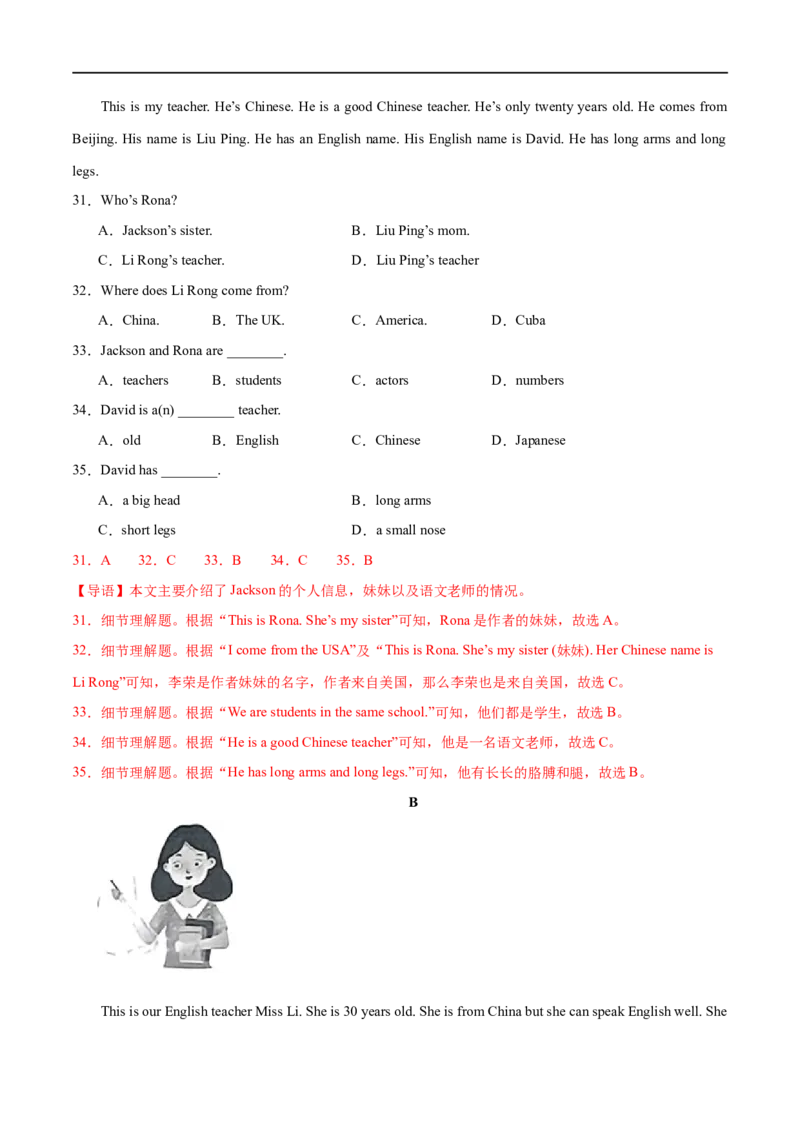
This is our English teacher Miss Li. She is 30 years old. She is from China but she can speak English well. Sheis tall and she has a round face. She has long brown hair and big black eyes. She has a small nose and she is in a
pink T-shirt. Miss Li is a good teacher. She likes her students very much. She is our favorite teacher and our friend.
36.Miss Li is ________ years old.
A.28 B.29 C.30 D.31
37.Miss Li is from ________.
A.America B.China C.Japan D.Canada
38.Miss Li doesn’t have ________.
A.a round face B.a big nose C.long brown hair D.big black eyes
39.Students think Miss Li is very ________.
A.old B.young C.strong D.nice
36.C 37.B 38.B 39.D
【导语】本文主要介绍了作者的英语老师。
36.细节理解题。根据“She is 30 years old.”可知,李老师30岁,故选C。
37.细节理解题。根据“She is from China”可知,她来自中国,故选B。
38.细节理解题。根据“She is tall and she has a round face. She has long brown hair and big black eyes.”可知,
她没有大鼻子,故选B。
39.细节理解题。根据“Miss Li is a good teacher.”可知,学生们认为李老师很好。故选D。
C
(S=Sally J=Jane K=Kangkang)
S:Excuse me, are you Jane?
J:Yes, I am. What’s your name?
S:My name is Sally. Where are you from?
J:I’m from Canada. Are you from England?
S:No, I’m not. I’m from the U.S.A.
J:Oh, this is Kangkang. He is from China. He is my good friend(朋友).His phone number is 9214-6953.
S:Nice to meet you, Kangkang.
K:Nice to meet you, too. Welcome to China!
S:Thank you.
40.Jane is from .
A.China B.Canada
C.England D.the U.S.A.41.Where is Sally from?
A.The U.S.A. B.China
C.England D.Canada
42. phone number is 9214-6953.
A.Jane’s B.Sally’s
C.Kangkang’s D.Lucy’s
43.Kangkang is Jane’s .
A.brother(兄弟) B.teacher
C.friend D.student(学生)
44.Kangkang is from .
A.England B.China
C.Canada D.the U.S.A.
40.B 41.A 42.C 43.C 44.B
【分析】文章主要介绍了萨利,简和康康初次见面,互相认识的过程。
40.细节理解题。由文中“J:I’m from Canada.简:我来自加拿大。”,可知简来自加拿大。故选B。
41.细节理解题。由文中“S:No, I’m not. I’m from the U.S.A.萨利:不,不是。我来自与美国。”,可知萨
利来自于美国。故选A。
42.细节理解题。由文中“Oh, this is Kangkang. He is from China. He is my good friend(朋友).His phone
number is 9214-6953. 哦,这是康康。他来自中国。他是我的好朋友,他的电话号码是9214-6953。”,可
知这是康康的电话号码。故选C。
43.细节理解题。由文中“J:Oh, this is Kangkang. He is from China. He is my good friend(朋友).简:哦,这是
康康。他来自中国。他是我的好朋友。”,可知康康是简的好朋友。故选C。
44.细节理解题。由文中“Oh, this is Kangkang. He is from China. 哦,这是康康。他来自中国。”,可知
康康来自于中国。故选B。
七、完形填空
A
Dear Ann,
Thank you for your e-mail. I go to school from Monday to 45 . We learn seven 46 atschool. We have four lessons in the 47 and two in the afternoon. On Monday and Wednesday, we have
Chinese, math and music. 48 Tuesday, we have English, math and art. And on Thursday, we have
Chinese and science. On Friday, we have Chinese and P. E. My favorite subject is 49 , because it is
interesting and it can make us 50 . Mr. Bruce is our P. E. teacher. He is strict (严格的) with us 51
he is nice. After P. E. class, we are tired but very happy. 52 is your P. E. teacher? Do you like P.E.? On
Saturday and Sunday, I don’t go to 53 . I can do sports and have a good time 54 my family.
Yours,
Emily
45.A.Sunday B.Wednesday C.Friday D.Saturday
46.A.subjects B.teachers C.grades D.classes
47.A.morning B.afternoon C.evening D.noon
48.A.On B.In C.At D.To
49.A.math B.science C.Chinese D.P.E.
50.A.boring B.healthy C.old D.easy
51.A.but B.and C.so D.because
52.A.What B.Why C.Where D.Who
53.A.store B.sports C.school D.library
54.A.with B.for C.about D.from
45.C 46.A 47.A 48.A 49.D 50.B 51.A 52.D 53.C 54.A
【导语】本文是一封信件,信中作者介绍了自己的学校生活。
45.句意:我从星期一到星期五上学。
Sunday星期天;Wednesday星期三;Friday 星期五;Saturday星期六。根据“go to school”可知是周一到周
五。故选C。
46.句意:我们在学校学七门科目。
subjects科目;teachers老师;grades年级;classes班。根据“learn seven”可知学习七门科目 。故选A。
47.句意:我们上午有四节课,下午两节课。
morning上午;afternoon下午;evening晚上;noon中午。根据“We have four lessons”以及后面的“two in
the afternoon, ”可知设空处说的是上午四节课。故选A。
48.句意:星期二,我们有英语、数学和美术。
On在……之时;In后接时间段;At在,后接时间点;To到。根据“Tuesday”可知这里是具体的某天,用
介词on。故选A。49.句意:我最喜欢的科目是体育,因为它很有趣,它可以使我们健康。
math数学;science科学;Chinese语文;P.E.体育。根据“because it is interesting and it can make us”可知这
里指的是体育课,故选D。
50.句意:我最喜欢的科目是体育,因为它很有趣,它可以使我们健康。
boring无聊的;healthy健康的;old旧的;easy简单的。根据“My favorite subject is P.E.”可知体育课使得我
们健康。故选B。
51.句意:他对我们很严格,但是人很好。
but但是;and和;so因此;because因为。根据“strict”以及设空处后的“nice”可知前后句存在转折语境,
故选A。
52.句意:谁是你的体育老师?
What什么;Why为什么;Where哪里;Who谁。根据前文提到过的“Mr. Bruce is our P. E. teacher.”以及
“is your P. E. teacher?”可知问你的体育老师是谁,其他选项不符合语境。故选D。
53.句意:星期六和星期天,我不去上学。
store商店;sports运动;school学校;library图书馆。根据“On Saturday and Sunday”可知周末不去学校。
故选C。
54.句意:我可以做运动,与我的家人度过一段美好的时光。
with和;for为了;about关于;from从。根据“my family”可知是和我的家人度过一段美好的时光。故选
A。
B
先通读下面两篇短文,掌握其大意,然后从各题所给的A、B、C、D四个选项中选出可以填入相应空白处
的最佳选项,并将其选项转涂到答题卡上的相应位置。
Hi, everyone! I’m Nick Brown. I’m English. My 55 name is Li Ke. Now I live in Shanghai.
I am a student at a middle school. It’s small 56 beautiful. I’m in Class 1, Grade 7. Look! This is my
student card. My name, my class and my student number are on it. 57 is my student number? It’s 359.
I have got 58 good friends in my class. They are Wu Hao, Zhao Lei and Ding Xuefei. We all like
sports. We often play 59 after school and our favourite football star is Messi.
55.A.English B.Chinese C.family D.first
56.A.but B.or C.and D.so
57.A.Who B.How C.Where D.What
58.A.two B.three C.four D.five
59.A.tennis B.basketball C.football D.cards55.B 56.A 57.D 58.B 59.C
【导语】本文是Nick介绍自己的校园生活。
55.句意:我的中文名字是李珂。
English英国的;Chinese中国的;family家庭;first第一。根据“name is Li Ke”可知,Li Ke是中文名字,
故选B。
56.句意:它很小但漂亮。
but但是;or或者;and和;so所以。根据“small...beautiful”可知,两者为转折关系,故选A。
57.句意:我的学号是多少?
Who谁;How怎么样;Where哪里;What什么。根据“number”及“It’s 359.”可知,问的是“什么”,故
选D。
58.句意:我在班上有三个好朋友。
two二;three三;four四;five五。根据“They are Wu Hao, Zhao Lei and Ding Xuefei”可知,班级里有三个
好朋友,故选B。
59.句意:我们经常在放学后踢足球,我们最喜欢的足球明星是梅西。
tennis网球;basketball篮球;football足球;cards卡片。根据“Messi”及常识可知,梅西是一位足球运动员,
由此可知作者和朋友们经常踢足球,故选C。
一、单项选择
1.(2023·西藏·中考真题)—Welcome to Lhasa! Nice to meet you!
—________.
A.That’s OK B.Goodbye C.Nice to meet you, too D.I’m fine
1.C
【详解】句意:——欢迎来拉萨!很高兴见到你!——也很高兴见到你。
考查情景交际。That’s OK没关系;Goodbye再见;Nice to meet you, too也很高兴见到你;I’m fine我很好。
根据“Nice to meet you!”可知,对方在表示欢迎,应用C项回应。故选C。
2.(2022·西藏·中考真题)—Good morning, mom. What’s for breakfast?
— ________, dear! Milk, eggs and hamburgers.
A.Morning B.Good afternoon C.Good evening D.Good night
2.A【详解】句意:——早上好,妈妈。早餐吃什么?——早啊,亲爱的!牛奶、鸡蛋和汉堡。
考查情景交际。Morning早啊;Good afternoon下午好;Good evening晚上好;Good night晚安。根据
“Good morning”可知,此处也应说“早上好”,故选A。
二、补全对话
(2023·黑龙江齐齐哈尔·中考真题)结合本题所设置的情境,在每个空白处填入适当的内容完成下列对话。
(A: Ann B: Betty C: Sales clerk)
A: Hi, Betty. Long time no see. 3 ?
B: Pretty good. How about you?
A: Great! Where are you going?
B: Summer vacation is coming. I’m going shopping for my study tour. 4 ?
A: Sure, I’d love to.
B: Terrific! Let’s go.
(The two girls are in the shopping mall)
C: 5 ?
B: I’d like a pair of sports shoes.
C: What about this pair? They’re the latest design and at a good price.
B: 6 ?
C: Of course.
A: You look cool in the shoes, Betty!
B: Haha, I think so. 7 ?
C: 150 yuan.
B: I’ll take them. Here is the money.
3.How’s it going(with you)?/How’s everything going(with you)?
4.Would you like to go with me?/Would you like to join me?/Would you like to go together?/Do you want to go
with me?/Do you want to join me?/Do you want to go together?/Can you go with me?/Can you join me?
5.Can I help you?/What can I do for you?
6.Can(Could/May)I try them on?/Can(Could/May)I try this pair on?/Can(Could/May)I try on this pair?
7.How much are they(the shoes)?/How much do they(the shoes)cost?/What’s the price of the
shoes?/What’s the price of them?
【导语】本文是安和贝蒂的对话,贝蒂邀请安一起去商店购物,最后她买了一双鞋。
3.根据“Long time no see.”和“Pretty good.”可知,安问候贝蒂的近况如何,故填How’s it going(withyou)?/How’s everything going(with you)?
4.根据“I’m going shopping for my study tour.”和“Sure, I’d love to.”可知,贝蒂邀请安一起去购物,故填
Would you like to go with me?/Would you like to join me?/Would you like to go together?/Do you want to go with
me?/Do you want to join me?/Do you want to go together?/Can you go with me?/Can you join me?
5.根据“I’d like a pair of sports shoes.”可知,商店店员问贝蒂需要什么,故填Can I help you?/What can I do
for you?
6.根据“You look cool in the shoes, Betty!”可知,贝蒂试穿了这双鞋,她会先询问店员是否可以试穿,故
填Can(Could/May)I try them on?/Can(Could/May)I try this pair on?/Can(Could/May)I try on this pair?
7.根据“150 yuan.”可知,贝蒂询问鞋的价钱,故填How much are they(the shoes)?/How much do they
(the shoes)cost?/What’s the price of the shoes?/What’s the price of them?