秘密☆启用前
2024 年广州市初中学业水平考试
英 语
考生号:_________ 姓名:_________
本试卷共13页,四大题,满分90分。考试用时100分钟。
注意事项:
1. 答题前,考生务必在答题卡上用黑色字迹的圆珠笔或钢笔填写自己的考生号姓名;将自己
的条形码粘贴在答题卡的“条形码粘贴处”。
2. 选择题每小题选出答案后,用2B 铅笔把答题卡上对应题目的答案标号涂黑;如需改动,
用橡皮擦干净后,再选涂其他答案标号。答案不能答在试卷上。
3. 非选择题答案必须用黑色字迹的圆珠笔或钢笔写在答题卡各题目指定区域内的相应位置上;
如需改动,先划掉原来的答案,然后再写上新的答案,改动后的答案也不能超出指定的区域;
不准使用铅笔、涂改液和修正带。不按以上要求作答的答案无效。
4. 考生必须保持答题卡的整洁,考试结束后,将本试卷和答题卡一并交回。
一、语法选择(共15小题;每小题1分,满分15分)
阅读下面短文,按照句子结构的语法性和上下文连贯的要求,从1~15各题所给的A、B、C和D项中选出
最佳选项,并在答题卡上将该项涂黑。
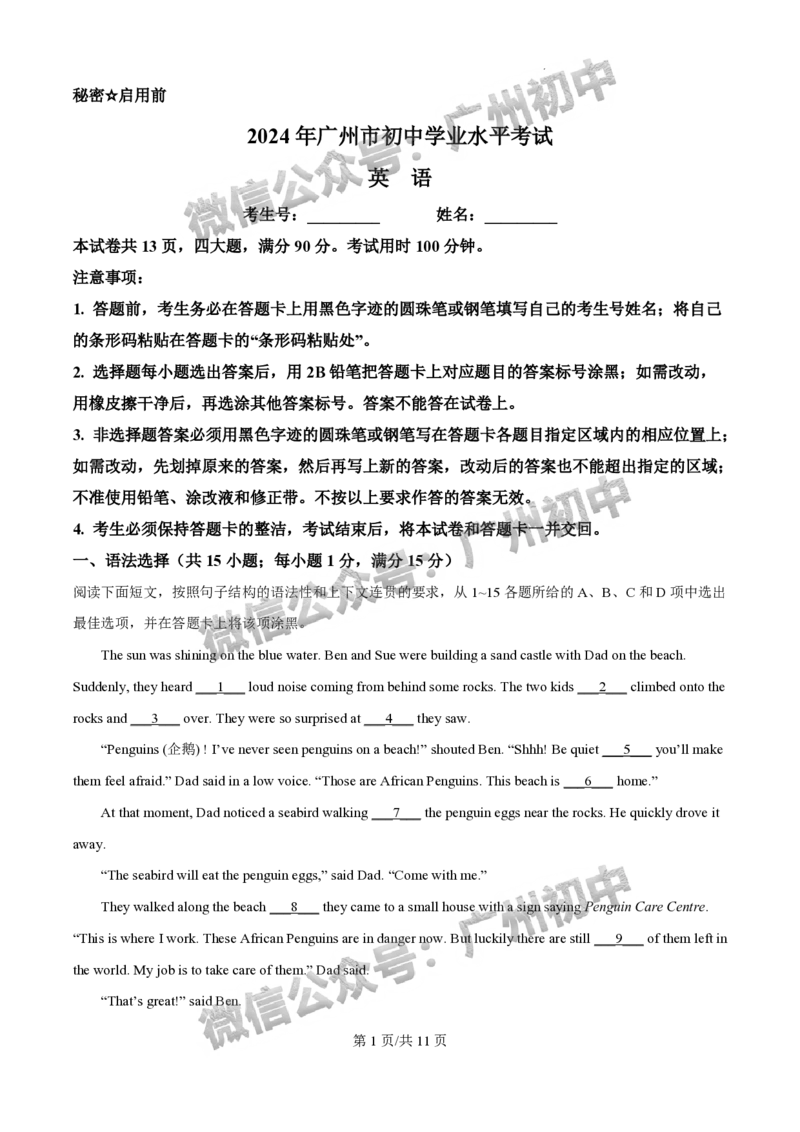
The sun was shining on the blue water. Ben and Sue were building a sand castle with Dad on the beach.
Suddenly, they heard ___1___ loud noise coming from behind some rocks. The two kids ___2___ climbed onto the
rocks and ___3___ over. They were so surprised at ___4___ they saw.
“Penguins (企鹅) ! I’ve never seen penguins on a beach!” shouted Ben. “Shhh! Be quiet ___5___ you’ll make
them feel afraid.” Dad said in a low voice. “Those are African Penguins. This beach is ___6___ home.”
At that moment, Dad noticed a seabird walking ___7___ the penguin eggs near the rocks. He quickly drove it
away.
“The seabird will eat the penguin eggs,” said Dad. “Come with me.”
They walked along the beach ___8___ they came to a small house with a sign saying Penguin Care Centre.
“This is where I work. These African Penguins are in danger now. But luckily there are still ___9___ of them left in
the world. My job is to take care of them.” Dad said.
“That’s great!” said Ben.
第1页/共11页
学科网(北京)股份有限公司“Yes. The number of the penguins was once much ___10___ , but it isn’t very big anymore. One reason is that
the penguin eggs ___11___ by seabirds and other animals. ___12___ is that the fishermen in this area catch too
many fish. Penguins ___13___ find enough food for their babies. So the government is taking action to stop people
___14___ for a whole season every year.” Dad explained.
“Now we are trying our best ___15___ the penguin eggs Do you want to help me?” Dad asked.
.
“Yes!” Ben and Sue both replied
1. A. a B. an C. the D. /
2. A. care B. caring C. careful D. carefully
3. A. look B. looking C. looked D. to look
4. A. what B. that C. how D. which
5. A. and B. or C. but D. so
6. A. they B. them C. their D. theirs
7. A. above B. off C. towards D. from
8. A. if B. when C. unless D. until
9. A. few B. a few C. little D. a little
10. A. big B. bigger C. biggest D. the biggest
11. A. eat B. ate C. are eating D. are eaten
12. A. Another B. Other C. Others D. The others
13. A. mustn’t B. needn’t C. can’t D. shouldn’t
14. A. fish B. fished C. to fish D. fishing
15. A. protect B. to protect C. protecting D. protected
二、完形填空(共10小题;每小题1分,满分10分)
阅读下面短文,掌握其大意,然后从各题所给的A、B、C和D项中选出最佳选项,并在答题卡上将该项
涂黑。
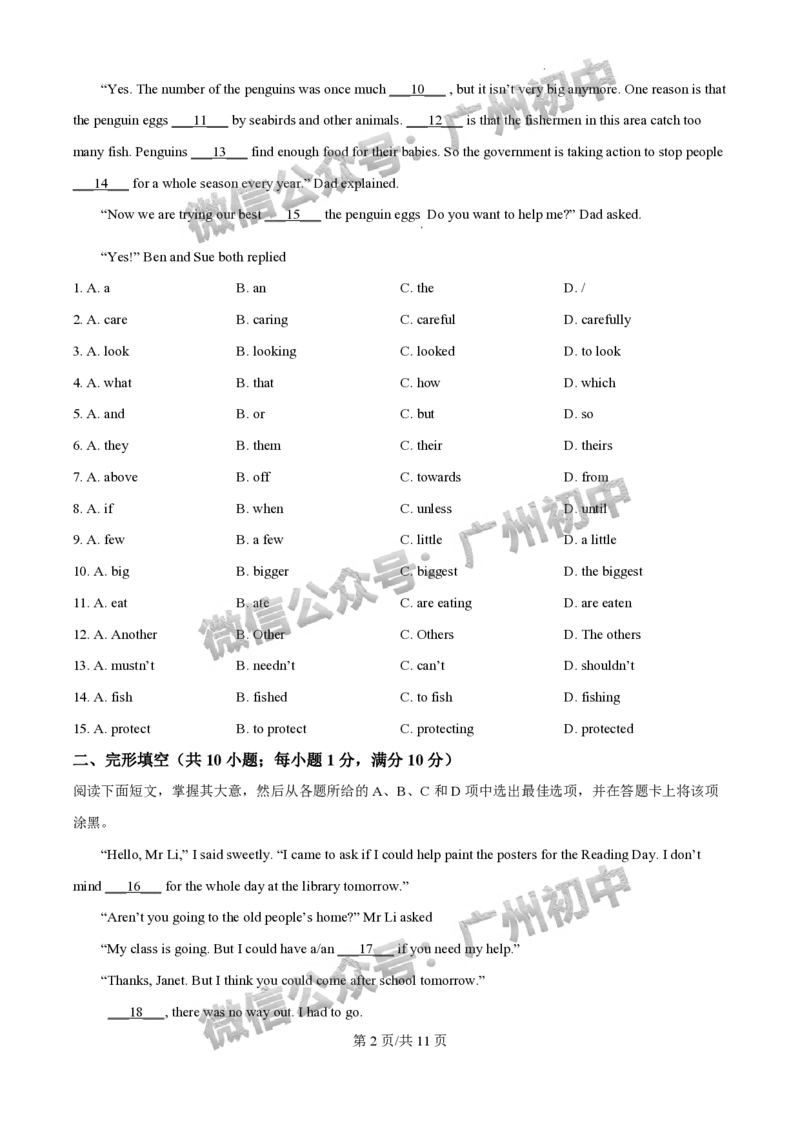
“Hello, Mr Li,” I said sweetly. “I came to ask if I could help paint the posters for the Reading Day. I don’t
mind ___16___ for the whole day at the library tomorrow.”
“Aren’t you going to the old people’s home?” Mr Li asked
“My class is going. But I could have a/an ___17___ if you need my help.”
“Thanks, Janet. But I think you could come after school tomorrow.”
___18___, there was no way out. I had to go.
第2页/共11页
学科网(北京)股份有限公司The next day, when my classmates were talking with the old people, I really felt nervous to ___19___ any of
them. I sat there on my own holding the card I made the night before.
Across the room there was an old lady in a wheelchair. She was ___20___ too. Maybe I could hand my card
,
to her. It might brighten her day. So carefully, I went to her.
“Thank you, Janet.” The old lady reached for the card but her hand was nowhere near it. I suddenly realized
that she was ___21___ .
“What does your card look like?” The old lady asked. I ___22___ my card patiently. Her fingers touched
every inch of it. She couldn’t enjoy more…
Too soon, it was time to return. But I didn’t want to ___23___ .
“Thanks for your coming, Janet! I’ll keep this card to remember you.”
“I’m sorry you can’t see it. I wished I had brought you a better gift,” I said
“The best gift,” the old lady said, “was your ___24___ , Janet.”
With tears, I felt light and warm. I couldn’t wait to come back to see my new ___25___ again.
16. A. reading B. discussing C. relaxing D. working
17 A. idea B. lesson C. excuse D. gift
.
18. A. Clearly B. Strangely C. Luckily D. Suddenly
19. A. accept B. join C. invite D. guide
20. A. alone B. active C. ready D. busy
21. A. tired B. blind C. serious D. worried
22. A. changed B. compared C. described D. prepared
23. A. forget B. leave C. promise D. imagine
24. A. return B. plan C. class D. visit
25. A. friend B. teacher C. classmate D. neighbour
三、阅读(共两节,满分35分)
第一节 阅读理解(共15小题;每小题2分,满分30分)
阅读下列短文,从各题所给的A、B、C 和D 项中选出最佳选项,并在答题卡上将该项涂黑。
(A)
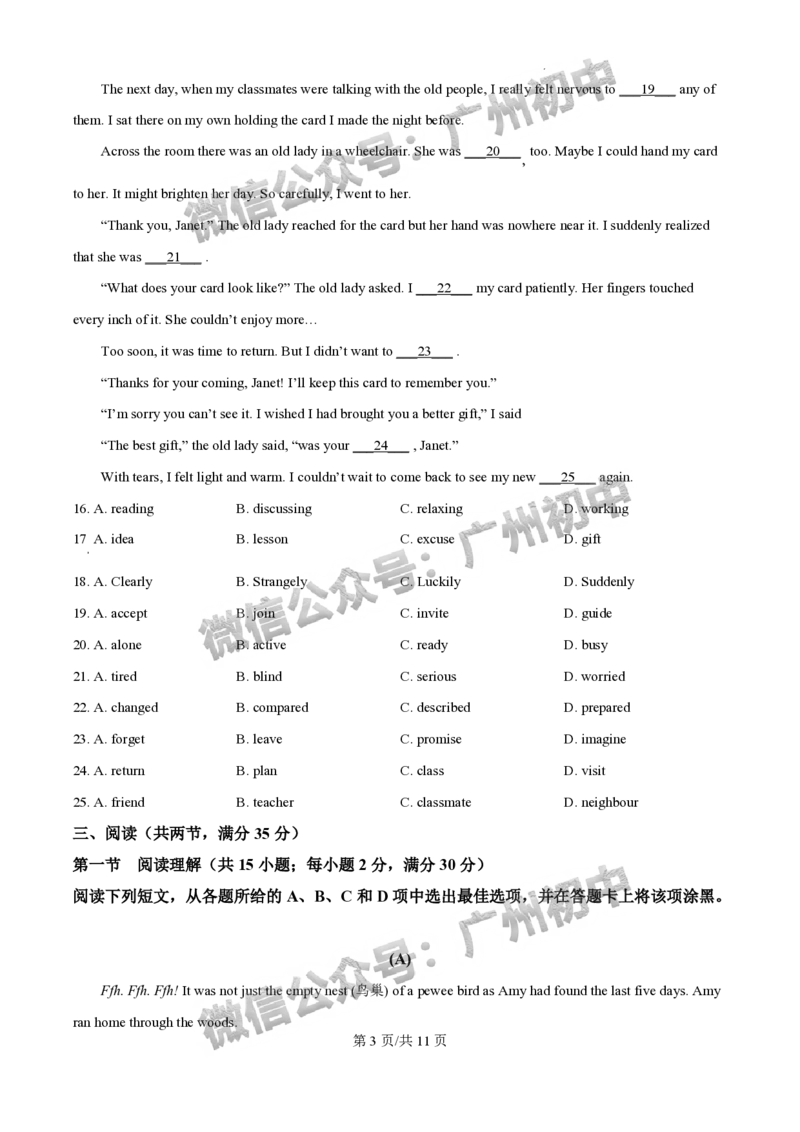
Ffh. Ffh. Ffh! It was not just the empty nest (鸟巢) of a pewee bird as Amy had found the last five days. Amy
ran home through the woods.
第3页/共11页
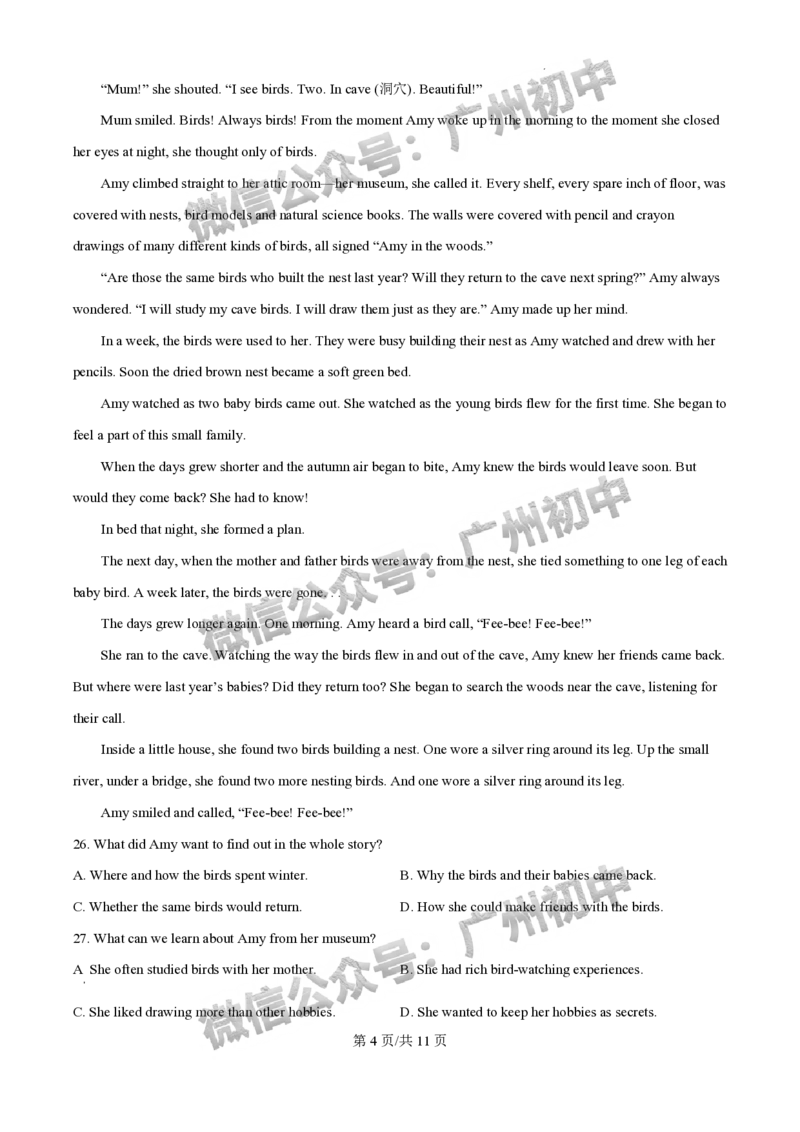
学科网(北京)股份有限公司“Mum!” she shouted. “I see birds. Two. In cave (洞穴). Beautiful!”
Mum smiled. Birds! Always birds! From the moment Amy woke up in the morning to the moment she closed
her eyes at night, she thought only of birds.
Amy climbed straight to her attic room—her museum, she called it. Every shelf, every spare inch of floor, was
covered with nests, bird models and natural science books. The walls were covered with pencil and crayon
drawings of many different kinds of birds, all signed “Amy in the woods.”
“Are those the same birds who built the nest last year? Will they return to the cave next spring?” Amy always
wondered. “I will study my cave birds. I will draw them just as they are.” Amy made up her mind.
In a week, the birds were used to her. They were busy building their nest as Amy watched and drew with her
pencils. Soon the dried brown nest became a soft green bed.
Amy watched as two baby birds came out. She watched as the young birds flew for the first time. She began to
feel a part of this small family.
When the days grew shorter and the autumn air began to bite, Amy knew the birds would leave soon. But
would they come back? She had to know!
In bed that night, she formed a plan.
The next day, when the mother and father birds were away from the nest, she tied something to one leg of each
baby bird. A week later, the birds were gone. . .
The days grew longer again. One morning. Amy heard a bird call, “Fee-bee! Fee-bee!”
She ran to the cave. Watching the way the birds flew in and out of the cave, Amy knew her friends came back.
But where were last year’s babies? Did they return too? She began to search the woods near the cave, listening for
their call.
Inside a little house, she found two birds building a nest. One wore a silver ring around its leg. Up the small
river, under a bridge, she found two more nesting birds. And one wore a silver ring around its leg.
Amy smiled and called, “Fee-bee! Fee-bee!”
26. What did Amy want to find out in the whole story?
A. Where and how the birds spent winter. B. Why the birds and their babies came back.
C. Whether the same birds would return. D. How she could make friends with the birds.
27. What can we learn about Amy from her museum?
A She often studied birds with her mother. B. She had rich bird-watching experiences.
.
C. She liked drawing more than other hobbies. D. She wanted to keep her hobbies as secrets.
第4页/共11页
学科网(北京)股份有限公司28. How did Amy carry out her plan in the late autumn?
A. She marked each baby bird with a silver ring. B. She separated the baby birds from their parents.
C. She cared for the birds and watched them grow. D. She used the birds’ language to call them back.
29. What happened to the two baby birds when the second spring came?
A. They flew back and looked for their parents. B. They made their own nests under a bridge.
C. They flew in and out of the cave to meet Amy. D. They returned and built nests near the cave.
(B)
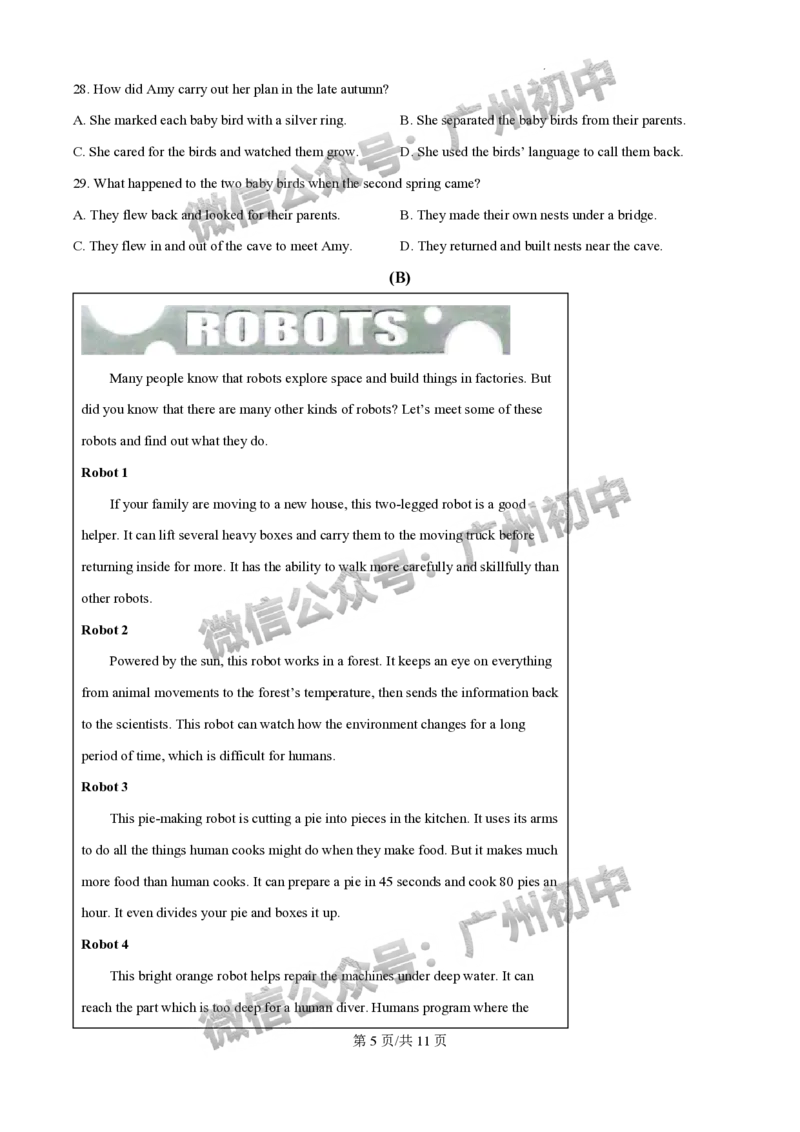
Many people know that robots explore space and build things in factories. But
did you know that there are many other kinds of robots? Let’s meet some of these
robots and find out what they do.
Robot 1
If your family are moving to a new house, this two-legged robot is a good
helper. It can lift several heavy boxes and carry them to the moving truck before
returning inside for more. It has the ability to walk more carefully and skillfully than
other robots.
Robot 2
Powered by the sun, this robot works in a forest. It keeps an eye on everything
from animal movements to the forest’s temperature, then sends the information back
to the scientists. This robot can watch how the environment changes for a long
period of time, which is difficult for humans.
Robot 3
This pie-making robot is cutting a pie into pieces in the kitchen. It uses its arms
to do all the things human cooks might do when they make food. But it makes much
more food than human cooks. It can prepare a pie in 45 seconds and cook 80 pies an
hour. It even divides your pie and boxes it up.
Robot 4
This bright orange robot helps repair the machines under deep water. It can
reach the part which is too deep for a human diver. Humans program where the
第5页/共11页
学科网(北京)股份有限公司robot should go and what it should do. This robot can also help humans explore the
sea and discover new living things. But it can’t work for long underwater.
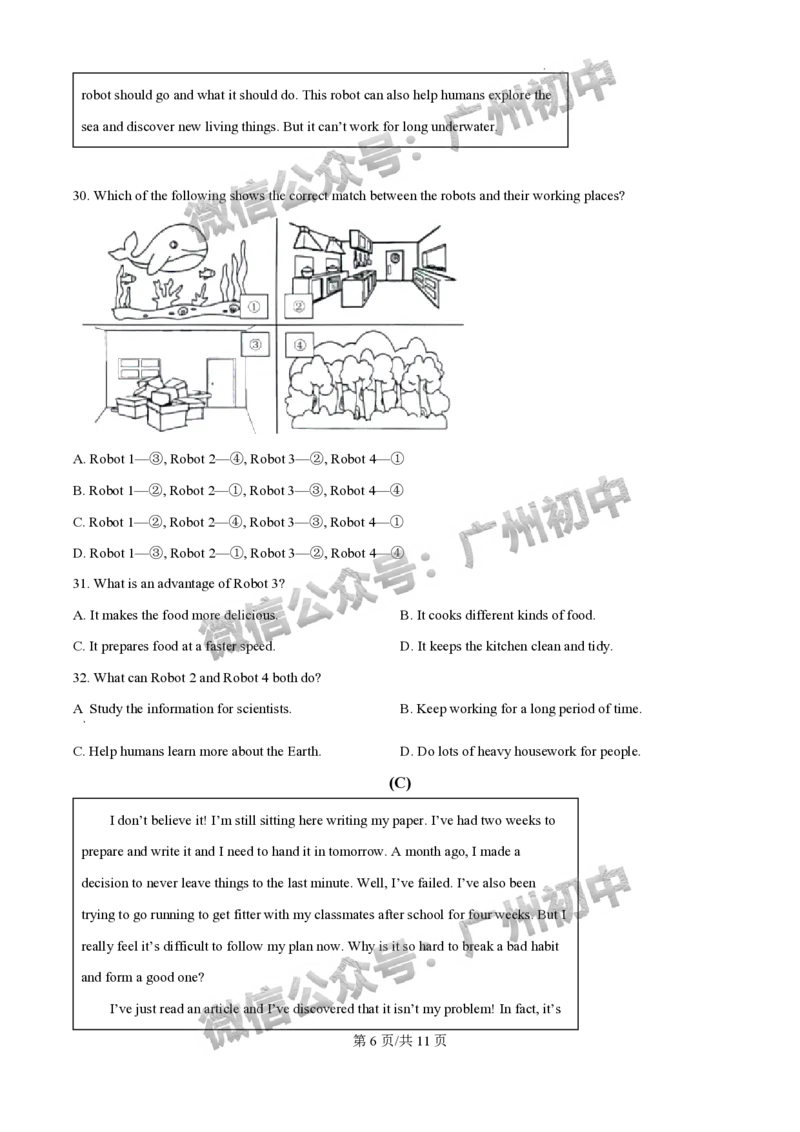
30. Which of the following shows the correct match between the robots and their working places?
A. Robot 1—③, Robot 2—④, Robot 3—②, Robot 4—①
B. Robot 1—②, Robot 2—①, Robot 3—③, Robot 4—④
C. Robot 1—②, Robot 2—④, Robot 3—③, Robot 4—①
D. Robot 1—③, Robot 2—①, Robot 3—②, Robot 4—④
31. What is an advantage of Robot 3?
A. It makes the food more delicious. B. It cooks different kinds of food.
C. It prepares food at a faster speed. D. It keeps the kitchen clean and tidy.
32. What can Robot 2 and Robot 4 both do?
A Study the information for scientists. B. Keep working for a long period of time.
.
C. Help humans learn more about the Earth. D. Do lots of heavy housework for people.
(C)
I don’t believe it! I’m still sitting here writing my paper. I’ve had two weeks to
prepare and write it and I need to hand it in tomorrow. A month ago, I made a
decision to never leave things to the last minute. Well, I’ve failed. I’ve also been
trying to go running to get fitter with my classmates after school for four weeks. But I
really feel it’s difficult to follow my plan now. Why is it so hard to break a bad habit
and form a good one?
I’ve just read an article and I’ve discovered that it isn’t my problem! In fact, it’s
第6页/共11页
学科网(北京)股份有限公司our brains. Our brains are programmed to make it difficult to break bad habits.
Research shows when we do something the same way repeatedly, our brain notices.
It’s just like, “Oh, writing a paper is hard. We still have time. We can relax for now?
Got it!” If we always do things like that, we get “into the habit” of leaving things to
the last minute. We may even get a reward (奖励) from this bad habit, at least at first.
Our brain may say, “Ah, relaxation! I like this!” Slowly, it seems that we can’t stop
doing the habit or control it. Maybe it’s because we don’t know how to get the
rewards without doing it.
But that’s not all. Scientists have also discovered that it takes ten weeks to form a
good habit. That’s because ten weeks is the amount of time the brain needs to change
and accept a new habit as part of everyday life. The good news is that once you make
it to ten weeks, everything becomes a lot easier. The bad news is that ten weeks is a
really long time, so you may give up your plan sooner.
So there you are. Maybe we want to change our ways and become better people,
but our brains won’t let us. Or is this just an excuse? Look—I’ve finished my paper
on time! Anything is possible!
By Ana
33. Who is Ana?
A. A schoolgirl. B. A brain scientist. C. A teacher. D. A sports coach.
34. What can be a reason why it’s hard to break a bad habit?
A. Our brains avoid doing things repeatedly.
B. Our brains are not programmed to notice it.
C. Our brains need relaxation from time to time.
D. Our brains enjoy getting the rewards from doing it.
35. How many more weeks will it take Ana to develop her habit of running after school?
A. Four. B. Six. C. Eight. D. Ten.
36. What does Ana want to tell us at the end of the passage?
A. You’d better finish your paper on time. B. Don’t forget to make a plan beforehand.
C. Stick with the ways you are doing habits. D. It depends on you to control your habits.
第7页/共11页
学科网(北京)股份有限公司(D)
Have you ever heard of upcycling? It is a way of turning old or unnecessary things into something useful and
often beautiful.
Is it the same as recycling? Recycling usually takes old things, like paper and glass, and breaks them down to
make a new product. When you upcycle an object, you are probably doing something different. You can simply
refashion it. For example, you might make a bag out of an old T-shirt. Also, the upcycled object is usually in the
same, or even better condition.
Upcycling isn’t a new idea. Some of the best examples of modem-day upcycling come from the old times. In
those days, things were repurposed over and over until they were no longer useful. Upcycling is a way of life.
Things shouldn’t be just thrown away when they can be saved and turned into something useful.
It’s clear that upcycling is green. It is also considered to be more environmentally friendly than recycling.
Upcycling can just require your own ideas and work, but recycling requires energy (能源) or water to break down
things.
Grace, a young woman from the UK, takes used tea bags and turns them into dresses, shoes and even hats.
Every day she drinks some tea, then dries out the tea bags with the tea still in them. When they’re dry, she takes the
tea out and puts the bags together to make an item of clothing. This can take a long time, but Grace has made lots
of artworks.
In fact, no matter you create objects from old things or buy ready-made products from upcycled things, both
ways are helpful for the environment and can bring you something that’s both beautiful and useful. Get started
today!
37. What does the underlined word “refashion” mean in paragraph 2?
A. Break down useless things. B. Collect used things.
C. Create things out of old ones. D. Come up with good ideas.
38. How is upcycling different from recycling?
A. It’s a completely new idea. B. It needs more energy.
C. It requires more time and work. D. It’s a greener way of life.
39. Why does the writer tell the story of Grace in paragraph 5?
A. To list the steps of doing upcycling. B. To give a good example of upcycling.
C. To express a different idea of upcycling. D. To provide basic knowledge of upcycling.
40. What is the main purpose of the passage?
第8页/共11页
学科网(北京)股份有限公司A. To encourage people to do upcycling. B. To introduce the history of upcycling.
C. To compare upcycling with recycling. D. To explain the importance of recycling
第二节 阅读填空(共5小题;每小题1分,满分5分)
阅读短文及文后A~E选项,选出可以填入各题空白处的最佳选项,并在答题卡上将该项涂黑。
Cave paintings are the oldest pictures. Some of them are almost 30, 000 years old. Many of these paintings
show animals or hunting scenes (狩猎场景). They do not have written words on them. But when we look at them,
we get an idea of the feelings the people had when drawing them. The paintings tell stories of hopes and fears.
____41____
Sometime between 4, 000 and 3, 000 BCE, the skill of writing was developed in Egypt and Mesopotamia.
People cut texts on stones first. ____42____ But it was impossible to carry stones from place to place. The
invention of papyrus (莎草纸) allowed documents to be moved easily. More than 3, 000 years ago, the ancient
Chinese people cut words on bones and shells. These words are called jiaguwen. It is the writing system that has
developed over thousands of years into today’s hanzi.
People made the first books from papyrus and from thin animal skins. Around 105 CE, paper-making skill was
improved after the invention of paper in China. ____43____ It was published in 868 CE. In the middle of the 15th
century, the printing machine was invented in Germany. Since that time, a huge number of books have been printed
worldwide. ____44____
Books will be around for many years, of course. But some people prefer reading electronic books.
____45____ Now you can buy your books whenever you want without having to leave the comfort of your home.
A. They are easier to take with you when you travel.
B. They are an early form of written communication.
C. The world’s oldest known printed book is from China too.
D. They are an early form of communication without reading and writing.
E. For many people, reading in the library is one of life’s greatest pleasures.
四、写作(共三节,满分30分)
第一节 语篇填词(共5小题;每小题1分,满分5分)
阅读短文,根据上下文和所给的首字母写出所缺单词。注意使用正确形式,每空限填一词。答卷时,要求
写出完整单词。
Shadow puppet play (皮影戏) has a history of over 2, 000 years. It is a t____46____ art of telling stories.
Sam is a foreign student, who came to China last year. He fell in l____47____ with shadow puppet play
第9页/共11页
学科网(北京)股份有限公司during a visit to a museum. He d____48____ to learn this art because he thought it was a great way to tell stories of
Chinese culture.
With the help of his Chinese friends, Sam built a shadow puppet play stage and made some paper puppets. But
learning to control the puppets is not e____49____. He spent hours practising every day for several months. So far,
Sam has successfully put several of his videos online and won many fans. He wants to s____50____ the beauty of
this art with people from all over the world.
第二节 完成句子(共5小题;每小题2分,满分10分)
根据所给的汉语内容,用英语完成下列句子。每空限填一词。
51. 下周,我校将在运动日举行各种趣味运动。麦克和汤姆将参加“二人三足”赛跑。
A lot of fun games ________ ________ ________ on the Sports Day in our school next week. Mike and Tom will
take part in the “three-legged” race.
52. 这种赛跑太难,他们训练时总是摔倒。
This kind of race was ________ hard ________ they kept falling over while practising.
53. 体育老师鼓励他们,并教他们如何能提高合作跑步的技巧。
Their PE teacher encouraged them and taught them ________ ________ improve their skills of running together.
54. 他们认识到面对困难时不放弃很重要。
They realized that it was important not to ________ ________ when facing difficulties.
55. 这是一次多么有意义的经历啊!
________ ________ ________ experience it is!
第三节 书面表达(共1题,满分15分)
56. 你校将在英语周举办英语征文比赛,主题是“An unforgettable school trip”。请根据以下思维导图的
内容提示写一篇短文。
注意:
1. 可在思维导图内容提示的基础上适当拓展信息;
2. 词数80词左右;
第10页/共11页
学科网(北京)股份有限公司3. 不得透露学校、姓名等任何个人信息,否则不予评分。
An unforgettable school trip
____________________________________________________________________________________________
____________________________________________________________________________________________
____________________________________________________________________________________________
____________________________________________________________________________________________
____________________________________________________________________________________________
____________________________________________________________________________________________
____________________________________________________________________________________________
____________________________________________________________________________________________
____________________________________________________________________________________________
____________________________________________________
第11页/共11页
学科网(北京)股份有限公司