文档文本内容
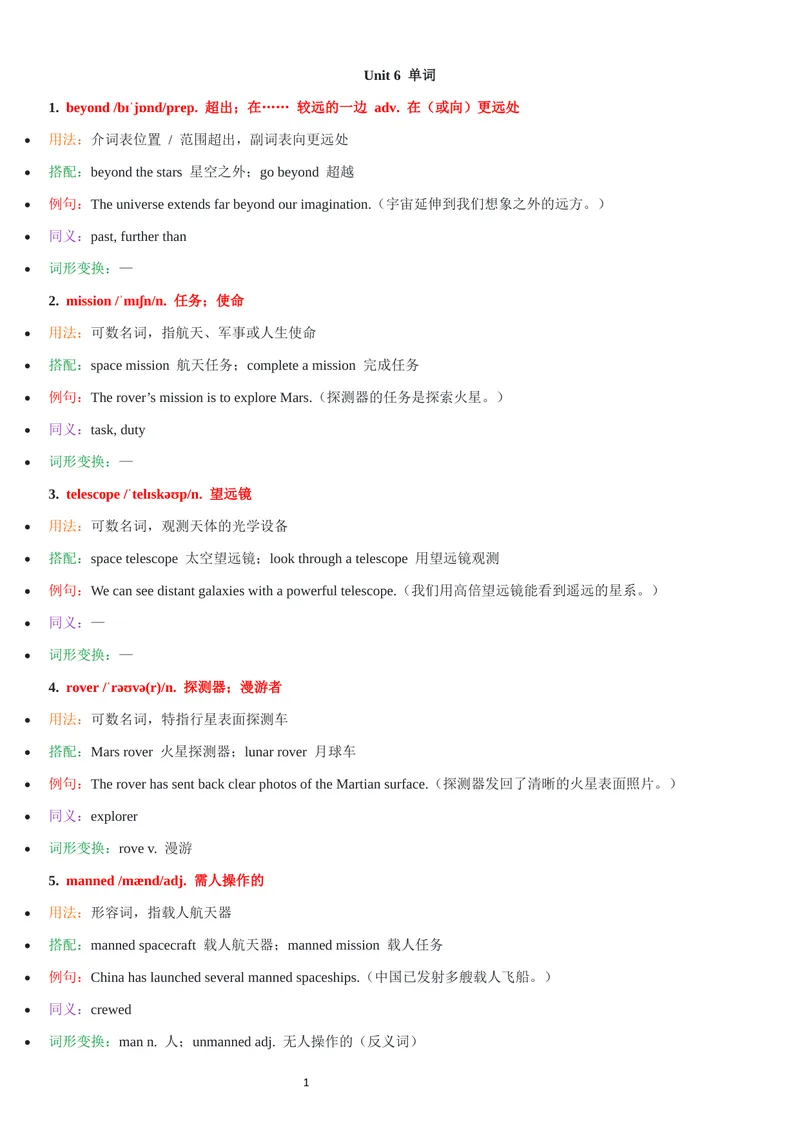
Unit 6 单词
1. beyond /bɪˈjɒnd/prep. 超出;在…… 较远的一边 adv. 在(或向)更远处
用法:介词表位置 / 范围超出,副词表向更远处
搭配:beyond the stars 星空之外;go beyond 超越
例句:The universe extends far beyond our imagination.(宇宙延伸到我们想象之外的远方。)
同义:past, further than
词形变换:—
2. mission /ˈmɪʃn/n. 任务;使命
用法:可数名词,指航天、军事或人生使命
搭配:space mission 航天任务;complete a mission 完成任务
例句:The rover’s mission is to explore Mars.(探测器的任务是探索火星。)
同义:task, duty
词形变换:—
3. telescope /ˈtelɪskəʊp/n. 望远镜
用法:可数名词,观测天体的光学设备
搭配:space telescope 太空望远镜;look through a telescope 用望远镜观测
例句:We can see distant galaxies with a powerful telescope.(我们用高倍望远镜能看到遥远的星系。)
同义:—
词形变换:—
4. rover /ˈrəʊvə(r)/n. 探测器;漫游者
用法:可数名词,特指行星表面探测车
搭配:Mars rover 火星探测器;lunar rover 月球车
例句:The rover has sent back clear photos of the Martian surface.(探测器发回了清晰的火星表面照片。)
同义:explorer
词形变换:rove v. 漫游
5. manned /mænd/adj. 需人操作的
用法:形容词,指载人航天器
搭配:manned spacecraft 载人航天器;manned mission 载人任务
例句:China has launched several manned spaceships.(中国已发射多艘载人飞船。)
同义:crewed
词形变换:man n. 人;unmanned adj. 无人操作的(反义词)
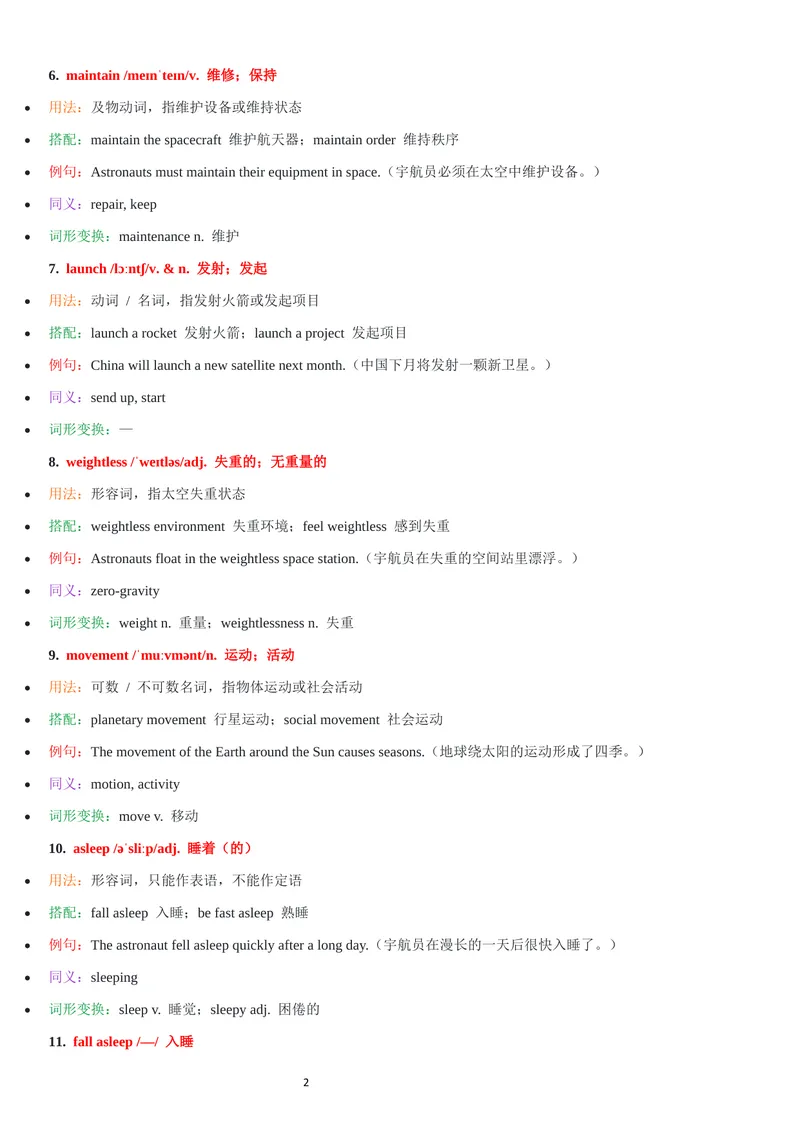
16. maintain /meɪnˈteɪn/v. 维修;保持
用法:及物动词,指维护设备或维持状态
搭配:maintain the spacecraft 维护航天器;maintain order 维持秩序
例句:Astronauts must maintain their equipment in space.(宇航员必须在太空中维护设备。)
同义:repair, keep
词形变换:maintenance n. 维护
7. launch /lɔːntʃ/v. & n. 发射;发起
用法:动词 / 名词,指发射火箭或发起项目
搭配:launch a rocket 发射火箭;launch a project 发起项目
例句:China will launch a new satellite next month.(中国下月将发射一颗新卫星。)
同义:send up, start
词形变换:—
8. weightless /ˈweɪtləs/adj. 失重的;无重量的
用法:形容词,指太空失重状态
搭配:weightless environment 失重环境;feel weightless 感到失重
例句:Astronauts float in the weightless space station.(宇航员在失重的空间站里漂浮。)
同义:zero-gravity
词形变换:weight n. 重量;weightlessness n. 失重
9. movement /ˈmuːvmənt/n. 运动;活动
用法:可数 / 不可数名词,指物体运动或社会活动
搭配:planetary movement 行星运动;social movement 社会运动
例句:The movement of the Earth around the Sun causes seasons.(地球绕太阳的运动形成了四季。)
同义:motion, activity
词形变换:move v. 移动
10. asleep /əˈsliːp/adj. 睡着(的)
用法:形容词,只能作表语,不能作定语
搭配:fall asleep 入睡;be fast asleep 熟睡
例句:The astronaut fell asleep quickly after a long day.(宇航员在漫长的一天后很快入睡了。)
同义:sleeping
词形变换:sleep v. 睡觉;sleepy adj. 困倦的
11. fall asleep /—/ 入睡
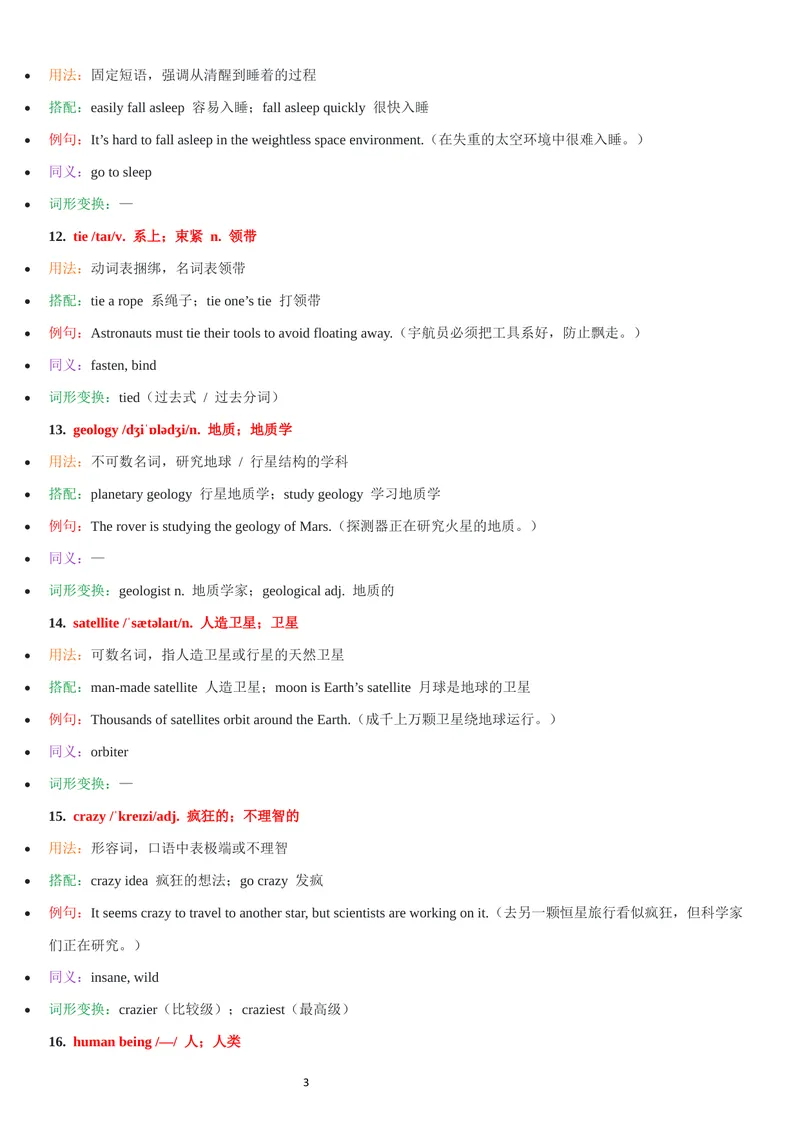
2 用法:固定短语,强调从清醒到睡着的过程
搭配:easily fall asleep 容易入睡;fall asleep quickly 很快入睡
例句:It’s hard to fall asleep in the weightless space environment.(在失重的太空环境中很难入睡。)
同义:go to sleep
词形变换:—
12. tie /taɪ/v. 系上;束紧 n. 领带
用法:动词表捆绑,名词表领带
搭配:tie a rope 系绳子;tie one’s tie 打领带
例句:Astronauts must tie their tools to avoid floating away.(宇航员必须把工具系好,防止飘走。)
同义:fasten, bind
词形变换:tied(过去式 / 过去分词)
13. geology /dʒiˈɒlədʒi/n. 地质;地质学
用法:不可数名词,研究地球 / 行星结构的学科
搭配:planetary geology 行星地质学;study geology 学习地质学
例句:The rover is studying the geology of Mars.(探测器正在研究火星的地质。)
同义:—
词形变换:geologist n. 地质学家;geological adj. 地质的
14. satellite /ˈsætəlaɪt/n. 人造卫星;卫星
用法:可数名词,指人造卫星或行星的天然卫星
搭配:man-made satellite 人造卫星;moon is Earth’s satellite 月球是地球的卫星
例句:Thousands of satellites orbit around the Earth.(成千上万颗卫星绕地球运行。)
同义:orbiter
词形变换:—
15. crazy /ˈkreɪzi/adj. 疯狂的;不理智的
用法:形容词,口语中表极端或不理智
搭配:crazy idea 疯狂的想法;go crazy 发疯
例句:It seems crazy to travel to another star, but scientists are working on it.(去另一颗恒星旅行看似疯狂,但科学家
们正在研究。)
同义:insane, wild
词形变换:crazier(比较级);craziest(最高级)
16. human being /—/ 人;人类
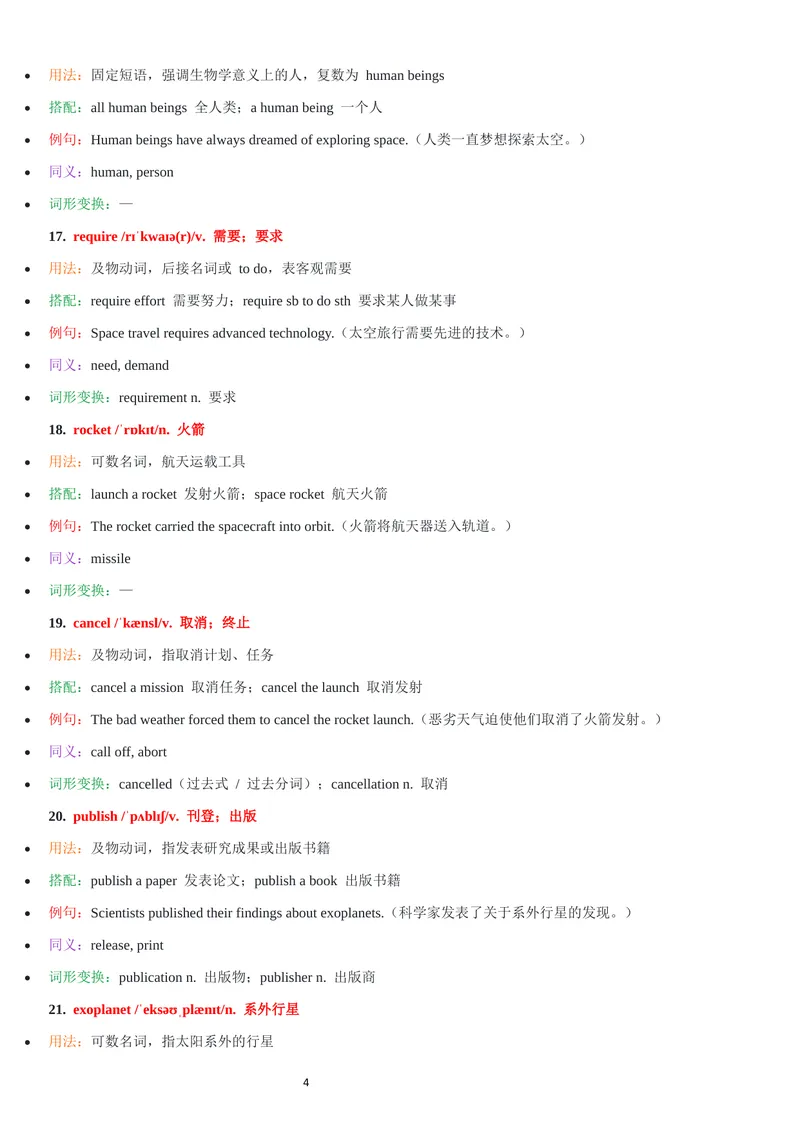
3 用法:固定短语,强调生物学意义上的人,复数为 human beings
搭配:all human beings 全人类;a human being 一个人
例句:Human beings have always dreamed of exploring space.(人类一直梦想探索太空。)
同义:human, person
词形变换:—
17. require /rɪˈkwaɪə(r)/v. 需要;要求
用法:及物动词,后接名词或 to do,表客观需要
搭配:require effort 需要努力;require sb to do sth 要求某人做某事
例句:Space travel requires advanced technology.(太空旅行需要先进的技术。)
同义:need, demand
词形变换:requirement n. 要求
18. rocket /ˈrɒkɪt/n. 火箭
用法:可数名词,航天运载工具
搭配:launch a rocket 发射火箭;space rocket 航天火箭
例句:The rocket carried the spacecraft into orbit.(火箭将航天器送入轨道。)
同义:missile
词形变换:—
19. cancel /ˈkænsl/v. 取消;终止
用法:及物动词,指取消计划、任务
搭配:cancel a mission 取消任务;cancel the launch 取消发射
例句:The bad weather forced them to cancel the rocket launch.(恶劣天气迫使他们取消了火箭发射。)
同义:call off, abort
词形变换:cancelled(过去式 / 过去分词);cancellation n. 取消
20. publish /ˈpʌblɪʃ/v. 刊登;出版
用法:及物动词,指发表研究成果或出版书籍
搭配:publish a paper 发表论文;publish a book 出版书籍
例句:Scientists published their findings about exoplanets.(科学家发表了关于系外行星的发现。)
同义:release, print
词形变换:publication n. 出版物;publisher n. 出版商
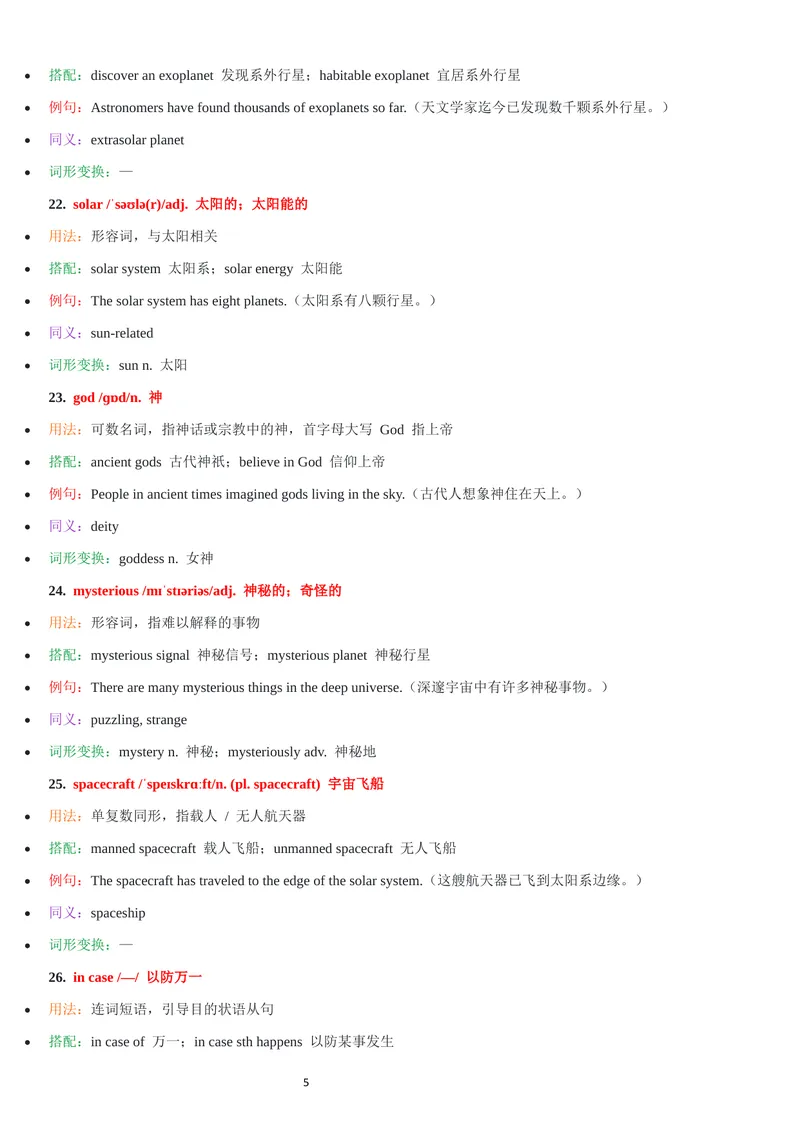
21. exoplanet /ˈeksəʊˌplænɪt/n. 系外行星
用法:可数名词,指太阳系外的行星
4 搭配:discover an exoplanet 发现系外行星;habitable exoplanet 宜居系外行星
例句:Astronomers have found thousands of exoplanets so far.(天文学家迄今已发现数千颗系外行星。)
同义:extrasolar planet
词形变换:—
22. solar /ˈsəʊlə(r)/adj. 太阳的;太阳能的
用法:形容词,与太阳相关
搭配:solar system 太阳系;solar energy 太阳能
例句:The solar system has eight planets.(太阳系有八颗行星。)
同义:sun-related
词形变换:sun n. 太阳
23. god /ɡɒd/n. 神
用法:可数名词,指神话或宗教中的神,首字母大写 God 指上帝
搭配:ancient gods 古代神祇;believe in God 信仰上帝
例句:People in ancient times imagined gods living in the sky.(古代人想象神住在天上。)
同义:deity
词形变换:goddess n. 女神
24. mysterious /mɪˈstɪəriəs/adj. 神秘的;奇怪的
用法:形容词,指难以解释的事物
搭配:mysterious signal 神秘信号;mysterious planet 神秘行星
例句:There are many mysterious things in the deep universe.(深邃宇宙中有许多神秘事物。)
同义:puzzling, strange
词形变换:mystery n. 神秘;mysteriously adv. 神秘地
25. spacecraft /ˈspeɪskrɑːft/n. (pl. spacecraft) 宇宙飞船
用法:单复数同形,指载人 / 无人航天器
搭配:manned spacecraft 载人飞船;unmanned spacecraft 无人飞船
例句:The spacecraft has traveled to the edge of the solar system.(这艘航天器已飞到太阳系边缘。)
同义:spaceship
词形变换:—
26. in case /—/ 以防万一
用法:连词短语,引导目的状语从句
搭配:in case of 万一;in case sth happens 以防某事发生
5 例句:Astronauts take extra oxygen in case of emergency.(宇航员携带额外氧气以防紧急情况。)
同义:for fear that
词形变换:—
27. board /bɔːd/n. 板;牌子
用法:可数名词,也可指董事会、甲板
搭配:notice board 布告栏;on board 在船上 / 飞机上
例句:There is a notice board on the space station.(空间站上有一块布告栏。)
同义:panel, plank
词形变换:—
28. on board /—/ 在船(或火车、飞机)上
用法:固定短语,指在交通工具内部
搭配:on board the spacecraft 在航天器上;all on board 全体登机
例句:There are three astronauts on board the space station.(空间站上有三名宇航员。)
同义:aboard
词形变换:—
29. billion /ˈbɪljən/num. 十亿
用法:数词,英式 / 美式均表十亿,复数 billions 表数十亿
搭配:billions of stars 数十亿颗星星;one billion 十亿
例句:There are billions of galaxies in the observable universe.(可观测宇宙中有数十亿个星系。)
同义:1,000 million
词形变换:—
30. trillion /ˈtrɪljən/num. 万亿;兆
用法:数词,美式表万亿(10¹²),英式表百万亿(10¹⁸),天文学常用美式义
搭配:trillions of stars 数万亿颗星星;one trillion 一万亿
例句:The Milky Way contains hundreds of billions of stars.(银河系包含数千亿颗恒星。)
同义:10¹²(美式)
词形变换:—
31. completely /kəmˈpliːtli/adv. 彻底地;完全地
用法:副词,修饰形容词或动词,表程度彻底
搭配:completely different 完全不同;completely lost 彻底迷失
例句:The space environment is completely different from Earth’s.(太空环境与地球完全不同。)
6 同义:totally, entirely
词形变换:complete adj. 完全的;v. 完成
32. cooperate /kəʊˈɒpəreɪt/v. 合作;协作
用法:不及物动词,常与 with 搭配
搭配:cooperate with sb 与某人合作;cooperate on a project 在项目上合作
例句:Countries around the world cooperate on space exploration.(世界各国在太空探索上合作。)
同义:collaborate, work together
词形变换:cooperation n. 合作;cooperative adj. 合作的
33. cooperate with /—/ 合作;协作;配合
用法:固定短语,后接人或机构
搭配:cooperate with other countries 与其他国家合作;cooperate with colleagues 与同事协作
例句:Astronauts must cooperate with each other in space.(宇航员在太空中必须互相配合。)
同义:work with, team up with
词形变换:—
34. set foot on /—/ 访问;参观(某地)
用法:固定短语,强调首次踏上某地
搭配:set foot on the Moon 踏上月球;set foot on Mars 踏上火星
例句:Neil Armstrong was the first man to set foot on the Moon.(尼尔 阿姆斯特朗是第一个踏上月球的人。)
・
同义:step onto, land on
词形变换:—
35. galaxy /ˈɡæləksi/n. 星系
用法:可数名词,由恒星、气体等组成的天体系统
搭配:the Milky Way Galaxy 银河系;distant galaxy 遥远星系
例句:Our solar system is part of the Milky Way Galaxy.(我们的太阳系是银河系的一部分。)
同义:—
词形变换:galactic adj. 星系的
36. unmanned /ˌʌnˈmænd/adj. 无(需)人操作的
用法:形容词,指无人驾驶 / 操作的设备
搭配:unmanned spacecraft 无人航天器;unmanned rover 无人探测器
例句:Unmanned probes have explored the outer planets.(无人探测器已探索过外行星。)
同义:automatic, pilotless
7 词形变换:manned adj. 载人的(反义词)
37. craft /krɑːft/n. 技艺;工艺 (pl. craft) 飞行器;船
用法:可数名词,单复数同形,指航天器或手工技艺
搭配:spacecraft 航天器;handicraft 手工艺
例句:The new space craft is designed for long-distance travel.(这艘新航天器是为长途旅行设计的。)
同义:vessel, skill
词形变换:—
38. spaceship /ˈspeɪsʃɪp/n. (航天) 飞船
用法:可数名词,侧重载人航天飞船
搭配:manned spaceship 载人飞船;interstellar spaceship 星际飞船
例句:The spaceship will carry astronauts to the space station.(这艘飞船将把宇航员送往空间站。)
同义:spacecraft
词形变换:—
39. survey /ˈsɜːveɪ/n. 测绘;民意调查
用法:名词 / 动词,指测绘地形或调查
搭配:geological survey 地质测绘;public survey 民意调查
例句:The rover conducted a geological survey of the Martian surface.(探测器对火星表面进行了地质测绘。)
同义:map, poll
词形变换:survey v. 测绘;surveyor n. 测量员
40. crowded /ˈkraʊdɪd/adj. 人(太)多的;拥挤的
用法:形容词,修饰场所或事物
搭配:crowded city 拥挤的城市;crowded schedule 排满的日程
例句:Earth is becoming more crowded with human population.(地球因人口增长变得越来越拥挤。)
同义:packed, busy
词形变换:crowd n. 人群;v. 拥挤
41. operate /ˈɒpəreɪt/v. 操作;运行
用法:动词,指操作设备或机器运行
搭配:operate a spacecraft 操作航天器;operate smoothly 平稳运行
例句:The robot can operate the equipment automatically.(机器人能自动操作设备。)
同义:run, control
词形变换:operation n. 操作;operator n. 操作员
842. Mars /mɑːz/n. 火星
用法:专有名词,太阳系第四颗行星,首字母大写
搭配:explore Mars 探索火星;Mars rover 火星探测器
例句:Scientists hope to send humans to Mars in the future.(科学家希望未来将人类送上火星。)
同义:the Red Planet
词形变换:Martian adj. 火星的;n. 火星人
43. Voyager 1 /ˈvɔɪɪdʒə(r)/ 旅行者 1 号探测器
用法:专有名词,NASA 发射的深空探测器,首字母大写
搭配:Voyager 1 mission 旅行者 1 号任务
例句:Voyager 1 has left the solar system and entered interstellar space.(旅行者 1 号已离开太阳系,进入星际空
间。)
同义:—
词形变换:—
44. Proxima Centauri /ˈprɒksɪmə/senˈtɔːri/ 比邻星
用法:专有名词,离太阳最近的恒星,首字母大写
搭配:Proxima Centauri b 比邻星 b(系外行星)
例句:Proxima Centauri is the closest star to our Sun.(比邻星是离太阳最近的恒星。)
同义:Alpha Centauri C
词形变换:—
45. Ann /æn/ 安
用法:专有名词,女子名,首字母大写
搭配:Ann’s dream 安的梦想
例句:Ann wants to be an astronaut when she grows up.(安长大后想当宇航员。)
同义:Anna
词形变换:—
9