2026 人教版英语九上学霸预习单词批注
Unit 3 Smart Learning 单词批注
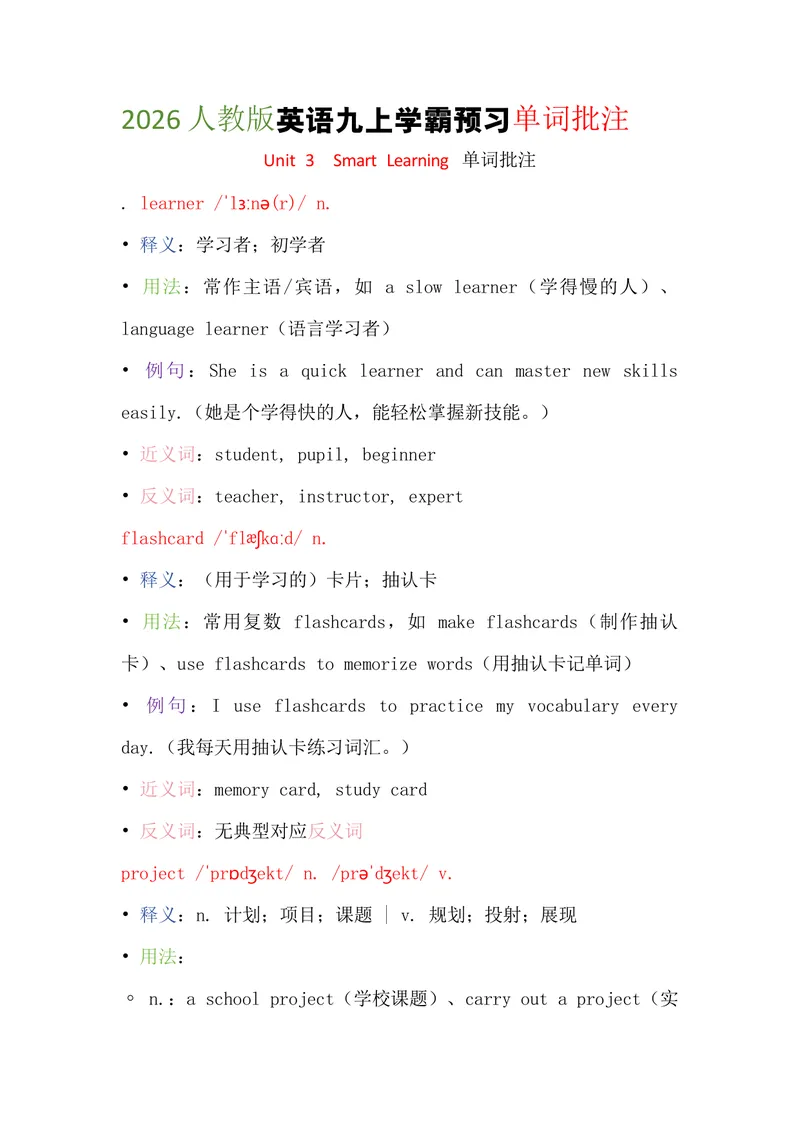
. learner /ˈlɜːnə(r)/ n.
• 释义:学习者;初学者
• 用法:常作主语/宾语,如 a slow learner(学得慢的人)、
language learner(语言学习者)
• 例句:She is a quick learner and can master new skills
easily.(她是个学得快的人,能轻松掌握新技能。)
• 近义词:student, pupil, beginner
• 反义词:teacher, instructor, expert
flashcard /ˈflæʃkɑːd/ n.
• 释义:(用于学习的)卡片;抽认卡
• 用法:常用复数 flashcards,如 make flashcards(制作抽认
卡)、use flashcards to memorize words(用抽认卡记单词)
• 例句:I use flashcards to practice my vocabulary every
day.(我每天用抽认卡练习词汇。)
• 近义词:memory card, study card
• 反义词:无典型对应反义词
project /ˈprɒdʒekt/ n. /prəˈdʒekt/ v.
• 释义:n. 计划;项目;课题 | v. 规划;投射;展现
• 用法:
n.:a school project(学校课题)、carry out a project(实
◦施项目)
v.:project one's feelings onto others(把情感投射到他人
◦
身上)
• 例句:We are working on a science project about climate
change.(我们正在做一个关于气候变化的科学课题。)
• 近义词:n. plan, task, assignment | v. plan, cast, display
• 反义词:n. routine, triviality | v. conceal, hide
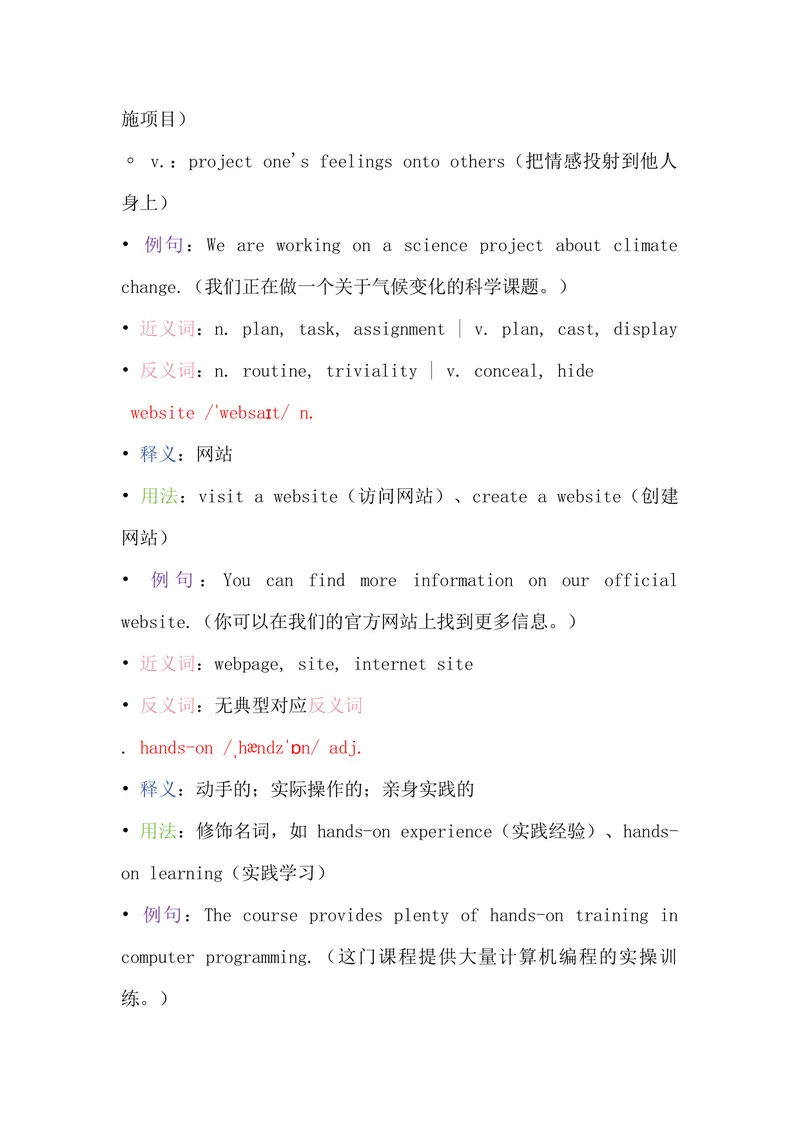
website /ˈwebsaɪt/ n.
• 释义:网站
• 用法:visit a website(访问网站)、create a website(创建
网站)
• 例 句 : You can find more information on our official
website.(你可以在我们的官方网站上找到更多信息。)
• 近义词:webpage, site, internet site
• 反义词:无典型对应反义词
. hands-on /ˌhændzˈɒn/ adj.
• 释义:动手的;实际操作的;亲身实践的
• 用法:修饰名词,如 hands-on experience(实践经验)、hands-
on learning(实践学习)
• 例句:The course provides plenty of hands-on training in
computer programming.(这门课程提供大量计算机编程的实操训
练。)• 近义词:practical, experiential, interactive
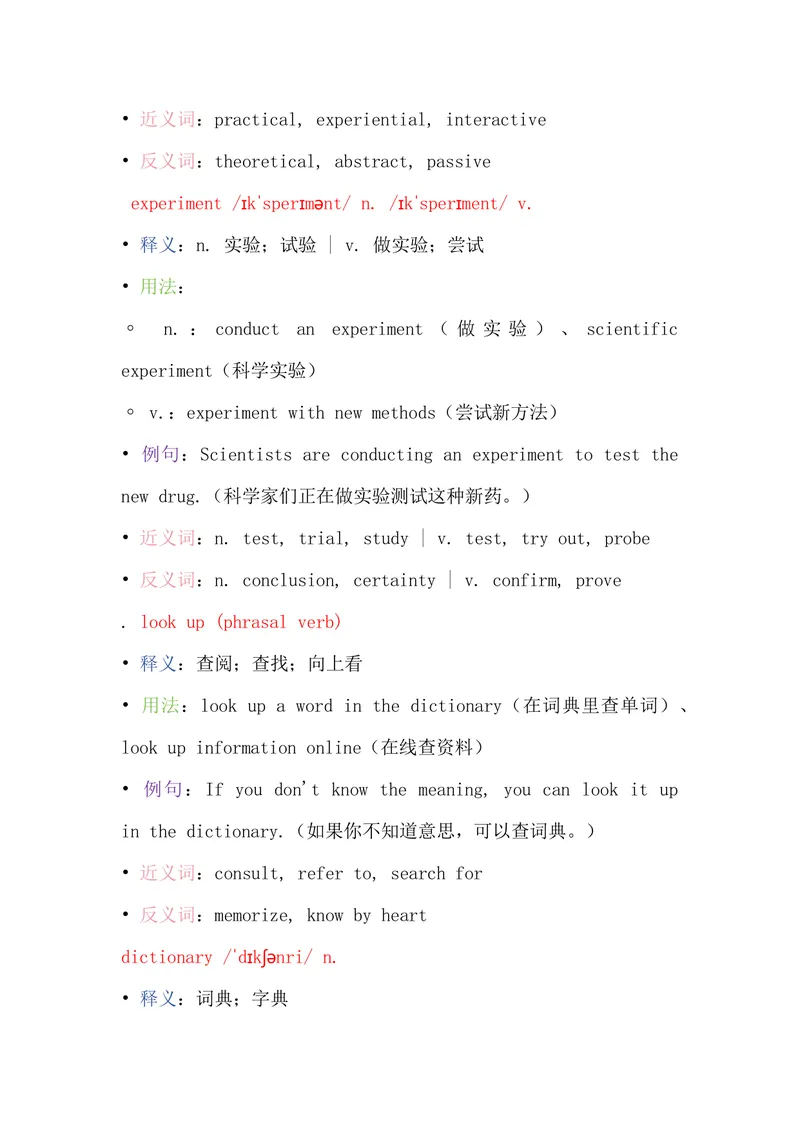
• 反义词:theoretical, abstract, passive
experiment /ɪkˈsperɪmənt/ n. /ɪkˈsperɪment/ v.
• 释义:n. 实验;试验 | v. 做实验;尝试
• 用法:
n. : conduct an experiment ( 做 实 验 ) 、 scientific
◦
experiment(科学实验)
v.:experiment with new methods(尝试新方法)
◦
• 例句:Scientists are conducting an experiment to test the
new drug.(科学家们正在做实验测试这种新药。)
• 近义词:n. test, trial, study | v. test, try out, probe
• 反义词:n. conclusion, certainty | v. confirm, prove
. look up (phrasal verb)
• 释义:查阅;查找;向上看
• 用法:look up a word in the dictionary(在词典里查单词)、
look up information online(在线查资料)
• 例句:If you don't know the meaning, you can look it up
in the dictionary.(如果你不知道意思,可以查词典。)
• 近义词:consult, refer to, search for
• 反义词:memorize, know by heart
dictionary /ˈdɪkʃənri/ n.
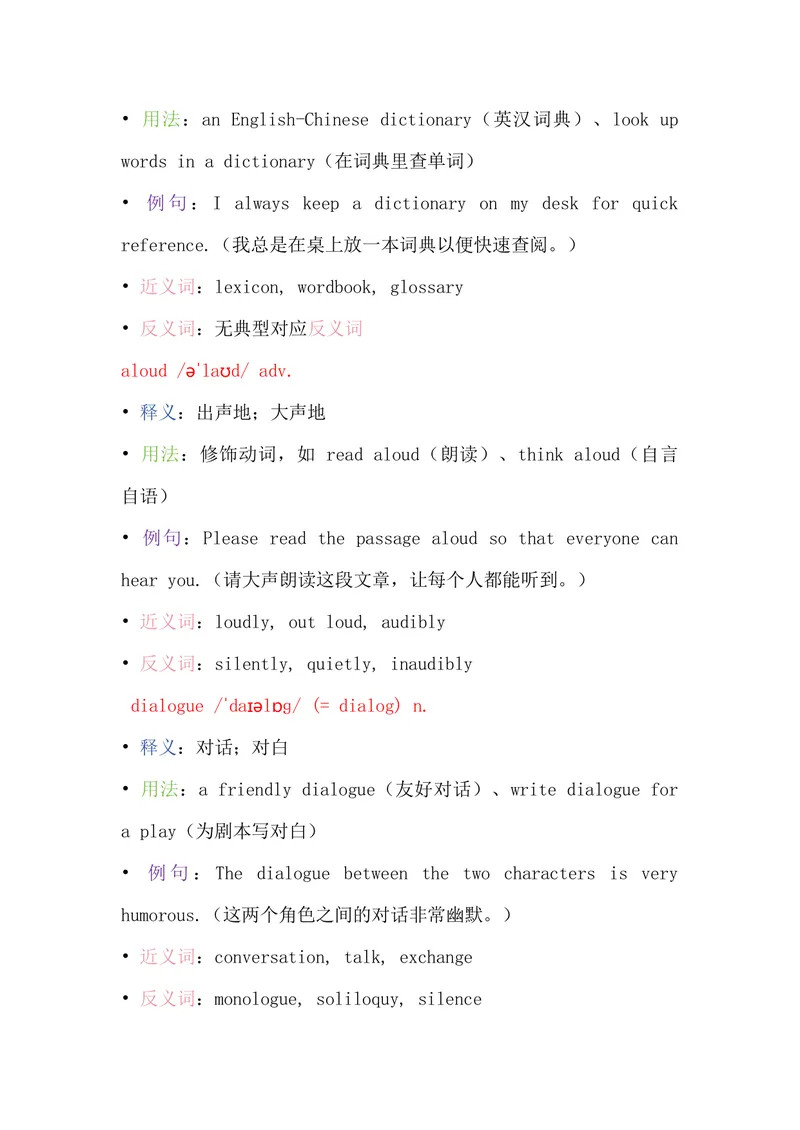
• 释义:词典;字典• 用法:an English-Chinese dictionary(英汉词典)、look up
words in a dictionary(在词典里查单词)
• 例句:I always keep a dictionary on my desk for quick
reference.(我总是在桌上放一本词典以便快速查阅。)
• 近义词:lexicon, wordbook, glossary
• 反义词:无典型对应反义词
aloud /əˈlaʊd/ adv.
• 释义:出声地;大声地
• 用法:修饰动词,如 read aloud(朗读)、think aloud(自言
自语)
• 例句:Please read the passage aloud so that everyone can
hear you.(请大声朗读这段文章,让每个人都能听到。)
• 近义词:loudly, out loud, audibly
• 反义词:silently, quietly, inaudibly
dialogue /ˈdaɪəlɒɡ/ (= dialog) n.
• 释义:对话;对白
• 用法:a friendly dialogue(友好对话)、write dialogue for
a play(为剧本写对白)
• 例句:The dialogue between the two characters is very
humorous.(这两个角色之间的对话非常幽默。)
• 近义词:conversation, talk, exchange
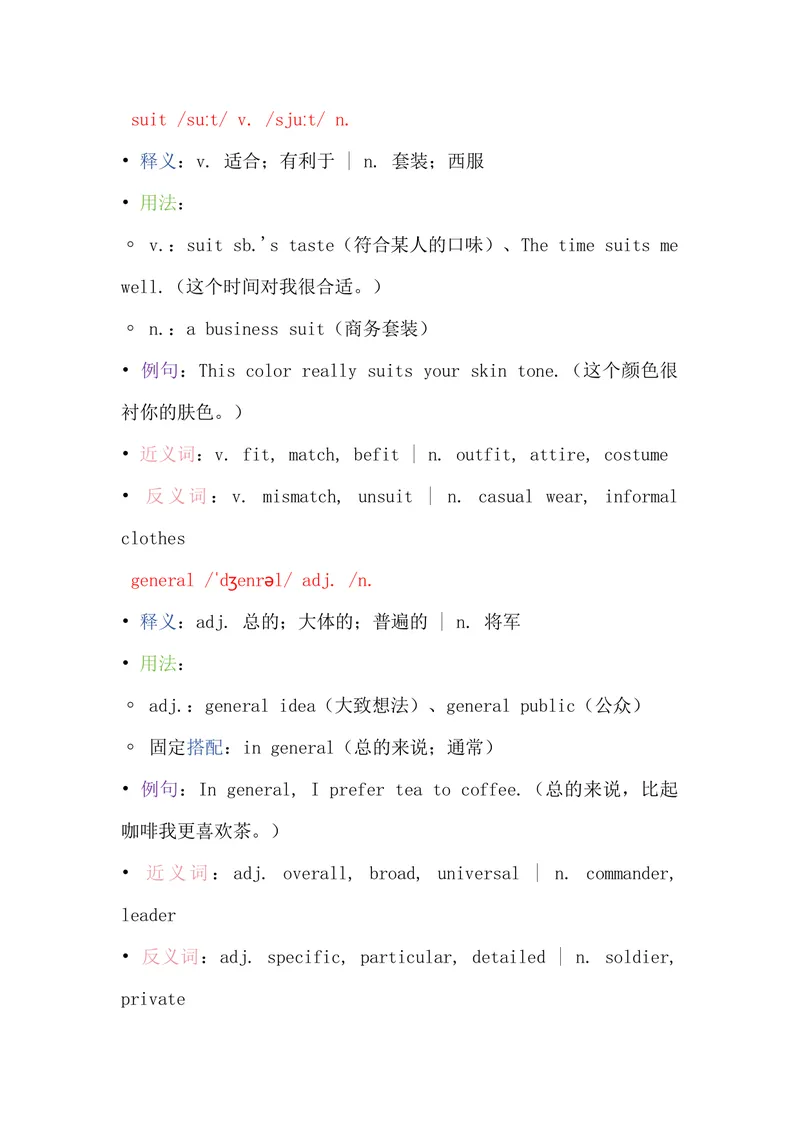
• 反义词:monologue, soliloquy, silencesuit /suːt/ v. /sjuːt/ n.
• 释义:v. 适合;有利于 | n. 套装;西服
• 用法:
v.:suit sb.'s taste(符合某人的口味)、The time suits me
◦
well.(这个时间对我很合适。)
n.:a business suit(商务套装)
◦
• 例句:This color really suits your skin tone.(这个颜色很
衬你的肤色。)
• 近义词:v. fit, match, befit | n. outfit, attire, costume
• 反义词:v. mismatch, unsuit | n. casual wear, informal
clothes
general /ˈdʒenrəl/ adj. /n.
• 释义:adj. 总的;大体的;普遍的 | n. 将军
• 用法:
adj.:general idea(大致想法)、general public(公众)
◦
固定搭配:in general(总的来说;通常)
◦
• 例句:In general, I prefer tea to coffee.(总的来说,比起
咖啡我更喜欢茶。)
• 近义词:adj. overall, broad, universal | n. commander,
leader
• 反义词:adj. specific, particular, detailed | n. soldier,
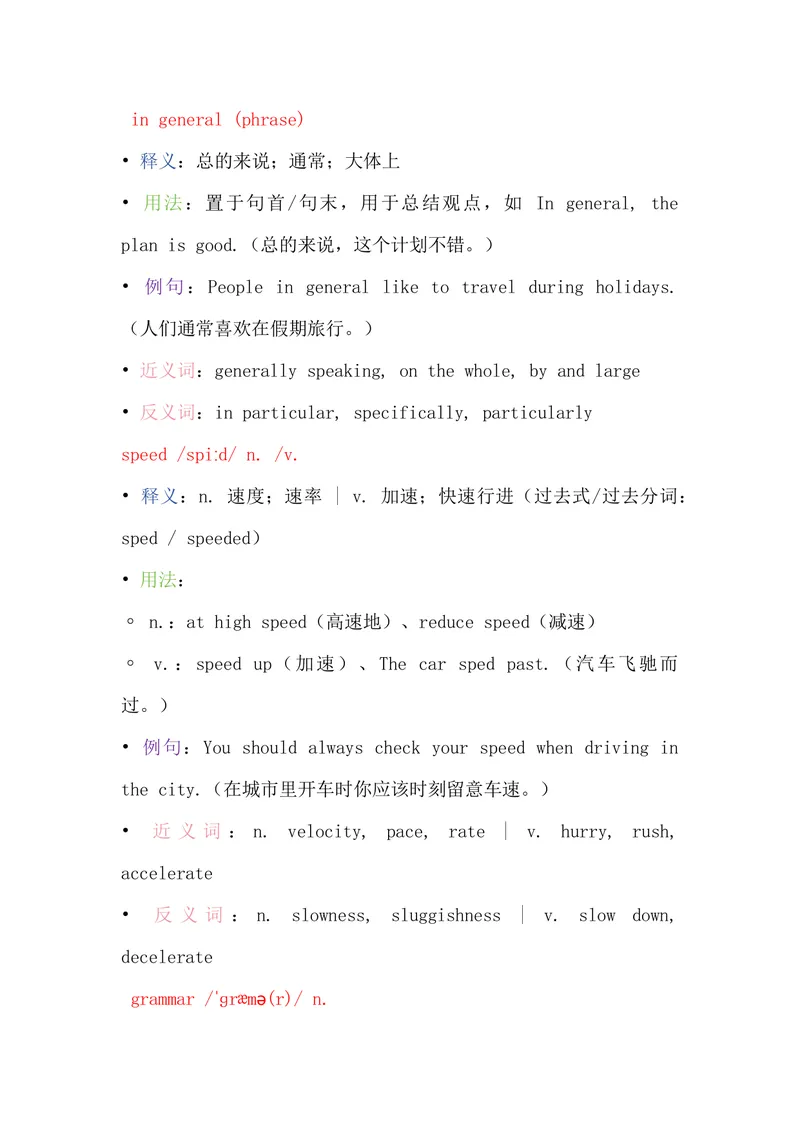
privatein general (phrase)
• 释义:总的来说;通常;大体上
• 用法:置于句首/句末,用于总结观点,如 In general, the
plan is good.(总的来说,这个计划不错。)
• 例句:People in general like to travel during holidays.
(人们通常喜欢在假期旅行。)
• 近义词:generally speaking, on the whole, by and large
• 反义词:in particular, specifically, particularly
speed /spiːd/ n. /v.
• 释义:n. 速度;速率 | v. 加速;快速行进(过去式/过去分词:
sped / speeded)
• 用法:
n.:at high speed(高速地)、reduce speed(减速)
◦
v.:speed up(加速)、The car sped past.(汽车飞驰而
◦
过。)
• 例句:You should always check your speed when driving in
the city.(在城市里开车时你应该时刻留意车速。)
• 近 义 词 : n. velocity, pace, rate | v. hurry, rush,
accelerate
• 反 义 词 : n. slowness, sluggishness | v. slow down,
decelerate
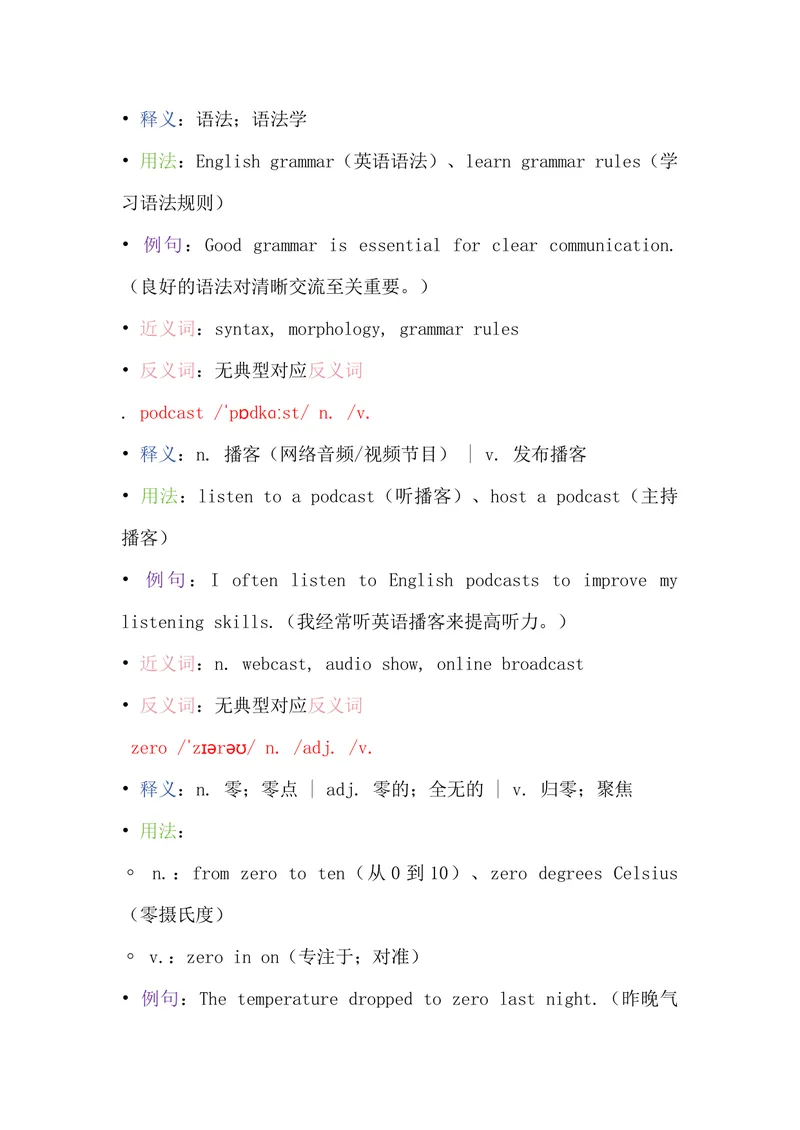
grammar /ˈɡræmə(r)/ n.• 释义:语法;语法学
• 用法:English grammar(英语语法)、learn grammar rules(学
习语法规则)
• 例句:Good grammar is essential for clear communication.
(良好的语法对清晰交流至关重要。)
• 近义词:syntax, morphology, grammar rules
• 反义词:无典型对应反义词
. podcast /ˈpɒdkɑːst/ n. /v.
• 释义:n. 播客(网络音频/视频节目) | v. 发布播客
• 用法:listen to a podcast(听播客)、host a podcast(主持
播客)
• 例句:I often listen to English podcasts to improve my
listening skills.(我经常听英语播客来提高听力。)
• 近义词:n. webcast, audio show, online broadcast
• 反义词:无典型对应反义词
zero /ˈzɪərəʊ/ n. /adj. /v.
• 释义:n. 零;零点 | adj. 零的;全无的 | v. 归零;聚焦
• 用法:
n.:from zero to ten(从 0 到 10)、zero degrees Celsius
◦
(零摄氏度)
v.:zero in on(专注于;对准)
◦
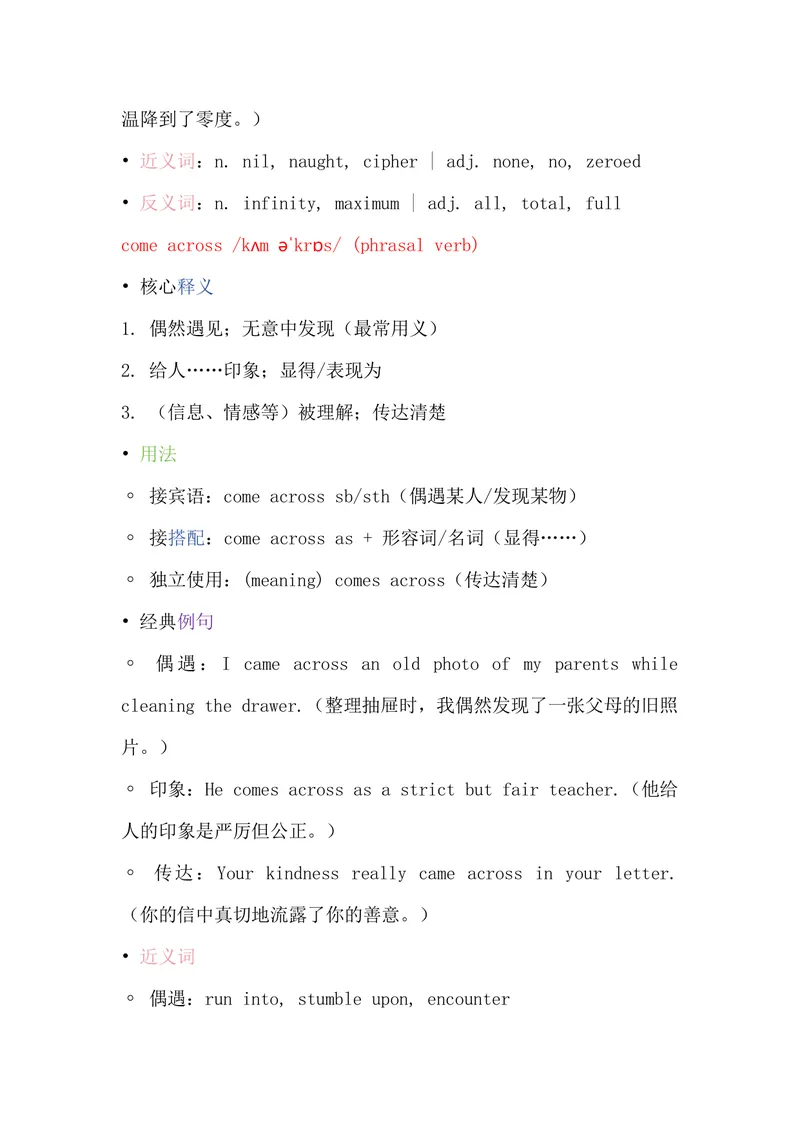
• 例句:The temperature dropped to zero last night.(昨晚气温降到了零度。)
• 近义词:n. nil, naught, cipher | adj. none, no, zeroed
• 反义词:n. infinity, maximum | adj. all, total, full
come across /kʌm əˈkrɒs/ (phrasal verb)
• 核心释义
1. 偶然遇见;无意中发现(最常用义)
2. 给人……印象;显得/表现为
3. (信息、情感等)被理解;传达清楚
• 用法
接宾语:come across sb/sth(偶遇某人/发现某物)
◦
接搭配:come across as + 形容词/名词(显得……)
◦
独立使用:(meaning) comes across(传达清楚)
◦
• 经典例句
偶遇:I came across an old photo of my parents while
◦
cleaning the drawer.(整理抽屉时,我偶然发现了一张父母的旧照
片。)
印象:He comes across as a strict but fair teacher.(他给
◦
人的印象是严厉但公正。)
传达:Your kindness really came across in your letter.
◦
(你的信中真切地流露了你的善意。)
• 近义词
偶遇:run into, stumble upon, encounter
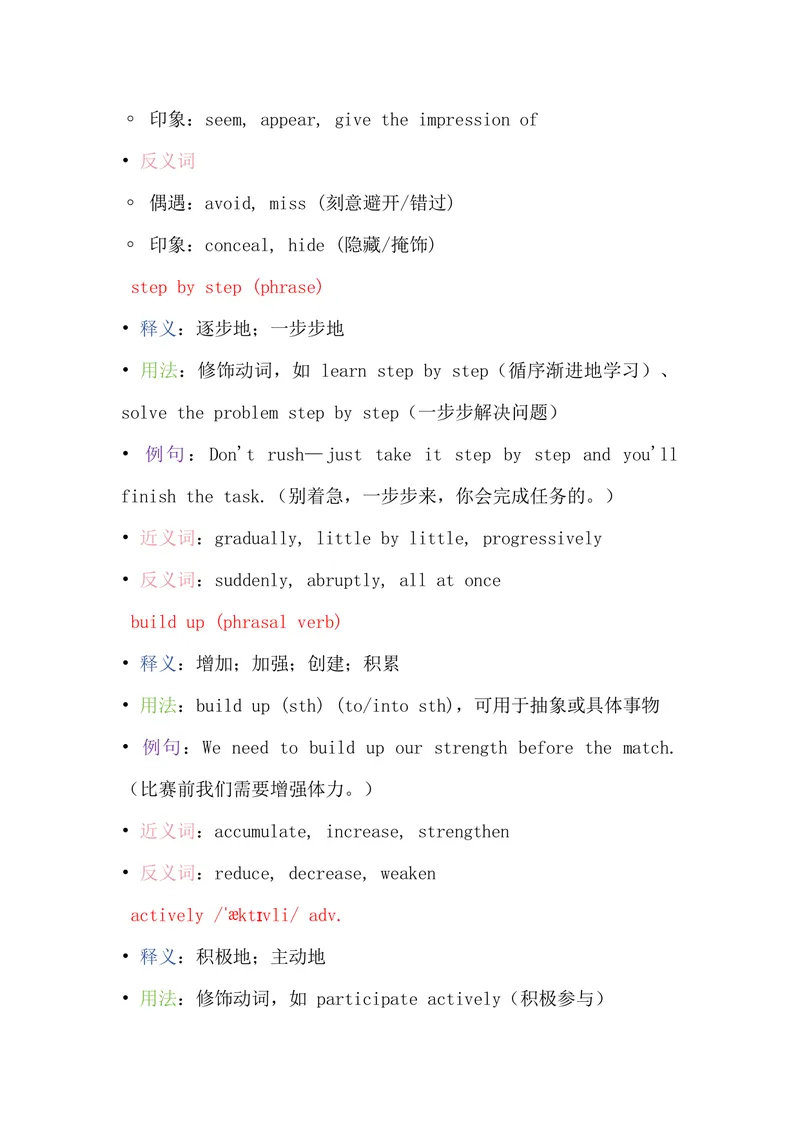
◦印象:seem, appear, give the impression of
◦
• 反义词
偶遇:avoid, miss (刻意避开/错过)
◦
印象:conceal, hide (隐藏/掩饰)
◦
step by step (phrase)
• 释义:逐步地;一步步地
• 用法:修饰动词,如 learn step by step(循序渐进地学习)、
solve the problem step by step(一步步解决问题)
• 例句:Don't rush—just take it step by step and you'll
finish the task.(别着急,一步步来,你会完成任务的。)
• 近义词:gradually, little by little, progressively
• 反义词:suddenly, abruptly, all at once
build up (phrasal verb)
• 释义:增加;加强;创建;积累
• 用法:build up (sth) (to/into sth),可用于抽象或具体事物
• 例句:We need to build up our strength before the match.
(比赛前我们需要增强体力。)
• 近义词:accumulate, increase, strengthen
• 反义词:reduce, decrease, weaken
actively /ˈæktɪvli/ adv.
• 释义:积极地;主动地
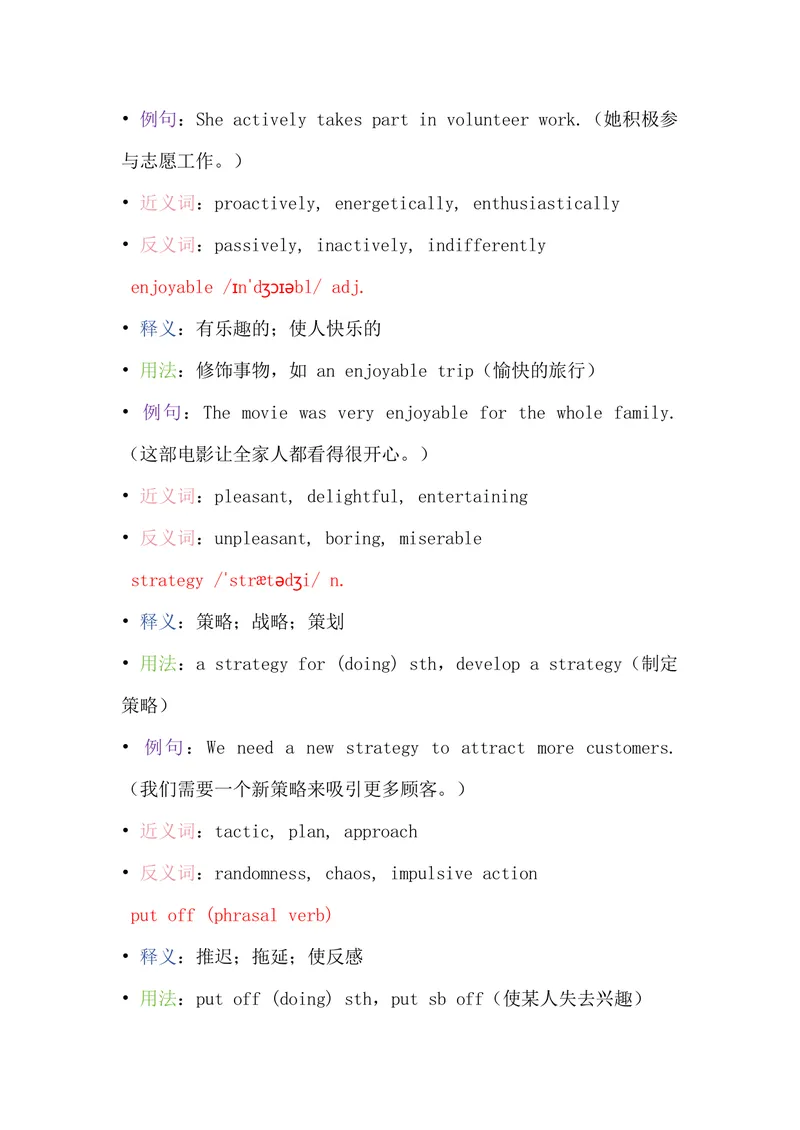
• 用法:修饰动词,如 participate actively(积极参与)• 例句:She actively takes part in volunteer work.(她积极参
与志愿工作。)
• 近义词:proactively, energetically, enthusiastically
• 反义词:passively, inactively, indifferently
enjoyable /ɪnˈdʒɔɪəbl/ adj.
• 释义:有乐趣的;使人快乐的
• 用法:修饰事物,如 an enjoyable trip(愉快的旅行)
• 例句:The movie was very enjoyable for the whole family.
(这部电影让全家人都看得很开心。)
• 近义词:pleasant, delightful, entertaining
• 反义词:unpleasant, boring, miserable
strategy /ˈstrætədʒi/ n.
• 释义:策略;战略;策划
• 用法:a strategy for (doing) sth,develop a strategy(制定
策略)
• 例句:We need a new strategy to attract more customers.
(我们需要一个新策略来吸引更多顾客。)
• 近义词:tactic, plan, approach
• 反义词:randomness, chaos, impulsive action
put off (phrasal verb)
• 释义:推迟;拖延;使反感
• 用法:put off (doing) sth,put sb off(使某人失去兴趣)• 例句:Don’t put off until tomorrow what you can do today.
(今日事今日毕。)
• 近义词:postpone, delay, procrastinate
• 反义词:do immediately, advance, bring forward
correct /kəˈrekt/ adj. / v.
• 释义:adj. 正确的;恰当的 | v. 改正;纠正
• 用法:adj. 修饰名词;v. 后接错误/对象
• 例句:Please correct the mistakes in your homework.(请改
正你作业里的错误。)
• 近义词:adj. right, accurate, proper | v. fix, rectify,
amend
• 反义词:adj. incorrect, wrong, improper | v. preserve,
keep, leave unchanged
suggest /səˈdʒest/ v.
• 释义:建议;提议;暗示
• 用法:suggest (doing) sth,suggest that sb (should) do sth
• 例句:I suggest taking a walk to relax.(我建议散散步放松
一下。)
• 近义词:propose, recommend, advise
• 反义词:oppose, reject, forbid
method /ˈmeθəd/ n.
• 释义:方法;办法;条理• 用法:a method of/for doing sth,effective method(有效方
法)
• 例句:This teaching method is very popular with students.
(这种教学方法很受学生欢迎。)
• 近义词:way, approach, technique
• 反义词:chaos, disorganization, randomness
summarize /ˈsʌməraɪz/ (=summarise) v.
• 释义:总结;概括;概述
• 用法:summarize sth (in sth),summarize the main points
(概括要点)
• 例句:Can you summarize the article in a few sentences?
(你能用几句话概括这篇文章吗?)
• 近义词:sum up, outline, recap
• 反义词:elaborate, expand, detail
. growth /ɡrəʊθ/ n.
• 释义:成长;增长;发展
• 用法:economic growth(经济增长),personal growth(个人成
长)
• 例句:Good nutrition is important for a child’s growth.
(良好的营养对孩子的成长很重要。)
• 近义词:development, increase, expansion
• 反义词:decline, decrease, shrinkagemindset /ˈmaɪndset/ n.
• 释义:观念模式;心态;思维倾向
• 用法:a positive mindset(积极心态), change one’s
mindset(改变心态)
• 例句:A growth mindset helps people overcome challenges.
(成长型心态帮助人们克服挑战。)
• 近义词:attitude, outlook, mentality
• 反义词:fixed mindset, rigid thinking, closed mind
material /məˈtɪəriəl/ n. / adj.
• 释义:n. 材料;资料 | adj. 物质的;重要的
• 用法:n. building materials(建筑材料),study materials
(学习资料)
• 例句:We need to collect more material for our research.
(我们需要为研究收集更多资料。)
• 近 义 词 : n. substance, stuff, data | adj. physical,
substantial, relevant
• 反 义 词 : n. immateriality, spirit | adj. spiritual,
irrelevant, trivial
in part (phrase)
• 释义:在某种程度上;部分地
• 用法:置于句中/句末,表部分原因或程度
• 例句:His success was due in part to hard work.(他的成功部分源于努力。)
• 近义词:partly, partially, to some extent
• 反义词:completely, entirely, wholly
guidance /ˈɡaɪdns/ n.
• 释义:指导;引导;咨询
• 用法:provide guidance(提供指导),under sb’s guidance
(在某人指导下)
• 例句:Students need careful guidance from their teachers.
(学生需要老师的悉心指导。)
• 近义词:direction, advice, counseling
• 反义词:misguidance, confusion, neglect
. feedback /ˈfiːdbæk/ n.
• 释义:反馈的意见;反馈信息
• 用 法 : give/get feedback ( 给 出 / 获 得 反 馈 ) ,
positive/negative feedback(正/负反馈)
• 例句:Please give me your feedback on the new design.(请
对新设计提出你的反馈意见。)
• 近义词:comment, response, reaction
• 反义词:silence, indifference, no comment
addition /əˈdɪʃn/ n.
• 释义:添加;加法;增加物
• 用法:in addition (to sth)(除……之外),the addition ofnew members(新成员的加入)
• 例句:In addition, we need to consider the cost.(此外,我
们还需要考虑成本。)
• 近义词:increase, inclusion, sum
• 反义词:subtraction, removal, deduction
. in addition (phrase)
• 释义:另外;此外;加之
• 用法:连接句子,表补充说明
• 例句 :The car is fast. In addition, it is very fuel-
efficient.(这辆车速度快,而且还很省油。)
• 近义词:furthermore, moreover, besides
• 反义词:however, nevertheless, on the other hand
resource /rɪˈsɔːs/ n.
• 释义:资源;资料;财力
• 用法:natural resources(自然资源),learning resources
(学习资源)
• 例句:The library is a valuable resource for students.(图
书馆是学生宝贵的学习资源。)
• 近义词:supply, material, asset
• 反义词:scarcity, lack, shortage
. textbook /ˈtekstbʊk/ n.
• 释义:教科书;课本• 用 法 : a history textbook ( 历 史 课 本 ) , study from a
textbook(用课本学习)
• 例 句 : This textbook covers all the topics we need to
learn.(这本课本涵盖了我们需要学习的所有主题。)
• 近义词:coursebook, schoolbook, primer
• 反义词:non-textbook materials, supplementary materials
. advantage /ədˈvɑːntɪdʒ/ n.
• 释义:优势;优点;有利条件
• 用法:have an advantage over sb(比某人有优势),take
advantage of(利用)
• 例句:His experience gives him an advantage over other
candidates.(他的经验让他比其他候选人更有优势。)
• 近义词:benefit, edge, superiority
• 反义词:disadvantage, drawback, weakness
. take advantage of (phrase)
• 释义:利用;占……的便宜
• 用法:take advantage of (sb/sth),可表中性或贬义
• 例句:We should take advantage of this opportunity to
learn.(我们应该利用这个机会学习。)
• 近义词:make use of, exploit, utilize
• 反义词:waste, miss, ignore
efficiently /ɪˈfɪʃntli/ adv.• 释义:效率高地;高效地
• 用法:修饰动词,如 work efficiently(高效工作)
• 例句:Computers can process data efficiently.(计算机能高
效处理数据。)
• 近义词:effectively, productively, competently
• 反义词:inefficiently, slowly, wastefully
valley /ˈvæli/ n.
• 释义:山谷;溪谷;流域
• 用法:a mountain valley(山谷),the Nile Valley(尼罗河流
域)
• 例句:The village is located in a beautiful valley.(村庄
坐落在一个美丽的山谷里。)
• 近义词:dale, gorge, ravine
• 反义词:mountain, peak, summit
pronunciation /prəˌnʌnsiˈeɪʃn/ n.
• 释义:发音;读音
• 用 法 : correct pronunciation ( 正 确 发 音 ) , practice
pronunciation(练习发音)
• 例 句 : Good pronunciation is important for clear
communication.(良好的发音对清晰交流很重要。)
• 近义词:enunciation, articulation, accent
• 反义词:mispronunciation, incorrect articulationclick /klɪk/ v. / n.
• 释义:v. 点击;(用鼠标/按键)单击;咔嗒作响 | n. 咔嗒声;
点击
• 用法:v. click (on) sth(点击某物),click with sb(与某
人合得来)
• 例句:Click the button to submit your form.(点击按钮提交
你的表格。)
• 近义词:v. tap, press, snap | n. snap, tick, tap
• 反义词:v. hold, press and hold, long press
magazine /ˌmæɡəˈziːn/ n.
• 释义:杂志;期刊;弹药库
• 用法:a fashion magazine(时尚杂志),read a magazine(读
杂志)
• 例句:I subscribe to a monthly magazine about technology.
(我订阅了一本科技月刊。)
• 近义词:journal, periodical, publication
• 反义词:book, novel, newspaper (广义上的非期刊类读物)
open up (phrasal verb)
• 释义:打开;开放;畅所欲言;展现
• 用法:open up (to sb)(向某人敞开心扉),open up a
business(开办企业)
• 例句:She finally opened up about her feelings to herfriend.(她终于向朋友敞开心扉说出了自己的感受。)
• 近义词:unfold, reveal, communicate
• 反义词:close up, shut down, hold back
shelf /ʃelf/ n. (pl. shelves)
• 释义:架子;搁板;搁板状物
• 用法:a bookshelf(书架),on the shelf(在架子上;束之高
阁)
• 例句:Put the books back on the shelf after reading.(读完
书后把它们放回架子上。)
• 近义词:rack, stand, ledge
• 反义词:floor, ground, table (放置平面的对立面)
schoolwork /ˈskuːlwɜːk/ n.
• 释义:学校作业;课业;学业
• 用法:不可数名词,泛指课堂与课后的学习任务
• 例句:I need to finish my schoolwork before watching TV.
(我需要先完成学校作业再看电视。)
• 近义词:homework, assignments, studies
• 反义词:leisure, free time, play
print /prɪnt/ n. / v.
• 释义:n. 印刷品;印刷字体 | v. 打印;印刷;刊载
• 用法:v. print (sth) (out)(打印某物);n. a print of a
photo(照片冲印件)• 例句:Please print this document for me.(请帮我把这份文件
打印出来。)
• 近义词:v. copy, publish, type | n. publication, hard copy
• 反义词:v. delete, erase, digitalize | n. digital copy,
screen display
newspaper /ˈnjuːzpeɪpə(r)/ n.
• 释义:报纸;报社
• 用法:read a newspaper(读报),a daily newspaper(日报)
• 例句:My grandfather reads the newspaper every morning.
(我爷爷每天早上都看报纸。)
• 近义词:paper, journal, daily
• 反义词:digital news, online media, social media
e-book /ˈiː bʊk/ n.
• 释义:电子书(electronic book 的缩写)
• 用法:read an e-book(读电子书),download an e-book(下载
电子书)
• 例句:I prefer reading e-books on my tablet.(我更喜欢在平
板上读电子书。)
• 近义词:digital book, electronic publication
• 反义词:physical book, hardcover, paperback
. recent /ˈriːsnt/ adj.
• 释义:最近的;新近的;近来的• 用法:修饰名词,如 recent news(最近的新闻),in recent
years(近年来)
• 例句:Have you seen her recent photos?(你看过她最近的照片
吗?)
• 近义词:latest, current, new
• 反义词:old, ancient, past
. Frank /fræŋk/ n.
• 释义:弗兰克(男子名,Francis 的昵称)
• 用法:人名,首字母大写
• 例句:Frank is my best friend from college.(弗兰克是我大
学时最好的朋友。)
• 近义词:Francis, Frankie
• 反义词:无(专有名词)
HSK /ˌeɪtʃ es ˈkeɪ/ abbr.
• 释义:汉语水平考试(Hanyu Shuiping Kaoshi),是测试母语非
汉语者汉语能力的国家级标准化考试
• 用法:take the HSK(参加汉语水平考试),HSK Level 5(HSK
五级)
• 例句:She is preparing for the HSK 4 exam.(她正在准备HSK
四级考试。)
• 近义词:Chinese Proficiency Test
• 反义词:无(专有名词). Cathy /ˈkæθi/ n.
• 释义:凯西(女子名,Catherine / Katherine 的昵称)
• 用法:人名,首字母大写
• 例句:Cathy is good at playing the piano.(凯西擅长弹钢
琴。)
• 近义词:Catherine, Katherine, Kathy
• 反义词:无(专有名词)