文档文本内容
2026 人教版英语九上学霸预习单词批注
Unit 2 Inspring People 单词批注
1. hole /həʊl/ n. 洞;孔
• 用法:可数名词,指物体上的孔洞、洞穴
• 搭配:dig a hole 挖洞;a hole in the ground 地上的洞
• 例句:The mouse made a hole in the box. 老鼠在盒子上咬了
个洞。
• 同义:cave(洞穴)、opening(开口)
• 反义:cover(盖子)、seal(密封处)
2. daughter /ˈdɔːtə(r)/ n. 女儿
• 用法:可数名词,指父母的女性子女
• 搭配:eldest daughter 大女儿;daughter-in-law 儿媳
• 例句:Her daughter is a doctor. 她的女儿是一名医生。
• 同义:female child(女孩)
• 反义:son(儿子)
3. herself /hɜːˈself/ pron. 她自己;她本人
• 用法:反身代词,指代前文提到的女性,作宾语或同位语
• 搭配:enjoy oneself 过得开心;help oneself to 自取
• 例句:She bought herself a new dress. 她给自己买了一条新裙
子。
4. flight /flaɪt/ n. 飞行;航班
• 用法:可数名词,指飞机航班或飞行过程• 搭配:flight number 航班号;direct flight 直飞航班
• 例句:I took a flight to Shanghai yesterday. 我昨天乘航班
去了上海。
• 同义:airplane trip(飞机行程)、flying(飞行)
• 反义:ground travel(地面出行)
5. woodwork /ˈwʊdwɜːk/ n. 木工手艺;木制品
• 用法:不可数名词,指木工技艺或木制构件
• 搭配:woodwork class 木工课;fine woodwork 精致木制品
• 例句:He spends his free time doing woodwork. 他空闲时间做
木工。
• 同义:carpentry(木工活)
• 反义:metalwork(金属工艺)
6. inventor /ɪnˈventə(r)/ n. 发明家
• 用法:可数名词,指发明新事物的人
• 搭配:great inventor 伟大发明家;famous inventor 著名发明
家
• 例句:The inventor created a new machine. 这位发明家发明了
一台新机器。
• 同义:creator(创造者)、designer(设计者)
• 反义:user(使用者)
7. above all /əˈbʌv ɔːl/ 最重要的是;尤其是
• 用法:短语,用于强调核心要点,放句首或句中• 搭配:above all, safety first 最重要的是安全第一
• 例句:Above all, we should keep healthy. 最重要的是,我们
要保持健康。
• 同义:most importantly(最重要的是)、especially(尤其)
• 反义:least of all(最不)
8. thinker /ˈθɪŋkə(r)/ n. 思想家;思考者
• 用法:可数名词,指善于思考、有思想的人
• 搭配:great thinker 伟大思想家;deep thinker 深刻的思考者
• 例句:He is a wise thinker. 他是一位睿智的思考者。
• 同义:philosopher(哲学家)、ideologist(思想家)
• 反义:follower(追随者)
9. period /ˈpɪəriəd/ n. 时期;一段时间;周期
• 用法:可数名词,指特定时间段或历史时期
• 搭配:historical period 历史时期;period of time 一段时间
• 例句:This is a happy period in my life. 这是我人生中一段
快乐的时光。
• 同义:time(时间)、stage(阶段)
• 反义:moment(瞬间)
10. kingdom /ˈkɪŋdəm/ n. 王国;领域
• 用法:可数名词,指国王统治的国家或某类领域
• 搭配:animal kingdom 动物界;magic kingdom 魔法王国
• 例句:The princess lived in a beautiful kingdom. 公主住在美丽的王国里。
• 同义:realm(领域)、empire(帝国)
• 反义:republic(共和国)
11. kindness /ˈkaɪndnəs/ n. 善良;仁慈
• 用法:不可数名词,指友善的品质或行为
• 搭配:act of kindness 善举;show kindness to 对……友善
• 例句:We should treat others with kindness. 我们应该友善待
人。
• 同义:goodness(善良)、mercy(仁慈)
• 反义:cruelty(残忍)、meanness(刻薄)
12. whether /ˈweðə(r)/ conj. 是否
• 用法:连词,引导宾语从句,常与or not连用
• 搭配:whether to do 是否做;whether…or… 是……还是……
• 例句:I wonder whether it will rain tomorrow. 我想知道明天
是否会下雨。
• 同义:if(是否,口语常用)
• 反义:无直接反义
13. mankind /mænˈkaɪnd/ n. 人类
• 用法:集合名词,泛指全人类,谓语用单数
• 搭配:all mankind 全人类;for mankind 为了人类
• 例句:Mankind has made great progress. 人类取得了巨大进步。
• 同义:human beings(人类)、humanity(人类)• 反义:animals(动物)
14. Michael Faraday /ˈmaɪkl ˈfærədeɪ/ n. 迈克尔·法拉第
• 用法:专有名词,英国物理学家、化学家
• 搭配:Faraday's law 法拉第定律;great scientist 伟大科学家
• 例句:Michael Faraday studied electricity. 迈克尔·法拉第
研究电学。
15. Marie Curie /məˈriː ˈkjʊəri/ n. 玛丽·居里
• 用法:专有名词,波兰裔法国物理学家、化学家
• 搭配:Nobel Prize winner 诺贝尔奖得主;woman scientist 女
科学家
• 例句:Marie Curie discovered radium. 玛丽·居里发现了镭。
16. Nobel Prize /nəʊˈbel praɪz/ n. 诺贝尔奖
• 用法:专有名词,世界性重要奖项
• 搭配:Nobel Prize in Physics 诺贝尔物理学奖;win the Nobel
Prize 获诺贝尔奖
• 例句:She won the Nobel Prize twice. 她两次获得诺贝尔奖。
17. Isaac Newton /ˈaɪzək ˈnjuːtn/ n. 艾萨克·牛顿
• 用法:专有名词,英国物理学家、数学家
• 搭配:Newton's laws 牛顿定律;famous physicist 著名物理学
家
• 例句:Isaac Newton founded classical mechanics. 艾萨克·牛
顿创立了经典力学。18. Isambard Brunel /ˈɪzəmbɑːd bruːˈnel/ n. 伊桑巴德·布鲁内尔
• 用法:专有名词,英国著名工程师
• 搭配:great engineer 伟大工程师;bridge builder 桥梁建造者
• 例句:Isambard Brunel built many famous bridges. 伊桑巴
德·布鲁内尔建造了许多名桥。
19. Alan Turing /ˈælən ˈtjʊərɪŋ/ n. 阿兰·图灵
• 用法:专有名词,英国数学家、计算机科学之父
• 搭配:father of computer 计算机之父;Turing test 图灵测试
• 例句:Alan Turing laid the foundation for computers. 阿
兰·图灵奠定了计算机的基础。
20. I.M. Pei /ˌiːəʊ ˈmɪŋ ˈpeɪ/ n. 贝聿铭
• 用法:专有名词,美籍华裔建筑师
• 搭配:famous architect 著名建筑师;modern architect 现代建
筑师
• 例句:I.M. Pei designed the Louvre Pyramid. 贝聿铭设计了卢
浮宫金字塔。
21. Louvre Museum /ˈluːvrə mjuˈziːəm/ n. 卢浮宫博物馆
• 用法:专有名词,法国巴黎著名博物馆
• 搭配:visit the Louvre 参观卢浮宫;art museum 艺术博物馆
• 例句:The Louvre Museum has many famous paintings. 卢浮宫
藏有许多名画。
22. Confucius /kənˈfjuːʃəs/ n. 孔子• 用法:专有名词,中国古代思想家、教育家
• 搭配:great thinker 伟大思想家;ancient sage 古代圣贤
• 例句:Confucius's ideas influence China. 孔子的思想影响着
中国。
23. Victor Hugo /ˈvɪktə(r) ˈhjuːɡə/ n. 维克多·雨果
• 用法:专有名词,法国著名作家
• 搭配:great writer 伟大作家;French novelist 法国小说家
• 例句:Victor Hugo wrote Les Misérables. 维克多·雨果创作了
《悲惨世界》。
24. Western Regions /ˈwestən ˈriːdʒənz/ n. 西域
• 用法:专有名词,古代中国对西部疆域的称呼
• 搭配:ancient Western Regions 古代西域;travel to the
Western Regions 出使西域
• 例句:Zhang Qian went to the Western Regions. 张骞出使西域。
25 Road /ðə sɪlk rəʊd/ n. 丝绸之路
• 用法:专有名词,古代东西方贸易通道
• 搭配:ancient Silk Road 古代丝绸之路;trade on the Silk
Road 丝绸之路贸易
• 例句:The Silk Road promoted cultural exchange. 丝绸之路促
进了文化交流。
•英语词汇拓展表(编号26起,按你给的顺序)
26. pioneer /ˌpaɪəˈnɪə(r)/ n. 先驱;先锋• 用法:可数名词,指某领域的开创者、带头人
• 搭配:a pioneer in… ……的先驱;a pioneer of… ……的开
拓者
• 例句:Yuan Longping is a pioneer in agriculture. 袁隆平是
农业领域的先驱。
• 同义:forerunner(先驱)、trailblazer(开拓者)
• 反义:follower(追随者)、copycat(模仿者)
27. admirable /ˈædmərəbl/ adj. 令人钦佩的
• 用法:形容词,修饰人或品质,表值得赞扬
• 搭配:admirable spirit 令人钦佩的精神;admirable behavior
令人敬佩的行为
• 例句:Her kindness is admirable. 她的善良令人钦佩。
• 同义:praiseworthy(值得称赞的)、respectable(可敬的)
• 反义:shameful(可耻的)、disgraceful(不光彩的)
28. pyramid /ˈpɪrəmɪd/ n. 金字塔
• 用法:可数名词,指金字塔形建筑或几何图形
• 搭配:the Egyptian pyramids 埃及金字塔;a pyramid of… 一
堆……
• 例句:The pyramids are very famous. 金字塔非常有名。
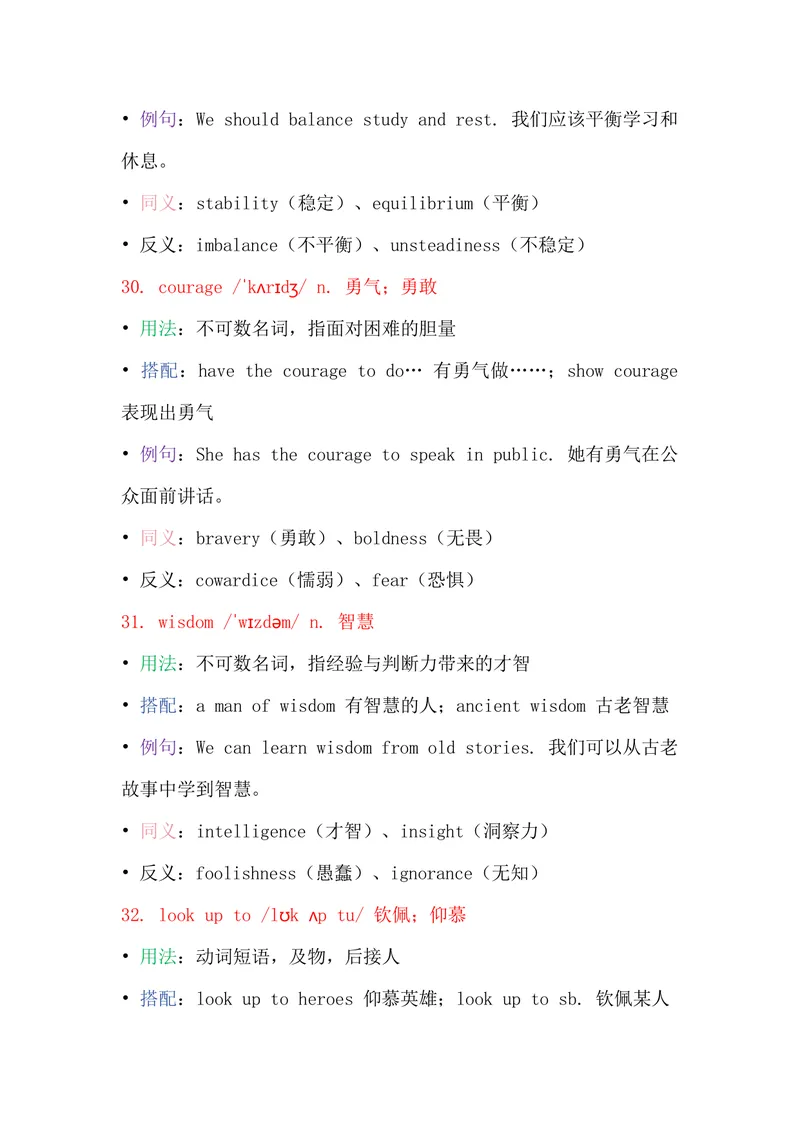
29. balance /ˈbæləns/ n. 平衡 v. 保持平衡
• 用法:n. 不可数/可数;v. 及物,表使平衡、权衡
• 搭配:keep balance 保持平衡;balance A and B 平衡A与B• 例句:We should balance study and rest. 我们应该平衡学习和
休息。
• 同义:stability(稳定)、equilibrium(平衡)
• 反义:imbalance(不平衡)、unsteadiness(不稳定)
30. courage /ˈkʌrɪdʒ/ n. 勇气;勇敢
• 用法:不可数名词,指面对困难的胆量
• 搭配:have the courage to do… 有勇气做……;show courage
表现出勇气
• 例句:She has the courage to speak in public. 她有勇气在公
众面前讲话。
• 同义:bravery(勇敢)、boldness(无畏)
• 反义:cowardice(懦弱)、fear(恐惧)
31. wisdom /ˈwɪzdəm/ n. 智慧
• 用法:不可数名词,指经验与判断力带来的才智
• 搭配:a man of wisdom 有智慧的人;ancient wisdom 古老智慧
• 例句:We can learn wisdom from old stories. 我们可以从古老
故事中学到智慧。
• 同义:intelligence(才智)、insight(洞察力)
• 反义:foolishness(愚蠢)、ignorance(无知)
32. look up to /lʊk ʌp tu/ 钦佩;仰慕
• 用法:动词短语,及物,后接人
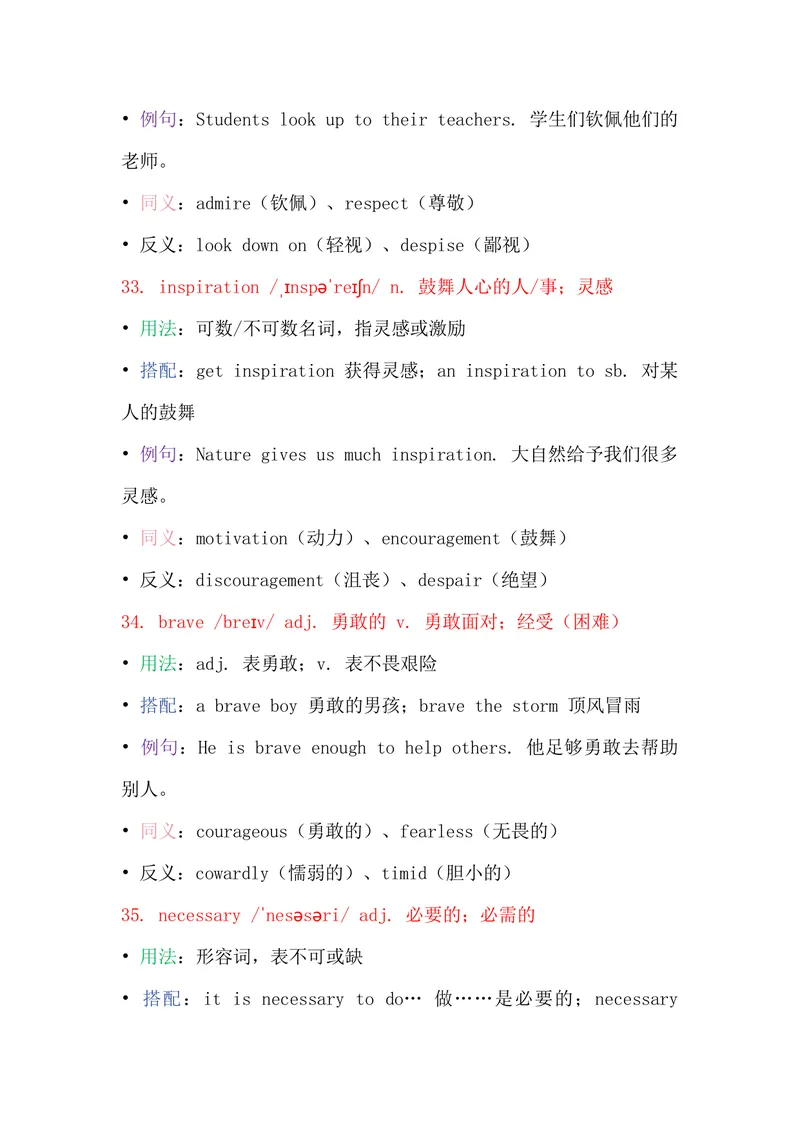
• 搭配:look up to heroes 仰慕英雄;look up to sb. 钦佩某人• 例句:Students look up to their teachers. 学生们钦佩他们的
老师。
• 同义:admire(钦佩)、respect(尊敬)
• 反义:look down on(轻视)、despise(鄙视)
33. inspiration /ˌɪnspəˈreɪʃn/ n. 鼓舞人心的人/事;灵感
• 用法:可数/不可数名词,指灵感或激励
• 搭配:get inspiration 获得灵感;an inspiration to sb. 对某
人的鼓舞
• 例句:Nature gives us much inspiration. 大自然给予我们很多
灵感。
• 同义:motivation(动力)、encouragement(鼓舞)
• 反义:discouragement(沮丧)、despair(绝望)
34. brave /breɪv/ adj. 勇敢的 v. 勇敢面对;经受(困难)
• 用法:adj. 表勇敢;v. 表不畏艰险
• 搭配:a brave boy 勇敢的男孩;brave the storm 顶风冒雨
• 例句:He is brave enough to help others. 他足够勇敢去帮助
别人。
• 同义:courageous(勇敢的)、fearless(无畏的)
• 反义:cowardly(懦弱的)、timid(胆小的)
35. necessary /ˈnesəsəri/ adj. 必要的;必需的
• 用法:形容词,表不可或缺
• 搭配:it is necessary to do… 做……是必要的;necessaryskills 必备技能
• 例句:It is necessary to learn English well. 学好英语是必
要的。
• 同义:essential(必不可少的)、required(必需的)
• 反义:unnecessary(不必要的)、needless(多余的)
36. seed /siːd/ n. 种子
• 用法:可数名词,指植物种子
• 搭配:plant seeds 播种;a seed of hope 希望的种子
• 例句:Seeds grow into big trees. 种子长成大树。
• 同义:grain(谷粒)、kernel(核)
• 反义:fruit(果实)、flower(花)
37. childhood /ˈtʃaɪldhʊd/ n. 童年
• 用法:不可数名词,指儿童时期
• 搭配:in one’s childhood 在某人的童年;happy childhood 快
乐的童年
• 例句:I had a happy childhood. 我有一个快乐的童年。
• 同义:early years(早年)、boyhood/girlhood(少年时代)
• 反义:adulthood(成年)、old age(老年)
38. come true /kʌm truː/ 实现;成为现实
• 用法:动词短语,不及物,主语为梦想、愿望等
• 搭配:make one’s dream come true 使梦想成真
• 例句:My dream will come true one day. 我的梦想终有一天会实现。
• 同义:realize(实现)、fulfill(达成)
• 反义:fall through(落空)、fail(失败)
39. dynasty /ˈdɪnəsti/ n. 朝代;王朝
• 用法:可数名词,指某家族统治的时期
• 搭配:the Tang Dynasty 唐朝;ancient dynasty 古代王朝
• 例句:The Tang Dynasty was very strong. 唐朝非常强盛。
• 同义:empire(帝国)、reign(统治时期)
• 反义:republic(共和国)
40. western /ˈwestən/ adj. 西方的;西部的
• 用法:形容词,表方位或文化
• 搭配:western countries 西方国家;western culture 西方文化
• 例句:He likes western food. 他喜欢西餐。
• 同义:westernmost(最西的)、Occidental(西方的)
• 反义:eastern(东方的)、oriental(东方的)
41. scientific /ˌsaɪənˈtɪfɪk/ adj. 科学(上)的
• 用法:形容词,表与科学相关
• 搭配:scientific research 科学研究;scientific method 科学
方法
• 例句:We need scientific methods. 我们需要科学的方法。
• 同义:technical(技术的)、rational(理性的)
• 反义:unscientific(不科学的)、irrational(非理性的)42. biologist /baɪˈɒlədʒɪst/ n. 生物学家
• 用法:可数名词,研究生物的科学家
• 搭 配 : a famous biologist 著 名 的 生 物 学 家 ; a marine
biologist 海洋生物学家
• 例句:The biologist studies plants. 这位生物学家研究植物。
• 同义:life scientist(生命科学家)
43. whole /həʊl/ adj. 所有的;完全的
• 用法:形容词,表全部、完整
• 搭配:the whole class 全班;a whole day 一整天
• 例句:The whole family went to the park. 全家人都去了公园。
• 同义:entire(全部的)、complete(完整的)
• 反义:partial(部分的)、incomplete(不完整的)
44. bank /bæŋk/ n. 银行
• 用法:可数名词,金融机构
• 搭配:go to the bank 去银行;a central bank 中央银行
• 例句:He works in a bank. 他在银行工作。
• 同义:financial institution(金融机构)
45. forever /fəˈrevə(r)/ adv. 永远
• 用法:副词,表永恒
• 搭配:love forever 永远爱;forever young 永远年轻
• 例句:We will be friends forever. 我们永远是朋友。• 同义:eternally(永恒地)、permanently(永久地)
• 反义:temporarily(暂时地)、briefly(短暂地)
46. radio /ˈreɪdiəʊ/ n. 无线电;收音机
• 用法:可数名词,通讯设备
• 搭配:listen to the radio 听收音机;radio signal 无线电信
号
• 例句:My grandpa likes listening to the radio. 我爷爷喜欢
听收音机。
• 同义:wireless(无线电)
47. leave behind /liːv bɪˈhaɪnd/ 留下;遗留
• 用法:动词短语,及物
• 搭配:leave behind good memories 留下美好的回忆;leave
behind a legacy 留下遗产
• 例句:He left behind a useful book. 他留下了一本有用的书。
• 同义:retain(保留)、bequeath(遗赠)
• 反义:take away(带走)、remove(移走)
48. collection /kəˈlekʃn/ n. 收集物;收藏品
• 用法:可数名词,指收集的东西
• 搭配:a stamp collection 集邮册;a large collection 大量收
藏
• 例句:He has a big collection of toys. 他有很多玩具收藏。• 同义:assortment(各类物品)、accumulation(积累物)
• 反义:distribution(分发)、dispersion(分散)
49. live on /lɪv ɒn/ 继续存在;继续活着
• 用法:动词短语,不及物
• 搭 配 : live on in history 永 载 史 册 ; live on through
memories 活在回忆中
• 例句:His spirit lives on. 他的精神永存。
• 同义:survive(幸存)、persist(持续)
• 反义:die out(灭绝)、perish(消亡)
50. exploration /ˌekspləˈreɪʃn/ n. 探索
• 用法:不可数/可数名词,指探究未知
• 搭配 :space exploration 太空探索; the exploration of
nature 大自然探索
• 例句:We like the exploration of nature. 我们喜欢探索大自
然。
• 同义:investigation(调查)、discovery(发现)
• 反义:ignorance(无知)、avoidance(回避)
51. universe /ˈjuːnɪvɜːs/ n. 宇宙
• 用法:可数名词,常用单数
• 搭配:in the universe 在宇宙中;the whole universe 整个宇
宙
• 例句:The universe is very big. 宇宙非常大。• 同义:cosmos(宇宙)、space(太空)
52. socialism /ˈsəʊʃəlɪzəm/ n. 社会主义
• 用法:不可数名词,社会制度
• 搭配:build socialism 建设社会主义;socialist country 社会
主义国家
• 例句:We are building socialism. 我们正在建设社会主义。
• 反义:capitalism(资本主义)
53. Irène /aɪˈriːn/ n. 艾琳
• 用法:专有名词(人名)
• 搭配:Irène Joliot-Curie 艾琳·约里奥-居里
• 例句:Irène was a great scientist. 艾琳是一位伟大的科学家。
54. Amelia Earhart /əˈmiːliə ˈeəhɑːt/ n. 阿梅莉亚·埃尔哈特
• 用法:专有名词(人名)
• 搭配:a famous pilot 著名飞行员
• 例句:Amelia Earhart flew across the Atlantic. 阿梅莉亚·
埃尔哈特飞越大西洋。
55. Atlantic Ocean /ətˈlæntɪk ˈəʊʃn/ n. 大西洋
• 用法:专有名词(大洋名)
• 搭配:cross the Atlantic Ocean 穿越大西洋
• 例句:The Atlantic Ocean is very big. 大西洋非常广阔。
56. BCE /ˌbiː siː ˈiː/ (before the Common Era) 公元前
• 用法:缩写,用于年份前• 搭配:in 500 BCE 公元前500年
• 例句:Confucius lived around 551 BCE. 孔子生活在公元前 551
年左右。
• 同义:BC(Before Christ,公元前)
• 反义:CE(公元)、AD(公元)
57. the Warring States Period /ðə ˈwɒrɪŋ ˈsteɪts ˈpɪəriəd/ n.
战国时期
• 用法:专有名词(历史时期)
• 搭配:in the Warring States Period 在战国时期
• 例句:Many stories happened in the Warring States Period.
很多故事发生在战国时期。
58. inspiring /ɪnˈspaɪərɪŋ/ adj. 鼓舞人心的;激励的;富有感染
力的
• 用法:形容词,修饰人、事、物
• 搭配 : an inspiring speech 鼓舞人心的演讲; inspiring
stories 励志故事
• 例句:Her story is very inspiring. 她的故事非常鼓舞人心。
• 同义:encouraging(鼓舞的)、motivating(激励的)
• 反义:discouraging(令人沮丧的)、depressing(压抑的)
59. admire /ədˈmaɪə(r)/ v. 钦佩;赞美;羡慕
• 用法:及物动词,后接人或品质
• 搭配:admire sb. for sth. 因某事钦佩某人;admire the view欣赏风景
• 例句:I admire his courage. 我钦佩他的勇气。
• 同义:respect(尊敬)、look up to(仰慕)
• 反义:despise(鄙视)、look down on(轻视)
60. historian /hɪˈstɔːriən/ n. 历史学家;史学工作者
• 用法:可数名词
• 搭配:a famous historian 著名历史学家;a great historian
伟大史学家
• 例句:The historian wrote many books. 这位历史学家写了很多
书。
• 同义:historical scholar(史学学者)
61. researcher /rɪˈsɜːtʃə(r)/ n. 研究者;调查者
• 用法:可数名词
• 搭配:a medical researcher 医学研究者;a market researcher
市场调查员
• 例句:She is a hard-working researcher. 她是一位勤奋的研究
者。
• 同义:investigator(调查者)、scholar(学者)
62. chemist /ˈkemɪst/ n. 化学家;药剂师;药商
• 用法:可数名词
• 搭配:a famous chemist 著名化学家;a chemist’s shop 药店
• 例句:The chemist studies chemicals. 这位化学家研究化学物质。
• 同义:pharmacist(药剂师)
63. physicist /ˈfɪzɪsɪst/ n. 物理学家
• 用法:可数名词
• 搭配:a great physicist 伟大物理学家;a nuclear physicist
核物理学家
• 例句:Einstein was a great physicist. 爱因斯坦是一位伟大的
物理学家。
• 同义:natural scientist(自然科学家)
64. hunger /ˈhʌŋɡə(r)/ n./v. 饥饿;渴望;挨饿
• 用法:n. 不可数;v. 不及物
• 搭配:hunger for knowledge 渴望知识;die of hunger 饿死
• 例句:He has a hunger for success. 他渴望成功。
• 同义:starvation(饥饿)、desire(渴望)
• 反义:fullness(饱足)、satisfaction(满足)
65. chemistry /ˈkemɪstri/ n. 化学;化学性质;化学反应
• 用法:不可数名词
• 搭配:study chemistry 学习化学;organic chemistry 有机化学
• 例句:Chemistry is my favorite subject. 化学是我最喜欢的科
目。
• 同义:chemical science(化学科学)
66. drop out /drɒp aʊt/ v. 退学;退出;脱离• 用法:动词短语,不及物
• 搭配:drop out of school 退学;drop out of a competition
退出比赛
• 例句:He dropped out of college last year. 他去年从大学退
学了。
• 同义:quit(退出)、leave(离开)
• 反义:join(加入)、participate(参与)
67. calendar /ˈkælɪndə(r)/ n. 日历;月历;日程表;历法
• 用法:可数名词
• 搭配:a wall calendar 挂历;school calendar 校历
• 例句:Please check the calendar. 请查一下日历。
• 同义:schedule(日程表)、almanac(历书)
68. discovery /dɪˈskʌvəri/ n. 发现;发觉;被发现的事物
• 用法:可数/不可数名词
• 搭配:make a discovery 做出发现;scientific discovery 科学
发现
• 例句:The discovery changed the world. 这个发现改变了世界。
• 同义:finding(发现)、detection(察觉)
• 反义:loss(丢失)、concealment(隐藏)
69. century /ˈsentʃəri/ n. 世纪;百年
• 用法:可数名词
• 搭配:the 21st century 21世纪;a century ago 一个世纪前• 例句:We live in the 21st century. 我们生活在21世纪。
• 同义:hundred years(百年)
70. wounded soldier /ˈwuːndɪd ˈsəʊldʒə(r)/ n. 伤兵;受伤的士
兵
• 用法:可数名词
• 搭 配 : help wounded soldiers 救 助 伤 兵 ; treat wounded
soldiers 治疗伤兵
• 例句:Doctors saved many wounded soldiers. 医生救了很多伤
兵。
• 同义:injured soldier(受伤士兵)
• 反义:healthy soldier(健康士兵)
71. British Airways /ˈbrɪtɪʃ ˈeəweɪz/ n. 英国航空公司
• 用法:专有名词
• 搭配:take British Airways 乘坐英国航空
• 例句:I flew with British Airways. 我乘坐了英国航空公司的
航班。