2026 人教版英语九上学霸预习单词批注
Unit 4 Our memory 单词批注
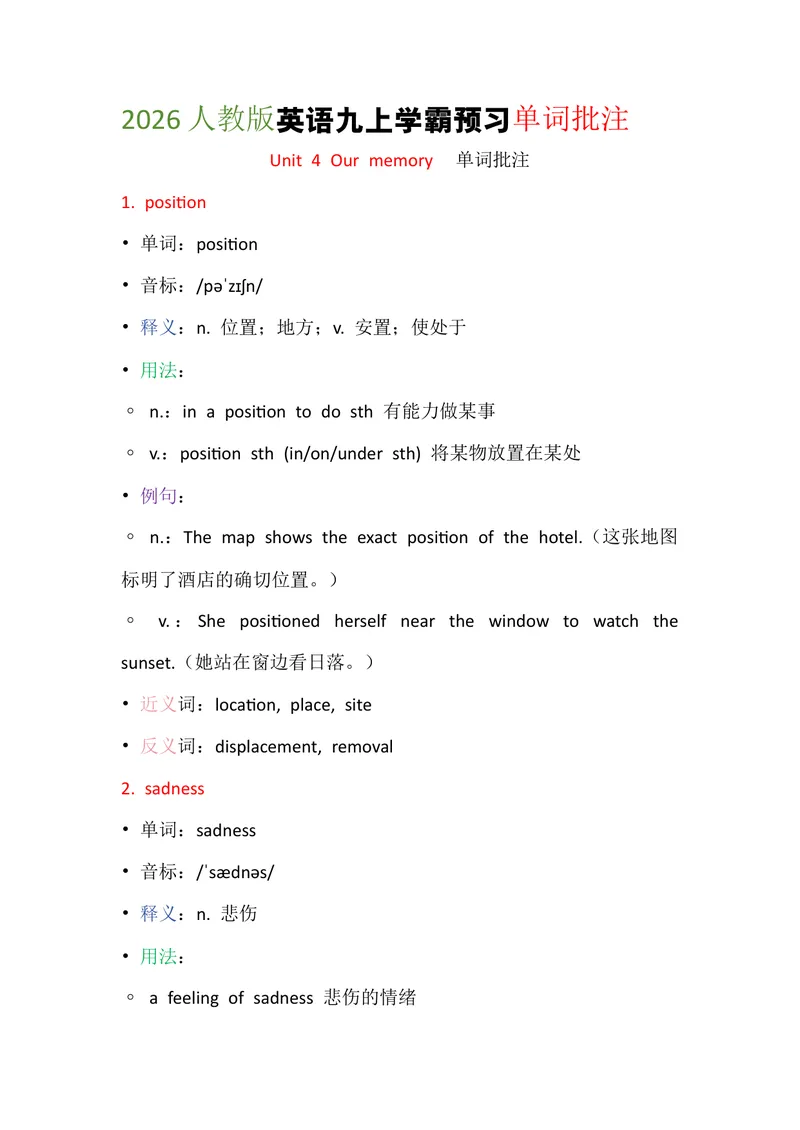
1. position
• 单词:position
• 音标:/pəˈzɪʃn/
• 释义:n. 位置;地方;v. 安置;使处于
• 用法:
n.:in a position to do sth 有能力做某事
◦
v.:position sth (in/on/under sth) 将某物放置在某处
◦
• 例句:
n.:The map shows the exact position of the hotel.(这张地图
◦
标明了酒店的确切位置。)
v. : She positioned herself near the window to watch the
◦
sunset.(她站在窗边看日落。)
• 近义词:location, place, site
• 反义词:displacement, removal
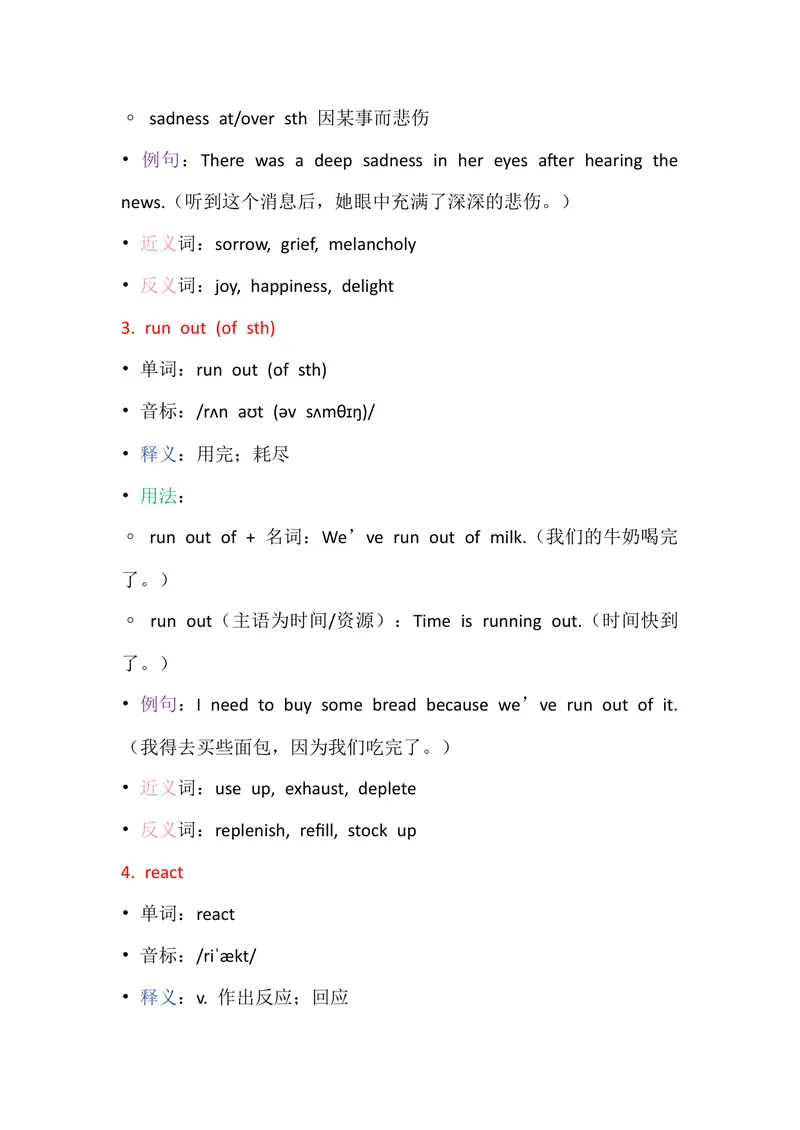
2. sadness
• 单词:sadness
• 音标:/ˈsædnəs/
• 释义:n. 悲伤
• 用法:
a feeling of sadness 悲伤的情绪
◦sadness at/over sth 因某事而悲伤
◦
• 例句:There was a deep sadness in her eyes after hearing the
news.(听到这个消息后,她眼中充满了深深的悲伤。)
• 近义词:sorrow, grief, melancholy
• 反义词:joy, happiness, delight
3. run out (of sth)
• 单词:run out (of sth)
• 音标:/rʌn aʊt (əv sʌmθɪŋ)/
• 释义:用完;耗尽
• 用法:
run out of + 名词:We’ve run out of milk.(我们的牛奶喝完
◦
了。)
run out(主语为时间/资源):Time is running out.(时间快到
◦
了。)
• 例句:I need to buy some bread because we’ve run out of it.
(我得去买些面包,因为我们吃完了。)
• 近义词:use up, exhaust, deplete
• 反义词:replenish, refill, stock up
4. react
• 单词:react
• 音标:/riˈækt/
• 释义:v. 作出反应;回应• 用法:
react to sth 对某事作出反应
◦
react against sth 反抗某事
◦
• 例句:How did he react when you told him the truth?(你告诉
他真相时,他有什么反应?)
• 近义词:respond, reply, act
• 反义词:ignore, disregard, neglect
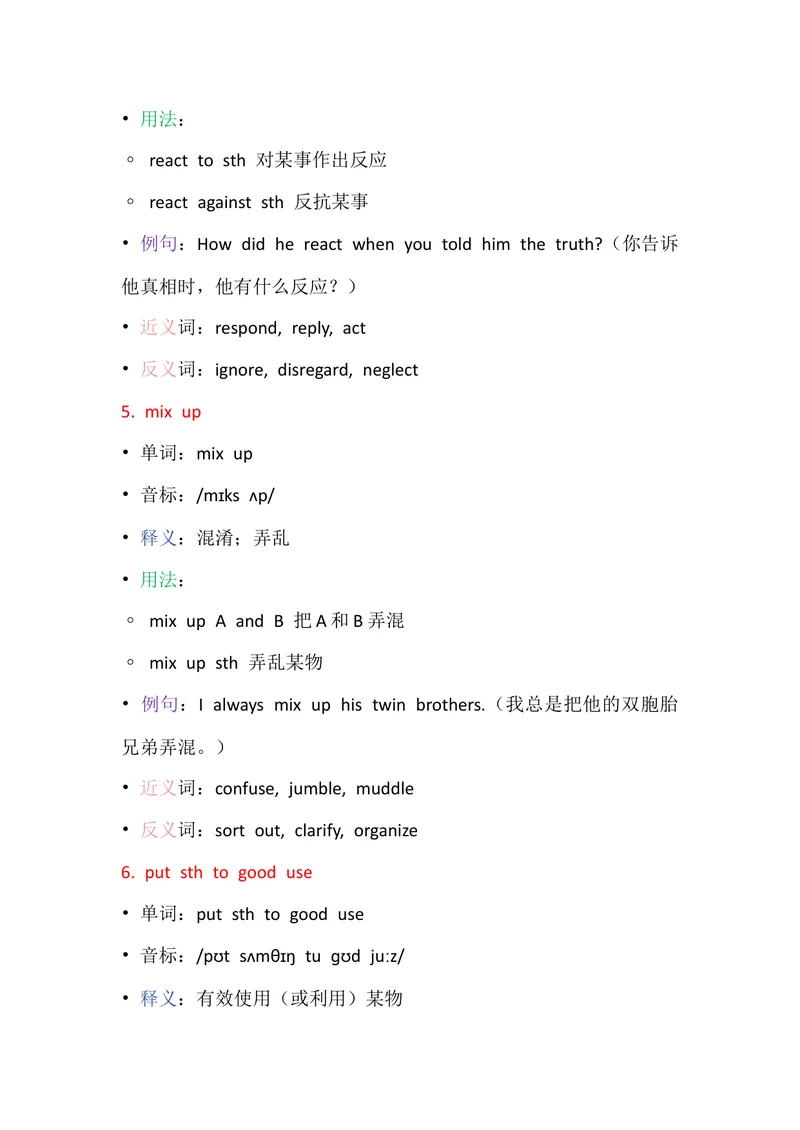
5. mix up
• 单词:mix up
• 音标:/mɪks ʌp/
• 释义:混淆;弄乱
• 用法:
mix up A and B 把A和B弄混
◦
mix up sth 弄乱某物
◦
• 例句:I always mix up his twin brothers.(我总是把他的双胞胎
兄弟弄混。)
• 近义词:confuse, jumble, muddle
• 反义词:sort out, clarify, organize
6. put sth to good use
• 单词:put sth to good use
• 音标:/pʊt sʌmθɪŋ tu ɡʊd juːz/
• 释义:有效使用(或利用)某物• 用法:put + 名词 + to good use
• 例句:She put her language skills to good use by working as a
translator.(她充分利用自己的语言技能做了翻译。)
• 近义词:make good use of sth, utilize effectively
• 反义词:waste sth, squander sth
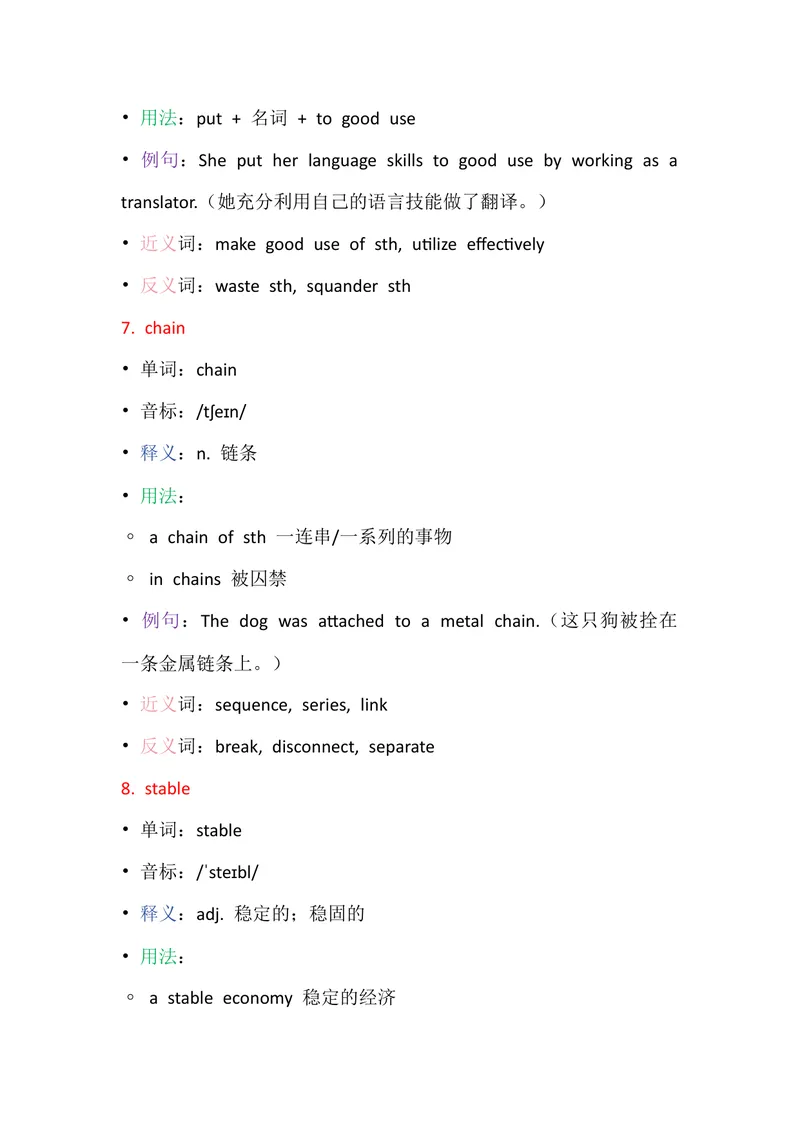
7. chain
• 单词:chain
• 音标:/tʃeɪn/
• 释义:n. 链条
• 用法:
a chain of sth 一连串/一系列的事物
◦
in chains 被囚禁
◦
• 例句:The dog was attached to a metal chain.(这只狗被拴在
一条金属链条上。)
• 近义词:sequence, series, link
• 反义词:break, disconnect, separate
8. stable
• 单词:stable
• 音标:/ˈsteɪbl/
• 释义:adj. 稳定的;稳固的
• 用法:
a stable economy 稳定的经济
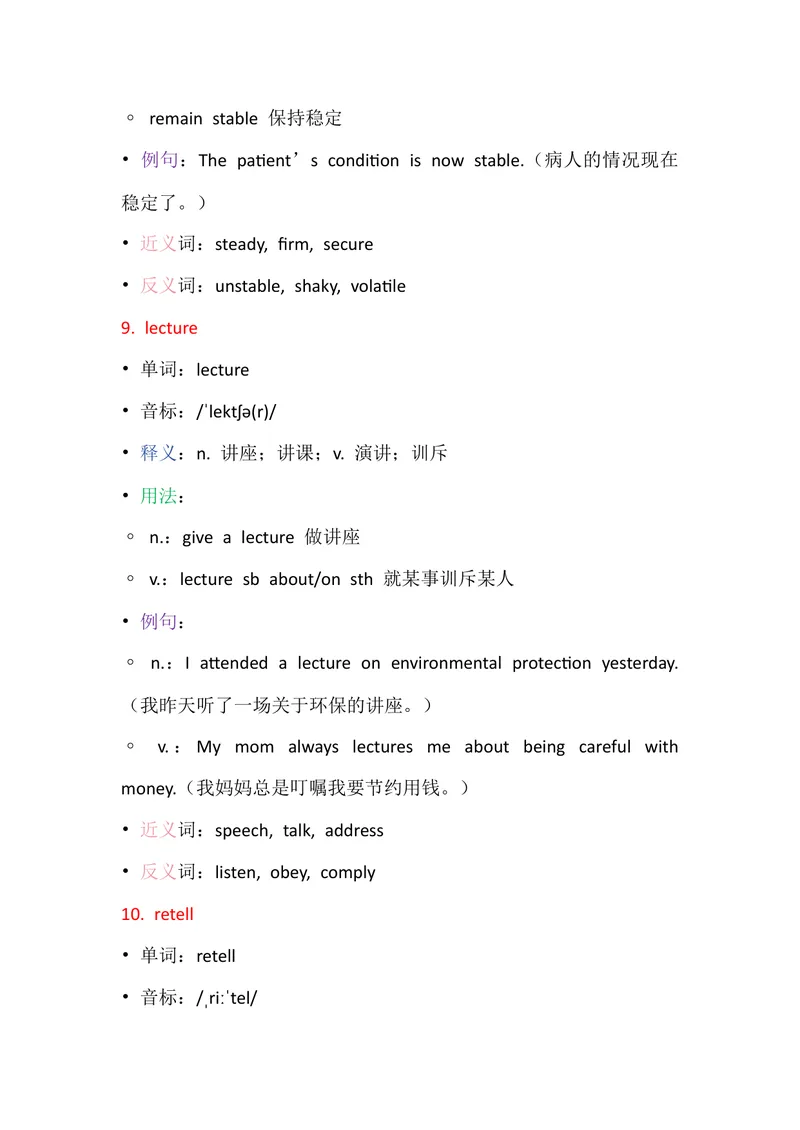
◦remain stable 保持稳定
◦
• 例句:The patient’s condition is now stable.(病人的情况现在
稳定了。)
• 近义词:steady, firm, secure
• 反义词:unstable, shaky, volatile
9. lecture
• 单词:lecture
• 音标:/ˈlektʃə(r)/
• 释义:n. 讲座;讲课;v. 演讲;训斥
• 用法:
n.:give a lecture 做讲座
◦
v.:lecture sb about/on sth 就某事训斥某人
◦
• 例句:
n.:I attended a lecture on environmental protection yesterday.
◦
(我昨天听了一场关于环保的讲座。)
v. : My mom always lectures me about being careful with
◦
money.(我妈妈总是叮嘱我要节约用钱。)
• 近义词:speech, talk, address
• 反义词:listen, obey, comply
10. retell
• 单词:retell
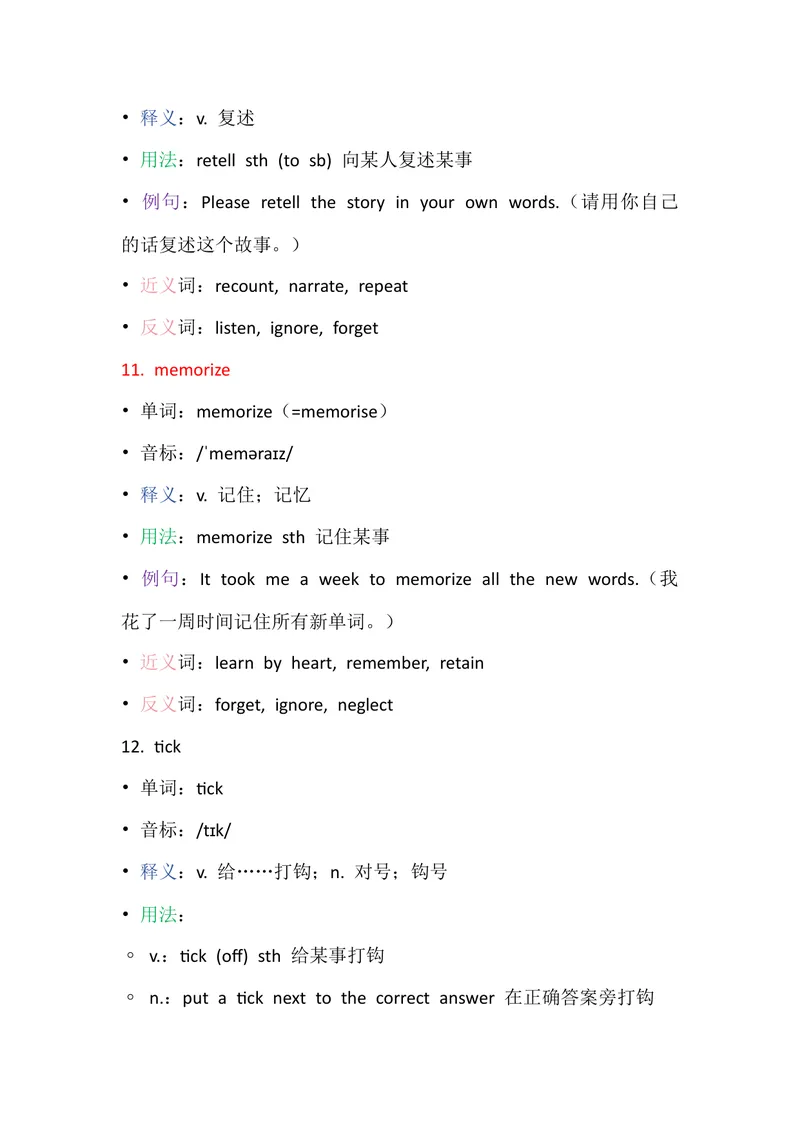
• 音标:/ˌriːˈtel/• 释义:v. 复述
• 用法:retell sth (to sb) 向某人复述某事
• 例句:Please retell the story in your own words.(请用你自己
的话复述这个故事。)
• 近义词:recount, narrate, repeat
• 反义词:listen, ignore, forget
11. memorize
• 单词:memorize(=memorise)
• 音标:/ˈmeməraɪz/
• 释义:v. 记住;记忆
• 用法:memorize sth 记住某事
• 例句:It took me a week to memorize all the new words.(我
花了一周时间记住所有新单词。)
• 近义词:learn by heart, remember, retain
• 反义词:forget, ignore, neglect
12. tick
• 单词:tick
• 音标:/tɪk/
• 释义:v. 给……打钩;n. 对号;钩号
• 用法:
v.:tick (off) sth 给某事打钩
◦
n.:put a tick next to the correct answer 在正确答案旁打钩
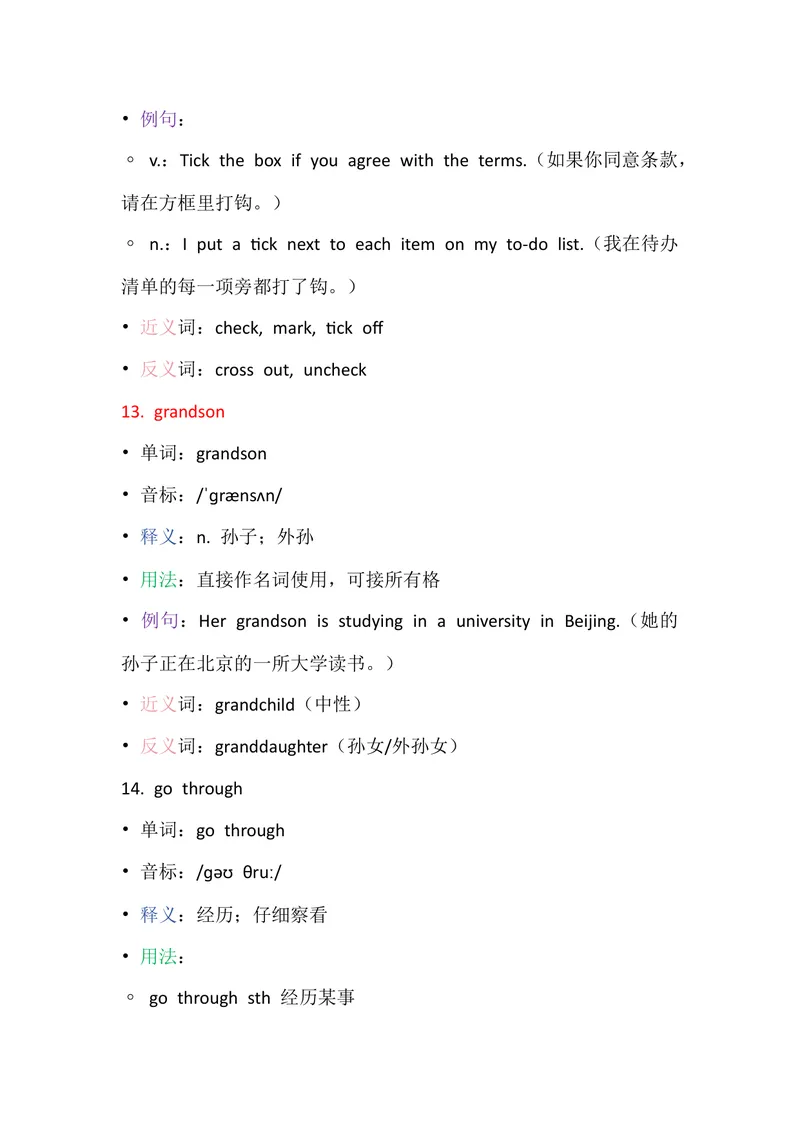
◦• 例句:
v.:Tick the box if you agree with the terms.(如果你同意条款,
◦
请在方框里打钩。)
n.:I put a tick next to each item on my to-do list.(我在待办
◦
清单的每一项旁都打了钩。)
• 近义词:check, mark, tick off
• 反义词:cross out, uncheck
13. grandson
• 单词:grandson
• 音标:/ˈɡrænsʌn/
• 释义:n. 孙子;外孙
• 用法:直接作名词使用,可接所有格
• 例句:Her grandson is studying in a university in Beijing.(她的
孙子正在北京的一所大学读书。)
• 近义词:grandchild(中性)
• 反义词:granddaughter(孙女/外孙女)
14. go through
• 单词:go through
• 音标:/ɡəʊ θruː/
• 释义:经历;仔细察看
• 用法:
go through sth 经历某事
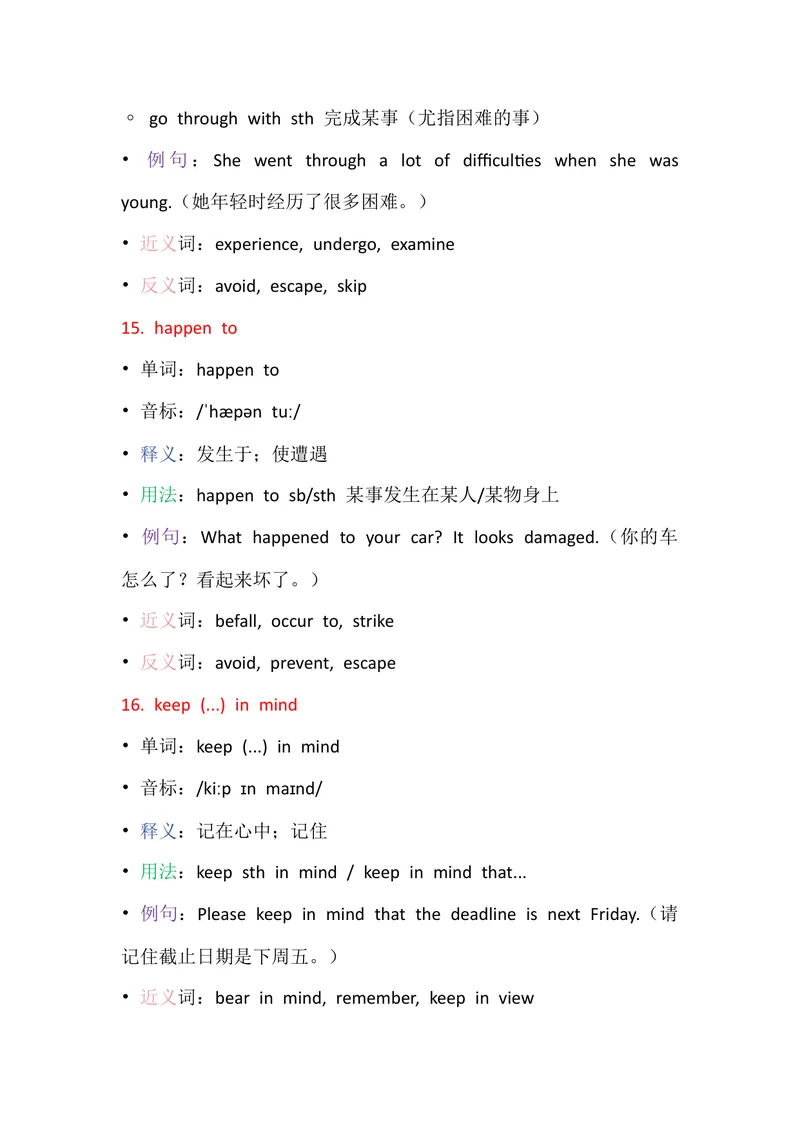
◦go through with sth 完成某事(尤指困难的事)
◦
• 例句:She went through a lot of difficulties when she was
young.(她年轻时经历了很多困难。)
• 近义词:experience, undergo, examine
• 反义词:avoid, escape, skip
15. happen to
• 单词:happen to
• 音标:/ˈhæpən tuː/
• 释义:发生于;使遭遇
• 用法:happen to sb/sth 某事发生在某人/某物身上
• 例句:What happened to your car? It looks damaged.(你的车
怎么了?看起来坏了。)
• 近义词:befall, occur to, strike
• 反义词:avoid, prevent, escape
16. keep (...) in mind
• 单词:keep (...) in mind
• 音标:/kiːp ɪn maɪnd/
• 释义:记在心中;记住
• 用法:keep sth in mind / keep in mind that...
• 例句:Please keep in mind that the deadline is next Friday.(请
记住截止日期是下周五。)
• 近义词:bear in mind, remember, keep in view• 反义词:forget, ignore, disregard
17. case
• 单词:case
• 音标:/keɪs/
• 释义:n. 情况;事实;案例
• 用法:
in case (of sth) 以防;万一
◦
in this/that case 在这种/那种情况下
◦
• 例句:In case of fire, please use the emergency exit.(如遇火灾,
请使用紧急出口。)
• 近义词:situation, instance, example
• 反义词:exception, anomaly, deviation
18. in sb’s case
• 单词:in sb’s case
• 音标:/ɪn sʌmbədz keɪs/
• 释义:就某人的情况而言
• 用法:用于引出针对某人的具体情况
• 例句:In your case, I think you should take a longer break.(就
你的情况而言,我觉得你应该多休息一段时间。)
• 近义词:as for sb, in sb’s situation
• 反义词:in general, on the whole
19. opera• 单词:opera
• 音标:/ˈɒprə/
• 释义:n. 歌剧;歌剧剧本
• 用法:
go to the opera 去看歌剧
◦
an opera house 歌剧院
◦
• 例句:She has been fond of classical opera since she was a
child.(她从小就喜欢古典歌剧。)
• 近义词:operatic work, musical drama
• 反义词:无(专有名词类无典型反义词)
20. ticket
• 单词:ticket
• 音标:/ˈtɪkɪt/
• 释义:n. 入场券;票;罚单
• 用法:
a train/bus/movie ticket 火车/公交/电影票
◦
get a ticket 收到罚单
◦
• 例句:I booked two tickets for the concert online yesterday.
(我昨天在网上订了两张音乐会的票。)
• 近义词:pass, voucher, coupon
• 反义词:无
21. wallet• 单词:wallet
• 音标:/ˈwɒlɪt/
• 释义:n. 钱包
• 用法:
lose one’s wallet 丢钱包
◦
a leather wallet 皮钱包
◦
• 例句:He realized he had left his wallet at home when he was
about to pay.(他正要付钱时发现钱包落在家里了。)
• 近义词:purse(英式,多指女用钱包), billfold
• 反义词:无
22. picnic
• 单词:picnic
• 音标:/ˈpɪknɪk/
• 释义:n. 野餐;v. 去野餐
• 用法:
n.:have a picnic 去野餐
◦
v.:picnic in the park 在公园野餐(过去式/分词:picnicked)
◦
• 例 句 : We plan to picnic by the lake this weekend if the
weather is fine.(如果天气好,我们计划这周末去湖边野餐。)
• 近义词:outdoor meal, al fresco dining
• 反义词:indoor meal, formal dinner
23. pardon• 单词:pardon
• 音标:/ˈpɑːdn/
• 释义:v. 原谅;宽恕;interj. 请再说一遍;抱歉
• 用法:
v.:pardon sb (for sth) 原谅某人(做某事)
◦
interj.:Pardon? (没听清时)请再说一遍?
◦
• 例句:Pardon me for interrupting your conversation.(请原谅我
打断了你们的谈话。)
• 近义词:forgive, excuse, beg your pardon
• 反义词:punish, condemn, blame
24. airport
• 单词:airport
• 音标:/ˈeəpɔːt/
• 释义:n. 机场
• 用法:
arrive at/depart from the airport 抵达/离开机场
◦
international airport 国际机场
◦
• 例句:We need to arrive at the airport two hours before our
flight.(我们需要在航班起飞前两小时到达机场。)
• 近义词:airfield, aerodrome
• 反义词:无
25. gunshot• 单词:gunshot
• 音标:/ˈɡʌnʃɒt/
• 释义:n. 枪声;(射出的)炮弹
• 用法:
hear a gunshot 听到枪声
◦
gunshot wound 枪伤
◦
• 例句:The gunshot echoed through the quiet forest, scaring the
birds away.(枪声在寂静的森林里回荡,惊飞了鸟儿。)
• 近义词:gunfire, shot
• 反义词:无
26. grown-up
• 单词:grown-up
• 音标:/ˌɡrəʊn ˈʌp/
• 释义:adj. 成年的;成熟的;n. 成年人
• 用法:
adj.:a grown-up son 成年的儿子
◦
n.:treat children like grown-ups 像对待成年人一样对待孩子
◦
• 例句:She has a very grown-up way of thinking for her age.
(以她的年纪来说,她的思维方式非常成熟。)
• 近义词:adult, mature, fully grown
• 反义词:child, kid, juvenile, immature
27. recall• 单词:recall
• 音标:/rɪˈkɔːl/
• 释义:v. 回忆起;回想起;召回
• 用法:
recall sth (to sb) (向某人)回忆起某事
◦
recall sb/sth from... 从……召回某人/某物
◦
• 例句:I can’t recall the exact date of our first meeting.(我想
不起我们第一次见面的确切日期了。)
• 近义词:remember, recollect, summon back
• 反义词:forget, ignore, repress
28. grapevine
• 单词:grapevine
• 音标:/ˈɡreɪpvaɪn/
• 释义:n. 葡萄藤;葡萄树;小道消息(非正式)
• 用法:
hear sth through the grapevine 从小道消息得知某事
◦
• 例 句 : I heard through the grapevine that she is going to
change jobs.(我从小道消息听说她要换工作了。)
• 近义词:rumor mill, gossip chain
• 反义词:无
29. boost
• 单词:boost• 音标:/buːst/
• 释义:v. 促进;使增长;n. 帮助;增长
• 用法:
v.:boost confidence/economy 增强信心/促进经济
◦
n.:a boost to sth 对某事的促进
◦
• 例句:The new policy is expected to boost the development of
small businesses.(新政策有望促进小微企业的发展。)
• 近义词:promote, enhance, increase, lift
• 反义词:reduce, decrease, hinder, suppress
30. to start with
• 单词:to start with
• 音标:/tuː stɑːt wɪð/
• 释义:首先;起初
• 用法:
用于句首引出第一个观点或步骤
◦
• 例句:To start with, we need to clarify the goal of this project.
(首先,我们需要明确这个项目的目标。)
• 近义词:first of all, firstly, initially
• 反义词:finally, lastly, in the end
31. short-term
• 单词:short-term
• 音标:/ˌʃɔːt ˈtɜːm/• 释义:adj. 短期的
• 用法:
short-term memory 短期记忆
◦
short-term goals 短期目标
◦
• 例句:This investment is only suitable for short-term gains.(这
项投资只适合获取短期收益。)
• 近义词:immediate, temporary, brief
• 反义词:long-term, permanent, extended
32. long-term
• 单词:long-term
• 音标:/ˌlɒŋ ˈtɜːm/
• 释义:adj. 长期的
• 用法:
long-term plan 长期计划
◦
long-term effects 长期影响
◦
• 例句:We should focus on the long-term development of the
company rather than short-term profits.(我们应该关注公司的长期
发展而非短期利润。)
• 近义词:permanent, extended, enduring
• 反义词:short-term, temporary, immediate
33. technique
• 单词:technique• 音标:/tekˈniːk/
• 释义:n. 技巧;技术;手法
• 用法:
a painting/teaching technique 绘画/教学技巧
◦
master a technique 掌握一项技术
◦
• 例 句 : She has developed a unique technique to paint
watercolor flowers.(她摸索出了一套独特的水彩花卉绘画技巧。)
• 近义词:skill, method, craft, technology
• 反义词:clumsiness, inefficiency, amateurism
34. passage
• 单词:passage
• 音标:/ˈpæsɪdʒ/
• 释义:n. 段落;走廊;通过
• 用法:
a passage from the novel 小说中的一段
◦
a secret passage 秘密通道
◦
• 例 句 : Please read the following passage and answer the
questions below.(请阅读下面的段落并回答问题。)
• 近义词:paragraph, excerpt, corridor, passageway
• 反义词:block
35. likely
• 单词:likely• 音标:/ˈlaɪkli/
• 释义:adj. 可能的;adv. 很可能
• 用法:
be likely to do sth 很可能做某事
◦
It is likely that... 很可能……
◦
• 例句:It is likely to rain this afternoon, so you’d better take
an umbrella.(今天下午很可能下雨,你最好带把伞。)
• 近义词:probable, possible, probably
• 反义词:unlikely, improbable, impossible
36. wear out
• 单词:wear out
• 音标:/weə aʊt/
• 释义:使疲乏;磨损
• 用法:
wear sth out 使某物磨损/耗尽
◦
be worn out 筋疲力尽;(物品)用坏
◦
• 例句:The long hike wore me out, and I fell asleep as soon as
I got home.(长途徒步让我筋疲力尽,一到家就睡着了。)
• 近义词:exhaust, tire out, fray
• 反义词:renew, refresh, repair
37. discuss
• 单词:discuss• 音标:/dɪˈskʌs/
• 释义:v. 讨论;谈论;商量
• 用法:
discuss sth (with sb) (和某人)讨论某事
◦
discuss doing sth 商量做某事
◦
• 例 句 : We need to discuss the details of the plan before
making a decision.(在做决定前,我们需要讨论计划的细节。)
• 近义词:talk over, debate, deliberate
• 反义词:ignore, avoid, suppress
38. image
• 单词:image
• 音标:/ˈɪmɪdʒ/
• 释义:n. 图像;形象;印象
• 用法:
a digital image 数字图像
◦
improve one’s public image 提升公众形象
◦
• 例句:The advertisement aims to create a positive image of the
brand.(这则广告旨在塑造该品牌的正面形象。)
• 近义词:picture, portrait, impression
• 反义词:reality, truth, fact
39. graph
• 单词:graph• 音标:/ɡrɑːf/
• 释义:n. 图;图表
• 用法:
a line/bar graph 折线图/柱状图
◦
plot a graph 绘制图表
◦
• 例句:The graph shows the changes in temperature over the
past week.(这张图表展示了过去一周的气温变化。)
• 近义词:chart, diagram, plot
• 反义词:无
40. view
• 单词:view
• 音标:/vjuː/
• 释义:v. 看;观看;n. 观点;视野
• 用法:
v.:view sth as... 把某事看作……
◦
n.:in my view 在我看来;a beautiful view 美丽的风景
◦
• 例句:In my view, we should prioritize environmental protection
over economic growth.(在我看来,我们应该把环境保护置于经济
增长之上。)
• 近义词:opinion, perspective, observe
• 反义词:ignore, overlook, blindness
41. effective• 单词:effective
• 音标:/ɪˈfektɪv/
• 释义:adj. 有效的;生效的
• 用法:
be effective in (doing) sth 在(做)某事上有效
◦
take effect 生效
◦
• 例句:This new teaching method is very effective in improving
students’ listening skills.(这种新的教学方法在提升学生听力技能
方面非常有效。)
• 近义词:efficient, successful, productive
• 反义词:ineffective, useless, futile
42. engine
• 单词:engine
• 音标:/ˈendʒɪn/
• 释义:n. 发动机;引擎
• 用法:
a car engine 汽车发动机
◦
start/stop the engine 启动/关闭引擎
◦
• 例句:The engine of the old car made a strange noise, so we
had to pull over.(这辆旧车的发动机发出奇怪的声音,我们不得不
靠边停车。)
• 近义词:motor, machine, power unit• 反义词:无
43. fuel
• 单词:fuel
• 音标:/ˈfjuːəl/
• 释义:n. 燃料;v. 给……加燃料;刺激
• 用法:
n.:fossil fuel 化石燃料
◦
v.:fuel sth (with sth) 用某物给某物加燃料;fuel growth 刺激
◦
增长
• 例句:The high demand for energy has led to a sharp increase
in fuel prices.(能源的高需求导致燃料价格急剧上涨。)
• 近义词:petrol, gasoline, energy source
• 反义词:无
44. address
• 单词:address
• 音标:/əˈdres/
• 释义:n. 地址;演讲;v. 演说;处理;称呼
• 用法:
n.:home address 家庭住址;deliver an address 发表演讲
◦
v.:address a problem 处理问题;address sb as... 称呼某人
◦
为……
• 例句:We need to address the issue of traffic congestion in thecity center.(我们需要处理市中心的交通拥堵问题。)
• 近义词:speech, lecture, tackle, deal with
• 反义词:ignore, avoid, neglect
45. password
• 单词:password
• 音标:/ˈpɑːswɜːd/
• 释义:n. 密码;口令
• 用法:
set/change a password 设置/修改密码
◦
enter a password 输入密码
◦
• 例句:You should use a strong password to protect your online
account.(你应该使用强密码来保护你的网上账户。)
• 近义词:passcode, code, PIN
• 反义词:无
46. account
• 单词:account
• 音标:/əˈkaʊnt/
• 释义:n. 账户;账目;描述
• 用法:
a bank/social media account 银行/社交媒体账户
◦
take into account 考虑到
◦
• 例句:I opened a new savings account at the bank last month.(我上个月在银行开了一个新的储蓄账户。)
• 近义词:statement, record, description
• 反义词:无
47. increase
• 单词:increase
• 音标:/ˈɪŋkriːs/(n.) /ɪnˈkriːs/(v.)
• 释义:v. 增长;增加;n. 增长;增加
• 用法:
v.:increase (by) 50% 增长50%
◦
n.:an increase in sth 某事的增长
◦
• 例 句 : The number of international students has increased
significantly in recent years.(近年来,国际学生的数量显著增
长。)
• 近义词:rise, grow, expand
• 反义词:decrease, reduce, decline
好的,我们从 wild 开始按顺序整理:
48. wild
• 单词:wild
• 音标:/waɪld/
• 释义:adj. 野生的;自然生长的;狂热的
• 用法:wild animals 野生动物;in the wild 在野外;wild with
joy 欣喜若狂• 例句:This plant grows wild in the mountains.(这种植物在山里
自然生长。)
• 近义词:untamed, feral, natural
• 反义词:tame, domesticated, cultivated
49. blood
• 单词:blood
• 音标:/blʌd/
• 释义:n. 血;血液
• 用法:blood type 血型;lose blood 失血;in cold blood 蓄意地
• 例句:Blood was flowing from the wound.(血从伤口流出
来。)
• 近义词:lifeblood, gore
• 反义词:无(名词无直接反义词)
50. wound
• 单词:wound
• 音标:/wuːnd/
• 释义:n. 伤口;创伤;v. 使受伤
• 用法:a deep wound 深伤口;be wounded in the leg 腿部受伤
• 例句:The soldier was wounded in the battle.(士兵在战斗中受
伤。)
• 近义词:injury, cut, hurt
• 反义词:heal, cure, mend51. mall
• 单词:mall
• 音标:/mɔːl/
• 释义:n. 购物商场;购物中心
• 用法:go to the mall 去商场;a shopping mall 购物中心
• 例句:We spent the afternoon shopping at the mall.(我们下午
在商场购物。)
• 近义词:shopping center, plaza
• 反义词:无
52. notebook
• 单词:notebook
• 音标:/ˈnəʊtbʊk/
• 释义:n. 笔记本;笔记本电脑
• 用法:a math notebook 数学笔记本;a laptop notebook 笔记本
电脑
• 例句:I wrote down the new words in my notebook.(我把生词
记在笔记本上。)
• 近义词:notepad, laptop
• 反义词:无
53. squirrel
• 单词:squirrel
• 音标:/ˈskwɪrəl/• 释义:n. 松鼠
• 用法:a red squirrel 红松鼠;squirrel away sth 储藏某物
• 例句:A squirrel was collecting nuts for the winter.(一只松鼠
在收集坚果过冬。)
• 近义词:无
• 反义词:无
54. nut
• 单词:nut
• 音标:/nʌt/
• 释义:n. 坚果;螺母
• 用法:a walnut nut 核桃;a nut and bolt 螺母和螺栓
• 例句:Squirrels love to eat nuts.(松鼠喜欢吃坚果。)
• 近义词:kernel, seed
• 反义词:无
55. dolphin
• 单词:dolphin
• 音标:/ˈdɒlfɪn/
• 释义:n. 海豚
• 用法:a pod of dolphins 一群海豚;dolphin show 海豚表演
• 例句:Dolphins are known for their intelligence.(海豚以聪明著
称。)
• 近义词:无• 反义词:无
56. recognize
• 单词:recognize(=recognise)
• 音标:/ˈrekəɡnaɪz/
• 释义:v. 辨认出;认可;承认
• 用法:recognize sb/sth 认出某人/某物;recognize that... 承
认……
• 例句:I recognized her voice immediately.(我立刻听出了她的声
音。)
• 近义词:identify, acknowledge, realize
• 反义词:forget, ignore, deny
57. outline
• 单词:outline
• 音标:/ˈaʊtlaɪn/
• 释义:n. 纲要;大纲;v. 概述;勾勒轮廓
• 用法:an outline of the plan 计划大纲;outline a story 概述故
事
• 例句:She outlined her ideas in the report.(她在报告中概述了
自己的想法。)
• 近义词:summary, sketch, framework
• 反义词:detail, elaborate, expand
58. fully• 单词:fully
• 音标:/ˈfʊli/
• 释义:adv. 完全地;充分地
• 用法:fully understand 完全理解;fully support 全力支持
• 例句:I am fully aware of the risks.(我完全意识到了风险。)
• 近义词:completely, entirely, totally
• 反义词:partially, partly, incompletely
59. divide
• 单词:divide
• 音标:/dɪˈvaɪd/
• 释义:v.(把……)分成;分配;除
• 用法:divide sth into... 把某物分成……;divide A by B A除以B
• 例句:The teacher divided the class into four groups.(老师把班
级分成四组。)
• 近义词:split, separate, share
• 反义词:unite, combine, join
60. divide sth into
• 单词:divide sth into
• 音标:/dɪˈvaɪd sʌmθɪŋ ˈɪntuː/
• 释义:把某物分为……
• 用法:divide + 宾语 + into + 部分
• 例句:We divided the cake into eight pieces.(我们把蛋糕分成八块。)
• 近义词:split sth into, separate sth into
• 反义词:unite sth into, combine sth into
61. one-size-fits-all
• 单词:one-size-fits-all
• 音标:/ˌwʌn saɪz fɪts ˈɔːl/
• 释义:adj. 通用的;一体适用的
• 用法:a one-size-fits-all solution 通用解决方案
• 例句:This policy is not a one-size-fits-all approach.(这项政策
并非通用方案。)
• 近义词:universal, general, all-purpose
• 反义词:customized, tailored, specific